Introduction
The blue shark, Prionace glauca (Linnaeus 1758), and swordfish, Xiphias gladius Linnaeus 1758, are two large pelagic and highly migratory predators sharing the same habitat, as demonstrated by the frequent incidence of this shark in the by-catch of drifting longlines targeting swordfish (De Metrio et al., Reference De Metrio, Petrosino, Montanaro, Matarrese, Lenti and Cecere1984; Megalofonou et al., Reference Megalofonou, Yannopoulos, Damalas, De Metrio, Deflorio, de la Serna J and Macias2005, Reference Megalofonou, Damalas, Deflorio and De Metrio2009; Campana et al., Reference Campana, Joyce and Manning2009; Garibaldi, Reference Garibaldi2015a). The blue shark is a cosmopolitan species distributed in temperate and tropical waters of all oceans (Nakano & Seki, Reference Nakano and Seki2003). Satellite tagging data demonstrated that it can be found from the surface to a maximum depth of 350 m (Stevens et al., Reference Stevens, Bradford and West2010). However, the blue shark is more common in epipelagic waters (Nakano & Seki, Reference Nakano and Seki2003), spending most of the time in upper waters and only little time at depths more than 350 m (Stevens et al., Reference Stevens, Bradford and West2010; Ebert et al., Reference Ebert, Fowler and Compagno2013). This depth range partially overlaps with the vertical distribution of swordfish, this teleost fish being able to perform large vertical excursions. Indeed, swordfish occurs from deep waters (up to 2887 m, according to Collette et al., Reference Collette, Acero, Amorim, Bizsel, Boustany, Canales Ramirez, Cardenas, Carpenter, de Oliveira Leite, Di Natale, Die, Fox, Fredou, Graves, Guzman-Mora, Viera Hazin, Hinton, Juan Jorda, Minte Vera, Miyabe, Montano Cruz, Masuti, Nelson, Oxenford, Restrepo, Salas, Schaefer, Schratwieser, Serra, Sun, Teixeira Lessa, Pires Ferreira Travassos, Uozumi and Yanez2011; but usually between 400 and 800 m, Lerner et al., Reference Lerner, Kerstetter, Prince, Talaue-McManus, Orbesen, Mariano, Snodgrass and Thomas2013), where it prefers to stay during the day, towards upper layers during the night (Carey & Robinson, Reference Carey and Robinson1981; Carey, Reference Carey and Stroud1990; Takahashi et al., Reference Takahashi, Okamura, Yokawa and Okazaki2003; Lerner et al., Reference Lerner, Kerstetter, Prince, Talaue-McManus, Orbesen, Mariano, Snodgrass and Thomas2013). According to Canese et al. (Reference Canese, Garibaldi, Orsi Relini and Greco2008), the swordfish permanence in deep waters is frequently interrupted by vertical rises. This behaviour changes in late spring and summer, during the reproductive period, when swordfish prefers to spend more time in surface water layers for mating (Romeo et al., Reference Romeo, Consoli, Greco, Canese and Andaloro2009, Reference Romeo, Perzia, Esposito, Malara, Battaglia, Consoli, Canese and Andaloro2011b, Reference Romeo, Battaglia, Raicevich, Perzia and Andaloro2015; Battaglia et al., Reference Battaglia, Perzia, Pedà, Esposito, Consoli, Andaloro and Romeo2018) and, then, the possibility to meet the blue shark increases. Moreover, available data on swordfish catches by conventional surface longline and mesopelagic longline demonstrate that smaller individuals are more abundant in upper waters (Garibaldi, Reference Garibaldi2015b), increasing the chance of interacting with the blue shark.
Although the profile of vertical distribution of both blue shark and swordfish also depends on environmental factors (Bigelow et al., Reference Bigelow, Boggs and He1999; Damalas & Megalofonou, Reference Damalas and Megalofonou2010; Stevens et al., Reference Stevens, Bradford and West2010; Lerner et al., Reference Lerner, Kerstetter, Prince, Talaue-McManus, Orbesen, Mariano, Snodgrass and Thomas2013; Braun et al., Reference Braun, Kaplan, Horodysky and Llopiz2015), an important role in these movements is played by food distribution in the water column (Bigelow et al., Reference Bigelow, Boggs and He1999; Stevens et al., Reference Stevens, Bradford and West2010) and prey aggregations at water fronts may represent an attraction for these predators (Bigelow et al., Reference Bigelow, Boggs and He1999). Albeit the blue shark also displays an opportunistic feeding behavior for carrion, such as seabirds or marine mammals (Compagno, Reference Compagno1984; Stevens, Reference Stevens2009), the diets of blue shark and swordfish partially overlap, in particular for pelagic cephalopods and some fish prey (Bello, Reference Bello1996; Clarke et al., Reference Clarke, Clarke, Martins and Silva1996; Romeo et al., Reference Romeo, Battaglia, Pedà, Perzia, Consoli, Esposito and Andaloro2011a; Hernandez-Aguilar et al., Reference Hernandez-Aguilar, Escobar-Sanchez, Galvan-Magaña and Abitia-Cardenas2015). Moreover, the diet of the blue shark also includes juvenile swordfish (Vaske-Júnior et al., Reference Vaske-Júnior, Lessa and Gadig2009; Lopez et al., Reference Lopez, Meléndez and Barría2010; Markaida & Sosa-Nishizaki, Reference Markaida and Sosa-Nishizaki2010). The predator–prey interactions, competition and habitat use sometimes generate conflicts between swordfish and sharks, as already demonstrated by some documented swordfish attacks towards elasmobranchs (Starck, Reference Starck1960; Vacchi et al., Reference Vacchi, Serena and Notarbartolo Di Sciara2000; Ellis, Reference Ellis2013; Penadés-Suay et al., Reference Penadés-Suay, Tomás and Aznar2017, Reference Penadés-Suay, Garcia-Salinas, Tomas and Aznar2019). This swordfish aggressive behaviour has also been documented against other large pelagic animals (e.g. whales and turtles), objects, ships, boats, fishing vessels, humans (e.g. Gudger, Reference Gudger1938, Reference Gudger1940; Frazier et al., Reference Frazier, Fierstine, Beavers, Achaval, Suganuma, Pitman, Yamaguchi and Prigioni1994; Zarudski and Haedrich, Reference Zarudski and Haedrich1974; Georgiadou et al., Reference Georgiadou, Zografos, Vaidakis, Avlonitis, Katopodi, Tzirakis, Sioutos, Drossos, Lampropoulou and Papastratis2010; Ellis, Reference Ellis2013; Romeo et al., Reference Romeo, Ammendolia, Canese, Andaloro and Battaglia2017) and even other swordfish (Carey & Robinson, Reference Carey and Robinson1981).
In this paper a rare case of a double swordfish mortal attack to an adult blue shark is reported. The blue shark was found stranded along the southern Sicilian coast (Strait of Sicily, Mediterranean Sea) and analysis of its carcass revealed that the specimen was impaled by two swordfish bills. The analysis of both our case study and data available in the literature seems indicate a precise defensive strategy by young swordfish individuals, discussed in this paper.
Materials and methods
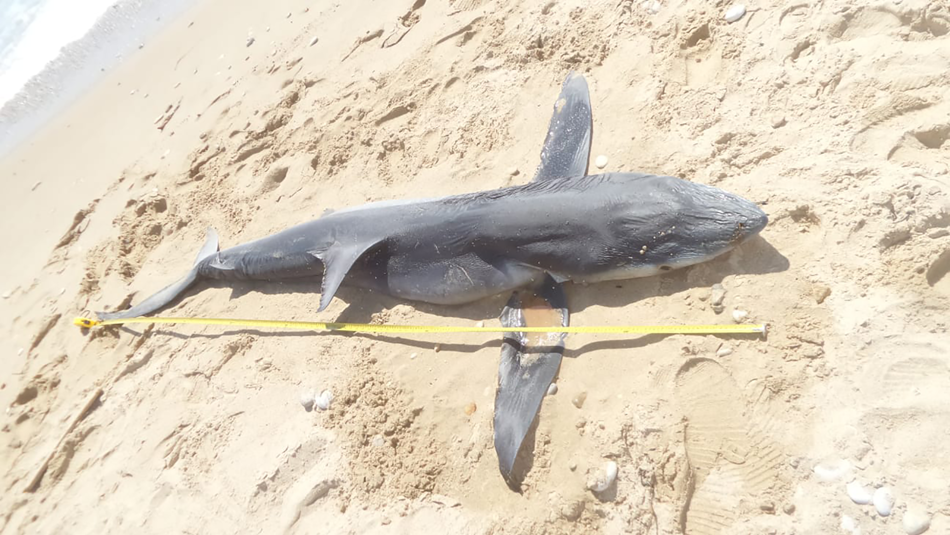
On 30 May 2018 a large shark was found stranded on the beach in Borgo Bonsignore (37°24′56.55″ N 13°15′54.50″ E), along the southern Sicilian coast (Strait of Sicily, Mediterranean Sea). The specimen was identified as a blue shark. It was a female individual of about 220 kg, measuring exactly 3 m total length (Figure 1). The carcass management procedures for the inspection and removal of the specimen were activated by the local Authority. The blue shark's body was inspected in order to understand the reasons of the death and, in particular, if it had been directly or indirectly caused by human activities (fishing, ingestion of marine litter, boat collision etc.). Two bill fragments were found pierced in the head of the blue shark and they were considered to belong to two different individuals of swordfish, according to the features described by previous studies (Fierstine & Voigt, Reference Fierstine and Voigt1996, Penadés-Suay et al., Reference Penadés-Suay, Tomás and Aznar2017, Reference Penadés-Suay, Garcia-Salinas, Tomas and Aznar2019): (i) flattened appearance in cross-section (i.e. depth less than half of width); (ii) absence of denticles on the surface; (iii) presence of central chambers in cross-section.
The female blue shark, 3 m total length, found stranded along the southern Sicilian coast (Strait of Sicily, Mediterranean Sea) on 30 May 2018.

After having observed that the head of this animal had been injured by swordfish, a radiology survey was performed on the blue shark's skull by X-ray computer-assisted tomography through two CT scans (Philips Brilliance 16 Slice CT Scanner): a first axial non-volumetric scan, having caudal-snout direction and 3 mm thickness cross-sections and a second volumetric scan, having snout-caudal direction and 2 mm thickness cross-sections.
The CT scans were elaborated via 3D method through post-processing Volume Rendering technique (VR), Maximum Intensity Projection (MIP) and Multi-Planar Reconstruction (MPR). This exam was performed at the ‘Centro di Radiologia Diagnostica’ in Sciacca (Italy).
Results
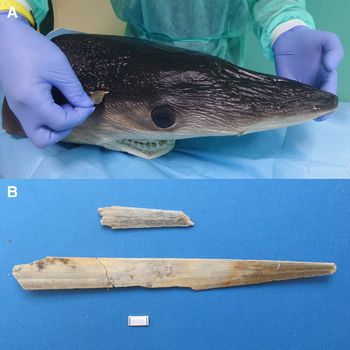
At first inspection, the stranded blue shark did not show any visible sign of evident cut, wounds or contusive trauma, or injuries from fishing gear interactions (hooks, lines, nets). The body of the fish showed no signs of decomposition: the bright colour of gills and the brightness of the eyes indicated that the specimen's death and beaching had happened a few hours previously, probably during the night. However, after a careful examination, two small cut lesions were observed and two rostra of swordfish were found stuck in the head of the blue shark (Figure 2):
(i) The first small cut was on the snout of the blue shark; from this cut a few millimetres of bone fragment protruded outside and after its extraction it was recognized to be the apex of a swordfish bill, 7 cm long (Figure 2B). Although this bill was stuck near the olfactory encephalic bulb, it could hardly have caused the death of that animal.
(ii) Another small cut was observed behind the right eye of the blue shark. In this case no objects were observed protruding from the specimen's head. Inspection of this cut revealed the presence of another swordfish bill (Figure 2B), longer than the first one (19.7 cm). The death of the blue shark was probably determined by this last rostrum.
It is not clear if the blue shark was impaled by two swordfish during a simultaneous attack or in different periods. Epidermal, dermal and subcutaneous wounds were recent and characterized by the presence of serous drainage. Scar tissue, fibrin and hemosiderin were absent. Furthermore, adhesions among the animal tissues and the two swordfish rostrum fragments were not found. For these reasons, it is plausible that swordfish attacks to the blue shark occurred close in time.
(A) The phase of the extraction of the longer bill fragment stuck behind the right eye of the blue shark; (B) the two swordfish bill fragments extracted from the head of the blue shark.

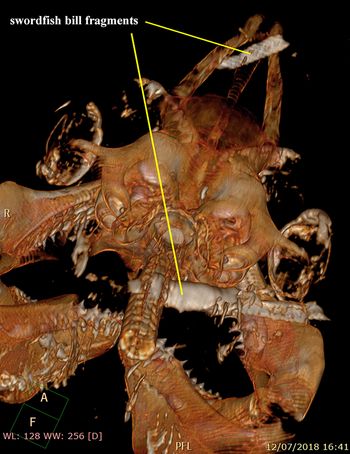
The CT analysis (Figure 3) showed a good representation of cartilaginous tissues, but also soft tissues, in which it was possible to observe a widespread subcutaneous emphysema, not deforming anatomic shape. The smaller fragment of swordfish bill was located in the anterior left part of the shark snout, showing a homogeneous density (about 750 HU). This bill impaled the shark snout with antero-posterior, supero-inferior and latero-medial direction, penetrated without contact over the left cartilaginous component and ended into the contra-lateral component. This bill caused a little cut together with small bone and cartilaginous fragments production, but did not injure the shark's vital organs (Figure 3).
An image obtained by a computed tomography analysis, showing the two bill fragments impaled into the blue shark's head.

The larger swordfish bill fragment (19.7 cm; about 700 HU) was found in the prevertebral plane, near the left side cranio-dorsal tract (Figure 3). The bill penetrated with antero-posterior, infero-superior and latero-medial direction, piercing the soft tissues of left emisoma, tangentially to the postero-superior margin of the shark cranium, crossing the vertebral column (V–VI vertebra). Here some vertebral fragments in adjacent soft tissues can be observed by CT scans, without contact with the left cartilaginous component and ending into the contra-lateral component. This bill determined a little cut together with small bone and cartilaginous fragments production, but did not injure the shark's vital organs. The tip of this bill penetrated in medullary canal, partially destroying its lateral walls and causing a sub-total occlusion of the spinal canal for the presence of hyperdense material (1300 HU), extending in cranium-caudal direction for about 3.5 cm. The same hyperdense material was observed next to the tip of the bill as well as near vertebrae in contro-lateral position. The typology of this injury suggests that the impact provoked the immediate sectioning of medulla.
Discussion
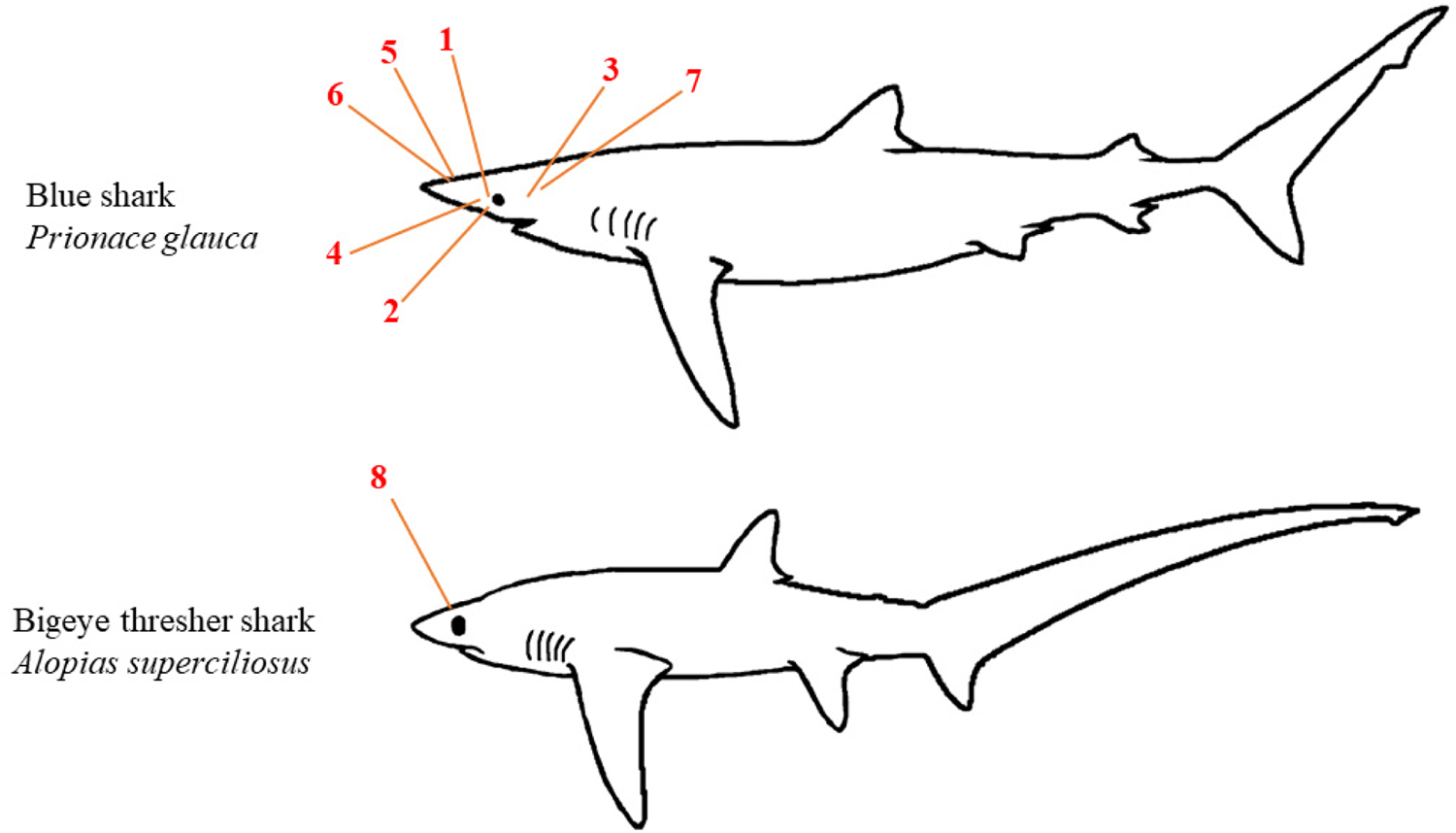
The analysis of the stranded elasmobranch carcass allowed the recording of a double swordfish attack on a blue shark, confirming that the interaction between swordfish and blue shark is more common than is thought. The size and proportions of the bill fragments indicated that the perpetrators of these swordfish attacks were juvenile individuals, similarly to the other recent cases of swordfish attacks against the blue shark reported by Penadés-Suay et al. (Reference Penadés-Suay, Tomás and Aznar2017, Reference Penadés-Suay, Garcia-Salinas, Tomas and Aznar2019). These authors firstly examined a large blue shark stranded on the Mediterranean Spanish coast of Valencia in September 2016 (Penadés-Suay et al., Reference Penadés-Suay, Tomás and Aznar2017), and then reported four other cases of similar interactions (Penadés-Suay et al., Reference Penadés-Suay, Garcia-Salinas, Tomas and Aznar2019). Another analogous attack was observed in the past by Vacchi et al. (Reference Vacchi, Serena and Notarbartolo Di Sciara2000) in the Tyrrhenian Sea, concerning a swordfish impalement in the intra-orbital region of a bigeye thresher shark (Alopias superciliosus). All the above-mentioned attacks were performed by juvenile swordfish (reconstructed total length of rostrum ranging between 24.2–50.5 cm) and the target was always the shark head, in particular around the orbital region (Appendix 1). In Appendix 1, we report a summary of these attacks including information on the bibliographic reference, date and location of the shark stranding, shark size, and the location and description of the injury determined by the impalement.
On the basis of these results as well as the current knowledge on swordfish and blue shark behaviour and ecology, it is possible to make some considerations in order to explain these attacks. From an ecological point of view, the interactions between swordfish and blue sharks may be mainly summarized in the following relationships:
(i) Competition for food resources between top predators: the partial overlap between the diets of the blue shark and the swordfish (Bello, Reference Bello1996; Clarke et al., Reference Clarke, Clarke, Martins and Silva1996; Romeo et al., Reference Romeo, Battaglia, Pedà, Perzia, Consoli, Esposito and Andaloro2011a; Hernandez-Aguilar et al., Reference Hernandez-Aguilar, Escobar-Sanchez, Galvan-Magaña and Abitia-Cardenas2015) may produce conflicts between these two species. Competition for food resources may also be exacerbated by the recent decrease or depletion of several prey stocks, also due to fishery overexploitation (Bearzi et al., Reference Bearzi, Politi, Agazzi and Azzellino2006). Swordfish may display an aggressive behaviour against sharks during foraging activity. The hypothesis of accidental collisions between swordfish and sharks during feeding activity on the same prey school (Fierstine et al., Reference Fierstine, Cailliet and Neer1997; Penadés-Suay et al., Reference Penadés-Suay, Tomás and Aznar2017), already proposed by some authors to also explain turtles' impalement (Frazier et al., Reference Frazier, Fierstine, Beavers, Achaval, Suganuma, Pitman, Yamaguchi and Prigioni1994), can be excluded for the contemporary finding of two swordfish bills impaled in the same shark. Moreover, both attacks were directed to the shark cranial zone, as in all the other cases reported in the literature (Vacchi et al., Reference Vacchi, Serena and Notarbartolo Di Sciara2000; Penadés-Suay et al., Reference Penadés-Suay, Tomás and Aznar2017, Reference Penadés-Suay, Garcia-Salinas, Tomas and Aznar2019) (Appendix 1);
(ii) Predator–prey relationship: data available in the literature show evidence of predation on juvenile swordfish by blue sharks (Vaske-Júnior et al., Reference Vaske-Júnior, Lessa and Gadig2009; Lopez et al., Reference Lopez, Meléndez and Barría2010; Markaida & Sosa-Nishizaki, Reference Markaida and Sosa-Nishizaki2010). All records of impalement reported in Appendix 1 can be referred to an interaction between a juvenile swordfish (two in our study case) and a large shark (236–300 cm TL for P. glauca, 400 cm TL for A. superciliosus). This indicates that the most probable reason for these attacks is a defensive reaction from the juvenile swordfish to a shark attack or to the presence of a potential predator (the shark). These predator–prey interactions seem to trigger a precise defensive strategy in young swordfish, which consists in a counter-attack against the shark, trying to pierce its vital points (Appendix 1). The finding of two bill fragments in the head of the same blue shark (present study) may be related to two almost simultaneous attacks if both swordfish specimens were in the same area (e.g. during foraging activity on the same prey shoal). Otherwise, the swordfish attacks were carried out by two young individuals at different times and, in this case, we imagine that the injury provoked by the smaller bill fragment should be referred to as a first, not lethal attack.
(iii) Occasional disturbance during swordfish reproductive period: higher swordfish belligerency during the reproduction period is well documented (Romeo et al., Reference Romeo, Ammendolia, Canese, Andaloro and Battaglia2017). In particular, males (smaller in size) strenuously defend females during the reproductive period, also attacking fishing boats if disturbed (Romeo et al., Reference Romeo, Ammendolia, Canese, Andaloro and Battaglia2017). The shark may have disturbed a couple during their courtship and therefore was impaled by defensive reaction. In our specimen, we found two bill fragments impaled in the shark head and it could also be possible that the attack was performed by two males following the same female. Indeed, according to some authors (Sisci, Reference Sisci1984; Romeo et al., Reference Romeo, Battaglia, Raicevich, Perzia and Andaloro2015), during the swordfish reproductive period, it is possible to observe the presence of two males near the same female. However, the bill fragments seem to belong to juvenile swordfish specimens, also according to the available information on swordfish morphometric data (Uchiyama et al., Reference Uchiyama, De Martini and Williams1999; Habegger et al., Reference Habegger, Dean, Dunlop, Mullins, Stokes, Huber, Winters and Motta2015) and size at first maturity (Macías et al., Reference Macías, De la Serna, Gomez-Vives and Godoy2005; Abid et al., Reference Abid, Laglaoui, Arakrak and Bakkali2019). Thus, this hypothesis can be considered less probable.
Based on these considerations, finally, we can conclude it is very probable that swordfish juveniles counter-attacked the shark in a defensive reaction to an attack or simply due to the presence of a potential predator. In this case the swordfish defensive strategy aims to deliver a blow against shark vital points, such as the head or eyes. As in other cases previously reported (Penadés-Suay et al., Reference Penadés-Suay, Tomás and Aznar2017, Reference Penadés-Suay, Garcia-Salinas, Tomas and Aznar2019), the angle of spearing suggests that the direction of attack was almost always nearly horizontal in regard to the anteroposterior axis of the blue sharks, then delivered with the aim to target these vital points. Large pelagic sharks are among the few natural predators of swordfish and billfishes in general, and they probably are seen as enemies or threats, as also confirmed by the fact that sharks regularly attack swordfish individuals caught by professional (with harpoon and longlines) or sport fishermen (Palko et al., Reference Palko, Beardsley and Richards1981). Aggressive behaviour against sharks was also observed by Cliff et al. (Reference Cliff, Dudley and Davis1990) in the sailfish Istiophorus platypterus, in the case of a shortfin mako Isurus oxyrinchus off South Africa with a broken bill embedded in the shark left orbit. Other cases of impaled sharks by swordfish or other billfishes have already been reported by Starck (Reference Starck1960), Fierstine et al. (Reference Fierstine, Cailliet and Neer1997) and Ellis (Reference Ellis2013).
Clear proof of an interaction of a blue shark with two swordfish is reported for the first time in this paper (finding of two bill fragments impaled in the head of the shark), although Penadés-Suay et al. (Reference Penadés-Suay, Garcia-Salinas, Tomas and Aznar2019) hypothesized a similar event in a blue shark stranded on the beach of Vera (Spain). Indeed, these authors found a swordfish bill fragment inside the right nostril, referred to an old injury, and then to a previous not deadly interaction with the blue shark, but also a mortal wound anteriorly to the right eye, without an associated bill fragment and possibly related to another swordfish attack (Penadés-Suay et al., Reference Penadés-Suay, Garcia-Salinas, Tomas and Aznar2019). All swordfish attacks against blue sharks reported in the literature (see Appendix 1) seem to reveal a precise defensive strategy performed by juvenile swordfish, which aims to hit the shark by targeting the head region where vital organs are located. It also appears that swordfish attacks may be underestimated, as suggested by Penadés-Suay et al. (Reference Penadés-Suay, Garcia-Salinas, Tomas and Aznar2019), since our data are based only on the inspection of stranded shark carcasses and non-mortal attacks are difficult to record and, in some cases, need particular scientific tools (e.g. computed tomography scanning).
Finally, the widespread use in the past of driftnets targeting swordfish probably contributed to the decline of the blue shark, which has been listed as near threatened in the IUCN Red List (Rigby et al., Reference Rigby, Barreto, Carlson, Fernando, Fordham, Francis, Herman, Jabado, Liu, Marshall, Pacoureau, Romanov, Sherley and Winker2019). However, in recent years, after a long period of serious stock depletion (Rigby et al., Reference Rigby, Barreto, Carlson, Fernando, Fordham, Francis, Herman, Jabado, Liu, Marshall, Pacoureau, Romanov, Sherley and Winker2019), the blue shark seems to be showing signs of recovery (Serena & Silvestri, Reference Serena and Silvestri2018). This probably increases the chance of potential interactions with swordfish, as demonstrated by the recent records of swordfish attacks against the blue shark (Penadés-Suay et al., Reference Penadés-Suay, Tomás and Aznar2017, Reference Penadés-Suay, Garcia-Salinas, Tomas and Aznar2019; present paper).
Appendix 1.
Summary of recent swordfish attacks on sharks in the Mediterranean Sea, with a drawing showing where each impaled bill was found. Information on the bibliographic reference, date and location of the shark stranding, shark size, and a description of the injury determined by the impalement are provided.