I. INTRODUCTION
Nonlinear thin-film dielectrics are of great interest for their applications in, for example, tunable and memory devices.Reference Tagantsev, Sherman, Astafiev, Venkatesh and Setter1–Reference Zhang, Zhai, Ben, Yu and Yao3 One common material of interest is BaTiO3, which exhibits a large permittivity and nonlinear dielectric response and has been widely used in multilayer ceramic capacitors.Reference Courreges, Zhao, Choi, Hunt, Papapolymerou and Minin4 Thin-film BaTiO3, while attractive for device integration, typically does not realize bulk-like properties due mainly to restrictions in processing temperature and thus crystalline perfection.Reference Aygün, Ihlefeld, Borland and Maria5 Efforts have been made to enhance the dielectric and tunable properties of these films by a variety of methods including doping and alternate synthesis approaches.Reference Zhang, Zhai, Ben, Yu and Yao3,Reference Chong, Kong, Chen, Yan, Tan, Yang, Ong and Osipowicz6–Reference Korn and Wu9 For example, liquid-phase sintering, a commonly used method for promoting densification and grain growth in bulk ceramics and metals, has recently been applied to thin-film BaTiO3 with promising results.Reference Aygün, Ihlefeld, Borland and Maria5,Reference Ihlefeld, Borland and Maria10,Reference Harris, Burch, Ihlefeld, Lam, Li, Dickey and Maria11 The addition of a liquid-forming flux increases grain size and film density, enabling improvements in dielectric properties to an extent that they are comparable to bulk BaTiO3. As in any fluxed material, residual amorphous and secondary phases may be found at grain boundaries and triple junctions, which dilute the ferroelectric and dielectric properties.Reference Ihlefeld, Borland and Maria10,Reference Prakash, Sharma, Mohan and Gopalan12,Reference Qi, Chen, Wang, Chan and Li13 Recently, Harris et al. demonstrated the ability to produce dense, large-grained BaTiO3 thin films without residual amorphous or secondary phases at the grain boundaries and triple junctions; these films were grown on sapphire substrates by pulsed laser deposition (PLD) at processing temperatures as low as 900 °C using a eutectic BaO–B2O3 (BBO) flux.Reference Harris, Burch, Ihlefeld, Lam, Li, Dickey and Maria11 The resulting films exhibited an increase in relative dielectric tuning from 20% for the unfluxed films to as much as 70% for the fluxed compositions.
Even though the flux leads to an improved overall larger grain size, enhanced crystalline perfection, and hence tunable properties, a reaction phase of BaAl2O4 is observed at the interface between the sapphire substrate and BaTiO3 thin film.Reference Harris, Burch, Ihlefeld, Lam, Li, Dickey and Maria11 The formation of BaAl2O4 is expected, as BaAl2O4 is an intermediate compound between BaO and Al2O3Reference Toropov and Galakhov14 and has been found to form between other barium-containing thin films and sapphire substrates under similar synthesis conditions.Reference Madakson, Cuomo, Yee, Roy and Scilla15–Reference Dovidenko, Oktyabrsky, Tokarchuk, Michaltsov and Ivanov18 In this study, we investigate the formation of the BaAl2O4 interphase and its role in the overall thin-film microstructure evolution.
II. EXPERIMENTAL PROCEDURE
All samples were fabricated using PLD from single targets that were either pure BaTiO3, or incorporated the barium borate flux with the ratio 94.5 mol% BaTiO3, 1.36 mol% BaO, and 4.13 mol% B2O3 powders and the unfluxed targets containing pure BaTiO3. Both unfluxed and fluxed samples were deposited onto c-sapphire substrates at 400 °C. Further details on flux and film preparation as well as dielectric and strain measurements are available in Harris et al.Reference Harris, Burch, Ihlefeld, Lam, Li, Dickey and Maria11 The thickness of the deposited films ranged between 350–500 nm. Samples were annealed subsequently for 1 h at 900 °C in air. Specimens were prepared for transmission electron microscopy (TEM) utilizing a FEI Quanta 3D-FEG dual-beam focused ion beam (FIB; FEI, Eindhoven, Netherlands). FIB thinning of the samples was performed by systematically stepping down the voltage from 30 to 2 kV to minimize sample damage caused by the ion milling. Samples were then examined in a JEOL 2000FX TEM for diffraction-contrast imaging, a JEOL 2010F TEM for high-resolution transmission electron microscopy (HRTEM; JEOL Ltd., Tokyo, Japan) and electron energy loss spectroscopy (EELS), and a FEI Titan for scanning transmission electron microscopy, energy dispersive x-ray spectroscopy, and EELS. Average grain size and thin-film morphology were assessed from the TEM images. Secondary phases were identified by selected area electron diffraction, EELS, and fast Fourier transforms of HRTEM images. Hot-stage x-ray diffraction (XRD) was performed on a PANalytical Empyrean system with Cu Kα radiation in the Bragg-Brentano geometry with a ramp rate of 5 °C/min and a scan taken every 30 s.
III. RESULTS
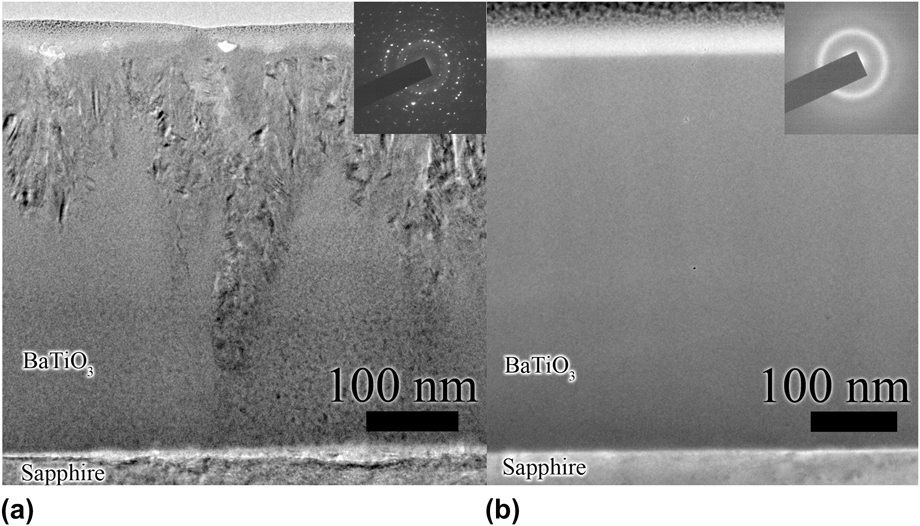
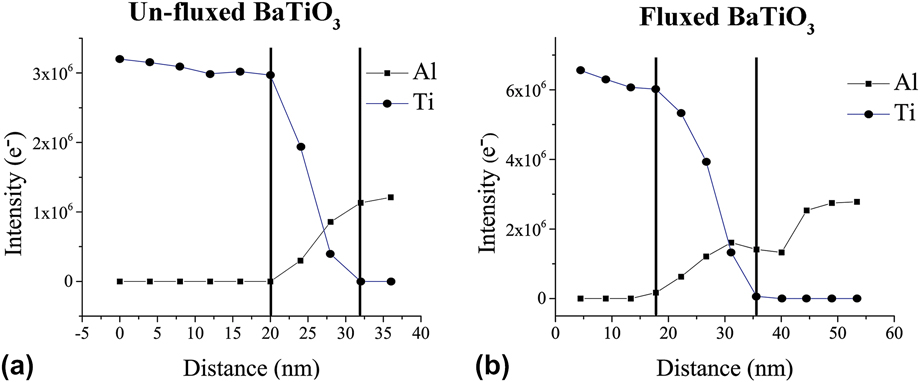
The microstructures of the as-deposited fluxed and unfluxed BaTiO3 thin films are shown by the representative TEM images in Fig. 1. The unfluxed samples [Fig. 1(a)] exhibit conically shaped microcrystalline regions that nucleate as close as 70 nm from the substrate interface. The electron diffraction pattern (inset) and XRD patterns (not shown) indicate that these microcrystals are perovskite BaTiO3. The fluxed samples [Fig. 1(b)] appear completely amorphous in the as-deposited state, as evidenced by the uniform intensity in the TEM images, the diffuse electron diffraction patterns and by further XRD studies (not shown). Local chemistry of the sapphire-BaTiO3 interface in the as-deposited state was studied by performing EELS maps across the interface at a step size of 4 nm. Figure 2 shows representative profiles of the integrated intensities of the Ti L2,3 and Al K EELS edges across the interfaces in a typical pure and fluxed film. The chemical width of the interface in the pure sample is approximately 8–12 nm, whereas the fluxed sample showed a width of 13–20 nm, indicating that the flux impacts the extent of the initial interfacial mixing layer.
Bright-field cross-sectional TEM images of the pre-annealed microstructure of the PLD deposited (a) unfluxed BaTiO3 and (b) fluxed BaTiO3 thin films.

EELS intensity profiles of Ti (blue) and Al (black) in the as-deposited (a) unfluxed BaTiO3 and (b) fluxed thin films across the interface region of the BaTiO3 thin film and sapphire substrate demonstrating the intermixing that occurs during deposition. The interface region denoted by vertical black lines was defined as deviation of more than 10% from the bulk EELS intensity.

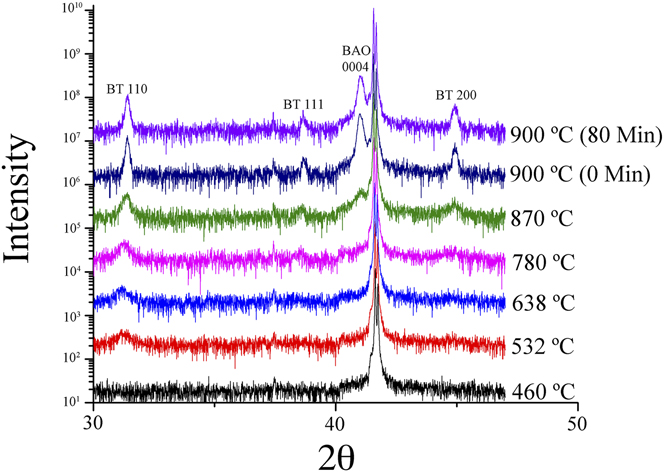
XRD patterns from an in situ heating measurement of flux-modified BaTiO3 thin films are shown in Fig. 3. BaTiO3 appears to form around ∼530 °C as indicated by the broad, diffuse peak at ∼31.5°. This low-order BaTiO3 peak corresponds to the 110-type reflections and remains relatively broad until sharpening dramatically and shifting to higher scattering angles around the flux melting temperature of 870 °C; this is concomitant with the sharpening of higher-order 111 and 200 BaTiO3 diffraction peaks. At the same temperature, 0004 peak from hexagonal BaAl2O4 become evident. The diffraction peaks associated with both BaTiO3 and BaAl2O4 become more intense and sharper at the final annealing temperature of 900 °C.
Stacked XRD plots taken from a hot-stage XRD experiment showing the crystallization of the fluxed BaTiO3 thin film during the annealing process. The ramp rate was 5 °C/min up to 900 °C/min, where it was held for 123 minutes. (BT=BaTiO3; BAO=BaAl2O4)

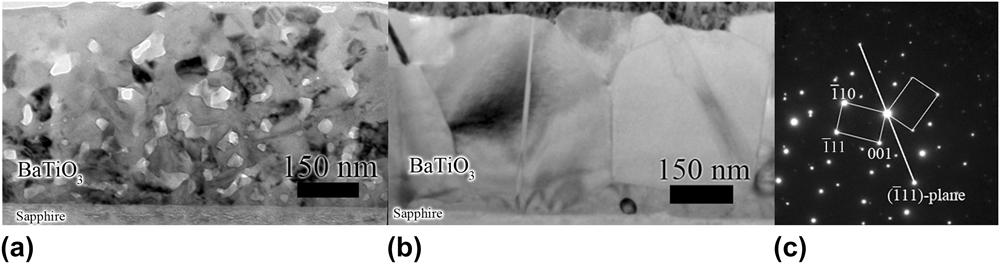
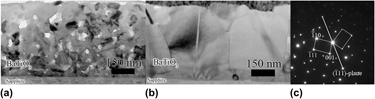
Figure 4 shows TEM cross-sectional images of the post-annealed BaTiO3 fluxed and unfluxed samples after annealing in air for 1 h at 900 °C. The average grain size of the unfluxed sample is 55 nm and the film contains substantial porosity. In contrast, the fluxed films are fully dense with an average grain size of 330 nm. These large-grained fluxed samples contain {111} twin lamellae, as can be observed in Figs. 4(b) and 4(c) with many of the {111} twins sharing a boundary with the substrate interface.
Microstructures of the post-annealed (a) unfluxed BaTiO3 and (b) fluxed BaTiO3 thin films. (c) An electron diffraction pattern showing an example of a {111} twin, which are found in many of the larger grains of the fluxed BaTiO3 thin films.

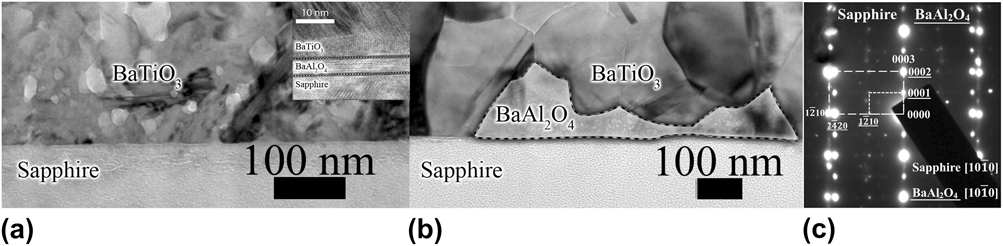
In annealed BaTiO3 thin films with and without flux, a crystalline reaction phase is present at the film–substrate interface as is outlined in Fig. 5. In the unfluxed samples [Fig. 5(a) inset], the reaction results in a continuous reaction layer, identified as BaAl2O4, about 3–5 nm in thickness between the BaTiO3 and Al2O3 substrate. In the fluxed samples [Fig. 5(b)], BaAl2O4 is also present at the interface but occurs in discrete pockets that may penetrate up to 190 nm into the BaTiO3 layer. A representative electron diffraction pattern in Fig. 5(c) shows that the interface phase is BaAl2O4 and that it adopts an epitaxial relationship with the underlying sapphire substrate. The orientation relationship is:
 $$\left( {2\bar 420} \right){\rm{BaA}}{{\rm{l}}_{\rm{2}}}{{\rm{O}}_{\rm{4}}}//\left( {1\bar 210} \right){\rm{A}}{{\rm{l}}_{\rm{2}}}{{\rm{O}}_{\rm{3}}}$$
 $$\left[ {10\bar 10} \right]{\rm{BaA}}{{\rm{l}}_{\rm{2}}}{{\rm{O}}_{\rm{4}}}//\left[ {10\bar 10} \right]{\rm{A}}{{\rm{l}}_{\rm{2}}}{{\rm{O}}_{\rm{3}}}.$$
Bright-field cross-sectional TEM and HRTEM micrographs demonstrating the occurrence of BaAl2O4 in (a) the unfluxed BaTiO3 (inset) and (b) the fluxed BaTiO3 thin films. (c) An electron diffraction pattern showing the crystallographic orientation relationship between the BaAl2O4 and the sapphire substrate.

The phase and orientation relationship is consistent for all of the BaAl2O4 grains examined in the fluxed samples.
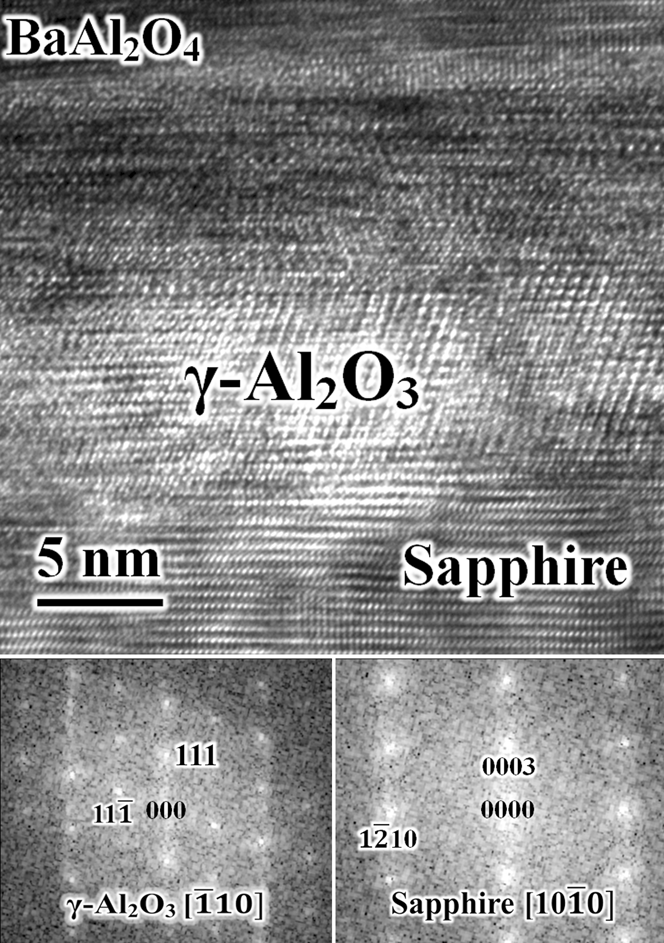
Figure 6 is a HRTEM image showing the presence of γ-alumina at the interface between the sapphire substrate and a region of BaAl2O4 in a fluxed BaTiO3 sample. The γ-alumina is observed in the as-deposited fluxed films and the annealed fluxed and unfluxed films.
A HRTEM micrograph showing the occurrence of γ-alumina in the substrate of a post-annealed fluxed BaTiO3 sample with its accompanying FFT’s demonstrating the secondary phase.

IV. DISCUSSION
Diffraction, microstructure, and microchemical analyses provide insight into the role of the BBO flux in the BaTiO3 microstructural evolution in terms of both nucleation and growth, both of which appear to be significantly affected by the presence of this flux. The unfluxed BaTiO3 films in the as-deposited state exhibit crystalline regions with a conical morphology that shares microstructural similarities to amorphous silicon. In the case of amorphous silicon, a roughening transition during growth induces crystalline nucleation at the film–vacuum interface.Reference Podraza, Li, Wronski, Dickey, Horn and Collins19,Reference Podraza, John, Li, Wronski, Dickey and Collins20 Importantly, however, the addition of hydrogen during deposition has been shown to delay or prevent crystallite nucleation in amorphous silicon.Reference Collins, Ferlauto, Ferreira, Chen, Koh, Koval, Lee, Pearce and Wronski21 In the BaTiO3 system, BBO appears to prevent crystallite nucleation; therefore, we speculate that the mechanism that retards nucleation is related and attributed to the glass network forming capabilities of boron oxide. The metastable amorphous state of the fluxed samples may increase the energy barrier to nucleation thereby reducing the homogeneous nucleation density during subsequent annealing while promoting heterogeneous nucleation at the substrate interface.
While full crystallization and the formation of a discrete BaAl2O4 interphase are not evident until post-deposition annealing, interdiffusion at the interface is present in both the unfluxed and fluxed as-deposited state. After annealing at 900 °C for 1 h, the unfluxed films exhibit a continuous 3–5 nm thick layer of crystalline BaAl2O4, which is approximately the same thickness as the as-deposited mixing layer. In contrast, the formation of BaAl2O4 in the fluxed BaTiO3 is not restricted to the thickness of the initial mixing layer of the as-deposited samples, instead forming as a patchy interface layer that can extend as deep as two-hundred nanometers into the thickness of the film. Hot-stage XRD of these samples shows a direct correlation between the BaAl2O4 crystallization and the melting point of the BBO at 870 °C, indicating that the liquid-phase flux is associated with the BaTiO3 reaction kinetics.
The microchemical and microstructural data also suggest that diffusion of Al and O out of the sapphire substrate toward the BaTiO3 film dominates the mass transport. This is especially evident in the fluxed samples, where the BaAl2O4 grows away from the interface into the BaTiO3 film. Even in the as-deposited state, depletion in the EELS Al signal is evident within the sapphire adjacent to the interface [Fig. 2(b)]. Furthermore, EDX and secondary ion mass spectrometry analysis of annealed samples (not shown) confirm the presence of Al throughout the BaTiO3 film. The Al and O transport out of the sapphire substrate results in a relatively disordered region in the sapphire; these disordered regions accommodate the Al and O vacancies and converts locally to γ-alumina when the vacancy concentration is high enough (Fig. 6), as γ-alumina is less dense than sapphire.
In addition to affecting the formation of the interface reaction layer, the BBO flux also has a dramatic influence on the final microstructure of the BaTiO3 film. The hot-stage XRD data indicate increased ordering in the BaTiO3 beginning at temperatures as low as ∼530 °C, as evidenced by the 110 BaTiO3 reflection at ∼31.5° 2θ. Around the melting temperature of BBO, 870 °C, a marked sharpening of the 110 reflections is accompanied by a shift to higher scattering angles and the appearance of higher order diffraction peaks, which is consistent with a marked increase in crystallinity and grain size. Importantly, these changes in the BaTiO3 crystallinity are directly correlated with the nucleation of crystalline BaAl2O4.
The authors surmise that the BBO liquid-phase influences the nucleation of both the BaAl2O4 interface phase and the BaTiO3, and we believe that these two nucleation events may be coupled with the BaAl2O4 serving as a heterogeneous nucleation site for the BaTiO3 in the presence of a liquid phase. While unconfirmed experimentally, this hypothesis is supported by the fact that the fluxed samples have {111} twins in the large BaTiO3 grains, many of which appear to emanate from the BaAl2O4 regions. {111} BaTiO3 twin formation has been observed and studied since the 1950s in both bulk ceramics and single crystals grown from a liquid flux.Reference DeVRIES22 The {111} twin formation is typically associated with excess Ti, but this has been shown to be an indirect effect via the formation of Ti-rich polytitanate phases, e.g., Ba6Ti17O40. Lee et al. demonstrated that in an oxidizing atmosphere, Ba6Ti17O40 grains act as nucleation sites for {111} twins in BaTiO3; the resulting twinned grains exhibit abnormal growth with a preferred <111> growth direction.Reference Lee and Kang23 The BBO-fluxed BaTiO3 films in the present study exhibit a large size distribution with the larger grains containing {111} twins, however our processing temperature is several hundred degrees below the minimum temperature needed for Ba6Ti17O40 formation,Reference Lee, Randall and Liu24 but we believe that the BaAl2O4 interphase in the presence of a liquid phase acts as a similar nucleation site for the BaTiO3 and {111} twins. It has previously been suggested that abnormal grain growth is promoted by the existence of {111} twins and that through seeding of twins a larger microstructure can be realized.Reference DeVRIES22,Reference Lee and Kang23,Reference Hu, Hiremath and Newnham25 Kang notes that grains containing a {111} twin will grow preferentially in that direction because of a reduction of the critical driving force for boundary migration where the {111} twin intersects a grain boundary.Reference Kang26 The existence of the {111} twins in the fluxed BaTiO3 suggests a possible mechanism that drives the growth of the large BaTiO3 grains, i.e., the addition of the flux to our system promotes BaAl2O4 formation, which leads to nucleation of {111} BaTiO3 twins, and thus results in improved grain size by lowering the energy barrier for grain boundary migration and providing a liquid phase for enhanced transport.
V. CONCLUSION
The presence of barium borate during the deposition and annealing of pulsed laser deposited BaTiO3 on sapphire has both direct and indirect effects on nucleation and growth. The flux prevents nucleation of crystalline BaTiO3 during deposition, while the melting of the eutectic barium borate during post-deposition annealing facilitates the nucleation and growth of a BaAl2O4 interface reaction phase. This interface phase, in combination with the liquid phase flux, appears to nucleate {111}-twinned BaTiO3 grains, which are typically associated with abnormal grain growth, or fast grain-growth kinetics. The resulting dense, large grained, and highly crystalline BaTiO3 microstructure leads to dielectric properties equivalent to materials processed at much higher (∼1200 °C) temperatures. These results suggest a promising path for low-temperature processing of thin-film BaTiO3, wherein a liquid flux is used in combination with a second phase that promotes nucleation of {111}-twinned grains at the substrate interface.
ACKNOWLEDGMENTS
Funding was provided by Defense MicroElectronics Activity (H94003-10-0-1002). This material is based upon work supported by the National Science Foundation Graduate Research Fellowship for M.J. Burch under Grant No. DGE-0946818. Any opinion, findings, and conclusions or recommendations expressed in this material are those of the authors(s) and do not necessarily reflect the views of the National Science Foundation. The authors acknowledge the use of the Analytical Instrumentation Facility (AIF) at North Carolina State University, which is supported by the State of North Carolina and the National Science Foundation.