Introduction
Dung beetles (Scarabaeidae: Aphodiinae, Scarabaeinae; some Geotrupidae) are important members of the insect community associated with cattle dung. As agents of dung degradation and bioturbation, they maintain pasture productivity and reduce populations of coprophilous insects and parasites that adversely affect livestock (Fincher Reference Fincher1981; Losey and Vaughan Reference Losey and Vaughan2006; Pokhrel et al. Reference Pokhrel, Cairns, Hemmings, Floate and Andrew2021). They are sensitive bioindicators of environmental change (Spector Reference Spector2006) and are frequently used to assess the nontarget effects of residues in dung of livestock treated with veterinary pharmaceuticals (Floate et al. Reference Floate, Wardhaugh, Boxall and Sherratt2005; Lumaret et al. Reference Lumaret, Errouissi, Floate, Römbke and Wardhaugh2012; Finch et al. Reference Finch, Schofield, Floate, Kubasiewicz and Mathews2020). They also are a food resource for other grassland insects and vertebrates (McCracken et al. Reference McCracken, Foster, Bignal and Bignal1992; Horgan and Berrow Reference Horgan and Berrow2004; Levey et al. Reference Levey, Duncan and Levins2004; Nichols et al. Reference Nichols, Spector, Louzada, Larsen, Amequita and Favila2008).
Nesting and feeding behaviour separates dung beetles into different functional groups (Doube Reference Doube1990; Cambefort and Hanski Reference Cambefort and Hanski1991). The larvae of aphodiines develop within the dung deposit, with degradation mainly the result of larval feeding activity. These species are commonly called dwellers or endocoprids. Adult scarabaeines and geotrupids remove portions of dung from the fresh deposit for burial in underground nests, in which they also lay their eggs. Species that bury the dung immediately below the deposit are termed tunnellers or paracoprids. Species that form the dung into a ball and then roll it away from the deposit before burial are termed rollers or telecoprids. The detritivores form a fourth functional group. Adults may be attracted to dung to feed and, in high numbers, can scatter the deposit (Seamans Reference Seamans1934). However, the eggs of detritivores are laid in organic-rich soils, where larvae develop on humus and plant roots (Christensen and Dobson Reference Christensen and Dobson1976; Gordon Reference Gordon1983; Cambefort Reference Cambefort1991; Floate Reference Floate2021).
Few studies have reported on dung beetles associated with cattle dung in Canada. Beetles recovered from dung pats in British Columbia included a native species of roller, a European species of tunneller, and nine aphodiine species (including five European species of dwellers) (Macqueen and Beirne Reference Macqueen and Beirne1974). All of the approximately 3500 beetles recovered from dung pats in a Québec study were of European origin, representing five species of dwellers, one species of tunneller, and two species of detritivores (Matheson Reference Matheson1987). Use of dung-baited pitfall traps on pastures near the city of Lethbridge, Alberta recovered about 156 500 beetles (17 species), dominated by European species that included a tunneller, a dweller, and two species of detritivores (Floate and Gill Reference Floate and Gill1998). Use of dung-baited pitfall traps on three native grasslands elsewhere in southern Alberta recovered about 188 000 beetles (12 species), dominated by European species that included two species of tunnellers and a detritivore (Floate and Kadiri Reference Floate and Kadiri2013). These collective results show that dung beetle assemblages associated with cattle dung in Canada are numerically abundant, species-rich, functionally diverse, and dominated by nonnative species.
The present study was undertaken with a two-fold objective. First, we used dung-baited pitfall traps to characterise the assemblage of dung beetles associated with cattle on native fescue pastures in Cypress Hills Interprovincial Park in southern Alberta. Intact fescue grasslands are among the most imperilled terrestrial ecosystems in Canada (Kraus and Hebb Reference Kraus and Hebb2020), yet studies designed to characterise insect biodiversity within these habitats are rare. Second, we used conventional metrics of community structure (alpha and beta diversity, species richness, component species abundances) to compare dung beetle assemblages on open grassland versus wooded habitats. Dung beetles are known to exhibit different preferences for these habitat types, even when the habitats are proximal and contiguous (Fincher et al. Reference Fincher, Blume, Hunter and Beerwinkle1986; Wassmer Reference Wassmer1995; Horgan Reference Horgan2008). To our knowledge, all previous surveys of dung beetles in Canada have been restricted to grassland habitats. By including both types of habitats, we expected to obtain a better understanding of beetle habitat preferences and a more comprehensive assessment of endemic dung beetle species in Cypress Hills Interprovincial Park. In addition, by virtue of operating pitfall traps from May through October, we were able to document seasonal changes in adult activity for individual dung beetle species.
Materials and methods
Site description
Features of the geology, soil, climate, and biota of the Cypress Hills are described in several sources (Bird and Halladay Reference Bird, Halladay and Hardy1967; Newsome and Dix Reference Newsome and Dix1968; Greenlee Reference Greenlee1981; Natural Resources Committee 2006; Widenmaier and Strong Reference Widenmaier and Strong2010). In brief, the Cypress Hills are an isolated “sky island” (Dempsey et al. Reference Dempsey, Burg and Goater2019) of approximately 2600 km2 in area that rises up to 600 m above the semi-arid prairie of southeastern Alberta and southwestern Saskatchewan, Canada. The Cypress Hills comprise an erosional plateau that was formed when glaciation removed sediment from the surrounding area over the course of millions of years. With a peak elevation of approximately 1500 m, they are the highest point of land in Canada between the Rocky Mountains (∼ 300 km to the west), in Alberta, and the Torngat Mountains (∼ 5000 km to the east), in Labrador and Québec.
Cooler and moister conditions on northerly slopes at higher elevations in the Cypress Hills support a mosaic of wooded and grassland habitats similar to those present in the Rocky Mountains (Newsome and Dix Reference Newsome and Dix1968; Widenmaier and Strong Reference Widenmaier and Strong2010). Wooded areas are characterised by grey luvisol soils that support stands of lodgepole pine (Pinus contorta var. latifolia Douglas ex. Loudon) (Pinaceae), trembling aspen (Populus tremuloides Michaux) (Salicaceae), white spruce (Picea glauca (Moench) Voss) (Pinaceae), and balsam poplar (Populus balsamifera Linnaeus) (Salicaceae). Grasslands are characterised by black chernozemic soils that support dominant stands of plains rough fescue (Festuca hallii (Vasey) Piper) (Poaceae) that characterise the mixed-grass natural subregion (Natural Resources Committee 2006). Less common grasses (Poaceae) include timber oatgrass (Danthonia intermedia Vasey), slender wheat grass (Elymus trachycaulus ssp. subsecundus (Link) Á. Löve and D. Löve), Idaho fescue (Festuca idahoensis Elmer), and June grass (Koeleria macrantha (Ledebour) Schultes). Shrubby cinquefoil (Dasiphora fruticosa Linnaeus) (Rosaceae) is the dominant grassland shrub.
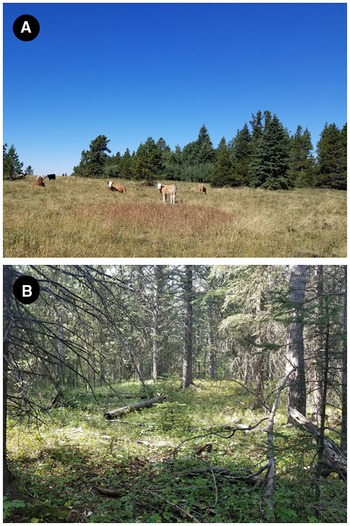
Cypress Hills Interprovincial Park is an area of 345 km2 located in the Cypress Hills. Local grazing associations maintain herds of cattle in the park that freely roam between wooded and grassland habitats (Scrimgeour and Kendall Reference Scrimgeour and Kendall2003; Hegel et al. Reference Hegel, Gates and Eslinger2009; Fig. 1). Partially due to this grazing activity, the understorey in wooded areas is sparse. Other large grazing mammals in the park include wapiti (Cervus canadensis (Erxleben)), mule deer (Odocoileus hemionus Rafinesque), and white-tailed deer (Odocoileus virginianus (Zimmermann)) (all Cervidae) (Hegel et al. Reference Hegel, Gates and Eslinger2009).
Habitat types examined in Cypress Hills Interprovincial Park, Alberta, Canada: A, open grassland, and B, wooded.

Sampling
To compare dung beetle assemblages between habitat types, we operated dung-baited pitfall traps from spring through autumn for two years at each of two sites in Cypress Hills Interprovincial Park (Alberta Parks Research and Collection Permits 16-055 and 17-145). The two sites were approximately 5 km apart. In 2016, traps were operated from 9 May to 28 October. In 2017, traps were operated from 8 June to 17 October.
At each site, we placed a set of five traps in grassland habitat and a set of five traps in adjacent wooded habitat (n = 20 total traps). Traps within habitats were separated from the habitat edge by at least 30 m and from each other by at least 10 m. At site 1, the two sets of traps were located about 500 m apart (grassland = latitude 49.657°, longitude –110.210°; woodland = latitude 49.656°, longitude –110.216°). At site 2, the two sets of traps were located about 100 m apart (grassland = latitude 49.630°, longitude –110.263°; woodland = latitude 49.629°; longitude –110.264°). The location of individual traps in each set was somewhat dictated by ease of access and placement to avoid trampling by cattle. Daily mean air temperature (°C) and precipitation (mm) during the study were measured by a weather station in the Cypress Hills, located about 5 km west of site 2. Historical records for this weather station are available back to 2005 and can be accessed using Alberta Agriculture and Forestry’s “Current and Historical Alberta Weather Station Data Viewer” (https://acis.alberta.ca/acis/weather-data-viewer.jsp).
Traps were as described by Bezanson et al. (Reference Bezanson, Dovell and Floate2021). Each trap comprised two plastic pails (2-L capacity), one nested inside the other, buried with the lip of the trap level with the soil surface. The inner pail was removed to empty trap contents, whereas the outer pail remained in the soil to prevent the hole from collapsing. A mixture of propylene glycol and water (1:1, ∼ 100 mL) was added to the inner pail as a preservative. A wire screen (10-mm grid) was secured with metal pins over the mouth of each trap to support a suspended dung bait and to exclude rodents and birds. Baits were made from fresh cattle dung (∼ 250 mL) wrapped in three-ply cheesecloth and secured with a twist tie. Dung was collected from cattle maintained on a diet of barley silage and housed at the Lethbridge Research and Development Centre (Agriculture and Agri-Food Canada) in Lethbridge, Alberta, Canada (latitude 49.691°, longitude −112.774°). Hundreds of baits were made at one time and held at –15 °C until needed. Baits are not adversely affected by freezing during storage in sealed containers and remain effective for 2–3 days when placed in the field (Bezanson et al. Reference Bezanson, Dovell and Floate2021). For the current study, traps were emptied and rebaited each week except for rare occasions when trap access was prevented by inclement weather.
Recovered insects were stored in 70% ethanol and held at 7 °C until counted and identified to species level, using Howden and Cartwright’s (Reference Howden and Cartwright1963) and Gordon and Skelley’s (Reference Gordon and Skelley2007) taxonomic keys. Voucher material was deposited in the main insect collection at the Lethbridge Research and Development Centre.
Statistical analyses
Given the difference in the length of our trap season in 2016 versus 2017, we did not test for an effect of year. Instead, for each year we performed a two-way analysis of variance (P = 0.05) to test for an effect of site and habitat on the total number of beetles recovered. For these analyses, all of the beetles recovered in the same trap were pooled across collection periods within years to obtain one sample per trap. Doing so provided us with five samples for each combination of site and habitat (n = 20 total samples) per year.
For each year, we then pooled collections across sites by habitat type to compare the diversity of beetles recovered from traps in grassland versus woodland habitats. For measures of α (within-sample) diversity, we used Chao-1, Shannon, and Simpson’s indices. The Chao-1 index estimates the expected or true species richness, which may differ from the observed species richness. It is particularly useful when species are represented by only a few individuals within a sample (Chao Reference Chao1984). The latter two indices measure species diversity. The Shannon index considers evenness and richness of the individuals (Shannon and Weaver Reference Shannon and Weaver1949). Values typically range from 1.5 to 3.5 (Magurran Reference Magurran2004), with smaller values indicating few taxa are present. Simpson’s index (1-Dominance) captures the variance of species abundance and distribution (Price et al. Reference Price, Brenneman and Johnston2012) and ranges from 0 (one taxon dominates) to 1 (equal presence of all taxa). For measures of β (between-sample) diversity, we used the Jaccard index. The value is given as a percentage of similarity, with higher values identifying a greater number of taxa shared between sites (Magurran Reference Magurran2004).
To take advantage of having two years of data with which to better assess diversity, we recalculated indices of α diversity and the Jaccard index for beetles recovered in each habitat for collections pooled across years. To obtain an overall measure of diversity for beetles recovered during the study, we recalculated indices of α diversity for collections pooled across years and habitats.
To examine the effect of habitat type on the recovery of individual species irrespective of year or site, we performed Kruskal–Wallis H tests (P = 0.05). This nonparametric equivalent of the one-way analysis of variance was required due to nonnormal distribution of data that could not be corrected by transformation. For these analyses, we combined data sets across years, allowing for 20 samples for each habitat type. For statistical rigour, we limited analyses to those species represented by at least 40 individuals (i.e., corresponding to one individual per sample).
Seasonal activity
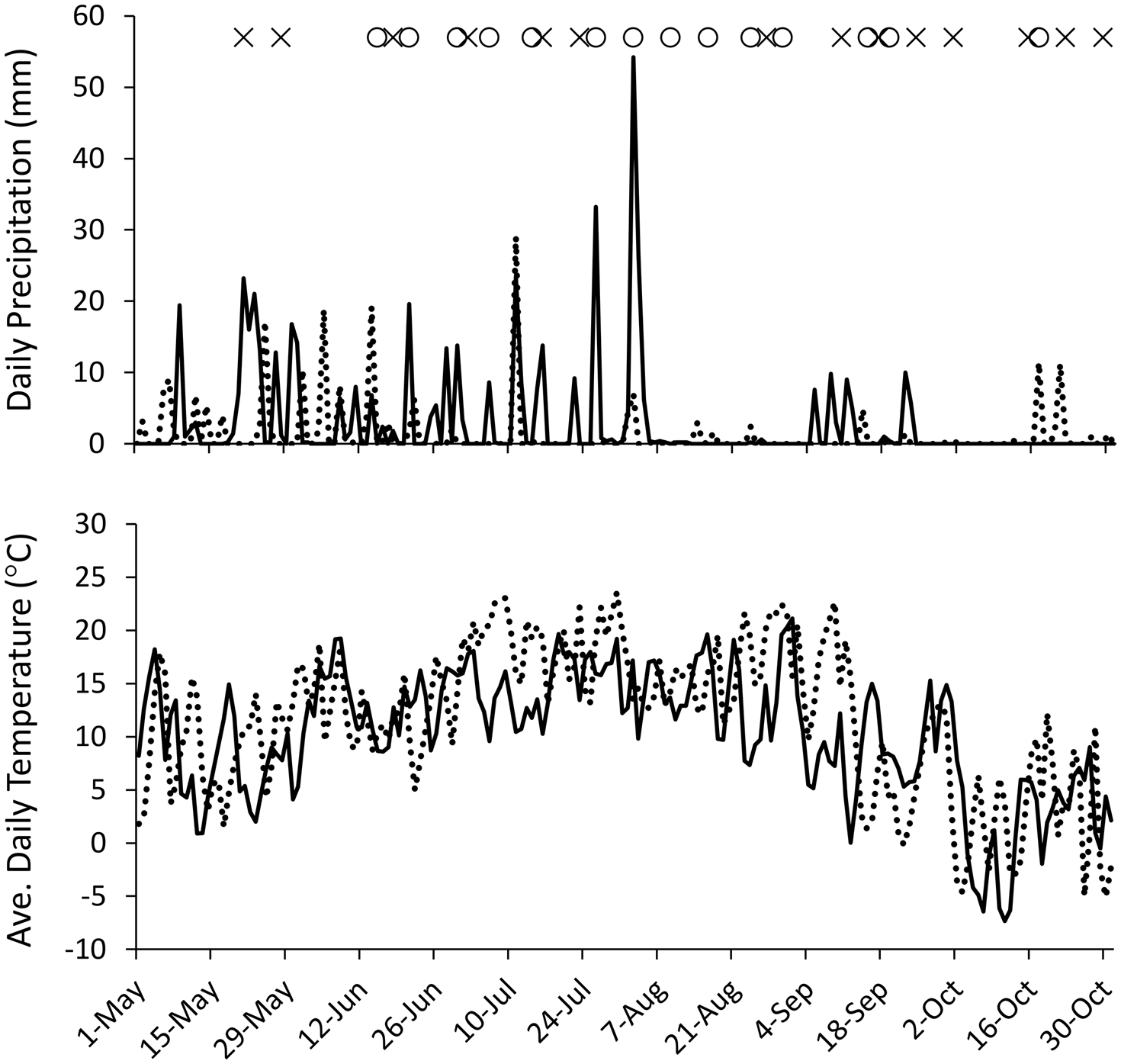
We recorded seasonal activity for each species as the total number of individuals recovered during the two-year study for a given week – for example, for the first week of June. In some cases, traps were not emptied and rebaited each week due to weather events. In these cases, we assumed that all beetles in the trap had been captured during the week the trap was baited. Bezanson et al. (Reference Bezanson, Dovell and Floate2021) previously showed that dung baits lose their effectiveness after 2–3 days. Dates of trap collections are indicated in Figure 2.
Daily precipitation (top panel) and average daily temperature (bottom panel) values for Cypress Hills Interprovincial Park for the duration of trapping in 2016 (solid lines) and 2017 (dashed lines). Dates on which traps were emptied are identified as “×” for 2016 and “O” for 2017. (Note: due to an instrument malfunction, precipitation values for October 2016 were not recorded).

Results
Weather conditions for the duration of trapping were wetter and cooler in 2016 than in 2017 (Fig. 2). From 1 May through 31 October, total precipitation recorded at the Cypress Hills weather station historically (i.e., since 2005) has averaged 316 mm. Total recorded precipitation for this period in 2016 was 494 mm (156% of average) but did not include precipitation for October due to an instrument malfunction. The historical average of precipitation in October is 25 mm. Total precipitation in 2017 from 1 May through 31 October was 224 mm (71% of average). The historical average for growing degree-days (base 0 °C) recorded at the Cypress Hills weather station from 1 May through 31 October is 2282 growing degree-days. In 2016 and 2017, this value was 1951 (85% of average) and 2173 growing degree-days (95% of average), respectively.
Beetle assemblages
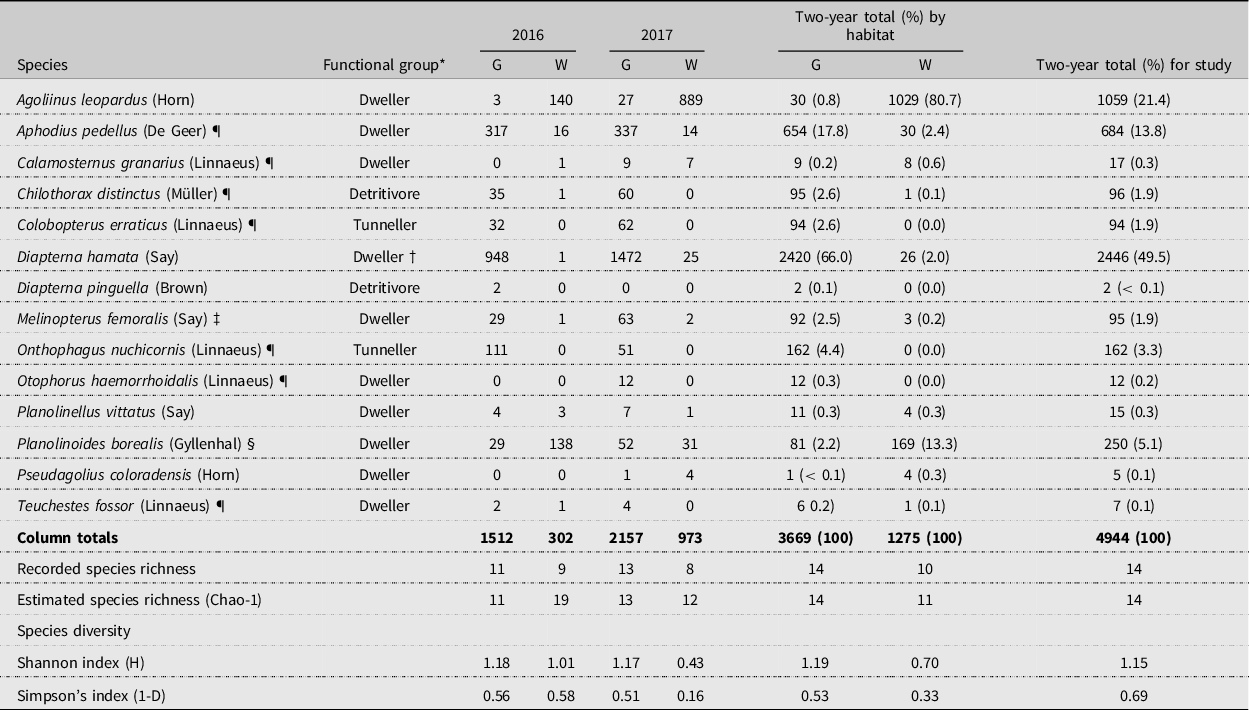
During the two-year study, we recovered 4944 dung beetles comprising 14 species – that is, 1814 (12 species) in 2016 and 3130 (14 species) in 2017 (Table 1). Eleven of these species were recovered in both years. In 2016, an effect on beetle recovery was detected for site (F 1,16 = 7.714, P = 0.013) and for habitat (F 1,16 = 20.186, P < 0.001) but not for the interaction of site × habitat (F 1,16 = 1.447, P = 0.246). In 2017, an effect on beetle recovery was detected for habitat (F 1,16 = 16.637, P = 0.001) but not for site (F 1,16 = 0.043, P = 0.838) nor for the interaction of site × habitat (F 1,16 = 0.840, P = 0.373).
Species recovered by year and habitat, with associated species richness and diversity indices. G, grassland; W, wooded.

* based on information from Howden and Cartwright (Reference Howden and Cartwright1963), Rojewski (Reference Rojewski1983), and Gordon and Skelley (Reference Gordon and Skelley2007); ¶ nonnative; † probably also functions as a detritivore; ‡ Bezanson (Reference Bezanson2019) reported Melinopterus prodromus (Brahm) and M. femoralis in collections, but reexamination of voucher specimens confirmed the presence of only M. femoralis; § Bezanson (Reference Bezanson2019) reported Planolinus tenellus (Say) and Planolinoides borealis in collections, but reexamination of voucher specimens confirmed the presence of only P. borealis
In each year, species richness and total beetle abundance were higher in open grassland than in wooded habitats. This pattern, however, was not always supported by indices of species diversity (Table 1). Values for the Chao-1 index in 2016 and 2017 indicated that from 10 to four more species remained to be detected in wooded areas, respectively. Values for the Shannon and Simpson’s indices were similar across habitats in 2016. We give greater confidence to results based on data combined across years, which should be more reflective of long-term patterns. When this is done, values of the Shannon index and Simpson’s index unambiguously identified a more diverse assemblage of dung beetles in grassland habitat. Similarly, the Chao-1 index identifies an estimated 14 and 10 species in grassland versus woodland habitats, which closely corresponds to the actual number of species recovered in the two habitats. The relatively low values of the Jaccard index further illustrate differences in species assemblages between the two habitat types, that is, 67% similarity in 2016, 62% similarity in 2017, and 71% similarity for data combined across both years.
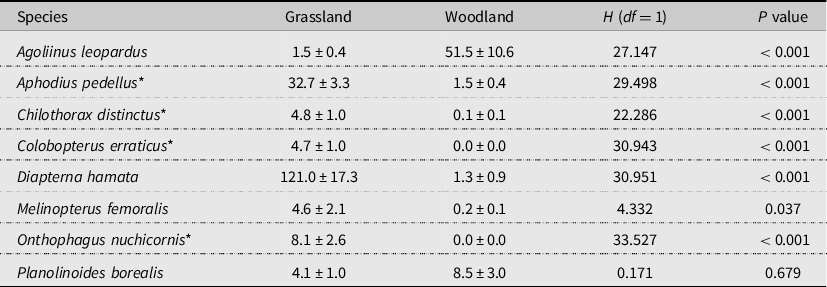
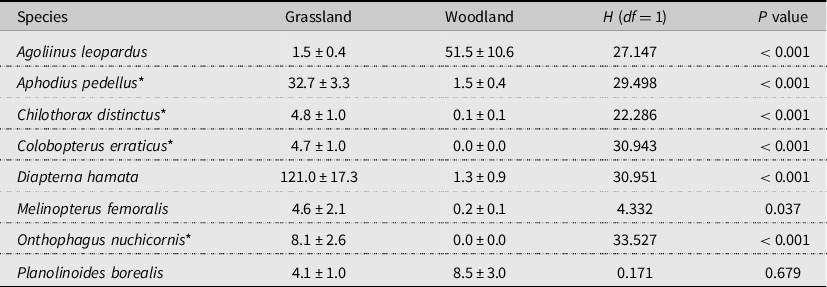
Differences in species assemblages between grassland and wooded areas are reflected by the preference of individual species for different habitats. Of the eight species considered for analyses (i.e., represented by at least 40 specimens), six were recovered significantly more often in grassland, one was recovered more often in wooded habitat, and one species showed no significant preference (Table 2).
Mean (± standard error) number of individuals recovered for different dung beetle species in dung-baited pitfall traps on grassland and wooded habitat. Values are based on 20 traps operated from May through October (10 traps each in 2016 and in 2017). Analyses use Kruskal–Wallis H tests.
* nonnative
Seasonal activity
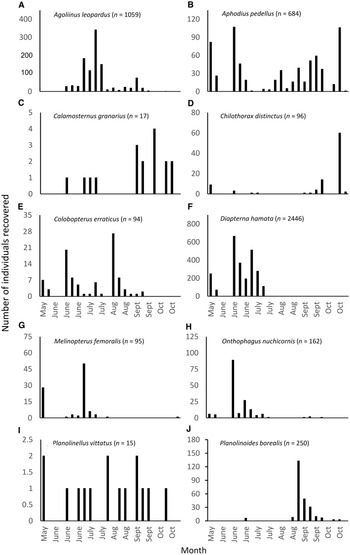
Seasonal patterns of recovery for the 10 most abundant species are provided in Figure 3. Some of these species were recovered throughout the trap period but with contrasting patterns of activity. Activity of Agoliinus leopardus (Horn) was unimodal with peak recovery in July (Fig. 3A). Activity of A. pedellus (De Geer) was bimodal with peak recovery in spring and autumn (Fig. 3B). Recovery of other species (i.e., Diapterna hamata (Say) (Fig. 3F), Melinopterus femoralis (Say) (Fig. 3G), and O. nuchicornis (Linnaeus) (Fig. 3H)) was limited primarily to spring through mid-summer. In contrast, almost no Planolinoides borealis (Gyllenhal) (Fig. 3J) were recovered until late August. Calamosternus granarius (Linnaeus) (Fig. 3C) and Planolinellus vittatus (Say) (Fig. 3I) were collected throughout the trap period but not in sufficient numbers to allow for meaningful interpretation of peak seasonal activity.
Seasonal activity of A, Agoliinus leopardus; B, Aphodius pedellus; C, Calamosternus granaries; D, Chilothorax distinctus; E, Colobopterus erraticus; F, Diapterna hamata; G, Melinopterus femoralis; H, Onthophagus nuchicornis; I, Planolinellus vittatus; and J, Planolinoides borealis. The numbers of individuals recovered over the two-year study are shown in parentheses.

Four additional species were recovered but only in low numbers. Two individuals of Diapterna pinguella (Brown) were recovered the last week in June. Five individuals of Pseudagolius coloradensis (Horn) were recovered between mid-June and mid-July. Seven individuals of Teuchestes fossor (Linnaeus) were recovered between mid-June and mid-July. Twelve individuals of Otophorus haemorrhoidalis (Linnaeus) were recovered between late June and mid-October.
Discussion
The most striking finding of the present study was the strong effect of habitat on the number of dung beetle individuals and species recovered. Five-fold and 2.2-fold more individuals were recovered in grassland versus wooded areas in 2016 and 2017, respectively (Table 1). This finding is similar to that of other studies that have reported large differences in the diversity and number of dung beetles recovered in untreed versus forest habitats (Klein Reference Klein1989; Wassmer Reference Wassmer1995; Price Reference Price2004; Horgan Reference Horgan2008). Most comparable in design to our study is that of Fincher et al. (Reference Fincher, Blume, Hunter and Beerwinkle1986). They compared recovery of dung beetles in a cattle pasture between open and wooded areas in Texas (Fincher et al. Reference Fincher, Blume, Hunter and Beerwinkle1986). Greatest recovery occurred in the open habitat (67% of 238 000 beetles recovered), with the 35 species captured showing clear preferences for habitat type (open = 15 species; wooded = 20 species). Therefore, even though fresh dung may be readily available for feeding and breeding, the placement of the deposit in the broader landscape has large effects on its associated beetle assemblage.
The magnitude of the differences in beetle abundance between grassland and woodland habitats was surprising. First, fresh dung occurs in both habitats deposited by cattle that roam freely in Cypress Hills Interprovincial Park during the summer months. Therefore, ample resources are available to sustain dung beetle populations in both grassland and woodland habitats. Second, the placement of our traps in the two habitats at each site was relatively close together. Distances of about 500 and 100 m separated grassland and woodland traps at sites 1 and 2, respectively. Furthermore, the sparse understorey of the wooded areas would not have greatly impeded insect flight (Fig. 1B). Dung beetles are strong fliers and can locate fresh deposits from distances of several hundred metres. Using mark–recapture techniques, da Silva and Hernández (Reference da Silva and Hernández2015) showed that dung beetles in a Brazilian forest readily flew several hundred metres to locate baits of human dung. Using the same method on grassland sites in Finland, Roslin (Reference Roslin2000) found that most aphodiine dung beetles flew relatively short distances to fresh cattle dung but were capable of flying up to as far as 1 km. Therefore, no obvious barriers prevent colonisation of both habitats by a given species.
Closer examination of species recovered in the present study identified two groups with significant habitat preferences. The first group is associated with grassland. It is dominated mainly by nonnative species of European origin that Gordon (Reference Gordon1983) describes as having a preference for untreed pastures and cattle dung. These European species include A. pedellus, C. distinctus (Müller), C. erraticus (Linnaeus), and O. nuchicornis. These species are common and widespread in North America (Bezanson and Floate Reference Bezanson and Floate2019). This group also includes D. hamata, a native species that feeds in cattle dung but that may also function as a detritivore (Gordon and Skelley Reference Gordon and Skelley2007). Helgesen and Post (Reference Helgesen and Post1967) suggest that D. hamata (reported as Aphodius hamatus Say) is associated with the boreal life zone. In support of this suggestion, we have not collected D. hamata in surveys of dung beetles at lower elevations on the prairies that surround the Cypress Hills (Floate and Gill Reference Floate and Gill1998; Floate and Kadiri Reference Floate and Kadiri2013; Bezanson Reference Bezanson2019). The second group of species is associated with wooded areas and is represented by the native species Agoliinus leopardus (Horn). This is a forest species with a preference for dung of sheep, deer, and elk (Gordon and Skelley Reference Gordon and Skelley2007). Of the 1029 A. leopardus specimens collected, only 3% were recovered on grassland (Table 1).
Two native species recovered in the present study, Melinopterus femoralis and Planolinoides borealis, showed weak or no apparent preference for habitat. Recovered most often on grassland, M. femoralis has been described as a generalist species common in cattle dung and which rarely uses deer dung (Gordon and Skelley Reference Gordon and Skelley2007). We also recovered this species in a survey of dung beetles conducted in 2016–2017 at a site about 120 km northwest of the Cypress Hills on native grassland (Bezanson Reference Bezanson2019). To our knowledge, the species has not previously been reported in Canada west of Ontario (Bousquet et al. Reference Bousquet, Bouchard, Davies and Sikes2013), although it has been collected to the south in the state of Montana (Bezanson and Floate Reference Bezanson and Floate2019). Planolinoides borealis was recovered most often in woodland but not significantly so. It is described from forest or shaded habitat, having a preference for dung of moose and deer but also using dung of sheep and cattle (Gordon and Skelley Reference Gordon and Skelley2007).
The barriers that limit or prevent colonisation of woodlands by grassland species and of grasslands by woodland species are unclear. Distance and suitable breeding sites (i.e., fresh dung) can be eliminated in the present study as factors that maintain this separation. It may be, as proposed by other authors, that separation is maintained by microhabitat differences within the pat. Landin (Reference Landin1961) provides detailed temperature measurements of dung deposits (sheep, cattle, horse) in exposed and shaded locations. More rapid drying and high (possibly lethal) temperatures of pats in exposed locations may render them unsuitable for development of woodland species. However, these factors seem less likely to prevent grassland species from developing in dung of shaded locations. We speculate that lower light intensities in wooded habitats may deter colonisation by grassland species. Detailed examination of developmental times and egg-to-adult mortality of dung beetle species developing in dung at exposed versus shaded locations would provide more insight into the role of microhabitat differences.
The recovery of more beetles in 2017 seems counterintuitive, given that the length of the trap period in 2016 was longer than that in 2017 by about six weeks. The earlier start date in 2016 undoubtedly augmented capture of species that overwinter as adults and are active in early spring – for example, Aphodius pedellus (Fig. 3B), Diapterna hamata (Say) (Fig. 3F), and Melinopterus femoralis (Say) (Fig. 3G). However, the overall activity and subsequent collection of beetles during the summer were likely suppressed in 2016 by colder and wetter conditions. In addition, two fewer collections were made in 2016 than in 2017 due to weather events. For example, due to an early snowstorm, traps baited on 29 September 2016 were not emptied until 20 October 2016.
The detection of a site difference in 2016 but not in 2017 cautions against placing too much weight on one year of data. A total of 1253 and 533 beetles were recovered in the first year of the study at sites 1 and 2, respectively. This was partially due to the greater recovery of D. hamata at site 1 (708 specimens) than at site 2 (241 specimens). However, it also reflected the recovery of 167 specimens of Planolinoides borealis (Gyllenhal) at site 1, which was not recovered at site 2. In the second year of the study, a total of 1535 and 1595 beetles were recovered at sites 1 and 2, respectively. More D. hamata were recovered at site 2 (775 specimens versus 722 specimens at site 1), and P. borealis was recovered at both sites (site 1, 72 specimens; site 2, 12 specimens). Therefore, for data combined across years, dung beetle assemblage was similar across the two study sites.
Patterns of seasonal activity observed in the Cypress Hills are consistent with previous reports for these species elsewhere (Gordon and Skelley Reference Gordon and Skelley2007; Wassmer Reference Wassmer2020). Adult A. leopardus have been reported to be active from July to November. We recovered this species from June through October, with peak recovery in July (Fig. 3A). Adult D. hamata are reportedly active from May to July, which we also observed (Fig. 3F). The seasonal activity of P. borealis is from April to November (Gordon and Skelley Reference Gordon and Skelley2007). In our study, we first recovered this species in June but not in significant numbers until later in August (Fig. 3J). Seasonal activities for most of the other species that we recovered in the Cypress Hills are reported for untreed pastures at lower elevations in southern Alberta by Floate and Gill (Reference Floate and Gill1998), Kadiri et al. (Reference Kadiri, Lumaret and Floate2014), and Bezanson (Reference Bezanson2019).
Our findings show that the dung beetle assemblage of the Cypress Hills is dominated by species of dwellers and detritivores that likely play a minor role in dung-pat degradation. Only two of the recovered species are tunnellers. These were the European species, C. erraticus and O. nuchicornis. These species comprised 1.9% and 3.3%, respectively, of the total number of individuals collected during the two-year study. In contrast, the dung beetle assemblage on grassland sites at lower elevations in the region contains a much greater representation of these two tunnelling species, supplemented with the presence of the native roller species Canthon pilularius (Linnaeus) and Canthon praticola LeConte (Floate and Gill Reference Floate and Gill1998; Floate and Kadiri Reference Floate and Kadiri2013; Bezanson Reference Bezanson2019).
We attribute the scarcity of rollers and tunnellers at our study sites in the Cypress Hills to a combination of soil type, a shorter growing season, and harsher overwintering conditions than those found at lower elevations. For example, the plateau of the Cypress Hills is covered with gravel overlain with a soil structure (see Greenlee Reference Greenlee1981) that is not conducive to the tunnelling activity of dung beetles. However, it also may be the case that the two European species of tunnellers have yet to fully establish in the Cypress Hills. The first report of O. nuchicornis in western Canada is from 1945 for a site in British Columbia (Hatch Reference Hatch1971); the earliest record for Alberta is perhaps 1961 (Floate and Gill Reference Floate and Gill1998). Colobopterus erraticus was not reported west of Manitoba before 1991 (Bousquet Reference Bousquet1991). One specimen was recovered during a three-year survey (1993–1995) at Lethbridge (Floate and Gill Reference Floate and Gill1998). More recently, thousands of C. erraticus have been collected at the Lethbridge site (Tiberg and Floate Reference Tiberg and Floate2011) and at Purple Springs, Alberta (Floate Reference Floate2007; Kadiri et al. Reference Kadiri, Lumaret and Floate2014). Future surveys in the Cypress Hills may show a greater representation of these species.
Acknowledgements
For maintenance of pitfall traps and processing insect samples, the authors thank P. Coghlin, C. Dovell, A. Larney, T. Messer, M. Owen, and S. Swan-Azmon. This work was made possible with the cooperation and helpfulness of the personnel of Cypress Hills Interprovincial Park.
Competing interests
The authors declare none.