Studies have shown that adult second language (L2) learning is characterized by appreciable individual differences in learning success (Birdsong, Reference Birdsong and Birdsong1999; Bongaerts, Reference Bongaerts and Birdsong1999; Golestani & Zatorre, Reference Golestani and Zatorre2009; Iverson, Hazan, & Bannister, Reference Iverson, Hazan and Bannister2005; Jilka, Reference Jilka, Dogil and Reiterer2009; Johnson & Newport, Reference Johnson and Newport1989; Wong & Perrachione, Reference Wong and Perrachione2007) and that learning grammar poses particular difficulty for L2 learners (Weber-Fox & Neville, Reference Weber-Fox and Neville1996). Although research has considered variation between individuals in learning sounds (Golestani, Paus, & Zatorre, Reference Golestani, Paus and Zatorre2002; Wong & Perrachione, Reference Wong and Perrachione2007) and words (Kaushanskaya & Marian, Reference Kaushanskaya and Marian2009) and in overall language learning ability (Robinson, Reference Robinson2002, Reference Robinson2005), there has been little work on individual variation in learning grammar. Furthermore, although some progress has been made in accounting for individual variation in learning by relating it to variation in verbal working memory (Robinson, Reference Robinson2002), current theories on the relationship between language and domain-general cognitive functions make additional explicit predictions. In particular, several theories hypothesize a crucial role for declarative memory (memory for facts; Eichenbaum, Reference Eichenbaum2001) and procedural memory (memory for skills and sequences; Eichenbaum & Cohen, Reference Eichenbaum and Cohen2001) that have yet to be tested in this way (Paradis, Reference Paradis and Ellis1994; Pinker & Ullman, Reference Pinker and Ullman2002; Ullman, Reference Ullman2004). In the present study, we explore variability in L2 learning by considering a hypothesized relationship between language and procedural and declarative memory.
LANGUAGE LEARNING AND DOMAIN-GENERAL CAPABILITIES
One component of the relationship between language learning and domain-general capabilities involves the sensory system and auditory perception. Wong and Perrachione (Reference Wong and Perrachione2007) showed that participants' ability to identify a pitch pattern predicted their ability to learn the words of a tone language. Lengeris and Hazan (Reference Lengeris and Hazan2010) similarly showed a correlation between frequency discrimination for nonspeech stimuli and L2 vowel learning. Other domain-general measures argued to predict learning success include pattern recognition ability, processing speed, and general intelligence (for a review, see Robinson, Reference Robinson2005).
There is also a well-established relationship between phonological working memory and L2 acquisition (Daneman & Case, Reference Daneman and Case1981; Miyake & Friedman, Reference Miyake, Friedman, Heay and Bourne1998; Palladino, Cornoldi, De Beni, & Pazzaglia, Reference Palladino, Cornoldi, De Beni and Pazzaglia2001; Robinson, Reference Robinson2002, Reference Robinson2005; Skehan, Reference Skehan1998; Williams & Lovatt, Reference Williams and Lovatt2003). For example, Service and Kohonen (Reference Service and Kohonen1995) showed that measures of phonological short-term memory predicted the final grades and scores on vocabulary tests 4 years later for Finnish children learning English as a L2. Williams and Lovatt (Reference Williams and Lovatt2003) also showed that phonological short-term working memory, as measured by the ability to recall the order of five Italian words, correlated with English speakers' ability to learn the gender agreement rules governing Italian determiners.
Although these findings account for some of the variability observed in the acquisition of sounds or in L2 learning as a whole through domain-general capabilities, they do not specifically address the acquisition of grammar. Current theories on how memory function supports language also suggest more specific relationships between language and domain-general capabilities.
LANGUAGE LEARNING AND MEMORY
One approach is based on the idea that acquiring a grammar involves extracting statistical regularities from the input. Procedural memory, given its role in abstract sequence learning (Clegg, Digirolamo, & Keele, Reference Clegg, Digirolamo and Keele1998), has been implicated in acquiring syntactic grammars by brain imaging and lesion studies. These studies suggest that there is a shared neural substrate for procedural memory and grammar consisting of a frontostriatal network incorporating the Broca area and the basal ganglia (Ettlinger, Margulis, & Wong, Reference Ettlinger, Margulis and Wong2011; Tyler, Marslen-Wilson, & Stamatakis, Reference Tyler, Marslen-Wilson and Stamatakis2005; Ullman, Reference Ullman and Sanz2005).
Behavioral evidence for a relationship between procedural memory and language processing has involved showing correlations between participants' native language abilities and performance on procedural memory tasks. For example, Conway, Bauernschmidt, Huang, and Pisoni (Reference Conway, Bauernschmidt, Huang and Pisoni2010) showed that speech comprehension in noise is predicted by participants' performance on a variant of the Serial Reaction Time Test (SRTT; Nissen & Bullemer, Reference Nissen and Bullemer1987). Similarly, studies have shown that the processing of long-distance syntactic dependencies in participants' native language is correlated with their performance on a procedural memory task that combined artificial grammar learning with the SRTT (Misyak & Christiansen, Reference Misyak and Christiansen2011; Misyak, Christiansen, & Tomblin, Reference Misyak, Christiansen and Tomblin2010). Evans, Saffran, and Robe-Torres (Reference Evans, Saffran and Robe-Torres2009) demonstrated that children with specific language impairment performed worse than normally developing children on procedural memory tasks involving transitional probabilities between syllables and tone sequences. Performance on the procedural memory task was also positively correlated with children's vocabulary size within each group.
Declarative memory has also been argued to play a role in the acquisition of grammar, especially in the early stages of L2 acquisition (Ullman, Reference Ullman and Sanz2005). This is based on the idea that grammar can emerge through a chunking mechanism that operates over long-term memory, extracting regularities over larger units of speech (Tomasello, Reference Tomasello2003). Similarly, others (Goldberg, Reference Goldberg1995; Jackendoff, Reference Jackendoff2002) argue that grammar is composed of larger, holistic units of speech that serve as analogical templates. These may be stored in long-term declarative memory, which is associated with the storage of word meanings (Damasio, Grabowski, Tranel, Hichwa, & Damasio, Reference Damasio, Grabowski, Tranel, Hichwa and Damasio1996; Eichenbaum & Cohen, Reference Eichenbaum and Cohen2001) and with analogy (Shohamy, Myers, Hopkins, Sage, & Gluck, Reference Shohamy, Myers, Hopkins, Sage and Gluck2009; Suzuki, Reference Suzuki2010). In this view, complex and analogical grammar learning may depend on the declarative memory system.
MORPHOPHONOLOGICAL LEARNING
Although much of this research has focused on English and on syntax, in the present study we consider morphophonology, the grammatical system governing how sounds and morphemes are combined into words, because it provides insight on a unique set of issues. Morphophonology is most closely related to the sensorimotor system and thus represents a challenging test case for an abstract memory–language relationship. Furthermore, phonological grammar mediates the relationship between abstract cognitive units of language and physiological constraints of motor control and auditory perception, and therefore it provides insight into language that is otherwise unavailable through the study of the syntactic system or the learning of individual speech sounds (Bradlow, Pisoni, Akahane-Yamada, & Tohkura, Reference Bradlow, Pisoni, Akahane-Yamada and Tohkura1997; Hawkins, Reference Hawkins2001; Robinson, Reference Robinson2002; White, Reference White, Patten and Williams2007; Wong & Perrachione, Reference Wong and Perrachione2007). Researchers addressing the uniqueness of human language have focused on syntax, and there remains considerable disagreement with respect to the place of phonology and morphophonology. Some argue that morphophonology reflects constraints of the sensorimotor system, does not involve higher order cognitive function, and is not unique to human language (Hauser, Chomsky, & Fitch, Reference Hauser, Chomsky and Fitch2002); others argue that these learned conventions of combination reflect higher order knowledge that is unique to language (Pinker & Jackendoff, Reference Pinker and Jackendoff2005). These views reflect a wider debate on which aspects of language are domain general versus domain specific. Evidence in favor of memory supporting the acquisition of grammar would suggest a third possibility: that language makes use of higher order cognitive function and that those functions are supported by domain-general abilities (Christiansen & Chater, Reference Christiansen and Chater2008).
To explore whether morphophonology reflects domain-specific processing, Moreton (Reference Moreton2008) investigated whether certain morphophonological patterns are acquired more easily than others. Using an artificial language learning paradigm, he found that there is a bias for learning vowel harmony as compared to vowel–consonant dependencies. Vowel harmony, a phonological pattern wherein the vowels of a word are made to share some feature, may be used to explore learning biases because it is not present in English but is otherwise generally common in languages around the world (van der Hulst & van de Weijer, Reference van der Hulst, van de Weijer and Goldsmith1995). A number of studies have demonstrated myriad biases for learning different types of vowel harmony patterns (Finley, Reference Finley2008; Finley & Badecker, Reference Finley and Badecker2009; Pycha, Nowak, Shin, & Shosted, Reference Pycha, Nowak, Shin, Shosted, Garding and Tsujimura2003). Because Moreton (Reference Moreton2008) also found a similar bias for consonant voicing harmony, a pattern not found in languages around the world, he concluded that there are cognitive biases for learning certain patterns but that these biases are domain general. Supporting this hypothesis, Finley and Christiansen (Reference Finley and Christiansen2011) showed that learning can be extended across modalities from morphophonological grammars to visual patterns and vice versa.
PRESENT STUDY
In the present study, we explore the hypothesis that procedural and declarative memory can account for variability in L2 morphophonological learning. In the main experiment, participants are trained on a single language incorporating both simple and complex morphophonological processes, then tested on their ability to extrapolate the two grammatical patterns to novel untrained words. Participants' procedural, declarative, and working memory were also assessed using standardized tests. In the control experiment, we test whether there are any biases in the test items and whether learning can occur from testing alone (Redington & Chater, Reference Redington and Chater1996), using a new set of participants matched for the standardized memory measures. We follow the same testing procedures as those in the main experiment but without the benefit of any training.
Based on the previous findings relating to procedural memory, declarative memory, and language described above, we hypothesize a difference between the acquisition of simple morphophonology and complex morphophonology. We can define simple morphophonology as one in which the phonological realization of a morpheme is consistently determined by context (e.g., the English plural is always –s after voiceless consonants, such as p, t, k, and –es after stridents, such as s, sh, ch; Kiparsky, Reference Kiparsky and Fujimura1973). The acquisition of a simple morphophonology should be supported by the same system, procedural memory, which supports transitional probabilities and using predictability to facilitate speech in noise perception (Conway et al., Reference Conway, Bauernschmidt, Huang and Pisoni2010; Evans et al., Reference Evans, Saffran and Robe-Torres2009). In contrast, complex morphophonology, in which the realization of a morpheme is not consistently determined by immediate context (no clear English examples) and which may be processed by recalling analogous units of speech (Kiparsky, Reference Kiparsky and Fujimura1973; McCarthy, Reference McCarthy, Downing, Hall and Raffelsiefen2005; Tomasello, Reference Tomasello2003), should be supported by declarative memory. Therefore, we expect to find a correlation between simple grammar learning success and procedural memory ability and a correlation between complex grammar learning success and declarative memory ability. This would support the view that domain-general processes, in particular memory, support the acquisition of morphophonology and that there is an important role for declarative memory in grammar learning.
METHOD
Main experiment
Participants
Thirty-six (13 male) native English-speaking students at Northwestern University participated in this experiment. All participants gave informed written consent prior to inclusion in the study and were compensated monetarily. Their mean age was 20.9 years (SD = 1.9).
Stimulus
The language participants learned was an artificial language based on the grammar of Shimakonde, a Bantu language spoken in Mozambique (Ettlinger, Reference Ettlinger2008; Liphola, Reference Liphola2001). The artificial language consisted of 30 noun-stems and two affixes: a prefix, [ka-], marking the diminutive (e.g., as in English dog-y), and a suffix, [-il], marking the plural (e.g., dog-s). The nouns represent 30 different animals, which freely combine with the affixes to produce 120 different words.
The phonemic inventory consists of American English consonants and three American English vowels, [i, e, a], each used in 10 words. All nouns were consonant–vowel–consonant and real English words were not used.
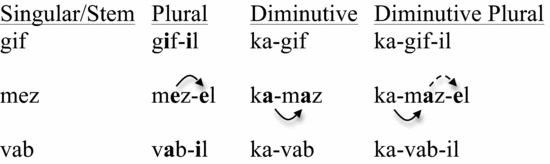
The grammar of this language has two types of word formation rules as depicted in Figure 1. Each participant was exposed to both types of rules in the same language. This contrasts with other studies exploring the acquisition of phonology and morphophonology, which generally focus on a single pattern (e.g., Finley, Reference Finley2008; Finley & Badecker, Reference Finley and Badecker2009; Wilson, Reference Wilson2006). The simple type, applicable to i-stems and a-stems, consists of concatenating the stems with the suffix [-il] and/or prefix [ka-] without changing any vowels. The complex type, applicable to e-stems, consists of concatenation plus changing vowels in the stem and affix. The changes reflect two phonological processes absent from English, the native language of the participants. First, vowel harmony changes vowels in the suffix so they have the same (jaw) height; the plural of [mez], “cow,” becomes [mez-el], “cows” (compare [gif-il], “horses”); second, reduction is triggered by the prefix [ka-] and changes the stem vowels (e.g., [ka-maz], “little cow”). When combined, they yield complex e-stem words (e.g., [ka-maz-el]) as contrasted with simple i-stem words (e.g., [ka-gif-il]).
Example words from the artificial grammar. Arrows point from the trigger to the target of a pattern. In the plural, the [e] in the stem [mez] changes the suffix to [el]. In the diminutive, the [a] in the prefix [ka-] changes the stem to [maz]. In the diminutive plural the two combine in a complex fashion: The suffix is still [el] even though the stem vowel has been changed to [a], which normally takes the suffix [il]. Bold indicates vowels that change due to a phonological pattern.

The forms are only complex in the diminutive plural form, because in the diminutive plural, the suffix is not determined by the final form of the stem (Bakovic, Reference Bakovic2007; Kiparsky, Reference Kiparsky and Fujimura1973). For example, comparing [ka-maz-el] “many little cows” to the diminutive plural of [vab], which is [ka-vab-il], it is not apparent what the generalization is for the suffix for words of the form [ka-_a_-].Footnote 1 This is not the case for any of the plural and diminutive forms where the same suffix is consistently used. That is, [_e_] words always receive the [-el] suffix, [_i_] words always receive the [-il] suffix, and in contrast with the diminutive plural, [_a_] words always receive the [-il] suffix.
This is distinct from patterns like the semiregular or irregular past tense in English (sing~sang; am~was) because the generalization can be consistently expressed as an exceptionless process. One way of doing so involves a four-part analogical relationship for extending the pattern to novel words: [pet]: [ka-pat-el]: : [_e_]: [ka-_a_-el] (Blevins & Blevins, Reference Blevins and Blevins2009; McCarthy, Reference McCarthy, Downing, Hall and Raffelsiefen2005). An [_e_] stem signals that the diminutive plural has the form [ka-_a_-el]. Ultimately, any formalization of the generalization involves reference to the original form of the stem, [pet]. By comparison, sing~sang does not necessarily entail that all similar words have the same past tense formation (e.g., bring~brought, king~kinged).
A native English speaker was recorded using Praat (Boersma & Weenink, Reference Boersma and Weenink2005) saying each of the stimulus forms spoken at a normal rate with English prosody and phonology so as to sound natural and fluent. Each word had a corresponding picture of an easily recognizable animal.
To avoid the possibility of a bias relating to which specific vowel is triggering the complex forms, two other versions of the experiment were created with 12 participants tested in each version. In the two other versions of the experiment, everything was identical as above except that the stimuli were modified such that the two other vowels (i, a) served as the indicator of complex forms. All stimuli for the main experiment are shown in Appendix A.
Procedure
Participants were simply told that they would be exposed to a new language and then tested on what they learned. They were given no instruction on the rules of the language or that there would be rules to learn. Auditory stimulus was presented over headphones. Visual stimulus (pictures of the words’ meaning) was presented via computer.
Training
Training consisted of exposure to word–picture pairings, with no feedback. The word for each picture was presented auditorily. During the 20 min of exposure, each participant was exposed to four repetitions of 12 of the nouns in all four forms for a total of 192 words, in random order. Four nouns were complex ([e]), 4 were simple ([i]) and 4 showed no alternation or harmony ([a]). For each exposure, a picture (of a large version of the animal, a small version of the animal, many large animals, or many small animals) was presented for 3 s. Five hundred milliseconds after the picture appeared, an audio clip naming the picture played for approximately 1 s. After the 3 s, the screen went blank for 500 ms and the next exposure began.
Test of untrained words
At the end of training, participants were tested on their ability to apply the grammar they learned to new words in a version of a wug test (Berko, Reference Berko1958). Used to assess grammatical knowledge, particularly in children, a wug test involves prompting participants with a new word (e.g., wug) then asking participants to produce the word with a modified meaning (e.g., wugs). Here, participants saw a new picture from the group of 18 withheld nouns for 1500 ms and heard the singular form of the corresponding new word. Following a blank screen (1 s), participants then saw a picture corresponding to the same noun but in a different form (e.g., first a lion, then many small lions). They were required to select from two heard alternatives for this second form. Participants recorded their responses using a button box, pressing a button labeled “1” if they thought the first item was correct or “2” is they thought the second item was correct. No feedback was provided. The plural, diminutive, and the diminutive plural forms of the 18 new nouns were tested in random order with the singular forms of the nouns used as the prompt. For plurals, the foil response used the opposite suffix, [-el]↔[-il]; for the diminutive, the foil used the opposite stem vowel ([a]↔[e]); for diminutive plurals, the foil used the opposite suffix, [-el]↔[-il]. Foils and correct responses were presented in a randomized order for each trial. Test items are in Appendix A.
Cognitive testing
To explore the relationship between memory and learning success, the same participants took a battery of standardized general cognitive tests. The tests included two subtests of the Woodcock–Johnson III Tests of Cognitive Ability (Woodcock, Mather, & McGrew, Reference Woodcock, Mather and McGrew2001): visual–auditory learning and auditory working memory. The Woodcock–Johnson is a widely used assessment of cognitive abilities, normed on a sample of 1,165 college and university students. The visual–auditory learning subtest is an assessment of declarative memory and involves learning picture–word associations. The pictures are abstract symbols; the words are common English nouns, verbs, adjectives, and function words. The auditory working memory subtest is an assessment of working memory requiring the reverse repetition of a heard sequence of numbers, increasing in length over the course of the experiment.
The assessment of procedural memory was done using a computerized version of the Tower of London (TOL) task. The task involves moving stacked balls around on pegs from a starting arrangement to a target goal arrangement. The balls are moved one at a time, and there are three pegs and three balls; as the test progresses, the minimum number of moves required to get from start to goal increases. Participants are told to think through their moves before using a computer mouse to manipulate the balls on the screen. To measure procedural learning, the same start–goal sequences are repeated later on in the test. Improvement in performance over time on these repeated sequences of moves is reflective of procedural learning (Phillips, Wynn, Gilhooly, Della Sala, & Logie, Reference Phillips, Wynn, Gilhooly, Della Sala and Logie1999; Vicari, Marotta, Menghini, Molinari, & Petrosini, Reference Vicari, Marotta, Menghini, Molinari and Petrosini2003). Unlike measures of procedural memory like the SRTT (Nissen & Bullemer, Reference Nissen and Bullemer1987), the TOL task is less dependent on motor skill and more closely relates to the learning of abstract sequences (Robertson, Reference Robertson2007). Each participant's score, reflecting improvement on the second repetition of sequences, was normalized relative to the rest of the group.
Control experiment
Participants
Eighteen (6 male, 12 female) native English speakers participated in the control experiment. Their mean age was 21.1 years (SD = 2.5), and all were students at Northwestern University and received monetary compensation.
Stimulus
The stimuli were identical to the test items in the main experiment.
Procedure
Participants were given just the test portion of the main experiment without any training. They were told they would be questioned about another language and that they should do their best to answer how they think the words should sound. Otherwise, the procedure was identical to that described in the Test of Untrained Words section.
RESULTS
Main experiment
As part of the experiment, participants were required to learn words reflecting simple patterns and words reflecting complex patterns. Therefore, there are four possible types of languages participants might acquire: one with both simple and complex patterns, one with just the simple pattern, one with just the complex pattern, or one with neither pattern. If what we establish as the more complex pattern is contingent on acquiring the simple pattern, we expect only three learner profiles will emerge, and no one will learn the complex grammar without learning the simple grammar.
We used a two-alternative forced-choice protocol to assess participants' ability to generate new words, with performance compared to chance (50%). We focus on performance for the diminutive plural words, except where noted, because these reflect the distinction between a simple grammar and a complex grammar. As described in the Methods section, diminutive plural complex forms are the only forms where the correct selection of the suffix is not determined by the final form of the word (Bakovic, Reference Bakovic2007; Kiparsky, Reference Kiparsky and Fujimura1973). We contrast performance on the diminutive plural complex forms with the diminutive plural simple forms because this controls for number of syllables and word length. We do consider performance on all the other noncomplex forms. Finally, the foil response for the complex diminutive plurals is a word reflecting the simple grammar. Therefore, if participants only learned a simple grammar and applied the simple grammar to complex words, then they will perform significantly below chance on complex words but above chance on simple words.
Participants performed the same across the three different vowel versions of the language, 55% (SD = 0.22) for i-complex, 53% (SD = 0.28) for e-complex, and 55% (SD = 0.26) for a-complex; F (2, 35) = 0.097, p = .91, so the three languages are grouped together for the analyses.
The distribution of performance on complex items is not normal (Shapiro–Wilk test of normality, W = 0.93, p = .02), so nonparametric statistics and nonparametric effect sizes are used (Wilcoxon signed rank test [W, nonparametric t test], Kruskal–Wallis test [H, nonparametric analysis of variance], Spearman ρ [nonparametric correlation]).
Simple pattern
Participants performed above chance (69%; z = 2.8, p = .002, r = .47) on words requiring generalization of simple patterns for diminutive plural words.
Complex pattern
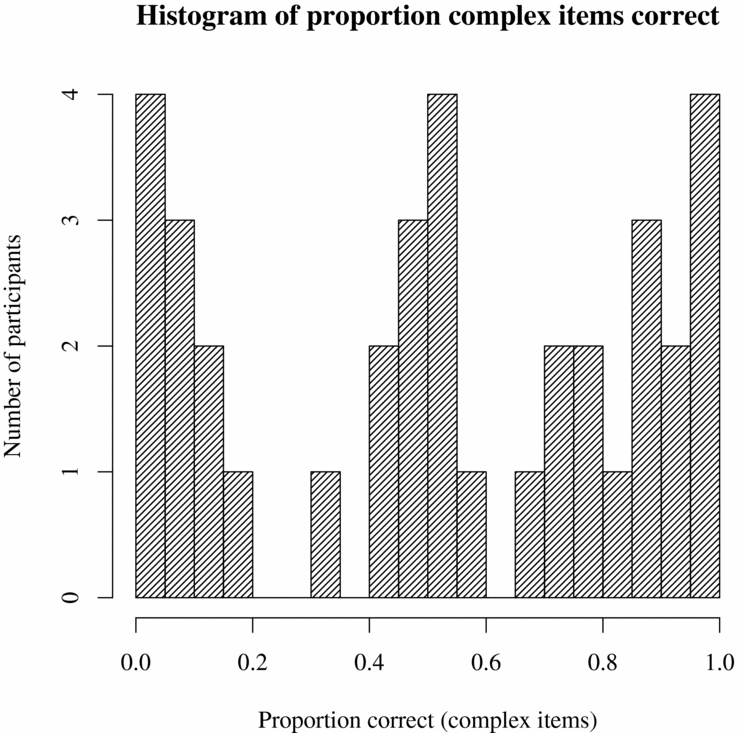
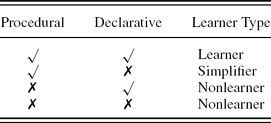
Performance was not different than chance (53%; z = 1.1, p = .84, r = .18) on complex words. We can consider individual variation by dividing participants into those above chance (learners), those below chance who preferred the simple foil on the complex words (simplifiers), and those who are neither (nonlearners). This division is suggested by the nonnormality reported above and the histogram of performance on complex items (Figure 2). The distribution reflects three peaks, one around 100%, a second around 0%, and a third around chance (50%). There were 13 learners, 11 nonlearners, and 12 simplifiers by this criterion.
Histogram of percentage of complex words answered correctly. The distribution suggests there are three distinct groupings of learning success.
By group, learners and simplifiers both performed significantly above chance on simple words (76% and 79%, respectively, z = 1.8, p = .002, r = .50; z = 1.9, p = .004, r = .55) and not significantly different from each other (z = 0.07, p = .35, r = .01). Nonlearners were not significantly above chance on simple words (52%, z = 0.19, p = .57, r = .06). No single participant acquired the complex pattern without acquiring the simple pattern. This suggests that acquiring the simple pattern is a precursor to acquiring the complex words and supports the idea that those who performed below chance on complex words did not fail to acquire a grammar but acquired a simple grammar.
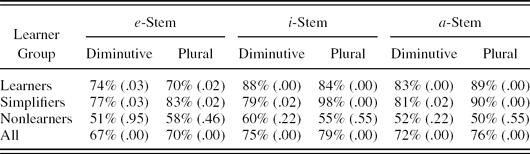
Performance on plural words and diminutive words is presented in Table 1. Overall, participants were successful in learning the generalizations associated with the plural and diminutive words, although only learners and simplifiers acquired the generalizations for the plural and diminutive forms whereas nonlearners did not. This is consistent with performance on the simple diminutive plural forms.
Performance on diminutive and plural test forms for untrained items by group
Note: The values in parenthesis are p values showing that performance is different than chance.
Participants performed better overall on i-stems and a-stems than e-stems (77% and 74% vs. 68%; z = 1.9, p = .005, r = .32); there was no significant difference between diminutives and plurals (71% vs. 74%, z = 0.30, p = .61, r = .05) or between i-stems and a-stems (77% vs. 74%; W = 320, Z = 0.15, p = .71, r = .03).
Relation between language learning and memory
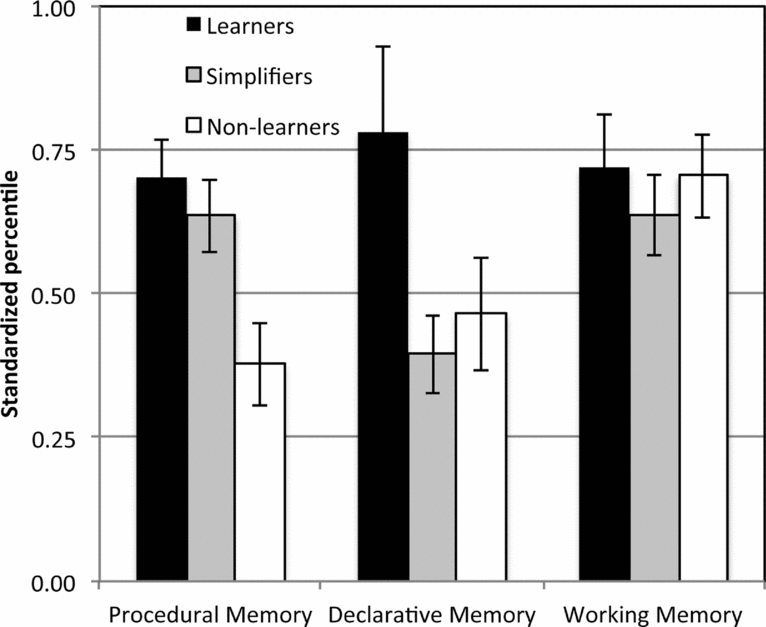
A nonparametric analysis of variance shows a significant difference in procedural memory, H (2) = 19, p < .001, and in declarative memory, H (2) = 21, p < .001, by learner type (Figure 3). Working memory is not significantly different between learner groups, H (2) = 2.7, p = .26. Therefore, there is no evidence that working memory or general intelligence (Ackerman, Beier, & Boyle, Reference Ackerman, Beier and Boyle2005) is driving variance in language learning in this case.
Performance on cognitive tests by learner type. Error bars indicate standard error.
Procedural memory
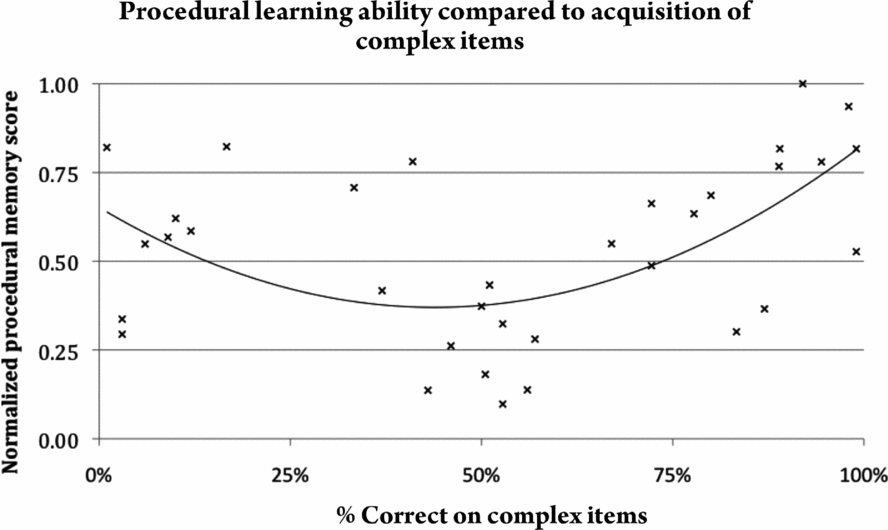
Post hoc comparisons of procedural memory as assessed by performance on the TOL task show that learners and simplifiers are better than nonlearners (z = 2.1, p = .02, r = .43; z = 2.1, p = .02, r = .43, respectively) and that learners and simplifiers are not different from each other (z = 1.1, p = .86, r = .22). There is a significant correlation between procedural memory and performance on simple words across all groups, ρ (35) = 0.52, p < .001, after Bonferroni correction for multiple comparisons (p < .0083 here and for subsequent corrections for multiple comparisons, which is calculated based on correlations for three memory types for two conditions). No correlation is found between procedural memory and percentage correct on complex words because being below chance does not reflect poorer performance but reflects the acquisition of a simpler grammar. Instead, a second-order regression of complex learning to procedural memory is significant, ρ (35) = 0.39, p < .001 (Figure 4). Participants with high procedural memory generally performed significantly above or below chance on complex items, whereas those with low procedural memory generally performed around chance. Among learners, the correlation between complex learning and procedural memory is marginally significant, ρ (12) = 0.47, p = .10.
Performance on test of procedural memory (Tower of London score) as compared to performance on complex items. The results show that participants with high procedural memory either succesfully learn the complex pattern or simplify the pattern, performing below chance.
Declarative memory
Learners scored higher than simplifiers and nonlearners in the test of declarative memory (z = 2.6, p = .003, r = .51; z = 2.5, p = .005, r = .51). Nonlearners and simplifiers do not differ significantly (z = 2.7, p = .46, r = .55). If simplifiers are ignored as discussed above, there is a significant correlation between declarative memory and performance on complex words after correcting for multiple comparisons, ρ (24) = .80, p < .001: The better the participants' declarative memory, the better they were able to acquire the complex pattern. This was also true among just learners, ρ (12) = 0.63, p = .02, which is marginally significant after correcting for multiple comparisons. A second-order correlation across all participants, which accounts for the below-chance performance of the simplifiers, is also significant, adjusted r 2 = 0.55, F (1, 34) = 20.5, p < .001. There was no significant correlation between declarative memory and performance on simple words for any of the groups (e.g., for all, adjusted r 2 = 0.02, p = .50).
Other word forms
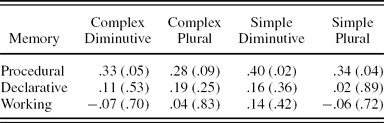
Performance on diminutive forms was 74% for simple words and 69% for complex words; performance on plural forms was 76% for simple words and 69% for complex words. All are significantly above chance (z = 4.2, p < .001, r = .59; z = 2.4, p = .02, r = .38; z = 3.7, p = .001, r = .53; z = 2.9, p = .006, r = .44, respectively). A complexity × word form nonparametric analysis of variance shows no significant main effects or interactions for the diminutive and plural test items, complexity: H (1) = 1.9, p = .17; word form: H (1) = 0.2, p = .66; interaction: H (3) = 2.1, p = .55. Correlations of performance on plural and diminutive words with procedural memory are significant or marginally significant but are not significant with declarative memory or working memory (Table 2). This confirms the general finding that procedural memory supports the acquisition of simple patterns since diminutive and plural forms require the application of a simple generalization.
Correlations (r) for performance on simple and complex diminutive and plural forms with measures of procedural, declarative, and working memory
Note: The values in parentheses are p values showing whether the correlations are significant.
Summary
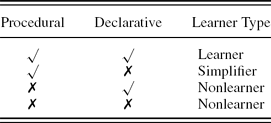
Juxtaposing the different groups' performance on the memory tests with the grammars they acquired in the language highlights a number of relationships between memory and L2 learning. The results suggest that declarative memory is associated with acquiring the complex pattern, whereas procedural memory is associated with the acquisition of both simple and complex patterns. Learners who acquired both have better declarative and procedural memory; simplifiers, who acquired the simple but not complex pattern, have better procedural memory but not declarative memory; and nonlearners demonstrated decreased performance on both memory tasks.
Using procedural and declarative memory to predict group membership via linear discriminant analysis correctly categorizes 89% of participants (32 of 36), as shown in a partition plot (Figure 5). This scatterplot of participants based on their procedural and declarative memory scores provides a profile of different learner types. Those with high procedural and declarative memory scores are primarily learners. Those with high procedural, but not declarative, memory are primarily simplifiers. Those with poor procedural memory are nonlearners, regardless of declarative memory (Table 3).
Partition plot showing performance on procedural (x axis) and declarative (y axis) memory tasks; letters indicate language learning group (L, learners; N, nonlearners; S, simplifiers). The red letters in the online-only version indicate incorrectly categorized participants (4 of 36) for a correct rate of 89%. [A color version of this figure can be viewed online at http://journals.cambridge.org/aps]
Summary of relationship between cognitive abilities and acquiring complex morphophonology
Control experiment
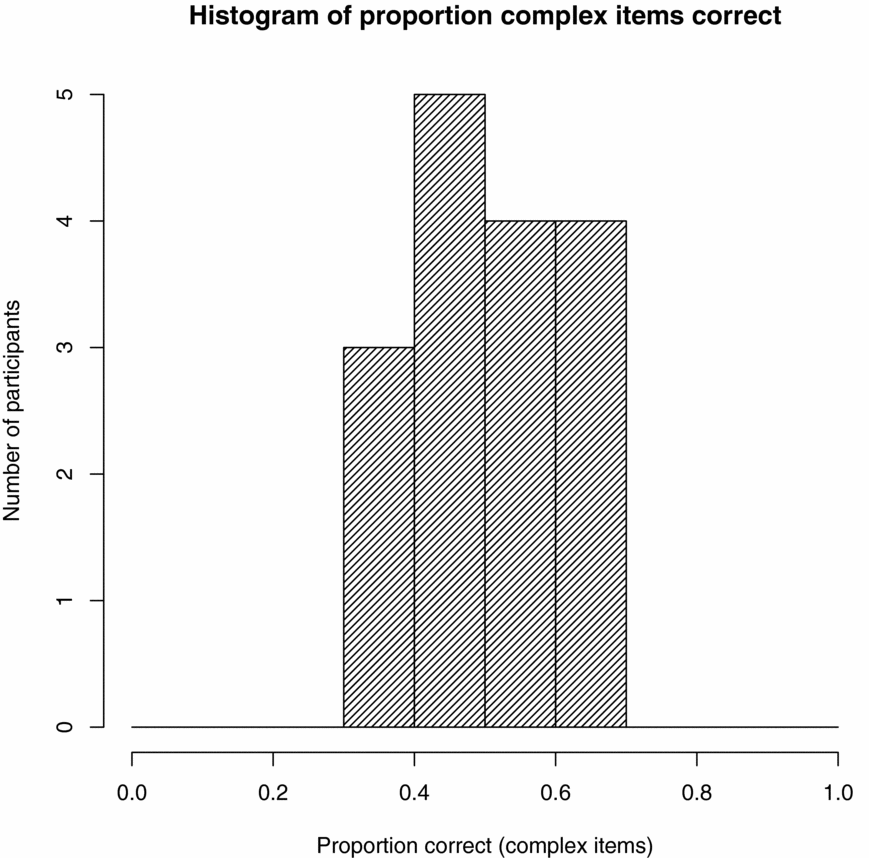
In a control experiment, a new set of participants was only given the test of untrained words without any training. These results establish whether the test items are biased toward a right or wrong answer or whether participants learn from testing alone (Redington & Chater, Reference Redington and Chater1996). A histogram of performance on complex words is shown in Figure 6, and the results are not different than normal (Shapiro–Wilk test of normality, W = 0.95, p = .56).Footnote 2 Participants were not significantly different from chance for simple or complex words (50%, z = 0.84, p = .81, r = .22; 51%, z = 1.2, p = .59, r = .31, respectively) and the distribution of learners, simplifiers, and nonlearners differed significantly between the main experiment and the control, χ2 (5, N = 54) = 30.2, p < .001.
Histogram of proportion correct for complex items for participants in the control experiment.
There are no significant correlations between performance on this test and any of the memory measures. This is true for complex words, procedural: ρ (17) = –0.13, p = .61; declarative: ρ (17) = 0.08, p = .75; and working: ρ (17) = 0.04, p = .89). It is true for simple words, procedural: ρ (17) = –0.21, p = .39; declarative: ρ (17) = 0.01, p = .97; and working: ρ (17) = 0.19, p = .45. Furthermore, it is also true for diminutive plural words, procedural: ρ (17) = 0.03, p = .90; declarative: ρ (17) = –.014, p = .57; and working: ρ (17) = –0.28, p = .26.
Finally, there are no significant differences between memory measures for the participants of the main experiment and the participants of the control, main effect of experiment: H (2) = 0.05, p = .82; interaction of experiment and memory test: H (2) = 4, p = .14. The differences between these results and those of the main experiment suggest that the results of the main experiment reflect the impact of learning. They are not artifacts of the test items nor do they stem from learning during testing (Redington & Chater, Reference Redington and Chater1996).
DISCUSSION
In the present study, we explored variation exhibited in L2 learning. We considered the case of morphophonological grammar and asked whether its acquisition is supported by different memory subsystems. We also tested for differences between acquiring a complex morphophonological grammar and a simple morphophonological grammar.
Our results show that language learners can generalize the complex pattern to novel words but that it is harder to acquire the complex pattern than the simple pattern. Two thirds of participants did not learn (nonlearners) or represented the complex pattern as a simple grammar (simplifiers) in response to our laboratory-based training program. This is a novel finding becausse only the acquisition of simple morphophonological generalizations has been shown previously (e.g., Finley, Reference Finley2008; Finley & Badecker, Reference Finley and Badecker2009; Wilson, Reference Wilson2006).
Furthermore, because some participants learned the simple, but not complex, pattern whereas no participants learned the complex, but not simple, pattern, these results coroborate resesarch on phonological markedness and acquisition (Eckman, Elreyes, & Iverson, Reference Eckman, Elreyes and Iverson2003; Jakobson, Reference Jakobson1941). This previous research has shown that more marked, or complex, segments and syllables are learned subsequent to simpler segments and syllables for both first (Jakobson, Reference Jakobson1941) and second (Eckman et al., Reference Eckman, Elreyes and Iverson2003; Eckman, Moravcsik, & Wirth, Reference Eckman, Moravcsik and Wirth1983) language learners. In the present study, we also show that the same principle applies at the level of morphophonological grammar: The acquisition of the complex pattern entails the acquisition of the simple pattern, but not vice versa. Further research may further corroborate this finding by showing that a simple–complex order of acquisition for morphophonology is present in natural language learning as well.
As expected, there was also considerable individual variation in learning success among the participants. We found that a significant amount of this variation in learning success is accounted for by measures of domain-general cognitive function. Because there is a correlation between performance on the declarative and procedural memory tests and performance on the language learning task, there is likely a common underlying ability supporting these processes. Because working memory does not correlate and because of the disociation between simple grammar and complex grammar, it suggests that this underlying ability is not general intelligence or attentional resources (Ackerman et al., Reference Ackerman, Beier and Boyle2005).
Measures of procedural memory correlate with success at learning simple, sensorimotor based phonological patterns. In addition to supporting combination in syntax (Ferreira, Bock, Wilson, & Cohen, Reference Ferreira, Bock, Wilson and Cohen2008), procedural memory may support combination in morphophonology. This is in line with a broader conception of procedural memory as supporting the ability to track dependencies among units (Christiansen & Chater, Reference Christiansen and Chater2008).
Conversely, measures of declarative memory, and to a lesser extent, procedural memory, correlate with success at acquiring complex patterns. This suggests that declarative memory plays a crucial role not only in word learning (Damasio et al., Reference Damasio, Grabowski, Tranel, Hichwa and Damasio1996) but also in grammar learning. Previous work has argued that declarative memory is crucial for early stages of L2 learning through the memorization of large chunks of speech (Tomasello, Reference Tomasello2003; Ullman, Reference Ullman and Sanz2005).
Because participants were forming novel words via a wug test, and not recalling memorized words, an alternate hypothesis is that declarative memory may be storing morphophonological paradigms. For example, in the present study, participants must recall the singular stem to learn complex diminutive plural forms because the stem determines the correct affix. When encountering [ka-maz-el], the learner must recall from declarative memory the stem, [mez], to make sense of the [-el] suffix. This use of related forms, or paradigms, is often understood as a type of analogy and has been suggested as a potential linguistic explanation for this particular type of complex morphophonological grammar (Blevins & Blevins, Reference Blevins and Blevins2009; McCarthy, Reference McCarthy, Downing, Hall and Raffelsiefen2005). Declarative memory has been proposed as supporting nonlinguistic analogical relationships (Eichenbaum & Cohen, Reference Eichenbaum and Cohen2001; Shohamy & Adcock, Reference Shohamy and Adcock2010), providing further corroborating evidence for this proposal.
This hypothesis broadens our understanding of dual-route models of language, which argue that regular words (e.g., pull~pulled) are processed via rule and irregular words (e.g., am~was) are memorized. These regular and irregular forms are argued to be supported by procedural and declarative memory, respectively, and generalization to novel words involves the application of the rule (e.g., wug~wugged; Ullman, Reference Ullman2004). In this experiment, participants were able to generalize the complex pattern to new words reflecting a regular pattern but not of the am~was type, suggesting another type of grammatical pattern that is not rule based, but analogical in nature. Thus declarative memory may play an important role in learning complex, analogy-based patterns (Shohamy et al., Reference Shohamy, Myers, Hopkins, Sage and Gluck2009; Ullman, Reference Ullman and Sanz2005).
Finally, these results provide insight into the acquisition of the complex phonology used in the experiment. These words are referred to as opaque (Kiparsky, Reference Kiparsky and Fujimura1973) because the phonological interactions make a consistent pattern difficult to discern. Although English does not have any clear examples of opaque words, it is a common phenomenon across languages of the world (Ettlinger, Reference Ettlinger2008). The acquirability of these patterns may be called into question because it is conceivable that learners simply store all the words of their language in memory, without acquiring a phonological grammar to generate them (Bybee, Reference Bybee2007). Furthermore, the production of opaque words by L2 learners has not been studied. If opaque words cannot be acquired by L2 learners, this would lend support to the idea that their acquisition is dependent on a domain-specific module available only during a critical period (cf. Kuhl, Reference Kuhl2000; Lenneberg, Reference Lenneberg1967). Experimental studies addressing opaque phonology have been undertaken on a small scale with mixed results (Al-Mozainy, Reference Al-Mozainy1981; Ettlinger, Reference Ettlinger2008). Here, we show that some adult learners can acquire opaque words with limited exposure, but participants are not successful in acquiring the pattern overall, in accordance with the idea that opaque words are marked (Kiparsky, Reference Kiparsky and Fujimura1973).
These findings also raise a number of interesting questions. It is unclear whether manipulation of some of the factors discussed above, such as type or duration of training, can improve performance for the nonlearners and simplifiers. Further research can also show whether all L2 learners can acquire this pattern, or whether some L2 learners are never able to learn opaque relationships. Morphophonological grammar (as opposed to the study of phonology as just the sounds themselves) has generally been understudied with respect to L2 acquisition and may reflect an area of persistent difficulty for L2 learners.
Further research may also show whether these findings apply to first language (L1) acquisition. Although research has suggested a close relationship between artificial grammar learning and natural language learning (Robinson, Reference Robinson2010), others have argued that L2 is differentiated from L1 learning by its reliance on domain-general cognitive abilities (Williams, Reference Williams2005). Research into L1 acquisition will ultimately provide insight into this relationship. Given children's superior procedural memory relative to their declarative memory (Greenbaum & Graf, Reference Greenbaum and Graf1989), we might expect that children will overgeneralize the simple pattern more often than adults. Furthermore, because others have shown that the locus of grammatical processing may shift with greater automaticity from declarative to procedural (Opitz & Friederici, Reference Opitz and Friederici2003), the role that declarative memory played in our study may evolve into a greater reliance on procedural memory over time. Exploring whether this occurs requires a longitudinal study of the acquisition of complex words.
CONCLUSION
Our results show that a significant portion of variation in L2 learning of a morphophonological grammar can be accounted for by domain-general memory ability. These data present a picture of language learning where procedural memory supports the acquisition of all grammatical patterns, whereas declarative memory supports the acquisition of complex patterns. Individual variation in working memory plays a role in neither.
In addition to furthering our understanding of variation in L2 learning, these findings have broader implications for our understanding of language as a whole. Recent work on English has made considerable progress in uncovering the neural and cognitive bases of how language is learned (Hagoort & Levelt, Reference Hagoort and Levelt2009; Sahin, Pinker, Cash, Schomer, & Halgren, Reference Sahin, Pinker, Cash, Schomer and Halgren2009). However, these models are limited by the extent of English phonology, which is relatively simple compared to other languages. Our study fills this gap in our understanding by exploring what is involved in acquiring a complex morphophonology (see also Bertram, Laine, Baayen, Schreuder, & Hyona, Reference Sahin, Pinker, Cash, Schomer and Halgren2000). We suggest that, although not unique to language, acquiring complex morphophonology still requires an interaction between higher order cognitive processes beyond simply the resolution of sensorimotor constraints. Other aspects of morphophonology may yet prove to be unique to language function, but these data suggest that the most complex aspects of morphophonology are supported by domain-general memory systems. Whereas the specific combination of these capabilities for learning morphophonology is unique to language (i.e., no other system combines the categorical perception of sound, procedural learning of sound patterns, and declarative learning of complex patterns), the subcomponents are associated with multiple cognitive domains.
APPENDIX A
Stimulus and test and foil stimulus used in the main and control experiments
Words for the e-opaque language with i as the default suffix (with vowel harmony) and a as the diminutive
Stimulus words for the i-opaque language with a as the default suffix (with high vowel harmony) and e as the diminutive
Stimulus words for the a-opaque language with e as the default suffix (with low vowel harmony) and i as the diminutive
ACKNOWLEDGMENTS
The authors thank Lionel Newman for assistance in editing the manuscript. The first author acknowledges the financial support of the NIH (T32 NS047987); and the last author acknowledges the financial support of the National Science Foundation (BCS-1125144), the National Institutes of Health (R01DC008333, K02AG035382), and Northwestern University. The funders had no role in study design, data collection, and analysis; the decision to publish; or preparation of the manuscript.