1. The puzzle of ineffectiveness
As in other democracies with mixed electoral systems, campaigns for the National Diet in Japan are conducted in parallel on two levels. Since its reform in 1993/94, the electoral system of the House of Representatives (HR, shūgiin) features 300 single member districts (SMD) in which individual candidates are at the center of electoral campaigns, and proportional representation in 11 multi-member districts in which parties try to win support for their set lists of candidates.Footnote 1 The electoral system of the House of Councilors (HC, sangiin) features a nationwide constituency in which 48 candidates are elected by proportional representation, while 73 seats are assigned according to plurality rule in 29 single-member, 12 two-member, five three-member, and one five-member districts (average district size: 1.55).Footnote 2
Since the 1990s, several electoral reforms have induced considerable change in the ways campaigns are conducted for both Houses of the National Diet. With the introduction of the present electoral system to the HR, for example, parties began to use TV spots and produce manifestos (manifesuto) to appeal to voters, a change that spilled over to HC campaigns and reflected a shift in electoral significance from individual candidates to parties (Maeda, Reference Maeda, Reed, McElwain and Shimizu2008). SMDs now force candidates to appeal to a broader group of voters, a change that is reflected in the workings of the kōenkai, the personal support organizations which have become increasingly important in terms of appealing to non-partisan voters (Krauss and Pekkanen, Reference Krauss and Pekkanen2004). The introduction of an open party list to the HC made it easier for candidates to campaign for organized votes in the nationwide district (Köllner, Reference Köllner2003).
At the same time, however, major characteristics of street campaigns in plurality districts have persisted because basic competitive structures and respective legal regulations have mostly remained unchanged. Campaign instruments available to candidates in the HR's SMDs and the plurality districts of the HC are quite similar to each other and to those that existed under the former HR system.Footnote 3 Some of the major ones are (i) delivering speeches in front of train stations (at ground level or elevated on top of campaign cars), amplified by megaphones and framed by waving campaign staffers; (ii) passing through shopping streets or across public places with flags and megaphones, shaking hands with shop owners and passers-by; (iii) standing at major roads, waving at passing cars; or (iv) driving in a campaign car, repeating the candidate's names through loudspeakers mounted on the car roof.Footnote 4
While the content of speeches certainly has changed and party policies as well as programs have grown in importance (see Reed et al., Reference Reed, Scheiner and Thies2009), the tools for street campaigns in plurality districts have remained largely the same. Surprisingly, this holds also true for a number of apparently ineffective campaign strategies. Observers of election campaigns in Japan are familiar with scenes in which candidates deliver energetic speeches in front of train stations without any of the passers-by listening. Sometimes, campaigners even address empty public spaces in the pouring rain or use their megaphones to deliver their messages to the closed windows of multi-storey apartment buildings. These and other activities leave the observer baffled as to the reason why politicians and their teams would conduct such an apparently ineffective campaign. At the same time, those familiar with campaigns in other countries often point to strategies not employed in Japan that are considered to have a greater impact on voters. One frequently mentioned example is canvassing; another tool conspicuously absent from Japanese campaigns is discussing policies with passers-by in shopping areas and other public places.
The reason, however, why some campaign instruments are not seen in Japan is simple: The Public Office Election Law (Kōshoku senkyo-hō) – a set of legal parameters that regulates the activities of parties and candidates in their efforts to win votes – prohibits many tactics commonly applied in other democracies. The law has been revised and tightened many times since its enactment in 1950 and has become so all-embracing that the majority of candidate activities are regulated in some way or other. When officially registering their candidacy, politicians receive a manual containing detailed explanations on the various prohibitions. Even bookstores carry titles on the topic.Footnote 5
In his seminal study of Japanese campaigning, Curtis (Reference Curtis1971) was one of the first to point to the restrictive character of the election law in explaining Japanese campaign styles, and it may well be because of this explanation that the question of why Japanese election campaigning often seems (and possibly is) ineffective has hardly been pursued any further. Later studies that dealt with electoral campaigning hardly examined the question of micro-level effectiveness but focused on structural adaptation of support organizations (Isao, Reference Isao and Ōtake1998; Ōtake, Reference Ōtake1998; Köllner, Reference Köllner2003), personal cooperation at the district level (Park, Reference Park and Ōtake1998, Reference Park2000), party cooperation (Christensen, Reference Christensen2000; Johnson, Reference Johnson2000), or the macro-level impact of the new rules that came alongside electoral reform in 1993/94 and made elections more issue-oriented and party-centered (Christensen, Reference Christensen1994; Reed, Reference Reed1995; Reed and Thies, Reference Reed, Thies, Soberg Shugart and Wattenberg2001; Saitō, Reference Saitō1995; Wada, Reference Wada1996; Yasuoka, Reference Yasuoka1996; Katō, Reference Katō1997, Reference Katō2003; Fukui and Fukai, Reference Fukui, Fukai, Grofman, Lee, Winkler and Woodall1999; McKean and Scheiner, Reference McKean and Scheiner2000; Krauss and Pekkanen, Reference Krauss and Pekkanen2004; Horiuchi, Reference Horiuchi2005). One exception has been the research of Dabney (Reference Dabney, Martin and Steel2008) who conducted a longitudinal study of campaign strategy change. In Section 4, some of his findings will be compared to those of this study.
Restrictive laws can only explain one type of apparent ineffectiveness, namely the limited set of available campaign tools. The second type consists of suboptimal selection and employment of legally allowed electoral strategies and instruments. One of many examples are candidates and their teams greeting passing cars at busy street crossings without providing sufficiently clear visuals that would identify the candidates name. Teams addressing commuters at train stations with lengthy speeches, which are mostly lost on the hastening audience, constitute another example. Observations such as these have been made during campaigns in both the old and the present electoral system of the HR as well as in plurality districts of the HC (Fukuoka, Reference Fukuoka1997; Katō, Reference Katō2003). While other elements of electoral campaigning have disappeared or been adapted to new electoral rules, the phenomena of the apparent ineffectiveness in street campaigning have largely remained the same. The simple question that triggered this research therefore was: Why? The following sections will first introduce the method and theoretical approach applied to find answers to this question and then discuss the results.
2. Method
In order to collect potential empirical evidence for ineffective campaigning, I conducted extensive participant observation during two election campaigns. Once several instances of apparently ineffective campaigning had been identified, I conducted semi-structured interviews with 20 practitioners, consisting of candidates, local politicians, and staff members in order to find out about the purpose and the assumed effectiveness of campaign instruments. ‘Micro-ethnographic’ may be an appropriate term for this method. While ethnographic studies often entail periods of one to three years spent with research subjects, the time I spent on the campaign trail was restricted to those 17 days (HC election in 2007) and 12 days (HR election in 2009) during which the election campaigns were conducted. As there were no legal possibilities to actively participate in the campaigns, my role was restricted to what Gold (Reference Gold1958) termed the ‘observer-as-participant’ status.
Sample
The major selection criterion for my sample of electoral districts was to cover the main competitive constellations. During the 2007 HC election, I chose the multi-member district of Tōkyō, in which 20 candidates competed for five seats. The then ruling Liberal Democratic Party (LDP, jiyū minshutō) fielded two candidates, Marukawa Tamayo and Hosaka Sanzō, as did the then-opposition Democratic Party of Japan (DPJ, nihon minshutō) with Suzuki Kan and Okawara Masako. The three smaller parties represented in the National Diet fielded one candidate each: Yamaguchi Natsuo ran for Kōmeitō (Clean Government Party), Sugiura Hitomi for the Social Democratic Party (SDP, shakai minshu tō), and Tamura Tomoko for the Japan Communist Party (JCP, nihon kyōsantō). Smaller parties also participated in the campaign, as did some independent candidates. In the 2009 HR election, I selected two SMDs. Kanagawa 6 had a Kōmeitō candidate (Ueda Isamu) battling his DPJ opponent (Ikeda Motohisa). In Kanagawa 8, the incumbent (Eda Kenji) from the ‘Your Party’ (YP, mina no tō) fought both LDP (Fukuda Mineyuki) and DPJ (Yamazaki Makoto) opponents. In both SMDs, one candidate each from the new ‘Happiness Realization Party’ (HRP, kōfuku jitsugentō)Footnote 6 competed (Kojima Hiroyuki and Terashima Hiroya). These two were interesting for this research since neither they nor their party had any experience of conducting an election campaign.
During both research periods, I tried to observe campaigns of the politically prospective actors, meaning all candidates from the Liberal Democratic Party, the Democratic Party of Japan, Kōmeitō, and, in the case of Kanagawa 8, the incumbent candidate Eda Kenji. For the control group, I observed a number of candidates who were running without any realistic chance of winning a seat, but, as I will explain later, often tried innovative or at least unusual campaigning tools. These uncommon tactics and the impact they may have on campaigning in general will be addressed later in this article.
Four caveats are significant with regard to my participant observation. First, due to the character of the situations that I observed, there was hardly any danger of reactive effects on my research subjects. As campaigners were addressing an audience and I kept in the background, there was neither the incentive nor the opportunity for them to change their performance because of my presence. I recorded most of the campaign speeches either on audio recorders or video. Second, although the repetitive way in which all election teams applied their instruments made me confident that I succeeded in gathering a sufficiently comprehensive data set on each campaign, I cannot exclude the possibility that I missed seldom-used tactics. Because I was conducting my field research alone, that risk was unavoidable. Third, only urban electoral districts were included in this study. As rural campaigning is different, my results cannot be applied to all of Japan. Finally, during my research I was perfectly aware of the fact that candidates are appealing to voters in an indirect way all year long. Taking care of their electoral district is a crucial element in the work of any politician. When election time draws near, they and their kōenkai intensify their efforts, many of which take place indoors and are not accessible to the public. This pre-campaigning, however, is not part of my research and it does not impair the value of my results. After all, the main question concentrates on the effectiveness of and reasoning behind street campaigning during the official election period, not on the wider effort made to win votes.
Interviews
In dealing with Japan's political system, interviewing is generally an underused tool. One practical set of reasons for this state of affairs includes the difficulty of gaining access to experts, especially national lawmakers and other members of the political elite. A second cause can be found in theories that favor structure and ontological assumptions of rational actors who behave alike under similar circumstances. A third reason is based on heightened alert regarding the subjectivity involved with qualitative interviews (Rathbun, Reference Rathbun, Box-Steffensmeier, Brady and Collier2008). There is no way to eliminate these basic methodological and theoretical concerns. However, in this study the advantages of interviewing clearly outweigh the skepticism because there is no better methodological tool to understand the ideational factors that affect actors (Aberbach and Rockman, Reference Aberbach and Rockman2002). For research questions like the one posed in this article, there simply is no satisfying alternative.
In the course of my research, opportunities to access politicians came and went depending on the general political situation. As rumors regarding the dissolution of the HR were quite numerous, lawmakers were often not available or postponed interview appointments. In the end, I conducted 12 interviews with candidates themselves (two of which had campaigned outside of the Tōkyō/Kanagawa area), four interviews with members of campaign teams, and four interviews with local politicians who supported candidates in their campaign for a seat in the National Diet. In addition, there were numerous occasions in which I simply conversed with campaigners. All formal interviews lasted between 30 and 60 minutes.Footnote 7 In order not to delimit unnecessarily the field of inquiry, I had conducted three pilot interviews with campaign staffers ahead of the 2007 election campaigns.
Based on these three preliminary interviews, on previous observations of election campaigns and on expert literature I constructed a semi-structured questionnaire. It began with a general inquiry into the sources from which practitioners had gathered information regarding election campaigns in general, and the effectiveness of strategies and instruments in particular. A further question addressed the people who contributed experience and knowledge to the preparation and execution of the campaign. Based on the answers it was then possible to add questions regarding the execution and assumed effectiveness of actually employed campaign instruments. I addressed instances of apparent ineffectiveness in the campaigns and ask for the practitioner's comment.
Observing former campaigns and my preparatory work had repeatedly made clear to me that campaign activities do not only have an effect on voters, but also on campaign members themselves. In order not to ignore this impact, I also added questions regarding the motivation of campaign teams. This part of the interview would also include questions regarding local politicians who in most cases temporarily joined the campaigns of party colleagues. Accordingly, the key questions were as follows:
1. Where does your knowledge about how to conduct an election campaign come from?
2. When preparing your campaign strategy, who do you cooperate with and how?
3. Are you aware of any empirical studies regarding the effectiveness of campaign instruments?
4. What is your impression regarding the effectiveness of electoral campaigning?
5. How does your campaign performance affect your team? How do you motivate your staff?Footnote 8
6. What is the function of local politicians when they join the campaign effort?
Although in qualitative research it is generally preferable to record and produce full transcriptions of interviews, I decided against it. Considering my research interest, it seemed more important not to disconcert interviewees and to allow for an unconstrained, informal atmosphere in order to elicit as many open comments as possible. In addition, my former experience in recording interviews with politicians had taught me that in many cases the frankest information comes between turning off the recorder and leaving the politician's office (see Parker, Reference Parker2000: 236).
3. Theoretical approach
A theoretical framework that seems appropriate for this kind of research is the structural learning theory put forward by Reed (Reference Reed1993). Its core assumption is that the connection between structure and behavior is learning. Actors within a predetermined, stable structure should, in individual learning processes, move toward a type of behavior that represents the outcome of numerous attempts to draw the most benefit from the potential options. The structural learning theory makes no assumptions regarding the preferences of actors except that ‘participants value the commodity being allocated and are capable of adjusting their behavior to avoid disaster and to seek success’ (Reed, Reference Reed1993: 49). Considering the many decades that campaigning in plurality districts has been conducted in Japan, the question of why many instances of ineffectiveness can still be observed today is of particular interest.
As explained above, before turning to this question, it had to be ascertained that the assumption of ineffectiveness was correct and not the result of the observer's blurred understanding of campaign activities. Indeed, not all campaign tactics immediately reveal their rationale. For example, standing at crossroads of major streets and waving to passing cars could be considered ineffective as there would seem to be places where voters can be reached better. Candidates, however, know that not all voters in their district commute by train, so in order to reach those who travel to work by car, campaigners feel compelled to apply this instrument. Identifying potential evidence for ineffectiveness in plurality campaigning was therefore the first task of my research; the second was to verify this evidence. If the evidence proved the assumption wrong, I would learn about another rationale behind a certain campaign instrument. If verification was positive, the question was why practitioners would employ or execute ineffective campaign instruments and why the assumptions of the structural learning theory seemed to be refuted.
4. Results
The following paragraphs present the three most frequent types of assumed ineffective campaigning observed, with the first resulting from weather conditions. Both election campaigns took place in the summer, which in the urban areas of Tōkyō and Kanagawa can be physically taxing. Still, many candidates conducted policy speeches in the midday sun in front of train and subway stations or next to busy roads. Their audience was scant: only a few people passed the campaign teams and hardly anyone stopped to listen. In Tōkyō's Shimokitazawa, for example, Nakamura Keiichirō, candidate for the People's New Party (PNP, kokumin shintō), delivered a policy speech, standing in the sun in front of the train station. A thermometer at a nearby building read 38C. Only four passers-by stopped and listened for less than a minute. Other candidates were hardly more successful when they delivered speeches outdoors on hot or rainy days.
During the 2007 HC-election, Hosaka Sanzō (LDP) had parked his campaign truck next to a covered shopping street called ‘Sun Mall’ in Tōkyō's Nakano. Four local LDP politicians were standing on his campaign truck, taking turns to deliver speeches of about three to five minutes. Although the number of passers-by was clearly larger than in Shimokitazawa, and some smokers were standing at a public ashtray not far from the campaign truck, only a handful of people paused to listen. Two of the four local politicians did not mention Hosaka in their speeches but instead emphasized their own name and achievements for the constituency. The other two mentioned Hosaka twice, but also used the opportunity to stress their own political agenda. The only people applauding – and very briefly at that – were the politicians themselves. Hosaka was not present during these speeches.
During the 2009 HR election, several candidates used Azamino station in Kanagawa to address their voters. On different occasions I observed Liberal Democrat Fukuda Muneyuki, ‘Your Party’ candidate Eda Kenji, and Kojima Hiroyuki from the ‘Happiness Realization Party’. All three of them chose a speech of up to 15 minutes to address thousands of people passing during the morning rush hour. While in the evening, some commuters would wait for their busses and possibly listen to the politicians for a few minutes, the time most commuters spent in the morning within the acoustic reach of the campaign megaphones, however, extended to a maximum of 15 seconds. The content of the speeches was clearly lost on the audience as passers-by would catch only a sentence or two. As the speaking candidates also hardly mentioned their own name in the course of their speeches, the opportunity to raise name recognition was squandered.
These are three typical examples that serve as illustrations of the many instances in which apparent ineffective campaigning occurred.Footnote 9 To confirm this impression I had tried to conceive of at least one alternative campaign instrument that would be more effective in the observed situation. In this way I could be more confident that I had not only identified probably ineffective activities, but also that there were better alternatives. The following list juxtaposes both.
1. Speeches or electoral chanting during periods of rain or great heat
Alternative: Campaign team moves like a caravan through covered shopping streets
2. Local politician rarely mentions candidate in his supporting speech
Alternative: Repeated, short messages including the candidate's name
3. Long policy speech during rush hour in front of train station
Alternative: Repeated, short messages including the candidate's name
Equipped with concrete examples of apparently ineffective campaigning, I entered the second stage of my research and approached practitioners with my observations. The answers I received showed among other things that (i) there are different kinds of effectiveness, (ii) consequently, not everything that appeared ineffective was ineffective, and (iii) the question of effectiveness is not always considered during campaigns.
When asked about the source of their knowledge regarding election campaigns, all candidates replied that they had acquired it from watching or participating in previous election campaigns. First-time candidates such as Marukawa Tamayo (LDP) were supported by professional campaign staff and managers delegated from politicians who were not running at that election. Independent candidate Kawada Ryūhei also based his 2007 HC campaign preparation on what he had observed in previous campaigns, but also took advice from his mother, who had been a national lawmaker for the SDP. She also introduced veteran practitioners to Kawada's team. In addition, his campaign was shaped by the experience of activists who had previously supported other SDP candidates and had joined Kawada's team ahead of the 2007 election. In comparison to other independent candidates, he consequently enjoyed the support of a relatively large and well-versed group.
Campaign tactics employed by candidates fielded by the Happiness Realization Party (HRP) were standard instruments also applied by the established parties. Although their party headquarters had provided HRP campaigners with printed (flyers, manifestos, etc.) and other campaign material, they had hardly been counseled on how to conduct a campaign. The very young party simply did not have the personnel and time to do so. Instead, local teams and candidates, both recruited out of the religious mother organization ‘The Science of Happiness’ (kōfuku no kagaku), had decided on their tactics based on their material resources and what they knew from other campaigns.
The teams’ respective understanding of who the main target groups were occasionally led to differences in campaign tactics. For example, the multi-member HC district of Tōkyō, with five seats up for grabs and more than 10 million voters, required a concentration on particular target groups. The campaign of Marukawa Tamayo, for example, clearly targeted young voters and male voters. Counting on the visual attractiveness of Ms. Marukawa and her moderate popularity as a TV announcer, her campaign featured relatively few and short policy speeches, but a lot of personal contact and hand shaking. Ironically, possibly the most effective campaign instrument was not a creation of her team, but that of voters: men in particular frequently approached her with their cell phones asking for pictures to be taken with her.
While the selection of target groups sometimes distinguished campaigns, virtually none of the 20 respondents was aware of the existence of any empirical study regarding the effectiveness of campaign instruments. Leading staff members agreed that the advice and common knowledge circulating among practitioners consisted of passed-on experience and was largely the result of assimilation in which candidates had compared their campaigns to those of others.
When asked about the perceived effectiveness of electoral campaigning, 17 of the interviewees explicitly criticized the Public Office Election Law for preventing campaigning in Japan to fulfill its democratic purpose, namely offering voters informed choices by presenting policies and discussing them. Restrictions on the tools allowed would partly force campaigners to resort to second-best strategies that indeed would often not be effective in the sense of appealing to and reaching voters.
Confronted with examples that I had observed and considered to be ineffective, candidates reacted differently. Ten of the 12 candidates who had conducted speeches or electoral chanting during periods of rain or great heat doubted the effectiveness of these activities. They were aware of the scant audience they had enjoyed and five of them even questioned whether their campaign planning had always been appropriate. A first-time candidate told me after his successful bid for an HC seat in 2007 that in future campaigns he would reduce the number of outdoor speeches, which he considered to be of little use, and conduct more indoor meetings with organized voters instead. An unsuccessful candidate of the 2007 HC election stated that the only effective outdoor speeches of his campaign had been the ones in close proximity to big events, such as baseball games at Tōkyō Dome. Like seven other interviewees, however, both men pointed out that outdoor speeches had been a major ingredient of campaigns for many decades and therefore were understood to be a standard technique.
Five practitioners met my question with the response that it was still better to reach very few voters than none at all. They and others also explained that the schedule for the day sometimes prevented teams from changing place, time, or electoral instruments. As a result, single parts of a campaign are understood to be less effective than originally expected, even before they are launched. The will and the ability to modify plans and to look for alternatives obviously differ from team to team and day to day. In many cases, however, practitioners seem to hold on to their schedule regardless of the degree of effectiveness they can achieve. When external support is part of a specific electoral performance, for example, alterations in the prearranged course of action seems particularly difficult. One candidate explained that although one of his electoral speeches hardly attracted any listeners, he had to continue because the head of his party was scheduled to arrive – he, however, eventually failed to show.
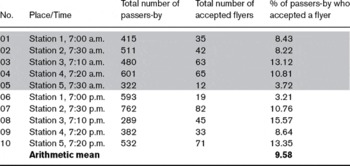
Surely, the (in)effectiveness of a campaign tool varies depending on time, place, and target group. Some ‘audiences’ are more perceptive than others. For example, during my field research in 2009, I conducted ten counts of 15 minutes duration each to capture the pick-up rate of a candidate's campaign leaflet by passers-by (Table 1). I selected five train stations and conducted one count each in the morning between 7 a.m. and 9 a.m., and one in the evening rush hour between 7 p.m. and 8 p.m. While the lowest pick-up rate was 3.21%, the highest amounted to 15.57%. These results confirm the impression of practitioners, namely that the perceptiveness of ‘crowds’ with regards to electoral campaigns varies considerably.
Pick-up rate of election flyers

Another case in which one kind of electoral activity developed a different degree of effectiveness due to its target group could be found in the campaign of Ueda Isamu. The Kōmeitō politician tried to defend his HR seat in an SMD in Kanagawa during the 2009 campaign and was often spurred on by as many as 50 to 100 spectators. They all appeared to have come for the sole purpose of listening to Ueda and were not passers-by who had stopped. Considering the support Kōmeitō candidates usually enjoy from the religious movement Sōka Gakkai and the high degree to which its members are organized, it seemed likely that Ueda's audience also consisted mostly of Gakkai members. Not all of those I approached were willing to answer my question of how they knew that Ueda was campaigning at that particular place at that time, but those who did confirmed that they had learned about the event from the religious organization or fellow Gakkai members. Clearly, for Ueda the challenge of these campaign speeches was first of all to consolidate political mobilization, not to convince voters, to trigger their initial interest, or cement his name in the memory of the audience.
A second type of ineffective campaigning that I asked candidates to comment on consisted of policy speeches delivered at train stations during rush hour. As explained above, not only were the contents of these speeches mostly lost on the audience, but such speeches also wasted the opportunity to raise the recognition of the candidate's name among voters. In explaining their actions, all candidates said they considered it important to present political convictions, with eight of them adding that this should be as important as, or even was tantamount to, maximizing effectiveness. When asked about the fact that hardly anyone stopped to listen, six of them replied that they would alternate between repetition of their name and policy speeches, while three said they did not consider the question of effectiveness at all times. One candidate explained that he hoped commuters would remember one of his policy proposals and later check on his website for details. When questioned how commuters would know his name, he referred to the flags his team put up at the station, to the pamphlets his assistants would distribute, and his repetitive mentioning of his name. Three observations of this candidate's campaign speeches at train stations showed, however, that four of his six flags only carried a slogan and no name, his assistants had little success in distributing pamphlets to passers-by, and contrary to the candidate's statement he hardly interrupted his policy speeches to mention his own name.
The four local politicians I interviewed explained they hoped to ‘transfer’ the support of their voters to the national candidate. By stressing the good partnership and cooperation between themselves and the candidate, local politicians would portray the latter as favorable for improving the people's life in the electoral district. They regularly appeared as speakers alongside the national candidate. In 15 of the 22 cases in which I observed such performances, local politicians did not restrict themselves to simple messages and repeating the candidates’ names, but delivered speeches of five to ten minutes. In 13 of these speeches, the local politician spent more time talking about his own achievements as praising the actual candidate. This apparent departure from campaign purposes was even more apparent when such speeches were delivered during rush hour to hurrying commuters. Nine of the national candidates shared the expectation that local politicians would be useful in mobilizing voters. The fact that the campaign speeches of local politicians often barely featured the national candidate was partly explained by the desire to present instead (local) policy issues. Eight candidates stressed that they were generally grateful to local politicians for supporting their campaign and that letting them talk about their own achievements would create an additional incentive for them to join the campaign. Maintaining a good working relationship was considered important, even though it came at a price.
These answers suggest that some campaign activities are not only directed toward voters but also toward the campaign organization itself. Some of the apparently ineffective activities appear in a different light once they are looked at from this internal perspective. When asked how their campaign performance affected their teams, all candidates confirmed that they tried to motivate their staff by being a good role model in terms of dedication, commitment, and fighting spirit. The Japanese term usually mentioned in this context was the verb ‘ganbaru’ which carries the meaning of ‘relentless fighting’ and ‘never giving up’. All candidates added that this was an important task as head of a campaign team and that they did their best to fulfil the expectations of their staff in this respect.
This apolitical secondary virtue also affects the evaluation of campaign speeches, because it is believed to attract voters. Dabney (Reference Dabney, Martin and Steel2008) used the term ‘campaign performance’ to describe the attempts of candidates to leave voters with the impression of being highly dedicated and accessible. One instrument to stress this dedication is to put up a signboard with the number of outdoor speeches the politician has already delivered. In Dabney's study, Usami Noboru claimed 2,500 speeches; I observed Fukuda Mineyuki crossing the 3,000 mark.
Local politicians as well as staff members confirmed the significance of ‘ganbaru’ as a means to motivate the team as a whole. They also agreed that a lack of commitment on the part of the candidate would probably diminish the motivation of staffers, especially in those cases were team members were spending even more time on the campaign trail, making preparations beforehand in the mornings, and clearing up at night. All candidates expressed a feeling of obligation not only to return the favor of the many helping hands, but also to prove that they themselves were worth the support. When asked for concrete examples of ‘ganbaru’, practitioners mentioned, among others, those campaign activities that were otherwise understood to be mostly ineffective: persisting to campaign in the heat or pouring rain, or addressing public spaces even when there was hardly any audience.
5. Discussion of results
Results of my research support the impression that election campaigning in plurality districts is in part conducted ineffectively with regard to voter appeal. My interview partners mostly agreed with all three types that I had identified during my participant observation. What answers to the main question of this article do my findings then suggest?
First, appealing to voters is the major purpose of street campaigning in plurality districts, but it clearly is not the only one. Activities are also directed towards the campaign team and other helpers. When speeches are delivered to almost empty public spaces, the effect on voters may be small and alternatives not easy to find, but at least candidates demonstrate their commitment and will to fight. Although politicians do not actively look for such opportunities, my interviews have shown that the side effect of keeping motivation and morale among staff members high does affect campaign strategies.
Second, a further goal of campaigning candidates can be found in the intention to maintain good working relationships with external helpers such as local politicians and campaign managers. On the one hand, the goal of broad cooperation apparently reduces the will of new candidates to challenge the campaign wisdom of professionals; on the other hand, it produces the need to express a sense of obligation toward local politicians. The latter are given incentives to cooperate by allowing them to largely decide upon the content of their speeches. This explanation has not only been confirmed by my interviews, but also by Soda Kazuhiro's (Reference Soda2005) documentary film Campaign, in which the relationship between the candidate and the party's campaign professionals is closely observed.Footnote 10
A third factor that interferes with effectiveness in terms of voter appeal is the candidates’ desire to explain political convictions. Apparently, candidates here are deciding about a trade-off: either concentrate on making a passing audience remember the politician's name, or focus on a very small number of pausing voters by expounding policy proposals. As Tetlock (Reference Tetlock, Philip, Luppia, McCubbins and Popkin2000: 242) explains: ‘By definition, trade-offs require interdimensional comparisons . . . that people do not have the cognitive equipment to perform in reliable ways.’ This incommensurability is accompanied by an emotional rejection to sacrifice one value for another (Tetlock, Reference Tetlock, Philip, Luppia, McCubbins and Popkin2000: 243): the value of publicly explaining political positions and the value of raising name recognition.
Given the significance of secondary virtues like ‘ganbaru’, these two values appear combinable under certain conditions. A policy speech, performed with dedication and endurance, is supposed to have an effect on voters even if they do not listen. However, this assumption holds true only for situations in which there is a larger audience, a condition that was not given in all of the instances that I observed. In addition, it remains unclear what levels of ‘dedication’ are needed to reach passers-by and what actually constitutes ‘dedication’. That is a question this study cannot answer, and anything between an emotionally charged text passage and a loud megaphone may be relevant. However, repeating short messages and the candidate's name can also be done with dedication and endurance, and would appear to have a higher degree of effectiveness than policy lectures.
In terms of structural learning theory, these goals and the problems of trade-offs create not one but two main learning processes with different levels of feedback. Candidates can indeed learn more easily how to maintain the smooth cooperation of their own staff with local politicians and campaign managers, while learning that processes regarding the effects of campaigning on voters are complex and produce no clear results. It is a core assumption of structural learning theory that ‘people are more likely to change their strategy in response to clear negative feedback than in response to clear positive feedback’ (Reed, Reference Reed1993: 50). Without clear negative feedback, winners of an election may be more likely to hold on to suboptimal campaigning methods than losers, whereas the losers are faced with the difficulties of identifying the factors which caused their defeat. This may encourage losers to adhere to the supposedly more reliable campaign instruments of the winners, who in turn have little incentive to look for improvements or change.
This assumption is supported by the phenomenon of ‘social proof’ (Cialdini, Reference Cialdini2001). Psychology tells us that especially under conditions of uncertainty, doing what others do appears to be a safe choice. This psychological process is facilitated by the condition of similarity: when candidates faced with similar challenges are using certain campaign instruments, then it is more attractive for others to follow their lead. ‘[W]e do want to be able to count on others’ behaviour as a source of valid information [even if they] are not acting on the basis of any superior information but are reacting, themselves, to the principle of social proof’ (Cialdini, Reference Cialdini2001: 151–2).
Finally, the imponderabilities and the physical as well as mental exertion that come with everyday campaigning surely cause ineffectiveness in the efforts of all teams. Campaigners may not always be able to constantly question their strategies or look for improvements. Time pressure, lack of personnel, or organizational needs may force teams to stick with electoral tactics instead of looking for better alternatives. Political events on the national or party levels may reduce the chances for a candidate to be successful and thus lower motivation and morale. All these ‘human factors’ should also be taken into account when looking at the elements that shape street campaigning in plurality districts in Japan.
6. Conclusion
Following a micro-ethnographic approach, this study inquired into the puzzling phenomenon of apparent ineffectiveness often observed in street campaigning in plurality districts in Japan. In summary, the findings suggest that, in addition to the Public Office Election Law, three (groups of) factors cause the observed phenomena. First, interviews with practitioners revealed additional campaign goals that stand next to the one of directly appealing to voters: motivating campaign staffers, maintaining good working relationships with external helpers, and expressing political convictions. The pursuit of these goals apparently leads candidates to occasionally campaign with a reduced level of voter appeal.
A second group of factors consists of constraints. Practitioners are not always good at making full use of the potential they have at their disposal. It is clearly impossible to fight an election campaign without being less effective than theoretically possible. The imponderabilities inherent in organizing a team and coordinating its efforts with those of other teams are clearly constraining factors.
A third reason partly responsible for the ineffectiveness of campaigning can be seen through the lens of structural learning theory. As there is no clear feedback with regard to the impact of campaign activities on voters, the learning processes of candidates are inhibited. With ‘social proof’ suggesting the employment of campaign instruments of winners, street campaigning tends to reinforce itself. Activities that aim at motivating campaign staffers or maintaining good working relationships with external helpers, however, have the advantage that feedback is more easily identified and understood.
It goes without saying that these findings do not suggest that street campaigning will never change. Some of those interviewees who were running for the first time expressed stronger doubts regarding the way street campaigning is conducted. It remains to be seen whether they will be able to change their campaign style, but the readiness to innovate will surely be supported by the intended reform of the Public Office Election Law, which will allow changes to candidates’ websites and the use of Twitter during the official campaign period.Footnote 11 Future research may focus on these changes, but also on those candidates conducting their campaigns outside of firmly established party structures. With less rigid organizational ties, less conservative psychological mechanisms, and greater incentives to critically question standard campaign tactics, those candidates may indeed run their campaigns differently. Former Nagano governor Tanaka Yasuo would appear to be a promising choice for such research. For his 2007 HC campaign, his first for the National Diet, Tanaka had very few staffers and hardly any organizational structure at his command. Although I only had the opportunity to observe his team twice, he made it clear in his interview with me that he tried to reach voters as effectively as possible by selecting and executing campaign tools differently from most of his competitors. Since his campaign was successful, he may provide ‘social proof’ for a different campaign style in the future.
About the author
Ph.D. in Japanese Studies and Political Science in 1998 from Bonn University (Germany); dissertation on electoral reform in Japan; Senior Adviser and interpreter at the Economic Department of the Embassy of Japan in Germany (1998); 1998–2007 Research Fellow at the Department for Japanese Studies, University of Bonn; 2005 ‘Habilitation’ in Japanese Studies with a thesis on the political system of Japan; since 2007 Senior Research Fellow at the German Institute for Japanese Studies, Tokyo. Research interests: demographic change and political responses to low fertility, electoral politics (2007: documentary film ‘Pictures at an Election’), religious organizations and their political parties (Kômeitô, Happiness Realization Party).
Appendix: Interviewees
Arimatsu Shoichirō, campaign staffer for Nakamura Keiichirō, People's New Party, Tōkyō, 14 October 2007.
Fukuda Mineyuki, LDP, former member of the HR, Yokohama, Yokohama, 2 May 2009.
Hoshino Yayoi, campaign staffer for Hosaka Nobuto, SDP, Tōkyō, 29 August 2007.
Ichihara Hiroko, SDP, member of the city council of Komae, Tokyo, 29 August 2007.
Igarashi Kôichirô, DPJ, member of the city council of Tsukuba, 27 August 2007.
Inoue Shinji, LDP, member of the HR, 2 February 2008.
Kawada Ryūhei, independent, member of the HC, Tōkyō, 13 November 2007.
Kawajo Shiga, LDP, member of the HR, 26 January 2009.
Kazuma Naoki, DPJ, member of the HC, Tōkyō, 11 September 2007.
Kojima Hiroyuki, candidate for the Happiness Realization Party, Tōkyō, 25 August 2009.
Matsumaru Makoto, campaign staffer for Suzuki Kan, DPJ, Tōkyō, 30 July 2007.
Nakamura Keiichirō, candidate for the People's New Party, Tōkyō, 12 October 2007.
Nakano Shoichi, Kōmeitō, member of the city council of Shiraii City, Tōkyō, 23 August 2008.
Nishimura Yasutoshi, LDP, member of the HR, 22 January 2009.
Okawara Masako, DPJ, member of the HC, Tōkyō, 31 January 2008.
Shioda Mieko, campaign staffer for Okawara Masako, DPJ, Tōkyō, 10 September 2007.
Suzuki Kan, DPJ, member of the HC, 21 February 2008.
Tanaka Junkō, candidate for the Happiness Realization Party, Tōkyō, 20 October 2009.
Tanaka Yasuo, New Party Japan, member of the HC, Tōkyō, 27 September 2007.
Ueda Isamu, Kōmeitō, member of the HR, Tōkyō, 27 January 2009.
Yamauchi Kazuhiko, LDP, former member of the city council of Kawasaki, Tōkyō, 22 January 2008.