

I. INTRODUCTION
The European Commission once posed the rhetorical question, ‘it is surely unacceptable for the international community to turn a blind eye to human rights violations in the name of trade liberalisation?’Footnote 1 Embracing a wealth of debate over the connection between the social dimension of globalisation and the pursuit of free trade, the EU has been asking itself this question over many decades.Footnote 2 Nevertheless, the EU’s actions, addressing this question, have been limited and it has still not found an adequate method to address this complex connection.Footnote 3 The EU was obliged to react, however, when the Rana Plaza factory complex near Dhaka collapsed on 24 April 2013. In the worst industrial disaster of the twenty-first century, to date, 1,136 people died and 2,535 suffered serious injuries.Footnote 4 Most were young women working on the production of ready-made garments (RMGs) for export, mainly to the EU. The victims had been instructed to work for fear of loss of wages despite compelling evidence that the building was unsafe.Footnote 5 The tragedy was wholly avoidable and has been summed up aptly by Jeremy Seabrook as ‘a story of such appalling contempt for human life that it must rank among the most callous in the brutal history of industrialism’.Footnote 6 It was Rana Plaza, which followed on from a series of fatal factory fires, that finally put the denial of labour rights and dangerous factory conditions in Bangladesh’s RMG industry under the global spotlight.Footnote 7
The EU as Bangladesh’s largest trading partner, with RMGs accounting for 90% of the country’s exports to the Union, was duty bound, morally, legally and normatively, to act.Footnote 8 Morally, the international community looked to the Union for some action of ‘moral generosity’ that would address the negative effects of trade liberalisation that had, in part, been facilitated by means of tariff preferences.Footnote 9 Legally, withdrawal of tariff preferences upon ‘serious and systematic violations’ of human rights, including violations of certain International Labour Organisation (ILO) conventions, listed as conditions under the EU’s Generalised Scheme of Preferences (GSP), had to be considered as a real possibility.Footnote 10 Normatively, as an international standard-setter, the EU had an imperative to act in a manner that would demonstrate its influence and effectiveness as a global actor.Footnote 11
In response, the Union concluded the Bangladesh Sustainability Compact (the Compact), a soft law initiative supported by the ILO, alongside several different actors, including the US (and later Canada), domestic and international trade union and employer organisations, and the Government of Bangladesh.Footnote 12 The uniqueness of the Compact stems from its nature as a tailored form of ‘global experimentalist governance’ (GXG) tested by the EU.Footnote 13 The Compact reflects support for experimentalist governance implicit in the EU’s legal and policy framework governing its external relations. Indeed, it may provide a blueprint for future EU interventions designed to provide solutions to complex interactions between trade, sustainable development and human rights’ considerations in bilateral or multilateral relations. However, concerns have been raised as to the Compact’s effectiveness, and its nature as a form of GXG must be assessed to ascertain its capacity for positively affecting labour rights and conditions in Bangladesh’s RMG industry.
This article will first define experimentalist governance and, next, explore the potential of the broader concept of GXG in the sphere of the EU’s external relations, before embarking on a case study of the Compact, to determine its effectiveness, as a GXG method, for the EU to exert its leverage in trade to promote sustainable development and continuous improvement in labour rights in Bangladesh’s RMG industry.
II. DEFINING EXPERIMENTALIST GOVERNANCE
‘Experimentalist governance’ is a term deployed to describe a typology of governance that differs from the norm. ‘Governance’ refers to features such as an integrated network of public and private actors and the deterioration of distinctions between hard and soft law.Footnote 14 It may also encompass flexible, less prescriptive, and less hierarchical-types of regulatory approaches to governance.Footnote 15 The involvement of actors other than classically governmental actors, both private and third sector, is one of its core features.Footnote 16 Experimentalist governance can be applied to processes and practices that are of a normative nature yet cannot be related to the traditional governmental ‘command-and-control-type legal institutions’.Footnote 17 The ‘experimentalist’ element of the term can be defined as processes and practices that instigate doubt about the assumptions and practices of governance, the solutions of which are thought incomplete and able to be readjusted through the comparison of different approaches to advancing similar aims.Footnote 18 Reduced to its core ‘experimentalist’ nature, it is a typology of governance that constitutes a particular method of achieving certain goals by putting it to the test to collect, ultimately, outcome samples of its success or failure.
The concept of ‘EU experimentalist governance’, coined by Sabel and Zeitlin, embodies several features.Footnote 19 These are: firstly, framework goals and measures that are established by joint action of the Member States and the EU institutions; secondly, that lower-level units have the freedom to meet these goals as they see fit; thirdly, that these units report regularly on performance and participate in a peer review; and fourthly, framework goals and procedures are periodically revised by the actors who initially established them.Footnote 20 This form of experimentalist governance is applied to the internal structure of EU policy making. Nevertheless, it has become clear that experimentalist governance also has an external dimension. Indeed, its attractiveness has led to its application both transnationally by the EU and, to a degree, globally.Footnote 21 As a form of policy making, it is increasingly recognised as a legitimate and advantageous method of pursuing external aims and objectives.
The term ‘global experimentalist governance’ (GXG), as developed by de Búrca et al, constitutes: firstly, an initial reflection and discussion among stakeholders over a common problem; secondly, the articulation of a framework understanding with open-ended goals; thirdly, the implementation of goals is left to lower-level or contextually situated actors with knowledge of local conditions; fourthly, there is continuous feedback from local contexts; and fifthly, the goals and practices are periodically and routinely re-evaluated and where possible revised.Footnote 22 GXG may also take place in the shadow of ‘penalty default’, which underpins this form of governance in a scenario of non-cooperation, in accordance with de Búrca and Scott’s default hybridity thesis.Footnote 23 In essence, this thesis underpins experimentalist governance with the ‘shadow of the law’ whereby the legal rules represent the default regime that can be applied for the purpose of forcing a particular action.Footnote 24
Many of the features of experimentalist governance and GXG are similar. In both, for example, the actors involved know the outcomes that are desired but the path to obtaining these outcomes is blurred.Footnote 25 Such forms of governance are endowed with a number of advantages, being suitable for, and facilitating, diverse, provisional and revisable decision making, transparency and policy learning, and participation and cooperation across a range of relevant stakeholders.Footnote 26
III. EXPERIMENTALIST GOVERNANCE IN EU EXTERNAL RELATIONS
Experimentalist governance is supported within the EU’s external relations, particularly the fields of trade, sustainable development and human rights, by a number of factors, including: ‘spillover’ from internal experimentalist governance processes and practices; legal foundation in the Treaties and policies pertaining to external action; close relations with international organisations that share policy objectives, such as the ILO; integration of non-governmental actors within trade instruments; and, the global context of fulfilling the UN’s Sustainable Development Goals (SDGs).
A. Experimentalist spillover
The EU’s pursuit of experimentalist governance within its external relations is represented by the term ‘experimentalist spillover’. In the field of labour law, experimentalist spillover has occurred as the EU adopts increasingly novel methods to develop and implement laws, involving both public and private actors, including the social partners – trade unions and employers’ organisations – in the design of laws and policies.Footnote 27 Experimentalist spillover also aligns with ‘normative spillover’ as the EU externalises human rights protection and norms, including sustainable development, worldwide.Footnote 28 These varying concepts of spillover stem from neofunctionalism, a theory put forward to explain the European integration process whereby integration in one policy area will lead rapidly to integration in other policy areas.Footnote 29 As such, the thrust of integration creates a domino effect as governance tools adopted internally are pursued externally. This endorses GXG as an effective mechanism for the EU to promote its standards as a ‘normative actor’.Footnote 30
B. Experimentalist governance as supported within EU external relations law and policy
The endorsement of experimentalist governance as a mechanism of governance within the EU’s acquis is evident. Ambitions of multilateralism and engagement with actors beyond traditional ‘command-and-control-type’ governmental institutions are mandated within Article 21(1) TEU on the principles of external action. With a domineering tone, this provision states that the EU ‘shall seek to develop relations and build partnerships with third countries, and international, regional or global organisations’ which share principles pertaining to, inter alia, ‘the universality and indivisibility of human rights and fundamental freedoms’.Footnote 31 It bolsters the founding of the Union on ‘respect for human rights’ (Article 2 TEU) and its mandate to uphold and protect its values, including sustainable development (Article 21(2) TEU), in its relations with the ‘wider world’ (Article 3(5) TEU). This mandate is generated from Articles 207(1) and 208(1) TFEU pertaining, respectively, to the Common Commercial Policy and Development Cooperation, which underpin Union policies in these areas with human rights values. Human rights are deemed the ‘silver thread’ that runs through EU external action.Footnote 32
Discernibly, the Union is a ‘staunch defender’ of human rights both internally and externally.Footnote 33 Labour rights falling within the broad domain of economic, social and cultural rights are put, at least notionally, on the same footing as civil and political rights under the EU’s Charter of Fundamental Rights. However, despite its normative ambitions as a human rights defender, the Union lacks policies that are consistent and coherent in the field of trade and labour rights.Footnote 34 Yet, as there is the scope for norm transfer as the EU conducts trade, it is a potentially lucrative field through which to promote labour rights rooted in ILO obligations shared with partner countries.Footnote 35
Trade and labour rights became a focus for the EU in the 1990s after the failure, at World Trade Organization (WTO) level, to integrate international trade and labour standards.Footnote 36 In turn, this led the EU to design an ‘ambitious’ agenda for promoting labour rights through trade.Footnote 37 This agenda rejects protectionist or sanction-based approaches, which might lead to disputes before the WTO, in favour of the pursuit of integrated, multi-disciplinary methods.Footnote 38 The EU seeks to promote incentive, dialogue and cooperation-based approaches to fostering labour rights, incorporating civil society, including domestic and international social partners.Footnote 39 Through this inclusive method, the EU aims to act broadly by collective means, facilitating social dialogue, and supporting regular review of progress towards set targets, and promoting feedback and learning.Footnote 40 The EU also conducts a significant proportion of external activities within multilateral global governance fora.Footnote 41
C. The EU–ILO relationship
Fundamentally, the EU–ILO relationship is intrinsic to any policy approach that is focused on improving labour rights in countries which, as ILO members, are signatories of the 1998 Declaration on Fundamental Principles and Rights at Work and committed to ratification of core ILO conventions.Footnote 42 The relationship between the EU and the ILO is not an asymmetric one.Footnote 43 The EU supports the ILO internally, by encouraging its Member States to ratify ILO conventions and approve recommendations, and externally through policy and normative measures.Footnote 44 From 2004 the relationship has deepened, out of a shared desire to promote the social dimension of globalisation, through the establishment of a ‘strategic partnership’ under which the EU plays a lead role in promoting the ILO programme for ‘decent work’ through joint development cooperation initiatives.Footnote 45 The concept of decent work encompasses job creation, rights at work, social protection and social dialogue, with gender equality as a crosscutting objective.Footnote 46 Decent work now forms part of Goal 8 of the UN’s 2030 Sustainable Development Agenda. Decent work is, however, ‘merely a singular thread among a complex web of issues that provide the dynamic of EU international relations’, making it even more important that labour rights are strengthened not by the EU acting alone but rather through mutually reinforcing EU–ILO strategies.Footnote 47 The ILO is ‘exceedingly relevant’ for ensuring that the Union’s normative goals are consistent with international obligations.Footnote 48
Support for ILO norms now forms a core element of EU trade policy and instruments. The EU’s capacity to act normatively comes from supporting international labour law as opposed to transnationally exporting its internal labour law, the direct impact of which on third countries is limited, and would, if attempted, be subject to strong resistance.Footnote 49 Thus, the standards set by the ILO represent a source of normative power for the EU when applying its trade leverage.Footnote 50 The Conventions set what the standard should be and ratification shows a commitment to achieve it.Footnote 51 In summary, the EU’s promotion of labour rights reflects the concept of ‘ILO-isation’, which comprises an increasing emphasis on the ILO’s role in setting and monitoring labour standards, a shift towards soft governance, and a growing responsibility for the private sector in applying principles in ILO Conventions.Footnote 52 The EU–ILO relationship, therefore, is a centrifuge around within which support for GXG is spun.
D. The integration of non-governmental actors within EU trade instruments
The EU’s trade instruments progressively integrate non-governmental actors. Unilateral GSP instruments and bilateral or multilateral free trade agreements (FTAs) have, as they have evolved, increasingly orientated themselves around local, regional and international stakeholders.Footnote 53 More recent initiatives have been concluded built on the premises of dialogue and cooperation, including the Bangladesh Sustainability Compact. The objective is to harness the EU’s trade and development policies to promote decent work and adherence to, at least, the core ILO conventions, the essence of which demands collaboration, coherence and consistency, all of which can potentially be provided within GXG.Footnote 54
Correspondingly, there has been a shift from ‘government’ to more inclusive new forms of governance within these trade instruments, even in long-established trade instruments such as the GSP. In the GSP, the procedure for tariff preference withdrawal by the EU – negative conditionality – overwhelmingly relies on ILO decisions and actions against that country where it is deemed to have seriously and systematically violated labour rights.Footnote 55 ILO country assessments and evaluations form the starting point for the EU’s assessment of the potential application of negative conditionality measures.Footnote 56 Other actors are relied upon within this process, including the WTO, the OECD, international trade unions and employers’ organisations.Footnote 57 As such, the EU mainstreams a collaborative approach to GSP withdrawal in specific instances of violations.Footnote 58 GSP negative conditionality is not, therefore, as ‘hard’ or as unilateral as it might seem.
Elements of newer governance methods are also evident in the EU’s ‘new generation’ FTAs, whereupon there has been both a deepening of the labour provisions customarily incorporated into such agreements and a widening of oversight.Footnote 59 Here, sustainable development clauses (SDCs) include provisions regarding labour rights, through which the EU is attempting to foster ILO commitments, that enable the participation of civil society in discussions relating to their implementation.Footnote 60 The EU’s insistence on the use of SDCs has caused controversy and slowed some FTA negotiations – for example, with India – because the EU’s support for labour rights through trade is still seen through a protectionist lens by many partner countries. Experimentalist governance may help to overcome the disinclination of trade partners towards the mix of EU trade, sustainable development and labour rights. Moreover, where previously human rights clauses acted either as a sword – forcing third countries to comply with human rights obligations in return for single market access – or as a shield – allowing the EU to revoke trade benefits – new style SDCs, by contrast, go beyond these functions.Footnote 61 SDCs act as an impetus for experimentalist governance and the basis for a multifarious and heuristic approach to addressing labour rights violations which may more successfully promote the social dimension of globalisation as opposed to the unilateral and punitive approach of GSP withdrawal.Footnote 62 Increased engagement with non-state actors has fostered an integrated, multi-disciplinary approach by the EU to trade and labour rights.Footnote 63
E. The global context of the UN Sustainable Development Goals
Experimentalist governance is further supported within the framework of the UN Sustainable Development Goals (SDGs). The shift in 2015 from the Millennium Development Goals (MDGs) to the SDGs was designed to promote multi-stakeholder engagement.Footnote 64 As part of this agenda, the EU has sought to facilitate a new global partnership with a spirit of solidarity and cooperation.Footnote 65 The EU pushes for multi-stakeholder partnerships that include private actors and civil society, with key GXG components of monitoring, accountability and review.Footnote 66 Sustainable development has thus become a further factor emphasising the need for the Union to orientate towards experimentalist governance. It has become not only a ‘buzz phrase’ that promotes the political consensus to include labour provisions in trade and sustainable development instruments, but also the SDGs are an overarching reference point to ensure the incorporation of civil society within trade and labour rights’ issues.Footnote 67
F. Summary
Experimentalist governance responds to the current global context and its dynamic challenges and opportunities.Footnote 68 The global and EU-level framework encouraging GXG enables countries to maximise progress towards attaining the SDGs and facilitates the adoption of EU trade instruments that are not sanctions-based, enabling the EU to reap the benefits of experimentalist methods in attaining certain normative goals. The Bangladesh Sustainability Compact is the epitome of EU GXG and is a suitable case for analysis.
IV. A CASE STUDY OF GLOBAL EXPERIMENTALIST EU GOVERNANCE
A. Labour rights’ issues in the RMG sector in Bangladesh: the case for EU external governance
In this case study, we have selected labour rights’ issues in the RMG industry in Bangladesh because of the intense interaction between trade, development and human rights issues focused on a specific sector in a country which is economically dependent upon exports to the EU’s single market.Footnote 69 The EU therefore has considerable leverage, through its external governance instruments and processes, to influence policy and practice on the ground to facilitate improvements in labour conditions.
The case for the exercise of global EU governance in the field of labour rights in Bangladesh is threefold. Firstly, with 47 million out of 161 million people living in poverty, Bangladesh is a priority for the EU in its development cooperation, as it seeks to contribute to the eradication of global poverty and the fulfilment of the SDGs by 2030.Footnote 70 Bangladesh is a long-standing development partner of the EU, and has faced the evolution of EU policy from being first a ‘donor’ and now a partner with Government and civil society focused on development needs, governance and human rights.Footnote 71 Under the EU’s Agenda for Change, the Union seeks to tailor its development partnerships so as to achieve the greatest ‘impact’ towards eradicating poverty, or aid effectiveness, supporting the twin objectives of: promoting human rights and democracy, and other elements of good governance; and attaining inclusive and sustainable growth for human development.Footnote 72 Aid effectiveness has improved under partnership and cooperation agreements, modernised financial instruments and mechanisms designed to improve policy coherence for development.Footnote 73
Partnership with Bangladesh is under the umbrella of the Cooperation Agreement of 2001,Footnote 74 which underpins cooperation with respect for human rights and democratic principles.Footnote 75 The EU uses policy dialogue and links results to specific cooperation programmes or instruments.Footnote 76 Bangladesh is a beneficiary of a €690 million country-specific allocation under the Development Cooperation Instrument.Footnote 77 The EU encourages sustainable economic and social development, but challenges remain, including youth unemployment, shrinking space for civil society and violence against women.Footnote 78 Corruption and political influence are further obstacles to securing safe working conditions and genuinely effective labour rights’ reforms.Footnote 79 Indeed, employers and trade unions are controlled by party patronage.Footnote 80
The ILO’s decent work agenda has become a core part of the EU’s development priorities, shifting the focus of the Union’s activities towards improving labour rights and working conditions.Footnote 81 In Bangladesh, the Decent Work Country Programme (DWCP) 2012–2015 has been the main instrument for carrying out this agenda.Footnote 82 Progress under the DWCP is linked to the specific action the ILO is taking in the RMG sector under the Better Work Programme, a partnership between the ILO and the International Finance Corporation (IFC), designed to improve conditions and promote competitiveness in the global garment industry.Footnote 83
Secondly, under EU trade policy, Bangladesh, as one of the UN’s designated Least Developed Countries (LDCs), is a beneficiary of the Everything But Arms (EBA) arrangement under the EU’s GSP, granting LDCs full duty and quota free access to the single market for all products except arms and ammunition.Footnote 84 The EBA trade preference has contributed to making the EU the country’s largest trading partner.Footnote 85 Among the 49 EBA qualifying countries, Bangladesh is overwhelmingly the main beneficiary, accounting for a staggering 69.1% of all EBA preferential imports into the EU in 2014.Footnote 86 The EBA is regarded as important as, in theory, its generous tariff advantages promote the volume of trade and thus export earnings and in turn should reduce poverty.Footnote 87 A significant feature of the EBA is the prospect of negative conditionality in the form of temporary withdrawal of preferences where the EU is satisfied that there have been ‘serious and systematic violations’ of rights contained in core UN and ILO conventions.Footnote 88 The prospect of imposing this penalty, which would be catastrophic for the RMG sector and the Bangladeshi economy as a whole, has given the EU considerable leverage over the Compact.
Thirdly, 90% of Bangladesh’s exports to the EU are from a single economic sector, RMGs.Footnote 89 Over the last 25 years Bangladesh has rapidly expanded its RMG industry to meet the ever-growing demands of global brands seeking high quality and low cost through their ‘global value chains’ (GVCs), to provide cheap clothes to predominantly European consumers mainly using local sub-contractors.Footnote 90 As such, the RMG industry is part of a complex global jigsaw and provides a fascinating study of the impact of globalisation on both workers and consumers. GVCs make it particularly difficult for countries focused on one export industry at the lower end of the value chain, such as Bangladesh, to escape from a cycle of dependency on low-cost labour and low skills.Footnote 91
However, with the RMG industry as an economic and social driver, Bangladesh has been transformed, meeting several of the MDG 2015 targets for, inter alia, cutting extreme poverty and hunger and achieving almost universal primary education.Footnote 92 It has fuelled economic growth of 6% per annum over the last decade.Footnote 93 The sector employs four million workers, approximately 85% of whom are women.Footnote 94 Evidence points to increasing school enrolment, decreasing child marriage rates and more financial independence for women.Footnote 95 Yet much more needs to be done to empower women and combat exploitative practices.Footnote 96
The rapid growth of the industry has been a ‘double-edged sword’ for RMG workers, enabling employers to exploit the country’s comparative advantage in global trade by maintaining the second lowest wages among its competitors.Footnote 97 Indeed, the RMG sector in Bangladesh is characterised by long working hours, short and infrequent rest breaks, low wages, job insecurity, gender inequality and child labour.Footnote 98 Freedom of association and a lack of collective bargaining rights are of particular concern. Only 10% of the 4,500 garment factories in Bangladesh have registered unions, and the law mandates excessive registration procedures.Footnote 99 An ILO high-level tripartite mission highlighted that unions may be ‘fake, paper-based, organised without workers’ support, initiated by employers or dissolved’.Footnote 100 The right to form trade unions is further supressed by harassment and abuse faced by union members from factory owners, women being particularly vulnerable.Footnote 101
Rapid growth has also encouraged speedy construction of factories, often without permits, leading to poor labour conditions, overcrowding, and exposure to noise and dangerous machinery.Footnote 102 Factories may also be constructed with extra floors illegally added, as in the case of Rana Plaza, or have been adapted from residential buildings.Footnote 103 Many workers lack sufficient training in essential health and safety understanding.Footnote 104 Factory owners face competitive pressure to keep costs low, which further undermines their ‘ability to invest in safety’.Footnote 105
These interconnected labour rights’ issues, alongside the need for, firstly, greater civil society involvement to support trade unions and hold institutions and private actors to account, and secondly, more responsible business conduct, has provided a reference point for the Compact.Footnote 106 In the following two parts we will first provide a contextual overview of the Compact before turning to an assessment of its features as an instrument of GXG.
B. The Bangladesh Sustainability Compact in context
All of the above reasons would have made the Bangladesh RMG sector suitable for a case study on the integration of the EU’s policies on development and trade with human rights’ objectives before the collapse of the Rana Plaza garment factory complex, which finally focused the world’s attention on the contrast between, on the one hand, liberalised trade and rapid economic growth in Bangladesh and, on the other hand, low pay, poor labour conditions and inadequate factory safety.Footnote 107 The Rana Plaza factory collapse also came just a few months after a tragic fire at the Tazreen Fashions factory near Dhaka, which left 112 dead. Global actors were compelled to respond to demands for immediate action from international trade unions, NGOs, civil society organisations and consumers concerned about the ethics behind cheap clothing. The message was clear, ‘business could not continue as usual’ without fundamental changes to safety, inspection, improvements in pay and working conditions, and compliance with international labour standards.Footnote 108
Undoubtedly, however, it is the EU, as Bangladesh’s largest export market for RMG products, facilitated by its trade preferences, that has had a particular responsibility post Rana Plaza to ensure that it utilises its trade and development leverage to demand significant improvements in labour rights and working conditions from the Government of Bangladesh and factory owners, and responsible business conduct from global brands and retailers. In the aftermath of Rana Plaza, Bangladesh has provided a key test case for the EU, with the levers at its disposal, including both soft law and normative power, to demonstrate that its human rights response is both purposeful and efficacious.
There has been no single consolidated action plan in response to Rana Plaza. Instead, there have been a series of inter-related public and private initiatives involving different actors, with the ILO playing the pivotal role as both coordinator and collaborator with key partners, and with significant EU input. On a national level, the National Tripartite Plan of Action (NTPA) is a Government of Bangladesh initiative with the social partners, backed up by the ILO, with input from the EU and its Member States.Footnote 109 Global trade unions drove the adoption of the Accord on Fire and Building Safety, a ground breaking legally binding agreement with global brands, and also the less ambitious business-led Alliance for Bangladesh Worker Safety, both of which are private initiatives to improve health and safety in garment factories through a continuing process of inspection and remediation.Footnote 110 The ILO’s Better Work Programme also has a key role in improving working conditions and promoting decent work.Footnote 111 These initiatives overlap in their objectives, and coordination between all the relevant actors involved in them is vital to fostering the needed changes. The EU is linked to them all through the overarching Compact with its specific focus on broad, ongoing engagement to secure implementation of human rights priorities.
Each of these initiatives is important and innovative, but the Compact is the most novel and far-reaching in its ambitions.Footnote 112 It is a cross-cutting coordinating mechanism that assesses technical progress towards the fulfilment of human rights objectives on the ground in Bangladesh’s RMG sector.Footnote 113 The EU issued the Compact in July 2013, in partnership with the ILO and the Government of Bangladesh, with the aim of fostering ‘continuous improvements’ in labour rights and factory safety in the country’s RMG industry.Footnote 114 The Compact represents a choice by the EU to reject, at least for the time being, the option of withdrawal of the GSP, and instead to embark on a ‘period of deep engagement for all actors involved in the global value chain’, including global buyers, brands, governments, employers’ and workers’ organisations, and consumers.Footnote 115 Although the US withdrew its GSP post Rana Plaza, it too joined later in 2013 and Canada is a partner from 2016.Footnote 116
‘Staying engaged’ was both a pragmatic and an economic choice for the EU, given the importance of the RMG industry for European firms, but it was also in line with ILO thinking, to ‘stay with Bangladesh’ so as to protect the millions of jobs that depend on the sector.Footnote 117 Together, the EU and ILO would use their leverage to send a message to the Government of Bangladesh, the domestic garment manufacturers and the global brands that change was needed to prevent any further disasters. The Compact covers three specific areas, each of which has a strong human rights dimension:
-
∙ Respect for labour rights, in particular freedom of association and the right to collective bargaining
-
∙ Structural integrity of buildings and occupational health and safety
-
∙ Responsible business conduct by all stakeholders.Footnote 118
We have analysed progress on the commitments made by the partners in each of these areas in depth in our report for the FRAME project.Footnote 119 Our conclusions can be summarised as follows.
In respect of labour rights, where the main obligations fall on the Government of Bangladesh, with the EU and the ILO providing technical support, there has been an improved legislative environment. The Bangladesh Labour Act was revised in 2013, bringing some improvements in relation to freedom of association, collective bargaining and workplace safety.Footnote 120 The implementing rules for the Act were issued in 2015, providing guidance on central elements of the law. However, this legislation falls short of ILO standards.Footnote 121 In our findings, we also identify the need for greater attention to be given to the issue of gender equality as part of the review process.
Lack of freedom of association remains a significant problem. The EU, on the recommendation of the ILO supervisory bodies, has urged the Bangladeshi authorities to speed up registrations of trade unions and end arbitrary non-registration.Footnote 122 The global unions have reported that a ‘severe climate of anti-union violence prevails’ often directed by factory managers and rarely investigated.Footnote 123 The ILO is also placing increasing pressure on Bangladesh. In June 2015, the Committee on the Application of Standards demanded: strengthening of the legislation in relation to freedom of association and collective bargaining; extending full freedom of association to the 400,000 workers in designated Export Processing Zones (EPZs), which are subject to lighter regulation and where trade unions are banned; and an investigation into all acts of anti-union discrimination to ensure reinstatement of those illegally dismissed and the imposition of fines and criminal sanctions on those responsible for the violence.Footnote 124
With regard to health and safety, the priority is to inspect factories, draw up Corrective Action Plans and carry out remediation alongside ongoing training. The responsibility for securing the objectives under this pillar lie with the Government, under the NTPA, and the private actors, the Accord and Alliance, linked to their obligations under the third pillar. Overall, the 2016 Technical Status Report notes ‘tangible improvements’ in enhancing building and workplace safety.Footnote 125 All factories identified as ‘export-orientated’ have been inspected and followed up.Footnote 126 As the ILO has noted, the completion of the factory inspections is an ‘important step’ towards improving safety in the sector but ‘no factory can be considered safe until it has successfully undergone a remediation process’.Footnote 127 It is in securing this essential objective that the Compact has a particular role, through engagement, in urging remediation of faults in factories.Footnote 128 The major barrier here is the cost of remediation. Again, the EU has a role, as the lead development partner alongside the Member States, working also with the US and Canada, to assist. In total US$200 million has been pledged but more will be needed.Footnote 129 The next period of remediation will be the true test because, without it, many workers will be at risk of injury or death on a daily basis, with the risk of fire remaining particularly acute.
The third pillar of the Compact, regarding responsible business conduct (RBC), does not establish any commitments upon Bangladesh or the EU. It merely takes note of the private sector response to Rana Plaza and encourages its progression.Footnote 130 Therefore, it places emphasis on the EU’s support for the Accord, the Alliance and further initiatives through RBC. The essence of the pillar is that Bangladesh and the EU remain ‘engaged to support and promote socially responsible supply chains’.Footnote 131 It is not about the EU regulating these supply chains, but about supporting RBC.
There are several points to note. Firstly, the EU, the ILO, and the international trade unions are highly critical of the inadequate progress made by Bangladesh towards adopting and implementing reforms of its labour law. Secondly, Bangladesh, the EU and the ILO welcome the efforts by major fashion and retail brands to improve safety in RMG factories. Thirdly, they support the Alliance, to a certain extent, but particularly the Accord, which is the optimum private initiative in partnership with global unions, national unions and other stakeholders.Footnote 132 Fourthly, the EU and Bangladesh recognise the need for transnational enterprises/brands/retailers to deepen discussion on RBC and encourage retailers and brands to adopt and follow a unified code of conduct for factory audit. Fifthly, they are seeking to ensure a fuller role for the social partners in the RBC process.
C. The Bangladesh Sustainability Compact as global experimental governance
Attributing features of GXG to the Compact acknowledges the variety of methods the EU, and other international actors, may utilise to pursue certain goals.Footnote 133 The Compact illustrates the creativity of the Union in going beyond the hierarchical nature of the conventional ‘trade-labour linkage’. It is an unprecedented initiative tailored specifically to labour rights and factory safety in the Bangladeshi RMG industry with the value of sustainable development buttressing it. The Compact is not ‘hard law’ like the GSP, which remains as a back stop, but instead is a form of iterative soft law that builds on the strength of the EU–ILO relationship, illustrating the potential for future engagement in other partner countries based on the model it offers.
The core tenets of GXG can be applied to the Compact. Firstly, there was an initial reflection and discussion among stakeholders with a broadly shared perception of a common problem.Footnote 134 After the tragedy of Rana Plaza, international stakeholders involved in the RMG industry were reproached for their laxity in allowing labour rights violations to prevail. They were directed to repair their ‘wrongs’. In a pressured environment, where consumers worldwide were pushing for change, international actors took different paths towards achieving the objective of improving labour rights and factory safety. The US, as mentioned above, withdrew its GSP shortly after the disaster, although this was somewhat superficial as the RMG sector had not been given a tariff preference.Footnote 135 Brands and retailers scrambled to conclude the Accord and the Alliance. The EU and the ILO emphasised the importance of ‘deep engagement’ in Bangladesh for all actors involved in the global value chain.Footnote 136 The concept of ‘deep engagement’ was seized upon to quell uncertainty about whether the EU would initiate the GSP withdrawal procedure. Ultimately, the EU – concerned about the impact on workers on the ground, and with the support of the ILO and, to a qualified extent, the international trade unions – was not willing to withdraw the GSP tariff preferences granted to RMG exports from Bangladesh and chose to reject this path, at least for the immediate term.Footnote 137
In theory, the broadly desired outcome of the international community was a shared endeavour to secure rapid improvement in labour rights and factory safety in Bangladesh.Footnote 138 Although, it must be noted that a genuine desire to bring about such change was propelled by a combination of concerns including, inter alia, the loss of business, the political friction that ensued after Rana Plaza, and the sheer scale of the disaster. The predominant difficulty in pursuing such goals was that the actors did not know the best path to take, evident in large part from their diverse responses.Footnote 139 It was a situation of strategic uncertainty that meant effective solutions to problems could only be defined by actually pursuing them.Footnote 140 The EU understood that it was in a position both of leadership and of a certain special responsibility, as the principal recipient of Bangladesh’s RMG exports.Footnote 141 Its emphasis on deep engagement manifested itself in a meeting, in July 2013, that brought together representatives from the industry, employers, trade unions and other key stakeholders to discuss the best mechanism with which to address the improvement of labour standards, factory safety and responsible business conduct in the industry.Footnote 142 The outcome of this meeting was the Compact driven by the EU in partnership with the ILO, and agreed to by the Government of Bangladesh, initially as a reactive rather than a proactive initiative.Footnote 143 It manifested the paramount objective of all the actors involved to foster the continuous improvement of labour rights and factory safety so as to ensure that there would be no more Rana Plazas.Footnote 144
The establishment of the Compact in response to Rana Plaza adopted and merged together four different ‘pathways’ to a transnational experimentalist regime discussed by Overdevest and Zeitlin.Footnote 145 First, private transnational initiatives were created in response to, in part, inaction by the Government on labour rights’ issues, regimes which were diffused throughout the RMG GVC. Second, the unilateral imposition of GSP conditions on labour rights moulded itself into a joint governance system with stakeholders from Bangladesh and the RMG industry. Third, the plethora of regimes imposing separate demands upon labour standards in Bangladesh were met by a need for coordination; and, fourth, there was a degree of benchmarking and comparison of different initiatives concluded post-Rana Plaza.Footnote 146
The Compact also meets the second tenet of GXG by operating as a framework with open-ended goals.Footnote 147 Linguistically, a ‘framework’ indicates the existence of a supporting or underlying structure.Footnote 148 As such a framework, it does not set out how the signatory partners to the Compact should act, but rather acts as a support to their efforts. The Compact becomes the foundation to their deployed methods to achieve the overarching goal. This is particularly reflected by the lexicon used within the Compact, including ‘welcome the support’, ‘take note of the work’, ‘encourage’, ‘recognise’ and ‘consulting closely’. Thus, the EU’s actions and decisions are not imposed upon the Compact partners, it is instead about establishing and fostering a consistent and long-term relationship between them.Footnote 149
Furthermore, each of the three pillars of the Compact constitutes an open-ended goal: respect for labour rights; structural integrity of buildings and occupational health and safety; and RBC.Footnote 150 It is under RBC that the nature of the Compact as a ‘framework’ is most evident. Here, the Compact partners support the coordination of RBC efforts by major fashion and retailer brands to improve safety in the Bangladeshi factories which supply them.Footnote 151 By contrast, under the first two pillars, certain commitments are imposed upon the Government of Bangladesh. The EU also makes commitments regarding its development cooperation priorities. Yet even these commitments do not belie the Compact’s flexible nature. The Compact acts as an overarching initiative with a cross-cutting coordinating mechanism, adding to the work of trade unions, industry, the ILO and the Government in finding solutions.Footnote 152 It was not designed to be the EU ‘preaching from a lofty pedestal’ but ‘rather offering advice’.Footnote 153
Addressing the third tenet of GXG, the implementation of the goals is left to ‘lower level’ or contextually situated actors with knowledge of local conditions and the discretion to adapt the framework norms to the different contexts.Footnote 154 The nature of the commitments and goals of the Compact endow the methods by which these goals can be met upon the partners. Much like the EU Member States, as ‘lower level’ actors are given the freedom to pursue goals in conventional experimentalist governance, so the Compact partners, including the government, are given some flexibility in the way they pursue its goals.Footnote 155 The EU’s most important partner in this respect is the Government, as it has the potential to ‘work the levers’ of law and policy in response to Rana Plaza.Footnote 156
Genuine experimentalist governance in the field of trade and labour rights also necessarily demands engagement and cooperation with grassroots trade union and employer organisations. Indeed, experimentalist governance is founded within EU engagement with domestic civil society.Footnote 157 Accordingly, the Compact engages both the ILO and the international and industry-based social partners. Local civil society organisations are key to the monitoring and implementation of the Compact.Footnote 158 These contextually-situated actors provide invaluable input. The social partners monitor and feedback on the situation on the ground, such as highlighting concerns relating to anti-union discrimination and violence.Footnote 159 They have played a crucial role in drawing attention to human rights violations in the RMG industry.Footnote 160 They also act as a pressure valve on the Government to improve labour rights and provide incentives for them to introduce regulatory reforms.Footnote 161 The international trade unions are ‘watchdogs’ for international labour standards.Footnote 162 Involving trade union organisations enables them to use their position to facilitate internal legitimisation within their domestic political context.Footnote 163 Particularly in Bangladesh, where there are significant concerns relating to the suppression of freedom of association and collective bargaining, enabling such legitimisation will empower and endow confidence on local trade unions and those who seek to form trade unions.Footnote 164
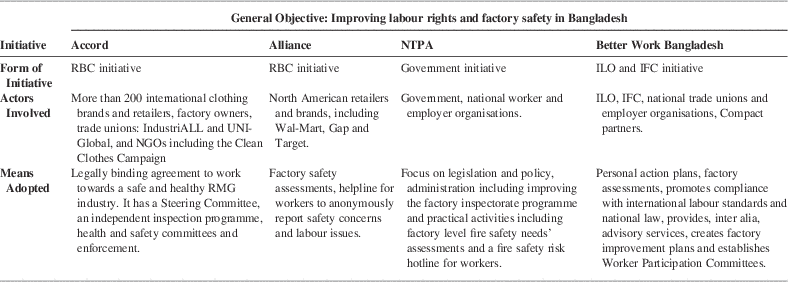
Table 1 takes note of the different initiatives operating under the framework of the Compact and reflects the nature of the Compact as a governance measure that permits the employment of differing means to the same general ends.Footnote 165 It is clear from Table 1 that each initiative adopts different means and involves different actors. The diverse pathways to an experimentalist regime converge on a multi-level, multi-actor governance architecture represented by the Compact which dissolves the distinctions between these actors.Footnote 166 While the NTPA is a national initiative, focusing on bringing together organisations within Bangladesh, the Better Work Bangladesh programme takes a more international outlook drawing upon the Compact partners, including the EU, ILO and IFC. Similarly, the Accord involves both global trade unions and global NGOs, whereas the Alliance does not. Contrasting means of obtaining the general objectives of the Compact are adopted, depending largely upon the form of initiative. The Accord and Alliance are both RBC, private sector initiatives, the NTPA is a government initiative, and the Better Work Bangladesh programme is an ILO–IFC initiative. The Accord is a legally binding agreement which engages with workers through committees, and factory safety through an inspection programme and enforcement system. The Alliance, however, is not a legally binding agreement. It adopts factory safety assessments and a helpline, rather basic in comparison to the Accord. The NTPA focuses on national law and policies, alongside factory inspections. The Better Work initiative promotes, in line with the ILO’s involvement, compliance with international labour standards and national labour law. The Compact provides space for ‘mutual readjustment, learning from experience, and increased accountability of schemes to one another and to external audiences’.Footnote 167
Bangladesh Sustainability Compact

An additional feature of GXG, found in the Compact, is the process of continuous feedback with frequent reporting, monitoring and peer review.Footnote 168 This is a key element as the Compact is an overarching initiative that coordinates the different public and private actions required to fulfil its goals. Peer review is undertaken through the engagement of all Compact partners. There is strict follow up, in the form of meetings and technical status reports, of progress under each of the pillars and commitments undertaken by Bangladesh, the EU, the ILO and the private actors.Footnote 169 In the follow-up meetings, the Compact partners discuss the progress of implementation and the importance of working together to draw upon lessons learned towards the improvement of working conditions in the RMG industry in similar conditions elsewhere. There is also a high-level ‘3+5+1 group’ at the local level, involving contextually relevant actors, the Government and ambassadors of Compact partners, which regularly reviews the progress of the Compact. Inevitably, this peer review process has given NGOs and international trade unions the opportunity to comment on the initiatives concluded under the remit of the Compact. For example, global trade unions provide data and analysis to the local high level 3+5+1 group to assist with the monitoring of the Compact.Footnote 170
Technical status reports published by the Commission provide transparency to supervision. They build upon information from several sources, including additional meetings with, and reports published by, actors from the private sector and civil society, including the International Trade Union Confederation and Human Rights Watch.Footnote 171 These actors are key to engaging in peer review, particularly apparent in the criticism that has arisen over the effectiveness of the RBC initiatives concerning factory inspection and remediation. Contrasting levels of progress between the initiatives have been made transparent as a result of such review. For example, the Government-led NTPA immediately declared 80% of factories under its scope safe, raising concerns about the seriousness with which Bangladesh treats its obligations and also corruption, whereas the private sector Accord and Alliance initiatives both found safety issues with every factory they inspected.Footnote 172 Global NGOs are keen to draw upon the Accord because of the unprecedented role it endows upon trade unions.Footnote 173 The private sector has, moreover, been particularly proactive in engaging in peer review. There is a regular forum meeting bringing together all interested brands and retailers to discuss issues related to RBC, and a data sharing facility.Footnote 174 The comparisons drawn upon in these meetings generate assessments of the success of the initiatives, which in turn feeds into public accountability, recursive learning and external pressure for improvement, particularly by NGOs both within Bangladesh and worldwide.Footnote 175
Finally, the Compact’s goals and practices must be periodically and routinely re-evaluated and where possible revised.Footnote 176 This can be recognised throughout the four years of the Compact to date. The engagement of more partners, such as Canada, reflects the nature of the Compact as a form of continuing engagement, or continually improving engagement. It is unquestionable that the addition of new partners will strengthen it, enabling greater support and funding to delve into, for example, ongoing issues such as skills development, combating gender discrimination and more effective factory remediation. Likewise, the transformation of the Compact as an initiative monitored primarily by civil society provides focused pursuit of its goals.
The Compact’s goals are not set in stone and have been revised over time. Priority areas have been reviewed parallel to what the Bangladeshi context demands. For example, the identification of difficulties with trade union registration, particularly the fact that the rate of registration approvals has slowed down, has led to a focus on the need to ensure that the registration process is carried out freely without interference by the Government or industry.Footnote 177 The work of the ILO Committee on the Application of Standards has highlighted further concerns regarding the lack of freedom of association and collective bargaining rights, whereupon follow up actions have been recommended under the Compact and are being monitored.Footnote 178 The ILO’s actions and decisions provide the reference point for the EU in its commitment to maintaining the Compact experiment.
The practices of the initiatives covered under the Compact have also been revised, through a process of deep engagement, most particularly on how to draw upon the different means adopted under the key initiatives and facilitating the understanding of how a variety of actors can work together to bring about change.
On the overarching level, the factory inspection systems under the Accord, Alliance and NTPA were re-aligned as a result of fragmentation caused by the different means adopted for factory inspections. An agreement was reached between all stakeholders carrying out inspections advocating a common reporting format.Footnote 179 In addition, owing to the disassociated nature of publications of inspection reports, in March 2014 summary reports from the three initiatives began to be published on the Department of Inspection for Factories and Establishments’ website, containing information on factory names, addresses, owner names, numbers of workers and inspections completed.Footnote 180 As of April 2015, it contained information on 3,743 factories, a major achievement for transparency.Footnote 181
Change has also been facilitated through the Compact whereby pressure placed on the Government by Compact partners has led to improvements in labour laws. For example, a 2015 update of implementing rules for the Bangladesh Labour Act facilitated a piloting programme under the Accord of training and safety committees.Footnote 182 The pilot of this programme has since engaged, as of March 2017, around 500,000 participants in ‘All Employee Meetings’ and around 1,500 in Safety Committee training programmes.Footnote 183 In addition, new practices have been adopted by the Government. In May 2015, a hotline was established by the Department of Labour with ILO support to receive grievances from workers and management in RMG and other sectors.Footnote 184 As of July 2016, it received 6,159 calls.Footnote 185 The establishment of this hotline mirrors the establishment of a helpline under the Alliance. There were 21,010 calls recorded under the Alliance helpline by September 2015.Footnote 186 This hotline has since been listed as one of the Compact’s key achievements under the first pillar.
Perhaps the most successful aspect of the Compact is that where problems on the ground have been identified, they have been addressed by the partners. The Compact thus provides a visible platform for engagement. For example, in response to the heightened difficulty in obtaining registered trade union status, the ILO conducted workshops bringing together trade unions and employer organisations educating workers on how to make online applications and appeal against application rejections.Footnote 187 With the backing of the Compact partners and the ILO, this placed increasing pressure on the Government to address difficulties regarding trade union registrations.
Efforts to improve factory safety have resulted in varying degrees of commitment by Compact partners. The weaknesses of the NTPA were identified and addressed by the injection of a US$31.4 million for a three and a half year ILO programme funded by Canada, the Netherlands and the UK.Footnote 188 The ILO developed hundreds of Corrective Action Plans (CAPs) for NTPA factories in the remediation stage.Footnote 189 With regards to difficulties obtaining funding for remediation, development partners including the EU pledged US$200 million,Footnote 190 the US having also pledged funding to strengthen Bangladesh’s inspectorate process through increasing the number of inspectors.Footnote 191 It has only been through extensive peer review and monitoring, and a shared commitment from the partners, that it has been possible to address these weaknesses and to act quickly upon them.
A further feature of the Compact that aligns itself with GXG is the existence of a ‘penalty default’. Indeed, experimentalist governance does not preclude the existence of binding legal obligations or sanctions for aspects of non-engagement.Footnote 192 This supports the ‘hybridity thesis’ which approaches the co-existence of law and experimentalist governance.Footnote 193 It affiliates with the hypothesis that this coexistence can produce a fruitful outcome. As part of this co-existence, ‘default hybridity’, governance ‘in the shadow of the law’ is applicable to the Compact. Hard law is the default regime which can be applied where there has been a lack of engagement in experimentalist governance. Such a default position is potentially severe in its consequences, and is designed to be an ‘action-forcing’ regime.Footnote 194 GXG is deemed to be unsuccessful where it is impossible to have the existence of this penalty default.Footnote 195 The penalty default underpinning the Compact is the possibility of GSP tariff preference withdrawal. The Compact is thus a novel form of regulation that can interact with negative conditionality.
However, tariff preference withdrawal is not such a strong ‘penalty default’. The Commission shows a policy preference for cooperation over sanctions, and sanctions in the form of tariff preference withdrawal have rarely been enacted by the EU.Footnote 196 Negative conditionality may no longer be considered a credible threat underpinning the Compact. This has led to calls for the EU to use its power and leverage more fully to influence the improvement of labour rights and factory safety.Footnote 197 Even in the light of ongoing labour rights’ violations in Bangladesh, the EU remains cautious about moving to a default scenario.Footnote 198 Nevertheless, global civil society continues to push for consideration of this option. NGOs have highlighted how each year since Rana Plaza the Government of Bangladesh has failed to meet its commitments, affirmed by the ILO supervisory machinery.Footnote 199 At the 2016 International Labour Conference, the ILO Committee on the Application of Standards inserted a special paragraph into its report, noting ‘with deep concern that the Government has failed to make progress on the repeated and consistent conclusions of this Committee’.Footnote 200 It urged the government to undertake several actions, including amending the 2013 Labour Act, investigating acts of anti-union discrimination and ensuring the appropriate procedures are in place for union registrations.Footnote 201
Global trade unions are confident that the initiation of an investigation process is the appropriate path for the EU to take.Footnote 202 They consider that it is time for the EU to take a bolder position and steps to determine whether a partial suspension of trade preferences is in order.Footnote 203 Despite this, the EU still has not undertaken a GSP investigation, arguing for more dialogue, which global trade unions view not in itself as problematic, but conclude that ‘the manner in which the EU has conducted dialogue has been ineffective given that the situation has only worsened substantially over the last several years’.Footnote 204 In March 2017, as progress stalled on the actions recommended by the ILO, it was reported that the Commission sent a joint letter to the Ambassador of Bangladesh in Brussels warning that key labour reforms had to be undertaken or it risked temporary withdrawal of trade preferences.Footnote 205 Certainly, the process of peer review of the EU’s actions by trade unions, NGOs and the ILO, with regard to the lack of imposition of the ‘penalty default’ has played a particularly important role under the Compact. In one of the rare instances that GSP withdrawal has occurred, in Myanmar, it was the trade union organisations, utilising their leverage within the ILO, that acted as the conduit for GSP withdrawal.Footnote 206 Trade union organisations in response to Rana Plaza, on the other hand, advocated at first the softer approach of the Compact. Now their position as Compact partners has endowed them with greater ongoing influence in the process of GXG.
The weakness in invoking the ‘penalty default’ scenario is that it provides less incentive for the employers and Government to engage.Footnote 207 The benefits of staying engaged in the Compact should not be underestimated, and it is important to enable lasting improvements, as opposed to a short-term solution.Footnote 208 The Compact may have been a reactive initiative, at the point of its inception, but it seeks to establish long-term proactive engagement. Deep engagement, after all, is about investment and cooperation between many actors in a rigorous process of review to attain improvements across the three pillars.Footnote 209 This is an optimistic objective, and the road to attaining the goal will not automatically foster improvements in labour rights. Experiments rarely guarantee success, and usually encompass many ‘tests’ prior to drawing any scientific conclusion.
V. CONCLUSION
The Compact, as a method of GXG, has evolved as a proactive initiative addressing some of the negative consequences of globalisation for RMG workers in Bangladesh.Footnote 210 The speed with which it was concluded after Rana Plaza shows that it was the result of a great deal of international stakeholder pressure. One might, therefore, regard the Compact as test case for future initiatives that may be concluded by the EU, in conjunction with the ILO, to pre-empt rather than react to crises in safety and violations of labour rights in specific sectors in partner countries, particularly when identified by civil society as requiring multi-level intervention.
The benefits of taking an approach of GXG towards achieving broad labour-related and societal goals are numerous. It is designed to foster participatory, deliberative, locally informed and adaptive problem solving, features which have notably constituted the Compact.Footnote 211 Ensuring a non-hierarchical method of governance, it also allows for the engagement of a variety of international actors and the creation of new partnerships.Footnote 212 This is clear within the Compact’s multi-level governance method. It has engaged the key States, international organisations and domestic actors within its remit, facilitating the sentiment of investment in the Compact by many.Footnote 213 Cooperation between the partners has been a vital element to its progress, reflecting a concept of engagement that has depth, seeking to go beyond scratching the surface of labour rights’ violations.Footnote 214 It has become a holistic and a heuristic approach to the promotion of labour rights, necessary for the Compact to be a normatively sustainable mechanism.Footnote 215 Experimentalist governance has also allowed for tailored solutions to the specific problem of addressing complex labour rights’ issues in the Bangladeshi RMG sector.Footnote 216 It has become clear that GXG within the Compact has been useful as a versatile instrument for pursuing the EU’s intertwined human rights, trade and sustainable development objectives in partnership with local actors. Commitment to the Compact remains relatively strong, and there have been some tangible improvements, such as completed factory inspections and limited strengthening of labour legislation, promoted by its unique governance-based approach to fostering labour rights.Footnote 217
However, there is much that remains to be done. As already ascertained, the engagement of the actors is decreasing. The Bangladesh Government, upon whom most of the obligations for ‘continuous improvement’ are placed, has not shown much support for the Compact’s objectives and its engagement is intermittent at best. Trade union organisations, for example, highlight concerns relating to the attitude of Government representatives ‘away from the spotlight’.Footnote 218 Serious violations of labour rights remain.Footnote 219 There is a need to improve respect for trade union rights, ensure that labour legislation meets ILO requirements and that issues regarding sexual harassment and abuses of child labour are dealt with.Footnote 220 Inspections of factories must always be followed up with effective remediation.Footnote 221 To guarantee the success of the Compact, in meeting its goals, it is important that ongoing pressure is maintained on the Government, and the initiative – which is not formally time-limited – must not diminish in influence or importance.Footnote 222
GXG, much like elements of experimentalist governance within the EU’s internal agenda, when transcribed to the EU’s external relations, offers a silver lining amongst the dark clouds created by pure sanctions-based EU approaches.Footnote 223 GXG may be the fundamental rethinking that is needed in the field of EU trade and labour rights.Footnote 224 Previously, in Bangladesh, the EU had a laissez-faire approach to labour rights knowing that it had the option of imposing trade sanctions if intervention was necessary. As a result, it was detached from the situation on the ground. Now, through continuous multi-level engagement, and strong international partnership, it is able, with the ILO, to shape progress towards the fulfilment of shared objectives while maintaining at least the underpinning of penalty default, however much of a chimera it may seem in practice.Footnote 225 Indeed, even where there are doubts as to the Compact’s effectiveness, the creativity of the Union in designing, with the ILO and other actors, the unique partnership that it has fostered offers promise for future GXG initiatives focused on delivering sustainable development objectives and strong adherence by States and private actors to international human rights’ standards.