Clostridium difficile is a spore-forming gram-positive anaerobic bacterium causing a spectrum of diseases from asymptomatic colonization to life-threatening toxic mega-colon.Reference Kelly and LaMont 1 Clostridium difficile infection (CDI) is a major complication of antibiotic therapy among older hospitalized patients.Reference Bauer, Veenendaal, Verhoef, Bloembergen, Van Dissel and Kuijper 2 Recently, CDI has been increasingly observed as a community-acquired condition.Reference Fellmetha, Yarlagaddaa and Iyer 3 Community-acquired CDI (CA-CDI) affects persons who are younger and have less comorbidity and fewer exposures to health care than persons with hospital-acquired (HA-CDI).Reference Bauer, Goorhuis and Koster 4 – Reference Kutty, Woods and Sena 7 Over the past decade, CDI has increased in both frequency and severity in the United States and several other countries.Reference Burke and Lamont 8 This increase has paralleled the global emergence of the hypervirulent strain PCR ribotype BI/NAP1/027.Reference Bauer, Veenendaal, Verhoef, Bloembergen, Van Dissel and Kuijper 2 , Reference Freeman, Bauer and Baines 9
Reports from the United States, Canada, and Europe have indicated that the incidence of CDI has increased 2- to 4-fold in the past decade, particularly among elderly patients with the exposure to healthcare settings such as long-term care facilities and hospitals.Reference Gilca, Hubert, Fortin, Gaulin and Dionne 10 Indeed, studies performed in the United States, Canada, and Europe have suggested that ~20%–28% of all CDI cases are community associated, with a mean incidence of 20–30 per 100,000 population.Reference Kuijper, Coignard and Tull 11 In the United States, similar incidence rates for CA-CDI and HA-CDI (11.16 and 12.1 cases per 100,000 person years, respectively) have been reported.Reference Kuntz, Chrischilles, Pendergast, Herwaldt and Polgreen 12
The aims of our study were to estimate the incidences of and to identify risk factors for CA-CDI and HA-CDI at the Tel Aviv Sourasky Medical Center, a 1,400-bed urban tertiary-care teaching hospital in Tel-Aviv, Israel.
METHODS
Study Design
Two parallel case-control studies of patients >18 years old were conducted at Tel Aviv Sourasky Medical Center as a retrospective matched study for cases with CA-CDI and HA-CDI. A CA-CDI case was defined as symptom onset in the community or within 48 hours of admission to a hospital without any hospitalization in the previous 12 weeks and a positive stool sample within 48 hours of admission. HA-CDI case was defined (1) as symptom onset during hospitalization and a positive stool sample at >48 hours after admission or (2) as symptom onset in the community and a positive sample within 48 hours of admission with hospital contact in the previous 12 weeks.
Controls cases for HA-CDI were defined as hospitalized patients not suffering from acute diarrhea; however, control cases for CA-CDI were patients not suffering from acute diarrhea and not hospitalized during the past 12 weeks. Case and control groups were matched by age (±5 years), sex, hospitalization days (±5 days), and unit of hospitalization (medical or surgical ward).
Incidence and Trends
A CDI episode was defined as any patient for whom toxigenic C. difficile had been confirmed in a diarrheal specimen by the microbiology laboratory at Tel Aviv Medical Center between January 1, 2007, and December 31, 2014. All cases were classified into CA-CDI and HA-CDI as described below, and we used these as numerator data to calculate incidence rates. As Tel Aviv Medical Center is the only hospital serving the city of Tel Aviv; the population served by Tel Aviv Sourasky Medical Center and its age groups were obtained from Israel Central of Statistics Bureau and served as denominator data to calculate incidence rates for CA-CDI; however we used the annual number of patient days for the facility ×10,000 as denominator for calculating the incidence of HA-CDI.
Microbiological Methods
Clostridium difficile testing was performed on all unformed stools. During 2007–2011, laboratory diagnosis of CDI was performed using an enzyme immunoassay to detect toxin A/B (C. difficile toxin A/B II, Techlab, Blacksburg, VA). Since 2012, testing has been performed using a 2-step algorithm and a combined GDH and Toxin A/B immunochromatographic rapid test (C. difficile QUIK CHEK Complete, Techlab, Orlando, FL) as the initial assay and CDT PCR (Xpert C. difficile, Cepheid, Sunnyvale, CA) as a second step for discordant results. Positive samples were frozen at −80°C.
Data Collection
Epidemiological information and additional relevant data were collected for study participants from January 1, 2011, to December 31, 2014, through a face-to-face interview using a standardized questionnaire. Data verification and completion was conducted with the correspondent medical records in cases in which it was not possible to interview the patient. All CA-CDI cases were included; however, the selection of cases with HA-CDI for the matched case-control study was conducted at random from patients who were still hospitalized. The number of CA-CDI cases was relatively small between 2011 and 2014; therefore, data collection from electronic databases or medical records continued from January 1, 2007, to December 31, 2010.
Definitions
Data were entered into a standardized case report form and included the following: demographics; symptoms; presence of diarrhea; types of comorbidity; use of proton pump inhibitors (PPIs); presence of nasogastric tube; treatment with cytotoxic chemotherapy in the previous 4 weeks; history of hospitalization in the previous year; other contact with the healthcare setting; close contact with family member who had been hospitalized in the previous 6 months; home density index; functional disability; abdominal surgery in the previous year; any antibiotic use in the previous 30 days; systemic signs and symptoms at the onset of diarrhea (fever); distinct gastrointestinal symptoms at the onset of diarrhea (abdominal pain and vomiting); and presence of leukocytosis, serum creatinine, plasma C-reactive protein or plasma albumin at the onset of diarrhea.
A case of CDI was defined as the acute onset of diarrhea (3 or more liquid stools within a 24-hour period) and positive C. difficile assay. The home density index was defined as the number of people living at home divided by number of rooms in the house. Functional disability 2 weeks before hospitalization was defined as failure to perform physical activities usually carried out at home, at work, or during free time due to illness or injury. Functional disability 6 months before hospitalization was defined as the inability to execute activities of daily living (ADL) that included eating, washing, dressing, using toilet facilities and/or the ability to move from a chair to a bed.
The Institutional Research Ethics Committee of the Medical Center approved the study protocol and informed consent.
Statistical Analysis
Comparisons between the case groups and controls were performed. The associations between CA-CDI and HA-CDI and the variables of interest were tested. All comparisons performed were paired to account for the matched design. The χ2 test or Fisher exact test were used for categorical variables, and the paired t test was used for continuous variables. Multivariate analyses were performed using conditional logistic regression models. Correlations between independent variables were examined using the Spearman test. The independent variables were divided into the following domains: sociodemographic variables, health status variables, comorbidities, antibiotic treatment, use of medication, emergency room visits, and hospitalizations. Variables with P<.20 in the univariate analysis were included in the multivariate analysis. Variables from the same domain that were correlated were selected based on preliminary logistic regression models. Calculated odds ratios (OR) and confidence interval of 95%. P<.05 was considered statistically significant. Analysis was stratification by type of acquisition (community/hospital acquired).
RESULTS
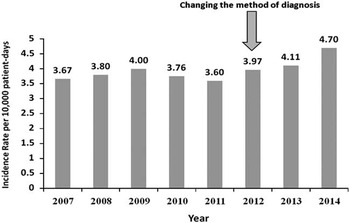
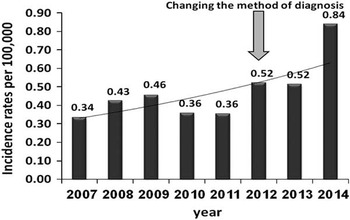
During the 8 years included in this case–case-control study, 1,563 CDI cases were identified. During this period, the population at risk (aged >18 years) served by TASMC varied between 2,077,620 and 2,367,540. The overall incidence of CDI increased from 8.09 to 9.63 per 100,000 between 2007 and 2014. This trend was observed for both CA-CDI and HA-CDI. During 2007–2011, the incidence rate of CA-CDI increased 1.06-fold, whereas HA-CDI reached a plateau; however, the average incidence rates of CA-CDI and HA-CDI were 0.39 per 100,000 and 3.77 per 10,000 patient days, respectively (Figures 1 and 2).
The incidence rates of CA-CDI and HA-CDI increased by 1.6-fold and 1.2-fold, respectively, during 2012–2014. However, the incidence rates of CA-CDI and HA-CDI in 2014 were 0.84 per 100,000 and 4.7 per 10,000 patient days, respectively (Figures 1 and 2).
Patient Characteristics
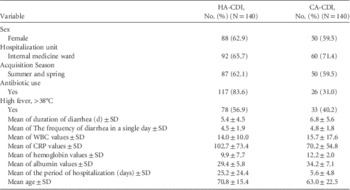
A total of 140 HA-CDI cases were identified randomly among 772 patients during 2011–2014. The average age of this patient cohort was 70.8 years; 62.9% were women. Patients were hospitalized an average of 25.2 days, 65.7% were admitted to the internal medicine ward. Moreover, 62.1% acquired the CDI during the spring and summer seasons (between March and September). All CA-CDI cases were included (n=84 patients) during 2007–2014. The average age of this patient cohort was 63.0 years; 59.5% were women. Only 31% of the patients had had recent antibiotic exposure; 59.5% acquired CDI during spring or summer season. Additional features of CA-CDI are shown in Table 1.
Characteristics of Subjects With CDI in CA-CDI Compared With HA-CDI

NOTE. CA-CDI, community-acquired Clostridium difficile infection; HA-CDI, hospital-acquired Clostridium difficile infection; SD, standard deviation; WBC, white blood cell count; CRP, C-reactive protein.
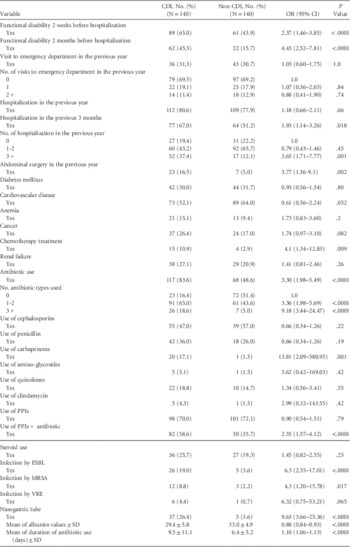
Factors Associated With Hospital Acquisition of CDI
A higher proportion of CDI patients had been treated with antibiotics and had a nasogastric tube compared with patients without CDI (83.6% vs 48.6%, and 26.4% vs 3.6%, respectively; P<.0001). Significant differences were detected between patients who acquired CDI and patients without CDI (Table 2): in functional disability at both 2 weeks and 6 months before hospitalization; for hospitalization in the previous 3 months; for abdominal surgery in the previous year; for number of antibiotic types used, including carbapenems; for use of PPIs plus antibiotic; for receiving chemotherapy; for infection with extended-spectrum β-lactamases (ESBL); and for infection with methicillin-resistant Staphylococcus aureus (MRSA). Patients who acquired CDI had mean albumin values that were significantly lower than those of patients without CDI (29.4±5.8 vs 33.0±4.9; P<.0001). Patients who acquired CDI had mean days of antibiotic exposure that were significantly greater than patients without CDI (11.1±9.5 vs 5.2±6.4; P<.0001).
Factors Associated With HA-CDI Among Hospitalized Patients

NOTE. HA-CDI, hospital-acquired Clostridium difficile infection; OR, odds ratio; CI, confidence interval; PPI, proton-pump inhibitor; ESBL, extended-spectrum β-lactamases; MRSA, methicillin-resistant Staphylococcus aureus; VRE, vancomycin-resistant enterococci; SD, standard deviation.
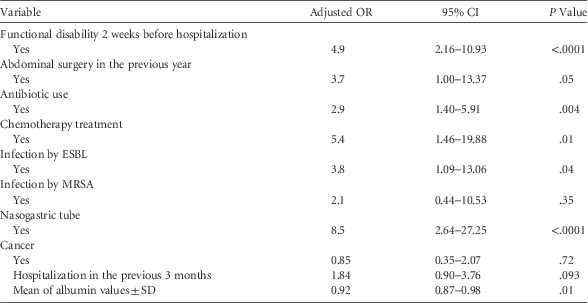
Multivariate analysis for risk factors for HA-CDI (Table 3) revealed significant association with the following factors: functional disability 6 months before hospitalization, presence of nasogastric tube, antibiotic use, chemotherapy treatment, infection by ESBL, and hypoalbuminemia. The associations with hospitalization in the previous 3 months and abdominal surgery in the previous year were of borderline significance (P=.09 and P=.05, respectively).
Multiple Logistic Regression Models for Factors Associated With HA-CDI

NOTE. HA-CDI, hospital-acquired Clostridium difficile infection; OR, odds ratio; CI, confidence interval; ESBL, extended-spectrum β-lactamases; MRSA, methicillin-resistant Staphylococcus aureus; SD, standard deviation.
Factors Associated With CA-CDI
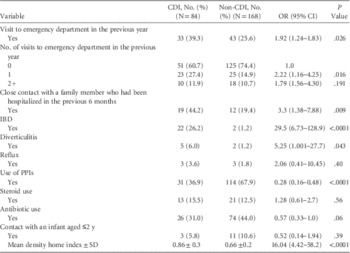
In the univariate analysis, a significant association was detected with a visit to emergency department in the previous year, hospitalization in the previous 6 months of a family member in close contact with the patient, inflammatory bowel disease (IBD), diverticulitis, and use of PPIs. Patients with CDI had higher mean grades of home density index than patients without CDI (0.86±0.3 vs 0.66±0.2; P<.0001) (Table 4).
Factors Associated With CA-CDI Among Hospitalized Patients

NOTE. CA-CDI, community-acquired Clostridium difficile infection; OR, odds ratio; CI, confidence interval; IBD, irritable bowel disease; PPI, proton-pump inhibitor; SD, standard deviation.
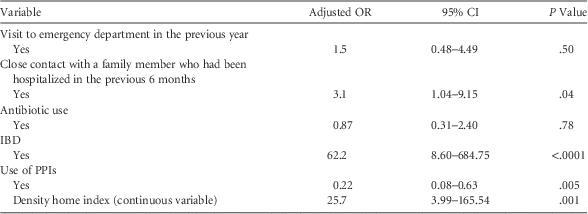
In the multivariate analysis of CA-CDI, close contact with a family member who had been hospitalized in the previous 6 months, IBD, and home density index (adjusted OR, 25.7; P=.001) remained significantly associated with increased risk of CA-CDI. However, the use of medications from PPIs was identified as a protective factor (adjusted OR, 0.22; P=.005) after adjusting for other covariates (Table 5). We added another analysis that related to community cases without the extension of the time of data collection period as downloadable supplemental files (See Online Supplemental Tables 1 and 2)
Multiple Logistic Regression Models for Factors Associated With CA-CDI

NOTE. CA-CDI, community-acquired Clostridium difficile infection; OR, odds ratio; CI, confidence interval; IBD, irritable bowel disease; PPI, proton-pump inhibitor.
DISCUSSION
We observed an increase in the number of patients with CDI, from 168 in 2007 to 228 in 2014. Both community and hospital acquisition of CDI increased. These findings are similar to the findings of other studies in which a marked increase in the incidence of CDI has been reported in various parts of the world since the turn of the 21st century.Reference Khanna, Pardi and Aronson 13 – Reference McDonald, Owings and Jernigan 15
Data from North America and Europe suggest that approximately 20% to 28% of all CDI cases are community acquired, with an incidence of 20 to 30 per 100,000 population.Reference Kuijper, Coignard and Tull 11 , Reference Svenungsson, Burman, Jalakas-Pornull, Lagergren, Struwe and Akerlund 16 In contrast with these reports, we found a lower proportion (8.8%) of CA-CDI, which is similar to the proportions reported by Wilcox et al.Reference Wilcox, Mooney, Bendall, Settle and Fawley 17
We found that treatment with carbapenems or multiple types of antibiotics was associated with an increased risk of HA-CDI. Similar findings have been documented in previous studies.Reference Larentis, Rosa, Dos-Santos and Goldani 18 , Reference King and Lager 19
Acid suppressive therapy (ie, with PPIs or H2RAs) was not a risk factor for CDI.Reference Obritsch, Stroup, Carnahan and Scheck 20 In our study, no association was identified between PPIs and increased risk of HA-CDI. One explanation for this finding in our study may be the large number of patients using these agents in our hospital and the possibility that increased risk may be related to prolonged use. Several other studies found no association between acid suppressive therapy and HA-CDI, including a Veterans Affairs studyReference McFarland, Clarridge, Beneda and Raugi 21 and a study of hospitalized patients.Reference Larentis, Rosa, Dos-Santos and Goldani 18 Another explanation may be related to receiving concurrent antibiotics; however, the effect of PPIs on specific colonic bacteria may be overwhelmed. In our study, patients receiving antimicrobials and PPIs were more likely to develop CDI than those who did not receive these drugs, similarly to the findings of King and Larger.Reference King and Lager 19 The effect of PPIs on the fecal microbiome and consequently on risk for CDI is modest compared to the effect of antibiotics. The relationship between PPIs and CDI was modified by exposure to antibiotics, but PPIs were not associated with a significantly increased risk for CDI in either those who did or did not receive antibiotics.Reference Faleck, Salmasian, Furuya, Larson, Abrams and Freedberg 22 The increased risk of acquiring colonization with healthcare-associated multidrug-resistant organisms (MDROs) resulted from disruption in normal gut flora by mechanical ventilation, enteral feeds, multiple antibiotic courses, PPIs, and prior CDI carriers among residents of long-term care facilities.Reference Prasad, Labaze and Kopacz 23
An interesting finding in our study was the increased risk of HA-CDI with functional disability 2 weeks and 6 months before hospitalization; this discovery corroborated the findings of Patricia et al,Reference Patricia, Wu Lai, Garcia-Salmones, Saavedra-Cervera, Garcia-Salguero and Merino 24 which showed a high level of dependence correlated with clinical diagnosis of C. difficile. Only a few studies have addressed this association between CDI and functional disability, which may be related to oral hygiene in these patients. Some of these patients were kept on mechanical ventilation or enteral feeding, which require intensive care with frequent contact from the attending staff, leading to an increase in person-to-person transmission of CDI by the fecal-oral route.
We observed significantly increased risks of HA-CDI linked to hospitalization in the previous 3 months, frequent hospitalization, presence of nasogastric tube, antibiotic use, chemotherapy treatment, infection by ESBL and hypoalbuminemia. These risk factors for CDI have been documented in previous studies.Reference Obritsch, Stroup, Carnahan and Scheck 20 , Reference Cohen, Gerding and Johnson 25 , Reference Lihua, Danfeng, Cen, Xuefeng and Yibing 26
Similar to other studies of CA-CDI,Reference Svenungsson, Burman, Jalakas-Pornull, Lagergren, Struwe and Akerlund 16 , 27 our findings indicate that CA-CDI did not have traditional risk factors. In our multivariate analysis of CA-CDI, close contact with a family member who had been hospitalized in the previous 6 months and home density index remained significantly associated with CA-CDI after adjusting for other covariates. These findings suggest that asymptomatic carriers contribute significantly to CDI transmission in long-term care facilities and may have a role in dissemination of C. difficile in the community as well.Reference Gupta and Khanna 28
To our knowledge, this is the first report that links home density index to the increase in CDI incidence. This observation may suggest that an increase in the proportion of asymptomatic carriers in the community contributes to an increase in person-to-person transmission among family members and supports further effort to detect high-risk hosts. Sources of C. difficile may be the home environment, the food chain, water, work place, or environment. Several potential reservoirs for CA-CDI needs further investigation such as environmental, animal, and human sources. Furthermore, CA-CDI is increasing in incidence and severity, and this disease is increasingly occurring in populations not traditionally considered at risk. Thus, symptomatic patients presenting with no recent history of hospitalization or antibiotic use should be investigated for potential CDI in addition to being tested for other potential enteric pathogens.Reference Tracey, Kirke, Armstrong and Riley 29 In addition, exposure to household contacts with CDI could increase the risk C. difficile acquisition.Reference Svenungsson, Burman, Jalakas-Pornull, Lagergren, Struwe and Akerlund 16
Hospital-acquired CDI and CA-CDI may differ in their association with PPI use due to differences in circulating clostridial strains and to the differential antibiotic exposure in these 2 distinct settings.Reference Freedberg and Abrams 30 The role of gastric acid suppression in CDI remains is controversial. In a large, community-based, case-control trial, the use of acid suppressants, especially PPIs, as well as nonsteroidal anti-inflammatory agents was associated with an increased risk for development of CDI.Reference Dial, Delaney, Barkun and Suissa 31 Other studies have shown that after controlling for important confounders, the use of PPIs was not associated with the risk of CDIReference Pepin, Saheb and Coulombe 32 nor was there an adverse relationship to the risk of CA-CDI.Reference Khanna, Aronson, Kammer, Baddour and Pardi 33 In our study, however, an inverse association was identified between PPIs and risk of CA-CDI; this finding should be interpreted with caution.
An interesting finding in our study was the increased risk of CA-CDI with IBD. The explanations for the association between IBD and CDI include immunosuppressive medication, host immunity, and use of corticosteroids.Reference Issa, Vijayapal and Graham 34 , Reference Rodemann, Dubberke, Reske, Seo da and Stone 35 The existence of intestinal flora alterations in IBD patients increased mucosal permeability, which could allow C. difficile colonization and proliferation.Reference Berg, Kelly and Farraye 36 , Reference Wang, Atreja, Wu, Lashner, Brzezinski and Shen 37
Our study has several limitations. The burden of CA-CDI in the community is likely to have been underestimated because we characterized only cases in which the patient was unwell enough to present to the hospital and have a stool sample collected. Thus, community patients may be diagnosed at a late and at a more severe stage of infection. The random selection of cases with HA-CDI included patients who were hospitalized and available for interview, and hospitalized patients may have had more severe cases. Thus, our analytical study may have been run on more severe cases. We were unable to assess colonization, especially in the community; however, we were unable to determine whether a positive stool test in unformed stools indicated colonization or infection if the patient had taken laxatives, hyperosmolar feeds, or PPIs. The results derived from this single-center study might not be representative of all hospitals in Israel or elsewhere due to patient heterogeneity across different institutions. To overcome this weakness, multicenter studies with larger populations should be performed in the future.
In conclusion, our findings indicate an increased incidence of both HA-CDI and CA-CDI during 2007–2014 at Tel Aviv Sourasky Medical Center. We identified several important predictors of CA-CDI: close contact with a family member who had been hospitalized in the previous 6 months, IBD, and density home index. However, subjects with functional disability 6 months before hospitalization, infection by ESBL, and hypoalbuminemia were interesting risk factors for HA-CDI in our study.
We identified 3 main modifiable risk factors for HA-CDI (antibiotic exposure and hypoalbuminemia) and for CA-CDI (close contact with a family member who had been hospitalized in the previous 6 months). Therefore, we offer the following recommendations: (1) providing a multiprotein diet, (2) cautious use of antibiotics and limiting the use of multiple types of antibiotics, and (3) strict guidelines for preventing infections for health services that provide long-term care for chronically ill patients (especially hand hygiene among the attending staff). Such measures are critical to preventing the spread of infection from C. difficile in hospitals and in the community.
Trends in the incidence rates of HA-CDI between 2007 and 2014. The incidence rate of HA-CDI was 3.67 per 10,000 patient days in 2007 compared with 4.70 per 10,000 patient days in 2014.

Trends in the incidence rates of CA-CDI between 2007 and 2014. The incidence rate of CA-CDI was 0.34 per 100,000 in 2007 compared with 0.84 per 100,000 in 2014.

ACKNOWLEDGMENTS
Financial support: No financial support was provided relevant to this article.
Potential conflicts of interest: All authors report no conflicts of interest relevant to this article.
SUPPLEMENTARY MATERIAL
To view supplementary material for this article, please visit https://doi.org/10.1017/ice.2017.82