Fertility in dairy cows has declined over the past five decades as milk production per cow has increased. Many hypotheses have been proposed to explain this, including issues of genetics, physiology, nutrition and management, and these factors have been investigated at the animal, organ and cellular level at critical time points during the productive life of dairy cows (Walsh et al. Reference Walsh, Williams and Evans2011).
Continuous monitoring of the reticuloruminal pH is advantageous due to the possibility of diurnal recording. Techniques for the continuous measurement of ruminal pH were used for a series of scientific investigations (Alzahal et al. Reference Alzahal, Kebreab, France, Froetschel and McBride2008). In order to obtain the collected data, a memory chip either has to be removed via the rumen, or the data is transmitted by a cable to an external unit, which is fixed to the animal (Alzahal et al. Reference Alzahal, Kebreab, France, Froetschel and McBride2008).
Subacute Ruminal Acidosis (SARA) corresponds to an imbalance between lactate-producing bacteria and lactate-using bacteria, which results in a change in the ruminal pH associated with the consumption of rapidly fermentable carbohydrates. The susceptibility of dairy cows to SARA seems to be higher for cows in early lactation, probably due to the instability of the bacterial population (Devries et al. Reference Devries, Beauchemin, Dohme and Schwartzkopf-Genswein2009). This disequilibrium in the microbiota is believed to be due to a change in the rumen pH, related to the consumption of rapidly fermentable carbohydrates (Devries et al. Reference Devries, Beauchemin, Dohme and Schwartzkopf-Genswein2009). Usually, the rumen pH threshold below which acidosis occurs is 5·5 (Dorigo et al. Reference Dorigo, Dalvit and Andrighetto2009). There is a close relationship between the rumen pH and blood. Various analyses of blood, urine, faeces, and milk have been considered and evaluated for the purpose of diagnosing SARA (Devries et al. Reference Devries, Beauchemin, Dohme and Schwartzkopf-Genswein2009), but the results of these studies are conflicting. Reversible decreases in ruminal contractions, faecal consistency, ruminal acetate and acetate to propionate ratio, milk fat content, and milk fat to milk protein ratio were also observed, all of which have been associated with SARA (Dorigo et al. Reference Dorigo, Dalvit and Andrighetto2009).
Clinical rumen acidosis is typically associated with fertility problems, but due to the difficulty in diagnosis the same cannot be assumed for SARA. However, low ruminal pH will in itself have negative consequences in the individual such as laminitis and reduction in feed intake, and it is uncertain what the consequences of low ruminal pH are on reproductive performance (Kleen & Cannizzo, Reference Kleen and Cannizzo2012). According to Inchaisri et al. (Reference Inchaisri, Chanpongsang, Noordhuizen and Hogeveen2013), low ruminal pH was associated with a high risk of non-conception at first insemination. In this research communication we make the assumption that cows with disturbed rumen metabolism are less likely to conceive, and we test the hypothesis that measurements of retuculoruminal pH and temperature can be used as a predictor of the likelihood of reproductive success.
Materials and methods
The study was performed on 20 multiparous Lithuanian Black and White dairy cows from a herd of 550 cows. The experimental cows were kept in a uniform environment and received a uniform ration of feed suitable for the stage of lactation. They had an average yield of 30 (±3) kg/d. Before the study, the cows selected were examined according to a general clinical examination plan, and were completely healthy. Clinical signs of acidosis (diarrhoea, loss of appetite, and weak rumination (on average, 3 times/2 min) were not found. All cows were clinically healthy throughout the study. The average somatic cell concentration in the milk of the cows studied was about 250 (±32) thousand/ml, and the milk urea was 25 (±4) mg/%. The pH and temperature of the contents of their reticulorumens were measured using specific smaXtec boluses manufactured for animal care. smaXtec animal care technology® enables the continuous real-time display of ruminal pH and temperature data. According to the directions of the manufacturer, the boluses were inserted into the reticulorumens with the help of a specific tool. The data was measured with the help of specific antennas (smaXtec animal care technology®). For monitoring the reticuloruminal pH, an indwelling and wireless data transmitting system (smaXtec animal care GmbH, Graz, Austria) was used. The data collected was transmitted using the ISM-Band (433 MHz). The system was controlled by a microprocessor. The data (pH and temperature) were collected by means of an analogue to digital converter (A/D converter) and stored in an external memory chip. Due to its dimensions (length: 12 cm; width: 3·5 cm; weight: 210 g), this indwelling system can be orally administered to an adult cow, and it is shock-proof and resistant to rumen fluid. Calibration of the pH-probes was performed using pH 4 and pH 7 buffer solutions at the beginning of the experiment. The data from reticulorumen were recording at following intervals: 1 to 7 and 7 to 56 d postpartum and then post insemination (on average 60 ± 12) until 170 d after calving.
Oestrus was identified with specific indicators of heat and the animal was considered to be in oestrus when she exhibited one or more of the following: mucous discharge, restlessness and alertness, standing to be mounted, tail raising, congestion of vulval mucous membrane, uterine tone. The uterine tone was observed by rectal palpation. After 12 h from the beginning of the oestrus, the cows were inseminatad. The pregnancies were tested with ‘Easy scan’ ultrasound after 30–35 d post-insemination. Those cows which were pregnant were assigned to the PD+ group (n = 12) and those which were not pregnant, were assigned to the PD− group (n = 8). All the data were obtained by smaXtec messenger® computer software.
Descriptive statistic (mean ± standard deviation), Pearson's correlation and linear regression analysis were calculated by the SPSS statistical package (SPSS for Windows 15·0, SPSS Inc., Chicago, IL, USA, 2006). The data were considered reliable from the statistical point of view, when P < 0·05.
Results and discussion
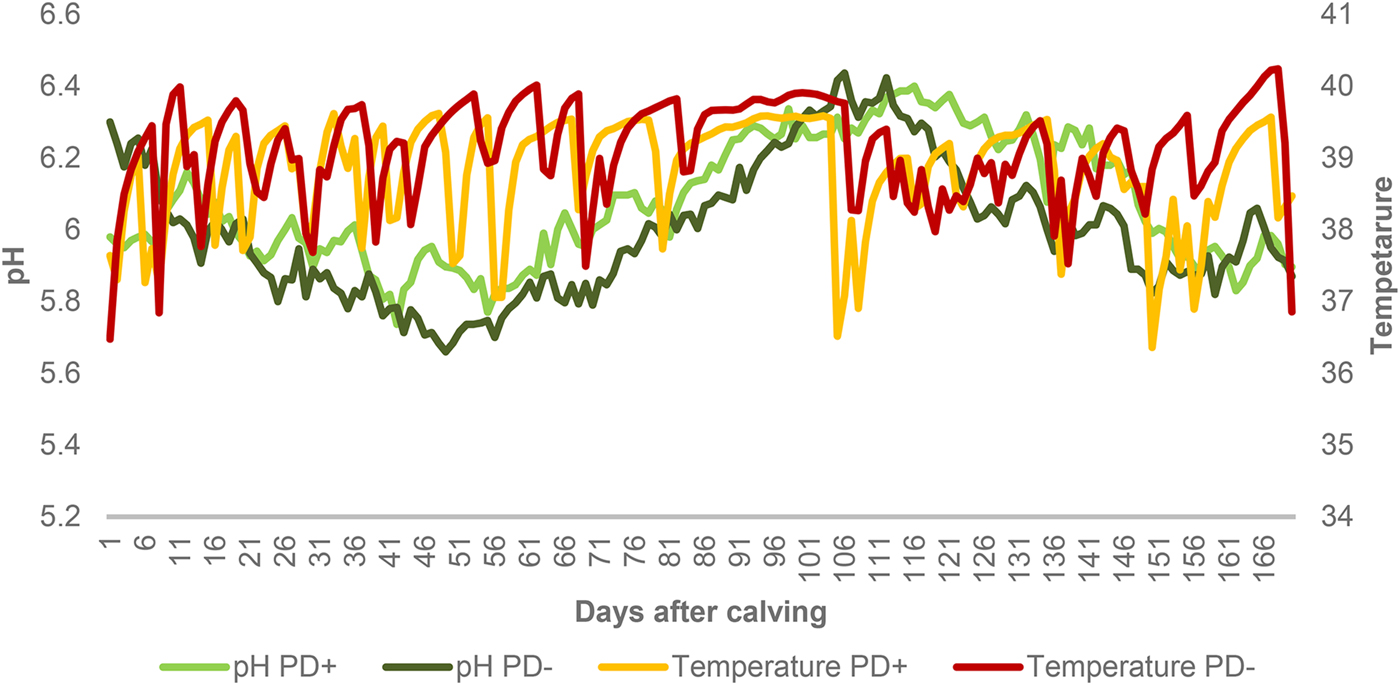
In the PD+ group, the average of the reticulorumen pH was consistently higher than PD− except for the period 1 to 7 d postpartum, when it was significantly lower. In the PD+ group on 7 to 56 d postpartum and post insemination till 170 d the pH difference was statistically significant (Table 1, Fig. 1). Regression analysis showed that the pH of the PD− had a tendency to decrease throughout the study whereas the opposite was true of the PD+ during the first week postpartum (Table 2). According to Inchaisri et al. (Reference Inchaisri, Chanpongsang, Noordhuizen and Hogeveen2013) a decrease of ruminal pH below a given threshold value reduces the fertility. Low ruminal pH could result in death and lysis of Gram-negative bacteria in rumen and hence increase lipopolysaccharides which could trigger a higher level of systemic inflammatory markers, such as acute phase protein serum amyloid A, cytokines, and haptoglobin that exceed a physiological level (Khafipour et al. Reference Khafipour, Krause and Plaizier2009). Additionally, some studies suggest that a ruminal pH depression alone is not enough to result in the clinical signs related to SARA. Many cases of SARA may not be detected, as the current field diagnosis of SARA is not clearly defined and depends either on ruminal pH point measurements, which are invasive, and due to fluctuations in pH, are not very accurate or sensitive for the diagnosis of a longer lasting pH depression indicative of SARA, or on continuous measurements which require costly equipment, and are primarily suited for research purposes (Devries et al. Reference Devries, Beauchemin, Dohme and Schwartzkopf-Genswein2009).
Reticulorumen content pH during the investigation (PD+ pregnant at first insemination, PD− non pregnant at first insemination).

Analysis of reticulorumen content pH and temperature in different periods

**P < 0·01, ***P < 0·001.
Equations of linear regression

PD+, pregnant at first insemination; PD−, non pregnant at first insemination.
Rumen temperature was not different between PD+ and PD− groups prior to conception. In the PD+ group, the average reticulorumen temperature in the period post insemination till 170 d postpartum was consistently higher than PD− (P < 0·05) (Table 1). Temperature changes across time were small apart from an increase in the first 7 d postpartum in the PD− group (Table 2).
We observed a negative correlation between the pH of the contents of the abomasum and rumen temperature. The increase in the acidity (decrease of pH) of the contents of the reticulorumen increases its temperature and also increases the temperature of the contents of the abomasum. At oestrus the reticulorumen pH increased (on average 6·22 ± 0·2), but this difference was not significant. The average reticulorumen content temperature during oestrus was increased to 40·2 ± 0·25 °C (P < 0·05). Ruminal temperature decreased the day before parturition and increased at oestrus in spring-calving beef cows and has a potential use as a predictor of parturition and oestrus (Cooper-Prado et al. Reference Cooper-Prado, Long, Wright, Goad and Wettemann2011). In other work (Suthar et al. Reference Suthar, Burfeind, Patel, Dhami and Heuwieser2011) diurnal temperature rhythms were similar before and after oestrus, but vaginal temperature before oestrus (d 11 and 12) was slightly (0·1 °C) higher, compared with the post-ovulation period. As a result, automated heat detection systems have been developed. Currently available tools for esturs detection are automated detectors of standing heat, activity-meters and automated in-line systems measuring milk progesterone. Camera-software systems and the monitoring of body temperature are also being developed (Saint-Dizier & Chastant-Maillard, Reference Saint-Dizier and Chastant-Maillard2012).
We can conclude that cows with disturbed rumen metabolism (with low rumen pH) are less likely to conceive. The measurements of reticuloruminal pH (and perhaps temperature) can be useful as a predictor of the likelihood of reproductive success, but more research is needed before practical application.