
Introduction
Fascioliasis, caused by Fasciola spp., is a food- and water-borne, zoonotic and neglected tropical disease which affects both animals and humans throughout the globe but more commonly found in tropics and sub-tropics (Mehmood et al., Reference Mehmood, Zhang, Sabir, Abbas, Ijaz, Durrani, Saleem, Ur Rehman, Iqbal, Wang, Ahmad, Abbas, Hussain, Ghori, Ali, Khan and Li2017; Fairweather et al., Reference Fairweather, Brennan, Hanna, Robinson and Skuce2020). It is reported as one of the most widely spread diseases over 50 countries of the world (Mas-Coma, Reference Mas-Coma2003; Mas-Coma et al., Reference Mas-Coma, Bargues and Valero2005; Toledo and Fried, Reference Toledo and Fried2014; Mehmood et al., Reference Mehmood, Zhang, Sabir, Abbas, Ijaz, Durrani, Saleem, Ur Rehman, Iqbal, Wang, Ahmad, Abbas, Hussain, Ghori, Ali, Khan and Li2017). It is estimated that 2.4 million people over 60 countries are infected with fascioliasis and more than 180 million people are at risk in the world (WHO, 1995; Mas-Coma et al., Reference Mas-Coma, Esteban and Bargues1999; Zerna et al., Reference Zerna, Spithill and Beddoe2021). Fascioliasis is considered an important and devastating disease in the world including Bangladesh which causes severe economic losses due to morbidity and mortality, declined weight gain (up to 20%), decreased milk and meat production (3–15%), damage and condemnation of liver of infected animals in the livestock industry (Mohanta et al., Reference Mohanta, Ichikawa-Seki, Shoriki, Katakura and Itagaki2014; Khan et al., Reference Khan, Anisur Rahman, Ahsan, Ehsan, Dhand and Ward2017; Aghayan et al., Reference Aghayan, Gevorgian, Ebi, Atoyan, Addy, Mackenstedt, Romig and Wassermann2019; Opio et al., Reference Opio, Abdelfattah, Terry, Odongo and Okello2021). The global economic losses are evaluated to be more than USD 3.2 billion annually due to fascioliasis (Mas-Coma et al., Reference Mas-Coma, Bargues and Valero2005; Charlier et al., Reference Charlier, Duchateau, Claerebout, Williams and Vercruysse2007; Luo et al., Reference Luo, Cui, Wang, Li, Wu, Huang, Zhu, Ruan, Zhang and Liu2021). In Bangladesh, the financial losses caused by fascioliasis are estimated to USD 0.16/slaughtered goat and would be USD 115.44/1000 slaughtered goats due to liver condemnation and USD 2374.9 annually (Islam and Ripa, Reference Islam and Ripa2015).
Globally, the incidence of fascioliasis has increased over the past two decades, possibly due to change in farming practices, climate and development of anthelmintic resistance (Sabourin et al., Reference Sabourin, Alda, Vázquez, Hurtrez-Boussès and Vittecoq2018). Fasciola gigantica is one of the most endemic and parasitic diseases of ruminants in Bangladesh (Amin and Samad, Reference Amin and Samad1988; Islam and Samad, Reference Islam and Samad1989; Rahman et al., Reference Rahman, Islam, Talukder, Hassan, Dhand and Ward2017). The prevalence of F. gigantica in live animals has been reported to vary from 21 to 53% in cattle, 10 to 32% in goats, 8.4 to 31% in sheep and 19 to 51% in buffaloes (Islam et al., Reference Islam, Rahman, Islam, Adhikary and Rauf2014; Rahman et al., Reference Rahman, Islam, Talukder, Hassan, Dhand and Ward2017) and its prevalence in slaughtered animals also vary from 15 to 66% in cattle, from 3.8 to 22% in goats, 81% in sheep and from 23 to 47% in buffaloes, respectively (Talukder et al., Reference Talukder, Bhuiyan, Hossain, Uddin, Paul and Howlader2010; Islam et al., Reference Islam, Rahman, Islam, Adhikary and Rauf2014). However, the actual burden of F. gigantica in domestic ruminants might be much higher than the mentioned values since fascioliasis is mainly the subclinical disease (Khatun et al., Reference Khatun, Asaduzzaman, Pallab and Chakrabartty2015). A recent retrospective epidemiological study has been carried out in domestic ruminants where the hot spot, clusters and risk factors of fascioliasis are identified in Bangladesh (Rahman et al., Reference Rahman, Islam, Talukder, Hassan, Dhand and Ward2017).
Fascioliasis is mainly treated with anthelmintic drugs, due to the absence of commercially available vaccines (Davis et al., Reference Davis, Winters, Milic, Devitt, Cookson, Brophy and Morphew2020). The most commonly used anthelmintic drugs against fascioliasis in animals are triclabendazole (TCBZ), nitroxynil (NTON), oxyclozanide (OCZN), clorsulon (CLORS), closantel and albendazole (ALBZ) (Kelley et al., Reference Kelley, Elliott, Beddoe, Anderson, Skuce and Spithill2016). TCBZ is considered the first choice of anthelmintic for the treatment of fascioliasis due to its effect against immature and mature flukes (Rolfe and Boray, Reference Rolfe and Boray1987) and other anthelmintics are effective against mature flukes only (Fairweather and Boray, Reference Fairweather and Boray1999). TCBZ inhibits the polymerization of the tubulin molecules into the cytoskeletal microtubule structures (Fairweather, Reference Fairweather2005; Fairweather, Reference Fairweather2009). NTON stops the oxidative phosphorylation in the cell mitochondria of flukes and disturbs the production of adenosine triphosphate, thus impairing the motility of the parasites, whereas OCZN acts by uncoupling the oxidative phosphorylation in flukes (Boray and Happich, Reference Boray and Happich1968; Rapic et al., Reference Rapic, Dzakula, Sakar and Richards1988). Currently, various flukicidal drugs are recommended commercially but their efficacy in fascioliasis has not been established (Fairweather et al., Reference Fairweather, Brennan, Hanna, Robinson and Skuce2020) and thus making the control of fascioliasis difficult (Novobilský and Höglund, Reference Novobilský and Höglund2015). There are several previous in vitro studies on both Fasciola hepatica and F. gigantica where the efficacy of flukicides has been analysed to evaluate the changes in various parameters namely relative motility (RM) (Saowakon et al., Reference Saowakon, Tansatit, Wanichanon, Chanakul, Reutrakul and Sobhon2009; Jeyathilakan et al., Reference Jeyathilakan, Murali, Anandaraj and Abdul Basith2012; Tansatit et al., Reference Tansatit, Sahaphong, Riengrojpitak, Viyanant and Sobhon2012; Lorsuwannarat et al., Reference Lorsuwannarat, Piedrafita, Chantree, Sansri, Songkoomkrong, Bantuchai, Sangpairot, Kueakhai, Changklungmoa, Chaichanasak, Chansela and Sobhon2014; Shareef et al., Reference Shareef, Brennan, Mcveigh, Khan, Morphew, Mousley, Marks, Saifullah, Brophy, Maule and Abidi2014; Chang and Flores, Reference Chang and Flores2015), morphometric (Shafiei et al., Reference Shafiei, Sarkari, Sadjjadi, Mowlavi and Moshfe2014; Ahasan et al., Reference Ahasan, Valero, Chowdhury, Islam, Islam, Mondal, Peixoto, Berinde, Panova and Mas-Coma2016; Shalaby et al., Reference Shalaby, El Namaky and Kamel2016) and morphology followed by histopathological changes of treated flukes (Saowakon et al., Reference Saowakon, Tansatit, Wanichanon, Chanakul, Reutrakul and Sobhon2009; Jeyathilakan et al., Reference Jeyathilakan, Murali, Anandaraj and Abdul Basith2012; Lorsuwannarat et al., Reference Lorsuwannarat, Piedrafita, Chantree, Sansri, Songkoomkrong, Bantuchai, Sangpairot, Kueakhai, Changklungmoa, Chaichanasak, Chansela and Sobhon2014; Hanna et al., Reference Hanna, Mcmahon, Ellison, Edgar, Kajugu, Gordon, Irwin, Barley, Malone, Brennan and Fairweather2015; Shalaby et al., Reference Shalaby, El Namaky and Kamel2016). Consequently, the tegument is one of the tissues that exposed most immediately to anthelmintics and is likely to represent a primary drug target region (McKinstry et al., Reference Mckinstry, Fairweather, Brennan and Forbes2003). Scanning electron microscopy (SEM) has been proven to be a useful tool for evaluating the surface changes on the tegument, suckers and spines of flukes resulting in anthelmintic action (Stitt and Fairweather, Reference Stitt and Fairweather1993; Fairweather and Boray, Reference Fairweather and Boray1999; Meaney et al., Reference Meaney, Fairweather, Brennan, Ramasamy and Subramanian2002; Halferty et al., Reference Halferty, Brennan, Hanna, Edgar, Meaney, McConville, Trudgett, Hoey and Fairweather2008; Saowakon et al., Reference Saowakon, Tansatit, Wanichanon, Chanakul, Reutrakul and Sobhon2009; Shalaby et al., Reference Shalaby, El Namaky and Kamel2009; Diab et al., Reference Diab, Mansour and Mahmoud2010; Lorsuwannarat et al., Reference Lorsuwannarat, Piedrafita, Chantree, Sansri, Songkoomkrong, Bantuchai, Sangpairot, Kueakhai, Changklungmoa, Chaichanasak, Chansela and Sobhon2014; Shareef et al., Reference Shareef, Brennan, Mcveigh, Khan, Morphew, Mousley, Marks, Saifullah, Brophy, Maule and Abidi2014; Omran and Ahmad, Reference Omran and Ahmad2015).
In Bangladesh, much less information is available regarding the effectiveness of anthelmintics where the efficacy of NTON has been reported as 92.57% followed by TCBZ (91.55%) and ALBZ (84.53%) (Aktaruzzaman et al., Reference Aktaruzzaman, Mohamed, Naim-Ul-Alam, Siddiqul Islam and Howlader2015). Although animals are treated commonly with various flukicides, the pathological changes may occur in liver and bile ducts which indicate flukicidal resistance against flukes. It has been reported previously that around 200–500 liver flukes, F. hepatica, are detected in a single infected liver during the necropsy of sheep (Soulsby, Reference Soulsby2012). Even though TCBZ, NTON, OCZN and ALBZ are used randomly in ruminants of Bangladesh, numerous (~120) liver flukes have recovered from a single infected liver of goat collected from slaughter house. The presence of numerous flukes suggests the possibility of development of anthelmintic resistance, which may be due to indiscriminate use of anthelmintics or inappropriate dose and timing of flukicidal drug administration in Bangladesh. Resistance against anthelmintics has already been reported against nematodes in this country (Hoque et al., Reference Hoque, Begum and Nooruddin2003; Dey et al., Reference Dey, Begum, Anisuzzaman, Alim and Alam2020). However, the current status of flukicides against F. gigantica has not yet been evaluated in Bangladesh. Since there is scarcity of information on the in vitro efficacy of flukicidal drugs on F. gigantica isolates in Bangladesh, the present study aimed to assess the potency of commonly used flukicidal drugs in vitro on F. gigantica by observing the fluke's motility, histopathology, morphometric and ultra-structural changes using SEM.
Materials and methods
Drugs and dosage
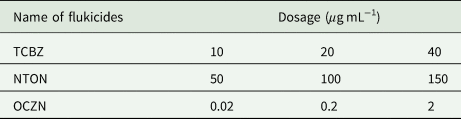
Pure form of drugs, TCBZ, NTON and OCZN was purchased directly from Germany (WITEGA Laboratorien Berlin-Adlershof GmbH, Berlin, Germany) and stored in the laboratory of the Department of Parasitology, Bangladesh Agricultural University, Mymensingh. Then the doses of these drugs were determined according to the calculation of previously published data (Table 1) (McKinstry et al., Reference Mckinstry, Brennan, Halferty, Forbes and Fairweather2007; Shalaby et al., Reference Shalaby, El Namaky and Kamel2009; Fairweather et al., Reference Fairweather, Mcshane, Shaw, Ellison, O'Hagan, York, Trudgett and Brennan2012; Tansatit et al., Reference Tansatit, Sahaphong, Riengrojpitak, Viyanant and Sobhon2012; Lorsuwannarat et al., Reference Lorsuwannarat, Piedrafita, Chantree, Sansri, Songkoomkrong, Bantuchai, Sangpairot, Kueakhai, Changklungmoa, Chaichanasak, Chansela and Sobhon2014; Arafa et al., Reference Arafa, Shokeir and Khateib2015).
Doses of flukicides used for in vitro experiment

Collection and isolation of live flukes from the liver of slaughtered goats
Livers were collected immediately after slaughtering of goats from the local abattoir and brought to the laboratory of the Department of Parasitology, Bangladesh Agricultural University, Mymensingh. Then flukes were recovered from livers following the standard procedure described previously in the laboratory (Shalaby et al., Reference Shalaby, El Namaky and Kamel2009). Flukes were cleaned from blood and debris using phosphate-buffered saline.
Culture of flukes
After washing, the alive flukes were cultured in a Petri dish containing RPMI-1640 medium incorporated with 50% (v/v) heat-denatured rabbit serum, 2% (v/v) rabbit red blood cells and antibiotics (penicillin, 50 IU mL−1; streptomycin, 50 mg mL−1) as per recommendation (Ibarra and Jenkins, Reference Ibarra and Jenkins1984) at 37°C in the presence of 5% CO2.
After an hour the dead or slow-moving flukes were removed from the culture plate. Then the media was changed with the help of pipette and the culture plate was placed in the incubator for subsequent in vitro experiments with flukicides.
Treatment of flukes with flukicidal drugs with selected doses
After half an hour of incubation, flukes were treated with flukicides when the motility was very live and spontaneous. Five flukes were cultured in each well of the culture plate containing RPMI-1640 media as per recommendation and treated with three selected drugs such as TCBZ, NTON and OCZN at different concentrations as described in Table 1 and subsequently repeated thrice independently.
Observation on the motility of flukes
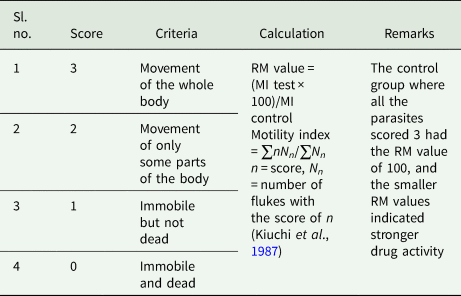
The motility of the flukes was observed with a stereo zoom microscope and recorded hourly until death of the flukes. The motility of each parasite at each incubation period was scored using the criteria (Table 2) described previously (Kiuchi et al., Reference Kiuchi, Miyashita, Tsuda, Kondo and Yoshimura1987).
Measurement criteria of motility and movement of flukes

Morphometric changes in apical cone, suckers, spines and tegument of treated flukes
The morphometric measurements of the apical cone of control and treated flukes were performed using a computer image analysis system (ELICA QWin 500, Cambridge, England) following the manual and keys described previously (Valero et al., Reference Valero, Marcos and Mas-Coma1996; Shafiei et al., Reference Shafiei, Sarkari, Sadjjadi, Mowlavi and Moshfe2014; Ahasan et al., Reference Ahasan, Valero, Chowdhury, Islam, Islam, Mondal, Peixoto, Berinde, Panova and Mas-Coma2016; Diyana et al., Reference Diyana, Mahiza, Latiffah, Fazila, Lokman, Hazfalinda, Chandrawathani, Ibitoye and Juriah2020). The measurements include the lineal biometric characters such as length and width of apical cone, maximum diameter of oral and ventral suckers, length and width of spine as well as area of tegumental swelling around the ventral sucker (Shalaby et al., Reference Shalaby, El Namaky and Kamel2009).
Histopathological changes of flukes treated with flukicides
Five dead flukes from each treated and control groups were taken for paraffin embedding. Then the flukes were fixed in 10% formaldehyde for 24 h, dehydrated with an ascending series of ethanol and cleaned with xylene. They were then embedded in paraffin, sectioned at a thickness of 5 μm using a rotary microtome and stained with haematoxylin and eosin. Then the specimens were examined under an inverted microscope to check for the abnormalities and were photographed (Jeyathilakan et al., Reference Jeyathilakan, Murali, Anandaraj and Abdul Basith2010; Hanna et al., Reference Hanna, Mcmahon, Ellison, Edgar, Kajugu, Gordon, Irwin, Barley, Malone, Brennan and Fairweather2015).
Scanning electron microscopy
Following incubation, the oral cone (including ventral sucker) of all flukes was fixed intact for 12 h in a 3:1 mixture of 4% (w/v) glutaraldehyde in 0.12 m Millonig's buffer (pH 7.4) and 1% aqueous osmium tetroxide. The specimens were washed repeatedly in double-distilled water, dehydrated through a graded series of ethanol (10, 20, 30, 40, 50, 70, 80, 90, 95 and 100%) for 10 min in each step, then dried with hexamethyldiacetylazene, fixed to aluminium stubs and coated with gold–palladium. The gold-coated specimens were examined under the Joel SEM (Jeol Corp., Mitaka, Japan) operated at 10 kV at the Centre for Advanced Research in Sciences in the University of Dhaka, Bangladesh.
Statistical analyses
One-way analysis of variance (ANOVA) with the post hoc Schaffer multiple comparison test was employed to identify the group having a statistically significant difference from the other groups in comparison with the control group. Differences between means at P < 0.05 were considered as the level of significance.
Results
NTON efficiently kills F. gigantica
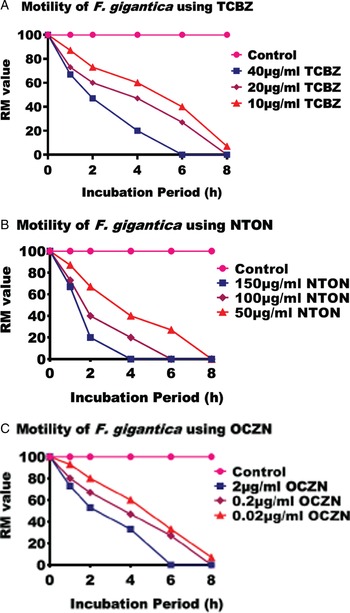
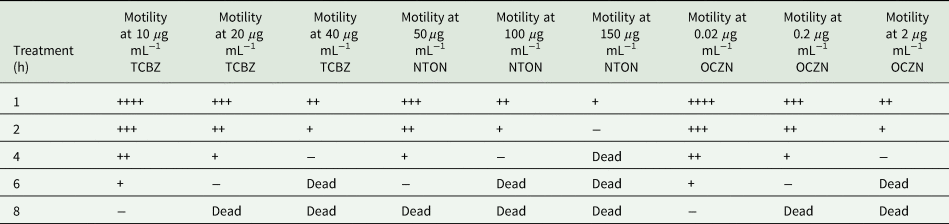
To determine the efficacy of commercially available anthelmintics, F. gigantica was incubated with TCBZ, NTON and OCZN at different concentrations and time frames as described in the ‘Materials and methods’ section. It was observed that NTON at 150 μg mL−1 drastically reduced the RM (=0) within 4 h of incubation whereas OCZN at 2 μg mL−1 and TCBZ at 40 μg mL−1 performed it by 6 h. The initial reduction of RM (decreased RM value) was found at 1 h of incubation with NTON at the concentration of 50 μg mL−1 and the RM value declined gradually until 8 h of incubation. Flukes incubated with NTON at the concentration of 100 μg mL−1 exhibited reduced motility at a more rapid rate than the previous dose, as the RM value dropped rapidly from 1 h and the parasites became completely immobile and dead at 6 h (RM = 0) whereas drastic reduction of RM value was observed at 4 h with NTON at 150 μg mL−1 (RM = 0) (Fig. 1B). In case of flukes incubated with TCBZ at various concentrations (10, 20 and 40 μg mL−1), the fluke's motility and RM value were decreased throughout the experimental period. The flukes treated with TCBZ at 10 and 20 μg mL−1 showed a gradual reduction of RM value at 1–8 h, and sharply decreased and finally dead from 6 to 8 h (RM = 0). However, the flukes became completely immobile and dead at 6 h (RM = 0) during treatment with TCBZ at 40 μg mL−1 (Fig. 1A). The flukes were incubated with OCZN at 0.02, 0.2 and 2 μg mL−1 at 1–8 h period showed rapid reduction of RM values which was similar to that of TCBZ (Fig. 1C). In contrast, flukes in the control group showed active movement throughout the duration of the experiment. The results reveal that flukes treated with TCBZ, NTON and OCZN exhibited reduced motility in a concentration and time-dependent manner. Data showing the visual observations on the motility of F. gigantica recovered from the control and treated groups are provided in Table 3.
RM rate of Fasciola gigantica treated with various concentrations of TCBZ (A), NTON (B) and OCZN (C) in vitro method.

Data showing the visual observations on the motility of adult flukes of Fasciola gigantica recovered from untreated control and TCBZ-, NTON-, OCZN-treated

Highly active (+++), moderately active (++) and immotile (−).
Anthelmintic treatment causes morphological distortion of apical cone of the flukes
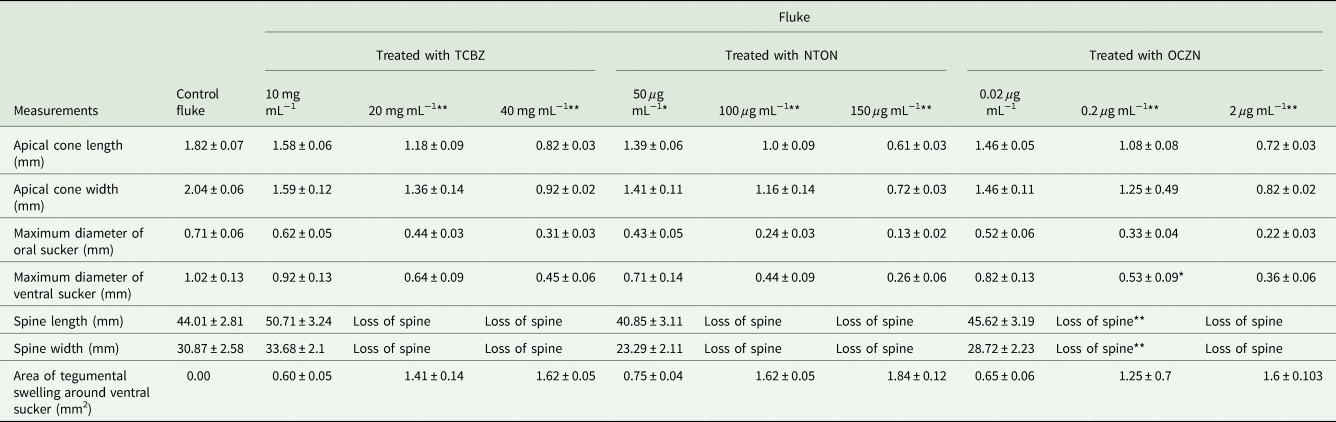
Tegumental disruption in the apical cone region was more pronounced and the ventral surface was severely affected than the dorsal of flukes treated with high concentration of flukicides (TCBZ at 40 μg mL−1; NTON at 150 μg mL−1 and OCZN at 2 μg mL−1) at 8 h of incubation compared to that of the low concentration treated and control group flukes. Both oral and ventral suckers were distorted with NTON (150 μg mL−1) and OCZN (2 μg mL−1). Losses of spine were observed in 20 and 40 μg mL−1 of TCBZ; 100 and 150 μg mL−1 of NTON and 0.2 and 2 μg mL−1 of OCZN. The tegumental swelling around ventral sucker was more pronounced in 40 μg mL−1 TCBZ; 150 μg mL−1 NTON and 2 μg mL−1 OCZN treated flukes, whereas no such damages were detected in flukes of the control group (Table 4).
Morphometric data of apical cone of control flukes and the three groups of treated flukes

*P < 0.05; **P < 0.01 (according to one-way ANOVA with post hoc Duncan test).
Architectural changes in the flukes treated with anthelmintics
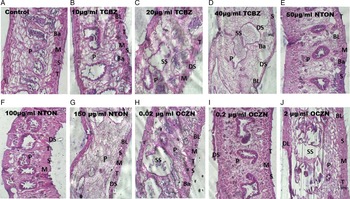
To reveal the architectural changes, histopathology of flukes from all groups was conducted. This study revealed that treated flukes at 8 h of incubation showed more prominent architectural changes. Flukes treated with TCBZ at 10 μg mL−1, NTON at 50 μg mL−1 and OCZN 0.02 μg mL−1 concentrations at 8 h of incubation showed the formation of small blebs on the tegument surface i.e. spine embedded in the slightly damaged tegument and muscle lying underneath the basement membrane. Flukes treated with TCBZ at 20 μg mL−1, NTON at 100 μg mL−1 and OCZN 0.2 μg mL−1 concentrations at 8 h of incubation showed mild separation of tegument between the spines and underlying tissue and dislodged of spines. Flukes treated with TCBZ at 40 μg mL−1, NTON at 150 μg mL−1 and OCZN 2 μg mL−1 concentrations at 8 h of incubation revealed the formation of small vacuoles, small blebs and disrupted blebs on the tegument, while spine, muscle and other structures underneath the basement membrane showed normal but dilate. However, none of these changes were detected in flukes of the control group (Fig. 2).
Stereomicroscopic figures showing the histopathology of the tegument of F. gigantica. (a) Control F. gigantica incubated in RPMI-1640 medium for 8 h, showing the tegument with normal appearances of parenchyma (P), spines (S) embedded in the intact tegument (T) and muscle layers (M) lying underneath the basement membrane (Ba). Flukes are treated with TCBZ at 10 μg mL−1; NTON at 50 μg mL−1 and OCZN at 0.02 μg mL−1 for 8 h of incubation, showing the formation of small blebs (BL) in the surface of tegument (T), mild separation of tegument between the spines (S) and underlying tissue (T) and dislodged spines (DS) in the micrograph of (b), (e) and (h). Flukes are treated with TCBZ at 20 μg mL−1; NTON at 100 μg mL−1 and OCZN at 0.2 μg mL−1 for 8 h of incubation, showing the small blebs (BL), disruption of blebs (DL) on the tegument and formation of small vacuoles (SS) in the cytoplasm, while spine (S), muscle (M) lying the underneath the basement membrane (Ba) in the micrographs of (c), (f) and (i). At high concentration of TCBZ at 40 μg mL−1, NTON at 150 μg mL−1 and OCZN at 2 μg mL−1, showing the formation of more outward small vacuoles (SS), small blebs (BL), degeneration and sloughing of tegument and disruption of blebs (DL) in the micrograph of (d), (g) and (j), respectively.

Ultra-structural changes of flukes treated with anthelmintics
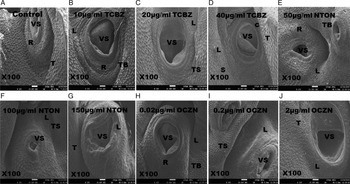
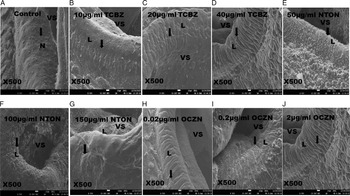
Ultra-structural changes of flukes were analysed by SEM. The most remarkable changes were found with TCBZ (40 μg mL−1) showing severe tegumental distortion (arrow) and sloughing of ventral sucker and NTON (150 μg mL−1) showing ridged tegumental distortion with losses of numerous spines and marked distortion at the tips of the spine (Figs 3–6).
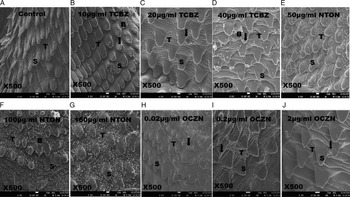
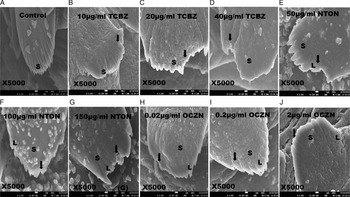
SEM of apical cone surface of treated F. gigantica following 8 h of incubation in 40 μg mL−1 of TCBZ showed disruption apart from swelling of the tegument of the ventral surface (Fig. 3). SEM of the ventral sucker at higher magnification (500×) showed tegumental distortion and sloughing in all TCBZ-treated flukes whereas these changes were more visible with TCBZ at 40 μg mL−1 (Fig. 4). SEM of the tegument showed extensive lesions in some areas of ventral apical cone with some distorted spine at 40 μg mL−1 of TCBZ-treated flukes (Fig. 5). SEM of the tegument at higher magnification (5000×) showed breaking of large tegument with losses of numerous spines and crumbled up (arrow) at their tips and corrugated appearance at 40 μg mL−1 of TCBZ-treated flukes (Fig. 6).
SEM images of the control and treated flukes. (A) SEM of apical cone surface of control flukes showing smooth ventral sucker (VS) with thick rims (R) covered with transverse folds (T) and appear spineless. SEM of the ventral sucker (B), (E) and (H) showing tegumental blebbing (TB), little disruption (L) apart from the swelling of tegument (T) on the ventral surface at a concentration of TCBZ at 10 μg mL−1; NTON at 50 μg mL−1 and OCZN at 0.02 μg mL−1 for 8 h of incubation. Pronounced tegumental swelling (TS) and disruption (L) and distortion of the ventral suckers (VS) showed in the SEMs (C), (F) and (I) during flukes were treated with CBZ at 20 μg mL−1; NTON at 100 μg mL−1 and OCZN at 0.2 μg mL−1 concentrations. SEM of flukes treated with TCBZ at 40 μg mL−1, NTON at 150 μg mL−1 and OCZN at 2 μg mL−1 concentrations showing relatively little disruption (L) on the ventral surface of flukes, apart from the swelling of the tegument (T) and swollen rim (R) of ventral sucker.

(A) SEM showing smooth and flourish wall of the ventral sucker (VS) of control fluke at higher magnification (500×). (B), (C), (E), (F), (H) and (I) SEM of the ventral sucker of flukes treated with TCBZ at 10 μg mL−1, TCBZ at 20 μg mL−1, NTON at 50 μg mL−1, NTON at 100 μg mL−1, OCZN at 0.2 μg mL−1 and OCZN at 0.2 μg mL−1 showing severe tegumental distortion (arrow marks) and sloughing (L) but all these lesions were more pronounced at the concentrations of TCBZ at 40 μg mL−1, NTON at 150 μg mL−1 and OCZN at 2 μg mL−1 in the SEM (D), (G) and (J).

(A) SEM micrograph of tegument (T) surface in control flukes shows normal appearance. (B–D) SEM of tegument of treated flukes with various concentrations of TCBZ showing gradual distortion of spines. (E–G) SEM of treated flukes with various concentrations of NTON showing gradual distortion of spines and blebbing of tegument. (H–J) SEM of treated flukes with various concentrations of OCZN showing severe damaged (arrow marks) of tegument and gradual distortion of spines (S).

(A) SEM image of spines (S) of control fluke shows finger-like protrusion at their tips. (B–J) SEM micrographs of treated flukes with various concentrations of TCBZ, NTON and OCZN showing extensive distortion (arrow marks) of the tegument (T) with losses of numerous spines (S). Severe tegumental distortion was found in flukes treated with higher concentration (150 μg mL−1) of NTON (G).

SEM of the apical cone surface of treated F. gigantica following 8 h of incubation at 150 μg mL−1 of NTON showed relatively little disruption and tegumental swelling with regional variations in severity surrounding the oral and ventral sucker's swollen rim, apart from swelling of the tegument on the ventral surface (Fig. 3). SEM of ventral sucker at higher magnification (500×) showed severe tegumental distortion and sloughing in all NTON-treated flukes (Fig. 4). SEM of the tegument showed extensive lesions in some areas of ventral apical cone in NTON-treated flukes (Fig. 5). SEM of the tegument at higher magnification (5000×) showed ridged tegumental distortion with losses of numerous spines and extensive breaking of tips of spine in NTON-treated flukes but more pronounced in 150 μg mL−1 NTON-treated flukes (Fig. 6).
SEM of the apical cone surface at 2 μg mL−1 of OCZN showed relatively little disruption, apart from swelling of the tegument on the ventral surface (Fig. 3). SEM of the ventral sucker shows swollen rim, blebbing, interior severe erosion of the muscular rim at higher magnification (500×) of OCZN-treated flukes (Fig. 4). SEM of tegument showed swollen tegument covering the spines (S) and extensive damaging of lesion on the tegument between the spines in all OCZN-treated flukes (Fig. 5). SEM of the tegument at higher magnification (5000×) showed ridged tegumental distortion with losses of numerous spines and marked distortion at the tips of the spine at 2 μg mL−1 of OCZN-treated flukes (Fig. 6). However, SEM of apical cone surface of control fluke (F. gigantica) showed smooth ventral sucker with thick rims covered with transverse folds and spines. The anterior part of the ventral surface of flukes showed the spines are small and closely spaced (Fig. 3). Wall of the ventral suckers showed smooth and flourish at higher magnification (Fig. 4). SEM of tegument surface appeared rough due to the presence of numerous normal spines and surface folding (Fig. 5) and spine showed finger-like protrusions at their tips (Fig. 6).
Discussion
Fasciola gigantica is a food- and water-borne devastating parasite, which induces cirrhosis, calcification and eventually causes severe damage and condemnation of liver leading to high economic losses in the livestock industry. This study evaluated the comparative efficacy of TCBZ, NTON and OCZN on F. gigantica in vitro technique by observing the RM value, morphological distortion of apical cone of the flukes as well as architectural changes by microscopy and ultra-structural changes of the flukes by SEM for the first time in Bangladesh.
In this study, flukes treated with TCBZ, NTON and OCZN revealed reduced motility in a concentration and time-dependent manner of flukicides. Among the tested flukicides, NTON was the most potent flukicides against F. gigantica which showed greater and faster reduction of fluke's motility. The present findings are in agreement with the findings reported previously where the RM values of the flukes exposed with TCBZ in crude extracts of Artocarpus lakoocha and artesunate were observed to decrease within 1 h (Fairweather et al., Reference Fairweather, Holmes and Threadgold1984; Bennett and Köhler, Reference Bennett and Köhler1987; Saowakon et al., Reference Saowakon, Tansatit, Wanichanon, Chanakul, Reutrakul and Sobhon2009; Tansatit et al., Reference Tansatit, Sahaphong, Riengrojpitak, Viyanant and Sobhon2012). Decreased contraction and motility were first observed after 3 h of incubation with TCBZ at the concentrations 80 and 175 μg mL−1. TCBZ markedly reduced the parasite's motility at the concentration of 175 μg mL−1 at 6 h, and killed the worms after 12 h exposure (Saowakon et al., Reference Saowakon, Tansatit, Wanichanon, Chanakul, Reutrakul and Sobhon2009). The RM values of TCBZ-treated flukes decreased significantly from 6 to 24 h for 20, 40 and 80 μg mL−1 dosages (Tansatit et al., Reference Tansatit, Sahaphong, Riengrojpitak, Viyanant and Sobhon2012). Tegumental disruption in the apical cone region, severely affected the ventral surface, distorted oral and ventral suckers seen as morphological changes; formation of some vacuoles, small blebs and disrupted blebs on the tegument surface, separation of tegument between the spines and underlying tissues and dislodged spines as histopathological changes were observed. Severe tegumental distortion and sloughing of the ventral sucker, extensive lesions of some areas of ventral apical cone with some distorted spine, ridged tegumental distortion with losses of numerous spines and crumbled up at their tips and corrugated appearance were determined by SEM in this study. The present findings from this study are consistent with the findings reported previously where sequential changes in the tegument including swelling, followed by blebbings that later ruptured, leading to the erosion and desquamation of the tegument syncytium were observed (Saowakon et al., Reference Saowakon, Tansatit, Wanichanon, Chanakul, Reutrakul and Sobhon2009). Tegumental disruption in the apical cone region became more pronounced and the ventral surface was more severely affected than the dorsal one. The tegumental swelling which was seen in the previous concentration was more pronounced and both oral and ventral suckers were distorted (Shalaby et al., Reference Shalaby, El Namaky and Kamel2009). The morphological changes after treatments with drugs, comprising swelling of tegumental ridges, followed by blebbing and later rupturing of the blebs, leading to erosion and lesion, and disruption of the tegument were observed (Tansatit et al., Reference Tansatit, Sahaphong, Riengrojpitak, Viyanant and Sobhon2012).
Architectural changes were detected through histopathological examination revealing that TCBZ, NTON and OCZN resulted in the disintegration of the tegument, vacuolization, blebbing formation, disruption of blebs and disrupting the fluke's surface which included detachment of spines. The findings of this study are in concurrence with the previous studies performed in vitro on Fischoederius cobboldi treated with ethanol extract of Terminalia catappa where vacuolization, blebbings and partial disruption of parasites tegument were reported (Anuracpreeda et al., Reference Anuracpreeda, Chankaew, Puttarak, Koedrith, Chawengkirttikul, Panyarachun, Ngamniyom, Chanchai and Sobhon2016) and treated flukes with 20 μg mL−1 TCBZ (Ebeid et al., Reference Ebeid, Moustafa, Arnaout, Degheidy, Omer, Shalaby and Abd El-Hamed2011). Flukes treated with higher doses of TCBZ, NTON and OCZN showed some vacuoles, the formation of small blebs and disrupted blebs on the tegument, while spine, muscle and other structures underneath the basement membrane showed normal but dilated that supports the previous finding where authors found the vacuole formation in the longitudinal section of fluke treated with OCZN (Jeyathilakan et al., Reference Jeyathilakan, Murali, Anandaraj and Abdul Basith2012). Histopathologically, the flukes showed marked separation of tegument from the cuticle and corrugated at 5% concentration Areca catechu. The longitudinal smooth muscle showed a massive contraction that leads to vacuolation of parenchyma (Jeyathilakan et al., Reference Jeyathilakan, Murali, Anandaraj and Abdul Basith2010). Hence, these histopathological changes indicate the potency of flukicides against F. gigantica.
However, architectural changes through histopathological changes were used to investigate a limited area of the surface change, whereas more changes in the tegument of the parasites could be observed by SEM. In response to TCBZ, NTON and OCZN on F. gigantica changes were noticed by SEM, depending on the used concentration of drugs and exposure time.
Regarding the ultra-structural changes through SEM of the apical cone surface of F. gigantica following 8 h of incubation in TCBZ showing relatively less disruption, apart from swelling of the tegument on the ventral surface, especially after the longer incubation periods in this study. The surface alterations observed in the present study resemble the earlier study where SEM of tegumental swelling followed by blebbing and rupturing of the blebs and disruption of tegument has been reported (Meaney et al., Reference Meaney, Fairweather, Brennan, Ramasamy and Subramanian2002; Tansatit et al., Reference Tansatit, Sahaphong, Riengrojpitak, Viyanant and Sobhon2012). The present study is also in agreement with the previous study where similar surface changes were observed in F. hepatica after treatment with CLORS, NTON and artemether (McKinstry et al., Reference Mckinstry, Fairweather, Brennan and Forbes2003; Meaney et al., Reference Meaney, Fairweather, Bernnan, Mcdowell and Forbes2003; Keiser and Morson, Reference Keiser and Morson2008; Anuracpreeda et al., Reference Anuracpreeda, Chankaew, Puttarak, Koedrith, Chawengkirttikul, Panyarachun, Ngamniyom, Chanchai and Sobhon2016). In contrast, extensive damage to the tegument has been reported in TCBZ-susceptible F. hepatica, whereas only localized and minor disruption of the tegument covering the spines is recorded in TCBZ-resistant flukes (Robinson et al., Reference Robinson, Trudgett, Hoey and Fairweather2002). The ultra-structural changes mentioned above might be plausibly due to response to the various anthelmintics, dependence on the thickness, variation in the anatomy and physiology, routes of drug uptake and metabolism of drug in different areas of the tegument.
In the present study, the ventral surface of treated flukes showed more severe disruption than the dorsal surface, and the anterior part of the fluke has also been affected in response to drug action. The findings of this study are in accordance with the previous in vitro studies of NTON where more disruption on the dorsal surface has been reported than the ventral surface and the anterior region of the fluke was more disrupted compared to the posterior region (McKinstry et al., Reference Mckinstry, Fairweather, Brennan and Forbes2003). In contrast, the present study is inconsistent with earlier study where the dorsal surface was found more severely affected than the ventral surface (Dawes, Reference Dawes1966; Anderson and Fairweather, Reference Anderson and Fairweather1988). However, the dorso-ventral changes have also been reported in juvenile flukes (Stitt and Fairweather, Reference Stitt and Fairweather1993).
The current study revealed that NTON causes swelling and severe disruption of the tegumental surface as well as swelling of the basal in-folds in the tegumental syncytium in treated flukes. OCZN was found to be also effective against in vitro F. gigantica that caused severe surface damage. The findings of this study are consistent with the previous studies where extensive swelling and blebbing of the tegument on both surfaces had reported in NTON-treated flukes (McKinstry et al., Reference Mckinstry, Fairweather, Brennan and Forbes2003). The results of the present study are also in accordance with previous studies where similar changes have been described for other fasciolicides (Fairweather et al., Reference Fairweather, Anderson and Threadgold1986, Reference Fairweather, Anderson and Baldwin1987; Anderson and Fairweather, Reference Anderson and Fairweather1988, Reference Anderson and Fairweather1995; Skuce and Fairweather, Reference Skuce and Fairweather1990; Stitt and Fairweather, Reference Stitt and Fairweather1993, Reference Stitt and Fairweather1994; Meaney et al., Reference Meaney, Fairweather, Brennan, Ramasamy and Subramanian2002, Reference Meaney, Fairweather, Bernnan, Mcdowell and Forbes2003; Robinson et al., Reference Robinson, Trudgett, Hoey and Fairweather2002; Buchanan et al., Reference Buchanan, Fairweather, Brennan, Trudgett and Hoey2003). Severe body surface damage has also been reported in vitro OCZN-treated Gigantocotyle explanatum where abrasion of surface papillae, formation of lesions and peeling of the tegumental syncytium are recorded.
In this study, enlarged, swollen and sloughing off numerous spines and submersion of spines by externally swollen tegument was detected in the treated flukes. The present findings are in accordance with the previous in vitro studies on NTON where widespread swelling and extensive furrowing of the tegument had been reported and the spines had submerged with the swollen tegument surrounding them in the mid-body region (Fairweather et al., Reference Fairweather, Holmes and Threadgold1984; McKinstry et al., Reference Mckinstry, Fairweather, Brennan and Forbes2003). The cause of swollen and sloughing off spines may plausibly be due to flukicidal action in the thin tegument covering the spines because a hole may be formed in the syncytium in the tegument which allow more access of the flukicidal drugs to internal tissues (McKinstry et al., Reference Mckinstry, Fairweather, Brennan and Forbes2003).
The severity of tegumental changes in NTON-, TCBZ- and OCZN-treated flukes was increased at higher concentration and longer exposure times which caused the immobility and death of the parasites. However, NTON causes faster and greater death of flukes at 4 h compared to TCBZ and OCZN which cause slower (6–8 h) death of parasites. NTON may be considered as a safe substitute for TCBZ/OCZN treatment for fascioliasis in rural animals.
Therefore, it is concluded that TCBZ, NTON and OCZN are still effective against F. gigantica in vitro testing particularly in goats from Bangladesh. The delayed reduction of RM of TCBZ-treated flukes suggests the presence of TCBZ-resistant fluke populations in Bangladesh. Further study is imperative to explore the effects of the flukicidal drugs in vivo and their molecular mechanisms.
Acknowledgements
The authors acknowledge the support from the Department of Livestock Services, Ministry of Fisheries and Livestock, Bangladesh, National Agricultural Technology Programme-2 (NATP-2), BARC; Department of Parasitology, Bangladesh Agricultural University, Mymensingh-2202, Bangladesh and Centre for Advanced Studies and Research for Scanning Electron Microscopy, University of Dhaka, Bangladesh. The abstract (P-3006) was presented in the conference of WAAVP2021, Dublin, Ireland, 18–22 July 2021.
Author contributions
Mohammad Manjurul Hasan: Conceptualization, methodology, formal analysis, resources, visualization, writing – original draft preparation, investigation, writing – review and editing. Hiranmoy Biswas: Methodology, investigation, formal analysis. Dr Babul Chandra Roy: Methodology, formal analysis, resources, validation, software, writing – review and editing. Dr Moizur Rahman: Methodology, formal analysis, writing – review. Dr Anisuzzaman: Formal analysis, resources, investigation, data curation, writing and editing. Dr Mohammad Zahangir Alam: Resources, co-supervision, writing-review & editing. Dr Md. Hasanuzzaman Talukder: Conceptualization, methodology, project administration, supervision, validation, visualization, investigation, resources, writing – review and editing.
Financial support
The authors acknowledge National Agricultural Technology Programme-2 (NATP-2), BARC, Bangladesh for providing financial support (Grant no. NATP-2/PIU-BARC-44/2017-6330, dated: 25/04/2019) to conduct this research work.
Conflict of interest
The authors declare there are no conflicts of interests.
Ethical standards
The study was approved by the Animal Welfare and Experimentation Ethics Committee of Bangladesh Agricultural University [AWEEC/BAU/2019(1)]. The authors maintained the highest possible ethical standards in their works as per guidelines.