Introduction
The term ‘globalization’ has come into common usage since the 1980s. The distinctiveness of contemporary globalization lies in the convergence of revolutionary technological advances and socioeconomic forces that have collapsed time and space, deterritorialized social activities, and drawn more and more countries, cities, and people into interdependent relationships. Most economists strongly believe the net effect of globalization to be positive (Dreher, Reference Dreher2006), and conclude that those who have lost the most from globalization typically have been the excluded nonparticipants (International Monetary Fund, 2000).
Globalization is a multidimensional phenomenon that ‘can be broken down into numerous complex and interrelated processes that have a dynamism of their own’ (United Nations, 2000: 2). A number of schemes have been developed to classify these flows of connections. For example, Arjun Appadurai (Reference Appadurai1996) explored the process from the relationships among five dimensions of global cultural flow: ethnoscapes, mediascapes, technoscapes, financescapes, and ideoscapes. These building blocks of the ‘imagined worlds’ may have their own speeds of growth and directions of movement. They are also inflected by the historical, linguistic, and political positions of the involved actors, including nation-states, multinationals, diasporic and local communities, families, and individuals. According to the types of flows and perceptual connections, Robert Keohane and Joseph Nye (2000: 4–5) have differentiated four dimensions of globalism: economic, military, environmental, and social and cultural. In a similar vein, the Globalization and World Cities Study Group and Network (GaWC) has identified four broad spheres of transnational activities and transactions that define four globalizations: economic, cultural, political, and social (Taylor, Reference Taylor2005).
In addition to its multidimensionality, globalization is profoundly dialectical (Matei, Reference Matei2006: 318). In Appadurai's (1996) words, it is a process of differentiation and disjunction, as much as it is one of interconnection. Culture is acquired through enculturation and is more historically durable and harder to standardize than political and economic activities.Footnote 1 For that reason, the dialectical nature of globalization is best exemplified in the cultural dimension. The prevailing views on the cultural consequences of globalization can be summarized under three major theses: homogenization, polarization, and hybridization (Holton, Reference Holton2000).
The homogenization thesis proclaims that globalization leads to cultural convergence. Many discourses, including John Tomlinson's (1991) cultural imperialism, Reinhold Wagnleitner's (1994) ‘Coca-Colonization’, and George Ritzer's (2001) ‘McDonaldization’, consider global culture to be an extension of capitalist commodity culture – essentially a hegemonic culture that tends to overwhelm and bury all local cultures. Western culture, and American culture in particular, is transferred along with the global economy. The emergence of transnational global elites, who have received a Western education and are committed to cosmopolitan values, also helps to create a dominant culture that is imbued with capitalist values.
The polarization thesis proposes an opposite view. Localities, with various historical and cultural legacies, differ in their ability and willingness to respond to external, global forces. Some societies, especially Muslim ones, are particularly resistant to cultural Westernization or Americanization. The contemporary world is thus still characterized by ethno-nationalism, rancorous identity politics, and conflicts between civilizations (Tusicisny, Reference Tusicisny2004). Cultural dichotomies have been constructed between Western and non-Western ways of life, the West and the Orient (Said, Reference Said1978), the West and an emergent Islamic–Confucian axis (Huntington, Reference Huntington1996), and Jihad and McWorld (Barber, Reference Barber1995).
The hybridization thesis argues that cultures incorporate elements from each other, generating syncretic forms of cultural life (Kraidy, Reference Kraidy2005). A number of new terminologies, such as ‘glocalization’ (Robertson, Reference Robertson, Featherstone, Lash and Robertson1995) and ‘hybridization’ (Pieterse, Reference Pieterse, Featherstone, Lash and Robertson1995), have been created to capture the dynamic and interactive relationship between globalization and localization.
In this article, we focus on the cultural dimension of globalization with a special emphasis on everyday life. After a brief introduction to the roles of everyday lifestyles in a globalizing world, we compare the socio-technological situations and experiences of those societies that participated in the 2006 AsiaBarometer Survey – China, Hong Kong, Japan, South Korea, Singapore, Taiwan, and Vietnam – with respect to the capacity of people to live a global life, as well as to their preference for and degree of acceptance of global culture. The seven societies differ to varying degrees in their ethnic, historical, cultural, socioeconomic, and political situations. They are also linked to the global community in different capacities. A comparison of their experiences would provide valuable information to understand the dynamics of cultural globalization.
Global culture and everyday lifestyles
The concept of lifestyle has gained wide currency with the rise of global consumerism. In a globalizing world many traditional factors of stratification, including wealth, income, educational attainment, occupation, status, and power, remain influential. However, lifestyle – generally considered a dimension of prestige – is increasingly important for an individual's identity and social position (Hsiao and Wan, 2006). Lifestyle, a generic term for the way an individual (or a group) lives and interprets his/her life in a social context, is mainly expressed in consumption choices, various preferences, living style, and so forth. Take, for example, the group LOHAS, an acronym for ‘lifestyle of health and sustainability’. Lohasians are dedicated to health and fitness, the environment, personal development, sustainable living, and social justice. The fast-paced growth of the LOHAS community around the world has turned it into a powerful driver for a wide range of market sectors, from green building supplies, eco-tourism, green stocks, alternative healthcare, to organic clothing and food.
Traditional discourses stress the influence of social position on an individual's lifestyle (including ideology and behavioral patterns), that is, the outward manifestation of social position. In recent years, a number of scholars have sought new concepts to examine the social phenomena, latent problems, and development trends that globalization is unleashing. For example, Ritzer's critical analysis of the impact of a revolution in the sites and processes of consumption on consumer needs and behavior in this age of hyper-consumption suggests how consumption sites are not only ‘means’, but also ‘cathedrals’. The new means of consumption – for example, fast-food restaurants, credit cards, and Internet shopping – are consummate selling machines that further escalate consumerism. They are also tools to ‘pacify individuals and mystify, legitimate, and reproduce social relations’ (Ritzer, Reference Ritzer2001: 199).
Zygmunt Bauman (Reference Bauman1998b) observed that as economic and technological developments in capital- and knowledge-intensive economies have demoted labor to a constraint on the rise of productivity and profits, streamlining and downsizing have become the norm in both private and public organizations. Capital is highly mobile, and the ‘flexibility’ of the labor market is key to attracting and maintaining investor confidence. These changes have ended the era of lifelong, long-term, or full employment, and of building a lifetime identity on the foundation of work. As a result, a ‘society of consumers’ ruled by the aesthetics of consumption has replaced a ‘society of producers’ guided by the work ethic. An individual's capacity, choices, and patterns of consumption, instead of work, technical skills, or occupation, have become the major determinants of his or her identity, social position, and life aspirations.
Some researchers (such as the German scholars Reinhard Kreckel, Stefan Hradil, and Ulrich Beck) have even suggested that the concepts of social class and social stratum are inadequate to capture contemporary social phenomena. They base this argument on their observations of social developments in Western Europe, where education levels have risen, access to information has grown, incomes have increased, working hours have decreased, welfare and legal protections have been reinforced, and so forth. These changes have increased the range of choices for personal lifestyles, which is having an independent effect on social identity and preferences for action. Although it can serve as a standard for social categorization, this rather individualistic standard allows people in different social positions to share a lifestyle. Those with a similar lifestyle, however, do not necessarily share the common interests posited in traditional class analyses (Sun, Reference Sun2001).
For different reasons, all of the aforementioned phenomena and analyses reflect the growing importance of culture and lifestyle in the global community.
The locality: gateway to the global community
Globalizing localities
Globalization is an ineluctable and irreversible trend. Today, even the anti-globalization movement has become one of the most globalized events. However, globalization is neither a spatially nor a socially uniform process. Some nations and individuals are becoming integrated into the global system more quickly than others.
The 2004 A.T. Kearney/Foreign Policy Globalization Index ranked Singapore second to Ireland as the most globalized country in the world. Out of a total of 62 countries, the respective rankings for Japan, South Korea, Taiwan, and China were 29th, 32nd, 36th, and 57th. The report concluded that the most global nations are those with the strongest records of equality, the most robust protection of natural resources, the most inclusive political systems, the lowest levels of corruption, where residents live the longest, healthiest lives, and where women enjoy the most marked social, educational, and economic progress (A.T. Kearney/Foreign Policy, 2004: 68).
According to the KOF Index of Globalization, which is a more comprehensive measure constructed by the Swiss Institute for Business Cycle Research, in 2006 the world's most globalized country was the United States, followed by Sweden and Canada. Hong Kong, Singapore, Japan, South Korea, and China ranked 10th, 12th, 15th, 29th, and 44th, respectively. The report also concluded that ‘globalization is good for growth’ (Dreher, Reference Dreher2006: 1105).
In the current phase of globalization, cities have become the prime localities where globalization is produced and reproduced (Taylor, Reference Taylor2005). According to the GaWC Inventory of World Cities, in 2004, Hong Kong, Singapore, and Tokyo were economic ‘global niche cities’ with specialized global contributions; Beijing was a political ‘subnet articulator city’, whereas Osaka and Shanghai were ‘worldwide leading cities’ (Taylor, Reference Taylor2005).
As the above analysis shows, the seven societies differ enormously in their degree of connectivity to the global community. People in less globalized nations and cities tend to be more deprived of opportunities to connect with the world.
Differential access to the new media globally
Having the capability to access information and communicate with others beyond a locality is a primary prerequisite for engaging in global networks. In this regard, the role of interactive, digital media (such as email, websites, electronic kiosks, Internet telephony, interactive television, podcasts, blogs, and vlogs) is much more important than that of the ‘old media’ (such as printed newspapers, magazines, and, to some extent, television).
Obviously, not everyone is capable of having this kind of anytime, anywhere, on-demand access to the global community. One's capacity to access global culture via electronic communication depends first and foremost on online freedom. According to the assessment of Reporters Without Borders (2005), in 2005, China and Vietnam were listed as being among ‘The 15 enemies of the Internet’, whereas Singapore and South Korea were on the list of ‘Countries to Watch’. In other words, among the seven societies, only people in Hong Kong, Taiwan, and Japan are relatively free to access online information.
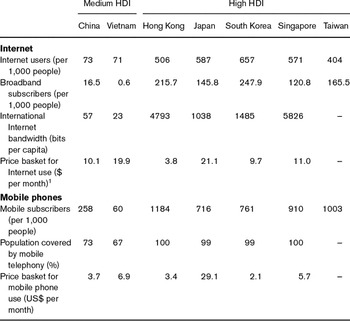
Apart from the regulatory environment, network infrastructure and equipment are indispensable for driving on the information superhighway. As Table 1 shows, there is clearly an infrastructural divide between capitalist and Communist societies. South Korea takes the lead in both Internet and broadband penetration rates. The ubiquity of broadband is the way to a new era of personal and participatory media. At present, only South Korea and Hong Kong have widespread broadband access: even America is several years behind (The Economist, 2006). Hong Kong also has the highest mobile phone penetration rate and the lowest price basket for the Internet. On the whole, Hong Kong, Japan, South Korea, Singapore, and Taiwan have built up a similar technical infrastucture for the new media. In the diffusion of information and communication technologies (ICTs), China and Vietman lag far behind the above five societies.
Access to the new media, 2004

Notes: HDI = Human Development Index. 1 = 2003 data.
Sources: China, Hong Kong, Japan, South Korea, Singapore and Vietnam: World Bank (2006: Tables 5.9, 5.10); Taiwan: Directorate General of Budget, Accounting and Statistics, Taiwan (2006).
Individual capacity to live a global life
Connectivity with the world: digital and personal
The Web enables the global sharing of information, communication, and collaboration irrespective of time and distance has the potential to affect everyone on earth. As Thomas Friedman (2005) succinctly expressed: ‘More people from more places, on more days, in more ways, are going to be able to collaborate on more different kinds of work and compete for more different kinds of work than at any time before in the history of the world. It is this leveling of the competitive and collaborative playing fields on the individual level, rather than the level of the country or the company, that I think defines the next stage of globalization’ (Friedman, 2005). This era of globalization is about the necessity and opportunity for individuals to globalize themselves and to collaborate and compete globally with other individuals. ‘Being local in a globalized world is a sign of social deprivation and degradation’ (Bauman, Reference Bauman1998a: 2).
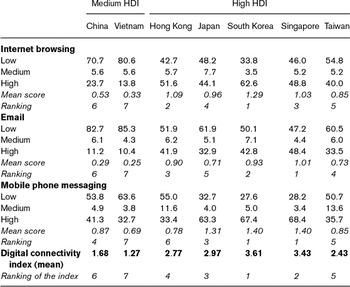
Being connected to the world is a prerequisite to individual globalization. In this article, connectivity beyond locality in daily life is examined in terms of two aspects: digital connectivity and personal contact. First, being connected to the world via ICTs is crucial in order to surpass the constraints of time and space. In addition to the sharing of information, the American experience reveals that online participation has the functions of both bridging and bonding: it has the capacity to deepen linkages among people who share similar beliefs and to serve as a virtual community that cuts across some traditional social divisions (Norris, Reference Norris2002). We postulate that the frequency of use of ICTs is positively related to global connectivity. Three forms of digital media use – Internet browsing, the use of email, and the use of mobile phone messaging – were used to reflect the degree of digital connectivity. Scoring standards for the frequency of use are as follows: the respondents received two points for using such digital media ‘almost every day’ or ‘several times a week’, and one point for ‘several times a month’. The score for each medium ranged from ‘0’ to ‘2’. The score range for the ‘digital connectivity index’, a simple composite index of the above three items, is ‘0’ to ‘6’ (reliability alpha = 0.86). The higher the score is, the stronger the digital connectivity.
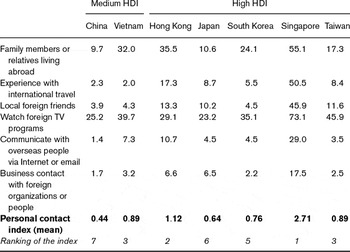
Second, international ties and contacts are believed to offer greater opportunities for people to reach beyond local experiences. To explore the range of personal contacts with overseas people and foreign cultures, respondents were asked whether they had the following connections or practices: (1) family members or relatives living abroad; (2) experience with international travel (at least three times in the past three years); (3) local foreign friends; (4) often watch foreign TV programs; (5) often communicate with overseas people via the Internet or email; and (6) maintain business contacts with foreign organizations or people. The scoring standards for international ties and contacts are as follows: a positive response received one point. Each score ranged from ‘0’ to ‘1’. The score range for the ‘personal contact index’, a simple composite index of the above six items, is ‘0’ to ‘6’ (reliability alpha = 0.66). The higher the score is, the stronger the international ties.
An analysis of individual data confirmed what was already known from data relating to the infrastructural digital divide between high and medium Human Development Index (HDI) societies: levels of digital connectivity are much higher in the high HDI societies (see Table 2). The gaps are particularly wide in the use of Internet browsing and email services. For example, while 62.6 per cent of South Koreans use the Internet at least several times a week, only 13.8 per cent of Vietnamese show the same pattern of usage. In the five high HDI societies, people in South Korea, Hong Kong, and Singapore tend to browse the Internet and use email more often than those in Japan and Taiwan. It is noteworthy that although the mobile phone penetration rate in China is significantly lower than in Hong Kong and Taiwan, Chinese people are relatively more active in using mobile phone messaging. On the whole, according to the digital connectivity index, South Korea tops the ranking of digital media use, followed by Singapore, Japan, Hong Kong, Taiwan, China, and Vietnam.
Digital connectivity: frequency of use of digital media (%)

Notes: Frequency of use: Low = seldom or less (0 point); Medium = several times a month (1 point); High = several times a week or more (2 points). Digital connectivity index: 0 = lowest; 6 = highest.
Source: 2006 AsiaBarometer Survey.
The disparity in personal international ties and contacts between these two groups in society remains wide (see Table 3). People in the high HDI societies generally have more personal contacts with overseas people and foreign cultures. Yet inter-society variations are wider than the variations in the degree of digital connectivity. In this comparison, Singapore stands out, where 55.1 per cent have family members or relatives living abroad, 50.5 per cent have traveled internationally, 45.9 per cent have local foreign friends, 73.1 per cent often watch foreign TV programs, 29.0 per cent often communicate with overseas people via the Internet or email, and 17.5 per cent maintain business contacts with foreign organizations or people. The respective percentages for China are 9.7 per cent, 2.3 per cent, 3.9 per cent, 25.2 per cent, 1.4 per cent, and 1.7 per cent.
Personal international ties and contacts (% giving a positive response)

Note: Personal contact index: 0 = lowest; 6 = highest.
Source: 2006 AsiaBarometer Survey.
Another exceptional country is Vietnam, where one-in-three people have family members or relatives living abroad, compared to 10.6 per cent in Japan, 17.3 per cent in Taiwan, and 24.1 per cent in South Korea. The proportion of Vietnamese who often watch foreign TV programs (39.7 per cent) is also higher than in Japan (23.2 per cent), Hong Kong (29.1 per cent), and South Korea (35.1 per cent).Footnote 2
In the personal contact index ranking, Singapore heads the list, followed far behind by Hong Kong, Taiwan, Vietnam, South Korea, Japan, and China.
English language capacity: a tool to a global life
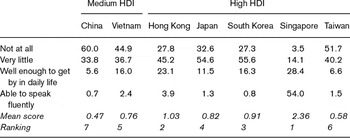
English has become a dominant international language in nearly all areas of life, for example, communications, science, business, professions and occupations, entertainment, and the Internet. Although the English-speaking bloc is not the sole cultural center in the world, proficiency in the English language is critical if one is to access global cultural flows and fit in with a changing global lifestyle. In this article, fluency in spoken English was used to reflect an overall English language capacity. The repondents were asked, ‘How well do you speak English?’ The scoring standards for fluency in spoken English are as follows: the respondents received three points for being able to speak fluently, two points for being able to speak well enough to get by in daily life, one point for being able to speak very little English. Scores ranged from ‘0’ to ‘3’.
Again, Singaporeans are distinctive in their English language capacity, with 54 per cent able to speak English fluently (see Table 4). Hong Kong, another former British colony, is second, but a significant 73 per cent of the respondents believe that they do not speak English well enough to get by in daily life. Lower down the list are South Korea, Japan, and Vietnam. Unexpectedly, over nine-in-ten Taiwanese indicated that they speak very little or no English. Again, China ranks last in this respect, with only 0.7 per cent of the respondents able to speak English fluently.
Fluency in spoken English (%)

Note: Scoring standard: 0 = not at all; 1 = very little; 2 = well enough to get by in daily life; 3 = able to speak fluently.
Source: 2006 AsiaBarometer Survey.
Sociodemographic variations
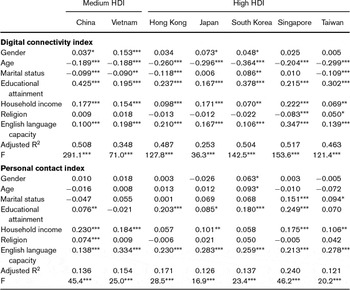
We conducted ordinary least square (OLS) regressions to examine the contribution of personal sociodemographic attributes and English language capacity to explain an individual's digital connectivity index and personal contact index scores. Table 5 briefly lists the results.
Standardized regression coefficients (β) of major sociodemographic variables on the digital connectivity index and personal contact index

*p < 0.05, **p < 0.01, ***p < 0.001.
Note: Gender: 0 = female; 1 = male; Age: 1 = under 30; 2 = 30–50; 3 = over 50; Marital status: 0 = unmarried; 1 = others; Educational attainment: 1 = low; 2 = middle; 3 = high; Household income 1 = low; 2 = middle; 3 = high; Religion: 0 = none; 1 = others; English language capacity: 0 = not at all; 1 = very little; 2 = well enough to get by in daily life; 3 = able to speak fluently.
Source: 2006 AsiaBarometer Survey.
First, these seven independent variables could explain the 25.3 per cent (Japan) to 51.7 per cent (Singapore) variance in the digital connectivity index. Age, educational attainment, household income, and English language capacity are found to have a significant independent effect on digital connectivity in all of the seven societies: the lower the age and the higher the educational attainment, household income, and English language capacity are, the higher the level of digital connectivity. Yet the relative effect of these variables differs across societies. In Hong Kong and Japan, age turns out to be the most influential variable. In China, South Korea, and Taiwan, educational attainment has the strongest explanatory power, whereas in Singapore and Vietnam, it is English language capacity.
Gender exerts no independent effect on people in Hong Kong, Singapore, and Taiwan. But in China, Japan, South Korea, and particularly Vietnam, women tend to have a lower level of digital connectivity than men. No consistent pattern emerged with regard to the influence of marital status. In Japan and Singapore, marital status seems to have no significant independent effect. In China, Vietnam, Hong Kong, and Taiwan, unmarried people tend to be more digitally connected than those who are married. But in South Korea, the reverse is true. Religion is the least influential variable. It only has a significant independent impact on people in Singapore and Taiwan. In Singapore, people with no religion are more likely to indicate a higher level of digital connectivity; however, the reverse is found for Taiwan.
Second, sociodemographic variations in personal contacts with overseas people and foreign cultures are found to be not as pronounced as that in digital connectivity. The seven independent variables together could explain the 12.1 per cent (Taiwan) to 24.0 per cent (Singapore) variance in the personal contact index. Gender and age exert minor effects only in South Korea; religion has no significant effect except in China; and only unmarried Singaporeans and Taiwanese tend to have fewer overseas connections. English language capacity is the only variable with a significant independent effect in all of these societies. It is also the most influential variable in Vietnam, Hong Kong, Japan, South Korea, and Taiwan. The higher the level of English proficiency, the more international ties and contacts a person has. Educational attainment also has a positive independent effect in China, Japan, Hong Kong, South Korea, and Singapore, particularly in the latter three societies.
Support for the forces of globalization
Lifestyle is, to a great extent, a matter of choice. People who look favorably on globalization should be less resistant to contact with global cultures and lifestyles. According to the ‘Voice of the People 2006’, a Gallup International survey conducted in 64 countries, Africans and Asians tend to see the benefits of international integration, whereas Americans and Europeans put a greater emphasis on the costs. In Asia and the Pacific, 52 per cent of the respondents consider globalization to be good for their countries, 5 per cent believe that it is bad, and 25 per cent say that it is neither good nor bad. People in Taiwan (78 per cent) and Vietnam (75 per cent) are the most likely to view globalization favorably (World Public Opinion.org, 2006).
In view of the morphing of globalization and Americanization, we chose the following three questions to measure the respondent's support for globalization forces:
(1) ‘Do you think the USA has a good influence or a bad influence on your society?’
(2) ‘To what extent do you trust the World Trade Organization (WTO) to operate in the best interests of your society?’
(3) ‘To what extent do you trust the multinational companies operating in your country to operate in the best interests of your society?’
A positive response received one point. Each score ranged from ‘0’ to ‘1’. The score range for the ‘support for globalization forces index’, a simple composite index of the above three items, is ‘0’ to ‘3’ (reliability alpha = 0.41). It is assumed that those who favor globalization tend to judge America's global reach positively, and trust the WTO and multinational companies. The higher the index score is, the greater the support for the forces of globalization.
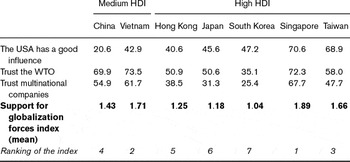
As Table 6 shows, the differences between the two groups in society are much smaller than is the case in high HDI societies. Cross-national variations are most remarkable in the public's evaluation of America's influence: 70.6 per cent of Singaporeans and 68.9 per cent of Taiwanese have a favorable view of America's influence, in contrast to 20.6 per cent in China, 40.6 per cent in Hong Kong, 42.9 per cent in Vietnam, and 45.6 per cent in Japan.
Support for the forces of globalization (% giving a positive response)

Note: Support for globalization forces index: 0 = lowest; 3 = highest.
Source: 2006 AsiaBarometer Survey.
The levels of trust in the WTO, the only global international organization that deals with the rules of trade between nations, are relatively high. In Vietnam, Singapore, and China, seven out of ten people trust the WTO to operate in the best interests of their societies. More than one-half of the people in Hong Kong, Japan, and Taiwan also have trust in the WTO. South Korea is the only exception, with only 35.1 per cent of the respondents giving a positive response. This finding confirms the historical mistrust of South Koreans toward this organization. To many South Koreans, their country's accession to the WTO has not only caused the country's agricultural sector to pay a heavy price, but also other services sectors. Over the years, cases brought to the WTO Dispute Settlement Body against South Korea have also strengthened the perception that the organization mainly works ‘for the benefit of advanced economies seeking to open the markets of developing countries’ (Yang, Reference Yang, Gallagher, Low and Stoler2005).
Standardized regression coefficients of major sociodemographic variables on the support for globalization forces index

*p < 0.05, **p < 0.01, ***p < 0.001.
Note: See Table 5 for coding.
Source: 2006 AsiaBarometer Survey.
Multinational companies have always been regarded as self-interested superpowers that profit by exploiting the resources of developing countries. National differences in trust in multinational companies are obvious: trust is strongest in Singapore (67.7 per cent), Vietnam (61.7 per cent), and China (54.9 per cent); weakest in South Korea (25.4 per cent); and falls somewhere in between in Japan (31.3 per cent), Hong Kong (38.5 per cent), and Taiwan (47.7 per cent).
Overall support for globalization, as measured by the support for globalization forces index, is strongest in Singapore, followed closely by Vietnam, Taiwan, and China. Further down the list are Hong Kong, Japan, and South Korea. This ranking is similar to that reported in the abovementioned Gallup International survey. The cases of South Korea and Vietnam have illustrated that the technological capacity for globalization and the support for the forces of globalization are not necessarily related.
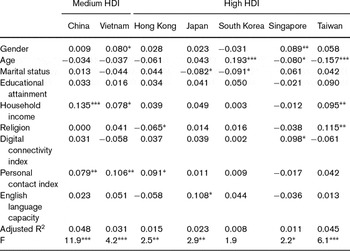
We then used an OLS regression analysis to examine the effects of six personal sociodemographic and three capacity-related variables in predicting an individual's support for globalization. On the whole, these variables explain less than 5 per cent of the variance in the support for globalization forces index score, with the highest variance in China (4.8 per cent) and the lowest in South Korea (0.8 per cent) (see Table 7). There seem to be two basic differences between medium and high HDI societies. First, in China and Vietnam, household income and personal contact index are the two most influential variables in predicting an individual's level of support for globalization. People with a higher household income and more international ties and contacts are more likely to show greater support for globalization. Yet the impact of these two variables is generally not sufficient to explain the differences in the high HDI societies.
Second, in most of the high HDI societies age is a significant factor in predicting support for globalization. It has a positive effect in South Korea, but a negative one in Singapore and Taiwan. In the medium HDI societies, age is found to have no significant independent influence in this respect.
Apart from household income, personal contact, and age, the effects of other variables are sporadic and relatively weak. For example, educational attainment has no significant independent impact in all of the societies under study. The influence of digital connectivity is significant only in Singapore, English language capacity only in Japan, marital status only in Japan and South Korea, and gender only in Vietnam and Singapore.
Living a global lifestyle
Thinking globally: a global concern
The forces of globalization are pushing all social actors to develop a global concern or a global mindset. A person with a global mindset is able to develop a perspective of personal space that extends beyond his/her personal surroundings, to conceive of global thinking in local contexts, to adapt global strategies to the needs of the local environment, and to see himself/herself as connected to the global community. One commonly cited downside of globalization is the globalization of risk. We used this aspect of risk to reflect the global mindset. To measure their awareness of the globalization of risk, the respondents were asked whether they worry about the following four issues: (1) fair world trade, (2) the globalization of human economic activities, (3) global recessions, and (4) refugee and asylum problems. A positive response received one point. Each score ranged from ‘0’ to ‘1’. The score range for the ‘global concern index’, a simple composite index of the above four items, is ‘0’ to ‘4’. The higher the score is, the greater the ability to ‘think globally’.
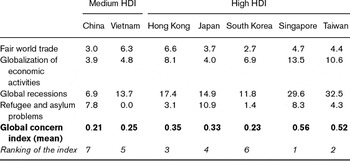
As Table 8 shows, of the respondents in the seven societies, those from China, South Korea, and Vietnam in particular, are not likely to be bothered by these global issues. For example, only 2.7 per cent of the South Koreans indicated that they worry about fair world trade, 3.9 per cent of the Chinese answered that they are bothered by the globalization of economic activities, and none of the Vietnamese showed deep concern about refugee and asylum problems. This response pattern is actually in line with their positive attitude toward globalization. Among the four issues, the one that most worried the respondents, especially the Taiwanese (32.5 per cent) and Singaporeans (29.6 per cent), is clearly that of global recessions.
Awareness of the globalization of risk (% who worry)

Note: Global concern index: 0 = lowest; 4 = highest.
Source: 2006 AsiaBarometer Survey.
The following is the order of ranking in terms of the global concern index: Singapore, Taiwan, Hong Kong, Japan, Vietnam, South Korea, and China.
Exposed globally: the Internet's influence on sociopolitical opinions
The new ICTs, with their properties of decentralized access, simultaneity, and interconnectivity, are recognized not only as a medium of communication, but also as a development enabler. They are acclaimed as an important tool to access knowledge and information; to create translocal networks for change and advocacy; to cultivate a more informed, competent, and active citizenry; to empower civil society actors and stakeholders; and to achieve internationally agreed-on development goals. The role of the Internet is particularly important. It has become a global facility and a central element of the Information Society (OECD, 2001; WSIS, 2005).
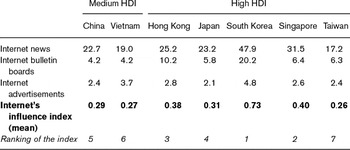
Here, we examine the extent of the influence of the Internet on the formation of sociopolitical opinions. The greater the influence, the less resistance there should be to global cultures and lifestyles. The respondents were asked whether the following three platforms of digital media have an important influence on their opinions about social and political issues: (1) Internet news, (2) Internet bulletin boards and mailing lists, and (3) Internet advertisements. A positive response received one point. Each score ranged from ‘0’ to ‘1’. The score range for the ‘Internet's influence index’, a simple composite index of the above three items, is ‘0’ to ‘3’. The higher the score is, the greater the influence of the Internet.
South Korea leads in all three platforms, with 47.9 per cent of the respondents admitting the important influence of Internet news, 20.2 per cent of Internet bulletin boards, and 4.8 per cent of Internet advertisements. Following far behind are Singapore, Hong Kong, Japan, China, Vietnam, and Taiwan (see Table 9). With the exception of Taiwan, this ranking is similar to that of digital connectivity. People with a higher level of digital connectivity are more likely to feel the influence of the Internet.
Influence of the Internet on sociopolitical opinions (% influenced)

Note: Internet's influence index: 0 = lowest; 3 = highest.
Source: 2006 AsiaBarometer Survey.
Eating globally: an appreciation of international food
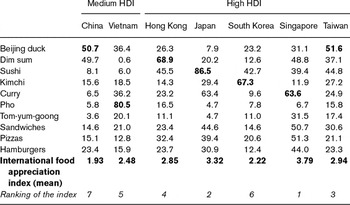
Many scholars have pointed out that globalization has led to a more global food supply and a global sharing of American fast-food eating habits. An epidemic of obesity is spreading throughout the world because people across borders are trading their traditional diets for one that is high in fat, sugar, and salt, but low in good nutrients. Yet we believe that people who are living a global lifestyle would have developed an appreciation of international food, including an appreciation of the diversity of the foods of various cultures and of fusion food. To explore this proposition, we asked the respondents which of the following ten foods, each representing food from a different culture, they enjoy eating: oriental food such as Beijing duck (Chinese), dim sum (Hong Kong), sushi (Japanese), kimchi (Korean), curry (Indian), pho (Vietnamese), and tom-yum-goong (Thai), as well as Western foods such as sandwiches, pizzas (Italian), and hamburgers (American). Scoring standards for food appreciation are as follows: a positive response received one point. Each score ranged from ‘0’ to ‘1’. The score range for the ‘international food appreciation index’, a simple composite index of the above ten items, is ‘0’ to ‘10’. The higher the score is, the greater the appreciation of international food.
It is clear that people of all seven societies, especially those from Japan and Vietnam, prefer the food of their own culture to that of the others. For example, 86.5 per cent of the Japanese enjoy eating sushi, and 80.5 per cent of the Vietnamese like to eat pho (see Table 10).
Appreciation of international food (% who enjoy eating)

Note: International food appreciation index: 0 = lowest; 10 = highest.
Source: 2006 AsiaBarometer Survey.
Western food, including sandwiches, pizzas, and hamburgers, are particularly popular in Singapore. As a result, Singapore ranks top again in the international food appreciation index. Japan and Taiwan come second and third. Following them are Hong Kong, Vietnam, and South Korea. China, which ranks last on our index, turns out to be the most conservative country with respect to appreciating food from different cultures. South Korea is unique within the high HDI and greater globalized country group in terms of its public's rather inhibited appreciation of other international cuisines.
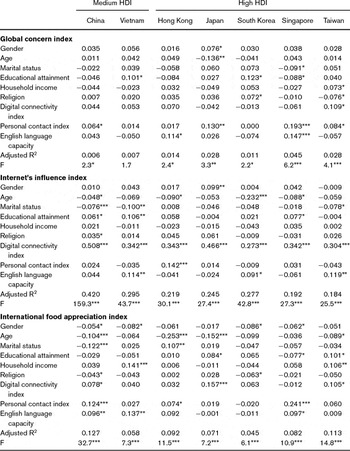
The results of the OLS regression analysis reveal that personal sociodemographic attributes and the capacity to connect with the world are insufficient to predict concern for global affairs (the adjusted R2 value for the global concern index ranges from 0.006 in China to 0.045 in Singapore). Their explanatory power is stronger in predicting the preference for international food (the adjusted R2 value for the international food appreciation index ranges from 0.045 in South Korea to 0.127 in China), and strongest in explaining the extent of the influence of the Internet on sociopolitical opinions (the adjusted R2 value for the Internet's influence index ranges from 0.184 in Taiwan to 0.420 in China) (see Table 11).
Standardized regression coefficients of major sociodemographic variables on the global concern index, Internet's influence index, and international food appreciation index

As for the appreciation of international food, the effects of age and gender are more pervasive than those of other sociodemographic and capacity-related attributes. On the whole, women and the young are more inclined to enjoy eating food from different cultures than men and the elderly. There seems to be no consistent pattern regarding the influence of other variables. For example, personal contact is the most influential variable in China and Singapore and, to a lesser degree, in Hong Kong. But its effect is negligible in Vietnam, Japan, South Korea, and Taiwan. The level of digital connectivity has a positive effect in China, Japan, and Taiwan, but not in Vietnam, Hong Kong, South Korea, and Singapore.
With regard to the influence of the Internet on sociopolitical opinions, the pattern is completely different. Here, the positive effect of digital connectivity is dominant in all seven societies. The stronger the digital connectivity is, the greater the influence of the Internet. The depressing effect of age is also significant in China, Hong Kong, Singapore, and especially South Korea. In these societies, the young are more susceptible to the influence of the Internet. The impact of other variables is comparatively weak and varies across societies. Household income is found to have no significant independent effect in any of the societies under study.
Feeling global: national/transnational identity
Globalization has always been associated with Western cultural imperialism, which involved the destruction of cultural identities and then a loss of cultural diversity. However, as noted by Tomlinson (Reference Tomlinson, Held and McGrew2003), identity formation is a universal feature of human existence. Identity is not a zero-sum game. Globalization actually creates and proliferates rather than destroys identities. The proliferation of identity positions may produce challenges to the dominance of national identity and patriotism, which all nation-states crave to preserve. Instead of building a homogenizing identity, globalization and identity are regarded by some to be an explosive combination, demonstrated throughout the world by outbursts of communal violence (Meyer and Geschiere, Reference Meyer and Geschiere1999). These ‘new wars’ of the era of globalization are being fought around a particularistic form of identity politics in which movements are mobilized around ethnic, racial, or religious identities for the purpose of claiming state power (Kaldor, Reference Kaldor1999). Therefore, the centripetal forces of globalization and the centrifugal forces of identity politics are two complementary tendencies that must be examined together (Eriksen, Reference Eriksen1999).
To measure national and transnational identities, the respondents were asked: ‘Throughout the world, many people identify themselves by their nationality. Do you think of yourself in this way?’ And ‘Throughout the world, many people also see themselves as belonging to a transnational group. Do you identify with the following transnational groups: (1) Asians, (2) ethnic groups with a common genealogy or ancestry, (3) language group (of the language that you speak), (4) religious group (of the religion that you believe in and practice), or (5) other transnational groups?’ The respondents received one point for identifying with their own nationality and with any kind of transnational group, respectively.
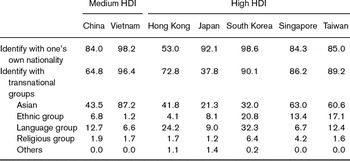
Nearly a decade has passed since Hong Kong was handed over to China and became a Special Administrative Region under Chinese sovereignty. However, not surprisingly, only 53.0 per cent of Hong Kong respondents identify with their Chinese nationality. Such a low level of national identity has made Hong Kong a truly exceptional case. In comparison, 98.6 per cent of the South Koreans, 98.2 per cent of the Vietnamese, and 92.1 per cent of the Japanese claim to have a national identity. It is interesting to note that 84 per cent of the people in China identify themselves as Chinese, virtually the same as the proportion of respondents in Taiwan who identify themselves as Taiwanese, at 85 per cent (see Table 12).
National and transnational identities (% giving a positive response)

Note: Hong Kong's national identity is Chinese; Taiwan's national identity is Taiwanese.
Source: 2006 AsiaBarometer Survey.
People in Vietnam are most willing to adopt a transnational identity, with 96.4 per cent identifying themselves as Asian, or with certain language, ethnic, or religious groups. The mentality of the Japanese represents another extreme: only 37.8 per cent have a transnational identity. The deep-seated and lingering resentment against Japan in China and South Korea is not conducive to the formation of a ‘we feeling’.
South Korea is an exceptional case. In all of the other societies, the most dominant transnational identity is Asian. But in South Korea, a substantial proportion of the respondents also identify themselves with language or ethnic groups. The major transnational communities with which South Koreans identify appear to be the people of North Korea and the recently fast-growing Korean diaspora (numbering 5.7 million as of 2001).
Logistic regressions were conducted to look for significant predictors of national and transnational identities. The independent variables that were assessed included six sociodemographic attributes and six globalization-related variables. As Table 12 shows, the distributions of national identity are too skewed for any meaningful analysis. Even in China, Hong Kong, Singapore, and Taiwan, the explanatory powers of these 12 variables are very low. The patterns of relation also vary across societies.Footnote 3 For example, the strongest predictor of national identity is age in both China and Singapore. In China, middle-aged people and the elderly are almost twice as likely as the young to have a national identity (the odds ratios are 1.92 and 1.84, respectively); while in Singapore, the elderly are about three times more likely than the young to have a national identity (the odds ratio is 3.17). But in Hong Kong and Taiwan, when all of the variables are considered jointly, age is not a significant factor in predicting national identity.
The situation with regard to transnational identity is similar. These sociodemo-graphic and globalization-related variables are not sufficient to predict people's sense of belonging to a transnational group, nor are the basic patterns of their relationship with transnational identity consistent across the societies under study.
The above analysis seems to indicate that individual globalization is not a determinant affecting orientations toward national identity. That also clearly indicates that personal experiences of cultural globalization and related everyday lifestyles can be indeed separate from one's collective identity.
Conclusion
Peter Berger (Reference Berger, Berger and Huntington2002) stresses the cultural dynamics of globalization and points out that a proper analysis should include the distinctive domains of observable cultural globalization and the different consequences of the intersection of globalization forces and local actors in the various societies concerned. In this article, we examined the distinguishable manifestation of cultural globalization as experienced by the public in their everyday life in the seven Asia-Pacific societies.
In that sense, our focus is on the individual level rather than the institutional aspect of cultural globalization. Still, we found that the overall individual experiences of cultural globalization in specific societies are in general a function of how their societies as a whole have undergone societal development and globalization. The seven societies are divided into two separate groups in terms of their medium or high performances on the HDI measure, and that typological analysis turns out to be valid and useful in differentiating how individuals experience various aspects of cultural globalization in those medium HDI societies, such as China and Vietnam, against those high HDI societies, such as Japan, Hong Kong, Singapore, South Korea, and Taiwan. All in all, the higher the human development a society has achieved, the greater the cultural globalization its citizens are experiencing in everyday life.
To be more specific, the public in the high HDI societies have developed wider and more intensive connection with the world beyond their own national boundaries, both through digital media and in personal contacts, and even in possessing English language capability. Within the medium HDI group, Vietnam is, however, an exception as its citizens have a relatively high percentage of family members or relatives living abroad, frequent communication with overseas via Internet or email, and great interest in watching foreign TV programs. It is understandable that many residents in today's Vietnam have friends and relatives living abroad as a result of large-scale emigration and refugee movements caused by the Vietnam War. The open door and reform strategies taken by both China and Vietnam since the 1980s and 1990s, respectively, also facilitated and fostered their citizens’ sense of international connectivity and awareness of an interdependent world. But, in all accounts, in advanced and higher HDI societies, the citizens still possess more intensive world connectivity and greater ability to manage English as a tool to a global life. Singapore, among all five societies in this group, has housed the highest number of globalized individuals, followed by Hong Kong.
It is also true that the public in higher HDI societies conduct their everyday life activities more in tune with global lifestyles. They tend to think more globally, having greater awareness of global issues and risks. They are more inclined to be influenced by Internet information on their various sociopolitical opinions, with the exception of Taiwan. They also tend to appreciate and enjoy other international food more, though the general public in the seven Asia-Pacific societies all still tend to eat their national food with great appreciation. With higher HDI national group, South Korea witnessed a rather inhibited and conservative appreciation of other international cuisines among its public.
Significantly, the public in more globalized and higher HDI societies, like their counterparts in less globalized countries, still identify strongly with their own nationality or collective identity. This is particularly true in South Korea and Japan, whereas Hong Kong is an exception on this account. Nevertheless, one can assert that globalization does not necessarily undermine the importance of a country's national identity as felt by its citizens. Conversely, the lesser globalized countries tend to foster a stronger nationalistic ideology within the public. This is true in both China and Vietnam.
As for identifying with transnational groups such as Asian, different HDI or globalization levels do not exert a discernible effect on an Asian identity in the Asia-Pacific. Japanese have the lowest level of an Asian collective identity, yet Vietnam has the highest degree of such a regional identity.
As to what extent the individual backgrounds affect one's cultural globalization experiences? In higher HDI societies, age, class, education, and English ability seem to be somewhat influential in various degrees on different aspects of one's globalization intensity, attitudes, and behavior. In lower HDI societies, besides the above background factors, the measures for gender and marital status sometimes proved to be influential.
However, after closer inspection, we tend to maintain that individual globalization manifested in everyday life should be understood under a comparative societal perspective (Hsiao, Reference Hsiao, Berger and Huntington2002). After all, such individual cultural globalization experiences are not only a simple matter of personal choice, but are more a reflection of the complex societal conditions, which are, to a great extent, constrained by such societal milieu.