

Introduction
Nuclear proliferation is a path fraught with various costs and political risks. Not only do most nuclear aspirants fail to attain nuclear weapons but many have paid the price of prohibitive sanctions or ran the risk of an arms race during their pursuit.Footnote 1 To alleviate these costs, several aspirants have turned to nuclear hedging, a strategy of maintaining nuclear latency and using that technical means for political ends. Yet, despite the availability of material and the signalling of intent, hedgers do not always completely nuclearise as some eventually choose a course of nuclear restraint.Footnote 2 Theoretical discussions and conceptual articulation on this link between the nuclear hedging strategy and restraining behaviour in the broader framework of nuclear reversals (or rollbacks) have only started to garner interest,Footnote 3 but attention to the link is important given that nuclear hedging is likely to be a more common threat to the non-proliferation regime in the future.Footnote 4
At the heart of post-Cold War threats to the non-proliferation regime is North Korea, a nuclear aspirant that has unambiguously adopted a hedging strategy over the past two decades.Footnote 5 Even as the latest rounds of Trump-Kim negotiations proceed, experts continue to observe construction or ‘other maintenance related activity’ at key nuclear facilities,Footnote 6 and over the past year, North Korea ‘may [even] have produced enough … to add as many as seven nuclear weapons to its arsenal’.Footnote 7 The latest iteration of the US-DPRK (Democratic People's Republic of Korea) negotiations to deal with the North Korean nuclear threat has been roundly criticised within the scholarly and policy circles.Footnote 8 Pessimists argue that recent negotiations achieved too little while conceding more to Pyongyang than in previous negotiations, while others question the sincerity of North Korea's diplomatic stance.Footnote 9 Yet, despite the increase in the number of nuclear tests and military provocations under the Kim Jong-un regime over the past few years,Footnote 10 North Korea has displayed considerable variation in its nuclear policy, showing an inclination to restrain its nuclear weapons programme on several occasions. Such patterns of nuclear restraint have continued in the current round of US-DPRK negotiations, for instance, when Pyongyang announced a moratorium on its nuclear weapons tests and its intercontinental ballistic missile launches in the lead-up to the Trump-Kim summit, and dismantled ‘key facilities’ as a part of its ‘confidence building measure’ more recently.Footnote 11 Notwithstanding the potential expansion of its nuclear arsenal, such acts of restraint ultimately ‘markedly reduced’ Pyongyang's threat to the US.Footnote 12 ‘When they ended missile testing, [weaponisation capabilities] rolled backwards. So when I look at the whole spectrum’, Siegfried Hecker points out, ‘North Korea … is less dangerous today than it was at the end of 2017, in spite of the fact that they may have made another five to seven weapons worth of nuclear material.’Footnote 13
Under what conditions do nuclear hedging states adopt a policy of nuclear restraint? In this article, we examine the causes of nuclear restraint and analyse the process through which it occurs in the international system. We argue that an aspirant decides to enter the nuclear reversal pathway or, at minimum, temporarily agrees to restrain its nuclear policy when asymmetric leveraging is obtained. Asymmetric leveraging occurs under two interrelated conditions: (1) when a nuclear hedger perceives its adversary shouldering relatively higher costs; and (2) when it is confident about attaining gains should a deal materialise. Drawing insights from prospect theory, we argue that asymmetric leveraging motivates restraint because of loss aversion. A hedger that is keen to minimise losses would restrain under the joint conditions of asymmetric leveraging when its reference point shifts, which defines the set of losses and gains, from the defence of its nuclear programme to the protection of these potential gains.
Theoretically, by focusing on the policy of restraint, our asymmetric leverage argument contributes to the nuclear non-proliferation literature by analysing the causal pathway through which aspirants may at minimum initiate the process of nuclear reversal.Footnote 14 While nuclear restraint may be taken as a suboptimal outcome to rollback, it may be the next best alternative available given the difficulties associated with a full reversal. From a policy perspective, our argument is somewhat counterintuitive and goes against the general diplomatic stance of the US and the approach of the international community towards rogue regimes in the post-Cold War period.Footnote 15 Oftentimes, negotiating with nuclear aspirants has been regarded as a form of ‘appeasement’, with potential non-proliferation options criticised as ‘rewarding bad behavior’.Footnote 16 In contrast, we argue that the most viable way to put an aspirant on a reversal pathway is by allowing it to fulfil its core interests at the bargaining table. This logic applies to North Korea in the current context. As Robert Carlin succinctly notes in his 2010 testimony to the US Senate Foreign Relations Committee, North Korea will ‘abide by the core of [a thoughtfully constructed and implemented agreement]’ although ‘they are likely to game the process, exploiting ambiguities and hedging their bets’ in the process.Footnote 17
The remainder of the article is organised as follows. In the next section, we first conceptualise nuclear hedging strategy and make the case that nuclear behaviour should be considered as a continuum rather than a dichotomy. We then develop and elaborate on the asymmetric leverage argument within the nuclear proliferation continuum in detail. In the following section, we test the theoretical arguments developed by conducting an in-depth case study of North Korea's nuclear policies during the 1994 Agreed Framework negotiations and the Six-Party Talks. The final section concludes with broad theoretical and policy implications for the future of non-proliferation in the post-Cold War era.
Nuclear hedging and the proliferation continuum
It is argued that nuclear proliferation in the post-Cold War era is more of an exception than the rule.Footnote 18 Yet, notwithstanding the exclusiveness of the nuclear club and the broad support for the Non-Proliferation Treaty (NPT), the long history of nuclear hedging and other weaponisation strategies, 26 and 21 instances respectively,Footnote 19 suggests that states have nonetheless tried at least to have the capability to develop nuclear weapons.Footnote 20 Moreover, while not prohibited by the NPT, latent capabilities concern the non-proliferation regime because advanced nuclear technologies ‘could result in strategic surprise’ should states decide to go nuclear.Footnote 21 Still, in contrast to the scholarly attention devoted to the causes of nuclear pursuit, strategies undertaken by states, such as nuclear hedging, remain conceptually vague and theoretically underspecified within the proliferation literature.Footnote 22 We first begin by unpacking the different concepts of the proliferation continuum.
Nuclear hedging is a state strategy where an aspirant maintains ‘a viable option for the relatively rapid acquisition of nuclear weapons, based on an indigenous technical capacity’.Footnote 23 The strategy equally applies to states that have yet to develop the ‘technological requirements … [that meet] a state's nuclear posture’.Footnote 24 Thus, depending on the aspirant's technological state for nuclear weapons acquisition, a variety of hedging strategies exists ranging from technical to hard hedging.Footnote 25 Two key features underpin the strategy, one technical and the other political. The first is nuclear latency, the ‘expected time to be taken by a non-nuclear weapons state to develop a conventionally deliverable nuclear weapon given the state's position on a path toward or away from a nuclear weapon and accounting for the state's motivations and intentions’.Footnote 26 While states may possess varying levels of latency, this aspect carries threat potential because it facilitates nuclear weapons acquisition and advancement should a state choose to do so.Footnote 27 The second relates to a state's deliberate decision to leverage the threat potential to achieve political objectives, that is, hedging is a political strategy.Footnote 28 Israel and South Africa adopted hedging, for instance, to avoid abandonment by their nuclear allies while maintaining ‘an important deterrent of major psychological value’.Footnote 29
As a strategy that lies ‘between nuclear pursuit and nuclear rollback’, hedging is conceptually distinct from the policy of nuclear restraint.Footnote 30 Nuclear restraint is a policy (or an external commitment) undertaken by the aspirant that ‘at least initially, falls short of nuclear rollback but nonetheless keeps it from proceeding with some prominent nuclear activities’ pertaining to its nuclear posture.Footnote 31 Nuclear restraint can be conceptualised by the notion of a ‘red line’ – a policy tool ‘meant to influence – usually to constrain – the actions of another actor … [and distinguish] acceptable actions from unacceptable actions’.Footnote 32 In this context, a nuclear hedger would be maintaining a policy of restraint insofar as it stays within the red line that is laid down by itself or other actors as the building block for the initiation or continuation of interactions. Relating to the ongoing US-DPRK negotiations, the one red line that US Senator Lindsey Graham identified is North Korea's ‘testing [of] another warhead on an intercontinental ballistic missile’, which Pyongyang has not violated since 2018.Footnote 33
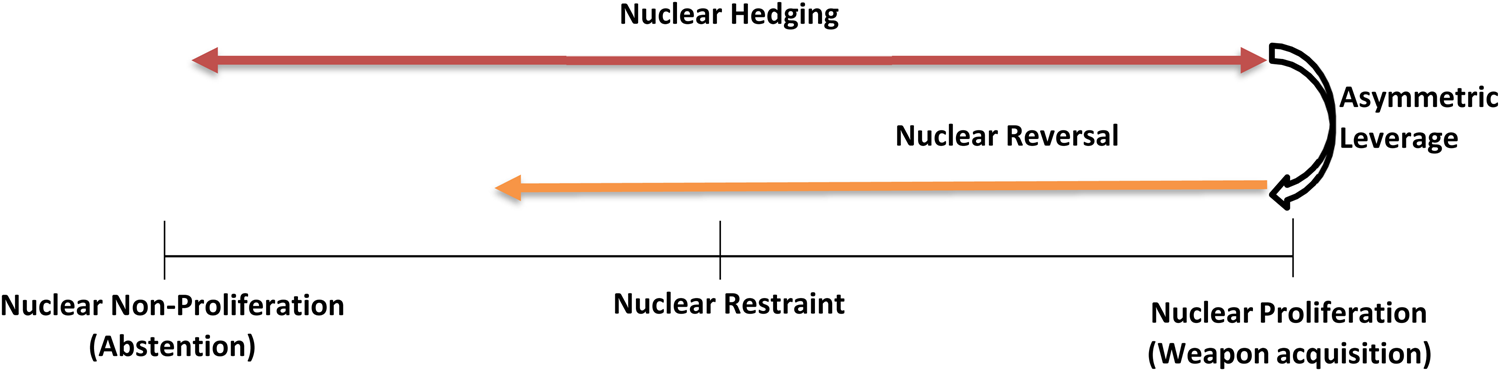
Owing to the conceptual distinction, nuclear hedging behaviour may be observed even after a state decides to shift its nuclear proliferation (or non-proliferation) policy from one to another: hedging strategy ‘may be adopted either during the process of developing a bomb or as part of the rollback process, as a way of retaining the option of restarting a weapons program that has been halted or reversed’.Footnote 34 That states would continue to hedge in spite of its commitment towards restraint should not be surprising since hedging can serve to limit risks or maximise bargaining leverage, or both.Footnote 35 Having clarified the definitions of the key concepts in this article, we join other scholars in disaggregating the existing binary view of nuclear proliferation,Footnote 36 and reconceptualise the three concepts as follows:
Nuclear proliferation continuum: Reconceptualisation.

Existing scholarship offers two insights into why states adopt the nuclear hedging strategy. First, hedging provides aspirants with the capability to deter adversaries or compel concessions, or both. States with security concerns could hedge, for instance, to guard against the lack of assurances accorded by alternative security arrangements. In the 1970s, South Korea, for example, continued advancing its nuclear programme despite acceding to US pressure to denuclearise because it could not be sure that the US would maintain its extended deterrence in the Korean peninsula.Footnote 37 By creating the impression that one has advanced technology, states, such as Italy, have also hedged in the 1950s to demand greater security protection in exchange for abandoning their indigenous nuclear weapons programmes.Footnote 38
Secondly, nuclear aspirants may espouse rhetoric to gain buy-in from domestic constituents because popular support is often needed when undertaking huge investments like nuclear development. Domestic support for a nuclear programme, however, does not necessarily imply support for a nuclear weapons programme. Hence, states might become handicapped by their own rhetoric; while they are able to justify progress in terms of nuclear latency, they are unable to exercise the option of weaponisation. In this case, hedging becomes ‘the only approach that allows the regime to reconcile any potential moves towards nuclear weapons with the consensus on nuclear advancement that the broader nuclear narrative has facilitated’.Footnote 39
Motivations for adopting the hedging strategy are thus broadly understood to be driven either by international or domestic reasons. However, if nuclear hedging reveals, by definition, the desire to retain the re-nuclearisation option, then such states are also more likely to be particularly sensitive to losses.Footnote 40 Derived from prospect theory,Footnote 41 loss aversion describes one's tendency to ‘overvalue losses relative to comparable gains’.Footnote 42 Centred on a given reference point, loss aversion implies that the value function in the loss domain is steeper than the gain side for a given state.Footnote 43 A loss-averse state would therefore rather retain something it owns than to give it up for something new, even if the latter has the same value (‘endowment effect’).Footnote 44 As such, reaching a negotiated settlement with a loss-averse state ‘is more difficult than expected-utility predicts because people overweight what they concede in bargaining relative to what they get in return’.Footnote 45 Moreover, loss-averse behaviour may persist with changes in the initial reference point if unrealised expectations are regarded as losses.Footnote 46
Such inclination towards maintaining one's possession may become even more pronounced when the costs of the nuclear hedging strategy are considered. States developing nuclear weapon capabilities risk inadvertent nuclear accidents or wars, potential regional nuclear arms racing, and political and technological costs imposed by the nuclear non-proliferation regime and the international community.Footnote 47 As such, loss-averse states engaging in nuclear hedging should have had undergone substantial ‘duress’ in the process,Footnote 48 which would cause policy changes to make little logical sense and commitments to reversal even more difficult. Yet, Iran's recent agreement to the Joint Comprehensive Plan of Action (JCPOA) and North Korea's brief abidance by the 1994 Agreed Framework demonstrate that policy shift towards restraint is possible even in the hardest cases of nuclear hedging. To resolve this puzzle, we propose a set of conditions that we term as asymmetric leveraging to explain the otherwise unlikely shift in nuclear policy by nuclear hedgers.
Asymmetric leverage and nuclear restraint
A leverage in a bargain is conceptually identified by its relative costs: ‘the more it costs Party B not to have an agreement with Party A, the more leverage Party A has’.Footnote 49 Given that we do not expect a nuclear hedger to be easily enticed by inducements, we expect it would take more for a hedger to eventually accept an agreement. Nuclear restraint due to asymmetric leveraging thus occurs under two interrelated conditions: (1) when a nuclear hedger perceives its adversary's cost to exceed its own; and (2) is confident about attaining gains should it cooperate toward their materialisation. Once the reference point has shifted towards these potential gains and the nuclear hedger again operates in a realm of loss, a loss-averse nuclear hedger would be encouraged to restrain as its focus shifts from defending its nuclear weapons program to preserving the potential gains of a successful deal.Footnote 50
We begin by elaborating the first condition. If nuclear hedging most often occurs when states undergo duress,Footnote 51 the risks of committing to and making concessions would expectedly be high.Footnote 52 Given the stakes, the adversary must therefore first incur costs to signal its commitment (or ‘irrevocable commitment’) towards a successful negotiation for the aspirant's reference point to begin shifting away from deterrence.Footnote 53 ‘Disarming gestures’ like the respectful exchanges between Donald Trump and Kim Jong-un communicate a change on the adversary's part, which could soften to some degree the aspirant's insistence on holding on to its initial reference point.Footnote 54
However, as mentioned, we do not expect loss-averse nuclear hedgers to shift reference points easily. Hence, following preliminary shifts in the adversary's posture, we would expect the aspirant to evaluate the magnitude of change in its adversary's position, which, in the context of negotiations, refers to the assessment of its willingness to also meet the hedger's central demands. Leverage in this sense becomes asymmetric because the adversary (often a more powerful state that has the means and interest to counter nuclear proliferation) is regarded as having less bargaining power than the weaker aspirant. Once these demands are agreed to and the reference point shifts, the aspirant would then work towards maintaining this newly gained leverage and the attainment of demands even if it meant freezing its own nuclear deterrent capabilities.Footnote 55 The impression that the Trump-Kim summits serve ‘as a “victory” for North Korea’ and the extent to which the summits led Kim Jong-un to expect an ‘exchange skewed largely in his regime's favor’ exemplify precisely this apparent asymmetry.Footnote 56
When asymmetric leverage holds, we should also not expect to see maximalist demands from the aspirant. Contrary to tendencies for negotiators to make ‘extreme demands’ at the bargaining table,Footnote 57 a loss-averse nuclear hedger would rather cooperate to defend its newly acquired leverage and its associated potential gains. Hence, demands should remain within the range it has been consistently claiming, reflecting perhaps its core interests or more urgent needs. Insofar as the adversary shows willingness to negotiate around the range, the aspirant should then yield on points considered to be secondary – including, in this case, potential advancements of its nuclear weapons programme. Lastly, when negotiations or the outcome fall short of the aspirant's demands, perceptions of loss are reconfirmed, and the aspirant should reinitiate nuclear development to ‘break even’.Footnote 58
In all, if the causal logic of asymmetric leveraging holds, then we should observe the following. First, an increase in the aspirant's bargaining leverage based upon its adversary's willingness to concede first, and the former's assessment that the latter would be willing to yield to its central demands. Having recognised the asymmetric leverage, the aspirant should largely shift its focus from defending its deterrence force towards concluding a deal and attaining its potential outcomes. Second, in the case that its central demands are formally acceded to, the aspirant should make explicit commitments demonstrating changes in its policy from proliferation to restraint. That said, because loss aversion represents a behavioural trait that accompanies a heightened sensitivity towards losses, we should also observe a quick reinitiation of proliferation activities or the lack of cooperation from the aspirant when its leverage appears to diminish in order to compensate for intermediary losses. This move towards minimising losses is consistent with the causal logic based on loss aversion. That is, what is not yet acquired – a successful deal and adherence to its central demands – should not be expected to be defended as strongly as what the aspirant already owns and is putting at risk.
North Korean case studies
To test the arguments of asymmetric leveraging presented above, we analyse the conditions under which North Korea adopted a policy of nuclear restraint in the post-Cold War era – the 1994 Agreed Framework and the Six-Party Talks. The North Korean nuclear issue is perhaps the biggest threat to the non-proliferation regime in the post-Cold War era and serves as a crucial case for our study. Unlike existing works in prospect theory that investigate the close relationship between changes in domain and risk propensity, we start with the assumption that aspirants operate in the domain of loss and primarily focus on analysing the shifts in reference point. As such, we focus on the negotiation phase and examine the causal pathway that led to Pyongyang's adoption of the nuclear restraining policy. We use process-tracing to infer and test the causal process while maintaining a high level of conceptual validity.Footnote 59 In the process, we further elaborate the antecedent variables and necessary conditions that led to the adoption of nuclear restraining behaviour in the international system.Footnote 60 Our goal is to be ‘descriptively accurate’ in our case studies, ‘which can in turn enrich explanatory and descriptive goals’.Footnote 61
US-North Korea 1994 Agreed Framework
Nuclear Hedging and the first nuclear crisis (1991–4)
Washington's overall relationship with Pyongyang can broadly be summarised as one mired in hostility and isolation for the latter.Footnote 62 After the first US deliberations on the use of atomic bombs during the Korean War,Footnote 63 no other country since ‘has been the target of more American [compellent] nuclear threats than North Korea’.Footnote 64 Even after ‘engagement replaced containment of China [in the early 1970s], the DPRK remained the target of containment’.Footnote 65 Serious efforts to develop an indigenous programme began in earnest during the Cold War period after doubts around the Soviet Union's economic and military assistance arose and South Korean plans to acquire its own nuclear capabilities were uncovered.Footnote 66 Thus, despite limited means and materials,Footnote 67 North Korea pushed forth with nuclear research and development, having in operation a five-megawatt reactor by 1986.Footnote 68
When Russia and China moved towards rapprochement with South Korea in the 1990s, once reliable pillars of support furthermore ceased to exist for North Korea and ‘the balance of power … shifted in [South Korea's] favor’.Footnote 69 These events sent a ‘transformative shock’ throughout Pyongyang as the systemic shift in the geopolitical situation accentuated existing regional threats (for instance, US-ROK [Republic of Korea] and US-Japan alliances) with limited time for adjustments.Footnote 70 At this juncture, signs of North Korea's hedging strategy became increasingly apparent as statements expressing Pyongyang's intent to establish a nuclear weapons programme began to emerge, shortly after it agreed to sign the NPT in December 1985.Footnote 71
However, following the withdrawal of American tactical nuclear weapons from the Korean peninsula in the early 1990s, the relationship between North and South Korea thawed, manifesting in the Joint Declaration on the Denuclearization of the Korean Peninsula.Footnote 72 This willingness to negotiate denuclearisation for diplomatic normalisation with the US and its regional allies has continuously served as Pyongyang's basic foreign policy line. In fact, normalisation of relations, an end to US nuclear threats, and a peace treaty to officially end the Korean War remain North Korea's fundamental demands since the 1970s.Footnote 73 Yet Pyongyang's demands have often been disregarded: ‘[s]enior officials in the [George] Bush and the [Bill] Clinton Administrations were themselves skeptical that diplomacy could succeed. Given the doubt and hostility in Congress and in the foreign policy establishment, both administrations were loath to try.’Footnote 74
The final straw leading to the first nuclear crisis, however, was the IAEA's demand for ‘special inspections’ in the light of discrepancy between its analysis of North Korea's nuclear development and that declared by Pyongyang.Footnote 75 Against this backdrop, which led Pyongyang to perceive the IAEA as being unfair, and the resumed joint US-ROK military exercise, ‘Team Spirit’, North Korea undertook an even harder stance on self-defence. Eventually, Pyongyang ‘declared its intention to withdraw from the NPT’, which finally prompted the international community, and especially the US, to engage with it formally in ‘high-level talks’.Footnote 76 Nevertheless, even as withdrawal discussions were taking place, DPRK made sure not to exceed the threshold towards nuclear weaponisation.Footnote 77 Evidently, Pyongyang was adopting a hedging strategy to mitigate its position of disadvantage and provide itself with the ability to defend its interests, which were so often dismissed by the broader community.
Asymmetric leveraging and the 1994 Agreed Framework
The high-level talks culminated in the US-DPRK Joint Statement, which was regarded by Pyongyang as a ‘historic’ agreement. The US ‘promised not to use force (including nuclear weapons) against North Korea, to respect its sovereignty, and not to interfere in its internal affairs’.Footnote 78 For Pyongyang, the apparent move towards normalisation was deemed such an achievement that despite its initial unwillingness to discuss the suspension of its NPT withdrawal, it unilaterally proceeded to doing so.
Still, crisis once again escalated following President Clinton's contemplation of military options, evident in his examination of the United States Forces Korea (USFK)’s defence posture, and the Pentagon's consideration of a potential air strike on North Korea's Yongbyon nuclear facility.Footnote 79 By June 1994, sanctions were ordered and threats were so rife that goods sold out in grocery stores as South Koreans prepared for a potential war.Footnote 80 However, war was averted as then ROK President Young-sam Kim was opposed to the use of military force and Clinton was deterred when told the war could sacrifice one million lives – including more than 50,000 Americans – and another $1 trillion due to interference to the US and regional economies.Footnote 81
As tension continued to heighten, Clinton finally sanctioned Jimmy Carter's visit to North Korea to discuss a ‘peaceful resolution’ to the ongoing nuclear crisis.Footnote 82 The former president was warmly welcomed as it marked a departure from traditional US reluctance on high-level talks.Footnote 83 In addition to assuring Kim Il-sung that the US had no intention of initiating nuclear attacks against North Korea, Carter publicly affirmed that the US had ceased efforts to pursue sanctions – a direct contradiction of the Clinton administration's North Korea policy. In the words of the then US negotiators, the press was already peppered with ‘[negativity], suggesting [the administration's] weakness and vacillation in the face of imminent sanctions’ the day after Carter's visit.Footnote 84 However, ‘Carter's pledge that he would urge the Clinton administration to negotiate with Pyongyang was highly validating to Kim.’Footnote 85
North Korea had all the reasons to believe that the bargaining leverage had moved in its favour given the changes in US position to Pyongyang's various demands, and the ensuing fait accompli diplomatic stance. As such, to the extent that nuclear hedgers are inclined to defend against potential losses, Pyongyang had all the incentives to recognise and prevent the loss of this newfound leverage. As Carter acknowledged, ‘the North Koreans emphasized [every time he visited] that they wanted peaceful relations with the United States and their neighbors … a peace treaty … and to end the economic sanctions that had been very damaging to them’.Footnote 86 Moreover, Kim immediately agreed to Carter's request to assist in recovering the remains of American soldiers from the Korean War, to permit IAEA supervision and to pursue a mutual agreement with the US regarding the peace treaty. Pyongyang even agreed to not restart the five-megawatt reactor, which was an added precondition by the US to ‘raise the bar [higher than where Carter] had set it’.Footnote 87 Effectively, beyond the inability to separate plutonium – America's original precondition for negotiations – North Korea was hindered from producing such materials in the interim.Footnote 88
To emphasise, nuclear hedging behaviour remained evident throughout the negotiation process. For instance, despite the Joint Statement of July 1993, Robert Gallucci, then-chief negotiator with North Korea, recalls that Pyongyang ‘deliberately did’ all that the US had warned them not to. Rather than facilitate IAEA's inspection, North Korea ‘shuffled the fuel elements … so that the possibility of eventually reconstructing a reactor operating history was destroyed’.Footnote 89 Hence, all these preliminary and especially unilateral concessions, which were absent in 1993, should be regarded as each side's devotion towards diplomacy that arguably contributed to the quick return to negotiations by July 1994.
Kim Il-sung's dedication towards diplomacy continued to bear upon the trajectory of the negotiations after his death. As commentators noted, Kim Jong-il, the successor to Kim Il-sung, had the added responsibility of completing the latter's ‘last wish’ because ‘[n]o one could disobey the will of the dying patriarch, especially in such a traditional society.’Footnote 90 Furthermore, ‘[t]he North Korean media also emphasized that denuclearization was “the dying wish [yuhun] of Supreme Leader Kim Il-sung”.’Footnote 91 Thus, failing to conclude a deal could result more so in a political suicide for the younger Kim than a boost to his legitimacy. Kim Jong-il soon made clear his position to ‘honor the promises by his father’ and negotiations resumed after a temporary pause.Footnote 92
In October 1994, the US and North Korea finally signed the grand bargain – the Agreed Framework. On the one hand, North Korea agreed to restrain by freezing its Yongbyon plutonium production facilities and permitting IAEA inspection. On the other hand, the US guaranteed to not use nuclear weapons against North Korea, establish diplomatic representation in Pyongyang, loosen existing economic sanctions, and provide North Korea with $4 billion worth of ‘proliferation-resistant’ light-water reactors and a ten-year supply of heavy fuel oil.Footnote 93
Economically, the generous financial aid via sanctions relief and energy assistance was timely given North Korea's dire economic situation in the 1990s.Footnote 94 Security-wise, while negative nuclear security guarantees were not new in the US-DPRK nuclear discussions, ‘the Agreed Framework committed the US publicly and formally to not using or threatening to use nuclear weapons against the DPRK’; importantly, it implied the ‘permanent suspension of the “Team Spirit”’.Footnote 95 Politically, in order to normalise relations, the US further offered to open diplomatic and political channels with North Korea.Footnote 96 Arrangements to exchange low-level diplomatic offices were also made and this move proved vital as diplomatic exchanges such as Carter's visit and Washington's agreement to open liaison offices were regarded by North Korea as a demonstration of US commitment toward the deal.Footnote 97
The terms of the deal affirm the final attribute of the asymmetric leverage argument. North Korea officially shifted to a policy of nuclear restraint only when the US formally agreed to satisfy its central and urgent demands: Pyongyang's need for economic assistance and security reassurances, and its desire for a normalisation of US-North Korea relations.Footnote 98 In evidence, Rodong Sinmun, the official newspaper of North Korea's ruling party, ‘published a full text of the accord as well as President Bill Clinton's separate letter of assurance to Kim Jong-il on its front page’ to publicise the country's ‘major victory’.Footnote 99
Unrealised goals and return to nuclear proliferation
Signing of the Agreed Framework was not risk-free for North Korea. Most evidently, while the DPRK delegation had asked for the deal to be legally binding, the US representatives managed at best to produce a ‘beefed-up political guarantee’. In effect, this guarantee is but an ‘impressive’ sounding phrase which, in legal terms, suggests that ‘the president was not committing the U.S. government beyond the scope of his constitutional powers’.Footnote 100 Plainly put, North Korea was, to some extent, betting on the US's good faith to reap its long desired rewards.Footnote 101
Moreover, even though the Korean Peninsula Energy Development Organization (KEDO) was established to finance the light water reactors and implement several other aspects of the agreement, these promises to North Korea remained unmaterialised.Footnote 102 Members of KEDO struggled to agree on the cost structure and the implementation process as none was ready to commit to the $4.6 million project. By 1998, debts amounted to $50 million and five years lapsed before KEDO would sign a contract with a South Korean power corporation to construct the agreed light water reactors.Footnote 103 Meanwhile, the US provided little leadership to smoothen the process. Not only did Congress exercise its influence over public expenditure to delay both the delivery of fuel oil and reactors, but also the president's power to fund KEDO through a national security waiver was lost to an amendment restricting US-DPRK nuclear cooperation.Footnote 104 Aggravated by deteriorating US-DPRK relations due to the Bush administration's preference for tougher policies, North Korea reoperated its Yongbyon facility and the Agreed Framework effectively ended in the early 2000s.Footnote 105
Six-Party Talks
Path to the second nuclear crisis
The second nuclear crisis was sparked in October 2002, amid US intelligence reports indicating the existence of a clandestine highly enriched uranium (HEU) weapons programme in North Korea. With the unwinding of the Agreed Framework, the international context had been substantially altered to heighten Pyongyang's sense of insecurity. The newly inaugurated Bush administration wanted to chart a vastly different course than his predecessor. Grounded in scepticisms of North Korea, Washington shunned bilateral political dialogue and approached the nuclear issue more ‘resolutely and decisively’.Footnote 106 Sentiments for a tougher policy towards DPRK were similarly echoed among the Republican Party leaders.Footnote 107 Moreover, following the 9/11 terror attacks, North Korea was now designated as part of the ‘axis of evil’, rogue states that posed immediate threats to the US and its regional allies.Footnote 108 The Bush Doctrine and the notion that preventive war could ultimately lead to ‘another Iraq’ had altered Pyongyang's reference point towards the need for a strong deterrence once again.Footnote 109
Intent on fulfilling its core demands of diplomatic normalisation with and security guarantees from the US, North Korea desired and pushed for the resumption of the Agreed Framework through bilateral discussions.Footnote 110 Such overtures were rebuffed and the US instead called for a complete nuclear disarmament ahead of any substantive negotiations. Kim Jong-il's regime responded by undoing the core vestiges of the 1994 Agreed Framework. Given the evolving state of the international realm, returning to the status quo under the existing Agreed Framework was thus unacceptable to Pyongyang as the conditions outlined were ‘not sufficient to provide for either the regime's security concerns or its energy needs’.Footnote 111 Subsequently, North Korea's attitude began to harden as it started to place greater emphasis on ‘its right to develop nuclear weapons programs’.Footnote 112
Under the politics of songun (a ‘strong and powerful country’), the nuclear weapons programme served a variety of domestic roles for Kim's regime.Footnote 113 But most importantly, North Korea desired a ‘powerful physical deterrent force’ against the US that would be economically feasible and able to offset its conventional inferiority.Footnote 114 Pyongyang's nuclear policy was best captured by Li Gun, then North Korean director general for American affairs: ‘with the Bush administration putting an end to bilateral political dialogue, its “axis of evil” pronouncement, and defining North Korea as a target of preemptive nuclear strike, the nuclear question has come back to the starting point’.Footnote 115
Without guarantees from the US, North Korea continued its hedging strategy in the lead-up to the Six-Party Talks and ‘chose to heighten its bargaining leverage while willing to bear the political and diplomatic cost of being brandished as a “defiant state”’.Footnote 116 Even while admitting its nuclear production in October 2002, Kang Suk Joo, DPRK's First Vice Foreign Minister, claimed that North Korea was willing to abandon its nuclear program ‘when U.S.-DPRK ties are completely normalised, and until that time it will continue to demand compensation for the freezing of its nuclear program’.Footnote 117
Asymmetric leveraging and the Six-Party Talks
As new tensions escalated rapidly between the US and DPRK, a trilateral meeting was organised by China in early 2003.Footnote 118 The negotiations were soon expanded to include South Korea, Japan, and Russia, reflecting ‘the Bush administration's view that the [North Korean] nuclear issue was a “neighborhood problem”’.Footnote 119 From the outset of the Six-Party Talks in August 2003, the US displayed an uncompromising stance towards the DPRK, which Wang Yi, then Chinese Vice Minister, noted: ‘[t]he American policy towards DPRK – this is the main problem we are facing.’Footnote 120 The US approached negotiations from a position of strength and, buttressed by its belief in North Korean collapsism, was willing to pressure Pyongyang and take its time. As such, negotiations assumed ‘a primarily tactical role rather than a wholehearted effort to engage the DPRK’.Footnote 121
The second round of negotiations the following year did not result in much progress and Washington began to shift its focus towards the issue of CVID (Complete, Verifiable and Irreversible Dismantlement), while intensifying its baseline negotiating stance.Footnote 122 Vice President Dick Cheney insisted on hard language in any potential joint statement while President Bush ‘highlighted the implication that all options were still on the table’ during his March 2004 interview with The Washington Post.Footnote 123 Other senior US officials in the Bush administration continued to advocate a tough policy towards North Korea,Footnote 124 and the US ‘sought to apply multilateral pressures to isolate, contain, and transform North Korea through sanctions and related measures’.Footnote 125
With North Korea portrayed as ‘an outpost of tyranny’ and Kim Jong-il as an ‘irresponsible leader’ by US officials, Pyongyang perceived diplomatic overtures as signs of insincerity and ‘left many observers puzzled as to the likely next steps’.Footnote 126 As US pressure intensified, Pyongyang remained flexible in its approach and consistently probed for terms that would see its adversary bear the heavier costs. As a senior North Korean official noted, nuclear development was part of a plan ‘to force Bush to negotiate on terms more favorable to North Korea’.Footnote 127 By the end of the third round, it was clear that both sides were approaching the Six-Party negotiations with maximalist demands. North Korea demanded security assurances and other compensatory measures in exchange for complete denuclearisation while the US regarded CVID as a prerequisite for the initiation of any serious discussions.Footnote 128
With both sides unable to narrow the gap, negotiations reached a deadlock. The US did not budge from its initial position, that is, to normalise relations with a rogue state only after North Korea had completely denuclearised.Footnote 129 Pyongyang continued its hedging strategy by engaging with the Six-Party Talks while continuing with nuclear development. Even as diplomacy was at a standstill in February 2005, ‘Kim Jong Il reiterated to Wang Jiarui, Minister of the International Department of the Chinese Communist Party, that he had no intention of withdrawing from the Talks.’Footnote 130 Yet, at the same time, the North Korean lead negotiator for the Six-Party Talks declared North Korea to be ‘a dignified nuclear weapons possessing state’ and, as such, demanded discussions to focus on bilateral arms control negotiations.Footnote 131 Indicatively, the costs of North Korean denuclearisation, in Pyongyang's view, had shifted and became much more expensive for the negotiating counterpart by this stage.
In July 2005, new rounds of talks commenced, after a year-long absence, largely through the efforts of Christopher Hill, then the assistant secretary for East Asia and Pacific Affairs at the State Department. By this time, the US adopted a much more conciliatory approach and attempted to engage North Korea in order to determine the boundaries for further action.Footnote 132 During round four talks, the North Korean representatives continued to argue for its right to develop peaceful nuclear capability and insisted on the light-water reactor requirement as a way ‘to overemphasize Pyongyang's early (going-in) negotiating position’.Footnote 133 After several delays and other holdups, talks would ultimately result in the September 19 Joint Statement.Footnote 134 Despite both sides agreeing to several overarching goals, such as the abandonment of nuclear weapons by DPRK and its return to the NPT, much of the substance remained vague in terms of timeline and sequencing.Footnote 135 Consequently, Pyongyang and Washington were ‘interpreting the agreement according to their own predilections that unfortunately “resembled a multilateral version of the 1994 U.S.-DPRK Agreed Framework”’.Footnote 136
The Joint Statement was not a planned proposal for North Korea to denuclearise or for Pyongyang to stop its hedging strategy for the foreseeable future. Consequently, North Korea took an even firmer stance on negotiations during the fifth round of the Six-Party Talks. For instance, the spokesman for the Ministry of Foreign Affairs highlighted that denuclearisation meant the whole Korean peninsula rather than just DPRK and emphasised that the joint statement from the previous round ‘started precisely from the principled position of denuclearisation through the normalisation of relations, not the normalisation of relations through denuclearisation’.Footnote 137 Efforts to hammer out the details of the initial joint statement in the last minutes ultimately fell short. Insistence on denuclearisation prior to normalisation did not sit well with Pyongyang. As such, it did not see itself bound by any arms limitation agreement and continued with nuclear hedging.Footnote 138
Ultimately, negotiations reached a stalemate as the US Treasury Department imposed sanctions on Banco Delta Asia (BDA), a bank in Macau that was suspected of counterfeiting, which led to the freezing of ‘$25 million of North Korea's funds’.Footnote 139 These sanctions were perceived by North Korea ‘as a clear sign of U.S. hostility’ and had urged Pyongyang to move ahead with missile and nuclear tests.Footnote 140 Weeks after North Korea's first partially successful nuclear tests in 2006, its chief negotiator, Kim Gye Gwan, and Ambassador Hill held a face-to-face meeting in China. This long sought-after meeting is significant for it signalled to North Korea the US's ‘respect for North Korea's legitimacy’. Moreover, contrary to the White House's insistence on not having bilateral arrangements with North Korea, Hill ‘agreed to create a bilateral working group’ to resolve the BDA issue. To reciprocate the US's apparent concession, North Korea returned to the negotiation table.Footnote 141
In January 2007, a separate Kim-Hill meeting took place in Berlin outside the framework of the six-party talks. Immediately following the meeting, Hill stated that the US was willing to engage DPRK in a ‘bilateral process’; through Hill's comments, ‘for the first time, the U.S. would engage in direct bilateral talks with the DPRK, as Pyongyang has long demanded’.Footnote 142 The US's promise to unfreeze North Korean assets at BDA during the Berlin meetings were particularly critical because they displayed not only the US's willingness to negotiate bilaterally but also ‘saved face for North Korea and signaled a change of U.S. hostile policy toward the Kim Jong Il regime’.Footnote 143 Subsequently, Washington finally accepted Pyongyang's demand for ‘sequenced actions-for-actions’ and showed willingness to acquiesce to Pyongyang's demands of a front-loaded economic reward structure.Footnote 144 With the February 2007 Beijing agreement, North Korea announced that ‘each side agreed on temporary suspension of the nuclear facilities [in Yongbyon and Taechon], and provision of energy equivalent to 1 million tons of heavy oil’.Footnote 145 Furthermore, North Korea agreed, among other things, to dismantle vital nuclear facilities, which would ‘not only make [restarting its nuclear programme] difficult, but also … expensive’.Footnote 146 In return, bilateral talks were set to continue between Washington and Pyongyang, and five working groups were due to be established to implement plans for the ‘denuclearization of the Korean Peninsula, DPRK-US normalization, DPRK-Japan normalization, economy and energy cooperation, and Northeast Asia Peace and Security Mechanism’.Footnote 147
The two-phase agreement itself was significant as Pyongyang signalled to the US and the international community that it was willing to take the necessary physical steps for the first time to halt the production of weapons-grade material. Upon successful completion of the agreement, the reconstitution of North Korea's plutonium production would be considerably much more difficult and time consuming. Furthermore, despite Pyongyang's dissatisfaction with the tardy delivery of promises in the beginning of 2008, it remained a cooperative partner in the implementation phase at least up until the middle of the year. Delegates from the US and DPRK reached a compromise regarding the details of North Korea's declaration on its nuclear capabilities; and Pyongyang submitted an approximately 18,000-page report that detailed the operations of its facilities in Yongbyon, and later, a ‘package of items’, which acknowledged Washington's ‘concerns about the DPRK's uranium enrichment and nuclear proliferation activities’ among other things.Footnote 148 In all, the 2007 Beijing agreement achieved results that are largely consistent with the minimum goal of keeping Pyongyang's nuclear programme in check.
Failure and nuclear advancements
Yet differences in opinion on the verification procedure proved to be incompatible as North Korea, after rounds of intensive discussions, argued that ‘disablement did not imply dismantlement’ and refused ‘any commitment to written, binding pledges on verification’.Footnote 149 Pyongyang felt that the steps towards dismantlement displayed in ‘good faith’, such as the blowing up of the 5MWe reactor cooling tower and its allowing IAEA inspectors back into Yongbyon, had not been reciprocated.Footnote 150 The US had shifted its initial policy and requested for a stronger verification regime to oversee the dismantlement process in exchange for the removal of North Korea from its terrorism list.Footnote 151 Needless to say, Pyongyang felt that it was deceived in the process and that the Bush administration was clearly not willing to shoulder the costs of peaceful dismantlement. By this point, the Six-Party Talks were pretty much over. Overtures for the continuation of multilateral dialogue made by the next administration were turned down as ‘Kim Jong Il … called the new administration “hostile” and “unchanged” from the Bush era’.Footnote 152
In all, the Six-Party Talks did accomplish more than the 1994 Agreed Framework in terms of engaging North Korea in the process of denuclearisation, such as disabling its core facilities and reactors at Yongbyon and Taechon.Footnote 153 However, they ultimately failed in pushing North Korea towards, at minimum, a sustained nuclear restraint policy. The ‘uncoordinated’ and ‘abruptly’ imposed BDA sanctions undermined the action-for-action process to fully set North Korea on a path of denuclearisation.Footnote 154 Inter-Korean relations around this period also soured when the incoming conservative Lee Myung-bak government adopted a tougher policy line towards its neighbours, and Washington's passive diplomacy in Northeast Asia was lacking urgency in dealing with North Korean nuclear issues.Footnote 155 Moreover, a crisis of succession with Kim Jong-il's deteriorating health led to a re-emphasis of the importance of nuclear deterrence by Pyongyang to ‘reaffirm the loyalty of key stakeholders as the leadership dealt with the succession challenge’.Footnote 156
Conclusion
Like policies aimed towards nuclearisation, the decision to forego it is a costly and contentious endeavour, and it oftentimes ends up being a long drawn-out process. Yet, nuclear hedgers have displayed a willingness to restrain their nuclear policies in the post-Cold War era. To understand the strategic decision-making process under which nuclear aspirants accept the terms of non-proliferation, we have outlined two interrelated necessary conditions based on the insights of prospect theory. First, a nuclear hedger must perceive itself as holding a greater leverage than its adversary. Owing to loss aversion, a state that chooses to adopt a nuclear hedging strategy would be particularly sensitive to losses and thus, the tendency would be to hold on to its initial position. Consequently, a shift away from this initial reference point, which originally underpinned nuclear proliferation, will only occur when its adversary concedes first.
If the first condition deals with shifts in reference points, the second deals with the nuclear aspirant's tendency to remain on the reversal pathway. The nuclear aspirant will explicitly commit to a restraining policy during negotiations and work towards concluding a successful deal if its adversary also agrees to yield to its core demands. It is only when these minimum conditions are satisfied that an aspirant will shift its initial reference point and undertake changes towards nuclear non-proliferation. However, remaining on the nuclear reversal pathway should not necessarily rule out the continuation of hedging strategy. On the contrary, nuclear hedging by loss-averse aspirants can continue even when on the nuclear reversal pathway because it would seek to do its best to compensate for intermediary losses.
An in-depth study of North Korea's nuclear policy provides support for our asymmetric leveraging thesis. Attempts by the US and the international community to deal with North Korea's nuclear weapons programme in the post-Cold War era have been frustrated countless times and have fallen short on numerous occasions. Yet, a closer examination of the nuclearisation pathway reveals that North Korea has shifted its nuclear policy towards nuclear restraint in the past. During negotiations around the 1994 Agreed Framework, Pyongyang accepted to restrain its nuclear weapons programme only when the US formally agreed to satisfy its central and urgent demands of security and economic assurances and diplomatic normalisation. The Six-Party Talks initially proved to be more problematic as both the US and DPRK held on to maximalist demands. Yet, the Beijing Agreement in 2007 was finally concluded when the US displayed a willingness to acquiesce to Pyongyang's demands and shoulder the costs of denuclearisation. In both cases, the loss-averse hedger, North Korea, shifted its nuclear policy from deterrence to restraint only when it held asymmetric leverage over its adversary. Moreover, once its reference point had shifted, the aspirant explicitly committed to the nuclear agreements until it felt that the bargaining leverage had disappeared.
The theoretical and policy implications that follow from our research are threefold. First, hedging strategy is not necessarily abandoned with the commencement of negotiations. As our case studies demonstrate, hedging continues to occur even during negotiations, which means, one should not expect North Korea, or any other nuclear aspirants, to exercise complete restraint throughout the whole negotiation period. In the lead-up to the Trump-Kim summit, Pyongyang, through its official news agency, continued to criticise the US approach and warned against taking its conciliatory posture as signs of North Korea's weakness or that it was willing to denuclearise.Footnote 157 Yet, North Korea has simultaneously displayed a preference for nuclear restraint as Kim Jong-un publicly claimed that it would not proliferate its nuclear technology and made ‘an unprecedented offer’ as soon as Washington agreed last October to ‘put the end-of-war declaration on the negotiating table’.Footnote 158 With security concerns still dominating North Korea's national discourse,Footnote 159 Pyongyang, as Carlin points out, needs to be certain about the US's ‘own commitment, [or] they will pursue hedging’.Footnote 160 While hedging continues, our theoretical explanation also expects North Korea to stay within the lines of restraint so long as the US refrains from undertaking punitive actions and the prospect of attaining Pyongyang's goals remains practicable.Footnote 161
Second, conceptually linking hedging strategy to restraining policy helps us better understand the whole process of nuclear proliferation and provides policymakers with a full spectrum of options in dealing with future nuclear aspirants, rather than a narrow hardline stance that the US and the international community have undertaken in the past. For instance, it has recently been noted that reassurance strategy serves as a valuable yet distinct means through which a nuclear state can signal non-aggressive intention to aspirants.Footnote 162 Our study supports this claim and shows that varieties of reassurance strategies exist within the nuclear reversal framework.
Lastly, bargaining with nuclear aspirants should be regarded as a process rather than a distinct outcome. As such, the rollback process would most likely be long regardless of whether the aspirant is a threat or an ally of the US.Footnote 163 For instance, both South Korea and Taiwan ‘preserved their options about committing to or giving up a nuclear weapons program until the last possible moment’.Footnote 164 This should be no different in the case of North Korea and, as Scott Snyder notes, the restarting of the US-DPRK nuclear dialogue marks ‘the beginning rather than the culmination of a process’.Footnote 165 A hedging strategy is a significant component of this long process and should be assumed so as an aspirant enters the nuclear reversal pathway.
Acknowledgements
The authors thank Paul Avey, Sean Braniff, Chonghyun Choi, Michael Desch, Eugene Gholz, Jeremy Graham, Inwook Kim, Choongkoo Lee, George Lopez, Dani Nedal, Clare O'Hare, and the three anonymous reviewers for their helpful comments. This research was made possible in part by support from the Liu Institute for Asia and Asian Studies at the University of Notre Dame.
Soul Park is Lecturer in International Relations in the Department of Political Science at the National University of Singapore.
Kimberly Peh is a PhD student in Political Science and a graduate affiliate of the Kellogg Institute for International Studies at the University of Notre Dame.