

Introduction
The environmental aspects of mass gatherings that can affect the health and safety of the crowd have been well described. These aspects include the type and duration of the event, the type and age of the crowd, and the availability of drugs and alcohol.Reference Milsten, Maguire, Bissell and Seaman1,Reference Arbon2 In 2004, Arbon proposed a conceptual model based on the idea that mass gathering health can be understood as an inter-relationship among three domains: (1) biomedical; (2) environmental; and (3) psychosocial.Reference Arbon3 To date, the science of mass gatherings has focused on the environmental and biomedical domains of mass gatherings. There is limited knowledge to support our understanding of the psychosocial domain, including identifiable key features and how these elements interact with one another.
Although it has been recognized that the nature of the crowd will directly impact the health and safety of the crowd,Reference Berlonghi4 the majority of research focuses on crowd behavior in a negative context such as violence or conflict.Reference Earl5,Reference Doukas6 Within the mass gathering literature, there is no agreement on what crowd behavior, crowd mood and crowd type actually mean. At the same time these elements have a number of applications, including event management and mass gathering medicine.Reference Zeitz, Tan, Grief, Couns and Zeitz7 Even though crowd type, mood and behavior are only part of the psychosocial domain, these questions are worthy of exploration. This paper will report on a pilot project undertaken to evaluate how effective two crowd assessment tools are in gaining an understanding of the psychosocial domain of a mass gathering event.
Psychosocial Domain
The mass gathering conceptual model proposed by Arbon describes the relationship between the environmental, psychosocial and biomedical domains of mass gatherings.Reference Arbon3 The relationship between the environmental and the biomedical domains has been well described in regard to the effect of features such as weather, boundedness, and mobility of the crowd.Reference Milsten, Maguire, Bissell and Seaman1,Reference Arbon3,Reference Zeitz, Bolton and Dippy8 The key features of each domain, it is argued, combine to produce an effect on the health and safety of the participants. Often this is measured as the patient presentation rate (PPR) or medical usage rate (MUR).
An important element in the Arbon model is the potential impact of the psychosocial domain on injury and illness rates due to elements traditionally described as crowd mood and type. This potential arises from the interaction of key features of the event, and these may be amenable to interventions that reduce risk and enhance safety. There is a dearth of literature describing the psychosocial domain and how participants’ behavior, mood, and motivation impact their health and safety at mass gatherings. In addition, there is limited evidence of practical tools for monitoring and measuring crowd characteristics at mass gatherings.Reference Zeitz, Bolton and Dippy8
Crowd behavior is the most visible feature of the psychosocial domain of mass gatherings. Crowd behavior has been described by Zeitz et al as an important factor that requires assessment and monitoring to underpin management actions.Reference Zeitz, Bolton and Dippy8 They argue that the term “crowd” refers to the gathering of a large number of people, and is not dependent on the reason for the gathering. Crowd type is defined as a descriptor of the societal sub-culture of a crowd; crowd mood is a descriptor of crowd emotion (psychology). Both crowd type and crowd mood can determine crowd behavior. Other factors identified as key influences on crowd behavior include the nature of the activity, the motivation of the crowd, the presence and nature of security interventions, weather conditions and the density of the crowd.Reference Milsten, Maguire, Bissell and Seaman1,Reference Arbon2
Zeitz et al proposed three strategies to assist in the management of crowds: (1) on-going assessment and monitoring in the pre-event and event phases; (2) identification and management of “seed” behavior; and (3) “containment” of the crowd.Reference Zeitz, Tan, Grief, Couns and Zeitz7 The “practical strategies to monitor and measure crowd type and mood have received limited attention” (p. 14) in the past.Reference Pines and Maslach9 Two models were developed by Berlonghi (USA)Reference Berlonghi4 and Pines and Maslach (UK)Reference Pines and Maslach9 in the mid-1990s to assess crowd mood and crowd type.Reference Zeitz, Bolton and Dippy8 Berlonghi's classification of crowd types is now promoted by Emergency Management Australia (EMA),10 and the work of Pines and Maslach was adapted by Zeitz et al to analyse the effect crowd mood may have on emergency services workload at mass gatherings.Reference Zeitz, Bolton and Dippy8
Crowd Type
Crowd types have been described by event managers and researchers within the context of crowd control and behavior management. Berlonghi argues that it is important to understand crowds to ensure “competent and effective action” when managing them (p. 239).Reference Berlonghi4 He argues that without understanding the nuances of the crowd's behavior, disastrous mistakes can happen in planning and in crowd control. Berlonghi's crowd typology as recommended by Emergency Management Australia to assess crowd behavior is presented in Table 1.
Crowd types (Berlonghi 1995/EMA 1999)

Crowd Mood
Pines and Maslach developed a matrix to calculate the resources required to support a public event and use the audience profile for assessment of crowd mood.Reference Pines and Maslach9 Their model is two-fold. First, they use descriptors to clearly identify separate groups (for example, families, young adults, children, elderly, and rival factions). Second, they attach a rating scale (1–5) to these groups. This rating scale is used to grade the amount of verbal noise, physical movement and overall audience participation. Attached to this numerical grading is a descriptor (see Table 2).
Crowd mood classification (Pines and Maslach 1993; Zeitz et al 2009)

Using this model to assess 35 events, Zeitz et al found that crowd mood was an important factor in predicting medical workload at a mass gathering event, although it did not significantly affect the work of other emergency services, such as police or fire and rescue.Reference Zeitz, Tan, Grief, Couns and Zeitz7 The mood of the crowd has been described as an important element in determining crowd behavior.Reference Milsten, Maguire, Bissell and Seaman1
Practical strategies to monitor and measure crowd mood and type, along with the resultant behavior of a crowd, have received limited attention.Reference Zeitz, Tan, Grief, Couns and Zeitz7 This study was designed to pilot a process to measure and monitor crowd behavior to assist in the assessment of the psychosocial elements of a mass gathering.
Methods
The research piloted two currently available tools, Pines and MaslachReference Pines and Maslach9 and Berlonghi,Reference Berlonghi4 to assess crowd behavior at a mass gathering event in Adelaide, South Australia. Human research ethics approval was sought and received from the Flinders University Social and Behavioral Research Ethics Committee.
Setting
The setting for this pilot was the Adelaide Big Day Out (BDO) alternative music festival held during the summer of 2010. The size of the crowd attending this single- day event was approximately 35,000. The event was targeted at a younger audience (16–35 years of age) and conducted in a bounded (enclosed by a security fence), ticketed space. The environment is a mixture of indoor, outdoor, seated and standing, and has a variety of ground surfaces including concrete and grass. There is a mixture of shaded and enclosed areas resulting in six separate stage areas. Patrons, once they had accessed the event site, were able to move freely through the various performance venues. There were six different entertainment zones within the BDO, and data were collected from all six venues. For the purpose of this pilot, data is taken from one zone only, as this was the largest and most heavily populated stage area of the event. This area was an outdoor venue, on grass with no shade. The grassed area was partially surrounded by covered stadium-style seating.
Collection of Data
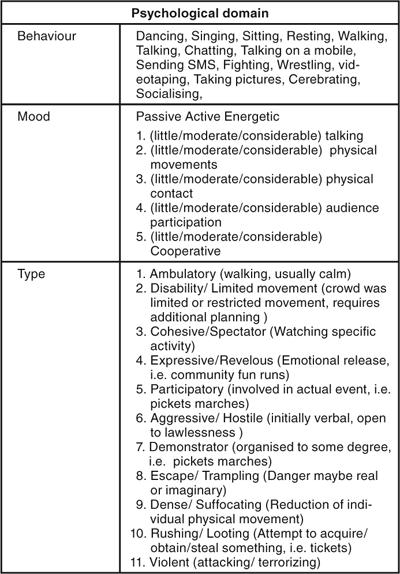
The study was interpretive, used participant observation, and was supported by a data template to collect qualitative data. Inter-rater reliability was strengthened by the use of three trained data collectors. Pre-event training included orientation to the data collection tools and peer review of trial crowd assessments. A data collection information sheet providing the descriptors in each model was used by all data collectors to ensure comprehensive and uniform data collection (Table 3).
Data collection sheet
In addition to the two tools used, the research team decided to include brief descriptions of their observations during the day. These assisted the team in interpreting the data set. Predetermined vantage points were chosen to allow for consistent observation throughout the day. Data were collected at hourly intervals, and described using the two data collection tools and additional brief descriptions.
In analyzing the data, researchers applied a simple scoring schema to each tool, attributing numerical values to each element to quantify the findings and identify any trends. For the crowd mood descriptors of Pines and Maslach, a score was applied to each element from 1–15. For example, passive (little or no talking) was assigned a score of 1, passive (little or no physical movements) a score of 2 etc., through to energetic (maybe episodes of violence) being assigned a score of 15. Berlonghi's crowd types were also assigned scores, with Ambulatory = 1, Disability Limited Movement = 2, Cohesive = 3, Expressive = 4, and so on. Finally, for the descriptive notes, a score was attributed to the behaviors observed using the classifications (active, passive, energetic) provided by Pines and Maslach. Each behavior was placed into a category; then assigned a score (Passive = 1, Active = 2, Energetic = 3).
Results
Crowd Type
The crowd type, based on the categories of Berlonghi, was predominantly ambulatory and cohesive, moving on to a more expressive and participatory crowd category as the day progressed. The scores assigned for Berlonghi's categories of crowd type are described in Table 4.
Data collected (crowd type)

The main crowd types observed throughout the day were participatory, ambulatory, cohesive and expressive. The numerical value for these measurements shows an emerging pattern of more expressive activity (Figure 1).
(Color online) Scoring of crowd type

Crowd Mood
The crowd mood descriptors of passive, active and energetic (based on Pines and Maslach) were assigned to the crowd throughout the data collection period. These findings are summarised in Table 5.
Data collected (crowd mood)

The total score for each hour indicates an increase in the incidence of energetic activity. The table shows that after midday, the crowd was primarily observed to be active and energetic. Figure 2 is a pictorial representation of increased activity that captures crowd mood.
(Color online) Scoring of crowd mood descriptors

Crowd Descriptors
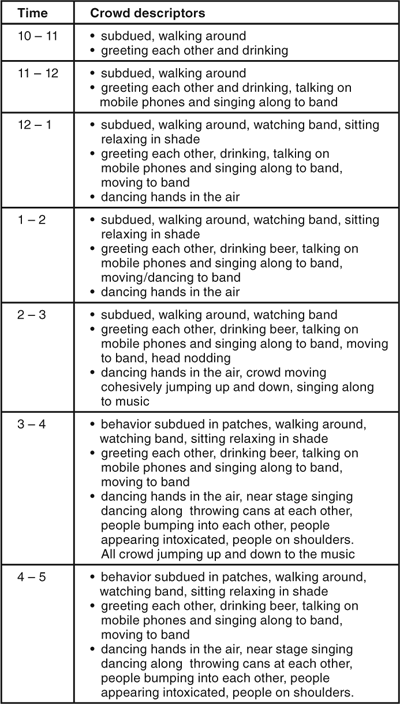
The analysis of the descriptive notes showed there were recurring crowd descriptors captured that helped describe crowd patterns. These indicated, in more detail, the specific activities of patrons. Documented descriptors included time on their feet, walking around or dancing, and watching entertainment. The descriptors of behavior were used to help the researchers understand in more detail the activities occurring within the crowd (Table 6).
Brief descriptors of behavior collected throughout the day

Using these descriptors, a score was then assigned to each behavior, using the framework provided by Pines and Maslach. Each descriptor was mapped under these headings. Each category was attributed a score as described above to give the behavior a ranking (Table 7).
Scoring of descriptors of behaviour using Pines and Maslach
As with crowd mood and type, behavioral scores were then plotted on a graph to show the changing pattern in behavior throughout the data collection period (Figure 3). Again, an increase in activity such as dancing, moshing, and the audience waving hands in the air and cohesively responding to the music is noted throughout the seven hour data collection period.
(Color online) Scoring of behavioral descriptors

Finally, scores for all three models were plotted to identify similarities and variations (Figure 4).
(Color online) Comparison of the scores

Discussion
This pilot was designed to evaluate the effectiveness of current tools for measuring and monitoring crowd behavior, in an attempt to increase the understanding of the psychosocial domain of a mass gathering event.
This pilot highlighted that crowd descriptive tools such as those promoted by Pines and Maslach and Berlonghi are limited. In these tools, the language used to describe aspects of the crowd is poorly defined. For example, Pines and Maslach describe crowd mood, but in fact, physical descriptors of crowd activity such as talking or participation are used. Berlonghi's descriptors of crowd type focus on the actions of the crowd, and are not a descriptor of the type of the crowd. The collection of brief qualitative descriptors in this pilot allowed a more dynamic picture of crowd behavior to emerge, and has highlighted the influence that drug and alcohol use can have on crowd behavior. This is absent from the existing models. Finally this pilot has shown that, along with the crowd observation process, the addition of a scoring matrix to any model allows a more practical surveillance method to emerge.
Further consideration is required as to whether this data set actually captures crowd mood as distinct and different from other descriptors of the crowd's behavior. The results of this pilot support the notion that crowd “mood” and “type’’ are outward displays of the interplay among mood, motivation, and type. Therefore, the data collected for the psychological domain should primarily focus on crowd “behavior” as the observable and measurable element. Within the paradigm of crowd behavior, crowd mood, type and descriptors can be assessed, and then used to describe or even predict behavior.
The addition of other measurements such as the basic descriptors of crowd activities, presence of alcohol and drugs, measures of crowd density and the scoring of behaviors, may improve the data set to better illuminate the psychological domain. Data collected in this study show that crowd descriptors are useful data to collect, in addition to the crowd mood and crowd type data. Observing and collecting data on crowd behaviors is useful in the comparison of crowd “mood” with crowd “type.” For example, at one data collection point the crowd was observed and described as “jumping up and down” as one to the music. This mood can be described as “energetic.” When this finding is cross-matched with crowd type, the crowd is more fully described as “energetic, participatory and cohesive.” When the additional descriptors are added, noting the “crowd jumping up and down in unison,” the data set collected becomes richer. The act of jumping up and down for an extended period of time may predict a potential for unexpected outcomes such as foot injuries, physical exhaustion or crush injuries.Reference Earl5
It is well reported that the availability of alcohol increases patient presentation rates at mass gatherings.Reference Milsten, Maguire, Bissell and Seaman1,Reference Arbon2 The crowd descriptors highlighted that the presence of drugs and alcohol is not captured by the traditional models. Incorporating the presence of drugs and alcohol into the data set, along with the subsequent impact on crowd behavior, is worthy of further exploration. In addition, other data elements (e.g., temperature and humidity) will improve the meaning and usefulness of the psychosocial domain in the assessment of crowds, their likely behaviors and, consequently, potential patient presentations.
The results of this pilot show that it is possible to monitor elements of the psychosocial nature of crowds at mass gathering events. The data collected showed a change in crowd behavior from the commencement of this event until data collection ceased at 5 pm. This finding begins to verify what event organizers may already know: crowd behavior changes through the duration of a festival or event. Getz states that as people interact with the setting, human behavior will change.Reference Getz and Getz11 This study demonstrated that these changes can be identified in a practical way as an event progresses in time and in its programmed performance elements.
Having a measurement scale that enables real-time identification of changes in crowd behaviors allows an event designer or event manager to modify the existing setting or program to influence change in audience behaviors to assist with the crowd control and risk management
Limitations
In piloting the tools and process to assess the psychological domain of a mass gathering, it is recognized that the data collection occurred at only one venue within a larger event. In the current Australian mass gathering climate, it is not always clear where the patient injury or illness arose within an event. A more definitive breakdown in crowd behavior across an event may not useful from a presentation point of view. The data was only collected until 5 pm, well before the official close of the event and before many of the event's headline music performances were scheduled, so this snapshot of the psychosocial nature of the event was limited.
From an event safety perspective, the mapping of psychosocial data against the physical and environmental domains is required to more fully describe the interplay of domains. This understanding would illuminate the connections among the various factors on outcomes such as patient presentation volume and type.
Conclusions
The data collection process using existing psychosocial data collection tools at a mass gathering enabled the development of a data set to support a description of the psychosocial domain of the event. In addition, it highlighted that traditional models of “crowd” typology are enhanced with a scoring system, and that this scoring system can identify trends of behavior throughout events.
The pilot also highlighted a need for a more consistent descriptive data set that focuses on crowd behavior. The descriptive data collected in this study provides a beginning insight into the science of understanding crowds at a mass gathering event. This pilot has commenced a process of quantifying the psychosocial nature of an event. To maximize the value of this work, future research is required to understand the interplay among the three domains of mass gatherings (physical, environmental and psychological), along with the effects of each element within the domains on safety and health outcomes for participants at mass gatherings.
Abbreviations:
BDO = Big Day Out
EMA = Emergency Management Australia
MUR = medical usage rate
PPR = patient presentation rate



