“Why should not system be opposed to system, brevity to brevity, cheapness to cheapness, entertainment to entertainment, and perseverance to perseverance? Thus alone can the enemy be met in his marches and his countermarches, and thus a reasonable hope may be indulged of baffling his schemes.”
–Annual Report of the Religious Tract Society, 1808Footnote 1On the Thursday morning of August 23, 1821, the executive committee members of the Religious Tract Society (RTS) gathered for a special meeting. Spread before them were specimens of irreligious street literature sold by their competitors. Balefully, they eyed a “good number of the low, mischievous, and disgusting publications now on the table.” The committee was in fact already intimately familiar with these types of publications, but their review of them inspired the RTS to redouble their efforts “to publish tracts with the express purpose of meeting and suppressing the lowest class of books now circulating.” To this end, they deemed it “expedient to descend the scale which the society's publications have hitherto maintained, in order to meet the evil so much complained of.” Furthermore, the committee resolved to focus their attention on discovering “the best means” for putting their new, lowbrow tracts into “extensive circulation.”Footnote 2
This meeting revealed three of the key components of the Religious Tract Society's approach to the early nineteenth-century print market: their intent to drive out non-religious competitors, their willingness to adjust and tailor their product to their audiences, and their careful attention to the methods of distribution and circulation. This strategy allowed the Religious Tract Society and benevolent evangelicals to exploit what they saw as a striking feature of their lifetimes: the explosive growth of cheap, mass print.
From its foundation in 1799 to its jubilee in 1849, the London Religious Tract Society produced nearly half a billion tracts, broadsheets, and handbills.Footnote 3 While its ecumenical principles found volunteers and financial support throughout many parts of the Christian community in Britain, the RTS also embraced marketplace competition as a means of spreading the gospel and as part of a national and global evangelical enterprise. The RTS's savvy market strategies stand in contrast to a tradition of modern scholarship that has posited an antagonistic relationship between religious faith and commerce. An examination of the RTS's operations reveals a major strain of evangelicalism that had a uniquely religious understanding of the market that in turn shaped and guided their large-scale and unprecedented production efforts. Approaching evangelicalism and commerce as potentially complimentary reveals the ways that religious and economic practices could interpenetrate and enrich each other in the minds of believers in early nineteenth-century Britain. While evangelicals always criticized the unbridled pursuit of capital, many understood the workings and innovations of commerce as peculiarly well-suited to the development and spread of religious feelings and experiences.
The RTS executive committee minutes from the period prior to the 1840s have been largely unexplored by recent scholars.Footnote 4 These minutes, generated from the committee's weekly meetings, provide a record of the committee's mundane, daily activities, which ranged from monitoring paper quality to wrestling with theological issues in their tracts. This article, then, explores the RTS archive side by side with some of its publications to develop an analytical, revisionist argument about religion and commerce while also offering a historical reconstruction of the early tactics and methods of one of nineteenth-century Britain's most influential and prolific publishers. Taken together, this two-fold approach reveals the centrality of mass production, urbanization, and growing commerce networks to British evangelicalism and to the development of religious publishing. It also shows that some evangelicals were not only aware of this contribution but also embraced it.
This study examines the RTS and its relationship with commerce in three prime contexts: hawking, design, and urban-centered trade networks. In the first context, the RTS's pricing and hawking techniques show how the RTS combined their business practices with their understanding of the marketplace's religious opportunities and benefits. Behind their vending strategies, however, stood the product itself. This second context of material design demonstrates how the mass media of cheap pamphlets inflected methods of evangelism and the possibilities of religious experience. The marketplace not only offered new ways to sell religion but also new ways to experience the evangelical message. Finally, urban and trade networks provide an opportunity to examine how the Society understood the possibilities for religious dispersion in an age of increasing mobility and growing commercial exchange. Though the RTS distributed a large portion of their products for free, that distribution was inextricable from the broader commercial circulation of goods and people in industrializing Britain. Even when making charitable gifts of tracts, the RTS sought to use the mechanisms of economic exchange. Taken together, the sale, production, and circulation of religious tracts offer a key but often overlooked means for assessing the overlapping logics of marketplace developments and evangelical innovations in the first half of the nineteenth century.
I. Christianity and the Market
Scholarship on religion and commerce in nineteenth-century Britain has usually assumed an inherent tension between Christian faith, business, and the exchange of commodities. Following in the footsteps of Max Weber and Émile Durkheim, historians have until recently portrayed economic rationality and the growth of consumer culture as either displacing religion or absorbing it and taking on the sacred functions of Christianity. In these interpretations, businessmen sidelined their religious sentiments in pursuit of profit or used religion as a tool for controlling their workers while consumers turned to commodities, rather than to the divine, to meet their spiritual needs.Footnote 5
As historians have become increasingly skeptical of the secularization narratives that have undergirded these sociological interpretations, they have begun to argue that the relationship between religion and commerce was often more harmonious. One strand of this research explores how dedicated businessmen also were active and dedicated Christians. This scholarship mainly studies the philanthropic activities and workplace policies of select business owners in order to demonstrate that their financial and business practices could be shaped by and not contradict their religious convictions. This approach, nevertheless, reproduces the dichotomy between religion and commerce by exploring the faith of Christian businessmen in their charitable behavior outside of their businesses or in their moderation of their capitalist practices. Faith is portrayed as compatible with commerce but yet also apart from it. In order for a Christian to engage in commerce and maintain their faith, these studies assume from the beginning that it required an act of balancing and Christian stewardship. While the market did not push aside Christianity, the two jostled with varying degrees of discomfort.Footnote 6
Revisionist intellectual historians, on the other hand, have attempted to discover specifically Christian understandings of the marketplace. These historians have identified the development of a “Christian political economy” in Britain after the French Revolution. This scholarship challenges the conventional historical narrative which described political economy as inherently secular and secularizing.Footnote 7 According to these studies, evangelical Anglican thinkers such as Thomas Chalmers, Thomas Malthus, William Paley, and Richard Whatley developed a system in which natural theology and divine providence worked hand in hand with a self-regulating market economy. In adopting political economy, these Christian thinkers did not abandon their faith but rather situated economics within their understanding of the workings of providence. Bankruptcy, poverty, and failed investments were part of God's design to prompt virtuous behavior and moral improvement. In their view, free markets were desirable, not because they promoted the increase of wealth, but because they promoted the increase of virtue. Ultimately, the scholarship on Christian political economy portrays evangelical thinkers as supporting free trade and market competition so that God's natural order might proceed without hindrance. However, the link between religion and economy is explored in politics, theology, and philosophy but not in evangelical commercial practices. The market's function is almost purely negative, providing punishments and moral tests rather than adding positive benefits. Thomas Searle, for instance, noting that Christian political economists did see the market as offering some positives, quickly shifts his analysis back to the market as punisher.Footnote 8
Thus, the Christian ambivalence to wealth and antipathy toward the immoderate pursuit of profit has dominated most discussions of religion and commerce. The underlying theme has been how believers justified their commercial activities and endorsement of the marketplace. As W. R. Ward has pointed out, “One of the puzzles is how businessmen reconciled their evangelical personal ethic of love with the impersonal market economics of their weekday commercial orthodoxy.”Footnote 9 One possible answer to this puzzle is that, for some evangelicals at least, it was not a puzzle at all. Rather, the workings of commerce, the growth of urban reading audiences, advances in cheap printing, and the very nature of exchanging goods seemed to them to offer an unprecedented opportunity. Evangelicals could now reach more people, in more places, more easily than ever before. In their eyes, the exchange and circulation enabled by the marketplace itself was perfectly suited to spreading Christian love and feelings.
An examination of the Religious Tract Society demonstrates that, indeed, some evangelical businessmen adopted marketplace practices in the belief that certain commercial strategies directly provided spiritual and moral benefits both for themselves and their potential customers and readers. Profit, for the Society, was a far secondary motive. Commerce and business, however, were not. Furthermore, a consideration of the RTS reconnects religious beliefs with actors moving in the marketplace rather than limiting consideration to evangelical theorists or the financial philanthropy of business owners.
Leslie Howsam and Aileen Fyfe have already offered important studies of the business of British religious printing.Footnote 10 Both have explored the histories of these institutions and the details of their production methods, and Fyfe has argued that the RTS believed that it was possible to combine religion with business interests.Footnote 11 Their accounts, however, ultimately continue the tendency to see an inherent opposition between religion and business. Both Howsam's research on the British and Foreign Bible Society and Fyfe's work on the Religious Tract Society emphasize religious publishers' sleight of hand in presenting themselves as charities while downplaying or hiding their commercial practices from the public eye. In the conclusion of her book, Fyfe stresses that the RTS “hid the commercial reality behind the dutiful appearance of a religious society, in order to gain support from the evangelical community.”Footnote 12 As Howsam noted, “The ‘fact’ that the BFBS was a hard-headed commercial publisher was of no help in raising funds.”Footnote 13
These British studies contrast with scholarship on the American context, which has been much more willing to see collaboration between evangelicalism, cheap print, and commerce. David Nord and David Morgan have argued that religious publishers were the driving force behind the development of mass media and cheap print in the United States.Footnote 14 Nonetheless, Nord has found that American evangelicals treated the commercial side of their benevolent publishing as unfortunate, if necessary. Their ultimate goal was always to achieve a model in which all their products were free. Nord sees this as a fundamental difference between North American and British religious publishers. As Howsam has argued with regard to the British and Foreign Bible Society, British evangelicals always sought a “transaction” in order to increase the worth of the Bible in the minds of their charity cases. For American evangelicals, their goal was ultimately non-economic while commercial exchange was central to the British case.Footnote 15
Frank Lambert's research on George Whitfield and the “Great Awakening” in a transatlantic context has uncovered the commercial strategies and language used by eighteenth-century revivalists. Whitfield especially adopted merchandising techniques for peddling his journals and sermons, and Lambert depicts him using the consumer transformations of his age to reach new audiences and to create new markets. Lambert's observations, however, do not seem to have been widely used in scholarship on nineteenth-century evangelicalism and British consumerism.Footnote 16
Howsam and Fyfe never question the sincerity of religious publishers' efforts at evangelism, yet the picture that emerges from their scholarship is one of religious businessmen who justify the means by the ends, “sweating their bookbinders” and treating their writers “as just another cog in the machine of the production process.”Footnote 17 Their commercial techniques, then, are depicted as moving against the grain of their principles, balanced precariously with the societies' stated goals and character. Fyfe notes that “the Society's commitment to evangelicalism was made manifest . . . in its business policy,” yet her detailed research mostly underscores the “inherent” tensions that this entailed and that “the balance between faith and finances was a tricky one.”Footnote 18
Undoubtedly, benevolent societies found that sentimental accounts of the deserving poor and uneducated were more effective in inspiring charity than the details of bookbinding. Dilemmas and debates over the proper Christian stewardship of business funds and practices certainly pressed on religious publishers. It is less clear that these tensions provide the most helpful lens for understanding the interplay between British faith and commerce. An investigation of the Religious Tract Society's executive committee minutes reveals other possibilities. For the RTS, the “ends” of conversion were not merely justified by the “means” of commercial publishing. Rather, the production and distribution of cheap print not only offered unique opportunities for evangelism but were in themselves beneficial, desirable, and socially redeeming activities. For religious publishers in the early nineteenth-century marketplace, the means and the end were inseparable.
II. Universal Diffusion and the Press
When members of the London Missionary Society formed the RTS in 1799, they pointed to the “thousands, who would have remained grossly illiterate, having through the medium of Sunday Schools been enabled to read.”Footnote 19 The efforts of evangelicals such as Hannah More in the Sunday School system had helped to create a lower-class reading public, but even More found herself unable to sustain a publishing enterprise to meet the needs of those readers. While recent research has shown that literacy in Britain at the turn of the century had just surpassed fifty percent of the combined male and female population, the Religious Tract Society felt convinced that “education has spread so rapidly that nearly all the rising generation now possesses the ability of reading.”Footnote 20
To meet this “universal diffusion of Education” required publications that were “not too expensive” and also “intelligible to minds not highly-cultivated.”Footnote 21 The “advocates of infidelity” were already taking advantage of this new group of readers and grim reports on dangerous publications surfaced as a persistent trope in RTS materials. The first RTS annual report noted that “the age of knowledge is also the age of temptation,” the latter finding form in an “abundance of trifling, impure and profane publications.”Footnote 22 Little seemed to have changed rhetorically when twenty years later in 1819, the RTS reminded its readers of “the increasing activity with which Infidel and Blasphemous Publications are now circulated.” These dangerous publications were cheap and “written in a style peculiarly suited to the lower classes.”Footnote 23
Popular printed materials of this sort emerged as a new form of “street literature” in the late eighteenth and early nineteenth centuries.Footnote 24 Examples of this genre might include bawdy and suggestive ballads such as The Beautiful Muff, gruesome accounts of crime such as A full, true, & particular Account of a most cruel and barbarous murder, and superstitious amuletic texts such as A copy of a letter written by our blessed Lord and Saviour, Jesus Christ, which promised their owners special protections from disaster.Footnote 25
The committee members of the Religious Tract Society, from its inception, had no doubt that they could meet such publications in the field of contest and defeat them with even cheaper and better-adapted products. They believed that they could “counteract these evil publications, and expel them.”Footnote 26 Cheap print was not inherently evil and they asserted that “the art of printing is one of the most important of all human inventions.”Footnote 27 Christians simply needed to take over and dominate the market. Luckily for them, the RTS committee believed, the workings of marketplace exchange itself contributed to this redemption of print culture and society.
III. Competitive Pricing and Hawking: Selling the Product
Tracing the RTS's hawking and pricing strategies not only recovers very early institutional strategies for the cheap print market but also reveals a positive and specifically religious engagement with the marketplace. Because the evangelicals of the RTS hoped to use commerce to increase morality rather than their own wealth, their lack of concern over profits comprised one of their chief weapons in their struggle to overwhelm “dangerous” publications. With profits as a secondary consideration, actual distribution and sales took primary place.Footnote 28 The RTS believed that the market, by the means of keen business acumen and God's providence, would successfully spread Christian texts while redeeming and rehabilitating the sellers.
The first step was to convince hawkers to sell RTS products instead of the usual street literature, which the RTS described as “feculent dregs.”Footnote 29 From the hawkers' point of view, this was no casual matter. Hawkers bought their tracts and broad sheets in bulk from booksellers and then profited by marking up the cost in the street. Unsold product could mean a true disaster for a hawker living on the edge of subsistence. A religious tract needed to catch a potential customer's attention, provide meaningful profit to the seller, and be entertaining enough to encourage the customer to make repeat purchases. To this end, the RTS experimented with pricing schemes as well as tract formats and content to lure hawkers and their customers.
Hawkers' profits comprised a reoccurring theme at the RTS committee meetings, and they focused primarily on pricing strategies. When the RTS announced the Hawkers' Series of tracts to their subscribers in 1806, they emphasized the “extremely low price” that would ensure that “a profit might accrue to the Hawker and Vendor superior to that which arises from the sale of the foolish and vicious Tracts which they are intended to counteract and supersede.” This profit would be “superior to that of any other Tracts hitherto published.”Footnote 30 By undercutting the prices of “profane” tracts at the point of supply, the RTS hoped to convince hawkers to make their daily funds go further and to tempt shopkeepers with a cheaper inventory. This had the double effect of allowing hawkers to receive more tracts for the same investment yet also of increasing the total number of religious tracts in circulation. The RTS considered each religious tract sold to be a direct substitute for a “very objectionable” tract that would have been sold otherwise.Footnote 31
After monitoring sales for a few years, the RTS felt that the prices were perhaps not low enough. In an 1809 meeting, the committee noted “the importance of superseding profane or immoral Tracts by holding out the inducement of a larger profit to the Vendors.”Footnote 32 Thus, they resolved to lower their bulk prices further, absorbing the loss themselves, in order to bring more profits to the tract suppliers and hawkers. The committee frequently reviewed their prices and sales statistics and in at least one case, when sales were not as high as expected, formed a subcommittee to investigate the reason and to make a report to the main committee in case any strategic changes were required.Footnote 33 Hawkers, apparently, found the whole scheme attractive and the RTS hawkers subcommittee reported with satisfaction that lowering bulk prices had resulted in doubling sales.Footnote 34
RTS accounts of its own successes in supplanting irreligious publications tended to be congratulatory, and gauging their actual effect on the print market presents clear difficulties. Some of their competitors, especially religious booksellers, did take note however. As their efforts expanded to include periodicals, the RTS executive committee received angry letters of complaint, some phrased in “coarse language,” accusing them of damaging legitimate business by attempting to form a monopoly on religious publishing.Footnote 35 The well-respected Christian publisher Francis Westley requested a meeting with the RTS, claiming injury from “the great quantity of matter, and the low price” of the RTS's publications. He also told the committee that other booksellers, some of whom were responsible for the anonymous letters, were attempting to “unite the trade” against the RTS.Footnote 36
In the face of these protests, the executive committee remained wholly unmoved and resolved that they would not compromise “to meet the objections of the General Bookseller, arising from interested motives of Pride.”Footnote 37 Instead, they offered the booksellers a further discount for bulk purchases of RTS materials. While this gesture was ostensibly meant to placate critics, it was of course the exact same cutthroat pricing strategy that had caused the upset in the first place. Again, their embrace of unrestricted competition aimed for moral good, not necessarily increased capital. The outcry from competitors, religious and irreligious alike, points to at least the perceived possibility that the RTS's manipulation of the market would succeed.
Committee deliberations, however, did not always end in lowering prices. At times, they decided that the “the superior manner” in which their products were produced warranted that prices be maintained.Footnote 38 On other occasions, the RTS raised prices—often to compensate for increased quality or production costs. Such moments reveal the desperate circumstances of street hawkers who depended on the cheap prices of RTS tracts. In May of 1820, a John Sidney Denham wrote to the Religious Tract Society, complaining of his “great injury” from a price increase. The minutes for that meeting noted that Denham “formerly could support his family by vending tracts, but that he is now reduced to distress.”Footnote 39 A week later, after the hawkers subcommittee considered the issue, they resolved to send Denham two-hundred stitched tracts in compensation.Footnote 40
Selling tracts was not easy, of course, and impoverished hawkers might also fall afoul of vagrancy or licensing laws.Footnote 41 The precarious circumstances of many tract hawkers, as well as the begging techniques that accompanied some hawkers' sales efforts, caused Henry Mayhew in the mid-century to categorize them as a type of “Professional Beggar” under the subheading of “Petty Trading Beggars” and equivalent to those who sold “lucifers, boot-laces, cabbage-nets, tapes, and cottons.”Footnote 42 While many hawkers like Denham would have struggled to support a family by selling religious tracts, the RTS believed that the profits from their tracts could help an impoverished or jobless person to get back on their feet and become productive members of society. Alternately, selling tracts could provide supplemental income such as in the case of a London fruit seller in a courtyard near Lombard Street who also put out a basket of tracts for sale (or loan, at half price) next to her produce.Footnote 43
Turning poor people into RTS hawkers became a favored form of benevolence since it rehabilitated the impoverished into industrious workers while simultaneously spreading the gospel. Charity of this sort could be initiated not just by the RTS committee but also by subscribers and readers. One subscriber, for instance, purchased a large number of tracts to give to a poor woman attending his church for her to sell.Footnote 44 In another instance, someone in “distressed circumstances” petitioned the RTS directly for tracts to vend after having been given a copy of the tracts The Penitent Prostitute and The Happy Negro and having enjoyed them so much that he believed he could successfully sell them.Footnote 45
Other innovations were forthcoming. The Hawkers' Tract Distribution Society formulated a scheme in which tract “tickets” could be given to the poor instead of money. Each ticket entitled the bearer to twelve tracts from the RTS depository which they could in turn sell.Footnote 46 This system complimented the social policies of Christian political economists like Thomas Chalmers who approved of benevolence that taught industry and spread Christianity rather than distributed money directly.Footnote 47 Those who were lazy, sold irreligious products, or who attempted to become rich too quickly would be defeated by those who were enabled to participate virtuously in the market. The tract-ticket plan not only targeted beggars but also hawkers in general who were selling non-religious tracts. “The result of this plan,” the RTS noted, “was, that many persons to whom these tickets were given, voluntarily delivered up the pernicious ballads and other publications which they had been accustomed to vend, and became regular customers for the purchase of moral or religious tracts.”Footnote 48 Turned into both “customers” and sellers of religious goods, they were redeemed through Christian commerce.
Dealing with hawkers, the RTS admitted, could be “sometimes trying.” The Reverend Samuel Kilpin opened a depository in Exeter and noted that “it needs the patience of Job to serve hawkers” as well as the “eyes of a hawk” while they were in the shop. Still, he understood his work as a valuable means of rehabilitating the poor and when approached for charity, Kilpin would ask, “Are you willing for me to set you up in business?”Footnote 49
The RTS encouraged subscribers to set up depots in order to give hawkers “easy access” to morally-edifying tracts, noting the self-sufficiency of such businesses, as well as the potential profits.Footnote 50 Specially printed placards enabled publishers to advertise the sale of RTS materials on their walls or in their windows.Footnote 51 The Society also supported stalls in markets, which seemed to meet with success in such locations as Cambridge and at the bazaar in Soho Square, London.Footnote 52 After receiving a report of smaller benevolent societies packaging RTS quarterly reports with other publications, the Society adopted the idea and began working with other publications (such as the Sunday School Teachers' Magazine) to include RTS publicity materials.Footnote 53 They soon added advertisements into the Evangelical Magazine and, in 1823, printed one hundred thousand one-sheet catalogues of their tracts for insertion into other magazines.Footnote 54 Other innovations were encouraged and the RTS depository manager Mr. Collins received funds for unspecified “experiments” with trustworthy hawkers.Footnote 55
All of the Religious Tract Society's techniques, from their competitive pricing to their use of hawkers, correlated with the formulations of Christian political economy. Boyd Hilton has shown that “moderate” evangelical thinkers embraced laissez-faire and non-interventionist economic policies because an unrestricted marketplace allowed God's providence to play out in society. The RTS's efforts demonstrate that the ideas of Christian political economists were part of a broad, evangelical understanding of the market that was implemented by actual businessmen. Hilton argues that mainstream evangelicals such as Chalmers envisioned “competition as a means to education rather than growth.”Footnote 56 This was precisely how the RTS explained its entrance into the competitive marketplace. Profits, which indeed did eventually accrue, were not the object sought but were instead a secondary effect. The primary objective was education and conversion – both through the content of the goods sold but equally through the selling itself. By “setting up” distressed persons in business, by rewarding frugality with increased profits, and by encouraging industriousness, the RTS sought to redeem society by means of market competition. The goal was a self-discipline which caused or reinforced spiritual conversion but yet also inserted the hawkers into a system or religious circulation and exchange.
Thus, the RTS's entry into the marketplace effected charity and social redemption by means of God's natural, providential order embodied in the cries of hawkers in the streets and the clash of their profane and moral products. Moral paternalism could work hand in hand with economic individualism.Footnote 57 The RTS believed that the unrestrained, cut-throat competition between profane and religious street literature would result in the success of virtuous products and the moral rehabilitation of hawkers. The righteous would get their spiritual, as well as earthly, reward and the RTS would help. For these evangelicals, commercial practices were not at variance with their faith but rather enabled an unprecedented propagation of religious literature while providing a mechanism for redeeming those who made their living in the marketplace of cheap print.
IV. The Gospel in Miniature: Designing the Product
Pricing and hawking strategies, however, were merely one of many steps in creating a successful and competitive product and there were other locations where religious and market logics overlapped. Design and format, for instance, not only made for marketable tracts but contributed to the religious experience and effects of reading the tract. Well-crafted products facilitated sales and salvation while providing a unique encounter with the gospel message. The sensationalism of arresting cover copy and topical news as well as the mundane details of paper quality and tract length had spiritual implications and opportunities which the RTS committee carefully deliberated.
Striking woodcut images, catchy titles, and higher quality materials all contributed to a tract's appeal. In order to compete against irreligious street literature, the RTS from almost the beginning produced tracts “having Cuts, and being printed in the same form, as those usually sold by Hawkers.”Footnote 58 Tract authors would sometimes submit sketches with their manuscripts which would be forwarded to an engraver and new editions of popular tracts were often accompanied by the commission of updated cover images.Footnote 59 The RTS committee paid attention to techniques that improved the quality of their woodcuts and were quick to complain if an engraving was not up to par.Footnote 60
Tracts without images at all, the committee also learned, suffered a distinct disadvantage. A letter from the New York Tract Society complained that since RTS tracts with woodcuts had been introduced into America, the American tracts, which lacked images, “were but little esteemed.”Footnote 61 The NYTS begged for stereotype casts of RTS woodcuts to increase the appeal of their own products. The RTS generously agreed, sending them woodcuts worth fifteen pounds.Footnote 62 While images might garner “esteem” for a tract, other innovations such as colored images “appeared to excite more than usual attention.” Noting that competitors had begun to add color to their covers, the RTS experimented with the strategy and then adopted it in some cases.Footnote 63
Sensational content in the woodcuts also lured in readers. For instance, the cover image of the tract, Memoirs of a Female Vagrant, depicted a climactic scene in which the heroine's nineteen-year-old son was brought into her home after drowning in a river. The mother is shown supporting a fainting sister while a servant turns away in grief at the door. The RTS executive committee added the poignant image at the same time that they added “Instructions for the Recovery of Drowned Persons” to the end of the tract. These instructions, playing on popular fears over drowning in the Thames, had apparently been inserted into the first edition and had met with such success that the committee decided to make them a permanent feature of the tract.Footnote 64
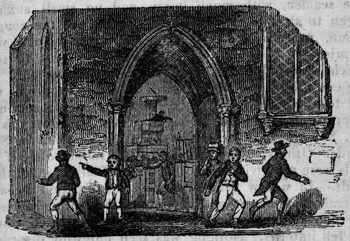
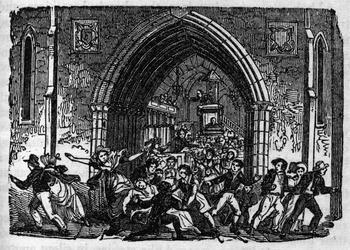
Woodcuts deemed uncompelling might be redone. In the case of the tract Christ the Only Refuge from the Wrath to Come, the original cover (fig. 1) portrayed a street scene in which a few anxious figures were furtively leaving a church. Within, a preacher stood at a pulpit and his words seemed to have made the small crowd uneasy.Footnote 65 Apparently the image did not strike the desired tone. The next version of the tract (fig. 2) featured a very similar woodcut but contained nearly triple the number of figures. Rather than uneasiness, the crowd embodied chaotic pandemonium as they poured out of the church. Some ran at full tilt; one woman was in mid-faint; another woman, half-turning as she ran, stretched her arms wide in a dramatic gesture. The preacher's posture had not changed, but his horizontal orientation had been flipped, perhaps to gesticulate in the direction of the most eye-catching chaos.Footnote 66 The RTS knew how to spice up an image, and tract titles sometimes received the same treatment as when the tract On Drunkenness became the much more attention-grabbing The Wonderful Advantages of Drunkenness.Footnote 67
“Christ the Only Refuge from the Wrath to Come” (Religious Tract Society, 1817). © The British Library Board, RB.23.a.23197 (3).

“Christ the Only Refuge from the Wrath to Come” (Religious Tract Society, ca. 1830). © The British Library Board, 863.k.4 (72).

One of the allures of street literature was its topical and ephemeral nature, perfectly suited to the latest news and gossip. Placing their own products into this category, the RTS created a special series of tracts on local or temporary topics “until the public opinion of their usefulness may be clearly ascertained.”Footnote 68 Those that had short-term appeal could be easily dropped while those that proved to have staying power could be given a permanent home in one of the main tract series. Committee members were encouraged to “avail themselves of any striking circumstances which may occur” to use as the subjects for such hawkers' tracts.Footnote 69
“Reflections” on the “authentic particulars” of “calamitous events” were a mainstay of these short tracts and broadsheets. Suitable calamities and noteworthy events included items such as a shipwreck in Liverpool, a fire at the Brunswick theater, a fire on a ship at Manchester, a “beautiful luminary” comet that excited “general attention,” earthquakes, collapsing investments in foreign securities, “the recent horrid murders at Ratcliff Highway,” “shocking murders in the metropolis,” the deaths of well-known figures, and public executions.Footnote 70
The RTS executive committee did not shy away from using newspapers and other cheap print as sources for their own material. In the case of Mary Lockham of Hull, accused of infanticide, the committee first read a newspaper account of the trial.Footnote 71 The Hull Packet and Original Weekly Commercial, Literary and General Advertiser found the case to be ripe for moralizing, noting that the age of the accused, just nineteen years old, was “peculiarly affecting” and that it formed “one of those instances, so full of warning and admonition, particularly to young women.”Footnote 72 The story, of course, was also sensational—the girl was a servant in “a respectable house” where the body of the illegitimate infant had been found in a locked hatbox with a piece of calico cloth in its mouth.Footnote 73 Fortunately for Mary, despite thorough tests and an autopsy, the prosecution was unable to prove beyond doubt that the baby had been born alive and so she was convicted only of hiding the birth and death, but not of murder.Footnote 74
The RTS committee then went on to read a sermon on the trial as well as a “narrative of the circumstances attending the death of Elizabeth ——.”Footnote 75 This publication was almost certainly the one advertised in the Hull Packet as “A Second Publication of mr.scott's sermon on the fatal consequences of licentiousness, preached on occasion of the Trial of mary lockham” bound along with “a second edition of the lover's monitor, or the Story of elizabeth ——.”Footnote 76 Scott's sermon, preached several times to large audiences, had already gained considerable notice and would go on into multiple printed editions. John Scott's father, the evangelical divine and Clapham Sect member Thomas Scott, mentioned the sermon in an 1811 letter to Zachary Macaulay and asserted that “it has attracted more attention, than any sermon, almost, published in my time.”Footnote 77 Thus, the RTS exploited an already hot topic and catered to the intense interest in a recent event. The committee agreed with the Hull Packet's opinion of the “affecting” yet instructive incident, trial, and sermon and asked committee member William Shrubsole to produce a Hawkers' Tract with the newspaper account and Scott's sermon as the foundation.
Woodcuts, colors, and sensationalism were not the only way to increase the “esteem” of a tract. Paper quality also boosted the perceived value of the merchandise. Children especially seemed to treat high-quality tracts more seriously and the Society noted that Sunday-school reward books printed on higher quality paper with “neat” woodcuts were deemed “much more acceptable.”Footnote 78 Parents, too, could not resist the “neat, nice little books” for their children and would open the door to tract distributors. “Thus the way was opened for distributing the larger tracts, and for commenting on them.”Footnote 79 High quality paper and woodcuts combined with a high page count to make a tract “more highly esteemed” and “much longer preserved and oftener read.”Footnote 80
The look and feel of tracts as well as their sensational topics helped them compete in the marketplace. Yet, these commercial characteristics were not divorced from the tracts' religious effects. They were not merely a way to generate sales. The RTS believed that the novelty and simplicity of short, entertaining narratives made them more effective. While admitting that some of their tracts, especially those in the Hawkers' Series, “descend[ed] the scale” from more lofty, theological works, the committee stressed that they were calculated “to catch at very uninformed minds.”Footnote 81 “These Tracts,” the RTS noted, “are addressed to the comprehension, the character, the habit, and the feelings, of the lower orders of the people.”Footnote 82
A lower-class person given a “plain didactic essay on a religious subject” would “fall asleep over it.” Instead, the RTS asserted that a “narrative can be made the medium of conveying truth.” By “blending entertainment with instruction,” such tracts would “allure the listless to read.” Yet, once the interesting covers, sensational titles, and entertaining narratives had drawn in the reader, the very format of the tract had additional effects. The RTS believed that the concise simplicity of a narrative tract not only engaged attention, but also assisted memorization that “makes a deeper impression on the heart.”Footnote 83 The structure of a plot, enhanced no doubt by striking woodcuts, stuck with a reader in a way unlike other genres. This accessible style, through impressing itself on “the heart,” created an interior experience. In other words, reading an RTS product felt different.
Even the brevity of religious cheap print had spiritual implications, allowing, as it were, a special distilled concentration of religious truth. “Truth cannot be compressed too much,” commented the RTS. “Every sentence contains something useful and something new.” Employing a creative twist on a traditional Christian metaphor, they portrayed their ingenuity in tract design as adding “an agreeable relish” and “seasoning” to the “abundant meal of the bread of life” contained in every tract.Footnote 84 Encountering the Christian truth in tract format offered a unique experience: the gospel in a new and different flavor.
Thus, design and format did not just propagate a religious message but were deeply implicated in the creation of a religious experience. Just as the RTS's pricing and hawking strategies were understood to contribute to societal redemption, the qualities of a tract which produced sales and tempted readers also facilitated conversion. Like competition in the marketplace, product design mattered for spiritual as well as financial reasons. The same attributes that made tracts most appealing to consumers also made them effective tools of evangelism. The easily distributed and marketable format of tracts did not detract from their spiritual message, but rather they were “the Gospel in Miniature.”Footnote 85
V. Channels of Commerce and Christianity: Circulating the Product
Even when distributing tracts free of charge, the RTS linked their circulation to the mechanisms and channels of economic exchange. Indeed, cheap print seemed imminently suited to move through urban spaces and along routes of trade and travel. In their private meetings and public promotional materials, the Religious Tract Society showed a preoccupation with crowds, trade, and the ways that tracts operated in public and commercial spaces. The movement of their products, they felt, aided the creation of Christian networks and contributed a timely intervention into a world of increasing urbanization and mobility. While city spaces and a population on the move have often been portrayed as secularizing forces, even by some evangelicals of the time, the RTS sensed opportunities.
It was the multiplicity of people in city spaces that seemed on the surface to present a unique challenge to would-be evangelists. “Personal instruction must, from the time it requires, be limited to comparatively few,” noted the RTS. Moreover, when a Christian spoke to a stranger directly, his or her boldness might well be interpreted as prideful superiority and inspire a defensive or scornful reaction.Footnote 86 Individually approaching each member of the teeming mass of urban strangers seemed an overwhelming task.
Tracts, however, transformed these challenges into strengths. It took only a moment for a distributor to hand a tract away. It was an instant message, faster than a conversation but yet more memorable since it could be perused later. The success of the message did not rely on the distributor's boldness or ability to preach and handing out tracts was a “method” which “may be done with ease.” There was not “enmity against the paper and print” as there was against a street preacher. Tracts could speak to strangers in ways that a person could not. “Some,” the RTS felt, “are accessible in no other way.” Cheap print, then, gave evangelicals access to those who were previously unreachable.Footnote 87
The RTS viewed the anonymity of giver and receiver as an advantage rather than as a drawback because a tract, when given “by a stranger, excites curiosity to know what it contains.” Passed off from hand to hand between strangers, without need of conversation, tract distribution could be “more extensive” than any other method of evangelism.Footnote 88 What better way to match the proliferation of people in cities than producing millions of cheap tracts?
Religious mass print also lent itself to the archetypal urban activity—ambling through the streets while observing strangers. An RTS treatise that included a description of the ideal tract distributor noted that he “saunters about the town” and “looks into the habitations of the poor.”Footnote 89 Though serendipity or providence may have guided the distributor's steps, the RTS's diverse catalog of tracts was prepared for any chance encounter. From the beginning, the Society had tailored their tracts to a variety of social and cultural niches. Some tracts targeted their audience by age, such as advice for young persons, or “consolation” for old persons printed in large print. Some targeted specific sinners, such as gamblers, swearers, or Sabbath-breakers. Some targeted an economic category or profession, such as the wealthy, the poor, coachmen, or servants. The RTS boasted that its tracts were “adapted to various situations and conditions.” “When an address is particular, and directed to a specified situation,” the RTS committee explained, “it comes home to the man's bosom who sees himself described; and it has a more powerful effect on his mind.”Footnote 90
The Society thus assumed that strangers were legible. The key was for a distributor to discern a stranger's “character.” The RTS suggested that one should always carry “a store of Tracts, of different kinds, and suited to different characters” and to pay “particular attention to character in the distribution.”Footnote 91 Upon encountering a likely person, the RTS advised, “Choose from your collection of Tracts what you think is suited to the person.”Footnote 92 The large variety of the RTS's tract catalog gave the distributor the resources to offer a product precisely targeted to almost any given consumer.
In this way, the distributors felt enabled and authorized to approach anyone and everyone. The Quaker Elizabeth Fry, for example, recorded in 1826 that while riding on a steam packet on the Thames, she “believed it right to enter a little into conversation with most of the passengers” and to give them, including the crew, suitable tracts.Footnote 93 Such serendipitous encounters in the street were fleeting and ephemeral. A tract was “given away in an instant,” and the distributor and stranger might never meet again.Footnote 94 Fantasizing about these brief encounters, the RTS imagined the “astonishment and joy” of tract distributors who, upon reaching heaven, would have revealed to them “a thousand glorious instances” of their tracts' success that had previously been unknown to them.Footnote 95 Thus, strangers, crowds, and urban spaces were made tame and knowable.
The physical and social qualities of cheap print, then, and the ways that it could be multiplied and targeted to a variety of readers, were central to how the RTS envisioned the success of its mission. Tracts were perfectly suited to urban environments and indeed, as Aileen Fyfe has demonstrated, the RTS had the most success in energizing donations and the formation of auxiliaries in urban and industrial areas.Footnote 96 Circulating in these spaces, the RTS spoke of tracts as taking on their own agency, describing them repeatedly with such phrases as “messengers of truth,” “little Messengers of Divine truth,” and “messengers of mercy.”Footnote 97 More than just carrying a message, the tracts actively disseminated it as “silent preachers of righteousness.”Footnote 98 It was within the context of strangers that these small agents took on their ability to wander down paths unreachable to their human counterparts.
Yet, the Religious Tract Society showed an awareness that not all strangers in crowds were equally suitable conduits for tracts. Instead, special attention was paid to certain types and groups of people, and not all of them were necessarily urban. Tract distributors targeted persons who in turn moved throughout the urban spaces of London, who crossed multiple social and cultural barriers, who traveled up and down streets or water ways, who were stationed on networks of trade, and who could penetrate with ease into areas that might be shut off to a middle-class RTS supporter.
Hackney coachmen, the era's iconic symbol of urban movement, provided a particularly attractive target. The RTS explicitly designed tracts and ballads to appeal to coachmen, including the Hawkers' Tract, “A Word to Hackney Coachmen,” with its specially commissioned woodcut and use of colloquial coachmen's language.Footnote 99 Coachmen's daily work made their cab a location of social intersection that physically crossed a variety of social barriers. As the RTS tract on coachmen suggested, a converted cabbie could have an auspicious influence on his fellow cabmen, who were notorious for their lack of morals, and could transform his cab into a highly visible and mobile example of cleanliness and honesty.Footnote 100 The strategies of a smaller tract society in St. Martin's made the connection between mobility and hackney coachmen clear by their focus on coachmen and the nightwatch. Like the coaches, nightwatchmen moved in a variety of spaces and social networks and were recruited to distribute tracts as they made their nightly rounds.Footnote 101
Other professions located at points of social mingling and exchange were targeted. In their advice on tract distribution, the RTS noted that tracts were an essential part of any traveler's baggage and that the lower-class employees of inns on the road, such as “the waiter, the servant-maid, and the ostler,” were perfect targets for tracts such as “Friendly Hints to Servants.”Footnote 102 Some distributors would leave tract volumes in the public rooms of inns while others left them in the “fashionable watering places” of the well-to-do.Footnote 103
Coachmen and inn servants were figurative “gatekeepers” in the sense that they allowed distributors access to a flow of human traffic from a variety of geographic spaces across the city and on the roads of commerce. Not surprisingly, then, the RTS focused on actual gatekeepers in parks and roads and suggested that distributors should hand a tract to the keeper of every turnpike.Footnote 104 The hope was that the publicly accessible gatekeepers would be converted and pass the tracts on into social networks beyond a lone distributor's reach. Turnpikes often stood just outside urban areas, regulating and capitalizing on the traffic between rural and urban Britain.Footnote 105 A tract tossed into that flow could potentially percolate into any area within the city or out into the countryside. The tract “Advice to the Keeper of a Turnpike Gate, together with Useful Hints to Travelers” signaled this strategy in its very title, addressing first the gatekeeper and then those to whom the gatekeeper might in turn give the tract.
Waterways and oceans, of course, provided the predominant means of travel and commercial transport. Reformers and the press had always seemed concerned about the morals of sailors, especially those recently decommissioned after a war, but the RTS's interest extended to anyone whose occupation placed them on or near water.Footnote 106 One distributor decided to focus entirely on bargemen on the Thames.Footnote 107 Another asked for a grant of tracts to give to “labourers on the Wharfs of the Thames.”Footnote 108 RTS accounts regularly mentioned distributors who dispersed tracts “on the river,” “on the Thames,” “on both sides of the Thames,” to lightermen, and to keelmen on the River Tyne.Footnote 109 They did not overlook the navy, fishermen, or whalers.Footnote 110 Nautically themed tracts dominated the RTS catalog.Footnote 111 The RTS reminded its readers that everyone living near a “sea-port” or a place where foreign, domestic, or imprisoned soldiers and sailors were stationed “possesses an opportunity.”Footnote 112 The residents of these areas undoubtedly needed tracts and salvation, but they were specifically identified by the RTS because of the further opportunity for dispersion.
Like a hackney coachmen in the streets of London, vessels traveled up waterways and across oceans, passing through social and geographic barriers and coming into contact with a multitude of people. Just as tracts could be left in coaches for future occupants, so too tracts could be left in ships' cabins.Footnote 113 In some cases, distribution from a ship might be direct, as when one RTS correspondent reported in a letter that, upon spying a steam packet filled with merry-making people and a band, he had tossed a few copies of the tract “The End of Time” from his ship onto the steamer's deck below as it passed.Footnote 114
Collier ships, their cargo both the symbol and fuel of Britain's industrial age, proved useful to the RTS and provide just one example of the distribution networks that the RTS exploited.Footnote 115 Though colliers did not usually carry passengers, they did move from place to place and at each stop encountered lower-class workers who moved the coal ashore to the docks. An anecdote from 1813 traces the introduction of RTS materials onto a collier ship and the diffusion of tracts which resulted.
The story began with a young boy identified only as “C.” who attended the Mulberry Garden Chapel Sunday School in London. After gaining an apprenticeship in the coal trade, the boy requested tracts from the Sunday School since his job included “much leisure” while the ship sailed from port to port and he wished to spend his free time reading tracts aloud to the crew. “C.” had already read aloud and distributed all the tracts that he had received as reward books in the Sunday School. The Sunday School granted his request and the boy's efforts, supported by the captain, resulted in weekly Sunday services on the ship, Bible readings and, of course, tracts distribution to the entire crew. The boy also gave extra tracts to colliers who worked in the mines in the neighborhood of Newcastle-on-Tyne. Thus, RTS tracts from a London Sunday school wended their way down the Thames, north along the coast of England, and into the mines of the northeast.Footnote 116 Tracts could also seep further inland up narrower waterways, like those carried by bargemen which then “circulated on the banks of our canals, where, at least, in many parts, they may never have been seen or heard of.”Footnote 117
A mid-century summary of the Society's special grants of tracts to groups outside London stated, “These had been voted for an almost endless variety of persons, including gipsies, hop-pickers, colliers, fishermen, and many others. There have also been special objects to which the Committee have annually directed their attention: these include the emigrants leaving our shores, our soldiers, sailors, and rivermen, the foreigners residing in England, and the labourers engaged in the formation of our railroads.”Footnote 118 It is striking that each of these groups were involved in either a lifestyle of travel and migration or a profession that placed them at social intersections of trade. Tellingly, by the mid-century, railway workers had joined the hackney coachmen and bargemen, their life of movement and social mingling earning them specially tailored tracts and woodcuts.Footnote 119 Taken together with inn servants, gatekeepers, and coachmen, these groups show how the Religious Tract Society targeted both specific urban and non-urban groups who gave them access to social networks normally beyond their reach.
The ephemeral, mobile nature of tracts allowed “the truth [to] flow through a great variety of channels.”Footnote 120 The RTS was not alone in emphasizing the urban spaces and commercial networks tapped into by “the tract which is left in the Inn, on the road, or in the hands of a passing stranger.”Footnote 121 The Eclectic Review's ambivalent critique of the Society's publications, which praised its tracts while criticizing its periodicals, also chose the language of urban inventions and circulation to describe the RTS's strategies. The reviewer likened the means of the RTS's “diffusion of knowledge” to “channels,” “tunnels,” and “pipes.” The circulation of cheap religious print was “a modern improvement, sprung up like the gas lights.” The reviewer both celebrated and expressed uneasiness about these new channels and inventions. They seemed beneficial, yet they also seemed “to evade our cognizance altogether.”Footnote 122 For the RTS, the way that tracts circulated in diffuse, unpredictable, and unknown ways was a blessing. Through the many channels of the city and commerce, “Millions of Tracts win an easy way into circles where the voice of a living evangelist never sounded, and would not be endured.”Footnote 123
Thus, not just the methods but also the infrastructure of commerce seemed endlessly productive to the Religious Tract Society. Rather than fretting over the implications of marketplace and business activity, the evangelicals of the RTS imagined benevolent distribution as naturally operating within a commercial framework. The overlap between the movement of the gospel and the movement of consumer objects along trade networks or through city spaces did not strike the RTS as a lucky coincidence but instead as part of the purpose of tracts. Tract distribution made strangers knowable and created connections between believers in different parts of society, forging a new sort of Christian community. Other evangelical publishing efforts also made this point, such as when a writer for a British and Foreign Bible Society auxiliary claimed that the dissemination of cheap Bibles united “the lower orders of Society” with “the more affluent Inhabitants,” establishing “an intercourse of sentiment and feeling between them, which can scarcely fail to improve the character of both.”Footnote 124
Even when the distributor and recipient remained unknown to each other, the RTS believed that the circulation of tracts created an invisible Christian network that would only be revealed at the end of time when tract distributors would meet in heaven the thousands whom they had unknowingly converted and with whom they had been connected.Footnote 125 From sales and design to free distribution, it was the mechanisms of the marketplace and commerce that offered new methods for redeeming society, experiencing the gospel narrative, and incorporating a growing urban and working class population into Christian society.
VI. Conclusion
Taken together, the sale, production, and circulation of religious tracts points to the overlapping logics between evangelicalism and commercial enterprise in early nineteenth-century Britain. For evangelicals, the exploitation of the market, methods of production, and networks of trade and distribution was linked with religious practices and spiritual conversion. While critical of speculation and the immoderate pursuit of wealth, the RTS believed that the profits sought by street hawkers and booksellers would lead them to selling cheap religious print that redeemed both the vendor and buyer and that would succeed over secular products through superior pricing and quality. The design and narrative possibilities of cheap print offered an entirely new form of religious reading experience. Unlike the dry theological treatises and didactic essays of the eighteenth-century Society for Promoting Christian Knowledge, carefully marketed and targeted RTS tracts came “home to the man's bosom who sees himself described” and had “a more powerful affect on his mind.”Footnote 126 Only the quantity and cheapness of tracts enabled this spiritual effect. Indeed, the physical qualities of tracts, made possible by and especially suited to an age of industrial and urban transformation, facilitated the exchange of Christian ideas and sentiments.
Thus at every turn, the production, sale, and circulation of religious tracts offered positive religious benefits that were inseparable from the workings of commerce and exchange. This understanding of the potential of the market goes further than the usual depictions made by intellectual historians. Boyd Hilton, A. M. C. Waterman, and Geoffrey Searle have stressed that Christian political economists such as Thomas Chalmers viewed marketplace competition as beneficial because it tested virtue and punished greed. Searle has argued that while some Christians understood “the development of commerce as part of God's design for propagating the Gospel throughout the world,” the emphasis of Christian political economists was upon sinfulness and retribution in the market.Footnote 127
Yet the RTS saw its own commercial practices as providing direct moral benefits at every stage, from production to consumption. The RTS's view of the market did not focus on its providentially limiting and morally punitive effects but rather on its spiritual and religious opportunities. Though the RTS became increasingly concerned to demonstrate that the benevolent funds that it received were indeed used completely for philanthropic purposes, it did not see its gratuitous distribution of tracts as somehow atoning for or offsetting its commercial practices or as even necessary to justify them.Footnote 128
Many British people of faith were undoubtedly skeptical or disapproving of the growing commercial culture of the nineteenth century. Their anxieties and justifications have been well-explored and documented in investigations that have guided modern scholarship away from examining more positive religious understandings of the market. The Religious Tract Society provides an example of a different sort of religious response to the possibilities of commerce—a response that produced over four hundred auxiliary societies and over half a billion products in its first fifty years. Scholars of Christian political economy have shown how God's providence and an unregulated market might be understood by evangelical theorists as operating in an identical fashion to each other and, indeed, ultimately being inseparable. The Religious Tract Society prompts a consideration of other even more productive forms of overlapping and shared logics between religion and commerce. It also reveals that urbanization, increased mobility, economic rationalization, and the rise of consumer culture not only presented challenges to religious cultures and communities but also brought new possibilities and made available new types of spiritual practices and experiences. For the Religious Tract Society, the “age of ingenuity,” with its cities, cheap products, and growing trade networks, offered the opportunity of “discovering every way of access for divine truth into the human heart.”Footnote 129