Introduction
In the animal kingdom, secondary sexual differences are common and are driven by sexual selection to increase reproductive success (Andersson, Reference Andersson1994). Morphological and/or behavioural differences between the sexes have been reported in a broad array of organisms, including fishes (Basolo, Reference Basolo1990; Parker, Reference Parker1992), marine mammals (Weckerly, Reference Weckerly1998; Beck et al., Reference Beck, Iverson, Bowen and Blanchard2007), sea birds (Shaffer et al., Reference Shaffer, Weimerskirch and Costa2001; Lewis et al., Reference Lewis, Benvenuti, Dall-Antonia, Griffiths, Money, Sherratt, Wanless and Hamer2002) and crustaceans (Crane, Reference Crane1975; Asakura, Reference Asakura1995). The investment in growth vs reproduction often differs between the sexes and is one factor explaining sexual size dimorphism, with males often being larger than females. After maturity, females need to invest considerable energy to produce eggs, whereas males may continue to allocate energy for growth (Abrams, Reference Abrams, Chelazzi and Vannini1988). Because larger males can achieve greater reproductive success through male–male competition or through female preference for larger males (Andersson, Reference Andersson1994; Davies et al., Reference Davies, Krebs, West, Davies, Krebs and West2012), investing in growth is critically important for adult males.
Considering sexual differences in investment toward growth or reproduction can also be a useful framework for understanding behavioural differences between the sexes, such as resource use patterns, especially during the reproductive season. For example, the marine isopod Idotea baltica exhibits sexual difference in food preference during the reproductive season; both sexes prefer newly grown parts to basal parts of the brown alga Fucus vesiculosus, but males’ preference is stronger (Jormalainen et al., Reference Jormalainen, Honkanen, Mäkinen, Hemmi and Vesakoski2001). During the isopod's reproductive season, newly grown parts of this alga contain more nitrogen than the basal parts, and Jormalainen et al. (Reference Jormalainen, Honkanen, Mäkinen, Hemmi and Vesakoski2001) suggested that different nutritional demands for growth in males and for reproduction in females may help to explain the sexual difference in food use. However, clutch size typically increases with female body size (Andersson, Reference Andersson1994), suggesting that growth is also important in females and would become a shared interest in both sexes during the non-reproductive season. Here, we hypothesize that if resource use serves both growth and reproduction rather than growth alone, the degree of its sexual difference would be greater in the reproductive season than in the non-reproductive season.
Hermit crabs provide an ideal system to examine the relationship between resource use and individual interests (i.e. growth vs reproduction) because of their shell use. Shell characteristics, such as size and species, strongly affect various aspects of hermit crab life history (Hazlett, Reference Hazlett1981) including body size growth (Fotheringham, Reference Fotheringham1976; Bertness, Reference Bertness1981; Turra & Leite, Reference Turra and Leite2003) and clutch size (Fotheringham, Reference Fotheringham1980; Bertness, Reference Bertness1981; Elwood et al., Reference Elwood, Marks and Dick1995; T. Koga, unpublished data). For example, in the hermit crab Pagurus longicarpus, individuals using a low-spired shell species grow larger than those using a high-spired shell species in both sexes (Blackstone, Reference Blackstone1985), and female P. filholi occupying a high-spired shell have an advantage with regard to egg number (Yoshino & Goshima, Reference Yoshino and Goshima2001). Previous studies revealed that sexual differences in shell use pattern are related to investment in growth or reproduction (e.g. Imazu & Asakura, Reference Imazu and Asakura1994; Yoshino et al., Reference Yoshino, Goshima and Nakao2001). However, because few studies have investigated whether and how sexual differences in shell use change seasonally (Asakura, Reference Asakura1995), the relationship between individual interests and the pattern of shell use remains unclear.
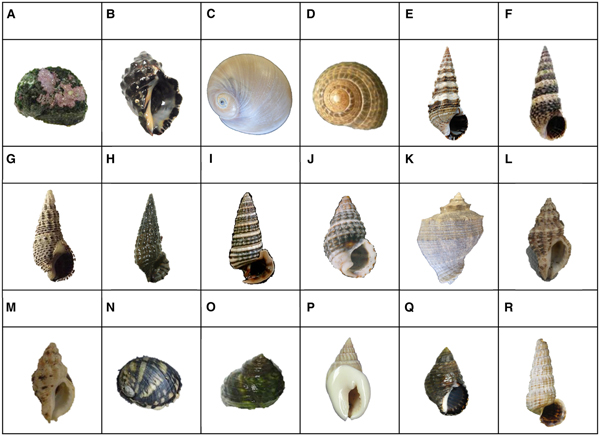
In this study, we (1) investigated the shell use pattern in both sexes of the hermit crab P. minutus and (2) examined whether the pattern of shell use differs between the non-reproductive and reproductive seasons. In our study area, at Nunohiki in the Waka River estuary in Japan (34°17′N 135°18′E), most P. minutus individuals use Batillaria spp. (high-spired, cone-like shape; Figure 1E–I) or Umbonium moniliferum (low-spired; Figure 1D) shells (~40% each; Yoshino et al., Reference Yoshino, Koga, Taniguchi and Tasaka2014), so we mainly focus on these two types of shell. During the reproductive season, a Pagurus male grasps the aperture of the gastropod shell occupied by a sexually mature female for several days until the female spawns (i.e. mate guarding; Imafuku, Reference Imafuku1986; Goshima et al., Reference Goshima, Kawashima and Wada1998). Because both sexes in the precopulatory guarding pair are reproductively active, we also (3) assessed the shell use of these crabs and (4) compared shell use patterns between solitary crabs and guarding pairs. Finally, we (5) examined the relationship between occupied shell type and number of newly spawned eggs.
Eighteen shell species occupied by the hermit crab Pagurus minutus: (A) Lunella coreensis, 25 mm SW (shell width); (B) Reishia clavigera, 30 mm SL (shell length); (C) Glossaulax didyma, 50 mm SL; (D) Umbonium moniliferum, 20 mm SW; (E) Batillaria zonalis, 40 mm SL; (F) Batillaria attramentaria, 30 mm SL; (G) Batillaria multiformis, 35 mm SL; (H) Cerithium coralium, 30 mm SL; (I) Pirenella nipponica, 30 mm SL; (J) Nassarius festivus, 15–20 mm SL; (K) Rapana venosa, 100 mm SL; (L) Bedeva birileffi, 25 mm SL; (M) Ergalatax contractus, 25–30 mm SL; (N) Nerita japonica, 15 mm SL; (O) Littorina brevicula, 15 mm SL; (P) Nassarius bellulus, 10 mm SL; (Q) Planaxis sulcatus, 25 mm SL; (R) Cerithidea moerchii, 40 mm SL. The size of each species is cited from Okutani (Reference Okutani2017).

Materials and methods
Field collection
Each month from May 2014 to April 2015 (except November 2014) we collected solitary Pagurus minutus from the sand flat at Nunohiki in the Waka River estuary, Wakayama, Japan (34°17′N 135°18′E). The sampling site has a sandy substrate with some algae and boulders or sea bank (Yasuda et al., Reference Yasuda, Otoda, Nakano, Takiya and Koga2007). Although fresh water seeps out from the adjacent land area (Koga & Fukuda, Reference Koga and Fukuda2008), salinity is considered to be relatively stable because the site is close to the open sea (Yoshino et al., Reference Yoshino, Koga, Taniguchi and Tasaka2014). We randomly cast a sieve (33 cm in diameter) on the ground several times. The sieve covered the ground with its mesh on the upper side, so hermit crabs were prevented from escaping through the mesh. After each cast, we collected all the solitary P. minutus found within. Few empty shells were found, and other animals such as living shells and other species of hermit crabs inside the frame were returned to the field. In a previous study at our site, only one or two empty shells were found even when more than 100 hermit crabs were collected (T. Koga, unpublished data).
In the laboratory, we identified the species of gastropod shell occupied and carefully cracked each crab's shell by using a large stationary vice. Each individual was then sexed under a dissecting microscope from the position of the gonopores (Yasuda et al., Reference Yasuda, Otoda, Nakano, Takiya and Koga2017). We then measured the shield length (SL, calcified anterior portion of the cephalothorax) of all crabs as an index of body size to the nearest 0.1 mm by using a digital calliper (for details of methodology of field collection and measurements, see Yasuda et al., Reference Yasuda, Otoda, Nakano, Takiya and Koga2017).
We also collected precopulatory guarding pairs of P. minutus from the same sampling site from December 2014 to April 2015; the species’ reproductive season at this site is November to April (Yasuda et al., Reference Yasuda, Otoda, Nakano, Takiya and Koga2017), but the data from November 2014 were unavailable. In the laboratory, each pair was placed into a small plastic container (13 × 8 × 8 cm) with natural seawater 2.5 cm deep and maintained until the female spawned. Shell species were then recorded. Next, we carefully cracked each shell and measured the SL of both sexes and counted the number of newly spawned eggs.
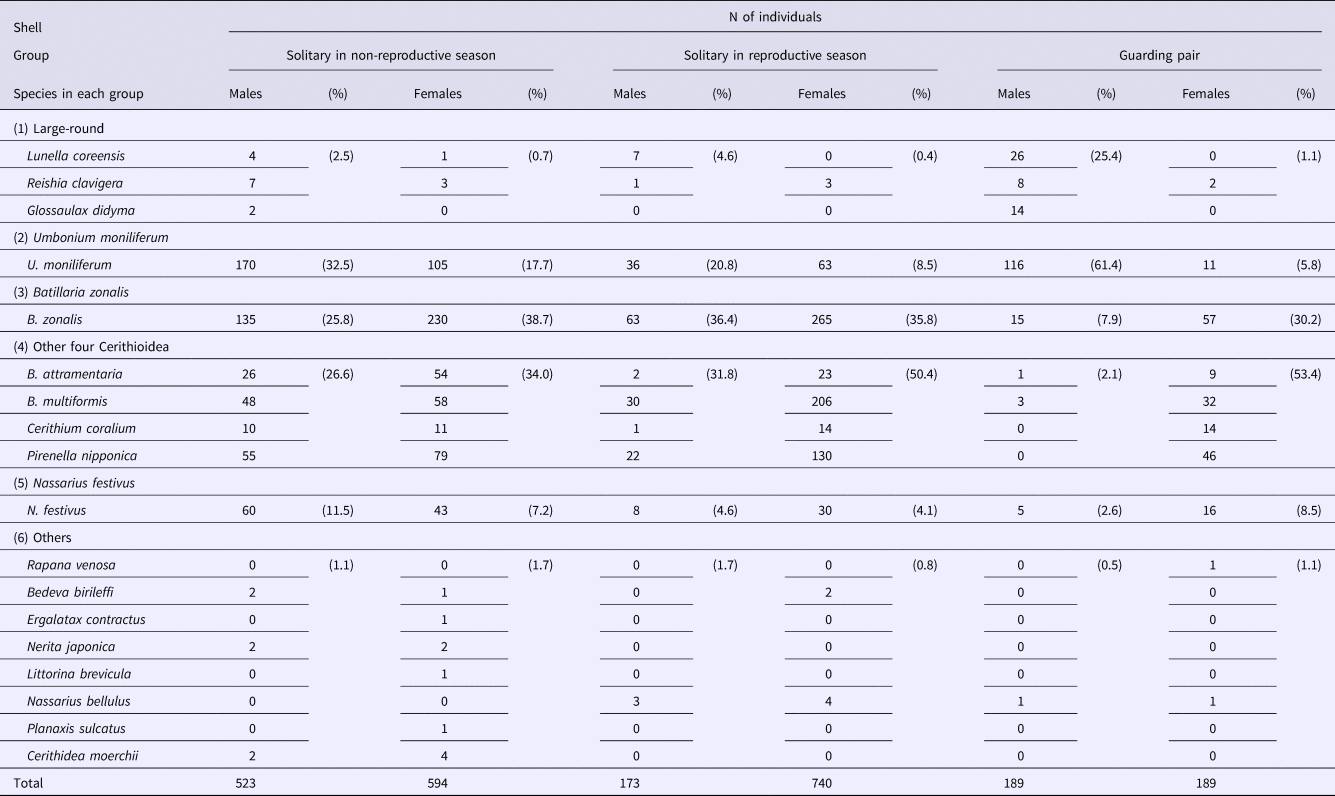
Because there was a considerable difference in the number of crabs that occupied a given shell species, to assess the overall trends of shell use pattern, we categorized the 18 collected shell species (Figure 1) into the following six groups based on the number of crabs that occupied them (i.e. those with fewer than 10 crabs classified as ‘other’; Table 1), taxonomy and general shape (i.e. relatively round, spiral, cone-like spiral): (1) large-round (i.e. Lunella coreensis, Reishia clavigera, Glossaulax didyma); (2) Umbonium moniliferum; (3) Batillaria zonalis; (4) four other Cerithioidea (i.e. Batillaria attramentaria, Batillaria multiformis, Cerithium coralium, Pirenella nipponica); (5) Nassarius festivus; and (6) others (i.e. Rapana venosa, Bedeva birileffi, Ergalatax contractus, Nerita japonica, Littorina brevicula, Nassarius bellulus, Planaxis sulcatus, Cerithidea moerchii). Based on the shell shape criteria, (1) and (2) are relatively round, (3) and (4) are cone-like spiral, and (5) is spiral, respectively. Some of the data used in this study were published by Yasuda et al. (Reference Yasuda, Otoda, Nakano, Takiya and Koga2017) and Nakano et al. (Reference Nakano, Yasuda and Koga2016); Yasuda et al. (Reference Yasuda, Otoda, Nakano, Takiya and Koga2017) focused on the seasonal differences in sexual size dimorphism in the major cheliped, and Nakano et al. (Reference Nakano, Yasuda and Koga2016) reported the temporal changes in the egg characteristics during a single reproductive season. Neither study described the shell use pattern of P. minutus.
Use pattern of six shell groups in solitary and guarding pairs of the hermit crab Pagurus minutus.

Eighteen shell species were categorized into six groups based on the number of crabs occupying that type, taxonomy and general shape of each species. Percentages were calculated as the number of crabs in each shell group divided by the total number of crabs in each sex of a category (e.g. solitary males in non-reproductive season using large-round group: [(4 + 7 + 2)/523] × 100 = 2.5%).
Statistical analyses
To examine sexual differences in body size (SL) distribution in each shell group, we first used all data including solitary males (mean ± SD = 2.92 ± 0.70 mm, range = 1.3–5.4 mm, N = 696), solitary females (2.86 ± 0.53 mm, range = 1.2–5.0 mm, N = 1334), guarding males (3.56 ± 0.45 mm, range = 2.1–5.2 mm, N = 189) and guarded females (2.44 ± 0.35 mm, range = 1.6–3.5 mm, N = 189). Because our focus was the seasonal change in sexual differences of shell use, the data for solitary crabs were divided into the non-reproductive season (i.e. May to October; males, N = 523; females, N = 594) and the reproductive season (i.e. December to April; males, N = 173; females, N = 740). We therefore had 18 separate data sets based on the six shell groups and three situations in which crabs were collected (i.e. solitary crabs in the non-reproductive season, solitary crabs in the reproductive season, and guarding pairs). To compare the SL distribution between the sexes in each shell group, the 18 data sets were separately analysed by using the Kolmogorov–Smirnov test. This analysis was applied again to data for solitary males or females to compare the SL distributions between seasons in each sex using a given shell group.
As reported by Yoshino et al. (Reference Yoshino, Koga, Taniguchi and Tasaka2014), most (~90%) of the P. minutus used either Batillaria-type shells (i.e. B. zonalis and the other four Cerithioidea) or round-type shells (i.e. U. moniliferum or large-round group). We therefore examined whether and how males and females differed in their use of these shell types. To do this, we constructed a generalized linear model (GLM) with a binomial error distribution and used a model selection approach based on the Akaike information criterion (AIC). We compared AIC values among all possible models, and the model with the lowest AIC was considered the most parsimonious (Akaike, Reference Akaike1983). For the analysis of Batillaria-type shell use by solitary crabs, the response variable was whether a solitary crab used this type or not (Yes = 1, No = 0). The explanatory variables in the model were (1) season (reproductive = 1, non-reproductive = 0), (2) sex (male = 1, female = 0), (3) SL, and interactions between (4) season and sex, (5) season and SL, (6) sex and SL, and (7) season and sex and SL. For the analysis of round-type shell use, the response variable was whether a crab used this type or not (Yes = 1, No = 0), and the explanatory variables were the same used for Batillaria-type shell analysis (i.e. (1)–(7)). Similarly, to examine the effects of guarding status on shell use, we analysed data of guarding pairs and solitary crabs in the reproductive season. The models in this analysis were similar to those described above, but instead of (1) season, (1) guarding status (guarding pair = 1, solitary = 0) was treated as an explanatory variable. Thus, the explanatory variables were (1) guarding status, (2) sex, (3) SL, (4) guarding status × sex, (5) guarding status × SL, (6) sex × SL, and (7) guarding status × sex × SL.
Finally, because more than 80% of guarded females used Batillaria-type shells (N = 158 vs N = 31; for details see Table 1), we examined the advantage of this shell type for clutch size by using a GLM with a normal error distribution. The response variable was the number of eggs spawned by each female, and the explanatory variables were shell type (Batillaria-type = 1, other = 0) and SL. The interaction between shell type and SL was excluded from the model because it was not significant (P = 0.262). All statistical analyses were performed with R version 3.2.3 (R Core Team, 2015).
Results
General trend
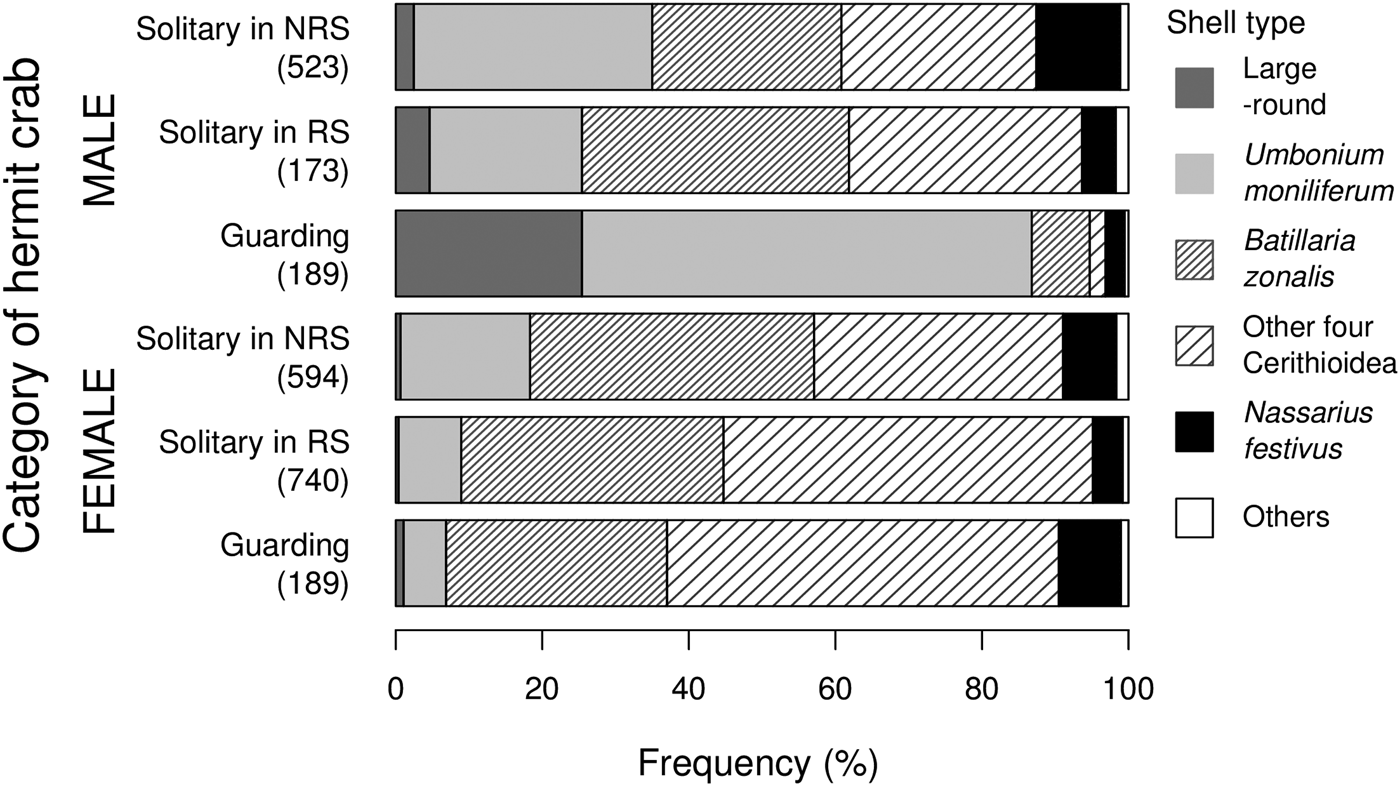
Table 1 lists the shells used by the Pagurus minutus collected in this study. Males tended to use round-type shells (i.e. Umbonium moniliferum or large-round group) more than females, whereas females used Batillaria-type shells (i.e. B. zonalis or the other four Cerithioidea) more than males (Figure 2), although a few solitary crabs used the large-round group (Table 1). Guarding males showed a unique pattern of shell use; whereas >50% of solitary crabs or guarded females used Batillaria-type shells, >80% of guarding males used round-type shells, especially those of Lunella coreensis and Glossaulax didyma.
Shell use pattern in both sexes of the hermit crab Pagurus minutus. Eighteen shell species were classified into six shell groups (see text and Table 1). Both males and females were collected as solitary crabs in the non-reproductive season (NRS) and reproductive season (RS) or as precopulatory guarding pairs (Guarding) in the reproductive season. Numbers in parentheses indicate sample size.

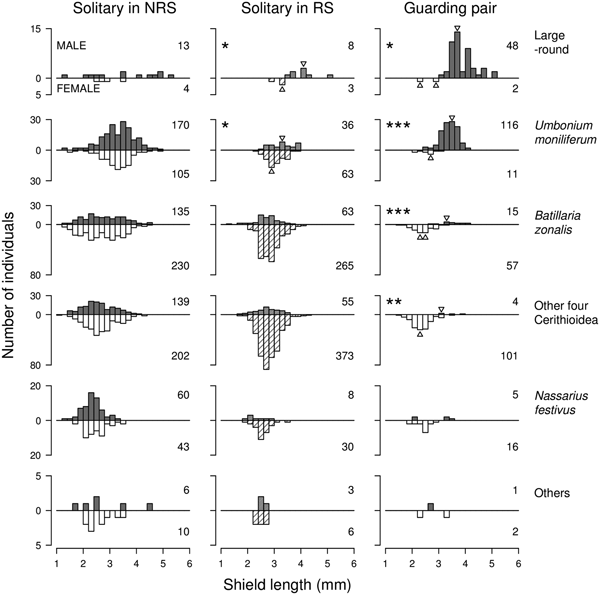
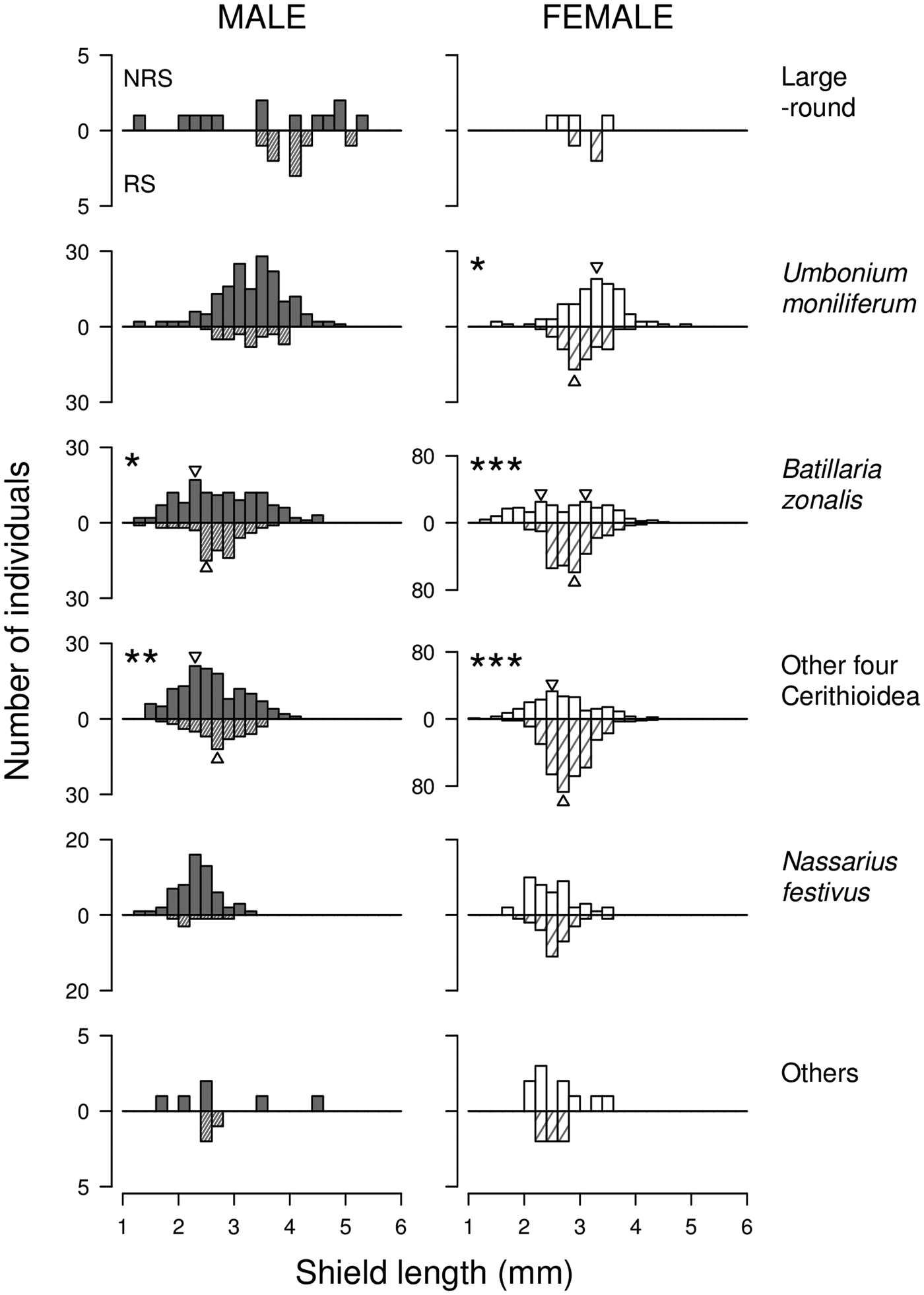
We examined sexual differences in the body size (SL) distribution for each shell group separately. For solitary crabs in the non-reproductive season, no significant difference was found between the sexes in any shell group (Kolmogorov–Smirnov test, all D < 0.54, P > 0.30). In the reproductive season, however, significant differences were found in the large-round group and U. moniliferum (D > 0.31, P < 0.03), but not in the others (D < 0.46, P > 0.14). In both groups, the modes of male body size were larger than those of females (Figure 3). For guarding pairs, significant differences in SL distribution between the sexes were found in the large-round group, U. moniliferum, B. zonalis, and the other four Cerithioidea (D > 0.82, P < 0.04), with larger modes in males than females (Figure 3). No such differences were found in the others (D < 0.6, P > 0.13).
Body size distributions of both sexes in the hermit crab Pagurus minutus (upper: male, lower: female). Eighteen shell species were classified into six shell groups (see text and Table 1). Both males and females were collected as solitary crabs in the non-reproductive season (NRS) and reproductive season (RS) or as precopulatory guarding pairs (Guarding) in the reproductive season. Numbers in each graph indicate sample size. Significant differences between the sexes are shown by asterisks (Kolmogorov–Smirnov test: *P < 0.05; **P < 0.01; ***P < 0.001), and open triangles indicate the mode of size in both sexes when the difference was significant.

We then compared the SL distribution of solitary crabs between the non-reproductive and reproductive seasons for each sex separately. Shield length distributions of B. zonalis and the other four Cerithioidea were significantly different between seasons in both sexes (Kolmogorov–Smirnov test, all D > 0.22, P < 0.03), with larger modes of body size in the reproductive season than those in the non-reproductive season (Figure 4). In females, moreover, a difference of SL distribution was also significant for U. moniliferum (D = 0.29, P = 0.003), but the size mode in the reproductive season was smaller than that in the non-reproductive season (Figure 4). Shield lengths in other shell groups did not differ significantly between seasons in either sex (D < 0.5, P > 0.24).
Body size distributions of male and female solitary hermit crabs, Pagurus minutus (upper: non-reproductive season, NRS; lower: reproductive season, RS). Eighteen shell species were classified into six shell groups (see text and Table 1). Significant differences between sexes are shown by asterisks (Kolmogorov–Smirnov test: *P < 0.05; **P < 0.01; ***P < 0.001), and open triangles indicate the mode of size in both seasons when the difference was significant.

Use pattern of Batillaria- or round-type shells
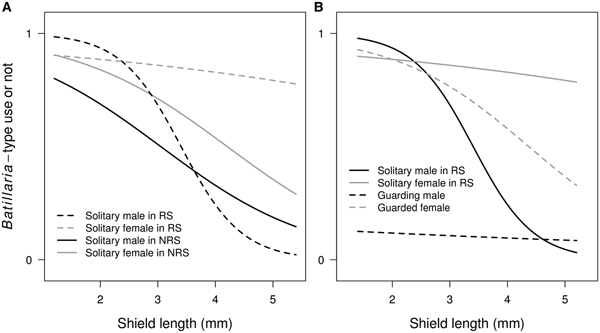
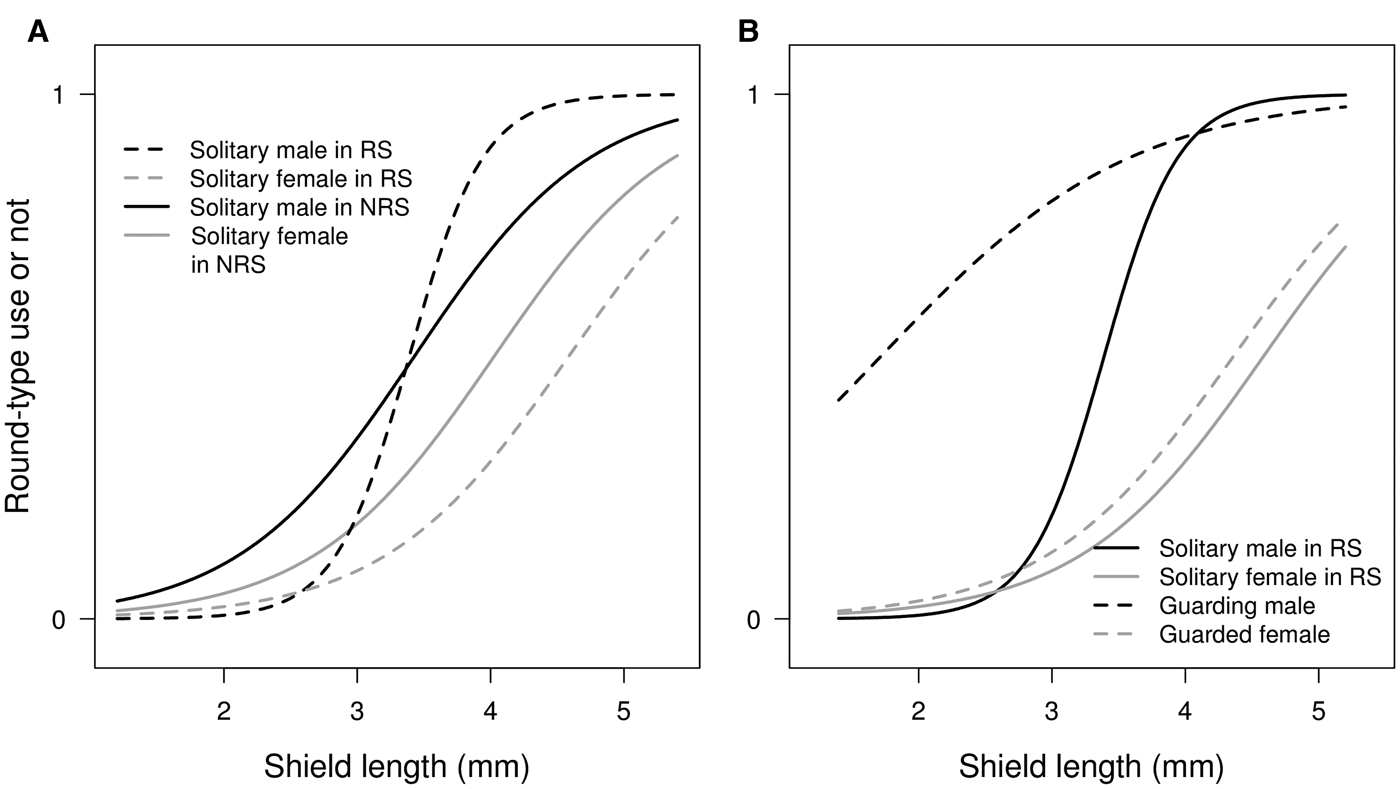
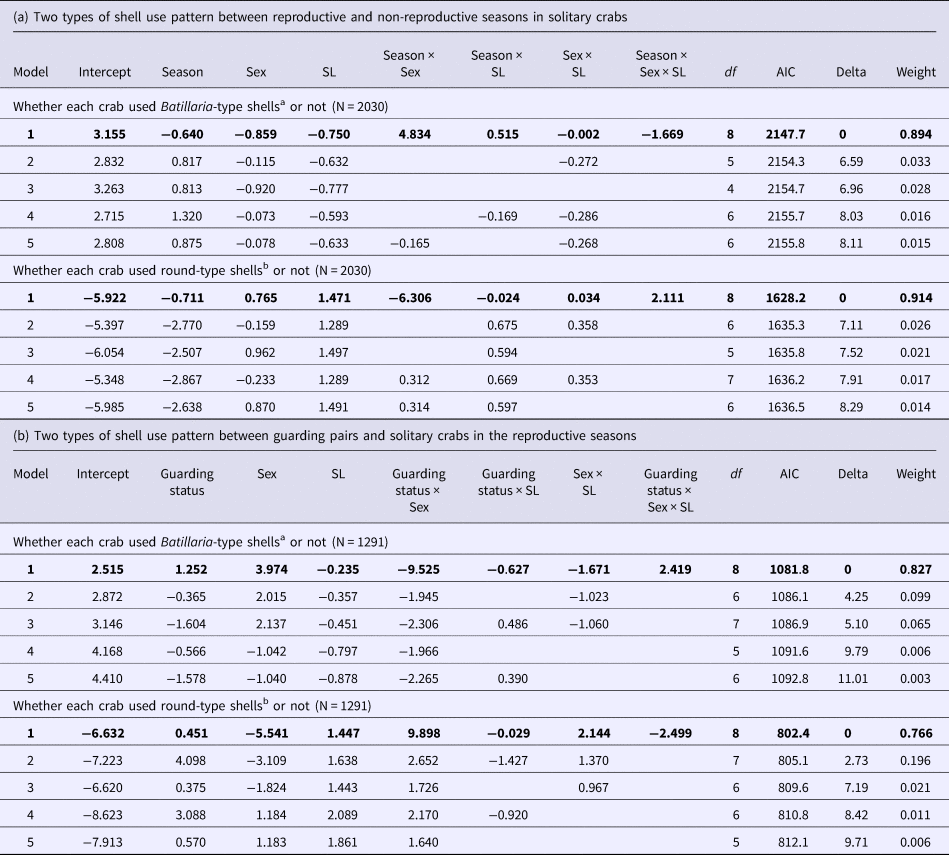
Details of Batillaria- or round-type shell use in P. minutus was investigated by model selection approaches. The results of the top five models in each analysis are shown in Table 2, and the full model was selected in all the analyses (Table 2a, b). However, the general pattern of shell use was opposite between the two types. The probability of Batillaria-type shell use was higher in females or smaller individuals than in males or larger ones (Figure 5A, B), whereas males or larger individuals were more likely to use round-type shells (Figure 6A, B).
Logistic regressions for whether each Pagurus minutus used Batillaria-type shells or not (Batillaria-type shells: B. zonalis and the other four Cerithioidea). Shell use patterns were compared between sexes and (A) seasons in solitary crabs, i.e. non-reproductive season (NRS) vs reproductive season (RS), or (B) guarding status, i.e. solitary in NRS vs guarding pairs. The curves were estimated by using the best models of a GLM with a binomial error distribution (Table 2a, b). Values of 0 and 1 indicate crabs occupied Batillaria-type shells or not, respectively. Shield length served as an index of body size.

Logistic regressions for whether each Pagurus minutus used round-type shells or not (round-type: Umbonium moniliferum and large-round group). Shell use patterns were compared between sexes and (A) seasons in solitary crabs, i.e. non-reproductive season (NRS) vs reproductive season (RS), or (B) guarding status, i.e. solitary in NRS vs guarding pairs. The curves were estimated by using the best models of a GLM with a binomial error distribution (Table 2a, b). Values of 0 and 1 indicate crabs occupied round-type shells or not, respectively. Shield length served as an index of body size.

Results of top five models selected based on the Akaike information criterion (AIC) analysed by a generalized linear model (GLM) with a binomial error distribution.

SL, shield length as an index of body size.
a Batillaria-type shells: B. zonalis and the other four Cerithioidea.
b Round-type shell: Umbonium moniliferum and large-round group.
In the analyses of solitary crabs, the three-way interaction of season × sex × SL was selected in both models (Table 2a), indicating that the use patterns of both shell types differed between the sexes and these trends changed seasonally (Figures 5A & 6A). Males and females showed a similar relationship between SL and shell use in the non-reproductive season, but in the reproductive season the relationship clearly differed between the sexes, especially in larger individuals. In the reproductive season, the probability of males using Batillaria-type shells sharply decreased with increasing SL, but most females occupied these shells regardless of body size (Figure 5A). For round-type shells, the probability of male use sharply increased with SL, and ~70% of males used this type in the 3.6–3.8 mm SL range (Figure 6A), which is the mode of guarding males in P. minutus (Yasuda et al., Reference Yasuda, Otoda, Nakano, Takiya and Koga2017). The round-type shell use pattern of females in the reproductive season was similar to that in the non-reproductive season, but the frequency was lower (Figure 6A).
Similarly, in the comparisons between solitary crabs in the reproductive season and guarding pairs, guarding status × sex × SL was selected in both models (Table 2b). Shell use patterns obviously differed between solitary and guarding individuals, especially in males (Figures 5B & 6B). Shell use in guarding males was characterized by a much lower frequency for Batillaria-type (Figure 5B) and a higher frequency for round-type (Figure 6B), regardless of body size. Guarded females showed a shell use pattern similar to that of solitary females. Although the slope of the curve describing Batillaria-type use in guarded females was estimated to be more negative than that of solitary females (Figure 5B), because most guarded females and solitary females occupied Batillaria-type shells (Table 1, Figure 2), this may have resulted from the effect of guarding status (Table 2b), which is mainly determined by guarding males.
The effects of shell type on clutch size
Clutch size in guarded females of P. minutus significantly increased with body size (SL), but it did not differ between Batillaria-type and other shell types (GLM; SL, t = 9.350, P < 0.001; shell type, t = 0.343, P = 0.732).
Discussion
Males and females often differ in resource use, and we examined how the sexual difference in shell use changed seasonally in the hermit crab Pagurus minutus. Although hermit crab shell use is generally expected to be determined by crab size and shell availability (Hazlett, Reference Hazlett1981), in this species, males generally used round-type shells (i.e. large-round group and Umbonium moniliferum), whereas most females occupied Batillaria-type shells (i.e. B. zonalis and the other four Cerithioidea). Sexual differences in shell use are affected by sexual size dimorphism and/or sex-specific shell species preference within a species (Imazu & Asakura, Reference Imazu and Asakura1994; Garcia & Mantelatto, Reference Garcia and Mantelatto2001). In our study, however, because we observed sexual differences in shell use even when body size was considered as an explanatory variable, sex-specific preferences might explain this pattern. The finding that sexual dimorphism in body size of this species is weak, especially during the non-reproductive season (Yasuda et al., Reference Yasuda, Otoda, Nakano, Takiya and Koga2017), may also support this possibility. In addition, our results demonstrated that, although the general trends (i.e. males used round-type shells whereas females used Batillaria-type shells) were observed regardless of season, these were more evident in the reproductive season than in the non-reproductive season (especially in larger crabs). Shell use pattern in this species may therefore be explained by selection to improve reproduction rather than just growth, and we now consider this seasonal change while focusing on the effects of each shell type on and the investment between the sexes in growth and reproduction.
In the non-reproductive season, the sexual difference in shell use pattern was relatively small, but larger crabs were more likely to use round-type shells and smaller crabs were more likely to use Batillaria-type shells. The non-reproductive season in P. minutus at our study site spans late spring to autumn, and hermit crabs often have a higher growth (i.e. moulting) rate during warmer periods of the year (Wada, Reference Wada2000). If P. minutus also follows this pattern, both sexes would invest in growth during this season, which would be reflected in shell use. Although shell size is an important constraint on hermit crab growth (Fotheringham, Reference Fotheringham1976), given that the shell use pattern was predicted by body size in this season, both sexes may use shells best suited for growth based on their own size. These findings also suggest that there is little intersexual conflict for shell use in the non-reproductive season.
In the reproductive season, however, males and females clearly differed in shell use pattern with body size. In males, the probability of Batillaria-type shell use sharply decreased, while that of round-type shells increased with their increasing size. The monopolization of round-type shells was observed in guarding males. Because hermit crab size is usually well correlated with shell size (Hazlett, Reference Hazlett1981) and guarding males are in the largest size class in P. minutus (Yasuda et al., Reference Yasuda, Otoda, Nakano, Takiya and Koga2017), the simplest explanation of this result is crab size. However, given that some Pagurus males can moult and grow even in winter (e.g. P. middendorffii; Yasuda & Wada, Reference Yasuda and Wada2015) or in the reproductive season (e.g. P. filholi; Matsuo et al., Reference Matsuo, Tanikawa, Yasuda and Wada2015), and larger P. minutus males are more likely to win in male–male contests (Yasuda & Koga, Reference Yasuda and Koga2016), as seen in other species (Wada et al., Reference Wada, Tanaka and Goshima1999; Okamura & Goshima, Reference Okamura and Goshima2010; Yasuda et al., Reference Yasuda, Suzuki and Wada2011; Tanikawa et al., Reference Tanikawa, Yasuda, Suzuki and Wada2012), investing in growth for greater mating success might still affect male shell use in the reproductive season. This possibility is also supported by studies showing that some hermit crabs have a growth advantage in round-type shells over those in high-spired shells (e.g. Blackstone, Reference Blackstone1985; Yoshino et al., Reference Yoshino, Goshima and Nakao2001). Thus, occupying a round-type shell is expected to be beneficial for further growth as well as immediate reproductive success.
In contrast, during the reproductive season, females were highly dependent on Batillaria-type shells regardless of size or guarded status. Reproductive success in female hermit crabs is often affected by shell characteristics (Hazlett, Reference Hazlett1981; Elwood et al., Reference Elwood, Marks and Dick1995), and females using the shells of Batillaria spp. have greater egg numbers (e.g. P. filholi, Yoshino & Goshima, Reference Yoshino and Goshima2001; Diogenes nitidimanus, T. Koga unpublished data). However, we found no evidence of a clutch size advantage with Batillaria-type shell use in P. minutus. Thus, although P. minutus females relied on these shells in the reproductive season more so than in the non-reproductive season, the reasons appear to be other than maximizing the number of eggs. If Batillaria-type shells provide benefits such as improved protection from predatory crabs (Siu & Lee, Reference Siu and Lee1992; Mima et al., Reference Mima, Wada and Goshima2003) or success of egg survival related to internal space, females may prefer Batillaria-type shells in this season. One of the other possibilities is that intersexual shell fights (Yoshino & Goshima, Reference Yoshino and Goshima2001; Briffa & Dallaway, Reference Briffa and Dallaway2007) occur for U. moniliferum and females compromise as a result of the fights.
We have no quantitative data on shell availability at our study site, but the empty shell supply is typically limited in the field (Hazlett, Reference Hazlett1981), including at this site (T. Koga, unpublished data). Hermit crabs therefore often directly compete with one another for gastropod shells (i.e. shell fight; Elwood & Neil, Reference Elwood and Neil1992; Elwood et al., Reference Elwood, Pothanikat and Briffa2006). In the intersexual competitions, females often become subordinate to males because of poorer competitive ability (Asakura, Reference Asakura1995; Briffa & Dallaway, Reference Briffa and Dallaway2007), as seen in other taxa (e.g. Figler et al., Reference Figler, Blank and Peeke2005). In P. filholi, for example, a male intruder more easily succeeded in shell exchange with a female occupant than with a male occupant (Yoshino & Goshima, Reference Yoshino and Goshima2002). In addition, major cheliped size also affects the outcomes of shell fights (Neil, Reference Neil1985). Pagurus minutus shows clear sexual dimorphism of this trait, with males possessing larger major chelipeds than females regardless of the reproductive schedule, while body size dimorphism is sometimes weak (Yasuda et al., Reference Yasuda, Otoda, Nakano, Takiya and Koga2017). In this study, U. moniliferum use clearly differed between the sexes in the reproductive season: fewer and smaller females occupied them, whereas similar sized males used them with a higher frequency. Taken together, these results indicate that if a female owner of a U. moniliferum shell were challenged by a male intruder in a Batillaria shell, a shell fight would likely result in the male occupying the U. moniliferum shell and the female using the Batillaria shell, partly because of the sexual dimorphism of major cheliped size. Female shell use therefore may also represent a compromise due to intersexual competition driven by males if empty shell species availability does not change seasonally.
Female shell use pattern in the reproductive season may not be suitable for increasing growth. Wada et al. (Reference Wada, Ito and Mima2007) showed that some P. minutus females moult just before copulation. The adaptive significance of this prenuptial moulting may be growth for future reproduction (Wada et al., Reference Wada, Ito and Mima2007) because clutch size in this species increases with female body size (Wada et al., Reference Wada, Ito and Mima2007; Nakano et al., Reference Nakano, Yasuda and Koga2016) as a general trend (Andersson, Reference Andersson1994). These findings strongly suggest that, like males, females are also advantaged by growth during this season, but the high-spired shells they are able to obtain, such as those of Batillaria spp., are not effective for increasing growth (Yoshino & Goshima, Reference Yoshino and Goshima2001).
In summary, the shell use pattern in P. minutus differed between the sexes and changed seasonally, likely driven by an interest in growth or reproduction. Although a higher reproductive success in both sexes of this species is related to growth, males selectively occupy round-type shells more so than females, who must compromise due to subordination in shell fights and use Batillaria-type shells. In addition to assessing shell availability in the field, future research should include shell selection experiments, staged intersexual shell fights, analyses of how growth pattern is related to shell type, and analyses of how these responses change seasonally, in order to clarify these issues in P. minutus.
Acknowledgements
We are grateful to the two referees for their extensive comments and contributions, which helped to improve the manuscript.
Financial support
This study was supported by a Japan Society for the Promotion of Science Research Fellowship KAKENHI Grant-in-Aid for Young Scientists (B) (grant no. 17K15188) to CIY and JSPS KAKENHI grant no. JP18K06416 to TK.