Introduction
The search for entomopathogenic nematodes (EPNs) has resulted in numerous surveys all over the world in order to acquire a new resource for biological control of insect pests and disease vectors. Several decades of applied research and hundreds of surveys have revealed that EPNs are ubiquitous, as they have been found in a wide range of ecologically diverse soil habitats, including cultivated fields, woodlands, grasslands, deserts and even ocean beaches, on every continent except Antarctica (Griffin et al., Reference Griffin, Downes and Block1990; Hominick, Reference Hominick and Gaugler2002). Genetic and phenotypic analyses of isolates from around the world have shown that their distribution is associated with great biological diversity. The genetic diversity and biological properties of the nematode–bacterium complexes, together with their geographical distribution (Hominick et al., Reference Hominick, Reid, Bohan and Briscoe1996), constitute an interesting biological resource which deserves to be better known and exploited. For this reason, studies of their biodiversity are important. Although the surveys conducted so far have provided valuable data on the distribution and occurrence of EPNs around the world (Hominick, Reference Hominick and Gaugler2002, with bibliographic key references up to 2002, plus a selective group of more recent references: Hazir et al., Reference Hazir, Keskin, Stock, Kaya and Özcan2003; Rolston et al., Reference Rolston, Griffin and Downes2005; Tarasco & Triggiani, Reference Tarasco, Triggiani, Lieutier and Ghaioule2005; Canhilal et al., Reference Canhilal, Reid, Kutuk and El-Bouhssini2006; Mauléon et al., Reference Mauléon, Denon and Briand2006; Stock & Gress, Reference Stock and Gress2006; Lòpez-Nuñez et al., Reference Lòpez-Nuñez, Cano, Góngora-B and Stock2007; Maru et al., Reference Maru, Siddiqui, Parihar and Sharma2007; Simard et al., Reference Simard, Belair, Stock, Mauléon and Dionne2007; Dolinski et al., Reference Dolinski, Kamitani, Machado and Winter2008; Emelianoff et al., Reference Emelianoff, Le Brun, Pagès, Stock, Tailliez, Moulia and Sicard2008; Stock et al., Reference Stock, Al Banna, Darwish and Katbeh2008; Eivazian et al., Reference Eivazian, Niknam, Griffin, Mohammadi and Moghaddam2009; Hatting et al., Reference Hatting, Stock and Hazir2009; Kary et al., Reference Kary, Niknam, Griffin, Abolgasem and Moghaddam2009; Ma et al., Reference Ma, Chen, Zou, Li, Han, De Clercq and Moens2010; Nikdel et al., Reference Nikdel, Niknam, Griffin and Kary2010; Salame et al., Reference Salame, Glazer and Miqaia2010; Noujeim et al., Reference Noujeim, Khater, Pages, Ogier, Tailliez, Hamzé and Thaler2011; Zamoum et al., Reference Zamoum, Berchiche, Sai, Triggiani and Tarasco2011; Almanoufi et al., Reference Almanoufi, Jamal, De Lillo, Tarasco and Yaseen2012; Seenivasan et al., Reference Seenivasan, Prabhu, Makesh and Sivakumar2012), their habitat preferences are not adequately known. The first survey on the biodiversity of EPNs in Italy was carried out in 1988 in the Emilia-Romagna region (Deseö et al., Reference Deseö, Fantoni and Lazzari1988). Further studies on the occurrence, distribution and systematics of EPNs have been carried out over the past two decades by the institutions where the present authors work, and these have provided partial information on the species and distribution of EPNs in some parts of Italy (Tarasco & Triggiani, Reference Tarasco and Triggiani1997, Reference Tarasco, Triggiani, Lieutier and Ghaioule2005, Reference Tarasco and Triggiani2007; Triggiani & Tarasco, Reference Triggiani and Tarasco1998, Reference Triggiani and Tarasco2000, Reference Triggiani and Tarasco2002; Triggiani et al., Reference Triggiani, Mráček and Reid2004; Clausi & Vinciguerra, Reference Clausi and Vinciguerra2005, Reference Clausi and Vinciguerra2007; Rappazzo et al., Reference Rappazzo, Clausi and Vinciguerra2005, Reference Rappazzo, Avanzato, Petronio, Clausi, Tarasco, Buccheri, Furneri, Scuderi and Vinciguerra2011; Vinciguerra & Clausi, Reference Vinciguerra and Clausi2006; Susurluk et al., Reference Susurluk, Tarasco, Triggiani and Ehlers2007; Tarasco et al., Reference Tarasco, Mráček, Nguyen and Triggiani2008, Reference Tarasco, Clausi, Rappazzo, Vinciguerra, Longo and Triggiani2009; Clausi et al., Reference Clausi, Longo, Rappazzo, Tarasco and Vinciguerra2011).
The present paper is partly based on the elaboration of the data contained in the cited papers, but mostly relies on new unpublished data. This paper aims to give more precise information on the occurrence and distribution of EPNs in Italy, using an ecological approach which takes into account their different habitats. We have extended the survey to other regions and different areas, in order to construct a clearer and more comprehensive map of EPN biodiversity in Italy, to assess the habitat preferences of the different EPN species and to compare the EPN community structures of the different habitats.
Materials and methods
Collection and morphometrics of nematodes
Surveys were conducted mostly during the humid season, from November to June, in nine Italian regions (Apulia, Basilicata, Calabria, Campania, Emilia-Romagna, Molise, Sardinia, Sicily with Aeolian islands, Pantelleria island and Tuscany), and a total of 2039 samples from 580 sites were collected over a period of 20 years (1990–2010). In order to sample ecologically different habitats, several samples were taken in natural and cultivated ecosystems, at altitudes ranging from 0 to 2000 m above sea level (asl) and from 11 different habitats, namely uncultivated land (wild vegetation, shrubland, tamarisk), orchard (olive, almond, vineyard, several kinds of fruit plants), field (several kinds of crops), sea coast (sandy beach, gravelly beach, sand dunes), pinewood (Pinus pinea, P. halepensis, P. nigra, P. sylvestris, P. pinaster), broadleaf wood (oak, chestnut, mulberry, walnut, hazelnut), grassland (meadows, pastures, irrigated gardens, herbs, turfgrass), river and lake borders (riparian vegetation), cave (caverns, quarries), salt-pan borders and wetland (swamp, lagoons, canebrake). These different habitats have been identified based on ecological similarities of the different sampling sites. Within each site, soil samples of approximately 2 kg each were collected using a hand shovel. They were obtained by pooling 3–5 subsamples taken at depths of c. 20 cm from an area of 50 m2. The soil was transported in sterile polythene bags to the laboratory and 5–6 Galleria mellonella L. (Lepidoptera, Pyralidae) larvae were inserted in a long-handled tea infuser in the middle of each sample (Tarasco & Triggiani, Reference Tarasco and Triggiani1997). Then the samples were incubated at 25°C for 7–10 days and the larvae checked for mortality. Infected wax moth larvae from each sample were placed individually in modified White traps (Kaya & Stock, Reference Kaya, Stock and Lacey1997) and held at 23 ± 2°C to allow the emergence of the infective juveniles (IJs). Emerging nematodes were pooled for each sample and used to infect fresh G. mellonella larvae for establishment of cultures, and to produce nematodes (IJs and males) used for identification. For each sampling location, the soil texture, altitude, time and type of vegetation or habitat were recorded. Infective juveniles that emerged from Galleria cadavers were collected from the water suspension and, after filtration and settling, established as a laboratory culture in glass tubes filled with wet polyurethane sponges; IJs were stored at 8°C (Steinernema) and 12°C (Heterorhabditis).
Nematode isolates were identified using morphological and morphometric characters based on Poinar (Reference Poinar1979, Reference Poinar, Gaugler and Kaya1990), Nguyen & Smart (Reference Nguyen and Smart1996), Adams & Nguyen (Reference Adams, Nguyen and Gaugler2002) and Nguyen & Hunt (Reference Nguyen and Hunt2007) for IJs and adults extracted directly from the cadavers. Morphometric characters were studied on 10 males and 30 IJs for each strain. Temporary mounts of these specimens were made by heat killing IJs and adult nematodes on glass slides in a drop of water, and then a cover glass was applied for observation. Permanent mounts of holotype and paratype third-stage infective juveniles and paratype adults were made by fixing them in hot triethanol-amine-formalin (TAF) (Courtney et al., Reference Courtney, Polley and Miller1955), transferring them to glycerine by a slow evaporation method and mounting them in anhydrous glycerine on permanent mounts (Seinhorst, Reference Seinhorst1959). Measurements and morphological examinations were performed with a Dialux light microscope (Leitz, Wetzlar, Germany).
Molecular analysis
The sequence of the internal transcribed spacer 1 (ITS1) was determined for a large number of isolates as described in Clausi et al. (Reference Clausi, Longo, Rappazzo, Tarasco and Vinciguerra2011), with a unique modification consisting of the direct sequencing of the polymerase chain reaction (PCR) products on both strands. For a few isolates, the mitochondrial locus coding for the 12S ribosomal RNA gene was also sequenced. The consensus sequences obtained were deposited in GenBank.
Cross-breeding tests
The reproductive compatibilities of EPN strains were examined in a series of individual diallelic crosses with known species of Steinernema (Poinar, Reference Poinar1975), namely Steinernema feltiae (Filipjev, 1934) Wouts, Mráček, Gerdin & Bedding, 1982, isolate UK76; Steinernema arenarium (Artyukhovsky, 1967) Wouts, Mracek, Gerdin & Bedding 1982 (Russian isolate); Steinernema affine (Bovien, 1937) Wouts, Mráček, Gerdin & Bedding, 1982 (Polish isolate); Steinernema litorale, Yoshida, 2004, isolate HkSf16; Steinernema kraussei (Steiner, 1923) Travassor, 1927 (Italian Alps isolate); Steinernema carpocapsae (Weiser, 1955), Wouts, Mráček, Gerdin & Bedding, 1982 (Polish isolate); and Steinernema oregonensis Liu and Berry, 1996, isolate OS21. This method uses a sterile drop of insect haemolymph seeded with surface-sterilized nematode juveniles. A haemolymph drop – obtained from a G. mellonella larva by cutting an abdominal proleg – was released on to a cover slip, which was inverted on a cavity microscope slide inside a Petri dish with moistened filter papers. Before immersion in the haemolymph drop, IJs were kept for 15–20 s in hyamine solution (0.1%), which was also used to sterilize the larval leg surface of G. mellonella before cutting. Two to four IJs were released in each haemolymph drop. The development of IJs was observed and checked continuously. Males and females were separated before mating, and crosses among different strains were performed using the same haemolymph drops in which the IJs developed. The strains belonging to the same species were also crossed with each other and the self-crossing treatments served as controls.
Data analysis
To characterize the structures of the EPN communities of the different habitats, we used the following standard parameters: species richness index (D, Margalef index), abundance of EPN strains, Shannon–Wiener diversity index (H′) and evenness index (J′, Pielou index). The relationships among standard parameters that describe the structure community were analysed using the Spearman correlation coefficient. We used the χ2 test to evaluate the differences among the habitats and the soil textures relative to the EPN strain assemblages.
Results
Identification of EPN isolates
A total of 133 out of 2039 samples (6.5%) were positive for EPNs. Molecular analysis was done in parallel with routine morphological determination for a large number of isolates by sequencing the rDNA ITS1 locus, which represents the most widely explored locus for EPNs, so that appropriate matches could be found when doing BLASTn database searches. In contrast, molecular data of mitochondrial loci were proportionally less informative. In most cases, the DNA sequences submitted showed some point variations compared with those already deposited; these changes were of little relevance at the species level, so they were considered to be polymorphic nucleotide variants. Polymorphic sites within ITS1, on the other hand, provide moderate-to-good discrimination among isolates of the same species (Longo, Reference Longo2008). Based on the molecular analysis, their morphological characters and cross-breeding tests, the EPN isolates recovered were identified as 12 species: 43 isolates of Heterorhabditis bacteriophora Poinar, 1976; 1 of H. downesi Stock, Griffin & Griffin et al., 1991; 1 of H. megidis Poinar, Jackson & Klein, 1987; 51 of Steinernema feltiae; 12 of S. affine; 4 of S. kraussei; 8 of S. apuliae Triggiani, Mráček & Reid, 2004; 5 of S. ichnusae Tarasco, Mrácek, Nguyen & Triggiani 2008; 3 of S. carpocapsae; 1 of S. vulcanicum, Clausi, Longo, Rappazzo, Tarasco & Vinciguerra, 2011; 3 of Steinernema ‘isolate S.sp.MY7’ of ‘S. intermedium group’ and 1 of S. arenarium (see supplementary table S1, available online).
EPN diversity and distribution
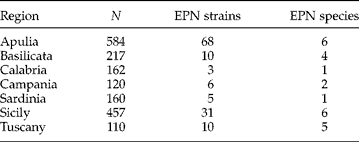
With regard to species distribution per region (table 1), no EPN strain was found in the samples collected in Emilia-Romagna and Molise, whereas the highest numbers of species were found in Sicily, Apulia and Tuscany.
The number of EPN species and strains found from soil samples in seven regions of Italy between 1990 and 2010; N=number of soil samples.

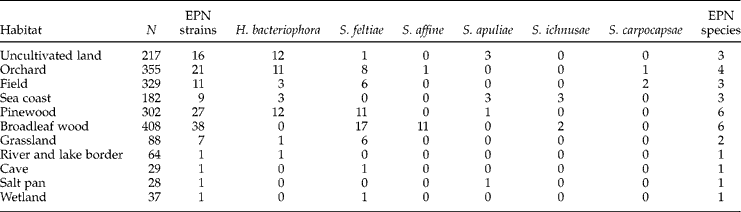
A complete list of the strains found, with the indication of the locality, habitat and soil texture for each of them and, when available, the accession number in GenBank, is given in supplementary table S1 in the online version of the present paper. The main data are summarized in table 2, which shows the number of samples taken in the 11 habitats and the number and percentage of EPN strains found in each of them. The relative presence of EPN strains found in the different habitats is given in table 3. The statistical analysis of these data, which takes into account the proportion between samples taken and strains found, showed that there were significant differences in the presence of the EPN strains among the different habitats (χ2= 20.74, df = 10, P< 0.05).
The number of EPN species and strains recovered from 11 differing habitats; N= number of soil samples. H. downesi, H. megidis and S. arenarium, were found only in pinewood and S. kraussei, S. MY7 and S. vulcanicum only in broadleaf woodland.

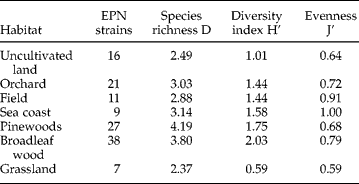
The number of EPN strains from 11 differing habitats together with indices of species richness, diversity and evenness; only one EPN strain was recovered from each of four habitats, namely the river and lake border, cave, salt pan and wetland.

The indexes D, H′ and J′ in the different habitats (table 3) show that the habitat with the highest diversity is pinewood, followed by broadleaf woodland and sea coast. Broadleaf woodland was distinct from the other habitats, due to the presence of some species occurring only in this habitat. The abundance of EPN strains recorded in each habitat, however, significantly influenced the species richness index (Spearman r= 0.87, P< 0.01) and, in our case, also the diversity and evenness index (Spearmandiversity index r= 0.91, < 0.001; Spearmanevenness r= 0.79, P< 0.01) (table 3).
The analysis of the species diversity and distribution (table 2) showed that, as expected, the diversity of steinernematids was greater than that of heterorhabditids; of 133 strains collected, nine distinct Steinernema genetic types were identified. Steinernematids made up 66% of the collection and among them S. feltiae dominated and made up 38% of the identified strains. In contrast only three Heterorhabditis species were identified, but H. bacteriophora made up 32% of the collection, and were the second most dominant species after S. feltiae. Of the 12 EPN species recovered, 3 were found in uncultivated land, field and sea coast habitats, 4 in orchards, 6 in pinewoods and in broadleaf woodland, 2 in grassland and 1 in the other habitats (table 2). Steinernema feltiae was the most frequently found species (51 strains) in almost all the habitats, except for river and lake borders and salt pan. Heterorhabditis bacteriophora was found in most habitats (43 strains), except for broadleaf woodland, cave, salt pan and moist zones. Steinernema affine (12 strains) was the dominant species in broadleaf woodland and was also found once in an orchard. Steinernema apuliae was recovered in uncultivated land (3 strains), sea coast (3), pinewood (1) and salt pan (1 strain); all of these sampling sites were quite close to the sea coast. Steinernema ichnusae was found at the sea coast (3 strains) and in broadleaf woodland (2). Steinernema kraussei was recovered four times in the same area (broadleaf woodland). Steinernema carpocapsae was trapped in the field (2 strains) and orchard (1) while Steinernema sp. MY7 was found only in broadleaf woodland (3 strains). Heterorhabditis downesi, H. megidis, Steinernema arenarium and S. vulcanicum were each recovered only once, in pinewood (the first three species) and in broadleaf woodland.
With regard to the soil texture, 68% of the EPNs were isolated from sand/sandy loam soils, 24% were recovered from silt/silty loam soils and only 8% were isolated from clay loam soils, with no nematodes found in clay soils (table 4). However, in relation to the number of samples collected, the proportion of EPN for each texture class sampled is as follows: sand/sandy loam, 11.7%; silt/silty loam, 3.85%; and clay/clay loam, 3.08%. This observed difference is statistically significant (χ2= 8.2, df = 2, P< 0.05). As to the species preferences, S. feltiae and H. bacteriophora, the most abundant and widespread species in the surveyed areas, were present in all soil types; S. affine was never found in sandy soil; H. downesi, S. arenarium, H. megidis, S. kraussei, S. vulcanicum, S. ichnusae and Steinernema sp. MY7 only in sand/sandy loam soils (table 4).
The number of EPN species and strains recovered from five differing soil textures; N= number of samples. H. downesi and S. arenarium were found only in sand, H. megidis, S. kraussei, S. MY7 and S. vulcanicum only in sandy loam.

Discussion
The present study provides a survey of the presence and characterization of entomopathogenic nematodes in Italy, and highlights the occurrence of EPNs based on defined habitats. EPNs were found in all 11 sampled habitats, thus showing a wide distribution of species in different ecosystems. Morphological analysis was thoroughly used for routine determination, and molecular identification was used for some unusual isolates, such as the MY7 cited above, the taxonomic status of which was still undetermined. This study of EPNs provides additional information about their preferred vegetation and soil types in Italy. More species of steinernematids were found than heterorhabditids, and S. feltiae and H. bacteriophora were the most commonly encountered species. Both species were isolated from all nine regions. Steinernema feltiae was present in most habitats, with a preference for sandy soils, thus confirming studies by Campos-Herrera et al. (Reference Campos-Herrera, Escuer, Cuadra, Labrador, Robertson, Barrios and Gutiérrez2007, Reference Campos-Herrera, Gómez-Ros, Escuer, Cuadra, Barrios and Gutiérrez2008). Heterorhabditis bacteriophora was also quite widespread, and was found even in volcanic soils (on Pantelleria volcanic island), but never in broadleaf woodland; it showed a preference for sand/sandy loam soils (58% of strains), with 30% of strains detected in silt/silty loam soils and 12% in clay loam soils. Except for the two dominant species S. feltiae and H. bacteriophora, EPNs tend to be correlated with a specific vegetation habitat; for example, S. kraussei and S. affine were found in forests at quite high altitudes. Steinernema affine, in particular, was isolated from different soil types, but almost exclusively in broadleaf woodland, thus confirming its preference for a forest habitat (Mráček et al., Reference Mráček, Bečvár, Kindlmann and Jersáková2005). Steinernema kraussei was collected four times in chestnut groves with sandy loam soils on Mount Etna in Sicily. Previously this species had been isolated only once in Italy, by Ricci et al. (Reference Ricci, Fifi, De Bernardis, Colli, Barcarotti and Ragni2004) in the Alps, but no indication of its habitat was given. Because it has been found in woodland elsewhere (Torr et al., Reference Torr, Heritage and Wilson2007), it is reasonable to suppose that this species prefers forest habitats. Regarding the preferences of other species, S. apuliae was isolated from different habitats, but always close to coastal areas, showing a clear preference for sandy soils. Steinernema carpocapsae was isolated in the northern part of Apulia and also in Tuscany; this species had already been reported in northern Italy by Ehlers et al. (Reference Ehlers, Deseö and Stackerbrandt1991). Previously, Steinernema sp. MY7 had been isolated only in Japan (Kuwata et al., Reference Kuwata, Shigematsu, Yoshida, Yoshida and Kondo2006), although in the present survey this species was found on three occasions in the same broadleaf woodland in Tuscany, which is the first report of its presence in Europe. Three species recently described – S. apuliae, S. ichnusae and S. vulcanicum – have been identified only for Italy and seem to be endemic. Heterorhabditids were frequently found in coastal sites with sandy soils, but were also isolated from many other inland locations, including hilly agricultural and uncultivated lands, even at 800 m asl, with clay loam and silty loam soils, which is somewhat unusual as heterorhabditids are often reported as coastal and sandy EPNs (Glazer et al., Reference Glazer, Liran and Steinberger1991; Griffin et al., Reference Griffin, Moore and Downes1991; Stock et al., Reference Stock, Pryor and Kaya1999). Sampling carried out in Sicily revealed the first Italian strains of H. megidis and H. downesi; this means that all Heterorhabditis species reported for Europe are present in Sicily, although H. bacteriophora was also found on the two small islands of Pantelleria and Salina (where S. feltiae was also found). Some of Sicily's small islands hosted just the most widespread EPN species, while others had no EPNs at all. The persistence of EPNs at a particular site is probably due to the presence of suitable hosts (Mráček & Webster, Reference Mráček and Webster1993; Peters, Reference Peters1996; Mráček & Bečvàr, Reference Mráček and Bečvàr2000), and some authors have reported an independent correlation between EPN density and insect hosts (Campbell et al., Reference Campbell, Lewis, Yoder and Gaugler1995; Půža & Mráček, Reference Půža and Mráček2005). The distribution of Italian EPN strains agrees with studies which found that EPN populations are both spatially and temporally extremely patchy, within and among sites (Cabanillas & Raulston, Reference Cabanillas and Raulston1994; Stuart & Gaugler, Reference Stuart and Gaugler1994; Garcia del Pino & Palomo, Reference Garcia del Pino and Palomo1996; Glazer et al., Reference Glazer, Kozodoi, Salame and Nestel1996; Koppenhöfer & Kaya, Reference Koppenhöfer and Kaya1996; Campbell et al., Reference Campbell, Orza, Yoder, Lewis and Gaugler1998). Soil characteristics are an additional factor influencing the presence of EPNs, and our survey showed a clear correlation between the EPN presence and soil texture, with a preference for sand/sandy loam and silt/silty loam soils. Only a few strains were recovered from clay loam soil and none from clay soil. This is probably because soils with a high sand/silt content favour EPN mobility and survival, whereas soils with a high clay content restrict nematode movements (Kung et al., Reference Kung, Gaugler and Kaya1990; Barbercheck & Kaya, Reference Barbercheck and Kaya1991). This study on EPN distribution among habitats suggests the importance of two natural habitats: pinewoods and broadleaf woodland. These two forest environments present the highest values of parameters describing community structure; in particular, only 3 out of the 7 species found in broadleaf woodland are shared with other habitats. Two out of the 3 new species were found in the broadleaf woodland, and S. vulcanicum was found only in this habitat.
The EPN biodiversity data collected so far does not cover exhaustively all geographical areas and habitats in Italy, but still makes a significant contribution to knowledge of EPN occurrence and geographical distribution in relation to the country's great variety of habitats.
Supplementary material
Supplementary Table S1. The occurrence with accession numbers where known of isolates of entomopathogenic nematodes from sampling sites in Italy from 1990 to 2010.
To view supplementary material for this article, please visit http://dx.doi.org/10.1017/S0022149X14000194
Acknowledgements
The authors express their gratitude to Dr Professor George Poinar Jr, Oregon State University, Corvallis, Oregon (USA) for critically reviewing the manuscript and Mr Michele Poliseno for help with sampling and soil analysis.
Financial support
This study was supported financially by Italian MIUR (PRIN 2007 2007MM4A9Z).
Conflict of interest
None.