Policymakers in large countries are often confronted with the one-size-does-not-fit-all dilemma. Decentralization has thus long been advocated to take account of the diverse subnational socioeconomic heterogeneities. Varying local circumstances, fiscal structures, administrative capacities and intergovernmental relations all profoundly shape the process of local policy discretion, particularly in unitary states with significant regional disparities and complex governance structures such as China. While there is no doubt that discretionary local policy adaptation is necessary, scholarly knowledge as to how it is actually done in multilevel governance systems remains rather limited. The simple central–local dichotomy used in previous analysis is often too simplistic and masks the complex dynamics between multiple levels of the political system in large countries. One major blind spot in the literature is the unique role played by provincial governments, the intermediary authorities in China's administrative hierarchy.
The literatures of political economy and policy sciences have extensively examined the logic of local policy decisions in China. While some emphasize local cadres’ political incentives as motivated by career advancement,Footnote 1 others explain local variance as the result of interregional competition for investment and gaining a competitive edge in economic growth.Footnote 2 A sizable body of the literature also examines how intergovernmental fiscal relations affect local agents’ compliance with the policy goals set by Beijing.Footnote 3 Although the literature is predominantly focused on economic policies, in recent years many studies have elucidated that the theoretical frameworks are hardly portable to the social policy field.Footnote 4 Some salient features of social policies mean that this field operates on distinctive logics. While economic policies generate wealth, social policies consume wealth and do not produce a direct fiscal motivation.Footnote 5 As a result, development-minded political elites tend not to favour social policy owing to concerns about undermining economic competitiveness.Footnote 6 The marginal political value of welfare investment for local cadres is also low when economic growth continues to be held as the ultimate yardstick in the “political tournament game.”Footnote 7 Scholars are therefore more inclined to hold that local states tend to race to the top in economic growth but race to the bottom in social welfare.Footnote 8
This old theoretical paradigm, however, has gradually lost part of its explanatory power, especially since the Hu Jintao 胡锦涛 era when the country embarked on a major social policy expansion. Both the political rhetoric – such as “harmonious society” and the recent “China dream” – and the practical pressure to maintain social stability required the state to elevate the status of social policy in its political agenda.Footnote 9 The old notion that only economic out-performers are more competitive in the political tournament is not entirely true as social policy innovators are receiving considerable political rewards as well.Footnote 10 In short, the rising prominence of social policy requires an update of the scholarly knowledge on local policy discretion in China.
Synthesizing the received wisdom, this study attempts to explain local policy discretion in China's social assistance system with quantitative evidence. Officially launched in 1999 nationwide, the minimum livelihood guarantee scheme (zuidi shenghuo baozhang zhidu 最低生活保障制度), or dibao 低保, is the flagship social assistance programme in urban China. Covering about 43 million people, it is also the world's largest cash-transfer social assistance scheme. In the absence of an explicit poverty line in the cities, this social safety net has essentially created China's de facto urban poverty line.Footnote 11 Owing to the vast regional socioeconomic disparities, local governments are granted substantial discretion to set both eligibility standards and the monetary value of benefits, resulting in significant subnational variation. Unfortunately, very few studies have explained the determinants of this variation from a comprehensive theoretical point of view. Engaging the theoretical debates, this study examines the respective influence of local fiscal power, intergovernmental fiscal arrangement, and the role of province and peer pressure in setting the eligibility threshold of local dibao. While the subnational variation in China's social welfare system has been widely documented in the literature, very few studies have explained – especially through quantitative analysis – the formation of this significant variation. Analysing a provincial-level panel dataset on urban dibao from 2003 to 2016 for each of the 31 provinces, this study sheds new light on how local social policy discretion is performed in a multilevel governance system. More importantly, this study makes a wider contribution by underscoring the often-neglected role of provincial authorities in China's subnational social policymaking.
The Political Economy of Social Policymaking in China
The traditional depiction that authoritarian states introduce social welfare policies for their own political survival is too simplistic and fails to account for the multifaceted dynamics of social policymaking in these countries. The mushrooming scholarship of the past decade has found that authoritarian states deliver welfare programmes to improve human capital in support of economic growth,Footnote 12 to assert political legitimacy,Footnote 13 and to forestall potential social unrest.Footnote 14 The evolution of social policy in China well epitomizes these traits. There has been a major shift of analytical focus in recent years, from national policymaking to the subnational level at which most welfare services are financed and delivered. The crucial role of subnational agents in China's social policy reforms has been increasingly recognized.Footnote 15 Despite the unitary nature of the Chinese state, political decentralization and the de facto fiscal federalism have created a structure of central–local relations that is conducive to bottom-up social policy innovations. In the meantime, the Chinese Communist Party's (CCP) rigid personnel control ensures that top-down mandates are translated into local compliance.
Under the nomenklatura-style personnel system, the promotion of local cadres is determined by the superior Party organs. The behaviour of local agents is oriented towards the centre's policy goals through political incentives and the cadre evaluation system, the latter of which comprises a complex collection of general as well as concrete performance targets. The received wisdom has widely illustrated that Chinese local cadres engage in a political tournament game, competing for limited promotion opportunities.Footnote 16 While economic growth is undoubtedly the ultimate yardstick in evaluating the performance of local cadres, it would be wrong to assume their indifference to social welfare; social unrest triggered by poor social protection could also veto a local cadre's career advancement.Footnote 17 Some researchers recently noted that the increasing prominence of social policy in the Party's political agenda has resulted in an emerging form of political tournament: local cadres are encouraged to initiate social policy innovations not only to solve long-standing local problems but also to impress the superior government, both of which would increase the chance of career progression.Footnote 18
Notwithstanding the positive factors motivating social policy development, local conditions, and the fiscal power of the local government in particular, exert a strong influence on welfare provision. There are significant subnational inequalities in terms of coverage and generosity of welfare, both of which are highly dependent on the fiscal capacity of local governments.Footnote 19 This has created a fragmented social welfare system, a phenomenon termed “welfare regionalism” by various scholars.Footnote 20
The fiscal structure of the Chinese state also profoundly shapes subnational social policymaking. The central government has been very adept in motivating local agents through fiscal transfers. Yet, since the mid-1990s, there has been a growing imbalance of fiscal responsibilities in central–local relations. This imbalance has become increasingly acute since 2003, when the Hu Jintao administration commenced a significant social policy expansion with titanic budgetary outlays. As the main providers of social welfare services, local governments bear the bulk of the financing responsibilities, but substantial budget constraints have impeded the ability of many local governments in underdeveloped regions to deliver.Footnote 21 In order to encourage social policy development, the centre has resorted to special fiscal transfer payments, which have turned out to be a very powerful financial incentive for local governments to achieve the goal of welfare equalization desired by the central government.Footnote 22 Fiscally dependent local governments have shown stronger compliance with central policies.Footnote 23 Remarkably, these powerful fiscal tools were found to give rise to an unprecedented race-to-the-top competition in the area of urban pension reform.Footnote 24
Decentralization, while encouraging local policy activism, also leads to – and sometimes aggravates – interregional inequality in welfare entitlements, given the varying fiscal capacity of local states. Recent years have witnessed a notable trend of fiscal recentralization, through which the central government has become more assertive in setting essential standards for the provision of basic welfare goods.Footnote 25 Provincial governments, as the intermediary agents between the central and the local states in China's political structure, play an increasingly crucial role in the social policymaking process as they are responsible for translating central policy principles into operational guidelines based on local circumstances; these guidelines essentially set the boundaries for local discretion that lower-level governments must abide by. Most prior studies on subnational social policy in China typically assume an ambiguous central–local dichotomy without a clearer depiction of the various layers of subnational actors and how they interact. The exact role of provincial authorities as the agents of the central government but the principals of prefectural governments is poorly understood, as most local-level empirical studies predominantly focus on prefectural and county levels. Xufeng Zhu has highlighted an evident recentralization of decision-making power to the provinces that has introduced binding targets to subordinate governments in an effort to equalize the uneven welfare provision.Footnote 26 This present study also seeks to illuminate how provincial authorities participate in the calibration of China's de facto urban poverty line.
Dibao and its Subnational Variations
Prior to China's market-oriented economic reforms, the communist planned economy supported a fairly comprehensive urban social welfare system, described as a mini welfare state.Footnote 27 The rapid market transition, especially the massive lay-offs in state-owned enterprises (SOEs) in the mid-1990s, led to a sharp rise in urban poverty. Started as local experiments, dibao was formally instituted as a national social assistance policy in 1999 as the party-state was eager to tackle the rising urban poverty and social outcry that resulted from structural reforms in the economy.Footnote 28 As the last-resort social safety net in China, this means-tested cash-transfer programme constitutes the cornerstone in fighting urban poverty.Footnote 29 Urban residents with a local hukou 户口 (household registration status) whose income falls below a locally determined line are eligible to receive cash assistance. This eligibility line, representing the absolute threshold below which subsistence is not attainable under prevailing local prices, essentially establishes China's urban poverty line in every city.Footnote 30
The State Council issued the “Urban minimum livelihood guarantee regulations” in 1999, followed by the “Interim measures for social assistance” in 2014. Both specify how dibao standards are to be set and adjusted. Governments above the county level are required to determine a local dibao threshold. Specifically, the local thresholds should be formulated by civil affairs departments in conjunction with other departments such as finance, statistics and pricing. The decisions made through this inter-departmental mechanism must be submitted to the prefectural government for approval at its executive committee meeting. The civil affairs department, as the lead bureaucracy, is required to coordinate with the finance department – the government's treasurer – on fiscal arrangements. Thus, decisions regarding dibao standards are made in a collective fashion within government; ordinary citizens play no direct role in this decision-making process. Periodical adjustment of both the eligibility threshold and cash value of the benefit is conducted to reflect changes in commodity prices.Footnote 31 Typically, statistics departments regularly monitor the daily expenses of a certain number of households to inform the necessary adjustment.
Figure 1 presents the changes in coverage, fiscal budget and average eligibility threshold from 2002 to 2018. Increasing sharply until 2013, dibao expanded dramatically in terms of both coverage and fiscal expenditure, thanks to the strong political will and growing fiscal muscle of the central government. The gradual decline from 2013 may partly be explained by the rising living standards of the urban poor, the tightened approval procedures and more accurate targeting.Footnote 32 The eligibility threshold registered a ten-fold increase between 2002 and 2018.
Dibao Coverage, Fiscal Budget and Eligibility Threshold, 2002–2018
Source: Ministry of Civil Affairs 2003–2019.
Note: Fiscal budget measures the total amount of fiscal outlay spent on urban dibao by governments of various levels in a given year.

Since its inception, dibao has been operated in a decentralized fashion. Initially, local governments alone were required to finance the programme. Diverse administrative modalities, eligibility thresholds and payment standards have been observed across the country, reflecting the varying fiscal strength of local governments as well as their respective policy priorities.Footnote 33 Because many cash-strapped local governments struggled to run the programme, the central government has, since 2000, offered significant special fiscal transfers to provinces with financial difficulties, leading to a dramatic expansion of dibao coverage.Footnote 34 The changing intergovernmental financing arrangements for dibao have thus led to even wider subnational variation in this de facto urban poverty line.
Observations and Hypotheses
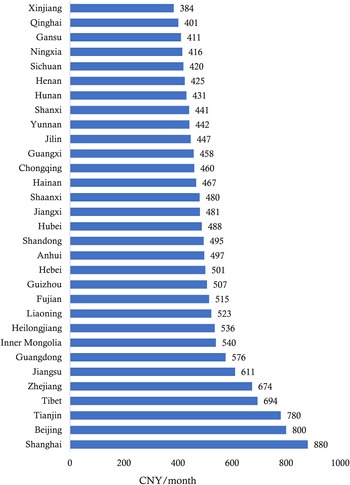
Figure 2 presents the dibao thresholds of mainland China's provincial administrative divisions in 2016. Two general observations are in order. First, there is indeed significant regional variation. While the standard in Shanghai was set at 800 yuan per month, it was only 384 yuan in Xinjiang. The eligibility threshold in most provinces ranged between 400 and 540 yuan. Second, although wealthier localities were generally associated with a higher standard dibao (for example, Shanghai = 880 yuan, Beijing = 800 yuan, Zhejiang = 764 yuan, etc.), their underdeveloped peers were not necessarily “stingier”: for instance, the thresholds in Tibet, Inner Mongolia, Heilongjiang and Guizhou were higher than those in the richer provinces of Hebei, Shandong and Hainan.
Dibao Eligibility Threshold in 2016, by Provincial Administrative Divisions
Source: Ministry of Civil Affairs 2017.

The observations above lead us to several research hypotheses. First, the existing literature has documented abundant evidence of a positive relationship between the fiscal strength of Chinese local states and the generosity of welfare provision.Footnote 35 Despite the centrally stipulated policy guidelines, the skewed intergovernmental fiscal relations in social welfare largely require local governments to offer what they can afford. Expecting the same logic to exist in this (largely) locally financed social assistance programme, we hypothesize:
ceteris paribus, the fiscal income of a provincial government is positively related to its local dibao threshold (H1: fiscal power effect).
As pointed out above, the central government has found that local governments in many poor regions have struggled to finance the urban dibao programme; therefore, special fiscal transfers have been employed extensively to support dibao programmes in these localities, leading to significant interregional disparities in financing. While some local governments rely heavily on transfer payments from the centre, those in developed regions are almost entirely responsible for financing the programme from the local budget.Footnote 36 We posit that fiscal dependency on central fiscal transfers critically limits the possible generosity of dibao. Those with a stronger reliance on central fiscal transfers naturally have to exercise budgetary prudence because if transfer payments cease to be offered, their shallow local public finances would have to shoulder even greater pressure. Hence, we hypothesize:
ceteris paribus, greater dependency on central fiscal transfers in financing dibao in a province is negatively related to the local dibao threshold (H2: fiscal dependency effect).
Notwithstanding the social assistance mission of dibao, local governments also face the pressure of keeping their public finances balanced. Given the intrinsic trade-off between welfare coverage and budgetary prudence, local governments, concerned with potential fiscal stress, may choose to set lower dibao standards if the recipient population is large. By the same token, having a small recipient population may allow local governments to offer higher benefits. This broad expectation leads us to posit:
ceteris paribus, the size of a province's urban population is negatively related to its local dibao threshold (H3: population effect).
In practice, although dibao is administered at the sub-provincial level, provincial governments, as the immediate subnational authorities in the Chinese state apparatus, play a role in determining various key parameters, particularly the eligibility threshold. While in some localities provincial governments delegate decision-making powers to prefectural authorities,Footnote 37 in other localities, provincial governments have a bigger say.Footnote 38 The intermediary role of provincial authorities can be found in many social policy domains, such as social health insurance and labour protection.Footnote 39 For example, in the case of minimum wage policy, the central government requires provinces to adjust minimum wage rates at least every two years to reflect the changes in local living standards. In practice, some provinces let prefectural cities get actively involved in the periodic adjustment of the standards, while others allow little flexibility. In provinces with large regional disparities, setting a provincial standard serves as an effective way to reduce the inequality in welfare entitlements across cities.Footnote 40 Reflecting a notable trend of social policy recentralization, provincial requirements essentially impose pressure on “welfare laggards” to catch up.Footnote 41 Hence, we speculate:
ceteris paribus, the presence of provincial requirements for dibao standards is positively related to the local dibao threshold (H4: province effect).
The existing literature suggests that local political elites in authoritarian states are also motivated to provide social welfare, notwithstanding the absence of an electoral link. Their incentives include gaining a competitive edge in the political tournament, showing political loyalty to the Party and solving long-standing local problems.Footnote 42 In particular, some scholars have revealed a neighbour effect in the sense that lower-level governments under the same superior tend to see each other as potential or real rivals competing for scarce political and economic opportunities.Footnote 43 In geographically proximate localities, peer local governments also engage in mutual learning. Hence, as a result of peer pressure, they benchmark with each other in terms of general policy strategies or compete on concrete key indicators in a way that resembles interregional policy learning.Footnote 44 Having a dibao standard lower than a neighbouring locality may create the impression that the local government is indifferent to social welfare. This negative image may tarnish the reputation of the local government and create an adverse effect on the political career of the local leaders.Footnote 45 The discussion above leads us then to hypothesize:
ceteris paribus, an increase in the dibao threshold in one province is positively determined by the increase in its neighbouring province (H5: neighbour effect).
Methodology
Data source and variables
We constructed a provincial-level panel dataset that covered 31 provincial administrative divisions in mainland China over 14 years (2003–2016); 31 cross-sections and 14 years yielded a sample of 434 observations. All variables were collected from secondary sources such as the various official statistical yearbooks. As various national-level statistical yearbooks regularly report related provincial data, provinces were taken as the unit of analysis in this present study. We acknowledge that this approach may mask intra-provincial variation to a certain extent, but an explicit provincial focus also enabled us to examine how these immediate subnational authorities exert an intermediary impact between the central principal and local agents in China's flagship social assistance programme.
As reported in the China Civil Affairs Statistical Yearbook, the dibao threshold of every province across the various years was the dependent variable of our study. The provincial standard was computed as a weighted mean of the dibao thresholds of all sub-provincial administrative divisions within a province. The Ministry of Civil Affairs uses this indicator to benchmark the provincial provision of dibao. To test our five hypotheses, we operationalized the key factors into the following independent variables: 1) total fiscal income of the provincial government (H1, in billion yuan); 2) the share of central government-earmarked fiscal transfer in the total dibao expenditures of the province (H2, in percentage); 3) the size of the urban population of the province (H3, in million); 4) provincial government setting the dibao standard (H4, a dummy); and 5) average dibao threshold of all neighbouring provinces (H5, in yuan).
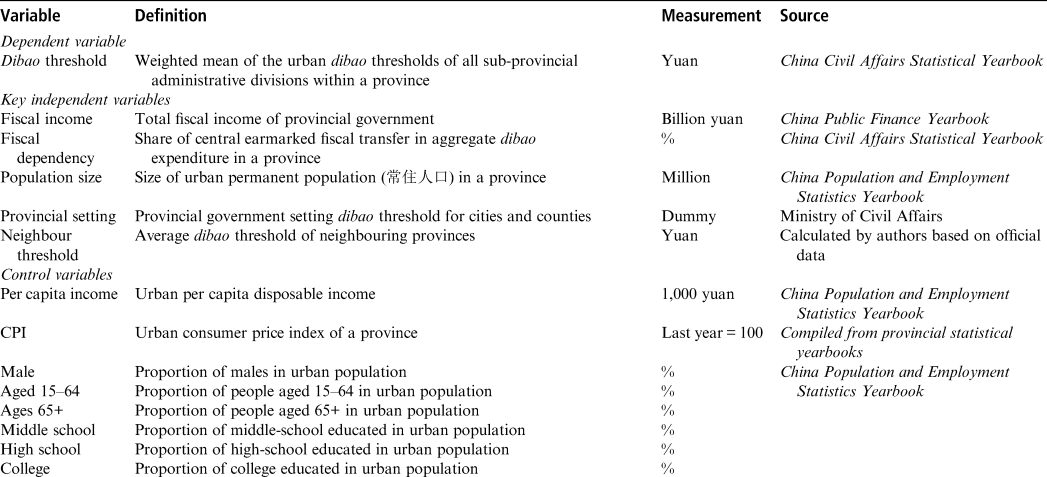
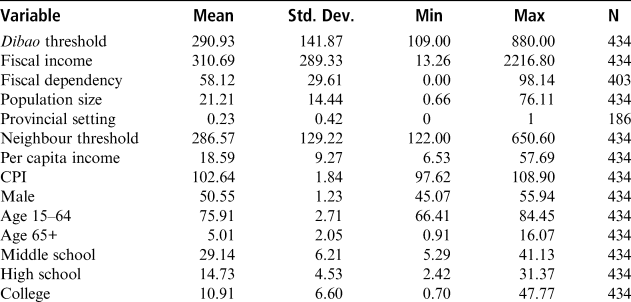
Several control variables were also included to account for variations in local dibao standards: 1) per-capita disposable income of a province, representing the level of economic affluence (in thousand yuan); 2) consumer price index (CPI), reflecting the inflation rate of a province (in relative terms, with last year's figure as 100); and 3) several other sociodemographic variables, including the demographic structure of the province and the educational attainment of its urban population. These factors are not the principal variables of interest of this present paper, so we treated them as control variables and do not report them in detail in the interest of parsimony in presentation. Data sources and variable definitions are presented in Table 1. Table 2 presents the descriptive statistics.
Variable Definitions

Descriptive Statistics

Empirical strategy
This study used fixed-effects methods to analyse the panel data. The equation below describes our model specifications. Subscripts i and t represent province and year, respectively; dibao (threshold) is the dependent variable; Xit refers to the vector of the key independent variables used to test the five hypotheses, with β loading their effects; Zit represents the control variables listed in Table 1, while γ denotes their coefficients; and δ i and θ t indicate province and year fixed effects, respectively. The constant term α is included in all specifications, while the error term is expressed by ɛit. The province fixed effects were able to capture all time-invariant provincial factors that shape dibao thresholds, and the year fixed effects were able to control for all the temporal shocks to dibao thresholds experienced by all the provinces. Although the hypotheses are not formulated in the language of causality, the empirical strategy is carefully designed to drive the correlation effects towards causation. The inclusion of fixed effects and the presence of control variables reduce to a large extent the estimation biases of β arising from endogeneity and thus strengthen our causal claims.
 $$Dibao_{it} = \alpha + {\boldsymbol X}_{{\boldsymbol it}}{\boldsymbol \beta } + {\boldsymbol Z}_{{\boldsymbol it}}{\boldsymbol \gamma } + \delta _i + \theta _t + \varepsilon _{it}$$
Provincial fiscal income and urban population size are included in Xit in all models, while the share of central government fiscal transfer in total provincial dibao expenditure, provincial government setting dibao standards, and average dibao threshold of neighbouring provinces are incorporated only when testing related hypotheses. Several reasons explain the adoption of the empirical strategies described above. First, data for fiscal transfers are unavailable in 2003; as a result, the variable is included at a cost of losing 31 observations. Second, information with regard to the provincial government setting dibao standards is inaccessible before 2011, and so only data between 2011 and 2016 are analysed when testing H4. Third, because the dummy variable for provincial government setting dibao standards is time-invariant, it is perfectly collinear with province fixed effects. As such, δ i is replaced by region fixed effects (Eastern, Central, Western, and North-Eastern ChinaFootnote 46) when testing H4. Fourth, the addition of the average dibao threshold of neighbouring provinces alone is insufficient to reveal the peer pressure because the correlation between a province's dibao threshold and the average of its neighbours may have resulted from similar demographic and socioeconomic circumstances. To account for this confounding possibility, we also control for the average demographic and socioeconomic factors of neighbouring provinces when testing H5.
Results
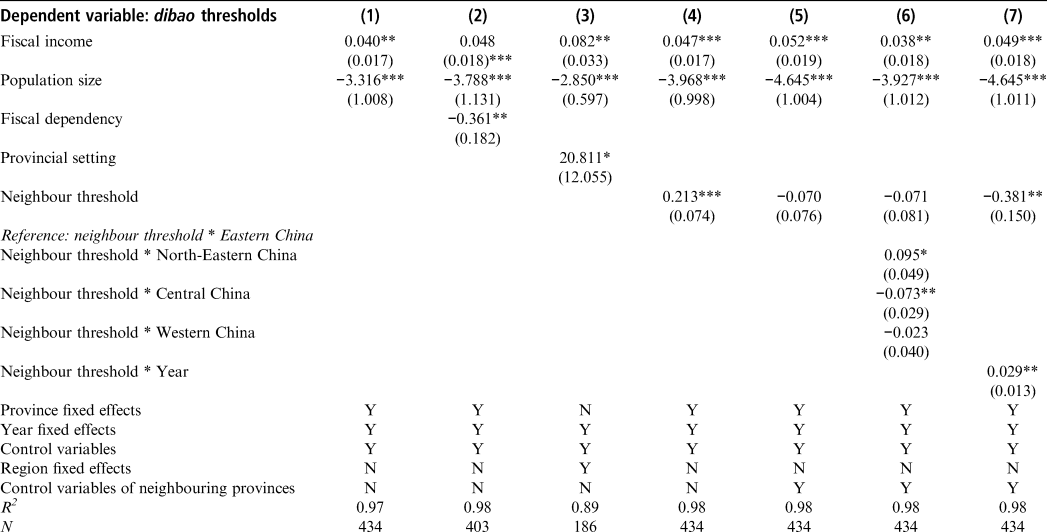
Table 3 presents the ordinary least square (OLS) regression results for the effects of various provincial factors on dibao thresholds. Robust standard errors are reported in parentheses. As explained above, the coefficients of the fixed effects and control variables are omitted to save space.Footnote 47 As shown in Column (1), the fiscal income of a province is positively related to local dibao standards in a statistically significant manner. Specifically, a one billion yuan increase in provincial fiscal income would result in a four cent rise in the dibao threshold. Therefore, H1 is supported. Urban population size stands out as a strong negative predictor of the local dibao threshold, as one million more people in the urban population would pull the threshold down by more than three yuan. Thus, H3 is supported.Footnote 48 Column (2) further includes fiscal dependency in the regression; the result suggests that a 1 per cent increase in the earmarked central fiscal transfer would squeeze down the local dibao threshold by 36 cents.Footnote 49 The significant negative relationship between fiscal dependency and the dependent variable thereby endorses H2.
Determination of Dibao Thresholds

Notes: * p<0.10, ** p<0.05, *** p<0.01; standard deviation in parentheses. As an additional robustness check, we transformed the variables except dummies and ratios into natural log and re-ran the regression models. The statistical patterns remained robust.
Column (3) includes the dummy variable indicating whether dibao standards are set by the provincial government. The sample analysed in this column only includes observations between 2011 and 2016 as it is unclear from the public documents which level of government determined dibao thresholds before 2011. Because the setting rules have remained unchanged since 2011, the dummy is perfectly collinear with the province fixed effects. Instead, Column (3) controls for region fixed effects (Eastern, Central, Western, or North-Eastern China) to capture time-invariant geographic determinants. The statistical result suggests that compared to localities where sub-provincial authorities set the dibao standards, localities where dibao standards are set by provincial governments tend to be more generous in their dibao thresholds by 20.8 yuan. H4 is thus supported.
Column (4) adds the average dibao thresholds of neighbouring provinces to the Column (1) specification in order to test H5. Neighbours of a province are defined as provinces that (a) are in the same region and (b) share common borders with the province concerned. Therefore, a province and its neighbours are not only geographically adjacent but also share similar socioeconomic characteristics. If a race-to-the-bottom or race-to-the-top indeed exists, a local government is more likely to perceive its peer in an adjacent locality as an immediate competitor.Footnote 50 The statistical result indicates that a one yuan increase in the average dibao threshold of neighbours leads to a 21 cent increase in a province's own threshold. As pointed out above, such a positive correlation could result from the similarity between a province and its neighbours. In order to corroborate our finding, Column (5) further controls for a variety of major characteristics of neighbouring provinces, including: 1) average provincial fiscal income; 2) urban population size; 3) urban per capita income; 4) urban consumer price index (CPI); 5) the percentage of males in the urban population; 6) the percentage of people aged 15 to 64; 7) the percentage of people aged 65+; and 8) the percentages of people in the urban population with a middle-school, high-school and college education. The variable “neighbour threshold” turned out to be statistically insignificant, implying that we have failed to find a sweeping positive peer pressure. Such a result leads us to investigate whether the neighbour effect emerges only for specific locations and periods.
We created interaction terms indicating the region to which a province belongs and its interaction with the dibao threshold. The interaction terms were included in Column (6). Compared to Eastern China, the most developed region of the country, the less-developed Central and Western regions overall appear to manifest weaker competition on dibao standards, despite the statistically insignificant coefficient for the Western region.Footnote 51 Column (7) reveals that the cross-sectional competition becomes more salient as time goes by. Starting from 2017, the overall neighbour effect turns positive. In sum, H5 is partially endorsed as the effect is more likely to hold for the most developed regions and in more recent years.
Robustness Checks
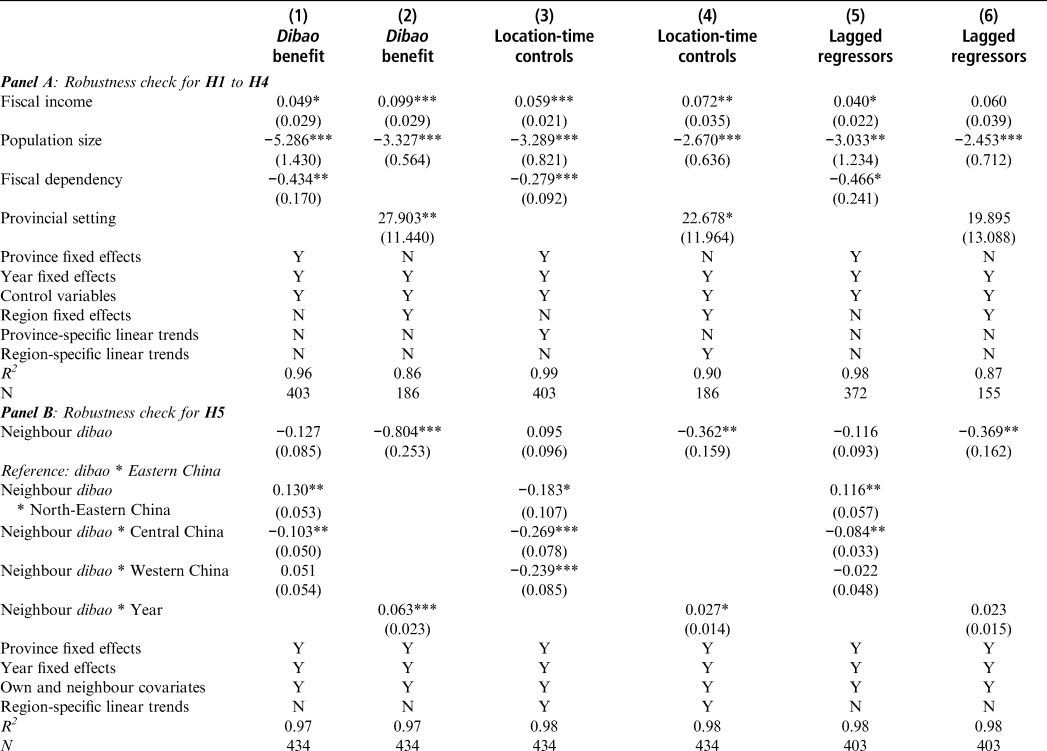
We performed two robustness checks to corroborate our results. First, we used the per capita monetary benefit of local dibao schemes as an alternative dependent variable. While this study explicitly focuses on the eligibility standard, the actual amount received by beneficiaries represents another crucial aspect of this cash transfer programme. The correlation coefficient between the two variables is as high as 0.95, implying that a province where the dibao threshold is generously set also offers higher benefits to qualified applicants. Columns (1) and (2) of Table 4 examine whether the two dependent variables show similar deterministic patterns. Column (1) of Panel A includes the same set of independent variables as in the main regression models. The result suggests that H1, H2 and H3 still hold robustly with the new dependent variable. Column (2) of Panel A corresponds to Column (3) of the main regression table; the robustness check result corroborates H4. The first two columns in Panel B replace neighbour dibao threshold with neighbour dibao benefit, with the rest of the regressors being identical to those used in the main regression models.Footnote 52 The result reinforces that peer pressure exhibits similar heterogeneous effects on actual local dibao benefits, thereby corroborating H5.
Results of Robustness Checks

Notes: * p<0.10, ** p<0.05, *** p<0.01; standard deviation in parentheses.
Despite the efforts to include as many covariates as possible, some determinants that vary by location and time may have been omitted and subsequently cause the endogeneity issue. In Columns (3) and (4) of Panel A, we include province-specific linear trends and region-specific trends, respectively; the results endorse H1, H2, H3 and H4. In Columns (6) and (7) of Table 3, various characteristics of a province and its neighbours are incorporated, but there may be time-varying intra-regional factors that impact the dibao thresholds of all provinces. Neglecting such variables would overestimate the connection of a province's dibao threshold with that of its peers. Columns (3) and (4) of Panel B therefore add region-specific linear trends to the last two columns of the main regression models, respectively. It remains robust that the less developed Central and Western regions are weaker in peer competition than the more developed Eastern area, and the competition escalates over time.
Dibao threshold and the various provincial indicators in the list of regressors may be simultaneously determined by policymakers and, therefore, the coefficients may hardly be interpreted as the effects from the independent variables to the dependent variable. Columns (5) and (6), by replacing all time-varying regressors with their one-period lagged terms, reinforce the direction of the causal effects. Such specifications reduce sample sizes by 31 and the coefficients of fiscal income, province setting and the neighbour-year interaction in Column (6) lose statistical significance. Nevertheless, the signs of these effects, together with other statistically significant coefficients, remain consistent with the five hypotheses. In sum, the robustness checks corroborate our empirical results.Footnote 53
Discussion and Conclusion
This study has explained the remarkable subnational variation in China's de facto urban poverty line with a synthesized analytical framework. While central–local relations and the distinctive local policy experimentation in this unitary communist state have been the subject of extensive theoretical discussions, the traditional depiction of local states as being solely development minded has been defied with the rising prominence of social policies in China. This study has examined the respective impact of alternative explanations for local policy discretion by explaining how the eligibility threshold of the dibao, China's flagship social assistance programme, is determined at the local level. The panel nature of our data has, to a large extent, allowed us to construct causal explanations. Synthesizing the received wisdom, we put forward five research hypotheses for quantitative examination: the fiscal power effect, the population size effect, the fiscal dependency effect, the province effect and the neighbour effect, each of which captures a certain aspect of the dynamics of policy adaptation at the subnational level. The quantitative results have supported these hypotheses, albeit to varying degrees. The empirical results are further reinforced by robustness checks.
The findings lead us to several critical insights that merit further discussion. First, concerns regarding resources apparently constrain local provision of welfare as fiscal strength and size of population exert a strong impact on dibao eligibility standards. Fiscal dependency also appears to reinforce conservatism in welfare spending. Although it is generally observed that fiscally dependent localities usually prioritize poverty alleviation in order to maintain social stability,Footnote 54 their spending behaviour is embedded within the broader intergovernmental fiscal arrangements. With all other socioeconomic factors being equal, fiscal dependency seems to promote a race-to-the-bottom among local governments as far as the dibao standard is concerned. This conservatism arguably stems from concerns in regard to the sustainability of fiscal transfers. Hence, our study argues that ad hoc fiscal transfer schemes may discourage – rather than encourage – the subnational welfare expansion that would need to be built on more institutionalized intergovernmental fiscal arrangements.
Second, a highlight of this study is the explicit focus on the role of provincial authorities. China's remarkable political decentralization in the past decades has led many prior studies to explain local policy dynamics at the city or county level, while how provinces manoeuvre between central and lower-level authorities in social policies is far less understood. Multiple principal-agent relationships on the part of provincial governments require them to implement central policy mandates in a faithful manner on the one hand but safeguard local interests on the other. Our study offers additional evidence of the social policy stance assumed by this immediate level of subnational authorities in China: provincial governments do represent the central principal in the sense that they are eager to reduce intra-provincial disparities in welfare provision by pushing the welfare laggards to catch up. The provincial centralization of dibao standards appears to be an effective instrument for harmonizing the benefit disparities. In contrast, in provinces where authority to set local dibao standards is delegated to prefectural governments, the standards clearly tend to be lower, manifesting a form of race-to-the-bottom. This result clearly reflects the policy discretion of lower-level governments in China, in spite of the touted progress towards a “people-centred” developmental outlook. As such, provinces play a highly pivotal role in moderating local state behaviour in the course of social policy development.Footnote 55
Third, a distinctive form of race-to-the-top is also observed in this study as the neighbour effect is largely substantiated. Although Chinese local states still predominantly put economic growth as their utmost strategic goal, they do appear mindful of their own performance in social policy. Shih-jiunn Shi has insightfully coined the term “competitive solidarity” to describe the distinctive regional competition in China's social policy: “Competitive solidarity refers to the configurations of welfare regions in competition with one another, with each devising its own welfare model that caters, first and foremost, to specific local circumstances while precluding outsiders from sharing the welfare benefits. Social solidarity in China thus takes on a strong territorial character, implying less about nationwide income redistribution and overarching social egalitarianism than about interregional contest for development and mutual exclusion of social citizenship.”Footnote 56 In this study, we have revealed another form of regional competition in which no local government wishes to be regarded as a welfare laggard because a lower standard in the social safety net may yield undesired consequences in terms of political image and perhaps societal reputation. Therefore, local governments try not to offer a dibao standard lower than that of their peers in the same region. Peer pressure, in this sense, appears to be a healthy mechanism promoting welfare provision among the local states, given the shallow financial protection provided by existing social assistance programmes.Footnote 57
In brief, this study contributes to the literature by providing empirical evidence of how local social policy discretion is exercised within a large unitary socialist state. In particular, the remarkable subnational variation in the de facto urban poverty line is well explained by a salient constellation of fiscal and political factors that are embedded within the country's political economy of social policymaking. Both race-to-the-top and race-to-the-bottom situations may be fostered by distinctive mechanisms. Our conclusions highlight the critical importance of understanding the complex intergovernmental relations and fiscal arrangements that determine the social policy decisions of subnational governments.
This study is certainly not without limitations, and we humbly acknowledge them. First, although this study explicitly investigates the role of provinces in local social policy discretion, the absence of prefectural-level datasets did not allow us to fully examine the central–provincial–prefectural dynamics in the setting of local dibao standards. Second, while the formulation of the hypotheses was in part inspired by the authors’ series of in-depth interviews and qualitative observations over the past eight years, this study is still predominantly quantitative, and we were unable to fully develop it into a mixed methods investigation. A further elucidation of the full mechanisms of local social policy discretion, especially in the case of dibao, would need to be based on thorough qualitative studies. These limitations will be addressed in our ongoing research on subnational social policymaking in China.
Acknowledgements
This study was funded by the National Natural Science Foundation of China (Ref. 71704181 and Ref. 71703160), the Fundamental Research Funds for the Central Universities, and the Research Funds of Renmin University of China (Ref. 21XNLG03). The authors are very grateful to three anonymous reviewers for useful comments.
Conflict of interest
None.
Biographical notes
Yu GUO is head and associate professor of the department of social security at the School of Labour and Human Resources, Renmin University of China. She specializes in social policy and pension reforms in China and has published extensively in leading international journals such as The China Quarterly, Ageing and Society, International Journal of Social Welfare, Journal of Social Work, Journal of Vocational Behavior, International Journal of Human Resource Management, Children and Society, Children and Youth Services Review, BMC Geriatrics and Journal of Asian Public Policy, as well as in Chinese journals such as Sociological Studies.
Alex Jingwei HE is associate head and associate professor of the department of Asian and policy studies, The Education University of Hong Kong. Specializing in social policy and healthcare reforms in East Asia, he has published widely in leading international journals such as The China Quarterly, Public Administration Review, Social Science and Medicine, Health Policy and Social Policy and Administration. He is the associate editor of Policy and Society and Journal of Asian Public Policy.
Fei WANG is associate professor at the School of Labour and Human Resources, Renmin University of China. Specializing in labour and demographic economics and subjective well-being, he has published in leading international journals such as PNAS, Journal of Population Economics and Journal of Happiness Studies. He is a contributor to the World Happiness Report and the Palgrave Handbook of Comparative Economics.