1. Introduction
The Jurassic sedimentary and volcanic formations occurring in the southwestern part of the Bükk Mountains were only recognized at the beginning of the 1980s (Bérczi-Makk & Pelikán, Reference Bérczi-Makk and Pelikán1984; Balogh, Kozur & Pelikán, Reference Balogh, Kozur and Pelikán1984; Csontos, Bérczi-Makk & Thiebault, Reference Csontos, Bérczi-Makk and Thiebault1991; Csontos, Dosztály & Pelikán, Reference Csontos, Dosztály and Pelikán1991). This recognition significantly changed the previous concepts concerning the stratigraphy, structure and evolutionary history of the Bükk Mountains, and led to the elaboration of a new structural model.
The striking similarity of the Upper Palaeozoic and Triassic formations of the Bükk Mountains with the corresponding formations of the Dinarides has been known for a long time (Schréter, Reference Schréter1959; Balogh, Reference Balogh1964; Protić et al. Reference Protić, Filipović, Pelikán, Jovanović, Kovács, Sudar, Hips, Less, Cvijić, Karamata and Janković2000; Pamić, Tomljenović & Balen, Reference Pamić, Tomljenović and Balen2002; Filipović et al. Reference Filipović, Jovanović, Sudar, Pelikán, Kovács, Less and Hips2003). Studies in the last decades pointed out similarities between the Jurassic olistostromal sedimentary and volcanic complexes in the Bükk Mountains, and the ophiolite mélange complex of the Dinarides (e.g. Pamić, Reference Pamić1997, Reference Pamić2003; Haas & Kovács, Reference Haas and Kovács2001; Dimitrijević et al. Reference Dimitrijević, Dimitrijević, Karamata, Sudar, Gerzina, Kovács, Dosztály, Gulácsi, Less and Pelikán2003; Haas et al. Reference Haas, Görög, Kovács, Ozsvárt, Matyók and Pelikán2006, Reference Haas and Kovács2011). These considerations inspired the concept that the Bükk Unit was derived from the Dinaridic realm and was emplaced in its present-day setting via large-scale transpressive tectonic displacements in the Tertiary Period (e.g. Csontos et al. Reference Csontos, Nagymarosy, Horváth and Kováč1992; Csontos & Nagymarosy, Reference Csontos and Nagymarosy1998; Haas & Kovács, Reference Haas and Kovács2001; Csontos & Vörös, Reference Csontos and Vörös2004; Schmid et al. Reference Schmid, Bernoulli, Fügenschuh, Matenco, Schuster, Schefer, Tischler and Ustaszewski2008).
The aim of the present paper is to characterize the Jurassic formations of the study area in the southwestern part of the Bükk Mountains with special regard to the redeposited sedimentary rocks (olistostromes) in order to obtain information on the provenance of the clasts, as well as on the mode and time of their redeposition. Determining the succession of the complex redeposition processes may contribute to understanding the history of closure of the western Neotethys Ocean, which places this study within a much wider context.
2. Geologic setting
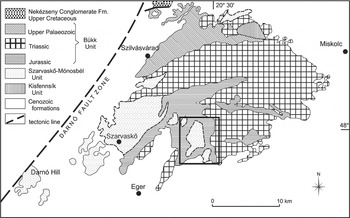
The area of the present study is located in the southwestern part of the Bükk Mountains (Figs 1, 2). The eastern part of the study area is made up of Middle to Upper Triassic (Ladinian to Norian) platform limestone and grey cherty limestone of intraplatform basin facies, with intercalations of basalt (Velledits, Reference Velledits2000; Pelikán & Dosztály, Reference Pelikán and Dosztály2000; Pelikán, Reference Pelikán, Pelikán and Budai2005) (Fig.3). These are overlain by red radiolarian chert (Bányahegy Radiolarite Formation) in a thickness of about 30 m (Figs 3, 4). Based on investigations of poorly preserved radiolarians taken from several sections, Dosztály (in Csontos, Dosztály & Pelikán, Reference Csontos, Dosztály and Pelikán1991) assigned this formation to the Callovian–Oxfordian time period.
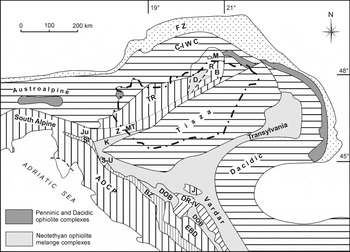
Geographic and geologic setting of the Bükk Unit within the Circum-Pannonian region. Abbreviations: ADCP – Adriatic–Dinaridic Carbonate Platform; B – Bükk Unit; BZ – Bosnian Zone; C-I WC – Central and Inner West Carpathians; D – Darnó Unit; DOB – Dinaridic Ophiolite Belt; DR-IV – Drina–Ivanica Unit; EBD – East Bosnian–Durmitor Unit; FZ – Helvetic and Outer Carpathian Flysch Zone; J – Jadar Block; Ju – Julian Alps; K – Kalnik Unit; M – Meliata Unit; R – Rudabánya; Sl – Slovenian Trough; S-U – Sana–Una Unit; TR – Transdanubian Range Unit; Z-MT – Zagorje–Mid-Transdanubian Unit. Vertical lines – units of Adriatic Microplate origin; horizontal lines – units of European Plate origin.

Simplified geologic map of the Bükk Mountains showing position of the study area.

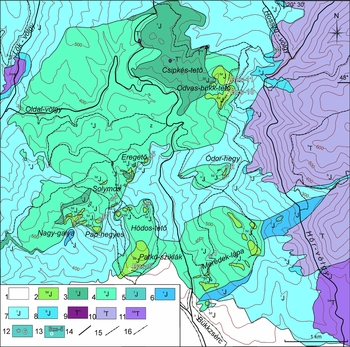
Geologic map of the study area showing location of the studied cores and outcrops. Legend: (1) Cenozoic formations; (2) Bükkzsérc Limestone Formation; (3) Csipkéstető Radiolarite Formation; (4) Oldalvölgy Limestone Formation; (5) Tardos Gabbro Formation; (6) Vaskapu Sandstone Formation; (7) Lökvölgy Formation; (8) Bányahegy Radiolarite Formation; (9) Olistoliths made up of Triassic pelagic carbonates and basalt; (10) Felsőtárkány Limestone Formation; (11) Berva Limestone Formation; (12) outcrops referred to in the paper; (13) studied boreholes; (14) asphalt road; (15) forest road; (16) settlement outline.

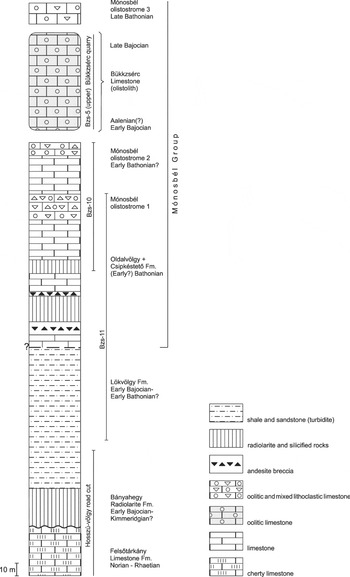
General lithostratigraphic succession of the study area with indication of age data based on biostratigraphic results of the present study.

The red chert formation is overlain by a dark grey to black shale succession consisting of sandstone, siltstone and claystone layers (Lökvölgy Formation). The succession is made up of millimetre-scale graded laminae suggesting deposition via turbidity currents (Pelikán, Reference Pelikán1987, Reference Pelikán, Pelikán and Budai2005; Csontos, Reference Csontos1988). Siliciclastic sandstone assigned to the Vaskapu Sandstone Formation (Pelikán, Reference Pelikán, Pelikán and Budai2005) occurs in the southern part of the study area, northeast of the village of Bükkzsérc, above Triassic beds, at the basal part of the Jurassic succession (Fig. 3). Owing to the lack of any biostratigraphic data, the stratigraphic position of this formation is not known. However, in some places similar sandstone bodies occur within or above the Lökvölgy Formation (Pelikán, Reference Pelikán, Pelikán and Budai2005). Consequently, it is probable that this sandstone has an interfingering connection with the Lökvölgy Formation (Pelikán, Reference Pelikán, Pelikán and Budai2005) and does not belong to the overlying Mónosbél Group.
The calcareous and siliceous basin and redeposited slope facies have been defined as the Mónosbél Group (Pelikán, Reference Pelikán, Pelikán and Budai2005). Within the group several lithofacies can be distinguished. These were defined as individual formations, but in many cases they show interfingering or transitional features and some of them may appear as redeposited clasts and blocks. The Oldalvölgy Formation is typically made up of an alternation of dark grey cherty limestone and black shale (silty claystone, sandstone) layers. Most of the limestone layers have mudstone or peloidal wackestone texture, but ooids or cortoids also occur in some beds. Radiolarian and/or sponge spicule wackestones are also typical textures of the formation. These gradually progress into radiolarian packstone, radiolarite and radiolarian chert beds, which can be assigned to the Csipkéstető Radiolarite. The Oldalvölgy Limestone and Csipkéstető Radiolarite formed coevally; accordingly, their lateral and vertical transition is a common occurrence.
Polymictic olistostrome beds typify the upper part of the series, which was classified as part of the Mónosbél Formation (Pelikán, Reference Pelikán, Pelikán and Budai2005; not to be confused with the Mónosbél Group, of which it forms a part; see Fig. 4 of this paper). Along with clasts of siliciclastic rocks, various volcanites and metamorphic rocks, oolitic carbonates resembling the Bükkzsérc Limestone are also common clastic components of these olistostromes.
The Bükkzsérc Limestone consists mostly of oolitic grainstone, as well as peloidal grainstone with intercalations of peloidal–‘filament’ wackestone and radiolarian wackestone, and packstone representing toe-of-slope apron and basin facies. However, rock types of this formation usually appear in the form of smaller or larger redeposited blocks (olistoliths) in the upper part of the Mónosbél Group (Haas et al. Reference Haas, Görög, Kovács, Ozsvárt, Matyók and Pelikán2006) (Fig. 4).
To the west of the studied area Jurassic basic magmatic rocks occur. They consist of basalt characterized by hyaloclastic lava flows and pillow lavas (Szarvaskő Basalt Formation), which were formed by submarine volcanic activity, and intrusive gabbro bodies (Tardos Gabbro Formation) (Fig. 3).
The Palaeozoic–Mesozoic formations of the Bükk Mountains were subjected to very low- and low-grade regional metamorphism (temperatures of 200–350°C, fluid pressures of 1.5–3 kbar; maximum 5 kbar, locally) (Árkai, Reference Árkai1983). The grade of metamorphism decreases from north to south from the epizone to the lower temperature part of the anchizone, as well as to the zone of medium–deep diagenesis (Árkai, Reference Árkai1983). Diagenetic to very low-grade metamorphic alteration characterizes the study area in the southwestern part of the Bükk Mountains. According to the latest studies performed on Jurassic formations of this area, the Kübler index and the chlorite ‘crystallinity’ data do not indicate any significant difference in the grade of alteration between the Lökvölgy Formation and the shale of the Mónosbél Group (Árkai & Judik, pers. com.). Based on K–Ar age dating, regional metamorphism of the Palaeozoic–Mesozoic formations occurred in two stages, at 160–120 Ma and 100–95 Ma, respectively (Árkai, Balogh & Dunkl, Reference Árkai, Balogh and Dunkl1995).
3. Key sections
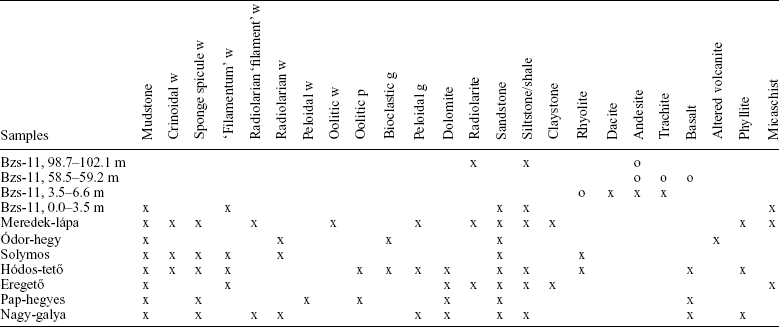
The area in the neighbourhood of the village of Bükkzsérc, in the southwestern part of the Bükk Mountains, is crucial for understanding the stratigraphy and lithology of the Jurassic sequences of this region. At the type locality of the Bükkzsérc Limestone, a number of outcrops of olistostrome beds of the Mónosbél Group are found; moreover, core sections (Bzs-5, -10, -11) are also available. Detailed sedimentological, petrographic and palaeontological investigations were carried out on the cores and samples taken from a number of outcrops (Meredek-lápa, Ódor-hegy, Solymos, Hódos-tető, Eregető, Pap-hegyes, Nagy-galya) for timing and better understanding the very complex rock-forming processes. Locations of the investigated cores and outcrops are presented in Figure 3. The lithological characteristics of the clastic components of the olistostromes in the studied outcrops are summarized in Table 1.
Lithological types of clastic components of olistostromes of the core Bzs-11 and outcrops studied
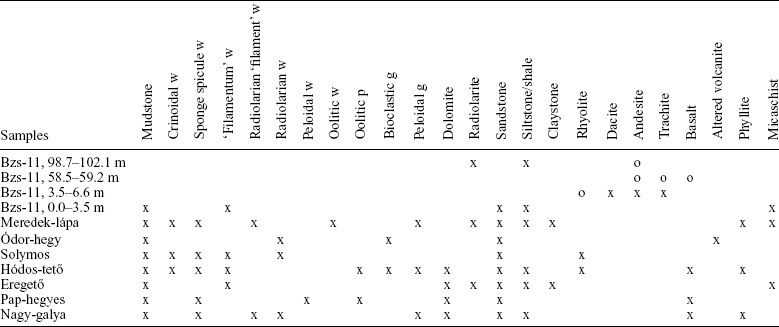
Abbreviations: w – wackestone; p – packstone, g – grainstone; x – occur, o – abundant.
3.a. Core Bzs-11 and related outcrops
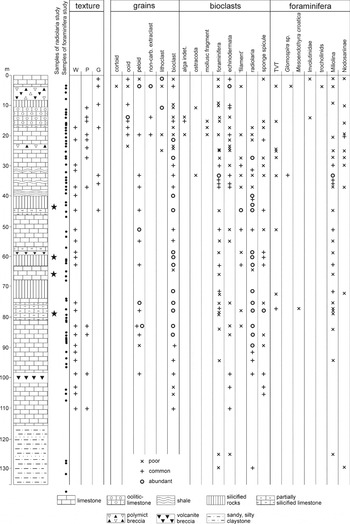
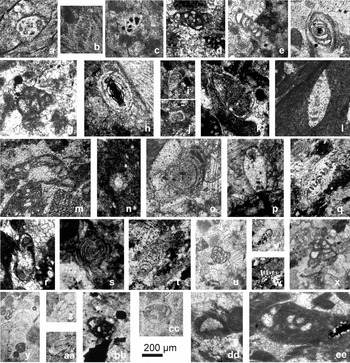
Core Bzs-11 was cut on the eastern slope of Odvas-bükk-tető (Fig. 3). The lower part of the cored section (115.2–135.0 m) can be assigned to the Lökvölgy Formation (Fig. 4). In the lowermost part of the core (130.0–135.0 m), dark grey sandstone and silty shale alternate. Graded bedding was recognized in the 131.7–132.7 m interval with mudstone rip-up clasts in the basal coarse-grained sandstone. It is followed by silicified silty shale containing various amounts of radiolarians (121.6–130.0 m). In two samples (129.7 and 125.2 m), a few foraminifera (Labalina rawiensis, Labalina sp., Nodosaria sp. and Cylindrotrocholina excelsa) were observed in sandstone (Fig. 6). The next interval (115.0–121.6 m) is typified by an alternation of sandstone and shale.
The predominantly shaly interval is overlain by a limestone unit (22.8–115.0 m) that is defined by radiolarian and sponge spicule wackestone microfacies (Fig. 5). The limestone is commonly silicified, partially or pervasively. Radiolarite interbeds also occur. Thus, this unit can be assigned to the Oldalvölgy–Csipkéstető Formation.
Lithology, microfacies characteristics and distribution of foraminifera in core Bzs-11.

In a few samples taken from this interval, a relatively poor radiolarian fauna was recorded (Pelikán & Dosztály, Reference Pelikán and Dosztály2000; Haas et al. Reference Haas, Görög, Kovács, Ozsvárt, Matyók and Pelikán2006). Peloidal packstone and grainstone containing smaller or larger amounts of recrystallized miliolid foraminifera (Labalina costata, L. occulta, L. rawiensis, Ophthalmidium caucasicum, O. aff. concentricum, Cornuspira infraoolithica), and a few agglutinated forms (Trochammina spp., Valvulina spp., Textularia spp., Mesoendothyra croatica) were encountered (Fig. 6). The richest foraminifer assemblage was found at 33.3–32.2 m (Fig. 5). The Textulariidae and especially the Nodosariidae are usually rare throughout the core, except at 77.5 m where the agglutinated TVT (Trochammina–Valvulina–Textularia) group is relatively frequent.
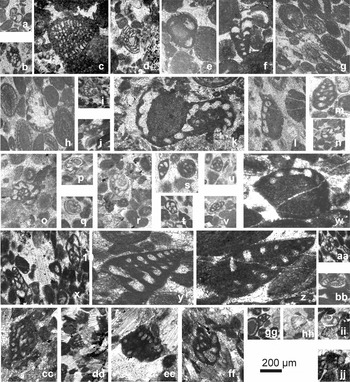
Characteristic Triassic (l, o–r) and Jurassic (a–k, m) foraminifera and incertae sedis of cores Bzs-11 and Bzs-10, and Odvas-bükk-tető outcrop: (a) Labalina rawiensis (Pazdrowa, Reference Pazdrowa1959), Bzs-11 (125.2 m), (b) Cylindrotrocholina excelsa (Ruggieri & Giunta, Reference Ruggieri and Giunta1965), Bzs-11 (125.2 m), (c) Labalina costata (Antonova, Reference Antonova1958b), Bzs-11 (72.3 m), (d) Labalina occulta (Antonova, Reference Antonova1958a), Bzs-11 (32.2 m), (e) Ophthalmidium caucasicum (Antonova, Reference Antonova1958a), Bzs-11 (32.2 m), (f) O. aff. concentricum (Terquem & Berthelin, Reference Terquem and Berthelin1875) Bzs-11 (33.3 m), (g) Textularia sp., Bzs-11 (33.1 m), (h) Labalina cf. rawiensis (Pazdrowa, Reference Pazdrowa1959), Bzs-11 (20.2 m), (i, j) Paralingulina tenera (Bornemann, Reference Bornemann1854), Bzs-11 (20.2 m), (k) Pseudonodosaria sp., Bzs-11 (20.2 m), (l) Triadodiscus cf. eomesozoicus (Oberhauser, Reference Oberhauser1957), Bzs-11 (15.5 m), (m) Trocholina palastiniensis Henson, Reference Henson1948, Bzs-11 (3.5–3.0 m), (n) Parastomiosphaera sp., Bzs-11 (3.5–3.0 m), (o) Triasina cf. oberhauseri Koehn-Zaninetti & Brönnimann, Reference Koehn-Zaninetti and Brönnimann1968, Bzs-11 (2.7 m), (p, q) Angulodiscus sp., Bzs-11 (2.7 m), (r) Auloconus permodiscoides (Oberhauser, Reference Oberhauser1964), Bzs-11 (2.7 m), (s) Ophthalmidium?, Bzs-11 (2.7 m), (t) Paralingulina testudinaria (Franke, Reference Franke1936), Bzs-10 (62.0 m), (u) Glomospira sp., Bzs-10 (61.3 m), (v) Trochammina sp., Bzs-10 (46.4 m), (w) Verneuilinoides sp., Bzs-10 (62.0 m), (x) Valvulina sp., Bzs-10 (62.0 m), (y) Nodosaria sp., Bzs-10 (19.2 m), (z) O. aff. concentricum (Terquem & Berthelin, Reference Terquem and Berthelin1875), recrystallized, Bzs-10 (61.3 m), (aa) Labalina cf. rawiensis (Pazdrowa, Reference Pazdrowa1959), recrystallized, Bzs-10 (61.3 m), (bb) Labalina costata (Antonova, Reference Antonova1958b), Bzs-10 (87.0 m), (cc) Protopeneroplis striata Weynschenk, Reference Weynschenk1950, Odvas-bükk-tető, (dd) Trocholina sp., Odvas-bükk-tető, (ee) Nautiloculina oolithica Mohler, Reference Mohler1938, Odvas-bükk-tető.

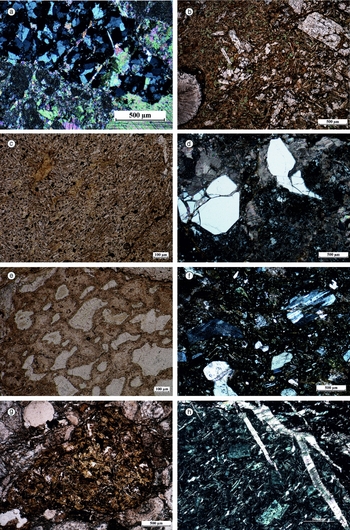
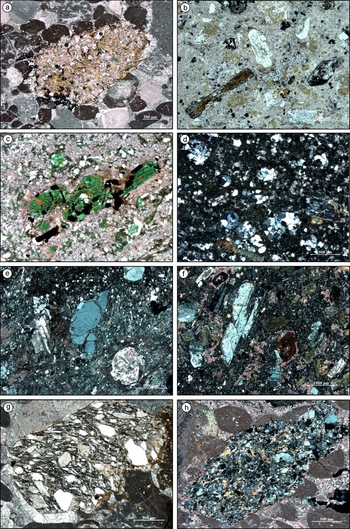
There is a 4 m thick red and green volcaniclastic interval (98.7–102.1 m) in the lower part of the carbonate-dominated succession that is made up predominantly of strongly altered and silicified fragments of basaltic and trachitic andesite (Fig. 7h). Moreover, a few radiolarite, silicified shale and carbonate clasts occur. Thinner volcaniclastic horizons were found at 58.5–59.2 m and at 40.2–41.4 m. Here trachitic, microholocrystalline andesite and chloritic basalt clasts were observed in a radiolarian wackestone matrix.
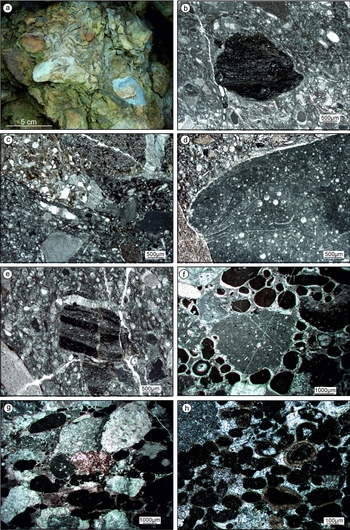
Typical clastic components of olistostromes in core Bzs-11: (a) elongated, rounded sandstone clast (+N), 3.0–3.5 m. (b) Intersertal porphyric basalt clast with calcite filled amygdale and plagioclase phenocrysts (1N), 4.3 m. (c) Intersertal-trachitic basalt clast (1N), 4.3 m. (d) Broken quartz phenocrysts in recrystallized matrix of a rhyolite clast (+N), 4.3 m. (e) Amygdalodial basalt clast (1N), 4.3 m. (f) Porphyric andesite clast with plagioclase phenocrysts (+N), 5.2 m. (g) Strongly altered intersertal dolerite clast (1N), 14–14.2 m. (h) Porphyritic-trachytic andesite clast with plagioclase phenocrysts and carbonatic vein (+N), 100.0 m.

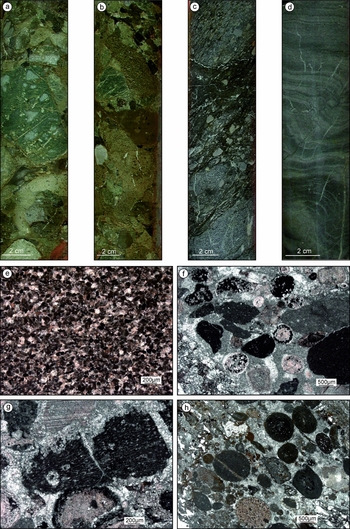
The uppermost part of the limestone-dominated interval described above is shaly and typified by radiolarian and sponge spicule wackestone microfacies with peloidal grainstone interlayers (Fig. 8e). This is overlain by polymictic olistostromes (0.0–22.8 m). The lowermost olistostrome (‘micro-olistostrome’) beds are made up of coarse calcarenite and fine calcirudite (Fig. 8c). The typical texture is lithoclastic, bioclastic, oolitic grainstone, packstone or wackestone (Fig. 8f, g). The matrix is commonly argillaceous. Among the lithoclasts, the carbonates (sponge spicule and radiolarian wackestone, peloidal grainstone, micritic mudstone, ‘filamentum’ wackestone, dolomicrosparite and dolosparite) are predominant but shale, chert and altered volcanic rocks also occur. In the sample taken from 20.2 m Labalina cf. rawiensis, indicating a Middle Jurassic age, was encountered in the matrix, whereas a Late Triassic–Early Jurassic foraminifera fauna (Paralingulina tenera, P. cf. testudinaria, Nodosaria spp. and Pseudonodosaria sp.) was found in a limestone clast. Coarse arenite-sized crinoid fragments are common. Millimetre-sized fragments of Rivularia-type calcimicrobe structures were also observed.
Typical lithological features and microfacies of the Mónosbél Group in cores Bzs-10 and Bzs-11: (a) grain-supported polymict breccia-conglomerate (olistostrome), Bzs-11 (4.3–4.5 m). (b) Grain-supported polymict breccia-conglomerate containing a large amount of volcaniclasts, Bzs-11 (4.5–4.8 m). (c) Mud-supported oligomict breccia (debrite), Bzs-11 (18.1–18.5 m). (d) Slump structures in pelagic limestone, Bzs-11 (90.9–90.8 m). (e) Fine-grained peloidal grainstone, Bzs-11 (34.8 m). (f) Medium-grained lithoclastic grainstone with ooid moulds, Bzs-11 (22.8 m). (g) Rivularia fragment and echinoderm detritus, Bzs-11 (22.8 m). (h) Peloidal grainstone. The globular peloids are probably micritized ooids or oncoids, Bzs-10 (19.0 m).

The lithoclasts vary increasingly upsection. Along with various carbonates, silty claystone, quartz sandstone and altered volcaniclasts are the most common components. A coarse-grained olistostrome containing mostly limestone and some sandstone clasts was penetrated between 16.0 and 18.6 m.
In the next interval (6.6–16.0 m) oolitic packstone and grainstone prevail, but coarse arenite to fine rudite-sized polymictic lithoclasts also commonly occur (Fig. 7g). In the 15.5 m sample, the Triassic Triadodiscus cf. eomesozoicus was recognized in carbonate lithoclasts (Fig. 6). This interval is followed by coarse-grained volcaniclastic beds (3.5–6.6 m). In these beds, the volcanic material is very variable. Clasts of rhyolite, dacite, trachyte and andesite were recognized (Fig. 7b–f, 8a, b).
Above the volcaniclastic olistostromes, in the topmost part of the core (0.0–3.5 m), peloidal grainstone with clasts of carbonates (micritic mudstone, filamentum microsparite, and sparite) quartz sandstone (Fig. 7a), shale and altered volcanites and oolitic grainstone with carbonate lithoclasts were exposed. In sample 3.5–3.0 m Jurassic microfauna (e.g. Trocholina palastiniensis, Labalina sp., Parastomiosphaera sp.), and in sample 2.7 m Norian foraminifera (Triasina cf. oberhauseri, Auloconus permodiscoides, Angulodiscus sp., Ophthalmidium? sp.) of carbonate platform origin were recognized in lithoclasts (Fig. 6).
The characteristic volcaniclastic interval is also exposed at the surface in a road-cut close to the site of the borehole. In the surface exposure, there are debrite (olistostrome) beds, containing various amounts of clasts, mostly of volcanic rocks. In one of these beds unsorted, unrounded to well-rounded clasts, 1–15 cm in size occur in a shale matrix. The clasts are mostly of rhyolite, typically with glauconitized rhombic pyroxene, plagioclase and a few resorbed quartz grains. A cumuloporphyric andesite containing glauconitized rhombic pyroxene, and another andesite clast were also found.
This bed is overlain by a limestone bed that also contains sandstone (partly metasandstone) clasts (Fig. 9h) and volcaniclasts, of a maximum size of 1 cm. The volcaniclasts are weathered and their minerals are strongly altered. However, based on the textures of the rocks, it is plausible that predominantly basic rock types occur, showing an appearance akin to that of basite of ophiolite complexes. The following rock types were recognized: sphaerolithic volcanite, intergranular dolerite, intersertal–variolitic amygdaloidal basalt, intergranular metabasalt and amygdaloidal volcanite (Fig. 9b–d, f, g). Rhyolite with resorbed quartz and volcanites with porphyritic plagioclase were also found, subordinately (Fig. 9e).
Typical clastic components of olistostromes from outcrop samples, Odvas-bükk-tető. (a) Strongly altered intersertal dolerite clast (1N), sample 19. (b) Biotite-amphibole andesite clast (1N), sample 15. (c) Glauconitized orthorhombic pyroxene–opaque mineral–apatite cumulate in dacite clast (1N), sample 16b. (d) Silicified dacite clast with plagioclase and pyroxene phenocrysts (1N), sample 16b. (e) Rhyolitic-dacitic clast with quartz and plagioclase phenocrysts (+N), sample 6. (f) Amphibole andesite clast (+N), sample 16. (g) Amphibole andesite clast (+N), sample 16. (h) Metasandstone clast containing mainly quartz and muscovite (+N), sample 19.

U–Pb age determination was recently carried out on zircon grains separated from acidic volcanite clasts. From this locality, only one data pair was concordant, yielding an age of 222 ± 18 Ma. However, also taking into account the concordant age data measured on similar volcanite clasts found in the olistostromes of the neighbouring Rudabánya Hills, 227.3 ± 4.4 Ma is the probable age of volcanism (Late Ladinian–Early Carnian) (Haas et al. Reference Haas, Kovács, Pelikán, Kövér, Görög, Ozsvárt, Józsa and Németh2011). This corresponds to the age of the late stage of the Ladinian–Carnian volcanism in the Bükk Mountains (Pelikán, Reference Pelikán, Pelikán and Budai2005).
3.b. Core Bzs-10
Core Bzs-10 (Fig. 10) was cut about 300 m south of core Bzs-11 and exposed a sequence corresponding to the upper part of the section encountered by the latter.
Lithology, microfacies characteristics and distribution of foraminifera in core Bzs-10.

The lower part of the core (65.5–87.0 m) is made up mostly of radiolarite, which can be correlated with the predominantly radiolaritic interval in core Bzs-11 (38–73 m). Above it, peloidal–bioclastic packstone and grainstone, as well as oolitic grainstone, were found (51.0–61.3 m). In the oolitic grainstone beds (59.1–62.0 m) carbonate lithoclasts (radiolarian wackestone and mudstone) occur. In some lithoclasts Early Jurassic foraminifera associations (Paralingulina tenera, P. testudinaria, Nodosaria spp., Pseudonodosaria sp. and Glomospira sp.) were encountered; a very similar horizon was found at 35.8–32.2 m in core Bzs-11.
The next interval (11.7–51.0 m) is typified by an abundance of sponge spicules. The foraminifera fauna is very poor; a few specimens of miliolinids (e.g. Labalina rawiensis, Ophthalmidium aff. concentricum), Glomospira sp., Textularia sp., Nodosaria spp. and Lenticulina sp. could be identified.
An olistostrome interbed (lithoclastic, oolitic, bioclastic grainstone) was encountered between 19.0–21.0 m (Fig. 8h). There are well-preserved ooid grains present; peloids are common and intraclasts also occur. Crinoid ossicles are abundant. The following lithoclast types were found: coarse sandstone, metasandstone, metasiltstone, quartzite with mica, holocrystalline microspherulitic rhyolite, strongly limonitized variolithic basalt and strongly altered microcrystalline volcanites with porphyric feldspars. Another polymictic breccia bed (olistostrome) was found between 11.4–12.3 m.
Oolitic grainstone and oolitic wackestone with millimetre-sized lithoclasts characterize the uppermost part of the core section (0–11.7 m). Carbonate lithoclasts (mudstone, bioclastic wackestone, peloidal microsparite) occur; moreover, sandstone, siltstone and strongly altered volcanite clasts (intergranular dolerite, intersertal basalt, chloritic, finely crystalline basic volcanite, andesite and microcrystalline rhyolite) were recognized.
Above the polymictic olistostrome horizon, which was penetrated by both corings, the lithofacies of the Oldalvölgy Formation continues upsection, and blocks (probably olistoliths) of the Bükkzsérc Limestone were mapped on the top of Odvas-bükk-tető (Fig. 3). The Bükkzsérc Limestone is characterized by an oolitic, peloidal, bioclastic grainstone texture, containing crinoids, foraminifera and micritic lithoclasts. Textulariids (Textularia sp., Valvulina sp. and Nautiloculina oolithica), Trocholina sp., Protopeneroplis striata, miliolinids (Labalina spp., Ophthalmidium spp.), large lenticulinids and Pseudonodosaria sp. were found in the samples.
3.c. Bükkzsérc Quarry, core Bzs-5 and Patkó-sziklák (Patkó cliffs)
The largest occurrence of the Bükkzsérc Limestone is located northwest of the village of Bükkzsérc on the southern slope of the Hódos-tető locality. Here the rocks are exposed in an abandoned quarry (Bükkzsérc Quarry) and several outcrops (Patkó cliffs). Core Bzs-5 (Fig. 11) was cut in the yard of the quarry; accordingly, the succession exposed in the quarry can be considered as the continuation of the cored section, and this assumption is also supported by the foraminifera fauna.
Lithology, microfacies characteristics and distribution of foraminifera in core Bzs-5.

In the lower part of core Bzs-5 (69.3–197.6 m) dark grey to black shale, i.e. an alternation of sandstone and clayey siltstone layers, was exposed. This interval can be assigned to the Lökvölgy Formation.
It is followed by polymictic breccia beds (olistostrome) and dark grey shale. The lower part of the breccia interval (66.7–69.3 m) contains predominantly quartzite components, but volcanites and carbonates also occur in a small amounts. The higher breccia beds (64.4–66.7 m) are made up of unrounded radiolarite fragments. They are overlain by an interval (61.4–64.4 m) typified by an alternation of fine sandstone and claystone. No core was recovered from the interval between 55.2–61.6 m because a karstic cavern was penetrated. Dark grey limestone was found between 54.7–55.2 m. That is overlain by dark shale with limestone breccia and limestone with claystone breccia grains (52.1–54.7 m). Oolitic limestone with thin black shale interlayers was exposed upsection (51.6–52.1 m).
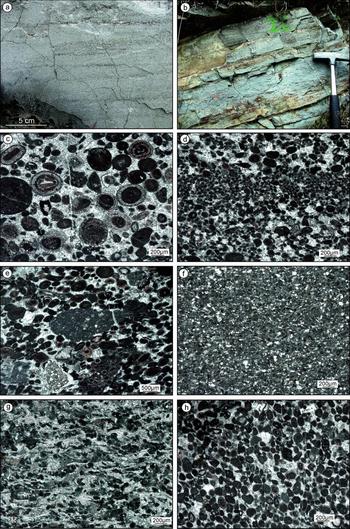
The contact between the breccia–shale interval and the Bükkzsérc Limestone (0.0–51.3 m) is either tectonic or a matrix/olistolith boundary, or both (the recovery was rather poor near the contact). This discontinuity is also supported by biostratigraphic data (see Section 4). In the lower part of the Bükkzsérc Limestone the medium- to coarse-grained calcarenites of oolitic grainstone and oolitic–lithoclastic grainstone texture are the most typical (Fig. 12). Among the bioclasts, fragments of crinoids and molluscs are the most common, but detritus of Rivularia-type calcimicrobes are also abundant.
Lithological features and typical microfacies of the Bükkzsérc Limestone: (a) graded oolitic carbonate turbidites in the lower part of the Bükkzsérc Quarry (Bed 10). (b) Thin-bedded cherty limestone bed with sinusoid parallel lamination in the middle part and horizontal parallel lamination in the upper part of the bed, Bükkzsérc Quarry, upper part (Bed 22). (c) Oolitic grainstone; medium-grained calcarenite. Some of the ooid grains were affected by micritization and then bioerosion; the others are only slightly altered. Bzs-5 (49.5 m). (d) Peloidal grainstone made up of alternation of graded laminae (distal turbidite). The peloids are mostly micritized ooids. Bzs-5 (45.0 m). (e) Oolitic, lithoclastic grainstone with oolitic packstone intraclast; radiolarian–‘filament’ wackestone lithoclast; sandy shale extraclast. (f) Peloidal wackestone with tiny ‘filament’ fragments. Bzs-5 (14.0 m). (g) Peloidal–‘filament’ packstone. Bzs-5 (8.4 m). (h) Peloidal, oolitic grainstone; fine-grained calcarenite. Bükkzsérc Quarry (Bed 14).

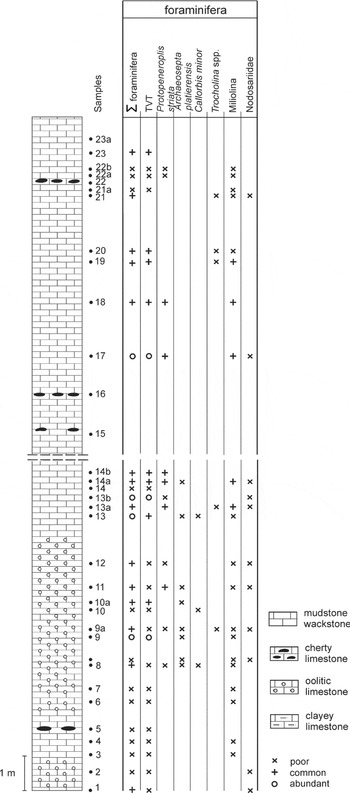
In the lower most part of the Bükkzsérc Limestone (51.6–45.0 m) the foraminifera fauna is characterized by the dominance of the agglutinated forms (TVT group), Mesoendothyra croatica and Gutnicella gr. cayeuxi (G. cayeuxi, G. brizonorum and G. minoricensis), indicating redeposition from the outer platform (sand shoal) environment. Mesoendothyra preferred the inner platform environment; it can be found in most of the section (up to sample 13 in the quarry), but only in small quantities. At 47.3 m, large Paravalvulininae (Riyadella spp. and Redmondoides lugeoni) occur, and at 45.7 m trocholinas (Trocholina conica and T. palastiniensis) and miliolinids (Labalina spp., Ophthalmidium spp.) occur (Fig. 11, 13). These latter groups, together with the TVT forms, are the most frequent in the upper part of the section (Fig. 11, 13, 14).
Characteristic foraminifera of the core Bzs-5, Bükkzsérc Quarry, Hódos-tető, Eregető and Pap-hegyes outcrops: (a) Trochammina sp., Bzs-5 (49.5 m); (b) Mesoendothyra croatica Gušić, Reference Gušić1969, Bzs-5 (42.0 m); (c) Gutnicella minoricensis (Bourrouilh & Moullade, Reference Bourrouilh and Moullade1963), Bzs-5 (48.0 m); (d) Gutnicella cayeuxi (Lucas, Reference Lucas1939), Bzs-5 (46.2 m); (e) Redmondoides lugeoni (Septfontaine, Reference Septfontaine1977), Bzs-5 (47.3 m); (f) Riyadella sp., Bzs-5 (47.3 m); (g) Trocholina conica (Schlumberger, Reference Schlumberger1898), Bzs-5 (32.0 m); (h) Trocholina palastiniensis Henson, Reference Henson1948, Bzs-5 (26.5 m); (i) Protopeneroplis striata Weynschenk, Reference Weynschenk1950, Bzs-5 (18.1 m); (j) Callorbis minor Wernli & Metzger, Reference Wernli and Metzger1990, Bzs-5 (43.0 m); (k) Placopsilina sp., Bzs-5 (37.0 m); (l) Placopsilina sp., Bzs-5 (27.9 m); (m) Verneuilinoides sp., Bükkzsérc Quarry (Bed 14a); (n) Trochammina sp., Bükkzsérc Quarry (Bed 14a); (o) Mesoendothyra croatica Gušić, Reference Gušić1969, Bükkzsérc Quarry (Bed 13b); (p) Archaeosepta platierensis Wernli, Reference Wernli1970, Bükkzsérc Quarry (Bed 7); (q) Archaeosepta platierensis Wernli, Reference Wernli1970, Bükkzsérc Quarry (Bed 14a); (r) Protopeneroplis striata Weynschenk, Reference Weynschenk1950, Bükkzsérc Quarry (Bed 13a); (s) Labalina praecostata (Kassimova, Reference Kassimova1971), Bükkzsérc Quarry (Bed 14a); (t) Trochammnina sp., Bükkzsérc Quarry (Bed 13b); (u) Labalina rawiensis (Pazdrowa, Reference Pazdrowa1959), Bükkzsérc Quarry (Bed 20); (v) L. cf. quinqueloculinoides (Danitch, Reference Danitch, Romanov and Danitch1971), Bükkzsérc Quarry (Bed 9); (w) Placopsilina sp., Hódos-tető; (x) Siphovalvulina sp., Hódos-tető; (y) Redmondoides lugeoni (Septfontaine, Reference Septfontaine1977), Hódos-tető; (z) Riyadella sp., Hódos-tető; (aa) Callorbis minor Wernli & Metzger, Reference Wernli and Metzger1990, Hódos-tető; (bb) Protopeneroplis striata Weynschenk, Reference Weynschenk1950, Hódos-tető; (cc) Hauraniinae indet., Eregető E; (dd) Kilianina cf. blancheti Pfender, Reference Pfender1933, Eregető; (ee) Meyendorffina cf. bathoniana Aurouze & Bizon, Reference Aurouze and Bizon1958, Eregető; (ff) Mesoendothyra croatica Gušić, Reference Gušić1969, Eregető; (gg) Labalina costata (Antonova, Reference Antonova1958b), Eregető; (hh) Trocholina palastiniensis Henson, Reference Henson1948, Eregető; (ii) Protopeneroplis striata Weynschenk, Reference Weynschenk1950, Eregető; (jj) Callorbis minor Wernli & Metzger, Reference Wernli and Metzger1990, Pap-hegyes.

Lithology and distribution of foraminifera in the section of the Bükkzsérc Quarry.

At 43.0 m, Protopeneroplis striata appears in large numbers and this species occurs in almost every sample upsection (in core Bzs-5 and also in the quarry). At the same level, Callorbis minor also appears and occurs in the studied samples up to sample 13 in the quarry. Higher up (37, 32.4 and 27.9 m) some specimens of an attached form belonging to the genus Placopsilina were recognized.
In the upper part of the cored section, the oolitic grainstone texture is still common but the grain size decreases (Fig. 12). Peloidal–‘filament’ wackestone–packstone and ‘filament’ mudstone interbeds also appear (Fig. 12). In the oolitic beds, clasts of deeper-water carbonates (peloidal–‘filament’ wackestone–packstone) and silicified radiolarian wackestone commonly occur. In some beds, along with carbonate lithoclasts, a few sand-sized shale and phyllite clasts and strongly altered volcaniclasts were also encountered (Fig. 12). The foraminifera fauna is characterized by the presence of Protopeneroplis striata, the TVT group and miliolinids.
Medium- to thin-bedded grey cherty limestone beds occur in the basal part of the quarry section. This interval is typified by peloidal grainstone with various amounts of ooids, cortoids and bioclasts. Fragments of thin-shelled bivalves (‘filaments’) are generally abundant; fragments of echinoderms and foraminifera (a few TVT, miliolinids) are usually present. This interval is overlain by a thick-bedded one that is made up of oolitic, peloidal grainstone (Fig. 12a, 14), with common occurrence of echinoderm detritus and foraminifera-like Archaeosepta platierensis (samples 7–14), several miliolinids (Labalina rawiensis, L. occulta, L. praecostata, L. cf. quinqueloculinoides), the TVT group, Protopeneroplis striata and a few Callorbis minor, Haplophragmoides sp., Nodosaria spp. and Lenticulina spp. This is followed by a thin-bedded interval with chert nodules that is characterized by radiolarian–filament wackestone. This in turn is overlain by another thick-bedded segment of peloidal grainstone texture. The topmost part of the section is again thin-bedded and cherty (Fig. 12b) with radiolarian wackestone–packstone texture. In these beds, the amount and the diversity of the foraminifera fauna strongly decrease.
Based on facies analysis of the approximately 50 m thick continuous succession, it is evident that the Bükkzsérc Limestone was accumulated at the toe of a carbonate platform foreslope and in a pelagic basin. Grains of the grainstone (ooids, cortoids, peloids and lithoclasts) were derived from a tropical carbonate platform and accumulated after redeposition in a toe-of-slope environment. The grainstone textures refer to a high-energy, probably current-controlled depositional environment, although the grading that is a typical feature of turbidites is only scarcely visible. The habitat of most of the foraminifera found in these beds was the inner platform (Siphovalvulina sp., Mesoendothyra croatica, Labalina rawiensis, Trocholina conica and T. palastiniensis) or the outer platform (e.g. Gutnicella spp., Protopeneroplis striata and Archaeosepta platierensis); the latter is commonly referred to as ‘threshold facies’ (e.g. Gušić, Reference Gušić1969; Wernli, Reference Wernli1970; Septfontaine, Reference Septfontaine1981; Haas et al. Reference Haas, Görög, Kovács, Ozsvárt, Matyók and Pelikán2006). The calcimicrobes may have occupied the platform and the upper slope. Crinoid meadows developed mostly on the slope terraces may have provided the crinoid detritus. The thin-shelled bivalves and some of the foraminifera (Labalina praecostata, Trochammina spp.) were inhabitants of the toe-of-slope and deeper open shelf (Clerc, Reference Clerc2005). The radiolarian-rich facies were formed in a pelagic basin.
It must be emphasized that we found only subordinate amounts of terrigenous extraclasts in the Bükkzsérc Limestone. They are made up almost exclusively of platform-derived carbonates, pelagic carbonates and biogenic siliceous components. The carbonate grains were usually transported and redeposited as individual grains (ooids, cortoids, bioclasts, etc.) suggesting a coeval active carbonate platform in the neighbourhood of the depositional area, due to relatively rapid cementation of the tropical platform sediments.
3.d. Summary of sedimentological characteristics and genetic interpretation of the studied succession
Siliciclastic turbidites of the Lökvölgy Formation were exposed in the deepest part of core Bzs-11. These beds were deposited by low-density turbidity currents in an outer fan setting. The radiolarian-bearing shale intercalation represents a basin plain setting.
The overlying Oldalvölgy–Csipkéstető Formation can be interpreted as a hemipelagic succession; the predominant part of the carbonate content may have been derived from a carbonate platform. The peloidal grainstone interbeds containing platform-derived foraminifera were deposited via low-density turbidity currents.
Core Bzs-11 exposed three breccia intervals within the Oldalvölgy–Csipkéstető Formation, which are made up predominantly of centimetre-sized clasts of volcanic rocks: andesite in the deepest and thickest bed and basalt in the higher, thinner beds. The age of the clasts is unknown, most probably Triassic, similar to that of the dated volcanic clasts in the higher part of the succession (Haas et al. Reference Haas, Kovács, Pelikán, Kövér, Görög, Ozsvárt, Józsa and Németh2011). The coarse clast-supported breccia may be interpreted as rock fall or mass gravity flow deposits, formed at the base of relatively steep slopes. The appearance of the coarse-grained gravity mass-flow deposits suggests the initiation of intense tectonic movements, probably the onset of nappe stacking.
Coarse calcarenite to fine calcirudite beds with polymictic lithoclasts and redeposited platform-derived bioclasts and ooids characterize the basal part of the Mónosbél Formation. In these beds, volcanic components are common and coarser-grained volcaniclastic interbeds also occur (cores Bzs-11, -10 and in some outcrops; Table 1; Fig. 15). The volcanic material is extremely variable, including clasts of andesite, dacite, rhyolite and rarely basalt. According to recent preliminary radiometric age data, the acidic volcanites are of early Late Triassic age (Haas et al. Reference Haas, Kovács, Pelikán, Kövér, Görög, Ozsvárt, Józsa and Németh2011).
Typical clastic components of olistostromes in various outcrop occurrences. (a) Mud-supported, coarse-grained polymict conglomerate (debrite), Meredek-lápa. (b) Bioclastic limestone with a phyllite extraclast, Meredek-lápa. (c) Polymict lithoclastic, bioclastic packstone, Meredek-lápa. (d) Gravel-sized radiolarian–‘filament’ wackestone clast (probably Triassic), Meredek-lápa. (e) Bioclastic, limestone with a phyllite extraclast, Hódos-tető. (f) Lithoclastic, oncoidal packstone, Solymos. (g) Lithoclastic, oncoidal packstone, Pap-hegyes. (h) Oolitic grainstone, Pap-hegyes.

In the lithoclastic beds of the investigated outcrops (Fig. 3), carbonate clasts are usually predominant (Table 1; Fig. 15). Based on their microfacies characteristics and in some cases their microfossil content, the limestone clasts were derived from previously deposited and already consolidated Jurassic formations: mostly from toe-of-slope (e.g. redeposited oolitic packstone, peloidal grainstone) and basinal (‘filament’ wackestone, sponge spicule wackestone, radiolaria wackestone) facies and rarely from carbonate platform (e.g. ostracodal wackestone) facies. The radiolarite clasts were probably also derived from Jurassic basinal facies. Triassic–Lower Jurassic carbonates also occur. Clasts derived from siliciclastic formations (silty claystone, siltstone, fine- to medium-grained quartz sandstone) are also common. These clasts probably derived from the Jurassic succession, since similar rock types are known in the study area (Lökvölgy Formation, Vaskapu Sandstone Formation). There are smaller and larger magmatic clasts derived from ophiolite as well as from acidic and intermediate magmatites. Clasts of phyllite and mica slate also occur, but rarely. The ages of these components are not known.
The rock types described above can be interpreted as mass-flow deposits containing millimetre- to centimetre-sized components derived from various sources. Some components were derived from metamorphic rocks; there are clasts originated from Triassic volcanites and shallow marine carbonates as well as from Jurassic rocks of basinal and platform foreslope facies. These sedimentological features suggest nappe stacking; the accreted nappes contained slightly metamorphosed slices and unmetamorphosed Triassic and Jurassic formations. Moreover, the platform-derived individual carbonate grains among the polymictic lithoclasts clearly indicate redeposition from a coeval carbonate platform. The mass-flow deposits (olistostromes) formed slope aprons along the front of the thrust belt. In the later stage of basin evolution, the size of the clasts increased and olistoliths of the Bükkzsérc Limestone became predominant in the upper part of the Mónosbél Formation. The large blocks may have been derived from out-of-sequence nappes of the previous platform foreland.
4. Biostratigraphy and chronostratigraphy
The biostratigraphy of the Mónosbél Group is based on radiolarians and foraminifera.
4.a. Radiolarian biostratigraphy
Radiolarians of Middle and Upper Jurassic formations have been investigated since the nineteenth century. In spite of this, their biostratigraphic interpretation is still questionable, because only a small proportion of radiolarian taxa have stratigraphic ranges that are constrained by other stratigraphically important fossils (e.g. Goričan, Reference Goričan1994; Baumgartner et al. Reference Baumgartner, O'Dogherty, Goričan, Urquhart, Pillevuit and De Wever1995; Kozur, Mock & Ožvoldová, Reference Kozur, Mock and Ožvoldová1996; Suzuki & Gawlick, Reference Suzuki, Gawlick, Weidinger, Lobitzer and Spitzbart2003; Beccaro, Reference Beccaro2004, Reference Beccaro2006; O'Dogherty et al. Reference O'Dogherty, Bill, Goričan, Dumitrica and Masson2005).
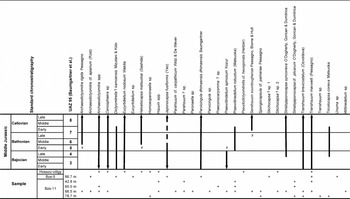
The age of the Bányahegy Radiolarite is of critical importance for the evaluation of the Jurassic successions. Therefore, new sampling was carried out on the Bányahegy Radiolarite exposed in the Hosszú-völgy road-cut section on the eastern slope of Odvas-bükk-tető (Fig. 3). This sample yielded numerous unidentifiable radiolarian shells and a few poorly preserved ones. Based on the presence of Helvetocapsa matsuokai and Transhsuum maxwelli, this assemblage could be assigned to Unitary Association Zones 95 (UAZ95) 3–10, providing a very wide age range from the Early–Middle Bajocian to Late Oxfordian–Early Kimmeridgian (Fig. 16).
Stratigraphic distribution and occurrences of the identified radiolarians in the studied samples.

On the eastern slope of Odvas-bükk-tető, the Bányahegy Radiolarite is overlain by the Lökvölgy Formation and then the Oldalvölgy–Csipkéstető Formation (Fig. 3, 4). In core Bzs-11, determinable radiolarians were found in four samples taken from the Oldalvölgy–Csipkéstető Formation. The lowermost sample (78.7 m) contained a poorly preserved and low-diversity radiolarian fauna (Fig. 16, 17). The sample 66.5 m yielded a moderately well-preserved and diversified fauna (Fig. 16). Sample 60.0 m contained a poorly preserved and low-diversity radiolarian fauna (Fig. 16) with Praewilliriedellum robustum, which probably indicates UAZ95 5–7. The sample taken from 42.8 m indicates UAZ95 5–7 (Baumgartner et al. Reference Baumgartner, O'Dogherty, Goričan, Urquhart, Pillevuit and De Wever1995) based on the co-occurrence of P. robustum and Transhsuum maxwelli.
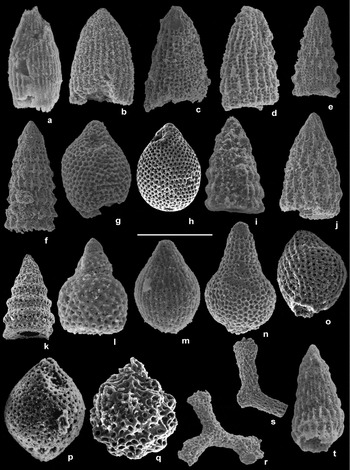
Radiolarians from core Bzs-11 and Hosszú-völgy outcrop: (a) Archaeodictyomitra rigida Pessagno, Reference Pessagno1977, Bzs-11 (66.5 m), scale bar = 100 μm; (b) Archaeodictyomitra cf. apiarium (Rüst, Reference Rüst1885), Bzs-11 (66.5 m), scale bar = 100 μm; (c) Parahsuum cf. carpathicum Widz & De Wever, Reference Widz and De Wever1993, Bzs-11 (66.5 m), scale bar = 100 μm; (d) Parahsuum? sp., Bzs-11 (42.8 m), scale bar = 85 μm; (e, f) Transhsuum brevicostatum (Ožvoldová, Reference Ožvoldova1975), Bzs-11 (66.5 m), scale bar = 200 μm; (g) Praewilliriedellum robustum (Matsuoka, Reference Matsuoka1984), Bzs-11 (66.5 m), scale bar = 165 μm; (h) Praewilliriedellum robustum (Matsuoka, Reference Matsuoka1984), Bzs-11 (78.7 m), scale bar = 160 μm; (i) Transhsuum sp., Bzs-11 (66.5 m), scale bar = 185 μm; (j) Semihsuum sourdoughense Pessagno et al. Reference Pessagno, Blome, Hull and Six1993, Bzs-11 (66.5 m), scale bar = 185 μm; (k) Dictyomitrella? kamoensis Mizutani & Kido, Reference Mizutani and Kido1983, Bzs-5 (66.7 m), scale bar = 100 μm; (l) Eucyrtidiellum nodosum Wakita, Reference Wakita1988, Hosszú-völgy, scale bar = 180 μm; (m) Helvetocapsa matsuokai (Sashida, Reference Sashida1988), Bzs-11 (66.5 m), scale bar = 125 μm; (n) Stichocapsa? sp. 1, Bzs-11 (66.5 m), scale bar = 175 μm; (o) Striatojaponocapsa synconexa O'Dogherty, Gorican & Dumitrica, Reference O'Dogherty, Bill, Goričan, Dumitrica and Masson2005, Bzs-11 (66.5 m), scale bar = 175 μm; (p) Japonocapsa. fusiformis (Yao, Reference Yao1979), Bzs-11 (60.0 m), scale bar = 135 μm; (q) Praeconocaryomma? sp., Bzs-11 (60.0 m), scale bar = 100 μm; (r) Paronaella sp., Bzs-11 (66.5 m), scale bar = 200 μm; (s) Homoeparonaella sp., Hosszú-völgy, scale bar = 200 μm; (t) Williriedellum sp., Bzs-11 (66.5 m), scale bar = 190 μm.

According to Baumgartner et al. (Reference Baumgartner, O'Dogherty, Goričan, Urquhart, Pillevuit and De Wever1995) UAZ95 5–7 correspond to an Early Bathonian–Early Callovian age. Beccaro (Reference Beccaro2006) established a new, better-defined radiolarian biozonation for the Middle and Late Jurassic epochs, where the UAZ95 6–7 correspond to UAZ-SA A–B, which were assigned to the (?Early)–Middle Bathonian to Early Oxfordian. The top of the UAZ-SA B is not directly constrained by stratigraphically important fossils but it must be older than Middle Oxfordian, owing to the precise age assignment of UAZ-SA C (Beccaro, Reference Beccaro2006). According to the detailed biostratigraphic works of Suzuki & Gawlick (Reference Suzuki, Gawlick, Weidinger, Lobitzer and Spitzbart2003) and Auer et al. (Reference Auer, Gawlick, Suzuki and Schlagintweit2009) UAZ-SA A–B corresponds approximately to the Eucyrtidiellum unumaense and the lower part of the Protunuma lanosus radiolarian zones set up in the Northern Calcareous Alps. In summary, according to the radiolarian data, the Oldalvölgy–Csipkéstető Formation in core Bzs-11 is most probably Bathonian (?Early Callovian) in age.
In core Bzs-5 only one sample taken from 66.7 m, probably representing the Oldalvölgy–Csipkéstető Formation, contained a moderately to poorly preserved radiolarian fauna. It is characterized mostly by nassellarians (Fig. 16). According to Kozur (Reference Kozur1984), Japonocapsa fusiformis occurs in the Bajocian–Lower Bathonian of the Bükk Mountains. However, this species was also reported from the Aalenian (Suzuki & Ogane, Reference Suzuki and Ogane2004) and with uncertainties (cf. and aff.) from the lowermost Oxfordian (Missoni et al. Reference Missoni, Gawlick, Suzuki and Diersche2005). This range roughly corresponds to the Eucyrtidiellum unumaense Middle Jurassic radiolarian zone of Suzuki & Gawlick (Reference Suzuki, Gawlick, Weidinger, Lobitzer and Spitzbart2003) and Auer et al. (Reference Auer, Gawlick, Suzuki and Schlagintweit2009).
4.b. Foraminifera biostratigraphy
Previously, Bérczi-Makk studied the foraminifera fauna of cores Bzs-5, -10 and -11, and some outcrops (in Bérczi-Makk & Pelikán, Reference Bérczi-Makk and Pelikán1984; Bérczi-Makk, Reference Bérczi-Makk1999). She found foraminifera in only a single level in core Bzs-10 and in two levels in core Bzs-11. From the latter core, Bérczi-Makk illustrated Lenticulina spp., which she defined as various species of the genus Epistomina (Bérczi-Makk, Reference Bérczi-Makk1999, pl. X, fig. 1) and assigned these samples to the Bathonian–Callovian. She identified the recrystallized miliolinids (Labalina spp., Ophthalmidium spp.) as Involutina bükki or as Spirillina sp. (e.g. Bérczi-Makk, Reference Bérczi-Makk1999, pl. XI, fig. 1) from core Bzs-10 as well as from an outcrop at Odvas-bükk-tető (Bérczi-Makk & Pelikán, Reference Bérczi-Makk and Pelikán1984). Based on the ambiguous identification of Planularia? (e.g. Bérczi-Makk, Reference Bérczi-Makk1999, pl. XI, fig. 4) and Lingulina nodosaria (e.g. Bérczi-Makk, Reference Bérczi-Makk1999, pl. XI, fig. 5), she assigned these beds to the Callovian–Oxfordian. From Meredek-lápa, Mesoendothyra cf. croatica was reported by Bérczi-Makk & Pelikán (Reference Bérczi-Makk and Pelikán1984, p. 142), although the location of the sample is somewhat ambiguously indicated on plate III. Otherwise, the illustrated specimens (pl. III, figs 5, 7) that were assigned to Paalzowella cf. turbinella belong to the genus Siphovalvulina, suggesting a Middle Jurassic age. In core Bzs-5, Bérczi-Makk (Reference Bérczi-Makk1999) recognized a Gutnicella gr. cayeuxi horizon and the appearance of Protopeneroplis striata above it. Referring to the work of Allemann & Schroeder (1975), who assigned this species to the Bajocian–Bathonian, she classified the entire succession of core Bzs-5 and the Bükkzsérc Quarry (referred to as Patkó cliff, Bükkzsérc) to the Bathonian–Callovian. It must be noted that the cited data are rather uncertain and the age assignment is unique in the literature.
The study of the foraminifera fauna in the succession exposed by core Bzs-11 led to important new results. It is particularly important that we found foraminifera (Labalina rawiensis, Labalina sp., Nodosaria sp. and Cylindrotrocholina excels) in the lower sandstone–shale interval that was assigned to the Lökvölgy Formation in core Bzs-11. These forms suggest a Middle Jurassic (Early Bajocian–Early Bathonian) age (Ruggieri & Giunta, Reference Ruggieri and Giunta1965; Clerc, Reference Clerc2005).
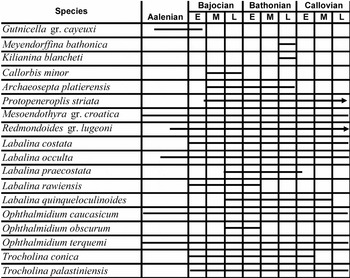
The co-occurrence of Mesoendothyra croatica, Labalina rawiensis, L. costata, L. occulta, Ophthalmidium caucasicum and Trocholina palastiniensis in the overlying limestone–radiolarite interval (Oldalvölgy–Csipkéstető Formation), both in cores Bzs-10 and -11, suggests a Middle Jurassic (probably Early Bajocian–Early Bathonian) age (Fig. 18; Derin & Reiss, Reference Derin and Reiss1965; Gutnic & Moullade, Reference Gutnic and Moullade1967; Septfontaine, Reference Septfontaine1974, Reference Septfontaine1978, Reference Septfontaine1981; Sotak, Reference Sotak1987; Heinz & Isenschmidt, Reference Heinz and Isenschmid1988; Banner, Simmons & Whittaker, Reference Banner, Simmons and Whittaker1991; Chiocchini & Mancinelli, Reference Chiocchini and Mancinelli1996; Bassoullet, Reference Bassoullet, Cariou and Hantzpergue1997; Clerck, Reference Clerc2005; Velić, Reference Velić2007).
Stratigraphic distribution of the most important taxa of the studied section based on Banner, Simmons & Whittaker (Reference Banner, Simmons and Whittaker1991), Bassoullet (Reference Bassoullet, Cariou and Hantzpergue1997), Chiocchini & Mancinelli (Reference Chiocchini and Mancinelli1996), Clerck (Reference Clerc2005), Derin & Reiss (Reference Derin and Reiss1965), Heinz & Isenschmidt (Reference Heinz and Isenschmid1988), Gutnic & Moullade (Reference Gutnic and Moullade1967), Septfontaine (Reference Septfontaine1974, Reference Septfontaine1978, Reference Septfontaine1981), Sotak (Reference Sotak1987) and Velić (Reference Velić2007).

In the upper part of cores Bzs-10 and -11, Late Triassic and Early and Middle Jurassic foraminifera faunas (similar, but poorer than below) were found in the polymictic olistostrome horizons. The Late Triassic and Early Jurassic faunas occur in carbonate lithoclasts while the Middle Jurassic elements redeposited from unconsolidated sediment may be roughly coeval with the deposition of the olistostrome beds. Above the top of the core sections, blocks of the Bükkzsérc Limestone were mapped on the higher part of the slope of Odvas-bükk-tető, which contains Middle Jurassic faunas (i.e. Trocholina cf. palastiniensis, Protopeneroplis striata) in contrast to the previous Toarcian age dating for this locality (Bérczi-Makk & Pelikán, Reference Bérczi-Makk and Pelikán1984).
In the type locality of the Bükkzsérc Formation the oldest layers (core Bzs-5, 51.9–45.0 m) are characterized the presence of the Aalenian–Early Bajocian Gutnicella gr. cayeuxi. Protopeneroplis striata was found above it (at 43.0 m). Both are characteristic forms of the outer platform environments (e.g. Septfontaine, Reference Septfontaine1981), but according to the relevant literature they never occur in the same stratigraphic level (e.g. Dufaure, Reference Dufaure1958; Raffi & Forti Reference Raffi and Forti1959; Radoičič, Reference Radoičič1966, Reference Radoičič1987; Gutnic & Moullade, Reference Gutnic and Moullade1967; Crescenti, Reference Crescenti1969, Reference Crescenti1971; Velić, Reference Velić2007). Co-occurrence of these two species in breccia beds of Bey Dağlari, Taurus, Turkey (Bassoullet & Poisson, Reference Bassoullet and Poisson1975) as well as in similar rocks in Iraqi Kurdistan (Radoičič, Reference Radoičič1987) can be explained by sedimentological reasons, i.e. reworking of the older elements in clasts.
We have to note that there is only one uncertain record of the presence of the Gutnicella group in Upper Bajocian strata (Dufaure, Reference Dufaure1958) and only very doubtful data are available on the occurrence of Protopeneroplis in Aalenian strata (Ferrari, Reference Ferrari1962; Brun, Reference Brun1968). There is no unambiguous record of this species from Lower Bajocian strata. Based on these facts, Gutnicella gr. cayeuxi indicates an Aalenian–Early Bajocian age, while the first occurrence of the genus Protopeneroplis can be dated to the late Early Bajocian. Thus, the disappearance of the Gutnicella group and the appearance of Protopeneroplis striata and Callorbis minor at about 43.0 m in core Bzs-5 would indicate the beginning of the Middle Bajocian (Humphriesianum Zone).
The appearance of Archaeosepta platierensis in Bed 7 in the Bükkzsérc Quarry indicates the beginning of the Late Bajocian. Based on the co-occurrence of A. platierensis, Callorbis minor and Labalina praecostata in Bed 13, this layer is older than Bathonian, most probably Late Bajocian. In Beds 15–23 there are no suitable age indicator foraminifera. Based on the presence of the earliest Bajocian to latest Callovian Labalina rawiensis up to Bed 21, only a Late Jurassic age for this interval can be excluded.
An assemblage characterized by Protopeneroplis striata and Callorbis minor similar to that in 43–32 m of core Bzs-5 was recognized in lithoclastic beds in the Hódos-tető and Pap-hegyes localities (Fig. 3, 13). These forms indicate a Middle to Late Bajocian age.
In the samples from Eregető, Late Bathonian complex agglutinated forms like Meyendorffina cf. bathonica and Kilianina cf. blancheti were recognized; this is the youngest assemblage found in the study area. The presence of the larger orbitolinids Gutnicella, Meyendorffina and Kilianina indicate continuous carbonate platform development during the (Aalenian)–Early Bajocian–Late Bathonian interval in the proximity of the depositional area of the Mónosbél Group.
4.c. Chronostratigraphic interpretation
There are uncertainties in the structural model, which influence the assumed relationships of the lithostratigraphic units, and there are uncertainties in the radiolarian and foraminifera biostratigraphy as well; thus, the construction of a coherent chronostratigraphic scheme is not easy. Based on our studies the following interpretation can be outlined. Evaluation of the new radiolarian data allowed a very wide age range for the Bányahegy Radiolarite from the Early Bajocian to the Early Kimmeridgian. If a younger age (younger than Bajocian) is valid, we must find a tectonic solution as was proposed by Csontos (Reference Csontos2000). However, if the Bányahegy Radiolarite is Early Bajocian in age, a continuous succession from the Bányahegy Radiolarite through the Lökvölgy Formation to the Mónosbél Group cannot be excluded either (see Fig. 4). We have a few foraminifera biostratigraphic data from the upper part of the Lökvölgy Formation suggesting an Early Bajocian to Early Bathonian age. Based on the foraminifera fauna in core Bzs-11, the Oldalvölgy–Csipkéstető Formation can be assigned to the Early Bajocian–Early Bathonian as well. Taking into account all of these data, the age of the Oldalvölgy–Csipkéstető Formation is Bathonian, probably Early Bathonian (Fig. 4).
Radiolarians found at 66.7 m in core Bzs-5 indicate an Early Bajocian to Early Bathonian age. However, this fauna was derived from breccia grains. Consequently the depositional age of the breccia bed, which is assigned to the Mónosbél Group, is probably Bathonian in age.
Based on the foraminifera fauna, the age of the Bükkzsérc Limestone in core Bzs-5 is (Aalenian?)–Early Bajocian. This age date suggests that the Bükkzsérc Limestone is present here as a block (or blocks) within the Mónosbél Group (Fig. 4). The age range of the Bükkzsérc Limestone encompasses the (Aalenian?) Early Bajocian to the Late Bajocian.
According to the foraminifera fauna encountered in the sample from Eregető E, the deposition of the lithoclastic beds (Mónosbél Formation) continued at least until Late Bathonian time (Fig. 4).
5. Relationships
In northeastern Hungary (Darnó Unit and Rudabánya Hills) and southeastern Slovakia (Meliata Unit), Middle to Upper Jurassic polymictic redeposited gravity deposits and ophiolite mélange complexes are known that show more or less similar features to those in the southwestern Bükk Mountains. They can be interpreted as tectonically transported, dispersed elements of the Neotethys suture zone (e.g. Pamić, Reference Pamić1997; Haas & Kovács, Reference Haas and Kovács2001; Dimitrijevic et al. Reference Dimitrijević, Dimitrijević, Karamata, Sudar, Gerzina, Kovács, Dosztály, Gulácsi, Less and Pelikán2003; Haas et al. Reference Haas, Görög, Kovács, Ozsvárt, Matyók and Pelikán2006, Reference Haas, Kovács, Pelikán, Kövér, Görög, Ozsvárt, Józsa and Németh2011) (Fig. 1).
The Mónosbél Group extends over the limits of the study area in the Bükk Mountains and continues into the Darnó area (Fig. 1). It was also recognized in ore exploratory wells in the basement of a Tertiary sedimentary and volcanic complex in the Mátra Mountains (Haas et al. Reference Haas, Görög, Kovács, Ozsvárt, Matyók and Pelikán2006, Reference Haas, Kovács, Pelikán, Kövér, Görög, Ozsvárt, Józsa and Németh2011; Kovács et al. Reference Kovács, Csontos, Szabó, Bali, Falus, Benedek and Zajacz2007). Olistoliths of marine Upper Permian and Upper Triassic Hallstatt Limestone were encountered here within Bajocian to Callovian shale and radiolarite. The thickness of the olistostrome-rich intervals may exceed 100 m. The usually matrix-supported breccia is made up mostly of radiolaria-bearing silicified rock types (radiolarian wackestone and packstone, radiolarite). However, a thin intercalation with redeposited oolite and oncoid grains was also encountered in a studied core section (Haas et al. Reference Haas, Kovács, Pelikán, Kövér, Görög, Ozsvárt, Józsa and Németh2011). In a borehole (Rm-109) drilled near Kékes Peak (Mátra Mountains), Bajocian platform-derived redeposited carbonates, more proximal than those in the Bükk Mountains, were encountered in a thickness of more than 200 m (Haas et al. Reference Haas, Görög, Kovács, Ozsvárt, Matyók and Pelikán2006).
Olistostrome, graded calcarenite and mixed siliciclastic–carbonate sandstone beds were recently found on the southern slope of Csipkés Hill, Rudabánya Hills, northeast of the Bükk Mountains (Fig. 1) (Kövér et al. Reference Kövér, Haas, Görög, Józsa, Ozsvárt and Götz2009). The foraminifera assemblage (Callorbis minor, Protopeneroplis striata, Planiinvoluta sp., Trochammina sp, Siphovalvulina sp., Tubinella? sp.) found in the matrix of graded turbiditic beds is similar to that found in the Bükkzsérc Limestone. The upper part of the section contains olistostrome horizons. The olistostromes are grain-supported, containing clasts from 1–2 mm to 40–50 mm in size. Typical components are Middle Triassic grey platform carbonates (Steinalm Limestone), Middle and Upper Triassic red cherty limestone of basin facies (Bódvalenke Formation) and Upper Triassic pink and grey limestone of basin facies (Hallstatt Limestone) (Kövér et al. Reference Kövér, Haas, Görög, Józsa, Ozsvárt and Götz2009).
There are two important occurrences of the Meliata Unit in southeastern Slovakia (Faryad, Reference Faryad1999) (Fig. 1.). Near the village of Meliata, dark shale with radiolarite, sandstone and olistostrome intercalations occurs. Based on radiolarians, the age of the radiolarite interbeds is Middle Bathonian to Early Oxfordian (Kozur, Mock & Ožvoldová, Reference Kozur, Mock and Ožvoldová1996). Large blocks (olistoliths) of Triassic rocks and Triassic and Jurassic radiolarite commonly occur in the shale matrix. The olistostromes contain mostly carbonate clasts (Carnian grey cherty limestone, Carnian and Norian limestone), but red radiolarian chert clasts also occur (Mock et al. Reference Mock, Sýkora, Aubrecht, Ožvoldová, Kronome, Reichwalder and Jablonský1998). In some breccia beds the basalt clasts are predominant (Mock et al. Reference Mock, Sýkora, Aubrecht, Ožvoldová, Kronome, Reichwalder and Jablonský1998).
The other important occurrence of the Meliata Unit is located near to the village of Jaklovce. Here the mélange is made up mostly of olistoliths of various sizes, whereas the sandstone to microbreccia and olistostrome intercalations are less common in the Middle Jurassic dark shale matrix (Kozur & Mock, Reference Kozur and Mock1995). The blocks consist of light, probably shallow marine, slightly metamorphosed limestone, siliciclastic rocks, pelagic cherty limestone, dolomite, radiolarite, rhyolite, basalt and serpentinite. Aalenian–Bajocian and Callovian–Oxfordian radiolarian faunas were found in the red limestone, and radiolarite occurs above the basalt blocks (Aubrecht et al. Reference Aubrecht, Gawlick, Missoni, Suzuki, Plašienka, Kronome and Kronome2010).
A strongly tectonized and partly reworked ophiolite mélange complex occurs in the northwestern part of Medvednica Mountains, southern part of Ivanščica Mountains, in the southeastern part of Samoborska Gora and in the central part of the Kalnik Mountains in Croatia, which were assigned to the Kalnik Unit (Fig. 1) (Haas et al. Reference Haas, Mioč, Pamić, Tomljenović, Árkai, Bérczi-Makk, Koroknai, Kovács and Rálisch-Felgenhauer2000). In the mélange complex, large blocks of basalt, gabbro, serpentinite, radiolarite and limestone of various facies and ages occur in a radiolarite and shale matrix (Pamić, Reference Pamić2003).
From the Medvednica Mountains, Triassic carbonate olistoliths and matrix-supported polymictic conglomerates containing clasts of Triassic radiolarian chert, Jurassic silicified shale and sandstone, basalt and ultramafic magmatic rocks were reported. Radiolarians found in the radiolarite matrix proved a latest Bajocian–Early Bathonian to Late Bathonian–Early Callovian age for the mélange complex (Halamić et al. Reference Halamić, Goričan, Slovenec and Kolar-Jurkovšek1999; Halamić, Marchig & Goričan, Reference Halamić, Marchig and Goričan2005). This lithofacies is very similar to those of the Mónosbél Formation in the Bükk as far as both the matrix and the components of the olistostromes are concerned; moreover their ages are also similar. In the Jurassic mélange complex of Kalnik Mountains the Triassic basalt olistoliths show definite genetic relationships with the Triassic volcanite bodies known in the Darnó area, North Hungary (Kiss, Molnár & Palinkaš, Reference Kiss, Molnár and Palinkaš2008; Kiss et al. Reference Kiss, Molnár, Kovács and Palinkaš2010).
In the Dinarides, ophiolite mélange complexes comparable to those in the Bükk area occur in the Dinaridic Ophiolite Belt (Fig. 1) (Dimitrijević et al. Reference Dimitrijević, Dimitrijević, Karamata, Sudar, Gerzina, Kovács, Dosztály, Gulácsi, Less and Pelikán2003). The ophiolite mélange contains fragments of obducted ophiolite (lherzolite), Triassic and Jurassic limestone olistoliths, and polymictic olistostromes. Carnian to Upper Jurassic radiolarian chert (Goričan, Karamata & Batoćanin-Srećković, Reference Goričan, Karamata and Batoćanin-Srećković1999; Vishnevskaya, Derić & Zakariadze, Reference Vishnevskaya, Derić and Zakariadze2009), greywacke, basalt, gabbro, ultramafic rocks, granite, and Triassic and Jurassic limestone are typical clastic components of the olistostromes. The Jurassic matrix is usually argillaceous, silty, less frequently sandy and locally radiolaritic (Karamata et al. Reference Karamata, Dimitrijević, Dimitrijević, Milovanović, Karamata and Janković2000; Pamić, Tomljenović & Balen, Reference Pamić, Tomljenović and Balen2002; Dimitrijević et al. Reference Dimitrijević, Dimitrijević, Karamata, Sudar, Gerzina, Kovács, Dosztály, Gulácsi, Less and Pelikán2003; Karamata, Reference Karamata, Robertson and Mountrakis2006; Robertson, Karamata & Šarić, Reference Robertson, Karamata and Šarić2009, Gawlick et al. Reference Gawlick, Sudar, Suzuki, Derić, Missoni, Lein and Jovanović2009).
Many common sedimentological features of the Jurassic complexes discussed above can be limited to the processes of the Neotethys closure. However, owing to their different palaeo-position, the composition of the redeposited clasts shows significant differences depending on geologic features of the source area. The most striking difference is the common occurrence of the Middle Jurassic redeposited oolitic lithoclasts, olistoliths and individual ooids and platform-derived bioclasts in the olistostromes of the Bükk Mountains, which was not reported from Dinaridic olistostromes. However, Middle Jurassic bioclastic and oolitic carbonate turbidite interbeds were encountered in radiolarite of some exposures in the Dinaridic Ophiolite Belt (Haas et al. Reference Haas, Kovács, Karamata, Sudar, Gawlick, Grădinaru, Mello, Polák, Péró, Ogorelec, Buser, Vozár, Ebner, Vozarová, Haas, Kovács, Sudar, Bielik and Péró2010).
6. Jurassic geodynamic setting and related sediment deposition in the Bükk area in the frame of the western Neotethys evolution
The Bükk Unit reached its present-day setting only during Tertiary time as a result of multiple large-scale tectonic movements along the Mid-Hungarian Fault Zone, together with other fragments originating from various parts of the South Alpine and Dinaridic domains (e.g. Csontos et al. Reference Csontos, Nagymarosy, Horváth and Kováč1992; Csontos & Nagymarosy, Reference Csontos and Nagymarosy1998; Fodor et al. Reference Fodor, Márton, Jelen, Báldi-Beke, Kázmér and Rifelj1999; Schmid et al. Reference Schmid, Bernoulli, Fügenschuh, Matenco, Schuster, Schefer, Tischler and Ustaszewski2008; Kovács & Haas, Reference Kovács and Haas2010). Its primary nappe stacking, regional metamorphism and folding took place during Late Mesozoic times, prior to the long-distance displacement of the unit. Consequently, the Alpine geodynamic evolution of the Bükk area and its tectonically controlled sediment deposition can be interpreted only within the framework of the evolution of the northwestern Neotethys realm.
The geodynamic and palaeogeographic interpretation of the northwestern Neotethys has been the subject of discussions for a long time. The key issue of the debate is the interpretation of the structural setting and evolution of the Dinaridic Ophiolite Belt. According to several authors it is the remnant of an in situ oceanic basin (e.g. Dimitrijević, Reference Dimitrijević1997; Dimitrijević et al. Reference Dimitrijević, Dimitrijević, Karamata, Sudar, Gerzina, Kovács, Dosztály, Gulácsi, Less and Pelikán2003; Karamata, Reference Karamata, Robertson and Mountrakis2006) that can be correlated with the Pindos oceanic basin in the Hellenides (Robertson & Shallo, Reference Robertson and Sallo2000; Stampfli et al. Reference Stampfli, Borel, Cavazza, Mosar and Ziegler2001; Csontos & Vörös, Reference Csontos and Vörös2004; Karamata, Reference Karamata, Robertson and Mountrakis2006; Robertson, Karamata & Sarić, Reference Robertson, Karamata and Šarić2009). According to other authors it is an ophiolite nappe, emplaced by westward obduction from the Vardar Zone (e.g. Bortolotti et al. Reference Bortolotti, Marroni, Pandolfi and Principi2005; Schmid et al. Reference Schmid, Bernoulli, Fügenschuh, Matenco, Schuster, Schefer, Tischler and Ustaszewski2008; Gawlick et al. Reference Gawlick, Frisch, Hoxha, Dumitrica, Krystyn, Lein, Missoni and Schlagintweit2008). There is a crucial difference between the two models. In the former the Jadar, Drina-Ivanjica and other units were dismembered from the Adriatic margin as a result of the opening of the western oceanic basin (Dinaridic Ophiolite Belt), while in the latter they are tectonic windows exposing the distal Adriatic margin.
The metamorphic soles of the Dinaridic ophiolite formed during Middle to Late Jurassic time (based mostly on K–Ar dating of 147–174 Ma; Sprey et al. Reference Spray, Bebien, Rex, Roddick, Dixon and Robertson1984; Karamata, Reference Karamata1985). The ophiolite and the associated mélange represent a subduction complex controlled by tectonic accretion and sedimentary redeposition (Robertson, Karamata & Šarić, Reference Robertson, Karamata and Šarić2009). Collision of a subduction trench with a continental margin may have been the cause of the Jurassic ophiolite emplacement. However, parts of the western Neotethys Ocean (the Vardar Zone Western Belt – Karamata, Reference Karamata, Robertson and Mountrakis2006; Sava Zone – Schmid et al. Reference Schmid, Bernoulli, Fügenschuh, Matenco, Schuster, Schefer, Tischler and Ustaszewski2008) remained open until Late Cretaceous time; its closure was followed by regional-scale southward thrusting.
The Upper Palaeozoic to Triassic succession of the Bükk Mountains shows striking similarity to that of the Carnic Alps–Southern Karawanks, the Julian Alps, and the Sana–Una and Jadar blocks of the Dinarides (e.g. Protić et al. Reference Protić, Filipović, Pelikán, Jovanović, Kovács, Sudar, Hips, Less, Cvijić, Karamata and Janković2000; Filipović et al. Reference Filipović, Jovanović, Sudar, Pelikán, Kovács, Less and Hips2003), suggesting that in Late Palaeozoic time they were located in the inner offshore zone of the Tethys, relatively close to each other. In Early Triassic time they were parts of a rather uniform marginal ramp typified by mixed siliciclastic and carbonate sedimentation that turned to carbonate deposition in the Anisian (Hips & Pelikán, Reference Hips and Pelikán2002). Neotethys rifting in Late Anisian to Early Ladinian time led to segmentation of this ramp; isolated platforms and grabens were formed (Velledits, Reference Velledits2000). These plate tectonic processes may have led to separation of the Adriatic–Dinaridic Carbonate Platform, where the shallow marine conditions continued throughout the Jurassic to Cretaceous period (Tišljar et al. Reference Tišljar, Vlahović, Velić and Sokač2002), and, at least according to some of the interpretations (e.g. Robertson, Karamata & Saric, Reference Robertson, Karamata and Šarić2009), dismembering of large blocks from the Adriatic margin, the Jadar and the Bükk units among others.
The area of the Bükk Mountains was also subject to extensional tectonics and related volcanic activity in Late Anisian to Carnian time (Velledits, Reference Velledits2000). Carbonate platforms and intraplatform basins developed. During Late Triassic time, continuous extension led to tectonically forced backstepping and to drowning of the platforms that was completed by the end of the Triassic Period. In Early Jurassic time, the former platforms were transformed into submarine highs with only local, ephemeral sediment deposition. In Middle Jurassic time, the deepening continued and at some time during Middle or early Late Jurassic time, a radiolarite veneer was formed, covering both the previous platform and basin deposits. Then coarse- to fine-grained siliciclastic sediments (Vaskapu Sandstone) and distal siliciclastic turbidites (Lökvölgy Formation) were deposited in a deep-sea basin developed above the attenuated continental crust. Owing to the discussed uncertainties of the age of these formations, their spatial and temporal relationship with the Mónosbél Group is still not clear.
The composition of the Mónosbél Group is complex, reflecting its multi-stage depositional history. The oldest biostratigraphically dated element of the Mónosbél Group is the (Aalenian?) Lower to Upper Bajocian Bükkzsérc Limestone, although it must be kept in mind that these rocks are usually present as smaller or larger redeposited fragments. The large blocks would have slid down from the neighbouring area into the deep depositional basin in late Middle Jurassic time, most probably in Late Bathonian time. It must be noted here that beds containing fine, redeposited shallow marine carbonate grains (ooids, cortoids, peloids and bioclasts) are also present in the hemipelagic Oldalvölgy Formation, and in some olistostromes of the Mónosbél Formation, individual platform-derived grains were also found. These facts imply continuing shallow marine input during Middle Jurassic time, at least until Late Bathonian time.
The grains of the Bükkzsérc Limestone were formed on a carbonate platform; the redeposited particles were accumulated in the foreland of a platform foreslope. The Adriatic–Dinaridic Carbonate Platform (ADCP) is the only preserved large carbonate platform in the wider region that was active during Middle Jurassic time. Along with the previously discussed geodynamic constraints, we assume that the ADCP was the provenance of the Bükkzsérc Limestone. However, a hypothetical non-preserved platform as provenance cannot be excluded. In Middle Jurassic time mostly oolitic sediments were formed in the northeastern part of the ADCP (Dragičević & Velić, Reference Dragičević and Velić2002). In several places coeval slope and toe-of-slope facies of the ADCP were also preserved. During Late Bajocian to Bathonian time, a thick, redeposited oolitic limestone succession accumulated in the Belluno Trough at the northwestern end of the ADCP (Friuli Platform) (Bosellini, Masetti & Sarti, Reference Bosellini, Masetti and Sarti1981; Clari & Masetti, Reference Clari, Masetti and Santantonio2002). At the same time, limestone containing carbonate lithoclasts and redeposited ooid grains was formed along the slope of the ADCP in the Slovenian Trough (surroundings of Tolmin), pinching out and interfingering with pelagic deposits northeastward (Rožič & Popit, Reference Rožič and Popit2006; Rožič, Reference Rožič2009). Similar sequences were reported from Mt Žumberak, Croatia (Bucković, Tešović & Gušić, Reference Bucković, Tešović and Gušić2004; Bucković, Reference Bucković2006) and further southeastward along the ADCP margin (Dragičević & Velić, Reference Dragičević and Velić2002). Textural features, microbiofacies and microfossils (e.g. foraminifera fauna) of these formations are very similar to those of the Bükkzsérc Limestone (Haas et al. Reference Haas, Görög, Kovács, Ozsvárt, Matyók and Pelikán2006). Distal toe-of-slope and pelagic basin facies were found as intercalations within the Bükkzsérc Limestone (e.g. in the Bükkzsérc Quarry). These are similar to those facies, which are predominant in the Oldalvölgy–Csipkéstető Formation. They imply a similar interfingering of the slope-related and basin facies reported from the Slovenian Trough (Rožič & Popit, Reference Rožič and Popit2006).
According to our concept, deposition of toe-of-slope and proximal basin facies of the Bükkzsérc Limestone represents the passive margin evolutionary stage of the Adriatic (Apulian) margin of the western Neotethys during Bajocian time. Dismembered and drowned blocks of the former platforms were already deep pelagic basins, by that time far from the still-existing platform.
The appearance of the polymictic gravity deposits (olistostromes), and later on large slid blocks (olistoliths), suggests the onset of the formation of accretionary complexes in the third stage of the evolution in Late Bathonian time. The compressive tectonic movements led to imbrication, stacking of thrust slices and uplifting and disruption of the previously deposited and already lithified periplatform carbonate deposits. In the course of the overthrusting movements, the older basement rocks may also have been exposed and subjected to erosion.
In the Bükk Unit, obduction may have taken place during Middle Jurassic to earliest Cretaceous time (Balla, Reference Balla1987; Csontos, Reference Csontos2000) and led to development of a subduction-related mélange complex containing blocks of ophiolite and fragments of the Adriatic continental margin. Further compression resulted in the overthrust of the mélange complex onto the blocks dismembered earlier from the Adriatic margin, leading to regional metamorphism of the Upper Palaeozoic to Upper Jurassic formations in late Early Cretaceous (110–120 Ma) and Late Cretaceous (90 Ma) times (Árkai, Balogh & Dunkl, Reference Árkai, Balogh and Dunkl1995).
7. Conclusions
(1) Displaced elements of the Neotethys ophiolite mélange complex occur in the Bükk-Darnó area, in North Hungary. Study of the depositional facies and age determination of the subduction-related sedimentary formations on the one hand, and detailed petrographic analysis, facies interpretation and age determination of the clastic components of the mélange on the other, provided important data for detection of the origin of clastic material and reconstruction of a complex ocean closure history.
(2) In Middle Triassic time, the opening of the Neotethys Ocean led to differentiation of the previously uniform shallow marine Adriatic margin, and probably large blocks were dismembered from the marginal part of the later Adriatic–Dinaridic Carbonate Platform. The Bükk Unit may have been one of the dismembered blocks where the carbonate ramps/platforms were subject to drowning by the end of the Triassic Period. During Middle to earliest Late Jurassic time, after a long-lasting marine erosion and/or non-depositional period, a radiolarite veneer was formed under deep-sea conditions over the shallow- and on the deep-marine Triassic carbonates. This was followed by deposition of siliciclastic gravity successions. However, the relationship between this sequence and the overlying Mónosbél Group is still uncertain; it is either continuous or tectonic (overthrust contact).
(3) The Bükkzsérc Limestone is a peculiar formation of the Jurassic of the Bükk Mountains that occurs mostly in the form of redeposited clasts and slid blocks. The limestone is typically made up of redeposited platform-derived grains, which were deposited in a toe-of-platform foreslope and periplatform basin setting during (?Aalenian) Early to Late Bajocian time.
(4) Showing a general coarsening-upward trend, the Mónosbél Group was formed in subduction-related basins. Based on radiolarians and foraminifera in the matrix of olistostrome interbeds, the formations of the Mónosbél Group were most probably deposited during Bathonian time. In the lower part of the group (Oldalvölgy–Csipkéstető Formation), pelagic carbonates, shale and radiolarite prevail. The higher part of the succession is characterized by polymictic olistostromes (Mónosbél Formation). Large olistoliths that are predominantly blocks of the Bükkzsérc Limestone appear in the upper part of the sequence.
(5) The appearance of the polymictic olistostromes with shallow- and deep-marine carbonate, siliciclastic, basic to acidic volcaniclastic and metamorphic components implies stacking of thrust slices in a compressional regime, probably in Late Bajocian time. This was followed by input of large slid blocks, mostly of the Bükkzsérc Limestone. The common occurrence of the ‘Bükkzsérc-type’ olistoliths is a special characteristic of the Bükk Mountains and has not been reported from any other Jurassic olistostromes in the western Neotethys realm. It suggests the involvement of the Bajocian platform foreslope and periplatform basin zones in the nappe accretion that took place, probably in Bathonian time.
Acknowledgements
The present work was supported by the Hungarian Science Fund (OTKA) projects K61872; K68791; F048341 and the Hantken Foundation. The authors thank the anonymous referees for their very constructive notes and suggestions. We are indebted to Henry Lieberman (Houston) for the linguistic correction of the paper.