INTRODUCTION
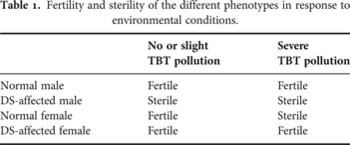
Amongst biological responses to anthropogenic disturbances of the environment, of particular interest is the development of male sex organs on female marine neogastropods. This phenomenon was first discovered by Blaber (Reference Blaber1970) in the dog-whelk Nucella lapillus (L.) and subsequently termed ‘imposex’ by Smith (Reference Smith1971). It is caused by tributyltin (TBT) pollution (Smith, Reference Smith1981; Bryan et al., Reference Bryan, Gibbs, Hummerstone and Burt1986, Reference Bryan, Gibbs and Burt1988). This toxin is mainly spread into seawaters by its use as the active component of some marine antifouling paints. Development of male sex organs on female stenoglossan gastropods may be promoted by other molecules but at concentrations far higher than those encountered in seawaters (Bryan et al., Reference Bryan, Gibbs and Burt1988). As the specific response is proportional to the intensity of the contamination, imposex development is a reliable specific bioindicator of TBT pollution (Gibbs et al., Reference Gibbs, Pascoe and Burt1988). Two indices were devised to define this masculinization of female gastropods (Bryan et al., Reference Bryan, Gibbs, Hummerstone and Burt1986; Gibbs et al., Reference Gibbs, Bryan, Pascoe and Burt1987), one of which is the vas deferens sequence index (VDSI). The VDSI is calculated as the average of the different stages of the defined scale encountered in the females of a given sample. VDS stages extend from 0 (no male character) to 6. In stage 6 females, the sterility is confirmed by the presence of aborted egg-capsules within the capsule gland because the genital opening is blocked by the overgrowth of the vas deferens (sperm duct) on the genital papilla (vulva). This overgrowth prevents both copulation and egg-release. No female was ever observed changed into a functional male even when the maximal stage of masculinization, development of a testis instead of an ovary, is reached (Gibbs et al., Reference Gibbs, Pascoe and Burt1988). In the most highly polluted areas, all females of the sensitive species N. lapillus are sterilized by the toxin and populations disappear (Bryan et al., Reference Bryan, Gibbs, Hummerstone and Burt1986; Huet et al., Reference Huet, Paulet and Glémarec1996a, Reference Huet, Paulet and Le Pennecb). The toxin is not lethal at the individual level but at the population level as it promotes the population disappearance through massive female sterilization. Nevertheless, several populations of N. lapillus have survived despite such lethal conditions. Within such resistant populations, an abnormal development of male sex organs is observed. The penis fails to develop in some males as in some TBT-contaminated females. This phenomenon was termed Dumpton syndrome (DS) since it was first discovered in the population at Dumpton Gap, in Kent, south-east England (Gibbs, Reference Gibbs1993). The resistance of DS-affected females to the sterilizing effect of imposex was accorded to a lesser development of the vas deferens by Quintela et al. (Reference Quintela, Barreiro and Ruiz2002). The most DS-affected (aphallic) males are sterilized by the lack of a penis: they cannot copulate and thus cannot contribute to the maintenance of the population. In extremely contaminated conditions, normal males can only cross with DS-affected females since every normal female (i.e. non DS-affected female) is sterilized by imposex (Table 1). Both phenotypes (normal and DS) are therefore maintained in males and females. Some DS-affected males are sterile when DS-affected females are fertile independently of TBT pollution. At the opposite, normal males are fertile independently of TBT pollution when normal females are sterile under TBT pollution. In the case of the DS, sterility is an inheritable recessive character that needs to be transmitted by the female to the male: no aphallic male was ever observed in the progeny of a normal female (Gibbs, Reference Gibbs2005). In parallel, when TBT pollution is severe, the sensitivity to the TBT-induced sterility is an inheritable character that is transmitted by male to female. Both sterility and fertility are opposite for both sexes and opposite for the ‘DS’ and ‘normal’ phenotypes. As some males exhibit a relatively short penis in parallel with a symptomatic open prostate gland, the syndrome is considered as a gradual phenomenon. To date, DS has been recorded in a single population at Dumpton Gap, England (Gibbs, Reference Gibbs1993), in the Bay of Brest, north-west Brittany (Huet et al., Reference Huet, Paulet and Glémarec1996a, Reference Huet, Paulet and Le Pennecb) and in Galicia, north-west Spain (Barreiro et al., Reference Barreiro, Quintela and Ruiz1999).
Fertility and sterility of the different phenotypes in response to environmental conditions.

TBT, tributyltin; DS, Dumpton syndrome.
A first survey of imposex in south-west Brittany was conducted in March 1989: 26 stations were sampled from Pointe de Penmarc'h to Ile Raguénez (Gibbs et al., Reference Gibbs, Bryan and Pascoe1991). Amongst the collected adult individuals, 357 were females and 398 males. More than 30% of the females were sterilized by imposex indicating a severe TBT contamination. Curiously, 9 females without penis were recorded at 3 sampling stations where imposex-sterilization was observed. A resistance to the TBT-induced masculinization was therefore suspected. DS as a discrete and recognizable phenomenon was not defined until after its discovery at Dumpton in September 1989. Whether DS was present in south-west Brittany remained to be established. To this end, repeat samplings were conducted at some of the 1989 stations between 2003 and 2007. The results of these observations are presented with reference to imposex levels and occurrence of DS.
MATERIALS AND METHODS
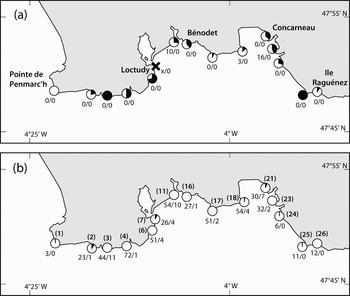
Twenty-six stations between Pointe de Penmarc'h and Ile Raguénez were visited in March 1989 (Gibbs et al., Reference Gibbs, Bryan and Pascoe1991), 15 of which were sampled again in September 2003 (Figure 1). Some of these stations were also sampled in May 2004, March 2005, March 2006 and April 2007. Wherever possible, 40 adult (‘toothed’) Nucella lapillus were collected by hand at low tide, except in 2003 when 50 individuals were collected. Individuals were kept either under cold and humid conditions or in aerated seawater prior to analysis that always took place within a few days after sampling.
Geographical distribution of imposex (female sterility) in relation to aphally in both females and males in south-west Brittany in (a) 1989 and (b) 2003–2007. Station numbers are indicated in parentheses. Shaded portions of circles indicate proportion of females sterilized. Percentages of aphallic females/DS-affected males are shown. X, site where only males were taken.

No narcotization was used prior to analysis. Shells were crushed in a vice and soft tissues observed under a binocular microscope. Females were notably identified by the presence of a dark-coloured sperm ingesting gland. VDS stages were assigned to females according to the scale defined by Gibbs et al. (Reference Gibbs, Bryan, Pascoe and Burt1987; see also Gibbs, Reference Gibbs1999); penis lengths were measured by micrometer to the nearest 0.1 mm.
Dumpton syndrome was detected in males by the absence of a penis or by the observation of at least one of the following characteristic symptoms: an abnormally short penis; incomplete vas deferens; brownish-coloured vas deferens and/or penial sperm duct; brownish pigment along the line of fusion of the two edges of the prostate gland; and prostate gland unfused (‘split’ i.e. open to the pallial cavity). In many cases, the vesicula seminalis was heavily distended with sperm, indicating that the male had not copulated. The percentages of sterilized females were calculated after discarding aphallic ones.
Complementary histological observations were performed on the entire gonads of some DS-affected males as described in Huet et al. (Reference Huet, Paulet and Le Pennec1996b): serial sections 7 µm thick were cut of paraplast-embedded tissues and stained using a method derived from the ‘Masson's trichrome’ method as described in Gabe (Reference Gabe1968).
Statistical analyses of the temporal evolution of aphally and female sterility were performed using signed rank test after yearly data were pooled together from all 11 stations concerned with DS. Spearman's test was used to estimate correlations between variables when pooling all data from 2003 to 2007 at each of the 11 stations.
RESULTS
From 1989 to date, 3396 adult Nucella lapillus were collected and analysed in south-west Brittany of which 1549 were females and 1847 males.
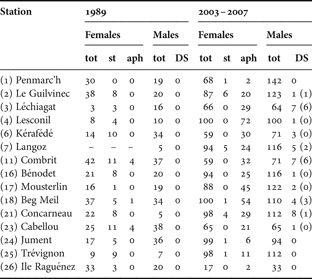
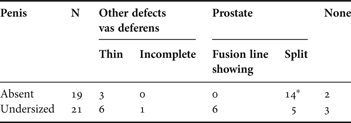
In 1989, females without penis (aphallic) suspected to be DS-affected were observed at 3 stations: Combrit (Station 11), Beg Meil (Station 18) and Pointe de Cabellou (Station 23) (see Figure 1). No aphallic male was registered in 1989 but such 19 individuals were observed in the 2003–2007 survey at 6 stations from Le Guilvinec (Station 2) to Concarneau (Station 21) (Table 2), notably at Combrit and Beg Meil where DS was suspected in 1989 thanks to the simultaneous presence of aphallic and sterilized females. The observation of aphallic males proved that DS was present in south-west Brittany. As at Dumpton, Brest and in Galicia (Gibbs, Reference Gibbs1993; Huet et al., Reference Huet, Paulet and Glémarec1996a, Reference Huet, Paulet and Le Pennecb; Barreiro et al., Reference Barreiro, Quintela and Ruiz1999), DS was a gradual phenomenon in south-west Brittany: some penis-bearing males exhibited characteristic symptoms of DS, i.e. split prostate, underdevelopment of vas deferens (not unfused but thin, incomplete or absent), brownish coloration of the fused or unfused edges of the prostate gland and brownish coloration of the vas deferens. A total of 21 such penis-bearing DS-affected males were recorded at the 11 central stations, from Le Guilvinec (Station 2) to Pointe de Cabellou (Station 23). Table 3 details the occurrence of each of the characteristics of DS. Twenty-five of the males were considered sterilized by DS—19 through aphally and six through abnormalities of the sperm duct, representing 2.2% of the males collected at the 11 stations concerned by DS between 2003 and 2007.
Evolution of the frequencies of the different sexual phenotypes at the locations where Dumpton syndrome (DS) was suspected to occur in 1989.

aph, aphallic; DS, DS-affected; st, sterilized; tot, total; in parentheses: aphallic DS-affected males.
Frequency of defects in the genital tract of males collected 2003–2007 according to whether penis was absent or undersized.
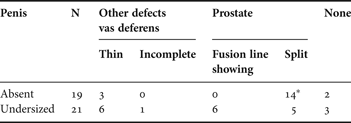
*, one male also lacked a vas deferens.
Twenty-six DS-affected males, half of which were aphallic, were studied histologically. Nineteen had a normal testis. Five penis-bearing DS-affected males had an ovotestis, the development of oocytes and surrounding reserves being more or less complete (see Huet et al., Reference Huet, Paulet and Le Pennec1996b). A similar condition occurred in an aphallic male. In another aphallic male, with a split prostate and no vas deferens, no spermiogenesis was observed but there was a complete oogenesis in the gonad.
Aphallic females were observed at every 15 studied stations in the 2003–2007 samples while such females were observed in 1989 at 3 stations only (Table 3). As a total, 402 aphallic females were observed in the 2003–2007 survey. As at Dumpton Gap, Brest and in Galicia (Gibbs Reference Gibbs1993; Huet et al., Reference Huet, Paulet and Glémarec1996a, Reference Huet, Paulet and Le Pennecb; Barreiro et al., Reference Barreiro, Quintela and Ruiz1999), DS seemed an all-or-none phenomenon in females, contrary to the males.
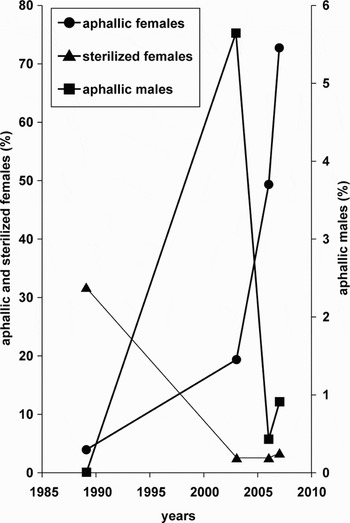
At the three stations concerned with DS in 1989, the same trends were observed (see Table 2): absence of DS-affected males in 1989 but presence in the 2003–2007 survey, decrease of female sterilization and increase of female aphally. To better analyse temporal trends in south-west Brittany, 1989, 2003, 2006 and 2007 surveys were considered at the 11 central stations (Station 2 to Station 23). Stations 1, 24, 25 and 26 were discarded as no DS-affected males were ever observed at these stations. As the whole 11 stations concerned with DS were not sampled in 2004 and 2005 these two surveys were discarded. Temporal evolutions of female sterilization and aphally in both sexes are presented in Figure 2.
Temporal evolution of imposex (female sterility) and Dumpton syndrome in south-west Brittany.

An improvement of environmental conditions is observed when considering the percentage of imposex-induced sterilization of females: it was above 30% in 1989 and decreased to one-tenth in the 2003–2007 surveys. The percentage of female sterilization was significantly higher in 1989 when compared to the other data sets that were not statistically different from 2003 to 2007 (P < 0.05).
The percentage of aphallic males (absent in 1989) reached a maximum of 5.6% in 2003. Nevertheless, no statistical difference was observed in the percentages of male aphally between the 2003 and 2007 surveys. Of particular interest, the maximal percentage of DS-affected males was registered at Léchiagat (Station 3) where all 3 collected females in 1989 were sterilized.
Female aphally showed a different trend to that of male aphally: it kept on increasing significantly from survey to survey and by 2007 had reached >72%. If female aphally was only due to DS, a correlation would be observed between female and male aphally. It is not the case (P > 0.95): male aphally has not kept on increasing from survey to survey as with females. The increase of female aphally is then due to an improvement of environmental conditions: recent TBT pollution is no longer severe enough as to further induce a penis development in all normal females.
DISCUSSION
In March 1989, aphallic females were observed at 3 stations where imposex-sterilization of females occurred (Figure 1). Such a simultaneous presence of both aphallic and imposex-sterilized females was observed for the second time: this feature was first observed in a sample from Dumpton Gap, in 1987 where one of 10 collected males was aphallic. The male genital defect procuring a resistance to imposex-induced female sterilization was confirmed by the observation of 11 aphallic males in a second sample at Dumpton Gap, in September 1989, 6 months after the survey in south-west Brittany. The Breton aphallic females were suspected ‘to represent a strain having some resistance to the endocrinological changes induced by TBT’ (Gibbs et al., Reference Gibbs, Bryan and Pascoe1991) but a lack of penis development needed to be also observed in males to confirm such a hypothesis. Male aphally was also observed in 2003, indicating DS was present in south-west Brittany too.
Dumpton syndrome being favoured by TBT-induced sterilization of normal females, that was more frequent in 1989 than today (Figure 2), it would have spread earlier if present and would have been observed in males collected in 1989. The evidence thereafter strongly suggests that the appearance of DS is a very recent feature in south-west Brittany.
Aphallic females were encountered at Combrit (Station 11), Beg Meil (Station 18) and Pointe de Cabellou (Station 23); the first two stations are separated by a distance of 10 km, the second two by 5 km. Either the mutation leading to DS appeared quite simultaneously at these three locations, or migrations of DS-affected individuals occurred from a location to the others. Despite extensive surveys along the European coasts (see Huet et al., Reference Huet, Paulet and Clavier2004, for a review), DS is a very scarce phenomenon worldwide, reported only in three areas (east England, north-west Brittany and Galicia). The mutation is thereby an exceptional phenomenon and the simultaneous appearance at three distinct points is highly unlikely. Migrations between populations are the more likely explanation which is also supported by the results from Colson & Hughes (Reference Colson and Hughes2004). These authors observed significant migration events when N. lapillus re-colonized areas in the UK where past populations had collapsed. Furthermore, migrations of individuals between populations of N. lapillus in south-west Brittany is also supported by the spreading of DS from three stations, 15 km apart, in 1989, to 11 stations, 30 km apart, in 2003–2007.
What was the temporal evolution of DS: has it kept on increasing? Both DS and absence of severe enough TBT contamination lead to female aphally. Thus data concerning females cannot be used to estimate DS spreading since it is not possible to discriminate normal from DS-affected females using aphally in slightly contaminated conditions as encountered in south-west Brittany. DS is a gradual phenomenon: males can be DS-affected without exhibiting any sign of the syndrome (Gibbs, Reference Gibbs2005). Aphally in males seems thereafter the sole reliable indicator of DS trends. The statistical test used in this study revealed no significant differences in male aphally between the 2003 to 2007 surveys, indicating no significant increase or decrease of the phenomenon during this period. One may thereafter only assert that DS was more widespread in 2003–2007 than in 1989 without giving further indications on the temporal variations of the frequency of the syndrome.
An increase of the number of sampled individuals per survey would improve the sensitivity of the statistical analysis for temporal trends of DS. However, collecting more individuals might endanger populations. Since DS-affected aphallic females are many times more numerous than such males, a method is needed to discriminate DS-affected from normal aphallic females in any environmental condition. A molecular probe, specific to DS, would be of great interest to monitor imposex deciphering between TBT and DS effects on sexual phenotypes. The research for a DS-specific molecular probe would also enhance our knowledge about the mechanisms of both imposex and DS.
ACKNOWLEDGEMENTS
The 1989 survey of the Brittany coast was supported by the UK Department of the Environment under Contract PECD 7/8/103. The 2003–2007 survey was partly supported by the RNO and NAS programmes. Thanks to R. Marc and M. Briand for computing the maps. Special thanks to the anonymous referees and to Jonathon Kirimavec. This study is contribution No.1072 of the IUEM, European Institute for Marine Studies (Brest).