INTRODUCTION
The genus Armandia (Family: Opheliidae) has a cosmopolitan distribution and includes 31 known species (WoRMS, Reference Read and Fauchald2015), and in general opheliids are active burrowers and appear to be deposit feeders (Fauchald & Jumars, Reference Fauchald and Jumars1979). The characters that distinguish members of Armandia from other opheliid genera are the presence of a ventral groove, branchiae and segmental eye spots between the parapodia. Within the genus, species are differentiated chiefly based on the morphology of the anal funnel, anal papillae and anal cirrus. To date only three species have been reported from Andaman and Nicobar waters of Indian EEZ, viz. Armandia lanceolata, Armandia leptocirris and Armandia intermedia (Tampi & Rangarajan, Reference Tampi and Rangarajan1964; Rao, Reference Rao2010).
MATERIALS AND METHODS
During benthic surveys of the Andaman Sea onboard the Fishery Oceanographic Research Vessel ‘Sagar Sampada’ (FORVSS Cruise No. 292), two specimens of Armandia were obtained in a Smith McIntyre grab, one from 57 m depth, off Rutland Island and another from 52 m depth off North Andaman (Figure 1). Sediment samples were sieved using a 300 μm mesh sieve and preserved in 5% buffered formalin, and stained using Rose Bengal solution. Taxonomic identification up to the generic level followed the keys of Fauchald (Reference Fauchald1977). A stereo zoom microscope (Leica S8APO) and a camera lucida attached to a compound microscope (Leica DM1000) were used to study the specimens. Length and width measurements were made using a Leica Application Suite (Leica DFC 425) and photographs were taken using a CatCam 130 Microscope Camera. Although the benthic survey covered 60 stations around Andaman and Nicobar Islands (50–200 m), this species was collected only from two locations. The specimens have been deposited with the FORV Referral Centre, Centre for Marine Living Resources and Ecology, Cochin, Kerala, India.
Map of Andaman Islands, indicating collection locations (9°18.175′N 92°49.337′E; 13°31.121′N 92°46.751′E).

SYSTEMATICS
Phylum Annelida
Class Polychaeta Grube, 1850
Family Opheliidae Malmgren, 1867
Genus Armandia Filippi, Reference Filippi, Canestrini, Doria, Ferrari and Lessona1861
Armandia sampadae sp. nov.
(Figures 2 & 3)
Armandia sampadae sp. nov., holotype. (A) Entire organism, (B) Prostomium with palpode, (C) Anal funnel. Scale bar 0.5 mm.

Armandia sampadae sp. nov., holotype. (A) Entire organism, (B) Parapodium, (C) Anal funnel. Scale bar 0.5 mm.

TYPE MATERIAL
Holotype: IO/SS/POL/0467, Off Rutland Island, 11°28.038′N 92°43.268′E, 57 m; Paratype: IO/SS/POL/0468, Off North Andaman, 13°31.121′N 92°46.751′E, 52 m. Specimens complete, 10.5 mm long, 1.9 mm wide with 32 chaetigers (Cruise 292, 3 December 2011, pre-monsoon season). Armandia sampadae sp. nov was collected from coralline sandy sediments with a dissolved oxygen content of 2.7 to 3.9 ml L−1, temperature of 27.1–28.2°C and salinity of 32.7–33.4.
DIAGNOSIS
Prostomium with an elongated pigmented palpode; branchiae with brownish orange pigmentation; 14 pairs of lateral eyes; a pair of large, flattened, rounded, stalked, pigmented, leaf-shaped ventral papillae at ventral base of anal funnel and with pair of sub-triangular black pigmented spots on basal portion of ventral papillae. Anal funnel bears 14 rings and fringed with 14 marginal papillae.
DESCRIPTION
Body slender with 32 chaetigers, faintly annulated throughout body (Figures 2A & 3A). Deep ventral groove extending from chaetiger 2 to last chaetiger. Prostomium conical, with a pair of dorsal eyes, palpode elongated with pigmentation near proximal end, apparently with tactile function (Figure 2B); pair of nuchal organs present posterior to prostomium. Peristomium indistinct, probably fused with prostomium; mouth ventral. Branchiae with patchy brownish orange pigmentation, appearing from chaetiger 2–31. Fourteen pairs of lateral eyes present from anterior of chaetiger 5 continuing to chaetiger 18; each eye pigmented brownish orange. Each parapodium (Figure 3B) with a presetal conical chaetigerous lobe bearing two bundles of simple capillaries and a small ventral cirrus, postsetal lobe absent. Ventral cirrus absent in last chaetiger. Anal funnel obliquely truncate, as long as last three chaetigers, bearing 14 rings with a ventro-posterior opening. Two large flattened, rounded, stalked, leaf-shaped papillae present in ventral base of anal funnel, originating at the end of ventral groove. Brownish orange pigmented spots scattered on ventral papillae in distal end (flattened portion) whereas absent in stalk. Stalk of ventral papillae folded in the inner margin. A pair of sub-triangular black pigmented areas composed of numerous minute spots present on basal portion of ventral papillae (Figures 2C & 3C) resembling eyes. Anal funnel fringed with 14 cirriform marginal papillae; long internal anal cirrus absent. Anal papillae long, slender and unequal in length.
ETYMOLOGY
The species is named for the research vessel FORV ‘Sagar Sampada’, which has been the backbone of marine biological research in India since 1984.
DISCUSSION
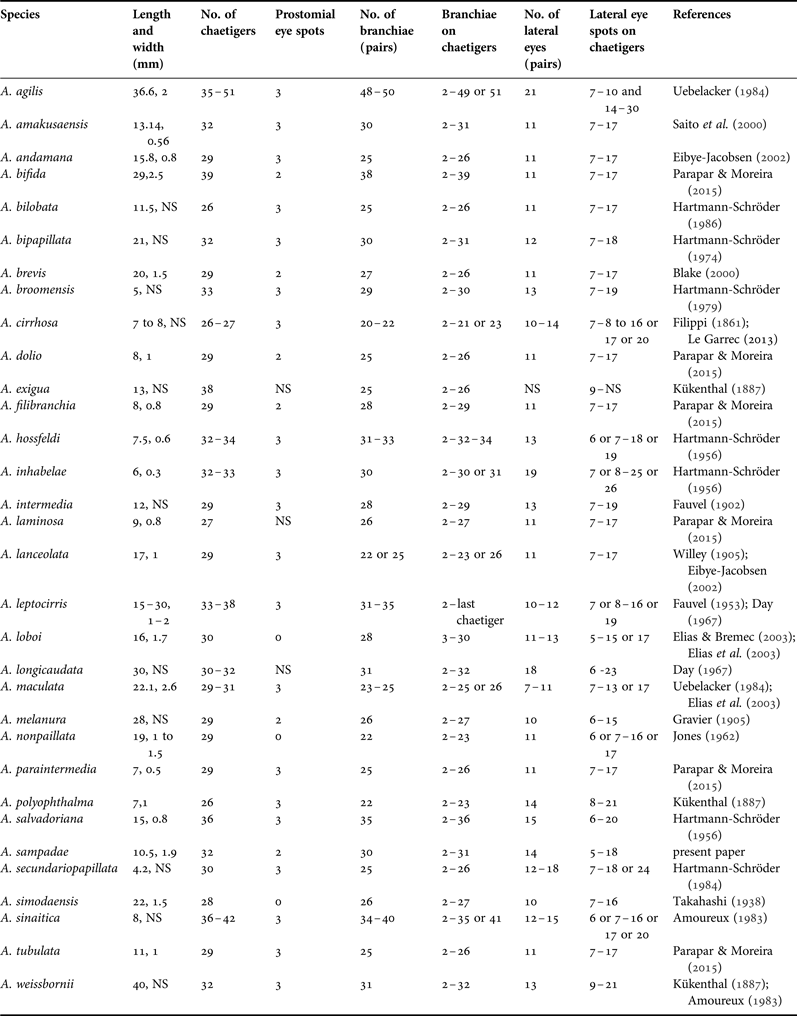
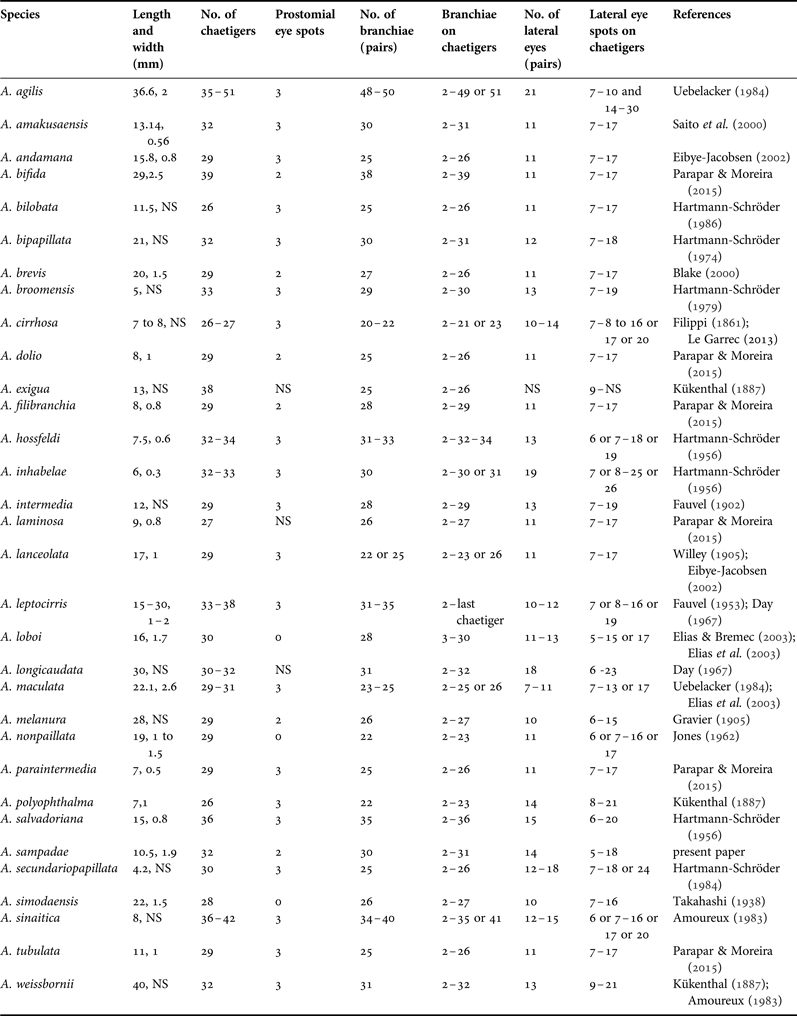
The genus Armandia was first recorded from the Mediterranean Sea by Filippi, Reference Filippi, Canestrini, Doria, Ferrari and Lessona1861 and named in honour of the French naturalist Jean Louis Armand de Quatrefages de Bréau. The genus currently includes 31 species (WoRMS, Reference Read and Fauchald2015) and morphological comparisons of the new species with other species are presented in Tables 1 and 2.
Comparison of the morphological characters of species of Armandia, adapted from the literature.
Comparisons of the anal funnel morphology of the species of genus Armandia, adapted from the literature.

*NS, not specified.
Along the northern Indian Ocean, six species of Armandia have been reported, viz. (1) Armandia leptocirris Grube, 1878 from Lakshadweep Islands by Misra & Chakraborty (Reference Misra, Chakraborty and Ghosh1991), Andaman and Nicobar Islands by Rao (Reference Rao2010), south-west coast of India by Smitha (Reference Smitha2011), (2) Armandia intermedia Fauvel, Reference Fauvel1902 from south-west coast of India by Joydas (Reference Joydas2002) and Smitha (Reference Smitha2011), (3) Armandia lanceolata Willey, Reference Willey1905 from Andaman and Nicobar Islands by Tampi & Rangarajan (Reference Tampi and Rangarajan1964), Thailand sector of Andaman Sea by Eibye-Jacobsen (Reference Eibye-Jacobsen2002), Lakshadweep Islands by Misra & Chakraborty (Reference Misra, Chakraborty and Ghosh1991), (4) Armandia melanura Gravier, Reference Gravier1905 from Thailand sector of Andaman Sea by Eibye-Jacobsen (Reference Eibye-Jacobsen2002), (5) Armandia longicaudata Caullery, 1914 from Thailand sector of Andaman Sea by Aungtonya et al. (Reference Aungtonya, Thaipal and Bussarawit2002), (6) Armandia andamana Eibye-Jacobsen, Reference Eibye-Jacobsen2002 from Thailand sector of Andaman Sea.
Armandia sampadae differs from all other species of Armandia in having a pair of large, flattened, rounded, pigmented, stalked and leaf-shaped ventral papillae at the ventral base of the anal funnel and with a pair of sub-triangular black pigmented spots in the basal portion of the ventral papillae. Armandia sampadae is most similar to A. intermedia Fauvel, Reference Fauvel1902 in the presence of an anal funnel with annulations and with two large ventral papillae with ventral openings. Armandia intermedia differ from A. sampadae in the shape of ventral papillae; the ventral papillae of the latter is stalked, flattened, and rounded in shape whereas in the former, the ventral papillae are sessile. The anal funnel of A. sampadae is devoid of ventral anal cirri which are characteristic of A. intermedia. The sub-triangular black pigmented spots in the basal portion of ventral papillae of A. sampadae is completely absent in A. intermedia. Armandia intermedia bears 18 anal papillae while only 14 were observed in A. sampadae.
Armandia andamana Eibye-Jacobsen, Reference Eibye-Jacobsen2002 recorded from Andaman Sea possesses a ventrally fused anal funnel with a sulcus, bearing 8–9 anal papillae, compared with the 14 papillae of A. sampadae. There are three prostomial eyes, 25 pairs of branchiae and 11 pairs of lateral eyes in A. andamana while these characters numbered 2, 30 and 14 respectively, in A. sampadae. Armandia melanura Gravier, Reference Gravier1905 possess an anal funnel which is strongly pigmented (very dark brown) and notched on the ventral midline on each side while in A. sampadae the black pigmentation is visible at the basal portion of the two large ventral papillae of the anal funnel. The anal funnel is ringed in A. sampadae without a ring in A. melanura. The only similar character in both species is the paired prostomial eyes.
In Armandia lanceolata Willey, Reference Willey1905 prostomial eyes are absent and 22 pairs of branchiae are recorded, and additionally, the anal funnel is in the form of a narrow membranous tube with 12 anal papillae, whereas in A. sampadae, two prostomial eyes and 30 pairs of branchiae are present, and the ringed anal funnel bears 14 papillae. The similarity between these species is the ventro-posterior opening of the anal funnel and absence of anal cirrus. In Armandia longicaudata Caullery, 1944 the anal funnel is obliquely truncate bearing 12 anal papillae and a ventral cirrus but in A. sampadae the ringed anal funnel has two large ventral papillae and 14 anal papillae, without anal cirrus. Armandia leptocirris Grube, 1878 possesses a long anal funnel opening upwards bearing a ventral anal cirrus, while in A. sampadae the anal funnel opens posterior-ventrally and lacks an anal cirrus; both possess rings in the anal funnel.
ACKNOWLEDGEMENTS
This work was carried out under the Marine Living Resources Programme of the Ministry of Earth Sciences, Govt. of India. The support and encouragement provided by the Director of CMLRE, all scientists and research staff in CMLRE is gratefully acknowledged. The support of vessel management and scientific team onboard FORV ‘Sagar Sampada’ is greatly acknowledged.