1. Introduction
Humans use linguistic expressions to refer to objects and events ‘very distant from our senses, such as the far side of the Moon and last year's potato crop’ (Hurford Reference Hurford2007: 41). This is sometimes referred to as displacement of reference (or displaced reference). The communication systems of nonhuman animals do not typically display displacement of reference. The signals of nonhuman animals are usually tightly coupled to currently occurring situations involving sex, social interaction, or survival.Footnote 2
In his book Adam's Tongue, Bickerton seeks to identify the selective pressure that drove our ancestors to break away ‘from the kind of communication system that had served all other species for at least half a billion years’ (6), a communication system consisting of signals that could not be used to refer to objects or events outside the sensory range of the sender or the receiver. Bickerton argues that the earliest stage of human language (as characterized, according to Bickerton, by the use of word-like signals that were uncoupled from currently occurring situations) was the result of a need to recruit individuals to help in the scavenging of carcasses of megafauna (very large land animals; see Section 3 below). The signals used for recruitment at the earliest stages of human language evolution were iconic, they resembled what they were used to refer to.
Drawing particularly on work in animal communication theory (Maynard Smith & Harper Reference Maynard Smith and Harper2003) and evolutionary game theory (Skyrms Reference Skyrms2004), I show that there are several hurdles we would need to jump over to demonstrate that Bickerton's model is valid. First, not much is known about early hominin scavenging.Footnote 3 While the available evidence is compatible with Bickerton's scenario, it is compatible with other scenarios as well. Second, Bickerton argues that, at the initial stages of language evolution, signals were grounded in salient aspects of the environment (such as the sounds that very large land animals made). The empirical support for natural salience as a determinant of the communication systems used at the earliest stages of language evolution is mixed at best; communication systems, with or without displacement of reference, can arise spontaneously in the absence of natural salience. Third, maintaining communication systems is nontrivial because of the incentive to deceive.
Bickerton's proposal is one among many conjectures in the language evolution literature about the environmental circumstances and selective pressures that favored the emergence of the human capacity for language (see Számadó & Szathmáry Reference Számadó and Szathmáry2006: 557). The broad aim of this article is to show that game theory can help us to evaluate proposals such as Bickerton's. Game theory allows us to model aspects of the context(s) for human language evolution. These aspects include the interests of the communicating parties and the costs associated with the use of particular signals (Számadó & Szathmáry Reference Számadó and Szathmáry2006: 556). In Section 4 of this article, I argue that Bickerton's scenario is an example of what is described in game theory as a stag hunt Skyrms (Reference Skyrms2004). We can, by recasting Bickerton's scenario as a stag hunt, identify criteria that any account of the transition to language must satisfy.
This article is organized as follows. Section 2 summarizes Bickerton's book. Section 3 presents his evolutionary scenario in detail. Section 4 explores a number of issues raised by Bickerton's evolutionary scenario, all of which need to be addressed if we are to take Bickerton's proposal seriously. Section 5 is the conclusion.
2. A summary of Adam's Tongue
In this section, I give a chapter-by-chapter summary of Bickerton's book. In the next section, I focus on the evolutionary scenario that Bickerton presents.
Following a brief introductory chapter, Chapter 1 (‘The size of the problem’) makes the case that it is implausible that human language evolved from the communication system of our last common ancestor (henceforth, LCA) with chimpanzees. The signals that constitute nonhuman animal communication systems are typically tightly coupled to currently occurring situations involving sex, social interactions, or survival. If the communication system of the LCA was the source of language, that communication system would have to have been uncoupled from currently occurring situations of those sorts. From Bickerton's perspective, it is not obvious how this uncoupling could have occurred. Bickerton (28–32) states several conditions that, he argues, any adequate theory of language evolution has to meet. They are:
• Immediate utility. The first words had to have some immediate and tangible payoff in terms of fitness (the reproductive success of an entity) that could not have been obtained by simpler means.
• Uniqueness. The theory needs to explain why there is no sign of language starting to develop in any other species.
• Ecology. The theory must not conflict with what we know or can deduce about the ecology of our ancestors.
• Credibility. The content of the first words must be able to be verified immediately and beyond doubt.
• Selfishness. The first linguistic acts must have been such that the speaker derived as much benefit from them as the hearer did.
Chapter 2 (‘Thinking like engineers’) argues (along with Deacon Reference Deacon1997) that what most sharply distinguishes humans from other species is our capacity to create and use symbols, which are, for Bickerton, chiefly characterized by displacement of reference. The signals of animal communication systems, including those that most likely constituted the animal communication system of the LCA, could not serve as the precursors of words in human language.Footnote 4 The reason for this is that the signals of animal communication systems are typically indexical (bound to the currently occurring situation). They cannot be used in the absence of what they are used to refer to. The primary function of these signals is to get the receiver to do things that enhance the fitness of the sender. In contrast, words in human language can be used to refer to things outside the currently occurring situation. Bickerton proposes that protolanguage, an intermediate stage between the communication system used by early nonlinguistic hominins and modern human language (Fitch Reference Tecumseh2010: 393), was characterized by the use of sequences of word-like units, but no syntax. While the central claim of Chapter 2 is that we will not find precursors of words or syntax in animal communication systems, Bickerton proposes that we might find signals in animal communication systems that, when used in certain contexts, could take on the property of displacement. For example, food calls might be a good candidate for this. Iconicity – the use of signals that resemble their referent such as the mimicking of a slicing gesture to refer to a knife – is the most probable road that our ancestors took to language.
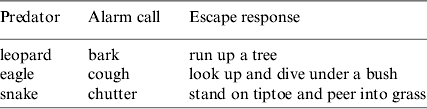
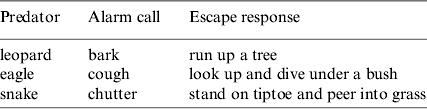
Chapter 3 (‘Singing apes?’) considers and rejects the claim that precursors for language can be found in nonhuman ape communicative behavior. Nonhuman ape communication systems are more limited than monkey communication systems. For example, nonhuman ape communication systems do not have predator-specific alarm calls; some monkey communication systems do. Table 1 illustrates the alarm call system of vervet monkeys (Cheney & Seyfarth Reference Cheney and Seyfarth1990). Three types of predators (leopards, eagles, and snakes) prey on vervet monkeys. Each predator is associated with an acoustically distinct alarm call. Each of these calls is keyed to a particular action that is appropriate to the type of predator that elicits the call.
The alarm call system of vervet monkeys (Cheney & Seyfarth Reference Cheney and Seyfarth1990)
Because of the differences between nonhuman ape communication systems and monkey communication systems, Bickerton claims that language began among some species ancestral to humans that evolved after our ancestral line separated from that of chimpanzees and bonobos. Some factor(s) that distinguished the food sources of our ancestors and those of the ancestors of present-day chimpanzees and bonobos might have caused a profound change in our ancestors' behavior.
Chapter 4 (‘Chatting apes?’) discusses research devoted to teaching language to apes and rejects claims that apes have language learning abilities comparable to those of present-day humans. Bickerton criticizes several claims that have been made by ape language researchers. He makes two important points. One, language-trained apes have never mastered syntax or functional items (linguistic expressions such as determiners, complementizers, etc.). Second, language-trained apes typically communicate about very different things than human children typically communicate about. The talk of language-trained apes tends to focus on wants, needs, and desires rather than objective information about the environment or the events in it. However, Bickerton observes that ape language researchers have shown that nonhuman apes can be taught some kind of protolanguage. The participants in these experiments have been shown to be able to distinguish between words and proper names; they are able to put signs together spontaneously; their behavior suggests that they are able to understand that arbitrary symbols could substitute for objects in the real world. Further, on the basis of language research with animal species other than apes (e.g. African grey parrots; Pepperberg Reference Pepperberg2000), Bickerton concludes that the precursors for human language can be found in the behavior of language-trained animals that are members of species distantly related to humans, in addition to the behavior of language-trained apes. In sum, based on a consideration of language learning studies with both apes and more distantly related species, the main conclusion of Chapter 4 is that the genetic prerequisites for something approaching language are not limited to our immediate relatives (chimpanzees and bonobos). All that is needed for the seeds of language to emerge is the right kind of selective pressure; there is no need for a genetic change.
Chapter 5 (‘Niches aren't everything (they're the only thing)’) focuses on niche construction theory (Odling-Smee, Laland & Feldman Reference Odling-Smee, Laland and Feldman2003) and the contribution that it makes to the study of language evolution.Footnote 5 The central idea of niche construction theory (building on earlier proposals by the developmental geneticist C. H. Waddington and the population geneticist Richard Lewontin) is that organisms select and modify their environments, and, as a consequence of doing so, change the selective pressures that both they and their descendants face (Odling-Smee Reference Odling-Smee, Pigliucci and Müller2010: 174–175; Odling-Smee et al. Reference Odling-Smee, Laland and Feldman2003). A niche is made up of three components: a habitat (e.g. savanna), a particular type of food (e.g. meat), and a particular way of obtaining that type of food (e.g. scavenging). Bickerton argues that, without the notion of niche construction, it is not possible to explain the evolution of language. Language arose out of a specific niche and enabled our ancestors to construct increasingly more elaborate niches. We have language (and all other species do not) because of the niche(s) that our ancestors constructed.
Chapter 6 (‘Our ancestors in their niches’) aims to demonstrate that present-day humans differ from our closest primate relatives (chimpanzees and bonobos) because of the series of niches that our ancestors developed. There have been many niches over the course of human evolution after the split from the LCA. This set of niches includes at least the following six distinct niches:
• a terrestrial omnivore niche
• a low-end scavenging niche
• a high-end scavenging niche
• a hunting-and-gathering niche
• a herding niche
• an agricultural niche
I discuss the first three niches in Section 3 below.
In Chapter 7 (‘Go to the ant, thou sluggard’), Bickerton argues (developing a claim that he made in Chapter 2) that the selective pressure likely to have led toward language was a need to transmit information about food sources too large to be handled by single individuals or small groups of individuals. He discusses species of ants and bees that have niches that require this kind of information exchange. To illustrate, ants communicate using chemical signals to recruit other ants to a new food source or nest site (Hölldobler & Wilson Reference Hölldobler and Wilson2009: 179ff.) These recruitment signals can be combined and used to transfer detailed information about things that are outside the sensory range of the receiver(s).
According to Bickerton, ants, bees, and a group of our ancestors after the LCA were able to uncouple the use of signals from currently occurring situations and achieve displacement of reference because they possessed similar niches. Chapter 8 (‘The big bang’) describes what happened when our ancestors achieved displacement at the earliest stages of language, approximately two million years ago. Bickerton argues that the origin of language was part of a ‘speciation event’ driven by niche construction. A group ancestral to Homo erectus, living around two million years ago, went from catchment scavenging based on the extraction of bone marrow, where scavenging was clustered around particular locations, to territorial scavenging based on the exploitation of carcasses of large herbivores, where scavenging ranged over broad territories. The territorial strategy involved fission–fusion foraging (i.e. foragers slept together in one location, but foraged either alone or in small groups), where large numbers of individuals were occasionally recruited to help with food sources too large to be handled by a single individual or a small group of individuals. As I describe in detail in Section 3 below, Bickerton argues that the signals that were used for recruitment displayed displacement. In the final part of Chapter 8, Bickerton reviews the different conditions for theories of language evolution described in Chapter 1 and argues that his theory meets each one successfully. He claims that his theory also gets us human cooperation for free because recruitment for big carcass exploitation depends on cooperation with non-kin.
The final four chapters of Adam's Tongue attempt to demonstrate that the creation of protowords (signals that could be used to refer to objects and events outside the sensory range of the receiver(s)) might have been enough to trigger the evolution of the rest of language. Chapter 9 (‘The challenge from Chomsky’) critiques Hauser, Chomsky & Fitch (Reference Hauser, Chomsky and Fitch2002) . Hauser et al. (Reference Hauser, Chomsky and Fitch2002) distinguish between faculty of language in a broad sense (all the cognitive mechanisms involved in language) and faculty of language in a narrow sense (the subset of mechanisms unique to humans and unique to language). They hypothesize that recursion is an element of faculty of language in a narrow sense and propose that recursion was not selected for as a specifically linguistic mechanism. Bickerton argues that the primary shortcoming of Hauser et al. (Reference Hauser, Chomsky and Fitch2002) is the failure to treat language evolution as part of human evolution. The details of human evolution are not discussed in Hauser et al. (Reference Hauser, Chomsky and Fitch2002). Further, according to Bickerton, Hauser et al. (Reference Hauser, Chomsky and Fitch2002) overlook the crucial role that niche construction played in the evolution of language. The chapter ends with a summary of Bickerton's evolutionary model and a discussion of the evolutionary relationship between language and human thought. For Bickerton, language came first and enabled human thinking. In contrast, for Chomsky, as paraphrased by Bickerton, human thinking came first and enabled language.
The focus of Chapter 10 (‘Making up our minds’) is the relationship between brain and behavior. As anticipated by Chapter 9, Bickerton argues against the view that thinking preceded speaking in human evolution. Bickerton first attempts to establish that we have abstract concepts, but nonhuman animals do not. From Bickerton's perspective, an observation that seems to support the claim that nonhuman animals do not possess abstract concepts is that it appears that only our own species has ever produced artifacts that require forethought. Because nonhuman animals lack abstract concepts, nonhuman animal minds are unable to deal with anything other than the immediate circumstances. What started human-type concepts not anchored to the here-and-now was the emergence of protowords (recruitment signals characterized by displacement of reference).
Chapter 11 (‘An acorn grows to a sapling’) considers the problem of how the tiny handful of signals required by recruitment evolved into full-blown human language. Bickerton argues that language developed gradually. The system devoted to recruitment for the scavenging of the carcasses of very large land animals persisted for several hundred thousand years. Possible evidence for this comes from the fossil and archaeological record: there was an increase in brain size over the course human evolution, but no comparable elaboration of culture and technology. In order for a protolanguage to emerge, signals had to become words and words had to yield concepts. Signals are first uncoupled from currently occurring situations involving fitness (sex, social interaction, or survival) and become word-like. As discussed by Bickerton in previous chapters, the territorial scavenging niche played a key role in the creation of protowords. Subsequently, protowords are chained together into sequences like beads on a string. Just as animals can combine actions into a series, once word-like signals are in place, animals can acquire and use sequences of them. At a later stage, protolanguage acquired a fairly fixed serial order (subject-first) as a consequence of how predication works (‘saying something, then saying something about that thing’ (231)).
In Chapter 12 (‘The sapling becomes an oak’), the final chapter of Adam's Tongue, Bickerton looks at the emergence of syntactic (hierarchical) structure. The core claim of the chapter is that this transition happened, at the earliest, a couple of hundred thousand years ago. The selection pressure for hierarchical structure was the need for rapid production; organisms that could get their messages out sooner had an advantage over those that were slower. Certain things (such as protowords) had to be in place to make hierarchical structures possible.
3. Bickerton's evolutionary scenario
In this section, I discuss Bickerton's evolutionary scenario in detail. Subsequent sections discuss problems for this scenario.
Climate change plays an important role in Bickerton's evolutionary scenario (112–113), as it has in many discussions of both cultural and biological aspects of human evolution. Dense forests once ranged across central Africa. Subsequently, over the past several million years, the eastern side of Africa grew drier. Forested areas gave way to increasingly more open arid woodlands and grassland habitats. A new genus, Australopithecus, arose approximately four million years ago (henceforth, mya) in this environment. Most species of Australopithecus were slender and, probably, bipedal. They lived in ‘a heterogenous mosaic of environments’ (Kingston, Marino & Hill Reference Kingston, Marino and Hill1994: 958). Early Homo seems to be descended from these gracile australopithecines. Recent research suggests that by around 2 mya, ‘tool-making hominins, probably early Homo, accessed and used a broad spectrum of East African habitats, from open grassland to riparian forest’ (Plummer et al. Reference Plummer, Ditchfield, Bishop, Kingston, Ferraro, Braun, Hertel and Potts2009: 1).
Bickerton (Chapter 6) focuses on three niches of early hominins. First, there was the omnivore niche of the australopithecines. Second, there was the ominivore plus bonecracker niche of the late australopithecines (for example, Australopithecus garhi) and/or early Homo (for example, Homo habilis).Footnote 6 Third, there was the omnivore plus preferential meat-eater niche occupied by later Homo (ergaster or erectus).
Bickerton's proposal that the second and third niches were characterized by low-end scavenging/foraging and high-end scavenging, respectively, is important for what follows. Low-end scavenging refers to the scavenging of bones for bone marrow, long after they have been defleshed by other animals, as well as the pursuit of other items such as gazelles, roots, and tubers. This type of subsistence behavior was comparatively low risk and noncooperative. Evidence that late australopithecines and/or early Homo were low-end scavengers comes from the pattern of tooth marks made by carnivores and cut marks made by hominin artifacts on bones that have been found at sites associated with early hominins (Blumenschine Reference Blumenschine1995).Footnote 7
Beginning approximately 2 mya, high-end scavenging involved the cooperative processing, butchering, and consumption of the carcasses of megafauna. These included herbivores such as mammoths, deinotheriums (predecessors of modern elephants), ancestors of rhinoceroses, and ancestors of hippopotami. All of these megafauna had thick, leathery hides. Evidence that later Homo might have been high-end scavengers comes from the sequences of cut marks on fossil bones (e.g. Domínguez-Rodrigo et al. Reference Domínguez-Rodrigo, Pickering, Semaw and Rogers2005).
Bickerton's core claim (Chapter 8) is that the ultimate explanation for the birth of language was the recruitment strategies associated with high-end scavenging of megafauna carcasses (carcasses of animals far larger than ourselves). Early hominins faced a problem: how to get potential recruits to act as a unit in the scavenging of megafauna to fend off other scavengers? A solution to this problem is: tell recruits what has been discovered (several days' or weeks' supply of nutritious food). However, early hominins did not have the capacity for language. One or more early hominins hit upon a solution. Imitate whatever species the dead animal belongs to, by imitating the sound it makes or the way it moves, or by miming some prominent feature of its anatomy.Footnote 8 These signals are characterized by displacement of reference. The object that is being imitated is outside the sensory range of the sender and the receiver. According to Bickerton, this was the earliest stage of the evolution of language.
Let us assume for the sake of argument that the initial stage of language necessitates displacement of reference. There are several significant features of Bickerton's proposal. First, there is the claim that high-end scavenging played an important role in language evolution. Second, natural salience plays a central role in this scenario: the signals used for recruitment were iconic, grounded in salient aspects of the environment. According to Bickerton (51–53), iconic signals characterized by displacement of reference constituted the earliest stage of language evolution. Third, Bickerton claims that the recruitment problem was solved by using iconic signals. Fourth, he claims that the resulting signaling systems characterized by low-cost iconic signals were stable enough to subsequently give rise to full-blown language. In the next section, I explore these features, showing that each one of them raises issues that must be addressed before we can demonstrate that Bickerton's model is a valid one.
4. Cooperation and communication
For Bickerton, the selective pressure for recruitment signals that could be used to refer to objects and events outside the immediate context was high-end scavenging (cooperative scavenging for megafauna carcasses, as opposed to noncooperative scavenging for gazelles, tubers, and bone marrow). There are two separate problems that must be addressed, given the evolutionary context that Bickerton describes. One, there is a problem of coordination: how do you get potential recruits to act as a unit to fend off competitors for megafauna carcasses? Two, there is a problem of communication: how do you alert potential recruits to the megafauna carcass? According to Bickerton (166), the solution (iconic signals that can be used to refer to objects and events outside the sensory range of both the sender and the receiver of the signal) to the communication problem also solves the coordination problem.
Bickerton's account of the initial stage of language evolution is, like a great deal of other work in the literature on language evolution, presented informally as a narrative. Without a formal model, it is difficult to evaluate Bickerton's claim that once we solve the communication problem in the way that he suggests that a solution to the coordination problem will come for free. In this section, I begin by considering the game-theoretic structure of Bickerton's account. Doing this will help us to evaluate Bickerton's proposal in a precise way in terms of the interests of the communicating parties involved. We will see that there is reason to think that coordinating collective action in the way that Bickerton has in mind can be quite difficult in certain contexts.
4.1 The stag hunt
In this section, I provide a very brief introduction to game theory and then argue that Bickerton's account of the breakthrough into language can be helpfully recast as a stag hunt, a game frequently discussed in the social sciences (Skyrms Reference Skyrms2004).Footnote 9
Game theory, an area of applied mathematics, aims to provide a framework for analyzing the behavior of individuals (players) in strategic situations (games). Game theory is used in a range of disciplines including biology, economics, political science, philosophy, and linguistics.Footnote 10 The strategic situations that game theory models include at least two players. In these situations, each player must make a decision simultaneously with the other player(s). The choice that a player makes is called a strategy. Further, each player makes their choice ignorant about what the other player(s) will do. Crucially, the success of each player's decision is dependent on the decision of the other player(s). Each player has preferences with respect to the different possible outcomes of the game.
Game theory has analyzed a broad range of strategic situations. One strategic situation that has been widely discussed is the prisoners' dilemma.Footnote 11 The prisoners' dilemma is a two-player game. Each player has the option of either cooperating or defecting. Defection yields a higher reward than cooperation. The dilemma is that if both players defect, they will both be worse off than they would have been if they both had cooperated.
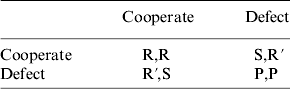
The structure of the prisoners' dilemma can be represented in a payoff matrix like the one in Table 2 (next page), where one player is playing the rows and the other player is playing the columns. One player – the row-player – chooses a row, either cooperating or defecting. At the same time, the other player – the column-player – chooses a column. There are four possible combinations of actions. Each is represented by one of the four cells. In each cell, the first element is the row-player's reward (for example, a payoff in dollars), given that particular combination of actions; the second element is the column-player's reward. If both players cooperate, they both get a reward R. If both players defect, they both get a reward P, where P<R. If one player cooperates but the other defects, then the defector gets a reward R′ (where R<R′) and the cooperator gets the sucker's payoff S (where S<R and S <P). The following ranking holds: R′>R>P>S.
Prisoners' dilemma
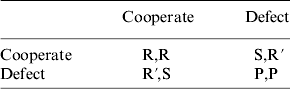
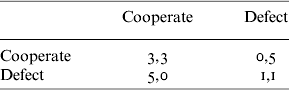
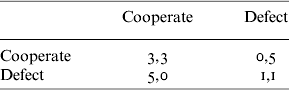
Table 3 shows a specific example of a prisoners' dilemma game, with example numerical payoffs included in each cell. The numerical values of the payoffs are not important; only the relative ranking of the different combinations of actions according to their payoffs is important.
Prisoners' dilemma (with numerical payoffs)
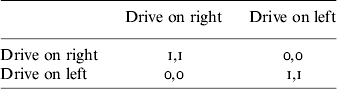
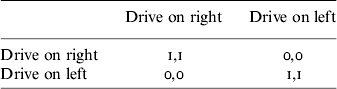
Applications of game theory attempt to predict how players will behave in games like the prisoners' dilemma. To facilitate this, game-theorists have developed rules (solution concepts) for predicting how different games will be played. One solution concept that has played an important role in game theory is the concept of a Nash equilibrium. A Nash equilibrium is a solution concept of a game involving two or more players in which no player has anything to gain by changing his or her own strategy unilaterally. To illustrate, in the game in Table 4, there are two Nash equilibria (both players drive on the right or both players drive on the left).Footnote 12
Game with two Nash equilibria
With this background in standard game theory, let us return to Bickerton's evolutionary scenario. Bickerton's account of the breakthrough into language can be helpfully recast as a stag hunt, a frequently discussed game in the social sciences (Skyrms Reference Skyrms2004).Footnote 13 The structure of the stag hunt is a good aid in understanding the problem of coordination that turns up in many social interactions where each player stands to gain from cooperating, but cooperation is risky because of the possibility that other players will not cooperate as well. The original conception of the stag hunt is presented in Rousseau (1984 [Reference Rousseau1755]: 111):
In this way men could have gradually acquired some crude idea of mutual commitments, and of the advantages of fulfilling them; but only so far as present and perceptible interests might demand, for men had no foresight whatever, and far from troubling about a distant future, they did not even think of the next day. If it was a matter of hunting a deer, everyone well realized that he must remain faithfully at his post; but if a hare happened to pass within reach of one of them, we cannot doubt that he would have gone off in pursuit of it without scruple and, having caught his own prey, he would have cared very little about having caused his companions to lose theirs.
Skyrms (Reference Skyrms2004: 1) describes the stag hunt as follows:
Let us suppose that the hunters each have just the choice of hunting hare or hunting deer. The chances of getting a hare are independent of what others do. There is no chance of bagging deer by oneself, but the chances of a successful deer hunt go up sharply with the number of hunters. A deer is much more valuable than a hare.
In a stag hunt, the cooperative strategy is for each individual hunter to take part in hunting a stag. Each hunter also has the noncooperative option of abandoning the stag hunt in favor of trapping a hare. Trapping a hare is a solitary activity, not requiring the help of other hunters. No stag will be caught unless each individual hunter participates in the stag hunt. So, in a stag hunt, if a hunter instead changes course and tries to capture a hare, that hunter will put the other hunters at a disadvantage.
What does this have to do with Bickerton's evolutionary scenario? In order to see the relationship between the stag hunt and Bickerton's account of language evolution, megafauna carcasses should be substituted for stags. Tubers (or roots or gazelles or bone marrow) should be substituted for hares. In Bickerton's account of language evolution, early hominins have a choice: participate in high-end cooperative scavenging or, instead, participate in low-end noncooperative alternatives such as foraging for tubers. We shall see why the high-end scavenging option is a riskier choice than the noncooperative low-end alternatives, even though the payoff for high-end scavenging is larger than that of its low-end alternatives.
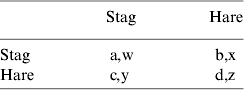
The structure of the stag hunt is represented in the payoff matrix in Table 5 (Shor 2001–Reference Shor2006), where the relations in (1a) and (1b) hold. (In Table 5 and in (1), the letters a–d represent the payoffs for the row player, and the letters w–z represent the payoffs for the column player.)
(1)
(a) a>c⩾d>b
(b) w>x⩾z>y
Stag hunt
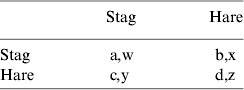
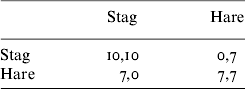
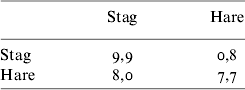
Table 6 presents a specific example of a stag hunt game, with numerical payoffs included in each cell.
Stag hunt with numerical payoffs
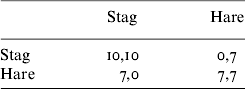
There are four possible combinations of strategies ((Stag, Stag), (Hare, Hare), (Stag, Hare), (Hare, Stag)) in the stag hunt, each of which is shown in the matrix in Table 5. Recall that the first letter in each cell represents the payoff for the row player and the second letter represents the payoff for the column player. If both players cooperate and hunt stag together, they receive the highest payoff. But, as discussed below, the outcome in which both players are noncooperative and hunt hares is a viable alternative in certain contexts, even though both players receive a smaller reward than if they had cooperated and hunted stag.Footnote 14
As a model of an actual stag hunt, the stag hunt described above is, of course, oversimplified and incomplete as it stands. For example, the payoffs in an actual stag hunt might be measurable not only in terms of meat, but also in terms of the psychological benefits associated with participating in the joint activity of hunting a stag – benefits denied a noncooperative hare hunter. Further, the payoffs might vary between individuals, depending on the number of dependents associated with particular hunters. In general, the stag-hunt game is a helpful way of understanding the coordination problem that turns up in many types of social interactions in which individuals stand to gain from cooperating with other individuals. The oversimplified, incomplete version of the game presented above is no doubt a false model of an actual stag hunt. One addition that we would need to make to the model is to try to incorporate certain aspects of early hominin subsistence behavior and social network structure (for example, by varying the degree of payoffs based on how many dependents the hunter has). That said, a virtue of a dramatically simple model of a stag hunt situation like the one presented above, as opposed to a more complicated one that includes all of the factors that might be relevant, is that it can be used to make easily understood quantitative and qualitative predictions about natural phenomena. Simple models of this sort can ‘direct our attention to things in the real world we should be measuring but had previously ignored’ (McElreath & Boyd Reference McElreath and Boyd2007: 7).Footnote 15
In a stag hunt, there are two evolutionarily stable strategies. The concept of an evolutionary stable strategy is a strengthening of the Nash equilibrium solution concept discussed above and is due to Maynard Smith & Price (Reference Maynard Smith and Price1973; see discussion in Skyrms Reference Skyrms2010: Chapter 4, whose presentation I draw upon here). An evolutionarily stable strategy is a strategy such that if the entire population played that strategy, invading mutants playing an alternative strategy would always do worse against the resulting population (containing both the original population and the mutant invaders) than the members of the original population would. More precisely, I is an evolutionarily stable strategy if for any other strategy J, where ‘E(I against J)’ is the expected payoff to strategy I against strategy J (Maynard Smith & Price Reference Maynard Smith and Price1973: 17), either
• E(I against I)>E(J against I)
or
• E(I against I)=E(J against I), but E(I against J)>E(J against J).
The two evolutionarily stable strategies in a stag hunt are one in which both hunters jointly hunt a stag, (Stag, Stag), and one in which both hunters separately hunt hares (Hunt, Hunt). A population of stag hunters is stable against an invasion by mutanthare hunters. Similarly, a population of hare hunters is stable against an invasion by mutant stag hunters.
Both players prefer the equilibrium in which both hunters jointly hunt a stag, (Stag, Stag), because of the high payoffs that both hunters receive, but that equilibrium involves cooperation. (Stag, Stag) is a more precarious equilibrium than (Hare, Hare) because the player that hunts stag may end up with nothing at all if there is a failure to coordinate. In contrast, in the payoff matrix in Table 6 above, a player who hunts hare will get a payoff of 7 whatever the other player does.Footnote 16
The distinction between payoff-dominant equilibria and risk-dominant equilibria (Harsanyi & Selten Reference Harsanyi and Selten1998) is helpful here. Hunting stag is a payoff-dominant equilibrium in that this equilibrium offers as much of a payoff for each player as their best alternative. In contrast, hunting hare is a risk-dominant equilibrium (the more uncertainty the players have about the other player(s) actions, the more likely this strategy is to be chosen).Footnote 17
Skyrms (Reference Skyrms2004: 10) poses the following question: ‘How do we get from the hunt hare equilibrium to the stag hunt equilibrium?’ That is, how do actions become correlated such that maximum cooperation is achieved and both players receive the high payoffs associated with cooperation (Skyrms Reference Skyrms2004: xii). In the context of Bickerton's evolutionary scenario for human language, we can rephrase the question as: ‘How do we get from a population of noncooperative low-end scavengers/foragers to a population of cooperative high-end scavengers?’. Skyrms (Reference Skyrms2010: 3) argues that signaling ‘is a key ingredient in the evolution of teamwork’. Similarly, for Bickerton, the deciding factor in achieving high-end cooperative scavenging at the initial stage of language evolution was iconic signals characterized by displacement of reference. According to Bickerton, iconic signals used to tell potential recruits about megafauna carcasses outside the sensory range caused actions to become correlated in high-end scavenging contexts.
How did iconic signals solve the problem of coordinating collective action in the transition to high-end scavenging? We will see below that ‘the effect of signals is not to create a stable cooperative equilibrium, but to destabilize a noncooperative one’ (Skyrms Reference Skyrms2004: 57). Signals alone are not enough to stabilize a cooperative equilibrium. Other conditions must hold as well. In the remainder of this section, the following four questions are addressed:
(i) What is the evidence for high-end scavenging among early hominins?
(ii) How do signals acquire conventionalized meaning? Does natural salience matter?
(iii) How do signals solve the problem of moving from the riskless hunt hare equilibrium to the risky but rewarding hunt stag equilibrium (the recruitment problem)?
(iv) How are conventions of meanings maintained (the problem of honest low-cost signaling)?
4.2 The evidence for high-end scavenging
Bickerton claims that human language arose out of a specific niche: high-end scavenging by our ancestors for megafauna carcasses. How strong is the evidence that scavenging was important among early hominins? There is some controversy regarding this issue (Klein Reference Klein2009: 262–271). For example, Ehrlich (Reference Ehrlich2000: 168) states that his ‘own guess is that the importance of scavenging is overrated in discussions of hominid evolution … Why fight lions if you can dig up tubers and ambush an occasional young gazelle?’ The goal of this section is to show that, while the currently available evidence is compatible with Bickerton's scenario, the evidence for high-end scavenging by our early hominin ancestors is too limited to serve as part of a solid empirical foundation for a viable model of the earliest stages of language evolution. The available evidence is compatible with subsistence behaviors other than high-end scavenging during the time period that is Bickerton's focus. Meat might have played a large role, but we do not have strong evidence for high-end scavenging approximately 2 mya. This section draws from overview discussions in Ehrlich (Reference Ehrlich2000) and Klein (Reference Klein2009: 262–271), as well as some of the literature on early hominin scavenging.
The evidence bearing on subsistence for early hominins is limited. For australopithecines, sticks and (unaltered) stones could have been helpful in chasing potential competitors, such as jackals and hyenas, away from megafauna carcasses. In a recent popular account of the rise of the genus Homo (Wrangham Reference Wrangham2009),Footnote 18 the present state of knowledge concerning early hominin subsistence behavior between 2.6 and 1.9 mya is described as follows:
Whatever the technique, by at least 2.6 million years ago, some groups were definitely getting meat from carcasses that previously only big carnivores would have eaten. Over the next few hundred thousand years, impact notches and cut marks on animal bones caused by stone tools attest to habilines spending long enough in the danger zones to be able to slice the meat off dead animals, from turtles to elephants. (Wrangham Reference Wrangham2009: 189)
Late Australopithecus and early Homo were mainly herbivores; they occasionally feasted on meat that was obtained by hunting or scavenging. It is possible that later Homo (c. 1.9–1.4 mya) was a wide-ranging omnivore with a large carnivorous component to its diet (Johanson, Edgar & Brill Reference Johanson, Edgar and Brill2006). Thus, while it is unlikely that meat constituted the primary element in the diet of australopithecines or early Homo, meat does seem to have been present in the diet of early hominins. This suggests that early hominins engaged in some forms of cooperative hunting and/or scavenging. It also suggests that they shared meat. Both of these behaviors can be found in nonhuman animals. For example, lions, chimpanzees, dolphins, hawks, and even bacteria engage in behaviors akin to cooperative hunting (Skyrms Reference Skyrms2010: 149–150).
The problem of early hominin scavenging is complex and the surviving evidence is ambiguous. This can be illustrated by considering the details of one of the main studies that Bickerton uses to support his claim about the role of high-end scavenging among early hominins. Domínguez-Rodrigo et al. (Reference Domínguez-Rodrigo, Pickering, Semaw and Rogers2005) present evidence from cut-marked bones at the archaeological sites at Gona (Afar, Ethiopia). These sites preserve both stone tools and fauna remains. They are one of ‘the world's oldest, unambiguous spatial associations of stone tools and fragmentary bones in good archaeological context’ (Domínguez-Rodrigo et al. Reference Domínguez-Rodrigo, Pickering, Semaw and Rogers2005: 113). The evidence that Domínguez-Rodrigo et al. (Reference Domínguez-Rodrigo, Pickering, Semaw and Rogers2005) discuss provides support for the hypothesis that the earliest stone artifacts of hominins functioned primarily as tools for butchery. Their evidence also suggests that hunting and/or high-end scavenging of large ungulate carcasses may have been part of the behavioral repertoire of hominins by about 2.5 mya.
The age for the Gona sites is 2.6–2.5 mya. The evidence for cut marks (Domínguez-Rodrigo et al. Reference Domínguez-Rodrigo, Pickering, Semaw and Rogers2005: 115–117) comes from macroscopic features and microscopic features. At one site (Site OG56) there was an identified bone specimen with cut marks that gives evidence for skinning activities. At a different site (Site DAN2), there were five identified bone specimens from small/medium-sized animals with cut marks that provide evidence for filleting. Hominins during this time period exploited a range of taxa (from bovids to equids) as food resources. Most of the taxonomically identifiable cut-marked bones specimens in the sample discussed by Domínguez-Rodrigo et al. (Reference Domínguez-Rodrigo, Pickering, Semaw and Rogers2005) derive from bovids. The anatomical placement of cut marks on many of the specimens that they discuss is ‘provisionally suggestive of the timing of hominid access to animal carcasses’ (Domínguez-Rodrigo et al. Reference Domínguez-Rodrigo, Pickering, Semaw and Rogers2005: 117), but the sample is too small to warrant definitive statements (Domínguez-Rodrigo et al. Reference Domínguez-Rodrigo, Pickering, Semaw and Rogers2005: 117): ‘What the few cutmarked bones do suggest is that, at least on certain occasions, hominids might have obtained fleshed carcasses’ (Domínguez-Rodrigo et al. Reference Domínguez-Rodrigo, Pickering, Semaw and Rogers2005: 118).
Meat was just one part of the diet of hominins between 2.5 and 1.5 mya. How much did early hominins rely on plants for food? Plant tissues do not survive in ancient archaeological sites. Even if plant tissues did survive, it would be difficult to gauge how much food they represent in comparison to the meat represented by the bones at the sites. Studies of recent hunter-gatherers suggest that early hominins relied mostly on plants and perhaps on other types of foraged foods such as insects (Klein Reference Klein2009: 270).
In sum, a great deal has been discovered in the last several decades about early hominin subsistence behavior. The current evidence is compatible with the claim that early hominins, perhaps as far back as 2.5 mya, were occasionally aggressive, high-end scavengers of animal carcasses. However, evidence related to scavenging for early hominins between 2.5 and 1.5 mya remains limited and is also compatible with subsistence behaviors other than high-end scavenging. An evolutionary scenario like Bickerton's, concerning the earliest stages of language evolution that rests on speculative claims about the recruitment behavior of early hominins in scavenging contexts during this period of human evolution, runs the risk of just the sort of untestable speculation that has fueled skepticism about the ability of scientists to provide empirical resolution to problems in the evolution of cognition generally (and the evolution of language particularly) (Lewontin Reference Lewontin, Scarborough and Sternberg1998).
4.3 Natural salience is superfluous
How is meaningful signaling of the sort that Bickerton describes spontaneously generated (Skyrms Reference Skyrms2010: 19)? In Bickerton's evolutionary scenario, natural salience plays a central role at the initial stage of language evolution. Bickerton proposes that the proto-language consisted of iconic signals that could be used for recruitment to refer to objects and events outside the immediate context. High-end scavengers imitate ‘whatever species the dead animals belongs to, imitate the sound it makes or the way it moves, or mime some prominent feature of its anatomy’ (160).Footnote 19
Darwin (Reference Darwin1871: 87), too, assumed that natural salience played a role in the evolution of language:
Since monkeys certainly understand much that is said to them by man, and when wild, utter signal-cries of danger to their fellows; and since fowls give distinct warnings for danger on the ground, or in the sky from hawks (both, as well as a third cry, intelligible to dogs), may not some unusually wise ape-like animal have imitated the growl of a beast of prey, and thus told his fellow-monkeys the nature of the expected danger? This would have been a first step in the formation of a language.
Both Bickerton and Darwin assume that at the initial stage of language evolution signals were grounded in salient aspects of the environment. Over time, this system of signals was modified by evolutionary processes and eventually included the use of non-iconic, conventional signals. The assumption that natural salience played an important role in language evolution is widespread and has a history dating back to at least the late Epicureans (Skyrms Reference Skyrms2010: 20).
There is no empirical evidence, though, that natural salience is a crucial determinant of either nonhuman animal communication systems such as the vervet monkey alarm call system discussed in Section 2 (Skyrms Reference Skyrms2004: 57) or the communication systems utilized at the earliest stages of human language evolution. Many animal signalling systems evolve by ritualization in which cues are exapted into signals (Maynard Smith & Harper Reference Maynard Smith and Harper2003).Footnote 20 One example of this is the use of urine to mark territorial boundaries: ‘Initially, the animal urinates through fear at leaving the territory in which they are safe. Other animals then evolve a mechanism that makes use of that information. This then puts a selection pressure on the focal animal to urinate whenever it needs to make clear its territorial boundaries’ (Scott-Phillips, Dickins & West Reference Scott-Phillips, Dickins and West2011: 43).
It is possible that the signals at the initial stage of language evolution were conventional and arose by chance (Skyrms Reference Skyrms2010: 5). Is this a plausible view, though? How do arbitrary signaling systems (such as that evidenced by vervet monkeys) evolve spontaneously, without any determinant such as natural salience? Drawing heavily on Skyrms (Reference Skyrms2004, Reference Skyrms2010), the goal of this section is to describe how, in the initial stages of the development of communication systems such as those exhibited by vervet monkeys and claimed by Bickerton to be exhibited by high-end scavenging early hominins, senders and receivers of signals can be behaving randomly, rather than using signals grounded in salient aspects of the environment. Despite the randomness of the initial state, signaling systems often evolve. The scenario ‘of some small initial natural salience amplified by evolutionary feedback may well be the correct one for many evolutionary histories’ (Skyrms Reference Skyrms2010: 21), but natural salience is not required.
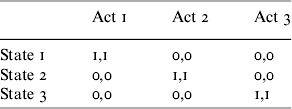
Lewis (Reference Lewis1969) discussed the conventionality of meaning in the context of signaling games. One player, the sender, has some knowledge about the world (e.g. ‘there is a deinotherium carcass’) and has a desire to share that knowledge with a second player, the receiver. The receiver can subsequently use that knowledge to make an informed decision about how to act. The payoffs to the sender and the receiver are dependent on the choices of both individuals. For example, Table 7 indicates the payoffs that both the sender (the row player) and the receiver (the column player) receive given each (State, Act) pair, in a game where there are three acts and three states.Footnote 21
Signaling game with numerical payoffs (Skyrms Reference Skyrms2004)
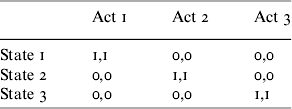
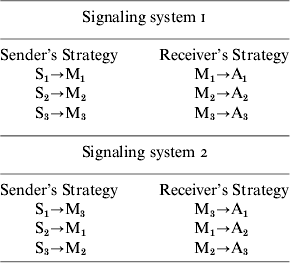
Both the sender and the receiver have strategies. The sender's strategy is a rule that associates each state (S) with a message (M) to be sent in that state. The receiver's strategy is a rule that associates each message with an action (A) to be taken if the message has been received. A particular pair of sender and receiver strategies is a signaling system if, for every state, the receiver's action taken is optimal for that state. An action is optimal for a given state if both players get the highest payoff possible for that state. The two pairs of strategies in Table 8 are signaling systems for the payoff structure given in Table 7.
Signaling systems (Skyrms Reference Skyrms2004)
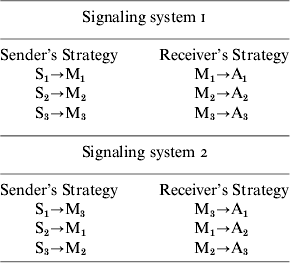
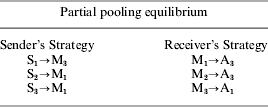
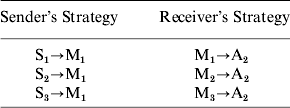
Both signaling systems in Table 8 are evolutionarily stable strategies. However, there are other equilibria that are not signaling systems. For example, as shown in Table 9, babbling (pooling) noncommunicative equilibria (Skyrms Reference Skyrms2010: 64) are possible, where the sender always sends the same signal (i.e. the sender ignores the state) and the receiver always undertakes the same action (i.e. the receiver ignores the signal).Footnote 22,Footnote 23
Babbling equilibrium
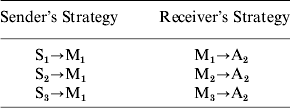
How do babbling equilibria fare against signaling systems? Consider again the matrix in Table 7. With respect to those payoffs, both of the signaling systems above, signaling system 1 and signaling system 2 (Table 8), but not the babbling equilibrium (Table 9), satisfy the first clause of Maynard Smith & Price's (Reference Maynard Smith and Price1973) definition of an evolutionarily stable strategy:
• E(I against I)>E(J against I)
A population of senders and receivers sharing signaling system 1 is stable against an invasion by mutants with the babbling system above. The same holds for signaling system 2. Compare, for example, the babbling equilibrium in Table 9 with signaling system 1 in Table 8. The expected payoff of signaling system 1 against itself is greater than the expected payoff of the babbling equilibrium against signaling system 1.
Assuming an initial stage in which some population proportions of sender and receiver strategies are selected randomly, signaling systems often spontaneously develop in the application of a model of large population, random mixing differential reproduction (replicator dynamics) to a signaling game, whether or not natural salience plays a role at the initial stage (Skyrms Reference Skyrms1996: 92; Reference Skyrms1998; Reference Skyrms2000; Reference Skyrms2004: 58; Reference Skyrms2010: Chapter 5). Consider again the two signaling systems, signaling system 1 and signaling system 2 in Table 8 above. What factors determine which of the two signaling systems takes over a population, assuming that both signaling systems serve to transmit information equally well, and neither is more naturally salient than the other at the initial stage? There is a range of factors that play a role here. For example, initial conditions (the relative proportions of the two signaling systems in the population at the initial stage of evolution), the relative probabilities of the different states, and chance aspects of the evolutionary process each play an important role (Skyrms Reference Skyrms1998; Reference Skyrms2010: Chapter 5).
Common ground, for example, is a key factor. In situations like the one described above – in which one player, the sender, has some knowledge about the world and has a desire to share that knowledge with a second player, the receiver, who, in turn, can use that knowledge to decide how to act – individuals must converge on a shared solution without knowing each other's intentions in advance, before any communication occurs. These shared solutions are sometimes referred to as Schelling points (Schelling Reference Schelling1960; see also Lewis Reference Lewis1969):Footnote 24
Most situations – perhaps every situation for people who are practiced at this kind of game – provide some clue for coordinating behavior, some focal point for each persons expectation of what the other expects him to expect to be expected to do. Finding the key, or rather finding a key – any key that is mutually recognized as the key becomes the key – may depend on imagination more than logic; it may depend on analogy, precedent, accidental arrangement, symmetry, aesthetic or geometric configuration, casuistic reasoning, and who the parties are and what they know about each other. (Schelling Reference Schelling1960: 57)
Schelling points are salient options in a game that allow players to coordinate. Lewis (Reference Lewis1969) discusses the role that Schelling points play in the resolution of games with multiple equilibria like the one above involving signaling system 1 and signaling system 2. Both Clark (Reference Clark1996) and Potts (Reference Potts2008) apply Schelling points to linguistic phenomena. Scott-Phillips, Kirby & Ritchie (Reference Scott-Phillips, Kirby and Ritchie2009) present important experimental work on the role of Schelling points in the emergence of communication.
What about displacement of reference? Can signals characterized by displacement of reference evolve without the relative transparency afforded by naturally salient iconic signals? Animal signals such as alarm calls and food calls are invested with meaning through successive rounds of association between the signals, on the one hand, and objects and events within the sensory range of the sender and the receiver(s), on the other hand. Things might work differently for communication about absent objects and events. In communicative interactions involving displacement of reference, such as the one Bickerton has in mind, there are no repeated and consistent associations between signals and objects and events within the immediate context. The objects and events in the case of displacement are, by definition, inaccessible to the senses of the sender and the receiver(s). Consequently, it could be argued that where displacement of reference was involved, (relative) transparency of meaning was necessary at the earliest stages of human language. An iconic signal, by resembling the referent of the signal, helps to constrain the range of possible interpretations.
There are a couple of reasons for rejecting the argument that natural salience was a key factor in the evolution of word-like signals characterized by displacement of reference. First, there is no evidence that natural salience played a role in the evolution of the communication systems of various ant species that display displacement of reference.Footnote 25 Second, language acquisition research suggests that transparency of meaning is not an important factor in the development of displacement of reference comprehension. The development of absent referent comprehension depends on the interaction of multiple factors, such as general representational capacity, the word–object relation, and contextual support (Ganea Reference Ganea2005). At 14 months of age, human infants can understand references to an absent object, but this comprehension is fragile, dependent on contextual factors such as how easy it is to gain access to the object and the length of time since the object was last viewed (Ganea Reference Ganea2005). There is no reason to think that displacement of reference comprehension would have developed any differently among early hominins.
In sum, we should not take for granted that natural salience is a necessary condition for displacement of reference at the earliest stages of language evolution. There is no evidence that natural salience is a key determinant of the signaling systems found in nature (for example, vervet monkey alarm calls). Signaling systems can emerge without any system being more salient than the other(s). In the case of displacement of reference, it may or may not have been the case that the first use of a signal to refer to an absent object was relatively iconic. Any particular signal begins as a ‘one-off’ case of speaker meaning, a meaning that may or may not match the receiver's interpretation. The earliest use of signals in a displaced fashion probably involved multiple rounds of receiver misunderstanding of various gestures and vocalizations. The most we can say is that, over time, a particular group of individuals eventually endowed the signals with significance (see related discussion in Green Reference Green2009: 146).
4.4 Signals destabilize noncooperative equilibria
Are signals enough to achieve the type of cooperative equilibrium that Bickerton argues characterized the high-end scavenging niche of early hominins?Footnote 26 Drawing heavily again on Skyrms (Reference Skyrms2004; see, in particular, Chapter 5), in this section, I discuss the role of signals in moving between noncooperative and cooperative equilibria. While iconic signals can help to solve the recruitment problem associated with high-end scavenging by destabilizing noncooperative equilbria, signals alone cannot maintain a cooperative equilibrium (Skyrms Reference Skyrms2004: 67).
Consider the following scenario that illustrates how signals can destabilize a noncooperative equilibrium (Robson Reference Robson1990; Skyrms Reference Skyrms2004: 66–67). At the initial stage, we have a population composed of noncooperative individuals that separately hunt hares (or, in Bickerton's scenario, dig up tubers and occasionally ambush gazelles). This is a noncooperative (but, recall, risk-dominant!) equilibrium. At some point in time, mutants invade the population by utilizing a previously unused signal as a ‘secret handshake’. Mutants do not cooperate with natives, but instead cooperate with each other to hunt stags (or, in Bickerton's scenario, scavenge megafauna carcasses). Mutants do better than natives in terms of the payoffs that they receive when interacting with other mutants. As a consequence, mutant invaders of this sort take over the population. With the introduction of the signal (the ‘secret handshake’), the noncooperative equilibrium is no longer evolutionarily stable.
The possibility of deception looms large here.Footnote 27 In Bickerton's scenario, the low-cost iconic signals that are used for recruitment are not tied to emotions and real-world stimuli immediately available to the receiver(s) of those signals. Consequently, in a context in which the interests of the sender and the receiver conflict, such signals make ‘listeners highly vulnerable to deception’ (Knight Reference Knight, Hurford, Studdert-Kennedy and Knight1998: 72). This is potentially problematic for Bickerton's scenario. In a social context in which deception occurs with some regularity, it is likely that receivers would mistrust all those signals except those whose veracity is verifiable. Consequently, a signaling system whose signals are used to refer to objects and events outside the immediate context would be highly unstable in certain circumstances.
To illustrate the problem, consider the payoff matrix in Table 10 (Aumann Reference Aumann, Gabszewicz, Richard and Wolsey1990, cited in Skyrms Reference Skyrms2004: 67–70). In this context, hare-hunting against a stag hunter is better than hare-hunting against a hare hunter, so hare hunters profit by deceiving. The generic form of this scenario is in Table 5 above, with the relations between the payoffs as in (2a) and (2b).
(2)
(a) a>c>d>b
(b) w>x>z>y
Stag hunt (Aumann Reference Aumann, Gabszewicz, Richard and Wolsey1990)
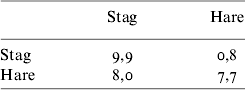
Unused signals alone are not enough in this scenario to create and stabilize a cooperative equilibrium. Payoff matrices like this one must be kept in mind when considering Bickerton's evolutionary scenario. In the next section, we consider what conditions must hold in order to maintain a cooperative equilibrium in which the population utilizes low-cost recruitment signals displaying displacement of reference.
4.5 Maintaining conventions of meaning
As noted in the previous section, there is a serious obstacle to the evolutionary stability of honest communication systems: communication ‘opens the door for deception; where one can communicate, one can manipulate’ (Bergstrom Reference Bergstrom and Harrington2009: 20). In order for a signaling system to be evolutionarily stable, it must benefit both the sender and the receiver. In contexts such as that described at the end of the previous section, a noncooperative sender will benefit by deceiving the receiver. Over time, if signals are unreliable, receivers will stop attending to the signals. If so, how are honest signaling systems maintained? What can keep signals reliable in the face of evolutionary pressure to deceive (Maynard Smith & Harper Reference Maynard Smith and Harper2003, Scott Phillips Reference Scott-Phillips, Smith, Smith and Ferrer i Cancho2008b)?Footnote 28
One explanation for the stability of honest communication is the ‘costly signaling hypothesis’: honest signals are ensured by appropriate signal costs (Zahavi Reference Zahavi1975). This explanation was proposed to explain signals such as the elaborate tails of peacocks, whose high cost serves as an indicator of genetic quality. The costly signaling hypothesis distinguishes two kinds of costs (Maynard Smith & Harper Reference Maynard Smith and Harper2003: 7; Fitch Reference Tecumseh2010: 197): efficacy costs and strategic costs. An efficacy cost is the cost paid to transmit the information unambiguously. This cost must be paid even when the sender has no temptation to deceive the receiver. The strategic cost of a signal is the additional cost above the efficacy cost. The function of strategic cost is to maintain the reliability of the signal. The costly signaling hypothesis concerns strategic cost. According to the costly signaling hypothesis, an honest signaling system can be stable if the strategic cost of signaling is greater for low-quality signalers than for high-quality signalers.
While costly signals may be one way of ensuring the stability of honest communication, especially when it is relatively difficult for receivers to verify the integrity of the signal (Lachmann, Számadó & Bergstrom Reference Lachmann, Szabolcs and Bergstrom2001), human speech is typically assumed to be strategically low-cost, at least energetically (Fitch Reference Tecumseh2010: 195).Footnote 29 As Locke (Reference Locke2008: 640) observes, ‘[s]ignals that are energetically “cheap”, according to the [costly signaling hypothesis – BZC], cannot serve as “honest” or reliable indices of fitness because selection would have applied only to signals that preferentially benefited individuals of high genetic quality’. Hence, if indeed human speech is low-cost, then we must look to possible explanations other than the costly signaling hypothesis for the maintenance of honest communication at the earliest stages of the evolution of human language.
Before we turn to alternatives to the costly signaling hypothesis, we must ask whether or not it is really safe to assume that the strategic costs of human speech and language production are low. The claim that speech and language production are strategically low-cost typically takes for granted that the cost of production should be measured solely in terms of the expenditure of energy during the execution of speech. But there are other sender-related costs associated with human speech and language production that must be taken into consideration (see Locke Reference Locke2008, whom I am drawing upon here, for more discussion). First, we must take into account the developmental costs associated with the acquisition of a communication system. Second, we need to factor in the cognitive demands associated with the formulation of signals, not just their execution. Further, the cognitive demands of formulating and executing a deceptive signal might be greater than those associated with formulating and executing an honest signal. Our model also needs to accommodate the observation that ordinarily low-cost signals can be produced in more costly ways. For example, speech can be whispered and speech can be exaggerated, and these whispered or exaggerated signals might be differentially costly for different speakers.
For the purposes of this discussion, though, let us assume that the strategic costs of human speech and language production are low. What are some different ways in which honest low-cost signals can be evolutionarily stable? Bickerton is aware of the problem of honest low-cost signals and responds in the following way to the question of why low-cost iconic signals should be believed in the evolutionary context that he describes (166):
[B]ecause of rapid confirmation (or disconfirmation) … [e]ither there's a dead deinotherium over the hill, or there isn't. In a couple of hours you'll know. If anyone's foolhardy enough to fake a message, you can kick his or her ass. If not, there's a bonanza of food there for you, enough incentive to make you a believer when the call comes again.
For Bickerton, (relatively) rapid (dis)confirmation is key. He assumes (166) that once dishonesty is discovered immediate punishment would result, thus overcoming the problem of deception. Further, in Bickerton's evolutionary scenario, the interests of the sender and the receiver(s) are exactly coincident. In the remainder of this section, I consider the problem of maintaining honest low-cost signals. Low-cost signals can be maintained in a range of social contexts beyond the one that Bickerton claims to be associated with the earliest stages of language evolution.
There is no reason to assume, based on the evidence currently available, that language evolved in ‘an Eden of coincident interests’ (Lachmann et al. Reference Lachmann, Szabolcs and Bergstrom2001: 13189). A safer assumption is that language evolved in contexts somewhere between the poles of pure conflict and pure coincidence of interests. There are various situations in which unrelated individuals with noncoincident interests can use low-cost signals to communicate honestly. For example, low-cost signals in contexts where interests conflict can be evolutionarily stable provided that, as in the situation Bickerton described above, receivers are able to verify the veracity of the signal within the time frame of their decision and lying is punished (Lachmann et al. Reference Lachmann, Szabolcs and Bergstrom2001, Scott-Phillips Reference Scott-Phillips, Smith, Smith and Ferrer i Cancho2008b). In this situation, rather than individuals using high-cost signals to ensure their honesty (as with the ‘costly signaling hypothesis’), individuals are punished for using low-cost signals dishonestly. Along these lines, Green (Reference Green2009) argues that a signal (such as the assertion of some proposition p) can be costly to produce because production of that signal makes senders open to a loss of credibility and only some senders (e.g. honest senders) can bear the risks associated with producing the signal. But, as Fitch (Reference Tecumseh2010: 198) points out, receiver-imposed costs such as punishment pose their ‘own deep evolutionary problems’. Any complete model of the evolution of language which depends on the presence of punishment at the initial stage must also account for the evolutionary development of punishment itself.
Stability can also arise in situations of noncoincident interests with low-cost signals if the same pair interacts repeatedly. For example, if the receiver avoids interactions with an individual who in the past signaled ‘there is a deinotherium carcass’ dishonestly, then honest low-cost signals are maintained (Silk, Kaldor & Boyd Reference Silk, Kaldor and Boyd2000; Maynard Smith & Harper Reference Maynard Smith and Harper2003: 122–123). Reputation has been argued to play a crucial role in the stability of human sociality (see Scott-Phillips Reference Scott-Phillips, Smith, Smith and Ferrer i Cancho2008b for discussion).
Honest low-cost signals can also be stable if the sender and the receiver place the possible outcomes in the same order of preference (Maynard Smith & Harper Reference Maynard Smith and Harper2003: 122; Scott-Phillips Reference Scott-Phillips, Smith, Smith and Ferrer i Cancho2008b). We saw an example of this type of situation in Section 4.3 above. Even if the sender and the receiver differ in their order of preference, such signals can still be stable if the two individuals have a common interest (for example, both the sender and the receiver benefit from the communicative interaction in some way). But, again, there is no reason to believe that human language evolved in ‘an Eden of coincident interests’. Rather, most communicative interactions throughout human evolution, especially among non-kin, are likely to have involved multiple sources of noncoincident interests.Footnote 30
What about deception among nonhuman animals? Deception is found in all sorts of communicative interactions between nonhuman animals (Skyrms Reference Skyrms2010: 79–80). Much interaction between nonhuman animals, as with humans, occurs against a backdrop of noncoincident interests. Consequently, we expect to find a mix of misinformation and information in nonhuman animal communicative behavior. That is indeed the case. While much communicative behavior in nature involves sufficient transmission of information to maintain signaling systems, misinformation – a use of signal that decreases the probability of the actual state in which it was sent and increases the probability of a nonactual state – is also found in nonhuman animal communicative behavior.Footnote 31 Deception – where the sender misinforms systematically to the detriment of the receiver(s) and the benefit of the sender – is found as well: ‘Evidence supporting the occurrence of deception has been found in all the major categories of signaling systems …, including begging, alarming, mating signals and aggressive signals’ (Searcy & Nowicki Reference Searcy and Nowicki2005: 223, quoted in Skyrms Reference Skyrms2010).
In sum, whether or not low-cost signals of the sort assumed by Bickerton are maintained is dependent on the relationships that hold between the interests of individuals involved in the communicative interaction. Are their interests coincident or not? Lachmann et al. (Reference Lachmann, Szabolcs and Bergstrom2011: 13191) make the prediction that ‘“conventional signals” will be used when communicating about (i) coincident interests or (ii) verifiable aspects of conflicting interests; “costly” signals will be used otherwise’. Bickerton claims that the possibility of (relatively) rapid (dis)confirmation was key to maintaining the honest low-cost signaling system at the earliest stages of language evolution. It is also crucial to his scenario that the interests of the sender and the receiver(s) were exactly coincident. Bickerton's assumptions are consistent with the available evidence, but, as I reviewed in this section, honest low-cost signals can be maintained in a range of possible social contexts, social contexts that are also compatible with what we know about human evolution. The most reasonable assumption, the most we can assume really given what we currently know about the social contexts in which our ancestors lived approximately 2 mya, is that language evolved in contexts somewhere between the poles of pure conflict and pure coincidence of interests.
5. Conclusion
This article evaluated the theory of language evolution presented by Derek Bickerton in his book Adam's Tongue. He proposes that the key selective pressure at the earliest stage of language evolution was the need to recruit individuals to help in the scavenging of carcasses of megafauna. The signals used for recruitment at the earliest stage of human language evolution were iconic word-like signals that could be used to refer to objects outside the sensory range of the receiver(s). Bickerton treats language evolution as part of human evolution and draws on a range of evidence not typically considered in the language evolution literature. He presents a useful critique of several rival proposals concerning the evolution of language. For these and other reasons, Bickerton's book is an important contribution to the language evolution literature. Further, Bickerton's evolutionary scenario is compatible with the available evidence for early hominin scavenging.
Little more than that can be said about Bickerton's 2009 theory of language evolution. In this article, I have shown that several of Bickerton's central claims are underdeveloped and that certain important issues crucial to Bickerton's evolutionary scenario are either not addressed or are not addressed in sufficient detail in Adam's Tongue. First, we simply do not know much about the details of early hominin scavenging. The available evidence is compatible with Bickerton's scenario, but it is compatible with a range of other possible scenarios as well. Second, natural salience plays an important role in Bickerton's scenario, grounding the earliest word-like signals (as characterized by displacement of reference). But, there is no empirical or conceptual support for natural salience as a determinant of early hominin signaling systems. Third, Bickerton fails to adequately deal with the complexities associated with maintaining an honest low-cost signaling at the initial stages of human language. Maintenance of such a signaling is highly dependent on the ways in which the interests of the communicators interact. Bickerton claims that (relatively) rapid (dis)confirmation and pure coincidence of interest were key to maintaining the honest low-cost signaling system at the earliest stages of language evolution. But low-cost signals can be maintained in a range of possible social contexts. Given the evidence available, the most we can say is that language probably evolved in contexts somewhere between the pole of pure conflict and the pole of pure coincidence of interests.
The more general goal of the article has been to show that highly abstract, simple formal models such as the stag hunt are valuable when thinking about the constraints that any account of language evolution must satisfy. Work in animal communication theory and evolutionary game theory can help us constrain the space of possible evolutionary scenarios for human language where the empirical evidence is lacking, as with Bickerton's scenario.