

INTRODUCTION
Dietary reconstructions based on the analyses of carbonized crusts attached on prehistoric pottery and the effects the compositions of these residues have on the reliability of radiocarbon (14C) dates have been vigorously discussed during recent years. Due to the lack of data, the earliest potteries from northeastern Europe have not been involved in this discussion.
Studies on the Stone Age subsistence in this area have suffered from inadequate source material of the prehistoric flora and fauna. Hardly any non-charred skeletal or other organic remains have preserved under normal conditions due to the acidic soils prevalent in the region (Ukkonen Reference Ukkonen2001: 13; Ahola et al. Reference Ahola, Salo and Mannermaa2016). Therefore, the fragmentary assemblages of burnt bones, the radically fewer charred plant remains (Vanhanen and Pesonen Reference Vanhanen and Pesonen2016), the 13C values of AMS-dated pottery crusts (Pesonen et al. Reference Pesonen, Oinonen, Carpelan and Onkamo2012), and lipid analyses (Cramp et al. Reference Cramp, Evershed, Lavento, Halinen, Mannermaa, Oinonen, Kettunen, Perola, Onkamo and Heyd2014; Pääkkönen et al. Reference Pääkkönen, Bläuer, Evershed and Asplund2016) have been the main source for evaluating the utilized resources.
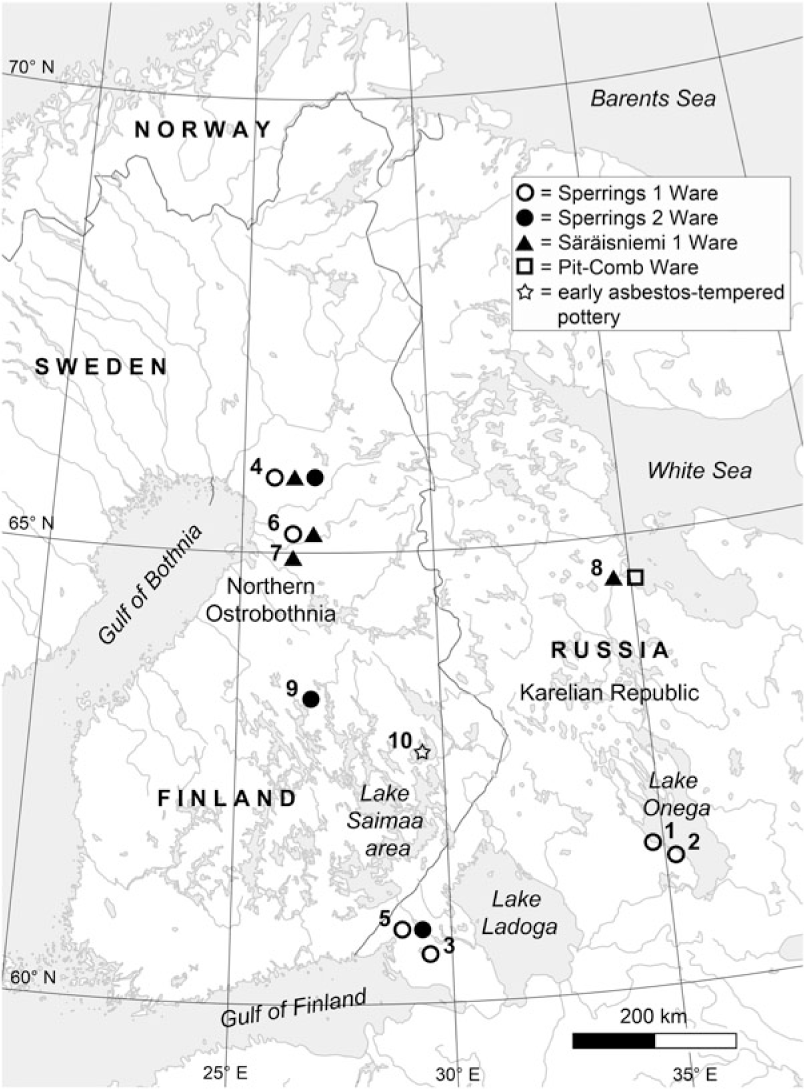
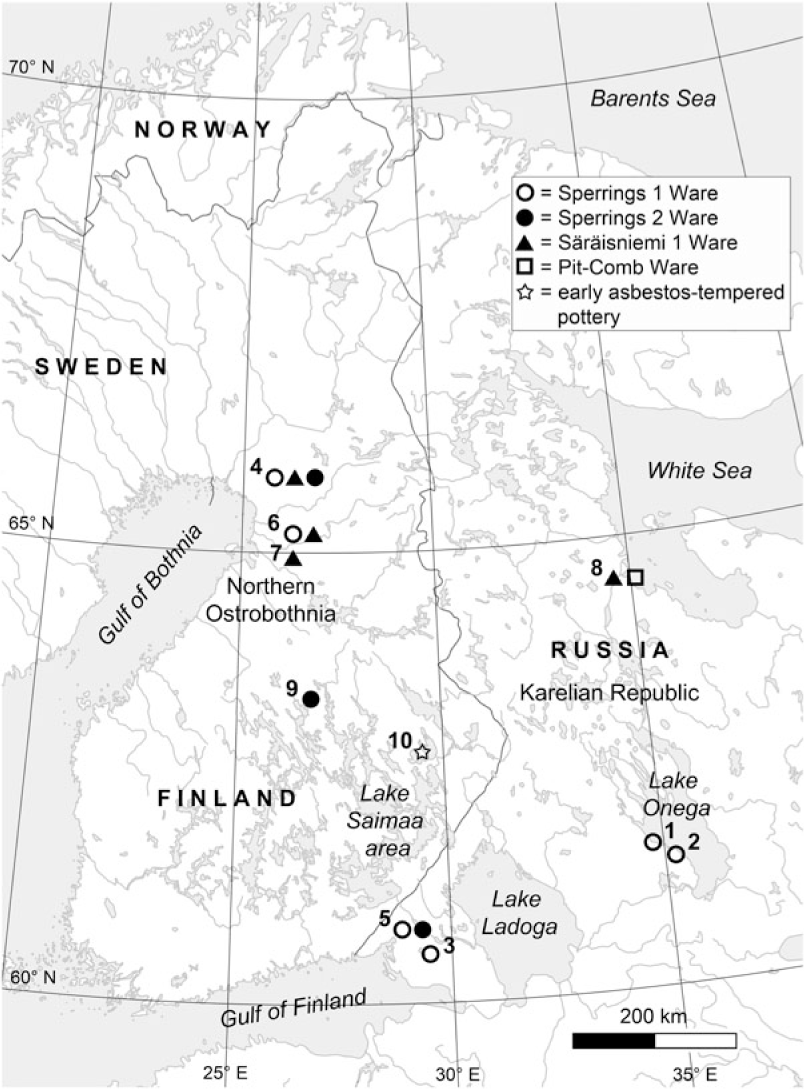
Within this study, 23 samples of charred crusts attached on 6th and 5th millennia cal BC pottery from Finland and northwestern Russia (Figures 1 and S1) were analyzed for their bulk stable isotopes (δ13C, δ15N, C/N ratio) by isotope ratio mass spectrometry (IRMS) and 14C dated (AMS). The radiocarbon dates have been published earlier (Nordqvist and Mökkönen Reference Nordqvist, Mökkönen, Lozovskaya, Mazurkevich and Dolbunova2016, Reference Nordqvist and Mökkönen2018; Tarasov et al. Reference Tarasov, Nordqvist, Mökkönen and Khoroshun2017) but the bulk isotope data is discussed here for the first time. The data is supplemented with four recently published analyses (Nordqvist and German Reference Nordqvist and German2018). Based on this data, the article aims to understand the differences between carbonized crusts on the outer and inner surfaces of vessels, and to estimate the contents of foodcrusts, and the development of dietary habits and ingredients processed in vessels.
The sites with 6th and 5th millennium cal BC pottery included in the study. Sites: 1 – Uya III, 2 – Sheltozero V, 3 – Kelonen, 4 – Tainiaro, 5 – Selänkangas, 6 – Latokangas, 7 – Vepsänkangas, 8 – Besovy Sledki II (and Besovy Sledki), 9 – Vorob’i 4, 10 – Kivimäki, and 11 – Sätös. (Vector map data by Natural Earth; illustration: T Mökkönen.)
MATERIALS AND METHODS
Sites
The analyzed samples originate from originally shore-bound hunter-gatherer sites located between 60° and 66° northern latitude. Depending on the local environmental history, especially the rate of isostatic rebound of Earth’s crust in relation to changes in water level, the duration of settlement episodes has varied greatly at the sites. In general, the sites by the northern Gulf of Bothnia have been affected by swift isostatic land uplift (approximately 12 mm/14C yr), and the settlement episodes by the sea shore have lasted typically less than a century (the Vepsänkangas site), although could have prolonged at the sites followed by post-marine habitation in riverine settings (the Latokangas and Tainiaro sites). In other parts of the research area, changes in the natural settings have been of a different magnitude and enabled prolonged occupation.
In the northern Gulf of Bothnia, the Vepsänkangas site and the highest habitation zone of the Latokangas site are related with Säräisniemi 1 Ware, the latter with Sperrings 1 Ware, too. The Tainiaro site has yielded three pottery types (Sperrings 1 and 2 and Säräisniemi 1 Wares). In the Lake Saimaa area, the Kivimäki site is connected with Sperrings 2 Ware, whereas Sätös is a multiperiod site with asbestos-tempered Sperrings 2, Kaunissaari, Typical Comb, and Pöljä Wares found at the same elevation. The sites in the eastern Gulf of Finland have been recurrently used: the Selänkangas and Kelonen sites are associated with Sperrings 1 and 2 Wares and younger components. Similarly, most of the sites in the Karelian Republic are multiperiod locations. Only the Uya III site belongs purely to the context of Sperrings 1 Ware, and the Vorob’i 4 site has produced almost exclusively Pit-Comb Ware.
Carbonized Crusts
The previously unpublished material consists of 23 samples of charred crusts from equally many vessels (half-egg-shaped, cylindrical upper part) found at 11 locations in Finland and northwestern Russia, and is supplemented by four recently published samples (Nordqvist and German Reference Nordqvist and German2018) from one site in Lake Onega, Russia (Figure 1, Tables 1 and S1). The samples originate from five areas: the northern Gulf of Bothnia (7 samples), the eastern Gulf of Finland (5 samples), the Ancient Lake Saimaa (3 samples), Lake Onega (7 samples) and the White Sea (5 samples). The material was gathered from the collections of the National Museum of Finland (Helsinki, Finland) and the Karelian Research Centre, Russian Academy of Sciences (Petrozavodsk, Russia) and derives from assemblages excavated during the 20th century.
The size of the samples varied between 40 and 250 mg of charred crust, the average being 90 mg. In general, material (foodcrust) was not abundantly available among the studied collections. However, the rather equal shares of analyzed inner and outer residues correspond roughly to the observed occurrence of crusts. In general, residues on the outer surfaces seemed to be less-thick and more coating-like layers in comparison with more intense black-colored crusts on the inner surfaces. Most of the crusts were considered to have formed during cooking episodes, excluding one crust-like black coating interpreted as paint (GrA-63581).
Results of bulk stable isotope analyses and 14C AMS datings of charred crusts from Finland and northwestern Russia. δ15N values given with the precision of ± 0.1‰. All samples represent individual vessels. δ15N, %C and %N values previously unpublished, except the samples from Vorob’i 4. Collections: KM – the National Museum of Finland (Helsinki, Finland), № – Archaeological Museum of the Institute of Language, Literature and History, Karelian Research Centre, Russian Academy of Sciences (Petrozavodsk, Russia). References: 1. Nordqvist and German (Reference Nordqvist and German2018); 2. Nordqvist and Mökkönen (Reference Nordqvist, Mökkönen, Lozovskaya, Mazurkevich and Dolbunova2016); 3. Nordqvist and Mökkönen (Reference Nordqvist and Mökkönen2018); 4. Tarasov et al. (Reference Tarasov, Nordqvist, Mökkönen and Khoroshun2017). * Erroneous result; PBlack paint; RRed paint underneath the crust

Bulk Stable Isotope Analysis and Radiocarbon Dating
Both the AMS 14C datings and the bulk stable isotope and atomic ratio measurements (IRMS; δ13C, δ15N, %C, %N in weight) were conducted at the Centre for Isotope Research (University of Groningen), the Netherlands, during 2015–2016 (Table 1). 14C dates were calibrated with OxCal v4.3.2 (Bronk Ramsey Reference Bronk Ramsey2009) and the IntCal13 atmospheric curve (Reimer et al. Reference Reimer, Bard, Bayliss, Beck, Blackwell, Bronk Ramsey, Grootes, Guilderson, Haflidason, Hajdas, Hatté, Heaton, Hoffmann, Hogg, Hughen, Kaiser, Kromer, Manning, Niu, Reimer, Richards, Scott, Southon, Staff, Turney and van der Plicht2013).
In the laboratory, the following acid-base-acid (ABA) pretreatment was applied for all samples (>30 mg)Footnote 1: an ABA pretreatment with temperature restrictions; 4% HCl at 80 C at least for 4 hr, rinsed with decarbonized water to neutral Ph, added 1% NaOH solution at 80°C for a maximum 30 min, rinsed again to neutral Ph with decarbonized water, <1% HCl at room temperature, rinsed again to neutral Ph with decarbonized water, and dried in oven at 85°C.
The samples were analyzed (δ13C, δ15N, %C, %N) by combustion in IsotopeCube NCS by Elementar coupled to IRMS (Isoprime 100). Atomic C/N ratios were calculated from the elemental concentrations. 14C measurements were conducted with 2.5MV Tandetron, model 4130 manufactured by High Voltage Engineering Europe.
RESULTS AND DISSCUSSION
Stable Isotope Analyses
Experimental studies have shown that stable isotope values and C/N ratios do not change significantly during heating and charring, and therefore, foodcrusts can be used in reconstructing the past dietary habits (Philippsen Reference Philippsen2012, Reference Philippsen2015; Yoshida et al. Reference Yoshida, Kunikita, Miyazaki, Nisgida, Miyao and Matsuzaki2013; Fernandes et al. Reference Fernandes, Meadows, Dreves, Nadeau and Grootes2014). Even though the level of post-depositional alteration is still an unknown factor (Heron and Craig Reference Heron and Craig2015), the samples that are outliers when compared with isotopic values and ratios of different food sources have been interpreted as mixtures of different ingredients (Philippsen Reference Philippsen2012:123, Reference Philippsen2015; Kunikita et al. Reference Kunikita, Popov, Lazin, Morisaki and Matsuzaki2017a). Still, as the measured values tend to fit within the ranges of “original ingredients,” changes in isotopic compositions have been usually taken to indicate changes in the processed resources (Kunikita et al. Reference Kunikita, Wand, Onuki, Sato and Matsuzaki2017b).
Reference material providing the isotope values of the Neolithic fauna and flora is not available from the research area. Stable isotope values have slightly altered in nature over time, and due to fossil fuel effect the modern δ13C values are depleted in comparison to pre-industrial values in terrestrial samples by 2‰ and in marine samples by 1‰ (Hellevang and Aagaard Reference Hellevang and Aagaard2015). The comparison between charred crusts of unknown ingredients and modern isotope values is further complicated, since the different tissues of the same organism produce divergent isotope values. Fat, in particular, has depleted δ13C values and similar (Nardoto et al. Reference Nardoto, de Godoy, de Barros Ferraz, Ometto and Martinelli2006) or enriched δ15N values (Germain et al. Reference Germain, McCarthy, Koch and Harvey2012) compared to muscle of the same mammals. Even so, it may be assumed that the trophic levels and general isotopic ratios connected with different species and environments have remained relative to each other irrespective of the fluctuating values. Consequently, our archaeological data can be tentatively analyzed against the modern reference material (Figure 3), which in this case is available for the Finnish part of the research area only.Footnote 2 In particular, marine fish and seals from the White Sea area are likely to have higher δ15N and less depleted δ13C values in comparison to the reference data from the Finnish inland lakes and the Baltic Sea.
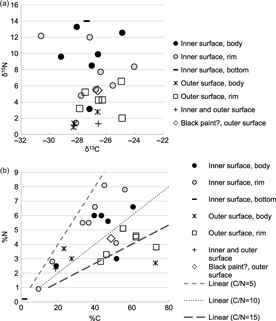
Crusts attached on the inner and outer surfaces in different parts of vessels: (a) ratios of stable bulk isotopes, and (b) elemental concentrations (by weight). For data, see Table 1 (Graphs: T Mökkönen.)
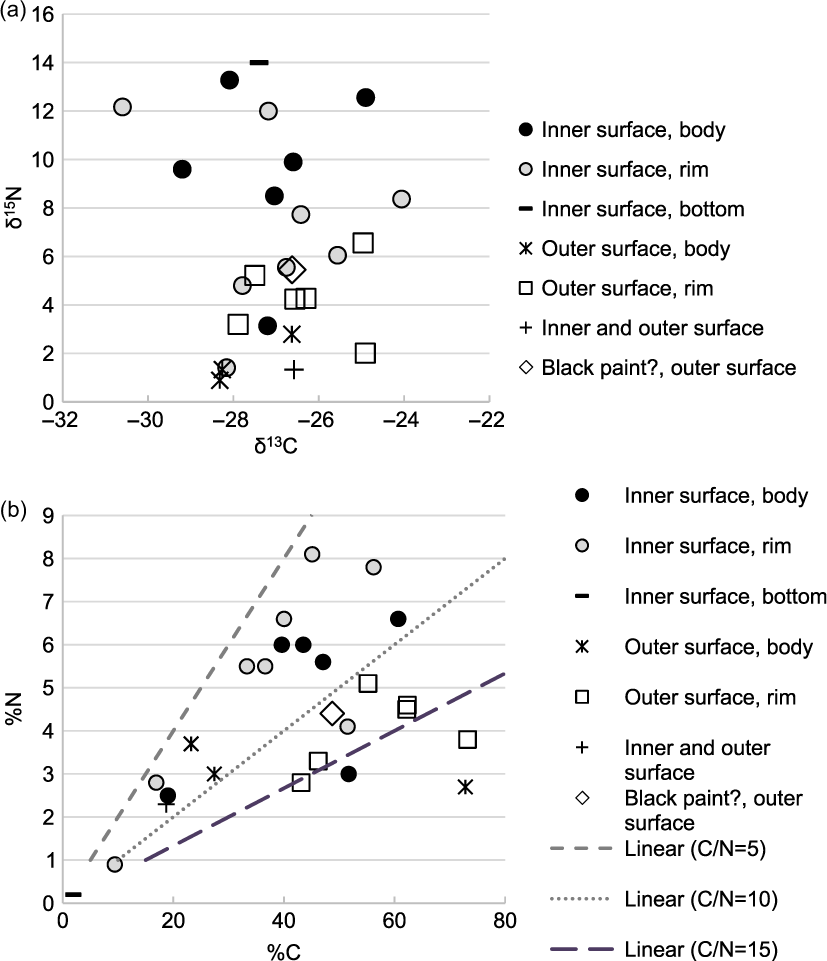
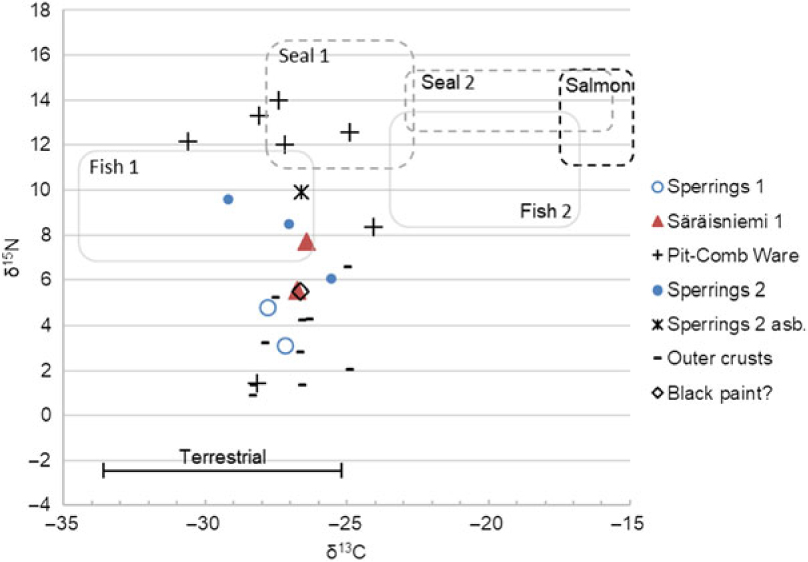
Bulk stable isotopes of the inner surface foodcrusts according to pottery type and the outer surface crusts of all pottery types. Modern ranges of aquatic species from Finland: Salmon = from the Gulf of Finland and northern Baltic Sea (scale; Torniainen et al. Reference Torniainen, Vuorinen, Jones, Keinänen, Palm, Vuori and Kiljunen2013, n = 488), Seal 1 = Saimaa ridged seal from the Lake Saimaa area (muscle and liver; Auttila et al. Reference Auttila, Sinisalo, Valtonen, Niemi, Viljanen, Kurkilahti and Kunnasranta2015, n = 54), Seal 2 = ridged seal and grey seal from the northern Baltic Sea (plasma, liver and muscle; Mänttäri Reference Mänttäri2011, n = 100), Fish 1 = fish from small lakes in central Finland (fin and muscle; Saari Reference Saari2014, n = 604), Fish 2 = fish from the northern Baltic Sea (muscle; Sinisalo et al. Reference Sinisalo, Valtonen, Helle and Jones2006, n = 130). Terrestrial = modern δ13C values of terrestrial mammals (muscle, values from Pääkkönen et al. Reference Pääkkönen, Evershed and Asplundaccepted, n = 47). (Graph: T Mökkönen.)
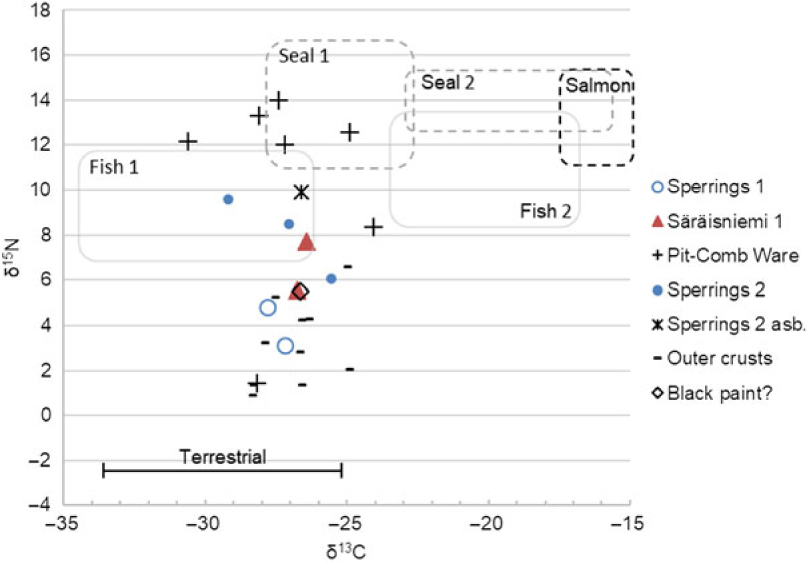
Carbonized crusts on the inner and outer surfacesFootnote 3 show highly significant statistical differences and form two partly overlapping groups (Table 1, Figure 2a–b)Footnote 4. The δ13C values of all the crusts cover a similar range, and significant differences were found in other values. The δ15N values of the internal crusts (m = 8.6‰) have more than a half of the magnitude of those of the outer surface crusts (m=3.39‰), and the C/N ratios of the outer surface material (m = 14.4‰) were about 60% higher than those of the inner crusts (m=8.5‰). This indicates the divergent origins of the crusts found in the different parts of the vessels’ surface.
The tendency of internal crusts to have elevated δ15N values and lower C/N ratios point towards animal and aquatic origins of residues (Kunikita et al. Reference Kunikita, Shevkomud, Yoshida, Onuki, Yamahara and Matsuzaki2013), while outer crusts’ tendency towards moderate or depleted δ15N values is characteristic for terrestrial ingredients. Especially, the higher C/N ratio of outer crusts suggests substantial input of plant ingredients, or more likely, that they consist largely of soot and other substances from the firewood (Miyata et al. Reference Miyata, Minami, Onbe, Skamoto, Matsuzaki, Nakamura and Imamura2011; Philippsen Reference Philippsen2012: 123,125; Yoshida et al. Reference Yoshida, Kunikita, Miyazaki, Nisgida, Miyao and Matsuzaki2013; Teetaert et al. Reference Teetaert, Boudin, Saverwyns and Crombé2017).
The sooting impact of flames is further illustrated by the rim shards, which are mostly grouped between the values of the inner and outer body shards (Figure 2a–b). This indicates that the residues near the rim are prone to the effects of exterior charring. Thus, only the inner surface residues, especially on the lower parts of vessel’s body, can be thought to represent more homogeneous foodcrusts (Kunikita et al. Reference Kunikita, Shevkomud, Yoshida, Onuki, Yamahara and Matsuzaki2013, Reference Kunikita, Popov, Lazin, Morisaki and Matsuzaki2017a; Teetaert et al. Reference Teetaert, Boudin, Saverwyns and Crombé2017), which allow the identification of terrestrial ingredients without the mixing signal of the residues produced by firewood.
The inner surface residues (n=16) were studied for detecting temporal variation in the ingredients involved in the foodcrust formation (Figure 3). Terrestrial isotope values are present, respectively, in both samples of Sperrings 1 Ware (Lake Onega and the northern Baltic Sea) as well as in one sample of Säräisniemi 1 Ware (the White Sea), Pit-Comb Ware (the White Sea) and Sperrings 2 Ware (the northern Baltic Sea) each. The δ15N values, that fit into the modern aquatic values from Finland, are present in ten samples: Säräsiniemi 1 Ware (n=1, the Gulf of Bothnia), Sperrings 2 Ware (n=3, Lake Saimaa), and Pit-Comb Ware (n=6, Lake Onega, the White Sea). Only the Pit-Comb Ware samples clearly correspond to the isotopic values of modern seals. It is noteworthy that all outer crusts are characterized by terrestrial bulk isotope values.
The internal crusts of Sperrings 1 Ware (n=2) have low nitrogen values (δ15N, %N) and moderate δ13C values suggesting a C3 plant or herbivore origin, whereas the notably high C/N ratios (17.2, 12.6 versus 5.6–10.4 in other inner residues) similar to the values of the outer crusts (see Figure 2b), point towards a plant origin (Philippsen Reference Philippsen2012: 127–128; Fraser et al. Reference Fraser, Bogaard, Charles, Styring, Walleca, Jones, Ditchfield and Heaton2013; Yoshida et al. Reference Yoshida, Kunikita, Miyazaki, Nisgida, Miyao and Matsuzaki2013; Piezonka et al. Reference Piezonka, Meadows, Hartz, Kostyleva, Nedomolkina, Ivanishcheva, Kosorukova and Terberger2016; Oras et al. Reference Oras, Lucquin, Lõugas, Tõrv, Kriiska and Craig2017). However, the high C/N ratios have been recorded in connection to processing of seal fat and fish oils (Heron et al. Reference Heron, Andersen, Fischer, Glykou, Hartz, Saul, Steele and Craig2013, Reference Heron, Craig, Luquin, Steele, Thompson and Piličlauskas2015), together with aquatic δ15N values, which is not the case here. Another explanation is that these high C/N ratios might be connected to processing of terrestrial fats.
Only one sample representing the two oldest pottery types displays aquatic values. This sample of Säräisniemi 1 Ware dating to the mid-5th millennium cal BC from costal Gulf of Bothnia (GrA-63480) indicates freshwater fish origin. On the contrary, the bulk stable isotope values of the inner surface crusts from younger pottery types show mainly aquatic values (Figure 3). Pit-Comb Ware from Lake Onega and the White Sea display values connected to freshwater seals and fishes, and one sample (GrA-63681) is likely to indicate the mixing of aquatic and terrestrial ingredients. Also, the values of Sperrings 2 Ware from Lake Saimaa and the Gulf of Bothnia indicate freshwater fish origin. It is remarkable, that clearly marine isotope values are missing, even if over 60% of the samples originate from the seaside. Whether this is the result of the mixing of ingredients or post-depositional alteration, cannot be resolved based on the present data.
Shift from Terrestrial to Aquatic Resources
Studies on stable isotopes and lipids have shown the connection between the oldest pottery (of eastern origin) and the processing of aquatic resources in the southern Baltic Sea area and the Baltic countries (Craig et al. Reference Craig, Steele, Fisher, Hartz, Andersen, Donohoe, Glykou, Saul, Jones, Koch and Heron2011; Philippsen and Meadows Reference Philippsen and Meadows2014; Heron et al. Reference Heron, Craig, Luquin, Steele, Thompson and Piličlauskas2015; Oras et al. Reference Oras, Lucquin, Lõugas, Tõrv, Kriiska and Craig2017). In Finland, the adoption of pottery has been connected to specialization to maritime resources, as judged by osteological data (Siiriäinen Reference Siiriäinen1981; Nunez Reference Nunez1990).
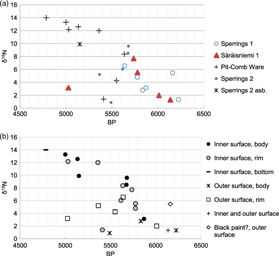
In the present data, the clearly aquatic δ15N values (>7‰, including shellfish; Mänttäri Reference Mänttäri2011) become visible around the time the Sperrings 2 and Pit-Comb Wares appear, ca. 5700 BP (ca. 4500 cal BC) (Figure 4a–b). This suggests that mainly terrestrial products were processed in the ceramic containers during the first half a millennium following the pottery adoption. The shift in isotopes indicates either change in the general subsistence base or in the use of pottery. The increase of aquatic δ15N values makes the difference between the inner and outer crusts increasingly clear (Figure 4b).
Dating of crust samples and their δ15N values presented according to (a) pottery type, (b) crusts attached on the inner and outer surfaces in different parts of vessels. (Graphs: T Mökkönen.)

Based on Stone Age osteological data, some 40–50% of identified mammalian bones from the Finnish inland Lake District and the Karelian Isthmus are terrestrial species (Ukkonen Reference Ukkonen1992; Mökkönen Reference Mökkönen2001; Seitsonen et al. Reference Seitsonen, Seitsonen, Broderick and Gerasimov2017).Footnote 5 The corresponding figure at the sites located by the Baltic Sea coast in Finland is less than 5% (Ukkonen Reference Ukkonen1992). Because fish bones dominate the osteological assemblages throughout the Stone Age (Mökkönen Reference Mökkönen2001; Seitsonen et al. Reference Seitsonen, Seitsonen, Broderick and Gerasimov2017), the share of aquatic isotope values should be more pronounced if the processing of aquatic products would have been the key factor in adoption of pottery.
A delayed shift towards the intensified utilization of freshwater resources after the adoption of pottery has been proposed in the Upper-Volga region, central Russia, during the 6th and 5th millennia cal BC (Hartz et al. Reference Hartz, Kostyleva, Piezonka, Terberger, Tsydenova and Zhilin2012; Piezonka et al. Reference Piezonka, Meadows, Hartz, Kostyleva, Nedomolkina, Ivanishcheva, Kosorukova and Terberger2016), although these studies do not mention if the analyzed residues originate from the inner or outer surfaces. These results stand in stark contrast to the results acquired in more southern parts of the Baltic Sea, which point towards the intense utilization of aquatic resource base from the very beginning of pottery craft (Philippsen and Meadows Reference Philippsen and Meadows2014; Kriiska et al. Reference Kriiska, Oras, Lõugas, Meadows, Lucquin and Craig2017).
Studies on lipid biomarkers and δ13C values of fatty acids found in the organic residues on Neolithic pottery from the coastal southwestern and southern Finland show that the residues on Early Comb Ware (mostly Early Comb Ware, style I:1, i.e. Sperrings 1 Ware, 5200–4450 cal BC)Footnote 6 are mixtures of ruminants (elk, forest reindeer) and brackish water species processed in the same vessels (Pääkkönen et al. Reference Pääkkönen, Bläuer, Evershed and Asplund2016). In the younger pottery types (Jäkärlä Ware, 4300–3900 cal BC; Typical- and Late Comb Ware, 3950–3250 cal BC) the residues originate chiefly from Baltic Sea organisms even if some ruminants were present, too (Hopia et al. Reference Hopia, Reunanen and Pesonen2003; Cramp et al. Reference Cramp, Evershed, Lavento, Halinen, Mannermaa, Oinonen, Kettunen, Perola, Onkamo and Heyd2014; Pääkkönen et al. Reference Pääkkönen, Bläuer, Evershed and Asplund2016).
The results presented here are in line with the previous lipid-based studies, and set the shift towards aquatically oriented use of pottery vessels to the mid-5th millennia cal BC. Based on the data, this change seems to have taken place rather coevally in different parts of Finland and northwestern Russia. Still, it is probable that aquatic resources were involved in the earliest pottery use in some regions of northern Europe, too, as suggested by marine δ13C values of some 14C dated crusts of north Norwegian Säräisniemi 1 Ware (Pesonen et al. Reference Pesonen, Oinonen, Carpelan and Onkamo2012).
AMS 14C Dating
Currently, the magnitudes of past reservoir effects in the research area remain basically unstudied. Instead, marine reservoir effect is present in the Barents Sea (Pesonen et al. Reference Pesonen, Oinonen, Carpelan and Onkamo2012; Piezonka Reference Piezonka2015) and the southern Baltic Sea areas (Piličiauskas and Heron Reference Piličiauskas and Heron2015; Kriiska et al. Reference Kriiska, Oras, Lõugas, Meadows, Lucquin and Craig2017). Based on pre-bomb samples, marine reservoir effect of less than 100 14C yr has been estimated for the northern Gulf of Bothnia and less than 200 14C yr for the Gulf of Finland (Lougheed et al. Reference Lougheed, Filipsson and Snowball2013). The offset caused by freshwater reservoir effect has been assumed to be rather insignificant in the inland lake areas due to the lack of substantial limestone deposits in the region (Pesonen et al. Reference Pesonen, Oinonen, Carpelan and Onkamo2012).
As paired samples of different origin from the same shards or from the closed archaeological contexts are not included in our data, the question of reservoir effects cannot be answered. The terrestrial bulk isotope signal of the dates older than ca. 5700 BP, nevertheless, indicates that the oldest dates presented here are rather free from reservoir offsets. Instead, the dating of the increased aquatic input in pottery may be influenced by reservoir effects.
CONCLUSIONS
This study explores bulk stable isotopes of carbonized organic crusts attached on 6th and 5th millennium cal BC pottery from Finland and northwestern Russia. Bulk stable isotope analyses presented here demonstrate that the inner and outer surface residues are mostly of different origin. Only the first mentioned can be comprehended as rather homogeneous foodcrusts, while the latter consist of a mixture of firewood soot and some food residues.
The 14C dated isotope data provides new insight for understanding the adoption and use of pottery in northeastern Europe during the late 6th and 5th millennia cal BC. In contrast to the traditional scenario proposing the processing of aquatic products as the main reason behind the adoption of pottery technology, the present results argue for the processing of mainly terrestrial resources during the earliest phase of pottery use.
The change towards more intensified processing of aquatic ingredients in ceramic vessels took place around 5700 BP (ca. 4500 cal BC). This seems to have taken place rather coevally in large areas in Finland and northwestern Russia, and was coupled with the appearance of new pottery types: Sperrings 2 and Pit-Comb Wares. Even if the osteological material is dominated by aquatic species throughout the Stone Age, none of the residues in the present data exhibit a clear marine component.
Although the presence or absence of reservoir effect cannot be confirmed based on the current data, the terrestrial isotope values for the oldest dated samples suggests that the age proposed for the earliest pottery in Finland and northwestern Russia can be regarded as fairly reliable. Increasing use of aquatic ingredients in pottery most likely introduces some reservoir offsets to 14C dating, although their magnitude cannot be estimated based on the current data.
SUPPLEMENTARY MATERIAL
To view supplementary material for this article, please visit https://doi.org/10.1017/RDC.2019.18.
ACKNOWLEDGMENTS
Research was funded by project “The use of materials and the Neolithisation of northeast Europe (c 6000–1000 BC)” (Academy of Finland, University of Oulu, #269066). We also thank Aleksey Tarasov (Petrozavodsk), and the anonymous referees.