Introduction
Health care providers often do a poor job assessing and treating pain in pediatric patients.1-Reference Garrison, Maio and Spaite4 This oligoanalgesia is recognized by the American Academy of Pediatrics which recommends using all available methods of pain management to eliminate barriers to analgesic administration in children.Reference Zempsky and Cravero5 In the out-of-hospital setting, perceived patient discomfort and the difficulty associated with intravenous access are thought to be large barriers to appropriate pain management in pediatric patients. The delivery of intranasal analgesia may be a novel solution to this problem.Reference Borland, Jacobs, King and O'Brien6 Intranasal fentanyl is both safe and efficacious in the management of acute painful conditions associated with pediatric trauma.Reference Borland, Jacobs and Geelhoed7 The study investigated whether the introduction of the mucosal atomization device as an additional method for fentanyl delivery (MAD, Model 300, Wolf Tory Medical, Salt Lake City, Utah, USA) would increase fentanyl administration rates in pediatric trauma patients.
Methods
Study Design
The research used a 2-group, retrospective study of pediatric trauma patients (age <16) transported to one of eight hospitals by an urban, hospital-based ambulance service during a 13-month period. Study Group 1 included all pediatric trauma patients transported during the 6-month period before introducing the MAD (September 1, 2007 through February 28, 2008). During this period, the only delivery method for fentanyl was intravenous. In March 2008, a training session was conducted to educate paramedics about the new device in conjunction with a revised county EMS protocol. Study Group 2 included all pediatric trauma patients transported during the succeeding 6-month period, April 1, 2008 through September 30, 2008. During the second period, the paramedic could administer fentanyl intravenously or via the MAD device.
Study Setting and Populations
The setting was an urban, hospital-based ambulance service with an annual call volume of over 80,000 providing the majority of out-of-hospital care for the city of Indianapolis, located in Marion County, Indiana. The study populations included two groups of pediatric trauma patients identified as candidates for pain medication using the county EMS pain management protocol. Prior to introduction of the MAD device, all providers were mandated to undergo a 3-hour classroom session on the revised EMS protocols. One component of this session included an in-service training on the use of the MAD device as an alternative for fentanyl administration. The training focused on the motor skills necessary for proper use of the MAD while giving some background on the efficacy of intranasal fentanyl administration. Providers were not encouraged to favor one route over the other. Once this training was completed, all providers were permitted to use the MAD device as a method for fentanyl delivery. The route of delivery as well as the decision to administer was made by the treating paramedic. In accordance with the protocol, fentanyl was indicated when a patient was describing moderate to severe pain which was defined as a pain rating greater than 3 on a 1 to 10 scale or a score greater than 4 on the Wong-Baker FACES pain rating scale. In Group 1, fentanyl was administered intravenously, the standard of care, and in Group 2, fentanyl could be administered intravenously or via the MAD. Inclusion criteria were all pediatric trauma patients older than 15 years of age. Patients were excluded if they had a verbal pain score of less than 3 out of 10, Wong-Baker score less than 4, or Glasgow Coma Scale (GCS) of less than 14. The Indiana University School of Medicine Institutional Review Board (IRB) categorized the study as exempt from IRB review.
Measurements
Two emergency physicians individually reviewed each chart to determine appropriateness for fentanyl administration using the Marion County EMS pain management protocol. Since a pain scale was not a required entry for pediatric patients, charts were reviewed for documented evidence that the patient was experiencing pain; for example, the patient was described to be in moderate to severe discomfort, inconsolable, or had an obvious deformity. Conversely, if there was evidence the patient was well-appearing and in no acute distress, the reviewer determined that fentanyl was not indicated. A third, independent, physician reviewer resolved any discrepancies between the initial reviewers. A KappaReference Fleiss8 score was computed to reflect agreement between the initial reviewers. A research assistant recorded vital signs, mechanism of injury, and method and rate of fentanyl administration from the out-of-hospital record. Trauma was categorized as an ICD-9 code between 900 and 959.9, and the mechanism of injury was indicated using a short description of how the child was injured. The research assistant then organized mechanism of injury into seven categories.
Data Analysis
Two-sample t tests and chi-square tests were used to identify differences in demographic and clinical characteristics by time period and fentanyl administration. SAS Version 9.3 (SAS Institute, Cary, North Carolina, USA) was used for all analyses.
Results
A total of 946 patient-care records were reviewed—518 in the pre-MAD group and 428 in the post-MAD group. In the pre-MAD group, of the 518 charts reviewed, 135 patients (26.1%) met the criteria for pain medication administration; of these, 41 (30.4%) received fentanyl. In the post-MAD group, of the 428 charts reviewed, 98 patients (22.9%) met the criteria, and of these, 36 (36.7%) received fentanyl. Only 13 (36.1%) patients of those receiving fentanyl were treated with the MAD. Using the Kappa score, reviewer agreement for both the pre and post MAD groups was 86.7% (95% CI, 0.811-0.924).
The mean age, in years, of both the pre-MAD group and the post-MAD group was identical (9.9, SD 4.5). Both groups were predominantly male. There was no difference in the mean Glasgow Coma Scale or mean initial pulse. The difference between the mean initial respiratory rate was significant: 22.3 (SD 6.1) in the pre-MAD group and 20.6 (SD 5.3) in the post-MAD group, P < .05.
Males tended to receive fentanyl more than females in both the pre- and post-MAD groups (37.9% vs 26.9%). However, this trend was not statistically significant. Furthermore, there was a trend toward older children receiving fentanyl when compared with younger children. Just over 23% of those receiving fentanyl were 0-5 years of age; 27.6% were 6-10 years of age; and 39.8% were 11-15 years of age. Again, while there was a trend, it did not reach statistical significance. Mechanism of injury, however, was a statistically significant predictor of fentanyl administration. The percentage of children receiving fentanyl by mechanism of injury was assault, 16.7%; burn, 69.2%; cut, 20.0%; fall, 40.9%; motor vehicle crash, 13.0%; struck by or against, 33.3%; and other, 33.6%; P < .001. Injuries in the “other” category included animal bite, bicycle, pedestrian, penetrating, or sports injury.
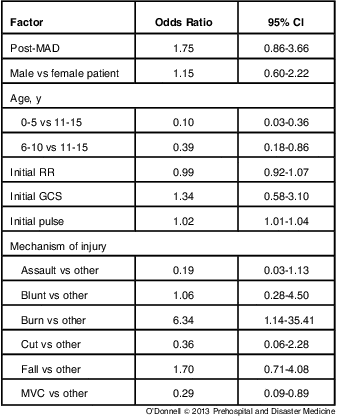
The logistic regression analysis of the factors influencing fentanyl use is presented in Table 1. As age increased, the likelihood of receiving fentanyl increased. Similar results were found for initial pulse of the patient. Burn patients were associated with an increase in fentanyl use in the post-MAD period (adjusted odds = 6.34; 95% CI, 1.14-35.41) while motor vehicle crash patients were associated with a decrease in fentanyl use in the post-MAD period (odds = 0.29; 95% CI, 0.09-0.89).
Logistic Regression of Factors Influencing Fentanyl Use in Pediatric Patients

Abbreviations: RR, Respiratory Rate, GCS, Glasgow Coma Scale; MAD, mucosal atomization device; MVC, motor vehicle crash
Discussion
This study indicates there was no significant difference in fentanyl administration among the pre- and post-MAD groups. These results were in contrast to the study hypothesis that this alternative delivery method would improve the rate of fentanyl administration. It is unclear why paramedics did not use the MAD as expected given that intravenous access has been perceived as a barrier to fentanyl administration and administering fentanyl via the intranasal route is comparatively easy and painless.
Logistic regression results from the current study confirm that fentanyl use in the post-MAD period was associated with older children, specifically those between the ages of 11 and 15 years. In fact, as age decreased, the likelihood of receiving fentanyl in the post-MAD period decreased such that children 0-5 years of age were associated with less fentanyl than the 6-10 age group, even though the hypothesis was that the MAD would increase fentanyl use in the younger population. These results are similar to a study by SworReference Swor, McEachin, Seguin and Grall2 concluding that younger children with painful conditions such as an extremity fracture receive analgesia less frequently when compared with older children with similar injuries. Also similar to Swor,Reference Swor, McEachin, Seguin and Grall2 fentanyl use in the post-MAD period was associated with burns and not associated with motor vehicle crashes.
ZempskyReference Zempsky and Cravero5 and colleagues hypothesize that it is possible that paramedics do not assess or manage pain in pediatric trauma patients due to a lack of adequate assessment tools. In a survey by HennesReference Hennes, Kim and Pirrallo9 of paramedics in a large urban ambulance service, only 6% and 31% stated they had used a verbal pain scale in children and adolescents, respectively, in the previous month. Further, a study by IzsakReference Izsak, Moore, Stringfellow, Oswanski, Lindstrom and Stombaugh10 of nearly 700 pediatric trauma patients transported by a county ambulance service identified only one pediatric trauma chart documenting that a validated pain assessment tool was used. This study had similar findings. Many of the charts reviewed had no documented pain score. These studies suggest that a major limitation to pain management is proper assessment rather than difficult intravenous delivery. However, it is also possible that paramedics did not easily embrace this new alternative delivery method due to the fact that intranasal drug delivery had never been done prior to this protocol change. This change could be due to the difficulty of implementing a new method when paramedics are entrenched in the traditional method of medication administration.
Limitations
There are a few limitations for this study. First, only one ambulance service was studied, thus limiting the study's external validity. Second, this study was conducted over two successive 6-month periods and does not reflect the seasonal nature of trauma. To obtain a complete picture of the rate of injury in pediatric trauma patients, 12 months of data should have been collected for both the pre- and post-MAD groups. However, this study was a pilot study on the use of fentanyl by out-of-hospital care providers. Third, the paramedics had a limited opportunity to use the device based on the small number of pediatric trauma patients in both groups. Therefore, use of the MAD reflects only a portion of the paramedics’ experience with the MAD.
Conclusion
The results of this study indicate that fentanyl use is not statistically different between the pre- and post-MAD groups. Given that fentanyl administration in this population of pediatric trauma patients was limited to 34.8% of total patients transported, additional research is needed to identify methods that will improve the assessment and treatment of pain in out-of-hospital pediatric trauma patients.