Music printing and publishing has rightfully been the subject of considerable attention in recent decades, and no period has benefited more from this interest in the history of the book than the sixteenth century. Whereas early bibliographies grew out of the antiquarian spirit that infatuated nineteenth-century bibliophiles – Claudio Sartori's Bibliografia delle opere musicali stampate da Ottaviano Petrucci is one such example, not least because it took as its subject some of the rar est and most collectible music prints aroundFootnote 1 – subsequent catalogues have tackled the largest music printing houses of the age and in so doing have established the bibliographic foundations on which a cultural history of printed music can be based. Suffice it to mention here the magisterial catalogues of the printers Pierre Attaingnant (Paris), Antonio Gardano (Venice), Ottaviano Scotto (Venice) and the new catalogue of Ottaviano Petrucci (Venice and Fossombrone), all of which pair highly detailed descriptive bibliographies with historical studies. Taken together, they provide unprecedented bibliographic control over a wealth of music that flew from European presses in the sixteenth century.Footnote 2 In fact, the printing capitals of Paris and Venice prove exemplary: Pierre Attaingnant, who commercialised the printing process by rejecting xylography and multiple-impression printing in favour of a less elegant but more economical single-impression technology, issued over 170 titles between 1528 and 1551.Footnote 3 In Venice, the Scotto press issued hundreds of music titles between 1539 and 1613, of which at least 724 are extant; the Gardano press put out well over a thousand music titles between 1538 and 1611, of which 1,425 survive; and smaller presses issued at least seventy-four music titles in the years up to 1572.Footnote 4 If we use the conservative figure of 500 copies for print runs at that time and count only the surviving editions, Attaingnant's rather modest enterprise in Paris would have produced over 85,000 prints and presses in La Serenissima well over one million.Footnote 5
The catalogues on which these figures are based have – by their sheer dimensions – reaffirmed the classic history of printing as one of abundance. In thousands of entries and many thousand pages, they give impressive substance to a narrative of mass production, broad dissemination and ‘popular’ genres pitched to an expanding public for music. Historians of the book such as Roger Chartier have been led to cry ‘mea culpa’ for having ignored music in their studies of print culture, and – encouraged – musicologists have claimed for music its own ‘culture of print’ and concomitant fame for Renaissance composers.Footnote 6
But the celebratory rhetoric with which these newly calculated sums are usually announced masks some equally stunning statistics that music bibliographers have not weighed as critically – those describing the dizzying rate at which printed music was destroyed. To take a dramatic example, were it not for Munich, BS Mus. Rar. 900, a set of thirty-five prints bound together when fresh from the press, literally one-quarter of Attaingnant's chansonniers would be unknown to us today. Twenty-seven unica survive in this pair of partbooks alone. Compared to literary texts, the fortunes of printed music were dismal indeed. To draw but one comparison, 256 copies of the Shakespeare first folio from 1623 survive from a print run of 750, figures that easily trump the sorry fate of Cristóbal de Morales's super-sized folio choirbook, the Missarum liber primus (Rome, 1544), which was issued in 525 copies, of which only 25 survive.Footnote 7
These breathtaking records of loss illustrate just how ephemeral music was. Indeed, large shares of the music left to us today survive thanks to avid collectors from the Renaissance.Footnote 8 One such was Hans Heinrich Herwart, owner of Munich chansonniers cited above, whose personal music library was purchased by the Dukes of Bavaria in 1586.Footnote 9 Unsurprisingly, Herwart's set of Attaingnant prints is a real collector's item: they were bound luxuriously in coloured leather with interlacing strapwork, gold stamping and gold gauffered edges in the Parisian style of bindings made for Jean Grolier and were easily the most beautiful music books in Herwart's collection. In effect, they were connoisseur's books in their own time, destined sooner for the cabinet, studiolo or Wunderkammer than the music desk. Indeed, Herwart's manuscript copies of songs from the Attaingnant chansonniers reaffirm that these gorgeous tomes were meant for safekeeping and admiration, not practical use.Footnote 10
Munich BS Mus. Rar. 900 might seem to be a special case, but a surprisingly large number of the sixteenth-century volumes now in European libraries were originally owned by but a handful of Renaissance bibliophiles and institutional libraries. This is to say, what we often work with when we consult original sources is not the sheet music of the age, but the volumes made for and preserved by sixteenth-century collectors. The history of the music holdings at the Bavarian State Library provides a particularly clear example of this, since the provenance of the music books is well documented. To the large collection purchased at Herwart's death – 456 music prints – the Dukes added 451 prints from the library of Johann Georg von Werdenstein, a fabled local collector that they pressured for years to part with his treasures and who finally capitulated in 1592.Footnote 11 For both of these ducal purchases, detailed inventories were drawn up by Wolfgang Prommer; working back and forth between these inventories and the books makes it fairly simple to identify which books in the collection came from which library.Footnote 12 Together, these two collections account for 81 per cent of the Bavarian State Library's 1,236 sixteenth-century music prints. The same scenario holds true for the early music holdings at the Biblioteka Polskiej Akademii Nauk in Gdańsk, which houses the private music library of Georg Knoff, a sixteenth-century music lover with a particular taste for Italian madrigals. His son gave this impressive collection of over 250 music prints to the Municipal Senate of Danzig in 1615, as documented in contemporary acquisition records of 1617, and most of the books are still there today in their original bindings marked with his initials.Footnote 13
Rarely do archival documents pair so nicely with modern-day library holdings.Footnote 14 In some cases we have inventories but the books were dispersed centuries ago. Many of Raimund Fugger the Younger's 200 music prints fill the shelves of the Österreichische Nationalbibliothek in Vienna, but the collection is far from intact, judging from the Fugger inventory of 1566.Footnote 15 Of the 102 prints owned by Sir Charles Somerset and inventoried in 1622, only two have been identified.Footnote 16 Even in the case of Ferdinand Columbus, who arranged to have his phenomenal library taken over at his death by the Cathedral Chapter of Seville, only a few thousand of his 15,370 books survive at the Biblioteca Colombina today.Footnote 17 His detailed acquisition logs (numerical registra) and alphabetical catalogues (the Abecedaria) record what was a virtually complete collection of all printed polyphonic music known to us today up to the year 1535, but the Colombina has suffered such losses to vandals and theft over the centuries that few of the 172 music titles are still there.
In the absence of original bindings, however, even some sixteenth-century inventories can be of little use no matter how close to hand the books may be. This is not just a matter of the books having lost bindings that were once personalised with signatures, initials, and other ex libris; rather, it concerns the common practice by which printed partbooks were rendered unique in the early modern age: binding them together in tract volumes (also known as ‘binder's volumes’, ‘collector's volumes’, ‘recueils factices’, and ‘Sammelbände’).Footnote 18 Although music – like other sorts of printed matter – was shipped and sold unbound, and although many musicians used it that way just as we use sheet music today, some music lovers organised their partbooks by binding them together in volumes by voice type, that is, with a series of superius parts in one volume, altus parts together in another, and so forth. Publishers certainly encouraged such projects with the series titles they used for anthologies (‘primo libro di madrigali a quattro voci di Jacques Arcadelt’, ‘secondo libro’, etc.), and not a few of the series that remain to us today survive together in tract volumes such as Munich BS Mus. Rar. 900, which contains the Premier to Trente cinquiesme livre de chansons printed by Attaingnant, or Munich BS Mus Pr. 4o 182, which contains the Premier to Dixiesme livre of the Parangon des chansons series printed by Moderne. Both of these sets once belonged to Hans Heinrich Herwart, but we know this not because the books have an ex libris or because they are in Herwart's favourite style of binding (which was workaday parchment). In fact, it would seem that Herwart purchased these books already bound, since the prints date from a time when he was only in his twenties, and the bindings are French. In this case, they are identifiable as having belonged to him because Prommer's inventory provides a complete list of the contents of each tract volume, making clear what was bound together and in what sort of binding.Footnote 19
The uniqueness of tract volumes and its usefulness to historians cannot be overstated, for whereas the French volumes we have just been discussing were bound by publisher's series – a practice that hardly seems very original – Italian tract volumes tend to be far more varied in complexion. In the first place, Scotto and Gardano favoured single-author prints over anthologies, and so while they did tend to title prints in numbered series, the series rarely went beyond a few books. Secondly, they coordinated their formats so that music of all sorts could be bound together. Attaingnant, Moderne, and later Nicholas du Chemin and Le Roy & Ballard produced music in a large array of formats and layouts that ranged from Moderne's all-in-one table layout for the Parangon series and Attaingnant's two-in-one chansonniers (with the Superius and Tenor on facing pages of one booklet and the Altus and Bassus on facing pages of the other) to Du Chemin's folio mass prints on carta reale and Le Roy & Ballard's large oblong quarto motet prints, small oblong quarto chansonniers, and even a chanson series in oblong octavo. By contrast, one size fit all for Scotto and Gardano: masses, motets and madrigals were all issued in oblong quarto sheets that measured approximately 130 × 180 mm when folded, which meant that collectors could bind together whatever they liked. German printers such as Berg & Neuber and Flemish printers such as Susato and Phalèse followed suit, opting for the formats and layouts standardised by the high-volume commercial presses of Venice. Collectors, in turn, mixed genres and music from various publishers together at will, producing a stunning variety of bound volumes that might include everything from Adrian Willaert, Musicorum sex vocum … liber primus (Venice: Gardano, 1542), Di Verdelotto tutti li madrigali … (Venice: Scotto, 1540) and Phinot, Premier livre … chansons (Lyons: Beringen, 1548) to Clément Janequin, Les chansons de la guerre, la chasse … (Paris: Attaingnant, 1537) within the covers of a single volume.Footnote 20
The unique complexion of tract volumes certainly contradicts any commonplaces about printed books being blank, uniform, nondescript and unpersonalised. Stanley Boorman has suggested, for instance, that ‘a printed source, almost by definition, cannot fulfill a specific, different function for each of its readers. It is mass-produced, and arranged according to a scheme that the publisher believes will appeal to the greatest number of purchasers.’Footnote 21 But it is in fact precisely the publishing strategy of producing partbooks in slim uniform quarto formats that allowed purchasers to collect more selectively and to arrange their music the way they pleased if and when they bound it together.
Unfortunately, the inclinations and habits of early modern music lovers and bibliophiles have been partially lost to view owing to the subsequent practices of music librarians. Large numbers of tract volumes were removed from their bindings in the nineteenth century. In some cases, well-intentioned librarians sought to rationalise their collections, but in doing so they destroyed a considerable wealth of physical evidence. Thomas Oliphant initiated such a project at the British Library in 1842, splitting up volumes with multiple titles, either because the bindings were deteriorating or, more likely, because separating the prints made cataloguing and shelving easier.Footnote 22 Among these books were those in the collection of Henry Fitzalan, 12th Earl of Arundel, and his son-in-law Lord Lumley. In 1609, at Lumley's death, his Nonesuch palace and its contents went to the Crown, and from there Lumley's private library was absorbed into the Royal Library and eventually became part of the holdings at the British Museum. A catalogue of the library made in 1596 shows that Lumley's books were bound in tract volumes, but they have since been disassembled, and only thanks to the painstaking reconstructions of John Milsom (based on realigning wormholes and other forensics) has the provenance of many of the prints been ascertained.Footnote 23
This practice of disassembling bound volumes was complete at the Liceo Musicale in Bologna (now the Museo Internazionale e Biblioteca della Musica), one of the world's richest collections of sixteenth- and seventeenth-century music. The foundation of its extraordinary holdings was amassed in the eighteenth century by the Franciscan Padre Giambattista Martini (1706–84), Italy's first great music historian and a bibliophile to rival any modern-day antiquarian.Footnote 24 Martini's astounding collection of over 17,000 books and scores includes a treasure trove of Cinquecento prints that came to him in a variety of ways, everything from ‘gifts’ acquired from convents to a cache of damaged madrigal partbooks recovered from a pizzicheria in Rome, where they were being sold by weight for the price of the paper.Footnote 25 Martini actively salvaged copies of the very first polyphonic prints at a time when they were being discarded by others. In one respect, his collecting formed part of the research he undertook to write his Storia della musica,Footnote 26 but we should also see in Martini a great music bibliographer in the tradition begun by Antonfrancesco Doni and Conrad Gesner, for alongside his history he hoped to create a general bibliography of music, for which he wrote to a number of libraries such as the Escorial asking for lists of their music holdings.Footnote 27
Along with the books in Martini's legendary library, the Museo Internazionale e Biblioteca della Musica in Bologna also possesses the large archive of his letters.Footnote 28 Thanks to Martini's passion for detail, his correspondence includes more than 600 drafts of responses that he kept as a record, which in some instances renders his epistolary exchanges virtually complete. The letters are a valuable source of information concerning the provenance of his books. But with the exception of research into his acquisition of the Petrucci volumes he owned, little has been done to pair the books in the library at present with those described in the correspondence.Footnote 29 One obstacle to this sort of research has been the loss of Martini's own catalogue of the collection, which makes it difficult to ascertain what his library contained in the eighteenth century.Footnote 30 But another significant problem is posed by the current state of the books, for in the mid-nineteenth century, at about the same time conservators at the British Library were busy systematically wrenching partbooks in their holdings from their bindings, a similar operation was in progress at the Liceo Musicale in Bologna. Along with the discarded bindings were lost valuable indications of the provenance of the prints, and as more and more books were added to the collection at the Liceo, even those books that had originally belonged to Martini became virtually impossible to identify. Yet despite the homogenisation of the music collection at Bologna, a substantial Renaissance music library has come to light there, the Pagliarini collection, so named for the Roman bookseller from whom it was purchased in 1747.Footnote 31 This article presents an inventory and analysis of the Pagliarini collection, weighs its relative importance and sketches the unusual means by which we were able to rediscover it.
THE PAGLIARINI COLLECTION
The earliest – and indeed, the only – inventory we have of the Pagliarini collection was made in 1747 by Girolamo Chiti, the maestro di cappella at San Giovanni in Laterano in Rome and Padre Martini's principal resource for locating books.Footnote 32 Martini first contacted Chiti between March and April of 1745 (the earliest letter between them conserved in Bologna is dated 9 April 1745), via the Franciscan Padre Bandi, who was travelling between Bologna and Rome; Martini was extremely interested to learn more about Giuseppe Ottavio Pitoni, Chiti's teacher, as part of his research into the Roman school of composition, which he very much admired.Footnote 33 The esteem Chiti and Martini held for each other seems to have been mutual and immediate, for in one of his first letters to Martini, Chiti expressed regret at having just given many of his rarest books to the Papal Chapel: ‘if Padre Bandi had spoken to me more clearly first, at this moment you would have all the old keepsakes I collected in the last 29 years …’.Footnote 34 Between 1746 and 1750, Chiti loaned or gave to Martini a large number of books that were lacking in Martini's collection.Footnote 35 Chiti's dispersal of his library in these years was made with great care and with Martini in mind. For instance, in 1750, Chiti gave a number of books to Cardinal Neri Maria Corsini (1685–1770), for whose family Chiti was cappellano e custode in San Giovanni in Laterano. But the part of his library given to the Corsini family apparently consisted of volumes owned by or already known to Martini, whom Chiti was clearly happy to ‘favorire’ with books from his collection.Footnote 36 The same seems to be true of Chiti's gift of books to San Giovanni in Laterano in 1748 – all of the printed music he gave to the Roman church is duplicated in the holdings now in Bologna in the same or more complete form, implying that he only bequeathed to others books that Martini already owned.
In May of 1747, Martini had made a trip to Rome, at which time he first saw the books that were being sold by the Libreria Pagliarini at the shop ‘a Pasquino’ near the Piazza Navona.Footnote 37 He arranged to purchase them, with Chiti's help.Footnote 38 After Martini returned to Bologna, on 5 July, Chiti wrote to him about the collection, which he was preparing for shipment: ‘the more that I look at the assortment of … books, the more stunned I am at how many editions and pieces there are, volume by volume to a total of seventeen volumes. In sum, there are eighty-four books nicely bound in parchment with indexes.’Footnote 39 In the weeks that followed, he made a complete list of the volumes and their contents. Appendix I is based on this inventory.Footnote 40
Our knowledge of the provenance of the collection begins with its purchase from the Libreria Pagliarini.Footnote 41 The Pagliarini family were bookseller-printer-publishers active in Rome, with editions dating from 1735 to around 1805. In 1747, the business was being run by two brothers, Nicolò and Marco, out of a shop in the piazza Pasquino. Although the Pagliarinis never printed any music, over the years their firm issued a stunning array of books in every subject from theology, philosophy and mathematics to descriptions of festivals, illustrated books, guides to Rome (among them Le magnificenze di Roma) and, from 1745 to 1799, about twenty opera and oratorio librettos. In these same years, the Pagliarinis were important early patrons of Giovanni Battista Piranesi.
Booksellers often dealt in second-hand books, even speciality items such as music, which regularly turned up in small quantities when they bought entire libraries at estate sales. In the case of the ‘sortimento Pagliarini Martini’, as Chiti called it, we know that the books came from the convent of San Francesco a Ripa in Rome. As he remarks:
The Pagliarini–Martini collection has certainly finished its storm in a safe port. This collection was discarded by the reformed fathers of San Francesco a Ripa in exchange for moral classics, sermons and so forth, with no concern for music, because nowadays these religious only sing in falsobordone.Footnote 42
How and when the books first came to San Francesco a Ripa is unknown, though given the preponderance of secular music, it seems likely that the collection did not originate there.Footnote 43 Private collectors are known to have given or bequeathed their music books – even secular titles – to sacred institutions for safekeeping in their libraries, and of course clerics often had private libraries of their own that went to cathedral and convent libraries at their death.Footnote 44
Whatever its provenance, the oldest layer of the collection is coherent and large: 241 titles inventoried by Chiti as having been bound in sets of parchment-covered tract volumes that were probably numbered on the covers as they were in Chiti's inventory (see Appendix I, tomi I–XIII of secular music and tomi XV–XVII of sacred music).Footnote 45 Each included about fifteen prints each. As can be seen in Appendix I, the acquisition also included a number of ‘mute sciolte’ or ‘loose sets’ (XIVb and XVIIIb) that seem to have come along with the books bound as tract volumes. About half of the loose books bear publication dates coeval with those in the tract volumes, which range from 1566 to 1629; the newest print in the list of ‘mute a libretti in quarto’ (listed in Appendix I as XVIIIb.16) dates from 1673, making it easy to imagine that the group comprises some prints left separate in 1629, when the steady expansion of the collection gave out abruptly, to which were joined other occasional additions made to the collection in subsequent years. It should come as little surprise that some of the books were not bound into tract volumes and were perhaps not bound at all – many of the largest and most venerable music collections often consisted of unbound material. Over half of Herwart's library, for example, was unbound at the time of his death, the stacks of partbooks shoved into sacks for safekeeping. Nonetheless, the question remains as to whether the loose sets originally belonged with the tract volumes. Many of the books listed in XIVb and XVIIIb bear an ex libris from San Francesco a Ripa, which is likewise the case with the odd little set of Marenzio villanelle a 3 inventoried as XIV; furthermore, half of the books from both groups of ‘mute sciolte’ bear what looks like an early eighteenth-century shelfmark entered by hand on the title page, something missing from the tract volumes. Still, these discrepancies between the loose sets and the tract volumes nonetheless verify that tomi I–XIII and XV–XVII (which we consider to be the definitive core of the collection), tomo XIV (possibly of separate provenance) and the loose sets XIVb and XVIIIb (possibly subsequent additions to the music collection at San Francesco a Ripa) apparently came to the Libreria Pagliarini from San Francesco a Ripa as a set.Footnote 46
Only one of the music books acquired by Martini stands entirely apart from the rest, tomo XVIII. This was an item that had been knocking around the Pagliarini bookshop and that they were keen to bundle into the sale: the Gunther Vaclav Jacob, Acratismus pro honore Dei (Prague, 1725), a set of ten bound folio partbooks of sacred music for double choir, a print that stands well outside the scope of rest of the collection in every respect; Chiti also took a book by Fra Giovanni d'Avella that the Pagliarinis obviously wanted to get rid of along with the rest.Footnote 47 The sale also included other music theory books, including one by Aaron, but Chiti kept them for himself, since they were duplicates of books already owned by Martini.Footnote 48
If we exclude the Jacob Acratismus, the Marenzio villanelle and the loose sets (XIVb and XVIIIb) from consideration, the Pagliarini collection consisted of 241 items. All but two sets are upright quarto, the format regularly employed by Venetian printers beginning with Scotto in 1564 and eventually adopted by others.Footnote 49 Volumes I and II are in oblong quarto, the standard format for Italian music prints at mid-century and a format with a much longer lifespan elsewhere in Europe even after the Venetians switched to upright quarto. The oblong prints may have looked antiquated in 1630, though some of them date from as late as 1607 – they are all Gardano madrigal prints, most of them numbers in extensive series that were begun before Antonio Gardano's sons changed to upright quarto in the 1580s.Footnote 50 Long-time collectors of madrigals undoubtedly found the oblong format more appealing, since it fit with the shape of their other partbooks. Indeed, at the same time Gardano continued to print the extremely popular madrigals of Philippe de Monte and Giaches de Wert in oblong, we can see from Volume XIII in the Pagliarini collection that Scotto was issuing the same series in upright quarto. Apparently, the switch to upright formats for music was a slow process that included a gradual transition for long-lived series.
The lion's share of the Pagliarini prints date from 1580 to 1620, with strong concentrations of prints in the 1580s and the 1610s, the first wave entirely madrigals, the second including a significant number of sacred prints as well. Some volumes contain music printed as much as forty or fifty years apart, and most of the volumes include at least one print from the 1620s, suggesting that the books were bound in that decade or shortly thereafter: the last prints of secular music date from 1627 and the last sacred prints from 1629. It is impossible to know who assembled the collection, whether it was the music library of an academy, as Chiti suggested, or that of a single music lover, but it is nonetheless worth remarking that the spread of publication dates and their definitive end-point in 1629 are well within the compass of the adult life of an individual collector.Footnote 51 It is also worth remarking that the concentrations of madrigal prints from the 1580s and of sacred prints from the 1610s – while they might seem to represent the evolving interests of an individual connoisseur or some particular music master at an academy – are also representative of Italian music printing more generally. That is to say, graphs of the dates for the secular and sacred prints in this collection map fairly coherently onto what we can discern of the overall output of Italian presses.Footnote 52 The 1580s were especially healthy years for the publication of the Italian polyphonic madrigals that dominate the Pagliarini collection: Angelo Gardano alone is known to have printed almost 200 books of madrigals, canzonette and villanelle; twenty-three of these prints are present in the Pagliarini collection, all but one of them madrigals, and of those all but one for five or six voices.Footnote 53 It is certainly possible to discern some stylistic focal points in the collection, but in its broadest outlines, the collection evinces a pattern of consumption that reflects what seems to have been available for purchase.
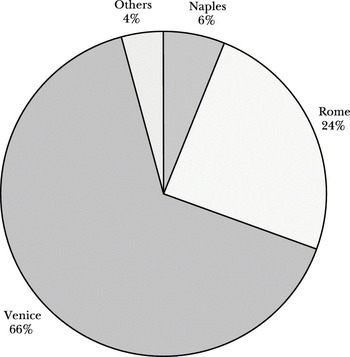
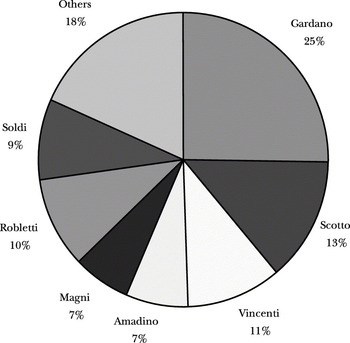
The Pagliarini prints primarily come from Venice, with Scotto and Gardano represented in good measure consistent with their dominance of the market, though a large number of Roman and Neapolitan printers are represented in the collection by a few titles, giving the whole a particular character that fits well with its Roman provenance (see Figures 1 and 2).Footnote 54 The combination of prints with international appeal distributed by the large commercial presses in Venice and more local production likewise fairly describes the working homes of the composers represented in the collection. There are large madrigal series with enduring appeal by Philippe de Monte, Giaches de Wert, Luca Marenzio and Benedetto Pallavicino, all northerners (Monte, of course, northern to the extreme, since he served the Habsburgs in Vienna and Prague, but who used Venetian printers for his madrigals, Flemish printers for his masses, and Parisian printers for his chansons).Footnote 55 Their works are concentrated in tomi I to III. Many composers from Rome and the south also had their work printed in Venice, without question the capital of music printing in Italy – Pomponio Nenna, Giovanni Maria Nanino and Carlo Gesualdo exemplify this trend. Finally, prolific Roman, Neapolitan and Sicilian composers are represented by local prints – the music of Antonio Cifra and Giovanni Francesco Anerio printed by Giovanni Battista Robletti and Luca Antonio Soldi in Rome and the madrigals of Antonio Il Verso printed by Giovanni Battista Maringo in Palermo are good examples; many lesser lights also had their works printed locally, something particularly true for church composers in Rome, such as Giovanni Boschetto Boschetti, Alessandro Capocci and Angelo Bonetti, and Neapolitan madrigalists such as Marcello Albano and Crescenzio Salzilli. The Pagliarini volumes also include the music of provincial church composers who had their works printed in Rome, such as Gregorio Allegri, who worked at Fermo until 1621. Volume XVI includes nice examples of the new early seventeenth-century style of sacred music then popular in Rome, smaller in scale and with basso continuo.
Prints in the Pagliarini collection analysed according to city of publication

Prints in the Pagliarini collection analysed according to individual printers

Overall, then, the ‘geography’ of the collection is a combination of broadly distributed music written by more famous composers (much of it in re-editions) and local repertory (much of it printed in Rome and Naples). As a set, the Pagliarini books have a nice coherence with a genuine strength in madrigal repertories that implies a unified strategy of acquisition. In this respect, the collection is distinctive. A preference for books of madrigals a 5 by single authors is clear, though tomo IV is of madrigals a 4 and with tomo VIII the mix broadens to include works with basso continuo (tomi VIII and IX), madrigals a 3 (tomo XII), a book of Gesualdo, Nanino and madrigalists working in the Neapolitan style (tomo XI), and a set of Venetian anthologies (tomo X).
Italian repertories that are not well represented include the works of Monteverdi, the extremely popular balletti of Giovanni Giacomo Gastoldi, secular monody, and canzonette and other settings of light strophic verse, including villanelle (remembering that tomo XIV may well have come from elsewhere or been a later addition). These are significant omissions that not only cast into even brighter relief the inclination towards five-voice madrigals but also show a preference for ‘serious’ polyphony, rather than the new concerted music of the early seventeenth century featuring solo voices and basso continuo. The fact that Rome and Naples were the two strongholds of the ‘antico’ style in the first three decades of the Seicento, coupled with the fact that the collection contains a disproportionately large number of Roman prints, seems strongly to suggest Roman origins for the collection.Footnote 56
At 241 titles, the Pagliarini collection is among the largest late Renaissance music libraries known to us today. Its size surpasses the collections of Raimund Fugger the Younger and Sir Charles Somerset, rivals that of Georg Knoff, and stands up nicely to the mammoth libraries amassed by Herwart and von Werdenstein. The Pagliarini books account for 10 per cent of the Cinquecento music books in the Museo Internazionale e Biblioteca della Musica today and are by all measures a significant find. Yet no one has studied the books themselves, despite the fact that the letters containing Chiti's inventory were reproduced over a century ago by Federico Parisini and have been cited by Anne Schnoebelen and Giancarlo Rostirolla. The disappearance of the collection is due to its having been dismembered in the nineteenth century. Its recovery involved research into the organisational strategies of the nineteenth-century custodians of the library at the Liceo where it was housed. It is this subsequent history that we retrace below.
MARTINI, GASPARI AND THE ‘PROBLEM’ OF PARTBOOKS
In 1748, the books from the Libreria Pagliarini were sent from Rome to Bologna, arriving at the end of January or beginning of February at the Convent of San Francesco, where Martini had his library. As best as anyone can tell, they remained there after Martini's death in 1784, at which time Martini's library was placed in the care of his student Stanislao Mattei, who became the first counterpoint teacher at the new Liceo Musicale when it was founded in 1804.Footnote 57 The library was then transferred in various stages to the new Liceo. The geography is impressive by virtue of its very limits: the collection that made its way from San Francesco a Ripa to the safe haven of Martini's library has remained in Bologna since its delivery in the eighteenth century. Almost. For numerous items are missing, as can be seen from Appendix I.
The attrition in the Pagliarini collection is clearly tied to the removal of the bindings, something that happened in stages, perhaps beginning with Martini himself. The music at the Liceo was first inventoried around 1820 by Francesco Barbieri, guardian and archivist from 1804 until his death in 1828. By the time of Barbieri's inventory, at least four tomi had been unbound, numbers I, IX, XII and XV. In every case, these were incomplete sets of partbooks, and there were reasons not to keep them in their bindings, as we shall see. What should be remarked here are the striking fortunes of those miscellaneous and broken sets of partbooks, something easily ascertained by comparing the current shelfmarks of books in those volumes with those of the books in the volumes that remained bound until 1840, tomi II to VIII, X, XI, XIII, XIV, XVI and XVII. Almost all of the books in the latter tomi are still in Bologna, most in complete sets of parts (volumes XI and XIII had been purchased as incomplete sets in 1747). Of the missing titles, three of the four can be accounted for (more on this below). By contrast, over half the contents of volumes I and IX are missing, with many titles unaccounted for. It may have been Martini who took the books apart, since we know from his letters that he actively sought to round out incomplete sets of partbooks by trading away duplicates;Footnote 58 this is probably what happened to number IX.6, the Michelangelo Cancineo Primo libro, and IX.12, the Cifra Madrigali … libro sesto, both of which were incomplete duplicates of prints contained in tomo VII. The Cifra and several other individual prints from volume IX ended up in other libraries, but many, like the Cancineo, have been lost entirely, IX.14 being a case in point – according to RISM, not one single part of the Raffaello Rontani, Madrigali concertati survives today. Clearly, unbinding the tract volumes facilitated exchanges, but ultimately it proved bad for preservation. For this reason, Martini may have chosen to retain the bindings, even when complete duplicates were present, as was the case for the Floridi virtuosi d'Italia primo libro (15868, in tomi III and X) and Paolo Bottaccio, I sospiri … libro primo (B-3794 [1609], in tomi V and VI).
In 1839 a new archivist replaced Barbieri at the Liceo, Stefano Antonio Sarti (1784–1855), a piano teacher at the Liceo since 1820.Footnote 59 He established a new catalogue with a set of shelfmarks that confirm that most of the Pagliarini volumes were still bound together at that time.Footnote 60 But the most dramatic changes at the Liceo came at mid-century, in 1855, when Sarti was succeeded by Gaetano Gaspari (1807–81).Footnote 61 Gaspari was 48 when he took over as librarian and had already been working at the Liceo since 1840 as a teacher of ‘solfeggio’. He was also an avid book collector and bibliographer – very much like Martini – and in 1851 he had announced his intention to publish a Bibliografia della Musica that would have realised Martini's own aspirations in that field.Footnote 62 In fact, the first card catalogue of the Liceo began as a set of detailed descriptions of the books at the Liceo and in his collection, descriptions originally intended as one basis of the Bibliografia, which never came to light.Footnote 63 Gaspari's private music collection included numerous rare books from the Cinquecento such as Aaron's Toscanello (Venice: Vitali, 1523) and Lucidario (Venice: Scotto, 1545), Animuccia's Missarum liber primus (Rome: Dorico, 1567), Gaffurio's Theoricum opus (Naples, 1480) and Practica musicae (Milan: Le Signerre-Lomazzo, 1496), Peri's Le musiche sopra l'Euridice (Venice: Raverii, 1608), Spataro's Tractato di musica (Venice: Vitali, 1531), and Ariosto's autograph of Rinaldo ardito. Although small by comparison with Martini's holdings in early music, Gaspari's entire collection came to more than 700 titles and was very precious.
Almost immediately upon his appointment, Gaspari undertook a huge project to reorganise the library, to which he added his own books, significantly enriching the collection. He unbound tract volumes and gave everything new shelfmarks, title by title.Footnote 64 He also systematised everything, putting together complete sets of parts when some were missing and checking for parts that existed in duplicate when his own books were put together with Martini's; in 1862 he auctioned off some 500 of the duplicate copies in Paris in a sale that lasted three days.Footnote 65 From tomo IX of the Pagliarini collection, for instance, two books went to the Conservatoire de Paris, IX.4, the Marenzio Terzo libro, and IX.12, the Cifra Madrigali a 5.Footnote 66 The Cifra was sold incomplete, missing its Alto part, but for the Marenzio, Gaspari substituted an Alto part from the 1594 edition by Gardano. Similar situations apply in the case of books from the Pagliarini collection we have identified in London, Brussels, Glasgow and Los Angeles, all of which can be traced to the auction in 1862.Footnote 67
The story is slightly different for the fifth book in tomo IX, Marenzio's Quinto libro. In this case, Gaspari exchanged the Liceo's incomplete copy for the complete copy at the basilica of San Petronio, where he worked as maestro di cappella beginning in 1857. Other exchanges with San Petronio include XI.8, Claudio Monteverdi's second book of madrigali a 5, a trade that gave the Liceo a complete copy and left San Petronio with the Pagliarini set in which the Alto and Quinto parts were missing; likewise in the case of I.14, Monte's fifteenth book of madrigali a 5, the Liceo obtained the complete copy from San Petronio in exchange for the Soprano, Alto and Tenor partbooks from the Pagliarini set.
Finally, Gaspari pulled together complete sets of partbooks by combining items in the Pagliarini collection that were missing parts with bits and pieces from elsewhere, sometimes even mixing different editions together. Such was the case for XII.9, Giovanni Giacomo Gastoldi, Canzonette a 3, libro secondo, in which the Canto I and Canto II come from the edition printed by Lomazzo in Milan in 1615 (from the Pagliarini set) and the Tenor and Bass parts are from an edition printed by Francesco Osanna in Mantua in 1595 (the Tenor lacks a date). In all of these cases, Gaspari's intentions are clear: to cull the collection of duplicates and complete the sets of parts at the Liceo either with elements already in the collection or by trades with San Petronio.Footnote 68
This traffic in books is traceable thanks to Gaspari's inventories and card catalogue, the auction catalogue from 1862 and acquisition records at various libraries, but also thanks to the fact that when the Pagliarini volumes were compiled in the sixteenth and seventeenth centuries, most of them were numbered throughout by hand when they were bound.Footnote 69 These manuscript folio numbers made the copies unique and have been an essential factor in identifying them. By studying them, it has been possible to verify the provenance of the books, both in Bologna and abroad, and to reconstruct the Pagliarini collection. In some cases where there is no manuscript numeration, as happens in tomi III, XII, XIII, XIV, and XVI, forensic evidence has been key to identifying which parts were once bound together, signs such as shared patterns of wormholes, foxing, stains and creases.
We will probably never know who first amassed the collection, but locating and studying the books has provided some interesting revelations concerning the habits motivating their assembly. Two strong tendencies emerge: the desire to complete incomplete sets of partbooks – apparently an eternal problem for all collectors of music in parts – and the desire to obtain complete series of books when possible, that is, for instance, to try to acquire the entire series of five-voice madrigals by Wert, books 1 to 12, published between 1558 and 1608. Even given that second, third and even fourth editions were put out by Gardano and Scotto over the years, the Wert madrigals could have been difficult to come by for a collector who began to shop for them in the 1580s. The situation is even more extreme in the case of Monte, whose series of madrigali a 5 ran to nineteen books, with first editions dated 1554 to 1598.
For series such as these, in which new books and re-editions came out intermittently over the decades, the person or persons who first amassed the collection willingly resorted to re-editions (which some individuals might not have found as collectable, since they lacked dedications) and to second-hand books. This is apparent in tomo IV, which includes at least four prints that were acquired second-hand, the three books of madrigals by Monte, IV.7–9, and the Rore madrigals, IV.10. All havean earlier set of manuscript folio numbers from a set of tract volumes that was split up.Footnote 70 Certain titles were then salvaged and rebound in the Pagliarini volumes. But not all of them, since there is a gap of fourteen folio numbers between IV.9 and IV.10, implying that one title went missing. The fact that not all the prints from that anterior set of tract volumes are present in the Pagliarini collection implies that around or after 1627 when the Pagliarini set was bound, that earlier set had already suffered some losses. Binding was probably all that saved the four titles that do survive from ending up as deli wrap in the seventeenth or eighteenth century.
We saw that for Martini and Gaspari, coping with incomplete sets of parts was a matter of some concern, and judging from the complexion of the Pagliarini collection as it stood in 1629, this concern seems to have been perennial for collectors of partbooks. It seems significant that the oldest prints in the collection are in volume XIII, a broken set of partbooks that includes only Canto and Alto parts. We can only guess at whether it was acquired incomplete in the first place, but it looks as though it might have been bought or kept as a salvage yard for spare parts, since it included first editions of the Primo libro de madrigali of Giovanni Pierluigi Palestrina, the Wert Sesto libro that was missing from the series in volume II and Alessandro Striggio's Primo libro, a print that would have fit nicely with the secondo libro in volume III. Apparently this collector liked to have complete series, and it is entirely possible that this old and broken set of partbooks had the same appeal in the early seventeenth century that it did in the eighteenth, when Martini was building his library. Martini's letters to Chiti are full of remarkably detailed accounts of his collection – that, for instance, he had seven different editions of the Lassus second book madrigals a 5 but not the Gardano edition of 1585, which he hoped to obtain.Footnote 71 Martini knew his collection inside and out and kept phenomenal track of which editions he owned, which were complete and incomplete, which parts were missing, and so forth. But in one sense, Martini's book-lists are not so far from the inventories drawn up by the music master, secretary, or librarian at the Accademia Filarmonica of Verona in the sixteenth century, who in 1564, for instance, took stock of the ‘cose che Amancano ne l'Academia nostra’, a list that included a number of single partbooks and several entire sets that had no doubt been lost to members who had failed to return them.Footnote 72 All in all, the constants for collectors across the centuries are impressive, as though the material form of partbooks, the long time-span over which series were published, and the mixed market in new, old and second-hand print imposed a fixed and enduring set of challenges rarely overcome.
CONCLUSIONS
The Pagliarini collection alone preserves over forty unica (not just unique editions, but unica of a given print). About half are complete sets, and almost all – unsurprisingly – are first editions. Given the strong predilection in historiography for narratives of great composers and the origins of various genres, the importance of the collection would be self-evident if it preserved an unicum of an otherwise lost book of madrigals by Monteverdi, the missing parts from Gesualdo's first book of Madrigali a 6, or unknown early madrigals of Arcadelt. But it does not. Among the unica are Cifra's Madrigali concertati a 5, libro quinto (IX.11) and the Quarto libro de' madrigali a 5 (VI.4) of Pietro Maria Marsolo, who was praised by Giovanni Maria Artusi, but many of the other composers are of the most minor order.
The works of these lesser lights do, however, suggest how intense musical activities were in places that – in their absence – might seem to have supported but a few composers. They also show how fragile the historical record can be, even in print. The Neapolitan school of madrigalists is an excellent example. Its luminaries were Gesualdo and Giovanni de Macque, whose works survive today in multiple copies, some of them in tomi IV and XI of the Pagliarini collection. Alongside their madrigals, in precisely these volumes, we also find the works of Giovanni Battista de Bellis and Giacomo Tropea (in tomo IV) and Alfonso Montesano, Marcello Albano, Scipione Lacorcia and Crescenzio Salzilli (in tomo XI), all composers identified with the Neapolitan school.Footnote 73 Luzzasco Luzzaschi should be included among them by virtue of Gesualdo's admiration for him and the fact that the Carlino print in tomo XI, the Seconda scelta delli madrigali a 5 of 1613, was probably made at Gesualdo's request. Like the Seconda scelta, the Nuova scelta di sette autori next to it in tomo XI was also edited by Marcello Magnetta: it includes an exemplary selection of Neapolitan madrigals.Footnote 74Tomo VI includes five books of madrigals by Nenna (who was in Gesualdo's service but who had moved to Rome by late 1600) and single prints by Donato Antonio Spano (who studied with Macque), Giovanni Vincenzo Macedonio and Ascanio Meo, maestro di cappella at San Giacomo degli Spagnoli in Naples.Footnote 75Tomo XII includes another print by Albano and an unicum by Scipione Cerreto, head of the Neapolitan music confraternity, the Congregazione della Madonna degli Angeli, and a composer who is well known as a theorist, thanks to the survival of his treatises, but whose music is almost entirely lost.Footnote 76 With the exception of the music by Gesualdo and Nenna, which was printed (in fact, reprinted) by the ‘international’ houses in Venice, all of these editions issued from presses in Naples: Ottavio Beltrano (the archiepiscopal printer), Giovanni Giacomo Carlino (Gesualdo's personal printer and another archiepiscopal printer), Giovanni Battista Gargano & Lucrezio Nucci and Costantino Vitale.
In sum, this significant group of madrigal prints could not be more Neapolitan. Indeed, the Pagliarini collection preserves a remarkably comprehensive set of madrigals from the Neapolitan school, at least as we know of it today. Virtually the only names missing from its constellation of composers are Scipione Dentice, Scipione Stella and Giovanni Domenico Montella. Most important for our analysis here, however, is the fact that many of these works are unica in the Pagliarini volumes. To take the most forceful example, without two madrigal prints in the collection, IV.13 and XI.12, we would know nothing of Giacomo Tropea or his music. They are the only surviving examples of his work and – to date – the only record of his existence. Of the output of Giovanni Battista de Bellis, two books of madrigals survive, one of which is IV.12; his other publications are lost, including at least two books of sacred music. The two madrigal books of Marcello Albano that survive in the Pagliarini collection, XI.13 and XII.14, are his only known works, both unica, though sadly incomplete.
This particular pattern of survival is all the more significant given the indications that the collection was amassed not in Naples but in Rome. There are sixteen prints from Naples in the Pagliarini collection, thirteen of which are unica, which certainly tells us something about the survival rates in general of Neapolitan prints and possibly – by extension – something about the relative press-runs from those printers. But between 1566 and 1629 Neapolitan presses produced at least 170 prints, of which we find fewer than 10 per cent in the Pagliarini collection, as compared with the presence of over 20 per cent of the Roman prints produced in those years and around 5 per cent of Venetian prints.Footnote 77 We have to be grateful for the enduring appreciation of ‘stile antico’ polyphony in Rome and its sympathies with Neapolitan styles, thanks to which these prints found a safe haven and some trace of the Neapolitan school was preserved.
Our point could easily be belaboured with further examples from the list of unica in Appendix II, but the upshot is manifest without the iteration of more details: while the Pagliarini collection does not preserve any ‘masterworks’ of ‘famous’ composers, without it we would have lost the record of a significant musical repertory at ground level. We would also have lost large portions of the oeuvres of many sub-stellar composers. The secular works of Giovanni Battista Leonetti, Asprilio Pacelli, Francesco Pasquali and Curzio Mancini would be lost, and all but two of Michelangelo Cancineo's madrigals. Gone would be half of the secular works of Gioseffo Marini, Benedetto Magni (brother of the printer Bartolomeo), Biagio Tomasi and the flamboyant Spanish soldier, friar and composer Sebastián Raval, whose first two books of madrigals survive in unica in the Pagliarini collection. The only known work of Giulio Ferro, maestro di cappella at Urbino from 1576 to 1581, is his primo libro de madrigali a 5 (V.9).
It was precisely this richer and more complex representation of Italian musical production that Gaspari must have been trying to promote when, in June 1846, he sent to François-Joseph Fétis thirty title pages, all drawn from the Pagliarini collection (see Appendix VI). The image of Gaspari tearing pages out of books is rather scandalous, but his motives seem to have been on the side of the collection at the Liceo, for the title pages that he sent were all from works that had been left out of the first edition of Fétis's Biographie universelle (1835–44); in some cases the authors were missing entirely. A new edition had been planned (it appeared between 1860 and 1865), and Gaspari's contribution to it was in this way significant. The reason for sending the title pages rather than a list of titles no doubt had to do with the dedications often printed on the verso, a valuable source of biographical information about the composers of the works, one that would have been extremely time-consuming to copy out by hand. The missing title pages were never returned, despite Gaspari's requests. By this time news had probably spread of the proceedings against Fétis pursued by the Conservatoire de Paris following his resignation as librarian there – proceedings that charged him with retaining books from the collection (notably many from the Brossard collection), mutilating books, unbinding and or rebinding books to mask their provenance, and maintaining a ‘strange confusion … between his books and those of the Royal Library’.Footnote 78 No doubt Gaspari was anxious to recover the materials he had loaned, but in a certain sense, the logic of Gaspari's decision to share them in the first place is related to the argument we are making here about the relevance of the collection – the books themselves were not gems, even the unica, unless viewed from the perspective of a bibliographer or historian seeking to comprehend the breadth of Italian musical production in the decades around 1600.
Unica are significant, particularly for the way they help circumscribe a pattern of musical production and collecting that so clearly centres on local prints from Naples and Rome, but the importance of the Pagliarini collection should not be assessed solely according to its contents, unica or otherwise. Its material forms, too, contribute a new layer to our understanding of how music circulated and was used in the decades around 1600. The collection confirms the existence of a trade in second-hand music books that reached beyond the market for high-end collectibles being purchased by rich bibliophiles like Herwart and von Werdenstein, whose libraries included fancy second-hand copies of Petrucci prints and Moderne's Parangon de chansons series in nicely tooled leather bindings. What the Pagliarini collection verifies is that more ordinary prints were also trafficked second-hand, some perhaps already falling out of their bindings or unbound, others in ragtag or broken sets that still occasionally found a home. It also corroborates what we know from inventories of the music stocked in booksellers' shops, that music might still be eminently desirable forty years or more after its publication date.Footnote 79 Indeed, the book trade seems to have been slow for all sorts of print, musical and otherwise: to cite but one remark from the last decades of the sixteenth century, the Florentine booksellers Filippo and Jacopo Giunta – members of the Giunta printing dynasty, which had uffici all across Europe – complained that ‘this book business is different from others and from what is often assumed, for not all books are always sold, and they tend to fill up rooms and shelves’.Footnote 80 The rare records we have of purchases made by music-lovers also confirm that much music sold as much as thirty or forty years after publication. In 1634, for instance, Cardinal Francesco Barberini had bound ‘twenty collections of Madrigals brought back from Gardano in Venice for the use of His Eminence’, books that included titles as old as Alfonso Fontanelli's Madrigali I (1603, repr. 1609) and II (1603, repr. 1608 and 1617) and Sigismondo d'India, Madrigali I a 5 (1607, repr. 1610).Footnote 81
The history of the Pagliarini collection, traceable as it is across several centuries, also bears on our understanding of all the materials now in special collections of research libraries across the world. Many of the partbooks on which we base our research had their bindings removed by well-intentioned librarians in the nineteenth century (and less well-meaning book dealers in the twentieth, as a means to increase the number of individual lots in sales and thus bring a higher price). This homogenisation of materials has not only effaced details indicating the provenance of individual prints, it has masked the startling fact that a large share of the early printed music that remains to us today survives thanks to a small number of collectors who bound their partbooks together in tract volumes. There is a tendency in musicology to stress the uniqueness of early manuscripts and – by contrast – the abundance and exchangeability of early prints. But now that bibliographic control of printed sources is within reach, this narrative needs correcting. The point is not only that in many cases only a single copy or partbook survives from a print run of 500 or more copies, but that many of these unica survive or survived together in a single tract volume. The efforts of surprisingly few collectors contributed decisively to the preservation of large quantities of music, and only by beginning to trace the provenance of printed books with the same assiduousness already granted to manuscripts will we fully grasp how fragmentary our record of musical repertories in the first age of print really is.
APPENDIX I
Inventory of the Pagliarini Collection
The Pagliarini ‘sortimento’, as the collection is called in the correspondence between Chiti and Martini, consisted of seventeen sets (‘tomi’) of partbooks (‘libri’) bound in parchment, each set containing a number of editions; there were also some ‘loose sets’ (‘mute sciolte’ and ‘mute a libretti in quarto’), which may or may not have been bound individually. Quite probably the numbers given to the tomi in the inventory refer to roman numerals on the bindings (see letter I.11.105 – Chiti: Rome, 1 July 1747, and I.12.5 – Chiti: Rome, 20 February 1748),Footnote 1 a numbering system followed by Chiti when compiling the inventory, which was comprised of separate lists enclosed in several letters he sent to Martini between 1 July and 9 August 1747 (see App. V). To Chiti's inventory Martini added his own lists and manuscript notes, which were used to verify details of individual titles; they are an integral part of the correspondence concerning the collection.Footnote 2
Almost all of the partbooks bear manuscript folio numbers in the upper right-hand corner of the recto page; this numeration represents the first means of determining whether a given exemplar is part of the collection. However, some partbooks in tomi III, XII, XIII, XIV, XVI and those in the loose sets do not bear such numeration, making their identification uncertain, a problem exacerbated by the possibility that partbooks from various exemplars may have been mixed together to form complete sets. Nonetheless, even in the absence of manuscript numeration, it has been possible to verify that some partbooks were once bound together as recorded in the inventory, based on the alignment of unique physical marks (wormholes, stains, foxing, and creases) with those on adjacent folios in the once-bound volumes. As for the loose sets, at least half bear a manuscript number on the title page in ink from the first half of the eighteenth century (the lowest number is 9, the highest 26), the meaning and origin of which remain uncertain. Many volumes bear old shelfmarks, the two-volume manuscript catalogue of which was compiled by Stefano Antonio Sarti around 1840 and lists the books alphabetically by author. This catalogue (cited here as Sarti) is valuable for the indications it gives as to which volumes were still bound at that time.Footnote 3
This Appendix is not a literal transcription of the inventory compiled by Chiti. Authors, titles, printers and places have been normalized and abbreviations realized in full. Each print is identified by its RISM number. We have preserved the structure and numbering of the inventory with the exception of the ‘tomi spirituali’: they were originally numbered by Chiti I–III, but here they are numbered XV–XVII in order to avoid confusion in the discussion of the collection. Similarly, whereas the loose sets were left unnumbered by Chiti, here they are assigned the numbers XIVb and XVIIIb. For an overview, see the table below.
When possible, the present location of each exemplar is given in the right-hand column, including the library (using RISM sigla) and followed by the shelfmark of the copy. A question mark (‘?’) indicates that the Pagliarini exemplar could not be identified or located or that the identification is uncertain. For places of publication the following abbreviations are used: FI = Florence, NA = Naples, OR = Orvieto, PA = Palermo, RO = Rome, TO = Turin, VE = Venice.
Titles of Volumes in Chiti's Inventory

I. Madrigali diversi a 5. Tomo primo, benissimo titolati e distinti
Set of four out of five partbooks in oblong quarto (Quintus lacking).Footnote 8

II. Madrigali a 5 di diversi. Tomo 2do. Bislungo
Set of five partbooks in oblong quarto. Sarti no. 2738.

III. Nota de' madrigali diversi a 5 voci. Tomo terzo in quarto di foglio
Set of five partbooks in upright quarto. Sarti no. 2739. Only the Alto parts have manuscript numeration, but the identification of the exemplars cited here and based on the Alto parts is probably correct for the other parts as well.

IV. Nota de' madrigali diversi a 4 voci. Tomo 4o in quarto
Set of four partbooks in upright quarto. Sarti no. 2740.

V. Nota de' madrigali diversi a 5. Tomo V in quarto
Set of five partbooks in upright quarto. Sarti no. 2749

VI. Madrigali a 5. Tomo sesto. Con l'indice in tutti li cinque libri sani
Set of five partbooks in upright quarto. Sarti no. 2737.

VII. Madrigali a 5. Tomo settimo con l'indice per tutto
Set of six partbooks in upright quarto. Sarti no. 2748.
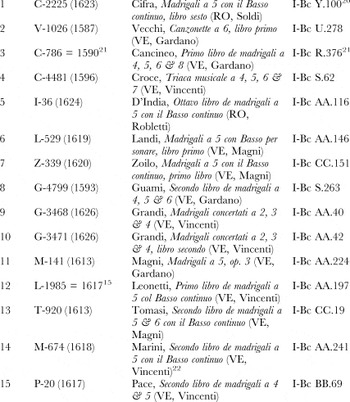
VIII. Tomo ottavo. Madrigali, arie, canzoni, ricercari e varietà di capricci di diversi ad 1. 2. 3. e 4. voci
Set of four partbooks in upright quarto. Sarti no. 2746.

IX. Tomo nono. Madrigali a 6 et a 5. col basso continuo e senza, e l'indici ne' libri manuscritti
Set of five out of six partbooks (CTBQS/Bc; A lacking) in upright quarto.

X. Tomo X. Madrigali a 5 di diversi autoriFootnote 30
Set of five partbooks in upright quarto. Sarti no. 2138.

XI. Tomo XI. Madrigali a 5 di diverse editioni et autori. Con l'indici
Set of three out of five partbooks (CTB; AQ lacking) in upright quarto.

XII. Tomo XII. Madrigali a 3 di diverse editioni et autori con indice solito
Set of two out of three partbooks (CICII; B lacking) in upright quarto. All sets are numbered only in the Canto partbook.

XIII. Tomo XIII. Madrigali di diverse editioni a 5 voci senza l'indice
Set of two out of five partbooks (CA; TBQ lacking) in upright quarto. Because of the absence of manuscript folio numbers, all the identifications here need to be considered doubtful, even though it seems certain that many of these partbooks did originally belong to the volume.

XIV. Tomo XIV. Villanelle et arie napolitane a 3 voci, di Luca Marentio, libretti piccoli in mezzo quarto, o vero ottavo
Set of three partbooks in upright octavo. Nos. 1–4 are still bound in seventeenth-century parchment covers. The three partbooks of no. 5 were removed from the other bindings and subsequently rebound together in a single volume. On the title page of each partbook in I-Bc S.399 and I-Bc S.407 can be found the ex libris: ‘Pertinet ad Bibliothecam S. Francisci Transtiberim’ or ‘Pertinet ad Conventum Sancti Francisci ad Ripam’

[XIVb] [Loose sets]

[XV]. Musica spirituale con organo e senza. Tomo primo. Con i libri di prima e 2da parte, cioè primo e 2do coroFootnote 45
Set of eight out of nine partbooks (CI lacking) in upright quarto.Footnote 46

[XVI]. Musica spirituale. Tomo secondo. Mottetti antifone salmi a 1. 2. 3. 4. 5. 6. e più voci. 13 editioni di varij autori col basso continuo
Set of four partbooks (CATBc) in upright quarto. Sarti no. 848. None of the Basso continuo copies we checked bears manuscript foliation numbers, though most of them show evidence of having been bound together, which confirms their provenance.

[XVII]. Tomo terzo. Musica spirituale
Set of three partbooks (CICII/AB) in upright quarto. CI and B lost for all titles (before being unbound?) and no longer in I-Bc.

[XVIII]. Tomo quarto messe n. 5 in foglio con instromi. Libri num. X

[XVIIIb] Mute a libretti in quarto, suoi autori et editioniFootnote 53

APPENDIX II
Unica in the Pagliarini Collection
Unless otherwise indicated, all partbooks from a given set are unica. Partbooks subsequently added to the library under the same shelfmark have not been taken into consideration here. Prints are arranged by RISM number, beginning with the anthologies.

APPENDIX III
Lost or Unidentified Copies from the Pagliarini Collection
This list does not include exemplars of unverifiable provenance, that is, those bearing both a question mark and a shelfmark in Appendix I;Footnote 1 it also does not include the partbooks already missing from the ‘sortimento’ at the time Chiti made his inventory.Footnote 2 It is of course possible that some of the books that originally were part of the collection have now turned up in modern libraries without ever having arrived in Bologna in 1748, since we know that some books were missing at that time. For more details about individual copies see Appendix I.

APPENDIX IV
Copies of Books from the Pagliarini Collection in Other Libraries
Most copies of books from the Pagliarini collection now in other libraries were sold off as duplicates in the auction held by Gaspari in 1862. See Catalogue des livres de la bibliothèque de M. Gaetano Gaspari (Paris: Potier, 1862). The copy in I-Bc is interfoliated with blank pages on which Gaspari recorded the purchaser and the sale price of each item [G62].

APPENDIX V
The Pagliarini Collection in the Chiti–Martini Correspondence
For each letter we give the shelfmark in I-Bc, followed by the sender, place and date, followed by references to Schnoebelen (S.) and Parisini (P.). Beginning with tomo VI, the lists included in Chiti's letters are interfoliated in Martini's copies of his replies.
I.11.98 – Chiti: Rome, 7 June 1747 (S. 1310). ‘In 3o luogo ho scoperto una vena di libri musicali teorici, et altro, che vado a visitare venerdì mattina dal p.o famoso libraro di Roma, di cui saprò ragguagliarla …’.
I.11.97 – Chiti: Rome, 11 June 1747 (S. 1311). ‘Fui dal famoso libraro dove veramente trovai sopra 150 libri musicali, la maggior parte madrigaleschi ben legati, dove sono da 6. o 7. libri diversi per muta, e veramente degni [con?] opere d'Anerio, Palestrina et altre che non hebbi tempo considerare, il che farò la settimana che viene, volendoci una giornata di riscontro; [li?] messi a parte a mio conto e credo […ile?] per poco. Di teorici due libri d'Avella,Footnote 1 uno d'Aron, et altri pochi che non potei considerare; gli saprò dar distinta relatione di tutto, che scriverò ad uso d'indice et editione per sabbato venturo.’
I.11.100 – Chiti: Rome, 17 June 1747 (S. 1312). ‘Con il libraro osservato il sortimento, avendoci mezzano amico e ritrovandoci cose rare assai per editioni, in 2. ore visitati, accordati, e mandati da me a S. Gio. [in Laterano] sapendo essservi qualche impegno per Milano, e questa cappella pontificia, et in un colpo mi ritrovo intorno ad editioni 10 volte superiore di rarità, et antiche ottime cose a quelle che avevo. Oltre 10 mute del Palestrina et altre et altre [sic] che sono spaventi, e fra l'altri il sig. Domenico Ricci, che di tutto buon cuore suo solito la ringratia, e centuplica i saluti, fra l'altri esso parmi, perché amico, ne soffrisse una cortese e gustosa invidia; la discorreremo a tempo, perché ogni muta averà da 20 opere et editioni diverse, e sono sopra 20. mute a 4. 5. e 6. da 90 libri legati a maraviglia; a suo tempo la discorreremo, e riderà che il libraro contava assai la legatura di carta pecora e fettuccie, e mi donava li piccoli del Palestrina per un tozzo di pane, et io consideri se ridevo internamente.’
I.11.99 – Martini: Bologna, 21 June 1747 (S. 1313). ‘La vena di tante opere di musica da lei vedute da cotesto libraro Pagliarini furono già da me visitate alla confusa col sig. Ab. Salvi segretario di monsignor Molinari, e restassimo d'acordo che il Padre ill.mo Scandalibeni dei SS. Apostoli mi favorirebbe di farne un cattalogo, perché se la maggior parte mi manca, le avrei prese, se no non mi tornava il prenderle per poche che mi mancassero; quei pochi libri teorici che ci sono già li tengo tutti presso di me. Mi rimetto per altro a quello che lei stimarà ben fatto.’
I.11.105 – Chiti: Rome, 1 July 1747 (S. 1315). Includes Chiti's first list (tomi I–II). ‘Giusto dal libraro Pagliarini ho preso tutto il sortimento che non voleva darlo a parte, ma insieme, et ho saputo doppo fatta la compra il suo contratto; e se prima lo sapevo, non averei ardito metterci mani, o vero avrei fatto da agente più sollecito del Ab. Salvi per V.P.M.R. Se lei considerava un poco, le fermava subbito, perché veramente l'è un sortimento raro e particolare. Il libraro non faceva altra stima che della legatura de' libri veramente ottima con sue fettuccie, et indice in ogni libretto dell'opere a [carte …?] etc. studio da [grandissimo?] porporato prencipesco, o pontificio o reggio etc. li tomi diversi sono da 17, chi a 5. a 6. a 8. a 4. a 3. libri per tomo, tutti ben legati. Vi sono tre o quattro mute scompagnate, che nel aggiustar quella stanza, come fa l'inventario di presente il libraro per la morte di suo padre etc. se ne troverà saranno miei, onde spero trovarne, essendo doppo il resto in buono ordine, mi ha dato per giunta una muta di 9 libri in foglio, messe 4 con vv. e clarino stampati in Praga, e l'Avella sciolto. Il tutto per scudi 12 monete: oltre li libretti di musica a cappella che l'è il meglio passate per una muta, di cui gli farò nota giusta per mercordì, fra l'altre li magnificat 16 del Palestrina, e 16 del Morales stampa pretiosa, 2.da parte Offertorij del Palestrina, mottetti a 4 libro primo e libro 2do cosa rarissima, mottetti del Cifra, del Anerio etc., che tutti gli dirò chiaro, sono 19 mute etc. né mi par d'aver fatto cattivo negotio, et tutti però sta alli suoi amatissimi comandi. Monicuccio Ricci, che vidde il dì di S. Giovanni si mordeva le mani, quale la saluta, e vedrò giovedì di nuovo, sta voglioso ma gli ho dato a bastanza etc. e se prima conoscevo lei il d'Antiquis etc. era suo di certo. Io per adesso gli fo un catalogo di due tomi primo e 2do, avendo ogni tomo da 15. 17. 20. 24. diverse opere et editioni, vede lei che robba, più copiosa di quelli miei mottetti a 4 che diedi al sig. Ricci, io dico che sono spaventi mai più veduti da me, per essere un ristretto di tante opere così bene legate, tenute, numerate, e con l'indice per tutto. … Eccole li più libri piccoli, vi sono più li madrigali a 3 voci in piccolo opere 4o. Cosa rara la credo del Luca Marentio. In somma sono spaventi, vi sono tre mute di concerti sacri a 8. 7. 6. 5. con 19. e 20. opere et editioni diverse sì che di chi erano si dilettava del sacro e del soprano nella sua dotta accademia; io già mi credo, che forze gli farà specie questa partita con tante specie di Roma in testa, non considerata, e sentirò cosa mi risponde, ma lei è certo che avendola il Chiti, l'ha e la possiede il Padre Martini, così fuggiamo ogni adito alla febbre di concupiscenza che potesse assalirlo …’.
I.11.102 – Martini: Bologna, 5 July 1747 (S. 1316). ‘Sentirò ciò che ella ha trovato di singolare nel sortimento d'opere di musica che aveva il libraro Pagliarini, et è ben cosa da ridere in sentire la stima che fa il libraro delle fetuccie e carta pecora.’
I.11.106 – Chiti: Rome, 5 July 1747 (S. 1319; P. 93). Includes Chiti's second list (tomi III–V). ‘più che osservo il sortimento di libri comprati, più mi stordisco per le tante editioni et opere che vi sono, tomo per tomo fino a 17 tomi, il minore a 4 libri, a 5 sei tomi, a 6 4 tomi, a 8 due, a 9 e 10 uno. In somma sono 84 libri benissimo legati in carta pecora e l'indice per tutti, come averà veduto, se si ricorda, l'Avella sciolto, e 19 mute di libretti in quarto piccolo legati in cartone con le cose del Palestrina accennatele etc… Ecco gl'includo altra lista di tre altri tomi. Così farò del resto essendomene fatta pure una per me …’.
I.11.107 – Martini: Bologna, 12 July 1747 (S. 1320). ‘riserbandomi nell'ordinario venturo di rispondere alle due sue del primo e 5. corrente, quali richiegono non poco tempo, per causa di riscontrare l'aquisto raro di tante opere fatto da lei’.
I.11.109 – Chiti: Rome, 15 July 1747 (S. 1322). ‘la consegnerò al P.M. Azzoguidi, la compra da me fatta, ma credo possa avere adombrato la sua persona, mentre come le scrissi, stava tutta a sua dispositione, né lei mi disse cosa alcuna d'averla veduta, né sapevo ci fosse stato, e contrattato, sapevo bene esservi altri la cercavano dal mio organista et perciò per assicurare io gle ne diedi avviso, e conclusi la compra, io non ardisco includere l'altre note da me fatte, fino che non me ne dia la primissima …’.
I.11.108 – Martini: Bologna, 15 July 1747 (S. 1321; P. 94). Includes Martini's list of tomi I–V. ‘Ho tutto il contento che ella abbia fatto aquisto del sortimento di autori musicali che trovavansi appresso il Pagliarini, e nel fine di questa mia le accennerò le opere che ho e quelle che non ho presso di me delle indicatemi fino ad ora nelle due note favoritemi nelle sue due ultime lettere del primo e dei 5. del corrente. Veramente sono capitate in ottime mani, perché ella sa distinguerne il valore, e farne ottimo uso, ed io ne ho tutto il contento. Non così sarebbe se fossero capitate in altre mani. … Non si può negare che il sortimento prima Pagliarini, ora Chiti non sia una raccolta singolarissima per tutti i capi, né posso io negare che se fosse andato in altre mani fuori che nelle sue, mi dispiacerebbe non poco, singolarmente perché tali gioie sarebbero come incastrate nel piombo, ora sono veramente incastrate nel finissimo oro.’
I.11.111 – Chiti: Rome, 18 July 1747 (S. 1323). Includes Chiti's third list (tomi VI–VIII), which is preserved in I.11.112 with Martini's notes on separate folios. ‘Gli seguito inviare la nota di ciò che ho ritrovato di spaventi singolari nella compra di Pagliarini, onde aspetto cosa ne dice: e mi imagino mirabilia e febbri 3ne 4ne e quotidiane musicali etc. … essendo innamorato in più cose della compra da me fatta, che non mi sento dargliele, sì che gli mando piccola cartina acciò V.P.M.R. me ce le ponga e rimandi, per compimento della sequenza. Il resto a 8 che manca sta tutto messo, e per non far fagotto ho inclusa la cartina che aspetto dalle sue grazie. Perdoni l'ardire. Gli rimanderò il canone di Lobo, mi dica quale manca. E così compiremo a poco a poco il tutto nelle note de' tomi comprati per due lettere posteriori inviatele parmi essere arrivato al tomo sesto, che gli seguirò quivi acclusa la notarella, e bisogna andare fino al tomo XVII e poi con il resto di 19. opere a libretti, 8 di Palestrina, Magnificat del Morales etc. Quando gli dico che sono spaventi e lei non ci crede, e pure l'ha veduti, e gli sono come dice venuti nelle mani il che non sapevo, il Ricci si mozzica li gombiti che l'habbia prevenuto …’.
I.11.114 – Chiti: Rome, 21 July 1747 (S. 1324). Includes Chiti's fourth list (tomi IX–XII.12), which is preserved in I.11.113 with Martini's notes on separate folios. ‘Veramente sono stato fortunato nelli libri etc. e me ne accorgo anche io, ma l'è stato caso felice a lei, et a me più memoria et conservatione: che se altrove capitavano requiescant in pace si poteva cantare; et i pizzicaroli godere etc. gli farò all'ultimo la nota de' libelli d'un'opera sola … Così diremo del resto che sono spaventi. In sostanza con scudi 12. ho avuto libri 73 in carta pecora con le tante editioni, e 13 in foglio come nuovi etc. e libretti in quarto altri 86 di [qui …] tutta la compra fatta. … Il sortimento Pagliarini Martini più tosto ha compìto in porto salvo la sua tempesta. Questo sortimento è uno scarto fatto da PP. riformati di S. Francesco a Ripa dato in cambio di libri classici morali, prediche etc., senza badare punto alla musica per essere ridotti questi osservanti in oggi al falso bordone quando prima eran de teorici et prattici. Basta utcumque sia, se si ritroveranno alcuni libri di compimento che si riducono a pochi l'averà, ma se sia tale quale è venuto da S. Francesco a Ripa, sarà mancante da prima nelle loro mani … Le mie rimasuglie e bazzecole riscontrate, credo sieno di suo piacere, io ne ho fatto un poco d'esame di conscienza ma non mi ricordo di tutte, per averle fatto varie mandate costì e portate di quà; per me lavori, e facci lavorar commodo che se lei ben vede l'abbiamo de' presenti a discorrere molto e forze più d'anzio, perché ritroverà autori mai sentiti, in specie in due tomi, dove essendovi 15. editioni per tomo quasi tutte l'opere di dette editioni sono di varij et eccellentissimi autori sì che ogni libro conta 25. o 30. madrigali tutti col suo nome sopra dell'autore. Son cose d'incanto. … e credo che alla fine vedendo dalle sue note che molte gli arrivano nuove, molte gli mancano, concluderemo con farle viaggiare da S. Francesco a Ripa a S. Francesco di Bologna … Seguita l'indice dell'opere Pagliarini Martini Chiti.’
I.11.112 – Martini: Bologna, 26 July 1747 (S. 1326, P. 94). Includes Chiti's third list (tomi VI–VIII) with Martini's notes on separate folios. See I.11.111. ‘Qui sotto pongo il riscontro degl’auttori del tomo 6. 7. 8. avendone già avuto la nota del tomo 1. 2. 3. 4. 5. come dal riscontro, che a quest'ora spero avrà ricevuto, ella conoscerà. Oh che bella raccolta! Oh che bell'aquisto ella ha mai fatto! Torno di nuovo a ripetterle ciò che le scrissi in altra mia, se tutti fuor che lei me l'avessero levato, stante che senz'altro poteva esser mio, se non fosse stata la troppa fretta di partire da Roma, mi sarebbe infinitamente dispiaciuto, perché non avrei potuto aver né le opere, né le notizie, ma essendo venuto nelle di lei mani, ho il vantaggio delle notizie, e la consolazione che sono nelle mani d'un uomo singolare e per la profondità del sapere e per il discernimento, e che ha per sua mera bontà dell'amore per me.’
I.11.115 – Chiti: Rome, 29 July 1747 (S. 1328). Includes Chiti's fifth list (tomi XII.13–XV.4), preserved in I.11.116 with Martini's notes on separate folios. ‘Io gl'accludo la 5a lista del sortimento Pagliarini Martini Chiti, e ci sono altri foglietti per compire l'opera …’.
I.11.113 – Martini: Bologna, 29 July 1747 (S. 1327). Includes Chiti's fourth list (tomi IX–XII.12) with Martini's notes on separate folios. See I.11.114. ‘Ora vengo alla nota dei tomi 9. 10. 11. e 12. e sempre più mi rallegro con lei per il raro aquisto fatto. … che sia venuto nelle di lei mani, perché in questa maniera, stante le notizie che ella mi favorisce, ne godo ancor io.’
I.11.118 – Chiti: Rome, 5 August 1747 (S. 1329). Includes Chiti's sixth list (tomi XIVb–XVIII),Footnote 2 preserved in I.11.117 with Martini's notes on separate folios. ‘e questo sortimento, dice lei Pagliarini, Martini dico io, con tutta libertà sta al suo comando, e da tante mancanze che vedo e dalla bellezza di detti libri gioverebbe necessario essere collocato nel suo famosissimo archivio musicale che fa delle notitie che riceve. Parli con ogni libertà e schiettezza, che io ho preso a reflesso suo più che ogni altro fare, né mai ho inteso far negotio in tali cose come fino ad ora infatti si averà conosciuto, et però me lo spiego sinceramente, almeno ho tolto simili notitie dal ludibrio d'un pizzicarolo che poteva sortirli etc. … Basta per ora di fino qui, perché voglio veder di finire la nota del 3o tomo spirituale, che gli includo l'altri due, e mercordì sarò verso per verso a darle risposta. Tomo X, al n.o cinque manca l'editione così: Dolci affetti, madrigali a 5, di diversi et ec.mi musici di Roma, Venezia, Girolamo Scotto 1585. Li 13 autori che tengo, è senza dedica come ben desidera sapere. Veniamo adesso al compimento delli spirituali libretti.’
I.11.116 – Martini: Bologna, 5 August 1747 (S. 1331). Includes Chiti's fifth list (tomi XII.13–XV.4) with Martini's notes on separate folios. See I.11.115. ‘a quest'ora spero che lei avrà ricevuto la risposta di ambedue assieme con il riscontro delle opere del sempre più raro aquisto da lei fatto. … Pongo qui sotto il riscontro dell'opere accennatemi da lei nella 5a lista …’.
I.11.121 – Chiti: Rome, 9 August 1747 (S. 1332). Includes Chiti's seventh list (XVIIIb), preserved in I.11.117 with Martini's notes on separate folios. ‘ma io con questi riscontri sì puntuali sono causa di gran sudori e fatighe e non ho a parlare, obbedisco e taccio. Certo si è che l'ho preso questo sortimento non sapendo l'avesse veduto, ma tutto a suo riflesso, per i gran lumi datimi, et il genio suo conosciuto necessario per la grand'impresa che prepara sì che puole avere e l'opere e le notitie … Intorno alli tomi, nel 6o mancano la maggior parte per quanto vedo, nel 7o tutte a riserva di Stefano Landi, e l'ottavo a riserva di Cifra, e la Scaletta editione consimile a quella che gli diedi io. E questa volta vedo una gran mancanza, e di qui mi cresce il concetto di questo sortimento; se lei vuole si rimedia a tutto, animo, non dubiti viva contento. Or veniamo all'altra lettera. Mi ero scordato che tengo il riscontro fatto da me dell'indici e tomi mandatili, e subbito vedo ciò che le manca, e per verità resto sorpreso alle volte come sia capitato questo copioso sortimento. … Eccoci alla nota dei tomi 9. 10. 11. 12. Io mi rallegro con lei già glene ho scritto, sortimento Pagliarini Martini, e lei mi burla basta etc. Tomo nono mancano assai; X già li scrissi, l'editione de' 13 autori è senza dedica, siccome il numero 5toI Dolci affetti di diuersi et ec.i musici di Roma, Venezia, Scotto, 1585. Qui ancora mancano varij. L'XI manca tutto, e vede lei se dal Laterano non dovrà prendere le poste per Bologna a S. Francesco. Il XII ancora và per la strada istessa: adesso sentirò cosa dirà del residuo di questo tomo: del XIII e XIV. Con il resto che gli scrissi lì 29. luglio, e poi le spirituali del 5. agosto che spero averà ricevuto a quest'ora. … Proscritto: Mi ero scordato dirle che gl'includo l'ultima nota del sortimento intorno a' libretti in quarto, editione per editione. Ogni cosa ha fine in questo mondo, finalmente doppo averla seccata e stancata per 2 e più mesi, con la somma fatigha di ricercare l'editioni di tanta copia di suoi libri, averò finita questa noia, che per me è stato divertimento nel raccogliere libro per libro come in un giardì tanta diversità di fiori …’.
I.11.117/I.11.119/I.11.120 – Martini: Bologna, 16 August 1747 (S. 1334/S. 1330/S. 1335).Footnote 3 Includes Chiti's sixth and seventh lists (tomi XIVb–XVIII; XVIIIb) with Martini's notes on separate folios. See I.11.118 and I.11.121. ‘Non so cosa rispondermi alle cortesissime esibizioni che ella mi fa del belissimo sortimento aquistato: tuttavia per obedirla io le proporrò varij sistemi, lasciandola in piena libertà di sciegliere, e quando non li piacessero, di proporne come più le pare e piace. Stante che varie delle opere di esso sortimento sono presso di me, di queste non è dovere privarla, e per l'altra parte, essendo le sue legate in tanti tomi, potrei io mandarle quelle che ho presso di me, giacché sono separate. Per le altre delle quali ne sono affatto privo, potrei farne cambio, mandandoglene altre che lei non avesse. … Per quelle poi che lei si trova avere, ma imperfette o mancanti, io mi esibisco di cambiarglele in altre tante, ma compite. … Sempre più me li professo obbligato per le esibizioni che mi fa del nuovo aquisto fatto, che però mi rimetto a quanto le ho significato sopra. Qui sotto pongo il riscontro delle opere dell'una e dell'altra lettera, e siccome varie opere mi furono accennate nella sua delli 19 [recte 29] scaduto luglio, così di queste non ne farò menzione alcuna, avendone già avuto riscontro.’
I.11.124 – Chiti: Rome, 27 August 1747 (S. 1338). ‘intorno all'indice mandatole che di 4 parti, tre buone gli mancano; e come ben reflette V.R. essendo l'editioni unite insieme in tomi sì ben legati e conservati, e di più facendo V.R. costì una libreria e raccolta così famosa, particolare, rara ed eterna, parmi che questo sortimento fosse tutto necessario per vostra reverenza e suo servitio, ed a questo fine da me considerato da Pagliarini, venni alla resolutione di far tutto un patto; quando debba essere di grave spesa, non intendo darli questo aggravio, né intendo guadagnarci un fico secco: solo il semplice rimborzo, che come parmi aver detto, toltone alcune mute sciolte che lei tiene di più, et unita la spesa del partito delli Magnificat del Palestrina e di Morales, che cambieremo senza però suo pregiuditio per la copia, li mottetti a 4 che volendoli potremo cambiare, intorno all'offertorij il Tenore che manca a me dice favorirmi, le messe a 4 d'Anerio che non ha l'editione le manderò, e la seconda editione a cui manca un libro o due cambieremo. In somma toltone queste cose sciolte, e doppie, che lei tiene e non vuole, giudicherei necessario il tutto per il suo studio, e volentieri me ne sfornisco, anzi sempre ho avuto tal mira, la spesa sarebbe 86 pei libri ben legati 86 pavoli, e tutto il resto non legato in carta pecora 14 pavoli che sono dieci scudi …’.
I.11.126 – Martini: Bologna, 6 September 1747 (S. 1341). ‘Ella mi favorisce di tal maniera esibendomi tutto il belissimo sortimento Pagliarini, che non posso ricusare le sue grazie, perché secondo le mie intenzioni tutto mi è necessario, e in quel modo che ella me lo esibisce molto volentieri lo prenderò. Bisogna però che io la supplichi di una grazia, et è di lasciar passar un poco di tempo, stante che per le molte spese fatte in quest'anno, singolarmente nel viaggio di Roma, mi trovo scarso di denaro. Avrei mezo di soddisfarla subito, ogni qualvolta, ella avesse il comodo di contentarsi di tante messe quanto importa il costo dell'opere, perché ho persone quali devono celebrare secondo la mia intenzione una quantità di messe, sicché le farei applicar per lei …’.
I.11.132 – Chiti: Rome, 13 September 1747 (S. 1344). ‘Sia laudato Iddio: i libri Pagliarini Martini Chiti sono tutti Martini lei dica, come quando et intorno ai denari e altro ci sarà tempo …’.
I.11.133 – Martini: Bologna, 20 September 1747 (S. 1332). ‘per la buona disposizione e speranza di trovarle messe per il sortimento famoso Pagliarini, ora Chiti …’.
I.11.140 – Chiti: Roma, 26 September 1747 (S. 1349). ‘In questo punto ritorno da Roma, dove ho presentato un suo memoriale per 169 messe a monsignor Riccardi ed ottenuto il decreto favorevole, si ché vista la presente potrà intavolare e principiare subito la celebratione delle messe …’.
I.11.136 – Martini: Bologna, 30 September 1747 (S. 1351). ‘sento come il sig. D. Domenico Aschieri sagrestano maggiore della Basilica Lateranense abbia dato tutta la mano per avere le messe, le quali serviranno per ottenere il sortimento di musica stampata Pagliarini, ora Chiti …’.
I.11.139 – Chiti: Rome, 30 September 1747 (S. 1352). ‘ordini dove devo imballare li tomi, a chi dare, animo et presto che si faccia totalmente sortimento Martini’.
I.11.137 – Martini: Bologna, 4 October 1747 (S. 1353). ‘Perciò che riguarda le llemosine, ella le tenga presso di sé, che serviranno per le spese fatte nel Cribrum musicum e per il sortimento già Pagliarini ora Chiti, che per quello riguarda il residuo che possa mancare io sodisfarò quanto occorrerà.’
I.11.150 – Martini: Bologna, 8 November 1747 (S. 1364). ‘PS: Mi scordavo dirle, che perciò riguarda il sortimento fu Pagliarini ora Chiti, che lei con tanta bontà mi vuol favorire, la spedizione e modo di spedirlo ella ha pensato ottimamente: gia ché con tanta bontà si vuol prendere anche questo incomodo, faccia come più stima proprio …’.
I.11.157 – Martini: Bologna, 25 November 1747 (S. 1372). ‘ella già avrà il denaro delle 169. messe sicché potrà rimborsarsi e del sopraddetto, siccome del sortimento Pagliarini, ora Chiti e per sua grazia sarà Martini.’
I.12.1 – Chiti: Rome, 4 January 1748 (S. 1379). ‘il tutto io rilascio a lei per scudi 10, benché a me come le scrissi sia arrivato alli 12, ma lei mi ha favorito e favorirà copie e altro, sì che musica con musica si compensa: ricevute che l'averà e quando sia contento io gli manderò il conto dare et avere di tutto puntualmente …’.
I.12.2 – Martini: Bologna, 17 January 1748 (S. 1380). ‘Non mi sono per anco pervenute le due cassette, né tampoco l'involto …’.
I.12.4 – Martini: Bologna, 7 February 1748 (S. 1382). Includes Martini's checklist, ‘Le do parte come pochi giorni sono mi sono pervenute le due cassette e l'involto, il tutto ottimamente condizionato, e pazienza se sono state in viaggio più di 24 giorni, effetto de' cattivi tempi, a buon conto sono nelle mie mani, contento come un Cesare d'aver fatti tanti belli aquisti mediante la sempre singolar bontà di lei.’ … ‘Nota delle opere trovate nelle due casse ed involto’.
I.12.5 – Chiti: Rome, 20 February 1748 (S. 1383). ‘mi consolo essere arrivate finalmente le due cassette, che pensavo incontrassero minor tempo de' 24 giorni, ma finalmente sono arrivate in ottimo stato come dice, e ne godo infinitamente; come più ancora del suo contento e del poco operato da me, che maggiormente desidero contribuire alle sue gloriose e virtuosissime idee V.R., mi manda la nota, e se bene osserva le mie note fattele di luglio et agosto troverà le medesime mancanze nelli tomi; e perché nello scrivere dell'involto ancora, non me ne dice particolarità alcuna, e del sortimento alcuna partita non averà osservata, prendo l'ardire di rammentarvela: cioè tomo primo musica spirituale, è vero che manca il soprano primo coro, come osserverà dal mio rincontro scrittole etc. ma tanto il tomo 2do che tomo 3o non mancano a mio poco giuditio libri alcuni, essendo li tomi a una, 2. 3. e 4. voci sì che duplicati di parti dentro sé stessi. Il tomo 4o delle spirituali non segnato col numero IV ma stampato in Praga in foglio, libri X compito di messe etc. del Padre Giuntero Jacob benedectino, quali libri stavano per coperta come forti di carta pecora. Lei non me lo dice. Spero però che siasi scordato, e che vi sia come che stavano questi libri in capite delle casse, stando anzioso di sua risposta. L'altri libretti piccoli o in 4o, vi sono delli scompagnati, alcuni però stanno inclusi colle parti doppie, se non sbaglio come il Cifra. Lei avendo tempo di confrontarli spero, ritroverà tutto in conformità delle mie note di rincontro fattele a mano a mano questa estate. Intorno all'involto poi, non me ne dice nulla delle partiture originali di Pitoni, de' Salmi a 8 di Melani, de ricercari di Palestrina etc. Il che pure aspetto, e so benissimo che ci vuol tempo a confrontare un sortimento musicale simile.’
I.12.7 – Martini: Bologna, 2 March 1748 (S. 1385). ‘Ora che ho avuto tutto il comodo per rivedere ed incontrare cosa per cosa delle due cassette e dell'involto nel quale ho trovato tanti originali del sig. Pitoni, incontrato il tutto diligentemente, secondo le di lei note favoritemi ne' mesi scorsi di luglio et agosto, e il tutto sta a puntino: siché per questo capo non vi sarà più che dire, avendo quasi terminato di unirle e porle in serie con tutte le altre opere, e notarle nell'indice.’
I.12.8 – Chiti: Rome, 13 marzo 1748 (S. 1386). ‘Godo che tanto l'involto quanto il sortimento delle due cassette vada a puntino …’.
APPENDIX VI
Title Pages from the Pagliarini Collection Sent to Fétis by Gaspari
On 19 June 1846 Gaetano Gaspari sent François-Joseph Fétis thirty title pages, all drawn from the Pagliarini collection. His motive was to help improve upon the first edition of the Biographie universelle (1835–44) by making sure that the authors and titles that were missing from that work would be included in the next edition (1860–5).Footnote 1 The title pages indicated in this table by shelfmark – which are still missing – were requested by Gaspari in two letters to Fétis, of 30 April and 21 July 1847, but they were never returned.

INDEXES OF THE PAGLIARINI COLLECTION
ALPHABETICAL INDEX

CRONOLOGICAL INDEX

INDEX OF PRINTERS