


Highlights
-
• Pre-1970 military base locations provide plausibly exogenous variation in repression.
-
• Early-life exposure to political repression is associated with durably lower trust in the police.
-
• The effect is concentrated among cohorts exposed during adolescence and early adulthood.
-
• Authoritarian repression leaves institution-specific legacies that persist long after democratization.
Introduction
Many post-authoritarian societies continue to grapple with the long-run political consequences of state repression. A growing literature shows that exposure to violence durably shapes political attitudes, including trust in public institutions (Blattman, Reference Blattman2009; Cassar et al., Reference Cassar, Grosjean and Whitt2013; Lupu and Peisakhin, Reference Lupu and Peisakhin2017; Rozenas et al., Reference Rozenas, Schutte and Zhukov2017). Yet two dimensions remain underexplored: when in the life cycle repression occurs, and which institutions are most affected.
This paper argues that both dimensions are central. Building on the Impressionable Years Hypothesis (IYH), which posits that late adolescence and early adulthood are critical periods for the formation of durable political attitudes (Hooghe and Wilkenfeld, Reference Hooghe and Wilkenfeld2008; Neundorf et al., Reference Neundorf, Smets and García-Albacete2013; Rekker et al., Reference Rekker, Keijsers, Branje and Meeus2015), I examine whether exposure to political repression during these formative years produces persistent and institution-specific effects on political trust. I focus on Chile’s 1973 military coup and subsequent dictatorship, exploiting variation in both age at exposure and local repression intensity.
Identifying long-term effects of repression is challenging because violence is rarely randomly distributed. To address this issue, I leverage the pre-1973 geography of military bases as a plausibly exogenous proxy for local repression capacity. These bases were established under civilian governments and strongly predicted repression intensity after the coup, while being unrelated to pre-coup political alignment. Combining this spatial variation with nationally representative survey data on political trust, I estimate whether cohorts exposed during their formative years display different long-run attitudes.
I find that individuals who were aged 17–25 years in 1973, and, to a slightly lesser extent, those aged 10–16 years, exhibit significantly lower trust in the Carabineros (national police) decades later if they grew up in municipalities hosting a military base. The magnitude is substantial (around 0.3 points on the 1–5 scale). In contrast, I find no persistent effects on trust in representative institutions (government and presidency) or on trust in the military. The legacy of repression thus appears both age-dependent and institution-specific, concentrated on the coercive actor most directly involved in everyday repression. Notably, this is a relative effect: the Carabineros remain the most trusted political institution in the sample even among exposed cohorts, with the legacy visible as a persistent trust gap rather than absolute mistrust. This point is developed in more detail in the discussion.
This paper contributes to the political economy of authoritarian legacies in three ways. First, it provides micro-level evidence that exposure to repression during formative years durably shapes institutional trust. Second, it refines the IYH by showing that sensitivity to repression extends into early adolescence. Third, it highlights institutional heterogeneity in authoritarian legacies, showing that coercive institutions bear distinct long-run trust penalties.
The remainder of the paper proceeds as follows. Literature review section reviews the related literature. Historical context section provides background on repression and military infrastructure. Methods and descriptive statistics section presents the data and empirical strategy. Results section reports the results. The Discussion section examines the results, before closing with the Concluding remarks section.
Literature review
Experience with violence and political attitudes
A large literature examines how exposure to violence shapes political attitudes. Most studies find that civil conflict or repression reduces long-run political trust, though effects vary by institutional context and post-conflict trajectories (Cassar et al., Reference Cassar, Grosjean and Whitt2013; Chávez, Reference Chávez2021; De Juan and Pierskalla, Reference De Juan and Pierskalla2016; Rozenas et al., Reference Rozenas, Schutte and Zhukov2017). Other work highlights that the direction and magnitude of effects may depend on which institutions are considered and how citizens interact with them (Camussi and Mancini, Reference Camussi and Mancini2019; Sacks and Larizza, Reference Sacks and Larizza2012). Within institutional economics, episodes of instability and authoritarian rule are understood to generate persistent political and economic consequences, even after formal institutions improve (Berggren et al., Reference Berggren, Bergh and Bjørnskov2012).
Among this literature, studies of state-led repression in authoritarian contexts are most directly relevant to the present paper. Wang (Reference Wang2021) shows that individuals who grew up in localities more exposed to violence during China’s Cultural Revolution express persistently lower trust in national political leaders decades later, while Rozenas et al. (Reference Rozenas, Schutte and Zhukov2017) find that communities subjected to Stalinist deportations in Ukraine are significantly less likely to support political forces associated with the perpetrators in contemporary elections. Neither study, however, examines whether effects vary by age at exposure or differ across specific state institutions, which are the two dimensions this paper addresses.
Developmental critical periods
Political attitudes are not formed uniformly across the life cycle. While early-life shocks can have long-term effects on health and socioeconomic outcomes, political learning is widely understood to crystallize during late adolescence and early adulthood. The IYH posits that individuals aged roughly 17–25 years are particularly responsive to major political events, forming durable beliefs about authority and legitimacy (Hooghe and Wilkenfeld, Reference Hooghe and Wilkenfeld2008; Neundorf et al., Reference Neundorf, Smets and García-Albacete2013; Rekker et al., Reference Rekker, Keijsers, Branje and Meeus2015).
Recent work shows that aggregate shocks experienced during this period can permanently alter preferences and institutional trust. In a comprehensive review, Giuliano and Spilimbergo (Reference Giuliano and Spilimbergo2025) synthesize evidence across disciplines showing that economic downturns, political upheavals, and episodes of violence experienced in young adulthood function as ‘belief-twisting shocks” that recalibrate foundational orientations toward authority and redistribution durably. Studies reviewed therein, from Cassar et al. (Reference Cassar, Grosjean and Whitt2013) on postwar Tajikistan to Tur-Prats and Valencia Caicedo (Reference Tur-Prats and Valencia Caicedo2025) on the Spanish Civil War, consistently demonstrate that violent contexts leave lasting imprints on political trust, especially among cohorts socialized during their impressionable years. Jennings and Markus (Reference Jennings and Markus1984) similarly document the long-run stability of political orientations formed in late adolescence, showing that partisan and civic dispositions established during this window persist with remarkable consistency over subsequent decades.
Despite this breadth, the literature leaves three gaps that this paper addresses. First, most studies exploit cross-national variation in regime type rather than within-country variation in repression intensity, limiting causal identification. Brum (Reference Brum2026) shows that exposure to non-democratic regimes between ages 4 and 25 lowers democratic support across Latin American countries, but relies on country-level comparisons that cannot isolate the effect of local repression intensity. Second, trust in state institutions is typically treated as a homogeneous outcome, obscuring whether legacies are concentrated in specific agencies. Third, existing work focuses narrowly on the canonical 17–25 window, leaving open whether formative sensitivity extends into earlier adolescence under conditions of heightened threat. Etchegaray et al., (Reference Etchegaray, Scherman and Valenzuela2019) take a step towards addressing this in Chile, finding that cohorts socialized during the dictatorship exhibit greater self-censorship, but their analysis covers a single behavioural outcome and does not exploit spatial variation in repression.
By leveraging within-country variation in pre-1970 military base locations as a proxy for local repression intensity, disaggregating trust by institution, and testing whether effects extend below the 17–25 threshold, this paper addresses all gaps simultaneously, providing more precise identification of how the timing and local context of repression shape long-run institutional trust. Yet documenting that legacies persist is distinct from explaining why they do. Answering that question requires an account of the institutional mechanisms through which beliefs formed under authoritarian rule survive formal democratization.
Institutional persistence and informal belief formation
This paper connects to a central question in institutional economics: under what conditions do institutional legacies persist after formal regime change? The standard framework, developed by North (Reference North1990), distinguishes between formal rules (laws, constitutions, and codified regulations) and informal constraints, including behavioural norms, conventions, and the belief systems through which individuals interpret authority and legitimacy. A defining feature of this framework is the asymmetry in the pace of change: formal rules can be altered by decree, while informal constraints evolve slowly because they are embedded in the accumulated experience of individuals and transmitted across time. North (Reference North2005) further develops this argument by grounding informal constraints in shared mental models, which are shaped by historical experience and resist rapid revision even when the formal environment changes around them.
Political trust towards coercive state actors constitutes precisely such an informal constraint. It is not mandated by law, it cannot be reformed by constitutional amendment, and it does not respond automatically to improvements in institutional performance. Like other informal constraints, it is formed through repeated interaction with specific institutions during formative periods of socialization, and it persists as an evaluative disposition long after those interactions have ceased. Whether formal democratization can dissolve the informal beliefs generated by a prior repressive regime is, fundamentally, an empirical question.
Democratization restored formal institutions: Congress was reconstituted, civil liberties reinstated, and the constitutional framework progressively reformed. Yet, formal change left the organizational structure of the Carabineros largely intact: their hierarchical command and institutional identity persisted essentially unchanged after 1990 (Bonner, Reference Bonner2013). In Chile’s negotiated transition, reforming the Carabineros would have entailed significant political costs that democratizing governments were not positioned to bear. The result is an institutional split: formal democratization advanced while the organizational identity of the coercive apparatus remained largely unchanged.
The institution-specificity of the trust deficit further grounds the analysis in this literature. Helmke and Levitsky (Reference Helmke and Levitsky2004) show that informal institutions do not operate in isolation but interact with formal rules in distinct patterns: complementary, accommodating, competing, or substitutive. In the post-authoritarian Chilean case, the informal beliefs of exposed cohorts towards the Carabineros can be read as a competing informal institution in the sense of Helmke and Levitsky (Reference Helmke and Levitsky2004): they persist alongside and in tension with the formal legitimacy that democratization conferred on the police. This interpretation is offered as a framework consistent with the evidence rather than as a directly tested claim; establishing the existence of such an informal institution would require evidence beyond the present design, and I cannot rule out that unobserved local factors contribute to the observed trust gap. Camussi and Mancini (Reference Camussi and Mancini2019) provide direct empirical grounding for this mechanism, showing that trust responds to citizens’ direct and localized interactions with specific public institutions rather than to diffuse assessments of government. The Carabineros, as the everyday interface between state and population under the dictatorship, generated institution-specific beliefs that did not generalize to representative institutions, precisely because the relevant experience was bounded and concrete.
Historical context
Political repression under pinochet
The 1973 military coup ended decades of constitutional democracy in Chile and inaugurated a seventeen-year authoritarian regime characterized by systematic repression. Political parties were banned, Congress dissolved, and civil liberties suspended. Thousands were killed, disappeared, or tortured, while many more experienced curfews, surveillance, arrests, and intimidation.
Although the armed forces held ultimate political authority, the Carabineros (i.e., the national police) played a central role in everyday repression. They enforced curfews, conducted house raids, and detained civilians, acting as the most visible interface between citizens and the coercive state. This distinction between military command and police implementation is central to the paper’s institutional argument.
Geography of repression and military infrastructure
Repression intensity varied substantially across municipalities. A key determinant of local repression capacity was the presence of pre-existing military bases. These bases were established throughout Chile during the many decades of democratic rule that preceded the 1973 coup, with their placement driven by long-term national security considerations (e.g., defending the country’s borders, ensuring territorial presence, and accommodating technological developments in transport and telecommunications) rather than by partisan or repressive logic. Indeed, Bautista et al. (Reference Bautista, González, Martínez, Muñoz and Prem2023) document that 48% of bases in operation in 1970 were established under centre-right governments and 52% under centre-left or independent ones, and that their geographic distribution shows no spatial concentration in politically polarized areas.
Several pieces of evidence support the assumption that pre-1970 base locations were orthogonal to the political conditions that subsequently shaped repression. First, until 1973, the Chilean military had a long-standing tradition of subordination to civilian government: over 140 years of independence had produced only 13 months of military rule. Even the CIA acknowledged at the time that a coup was unlikely to succeed because of the apolitical history of the military in Chile (Kornbluh Reference Kornbluh2013). Second, Bautista et al. (Reference Bautista, González, Martínez, Muñoz and Prem2023) test for correlations between base presence and pre-coup political outcomes, Allende’s vote share in the 1952, 1958, 1964, and 1970 presidential elections, the Unidad Popular vote share in the 1971 municipal and 1973 legislative elections, and voter turnout, and find no systematic differences once province fixed effects and basic geographic controls are included.
After the coup, proximity to a military base sharply altered the local environment, providing the logistical infrastructure that the new regime needed for patrols, raids, and detentions in the immediate aftermath of September 11, 1973. Bautista et al. (Reference Bautista, González, Martínez, Muñoz and Prem2023) show that comunas hosting a base experienced substantially higher rates of documented victims, with effects concentrated in the first two years of the dictatorship when the armed forces were directly in charge of repression. The pre-1970 base network therefore offers a plausible source of exogenous variation in exposure to repression: predetermined by decades of pre-coup defense planning, uncorrelated with the political geography of the country, but strongly predictive of the intensity of state violence after 1973.
Institutional and political legacies of the dictatorship
Chile’s post-authoritarian democracy developed under the enduring institutional shadow of the Pinochet regime. Previous research documents persistent legacies in political alignments, local governance, and socioeconomic inequality (Bautista et al., Reference Bautista, López, Martínez, Muñoz and Prem2020; González et al., Reference González, Muñoz and Prem2021;). These findings suggest that authoritarian rule left durable institutional and ideological imprints that extended well beyond the transition to democracy. Beyond formal rules, repression also shaped citizens’ relationship with coercive state actors. While the armed forces held national authority, the Carabineros were the regime’s most visible agents in everyday life, enforcing curfews, conducting raids, and detaining civilians. Unlike many other institutions that were formally restructured after 1990, the Carabineros retained their hierarchical command structure and organizational identity, maintaining a symbolic continuity with the authoritarian period that formal democratization did not sever (Bonner, Reference Bonner2013). This proximity to coercion likely played a central role in shaping long-run perceptions of state authority. Building on this insight, the present study examines whether exposure to coercive institutions during formative years generated persistent trust penalties specifically towards the police, rather than toward representative institutions.
Methods and descriptive statistics
Data
The ELSOC survey
I use data from the Estudio Longitudinal Social de Chile (ELSOC), a nationally representative survey of individuals aged 18–75 years conducted in 92 comunas. The main outcomes are trust in the Carabineros, the Government, and the President, measured on a 1–5 scale.Footnote 1
To approximate exposure to repression, I infer respondents’ 1973 comuna of residence from the comuna where they attended primary school. The sample is restricted to individuals aged 5–32 years in 1973. I construct four age cohorts: 5–9 (reference), 10–16, 17–25 (impressionable years), and 26–32 (placebo cohort). Table A1 reports cohort distributions.
Bautista et al., (2023) database
I combine ELSOC with comuna-level historical data from Bautista et al. (Reference Bautista, González, Martínez, Muñoz and Prem2023), including the location of military bases built before 1970 and victim records from 1973 to 1974. The preferred exposure measure is a binary indicator for the presence of a pre-1970 military base in the respondent’s 1973 comuna. These bases predate the dictatorship and were determined by long-term defense planning rather than local political conditions, making them a plausible proxy for local repression capacity. Table 1 presents summary statistics.
Descriptive statistics by presence of military base

Table 1. Long description
A table comparing descriptive statistics by presence of military base. The table has 21 rows and 6 columns. The columns are labeled as Full sample, Presence of military B. = 0, and Presence of military B. = 1, each with Mean and SD sub-columns. The rows are labeled with various variables such as Trust in the carabineros, Trust in the government, Trust in the president, Trust in the military, Gender (male = 0), Age in 1973, Migrated, Education, Childhood in Santiago, Distance to Santiago, % 12 + years education (1970), % rural (1970), # Universities pre-1973 (pc), Pol. leaning: left, Pol. leaning: centre/none, Pol. leaning: right, Religiosity: never, Religiosity: 1 + times/year, Religiosity: 1 + times/month, and Religiosity: 1 + times/week. Each row provides the mean and standard deviation (SD) values for the full sample and for the presence of military base categorized as 0 and 1. For example, Trust in the carabineros has a mean of 3.19 and SD of 1.16 for the full sample, 3.13 and 1.14 for presence of military B. = 0, and 3.27 and 1.17 for presence of military B. = 1. The table provides a detailed comparison of various statistical measures across different categories.
Note: This table reports means and standard deviations (in parentheses) for the full sample and by the presence of a military base in the respondent’s comuna in 1970.
Table 1 shows some descriptive statistics for the final sample used in the main analysis and comparing the final sample to the split sample between the respondents who lived in a comuna without (=0) and with (=1) a military base built before 1970. Additionally, Table A2 reports summary statistics with balance tests for all variables. On average, respondents more exposed to repression (by the military base measures) exhibit lower trust in the Government but higher in the Carabineros and the military. We observe imbalances on some characteristics, notably distance to Santiago, the number of pre-1973 universities, and rurality. In addition, treated respondents tend to come from less rural areas and report higher education levels.
Empirical strategy
Identification strategy
To estimate the long-term effect of exposure to political repression on political trust, I exploit variation across space and age cohorts. Age in 1973 determines the timing of exposure, while the comuna where respondents attended primary school approximates their location at the onset of the dictatorship. Political repression was not randomly distributed across space, so I use measures plausibly exogenous to pre-coup political conditions. Following Bautista et al. (Reference Bautista, González, Martínez, Muñoz and Prem2023), I rely on the location of military bases constructed before 1970 as source variation. Figure 1 displays their spatial distribution. These bases were unrelated to pre-1973 political characteristics but strongly associated with subsequent repression intensity. They therefore provide a credible proxy for local exposure to repression. The identification strategy rests on the assumption that, conditional on observable controls, comunas with and without military bases were not systematically different in their political characteristics before the coup. In other words, the placement of military bases should be orthogonal to pre-existing political attitudes that could independently influence present-day trust. To assess the plausibility of this assumption, I examine pre-coup electoral outcomes, specifically voter turnout and Allende’s vote share, in the four presidential elections between 1952 and 1970 (Figure 2). These indicators capture local political engagement and ideological orientation prior to the dictatorship. For comparability across treatment definitions, the continuous exposure measures (distance to base and victims per capita) are dichotomized at their medians. The results show broadly similar pre-coup patterns in Allende’s vote share across exposure groups, though some differences appear for voter turnout, particularly in 1970. The lower Allende vote share observed in base comunas is not surprising: military personnel and their families, concentrated near installations, were systematically less likely to support a socialist candidate. This reflects a composition effect rather than a violation of exogeneity. Importantly, repression intensity after the coup was driven by logistical capacity, not by the political complexion of local residents. Province fixed effects included in all specifications absorb the broad regional political variation, and the balance on pre-coup electoral outcomes shown in Figure 2 supports the plausibility of the identification assumption conditional on observables. These differences suggest that the identifying assumption may not hold perfectly, and that unobserved local factors could partly drive estimated effects. Accordingly, the estimates should be interpreted as associations consistent with a causal interpretation under conditional exogeneity, rather than strict causal effects under a difference-in-differences framework.
Distribution of military bases (pre-1970) and victims per capita (1973–1974). Note: Red triangles indicate military bases built before 1970; darker shading denotes higher per-capita victimization during 1973–1974. Black dots represent respondents’ current locations (aged 5–32 years in 1973). Source: Author’s calculations using Bautista et al. (Reference Bautista, González, Martínez, Muñoz and Prem2023) and ELSOC (2016–2018).

Pre-treatment political characteristics by exposure group. Note: This figure assesses the comparability of comunas with different exposure levels prior to the 1973 coup. It plots average voter turnout and Allende’s vote share across four pre-coup presidential elections (1952, 1958, 1964, and 1970), separately for areas above and below the median of each repression measure: (1) distance to the nearest military base, (2) presence of a military base in the comunas, and (3) victims per capita in 1973–1974. Standard errors are clustered at the comuna level. Vertical lines denote 95% confidence intervals.

Figure 2. Long description
The image contains six line graphs arranged in a 2x3 grid, each comparing two groups: Control and Treated. The graphs assess pre-treatment political characteristics by exposure to repression levels before the 1973 coup. Panel A: The first graph shows voter turnout over the years 1952, 1958, 1964, and 1970 for areas above and below the median distance to the nearest military base. The Treated group shows a higher increase in turnout over time compared to the Control group. The second graph shows the vote share for Allende over the same years, with both groups showing an increase, but the Treated group peaking higher in 1964 before slightly declining. Panel B: The third graph shows voter turnout for areas with and without a military base, with the Treated group again showing a higher increase over time. The fourth graph shows the vote share for Allende, with both groups increasing similarly but the Treated group peaking higher in 1964. Panel C: The fifth graph shows voter turnout for areas with different levels of victims per capita, with the Treated group showing a higher increase. The sixth graph shows the vote share for Allende, with both groups increasing similarly but the Treated group peaking higher in 1964. Standard errors are clustered at the comuna level, and vertical lines denote 95% confidence intervals.
Estimation strategy
The empirical model follows an interaction design leveraging spatial and cohort variation in exposure to repression, similar in spirit to Duflo (Reference Duflo2001); Majid (Reference Majid2015) or Meng and Qian (Reference Meng and Qian2009). The specification can be expressed as:
 $\eqalign{ {{\rm{Y}}_{imw}} & = {\rm{\alpha }} + \mathop \sum \nolimits_{a = 1}^3 {{\rm{\beta }}_{1a}}\,{\rm{Ag}}{{\rm{e}}_{i,a}} + {{\rm{\beta }}_2}\,{\rm{Repressio}}{{\rm{n}}_i} \cr & + \mathop \sum \nolimits_{a = 1}^3 {{\rm{\beta }}_{3a}}\,\left( {{\rm{Repressio}}{{\rm{n}}_i} \times {\rm{Ag}}{{\rm{e}}_{i,a}}} \right) \cr & + {X_i}{\rm{\delta }} + {{\rm{\mu }}_m} + {\phi _w} + {{\rm{\varepsilon }}_{imw}} \cr}$
where Y imw denotes political trust for individual i in comuna m and wave w. Age (i,a) is a categorical variable for the respondent’s age cohort in 1973:
-
• a = 0: 5–9 years (reference group),
-
• a = 1: 10–16 years (early exposure),
-
• a = 2: 17–25 years (impressionable years),
-
• a = 3: 26–32 years (post-formative, placebo group).
Repression i measures exposure to political repression in the respondent’s childhood comuna. X i includes individual and comuna-level controls, while μ m and ϕ w are province and survey-wave fixed effects. The coefficients β 3a capture the differential association between repression and political trust across cohorts, relative to the baseline group (a = 0). This model identifies whether the association between local repression and current political trust varies by age at exposure. It does not rely on a formal difference-in-differences framework, but rather on the assumption that, conditional on controls, variation in pre-1970 military presence is exogenous to unobserved determinants of present-day trust. In this sense, the specification isolates heterogeneity in the effect of contextual repression across life-course stages. Respondents aged 5–32 years in 1973 are included in the main sample. Younger individuals (0–4 in 1973) are excluded to mitigate bias from parental migration, which cannot be tracked in the census data. Results are robust to including this youngest group. All independent variables are standardized for comparability across specifications, while dependent variables retain their original 1–5 scale for substantive interpretation. The reference cohort (5–9) captures individuals too young to internalize repression politically but old enough to be indirectly exposed. The 10–16 cohort represents early exposure, potentially old enough to develop political awareness. The 17–25 cohort corresponds to the impressionable years where long-term attitude formation occurs. Finally, the 26–32 cohort falls outside this window for the whole dictatorship and serves as an internal placebo comparison.
Trust in political institutions
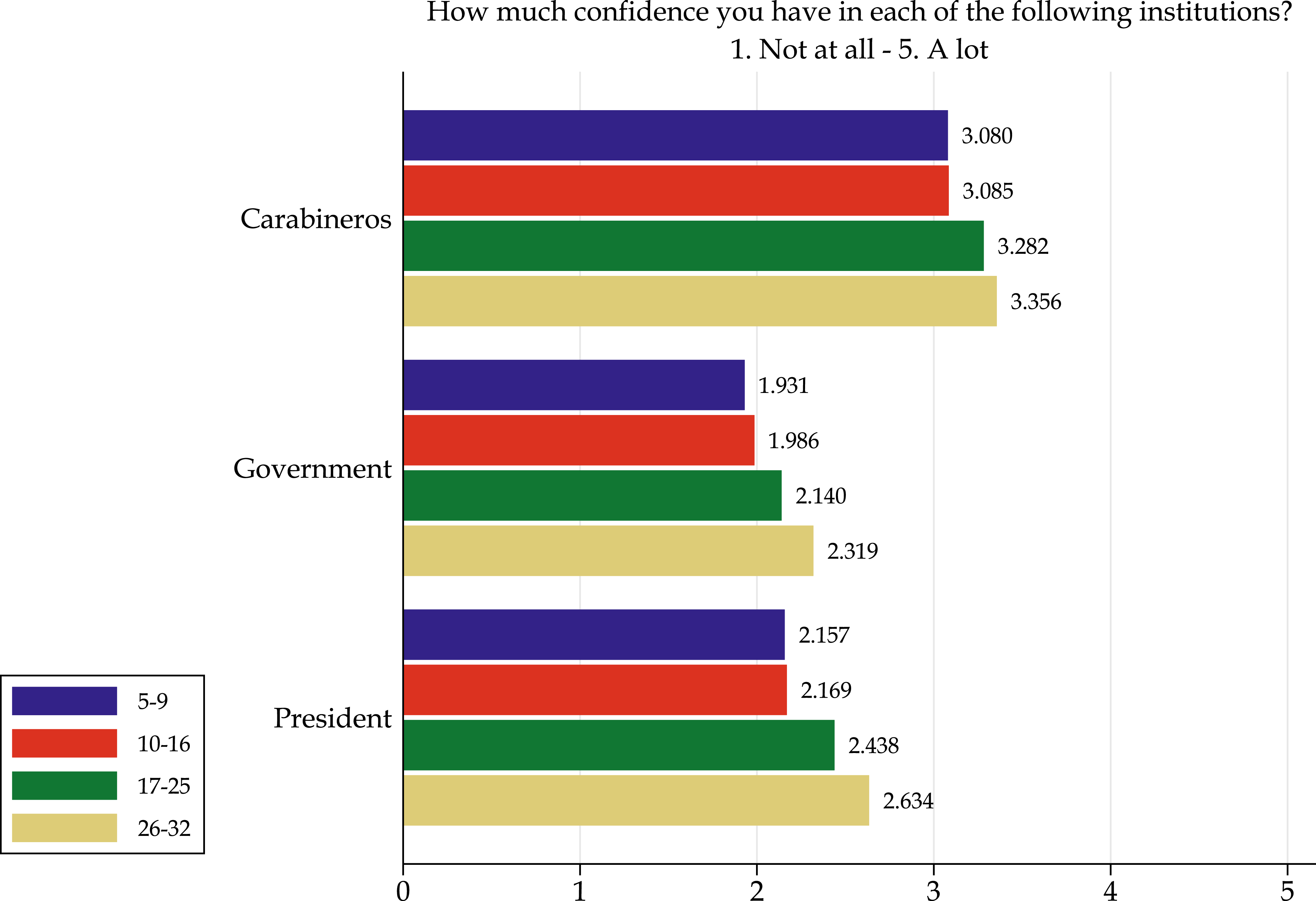
Figure 3 plots the average level of institutional trust by age cohort in 1973. Across all cohorts, the Carabineros elicit substantially higher trust than both the government and the presidency. Trust increases monotonically with age for all three institutions, which seems to reflect a life-cycle effect, well known by the literature (Bailey and Leon, Reference Bailey and Leon2019). The cohort design absorbs this pattern by comparing individuals of similar age across exposure conditions, with the 26–32 cohort serving as a placebo benchmark.
Average political trust by cohort and institution.
Note: Trust levels (1–5 scale) by cohort (age in 1973) and institution. Source: author’s calculations using ELSOC (2016–2018).

Limitations
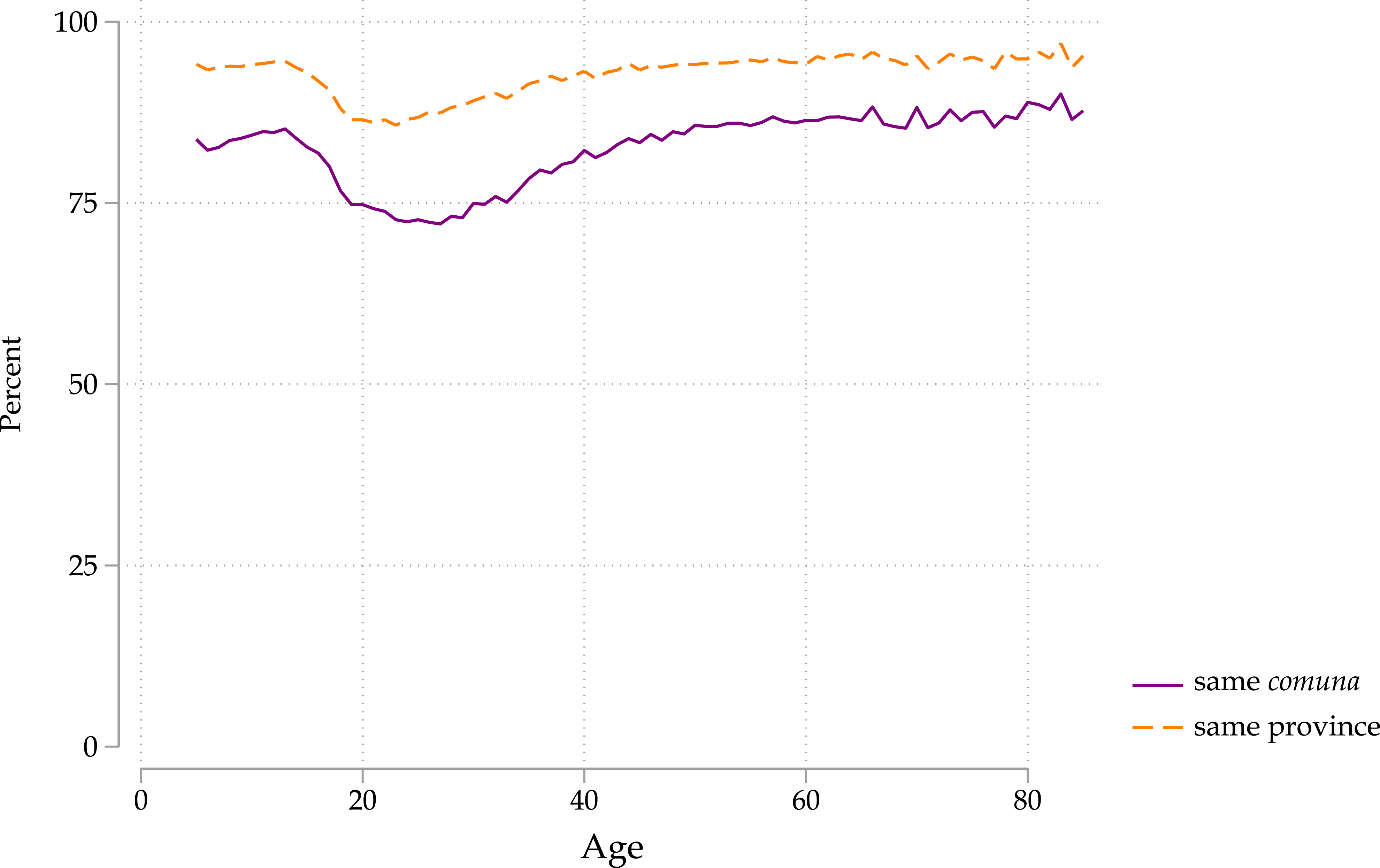
Three identification concerns merit explicit attention. The analysis infers respondents’ 1973 location from the comuna where they attended primary school (ages 6–14), assuming limited migration during childhood and adolescence. This assumption is imperfect: using data from the 1970 census, around 27% of Chileans aged 25 years reported living in a different comuna five years earlier (Figure 4). To assess the implications of this mobility, I exclude respondents who report having migrated between 1973 and the survey and find that the results remain similar. I also re-estimate the models excluding individuals who attended university, who are more likely to have moved, and obtain slightly stronger effects. This pattern suggests that mobility-related measurement error may attenuate the estimated coefficients. If politically engaged or higher-income individuals were more likely to migrate out of repressive areas, their relocation would blur the true variation in exposure, mechanically biasing estimates toward zero. Hence, the reported effects should be interpreted as conservative lower-bound estimates of the long-term relationship between exposure to repression and political trust.
Five-year migration rates in 1970, by age.
Note: Share of individuals residing in the same comuna (solid line) or province (dashed line) as five years earlier, by age in 1970. Source: author’s elaboration using Chilean census data (1970).

A second identification concern is that proximity to military bases may correlate with unobserved post-coup events that independently affected trust. I cannot fully rule this out, and I acknowledge this openly in the Limitations section. Three features of the design limit this concern, though they do not eliminate it: the null placebo outcomes suggest no general confounding from local conditions; the institution-specificity of the effect is harder to reconcile with a generic local shock than with the proposed mechanism; and the consistency of estimates across migration subsamples reduces the likelihood that differential post-coup trajectories drive the results.
Third, repression in one comuna may have influenced perceptions in nearby areas through information diffusion, fear, or visible military activity. To address this concern, I re-estimate the models using distance to the nearest military base as a continuous exposure measure, which implicitly accounts for the declining intensity of repression with geographic proximity. The results remain virtually unchanged, suggesting that spillover effects do not drive the main findings. If anything, such spillovers would attenuate estimated differences between treated and control areas, reinforcing the interpretation that the coefficients represent conservative lower bounds.
Results
Baseline results
Table 2 presents estimates of the association between exposure to political repression, proxied by the presence of a pre-1970 military base in the respondent’s comuna, and long-term political trust, across age cohorts at the time of the 1973 coup. All specifications include fixed effects for the respondent’s 1973 province and survey wave (2016 or 2018), with standard errors clustered at the comuna level following Abadie et al. (Reference Abadie, Athey, Imbens and Wooldridge2023). The three specifications sequentially add: (1) no covariates, (2) comuna-level pre-coup characteristics (education, number of university per capita, rurality, distance to Santiago), and (3) individual-level controls (gender, education, political leaning, migration status, and religiosity). For readability, only the cohort–repression interaction terms are reported.
Presence of military base on political trust (baseline)

Table 2. Long description
The table presents estimates of the association between exposure to political repression, proxied by the presence of a pre-1970 military base in the respondents’ comuna, and long-term political trust, across age cohorts at the time of the 1973 coup. The table includes fixed effects for the respondents’ 1973 province and survey wave (2016 or 2018), with standard errors clustered at the comuna level. The specifications sequentially add different covariates. The table has 9 columns and 20 rows, including headers and interaction terms. Column headers are labeled as follows: (1) Cara., (2) Cara., (3) Cara., (4) Gov., (5) Gov., (6) Gov., (7) Pres., (8) Pres., (9) Pres. Row labels include Repression, age cohorts (5-9, 10-16, 17-25, 26-32), and interaction terms (5-9 x Repression, 10-16 x Repression, 17-25 x Repression, 26-32 x Repression). The table also includes notes on the inclusion of wave and province fixed effects, time-invariant controls, individual controls, number of observations, number of clusters, and the mean control value. Each row provides specific estimates and standard errors for the different specifications.
* p < 0.1, ** p < 0.05, *** p < 0.01.
Clustered standard errors at the comuna level in parenthesis. Cohorts are defined by the age of the respondent in 1973. Repression is a binary variable taking the value of 1 if a the respondent lives in a comuna containing a military base built before 1970. Time-invariant Controls only include pre-treatment or time-invariant controls: education (in comuna) in 1970, rural population in 1970 and distance to Santiago de Chile. Individual Controls include gender, education, political leaning, migration (between 1973 and the survey) and religiosity. The mean of the dependent variable corresponds to the mean of respondents aged 5 to 9 years in 1973 with Repression = 0.
Among respondents who were aged 17–25 years in 1973 (i.e., the impressionable-years cohort), living in a comuna with a military base is associated with, on average, trust in the Carabineros that is 0.27–0.30 points lower on the 1–5 scale, relative to those aged 5–9 years, about 0.23 to 0.26 of a standard deviation. The cohort aged 10–16 years shows similar, slightly smaller coefficients, suggesting that sensitivity to repression may extend into early adolescence. These associations are statistically robust across specifications. The modest attenuation when individual controls are added is driven primarily by the inclusion of political leaning.Footnote 2 By contrast, no differentiated effect appears for trust in representative institutions (the Government and the President), and the placebo cohort (aged 26–32 years in 1973) shows no response. This pattern indicates that the results are unlikely to be driven by simple age effects, but rather by the timing of exposure during key formative years. In addition, exploratory analyses reveal significant gender heterogeneity in the trust deficit: while exposed cohorts of both genders display lower trust in the Carabineros, the effect is significantly larger among men, which might be related to the documented targeting of young males during the repression (Table B1).
The relevant magnitude here is not the unconditional contrast in Table 1, where trust in the Carabineros differs little, and if anything is higher, in comunas with a military base (3.27 versus 3.13), but the cohort-specific differential. For respondents aged 17–25 years in 1973, exposure is associated with trust in the Carabineros that is 0.27 to 0.30 points lower on the 1–5 scale than for the 5–9 reference cohort – about 0.23 to 0.26 of a standard deviation, since the outcome has a standard deviation of 1.16. This is a substantively meaningful gap: it persists four decades after the events, it is confined to the cohort and institution that the impressionable-years and institution-specificity arguments single out, and it concerns trust in the police, an attitude closely tied to compliance and perceived legitimacy. That the Carabineros nonetheless remain the most trusted institution overall does not diminish the result; it defines it as a durable, cohort-bound relative deficit rather than a claim about aggregate distrust.
To assess whether the effect generalizes to other coercive actors, Table C1 replicates the same specification using trust in the military as the dependent variable. The results show no statistically significant association across any cohort, reinforcing the interpretation that the observed decline in confidence is specific to the Carabineros.
Migration history
Identifying the long-term association between exposure to repression and present-day political trust requires accounting for residential mobility. If individuals did not remain in the same local environment where political repression occurred, it becomes difficult to disentangle the effect of early-life exposure from subsequent contextual influences (Couttenier et al., Reference Couttenier, Petrencu, Rohner and Thoenig2019). Such mobility is rarely random: individuals may sort across space according to socioeconomic status or political orientation, which can bias estimates in legacy studies (Marbach, Reference Marbach2024). Historical data indicate that population mobility around the time of the coup was indeed substantial: according to the 1970 census, roughly 27% of 25-year-olds in Chile were living in a different comuna than five years earlier. This suggests our proxy for 1973 residence might misclassify exposure for some individuals. To assess whether this affects the results, Table 3 replicates the baseline analysis on the sub-sample of respondents who report having lived in the same comuna between 1973 and the survey year, thus excluding respondents declaring living in another comuna to which they are assumed to live in 1973. The estimates are broadly consistent with the baseline, though the number of clusters falls from 180 to 64, reflecting the concentration of non-movers in a subset of comunas.Footnote 3 Exposure to repression continues to predict lower trust in the Carabineros for the cohorts aged 10–16 years and 17–25 years in 1973, while remaining insignificant for representative institutions. Although the coefficient for the 17–25 cohort loses statistical significance in the most saturated specification, its sign and magnitude remain stable. Overall, the fact that the estimates hardly change when focusing on individuals who did not move suggests that selective migration is not driving the results.
Presence of military base on political trust: sub-sample among non-movers since 1973

Table 3. Long description
The table presents data on the impact of repression on political trust among different age cohorts and government types. It has 12 rows and 9 columns. The columns are labeled as follows: (1) Cara., (2) Cara., (3) Cara., (4) Gov., (5) Gov., (6) Gov., (7) Pres., (8) Pres., (9) Pres. The rows are labeled with different age cohorts and their interactions with repression. Row 1: Repression, values: 0.33*, 0.35*, 0.29, -0.30, -0.38**, -0.32*, -0.31, -0.33*, -0.31. Row 2: 5-9, values: 0.00, 0.00, 0.00, 0.00, 0.00, 0.00, 0.00, 0.00, 0.00. Row 3: 10-16, values: 0.28**, 0.30**, 0.27*, 0.10, 0.11, 0.18, 0.04, 0.05, 0.05. Row 4: 17-25, values: 0.45***, 0.46***, 0.38**, 0.25, 0.25, 0.26, 0.13, 0.13, 0.18. Row 5: 26-32, values: 0.39*, 0.41*, 0.33, 0.44*, 0.44*, 0.39, 0.30, 0.30, 0.30. Row 6: 5-9 x Repression, values: 0.00, 0.00, 0.00, 0.00, 0.00, 0.00, 0.00, 0.00, 0.00. Row 7: 10-16 x Repression, values: -0.51***, -0.54***, -0.41**, 0.02, -0.02, -0.03, 0.06, 0.02, 0.19. Row 8: 17-25 x Repression, values: -0.41*, -0.42*, -0.27, 0.07, 0.05, 0.12, 0.31, 0.29, 0.35. Row 9: 26-32 x Repression, values: -0.38, -0.38, -0.26, 0.35, 0.34, 0.41, 0.51, 0.49, 0.49. The table also includes notes on wave and province fixed effects, time-invariant controls, individual controls, observations, number of clusters, and mean control values.
* p < 0.1, ** p < 0.05, *** p < 0.01.
Cohorts are defined by the age of the respondent in 1973. Non-movers are the respondents who are identified to live in the same comuna in 1973 and at the time of the survey (around 50% of the sample). Time-invariant Controls only include pre-treatment or time-invariant controls: education (in comuna) in 1970, rural population in 1970 and distance to Santiago de Chile. Individual Controls include gender, education, political leaning, migration (between 1973 and the survey) and religiosity. The mean of the dependent variable corresponds to the mean of respondents aged 5 to 9 years in 1973 with Repression = 0.
Excluding university-educated respondents
A related concern is that higher educational attainment may correlate with both political attitudes and post-coup mobility. In particular, individuals who attended university were more likely to migrate from smaller towns to urban centres (such as moving to Santiago for education or jobs), potentially introducing additional measurement error or selection bias in their inferred 1973 location. Moreover, university education itself might shape political views in ways that interact with the experience of repression. To assess whether such factors are affecting the results, I re-estimate the models excluding all respondents who report having attended university (completed or not). This subsample removes roughly 50% of the original sample.Footnote 4 Re-estimating the models on this subsample yields broadly consistent and slightly larger coefficients for the 10–16 and 17–25 cohorts on trust in the Carabineros, with no effects on representative institutions (Appendix Table D3). This pattern suggests that any bias introduced by the mobility or attitudes of the university-educated was diluting the effect in the full sample. In other words, the baseline estimates were likely conservative. Once the more mobile, higher-educated respondents are removed, the core relationship between formative-years repression and lower trust in the Carabineros is even clearer. Crucially, across this subsample analysis, there continue to be no systematic effects on trust in the Government or President, reinforcing that the phenomenon is specific to the Carabineros.
Residence in the capital
A further concern relates to the specific context of the capital city, Santiago, where the dynamics of political repression differed markedly from the rest of the country. The capital hosted the main military command structures and government institutions, and thus experienced both a stronger military presence and different patterns of political surveillance and control. In fact, repression in Santiago was characterized by continuous mass detentions and the visible use of large facilities such as the National Stadium, while in provincial cities violence tended to occur in concentrated waves, notably during operations like la Caravana de la Muerte (the ‘Caravan of Death’) that targeted regional centres (Biblioteca Nacional de Chile, 2025; Seguel-Gutiérrez, Reference Seguel-Gutiérrez2020). To assess whether the baseline results are driven by respondents who resided in the capital, I re-estimate the models excluding individuals identified as living in Santiago in 1973 (approximately 17% of the sample). The results are largely consistent with the baseline: the negative association between exposure and trust in the Carabineros persists for the 10–16 cohort and becomes significant for the 17–25 cohort, with no effects on representative institutions (Appendix Table D4). These findings suggest that the observed patterns are not only attributable to the distinct political dynamics of the capital, but rather reflect a broader national relationship between early-life exposure to repression and subsequent trust in coercive institutions.
Robustness and sensitivity analyses
To assess the robustness of the baseline findings, I perform several complementary analyses using alternative measures of exposure, outcomes, and model specifications. Together, these exercises test whether the observed relationship between early-life exposure to repression and political trust is sensitive to alternative operationalization of both treatment and outcome variables.
Alternative measures of exposure
Tables E1 and E2 rely on two alternative indicators of political repression. First, I replace the presence of a military base with the number of dictatorship victims per 10,000 inhabitants in 1973–1974, using the victimization records compiled in Bautista et al. (Reference Bautista, González, Martínez, Muñoz and Prem2023). A weak negative effect appears for trust in the Government among those aged 10–16 years and a positive one for trust in the President among those aged 17–25 years, for which I cannot attribute any clear explanation.
In addition, this variable provides a direct measure of realized violence, yet it may also reflect preexisting political conflict and strategic military targeting rather than the population’s perceived exposure to coercion. Consistent with this interpretation, this specification yields no significant association between exposure and trust in the Carabineros. These heterogeneous and muted effects align with historical evidence showing that under Pinochet’s regime, fear was sustained less by visible acts of violence than by the constant possibility of repression.Footnote 5 Lessa and Druliolle (Reference Lessa and Druliolle2011) show that in Chile, curfews, disappearances, and systematic disinformation fostered a pervasive sense of insecurity that extended well beyond those directly targeted. Fear became embedded in everyday life through uncertainty and silence, as citizens learned to anticipate repression even in the absence of visible violence.
In this context, the power of state terror operated largely through expectation and rumour rather than direct victimization. Consequently, the number of recorded victims provides a poor proxy for the diffuse climate of fear that permeated daily life. The spatial presence of military infrastructure, which symbolizes the regime’s reach and potential for coercion, more accurately captures citizens’ subjective sense of exposure. This interpretation is supported by the second robustness test, which replaces the binary indicator of military presence with the logarithm of the distance to the nearest military base. Results remain virtually identical to the baseline: respondents who grew up closer to a base display significantly lower trust in the Carabineros, particularly among the 10–16 and 17–25 cohorts. The convergence across these two exogenous measures of military reach strengthens the interpretation that the long-term erosion of institutional trust reflects an enduring environment of fear and surveillance, rather than the direct experience of physical violence.
Trust beyond institutions
One could ask whether the lower trust observed among exposed cohorts reflects a more general erosion of trust rather than an institution-specific reaction. If life near a military base meant living in a community where neighbours informed on neighbours, the legacy might extend to interpersonal trust itself, as documented for other historical episodes of repression and betrayal (Chávez, Reference Chávez2021; Nunn and Wantchekon, Reference Nunn and Wantchekon2011). Appendix Table F1 re-estimates the baseline specification using the ELSOC item on generalized interpersonal trust. Neither the direct effect of military presence nor the cohort-specific interactions yield a robust negative association: the 17–25 cohort, which carries the main result on the Carabineros, shows no effect, and the weak coefficient on the 10–16 cohort vanishes once individual controls are added. The legacy of repression therefore appears bounded to the institution that embodied coercion in everyday life, rather than seeping into broader social relations.
Alternative scaling of the outcomes
Next, I test whether the results are driven by the scaling of the dependent variable. In Table F2, I recode political trust into a binary outcome, contrasting low trust (1–2) with high trust (4–5), and excluding neutral responses (3) in a linear probability model. The estimated effects remain virtually identical to the baseline, indicating that results are not sensitive to the treatment of intermediate responses or the linearity assumption.
Alternative cohort definitions
I test multiple alternative cohort definitions and reference groups (Appendix Tables F3–F7). Across specifications, the magnitude and direction of the interaction coefficients remain stable, indicating that findings are not sensitive to the precise age cut-offs.
Placebo tests
Finally, I perform placebo analyses using three behavioural outcomes unrelated to political attitudes and available in ELSOC: frequency of visits to neighbours, frequency of physical activity, and the day of the interview (Table F8). None of these placebo outcomes show significant associations with repression exposure.
Discussion
The (Extended) impressionable period
The findings are consistent with the IYH while suggesting that susceptibility to repression may extend into earlier adolescence. Individuals aged 10–16 years in 1973 display declines in trust comparable to those aged 17–25 years, indicating that under conditions of intense repression, attitudinal imprinting may occur before early adulthood. Rather than contradicting the IYH, this pattern refines it.
This interpretation aligns with Giuliano and Spilimbergo (Reference Giuliano and Spilimbergo2025): under conditions of routinized coercion (checkpoints, curfews, and disappearances, Stern, Reference Stern2010), political awareness may crystallize earlier among younger adolescents.
This broader window of impressionability is also consistent with political socialization research. Sears and Valentino (Reference Sears and Valentino1997) emphasize that political orientations begin forming well before adulthood, while Neundorf and Smets (Reference Neundorf and Smets2017) show that shocks during late childhood can leave lasting marks on regime support. The Chilean case suggests that exposure to coercive authority between ages 10 and 16 can generate durable associations between the state and repression, particularly when such exposure is sustained and highly salient.
The type of institution matters
The erosion of trust is concentrated in the Carabineros, while trust in representative institutions and in the military remains largely unaffected. This asymmetry underscores the importance of institutional specificity. The Carabineros were the primary agents of internal control during the dictatorship, directly engaging with civilians through surveillance, arrests, and enforcement of curfews. Their visibility in everyday repression distinguishes them from the armed forces, whose presence was more episodic.
This finding should not be read as evidence of generalized mistrust. The Carabineros remain the most trusted institution across all cohorts. What the results reveal is a relative deficit: exposed cohorts display lower confidence than unexposed peers of similar age, not lower confidence in absolute terms. One reading consistent with this pattern is that two forces operated in tension. On one hand, post-authoritarian professionalization plausibly raised average trust in the police; on the other, the Carabineros preserved their hierarchical structure and organizational identity after democratization (Bonner, Reference Bonner2013), so that the symbolic associations with authoritarian rule were never fully dissolved for those who had encountered the institution during their formative years. I advance this as an interpretation rather than a tested mechanism: sustained public demands for structural reform of the Carabineros are largely a recent phenomenon, and the present data do not allow me to identify the channel through which the cohort-specific gap persists. This pattern may reflect organizational inertia, whereby incentive structures and accountability mechanisms constrain institutional adaptation after regime change even when governments pursue reform (Fegley, Reference Fegley2021).
In addition, the absence of effects on trust in the military is consistent with, not contradictory to, the identification strategy. Military bases provided the logistical infrastructure for repression: vehicles, communication networks, and operational coordination. It was the Carabineros, however, who executed repression in daily life, patrolling neighbourhoods, enforcing curfews, and detaining civilians: the military remained institutionally distant from the population (Loveman, Reference Loveman2020; Sigmund, Reference Sigmund2003). Individuals therefore updated their beliefs about the Carabineros, the institution they directly and repeatedly encountered, not about the military, which operated in the background. The base location captures exposure to a repressive environment facilitated by military infrastructure, not exposure to the military as a coercive actor per se.
By contrast, elected institutions are periodically renewed through elections, potentially weakening direct historical associations. The contrast suggests that rebuilding trust in coercive institutions requires credible organizational reform, not merely democratic turnover.
Contextual considerations
The timing of the survey coincides with Michelle Bachelet’s second presidency (2014–2018), a period marked by renewed emphasis on human rights and transitional justice. As both a survivor of repression and a central figure in Chile’s reconciliation process, Bachelet embodied the state’s moral rehabilitation. This context may have temporarily bolstered confidence in democratic offices, explaining the absence of significant effects for trust in the government or presidency. However, as Collins et al. (Reference Collins, Hite and Joignant2013) observes, official memory policies often generate mixed reactions: they can foster reconciliation but also reactivate latent grievances. The persistence of lower trust in the Carabineros, despite these efforts, underscores how coercive institutions remain insulated from broader legitimacy restoration.
Implications for democratic consolidation
The findings highlight that democratic consolidation depends not only on electoral continuity but also on the re-legitimization of state coercion. Persistent lower trust toward the Carabineros among cohorts exposed during formative years, relative to less exposed peers, illustrates how authoritarian legacies can endure through belief formation rather than through formal constitutional arrangements alone.
Comparative research shows that police institutions in post-authoritarian Latin America often retained centralized, militarized structures with limited reform (Malone and Dammert, Reference Malone and Dammert2021). In Chile, the Carabineros preserved their organizational identity and command structure, maintaining symbolic and institutional links to the dictatorship. Episodes such as the 2019 Estallido Social demonstrate how unresolved tensions surrounding police legitimacy can reemerge during periods of democratic crisis (Garcés, Reference Garcés2019; Silva, Reference Silva2022). The persistent trust deficit toward the Carabineros documented in this current work, particularly among cohorts socialized under repression, is consistent with the framework of Storr et al. (Reference Storr, Romero and Storr2025), who argue that extreme protests reflect a disconnection between an established ideology and the current institutional reality.
More broadly, the results suggest that without structural reform of coercive institutions, historical grievances may persist, constraining the full restoration of political legitimacy even decades after regime change.
Concluding remarks
This paper examined how exposure to political repression during formative years shapes long-term trust in state institutions. Exploiting spatial variation in military presence around the 1973 coup in Chile, I show that individuals socialized in areas with stronger military infrastructure express significantly lower trust in the Carabineros, particularly among those aged 17–25 years, and similarly among those aged 10–16 years, at the onset of repression. No comparable effects emerge for representative institutions such as the government or presidency, indicating that citizens differentiate between the coercive and political arms of the state.
Importantly, the results indicate that it is not necessarily direct victimization, but the broader climate of fear and surveillance that leaves the most persistent mark on political trust. The absence of consistent effects when using recorded victimization, contrasted with the robust association of military presence, suggests that authoritarian power operated through anticipation and deterrence as much as overt violence. The observed decline in trust toward the police therefore reflects the internalization of coercive authority during formative years. More broadly, the persistent trust deficit toward the Carabineros among exposed cohorts underscores a central challenge for post-authoritarian democracies: the re-legitimation of coercive institutions. The Chilean case suggests that without credible institutional transformation, the legacies of repression may endure through belief formation long after formal regime change.
Several avenues for future research emerge from these findings. The gender heterogeneity documented in Appendix B1 suggests that the mechanisms through which repression shapes institutional trust may differ by gender, warranting a dedicated analysis. The intergenerational transmission of institutional distrust also remains an open question: whether the children of exposed cohorts inherited attenuated trust in the Carabineros, and through what channels, would shed light on the broader social legacy of authoritarian coercion. Finally, comparative work on post-authoritarian police reforms across Latin America could identify the conditions under which such legacies are attenuated or reinforced.
Supplementary Material
The supplementary material for this article can be found at https://doi.org/10.1017/S1744137426100782.
Data Availability Statement
The data and code that support the findings of this study will be made openly available in Harvard Dataverse at https://doi.org/10.7910/DVN/CUWDOZ.
Acknowledgements
I would like to thank Valentina Alvarez Saavedra, Maël Astruc – Le Souder, Olivier Bargain, Delphine Boutin, Thomas Calvo, Sébastien Carrère, Lisa Chauvet, Matthieu Clément, Mathilde Col, Maïra Colacce, Jérémy Do Nascimento Miguel, Félix Garnier, Claire Gondard-Delcroix, Marlène Guillon, Florian Leray, Béka Lomidze, Daniel Pérez-Parra, Thibaut Plassot Sansans, David Rivera Gonzalez, Éric Rougier, Quentin Stoeffler, and Thomas Thivillon for their advice and feedback throughout this work. I finally would like to acknowledge all the participants to the first WAPLAC workshop, the AFEDEV doctoral days 2024 and the BxSE seminars.
Competing Interests
The author declares that they have no affiliations with or involvement in any organisation or entity with any financial interest in the subject matter or materials discussed in this manuscript.
Funding Statement
This study has received financial support from the French State in the framework of the IdEx ‘Investments for the Future’ fund of the University of Bordeaux and the Grand Programme de Recherche HOPE.
Use of Artificial Intelligence
A large language model was used to assist with language editing and proofreading of the English text. The author reviewed and edited all content and takes full responsibility for the analyses, interpretations, and conclusions presented in this manuscript.




 Open access

