


1 Introduction and statement of results
Let  $X$ be a smooth projective and geometrically connected curve of genus
 $g$, defined over a field
 $\Bbbk$. Let
 $D$ be a divisor on
 $X$ of degree
 $\ell$. A
 $D$-twisted (or meromorphic) Higgs bundle over
 $X$ is a pair
 $(E,\unicode[STIX]{x1D703})$, where
 $E$ is a vector bundle over
 $X$ and
 $\unicode[STIX]{x1D703}\in \operatorname{Hom}(E,E(D))$. When
 $D=K$, the canonical divisor of
 $X$, one recovers the usual notion of Higgs bundles introduced in [Reference HitchinHit87]. There is a natural notion of semistability for these pairs, and one can construct the moduli stack
 $\mathfrak{M}_{D}^{\text{ss}}(r,d)$ of semistable
 $D$-twisted Higgs bundles over
 $X$ of rank
 $r$ and degree
 $d$.
Despite its importance in algebraic geometry, in the theory of integrable systems and more recently in the theory of automorphic forms, the topology  $\mathfrak{M}_{D}^{\text{ss}}(r,d)$ still remains somewhat mysterious. Observe that twisting by a line bundle of degree
 $1$ yields an isomorphism
 $\mathfrak{M}_{D}^{\text{ss}}(r,d)\simeq \mathfrak{M}_{D}^{\text{ss}}(r,d+r)$ so that only the value of
 $d$ in
 $\mathbb{Z}/r\mathbb{Z}$ matters. In [Reference Hausel and Rodriguez-VillegasHR08] (see also [Reference HauselHau05, Conjecture 5.6]), Hausel and Rodriguez-Villegas formulated a precise conjecture for the Poincaré polynomial of
 $\mathfrak{M}_{K}^{\text{ss}}(r,d)$ when
 $\Bbbk =\mathbb{C}$ and
 $\gcd (r,d)=1$. This conjecture was later refined by the first author in [Reference MozgovoyMoz12, Conjecture 3] (see also [Reference Chuang, Diaconescu and PanCDP11]) to a conjecture for the motive
 $[\mathfrak{M}_{D}^{\text{ss}}(r,d)]$ for any divisor
 $D$ of degree
 $\ell >2g-2$ or
 $D=K$. In the case of
 $D=K$ this conjecture was verified in low ranks [Reference García-Prada, Heinloth and SchmittGHS14, Reference GothenGot94] as well as for the
 $y$-genus specialization [Reference García-Prada and HeinlothGH13]. Some very interesting results for coprime
 $r$,
 $d$ were obtained in [Reference ChaudouardCha15, Reference Chaudouard and LaumonCL16]. In [Reference SchiffmannSch16] the second author gave an explicit formula for the Poincaré polynomial of
 $\mathfrak{M}_{K}^{\text{ss}}(r,d)$ when
 $\Bbbk =\mathbb{C}$ and
 $\gcd (r,d)=1$, by counting the number of points of
 $\mathfrak{M}_{K}^{\text{ss}}(r,d)$ over a finite field of high enough characteristic and using the Weil conjectures. This point count in turn relies on a geometric deformation argument to show that (in high enough characteristic)
 $$\begin{eqnarray}\displaystyle \#\mathfrak{M}_{K}^{\text{ss}}(r,d)(\mathbb{F}_{q})=q^{1+(g-1)r^{2}}\frac{\mathsf{A}_{X,r,d}}{q-1}, & & \displaystyle \nonumber\end{eqnarray}$$
where  $\mathsf{A}_{X,r,d}$ stands for the number of geometrically indecomposable vector bundles on
 $X$ of rank
 $r$ and degree
 $d$. A closed expression for
 $\mathsf{A}_{X,r,d}$ is derived in [Reference SchiffmannSch16]. Mellit [Reference MellitMel17] recently proved the equality between this closed expression and the one appearing in the conjecture of Hausel and Rodriguez-Villegas, hence concluding the proof of that conjecture.
The main aim of this paper is to generalize the above results to arbitrary meromorphic Higgs bundles (i.e. to  $\mathfrak{M}_{D}^{\text{ss}}(r,d)$ for any
 $D$ of degree
 $\ell >2g-2$ or
 $D=K$) and to an arbitrary pair
 $(r,d)$ (i.e. dropping the coprimality assumption on
 $r$ and
 $d$). Our approach is in part related to that of [Reference SchiffmannSch16], but it replaces the geometric deformation argument (only available in the symplectic case
 $D=K$ and in high enough characteristic) by an argument involving the Hall algebra of the category of meromorphic Higgs bundles, which works for all
 $\ell \geqslant 2g-2$, in all characteristics, and which yields at the same time the motive of
 $\mathfrak{M}_{D}^{\text{ss}}(r,d)$ for all
 $r$ and
 $d$. We also partly extend these results to the moduli spaces of affine type
 $A$ quiver bundles (including the moduli spaces of chains of García-Prada et al. on the one hand, and moduli spaces of
 $U(p,q)$-Higgs bundles on the other).
Our main result is formulated in terms of the Donaldson–Thomas (DT) invariants of the moduli stack  $\mathfrak{M}_{D}^{\text{ss}}(r,d)$. Given a finite-type algebraic stack
 ${\mathcal{X}}$ over a finite field
 $\mathbb{F}_{q}$, one defines its volume
 $[{\mathcal{X}}]$ (see Appendix A) which corresponds to the point counting of
 ${\mathcal{X}}$, taking into account the automorphism groups. Define the DT invariants
 $\unicode[STIX]{x1D6FA}_{D}(r,d)$ by the formula
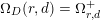
 $$\begin{eqnarray}\mathop{\sum }_{d/r=\unicode[STIX]{x1D70F}}\frac{\unicode[STIX]{x1D6FA}_{D}(r,d)}{q-1}T^{r}z^{d}=\operatorname{Log}\biggl(\mathop{\sum }_{d/r=\unicode[STIX]{x1D70F}}(-q^{1/2})^{-\ell r^{2}}[\mathfrak{M}_{D}^{\text{ss}}(r,d)]T^{r}z^{d}\biggr),\quad \unicode[STIX]{x1D70F}\in \mathbb{Q},\end{eqnarray}$$
where  $\operatorname{Log}$ is the plethystic logarithm (see Appendix A or [Reference MozgovoyMoz07]). It was conjectured in [Reference MozgovoyMoz12] (cf. [Reference Chuang, Diaconescu and PanCDP11]) that
 $\unicode[STIX]{x1D6FA}_{D}(r,d)$ is a polynomial in the Weil numbers of
 $X$ which is independent of
 $d$, regardless of whether
 $\gcd (r,d)=1$ or not. Note that
 $\unicode[STIX]{x1D6FA}_{D}(r,d)=\unicode[STIX]{x1D6FA}_{D}(r,d+r)$ follows from the above observation on moduli stacks. Note also that if
 $\gcd (r,d)=1$ then
 $$\begin{eqnarray}\displaystyle \unicode[STIX]{x1D6FA}_{D}(r,d)=(q-1)(-q^{1/2})^{-\ell r^{2}}[\mathfrak{M}_{D}^{\text{ss}}(r,d)], & & \displaystyle \nonumber\end{eqnarray}$$
but in general the DT invariant  $\unicode[STIX]{x1D6FA}_{D}(r,d)$ involves the volume of the stacks
 $\mathfrak{M}_{D}^{\text{ss}}(r/n,d/n)$ for all
 $n\mid \gcd (r,d)$.
In this paper we give an explicit formula for the invariants  $\unicode[STIX]{x1D6FA}_{D}(r,d)$ when
 $\deg D>2g-2$ or
 $D=K$. Our result relies on two rather complicated rational functions
 $J_{\unicode[STIX]{x1D706}}(z)$,
 $H_{\unicode[STIX]{x1D706}}(z)$ (which also depend on the Weil numbers of
 $X$) defined in [Reference SchiffmannSch16] (cf. Appendix B) for every partition
 $\unicode[STIX]{x1D706}$. Given a partition
 $\unicode[STIX]{x1D706}=(\unicode[STIX]{x1D706}_{1},\unicode[STIX]{x1D706}_{2},\ldots )$, define
 $|\unicode[STIX]{x1D706}|=\sum _{i\geqslant 1}\unicode[STIX]{x1D706}_{i}$ and
 $$\begin{eqnarray}n(\unicode[STIX]{x1D706})=\mathop{\sum }_{i\geqslant 1}(i-1)\unicode[STIX]{x1D706}_{i}=\mathop{\sum }_{i\geqslant 1}\binom{\unicode[STIX]{x1D706}_{i}^{\prime }}{2},\quad \langle \unicode[STIX]{x1D706},\unicode[STIX]{x1D706}\rangle =\mathop{\sum }_{i\geqslant 1}(\unicode[STIX]{x1D706}_{i}^{\prime })^{2}=2n(\unicode[STIX]{x1D706})+|\unicode[STIX]{x1D706}|,\end{eqnarray}$$
where  $\unicode[STIX]{x1D706}^{\prime }$ is the partition conjugate to
 $\unicode[STIX]{x1D706}$.
Theorem 1.1 (See Theorem 6.3 and Corollary 4.10).
Let  $X$ be a smooth projective geometrically connected curve of genus
 $g$ defined over a finite field
 $\mathbb{F}_{q}$. Let
 $D$ be a divisor on
 $X$ of degree
 $\ell$. Define invariants
 $\unicode[STIX]{x1D6FA}_{r,d}^{+}$ by the formula
 $$\begin{eqnarray}\mathop{\sum }_{r,d}\unicode[STIX]{x1D6FA}_{r,d}^{+}T^{r}z^{d}=(q-1)\operatorname{Log}\biggl(\mathop{\sum }_{\unicode[STIX]{x1D706}}z^{(\ell -2g+2)n(\unicode[STIX]{x1D706}^{\prime })}(-q^{1/2})^{\ell \langle \unicode[STIX]{x1D706},\unicode[STIX]{x1D706}\rangle }J_{\unicode[STIX]{x1D706}}(z)H_{\unicode[STIX]{x1D706}}(z)T^{|\unicode[STIX]{x1D706}|}\biggr).\end{eqnarray}$$
Then, for all  $r\geqslant 1$ and
 $d\geqslant \ell \binom{r}{2}$:
(i) if
 $\deg D>2g-2$, then $\unicode[STIX]{x1D6FA}_{D}(r,d)=\unicode[STIX]{x1D6FA}_{r,d}^{+}$;
(ii) if
$D=K$, then $\unicode[STIX]{x1D6FA}_{D}(r,d)=q\unicode[STIX]{x1D6FA}_{r,d}^{+}$.



Moreover, for all  $r,d$,
 $$\begin{eqnarray}\unicode[STIX]{x1D6FA}_{K}(r,d)=q\mathsf{A}_{X,r,d}.\end{eqnarray}$$
Let us briefly comment on the proof of the theorem. The standard technique to compute the volume (or DT invariants) of the moduli stack of semistable objects in a category, especially when (as in the present case) there is no freedom of choice for the stability parameter, is to first compute the volume of the moduli stack of all objects and then to use some form of Harder–Narasimhan (HN) recursion [Reference ZagierZag96, Reference Laumon and RapoportLR96]. This strategy cannot work in the case of Higgs bundles as the moduli stack  $\mathfrak{M}_{D}(r,d)$ of all twisted Higgs bundles having rank
 $r$ and degree
 $d$ is of infinite volume.
Let  ${\mathcal{A}}_{D}$ denote the category of
 $D$-twisted Higgs bundles on
 $X$. In order to introduce a suitable truncation of
 $\mathfrak{M}_{D}(r,d)$ we will first define a subcategory
 ${\mathcal{A}}_{D}^{+}$ of
 ${\mathcal{A}}_{D}$ and then consider the moduli stack of objects in
 ${\mathcal{A}}_{D}^{+}$. More precisely, let
 $\operatorname{Coh}^{+}(X)$ be the category of coherent sheaves over
 $X$ all of whose HN factors have slopes
 ${\geqslant}0$; see § 2.3. Let
 ${\mathcal{A}}_{D}^{+}$ be the category of
 $D$-twisted Higgs sheaves
 $(E,\unicode[STIX]{x1D703})$ with
 $E\in \operatorname{Coh}^{+}(X)$. It is easy to see that the corresponding moduli stacks
 $\mathfrak{M}_{D}^{+}(r,d)$ are of finite volume. We can consider the generating function of volumes of these stacks and define a new family of DT invariants
 $\unicode[STIX]{x1D6FA}_{D}^{+}(r,d)$ similarly to (1). We can think about these invariants as the DT invariants of the moduli stacks of semistable objects in
 ${\mathcal{A}}_{D}^{+}$, although we will not introduce any semistability condition on this category.
We will show that if  $\ell \geqslant 2g-2$ and
 $d\geqslant \ell \binom{r}{2}$ then
 $\unicode[STIX]{x1D6FA}_{D}(r,d)=\unicode[STIX]{x1D6FA}_{D}^{+}(r,d)$. As
 $\mathfrak{M}_{D}^{\text{ss}}(r,d)\simeq \mathfrak{M}_{D}^{\text{ss}}(r,d+r)$ and therefore
 $\unicode[STIX]{x1D6FA}_{D}(r,d)=\unicode[STIX]{x1D6FA}_{D}(r,d+r)$, it is thus enough to compute invariants
 $\unicode[STIX]{x1D6FA}_{D}^{+}(r,d)$. Using the formula (see Proposition 4.4)
 $$\begin{eqnarray}\displaystyle \unicode[STIX]{x1D6FA}_{D}^{+}(r,d)=\unicode[STIX]{x1D6FA}_{K-D}^{+}(r,d) & & \displaystyle \nonumber\end{eqnarray}$$
which is a consequence of Serre duality, we may reduce the case  $\ell >2g-2$ to the case
 $\ell <0$, in which situation all
 $D$-twisted Higgs bundles are nilpotent. We then consider a stratification by Jordan types and apply a variant of the method introduced in [Reference SchiffmannSch16] to compute the volumes of the stacks
 $\mathfrak{M}_{D}^{+}(r,d)$, yielding the formula (cf. (3))
 $$\begin{eqnarray}\displaystyle \mathop{\sum }_{r,d}\unicode[STIX]{x1D6FA}_{D}^{+}(r,d)T^{r}z^{d}=(q-1)\operatorname{Log}\biggl(\mathop{\sum }_{\unicode[STIX]{x1D706}}z^{(\ell -2g+2)n(\unicode[STIX]{x1D706}^{\prime })}(-q^{1/2})^{l\langle \unicode[STIX]{x1D706},\unicode[STIX]{x1D706}\rangle }J_{\unicode[STIX]{x1D706}}(z)H_{\unicode[STIX]{x1D706}}(z)T^{|\unicode[STIX]{x1D706}|}\biggr). & & \displaystyle \nonumber\end{eqnarray}$$
The technique developed here is general enough that most of it may be applied to the moduli stacks of type  $A$ (twisted) quiver sheaves, and we write the paper in this generality. We note, however, that, as the Euler form on the category of twisted quiver sheaves is not symmetric unless we are in type
 $\widehat{A}_{0}$ (i.e. in the Higgs case), the machinery of DT invariants does not apply and we cannot obtain formulas as explicit as in the Higgs case.
2 Twisted quiver sheaves
2.1 Definitions
Let  $X$ be a smooth, projective, geometrically connected curve of genus
 $g$ over a field
 $\Bbbk$ and let
 $D$ be a divisor on
 $X$ of degree
 $\ell$. Given
 $n\in \mathbb{N}$, let
 $Q=(I,H)$ be the quiver of type
 $A_{n-1}^{(1)}$, that is, let
 $I=\mathbb{Z}/n\mathbb{Z}$ be the set of vertices and
 $H=\{i\rightarrow i+1\mid i\in \mathbb{Z}/n\mathbb{Z}\}$ be the set of arrows. By definition, a
 $D$-twisted quiver sheaf (respectively, bundle) on
 $X$ is a tuple
 $\bar{E}=(E_{i},\unicode[STIX]{x1D703}_{i})_{i\in I}$ where
 $E_{i}$ is a coherent sheaf (respectively, vector bundle) on
 $X$ and
 $\unicode[STIX]{x1D703}_{i}\in \operatorname{Hom}(E_{i},E_{i+1}(D))$. As
 $D$ will be fixed throughout, we will often refer to such a data simply as a quiver sheaf (respectively, bundle).
To simplify notation, let  ${\mathcal{A}}=\operatorname{Coh}(X)^{I}$ be the category of
 $I$-graded objects
 $E=(E_{i})_{i\in I}$ in
 $\operatorname{Coh}(X)$ and consider the shift functor
 $$\begin{eqnarray}\displaystyle T:{\mathcal{A}}\rightarrow {\mathcal{A}},\quad E=(E_{i})_{i}\mapsto E[1]=(E_{i+1}(D))_{i}. & & \displaystyle \nonumber\end{eqnarray}$$
Then a quiver sheaf can be interpreted as a pair  $\bar{E}=(E,\unicode[STIX]{x1D703})$, where
 $E\in {\mathcal{A}}$ and
 $\unicode[STIX]{x1D703}:E\rightarrow E[1]$ is a morphism in
 ${\mathcal{A}}$. We denote by
 ${\mathcal{A}}_{D}$ the category of quiver sheaves. It is an abelian category, with the obvious notion of morphism. Such categories have been studied by García-Prada, Gothen and collaborators; see, for example, [Reference García-Prada, Heinloth and SchmittGHS14, Reference Gothen and KingGK05]. Of particular importance are the Higgs case (
 $n=1$) in which one recovers the category of
 $D$-twisted (or meromorphic) Higgs sheaves, and the case
 $n=2$ which, for
 $\Bbbk =\mathbb{C}$ and
 $D=K$ the canonical divisor of
 $X$, yields a category equivalent to the (collection of) categories of Higgs bundles for the real groups
 $U(p,q)$; see [Reference GothenGot16]. Note also that, as any representation of a finite type
 $A$ quiver may trivially be regarded as a representation of a cyclic quiver, the categories of quiver sheaves considered here also contain the categories of quiver sheaves for finite type
 $A$ quivers (also known as ‘chains’; see [Reference García-Prada, Heinloth and SchmittGHS14]).
For  $L$ a line bundle on
 $X$ and
 $E\in {\mathcal{A}}$, we define
 $E\otimes L=(E_{i}\otimes L)_{i}$. Similarly, for
 $\bar{E}=(E,\unicode[STIX]{x1D703})\in {\mathcal{A}}_{D}$, we define
 $\bar{E}\otimes L=(E\otimes L,\unicode[STIX]{x1D703}\otimes L)$ and we use a similar notation for the operation of twisting by a divisor. Similarly, we define
 $\bar{E}[1]=(E[1],\unicode[STIX]{x1D703}[1])$.
For a coherent sheaf  $E\in \operatorname{Coh}(X)$, we define its class to be the pair
 $\operatorname{cl}E=(\operatorname{rk}E,\deg E)\in \mathbb{Z}^{2}$. The slope of a sheaf is
 $$\begin{eqnarray}\displaystyle \unicode[STIX]{x1D707}(E)=\frac{\deg E}{\operatorname{rk}E}\in \mathbb{Q}\cup \{\infty \}. & & \displaystyle \nonumber\end{eqnarray}$$
Similarly, for  $E=(E_{i})_{i}\in {\mathcal{A}}$, we define
 $$\begin{eqnarray}\displaystyle & \operatorname{cl}E=(\operatorname{cl}E_{i})_{i}\in \unicode[STIX]{x1D6E4}=(\mathbb{Z}^{2})^{I}=\mathbb{Z}^{I}\oplus \mathbb{Z}^{I}, & \displaystyle\end{eqnarray}$$
 $$\begin{eqnarray}\displaystyle & \displaystyle \unicode[STIX]{x1D707}(E)=\frac{\deg E}{\operatorname{rk}E}\in \mathbb{Q}\cup \{\infty \},\quad \operatorname{rk}E=\sum \operatorname{rk}E_{i},\quad \deg E=\sum \deg E_{i}. & \displaystyle\end{eqnarray}$$
We extend this notation to quiver sheaves by setting  $\operatorname{cl}\bar{E}=\operatorname{cl}E$ and
 $\unicode[STIX]{x1D707}(\bar{E})=\unicode[STIX]{x1D707}(E)$, for
 $\bar{E}=(E,\unicode[STIX]{x1D703})\in {\mathcal{A}}_{D}$. For any
 $\unicode[STIX]{x1D6FE}=(\bar{r},\bar{d})\in \unicode[STIX]{x1D6E4}$, define
 $$\begin{eqnarray}\unicode[STIX]{x1D6FE}[1]=(r_{i+1},d_{i+1}+\ell r_{i+1})_{i}\in \unicode[STIX]{x1D6E4}.\end{eqnarray}$$
Then  $\operatorname{cl}(E)[1]=\operatorname{cl}(E[1])$ for any
 $E\in {\mathcal{A}}$.
For  $E,F\in \operatorname{Coh}(X)$, we denote by
 $\unicode[STIX]{x1D712}(E,F)$ the Euler form on the category
 $\operatorname{Coh}(X)$, that is, we set
 $$\begin{eqnarray}\displaystyle \unicode[STIX]{x1D712}(E,F)=\dim \operatorname{Hom}(E,F)-\dim \operatorname{Ext}^{1}(E,F). & & \displaystyle \nonumber\end{eqnarray}$$
By the Riemann–Roch formula,
 $$\begin{eqnarray}\unicode[STIX]{x1D712}(E,F)=(1-g)\operatorname{rk}E\cdot \operatorname{rk}F+(\operatorname{rk}E\cdot \deg F-\operatorname{rk}F\cdot \deg E).\end{eqnarray}$$
Since  $\unicode[STIX]{x1D712}(E,F)$ only depends on
 $\operatorname{cl}E$ and
 $\operatorname{cl}F$, we will sometimes denote this Euler form also by
 $\unicode[STIX]{x1D712}(\operatorname{cl}E,\operatorname{cl}F)$. The same notation is used for the Euler form on the category
 ${\mathcal{A}}$.
2.2 Homological properties
The categories  $\operatorname{Coh}(X)$ and
 ${\mathcal{A}}$ are of homological dimension 1, while the category
 ${\mathcal{A}}_{D}$ is of homological dimension 2. More precisely, we have the following theorem.
Theorem 2.1 (cf. Gothen and King [Reference Gothen and KingGK05]).
Given  $\bar{E}=(E,\unicode[STIX]{x1D703})$,
 $\bar{F}=(F,\unicode[STIX]{x1D703}^{\prime })$ in
 ${\mathcal{A}}_{D}$, there is a long exact sequence
 $$\begin{eqnarray}\displaystyle 0 & \rightarrow & \displaystyle \operatorname{Hom}(\bar{E},\bar{F})\rightarrow \operatorname{Hom}(E,F)\rightarrow \operatorname{Hom}(E,F[1])\nonumber\\ \displaystyle & \rightarrow & \displaystyle \operatorname{Ext}^{1}(\bar{E},\bar{F})\rightarrow \operatorname{Ext}^{1}(E,F)\rightarrow \operatorname{Ext}^{1}(E,F[1])\rightarrow \operatorname{Ext}^{2}(\bar{E},\bar{F})\rightarrow 0\nonumber\end{eqnarray}$$
and the groups  $\operatorname{Ext}^{i}(\bar{E},\bar{F})$ vanish for
 $i>2$.
Let us denote by
 $$\begin{eqnarray}\displaystyle \unicode[STIX]{x1D712}_{D}(\bar{E},\bar{F})=\dim \operatorname{Hom}(\bar{E},\bar{F})-\dim \operatorname{Ext}^{1}(\bar{E},\bar{F})+\dim \operatorname{Ext}^{2}(\bar{E},\bar{F}) & & \displaystyle \nonumber\end{eqnarray}$$
the Euler form in  ${\mathcal{A}}_{D}$.
Corollary 2.2. For any  $\bar{E},\bar{F}\in {\mathcal{A}}_{D}$, we have:
(i)
$\unicode[STIX]{x1D712}_{D}(\bar{E},\bar{F})=\unicode[STIX]{x1D712}(E,F)-\unicode[STIX]{x1D712}(E,F[1])=\sum _{i}(\unicode[STIX]{x1D712}(E_{i},F_{i})-\unicode[STIX]{x1D712}(E_{i},F_{i+1}(D)))$;(ii) if
$n=1$ then $\unicode[STIX]{x1D712}_{D}(\bar{E},\bar{F})=\unicode[STIX]{x1D712}_{D}(\bar{F},\bar{E})=-\ell \operatorname{rk}E\cdot \operatorname{rk}F$.



Observe that the Euler form  $\unicode[STIX]{x1D712}$ on
 ${\mathcal{A}}_{D}$ is symmetric only in the case of Higgs sheaves (i.e. for
 $n=1$). Applying Serre duality for coherent sheaves, we obtain the following form of Serre duality for quiver sheaves.
Corollary 2.3. For any  $\bar{E},\bar{F}\in {\mathcal{A}}_{D}$, we have
 $$\begin{eqnarray}\displaystyle \operatorname{Ext}^{i}(\bar{E},\bar{F})\simeq \operatorname{Ext}^{2-i}(\bar{F},\bar{E}[-1](K))^{\ast }. & & \displaystyle \nonumber\end{eqnarray}$$
Recall that a coherent sheaf  $E\in \operatorname{Coh}(X)$ is called semistable (respectively, stable) if for any proper subsheaf
 $F\subset E$ we have
 $\unicode[STIX]{x1D707}(F)\leqslant \unicode[STIX]{x1D707}(E)$ (respectively,
 $\unicode[STIX]{x1D707}(F)<\unicode[STIX]{x1D707}(E)$). The HN filtration of
 $E$ is the unique filtration
 $$\begin{eqnarray}\displaystyle E=E_{1}\supset E_{2}\supset \cdots \supset E_{s}\supset E_{s+1}=0 & & \displaystyle \nonumber\end{eqnarray}$$
such that  $E_{i}/E_{i+1}$ are semistable and
 $$\begin{eqnarray}\displaystyle \unicode[STIX]{x1D707}(E_{1}/E_{2})<\unicode[STIX]{x1D707}(E_{2}/E_{3})<\cdots <\unicode[STIX]{x1D707}(E_{s}). & & \displaystyle \nonumber\end{eqnarray}$$
We set
 $$\begin{eqnarray}\displaystyle & \unicode[STIX]{x1D70E}(E)=\{\unicode[STIX]{x1D707}(E_{1}/E_{2}),\unicode[STIX]{x1D707}(E_{2}/E_{3}),\ldots ,\unicode[STIX]{x1D707}(E_{s})\}\subset \mathbb{Q}\cup \{\infty \}, & \displaystyle \nonumber\\ \displaystyle & \unicode[STIX]{x1D707}_{\text{min}}(E)=\min \unicode[STIX]{x1D70E}(E)=\unicode[STIX]{x1D707}(E_{1}/E_{2}),\quad \unicode[STIX]{x1D707}_{\text{max}}(E)=\max \unicode[STIX]{x1D70E}(E)=\unicode[STIX]{x1D707}(E_{s}). & \displaystyle \nonumber\end{eqnarray}$$
In the same way we define semistable objects in  ${\mathcal{A}}$ using the slope function (6). An object
 $E=(E_{i})_{i}\in {\mathcal{A}}$ is semistable if and only if all
 $E_{i}$ are semistable and have equal slope. We similarly define semistable objects in
 ${\mathcal{A}}_{D}$ using the slope function (6), that is, we say that
 $\bar{E}$ is semistable if for any quiver subsheaf
 $\bar{F}\subset \bar{E}$ we have
 $\unicode[STIX]{x1D707}(\bar{F})\leqslant \unicode[STIX]{x1D707}(\bar{E})$. We further say that
 $\bar{E}$ is stable if the inequality is strict for any proper quiver subsheaf
 $\bar{F}$. For
 $\unicode[STIX]{x1D708}\in \mathbb{Q}\cup \{\infty \}$ let us denote by
 ${\mathcal{A}}_{D}^{(\unicode[STIX]{x1D708})}$ the full subcategory of
 ${\mathcal{A}}_{D}$ whose objects are the semistable quiver sheaves of slope
 $\unicode[STIX]{x1D708}$.
Remark 2.4. If  $\ell \leqslant 0$ then a quiver sheaf
 $\bar{E}=(E,\unicode[STIX]{x1D703})$ is semistable if and only if
 $E\in {\mathcal{A}}$ is semistable. Indeed, if
 $E$ is not semistable then the last term
 $E_{s}$ in its HN filtration satisfies
 $\unicode[STIX]{x1D703}(E_{s})\subset E_{s}[1]$ for slope reasons, and thus
 $(E_{s},\unicode[STIX]{x1D703}|_{E_{s}})$ is automatically a (destabilizing) quiver subsheaf of
 $\bar{E}$.
We summarize the standard properties of  ${\mathcal{A}}_{D}$ with respect to the above semistability notion in the following proposition, whose proof is left to the reader.
Proposition 2.5. The following statements hold.
(i) For any
$\unicode[STIX]{x1D708}$, ${\mathcal{A}}_{D}^{(\unicode[STIX]{x1D708})}$ is an abelian subcategory of ${\mathcal{A}}_{D}$ which is closed under extensions and direct summands.(ii) For any line bundle
$L$ on $X$, twisting by $L$ defines an equivalence ${\mathcal{A}}_{D}^{(\unicode[STIX]{x1D708})}\simeq {\mathcal{A}}_{D}^{(\unicode[STIX]{x1D708}+\deg (L))}$.(iii) If
$\unicode[STIX]{x1D708}>\unicode[STIX]{x1D70F}$ then $\operatorname{Hom}({\mathcal{A}}_{D}^{(\unicode[STIX]{x1D708})},{\mathcal{A}}_{D}^{(\unicode[STIX]{x1D70F})})=0$.(iv) Any quiver sheaf
$\bar{E}$ carries a unique filtration such that$$\begin{eqnarray}\displaystyle \bar{E}=\bar{E}_{1}\supset \bar{E}_{2}\supset \cdots \supset \bar{E}_{s}\supset \bar{E}_{s+1}=0 & & \displaystyle \nonumber\end{eqnarray}$$$\bar{E}_{i}/\bar{E}_{i+1}$ are semistable and $$\begin{eqnarray}\displaystyle \unicode[STIX]{x1D707}(\bar{E}_{1}/\bar{E}_{2})<\unicode[STIX]{x1D707}(\bar{E}_{2}/\bar{E}_{3})<\cdots <\unicode[STIX]{x1D707}(\bar{E}_{s}). & & \displaystyle \nonumber\end{eqnarray}$$







The following result will be crucial for our purposes.
Corollary 2.6. Assume that  $\ell \geqslant 2g-2$ and
 $\bar{E},\bar{F}\in {\mathcal{A}}_{D}$ are semistable objects such that
 $\unicode[STIX]{x1D707}(\bar{E})<\unicode[STIX]{x1D707}(\bar{F})$. Then
 $\operatorname{Ext}^{2}(\bar{E},\bar{F})=0$.
Proof. By our assumption,  $\deg (K-D)\leqslant 0$. Therefore
 $$\begin{eqnarray}\displaystyle \unicode[STIX]{x1D707}(\bar{E}[-1](K))\leqslant \unicode[STIX]{x1D707}(\bar{E})<\unicode[STIX]{x1D707}(\bar{F}). & & \displaystyle \nonumber\end{eqnarray}$$
By the semistability of  $\bar{E}[-1](K)$ and
 $\bar{F}$, we conclude that
 $$\begin{eqnarray}\displaystyle \operatorname{Hom}(\bar{F},\bar{E}[-1](K))=0. & & \displaystyle \nonumber\end{eqnarray}$$
By the Serre duality of Corollary 2.3, this implies that  $\operatorname{Ext}^{2}(\bar{E},\bar{F})=0$.◻
2.3 Positive quiver sheaves
In this paragraph we introduce a suitable truncation  ${\mathcal{A}}_{D}^{+}$ of
 ${\mathcal{A}}_{D}$ and prove that semistable objects of
 ${\mathcal{A}}_{D}$ having large slope are contained in
 ${\mathcal{A}}_{D}^{+}$.
We denote by  $\operatorname{Coh}^{+}(X)$ the full subcategory of
 $\operatorname{Coh}(X)$ whose objects satisfy
 $\unicode[STIX]{x1D707}_{\text{min}}(E)\geqslant 0$. Equivalently, this means that all quotients of
 $E$ have nonnegative degree. The subcategory
 $\operatorname{Coh}^{+}(X)$ is closed under extensions and quotients, but not under taking subobjects. Similarly, we define
 ${\mathcal{A}}^{+}\subset {\mathcal{A}}$ to be the subcategory of
 ${\mathcal{A}}$ whose objects
 $E\in {\mathcal{A}}$ satisfy
 $\unicode[STIX]{x1D707}_{\text{min}}(E)\geqslant 0$. We define
 ${\mathcal{A}}_{D}^{+}$ as the full subcategory of
 ${\mathcal{A}}_{D}$ whose objects
 $\bar{E}=(E,\unicode[STIX]{x1D703})$ satisfy
 $E\in {\mathcal{A}}^{+}$. Obviously, if
 $\bar{E}\in {\mathcal{A}}_{D}^{+}$, then
 $\unicode[STIX]{x1D707}(\bar{E})\geqslant 0$.
Lemma 2.7. Let  $E\in {\mathcal{A}}$ and assume that
 $\unicode[STIX]{x1D70E}(E)=\{\unicode[STIX]{x1D708}_{1}<\cdots <\unicode[STIX]{x1D708}_{s}\}$ has a gap
 $\unicode[STIX]{x1D708}_{k+1}-\unicode[STIX]{x1D708}_{k}>\ell$. Then there exists no
 $\unicode[STIX]{x1D703}\in \operatorname{Hom}(E,E[1])$ such that
 $\bar{E}=(E,\unicode[STIX]{x1D703})\in {\mathcal{A}}_{D}$ is semistable.
Proof. Let  $\unicode[STIX]{x1D703}\in \operatorname{Hom}(E,E[1])$ and
 $\bar{E}=(E,\unicode[STIX]{x1D703})$. There exists a (unique) short exact sequence
 $$\begin{eqnarray}\displaystyle 0\rightarrow E^{\prime }\rightarrow E\rightarrow E^{\prime \prime }\rightarrow 0 & & \displaystyle \nonumber\end{eqnarray}$$
in  ${\mathcal{A}}$ with
 $\unicode[STIX]{x1D707}_{\text{min}}(E^{\prime })\geqslant \unicode[STIX]{x1D708}_{k+1}$ and
 $\unicode[STIX]{x1D707}_{\text{max}}(E^{\prime \prime })\leqslant \unicode[STIX]{x1D708}_{k}$. Since
 $\unicode[STIX]{x1D707}_{\text{min}}(E^{\prime })>\unicode[STIX]{x1D707}_{\text{max}}(E^{\prime \prime })+\ell$ we deduce that
 $\operatorname{Hom}(E^{\prime },E^{\prime \prime }[1])=0$ and thus
 $\unicode[STIX]{x1D703}(E^{\prime })\subset E^{\prime }[1]$. But then
 $\bar{E}^{\prime }=(E^{\prime },\unicode[STIX]{x1D703})$ is a destabilizing subobject of
 $\bar{E}$.◻
Lemma 2.8. Let  $\bar{E}=(E,\unicode[STIX]{x1D703})\in {\mathcal{A}}_{D}$ be semistable of rank
 $r$ and degree
 $d$. If
 $d\geqslant \ell \binom{r}{2}$ and
 $d\geqslant 0$, then
 $\bar{E}\in {\mathcal{A}}_{D}^{+}$.
Proof. If  $\ell \leqslant 0$, then by Lemma 2.7 the object
 $E$ is semistable, hence
 $\bar{E}\in \mathfrak{M}_{D}^{+}$. Assume that
 $\ell >0$. Let us write
 $\unicode[STIX]{x1D70E}(E)=\{\unicode[STIX]{x1D708}_{1}<\unicode[STIX]{x1D708}_{2}<\cdots <\unicode[STIX]{x1D708}_{s}\}$ and let
 $r_{k},d_{k}$ be the rank and degree of the
 $k$th factor of the HN filtration of
 $E$, so that
 $$\begin{eqnarray}\displaystyle \mathop{\sum }_{k}d_{k}=d,\quad \mathop{\sum }_{k}r_{k}=r,\quad \unicode[STIX]{x1D708}_{k}=\frac{d_{k}}{r_{k}}. & & \displaystyle \nonumber\end{eqnarray}$$
By Lemma 2.7 we have  $\unicode[STIX]{x1D708}_{k+1}-\unicode[STIX]{x1D708}_{k}\leqslant \ell$, hence
 $\unicode[STIX]{x1D708}_{k}\leqslant \unicode[STIX]{x1D708}_{1}+(k-1)\ell$, for all
 $k$, and
 $$\begin{eqnarray}\displaystyle \ell \frac{(r-1)}{2}\leqslant \frac{d}{r}=\frac{\mathop{\sum }_{k}\unicode[STIX]{x1D708}_{k}r_{k}}{r}\leqslant \frac{\mathop{\sum }_{k}(\unicode[STIX]{x1D708}_{1}+(k-1)\ell )r_{k}}{r}\leqslant \frac{s}{r}\unicode[STIX]{x1D708}_{1}+\ell \frac{(r-1)}{2} & & \displaystyle \nonumber\end{eqnarray}$$
which implies that  $\unicode[STIX]{x1D708}_{1}\geqslant 0$, hence
 $E\in {\mathcal{A}}^{+}$. We used here the fact that if
 $\sum _{k}r_{k}=r$ and
 $r_{k}\geqslant 1$ for all
 $k$ then
 $\sum _{k}(k-1)r_{k}\leqslant \binom{r}{2}$.◻
2.4 Notation for stacks
Let us denote by  $\mathfrak{M}(r,d)$ the stack of coherent sheaves of rank
 $r$ and degree
 $d$ on
 $X$. This stack is locally of finite type and of finite volume; see, for example, [Reference SchiffmannSch16, Theorem 4.1.] Let
 $\mathfrak{M}^{+}(r,d)$ be the substack parametrizing positive coherent sheaves. This open substack is of finite type. Similarly, given
 $\unicode[STIX]{x1D6FE}\in \unicode[STIX]{x1D6E4}=\mathbb{Z}^{I}\oplus \mathbb{Z}^{I}$, let
 $\mathfrak{M}(\unicode[STIX]{x1D6FE})$ be the stack of objects in
 ${\mathcal{A}}$ having class
 $\unicode[STIX]{x1D6FE}$ and let
 $\mathfrak{M}^{+}(\unicode[STIX]{x1D6FE})$ be its substack parametrizing positive objects.
Let  $\mathfrak{M}_{D}(\unicode[STIX]{x1D6FE})$ (respectively,
 $\mathfrak{M}_{D}^{\text{vec}}(\unicode[STIX]{x1D6FE})$) be the stack parametrizing quiver sheaves (respectively, bundles) on
 $X$ having class
 $\unicode[STIX]{x1D6FE}$. Let
 $\mathfrak{M}_{D}^{+}(\unicode[STIX]{x1D6FE})$ (respectively,
 $\mathfrak{M}_{D}^{+,\text{vec}}(\unicode[STIX]{x1D6FE})$) be the substack parametrizing positive quiver sheaves (respectively, bundles). Contrary to
 $\mathfrak{M}_{D}(\unicode[STIX]{x1D6FE})$, the stack
 $\mathfrak{M}_{D}^{+}(\unicode[STIX]{x1D6FE})$ is of finite type and hence of finite volume. Finally, let
 $\mathfrak{M}_{D}^{\text{ss}}(\unicode[STIX]{x1D6FE})\subset \mathfrak{M}_{D}(\unicode[STIX]{x1D6FE})$ be the substack of semistable quiver sheaves (they are automatically quiver bundles if the rank is positive).
3 Generating functions and Donaldson–Thomas invariants
In this section we introduce several generating functions for the volume of the stacks of positive and/or semistable quiver sheaves, as well as the DT invariants of the categories  ${\mathcal{A}}_{D}$,
 ${\mathcal{A}}_{D}^{+}$ in the Higgs case. We begin with a brief review of the relevant theory of Hall algebras. Let us from now on assume that the curve
 $X$ is defined over a finite field
 $\Bbbk =\mathbb{F}_{q}$.
3.1 Hall algebras and quantum torus
Let  ${\mathcal{A}}$ be an abelian category, linear over a finite field
 $\Bbbk =\mathbb{F}_{q}$, of finite homological dimension and such that
 $\dim \operatorname{Ext}^{k}(M,N)<\infty$ for all objects
 $M,N$ and all
 $k\geqslant 0$. Let
 $\unicode[STIX]{x1D712}:K_{0}({\mathcal{A}})\otimes _{\mathbb{Z}}K_{0}({\mathcal{A}})\rightarrow \mathbb{Z}$ denote the Euler form. Let also
 $\unicode[STIX]{x1D6E4}$ be a lattice equipped with a skew-symmetric form
 $\langle -,-\rangle$ and with a group homomorphism
 $\operatorname{cl}:K_{0}({\mathcal{A}})\rightarrow \unicode[STIX]{x1D6E4}$ such that
 $$\begin{eqnarray}\displaystyle \unicode[STIX]{x1D712}(E,F)-\unicode[STIX]{x1D712}(F,E)=\langle \operatorname{cl}E,\operatorname{cl}F\rangle ,\quad E,F\in {\mathcal{A}}. & & \displaystyle \nonumber\end{eqnarray}$$
The algebra  $\mathbb{T}=\mathbb{Q}(q^{1/2})[\unicode[STIX]{x1D6E4}]$ equipped with the product
 $$\begin{eqnarray}t^{\unicode[STIX]{x1D6FC}}\circ t^{\unicode[STIX]{x1D6FD}}=(-q^{1/2})^{\langle \unicode[STIX]{x1D6FC},\unicode[STIX]{x1D6FD}\rangle }t^{\unicode[STIX]{x1D6FC}+\unicode[STIX]{x1D6FD}},\quad \unicode[STIX]{x1D6FC},\unicode[STIX]{x1D6FD}\in \unicode[STIX]{x1D6E4},\end{eqnarray}$$
is called the quantum (affine) torus. Let  ${\mathcal{H}}$ be the Hall algebra of
 ${\mathcal{A}}$ (see, for example, [Reference SchiffmannSch12]). It is a vector space generated by isomorphism classes of objects in
 ${\mathcal{A}}$ equipped with an associative multiplication
 $$\begin{eqnarray}\displaystyle (f\circ g)(X)=\mathop{\sum }_{U\subset X}f(U)g(X/U),\quad f,g\in {\mathcal{H}}. & & \displaystyle \nonumber\end{eqnarray}$$
Both  ${\mathcal{H}}$ and
 $\mathbb{T}$ are graded by the lattice
 $\unicode[STIX]{x1D6E4}$. We will occasionally consider their completions, which we will still denote by
 ${\mathcal{H}}$ and
 $\mathbb{T}$ respectively for simplicity when there is no risk of confusion. One defines the integration map
 $$\begin{eqnarray}I:{\mathcal{H}}\rightarrow \mathbb{T},\quad [E]\mapsto (-q^{1/2})^{\unicode[STIX]{x1D712}(E,E)}\frac{t^{\operatorname{cl}E}}{\#\operatorname{Aut}E}.\end{eqnarray}$$
A crucial property of  $I$ is that it is a ring homomorphism if
 ${\mathcal{A}}$ has homological dimension
 $1$ [Reference ReinekeRei06]. More generally, it satisfies
 $$\begin{eqnarray}I([E]\circ [F])=I(E)\circ I(F)\end{eqnarray}$$
if  $\operatorname{Ext}^{k}(F,E)=0$ for
 $k\geqslant 2$. This explains the significance of Corollary 2.6.
3.2 Generating functions
We will denote the Hall algebra of  ${\mathcal{A}}_{D}$ by
 ${\mathcal{H}}_{D}$. Set
 $\unicode[STIX]{x1D6E4}=(\mathbb{Z}^{2})^{I}=\mathbb{Z}^{I}\oplus \mathbb{Z}^{I}$, consider the map
 $\operatorname{cl}:K_{0}({\mathcal{A}}_{D})\rightarrow \unicode[STIX]{x1D6E4}$ defined in (5), and equip
 $\unicode[STIX]{x1D6E4}$ with bilinear forms (cf. Corollary 2.2)
 $$\begin{eqnarray}\displaystyle \displaystyle \unicode[STIX]{x1D712}_{D}(\unicode[STIX]{x1D6FE},\unicode[STIX]{x1D6FE}^{\prime }) & = & \displaystyle \mathop{\sum }_{i\in I}\biggl((1-g)r_{i}r_{i}^{\prime }+(g-1-\ell )r_{i}r_{i+1}^{\prime }+\left|\begin{array}{@{}cc@{}}r_{i} & r_{i}^{\prime }-r_{i+1}^{\prime }\\ d_{i} & d_{i}^{\prime }-d_{i+1}^{\prime }\end{array}\right|\biggr),\end{eqnarray}$$
 $$\begin{eqnarray}\displaystyle \langle \unicode[STIX]{x1D6FE},\unicode[STIX]{x1D6FE}^{\prime }\rangle & = & \displaystyle \unicode[STIX]{x1D712}_{D}(\unicode[STIX]{x1D6FE},\unicode[STIX]{x1D6FE}^{\prime })-\unicode[STIX]{x1D712}_{D}(\unicode[STIX]{x1D6FE}^{\prime },\unicode[STIX]{x1D6FE}),\end{eqnarray}$$
for  $\unicode[STIX]{x1D6FE}=(\bar{r},\bar{d})\in \unicode[STIX]{x1D6E4}$ and
 $\unicode[STIX]{x1D6FE}^{\prime }=(\bar{r}^{\prime },\bar{d}^{\prime })\in \unicode[STIX]{x1D6E4}$. In the above equation,
 $|\cdot |$ stands for the determinant. Observe that when
 $n=1$ (i.e. in the Higgs case) the form
 $\langle -,-\rangle$ vanishes, hence the quantum torus
 $\mathbb{T}=\mathbb{Q}(q^{1/2})[\mathbb{Z}^{2}]$ is commutative.
Given  $\unicode[STIX]{x1D6FE}=(\bar{r},\bar{d})\in \unicode[STIX]{x1D6E4}=\mathbb{Z}^{I}\oplus \mathbb{Z}^{I}$, we will use variables
 $$\begin{eqnarray}\displaystyle z^{\bar{d}}=t^{(0,\bar{d})},\quad T^{\bar{r}}=t^{(\bar{r},0)} & & \displaystyle \nonumber\end{eqnarray}$$
in the quantum torus. Recall that  $\mathfrak{M}_{D}^{\text{ss}}(\unicode[STIX]{x1D6FE})=\mathfrak{M}_{D}^{\text{ss}}(\bar{r},\bar{d})$ is the stack of semistable objects
 $\bar{E}=(E,\unicode[STIX]{x1D703})\in {\mathcal{A}}_{D}$ with
 $E$ having class
 $\unicode[STIX]{x1D6FE}$. Note that if
 $(E,\unicode[STIX]{x1D703})$ is semistable and has positive rank then
 $E=(E_{i})_{i}$ is an
 $I$-graded vector bundle. Define
 $$\begin{eqnarray}\displaystyle \displaystyle \unicode[STIX]{x1D7D9}_{\unicode[STIX]{x1D6FE}}^{\text{ss}} & = & \displaystyle \mathop{\sum }_{\bar{E}\in \mathfrak{M}_{D}^{\text{ss}}(\unicode[STIX]{x1D6FE})(\Bbbk )}[\bar{E}]\in {\mathcal{H}}_{D},\end{eqnarray}$$
 $$\begin{eqnarray}\displaystyle \displaystyle \hat{\unicode[STIX]{x1D6FA}}_{D}(\unicode[STIX]{x1D6FE})t^{\unicode[STIX]{x1D6FE}} & = & \displaystyle I(\unicode[STIX]{x1D7D9}_{\unicode[STIX]{x1D6FE}}^{\text{ss}})=(-q^{1/2})^{\unicode[STIX]{x1D712}_{D}(\unicode[STIX]{x1D6FE},\unicode[STIX]{x1D6FE})}\mathop{\sum }_{\bar{E}\in \mathfrak{M}_{D}^{\text{ss}}(\unicode[STIX]{x1D6FE})(\Bbbk )}\frac{1}{\#\operatorname{Aut}\bar{E}}t^{\unicode[STIX]{x1D6FE}},\end{eqnarray}$$
 $$\begin{eqnarray}\displaystyle \displaystyle \hat{\unicode[STIX]{x1D6FA}}_{D,\unicode[STIX]{x1D70F}} & = & \displaystyle \mathop{\sum }_{\unicode[STIX]{x1D707}(\unicode[STIX]{x1D6FE})=\unicode[STIX]{x1D70F}}\hat{\unicode[STIX]{x1D6FA}}_{D}(\unicode[STIX]{x1D6FE})t^{\unicode[STIX]{x1D6FE}},\quad \unicode[STIX]{x1D70F}\in \mathbb{Q}.\end{eqnarray}$$
Tensoring by a line bundle preserves semistability. There always exists a line bundle of degree  $1$ over a smooth, projective, geometrically connected curve defined over a finite field, hence we conclude that
 $\hat{\unicode[STIX]{x1D6FA}}_{D}(\bar{r},\bar{d})=\hat{\unicode[STIX]{x1D6FA}}_{D}(\bar{r},\bar{d}+\bar{r})$.
We likewise define the elements
 $$\begin{eqnarray}\displaystyle \displaystyle \unicode[STIX]{x1D7D9}_{\unicode[STIX]{x1D6FE}}^{+} & = & \displaystyle \mathop{\sum }_{\bar{E}\in \mathfrak{M}_{D}^{+}(\unicode[STIX]{x1D6FE})(\Bbbk )}[\bar{E}]\in {\mathcal{H}}_{D},\end{eqnarray}$$
 $$\begin{eqnarray}\displaystyle \displaystyle \unicode[STIX]{x1D6E9}_{D}^{+}(\unicode[STIX]{x1D6FE})t^{\unicode[STIX]{x1D6FE}} & = & \displaystyle I(\unicode[STIX]{x1D7D9}_{\unicode[STIX]{x1D6FE}}^{+})=(-q^{1/2})^{\unicode[STIX]{x1D712}_{D}(\unicode[STIX]{x1D6FE},\unicode[STIX]{x1D6FE})}\mathop{\sum }_{\bar{E}\in \mathfrak{M}_{D}^{+}(\unicode[STIX]{x1D6FE})(\Bbbk )}\frac{1}{\#\operatorname{Aut}\bar{E}}t^{\unicode[STIX]{x1D6FE}}.\end{eqnarray}$$
Observe that the stacks  $\mathfrak{M}_{D}^{+}(\unicode[STIX]{x1D6FE})$ have finitely many objects up to isomorphisms so that the above sums are well defined. We can uniquely factorize
 $$\begin{eqnarray}\unicode[STIX]{x1D6E9}_{D}^{+}(T,z)=\mathop{\sum }_{\unicode[STIX]{x1D6FE}}\unicode[STIX]{x1D6E9}_{D}^{+}(\unicode[STIX]{x1D6FE})t^{\unicode[STIX]{x1D6FE}}=\mathop{\prod }_{\unicode[STIX]{x1D70F}\downarrow }\tilde{\unicode[STIX]{x1D6FA}}_{D,\unicode[STIX]{x1D70F}}^{+},\quad \tilde{\unicode[STIX]{x1D6FA}}_{D,\unicode[STIX]{x1D70F}}^{+}=\mathop{\sum }_{\unicode[STIX]{x1D707}(\unicode[STIX]{x1D6FE})=\unicode[STIX]{x1D70F}}\tilde{\unicode[STIX]{x1D6FA}}_{D}^{+}(\unicode[STIX]{x1D6FE})t^{\unicode[STIX]{x1D6FE}}.\end{eqnarray}$$
Note that unless  $n=1$, the product is ordered as the quantum torus is not commutative.
It will be convenient to consider the above invariants simultaneously for all finite field extensions of  $\Bbbk =\mathbb{F}_{q}$. Hoping that this will not cause confusion, we define volumes (see Appendix A)
 $$\begin{eqnarray}\displaystyle \displaystyle \hat{\unicode[STIX]{x1D6FA}}_{D}(\unicode[STIX]{x1D6FE}) & = & \displaystyle (-q^{1/2})^{\unicode[STIX]{x1D712}_{D}(\unicode[STIX]{x1D6FE},\unicode[STIX]{x1D6FE})}[\mathfrak{M}_{D}^{\text{ss}}(\unicode[STIX]{x1D6FE})]\in {\mathcal{V}},\end{eqnarray}$$
 $$\begin{eqnarray}\displaystyle \unicode[STIX]{x1D6E9}_{D}^{+}(\unicode[STIX]{x1D6FE}) & = & \displaystyle (-q^{1/2})^{\unicode[STIX]{x1D712}_{D}(\unicode[STIX]{x1D6FE},\unicode[STIX]{x1D6FE})}[\mathfrak{M}_{D}^{+}(\unicode[STIX]{x1D6FE})]\in {\mathcal{V}}.\end{eqnarray}$$
We can similarly define invariants  $\unicode[STIX]{x1D6E9}_{D}^{+,\text{vec}}(\unicode[STIX]{x1D6FE})\in {\mathcal{V}}$ counting quiver bundles. The quantum torus
 $\mathbb{T}$ is now the algebra
 ${\mathcal{V}}[\unicode[STIX]{x1D6E4}]$ (or its completion) with the multiplication (9) using
 $\boldsymbol{q}=(q^{n})_{n\geqslant 1}\in {\mathcal{V}}$ instead of
 $q$ (which we will still denote by
 $q$ for convenience).
We will determine the series  $\unicode[STIX]{x1D6E9}_{D}^{+}(T,z)$ for
 $\ell \geqslant 2g-2$ in the next sections. Then the series
 $\tilde{\unicode[STIX]{x1D6FA}}_{D,\unicode[STIX]{x1D70F}}^{+}$ (19) can be computed by the formula of Reineke [Reference ReinekeRei03] (cf. [Reference MozgovoyMoz10, Reference Mozgovoy and ReinekeMR14]). After that the following statement allows us to determine
 $\hat{\unicode[STIX]{x1D6FA}}_{D}(\unicode[STIX]{x1D6FE})$.
Proposition 3.1. Let  $\ell =\deg D\geqslant 2g-2$ and
 $\unicode[STIX]{x1D6FE}\in \unicode[STIX]{x1D6E4}$ satisfy
 $d\geqslant \ell \binom{r}{2}$, where
 $r=\operatorname{rk}\unicode[STIX]{x1D6FE}$,
 $d=\deg \unicode[STIX]{x1D6FE}$. Then
 $\hat{\unicode[STIX]{x1D6FA}}_{D}(\unicode[STIX]{x1D6FE})=\tilde{\unicode[STIX]{x1D6FA}}_{D}^{+}(\unicode[STIX]{x1D6FE})$.
Proof. Choose  $\unicode[STIX]{x1D70F}=\ell (r-1)/2$. Given any
 $\bar{E}\in \mathfrak{M}_{D}^{+}$ or rank
 ${\leqslant}r$, there is a unique exact sequence
 $$\begin{eqnarray}\displaystyle 0\rightarrow \bar{E}^{\prime }\rightarrow \bar{E}\rightarrow \bar{E}^{\prime \prime }\rightarrow 0, & & \displaystyle \nonumber\end{eqnarray}$$
where  $\bar{E}^{\prime }$ has HN factors (in
 ${\mathcal{A}}_{D}$) of slope
 ${\geqslant}\unicode[STIX]{x1D70F}$ and
 $\bar{E}^{\prime \prime }$ has HN factors of slope
 ${<}\unicode[STIX]{x1D70F}$. The object
 $\bar{E}^{\prime \prime }$ is contained in
 ${\mathcal{A}}_{D}^{+}$ as a quotient of
 $\bar{E}$.
Conversely, assume that we have an exact sequence as above, with  $\operatorname{rk}(\bar{E})\leqslant r$,
 $\bar{E}^{\prime }$ having HN factors of slope
 ${\geqslant}\unicode[STIX]{x1D70F}$ and
 $\bar{E}^{\prime \prime }\in {\mathcal{A}}_{D}^{+}$ having HN factors of slope
 ${<}\unicode[STIX]{x1D70F}$. Given an HN factor
 $\bar{F}$ of
 $\bar{E}^{\prime }$ having rank
 $r^{\prime }$ and degree
 $d^{\prime }$, we have
 $d^{\prime }/r^{\prime }\geqslant \unicode[STIX]{x1D70F}=\ell (r-1)/2\geqslant \ell (r^{\prime }-1)/2$. Therefore
 $\bar{F}\in {\mathcal{A}}_{D}^{+}$ by Lemma 2.8. We conclude that
 $\bar{E}\in {\mathcal{A}}_{D}^{+}$.
This observation implies an identity in the Hall algebra which translates, by applying (11) and Corollary 2.6, to the identity in the quantum torus
 $$\begin{eqnarray}\displaystyle \unicode[STIX]{x1D6E9}_{D}^{+}(T,z)=\mathop{\prod }_{\unicode[STIX]{x1D708}\downarrow ,\unicode[STIX]{x1D708}\geqslant \unicode[STIX]{x1D70F}}\hat{\unicode[STIX]{x1D6FA}}_{D,\unicode[STIX]{x1D708}}\circ \mathop{\sum }_{\unicode[STIX]{x1D707}(\unicode[STIX]{x1D6FC})<\unicode[STIX]{x1D70F}}C_{\unicode[STIX]{x1D6FC}}t^{\unicode[STIX]{x1D6FC}} & & \displaystyle \nonumber\end{eqnarray}$$
modulo powers of  $t$ having rank
 ${>}r$, where
 $C_{\unicode[STIX]{x1D6FC}}$ are some invariants. Comparing it with (19), we conclude that
 $\hat{\unicode[STIX]{x1D6FA}}_{D,\unicode[STIX]{x1D708}}=\tilde{\unicode[STIX]{x1D6FA}}_{D,\unicode[STIX]{x1D708}}^{+}$, for
 $\unicode[STIX]{x1D708}\geqslant \unicode[STIX]{x1D70F}$, modulo powers of
 $t$ having rank
 ${>}r$. This means that
 $\hat{\unicode[STIX]{x1D6FA}}_{D}(\unicode[STIX]{x1D6FC})=\tilde{\unicode[STIX]{x1D6FA}}_{D}^{+}(\unicode[STIX]{x1D6FC})$ for
 $\operatorname{rk}\unicode[STIX]{x1D6FC}\leqslant r$ and
 $\unicode[STIX]{x1D707}(\unicode[STIX]{x1D6FC})\geqslant \unicode[STIX]{x1D70F}$. In particular,
 $\operatorname{rk}\unicode[STIX]{x1D6FE}=r$ and
 $\unicode[STIX]{x1D707}(\unicode[STIX]{x1D6FE})=d/r\geqslant \unicode[STIX]{x1D70F}$, hence
 $\hat{\unicode[STIX]{x1D6FA}}_{D}(\unicode[STIX]{x1D6FE})=\tilde{\unicode[STIX]{x1D6FA}}_{D}^{+}(\unicode[STIX]{x1D6FE})$.◻
3.3 Donaldson–Thomas invariants
The special case  $n=1$ is the most important as it corresponds to the moduli stacks of (meromorphic) Higgs bundles. The quantum torus is commutative in this case, as the form
 $\langle -,-\rangle$ on
 $\unicode[STIX]{x1D6E4}=\mathbb{Z}^{2}$ vanishes. We define the DT invariants
 $\unicode[STIX]{x1D6FA}_{D}(r,d)$ by the formula
 $$\begin{eqnarray}\mathop{\sum }_{d/r=\unicode[STIX]{x1D70F}}\frac{\unicode[STIX]{x1D6FA}_{D}(r,d)}{q-1}T^{r}z^{d}=\operatorname{Log}\biggl(\mathop{\sum }_{d/r=\unicode[STIX]{x1D70F}}\hat{\unicode[STIX]{x1D6FA}}_{D}(r,d)T^{r}z^{d}\biggr),\quad \unicode[STIX]{x1D70F}\in \mathbb{Q},\end{eqnarray}$$
where  $\operatorname{Log}$ is the plethystic logarithm. Comparing equations for
 $\unicode[STIX]{x1D70F}$ and
 $\unicode[STIX]{x1D70F}+1$, we obtain that
 $\unicode[STIX]{x1D6FA}_{D}(r,d)=\unicode[STIX]{x1D6FA}_{D}(r,d+r)$. Various tests justify the conjecture that if
 $\deg D\geqslant 2g-2$, then
 $\unicode[STIX]{x1D6FA}_{D}(r,d)$ are independent of
 $d$ (cf. [Reference Chuang, Diaconescu and PanCDP11, Conjecture 1.9]). Note that if
 $r,d$ are coprime then
 $$\begin{eqnarray}\displaystyle \hat{\unicode[STIX]{x1D6FA}}_{D}(r,d)=\frac{\unicode[STIX]{x1D6FA}_{D}(r,d)}{q-1}. & & \displaystyle \nonumber\end{eqnarray}$$
For  $D=K$ and coprime
 $r,d$, independence of
 $\hat{\unicode[STIX]{x1D6FA}}_{D}(r,d)$ of
 $d$ was conjectured (in the closely related case of
 $\operatorname{SL}_{n}$-Higgs bundles) in [Reference HauselHau05, Conjecture 3.2].
We also consider the truncated version (cf. (19))
 $$\begin{eqnarray}\mathop{\sum }_{d/r=\unicode[STIX]{x1D70F}}\frac{\unicode[STIX]{x1D6FA}_{D}^{+}(r,d)}{q-1}T^{r}z^{d}=\operatorname{Log}\biggl(\mathop{\sum }_{d/r=\unicode[STIX]{x1D70F}}\tilde{\unicode[STIX]{x1D6FA}}_{D}^{+}(r,d)T^{r}z^{d}\biggr),\quad \unicode[STIX]{x1D70F}\in \mathbb{Q}.\end{eqnarray}$$
As the quantum torus is commutative, we obtain from (19) that
 $$\begin{eqnarray}\mathop{\sum }_{r,d}\frac{\unicode[STIX]{x1D6FA}_{D}^{+}(r,d)}{q-1}T^{r}z^{d}=\operatorname{Log}\biggl(\mathop{\sum }_{r,d}\unicode[STIX]{x1D6E9}_{D}^{+}(r,d)T^{r}z^{d}\biggr).\end{eqnarray}$$
We can similarly define  $\unicode[STIX]{x1D6FA}_{D}^{+,\text{vec}}(r,d)$ using invariants
 $\unicode[STIX]{x1D6E9}_{D}^{+,\text{vec}}(r,d)$, but we will actually see in Corollary 4.2 that
 $\unicode[STIX]{x1D6FA}_{D}^{+,\text{vec}}(r,d)=\unicode[STIX]{x1D6FA}_{D}^{+}(r,d)$ for
 $r\geqslant 1$.
Lemma 3.2. Let  $\ell =\deg D\geqslant 2g-2$ and
 $d\geqslant \ell \binom{r}{2}$. Then
 $\unicode[STIX]{x1D6FA}_{D}(r,d)=\unicode[STIX]{x1D6FA}_{D}^{+}(r,d)$.
Proof. By Proposition 3.1, we have  $\tilde{\unicode[STIX]{x1D6FA}}_{D}^{+}(r,d)=\hat{\unicode[STIX]{x1D6FA}}_{D}(r,d)$ for
 $d\geqslant \ell \binom{r}{2}$. Applying formulas (22) and (23), we obtain
 $\unicode[STIX]{x1D6FA}_{D}^{+}(r,d)=\unicode[STIX]{x1D6FA}_{D}(r,d)$ for
 $d\geqslant \ell \binom{r}{2}$.◻
In § 6 we will use our computation of  $\unicode[STIX]{x1D6E9}_{D}^{+}(r,d)$ for negative
 $D$ (see § 5) to give a closed expression for the truncated DT invariants
 $\unicode[STIX]{x1D6FA}_{D}^{+}(r,d)$. Because
 $\unicode[STIX]{x1D6FA}_{D}(r,d)=\unicode[STIX]{x1D6FA}_{D}(r,d+r)$, this will be enough to fully determine the DT invariants
 $\unicode[STIX]{x1D6FA}_{D}(r,d)$.
4 Serre duality and nilpotent quiver sheaves
In this section we will show by a simple Serre duality argument that the computation of the volume of the stacks  $\mathfrak{M}_{D}^{+}(\unicode[STIX]{x1D6FE})$ (see § 2.4) is equivalent to the computation of the volume of stacks
 $\mathfrak{M}_{K-D}^{+}(\unicode[STIX]{x1D6FE})$ where
 $K$ is the canonical divisor of
 $X$. This will allow us to relate, when
 $\ell \geqslant 2g-2$, the volume of
 $\mathfrak{M}_{D}^{+}(\unicode[STIX]{x1D6FE})$ to the volume of certain stacks parametrizing nilpotent quiver sheaves.
4.1 Nilpotent quiver sheaves
We will say that a quiver sheaf  $\bar{E}=(E,\unicode[STIX]{x1D703})$ is nilpotent if there exists
 $k>0$ such that the composition
 $\unicode[STIX]{x1D703}^{k}$,
 $$\begin{eqnarray}E\rightarrow E[1]\rightarrow E[2]\rightarrow \cdots \rightarrow E[k],\end{eqnarray}$$
vanishes. We call the minimal  $k$ satisfying this property the nilpotency index of
 $\bar{E}$.
Let  $\mathfrak{M}_{D,\text{nil}}^{+}(\unicode[STIX]{x1D6FE})$ denote the stack of nilpotent positive quiver sheaves having class
 $\unicode[STIX]{x1D6FE}\in \unicode[STIX]{x1D6E4}$ and let
 $\mathfrak{M}_{D,\text{nil}}^{+,\text{vec}}(\unicode[STIX]{x1D6FE})$ denote its open substack whose objects are quiver bundles. Observe that if
 $\ell <0$ then any quiver bundle is automatically nilpotent, hence
 $$\begin{eqnarray}\mathfrak{M}_{D}^{+,\text{vec}}(\unicode[STIX]{x1D6FE})=\mathfrak{M}_{D,\text{nil}}^{+,\text{vec}}(\unicode[STIX]{x1D6FE}).\end{eqnarray}$$
We define (cf. (21))
 $$\begin{eqnarray}\displaystyle \unicode[STIX]{x1D6E9}_{D,\text{nil}}^{+}(r,d)=(-q^{1/2})^{-\ell r^{2}}[\mathfrak{M}_{D,\text{nil}}^{+}(r,d)],\quad \unicode[STIX]{x1D6E9}_{D,\text{nil}}^{+,\text{vec}}(r,d)=(-q^{1/2})^{-\ell r^{2}}[\mathfrak{M}_{D,\text{nil}}^{+,\text{vec}}(r,d)] & & \displaystyle \nonumber\end{eqnarray}$$
and in the Higgs case we may also define  $\unicode[STIX]{x1D6FA}_{D,\text{nil}}^{+}(\unicode[STIX]{x1D6FE})$ and
 $\unicode[STIX]{x1D6FA}_{D,\text{nil}}^{+,\text{vec}}(\unicode[STIX]{x1D6FE})$ as in (24).
Lemma 4.1. We have
 $$\begin{eqnarray}\displaystyle \mathop{\sum }_{\unicode[STIX]{x1D6FE}}\unicode[STIX]{x1D6E9}_{D}^{+}(\unicode[STIX]{x1D6FE})t^{\unicode[STIX]{x1D6FE}} & = & \displaystyle \mathop{\sum }_{\unicode[STIX]{x1D6FE}}\unicode[STIX]{x1D6E9}_{D}^{+,\text{vec}}(\unicode[STIX]{x1D6FE})t^{\unicode[STIX]{x1D6FE}}\cdot \mathop{\sum }_{\bar{d}}\unicode[STIX]{x1D6E9}_{D}^{+}(0,\bar{d})t^{(0,\bar{d})},\end{eqnarray}$$
 $$\begin{eqnarray}\displaystyle \mathop{\sum }_{\unicode[STIX]{x1D6FE}}\unicode[STIX]{x1D6E9}_{D,\text{nil}}^{+}(\unicode[STIX]{x1D6FE})t^{\unicode[STIX]{x1D6FE}} & = & \displaystyle \mathop{\sum }_{\unicode[STIX]{x1D6FE}}\unicode[STIX]{x1D6E9}_{D,\text{nil}}^{+,\text{vec}}(\unicode[STIX]{x1D6FE})t^{\unicode[STIX]{x1D6FE}}\cdot \mathop{\sum }_{\bar{d}}\unicode[STIX]{x1D6E9}_{D,\text{nil}}^{+}(0,\bar{d})t^{(0,\bar{d})}.\end{eqnarray}$$
Proof. Let us prove just the second statement; the proof of the first is similar. Let  $E\in {\mathcal{A}}^{+}$, and let
 $E=F\oplus T$ be a decomposition as a direct sum of a torsion-free and a torsion part. Observe that
 $F$ and
 $T$ belong to
 ${\mathcal{A}}^{+}$. We have
 $$\begin{eqnarray}\displaystyle \operatorname{Hom}(E,E[1])=\operatorname{Hom}(F,F[1])\oplus \operatorname{Hom}(T,T[1])\oplus \operatorname{Hom}(F,T[1]), & & \displaystyle \nonumber\end{eqnarray}$$
and  $\unicode[STIX]{x1D703}\in \operatorname{Hom}(E,E[1])$ is nilpotent if and only if its projections to
 $\operatorname{Hom}(F,F[1])$ and
 $\operatorname{Hom}(T,T[1])$ are. On the other hand, there is a canonical exact sequence
 $$\begin{eqnarray}\displaystyle 1\rightarrow \operatorname{Hom}(F,T)\rightarrow \operatorname{Aut}E\rightarrow \operatorname{Aut}F\times \operatorname{Aut}T\rightarrow 1. & & \displaystyle \nonumber\end{eqnarray}$$
We deduce that
 $$\begin{eqnarray}\displaystyle \frac{\#\operatorname{Hom}^{\text{nil}}(E,E[1])}{\#\operatorname{Aut}E}=\frac{\#\operatorname{Hom}^{\text{nil}}(F,F[1])}{\#\operatorname{Aut}F}\cdot \frac{\#\operatorname{Hom}^{\text{nil}}(T,T[1])}{\#\operatorname{Aut}T}.\Box & & \displaystyle \nonumber\end{eqnarray}$$
In the Higgs case ( $n=1$) this implies the following corollary.
Corollary 4.2. We have, for  $r\geqslant 1$ and
 $d\geqslant 0$,
 $$\begin{eqnarray}\displaystyle \unicode[STIX]{x1D6FA}_{D}^{+}(r,d)=\unicode[STIX]{x1D6FA}_{D}^{+,\text{vec}}(r,d),\quad \unicode[STIX]{x1D6FA}_{D,\text{nil}}^{+}(r,d)=\unicode[STIX]{x1D6FA}_{D,\text{nil}}^{+,\text{vec}}(r,d). & & \displaystyle \nonumber\end{eqnarray}$$
Lemma 4.3. We have
 $$\begin{eqnarray}\displaystyle \mathop{\sum }_{d\geqslant 0}\unicode[STIX]{x1D6E9}_{D,\text{nil}}^{+}(0,d)z^{d}=\operatorname{Exp}\biggl(\frac{[X]}{q-1}\mathop{\sum }_{d\geqslant 1}z^{d}\biggr)=\operatorname{Exp}\biggl(\frac{[X]}{q-1}\cdot \frac{z}{1-z}\biggr). & & \displaystyle \nonumber\end{eqnarray}$$
Proof. This formula is proved as the second equality of Theorem 4.9. Observe that the number of absolutely indecomposable torsion sheaves of degree  $d>0$ is
 $\#X(\Bbbk )$, hence
 $$\begin{eqnarray}\displaystyle \mathop{\sum }_{d\geqslant 0}\unicode[STIX]{x1D6E9}_{D,\text{nil}}^{+}(0,d)z^{d}=\operatorname{Exp}\biggl(\frac{[X]}{q-1}\mathop{\sum }_{d\geqslant 1}z^{d}\biggr).\Box & & \displaystyle \nonumber\end{eqnarray}$$
4.2 Consequences of Serre duality
Proposition 4.4. Given  $\unicode[STIX]{x1D6FE}\in \unicode[STIX]{x1D6E4}$, define
 $\unicode[STIX]{x1D6FE}^{\ast }=(\unicode[STIX]{x1D6FE}_{-i})_{i}\in \unicode[STIX]{x1D6E4}$. Then, for any divisor
 $D$,
(i)
$\unicode[STIX]{x1D6E9}_{D}^{+}(\unicode[STIX]{x1D6FE})=\unicode[STIX]{x1D6E9}_{K-D}^{+}(\unicode[STIX]{x1D6FE}^{\ast })$ and $\unicode[STIX]{x1D6E9}_{D}^{+,\text{vec}}(\unicode[STIX]{x1D6FE})=\unicode[STIX]{x1D6E9}_{K-D}^{+,\text{vec}}(\unicode[STIX]{x1D6FE}^{\ast })$;(ii)
$\unicode[STIX]{x1D6FA}_{D}^{+}(\unicode[STIX]{x1D6FE})=\unicode[STIX]{x1D6FA}_{K-D}^{+}(\unicode[STIX]{x1D6FE})$ and $\unicode[STIX]{x1D6FA}_{D}^{+,\text{vec}}(\unicode[STIX]{x1D6FE})=\unicode[STIX]{x1D6FA}_{K-D}^{+,\text{vec}}(\unicode[STIX]{x1D6FE})$ in the Higgs case.




Proof. We have, by definition,
 $$\begin{eqnarray}\displaystyle \unicode[STIX]{x1D6E9}_{D}^{+}(\unicode[STIX]{x1D6FE})=(-q^{1/2})^{\unicode[STIX]{x1D712}_{D}(\unicode[STIX]{x1D6FE},\unicode[STIX]{x1D6FE})}\mathop{\sum }_{\bar{E}\in \mathfrak{M}_{D}^{+}(\unicode[STIX]{x1D6FE})}\frac{1}{\#\operatorname{Aut}(\bar{E})}=(-q^{1/2})^{\unicode[STIX]{x1D712}_{D}(\unicode[STIX]{x1D6FE},\unicode[STIX]{x1D6FE})}\mathop{\sum }_{E\in \mathfrak{M}^{+}(\unicode[STIX]{x1D6FE})}\frac{q^{h^{0}(E,E[1])}}{\#\operatorname{Aut}(E)}, & & \displaystyle \nonumber\end{eqnarray}$$
where we have set
 $$\begin{eqnarray}\displaystyle h^{k}(E,F)=\dim \operatorname{Ext}^{k}(E,F),\quad k=0,1;\,E,F\in {\mathcal{A}}. & & \displaystyle \nonumber\end{eqnarray}$$
Given  $E=(E_{i})_{i}\in {\mathcal{A}}^{+}(\unicode[STIX]{x1D6FE})$, consider
 $F=(E_{-i})_{i}\in {\mathcal{A}}^{+}(\unicode[STIX]{x1D6FE}^{\ast })$. Then
 $(F,\unicode[STIX]{x1D711})\in \mathfrak{M}_{K-D}^{+}(\unicode[STIX]{x1D6FE}^{\ast })$ means that
 $$\begin{eqnarray}\displaystyle \unicode[STIX]{x1D711}\in \mathop{\prod }_{i}\operatorname{Hom}(E_{i},E_{i-1}(K-D))=\operatorname{Hom}(E,E[-1](K)). & & \displaystyle \nonumber\end{eqnarray}$$
Therefore, we have to prove that
 $$\begin{eqnarray}\displaystyle \unicode[STIX]{x1D712}_{D}(\unicode[STIX]{x1D6FE},\unicode[STIX]{x1D6FE})+2h^{0}(E,E[1])=\unicode[STIX]{x1D712}_{K-D}(\unicode[STIX]{x1D6FE}^{\ast },\unicode[STIX]{x1D6FE}^{\ast })+2h^{0}(E,E[-1](K)) & & \displaystyle \nonumber\end{eqnarray}$$
or, equivalently, by Serre duality, that
 $$\begin{eqnarray}\unicode[STIX]{x1D712}_{D}(\unicode[STIX]{x1D6FE},\unicode[STIX]{x1D6FE})+2\unicode[STIX]{x1D712}(E,E[1])=\unicode[STIX]{x1D712}_{K-D}(\unicode[STIX]{x1D6FE}^{\ast },\unicode[STIX]{x1D6FE}^{\ast }).\end{eqnarray}$$
By Corollary 2.2, we have
 $$\begin{eqnarray}\displaystyle \unicode[STIX]{x1D712}_{D}(\unicode[STIX]{x1D6FE},\unicode[STIX]{x1D6FE}) & = & \displaystyle \unicode[STIX]{x1D712}(E,E)-\unicode[STIX]{x1D712}(E,E[1]),\nonumber\\ \displaystyle \unicode[STIX]{x1D712}_{K-D}(\unicode[STIX]{x1D6FE}^{\ast },\unicode[STIX]{x1D6FE}^{\ast }) & = & \displaystyle \unicode[STIX]{x1D712}(E,E)-\unicode[STIX]{x1D712}(E,E[-1](K)).\nonumber\end{eqnarray}$$
This and the fact that  $\unicode[STIX]{x1D712}(E,F)=-\unicode[STIX]{x1D712}(F,E(K))$, for any
 $E,F\in {\mathcal{A}}$, imply (29). The statement concerning Higgs sheaves follows from the definition of the DT invariants (24).◻
From (26) and Proposition 4.4 we immediately deduce the following result.
Corollary 4.5. If  $\ell >2g-2$ then, for any
 $\unicode[STIX]{x1D6FE}=(\bar{r},\bar{d})\in \unicode[STIX]{x1D6E4}$, we have
 $\unicode[STIX]{x1D6E9}_{D}^{+,\text{vec}}(\unicode[STIX]{x1D6FE})=\unicode[STIX]{x1D6E9}_{K-D,\text{nil}}^{+\text{vec}}(\unicode[STIX]{x1D6FE}^{\ast })$ or, equivalently (cf. (29) and (8)),
 $$\begin{eqnarray}\displaystyle [\mathfrak{M}_{D}^{+,\text{vec}}(\unicode[STIX]{x1D6FE})] & = & \displaystyle q^{\unicode[STIX]{x1D712}(\unicode[STIX]{x1D6FE},\unicode[STIX]{x1D6FE}[1])}[\mathfrak{M}_{K-D,\text{nil}}^{+,\text{vec}}(\unicode[STIX]{x1D6FE}^{\ast })],\nonumber\\ \displaystyle \unicode[STIX]{x1D712}(\unicode[STIX]{x1D6FE},\unicode[STIX]{x1D6FE}[1]) & = & \displaystyle (1-g+\ell )\mathop{\sum }_{i}r_{i}r_{i+1}+\left|\begin{array}{@{}cc@{}}r_{i} & r_{i+1}\\ d_{i} & d_{i+1}\end{array}\right|.\nonumber\end{eqnarray}$$
In the Higgs case we have, for  $r\geqslant 1$,
 $$\begin{eqnarray}\displaystyle \unicode[STIX]{x1D6FA}_{D}^{+}(r,d)=\unicode[STIX]{x1D6FA}_{D}^{+,\text{vec}}(r,d)=\unicode[STIX]{x1D6FA}_{K-D,\text{nil}}^{+,\text{vec}}(r,d)=\unicode[STIX]{x1D6FA}_{K-D,\text{nil}}^{+}(r,d). & & \displaystyle \nonumber\end{eqnarray}$$
4.3 From Higgs sheaves to nilpotent Higgs sheaves
The aim of this section is to prove a result somewhat similar to Corollary 4.5 in the case  $D=K$. We begin with the Higgs case, for which things can be made very explicit in terms of DT invariants and Kac polynomials of curves. Let
 $\mathsf{A}_{X,r,d}$ denote the number of absolutely indecomposable coherent sheaves on
 $X$ of rank
 $r$ and degree
 $d$. Similarly, let
 $\mathsf{A}_{X,r,d}^{+}$ denote the number of positive (i.e. contained in
 ${\mathcal{A}}^{+}$) absolutely indecomposable vector bundles of rank
 $r$ and degree
 $d$. Both of these numbers are the evaluation, at the collection of Weil numbers of
 $X$, of certain polynomials determined in [Reference SchiffmannSch16] which only depend on the genus of
 $X$. For simplicity, we will drop the index
 $X$ from the notation when the curve is understood. We will use the same notation for the corresponding volumes (see Appendix A), hoping it will not cause any confusion.
Proposition 4.6. For  $d\geqslant (2g-2)\binom{r}{2}$, we have
 $\mathsf{A}_{r,d}^{+}=\mathsf{A}_{r,d}$.
This is proved in [Reference SchiffmannSch16, Proposition 2.5]. We provide below a proof for the convenience of the reader.
Lemma 4.7 (Cf. Lemma 2.7).
Let  $E$ be an indecomposable vector bundle over
 $X$. Then
 $\unicode[STIX]{x1D70E}(E)=\{\unicode[STIX]{x1D708}_{1}<\cdots <\unicode[STIX]{x1D708}_{s}\}$ does not have gaps of length greater than
 $2g-2$.
Proof. Assume that there is a gap of length greater than  $2g-2$, say
 $\unicode[STIX]{x1D708}_{k+1}-\unicode[STIX]{x1D708}_{k}>2g-2$. Then there exists an exact sequence
 $$\begin{eqnarray}\displaystyle 0\rightarrow E^{\prime }\rightarrow E\rightarrow E^{\prime \prime }\rightarrow 0, & & \displaystyle \nonumber\end{eqnarray}$$
where  $E^{\prime }\in {\mathcal{A}}^{{\geqslant}\unicode[STIX]{x1D708}_{k+1}}$ and
 $E^{\prime \prime }\in {\mathcal{A}}^{{\leqslant}\unicode[STIX]{x1D708}_{k}}$. This implies that
 $$\begin{eqnarray}\displaystyle E^{\prime \prime }(K)\in {\mathcal{A}}^{{\leqslant}\unicode[STIX]{x1D708}_{k}+2g-2}\subset {\mathcal{A}}^{{<}\unicode[STIX]{x1D708}_{k+1}} & & \displaystyle \nonumber\end{eqnarray}$$
and therefore  $\operatorname{Ext}^{1}(E^{\prime \prime },E^{\prime })\simeq \operatorname{Hom}(E^{\prime },E^{\prime \prime }(K))^{\ast }=0$. We conclude that the above sequence splits and
 $E$ is not indecomposable.◻
Corollary 4.8. Assume that  $E$ is an indecomposable vector bundle over
 $X$ of rank
 $r$ and degree
 $d\geqslant (2g-2)\binom{r}{2}$. Then
 $E\in {\mathcal{A}}^{+}$.
Proof. The proof is in all points analogous to the proof of Lemma 2.8. ◻
Proposition 4.6 follows.
The first formula of the next result was proved by the first author [Reference MozgovoyMoz11] in the case of quiver representations. The second formula was proved by the second author [Reference SchiffmannSch16].
Theorem 4.9. We have
 $$\begin{eqnarray}\displaystyle \mathop{\sum }_{r,d}\unicode[STIX]{x1D6E9}_{K}^{+}(r,d)T^{r}z^{d} & = & \displaystyle \mathop{\sum }_{r,d}\unicode[STIX]{x1D6E9}_{0}^{+}(r,d)T^{r}z^{d}=\operatorname{Exp}\biggl(\frac{q\mathop{\sum }_{r,d}\mathsf{A}_{r,d}^{+}\;T^{r}z^{d}}{q-1}\biggr),\end{eqnarray}$$
 $$\begin{eqnarray}\displaystyle \mathop{\sum }_{r,d}\unicode[STIX]{x1D6E9}_{0,\text{nil}}^{+}(r,d)T^{r}z^{d} & = & \displaystyle \operatorname{Exp}\biggl(\frac{\mathop{\sum }_{r,d}\mathsf{A}_{r,d}^{+}\;T^{r}z^{d}}{q-1}\biggr).\end{eqnarray}$$
Proof. Let  $\operatorname{Ind}^{+}$ be the set of indecomposable positive coherent sheaves, up to isomorphism. For each
 $I\in \operatorname{Ind}^{+}$, let
 $\Bbbk _{I}=\operatorname{End}(I)/\text{rad}\operatorname{End}(I)$ be the residue field and
 $l_{I}=[\Bbbk _{I}:\Bbbk ]$ be its degree. The isomorphism classes of positive coherent sheaves are thus indexed by maps
 $\unicode[STIX]{x1D719}:\operatorname{Ind}^{+}\rightarrow \mathbb{N}$ with finite support and we set
 $E_{\unicode[STIX]{x1D719}}=\bigoplus _{I}I^{\oplus \unicode[STIX]{x1D719}(I)}$. Note that (see, for example, [Reference SchiffmannSch16, § 2.2])
 $$\begin{eqnarray}\displaystyle \frac{\#\operatorname{End}(E_{\unicode[STIX]{x1D719}})}{\#\operatorname{Aut}(E_{\unicode[STIX]{x1D719}})}=\mathop{\prod }_{I}\frac{\#\mathfrak{g}\mathfrak{l}(\unicode[STIX]{x1D719}(I),\Bbbk _{I})}{\#\operatorname{GL}(\unicode[STIX]{x1D719}(I),\Bbbk _{I})}=\mathop{\prod }_{I}\frac{1}{(q^{-l_{I}})_{\unicode[STIX]{x1D719}(I)}}, & & \displaystyle \nonumber\end{eqnarray}$$
where  $(q)_{n}=(1-q)\cdots (1-q^{n})$. Now the forgetful map
 $$\begin{eqnarray}\displaystyle \mathfrak{M}_{K}^{+}(r,d)\rightarrow \mathfrak{M}^{+}(r,d) & & \displaystyle \nonumber\end{eqnarray}$$
has the fiber over  $E\in \mathfrak{M}^{+}(r,d)$ that is equal to
 $$\begin{eqnarray}\displaystyle \operatorname{Hom}(E,E\otimes K)\simeq \operatorname{Ext}^{1}(E,E)^{\ast }. & & \displaystyle \nonumber\end{eqnarray}$$
If  $E\simeq E_{\unicode[STIX]{x1D719}}$ then the contribution of the fiber of
 $E$ to
 $[\mathfrak{M}_{K}^{+}(r,d)]$ is equal to
 $$\begin{eqnarray}\displaystyle \frac{\#\operatorname{Hom}(E,E\otimes K)}{\#\operatorname{Aut}(E)}=\frac{\#\operatorname{Ext}^{1}(E,E)}{\#\operatorname{Aut}(E)}=\frac{q^{-\unicode[STIX]{x1D712}(E,E)}}{\mathop{\prod }_{I}(q^{-l_{I}})_{\unicode[STIX]{x1D719}(I)}}. & & \displaystyle \nonumber\end{eqnarray}$$
Note that  $\unicode[STIX]{x1D712}(E,E)=r^{2}(1-g)$ and
 $\unicode[STIX]{x1D712}_{D}(E,E)=2r^{2}(1-g)$. We conclude from the proof of [Reference MozgovoyMoz11, Theorem 5.1] that (cf. (21))
 $$\begin{eqnarray}\displaystyle \mathop{\sum }_{r,d}\unicode[STIX]{x1D6E9}_{K}^{+}(r,d)T^{r}z^{d}=\mathop{\sum }_{r,d}q^{r^{2}(1-g)}[\mathfrak{M}_{K}^{+}(r,d)]T^{r}z^{d}=\mathop{\sum }_{\unicode[STIX]{x1D719}}\mathop{\prod }_{I}\frac{t^{\unicode[STIX]{x1D719}(I)\operatorname{cl}I}}{(q^{-l_{I}})_{\unicode[STIX]{x1D719}(I)}}=\mathop{\prod }_{I}\biggl(\mathop{\sum }_{n\geqslant 0}\frac{t^{n\operatorname{cl}I}}{(q^{-l_{I}})_{n}}\biggr). & & \displaystyle \nonumber\end{eqnarray}$$
Using Heine’s formula and [Reference SchiffmannSch16, Lemma 2.6], we get
 $$\begin{eqnarray}\displaystyle \mathop{\prod }_{I}\biggl(\mathop{\sum }_{n\geqslant 0}\frac{t^{n\operatorname{cl}I}}{(q^{-l_{I}})_{n}}\biggr)=\mathop{\prod }_{I}\exp \biggl(\mathop{\sum }_{k\geqslant 1}\frac{1}{k}\frac{t^{k\operatorname{cl}I}}{1-q^{-kl_{I}}}\biggr)=\operatorname{Exp}\biggl(\mathop{\sum }_{r,d}\frac{\mathsf{A}_{r,d}^{+}\;T^{r}z^{d}}{1-q^{-1}}\biggr). & & \displaystyle \nonumber\end{eqnarray}$$
The proof of the second formula proceeds along the same lines. Consider the forgetful map
 $$\begin{eqnarray}\displaystyle \mathfrak{M}_{0,\text{nil}}^{+}(r,d)\rightarrow \mathfrak{M}^{+}(r,d). & & \displaystyle \nonumber\end{eqnarray}$$
The contribution of the fiber of  $E_{\unicode[STIX]{x1D719}}$ in
 $[\mathfrak{M}_{0,\text{nil}}^{+}(r,d)]$ is equal to [Reference SchiffmannSch16, Corollary 2.4]
 $$\begin{eqnarray}\displaystyle \frac{\#\operatorname{Hom}^{\text{nil}}(E_{\unicode[STIX]{x1D719}},E_{\unicode[STIX]{x1D719}})}{\#\operatorname{Aut}E_{\unicode[STIX]{x1D719}}}=\mathop{\prod }_{I}\frac{q^{-\unicode[STIX]{x1D719}(I)l_{I}}}{(q^{-l_{I}})_{\unicode[STIX]{x1D719}(I)}}. & & \displaystyle \nonumber\end{eqnarray}$$
Applying the same argument as above, we conclude that
 $$\begin{eqnarray}\displaystyle \mathop{\sum }_{r,d}\unicode[STIX]{x1D6E9}_{0,\text{nil}}^{+}(r,d)T^{r}z^{d} & = & \displaystyle \mathop{\sum }_{r,d}[\mathfrak{M}_{0,\text{nil}}^{+}(r,d)]T^{r}z^{d}\nonumber\\ \displaystyle & = & \displaystyle \mathop{\sum }_{\unicode[STIX]{x1D719}}\mathop{\prod }_{I}\frac{q^{-\unicode[STIX]{x1D719}(I)l_{I}}t^{\unicode[STIX]{x1D719}(I)\operatorname{cl}I}}{(q^{-l_{I}})_{\unicode[STIX]{x1D719}(I)}}=\operatorname{Exp}\biggl(\mathop{\sum }_{r,d}\frac{q^{-1}\mathsf{A}_{r,d}^{+}\;T^{r}z^{d}}{1-q^{-1}}\biggr).\Box \nonumber\end{eqnarray}$$
Corollary 4.10. We have, for any pair  $(r,d)$:
(i)
$\unicode[STIX]{x1D6FA}_{K}^{+}(r,d)=q\unicode[STIX]{x1D6FA}_{0,\text{nil}}^{+}(r,d)=q\mathsf{A}_{r,d}^{+}$;(ii)
$\unicode[STIX]{x1D6FA}_{K}(r,d)=q\mathsf{A}_{r,d}$.


Proof. The first statement follows from Theorem 4.9 and the definition of the DT invariants  $\unicode[STIX]{x1D6FA}_{D}^{+}(r,d)$ and
 $\unicode[STIX]{x1D6FA}_{D,\text{nil}}^{+}(r,d)$. We prove the second. If
 $d\geqslant (2g-2)\binom{r}{2}$ then
 $\unicode[STIX]{x1D6FA}_{K}(r,d)=\unicode[STIX]{x1D6FA}_{K}^{+}(r,d)$ and
 $\mathsf{A}_{r,d}=\mathsf{A}_{r,d}^{+}$, hence
 $\unicode[STIX]{x1D6FA}_{K}(r,d)=q\mathsf{A}_{r,d}$ by the first statement. For arbitrary
 $r,d$ we note that
 $\unicode[STIX]{x1D6FA}_{K}(r,d)=\unicode[STIX]{x1D6FA}_{K}(r,d+r)$ and
 $\mathsf{A}_{r,d}=\mathsf{A}_{r,d+r}$.◻
Let us now turn to the case of quiver sheaves. We do not know of a formula similar to those of Theorem 4.9 expressing the volume of  $\mathfrak{M}_{0}^{+}(\unicode[STIX]{x1D6FE})$ or
 $\mathfrak{M}_{0,\text{nil}}^{+}(\unicode[STIX]{x1D6FE})$ in terms of Kac polynomials
 $\mathsf{A}_{r,d}$. However, one still has the following relation between the volumes of
 $\mathfrak{M}_{0}^{+}(\unicode[STIX]{x1D6FE})$ and
 $\mathfrak{M}_{0,\text{nil}}^{+}(\unicode[STIX]{x1D6FE})$.
Proposition 4.11. We have the following equality of formal series in  $\mathbb{T}$:
 $$\begin{eqnarray}\displaystyle \mathop{\sum }_{\unicode[STIX]{x1D6FE}}\unicode[STIX]{x1D6E9}_{0}^{+}(\unicode[STIX]{x1D6FE})t^{\unicode[STIX]{x1D6FE}}=\biggl(\mathop{\sum }_{\unicode[STIX]{x1D6FE}}\unicode[STIX]{x1D6E9}_{0,\text{nil}}^{+}(\unicode[STIX]{x1D6FE})t^{\unicode[STIX]{x1D6FE}}\biggr)\cdot \operatorname{Exp}\biggl(\mathop{\sum }_{r,d}\mathsf{A}_{r,d}^{+}\;T^{r\unicode[STIX]{x1D6FF}}z^{d\unicode[STIX]{x1D6FF}}\biggr), & & \displaystyle \nonumber\end{eqnarray}$$
where  $\unicode[STIX]{x1D6FF}=(1,1,\ldots ,1)\in \mathbb{Z}^{I}$.
Proof. Note that the subalgebra  $\bigoplus _{r,d}{\mathcal{V}}\cdot T^{r\unicode[STIX]{x1D6FF}}z^{d\unicode[STIX]{x1D6FF}}$ of
 $\mathbb{T}$ is commutative, hence the plethystic exponential is well defined. Let
 ${\mathcal{A}}_{0}^{+,\text{iso}}$ be the full subcategory of
 ${\mathcal{A}}_{0}^{+}$ consisting of quiver sheaves
 $\bar{E}=(E_{i},\unicode[STIX]{x1D703}_{i})_{i}$ for which
 $\unicode[STIX]{x1D703}_{i}:E_{i}\simeq E_{i+1}$ for all
 $i$. We claim that any object
 $\bar{E}\in {\mathcal{A}}_{0}^{+}$ has a unique subobject
 $\bar{E}^{\prime }$ satisfying
 $$\begin{eqnarray}\displaystyle \bar{E}^{\prime }\in {\mathcal{A}}_{0}^{+,\text{iso}},\quad \bar{E}/\bar{E}^{\prime }\in {\mathcal{A}}_{0}^{+,\text{nil}}. & & \displaystyle \nonumber\end{eqnarray}$$
To see this, consider the decreasing filtration  $\bar{E}\supset \unicode[STIX]{x1D703}(\bar{E})\supset \unicode[STIX]{x1D703}^{2}(\bar{E})\cdots \,$. Since
 $\operatorname{End}(\bigoplus _{i}E_{i})$ is finite-dimensional and hence finite, this filtration stabilizes and we let
 $\bar{E}^{\prime }$ denote its limit. By construction and because
 $\operatorname{Coh}^{+}(X)$ is stable under taking quotients,
 $\bar{E}^{\prime }\in {\mathcal{A}}_{0}^{+,\text{iso}}$ and
 $\bar{E}/\bar{E}^{\prime }\in {\mathcal{A}}_{0}^{+,\text{nil}}$. This shows the existence of a filtration of the desired form. Unicity comes from the easily checked fact that
 $\operatorname{Hom}(\bar{E}^{\prime },\bar{E}^{\prime \prime })=\{0\}$ whenever
 $\bar{E}^{\prime }\in {\mathcal{A}}_{0}^{\text{iso}}$ and
 $\bar{E}^{\prime \prime }\in {\mathcal{A}}_{0}^{\text{nil}}$. Setting
 $\bar{E}^{\prime \prime }=\operatorname{Ker}(\unicode[STIX]{x1D703}^{n})$ for
 $n\gg 0$ yields in fact a canonical splitting of the exact sequence
 $0\rightarrow \bar{E}^{\prime }\rightarrow \bar{E}\rightarrow \bar{E}/\bar{E}^{\prime }\rightarrow 0$ but we will not need this. Let
 $$\begin{eqnarray}\displaystyle \unicode[STIX]{x1D6E9}_{0,\text{iso}}^{+}(\unicode[STIX]{x1D6FE})=\mathop{\sum }_{\bar{E}\in {\mathcal{A}}_{0}^{+,\text{iso}}(\unicode[STIX]{x1D6FE})}(-q^{1/2})^{\unicode[STIX]{x1D712}_{0}(\unicode[STIX]{x1D6FE},\unicode[STIX]{x1D6FE})}\frac{1}{\#\operatorname{Aut}\bar{E}}. & & \displaystyle \nonumber\end{eqnarray}$$
From the uniqueness of the filtration  $\bar{E}^{\prime }\subseteq \bar{E}$ above we have, by a standard argument in the Hall algebra,
 $$\begin{eqnarray}\displaystyle \mathop{\sum }_{\unicode[STIX]{x1D6FE}}\unicode[STIX]{x1D6E9}_{0}^{+}(\unicode[STIX]{x1D6FE})T^{\bar{r}}z^{\bar{d}}=\biggl(\mathop{\sum }_{\unicode[STIX]{x1D6FE}}\unicode[STIX]{x1D6E9}_{0,\text{nil}}^{+}(\unicode[STIX]{x1D6FE})T^{\bar{r}}z^{\bar{d}}\biggr)\cdot \biggl(\mathop{\sum }_{\unicode[STIX]{x1D6FE}}\unicode[STIX]{x1D6E9}_{0,\text{iso}}^{+}(\unicode[STIX]{x1D6FE})T^{\bar{r}}z^{\bar{d}}\biggr). & & \displaystyle \nonumber\end{eqnarray}$$
Observe that  $\unicode[STIX]{x1D6E9}_{0,\text{iso}}^{+}(\unicode[STIX]{x1D6FE})=0$ unless
 $\unicode[STIX]{x1D6FE}=(r\unicode[STIX]{x1D6FF},d\unicode[STIX]{x1D6FF})$ for some
 $(r,d)$. All that remains to prove is the following equality:
 $$\begin{eqnarray}\mathop{\sum }_{r,d}\unicode[STIX]{x1D6E9}_{0,\text{iso}}^{+}(r\unicode[STIX]{x1D6FF},d\unicode[STIX]{x1D6FF})T^{r\unicode[STIX]{x1D6FF}}z^{d\unicode[STIX]{x1D6FF}}=\operatorname{Exp}\biggl(\mathop{\sum }_{r,d}\mathsf{A}_{r,d}^{+}\;T^{r\unicode[STIX]{x1D6FF}}z^{d\unicode[STIX]{x1D6FF}}\biggr).\end{eqnarray}$$
The proof of that last statement is of a similar nature to that of Theorem 4.9. Let  $\mathfrak{M}_{0,\text{iso}}^{+}(r\unicode[STIX]{x1D6FF},d\unicode[STIX]{x1D6FF})$ be the stack parametrizing objects in
 ${\mathcal{A}}_{0}^{+,\text{iso}}$ of class
 $(r\unicode[STIX]{x1D6FF},d\unicode[STIX]{x1D6FF})$. Note that
 $\unicode[STIX]{x1D712}_{0}((r\unicode[STIX]{x1D6FF},d\unicode[STIX]{x1D6FF}),(r\unicode[STIX]{x1D6FF},d\unicode[STIX]{x1D6FF}))=0$. Consider the forgetful map
 $\unicode[STIX]{x1D70B}:\mathfrak{M}_{0,\text{iso}}^{+}(r\unicode[STIX]{x1D6FF},d\unicode[STIX]{x1D6FF})\rightarrow {\mathcal{A}}^{+}(r,d)$. For any positive coherent sheaf
 $E\in {\mathcal{A}}^{+}(r,d)$, the fiber of
 $\unicode[STIX]{x1D70B}$ contributes a volume of
 $\prod _{i}\#\operatorname{Aut}E/\prod _{i}\#\operatorname{Aut}E=1$. It follows that
 $$\begin{eqnarray}\#\mathfrak{M}_{0,\text{iso}}^{+}(r\unicode[STIX]{x1D6FF},d\unicode[STIX]{x1D6FF})(\Bbbk )=\#\{E\in \operatorname{Coh}^{+}(X)\mid \operatorname{cl}E=(r,d)\}/\sim .\end{eqnarray}$$
Let us denote the right-hand side of (33) by  $m_{r,d}$. Equality (32) is now a consequence of the next lemma (cf. [Reference MozgovoyMoz07, Lemma 5]).◻
Lemma 4.12. We have  $\sum _{r,d}m_{r,d}T^{r}z^{d}=\operatorname{Exp}(\sum _{r,d}\mathsf{A}_{r,d}^{+}\;T^{r}z^{d})$.
Proof. The proof is close to that of [Reference SchiffmannSch16, Proposition 2.2]. For any  $l\in \mathbb{N}$, let us denote by
 $\operatorname{Ind}_{(r,d),l}^{+}$ the set of isoclasses of indecomposable positive coherent sheaves
 $E$ on
 $X$ of class
 $(r,d)$ for which
 $E\otimes _{\Bbbk }\overline{\Bbbk }$ splits as a direct sum of
 $l$ geometrically indecomposable coherent sheaves. This means that
 $[\Bbbk _{E}:\Bbbk ]=l$, where
 $\Bbbk _{E}=\operatorname{End}(E)/\!\operatorname{rad}\operatorname{End}(E)$ (cf. the proof of Theorem 4.9). Note that
 $\operatorname{Ind}_{(r,d),l}^{+}$ is empty unless
 $l\mid \gcd (r,d)$; see [Reference SchiffmannSch16, Lemma 2.6]. Let
 $\Bbbk =\mathbb{F}_{q}$ and let
 $X_{n}=X\otimes _{\mathbb{F}_{q}}\mathbb{F}_{q^{n}}$, for
 $n\geqslant 1$. By [Reference SchiffmannSch16, (2.4), (2.5)] we have, for every
 $n,r,d$,
 $$\begin{eqnarray}\displaystyle \mathsf{A}_{X_{n},r,d}^{+}=\mathop{\sum }_{l\mid n}l\#\operatorname{Ind}_{(lr,ld),l}^{+} & & \displaystyle \nonumber\end{eqnarray}$$
and
 $$\begin{eqnarray}\displaystyle \mathop{\sum }_{n\geqslant 1}\mathop{\sum }_{r,d}\frac{1}{n}\mathsf{A}_{X_{n},r,d}^{+}\;T^{nr}z^{nd}=\mathop{\sum }_{l\geqslant 1}\mathop{\sum }_{r,d}\frac{1}{l}\#\operatorname{Ind}_{r,d}^{+}T^{lr}z^{ld}. & & \displaystyle \nonumber\end{eqnarray}$$
We deduce that
 $$\begin{eqnarray}\displaystyle \operatorname{Exp}\biggl(\mathop{\sum }_{r,d}\mathsf{A}_{X,r,d}^{+}\;T^{r}z^{d}\biggr) & = & \displaystyle \exp \biggl(\mathop{\sum }_{n\geqslant 1}\mathop{\sum }_{r,d}\frac{1}{n}\mathsf{A}_{X_{n},r,d}\;T^{nr}z^{nd}\biggr)\nonumber\\ \displaystyle & = & \displaystyle \mathop{\prod }_{r,d}\exp \biggl(\mathop{\sum }_{l\geqslant 1}\frac{1}{l}\#\operatorname{Ind}_{r,d}^{+}\;T^{lr}z^{ld}\biggr)\nonumber\\ \displaystyle & = & \displaystyle \mathop{\prod }_{r,d}\frac{1}{(1-T^{r}z^{d})^{\#\operatorname{Ind}_{r,d}^{+}}}=\mathop{\sum }_{r,d}m_{r,d}T^{r}z^{d},\nonumber\end{eqnarray}$$
as desired. ◻
5 Counting nilpotent quiver sheaves
The purpose of this section is to give an explicit formula counting the nilpotent quiver sheaves (of fixed rank and degree) which belong to  ${\mathcal{A}}_{D}^{+}$, under the assumption that
 $\ell \leqslant 0$. As in [Reference SchiffmannSch16] (in the special case
 $D=0$), we first stratify the collection of such nilpotent quiver sheaves according to some Jordan type, and then reduce the computation of the count for each stratum to the computation of some truncated Eisenstein series.
5.1 Jordan stratification
We do not assume that  $\ell \leqslant 0$ here. Let
 $\bar{E}=(E,\unicode[STIX]{x1D703})\in {\mathcal{A}}_{D}$. For any
 $k\geqslant 0$, define
 $\unicode[STIX]{x1D703}^{k}$ to be the composition (cf. (25))
 $$\begin{eqnarray}\displaystyle E\rightarrow E[1]\rightarrow \cdots \rightarrow E[k], & & \displaystyle \nonumber\end{eqnarray}$$
and set  $F_{k}=\operatorname{Im}\unicode[STIX]{x1D703}^{k}[-k]\subset E$. Assume that
 $(E,\unicode[STIX]{x1D703})$ is a nilpotent quiver sheaf, of nilpotency index
 $s$. By construction, we have a chain of inclusions
 $$\begin{eqnarray}\displaystyle E=F_{0}{\hookleftarrow}F_{1}{\hookleftarrow}F_{2}{\hookleftarrow}\cdots {\hookleftarrow}F_{s}=0 & & \displaystyle \nonumber\end{eqnarray}$$
and a chain of epimorphisms
 $$\begin{eqnarray}\displaystyle E=F_{0}{\twoheadrightarrow}F_{1}[1]{\twoheadrightarrow}F_{2}[2]{\twoheadrightarrow}\cdots {\twoheadrightarrow}F_{s}[s]=0. & & \displaystyle \nonumber\end{eqnarray}$$
Let us set
 $$\begin{eqnarray}\displaystyle F_{k}^{\prime }=\operatorname{Ker}(F_{k}\rightarrow F_{k+1}[1]),\quad F_{k}^{\prime \prime }=\operatorname{Coker}(F_{k+1}\rightarrow F_{k}). & & \displaystyle \nonumber\end{eqnarray}$$
Then we have a chain of inclusions
 $$\begin{eqnarray}\displaystyle F_{0}^{\prime }{\hookleftarrow}F_{1}^{\prime }{\hookleftarrow}F_{2}^{\prime }{\hookleftarrow}\cdots {\hookleftarrow}F_{s}^{\prime }=0 & & \displaystyle \nonumber\end{eqnarray}$$
and a chain of epimorphisms
 $$\begin{eqnarray}\displaystyle F_{0}^{\prime \prime }{\twoheadrightarrow}F_{1}^{\prime \prime }[1]{\twoheadrightarrow}F_{2}^{\prime \prime }[2]{\twoheadrightarrow}\cdots {\twoheadrightarrow}F_{s}^{\prime \prime }[s]=0. & & \displaystyle \nonumber\end{eqnarray}$$
Finally, let us set
 $$\begin{eqnarray}\displaystyle \unicode[STIX]{x1D6FC}_{k+1}=\operatorname{cl}F_{k}^{\prime \prime }[k]-\operatorname{cl}F_{k+1}^{\prime \prime }[k+1]\in \unicode[STIX]{x1D6E4},\quad k\geqslant 0, & & \displaystyle \nonumber\end{eqnarray}$$
and call the tuple  $\bar{\unicode[STIX]{x1D6FC}}=(\unicode[STIX]{x1D6FC}_{1},\ldots ,\unicode[STIX]{x1D6FC}_{s})$ the Jordan type of
 $\bar{E}=(E,\unicode[STIX]{x1D703})$.
Lemma 5.1. We have  $\operatorname{cl}F_{k}^{\prime \prime }=f_{k}^{\prime \prime }(\bar{\unicode[STIX]{x1D6FC}})$ and
 $\operatorname{cl}F_{k}^{\prime }=f_{k}^{\prime }(\bar{\unicode[STIX]{x1D6FC}})$, where
 $$\begin{eqnarray}f_{k}^{\prime \prime }(\bar{\unicode[STIX]{x1D6FC}})=\mathop{\sum }_{j\geqslant k}\unicode[STIX]{x1D6FC}_{j+1}[-k]\in \unicode[STIX]{x1D6E4},\quad f_{k}^{\prime }(\bar{\unicode[STIX]{x1D6FC}})=\mathop{\sum }_{j\geqslant k}\unicode[STIX]{x1D6FC}_{j+1}[-j]\in \unicode[STIX]{x1D6E4}.\end{eqnarray}$$
Proof. The first statement is immediate from the definition of  $\unicode[STIX]{x1D6FC}_{k}$:
 $$\begin{eqnarray}\displaystyle \operatorname{cl}F_{k}^{\prime \prime }=\unicode[STIX]{x1D6FC}_{k+1}[-k]+\operatorname{cl}F_{k+1}^{\prime \prime }[1]=\unicode[STIX]{x1D6FC}_{k+1}[-k]+\unicode[STIX]{x1D6FC}_{k+2}[-k]+\operatorname{cl}F_{k+2}^{\prime \prime }[2]=\cdots \,. & & \displaystyle \nonumber\end{eqnarray}$$
The second statement is then a consequence of the relations  $\operatorname{cl}F_{k}=\sum _{j\geqslant k}\operatorname{cl}F_{j}^{\prime \prime }$ and
 $\operatorname{cl}F_{k}^{\prime }=\operatorname{cl}F_{k}-\operatorname{cl}F_{k+1}[1]$:
 $$\begin{eqnarray}\displaystyle \!\!\operatorname{cl}F_{k}^{\prime }=\mathop{\sum }_{j\geqslant k}\operatorname{cl}F_{j}^{\prime \prime }-\mathop{\sum }_{j\geqslant k}\operatorname{cl}F_{j+1}^{\prime \prime }[1]=\mathop{\sum }_{i\geqslant j\geqslant k}\unicode[STIX]{x1D6FC}_{i+1}[-j]-\mathop{\sum }_{i>j\geqslant k}\unicode[STIX]{x1D6FC}_{i+1}[-j-1+1]=\mathop{\sum }_{j\geqslant k}\unicode[STIX]{x1D6FC}_{j+1}[-j].\Box & & \displaystyle \nonumber\end{eqnarray}$$
Define  $|\bar{\unicode[STIX]{x1D6FC}}|=\sum _{k}f_{k}^{\prime \prime }(\bar{\unicode[STIX]{x1D6FC}})\in \unicode[STIX]{x1D6E4}$, so that
 $\operatorname{cl}\bar{E}=|\bar{\unicode[STIX]{x1D6FC}}|$. Given a partition
 $\unicode[STIX]{x1D706}$, define
 $$\begin{eqnarray}|\unicode[STIX]{x1D706}|=\mathop{\sum }_{i\geqslant 1}\unicode[STIX]{x1D706}_{i},\quad n(\unicode[STIX]{x1D706})=\mathop{\sum }_{i\geqslant 1}(i-1)\unicode[STIX]{x1D706}_{i}=\mathop{\sum }_{i\geqslant 1}\binom{\unicode[STIX]{x1D706}_{i}^{\prime }}{2},\quad \langle \unicode[STIX]{x1D706},\unicode[STIX]{x1D706}\rangle =\mathop{\sum }_{i\geqslant 1}(\unicode[STIX]{x1D706}_{i}^{\prime })^{2},\end{eqnarray}$$
where  $\unicode[STIX]{x1D706}^{\prime }$ is the partition conjugate to
 $\unicode[STIX]{x1D706}$. Then
 $\langle \unicode[STIX]{x1D706},\unicode[STIX]{x1D706}\rangle =2n(\unicode[STIX]{x1D706})+|\unicode[STIX]{x1D706}|$.
Lemma 5.2. Let  $(E,\unicode[STIX]{x1D703})$ have Jordan type
 $\bar{\unicode[STIX]{x1D6FC}}=(\unicode[STIX]{x1D6FC}_{1},\ldots ,\unicode[STIX]{x1D6FC}_{s})$ with
 $\unicode[STIX]{x1D6FC}_{i}=(r_{i},d_{i})$. Let
 $\unicode[STIX]{x1D706}=(1^{r_{1}}2^{r_{2}}\cdots \,)$ be the corresponding partition and
 $$\begin{eqnarray}\operatorname{rk}(\bar{\unicode[STIX]{x1D6FC}})=|\unicode[STIX]{x1D706}|=\mathop{\sum }_{i\geqslant 1}ir_{i},\quad \deg _{D}(\bar{\unicode[STIX]{x1D6FC}})=\mathop{\sum }_{i\geqslant 1}id_{i}-\ell \cdot n(\unicode[STIX]{x1D706}^{\prime }).\end{eqnarray}$$
Then  $\operatorname{rk}E=\operatorname{rk}(\bar{\unicode[STIX]{x1D6FC}})$ and
 $\deg E=\deg _{D}(\bar{\unicode[STIX]{x1D6FC}})$.
Proof. We have
 $$\begin{eqnarray}\displaystyle \operatorname{cl}E=\operatorname{cl}F_{0}=\mathop{\sum }_{j\geqslant 0}\operatorname{cl}F_{j}^{\prime \prime }=\mathop{\sum }_{i\geqslant j\geqslant 0}\unicode[STIX]{x1D6FC}_{i+1}[-j]=\mathop{\sum }_{i\geqslant 1}\mathop{\sum }_{j=0}^{i-1}(r_{i},d_{i}-j\ell r_{i})=\mathop{\sum }_{i\geqslant 1}\biggl(ir_{i},id_{i}-\binom{i}{2}\ell r_{i}\biggr). & & \displaystyle \nonumber\end{eqnarray}$$
We note that  $\sum _{i\geqslant 1}\binom{i}{2}r_{i}=\sum _{i\geqslant 1}\binom{\unicode[STIX]{x1D706}_{i}}{2}=n(\unicode[STIX]{x1D706}^{\prime })$.◻
For any fixed tuple  $\bar{\unicode[STIX]{x1D6FC}}=(\unicode[STIX]{x1D6FC}_{k})_{k}$, we write
 $\mathfrak{M}_{D,\text{nil}}(\bar{\unicode[STIX]{x1D6FC}})$ for the locally closed substack of
 $\mathfrak{M}_{D,\text{nil}}(|\bar{\unicode[STIX]{x1D6FC}}|)$ whose objects are nilpotent quiver sheaves of Jordan type
 $\bar{\unicode[STIX]{x1D6FC}}$. Intersecting it with
 $\mathfrak{M}_{D,\text{nil}}^{+}(|\bar{\unicode[STIX]{x1D6FC}}|)$ yields an open substack
 $\mathfrak{M}_{D,\text{nil}}^{+}(\bar{\unicode[STIX]{x1D6FC}})=\mathfrak{M}_{D,\text{nil}}^{+}(\bar{\unicode[STIX]{x1D6FC}})$.
5.2 The forgetful map
For  $\bar{\unicode[STIX]{x1D6FC}}=(\unicode[STIX]{x1D6FC}_{0},\unicode[STIX]{x1D6FC}_{1},\ldots ,\unicode[STIX]{x1D6FC}_{s-1})$ a tuple of elements of
 $\unicode[STIX]{x1D6E4}$, we let
 $\mathbf{Flag}(\bar{\unicode[STIX]{x1D6FC}})$ denote the stack of chains of epimorphisms in
 ${\mathcal{A}}$,
 $$\begin{eqnarray}\displaystyle E_{0}{\twoheadrightarrow}E_{1}{\twoheadrightarrow}\cdots {\twoheadrightarrow}E_{s}=0, & & \displaystyle \nonumber\end{eqnarray}$$
such that
 $$\begin{eqnarray}\displaystyle \operatorname{cl}\operatorname{Ker}(E_{k}{\twoheadrightarrow}E_{k+1})=\unicode[STIX]{x1D6FC}_{k},\quad \forall k=0,\ldots ,s-1. & & \displaystyle \nonumber\end{eqnarray}$$
We denote by  $\mathbf{Flag}^{+}(\bar{\unicode[STIX]{x1D6FC}})$ the open substack of
 $\mathbf{Flag}(\bar{\unicode[STIX]{x1D6FC}})$ consisting of chains
 $E_{0}{\twoheadrightarrow}E_{1}{\twoheadrightarrow}\cdots \,$ such that
 $E_{0}\in {\mathcal{A}}^{+}$.
Consider the map (see § 5.1 for notation)
 $$\begin{eqnarray}\unicode[STIX]{x1D71B}_{\bar{\unicode[STIX]{x1D6FC}}}:\mathfrak{M}_{D,\text{nil}}(\bar{\unicode[STIX]{x1D6FC}})\rightarrow \mathbf{Flag}(\bar{\unicode[STIX]{x1D6FC}}),\quad (E,\unicode[STIX]{x1D703})\mapsto (F_{0}^{\prime \prime }{\twoheadrightarrow}F_{1}^{\prime \prime }[1]{\twoheadrightarrow}\cdots {\twoheadrightarrow}F_{s}^{\prime \prime }[s]=0).\end{eqnarray}$$
From the fact that the category  ${\mathcal{A}}^{+}$ is closed under taking quotients, it follows that
 $\unicode[STIX]{x1D71B}_{\bar{\unicode[STIX]{x1D6FC}}}$ restricts to a map
 $\mathfrak{M}_{D,\text{nil}}^{+}(\bar{\unicode[STIX]{x1D6FC}})\rightarrow \mathbf{Flag}^{+}(\bar{\unicode[STIX]{x1D6FC}})$.
Theorem 5.3. The volume of every fiber of  $\unicode[STIX]{x1D71B}_{\bar{\unicode[STIX]{x1D6FC}}}$ is equal to
 $q^{\mathbf{d}_{D}(\bar{\unicode[STIX]{x1D6FC}})}$, where (see (34))
 $$\begin{eqnarray}\mathbf{d}_{D}(\bar{\unicode[STIX]{x1D6FC}})=-\mathop{\sum }_{k\geqslant 0}\unicode[STIX]{x1D712}(f_{k}^{\prime \prime }(\bar{\unicode[STIX]{x1D6FC}}),f_{k+1}^{\prime }(\bar{\unicode[STIX]{x1D6FC}}))=-\mathop{\sum }_{k\geqslant 0}\mathop{\sum }_{\substack{ i\geqslant k \\ j\geqslant k+1}}\unicode[STIX]{x1D712}(\unicode[STIX]{x1D6FC}_{i+1}[-k],\unicode[STIX]{x1D6FC}_{j+1}[-j]).\end{eqnarray}$$
Proof. Let  ${\mathcal{T}}$ be the category of triples
 $(F^{(1)},F^{(2)},\unicode[STIX]{x1D703})$, where
 $F^{(1)},F^{(2)}\in {\mathcal{A}}$ and
 $\unicode[STIX]{x1D703}:F^{(1)}\rightarrow F^{(2)}[1]$. Given a nilpotent quiver sheaf
 $(E,\unicode[STIX]{x1D703})$, we can define objects
 $\bar{F}_{k}=(F_{k},F_{k+1},\unicode[STIX]{x1D703})\in {\mathcal{T}}$, for
 $k\geqslant 0$, together with monomorphisms
 $$\begin{eqnarray}\displaystyle \bar{F}_{0}{\hookleftarrow}\bar{F}_{1}{\hookleftarrow}\bar{F}_{2}{\hookleftarrow}\cdots \,. & & \displaystyle \nonumber\end{eqnarray}$$
By the discussion in the previous section, the category of nilpotent quiver sheaves of Jordan type  $\bar{\unicode[STIX]{x1D6FC}}$ is equivalent to the category
 ${\mathcal{D}}$ consisting of tuples
 $(\bar{F}_{k}\in {\mathcal{T}})_{k=0,\ldots ,s}$ equipped with a chain of monomorphisms
 $$\begin{eqnarray}\displaystyle \bar{F}_{0}{\hookleftarrow}\bar{F}_{1}{\hookleftarrow}\bar{F}_{2}{\hookleftarrow}\cdots \,, & & \displaystyle \nonumber\end{eqnarray}$$
isomorphisms  $F_{k+1}^{(1)}=F_{k}^{(2)}$ for all
 $k$, and satisfying
 $\operatorname{cl}F_{k}^{(1)}=\sum _{j\geqslant k}f_{j}^{\prime \prime }(\bar{\unicode[STIX]{x1D6FC}})$ for all
 $k$. Under the equivalence
 $\mathfrak{M}_{D,\text{nil}}(\bar{\unicode[STIX]{x1D6FC}})(\Bbbk )\simeq \langle {\mathcal{D}}\rangle$ (groupoid of the category
 ${\mathcal{D}}$), the map
 $\unicode[STIX]{x1D71B}_{\bar{\unicode[STIX]{x1D6FC}}}$ is given by the functor
 $$\begin{eqnarray}\displaystyle \langle {\mathcal{D}}\rangle \rightarrow \mathbf{Flag}(\bar{\unicode[STIX]{x1D6FC}})(\Bbbk ),\quad (\bar{F}_{k})_{k}\mapsto (\bar{F}_{0}^{(1)}/\bar{F}_{1}^{(1)}{\twoheadrightarrow}(\bar{F}_{1}^{(1)}/\bar{F}_{2}^{(1)})[1]{\twoheadrightarrow}\cdots {\twoheadrightarrow}\bar{F}_{s}^{(1)}[s]=0). & & \displaystyle \nonumber\end{eqnarray}$$
Let  $\bar{H}=(H_{0}{\twoheadrightarrow}H_{1}{\twoheadrightarrow}\cdots \,)$ be an object of
 $\mathbf{Flag}(\bar{\unicode[STIX]{x1D6FC}})(\Bbbk )$. Let
 $F_{k}^{\prime \prime }=H_{k}[-k]$, so that
 $\operatorname{cl}F_{k}^{\prime \prime }=f_{k}^{\prime \prime }(\bar{\unicode[STIX]{x1D6FC}})$. Define
 $$\begin{eqnarray}\displaystyle \bar{F}_{k}^{\prime \prime }=(F_{k}^{\prime \prime },F_{k+1}^{\prime \prime },\unicode[STIX]{x1D703})\in {\mathcal{T}}, & & \displaystyle \nonumber\end{eqnarray}$$
where  $\unicode[STIX]{x1D703}:F_{k}^{\prime \prime }{\twoheadrightarrow}F_{k+1}^{\prime \prime }[1]$ is induced by the map
 $H_{k}[-k]{\twoheadrightarrow}H_{k+1}[-k]$. By construction, an object of the fiber of
 $\bar{H}$ corresponds to an iterated extension, in the category
 ${\mathcal{T}}$ of the objects
 $\bar{F}_{k}^{\prime \prime }$. More precisely, we may canonically reconstruct objects
 $\bar{E}$ of the fiber of
 $\bar{H}$ as follows: we inductively build exact sequences in
 ${\mathcal{T}}$,
 $$\begin{eqnarray}0\rightarrow \bar{F}_{k+1}\rightarrow \bar{F}_{k}\rightarrow \bar{F}_{k}^{\prime \prime }\rightarrow 0,\end{eqnarray}$$
together with identifications  $F_{k}^{(2)}=F_{k+1}^{(1)}=:F_{k+1}$,

starting from  $\bar{F}_{s}=\bar{F}_{s}^{\prime \prime }=0$ and letting
 $k=s-1,\ldots ,0$; we then set
 $\bar{E}=(F_{0}^{(1)},\unicode[STIX]{x1D703})$, where
 $\unicode[STIX]{x1D703}$ is the composition
 $F_{0}^{(1)}\rightarrow F_{0}^{(2)}[1]\simeq F_{1}^{(1)}[1]{\hookrightarrow}F_{0}^{(1)}[1]$.
In order to keep track of these successive extensions, we will use the following result. Let  $\bar{E}=(E^{(1)},E^{(2)},\unicode[STIX]{x1D719})$,
 $\bar{F}=(F^{(1)},F^{(2)},\unicode[STIX]{x1D713})$ be a pair of objects of
 ${\mathcal{T}}$. Consider the groupoid
 ${\mathcal{C}}$ whose objects are short exact sequences
 $$\begin{eqnarray}0\rightarrow \bar{F}\rightarrow \bar{G}\rightarrow \bar{E}\rightarrow 0\end{eqnarray}$$
in  ${\mathcal{T}}$, and the groupoid
 ${\mathcal{C}}^{\prime }$ whose objects are short exact sequences
 $$\begin{eqnarray}0\rightarrow F^{(2)}\rightarrow G\rightarrow E^{(2)}\rightarrow 0.\end{eqnarray}$$
The set of isoclasses of objects in  ${\mathcal{C}}$ is
 $\operatorname{Ext}_{{\mathcal{T}}}^{1}(\bar{E},\bar{F})$ and, for any
 $\unicode[STIX]{x1D702}\in \operatorname{Ext}_{{\mathcal{T}}}^{1}(\bar{E},\bar{F})$, we have
 $\operatorname{Aut}(\unicode[STIX]{x1D702})=\operatorname{Hom}_{{\mathcal{T}}}(\bar{E},\bar{F})$. Likewise, the set of isoclasses of objects in
 ${\mathcal{C}}^{\prime }$ is
 $\operatorname{Ext}_{{\mathcal{A}}}^{1}(E^{(2)},F^{(2)})$ and, for any
 $\unicode[STIX]{x1D6FE}\in \operatorname{Ext}_{{\mathcal{A}}}^{1}(E^{(2)},F^{(2)})$, we have
 $\operatorname{Aut}(\unicode[STIX]{x1D6FE})=\operatorname{Hom}_{{\mathcal{A}}}(E^{(2)},F^{(2)})$. There is an obvious forgetful functor
 $\unicode[STIX]{x1D6F7}:{\mathcal{C}}\rightarrow {\mathcal{C}}^{\prime }$.
Lemma 5.4. Assume that  $\unicode[STIX]{x1D713}:F^{(1)}\rightarrow F^{(2)}[1]$ is an epimorphism. Then the orbifold volume of any fiber of
 $\unicode[STIX]{x1D6F7}:{\mathcal{C}}\rightarrow {\mathcal{C}}^{\prime }$ is equal to
 $q^{-\unicode[STIX]{x1D712}(\bar{E},\bar{F})+\unicode[STIX]{x1D712}(E^{(2)},F^{(2)})}$.
Proof. By [Reference Gothen and KingGK05] there is a long exact sequence
 $$\begin{eqnarray}\displaystyle 0 & \rightarrow & \displaystyle \operatorname{Hom}_{{\mathcal{T}}}(\bar{E},\bar{F})\rightarrow \operatorname{Hom}_{{\mathcal{A}}}(E^{(1)},F^{(1)})\oplus \operatorname{Hom}_{{\mathcal{A}}}(E^{(2)},F^{(2)})\rightarrow \operatorname{Hom}_{{\mathcal{A}}}(E^{(1)},F^{(2)}[1])\nonumber\\ \displaystyle & \rightarrow & \displaystyle \operatorname{Ext}_{{\mathcal{T}}}^{1}(\bar{E},\bar{F})\rightarrow \operatorname{Ext}_{{\mathcal{A}}}^{1}(E^{(1)},F^{(1)})\oplus \operatorname{Ext}_{{\mathcal{A}}}^{1}(E^{(2)},F^{(2)})\rightarrow \operatorname{Ext}_{{\mathcal{A}}}^{1}(E^{(1)},F^{(2)}[1])\nonumber\\ \displaystyle & \rightarrow & \displaystyle \operatorname{Ext}_{{\mathcal{T}}}^{2}(\bar{E},\bar{F})\rightarrow 0.\end{eqnarray}$$
Because  $\unicode[STIX]{x1D713}$ is an epimorphism and the category
 ${\mathcal{A}}$ is hereditary, the map
 $$\begin{eqnarray}\displaystyle \operatorname{Ext}^{1}(E^{(1)},F^{(1)})\rightarrow \operatorname{Ext}^{1}(E^{(1)},F^{(2)}[1]) & & \displaystyle \nonumber\end{eqnarray}$$
is onto. It follows that  $\operatorname{Ext}^{2}(\bar{E},\bar{F})=0$ and that the composed map
 $$\begin{eqnarray}\displaystyle \operatorname{Ext}^{1}(\bar{E},\bar{F})\rightarrow \operatorname{Ext}^{1}(E^{(1)},F^{(1)})\oplus \operatorname{Ext}^{1}(E^{(2)},F^{(2)})\rightarrow \operatorname{Ext}^{1}(E^{(2)},F^{(2)}) & & \displaystyle \nonumber\end{eqnarray}$$
is surjective. Therefore the functor  $\unicode[STIX]{x1D6F7}$ is essentially surjective on objects and the set of isoclasses of objects
 $\unicode[STIX]{x1D6F7}^{-1}(\unicode[STIX]{x1D6FE})$ is of cardinality
 $q^{\dim \operatorname{Ext}^{1}(\bar{E},\bar{F})-\dim \operatorname{Ext}^{1}(E^{(2)},F^{(2)})}$. Taking into account the automorphisms of objects and using the fact that
 $\unicode[STIX]{x1D712}(\bar{E},\bar{F})=\dim \operatorname{Hom}(\bar{E},\bar{F})-\dim \operatorname{Ext}^{1}(\bar{E},\bar{F})$ yields the statement of the lemma.◻
We may now finish the proof of Theorem 5.3. Starting from  $\bar{F}_{s}=\bar{F}_{s}^{\prime \prime }$, we inductively build objects
 $\bar{F}_{k}\in {\mathcal{T}}$ and exact sequences (39) in such a way that
 $F_{k}^{(2)}=F_{k+1}^{(1)}=:F_{k+1}$ for all
 $k$. We obtain inductively that the maps
 $F_{k}^{(1)}\rightarrow F_{k}^{(2)}[1]$ are epimorphisms. By Lemma 5.4, each step contributes a factor of
 $q^{-\unicode[STIX]{x1D712}(\bar{F}_{k}^{\prime \prime },\bar{F}_{k+1})+\unicode[STIX]{x1D712}(F_{k+1}^{\prime \prime },F_{k+2})}$ to the volume of the fiber. It remains to observe that because of the exact sequence (42), we have
 $$\begin{eqnarray}\displaystyle -\unicode[STIX]{x1D712}(\bar{F}_{k}^{\prime \prime },\bar{F}_{k+1})+\unicode[STIX]{x1D712}(F_{k+1}^{\prime \prime },F_{k+1}^{(2)}) & = & \displaystyle -\unicode[STIX]{x1D712}(F_{k}^{\prime \prime },F_{k+1}^{(1)})+\unicode[STIX]{x1D712}(F_{k}^{\prime \prime },F_{k+1}^{(2)}[1])\nonumber\\ \displaystyle & = & \displaystyle -\unicode[STIX]{x1D712}(F_{k}^{\prime \prime },F_{k+1}^{}-F_{k+2}^{}[1])\nonumber\\ \displaystyle & = & \displaystyle -\unicode[STIX]{x1D712}(F_{k}^{\prime \prime },F_{k+1}^{\prime }).\Box \nonumber\end{eqnarray}$$
Lemma 5.5. Let  $\bar{\unicode[STIX]{x1D6FC}}=(\unicode[STIX]{x1D6FC}_{1},\ldots ,\unicode[STIX]{x1D6FC}_{s})$ with
 $\unicode[STIX]{x1D6FC}_{i}=(r_{i},d_{i})$ and let
 $\unicode[STIX]{x1D706}=(1^{r_{1}}2^{r_{2}}\cdots \,)$ be the corresponding partition of weight
 $r=|\unicode[STIX]{x1D706}|=\sum _{i}ir_{i}$. Then
 $$\begin{eqnarray}\displaystyle \mathbf{d}_{D}(\bar{\unicode[STIX]{x1D6FC}})=\mathbf{d}_{0}(\bar{\unicode[STIX]{x1D6FC}})+\frac{\ell }{2}r^{2}-\frac{\ell }{2}\langle \unicode[STIX]{x1D706},\unicode[STIX]{x1D706}\rangle . & & \displaystyle \nonumber\end{eqnarray}$$
Proof. For  $\unicode[STIX]{x1D6FC}=(r,d)$ and
 $\unicode[STIX]{x1D6FD}=(r^{\prime },d^{\prime })$, we have
 $$\begin{eqnarray}\displaystyle \unicode[STIX]{x1D712}(\unicode[STIX]{x1D6FC}[1],\unicode[STIX]{x1D6FD})=\unicode[STIX]{x1D712}(\unicode[STIX]{x1D6FC},\unicode[STIX]{x1D6FD})-\ell rr^{\prime },\quad \unicode[STIX]{x1D712}(\unicode[STIX]{x1D6FC},\unicode[STIX]{x1D6FD}[1])=\unicode[STIX]{x1D712}(\unicode[STIX]{x1D6FC},\unicode[STIX]{x1D6FD})+\ell rr^{\prime }. & & \displaystyle \nonumber\end{eqnarray}$$
Therefore
 $$\begin{eqnarray}\displaystyle \mathbf{d}_{D}(\bar{\unicode[STIX]{x1D6FC}}) & = & \displaystyle -\mathop{\sum }_{k\geqslant 0}\mathop{\sum }_{i\geqslant k}\mathop{\sum }_{j\geqslant k+1}\unicode[STIX]{x1D712}(\unicode[STIX]{x1D6FC}_{i+1}[-k],\unicode[STIX]{x1D6FC}_{j+1}[-j])\nonumber\\ \displaystyle & = & \displaystyle -\mathop{\sum }_{k\geqslant 1}\mathop{\sum }_{i\geqslant k}\mathop{\sum }_{j>k}\unicode[STIX]{x1D712}(\unicode[STIX]{x1D6FC}_{i}[-k+1],\unicode[STIX]{x1D6FC}_{j}[-j+1])=\mathbf{d}_{0}(\bar{\unicode[STIX]{x1D6FC}})+\ell \mathop{\sum }_{k\geqslant 1}\mathop{\sum }_{i\geqslant k}\mathop{\sum }_{j\geqslant k}(j-k)r_{i}r_{j}.\nonumber\end{eqnarray}$$
We note that
 $$\begin{eqnarray}\displaystyle \mathop{\sum }_{k\geqslant 1}\mathop{\sum }_{i\geqslant k}\mathop{\sum }_{j\geqslant k}(j-k)r_{i}r_{j} & = & \displaystyle \mathop{\sum }_{i\geqslant j}\binom{j}{2}r_{i}r_{j}+\mathop{\sum }_{i<j}\biggl(i(j-1)-\binom{i}{2}\biggr)r_{i}r_{j}\nonumber\\ \displaystyle & = & \displaystyle \mathop{\sum }_{i}\binom{i}{2}r_{i}^{2}+\mathop{\sum }_{i<j}i(j-1)r_{i}r_{j}\nonumber\\ \displaystyle & = & \displaystyle \frac{1}{2}\mathop{\sum }_{i,j}ijr_{i}r_{j}-\frac{1}{2}\mathop{\sum }_{i,j}\min \{i,j\}r_{i}r_{j}=\frac{1}{2}r^{2}-\frac{1}{2}\langle \unicode[STIX]{x1D706},\unicode[STIX]{x1D706}\rangle .\Box \nonumber\end{eqnarray}$$
The map (cf. § 2.4)
 $$\begin{eqnarray}\mathbf{Flag}(\bar{\unicode[STIX]{x1D6FC}})\rightarrow \mathop{\prod }_{k}\mathfrak{M}(\unicode[STIX]{x1D6FC}_{k}),\quad (E_{0}{\twoheadrightarrow}E_{1}{\twoheadrightarrow}\cdots {\twoheadrightarrow}E_{s}=0)\mapsto (\operatorname{Ker}(E_{k}{\twoheadrightarrow}E_{k+1}))_{k}\end{eqnarray}$$
is a stack vector bundle of rank  $-\!\sum _{j>k}\unicode[STIX]{x1D712}(\unicode[STIX]{x1D6FC}_{j},\unicode[STIX]{x1D6FC}_{k})$ (see [Reference García-Prada, Heinloth and SchmittGHS14, § 3.1]), hence
 $$\begin{eqnarray}[\mathbf{Flag}(\bar{\unicode[STIX]{x1D6FC}})]=q^{-\!\mathop{\sum }_{j>k}\unicode[STIX]{x1D712}(\unicode[STIX]{x1D6FC}_{j},\unicode[STIX]{x1D6FC}_{k})}\mathop{\prod }_{k}[\mathfrak{M}(\unicode[STIX]{x1D6FC}_{k})].\end{eqnarray}$$
We obtain from (44) and Theorem 5.3 that
 $$\begin{eqnarray}[\mathfrak{M}_{D,\text{nil}}(\bar{\unicode[STIX]{x1D6FC}})]=q^{\mathbf{d}_{D}(\bar{\unicode[STIX]{x1D6FC}})-\mathop{\sum }_{j>k}\unicode[STIX]{x1D712}(\unicode[STIX]{x1D6FC}_{j},\unicode[STIX]{x1D6FC}_{k})}\mathop{\prod }_{k}[\mathfrak{M}(\unicode[STIX]{x1D6FC}_{k})].\end{eqnarray}$$
5.3 Volume of stacks of positive nilpotent quiver sheaves
We assume that  $\ell \leqslant 0$. Fix
 $\unicode[STIX]{x1D6FC}\in \unicode[STIX]{x1D6E4}=(\mathbb{Z}^{2})^{I}$ such that
 $\unicode[STIX]{x1D707}(\unicode[STIX]{x1D6FC})\geqslant 0$. There are only finitely many
 $\bar{\unicode[STIX]{x1D6FC}}$ satisfying
 $|\bar{\unicode[STIX]{x1D6FC}}|=\unicode[STIX]{x1D6FC}$ for which
 $\mathfrak{M}_{D,\text{nil}}^{+}(\bar{\unicode[STIX]{x1D6FC}})$ is not empty; indeed, there are finitely many possible choices for
 $(f_{k}^{\prime \prime }\in \unicode[STIX]{x1D6E4})_{k\geqslant 0}$ satisfying
 $\sum _{k}f_{k}^{\prime \prime }=\unicode[STIX]{x1D6FC}$ and
 $\unicode[STIX]{x1D707}(f_{k,i}^{\prime \prime })\geqslant 0$ for
 $i\in I$.
Proposition 5.6. Assume that  $\ell \leqslant 0$. Then the following diagram is cartesian:

where the horizontal arrows stand for the open immersions.
Proof. We must show that  $(E,\unicode[STIX]{x1D703})\in \mathfrak{M}_{D,\text{nil}}(\bar{\unicode[STIX]{x1D6FC}})$ belongs to
 $\mathfrak{M}_{D,\text{nil}}^{+}(\bar{\unicode[STIX]{x1D6FC}})$ if and only if
 $F_{0}^{\prime \prime }$ belongs to
 ${\mathcal{A}}^{+}$. Let us first assume that
 $(E,\unicode[STIX]{x1D703})$ belongs to
 $\mathfrak{M}_{D,\text{nil}}^{+}(\bar{\unicode[STIX]{x1D6FC}})$. As
 ${\mathcal{A}}^{+}$ is closed under taking quotients and
 $F_{0}^{\prime \prime }$ is a quotient of
 $F_{0}=E$, we have
 $F_{0}^{\prime \prime }\in {\mathcal{A}}^{+}$. Conversely, assume that
 $F_{0}^{\prime \prime }\in {\mathcal{A}}^{+}$. Then by the same argument,
 $F_{k}^{\prime \prime }[k]\in {\mathcal{A}}^{+}$ and hence
 $F_{k}^{\prime \prime }\in {\mathcal{A}}^{+}$, for all
 $k$, since
 $D$ is negative. But since
 $E=F_{0}$ is a successive extension of objects
 $F_{0}^{\prime \prime },F_{1}^{\prime \prime },\ldots$ and since
 ${\mathcal{A}}^{+}$ is stable under extensions, we deduce that
 $E$ belongs to
 ${\mathcal{A}}^{+}$ as well. We are done.◻
As an immediate corollary of Theorem 5.3 and Proposition 5.6 we obtain the following formula.
Corollary 5.7. Assume that  $\ell \leqslant 0$. Then the volume of the stack
 $\mathfrak{M}_{D,\text{nil}}^{+}(\bar{\unicode[STIX]{x1D6FC}})$ is equal to
 $$\begin{eqnarray}\displaystyle [\mathfrak{M}_{D,\text{nil}}^{+}(\bar{\unicode[STIX]{x1D6FC}})]=q^{\mathbf{d}_{D}(\bar{\unicode[STIX]{x1D6FC}})}[\mathbf{Flag}^{+}(\bar{\unicode[STIX]{x1D6FC}})], & & \displaystyle \nonumber\end{eqnarray}$$
where  $\mathbf{d}_{D}(\bar{\unicode[STIX]{x1D6FC}})$ is defined in (38).
The volumes of the stacks  $\mathbf{Flag}^{+}(\bar{\unicode[STIX]{x1D6FC}})=\prod _{i\in I}\mathbf{Flag}^{+}(\bar{\unicode[STIX]{x1D6FC}}_{i})$ have been explicitly computed in [Reference SchiffmannSch16]. This yields a closed (albeit complicated) formula for the volumes of all the stacks
 $\mathfrak{M}_{D,\text{nil}}^{+}(\bar{\unicode[STIX]{x1D6FC}})$.
6 Computation of Donaldson–Thomas invariants
In this section we use the results of §§ 3 and 4 to derive a closed formula for the volume of the stacks  $\mathfrak{M}_{D}^{\text{ss}}(\unicode[STIX]{x1D6FC})$ when
 $n=1$ and
 $\ell \geqslant 2g-2$, that is, when the moduli stack in question is the moduli stack of semistable meromorphic Higgs bundles associated to a divisor
 $D$. Note that the case
 $\ell =2g-2$ is covered by Corollary 4.10 and [Reference SchiffmannSch16].
6.1 The case $D=0$

In this section we will recall the main computation of [Reference SchiffmannSch16]: the volumes of the nilpotent stacks  $\mathfrak{M}_{D,\text{nil}}^{+}(\bar{\unicode[STIX]{x1D6FC}})$ for
 $D=0$.
Let  ${\mathcal{J}}$ be the set of Jordan types
 $\bar{\unicode[STIX]{x1D6FC}}=(\unicode[STIX]{x1D6FC}_{1},\ldots ,\unicode[STIX]{x1D6FC}_{s})$ with
 $\unicode[STIX]{x1D6FC}_{s}\neq 0$ and let
 ${\mathcal{P}}$ be the set of partitions. Define the map
 $$\begin{eqnarray}\displaystyle \unicode[STIX]{x1D70B}:{\mathcal{J}}\rightarrow {\mathcal{P}},\quad \bar{\unicode[STIX]{x1D6FC}}=(\unicode[STIX]{x1D6FC}_{1},\ldots ,\unicode[STIX]{x1D6FC}_{s})\mapsto (1^{r_{1}}2^{r_{2}}\cdots \,),\quad \unicode[STIX]{x1D6FC}_{i}=(r_{i},d_{i}). & & \displaystyle \nonumber\end{eqnarray}$$
Theorem 6.1 (see [Reference SchiffmannSch16, § 5.6]).
If  $D=0$, then
 $$\begin{eqnarray}\displaystyle \mathop{\sum }_{\bar{\unicode[STIX]{x1D6FC}}\in \unicode[STIX]{x1D70B}^{-1}(\unicode[STIX]{x1D706})}[\mathfrak{M}_{D,\text{nil}}^{+}(\bar{\unicode[STIX]{x1D6FC}})]z^{\mathop{\sum }_{i}i\deg \unicode[STIX]{x1D6FC}_{i}} & = & \displaystyle \mathop{\sum }_{\bar{\unicode[STIX]{x1D6FC}}\in \unicode[STIX]{x1D70B}^{-1}(\unicode[STIX]{x1D706})}q^{\mathbf{d}_{0}(\bar{\unicode[STIX]{x1D6FC}})}[\mathbf{Flag}^{+}(\bar{\unicode[STIX]{x1D6FC}})]z^{\mathop{\sum }_{i}i\deg \unicode[STIX]{x1D6FC}_{i}}\nonumber\\ \displaystyle & = & \displaystyle q^{(g-1)\langle \unicode[STIX]{x1D706},\unicode[STIX]{x1D706}\rangle }J_{\unicode[STIX]{x1D706}}(z)H_{\unicode[STIX]{x1D706}}(z)\cdot \operatorname{Exp}\biggl(\frac{[X]}{q-1}\cdot \frac{z}{1-z}\biggr),\nonumber\end{eqnarray}$$
where  $\langle \unicode[STIX]{x1D706},\unicode[STIX]{x1D706}\rangle =\sum _{i\geqslant 1}(\unicode[STIX]{x1D706}_{i}^{\prime })^{2}$,
 $\unicode[STIX]{x1D706}^{\prime }$ is the partition conjugate to
 $\unicode[STIX]{x1D706}$, and the functions
 $J_{\unicode[STIX]{x1D706}}(z),H_{\unicode[STIX]{x1D706}}(z)$ are introduced in Appendix B.
6.2 The general case
Assume that  $\ell =\deg D\leqslant 0$. Recall that
 $$\begin{eqnarray}\displaystyle \unicode[STIX]{x1D6E9}_{D,\text{nil}}^{+}(r,d)=(-q^{1/2})^{-\ell r^{2}}[\mathfrak{M}_{D,\text{nil}}^{+}(r,d)]. & & \displaystyle \nonumber\end{eqnarray}$$
Theorem 6.2. We have
 $$\begin{eqnarray}\mathop{\sum }_{r,d}\unicode[STIX]{x1D6E9}_{D,\text{nil}}^{+}(r,d)T^{r}z^{d}=\mathop{\sum }_{\unicode[STIX]{x1D706}}z^{-\ell n(\unicode[STIX]{x1D706}^{\prime })}(-q^{1/2})^{(2g-2-\ell )\langle \unicode[STIX]{x1D706},\unicode[STIX]{x1D706}\rangle }J_{\unicode[STIX]{x1D706}}(z)H_{\unicode[STIX]{x1D706}}(z)T^{|\unicode[STIX]{x1D706}|}\cdot \operatorname{Exp}\biggl(\frac{[X]}{q-1}\cdot \frac{z}{1-z}\biggr).\end{eqnarray}$$
Proof. Given a Jordan type  $\bar{\unicode[STIX]{x1D6FC}}=(\unicode[STIX]{x1D6FC}_{1},\ldots ,\unicode[STIX]{x1D6FC}_{s})$ with
 $\unicode[STIX]{x1D6FC}_{i}=(r_{i},d_{i})$, define
 $$\begin{eqnarray}\displaystyle \unicode[STIX]{x1D6E9}_{D,\text{nil}}^{+}(\bar{\unicode[STIX]{x1D6FC}})=(-q^{1/2})^{-\ell r^{2}}[\mathfrak{M}_{D,\text{nil}}^{+}(\bar{\unicode[STIX]{x1D6FC}})],\quad r=\sum ir_{i}. & & \displaystyle \nonumber\end{eqnarray}$$
By Lemma 5.2, we have
 $$\begin{eqnarray}\displaystyle \mathop{\sum }_{r,d}\unicode[STIX]{x1D6E9}_{D,\text{nil}}^{+}(r,d)T^{r}z^{d} & = & \displaystyle \mathop{\sum }_{\bar{\unicode[STIX]{x1D6FC}}\in {\mathcal{J}}}\unicode[STIX]{x1D6E9}_{D,\text{nil}}^{+}(\bar{\unicode[STIX]{x1D6FC}})T^{\operatorname{rk}\bar{\unicode[STIX]{x1D6FC}}}z^{\deg _{D}\bar{\unicode[STIX]{x1D6FC}}}\nonumber\\ \displaystyle & = & \displaystyle \mathop{\sum }_{\unicode[STIX]{x1D706}\in {\mathcal{P}}}T^{|\unicode[STIX]{x1D706}|}z^{-\ell n(\unicode[STIX]{x1D706}^{\prime })}\mathop{\sum }_{\bar{\unicode[STIX]{x1D6FC}}\in \unicode[STIX]{x1D70B}^{-1}(\unicode[STIX]{x1D706})}\unicode[STIX]{x1D6E9}_{D,\text{nil}}^{+}(\bar{\unicode[STIX]{x1D6FC}})z^{\mathop{\sum }_{i}i\deg \unicode[STIX]{x1D6FC}_{i}}.\nonumber\end{eqnarray}$$
Given  $\bar{\unicode[STIX]{x1D6FC}}\in {\mathcal{J}}$ with
 $\unicode[STIX]{x1D70B}(\bar{\unicode[STIX]{x1D6FC}})=\unicode[STIX]{x1D706}$ and
 $\operatorname{rk}\bar{\unicode[STIX]{x1D6FC}}=|\unicode[STIX]{x1D706}|=r$, we have, by Corollary 5.7 and Lemma 5.5,
 $$\begin{eqnarray}\displaystyle \unicode[STIX]{x1D6E9}_{D,\text{nil}}^{+}(\bar{\unicode[STIX]{x1D6FC}})=(-q^{1/2})^{-\ell r^{2}+2\mathbf{d}_{D}(\bar{\unicode[STIX]{x1D6FC}})}[\mathbf{Flag}^{+}(\bar{\unicode[STIX]{x1D6FC}})]=(-q^{1/2})^{2\mathbf{d}_{0}(\bar{\unicode[STIX]{x1D6FC}})-\ell \langle \unicode[STIX]{x1D706},\unicode[STIX]{x1D706}\rangle }[\mathbf{Flag}^{+}(\bar{\unicode[STIX]{x1D6FC}})]. & & \displaystyle \nonumber\end{eqnarray}$$
Finally, applying Theorem 6.1, we obtain
 $$\begin{eqnarray}\displaystyle \!\!\!\mathop{\sum }_{\bar{\unicode[STIX]{x1D6FC}}\in \unicode[STIX]{x1D70B}^{-1}(\unicode[STIX]{x1D706})}\unicode[STIX]{x1D6E9}_{D,\text{nil}}^{+}(\bar{\unicode[STIX]{x1D6FC}})z^{\mathop{\sum }_{i}i\deg \unicode[STIX]{x1D6FC}_{i}}=(-q^{1/2})^{-\ell \langle \unicode[STIX]{x1D706},\unicode[STIX]{x1D706}\rangle }q^{(g-1)\langle \unicode[STIX]{x1D706},\unicode[STIX]{x1D706}\rangle }J_{\unicode[STIX]{x1D706}}(z)H_{\unicode[STIX]{x1D706}}(z)\cdot \operatorname{Exp}\biggl(\frac{[X]}{q-1}\cdot \frac{z}{1-z}\biggr).\Box & & \displaystyle \nonumber\end{eqnarray}$$
Theorem 6.3 (cf. Theorem 1.1).
Define invariants  $\unicode[STIX]{x1D6FA}_{D}^{+}(r,d)$ by the formula
 $$\begin{eqnarray}\mathop{\sum }_{r,d}\unicode[STIX]{x1D6FA}_{r,d}^{+}T^{r}z^{d}=(q-1)\operatorname{Log}\biggl(\mathop{\sum }_{\unicode[STIX]{x1D706}}z^{(\ell -2g+2)n(\unicode[STIX]{x1D706}^{\prime })}(-q^{1/2})^{\ell \langle \unicode[STIX]{x1D706},\unicode[STIX]{x1D706}\rangle }J_{\unicode[STIX]{x1D706}}(z)H_{\unicode[STIX]{x1D706}}(z)T^{|\unicode[STIX]{x1D706}|}\biggr).\end{eqnarray}$$
Then for all  $r\geqslant 1$ and
 $d\geqslant \ell \binom{r}{2}$:
(i) if
$\deg D>2g-2$, then $\unicode[STIX]{x1D6FA}_{D}(r,d)=\unicode[STIX]{x1D6FA}_{r,d}^{+}$;(ii) if
$D=K$, then $\unicode[STIX]{x1D6FA}_{D}(r,d)=q\unicode[STIX]{x1D6FA}_{r,d}^{+}$.

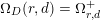


Proof. We obtain from Theorem 6.2 that  $\unicode[STIX]{x1D6FA}_{r,d}^{+}=\unicode[STIX]{x1D6FA}_{K-D}^{+,\text{nil}}(r,d)$ for
 $r\geqslant 1$. If
 $\ell >2g-2$, then, by Lemma 3.2 and Corollary 4.5,
 $$\begin{eqnarray}\displaystyle \unicode[STIX]{x1D6FA}_{D}(r,d)=\unicode[STIX]{x1D6FA}_{D}^{+}(r,d)=\unicode[STIX]{x1D6FA}_{K-D}^{+,\text{nil}}(r,d)=\unicode[STIX]{x1D6FA}_{r,d}^{+}. & & \displaystyle \nonumber\end{eqnarray}$$
If  $D=K$, then, by Lemma 3.2 and Corollary 4.10, we have
 $$\begin{eqnarray}\displaystyle \unicode[STIX]{x1D6FA}_{D}(r,d)=\unicode[STIX]{x1D6FA}_{D}^{+}(r,d)=q\unicode[STIX]{x1D6FA}_{K-D}^{+,\text{nil}}(r,d)=q\unicode[STIX]{x1D6FA}_{r,d}^{+}.\Box & & \displaystyle \nonumber\end{eqnarray}$$
Theorem 6.4. Define the series  $\unicode[STIX]{x1D6FA}_{r}^{+}(z)$ by the formula
 $$\begin{eqnarray}\displaystyle \mathop{\sum }_{r}\unicode[STIX]{x1D6FA}_{r}^{+}(z)T^{r}=(q-1)\operatorname{Log}\biggl(\mathop{\sum }_{\unicode[STIX]{x1D706}}z^{(\ell -2g+2)n(\unicode[STIX]{x1D706}^{\prime })}(-q^{1/2})^{l\langle \unicode[STIX]{x1D706},\unicode[STIX]{x1D706}\rangle }J_{\unicode[STIX]{x1D706}}(z)H_{\unicode[STIX]{x1D706}}(z)T^{|\unicode[STIX]{x1D706}|}\biggr). & & \displaystyle \nonumber\end{eqnarray}$$
Then the DT invariants  $\unicode[STIX]{x1D6FA}_{D}(r,d)$, for
 $r\geqslant 1$, are given by
 $$\begin{eqnarray}\displaystyle \unicode[STIX]{x1D6FA}_{D}(r,d)=\left\{\begin{array}{@{}ll@{}}\displaystyle -\mathop{\sum }_{\unicode[STIX]{x1D709}\in \unicode[STIX]{x1D707}_{r}}\unicode[STIX]{x1D709}^{-d}\operatorname{Res}_{z=\unicode[STIX]{x1D709}}\unicode[STIX]{x1D6FA}_{r}^{+}(z)\frac{dz}{z},\quad & \deg D>2g-2,\\ \displaystyle -q\mathop{\sum }_{\unicode[STIX]{x1D709}\in \unicode[STIX]{x1D707}_{r}}\unicode[STIX]{x1D709}^{-d}\operatorname{Res}_{z=\unicode[STIX]{x1D709}}\unicode[STIX]{x1D6FA}_{r}^{+}(z)\frac{dz}{z},\quad & D=K,\end{array}\right. & & \displaystyle \nonumber\end{eqnarray}$$
where  $\unicode[STIX]{x1D707}_{r}$ stands for the set of
 $r$th roots of unity.
Proof. Let  $\unicode[STIX]{x1D6FA}_{r}^{+}(z)=\sum _{d}\unicode[STIX]{x1D6FA}_{r,d}^{+}z^{d}$. Then, by the previous theorem,
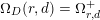 $\unicode[STIX]{x1D6FA}_{D}(r,d)=\unicode[STIX]{x1D6FA}_{r,d}^{+}$ if
 $\ell >2g-2$ or
 $\unicode[STIX]{x1D6FA}_{D}(r,d)=q\unicode[STIX]{x1D6FA}_{r,d}^{+}$ if
 $D=K$, for
 $d\gg 0$. Therefore
 $\unicode[STIX]{x1D6FA}_{r,d}^{+}$ is
 $r$-periodic for
 $d\gg 0$. This implies that the rational function
 $\unicode[STIX]{x1D6FA}_{r}^{+}(z)$ is regular outside of
 $r$th roots of unity and has at most simple poles. In addition, for large enough
 $N$,
 $$\begin{eqnarray}\displaystyle \unicode[STIX]{x1D6FA}_{r,d+Nr}^{+}=-\mathop{\sum }_{\unicode[STIX]{x1D709}\in \unicode[STIX]{x1D707}_{r}}\unicode[STIX]{x1D709}^{-d}\operatorname{Res}_{z=\unicode[STIX]{x1D709}}\unicode[STIX]{x1D6FA}_{r}^{+}(z)\frac{dz}{z}.\Box & & \displaystyle \nonumber\end{eqnarray}$$
Corollary 6.5. If  $\ell =\deg D\leqslant 0$, then
 $$\begin{eqnarray}\displaystyle \mathop{\sum }_{r,d}\unicode[STIX]{x1D6E9}_{D,\text{nil}}^{+,\text{vec}}(r,d)T^{r}z^{d}=\mathop{\sum }_{\unicode[STIX]{x1D706}}z^{-\ell n(\unicode[STIX]{x1D706}^{\prime })}(-q^{1/2})^{(2g-2-\ell )\langle \unicode[STIX]{x1D706},\unicode[STIX]{x1D706}\rangle }J_{\unicode[STIX]{x1D706}}(z)H_{\unicode[STIX]{x1D706}}(z)T^{|\unicode[STIX]{x1D706}|}. & & \displaystyle \nonumber\end{eqnarray}$$
Corollary 6.6. If  $\ell =\deg (D)>2g-2$, then
 $$\begin{eqnarray}\displaystyle \mathop{\sum }_{r,d}\unicode[STIX]{x1D6E9}_{D}^{+,\text{vec}}(r,d)T^{r}z^{d}=\mathop{\sum }_{\unicode[STIX]{x1D706}}z^{(\ell -2g+2)n(\unicode[STIX]{x1D706}^{\prime })}(-q^{1/2})^{\ell \langle \unicode[STIX]{x1D706},\unicode[STIX]{x1D706}\rangle }J_{\unicode[STIX]{x1D706}}(z)H_{\unicode[STIX]{x1D706}}(z)T^{|\unicode[STIX]{x1D706}|}. & & \displaystyle \nonumber\end{eqnarray}$$
Proof. By Corollary 4.5,
 $$\begin{eqnarray}\displaystyle \mathop{\sum }_{r,d}\unicode[STIX]{x1D6E9}_{D}^{+,\text{vec}}(r,d)T^{r}z^{d}=\mathop{\sum }_{r,d}\unicode[STIX]{x1D6E9}_{K-D,\text{nil}}^{+,\text{vec}}(r,d)T^{r}z^{d}. & & \displaystyle \nonumber\end{eqnarray}$$
We note that  $\deg (K-D)=2g-2-\ell <0$ and apply the previous statement.◻
Appendix A Plethystic notation and volumes
Throughout the paper we use the volume ring  ${\mathcal{V}}=\prod _{n\geqslant 1}\mathbb{C}$ [Reference MozgovoyMoz10], which is a
 $\unicode[STIX]{x1D706}$-ring having Adams operations
 $$\begin{eqnarray}\unicode[STIX]{x1D713}_{m}:{\mathcal{V}}\rightarrow {\mathcal{V}},\quad (a_{n})_{n\geqslant 1}\mapsto (a_{mn})_{n\geqslant 1},\quad m\geqslant 1.\end{eqnarray}$$
Define the volume of a finite-type algebraic stack  ${\mathcal{X}}$ over
 $\mathbb{F}_{q}$ to be
 $$\begin{eqnarray}[{\mathcal{X}}]=(\#{\mathcal{X}}(\mathbb{F}_{q^{n}}))_{n\geqslant 1}\in {\mathcal{V}},\quad \#{\mathcal{X}}(\mathbb{F}_{q^{n}})=\mathop{\sum }_{x\in {\mathcal{X}}(\mathbb{F}_{q^{n}})/\sim }\frac{1}{\#\operatorname{Aut}(x)}.\end{eqnarray}$$
In particular, if  $X$ is a curve of genus
 $g$ with the zeta function
 $$\begin{eqnarray}\displaystyle Z_{X}(t)=\exp \biggl(\mathop{\sum }_{n\geqslant 1}\frac{\#X(\mathbb{F}_{q^{n}})}{n}t^{n}\biggr)=\frac{\mathop{\prod }_{i=1}^{2g}(1-\unicode[STIX]{x1D6FC}_{i}t)}{(1-t)(1-qt)}, & & \displaystyle \nonumber\end{eqnarray}$$
then
 $$\begin{eqnarray}\displaystyle [X]=1+\boldsymbol{q}-\mathop{\sum }_{i=1}^{2g}\boldsymbol{\unicode[STIX]{x1D6FC}}_{i},\quad \boldsymbol{q}=(q^{n})_{n\geqslant 1}\in {\mathcal{V}},\quad \boldsymbol{\unicode[STIX]{x1D6FC}}_{i}=(\unicode[STIX]{x1D6FC}_{i}^{n})_{n\geqslant 1}\in {\mathcal{V}}. & & \displaystyle \nonumber\end{eqnarray}$$
We will usually denote  $\boldsymbol{q}$ by
 $q$, hoping it will not cause any confusion.
Let us also briefly recall standard plethystic operators  $\operatorname{Exp}$ and
 $\operatorname{Log}$. Consider the algebra
 ${\mathcal{V}}[\![z,T]\!]$ of power series in the variables
 $z,T$. Define its Adams operations
 $$\begin{eqnarray}\displaystyle \unicode[STIX]{x1D713}_{m}:{\mathcal{V}}[\![z,T]\!]\rightarrow {\mathcal{V}}[\![z,T]\!],\quad \mathop{\sum }_{r,d}a_{r,d}z^{d}T^{r}\mapsto \mathop{\sum }_{r,d}\unicode[STIX]{x1D713}_{m}(a_{r,d})z^{md}T^{mr}. & & \displaystyle \nonumber\end{eqnarray}$$
Let  ${\mathcal{V}}[\![z,T]\!]^{+}=z{\mathcal{V}}[\![z,T]\!]+T{\mathcal{V}}[\![z,T]\!]$ be the maximal ideal of
 ${\mathcal{V}}[\![z,T]\!]$. The plethystic exponential and logarithm functions are inverse maps
 $$\begin{eqnarray}\displaystyle \operatorname{Exp}:{\mathcal{V}}[\![z,T]\!]^{+}\longrightarrow 1+{\mathcal{V}}[\![z,T]\!]^{+},\quad \operatorname{Log}:1+{\mathcal{V}}[\![z,T]\!]^{+}\longrightarrow {\mathcal{V}}[\![z,T]\!]^{+}, & & \displaystyle \nonumber\end{eqnarray}$$
respectively defined by
 $$\begin{eqnarray}\displaystyle \operatorname{Exp}(f)=\exp \biggl(\mathop{\sum }_{k\geqslant 1}\frac{1}{k}\unicode[STIX]{x1D713}_{k}(f)\biggr),\quad \operatorname{Log}(f)=\mathop{\sum }_{k\geqslant 1}\frac{\unicode[STIX]{x1D707}(k)}{k}\unicode[STIX]{x1D713}_{k}(\log (f)), & & \displaystyle \nonumber\end{eqnarray}$$
where  $\unicode[STIX]{x1D707}$ is the Möbius function. These operators satisfy the usual properties, namely,
 $$\begin{eqnarray}\displaystyle \operatorname{Exp}(f+g)=\operatorname{Exp}(f)\operatorname{Exp}(g),\quad \operatorname{Log}(fg)=\operatorname{Log}(f)+\operatorname{Log}(g). & & \displaystyle \nonumber\end{eqnarray}$$
Appendix B The functions $H_{\unicode[STIX]{x1D706}}(z)$ and $J_{\unicode[STIX]{x1D706}}(z)$


In this section, we recall for completeness the definition of the functions  $H_{\unicode[STIX]{x1D706}}(z)$ and
 $J_{\unicode[STIX]{x1D706}}(z)$ introduced in [Reference SchiffmannSch16]. Let
 $\widetilde{Z}_{X}(z)=z^{1-g}Z_{X}(z)$ denote the renormalized zeta function of
 $X$. Given a partition
 $\unicode[STIX]{x1D706}=(1^{r_{1}},2^{r_{2}},\ldots ,t^{r_{t}})$, we set
 $$\begin{eqnarray}\displaystyle J_{\unicode[STIX]{x1D706}}(z)=\mathop{\prod }_{s\in \unicode[STIX]{x1D706}}Z_{X}^{\ast }(q^{-1-l(s)}z^{a(s)}), & & \displaystyle \nonumber\end{eqnarray}$$
where  $a(s)$ and
 $l(s)$ are respectively the arm and the leg lengths of
 $s\in \unicode[STIX]{x1D706}$ [Reference MacdonaldMac95, VI.6.14] and
 $$\begin{eqnarray}\displaystyle Z_{X}^{\ast }(q^{-1}u)=\left\{\begin{array}{@{}ll@{}}Z_{X}(q^{-1}u),\quad & \text{if }u\neq 1,q,\\ \displaystyle \operatorname{Res}_{u=1}Z_{X}(q^{-1}u)=q^{1-g}\frac{\#\operatorname{Pic}^{0}(X)(\mathbb{F}_{q})}{q-1},\quad & \text{if }u=1,\\ \displaystyle \frac{\#\operatorname{Pic}^{0}(X)}{q-1},\quad & \text{if }u=q.\end{array}\right. & & \displaystyle \nonumber\end{eqnarray}$$
Next, write  $n=l(\unicode[STIX]{x1D706})=\sum _{i}r_{i}$,
 $$\begin{eqnarray}\displaystyle r_{{<}i}=\mathop{\sum }_{k<i}r_{k},\quad r_{{>}i}=\mathop{\sum }_{k>i}r_{k},\quad r_{[i,j]}=\mathop{\sum }_{k=i}^{j}r_{k}, & & \displaystyle \nonumber\end{eqnarray}$$
and consider the rational function
 $$\begin{eqnarray}\displaystyle L(z_{n},\ldots ,z_{1})=\frac{1}{\mathop{\prod }_{i<j}\widetilde{Z}_{X}(z_{i}/z_{j})}\mathop{\sum }_{\unicode[STIX]{x1D70E}\in \mathfrak{S}_{n}}\unicode[STIX]{x1D70E}\biggl[\mathop{\prod }_{i<j}\widetilde{Z}_{X}\biggl(\frac{z_{i}}{z_{j}}\biggr)\cdot \frac{1}{\mathop{\prod }_{i<n}(1-q(z_{i+1}/z_{i}))}\cdot \frac{1}{1-z_{1}}\biggr]. & & \displaystyle \nonumber\end{eqnarray}$$
In the above equation, the symmetric group acts by permutation of the variable  $z_{1},\ldots ,z_{n}$. Denote by
 $\operatorname{Res}_{\unicode[STIX]{x1D706}}$ the operator of taking the iterated residue along
 $$\begin{eqnarray}\displaystyle \frac{z_{n}}{z_{n-1}} & = & \displaystyle \frac{z_{n-1}}{z_{n-2}}=\cdots =\frac{z_{2+r_{{<}t}}}{z_{1+r_{{<}t}}}=q^{-1},\nonumber\\ \displaystyle \vdots \quad & & \displaystyle \quad \vdots \qquad \qquad \qquad \vdots \nonumber\\ \displaystyle \frac{z_{r_{1}}}{z_{r_{1}-1}} & = & \displaystyle \frac{z_{r_{1}-1}}{z_{r_{1}-2}}=\cdots =\frac{z_{2}}{z_{1}}=q^{-1}.\nonumber\end{eqnarray}$$
We put
 $$\begin{eqnarray}\displaystyle \widetilde{H}_{\unicode[STIX]{x1D706}}(z_{1+r_{{<}t}},\ldots ,z_{1+r_{{<}i}},\ldots ,z_{1})=\operatorname{Res}_{\unicode[STIX]{x1D706}}\biggl[L(z_{n},\ldots ,z_{1})\mathop{\prod }_{\substack{ j=1 \\ j\not \in \{r_{{\leqslant}i}\}}}^{n}\frac{dz_{j}}{z_{j}}\biggr], & & \displaystyle \nonumber\end{eqnarray}$$
and finally,
 $$\begin{eqnarray}\displaystyle H_{\unicode[STIX]{x1D706}}(z)=\widetilde{H}_{\unicode[STIX]{x1D706}}(z^{t}q^{-r_{{<}t}},\ldots ,z^{i}q^{-r_{{<}i}},\ldots ,z). & & \displaystyle \nonumber\end{eqnarray}$$
Note that if  $r_{i}=0$ for some
 $i$ then the function
 $\widetilde{H}_{\unicode[STIX]{x1D706}}$ is independent of its
 $i$th argument.


