Introduction
Although there are various definitions of self-esteem, self-esteem is often conceptualized as “the result of a self-evaluative process in which individuals judge themselves positively or negatively on different abilities or attributes” (Vickery et al., Reference Vickery, Sherer, Evans, Gontkovsky and Lee2008). Although individuals with negative judgments of themselves are more likely to suffer from poorer overall feelings of self-worth, more sadness and increased likelihood of being depressed (Tarlow and Haaga, Reference Tarlow and Haaga1996; Leary and MacDonald, Reference Leary, MacDonald, Leary and Tangney2003), self-worth and depression are usually perceived as different constructs. Often, depression is considered as a syndrome that, in addition to having the feelings of worthlessness, involves other affective and somatic symptoms that include a negative mood state and sleep or appetite disturbances (Vickery et al., Reference Vickery, Sherer, Evans, Gontkovsky and Lee2008).
A limited number of studies have shown that poor self-esteem may be associated with negative health outcomes that include higher mortality in dialysis patients (Kutner et al., Reference Kutner, Brogan and Fielding1997) and worse functional outcomes post stroke (Chang and Mackenzie, Reference Chang and Mackenzie1998). Recent evidence suggests that lower self-esteem may be associated with poorer functional status after acute stroke and that low self-esteem may mediate the relationship between emotional and function outcomes (Fung et al., Reference Fung, Lui and Chau2006; Vickery et al., Reference Vickery, Sherer, Evans, Gontkovsky and Lee2008).
Although these studies demonstrated that there may be a positive relationship between low self-esteem and negative health outcomes, few studies have been conducted using a population-based community sample. Stamatakis et al. (2003), in a population sample of Finnish men, showed that although there may be an association between low self-esteem and poorer health outcomes, the association could have been mediated through other psychosocial factors such as hopelessness. As a result, more research is needed to clarify the independent relationship between low self-esteem and negative health outcomes.
Up to now most studies that have investigated the relationship between low self-esteem and health outcomes have been conducted among Caucasian populations in Western countries. Few studies have been conducted in other ethnic groups such as Chinese where the relationship between low self-esteem and health outcomes may be different owing to cultural differences between the East and West, and, in particular, among Chinese men (Woo et al., Reference Woo, Lynn, Leung and Wong2008). The objective of the current study was to explore and examine the relationship between lack of self worth or “worthlessness” and all cause non suicide related 5-year mortality in a cohort of community dwelling elderly Chinese men after controlling for other socio-economic and behavioral variables.
Methods
Subjects
Data from 1999 men aged 65 years and over who formed part of a study on risk factors of osteoporosis (Wong et al., Reference Wong2005) were used in the current study. Subjects were all volunteers and were recruited by placing notices in community centers for the elderly and in housing estates, followed by talks that explained the purpose, procedures and investigations of the study. The aim was to recruit a stratified sample so that approximately 33% were in each of the following age groups: 65–69 years, 70–74, 75 or older. The study was approved by the Clinical Research Ethics Committee of the Chinese University of Hong Kong, which requires informed consent to be obtained. Two men were excluded owing to suicide death.
A questionnaire containing information regarding demographics, socioeconomic status, medical history and depressive symptoms was administered by a trained interviewer. The presence or absence of disease was based on subjects' report of diagnosis by their doctors on eight common chronic medical conditions. These included coronary heart diseases (myocardial infarction, angina pectoris and congestive heart failure), stroke, chronic obstructive pulmonary diseases, chronic back pain, diabetes mellitus, congestive heart failure, Parkinson's disease and cancer. Education levels were used as an indirect measure for objective socioeconomic status.
Clinically significant depressive symptoms were measured using the validated Chinese version of Geriatric Depression Scale (Lee et al., Reference Lee, Chiu, Kowk and Leung1993) with a cut-off score of 8, which was recommended for detecting depression in Hong Kong elderly people. Worthlessness was defined by one of the 15 questions from the Geriatric Depression Scale: “Do you feel pretty worthless the way you are now?” with a yes/no response.
The Chinese Mini-mental State Examination (CMMSE) (Katzman et al., Reference Katzman1988) was used as an evaluation tool for cognitive impairment. The CMMSE is a validated Chinese version of the Mini-mental State Examination (MMSE) (Folstein et al., Reference Folstein, Folstein and McHugh1975). CMMSE scores range from 0 to 30; a lower CMMSE score reflects more dementia-related cognitive impairment. An individual with an MMSE score of 23 or less is identified as having significant cognitive impairment. Self-rated health was assessed by using the first question of the Medical Outcomes Study Short-Form Health Survey (SF-12) (Lam et al., Reference Lam, Tse and Gandek2005) with the question: “Compared to other people your own age, how would you rate your overall health?” Response choices were: “excellent for my age”, “good for my age”, “fair for my age”, “poor for my age” and “very poor for my age”.
Data on all cause mortality were obtained from the Death Registry of the Department of Health of the HKSAR Government where all deaths in Hong Kong are registered. These data were checked by four-monthly telephone interviews conducted by trained research assistants who called each individual's family members, and data on mortality statistics were collected through July 2008 with a mean (SD) follow-up of 5.2 (1.5) years. Cause of death was determined by review of death certificates and was coded using the International Classification of Diseases-version 10 (ICD-10). Any death with a cause of “suicide” was excluded as we were interested in finding the association with non-suicidal mortality.
Statistical analysis
Subjects were divided into two groups on the basis of the presence of the number of clinically relevant depressive symptoms as defined above. Means of variables between the two groups were compared using two-sample t-tests for continuous variables and χ2 tests for categorical variables.
Three separate Cox proportional hazards models assessed the association of depressive symptoms and mortality. The first model assessed the association of depressive symptoms and “worthlessness” in their relation to mortality respectively without adjustment. The second model assessed the association of “worthlessness” and depressive symptoms in relation to mortality with adjustment for intervening variables that included age, martial status, education, cigarette smoking, alcohol consumption, number of chronic disease, self-rated health, body mass index, cognitive status, physical activity, occupation and maximum lifetime income. All statistical analyses were performed using SAS software (SAS Institute, Cary, NC). All of the statistical tests were two-tailed with a significance level of 0.05.
Results
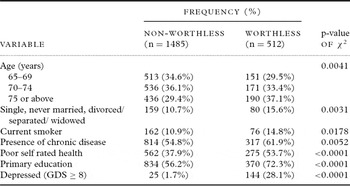
The results on the subjects' characteristics have been reported elsewhere (Wong et al., Reference Wong, Mercer, Leung and Woo2009). In brief, the age distribution was fairly evenly distributed among the three age groups (65–69, 70–74, 75 years or above) and was similar for men. The prevalence of men having clinically relevant depressive symptoms was around 8.5%. The prevalence of hopelessness in this sample of elderly men was 11.3%. Multi-morbidity was common and 56.7% of men reported the presence of at least one chronic medical condition. Two deaths with causes being suicide were excluded. Comparisons on demographic, social and medical characteristics were made between those who reported “yes” on the question “Do you feel pretty worthless the way you are now?” with those who reported negatively on the same question and the results are shown in Table 1. Overall, those who scored positively on “self-worthlessness” were older, more depressed, with more chronic diseases and were more likely to be cigarette smokers. The Cronbach's α for the 15 questions is 0.77 (95% CI: 0.76–0.78).
Characteristics of participants who answered “yes” to the question: “Do you feel pretty worthless the way you are now?” and those who answered “no”

GDS = Geriatric Depression Scale.
After an average of five years' follow-up, 18.2% of subjects who reported positively on “self-worthlessness” had died, compared with 9.9% of those who scored negatively on the same question. The mortality rate for this sample was 29.0 per 1,000 person years.
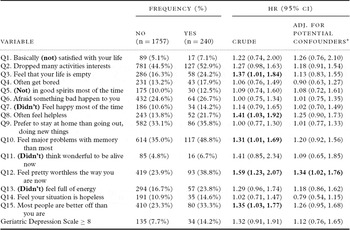
For statistics on causes of death for those who died, 96 (41.6%) died of neoplastic diseases (cancer) and 61 died of cardiovascular diseases (26.4%) followed by respiratory diseases (19.9%). Both unadjusted and adjusted Cox proportional hazards models are shown in Table 2. In the unadjusted model, “worthlessness”, “feeling that your life is empty”, “often feel helpless” and “most people are better off than you are” are significant predictors of all-cause mortality. In the final Cox proportional hazards model, only “worthlessness” is shown to be an independent significant predictor of all-cause mortality.
Five-year-mortality between different depressive symptoms (242 died)

*Potential confounders include age, marital status, education, smoking, alcohol consumption, no. of chronic disease, self-rated health, body mass index, cognitive status, physical activity, occupation and maximum lifetime income.
When analysis was performed studying the relationship between having clinically relevant depressive symptoms and all-cause mortality, being clinically depressed was not found to be an independent predictor for mortality in Cox proportional hazard models.
Discussion
Few studies have been conducted to evaluate the relationship between worthlessness in elderly men and mortality. Our literature search showed there to have been few studies that explored the relationship between worthlessness and health outcomes, although studies have explored the association between other related constructs such as self-esteem and mortality. In a population sample of Finnish men, Stamatakis et al. (Reference Stamatakis, Lynch, Everson, Raghunathan, Salonen and Kaplan2004) evaluated the relationship between self-esteem measured by the Rosenberg ten-item scale and all-cause mortality using Cox proportional hazard models. They showed that low self-esteem was associated with a twofold increase in age-adjusted mortality. However, this relationship disappeared when adjustment was made for behavioral and socioeconomic factors, chronic diseases and other psychosocial characteristics that included hopelessness, depression, cynical hostility and sullenness. Other studies have suggested that self-esteem may be important in the survival of dialysis patients (Kutner et al., Reference Kutner, Brogan and Fielding1997) and in the functional ability of individuals after stroke (Chang and Mackenzie, Reference Chang and Mackenzie1998).
We do not understand why worthlessness, among all other depressive symptoms, was the only independent predictor of mortality in this study nor why there was no statistically significant association of depression overall with mortality in this study, as in other previous studies (Wassertheil-Smoller et al., Reference Wassertheil-Smoller1996; Whooley and Browner, Reference Whooley and Browner1998; Penninx et al., Reference Penninx, Geerlings, Deeg, Eijk, Tilburg and Beekman1999; Schulz et al., Reference Schulz, Beach, Ives, Martire, Ariyo and Kop2000). Other related constructs, such as hopelessness, for example, have been shown to be related to important health outcomes in other studies. Hopelessness has been shown to be an important predictor of mortality in population-based longitudinal studies (Everson et al., Reference Everson1996; Stern et al., Reference Stern, Dhanda and Hazuda2001; Everson-Rose et al., Reference Everson-Rose, House and Mero2004). However, contrary to these previous findings, we did not find “feeling hopeless”, as defined by responding positively to the question, “Do you feel your situation is hopeless?” to be a predictor of mortality. In addition to hopelessness, previous community-based studies have showed increased mortality in those with depressive symptoms (Murphy et al., Reference Murphy, Monson, Olivier, Sobol and Leighton1987; Vogt et al., Reference Vogt, Pope, Mullooly and Hollis1994; Wassertheil-Smoller et al., Reference Wassertheil-Smoller1996; Whooley and Browner, Reference Whooley and Browner1998; Penninx et al., Reference Penninx, Geerlings, Deeg, Eijk, Tilburg and Beekman1999; Wulsin et al., Reference Wulsin, Vaillant and Wells1999; Schulz et al., Reference Schulz, Beach, Ives, Martire, Ariyo and Kop2000) although there was some inconsistency (Fredman et al., Reference Fredman1989; Wassertheil-Smoller et al., Reference Wassertheil-Smoller1996). Some researchers (Penninx et al., Reference Penninx, Geerlings, Deeg, Eijk, Tilburg and Beekman1999) attributed the inconsistency of results to the fact that other self-report measures of health and functioning that are included in the analysis could have attenuated the relationship (Idler and Benyamini, Reference Idler and Benyamini1997). When there is inclusion of other self-reported measures of health and functioning, the depression effects on mortality could have been shared and diluted by other self-assessments that included perceived health, self-assessed functional status and indicators of subjective well-being. Another reason for lack of association between depressive symptoms and mortality in our study could be due to the presence of a type II error. Eight depressive symptoms are required to indicate having clinically relevant depressive symptoms using the GDS and there were only 34 individuals who died and who reported clinically relevant depressive symptoms; thus, we might have lacked enough power to find a relationship between clinically relevant depressive symptoms and mortality. Other explanations include the possibility that participants with depressive symptoms may already have died at a younger age and thus were not included in our samples.
Moreover, as GDS is based on self-report, some participants might have been less willing to answer certain questions that may have biased our findings on positive relationships between only a particular symptom and mortality. In addition, there has been little empirical research conducted on the factor structure of the GDS in Hong Kong Chinese, and since there are significant differences in political, social and cultural contexts between the West and the East, the lack of association in overall depression and other depressive symptom items such as “empty feelings, helplessness” in their relation to mortality could be due to the different factor structure of GDS in Hong Kong Chinese. For example, a recent study conducted by Lai et al. (Reference Lai, Tong, Zeng and Xu2010) in mainland China using exploratory factor analysis showed that all items of the GDS could be loaded on four major factors that included positive and negative mood, energy level, inferiority and disinterestedness in Shanghai Chinese elderly. In the study, both “thinking that most people are better off”, and “feeling worthlessness” were grouped into a single factor (Lai et al., Reference Lai, Tong, Zeng and Xu2010). Further understanding of the lack of association between other depressive symptoms and mortality in Hong Kong Chinese will probably benefit from further exploratory factor analysis research in Hong Kong Chinese using the Chinese GDS.
Results from our study are the first to demonstrate this relationship with adjustments for other potential confounders that included age, social status, chronic diseases, body mass index, health status and depressive symptoms.
Apart from differences in factor structure of the GDS in Hong Kong Chinese, there are several plausible explanations for the positive relationship between “worthlessness” and mortality.
First, individuals who feel worthless may be less likely to engage in preventive health activities and may disengage themselves from health promoting behaviors and supportive social relationships. Second, they may be more likely to engage in unhealthy behaviors such as cigarette smoking. These may in turn result in dysregulation of the neuro-endocrine environment which can cause changes in immune function of the individuals.
From a clinical perspective, our results showed that sub-threshold depressive symptoms such as worthlessness might give important information on the prognosis of elderly men. Knowing this relationship, behavioral and medical interventions that can be used to increase worthiness in men may be of value in reducing morbidity such as reduced suffering due to a sense of worthlessness in elderly men.
From a policy perspective, the current policy in Asian countries, including Hong Kong, to encourage retirement between the ages of 55 and 60 and the reluctance of organizations (including governmental organizations) to employ older adults may increase social exclusion, decrease self-worth and increase depressive symptoms and possibly mortality particularly in men.
Limitations
There are several limitations in our study. First, we used only one question, “Do you feel pretty worthless the way you are now?” as a measure of worthlessness. We have not employed other validated scales such as the Rosenberg 10-item scale to measure self-esteem, which might have given us additional information on the degree of worthlessness and its relationship to mortality in men.
Second, GDS is a screening instrument for depressive symptoms with a yes/no response which may limit its uses to measure severity of symptoms or the relationship between risk factors and depressive symptoms in a dose response relationship.
Third, using only one question to define “worthlessness” makes it important to consider the construct of “worthlessness” as a possible subject of further research.
Fourth, we have relied on the Hong Kong Death Registry for reports of all deaths in our study; however, there may be reporting delays of up to six months which might have affected our results.
Fifth, we have only evaluated a male elderly population; data from elderly women were not available for analysis owing to their lower mortality rate. In future studies, it would be informative to compare the predictors of mortality in both elderly men and women to evaluate if there are differences in predictors between the sexes. In the literature, it has been suggested that there may be gender differences in risk factors for depression. As a result, low self-esteem or worthlessness may be a more important predictor of mortality in men than in women.
Sixth, we could only conduct statistical adjustment for known confounders; the effects of unmeasured confounders on mortality and their relationship with “worthlessness” is therefore not known.
Finally, our study consisted of a volunteer sample. This may have introduced a degree of selection bias in that our sample could have been healthier than the general population. However, information on the relationship between depressive symptoms and mortality is unlikely to have been affected significantly because we included a number of other variables that included lifestyle, medical and socioeconomic factors.
Future research may be able to shed light on the inter-relationship between economic hardship, social isolation and loss of function as important factors in the etiology of depressive symptoms and worthlessness in elderly men. Prospective interventional studies should be conducted to evaluate the effects of treating worthlessness on quality of life and mortality in men.
In terms of the implications for clinical practice, our study shows that worthlessness is associated with increased mortality in older Chinese elderly men and this should be recognized as a risk factor.
Conflict of interest
None.
Description of authors' roles
S.Y. Wong designed the study, supervised the data collection and wrote the paper. J.C. Leung planned the statistical design, carried out the analysis and assisted with writing the paper. J. Woo supervised the data collection and revised the paper for intellectual content. All authors approved the final paper.
Acknowledgments
This study was partially supported by the General Research Grant Council of Hong Kong Special Administrative Region. The authors gratefully acknowledge the role of Dr. Edith Lau in obtaining the initial grant.