The earthquake of 62/63 ce was a catastrophic event for Pompeii and Campania.Footnote 1 The destruction and death toll were extensive and it is clear that the city of Pompeii was still recovering and rebuilding when the eruption of Vesuvius happened.Footnote 2 This article takes into consideration the mental and emotional damage that the earthquake caused and the way in which Seneca and the archaeological record help us to perceive strategies of consolation and therapy. Seneca discusses this earthquake in Book 6 of his Naturales quaestiones and hopes to lead his reader from the shock of the earthquake to a more comprehensive understanding of the physical causes of the tremor.Footnote 3 The cultural memory of events not witnessed directly (such as Seneca's write-up of the Pompeii earthquake) makes us all survivors and ‘turn[s] history into a memory in which we can all participate’.Footnote 4 If trauma ‘spreads via language and representation’,Footnote 5 Seneca wants to limit what exactly is traumatic about this event and employs his creative rhetoric to do so. His account demonstrates how Stoic physics and ethics are connected and moves the reader from his or her fear of earthquakes to the fear of death at the root of the anxiety.Footnote 6 Seneca carefully alters the valence of certain terms as well as selected memories of the earthquake to encourage his reader to transcend his or her fear and view earthquakes as natural occurrences, not anomalies to be dreaded. He does this through strategies identified in modern trauma theory as useful for post-traumatic stress disorder (PTSD), and this article investigates how contemporary trauma theory can help us understand aspects of Seneca's remedy.Footnote 7 Seneca's repetitions of certain events and terminology works to reassess and renovate them from a philosophical angle – in essence it turns potential ‘flashbacks’ and ‘triggers’ into beneficial sites of memory and the means of recovery.Footnote 8 Survivors often relive the trauma again and again – Seneca's work alludes to this, but now makes the victim actively revise how to make such iterations part of the recovery.
Next, I will turn to the famous reliefs found in the home of L. Caecilius Iucundus (V.1.26).Footnote 9 These reliefs depict the earthquake and its impact on certain important monuments of the city, as well as a more abstract representation of religious stability. As part of the family's lararium, it is clear that they can symbolize an act of gratitude to the gods, but they are also a visual reminder of what has passed and act to normalize this event. In its mnemonic function,Footnote 10 it replicates much of what Seneca does in the Naturales quaestiones: namely, it is another way to control the memory of the disaster and refocus the reader/observer from being a passive casualty of the earthquake to a more active and informed participant who, in the words of Gareth Williams, can achieve a ‘cosmic viewpoint’ of this incident.Footnote 11
In essence, this article considers the responses of two contemporaries to the trauma of the earthquake and, in their responses, one can view how they share certain coping mechanisms that are in line with modern trauma therapy. Both activate the memory of the earthquake only to scrub the painful memories by placing them in new contexts. While the contexts (philosophy for Seneca, religion for the family of Caecilius Iucundus) are broadly different, the way they ask the reader/observers to consider and reconsider the text/image creates an active respondent who can understand the earthquake as part of the larger continuum of the natural world.
Senecan consolation and PTSD
The sixth book of Seneca's Naturales quaestiones begins by describing the recent earthquake and the mirabilia that occurred as part of the earthquake: cities such as Pompeii and Herculaneum suffered the most but, in addition, ‘a flock of hundreds of sheep was killed, and statues were split apart; afterward some people wandered around in a state of shock and deranged’ (sexcentarum ovium gregem exanimatum, et divisas statuas; motae post hoc mentis aliquos atque inpotentes sui errasse; Q Nat. 6.1.3).Footnote 12 Seneca then spends the majority of the book composing a detailed doxography, which analyses the various philosophical views on earthquakes,Footnote 13 before returning to the question of how such information will help comfort the fearful survivors (as well as the possibly shaken readers of the book).
Throughout the book Seneca stresses the importance of investigation and of paying close attention not only to the natural worldFootnote 14 but also to the language and structure that he uses to describe that world. His doxography is based around the elements (does water cause earthquakes? fire? air?) and Tutrone has recently stressed how this format assists one of Seneca's primary goals, ‘to create a web of intertexts and re-interpretations, a web covering both the field of scientific knowledge and that of literary memory’.Footnote 15 When Seneca's narrative returns to the same events of the Campanian earthquake near the conclusion of this book we should take note of such conspicuous ring composition. Such a rhetorical device inspires the reader to re-evaluate these phenomena, as well as to re-evaluate the language used to describe the trauma of the survivors. After making one's way through the book, the sheep that died should not be considered a wonder (nec id mirum est; Q Nat. 6.27.2) and it did not happen because of fear (timore; Q Nat. 6.27.1), but rather because of pestilential air that was emitted during the earthquake.Footnote 16 Likewise, one should not wonder at the statue split in half (statuam divisam non miror; Q Nat. 6.30.1), especially as Seneca has given example after example of the way in which the earth itself splits open (in partes divisa discedat; Q Nat. 6.4.1 [see also 6.14.1, 6.18.3]). Even his deployment of one word, in this case forms of dividere (‘to split’), can point to the larger lesson that he aims to teach in this book and the iteration that will lesson one's trauma. Seneca consciously and creatively recasts the horror and fear of these ‘wonders’ into something normal and expected.Footnote 17
His return to the survivors of the earthquake and their traumatic experience occurs in the chapter between these marvels. He writes (Q Nat. 6.29.1–3):
Nam aliquos insanis attonitisque similes discurrere fecit metus, qui excutit mentes, ubi privatus ac modicus est: quid? ubi publice terret…quid mirum est animos inter dolorem et metum destitutos aberrasse? Non est facile inter magna mala consipere. Itaque levissima fere ingenia in tantum venere formidinis ut sibi exciderent. Nemo quidem sine aliqua iactura sanitatis expavit, similisque est furentis quisquis timet: sed alios cito timor sibi reddit, alios vehementius perturbat et in dementiam transfert. Inde inter bella erravere lymphatici, nec usquam plura exempla vaticinantium invenies quam ubi formido mentes religione mixta percussit.
A number of people ran off as though mad or stupefied: this was the result of fear, which causes mental disturbance when it is private and moderate; so what happens when there is terror on a public scale?…is it surprising that minds deprived of support in the midst of grief and fear became deranged? It is not easy to stay sane in the midst of great disasters. So the weakest temperaments generally reach such a pitch of terror that they lose their heads.Footnote 18 No one can panic without some loss of sanity, and anyone who is afraid resembles a madman. But fear soon restores some people to their normal selves, while it disturbs others more deeply and drives them mad. That is why in time of war people wander around distraught, and nowhere will you find more cases of people prophesying than when panic blended with religion has attacked their minds.
As with the split statues and the sheep, so with the bewildered and panicked survivors, Seneca questions if this is truly surprising (quid mirum est; Q Nat. 6.29.1). In doing so, he also makes these emotional reactions parallel the physical effects of the earthquake. This passage strongly recalls language found at earlier moments in Book 6. In his opening, Seneca claims that ‘we should investigate the causes [of earthquakes]…comfort needs to be found for the fearful, and their great terror needs to be eradicated’ (quorum ut causas excutiamus…quaerenda sunt trepidis solacia, et demendus ingens timor; Q Nat. 6.1.3–4). That comfort can be found in reason: ‘But I regard this fact itself as a comfort, and a very powerful one, since incurable fear rescues the foolish. Reason can dispel terror from the wise’ (ego vero hoc ipsum solacii loco pono, et quidem valentissimi, quando quidem sine remedio Footnote 19 timor stultis est: ratio terrorem prudentibus excutit; Q Nat. 6.2.1).Footnote 20 These different translations of excutere (‘to dispel, to investigate’) indicate how inquiry and investigation can also act to dispel fear. Seneca repeats the same language later in this section, when he restates the survivors’ maddened wandering (quid mirum est animos inter dolorem et metum destitutos aberrasse; Q Nat. 6.29.1Footnote 21) which fear caused (qui excutit mentes; Q Nat. 6.29.1). The repeated use of excutere here models how Seneca wants us to pay attention to his language and exercise our ratio (‘reason’).
Seneca continues to focus on the connections between fear and madness, stating: ‘whoever fears is like a madman’ (similisque est furenti quisquis timet; Q Nat. 6.29.2). Fear becomes the primary emotion that needs to be eradicated and the fear of earthquakes or the distressing aftermath of an earthquake is conflated with the fear of death.Footnote 22 But death is also a refuge from all evils, including fear. Seneca wants to encourage those racked with fear to understand this, and his language highlights that the fearful actually desire death: ‘Death is a law of nature; death is the tribute and duty of mortals, and the remedy for every suffering. Anyone who is afraid is longing for it’ (mors naturae lex est, Footnote 23 mors tributum officiumque mortalium malorumque omnium remedium est: optavit illam quisquis timet; Q Nat. 6.32.12).Footnote 24
Through the contemplation of nature and study of the liberal arts (including this workFootnote 25) one becomes both wiser and braver: ‘The mind gains strength solely from liberal studies and from the contemplation of nature’ (non enim aliunde animo venit robur quam a bonis artibus, quam a contemplatione naturae; Q Nat. 6.32.1), and will come to the conclusion that death is what fearful individual actually desires. In this section we can see how Seneca repeats language (forms of the verbs excutere and errare) or phrases (quisquis timet) to lead the reader through the teaching he offers in the book.Footnote 26 Like a good teacher, these repetitions are meant to hammer home important points, but (also like a good teacher) it is not repetition for the sake of repetition, but rather to enrich and question the assumptions and learning already acquired.Footnote 27 The conclusion features a call for daily meditation, much as his letters or Dialogi do,Footnote 28 but now this can be put into a larger context of understanding the natural world (Q Nat. 6.32.12: hoc adfigamus animo, Footnote 29 hoc nobis subinde dicamus ‘moriendum est’; ‘Let us imprint this on our minds, let us constantly say this to ourselves: “We must die”.’). Memory is the key for the reading technique and the general hermeneutics of Seneca's account. Montiglio remarks, ‘Seneca's conception of memory can be termed “voluntaristic”, because it is grounded in the conviction that memories, their use and their effects can be governed by the will.’Footnote 30 The reader should recognize that Seneca is manipulating the language to lead the reader to a more perfect understanding of the unity of the Stoic universe (in which physics, ethics, and logic – in this case the rhetoric of his account – are bound together to create and define natura). Seneca ultimately utilizes the trauma that the earthquake survivors experience as a way to indicate the benefits of learning about humanity's place in the world.Footnote 31
Modern trauma theory can help us to understand how Seneca's account of the earthquake touches upon cognitive behavioural therapy.Footnote 32 Trauma theory stresses the importance of survivor accounts and the cultural memory that is created by witnessing, testimony, and listening. Recent psychiatric work on earthquake survivors has stressed the ubiquity of acute stress disorder (ASD) as well as PTSD on populations that have suffered earthquakes.Footnote 33 The initial shock and awe will dissipate and a path to recovery is opened by constant deliberate reassessment of the past trauma. Through his text, Seneca is actively trying to (re)formulate the memories about and around this earthquake and encourage the reader to define the event and control the trauma.Footnote 34 Trauma theory encourages us to read Seneca's intratextual repetitions as something more than his typical stylistic flourishes. Indeed, they are much of the therapy and they are purposeful. The reader is meant to notice these repetitions and remark how the language and imagery is re-contextualized in settings that promote a different reaction as the reader progresses in the work. Reading – active close reading – becomes therapeutic as the reader acknowledges the way that Seneca has reconstituted frightening marvels into something that accords with de rerum natura.Footnote 35 The cool water of the doxography and the rehabilitated conception of death as natural law will douse the fevered reaction to an earthquake. The book, in a sense, can represent the give and take of a therapeutic dialogue, with Seneca as a therapist aiming to alter the reactions of the patient's troubled mind.Footnote 36 The traumatic event needs to be brought up, again and again, in order to place it in beneficial contexts for recovery, whether those be the various doxographical explanations or Seneca's own ethical exposition of intratextual echoes.
One notable absence from Seneca's account is the dead and the dying. He does not write about children crushed by falling walls, husbands looking for their wives in the rubble, the maimed, the bloodied, the crushed, and the impaled.Footnote 37 If trauma is a ‘wound’ (the original etymology), then Seneca concentrates on healing that wound, not describing its horrific details. The absence of carnage is itself a way of creating the cultural memory of the earthquake and is important for Seneca's worldview. Although trauma may be ‘outside the range of usual human experience’,Footnote 38 Seneca's normalization of earthquakes will help to assuage this experience or, at least, to provide a preferred perspective on this trauma. When Seneca manipulates the fear of earthquakes into the fear of death, he redefines the concept of trauma to make it more universal.Footnote 39 Memories of such a moment will be preserved through literature and this book stresses how Seneca controls the memorialization of the earthquake and uses it to prove that the shock and derangement of trauma can be remedied by a steady diet of Stoic physics rendered in artistic Latin prose.
Household religion and trauma relief
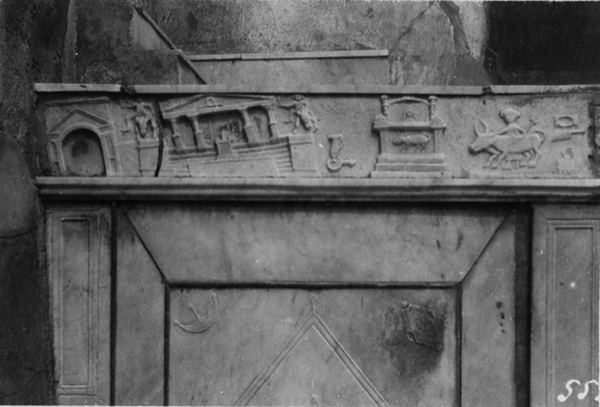
Seneca's description of the earthquake, however, is reported second hand from the information provided by eye-witnesses and framed in such a way to emphasize the natural order of this sublime event. For those who experienced the events first hand, the daily struggle to rebuild and recover resulted in a range of coping mechanisms. Most of these are lost to us, but there is evidence of evacuees moving elsewhere, as well as buildings being refitted to house survivors.Footnote 40 One memorial to the earthquake is the lararium of Caecilius Iucundus.Footnote 41 Flower has recently stressed the individuality present in household shrines because of the grouping of figurines, painted details, and shape of the shrine, and this is probably one of the most exceptional.Footnote 42 In the atrium of the house stands an altar with a unique sculptural programme which dramatically represents the earthquake on the south side (figure 1).Footnote 43
Earthquake relief on altar of Caecilius Iucundus. Courtesy of the American Academy in Rome, Photographic Archive.

This relief depicts the earthquake toppling the Temple of Jupiter in the forum, the equestrian statues with legs akimbo, and the preliminaries of a sacrifice taking place (5 February 62 ce was a festival day, so some have seen this as a freeze-frame of the actual sacrifice to the Pompeiian lares as well as Augustus).Footnote 44 There are certain questions – are those equestrian statues or actual riders trying to keep their balance and throwing their legs about to do so, and where, exactly, is the altar meant to be?Footnote 45 What is clear, however, is that the sculptural programme on this altar evokes the earthquake for all viewers and participants in the household cult. As Toner nicely puts it, ‘Managing to find some kind of meaning to the disaster aids recovery, as does finding someone to blame for it, both of which can be neatly achieved by attributing it to God's will.’Footnote 46 How does this lararium negotiate the results of the earthquake and the trauma suffered by the household? I believe that looking at this relief with its companion relief (on the east side) and placing them in the context of memorialization and the psychological stress caused by trauma can help us understand part of the motivation behind and meaning of these unique works.
The lararium is immediately to the left as one enters the atrium, and the first panel one would face is that of the earthquake upsetting the Temple of Jupiter. Petronius likewise describes how visitors would immediately see the lares upon entering the house of Trimalchio (29.8). The sightlines are important for understanding how to conceptualize the public nature of this altar and the way it speaks not only to household members but also to the larger public.Footnote 47 In the atrium of Caecilius Iucundus, this ornate altar shares the south wall with the money chest, and anyone gazing from left to right would eventually reach the bust of Caecilius Iucundus outside the tablinum (‘office’).Footnote 48 The position matters for the sense of place that such shrines intend:
A pious Roman…would aspire to a good relationship with deities of the natural world, who were imagined as already inhabiting spaces before these were occupied by men, as well as with the gods of his home, his lar(es) and his family gods (penates).Footnote 49
For one looking at this panel and ‘reading’ it, there is a stark difference between the rippling damage and disorientation of the left half, with its depiction of the crumbling north side of the forum, and the placid and ordered sacrifice on the right. The altar still stands with solid vertical alignment and the bull sacrifice looks like it could proceed as scheduled. Obviously, one can read panic into the bull's stone eyes, but it seems to me that this evokes the safety and solace granted by religion.Footnote 50 The central position of religious accoutrements such as an urceus (pitcher) for wine and a patera (sacrificial plate), and the observer's tendency to ‘read’ this relief from left to right, would encourage the transformation from disorder to order. The relief's depiction of a sacrifice to the lares should evoke the very lararium itself before which the observer stands, even if the relief shows the more formal sacrifice that is part of the Compitalia.Footnote 51 Peterson remarks on the depiction of ritual implements (such as the knife and axe) on an altar:
While the altar itself may be a locus for such transient ritual, its imagery captures the essence of those exchanges with the divine, as if to commemorate them for perpetuity. In this regard, altars – funerary and civic – may be understood to function, at one and the same time, as repositories of ritual action and as memorials of those actions.Footnote 52
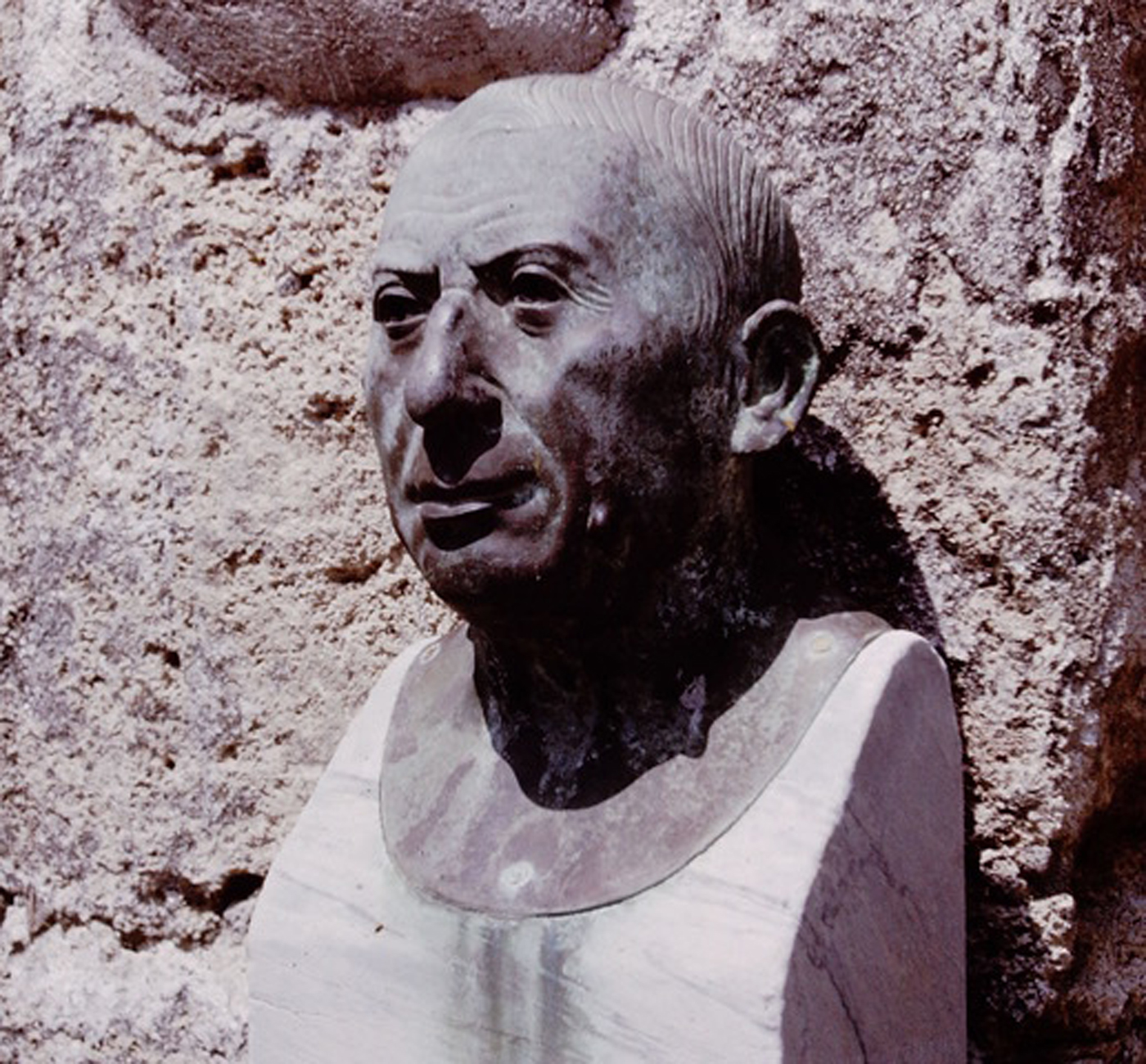
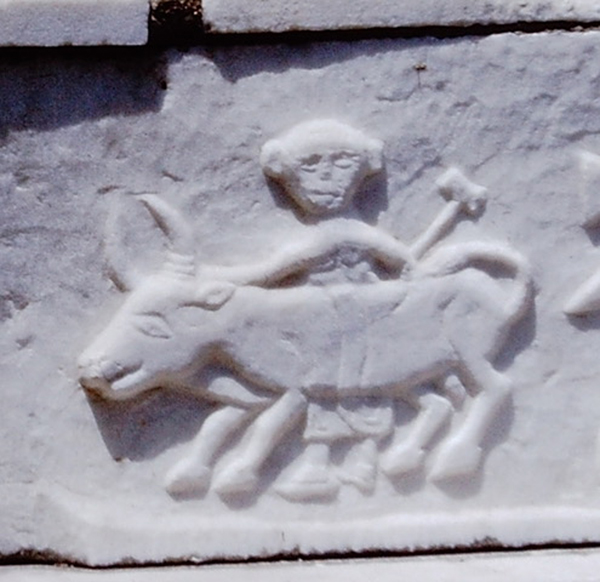
Ritual action is embodied in stone while ritual action is taking place by the observer who approaches the lararium of Caecilius Iucundus. If it is true that Caecilius died in the earthquake,Footnote 53 then the memorialization gains additional significance, as the man represented may evoke Caecilius himself, whose bust is also in the atrium (see figures 2 and 3 and compare those ears!).Footnote 54 He is the only human figure in the relief and, here, is alive and well (one may think back to Seneca's description of the earthquake and the lack of carnage there).
Bust of Caecilius Iucundus. Courtesy of the Wilhelmina and Stanley A. Jashemski Archive at the University of Maryland Library, Special Collections.

Detail of sacrifice from altar of Caecilius Iucundus. Courtesy of the Wilhelmina and Stanley A. Jashemski Archive at the University of Maryland Library, Special Collections.

There is a parallelism created between the figure on the altar, the bust of Caecilius, and the individual viewing the altar and participating in the ritual. This scene evokes the continuity between this artistic site of memory and the survivors who tend to the rituals for the lares.Footnote 55 Their pietas will ultimately be rewarded.Footnote 56 Flower comments on how participants in the cult enter into a sort of ritual reverie and how their experience is moderated by the memories:
A person making a gift or libation on an altar…would not simply make an offering addressed to a cult image. Rather, this worshipper would be seeing and probably claiming some share in the libation made by a genius to the lares, within an ideal ritual time and holy space. He or she would also be reminded of the full range of cult actions.Footnote 57
They are carrying on the tradition, overseen by the former pater familias and dominus of the home, in an opulent atrium that displays its wealth conspicuously; it is clear that the domestic gods have blessed the home in the past and their current worship will ensure future prosperity as well.
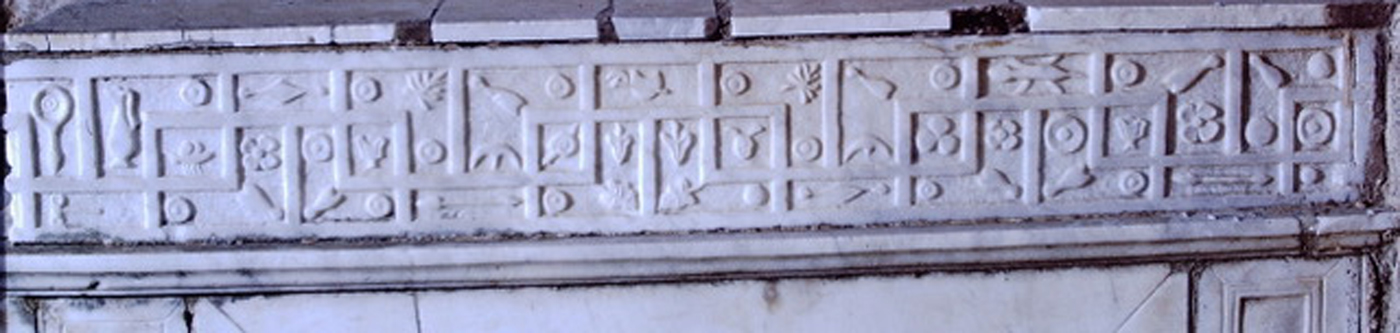
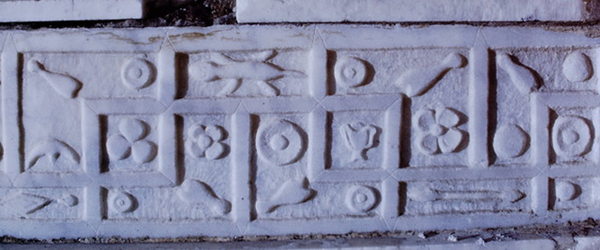
For the viewer, however, this is not the end of the ‘story’, and to continue to the other side of the altar leads to further contemplation. The repetition of certain objects, almost like the anaphora of words in Latin poetry from one line to the next or Seneca's own intratextual repetitions, ties the earthquake relief to the geometric relief on the east side of the altar. The sacrificial axe and pitcher are found at the far right edge of the sacrifice scene and the far left edge of the geometric pattern and their repetition encourages the observer to see these two sides tied together, although one is more figurative and the other more abstract (figures 4 and 5). It is a bold juxtaposition that gains significance from the connections created by the objects depicted.
Altar of Caecilius Iucundus, east face. Courtesy of the Wilhelmina and Stanley A. Jashemski Archive at the University of Maryland Library, Special Collections.

Detail of east face of altar. Courtesy of the Wilhelmina and Stanley A. Jashemski Archive at the University of Maryland Library, Special Collections.

Here we find geometric patterns with flowers, paterae, sacrificial vessels, food, leaves, insects, even a lizard.Footnote 58 Some scholars have postulated that these objects have religious significance and I agree that these could represent some of the humble daily offerings that might have been given to the household gods.Footnote 59 The flora and fauna are placed within the geometric order of the pattern, which indicates the way in which the natural world can be ordered as part of this religious ritual.Footnote 60 It is important to stress the ubiquity of worship of the domestic gods, who would be honoured on a daily basis. As Harmon states:
On the Kalends, the Nones and the Ides, and on family anniversaries (Cato Agr. 143.2), the hearth was dressed with flowers, and the sacred fire received offerings of perfume, wine and cakes. It was not only on these days, but on every day that the domestic gods enjoyed the worship of the family.Footnote 61
The geometric pattern shows a sense of order and stability: all the right angles of the various rectangles and squares and the regularity of three objects in the ‘L’-shaped sections and one in the squares and rectangles. The repetitions of offerings found in the blank spaces only adds to the sense of regularity. The intersections and overlapping of the figures creates a strong lattice-like mesh that shows not only harmony and organization but also controlled symmetry and design. This symbolizes the results of regular devotion to the household gods, and the reliefs, in tandem, create a sense of lawfulness through devotion and continual acts of religio.Footnote 62 By coming to the altar day after day, week after week, year after year, the survivors will find that the earthquake will signify a mere moment of terror, being part of larger continuum. As the psychiatrist Bessel van der Kolk postulates:
Traumatic memories are the unassimilated scraps of overwhelming experiences, which need to be integrated with existing mental schemes, and be transformed into narrative language. It appears that, in order for this to occur successfully, the traumatized person has to return to the memory often in order to complete it.Footnote 63
The reliefs, read in tandem, represent a return to the events of the earthquake and a reckoning with the earthquake through the orderly sacrifices to the household gods. Caruth claims that ‘trauma is not simply an effect of destruction but also, fundamentally, an enigma of survival’.Footnote 64 The survivors of the earthquake built this altar and commissioned this relief to be part of the altar in order to start to comprehend what may have seemed to be an incomprehensible event. Even this earthquake can be put into a larger cosmic context and controlled through contemplation of the iconography of the altar. While memory of the earthquake will be evoked, its trauma will be lessened through this representation and the repetition of daily rites to the household gods.
Conclusion: iteration and contemplation
Seneca's shell-shocked survivors of the earthquake needed to move beyond their speechless wandering and understand that what had happened was a sublime manifestation of natura. If death should result, even death itself is a puny concern for those who have attained this enlightened point of view.Footnote 65 His book on earthquakes models the way in which learning, specifically philosophical education which is enacted in the very reading of the book, will help one to move beyond the initial petrified terror. Physics informs ethics. Active redefinition of terms, as well as the ‘miraculous’ memories of the earthquake (the deceased sheep and ruptured statue), will aid in recovery and come to check further suffering. Ring composition and intratextual repetitions are not just rhetorical flourishes but work together to help the reader process and, ultimately, purge the trauma.
Seneca's strategies, informed by Stoicism and his own artful literary style, can be seen to converge with those of the iconographic programme of the lararium of Caecilius Iucundus. These points of convergence (normalizing the event, the larger order of natura) must be clarified by points of divergence as well. On the lararium we can see one of the ways in which survivors of the earthquake have attempted to make peace with the catastrophe: not through philosophy, but through religious devotion. The household is stable. Personal household religion (and not the ruined public temple) will create the larger context for this catastrophe, one framed by personal piety. Such nods to state or personal religio, for Seneca, are rubbish.Footnote 66
Both Naturales quaestiones Book 6 and the lararium fashion the memory of the earthquake, but for one salvation lies in the proper worship of the gods, whereas the other finds solace in philosophy and meditation on mortality. The east-facing relief with the lattice pattern and various representations of animals, insects, and offerings to the household gods provides an alternative view of the cosmos in which the answer to the naturalis quaestio of an earthquake is not philosophy but religion. The cracks that could shatter the household turn out to be repetitive patterns that add strength and cohesion to the family unit symbolized by this altar. Both aim to reduce the trauma through repetitive acts: for Seneca's reader the mantra moriendum est (‘we must die’) is always on the lips, while the familia of Caecilius approach the lararium daily, observe its reliefs, and say their prayers.Footnote 67 As Sielke states,
Since memory is no longer conceived of as the storage and retrieval of learning processes and information, but rather as a form of continuous rewriting, updating, forgetting, re-membering, and re-cognizing, memory and forgetting – in both cultural practice and cognition – can be understood as serial operations.Footnote 68
These two works show different types of iteration and memory creation – the household of Caecilius Iucundus though cultic actions (and words) informed by the iconography of the lararium, the readers of Seneca's work through the learning encouraged through his text and the consolation granted by study and natural philosophy. In both cases, the context helps to reduce the traumatic repercussions of the earthquake and finds a way to reduce the physical and mental turmoil of that earthquake into being a part of the larger cosmos, a cosmos overseen by a providential god or gods.Footnote 69