





Mental health issues in young people can have profound and lasting impacts throughout their lives, with approximately 75% of mental health problems developing before 25 years of age. Reference Fusar-Poli1,Reference Solmi, Radua, Olivola, Croce, Soardo and Salazar de Pablo2 Early intervention in youth may prevent 25–50% of adult cases, and is linked with better coping strategies, school performance and healthier relationships. Reference McGorry, Mei, Dalal, Alvarez-Jimenez, Blakemore and Browne3–Reference Kim-Cohen, Caspi, Moffitt, Harrington, Milne and Poulton5 However, despite the disability associated with mental health problems, delays in accessing mental healthcare often exceed a decade. Reference Wang, Berglund, Olfson and Kessler6
Many young people face significant barriers to accessing mental healthcare. Service use often drops sharply during the transition to adulthood, and young adults aged 18–24 years are the least likely to receive care compared to other age groups. Reference McGorry, Mei, Dalal, Alvarez-Jimenez, Blakemore and Browne3,Reference Knapp, Ardino, Brimblecombe, Evans-Lacko, Iemmi and King4,Reference Copeland, Shanahan, Davis, Burns, Angold and Costello7 Barriers such as stigma, lack of awareness about mental health and available support, and fragmented care systems further hinder access to support. Reference Radez, Reardon, Creswell, Lawrence, Evdoka-Burton and Waite8 In the UK context, fragmentation refers in particular to the discontinuities young people experience in the transition between child and adolescent mental health services and adult mental health services, and the multiple entry points (general practitioner (GP), self-referral pathways, emergency department, school-based provision and voluntary sector providers) that can be difficult to navigate. These structural challenges are compounded by sustained pressures on National Health Service (NHS) mental health services, including rising waiting times for children and young people referred to child and adolescent mental health specialty care and well-documented difficulties in the transition between child and adult services. 9,Reference Singh, Paul, Ford, Kramer, Weaver and McLaren10 Previous work in our cohort (unpublished data available on request) has shown that 40% of young people with mental health problems perceived a need for help, but did not know how to access it, and this is also supported by the broader literature suggesting not knowing where to go for help as one of the most common barriers. This suggests many young people, despite recognising the need for support, struggle to find services and are unaware of available treatment options and their effectiveness.
Digital technology can help address some access barriers by improving co-ordination of care, and support people to manage their health. In particular, mobile phone apps have the potential to provide scalable mental health resources that can be used privately and at the user’s own pace and help to bridge the gap in mental healthcare if proven effective and cost-effective. Reference Chandrashekar11 They can provide access to information and services without needing a referral from a healthcare provider, and are often appealing to young people because of their anonymity and convenience. Reference Klasnja and Pratt12 However, many existing apps focus on providing psychoeducational content or therapeutic tools rather than guiding users to appropriate services and support systems, leaving a gap in care navigation. A small but growing literature has examined digital interventions targeting help-seeking more broadly. For example, a systematic review of 35 digital interventions targeting help-seeking found that about half showed positive effects, mainly by increasing the intention to seek help, but fewer led to actual help-seeking behaviour (29%). Reference Evans-Lacko, Hahn, Peter and Schomerus13 Digital interventions that include active participation and personal storytelling were most effective in encouraging help-seeking. Reference Evans-Lacko, Hahn, Peter and Schomerus13 A recent evaluation has also highlighted benefits of digital professional and peer support, with users reporting gains in self-help strategies, confidence in social interactions and value in learning from peers’ experiences. Reference Stevens, Cartagena Farías, Mindel, DAmico and Evans-Lacko14
In response to the need described above, we developed the Afloat app, designed to provide mental health information, empower young people to seek support and connect them to relevant services, recognising that many do not know where to turn when they first experience mental health difficulties. Reference Radez, Reardon, Creswell, Lawrence, Evdoka-Burton and Waite8,Reference Ribeiro, Romeo, King, Owens, Gronholm and Fisher15 The app also aimed to reduce stigma and address help-seeking barriers by incorporating personal experiences and providing psychoeducational content. Specifically, Afloat aims to support young people in seeking help by sharing information and personal stories about mental health, providing psychoeducational content and signposting to a range of supports including free online resources, NHS and voluntary sector services and third-sector helplines and chat services (some of which can be accessed via self-referral).
This study aimed to (a) develop an evidence-based mobile app to support young people’s access to mental health services and support; and (b) evaluate the app in terms of satisfaction, acceptability, service use, mental health outcomes and economic impact.
Method
App prototype co-design and development
We began with a rapid scoping exercise. This comprised a search of mental health apps available to young people on the Apple App Store and Google Play Store; a search of PubMed and Google Scholar for relevant systematic reviews of digital mental health interventions for young people published before 2017; Reference Klasnja and Pratt12,Reference Donker, Petrie, Proudfoot, Clarke, Birch and Christensen16 and discussions with mental health stakeholders, particularly The Mix (https://www.themix.org.uk/), who shared findings from their own user consultations around key challenges with existing digital tools, which informed the initial app design. This exercise identified key challenges with existing digital tools, including low engagement with social and rating features, technical limitations of certain location-based functionalities and an emphasis on therapeutic content over support for navigating to existing services. As a result, we prioritised enhancing accessibility, help-seeking pathways and user-engagement features.
Two youth advisory group meetings were held to inform app development. We recruited young people aged 16–25 years with lived experience of mental health problems and/or service use (independent from the pilot study sample) through social media and links with relevant mental health organisations working in the community (i.e. Young Minds, Time to Change, The Mix). The first meeting was attended by three young people; ten had confirmed but several were unable to attend on the day because of adverse weather, and some of those who did not attend provided written comments by email. Discussion focused on language, psychoeducational content and pathways to services, with participants highlighting the importance of using inclusive, accessible language, normalising mental health issues and clearly signposting urgent services. The second meeting was attended by ten young people and provided feedback on a more developed version of the app, including its navigation, layout and additional content needs. Suggestions included advice on communicating with healthcare providers, signposting different service options and supporting individuals who may not be ready to seek help. Both meetings loosely followed a topic guide covering language, content, layout, visuals and the inclusion of lived experience narratives, with detailed notes taken throughout. Recommendations from both groups were recorded as items on the project collaboration platform Trello, where the app team discussed and prioritised each item for implementation.
Building on these discussions, we refined the app and then conducted iterative user testing. Reference Taylor Salisbury, Kohrt, Bakolis, Jordans, Hull and Luitel17 Fifteen young people tested the app on their phone in one-to-one sessions with a research team member lasting approximately 1h. They were asked to explore the app while speaking aloud about their actions, impressions and any frustrations, and to provide feedback on functionality, content and signposting. Detailed notes were taken during each session. Feedback was reviewed after each session and tracked on the project collaboration platform (Trello), with the app team meeting regularly to discuss issues identified and prioritise recurring concerns for immediate implementation. Feedback from these interviews was used iteratively to improve the app.
Pilot app evaluation
Participants
Participants were drawn from the London Child Health and Development Study, Reference Laurens and Cullen18 a prospective community cohort of young people initially recruited from collaborating primary schools across Greater London during 2004–2010, when participants were aged 9–11 years. In 2011–2012, valid contact information was retained for 573 children–caregiver dyads, of whom 407 participated in a previous wave of data collection. Reference Ribeiro, Romeo, King, Owens, Gronholm and Fisher15 For the present pilot evaluation initiated in 2018–2019, contact details were on record for 468 of these 573 dyads and all were invited to participate. Drawing from a community cohort, rather than a clinical sample, allowed us to evaluate the app among young people across the spectrum of help-seeking experience, including those with mental health concerns who had not previously sought help, those currently using services and those who had used services in the past. Socioeconomic status and ethnic diversity were indexed at the school level when the cohort was recruited. Reference Laurens, Hobbs, Sunderland and Green19 On average, 31% of children in participating schools were eligible for free school meals (range 2–62%), compared with a Greater London average of 25% and an England average of 16%. School enrolment was ethnically diverse, reflecting inner-city London: on average, 25% of children were of White British ethnicity (Greater London average 37%; England average 80%), with the remainder of Black (45%), Asian (11%), other White (9%) or other (10%) ethnicity.
Design
We conducted a prospective, single-arm, pre/post pilot evaluation of Afloat to examine acceptability, app engagement and preliminary changes in help-seeking, service use and mental health symptoms over 3 months. The 3-month follow-up was selected as a pragmatic time-frame, allowing sufficient time for participants to engage with the app and act on the information it provided while limiting attrition.
At baseline and 3 months, the following self-report measures were used to assess changes in mental health symptoms, self-perceptions of having a mental health problem, mental health-related stigma, mental health service use and associated barriers to care:
(a) The Patient Health Questionnaire (PHQ-9), Reference Kroenke, Spitzer and Williams20 a nine-item measure of common mental health problems used in primary care, Reference Kiely and Butterworth21,Reference Spitzer, Kroenke and Williams22 was used, with standard severity thresholds of <5 (none/minimal), ≥5 (mild or above) and ≥10 (moderate to severe);
(b) The Reported and Intended Behaviour Scale Reference Evans-Lacko, Rose, Little, Flach, Rhydderch and Henderson23 was used to assess mental health-related stigma;
(c) The Self-Identification of Having a Mental Illness Scale Reference Evans-Lacko, Stolzenburg, Gronholm, Ribeiro, York-Smith and Schomerus24,Reference Schomerus, Muehlan, Auer, Horsfield, Tomczyk and Freitag25 was used to assess self-perceptions of having a mental health problem; and the Service Assessment for Children and Adolescents (SACA) Reference Stiffman, Horwitz, Hoagwood, Compton, Cottler and Bean26,Reference Horwitz, Hoagwood, Stiffman, Summerfeld, Weisz and Costello27 was adapted to the UK context and used to estimate mental health service use and barriers to care, including the type, nature, frequency and duration of services used, and the associated barriers encountered in accessing services over the previous month. Adaptations were as follows: (i) service descriptors were aligned with UK provision (for example, GP and GP practice, community mental health centre, headteacher/deputy headteacher, detention centre); (ii) items were added to capture use of digital supports, i.e. a website or app (not Afloat); (iii) USA English terminology and spelling were replaced with UK equivalents throughout (e.g. paediatrician, centre, counselling, behaviour) and (iv) the recall period was set to 3 months to align with the evaluation window. The full SACA item set is provided in Supplementary Material 1.
In addition, we used the System Usability Scale to assess acceptability and satisfaction with the app. 28 We also asked participants about the perceived usefulness of information, relevance for linking with mental healthcare and whether they would recommend the app to others.
Using Google Analytics, we monitored the app use in the following ways: length of time participants interacted with the app, number of screens visited when using the app, which resources were most used and number of links clicked on while using the app.
Procedure
All participants were sent an introductory letter, an information sheet and a consent form. Those who agreed to participate provided their email address and were sent a link to a baseline survey. Following the questionnaire completion, they were invited to download the app and use it freely. Three months later, they were invited to complete a follow-up survey. They were also asked about their engagement and experience of the app, its acceptability and appropriateness. The online survey took around 10 min to complete. We also reviewed online analytics tools to understand app usage.
Statistical analysis
Baseline characteristics were summarised with means and standard deviations for continuous variables, and frequencies and percentages for categorical variables. The any mental health service use indicator was constructed as a binary variable scored 1 if the participant reported, in the past 3 months, any formal mental health service use (including an in-patient overnight stay, an out-patient or community contact; community mental health services; GP/primary care; accident and emergency departments; professionals such as psychologists, psychiatrists, social workers or counsellors; or crisis helplines) or any school-based service for problems with behaviour, feelings, drugs or alcohol; and 0 otherwise. Within-person change was tested with McNemar’s test, and analyses were stratified by baseline depression severity.
Budget-impact analysis
A budget-impact analysis was conducted from the perspective of local healthcare commissioners in Greater London, as the app’s map functionality was limited to the region. The assumed mode of implementation was through GPs, who are primary care physicians acting as the first point of contact for physical and mental health concerns. Following National Institute for Health and Care Excellence guidance, 29 the analysis used a 5-year time horizon to account for potential costs and benefits.
GPs from different practices in London completed questionnaires (over the telephone or in person) to determine the most likely user population. In total, 20 GPs from a range of London practices participated, recruited primarily at the British Journal of General Practice Research Conference held in London (2019) and through professional contacts of the research team. They were asked to download the app and answer questions about implementation of the app in their practice, including potential changes to existing care pathways, implementation activities, and associated resource use and costs.
Ethics
The project received ethical approval from the European Research Council Executive Agency and the London School of Economics Research Ethics Committee (reference 000577).
Written informed consent was obtained from all participants. All participants were aged 16 years and over and thus legally able to provide their own consent for participation in research. Consent and confidentiality procedures were discussed with participants, who gave consent by signing a consent form for both participation and the use of their data. All youth participants who participated in the app development were offered travel costs reimbursement, refreshments and a £15 voucher. Participants in the pilot evaluation survey received a £15 voucher upon completion of the follow-up survey. The authors assert that all procedures contributing to this work comply with the ethical standards of the relevant national and institutional committees on human experimentation and with the Helsinki Declaration of 1975, as revised in 2013.
Results
App testing and development
At the first meeting, the youth advisory group reviewed drafts of the app content. The group followed a topic guide and discussed language, content, layout and visuals and the inclusion of lived experience narratives from young people who had accessed mental health services. Participants contributed to the development of the content, appearance and functionality of the app. They shared their own experiences, including frustrations with accessing services.
At the second meeting, an improved version of the app was presented, and the group discussed signposting, information usefulness and help-seeking facilitation. Participants emphasised the importance of users knowing what good services should look like to empower them to seek better care or complain where care was not satisfactory. These suggestions were recorded on Trello for the app team to evaluate for implementation in the app.
The app name Afloat and logo were chosen through a competition among young people.
In one-to-one sessions with a researcher, testers explored the app with little prompting and answered questions about engagement, functionality, aesthetics and content. The app was well received, and their feedback led to changes to the app between sessions.
The final version of the Afloat app included the following features (See visual screenshots in Supplementary Material 2):
-
(a) information on mental well-being and specific mental health issues;
-
(b) links to personal stories/testimonies from young people who found services;
-
(c) ways to find support, including information on range of services;
-
(d) information about services nearby through a mapping feature;
-
(e) online support resources;
-
(f) option to seek urgent help.
Pilot app evaluation
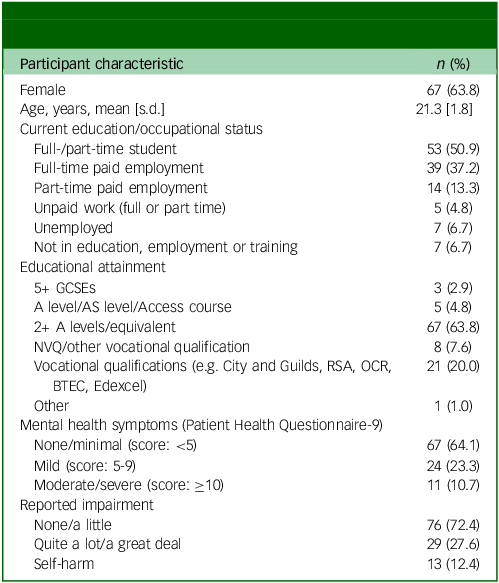
We conducted a survey of the app users at baseline and after 3 months. Of the 468 young people in the source cohort who were invited, 72 invitations were undeliverable; 6 declined to take part and 128 completed the baseline survey. The remaining group did not respond and we are unable to distinguish those who received but did not act on the invitation from those who never received it. A total of 105 completed both baseline and 3-month follow-up surveys. Compared with the 23 baseline completers who did not complete follow-up, those who did were less likely to have moderate-to-severe symptoms on the PHQ-9 at baseline (10.7 v. 54.2%) and less likely to report previous mental health service use (23.8 v. 37.5%). There were no differences in age or gender. Table 1 shows the evaluation participant characteristics at baseline.
App evaluation participant characteristics at baseline (n = 105)

Table 1 Long description
A table summarizing participant characteristics at baseline for an app evaluation study. The table has 11 rows and 2 columns. The columns are labeled ‘n’ and ‘%’. The rows are labeled with various characteristics such as gender, age, current education/occupational status, educational attainment, mental health symptoms, reported impairment, and self-harm. Each row provides the count and percentage of participants for each characteristic. For example, 67 participants are female (63.8 percent), the mean age is 21.3 years with a standard deviation of 1.8, 53 participants are full or part-time students (50.9 percent), and so on. The table provides a detailed breakdown of the demographic and health-related characteristics of the participants at the start of the study.
Preliminary outcomes
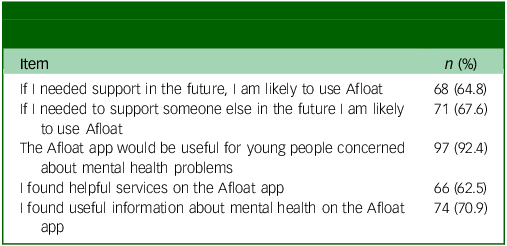
Results from the System Usability Scale indicated high levels of acceptability and satisfaction with the Afloat app (Table 2). Almost all (92.4%) felt that Afloat would be helpful for young people with mental health problems, and 70.9% reported they found useful information about mental health on the app. The majority (64.8%) reported that they would use Afloat for themselves or to support someone else (67.6%) in the future. Participants reported that the most useful information on the app included: how to seek support, information about mental health problems and information about local services.
Acceptability and satisfaction of the app (proportion reporting ‘somewhat’ or ‘very true’) (n = 105)

Table 2 Long description
A table with five rows and three columns. The columns are labeled ‘Item’, ‘n’, and ‘%’. The rows are as follows: Row 1: Item, If I needed support in the future, I am likely to use Afloat; n, 68; %, 64.8. Row 2: Item, If I needed to support someone else in the future I am likely to use Afloat; n, 71; %, 67.6. Row 3: Item, The Afloat app would be useful for young people concerned about mental health problems; n, 97; %, 92.4. Row 4: Item, I found helpful services on the Afloat app; n, 66; %, 62.5. Row 5: Item, I found useful information about mental health on the Afloat app; n, 74; %, 70.9.
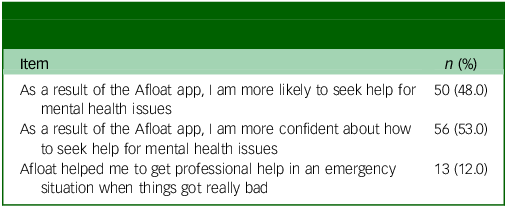
From the help-seeking items, about half of participants (48.0%) also reported that they were more likely to seek help and (53.0%) felt more confident to seek help as a result of the Afloat app (Table 3). Thirteen participants (12.0%) said that Afloat helped them to get professional help in an emergency situation, which included one person going to hospital, two people going to see a mental health professional, one person using a helpline, two people using an app/online support and three people using other types of support.
Potential effectiveness for help-seeking (proportion reporting ‘somewhat’ or ‘very true’) (n = 105)

Table 3 Long description
A table with three rows and three columns. The columns are labeled ‘Item’, ‘n’, and ‘%’. The rows are as follows: Row 1: Item, As a result of the Afloat app, I am more likely to seek help for mental health issues, n, 50, %, 48.0. Row 2: Item, As a result of the Afloat app, I am more confident about how to seek help for mental health issues, n, 56, %, 53.0. Row 3: Item, Afloat helped me to get professional help in an emergency situation when things got really bad, n, 13, %, 12.0.
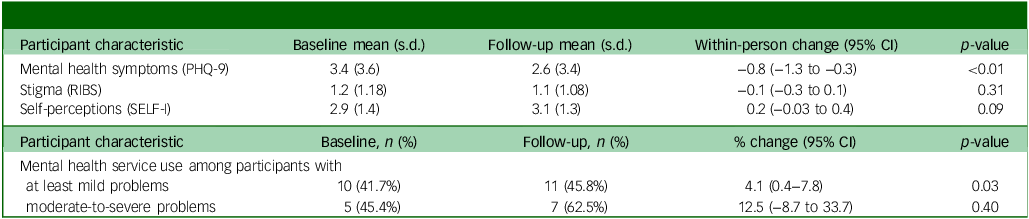
After 3 months of using the app, the proportion of people who said they would seek help if they had a mental health problem increased from 81.2% at baseline to 91.4% (p < 0.05). Service use captured by the SACA also showed a significant increase in the proportion of participants with mild mental health symptoms (total PHQ-9 score >4) who reported any mental health service use (41.7 v. 45.8%; p = 0.03). Similarly, the proportion of participants with moderate to severe mental health symptoms (total PHQ-9 score >9) who used services increased from 45.4% at baseline to 62.5% at follow-up, but this difference was not statistically significant, potentially because of the small sample size (n = 11). Self-reported depressive symptoms were also lower on average at 3-month follow-up compared with baseline, with a within-person mean change of −0.8 (95% CI −1.3 to −0.3; paired t-test p < 0.01) (Table 4). Most participants indicated that the app would be beneficial for young people concerned about mental health.
Changes in mental health, stigma and self-perception from baseline to 3-month follow-up (n = 105)

Table 4 Long description
A table with 8 rows and 5 columns comparing baseline and follow-up data on mental health symptoms, stigma, self-perceptions, and mental health service use. The columns are Baseline mean (s.d.), Follow-up mean (s.d.), Within-person change (95% CI), and p-value. The rows include data for Mental health symptoms (PHQ-9), Stigma (RIBS), Self-perceptions (SELF-I), and Mental health service use among participants with at least mild problems and moderate-to-severe problems. Notable trends include a decrease in mental health symptoms and an increase in mental health service use among participants with at least mild problems.
PHQ-9, Patient Health Questionnaire-9; RIBS, Reported and Intended Behaviour Scale; SELF-I, Self-Identification of Having a Mental Illness Scale.
App engagement and analytics
We reviewed three analytics programmes during the study period, with the following results:
-
(a) Apple App Store (iOS): 121 app units, 32 installs (no uninstall data), 0 crashes;
-
(b) Google Play Store (Android): 52 installs by user, 18 uninstalls, 0 crashes;
-
(c) Google Firebase Analytics: 350 users (168 iOS/182 Android), 341 first open events, 96 app removal events.
The analytics programmes also provided some information on app events or types of app usage, and suggested that individuals were particularly interested in contacting services, although they also engaged with some of the videos:
-
(a) contacting mental health services: telephone number clicked 274 times by 56 unique users, email link clicked 31 times by 21 unique users, web URL link clicked 337 times by 108 unique users;
-
(b) videos of personal stories: videos watched by 3.6% iOS users in page (average time 21 s), 1.4% iOS users watched video full screen (average time 57 s), no data on video controller were available from Android.
In terms of subjective reports of usage, the majority of participants reported opening the app at least once (81%) with 45% using the app two or more times. Over the 3-month testing period, just over a third (34%) reported using Afloat to help themselves and 15% reported using Afloat to help someone else.
Budget-impact analysis
The total cost of app development was estimated at £60 885, which included planning (£35 000), development (£19 890), incidentals (£1095), refinements (£2400) and database (£2500). Cost for ongoing annual maintenance was estimated at £2055 per annum.
Next, we sought to understand the additional cost to GPs (if any). Implementation costs to general practice were estimated at £138 per practice (£111 per GP and £27 per practice nurse), which referred to their time for attending meetings to understand the app and discuss it with their wider practice team. GPs estimated that signposting the app would fit within the standard 10 min appointment for young people presenting to their GP with mental health issues, so that no additional cost would be incurred for introducing the app.
Next, we estimated the cost consequences linked to additional mental health service use associated with the app. Conservatively, we assumed that any potential changes in service use within this population would relate only to mental health services and that no other services were affected. The observed change in service use was applied to the estimated population of young people who would visit their GP because of a mental health problem and accept using the app if offered (n = 7820). This estimate was derived from a total population of 70 000 young people, assuming a 16% prevalence of mental health problems, Reference McManus, Meltzer, Brugha, Bebbington and Jenkins30 that 26% would visit their GP for mental health-related reasons, Reference King, Gronholm, Knapp, Hoffmann, Bonin and Brimblecombe31 and that 25% would accept the app if offered. Reference Torous, Nicholas, Larsen, Firth and Christensen32,Reference Lattie, Schueller, Sargent, Stiles-Shields, Tomasino and Corden33 Once we applied the 4.1% increase in mental health service use as observed among participants who used the app in the study to this population, it yielded an estimated 328 additional young people using mental health services. Once unit costs (£348) for average mental health specialist service use in this population were applied, the potential increase in costs associated with greater mental health service use was estimated at £83 484 for the region. Using the observed 10.2% increase in intentions to seek help as an alternative scenario, an estimated 797 additional young people would access services. This would correspond to additional costs of £277 236 assuming specialist mental health services only, or £434 748 when including both specialist and GP services, equivalent to approximately £35–56 per app user offered the intervention. Estimates excluded potential cost offsets such as avoided crisis contacts, improved continuity of care or longer-term gains in mental health and employment outcomes, which were expected benefits from the app according to GPs.
Discussion
The results of this study suggest that Afloat has several promising aspects of acceptability and satisfaction among young people. Most participants found the Afloat app helpful for themselves or others. After using the app for 3 months, participants reported an increased likelihood of seeking help and some increase in actual service use. Participants also reported reduced mental health symptoms, which suggests that the app has the potential to improve mental health as well as engagement with services; however, in the absence of a control group, these changes cannot be attributed causally to the app.
The high levels of acceptability and satisfaction observed with Afloat are consistent with the broader literature that digital interventions, especially those incorporating active participation and personal stories, may improve user engagement, Reference Evans-Lacko, Hahn, Peter and Schomerus13 although our study was not designed to identify which specific app components drove these findings. The increase in intention to seek help and actual use of services, especially among those with mild mental health issues, is also consistent with previous studies. For example, Donker et al Reference Donker, Petrie, Proudfoot, Clarke, Birch and Christensen16 found that digital mental health apps can increase the intention to seek help, although whether this translates into actual help-seeking behaviour has been more difficult to establish. Reference Evans-Lacko, Hahn, Peter and Schomerus13 The lack of statistical significance for those with more severe issues may be a result of the small sample size, although it is also consistent with broader evidence that digital interventions alone may not effectively address more complex or severe mental health issues without face-to-face support. Reference Weisel, Fuhrmann, Berking, Baumeister, Cuijpers and Ebert34 Within a stepped-care framework, these patterns suggest that Afloat’s navigational and informational features may be best suited to individuals whose primary barrier is awareness of and access to services, with those experiencing moderate-to-severe difficulties likely to benefit additionally from structured clinical support. However, 12.0% of participants reported that the app helped them obtain help in an emergency situation, including contact with a hospital, mental health professional and helpline, suggesting that the app’s role is not limited to lower-intensity steps, but may also serve as a navigation tool for young people in acute or escalating need. However, this study was not able to determine whether the increased service use was appropriate for the severity and nature of participants’ difficulties.
Although analytics showed that Afloat users frequently clicked on external links, it remains unclear whether they engaged with the resources. This gap between engagement with the app features and actual follow-through on help-seeking behaviours is a well-documented challenge in digital health interventions. Reference Evans-Lacko, Hahn, Peter and Schomerus13,Reference Szinay, Perski, Jones, Chadborn, Brown and Naughton35,Reference Torous, Michalak and OBrien36
The decrease in self-reported depressive symptoms observed over the study period is consistent with the broader literature suggesting that digital mental health interventions can support access to, and understanding of, mental health information by offering a non-judgemental space for engagement. Reference Wang, Varma and Prosperi37,Reference Schleider, Dobias, Sung, Mumper and Mullarkey38 However, in the absence of a control group, this change cannot be attributed to the app itself, and several alternative explanations should be considered, including regression to the mean, natural symptom fluctuation, seasonal effects, maturation and concurrent help-seeking outside the study.
Our budget-impact analysis estimated the intervention costs of developing and maintaining Afloat, alongside the projected change in service use costs that wider implementation could generate. Although greater mental health service use may initially drive up costs for mental health services, this could be partly offset by the benefits of earlier access to support and from preventing or reducing the longer-term consequences of untreated mental health problems. Reference Knapp, Ardino, Brimblecombe, Evans-Lacko, Iemmi and King4,Reference Wang, Varma and Prosperi37 A formal cost-effectiveness evaluation alongside a controlled trial with longer follow-up will be required before broader claims about value for money or scalability can be made. Although our budget-impact analysis explored implementation through GP practices as one feasible route, Afloat is designed to be accessible directly by young people and to support multiple help-seeking pathways. By signposting to a range of NHS, voluntary sector and third-sector supports, the app is intended to complement rather than replace the GP referral pathway into specialist services.
Feedback from GPs about the potential usefulness of Afloat indicates the potential value of digital tools such as this one in care coordination, Reference Chandrashekar11 although their assessments were based on reviewing the app rather than on experience of implementing it in practice. These views nonetheless suggest that GPs could play a meaningful role in supporting wider use of the app. It is important to consider the next steps if Afloat were to be implemented more widely. Future work might consider the effectiveness of a hybrid intervention combining the Afloat app with in-person support, in which GPs could play a key role; for example, by following up with young people who have used Afloat to identify support or by integrating the app into routine consultations. It is also important to ensure that encouraging young people to seek help is accompanied by adequate service capacity. Although timely access to support has the potential to avert more serious need and associated costs later in life, Reference McGorry, Mei, Dalal, Alvarez-Jimenez, Blakemore and Browne3,Reference Knapp, Ardino, Brimblecombe, Evans-Lacko, Iemmi and King4,Reference Sawyer, Afifi, Bearinger, Blakemore, Dick and Ezeh39 stimulating demand without sufficient capacity to meet it could exacerbate waiting time pressures and potentially discourage future help-seeking. Afloat links young people to a range of supports, including in-person services, peer support and online resources, which might help distribute demand. Implementation should therefore be accompanied by monitoring of changes in service demand over time, alongside clear and diverse pathways to support. Wider implementation would also depend on how young people find out about the app itself, particularly those not already in contact with services. Young people often begin seeking help online, including through internet searches, social media and charity websites, Reference Pretorius, Chambers and Coyle40 suggesting that promotion through these channels, together with signposting in schools and primary care, could support the app’s reach, and this is an important implementation question for future work.
Limitations
The study sample included only a small proportion of young people with mental health problems, which may not reflect the broader population, and could have affected their engagement with the app or services in general. Follow-up completers had lower baseline symptom severity and lower previous service contact, suggesting that the analytic sample is enriched for participants with milder mental health concerns. Individual-level data on participants’ ethnicity and socioeconomic status were not collected and so sample composition could therefore be characterised only at the school level, against community norms, drawing on data from the cohort’s original recruitment. There is also a possibility that research participation itself may have influenced engagement with the app, which may not reflect real-world use. The prospective, single-arm, pre/post design without a control group means that observed changes are exploratory and cannot be causally attributed to the Afloat app. Alternative explanations include regression to the mean, natural symptom fluctuation, seasonal effects, maturation and concurrent help-seeking outside the study, which we did not capture. All outcome measures were self-reported, which may have introduced social desirability and recall biases. The limited sample size might explain the lack of statistically significant results for increased service use and decreased stigma. The subgroup of participants with moderate-to-severe symptoms (n = 11) was too small to support reliable inference about change in service use in this group, and the lack of statistical significance should not be interpreted as absence of effect. Also, the duration of 3 months may not have been sufficient to observe significant changes or engagement over a longer period of time. Although app analytics indicated frequent clicking on external links, we were unable to determine whether users went on to access or engage with the services they navigated to; this gap between engagement and action is a well-documented challenge in digital mental health interventions. Reference Evans-Lacko, Hahn, Peter and Schomerus13,Reference Szinay, Perski, Jones, Chadborn, Brown and Naughton35,Reference Torous, Michalak and OBrien36 Furthermore, taking part in research may have influenced participants’ engagement with the app, which might not be indicative of real-world use, where the uptake of mental health apps is typically around 25% in this population. Reference Chandrashekar11,Reference Lattie, Schueller, Sargent, Stiles-Shields, Tomasino and Corden33 Nonetheless, these data offer initial insights into how the app functions, offering preliminary evidence of its acceptability and potential impact, which will inform future larger-scale studies.
In addition, our cost estimates were based on several assumptions; for example, increased service use referred only to mental health specialists and GPs and did not include all practice staff, potentially underestimating budget impact. The 20 GPs were recruited as a convenience sample at a research conference in London and through professional contacts, therefore their views may not be representative of the wider GP population. Additionally, their assessments were based on reviewing the app rather than actual experience of implementing it in practice. The study also did not consider potential long-term economic benefits of timely support, such as improved mental health, increased employment and reduced emergency service use, which could affect the app’s financial impact. Another limitation concerns the app’s links to local services. Although the mapping and signposting functionality is a strength, services often change, close or vary in quality. Maintaining an accurate and up-to-date directory would be essential in any future roll-out.
In a UK context, characterised by long waiting times for child and adolescent mental health services and difficulties in the transition between child and adult mental health services, navigation tools such as Afloat have the potential to complement rather than substitute for service capacity. This pilot evaluation suggests that the Afloat app has promising aspects for engaging young people and potential for improving mental health and facilitating engagement with mental healthcare. Afloat provides young people with information about a range of ways to access care and support in their area without a referral. Although growing NHS mental health service waiting times remain a significant challenge, Afloat could help bridge the gap by offering resources and guidance to users as they navigate their options. However, it may also increase demand for services, which could limit its ability to directly alleviate waiting list pressures in the short term. Further research with larger samples and longer follow-up periods is needed to confirm these findings and fully evaluate the app’s long-term effectiveness and cost-effectiveness.
Supplementary material
The supplementary material is available online at https://doi.org/10.1192/bjo.2026.12098
Data availability
The data that support the findings of this study are available from the corresponding author, S.E.-L., upon reasonable request.
Acknowledgements
We are grateful to all the young people who took part in this study and shared their experiences in support of the development and evaluation of Afloat. We also thank the youth advisory groups and user-testing participants whose insights shaped the content and functionality of the app. Special thanks go to Tamsin Arai, whose winning design in the competition provided the name and logo for Afloat. ChatGPT was used to assist with limited editing of the original draft of the manuscript, including grammar and clarity. It was not used to develop the scientific content, conduct analyses or interpret the findings. The authors reviewed and approved all revisions and take responsibility for the final manuscript.
Author contributions
Conceptualisation was carried out by S.E.-L., A.B., K.C., K.R.L., P.M., B.S., W.S.-R. and M.S. Methodology and design was supported by S.E.-L., A.B., K.C., K.R.L., P.M., B.S., W.S.-R. and M.S. K.L., B.S., K.C., M.S. and P.M. supported data collection. W.S.-R., M.S., K.C. and B.S. conducted formal analysis. Writing (original draft preparation) was performed by S.E.-L., E.C., M.S. and K.C. Writing (reviewing, editing and approval) was carried out by S.E.-L., A.B., K.C., E.C., K.R.L., P.M., B.S., W.S.-R. and M.S.
Funding
The research leading to these results has received funding from the European Research Council (ERC) under the European Union’s Seventh Framework Programme (FP7/2007-2013)/ERC grant agreement number (337673) and the ERC proof-of-concept agreement (ERC-2016-PoC-DL2 - 737569_NCore).
Declaration of interest
S.E.-L. is a member of the Editorial Board of BJPsych Open. She had no involvement in the peer-review or editorial decision-making process for this manuscript. The authors declare no other competing interests.


 Open access


eLetters
No eLetters have been published for this article.