Introduction
The burden of neurological illnesses is rising quickly as the world’s population ages, posing a threat to the sustainability of health systems, notably in the low- and middle-income nations. Due to India’s rapid demographic and epidemiological transformation, the burden of neurological illnesses is also anticipated to rise in India. One of the most common neurological illnesses in India is cerebrovascular accidents and in 2019 it was the leading cause of neurological disorders (37.9%) (Singh et al., Reference Singh, Sharma, Kumar, Rao, Prasad, Mathur and Dandona2021). Cognitive impairment and memory dysfunction following a stroke significantly affect the survivors’ quality of life (Al-Qazzaz, Ali, Ahmad, Islam, & Mohamad, Reference Al-Qazzaz, Ali, Ahmad, Islam and Mohamad2014). Due to their prevalence and importance, early detection is required to facilitate rehabilitation. Cognitive assessment is useful for detecting a deficiency in knowledge, thought process, or judgment (Gonzalez Kelso & Tadi, Reference Gonzalez Kelso and Tadi2020), and is recommended in international clinical guidelines (e.g., Quinn et al., Reference Quinn, Richard, Teuschl, Gattringer, Hafdi, O’Brien and Markus2021). The severity of cognitive impairments is also a major predictor of broader functional (Nys et al. Reference Nys, van Zandvoort, van der Worp, de Haan, de Kort, Jansen and Kappelle2006; Bisogno et al, Reference Bisogno, Franco Novelletto, Zangrossi, De Pellegrin, Facchini, Basile, Baracchini and Corbetta2023) and mood outcomes (Williams & Demeyere, Reference Williams and Demeyere2021). For designing and evaluating effective stroke rehabilitation treatments, a valid cognitive screening tool specific for the identification of cognitive deficits in poststroke survivors is indispensable.
Unfortunately, such a tool is unavailable in Tamil, one of the world’s oldest languages that is still in use today (Stein, Reference Stein1977). It holds a prominent place in Malaysia, Mauritius, and Myanmar and has official language status in India, Sri Lanka, and Singapore. Seventy-five million people worldwide are estimated to speak 2021). Although there are many Tamil-speaking specialists in the field of cognition, the lack of reliable techniques to evaluate cognitive function continues to plague their ability to offer diagnostic, medical, and rehabilitation services to the Tamil-speaking population (Porrselvi & Shankar, Reference Porrselvi and Shankar2017).
The cognitive screening tools that are available in Tamil are Tamil-Montreal Cognitive Assessment (T-MoCA) (Coonghe, Fonseka, Sivayokan, & Keshavaraj, Reference Coonghe, Fonseka, Sivayogan, Keshavaraj, Malhotra and Ostbye2020), ACE-III Tamil (Mekala et al., Reference Mekala, Paplikar, Mioshi, Kaul, Divyaraj, Coughlan and Alladi2020), and TAM battery (Porrselvi, Reference Porrselvi2022). The MoCA 7.1 version which is available in Tamil was tested in a Tamil sample and was found to be a specific and sensitive tool for detecting mild cognitive impairment (Karim & Venkatachalam, Reference Karim and Venkatachalam2021). It is important to ensure that Tamil-speaking individuals are assessed with the most valid and reliable tools, yet there is a shortfall of Tamil-speaking stroke survivors. No such stroke-specific cognitive assessment tool exists in the Tamil language that can be used in clinical practice.
The Oxford Cognitive Screen (OCS; Demeyere et al., Reference Demeyere, Riddoch, Slavkova, Bickerton and Humphreys2015) is a sensitive screening tool for cognitive deficits after stroke and offers a domain-specific cognitive profile. OCS is the only brief cognitive screen that was specifically designed for stroke survivors, adapting for potential language and visual impairments. The screen measures key cognitive domains that are commonly affected after stroke. It was designed in line with UK national and international guidance on cognitive screening poststroke (Demeyere et al., Reference Demeyere, Riddoch, Slavkova, Bickerton and Humphreys2015; Rudd et al., Reference Rudd, Bowen, Young and James2017). OCS has been linguistically adapted and validated for many populations including Italian (Mancuso et al., Reference Mancuso, Varalta, Sardella, Capitani, Zoccolotti and Antonucci2016), Cantonese (Kong et al., Reference Kong, Lam, Ho, Lau, Humphreys, Riddoch and Weekes2016), Danish (Robotham et al., Reference Robotham, Riis and Demeyere2019), Dutch (Huygelier et al., Reference Huygelier, Schraepen, Demeyere and Gillebert2019), Putonghua (Hong et al., Reference Hong, Tao, Wong, Yang, Leung, Lee, Demeyere, Lau, Chien, Chan and Chen2018), Russian (Shendyapina et al., Reference Shendyapina, Kuzmina, Kazymaev, Petrova, Demeyere and Weekes2019), Brazilian Portuguese (Ramos et al., Reference Ramos, Amado, Borges, Bergamaschi, Nitrini and Brucki2018), European Portuguese (Valério et al., Reference Valério, Almeida, Demeyere, Lima, Nogueira and Santana2022), and Spanish (García-Manzanares et al., Reference García-Manzanares, Sánchez-Pérez, Alfaro-Sáez, Limiñana-Gras, Sunyer-Catllà and López-Roig2022). The subtests measure the patients' attention, memory, language, fluency, visuospatial, praxis, executive functions, unilateral neglect, and numerical cognition. OCS includes features that attempt to compensate for the common physical and sensory deficits seen poststroke, e.g., subtests can be completed with one hand to lessen the effects of upper limb motor weakness; non-verbal stimuli and short, high-frequency words are used and these together with non-penalized multiple-choice responses, forced-choice procedures, vertical layouts, and multimodal presentations, to ensure that the test is inclusive for patients with aphasia and neglect (Demeyere et al, Reference Demeyere, Riddoch, Slavkova, Jones, Reckless, Mathieson and Humphreys2016). The OCS appears as the best cognitive assessment to translate and adapt for use by Tamil-speaking stroke survivors.
The aim of the current study was to adapt the OCS linguistically and culturally to Tamil as the Tamil version of the Oxford Cognitive Screen (referred to as OCS TA for ease) for use in the Tamil-speaking population. In addition, we aimed to provide normative data comparisons as well as initial psychometric validation.
Methods
There were two phases to this study.
First phase
In the first phase, versions A and B of OCS were culturally adapted and linguistically translated into Tamil. The linguistic adaptation was approved by Oxford University Innovations. We followed the practice guidelines provided in the “Translation and Linguistic Validation Process” for OCS from the original OCS team. This included several phases such as initial translation to Tamil by independent translators, back translation to English by independent translators for review by the OCS team, and final translations in Tamil approved by the OCS team. There were several stages for design of culturally appropriate stimuli too (see https://doi.org/10.17605/OSF.IO/MQN6D for the document). These steps included a pilot in a small cohort sample of n = 10 at the beginning of test adaptation as well as at each translation phase. Relevant changes were made to the test depending on the test performance and feedback of the cohort. The cohort sample met our inclusion criteria for the normative data sample and was recruited from the community-dwelling population.
The test was translated to Tamil independently by two native Tamil-speaking psychologists studying in the field of cognition. The back translation was done by the native Tamil-speaking principal investigator who was blinded to the forward translation. The OCS TA includes the following material: a manual, a stimulus book, a scoring sheet, examiner amendment template, patient pack, scoring acetate, and stimulus material. The concept elaboration and the user manual were adapted and updated as per the linguistic adaptation done. The adaptations were explained, and the alternate options were also defined. Alternative responses for the naming test, based on the second phase of this study, were included in the user manual. The patient pack for both versions was created as per the updated patient pack based on the original OCS.
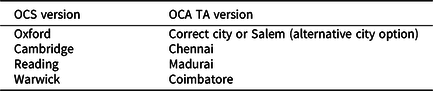
The UK version was analyzed to identify items that require adaptation to be culture-fair for the target population. The picture naming task, orientation, and sentence reading task were identified to require cultural adaptation. In the picture naming subtest, items that were culturally relevant were retained. Items in OCS such as hippopotamus, filing cabinet, and pear were found to be not readily recognizable in pilot testing. Hence, they were replaced with pictures of a camel, cupboard, and pineapple that were more commonly known and recognized by the Tamil-speaking population (Table 1). In the orientation subtest, the multiple-choice questions were adapted for the Tamil-speaking population as per adaptation instructions given in OCS Concept Elaboration Manual and practice guidelines. The cities or towns provided originally in OCS were adapted to cities or towns in Tamil Nadu for OCS TA. An alternative option of a city was provided in case of overlap between the correct city and the given options (Table 2).
OCS TA picture naming adaptation

Cultural adaptation table showing the cities that are more easily recognizable by the Tamil-speaking population

Diglossia refers to a situation in which two or more dialects of a language are used in different conditions within the same community. In a language such as Tamil, there is a high variety used in formal educational settings and a low variety used for everyday speech (Ferguson, Reference Ferguson1959). Due to the effect of diglossia, the pilot cohort was found to largely prefer the instruction in spoken Tamil. However, for the reading subtest of OCS TA, since spoken Tamil does not have a written form, the sentence in the sentence reading subtest is included in the formal language as education-loaded test items were found to be preferred in formal language during our pilot study.
In the sentence reading subtest, the source sentence contains 15 words and 4 high neighborhood density words. As with other adaptations, a direct translation of the sentence is not suitable and is also not comprehensible for the target population. Since Tamil is a phonetic language, irregular words were chosen on the basis of using “vadamozhi eluthukal” (letters in Tamil that are used only when the set of pure Tamil alphabets cannot provide for the phoneme). A Tamil sentence fulfilling these requirements in the practice guidelines of the OCS replaced the original sentence.
Second phase
In the second phase that followed, a control group of healthy native Tamil-speaking adults were assessed using the OCS TA. Both versions of the OCS TA were used. OCS TA Version A was used for the analysis of cutoff scores while OCS TA Version B was used for establishing equivalence between the two forms. Most of the participants received only OCS TA version A and some were administered version B to establish psychometric properties. There is an uneven balance of participants who completed version A versus those who completed version B first (two completed version B first). This is because counterbalancing was not formally included as part of the study design, which is discussed in the limitations. Two researchers administered version A in person to participants, using convenience sampling and two researchers administered version B to participants also using convenience sampling. All researchers conducted the study from different cities in Tamil Nadu.
Native Tamil speakers who have lived in Tamil Nadu for most of their lives, both males and females above the age of 18 were included in the study. They were included if they had a score of 0 on the Clinical Dementia Rating (CDR) scale (Morris, Reference Morris1993), a score of 7 or below on the Hamilton Depression Rating Scale (HAM-D) (Hamilton, Reference Hamilton1960), and an absence of any neurological or psychiatric medical history. Participants with unclear medical history were excluded.
A patient group above the age of 18 years of native Tamil speakers who had a stroke in the past three years was included in the study for the purpose of clinical validation. We did not control for location or severity of stroke. We included stroke survivors who had subjective cognitive concerns of having slowed down or becoming forgetful. The inclusion criteria are listed in Table 3. This study, as part of a larger project, was approved by the institutional ethics committee at Sri Ramachandra University. Participants in the control group were community-dwelling adults across Tamil Nadu who met the inclusion criteria and gave their informed consent to participate in the research. Participants for the patient group were recruited from July to December 2022 through the neuropsychology and neurology outpatient clinic in Chennai, India. All participants were unpaid volunteers who gave their informed consent.
Inclusion criteria for the control and patient group for OCS TA

The testing protocol began with obtaining informed consent from the volunteer participant for the control group and from the primary caregiver as well as the stroke survivor for the patient group. Next followed the administration of the HAM-D, a clinician-administered tool specifically used to screen for depressive symptoms over the past week. For the patient group, relevant medical history was obtained.
This was followed by the administration of the OCS TA, either version A or B. Then we administered the Addenbrooke’s Cognitive Examination III (ACE-III)-Tamil (Mekala et al., Reference Mekala, Paplikar, Mioshi, Kaul, Divyaraj, Coughlan and Alladi2020) for all participants in both the groups. The ACE-III-Tamil is a validated screening tool for dementia that assesses five cognitive domains – Attention, Memory, Language, Verbal Fluency, and Visuospatial abilities. Although the ACE-III is intended for use above 50 years of age (Calderón et al., Reference Calderón, Beyle, Véliz-García and Bekios-Calfa2021), we used it in this study for validation. It must be noted that this tool was not used for diagnostic purposes in our current study. The ACE-III was not administered ahead of the OCS TA to ensure that there were no learning or practice effects on the test performance of participants in the OCS TA.
The Clinical Dementia Rating Scale (CDR) is a global summary measure designed to identify the overall severity of dementia. Six different areas such as memory, orientation, judgment, problem-solving, community affairs, home and hobbies, and personal care, were rated. A global summary score was obtained using the CDR software (Harvey & Mohs, Reference Harvey and Mohs2001).
Following the assessment of the initial version of OCS TA, a subgroup of participants within the control group was chosen at convenience and administered the other version of OCS TA after an average of 7.45 days to establish the equivalence between the two versions of OCS TA. The participants were not informed prior to the re-assessment.
Data analysis
First, we compared the OCS TA normative sample demographics to the original UK OCS normative sample to establish sample differences which could then explain any discrepancies in performance between samples. We then specifically compared low and high-education groups within the Tamil sample on OCS TA scores to detect differences due to education, as seen in the UK OCS normative sample. We further investigated the effect of age on performance on OCS TA. Next, we assessed for potential differences between OCS TA version A and B, and the reliability between them via percentage agreement of raw scores. Percentage agreement was chosen due to the small ranges on our observed data, even on longer range scales, precluding the use of more conventional reliability statistics such as intraclass correlation coefficients, Cohen’s Kappa, or Krippendorff’s alpha, etc. We then directly compared the mean scores and centile cutoffs per subtest between the UK OCS and OCS TA to establish similarities and differences between the tools. It is essential to compare between UK OCS and OCS TA for scores and cutoffs, as there are limited differences in international OCS versions, so if large differences are to be found, adjustments to the OCS TA need to be made (see the Danish OCS which directly compared British and Italian OCS data, Robotham et al., Reference Robotham, Riis and Demeyere2019; and a more recent Australian OCS version which also found similar results, Sanctuary et al., Reference Sanctuary, Hewitt, Demeyere, Kankkunen, Oxenham, Simpson and Marsden2023). We then finalized the cutoffs and normative data for the OCS TA.
Using the finalized OCS TA normative data, we ran two further analyses: assessing for differences between healthy controls and stroke survivors on the OCS TA, and correlational analysis between matched subtests of the OCS TA and the ACE-III. For the comparison to the ACE-III, we chose subtests that were theoretically related to the ACE domains based on task similarity in each tool. For example, as there is no trail-making test in the ACE-III, we did not include the OCS TA trail-making test in analysis. We did not run any additional analyses to what is presented in this article, our data is open for further analysis with attribution (CC-BY 4.0 international licence).
Analysis was conducted in the R studio (R Core Team, 2021). We used the following packages to produce the analysis: readxl version 1.3.1 (Wickham & Bryan, Reference Wickham and Bryan2019); kableExtra version 1.3.4 (Zhu, Reference Zhu2021), effsize version 0.8.1 (Torchiano, Reference Torchiano2020), dplyr version 1.0.9 (Wickham et al., Reference Wickham, François, Henry and Müller2019), OptimalCutpoints version 1.1-5 (López-Ratón, Rodríguez-Álvarez, Suárez & Sampedro, Reference López-Ratón, Rodríguez-Álvarez, Cadarso-Suárez and Gude-Sampedro2014), and TOSTER version 0.7.1 (Caldwell, Reference Caldwell2022; Lakens, Reference Lakens2017). Data and analysis scripts to recreate the manuscript are openly available in CC-BY 4.0 licence (https://doi.org/10.17605/OSF.IO/MQPJF)
Results
Participants
In total, 181 healthy adults were recruited to generate normative data for the OCS TA of whom 141 completed version A, 40 completed version B, and 33 completed version A and B. Of the 33 who completed both versions of the OCS TA, two completed version B first and then A. In addition, we recruited 28 stroke survivors for comparison who completed either version A or B of the OCS. The demographic information of the samples is presented in Table 4. The comparison of age, sex, and education levels for versions A and B of the OCS and OCS TA healthy adult cohorts are shown in Table S1 in the supplementary materials.
Demographics of the entire sample who completed the OCS TA

We found that there were significant differences between the UK normative participant group and the OCS TA normative group, in age and education both with moderate to large effect sizes (d = 2.02, −.45 for version A age and education, and .91 and .52 for version B age and education respectively). Our sample was younger and had different years of formal education. Healthy controls who did version A were more educated, and healthy controls who did version B were less educated than the UK normative sample. On average, those who completed both versions A and B were highly educated. Proportions of sex in each sample were not statistically different from the UK normative data.
Next, we statistically compared low and high-education groups on OCS TA performance, with groups determined as equal to or less than 10 years of formal education and greater than 10 years of formal education, respectively. We found that there were statistical differences between the education groups on most OCS TA subtests except semantics, gesture imitation, and object and space asymmetry, see Table S2. We note that while there were statistical differences in the mean, the centiles for impairment were identical for education groups, therefore we did not separate centiles by education.
Alternative forms
We compared the alternative forms of the OCS TA to establish form score percentage agreement (see Table 5).
Statistical comparison between version A and B of the OCS TA using two-sided equivalence t-tests

Comparison of OCS TA to OCS UK original
We compared healthy controls performance on version A and B to the UK normative data for versions A and B respectively, and directly compared centiles for impairment classifications. The centile scores and group mean comparisons for each task for the OCS TA and OCS cohorts are shown in Table 6 (version A) and Table S3 (version B).
Comparison between OCS TA and OCS version A including 5th (95th) centile cut scores

Note: Significance is noted as ‘**’ for p < .001 and ‘*’ for p < .05.
Here we found that there were many significant differences between the samples on each subtest of both OCS TA versions, often with moderate to large effect sizes, but this had limited discernible impact on the impairment classifications. Whereby, on version A the only numerical differences in 5th centiles were for broken hearts total score, gesture imitation, and memory tasks (recall and episodic). For 95th centiles on version A, object asymmetry remained the same as the UK norms, however, the executive score centile was lower and the gesture imitation score was higher, suggesting OCS TA performance was better than the UK normative data. For version B, the 5th centiles were virtually identical, except for sentence reading (UK norms = 14, and OCS TA cutoff = 15), and gesture imitation again. For 95th percentile, the OCS TA controls were better on the executive task and broken hearts task, affecting centiles found.
As there were limited differences in centile cutoffs between versions A and B of OCS TA, and no statistical differences between OCS TA versions, we decided to use only cutoffs derived from version A. We adapted the centile cutoffs for the memory, gesture imitation, and executive function tasks to better suit the OCS TA sample. For consistency and given marginal differences on the Broken Hearts test where the Tamil sample slightly outperformed the UK normative group, we decided to retain the original norm cutoffs on this one test. We found differences in age group-based cutoffs (see Table S4 for cutoffs for all education and age groups in supplemental materials) and as such used different cutoffs for those in an ‘under’ and ‘over 60’ group (inclusive of 60 years of age). The finalized normative data and cutoffs are presented in Table 7.
Final normative data and adjusted cutoffs for impairment (scores on subtests lower than 5th centile or higher than 95th, separately for those over and under 59 yrs old) for OCS TA

We used the finalized impairment classifications for the OCS TA to determine its known-group sensitivity, where known-groups refer to stroke survivor or control. We statistically compared the groups, controlling for covariates of age and education. See Table 8 for the results of the group comparisons. We found that even when controlling for education and age as predictors of performance, there was still a significant main effect of the group on OCS TA performance. Finally, we present the results of the correlational analysis between theoretically selected OCS TA subtests and the ACE-III in Table 9. Here we found convergent validity of the OCS TA as a screen for cognitive impairments which are domain specific.
Statistical comparison between healthy controls and stroke survivors on the OCS TA using Analysis of Covariance (ANCOVA) controlling for age and education

Correlations between OCS TA subtasks and matching Addenbrooke’s Cognitive Examination III domains in healthy controls and stroke survivors

Note: For the Addenbrooke’s Cognitive Examination III (ACE-III) we used ACE-III domains’ scores, and do not reflect single sub tasks from the ACE-III.
Discussion
This study set out to culturally and linguistically adapt the two-parallel form versions of the OCS to Tamil for use in the Tamil-speaking population to help clinicians screen effectively for poststroke cognitive deficits. This newly adapted OCS TA is equivalent to the original OCS in types of subtests, number of test items, and how the test is presented, administered, and scored. The translation and adaptation ensure that the tool will be relevant to the target population. We note here that this process was not linear, and we had to go back and forth between the two phases of the study to ensure that the manual and other test materials were adapted to reflect the findings from the data collection. This included adding the alternative responses that can be accepted for the naming task.
In contrast to other translations of the OCS, the OCS TA contains translations only for the testing material that the patient will be exposed to. This is because of the prevalence of English language in this region among healthcare professionals who are trained in English only. Hence translation of all the information in the manual and instructions to the tester for test administration and scoring would be a purposeless task. Also, of note here is that the OCS TA has accommodations for the effect of Tamil diglossia. Test instructions are in the popular language spoken and not the formal textual language as this was found to be understood better by the test takers. Responses are accepted in both formal and spoken language as preferred by the test taker (detailed in the test manual). The exception was the sentence reading subtest in which we have the sentence in formal language as reading is an education-loaded task that is learned as a part of formal education.
Tamil is a phonetic language and so it does not have irregular words. For this purpose, words with vadamozhi eluthukkal (letters in Tamil that are used only when the set of pure Tamil alphabets cannot provide for the phoneme) were included. High neighborhood density words and other indicators of surface dyslexia are not possible in the Tamil sentence structure. Hence the OCS TA relies on ambiguous patterns of reading to identify deficits in the lexical pathway.
The OCS TA versions A and B have been found to be highly similar in scores, as the mean percentage agreement between tasks was 96.97% making this the first cognitive screening tool developed in Tamil with available alternate forms. The cutoffs for impairment for both versions are the same. The OCS TA will be of immense help for patient progress monitoring in clinical and rehabilitation settings. It was found that most OCS TA subtests except semantics, gesture imitation, and object and space asymmetry showed a test performance difference between the low and high-education level groups, which is an important finding because of the nonstandardized education in India. Cognitive tests developed in India (Mekala et al., Reference Mekala, Paplikar, Mioshi, Kaul, Divyaraj, Coughlan and Alladi2020; Verma et al., Reference Verma, Tripathi, Nehra, Paplikar, Varghese, Alladi, Narayanan, Dhaliwal, Sharma, Saroja, Arshad, Divyaraj, Ghosh, Manae, Mekala, Menon, Hooda, Iyer, Sunitha and Vishwanath2021) usually take educational level into account when developing their norms and cutoffs. However, for the OCS TA, the centiles for impairment were identical between the two education groups and there were no differences in cutoffs based on education. We did however find differences in cutoffs for those over 60 years of age, and as such provided alternative cutoffs for them. We did not further subdivide beyond three age groups due to limited numbers of participants in higher age categories, though further educational effects need to be confirmed in future studies with a larger stroke survivor sample group. It is relevant to relate the age group cutoffs to other OCS translations which all support the original division of normative data into three groups, but that all show relatively similar cutoff across groups, with some exceptions, see for instance the overall cutoffs in Table 4 of the European Portuguese OCS (Valério, Reference Valério, Almeida, Demeyere, Lima, Nogueira and Santana2022).
The sample in our study had significant differences in demographic characteristics of education and age but not gender when compared with the OCS UK normative sample. It is of note here that sample differences are important as the demographics of stroke survivors in India are different from those in the UK, and our sample is more reflective of Tamil-speaking stroke survivors (Pandian & Sudhan, Reference Pandian and Sudhan2013). According to the Department of Higher Education, MHRD, Government of India, as of 2015–16, 103.89 was the gross enrollment rate in the population of Tamil Nadu for primary education and 99.94% to elementary level. 93.92% went on to enroll in secondary education, and 82.03% of the population enrolled in senior secondary level of education (10 + 2 level) and 44.3% of the population went on to pursue higher education. Our sample is representative of our population as most people go on to have the range of education we have shown. For more information please refer to, https://www.education.gov.in/sites/upload_files/mhrd/files/statistics-new/ESAG-2018.pdf. When test performance of the OCS TA sample was compared with OCS UK sample, some subtask differences were found. In comparison to other translations and country differences, differences in raw scores of some subtasks are expected, but the majority of clinical cutoffs remain similar across nations. For instance, in the Australian OCS, differences in samples were found between semantics and orientation subtasks, but not in cutoffs, and differences in praxis lead to different cutoffs (Sanctuary et al, Reference Sanctuary, Hewitt, Demeyere, Kankkunen, Oxenham, Simpson and Marsden2023). Cutoffs for impairment were updated for the memory, gesture imitation, and executive function tasks. It is typical for cutoffs to be different if underlying raw score differences are sufficient, for example in the Hong Kong OCS, the max score for the broken hearts is 50 and the cutoff is 50 (across all age groups and education groups) as there were limited errors made by controls (Kong et al., Reference Kong, Lam, Ho, Lau, Humphreys, Riddoch and Weekes2016). Critically, OCS TA showed good convergent validity when compared against the domain-specific scores on the ACE-III.
There are several limitations of the current study. Though different individuals received either version A or B for retest, task familiarity could have affected their performance. This is particularly the case as we did not counterbalance order of version A or B of the OCS. Unfortunately, we were unable to control for practice effects via intraclass correlations coefficients due to low range in observed data. However, when comparing our study to other studies including parallel forms which did counterbalance, our data show near identical similarity in versions (e.g., Huygelier et al., Reference Huygelier, Schraepen, Demeyere and Gillebert2019). When comparing to other OCS translations that did not counterbalance, our data were found to be the same as well (e.g., Shendyapina et al., Reference Shendyapina, Kuzmina, Kazymaev, Petrova, Demeyere and Weekes2019), suggesting that whilst the lack of counterbalancing in our design is a limitation, results were in line with previous findings, due to the high equivalence between forms.
In addition, we had a relatively small stroke survivor sample group for this initial validation and future validation studies could set out to determine domain-specific cognitive impairment prevalence in the Tamil population. We also did not control for location and severity of stroke in the current study, and it will be useful to validate the performance of the OCS TA with these additional data in future studies. The current study suggests evidence for the potential equivalence between both versions of the OCS TA. Also, it might be useful to assess some of the participants with ACE-III ahead of the OCS TA to explore if that has any effect on the test scores obtained by the participants to rule out any biases.
The availability of the new OCS TA tool with alternate versions will be an important addition to the toolkit of the healthcare professional working in the field of cognition with the Tamil-speaking population. OCS TA will allow early detection of cognitive deficits in the stroke population which will help evaluate and determine rehabilitation pathways for the patients at discharge from acute stroke care. Ultimately, routine detection of poststroke cognitive impairments will help ease the disease burden on patients and their caregivers as early rehabilitation from stroke can decrease disability (Paolucci et al., Reference Paolucci, Antonucci, Grasso, Morelli, Troisi, Coiro and Bragoni2000).
Supplementary material
The supplementary material for this article can be found at https://doi.org/10.1017/S135561772300067X
Acknowledgements
None.
Funding statement
Nele Demeyere (Advanced Fellowship NIHR302224) is funded by the National Institute for Health Research (NIHR). The views expressed in this publication are those of the author(s) and not necessarily those of the NIHR, NHS or the UK Department of Health and Social Care.
Competing interests
Nele Demeyere is a developer of the copyrighted Oxford Cognitive Screen but does not receive any remuneration from its use.