

Introduction
Research on climate change, adaptation and mitigation strategies often relies on integrated models spanning from single farms to the global scale. Due to the complexity of these models and uncertainty in future scenarios, it is difficult to communicate the results beyond scientific circles. Overview results from such models are frequently provided for a higher level (e.g. regions in the European Union). At the same time, the impact of climate change can hardly be tackled at the aggregated level, but rather by stakeholders (e.g. policy makers, farmers) who adapt their behaviour or employ mitigation measures in their own sphere of influence. Yet, little is known about the impact of climate change on specific regions and the costs of counteractive measures individual stakeholders have to bear. These factors exacerbate both the communication between modellers and stakeholders as well as the identification of climate change-related strategies and coping mechanisms. The objective of our research is to narrow these gaps by developing a new tool, the Index-based Costs of Agricultural Production (INCAP). INCAP can be used for exploring and communicating possible economic implications related to the impact of climate change; it also informs farmers about adaptation and mitigation costs in their specific environment.
Material and methods
Many farmers use gross margin calculations (i.e. revenue minus variable costs) to explore the relative profitability of independent farming activities or entire production plans. On the matter of climate change and agriculture, gross margins can be communicated more easily than results from complex national or global-scale modelling exercises. INCAP takes up the concept of gross margins. INCAP is based on a range of existing data repositories (e.g. Federal Institute of Agricultural Economics (AWI), 2016; Statistik Austria, 2016) and currently specific to Austria. The data used are mostly based on published information (e.g. animal weight, output prices) and functional relations (e.g. nutritional requirements), but also on unpublished data (e.g. input quantities or prices; collected from agricultural advisors or suppliers). The purpose of the elaborated data set is to be able to identify costs for a wide range of plant and livestock production activities, for all types of farms, for all regions in a country and over long period of time. INCAP’s cattle activities include ‘dairy cow and milk production’, ‘suckler cow and beef calf production’, ‘heifer rearing’ and ‘bull fattening’. To capture the diversity of management variants, production conditions and the costs involved, each activity is differentiated by certain attributes (e.g. farming type). Results are identified in euros per hectare or euros per animal. To account for development over time, INCAP results can be provided as a time series. To this end, a baseline data set is established for the reference period. Price indices (e.g. agricultural price index) are then applied to each cost item in the reference period to generate data for specific years. Currently, INCAP covers the period from 2005 to 2014; however, to facilitate scenarios in future settings, the time horizon will be extended up to the year 2050. Overall, combining activities with multiple attributes and periods produces a considerably large number of unique activity–attribute(–time) combinations, which represent observed and potential production options in Austria.
Results
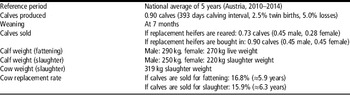
Results of the ‘suckler cow and beef calf production’ activity are presented below in order to illustrate the basic set-up and outputs of INCAP. Basic input data of the ‘suckler cow and beef calf production’ activity are indicated in Table 1.
Selected basic input data in the ‘suckler cow and beef calf production’ activity

A summary of the calculation scheme includes the following:
-
∙ Revenues: total revenue is a composite of calf and cow sales as well as animal waste. Dung and manure are valued at opportunity costs. The biggest portion of the revenue comes from calf sales.
-
∙ Costs: total variable costs include costs of heifer replacement, concentrate and minerals, forage, health and hygiene, reproduction, litter, water and energy, machinery as well as fees. In most cases, forage accounts for the largest portion of total costs (30% to 70%).
-
∙ Gross margin is the difference of revenues and costs, given in euros per cow and year.
-
∙ If applicable, the proportion contributed by the bull and the replacement heifer are included in the revenue, the costs and the gross margin.
-
∙ Agricultural payments (e.g. Common Agricultural Policy payments) and taxes are not included.
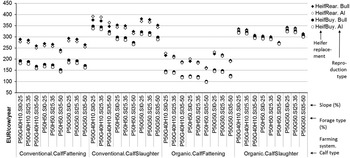
The ‘suckler cow and beef calf production’ activity is differentiated by the attributes of the farming system (conventional, organic), heifer replacement type (reared, bought in), reproduction type (artificial insemination, bull), calf type (sold for fattening, sold for slaughter), forage type (pasture : grass silage (50% : 50%), pasture : hay (50% : 50%), pasture : grass silage : hay (50% : 40% : 10%) and the slopes of the meadows (0% to 25%, 25% to 35%, 35% to 50%). This results in 144 different activity–attribute combinations for a single period. Figure 1 shows the gross margins for these combinations grouped by attributes for the reference period (Austrian average of 2010–2014).
Gross margins for 144 ‘suckler cow and beef calf production’ activities (Austrian average 2011–14, euros/cow per year).

It is apparent from Figure 1 that – in the reference period (average 2010–2014) – systems selling slaughter calves record higher revenues and thus markedly higher gross margins compared with systems selling calves for fattening. Systems with bought-in heifers achieve lower gross margins than systems rearing replacement heifers; this is explained by the costs of purchasing the replacement. In most cases, herds with their own bull generate slightly higher gross margins compared with herds being served through artificial insemination. Overall, gross margins are higher in the conventional systems than in organic ones; however, this would change if agricultural payments were included.
Discussion
In order to better understand the options and restrictions farmers face when making production choices, it is necessary to know about the costs of activities and their opportunity costs. INCAP is a tool that allows providing estimates about costs of observed production activities for almost any farm in Austria, using readily available structural information as input. The data fills a knowledge gap because only few farms have established cost accounting systems. INCAP is designed to provide information on costs of activities and management variants not yet observed, but likely to be of interest in the context of mitigation and adaptation strategies to cope with climate change. INCAP can therefore also be used for system analyses and simulation purposes. In its current state, INCAP needs further refinements before it can be used as a tool for some of the intended purposes, in particular as an information system for farmers who want to know about options for alternative production plans on their farms. Further enhancements are also needed to implement more variants of adaptation and mitigation measures, which are not yet observed on farms but have been described in the literature.
Acknowledgements
The work presented in this extended abstract is supported by the Austrian Climate and Energy Fund of the Austrian Federal Government (Contract B368569, ACRP 6 ADAPT-CAT MILK KR13AC6K11112) and the Austrian Federal Ministry of Agriculture and Forestry, Environment and Water Management (Project 101114 – FACCE Knowledge Hub MACSUR 2).