When Tony Blair took over the leadership of the British Labour Party in 1994, he inherited a party that had been incapable of breaking the electoral domination of the British Conservatives for about fifteen years. The Labour Party was widely perceived as too leftist to be able to attract enough support to defeat the incumbent Tories, despite the efforts of Neil Kinnock – Labour leader between 1983 and 1992 – to moderate the party’s position, especially in his later years.Footnote 1 Even when voter perceptions were moderating alongside the party’s positions,Footnote 2 they did so at a much slower pace. It was not until the election of Tony Blair that Labour’s appeals to centrist voters resonated within the electorate. Recast as a left-of-center party, Labour obtained a sweeping victory in the 1997 election. Hence, despite a decade-long effort by Kinnock, it was the new leader who helped voters understand the new party position.
In this article, we analyze whether the Labour Party example can be generalized to other parties, and whether appointing a new leader helps political parties change voters’ attitudes and beliefs about the party. Specifically, we examine whether, following a leadership change, voters develop a more accurate understanding of a party’s policy positions. Our main argument is that electing a new leader increases the credibility of the party’s policy stances in a context in which voters are generally skeptical of party policy rhetoric. While adopting new policies under a veteran leader can be seen as flip-flopping, with a new leader these stances are more likely to be interpreted as an actual change in the party’s views. The leadership change makes it easier to convince voters that the party’s policy proposals are the result of the new leader’s ideas rather than the product of a tactical choice. Even when the new party leader does not change the party’s policy stances, which is more common than generally thought, the party can take advantage of having a leader with no record of broken promises: voters can give it the benefit of the doubt that the party will follow through on its pledges. For both reasons, we predict that voters develop a more accurate perception of party stances on policy issues following a leader change.
We also expect these effects to be stronger for opposition parties. Incumbents’ policy decisions provide voters with information about the policy preferences of parties in government that is more credible than the parties’ own policy rhetoric during election campaigns. However, the main way opposition parties communicate their ideological positions is by publicly advocating their policies during campaigns. Thus any factor that increases the credibility of these policy stances will significantly enhance parties’ capacity to help voters understand party positions.
In order to evaluate these hypotheses, we examine the relationship between the left–right positions of party election manifestos and voter perceptions of party placements in seven Western European democracies during the period 1979–2012.Footnote 3 Using original data on party leader changes, we test whether running under a new leadership increases the strength of such a relationship.
The empirical evidence supports our argument. Only after a leadership change do voters develop a more accurate understanding of the party’s positions in line with its election platform. However, this effect is only observed for opposition parties: election platforms are not consequential for the left–right image of governing parties, regardless of whether the leader is new or veteran. We argue that this is because voters are likely to take their cues about governing parties’ policy positions from incumbent behavior rather than rhetoric.
These findings help make sense of the small or null average effects of election platforms identified in Adams et al.Footnote 4 and Fernandez-Vazquez.Footnote 5 Our article reveals that such findings mask an important heterogeneity: election campaigns play an important role in shaping perceptions of opposition parties, but only when they have a new leader in office.
Beyond solving this puzzle, our results also have normative implications for the functioning of representative democracy, and have important consequences for the political parties, political behavior and election campaign literatures. Normatively, election campaigns are supposed to provide an opportunity for political parties to publicly announce the policies they would promote if elected to office. The intended goal is to allow voters to learn about party positions so they can cast their votes for the parties that closely represent their interests.Footnote 6 Otherwise, if voter perceptions are not in line with what parties intend to do as incumbents, their capacity to select politicians based on their policy positions is weakened, thereby depressing the quality of representation.Footnote 7
Our findings also suggest that campaigns can matter.Footnote 8 In contrast to previous literature on voter perceptions of party positions,Footnote 9 we show how the policy stances that a party with a new leader publicizes in its campaign manifesto change voter expectations about the party. This is consistent with previous work that indicates that campaigns provide information to citizensFootnote 10 and, specifically, that they can shape voter opinions about parties and candidates.Footnote 11
Our findings also have implications for our understanding of the dynamics of party competition. If voters do not listen to parties and learn about their policy positions, then a party that needs to redefine or clarify its ideological reputation in order to increase its electoral appeal will have a hard time using its campaign rhetoric to achieve that goal. Our findings suggest that it is only under a new party leader that voters are willing to listen to party positions. Hence, for a party to be able to persuade voters about its policy position, it may need to replace its leader first.
Beyond these contributions, our research also has important implications for the extant literature on vote choice, voter turnout, valence voting and satisfaction with democracy. According to this literature, voter perceptions of parties’ ideological positions determine how close voters perceive the parties are to their preferred ideological positions, and hence affect their vote choice and turnout decisions,Footnote 12 whether voters would rely on party ideologies or valence evaluations of parties in their vote choice,Footnote 13 and their satisfaction with democracy.Footnote 14 The main assumption underlying this extensive literature is that voters accurately perceive party positions. One of the assumptions of the Responsible Party Model, for instance, is that voters accurately perceive party policy positions.Footnote 15 Yet whether (or to what extent) voters accurately perceive parties’ policy positions is an empirical question. And, as we stated above, the existing evidence regarding how voters perceive party positions is rather bleak.Footnote 16 Hence, our finding that opposition parties can enhance the accuracy of voter perceptions about their policy positions when they change their leader has important implications for this extant literature.
PARTY LEADERSHIP CHANGES AND VOTER PERCEPTIONS
Understanding the policies that each party would implement in office can help voters make informed voting decisions at the ballot box. For this reason, parties make policy offerings in advance of elections and state the policy goals they will target if elected. In most cases, European parties elaborate these goals in policy manifestos that they publish in the run-up to a campaign and then use as the basis of the messages they deliver to the mass media.Footnote 17 Politicians also often base their election campaigns on the policy positions they advocate in their election manifestos.Footnote 18
Existing evidence on whether voters adjust their perceptions of party positions based on what parties advocate in their campaigns, however, is bleak. Adams et al.Footnote 19 show that voters do not update their perceptions in response to shifts in party manifestos, and Fernandez-VazquezFootnote 20 reports only weak effects of election platforms on voter beliefs.
There are at least two reasons why voters may be reluctant to adjust their views of party positions according to what parties publicly announce. First, election manifestos are noisy signals: their implications are uncertain because policy statements can be vague, and therefore it may not be easy for voters to draw precise inferences about parties’ future policy behavior. Indeed, there is an emerging literature that emphasizes the uncertainty associated with estimating the policy orientation of election manifestos.Footnote 21
Secondly, and most importantly for our argument, election manifestos are not binding and hence parties may strategically take policy stances in order to improve their electoral prospects even if they do not intend to follow through on them. As a result, voters may be skeptical of party rhetoric, expect it to be motivated by short-term electoral incentives and therefore discount campaign policy messages as not credible.Footnote 22 In fact, the recent literature showing that voter perceptions of party positions are shaped by party actions, like the type of legislation passedFootnote 23 and the choice of coalition partners,Footnote 24 emphasizes the importance of credibility: these party actions constitute costly signals of parties’ policy commitments because they have concrete policy consequences that help reveal parties’ preferences. Party policy promises, however, can be broken – and hence are less likely to have the same effect as party actions in office on voters’ perceptions of party positions.
We argue that political parties can reduce voter skepticism of their policy rhetoric, and increase the credibility of their election promises, if they have a new leader in office for the upcoming election. Leadership changes encourage voters to listen to parties’ policy statements, and therefore allow citizens to develop a more accurate understanding of party positions. We also argue that leader changes affect voter perceptions regardless of the magnitude of party’s actual left–right position change.
On the one hand, voters find party policy shifts to be more credible under a new leader. A veteran leader who campaigns on new policy positions runs the risk of being accused of opportunism and flip-flopping by rival parties and the media.Footnote 25 These depictions of the party as inconsistent and unprincipled can be very costly in terms of votes and donations. As Tomz and Van Houweling have shown,Footnote 26 candidates who are perceived as flip-floppers face a substantial loss of electoral appeal. We argue, on the other hand, that new leaders do not face similar risks. When they change a party’s policy positions, they cannot be framed as flip-floppers because they do not have a well-established record of previous policy stances. Their policy shifts are more credible, and thus new leaders can use such shifts to their advantage to convince voters that their new positions are not short-term opportunistic changes. In this way, they can help voters update their perceptions about party policies.
At the same time, even if a party’s policy promises stay the same under the new administration, voters are more likely to find these existing policy positions credible under the new party leadership. There are no broken records from the past that the new leader is responsible for, and the new leader has a fresh opportunity to follow through with the existing election policy promises. Voters, therefore, are more likely to develop accurate perceptions of party promises under a new leader, even if the promises largely stay the same.Footnote 27
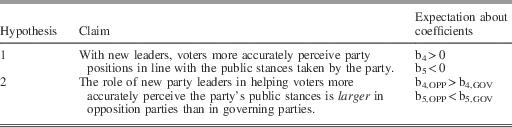
In summary, while voters tend to generally distrust parties’ policy rhetoric, they are more likely to change their mind about a party if a new politician leads it. Hence, our first hypothesis is:
Hypothesis 1: With new party leaders, voters more accurately perceive party positions in line with the public stances taken by the party.
Our argument that leadership changes help voters more accurately perceive party policy positions builds on the growing literature that highlights the rising importance of party leaders for voter evaluations of parties, vote choiceFootnote 28 and election outcomes.Footnote 29 According to this literature, the presidentialization of politics across Europe has been under way for quite some time. This is related to, first, a weakening of partisan loyalties and a process of partisan dealignment,Footnote 30 and secondly, to the use of personal politics and campaigning via television and the internet.Footnote 31 Regardless of the reason for the presidentialization of politics, however, one consistent finding of this literature has been that, even in parliamentary countries (where political parties have historically been the focus of attention), parties have been replaced by party leaders as the most important actors in politics. The increasing use of party leader debates in many European countries (particularly in the United Kingdom and Germany) during election campaigns, and the high levels of attention paid to these debates by the media and voters, is just one example of the increasing saliency of party leadership in electoral politics. In this context, we expect that party leaders – and especially a change in party leadership – should also affect voters’ perceptions of party policy positions.
At the same time, while we expect voters to more accurately perceive the policy positions of parties with new leaders, we also expect this effect to be stronger for opposition parties. Parties that are out of office rely mainly on campaign rhetoric to redefine their policy image, and can do this more successfully than governing parties. Incumbents, on the contrary, are often evaluated based on their performance in office and can only redefine their ideological reputation through other means, like the choice of coalition partners,Footnote 32 their legislative recordFootnote 33 or the orientation of the policies promoted while in office.Footnote 34 As Adams points out,Footnote 35 these are policy actions with specific winners and losers, and therefore constitute more powerful sources of information about a party’s ideological identity than public rhetoric and election campaigning. Indeed, Bawn and Somer-Topcu have shown that voters heavily discount the campaign policy pledges of incumbent political parties.Footnote 36 Opposition parties’ electoral performance, however, largely depends on their rhetoric and pledges before the election.Footnote 37 Therefore, our second hypothesis is:
Hypothesis 2: The role of new party leaders in helping voters more accurately perceive the party’s public stances is greater in opposition parties than in governing parties.
Note that, in terms of the timing of the leadership change, our argument only requires that the election manifesto be written under the direction of a new leader. This implies that, at some point since the previous election, the party has chosen a new politician as standard-bearer so that, first, the new leader cannot be accused of flip-flopping (that is, promises a certain policy position but then does not implement it or implements it differently), and secondly, the new campaign policy stances can be credibly attributed to a change in the party’s leadership. But our theory is agnostic as to whether the precise time gap between the leadership transition and the campaign modulates the credibility of policy rhetoric. In Appendix Table 17 we report evidence that the timing of a leadership change does not affect voters’ understanding of party positions.
RESEARCH DESIGN
To examine our hypotheses, we analyze how voters develop perceptions about party positions in response to party campaign messages. We consider party positions primarily on the left–right dimension. According to Downs, voters mainly gather information about parties along a left–right continuum, and electoral competition takes place on that dimension.Footnote 38 Indeed, political commentators, scholars and parties still frequently describe policies in terms of a left–right mapping. The left–right axis is an ‘ideological super-issue’ that summarizes positions on several key policy domains.Footnote 39 As such, research has shown that the left–right dimension is still useful to understand the structure of party competition in European democracies.Footnote 40
We have collected data on voter perceptions of parties’ left–right positions using election surveys conducted over the period of 1979–2012 in seven Western European countries: Britain, Denmark, Germany, the Netherlands, Norway, Spain and Sweden.Footnote 41 In order to capture voters’ perceptions of parties after a campaign, we have selected surveys fielded immediately after a parliamentary election from country-specific election studies or the Comparative Study of Electoral Systems.Footnote 42 The common feature of these questionnaires is that respondents were asked the following question in essentially the same wording: ‘In politics people sometimes talk of left and right. Where would you place [PARTY] on a scale from 0 to 10 where 0 means the left and 10 means the right?’Footnote 43
The countries and time periods covered in our dataset are those in which election studies have consistently asked respondents to place political parties on such a left–right scale. In each case, we have computed the average placement given to each political party as our measure of perceived left–right position.Footnote 44 We therefore have data on the ideological image of all relevant political parties in every country after each parliamentary election. Another empirical strategy to test our hypotheses would be to use individual-level survey data on perceptions of party positions to examine how individuals perceive party positions while controlling for individual-level characteristics with a multi-level design. However, given the wide-ranging differences across surveys regarding the questions that are required for such an analysis, we are unable to merge the individual-level data and test the hypotheses at the individual level.
We define party campaign messages as the policy proposals that parties make in their election manifestos. In European and Westminster-style democracies, manifestos become the basis of party competition during elections.Footnote 45 Indeed, party elites agree that their election manifestos constitute the basis of their electoral campaign and significantly shape the electoral competition.Footnote 46 It is therefore essential to try to understand how voters react to these policy pledges.Footnote 47
We use the Manifesto Project’s left–right coding of party campaign manifestos as our main measure of party policy offerings. Scholars in this project have collected party election manifestos and coded the percentage of each document that is dedicated to fifty-six different issues. Twenty-six of these issue categories have been used to determine the left–right orientation of the party program.Footnote 48 Half of them are considered as defining a left ideology, while the other half is coded as right leaning. The researchers in the Manifesto Project propose a left–right scaling of the manifesto position – the rile estimate – that measures the difference in the percentage of text units belonging to right- and left-leaning categories. This left–right scale, however, has been criticized for yielding estimates that are biased towards the center.Footnote 49 For that reason, here we employ the alternative scaling proposed by Lowe et al.Footnote 50 This estimate is computed by taking the log of the ratio of left and right sentences. We have rescaled these logit estimates so that they also take values on a 0–10 scale.Footnote 51
We also collected original leadership change data in the same seven Western European countries using Keesing’s World Archives, secondary literature and online newspaper archives. Who is perceived as the party leader varies from country to country, and even across parties within the same country. For example, we code the changes in the parliamentary leaders of the Conservative, Labour and Liberal Democratic parties in Britain as official leadership changes. However, the extraparliamentary party chairperson is identified as the party leader for most of the parties in Denmark, while the parliamentary leader is coded as the head of the party for the Danish Radical Liberal Party. In addition, in the Netherlands the top candidates on party lists (lijsttrekker) are often considered to be the party leaders, but occasionally the person may resign from the lijstrekker position and still continue as the leader of the party. The decision of who to code as the leader of each party was made based on an extensive reading of the literature and, in some instances, in consultation with country experts. We recorded leadership changes as a dummy variable that was coded 1 if there was a leadership change in the current election period, and 0 otherwise. We exclude parties that have a shared leadership position (dual leadership) from our data, and focus only on parties that gained at least 5 per cent of the votes in two or more of the elections under analysis.Footnote 52 The details of the leadership change data can be found in Appendix Tables 5 and 6. As Appendix Table 7 shows, the average leadership change in our data is 0.4, which suggests that on average, each party changes its leader almost every other election. However, some parties experienced leadership changes before almost every election in the data (for example, Dutch Liberal Party, German Social Democratic Party and Norwegian Conservative Party) and others had only one or two leadership changes during the entire study period (for example, Danish Liberal Party, Spanish Popular Alliance and Swedish Christian Democrats).
Finally, in order to test the second hypothesis on governing versus opposition parties, we have coded a dummy variable indicating the governing status of each political party. We define an incumbent party as any political party that has been part of the cabinet at any point between the current parliamentary election and the previous one. For example, we consider the Swedish Moderate Party to be an incumbent in the 1982 election because, even though at the time of the campaign it was not part of the government, it had participated in the cabinet at some point since the previous election, concretely between 1979 and 1981. Data on the partisan composition of national governments was obtained from the February 2014 release of the European Representative Democracy Data Archive.Footnote 53
The baseline model that we estimate allows us to determine whether party campaign messages influence how voters perceive the left–right position of these political parties:
 $$voter\_\,perceptions_{{it}} ={\rm b}_{1} {\plus}{\rm b}_{2} \,\,platform_{{it}} {\plus}{\rm b}_{3} \,\,voter\_\,perceptions_{{i,t{\,\minus\,}1}} {\plus}{\rm e}_{{it}} $$
where voter_perceptions it denotes the average left-right placement attributed to party i immediately after the election at time t. Platform it refers to the left–right orientation of party i’s election manifesto, and voter_perceptions i,t−1 indicates the average left–right party placement before the campaign. We therefore define voters’ perceptions of a party’s position after an election as the result of both the information obtained in the campaign (platform it ) and previous experiences with the party summarized in its pre-election ideological image (voter_perceptions i,t−1 ). Modeling evaluations as a combination of memory and new information is common in studies of public opinion change.Footnote 54 According to the logic of this approach, the more relevant campaigns are for voter perceptions – that is, the larger b 2 -, the lesser the role of prior notions about the party – the lower b 3 – and vice versa.
Our main hypothesis states that the above relationship is conditional on party leadership changes. That is, when there is a new leader, we should observe a stronger relationship between the party message and voter perceptions. In order to determine whether a change in the party leadership enables the party to change its ideological image, we estimate the following interactive model:
 $$\eqalignno{ voter\_\,perceptions_{{it}} = \,& {\rm b}_{1} {\plus}{\rm b}_{2} \,\,platform_{{it}} {\plus}{\rm b}_{3} \,\,voter\_\,perceptions_{{i,t{\minus}1}} \cr & {\plus}{\rm b}_{4} \left( {platform_{{it}} {\,\asterisk\,}leaderchange_{{it}} } \right) \cr & {\plus}{\rm b}_{5} \left( {voter\_\,perceptions_{{i,t{\,\minus\,}1}} {\,\asterisk\,}leaderchange_{{it}} } \right) \cr & {\plus}{\rm b}_{6} \,\,leaderchange_{{it}} {\plus}{\rm e}_{{it}} $$
Leaderchange it is a dummy variable indicating that there has been a change in the party leadership since the last parliamentary election. According to this specification, if there has been continuity in the party leadership, the effect of campaign stances and the inertia in the party image are captured by the parameters b 2 and b 3 , respectively. However, if a new politician is guiding the party, the effect of the election platform equals b 2 +b 4 , and the degree to which the pre-campaign ideological brand carries over after the election is represented by b 3 +b 5 . Hypothesis 1 states that changes in party leadership open a window of opportunity for the party to publicize a shift in policy stances, and therefore we expect b 4 to be positive. As a logical consequence, the voters’ initial perceptions should have a less important effect on their opinions about the party after the election, and hence we expect b 5 to be negative. Since our argument does not make predictions about whether the leadership change itself reveals any information about the party, we do not formulate claims about b 6 .
The second hypothesis implies that new party leaders have a greater impact on opposition parties than incumbents. Hence, the interactive model in Equation 2 is estimated for the full sample as well as separately for the subsamples of governing and opposition parties. To summarize, Table 1 presents our hypotheses regarding our expectations about the coefficients in the interactive regression model.
Hypotheses Expressed in Terms of Expectations about the Coefficients in the Interactive Regression Model

Note: coefficients denoted by the subscript OPP refer to those estimated for the subsample of parties in opposition, whereas those using the subscript GOV reflect estimates for the subsample of governing parties.
We estimate the parameters in the baseline and interactive models using ordinary least squares (OLS). We also follow King and Roberts and estimate cluster-robust standard errors as a diagnostic of model misspecification.Footnote 55 The result of this diagnostic test – available in Appendix Tables 10 and 11 – shows that OLS and cluster-robust error estimates are very close, which increases the confidence in our choice of empirical model.Footnote 56 The Appendix includes further diagnostic and robustness checks, which show that our results are not affected by the choice of scale of manifesto data, measurement error in the dependent and independent variables, serial correlation in the error term, the number of data clusters or the inclusion of additional control variables.
EMPIRICAL RESULTS
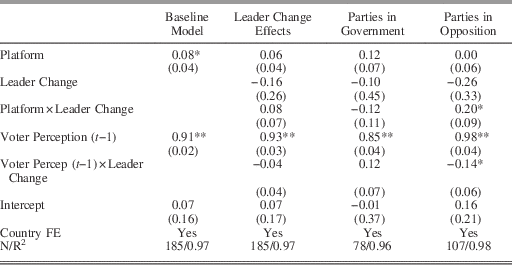
Table 2 presents the results of estimating the baseline and interactive models, first for the whole sample of political parties, and then followed by the interactive equation for governing and opposition parties separately. Column 1 reports the estimates for the baseline equation. They suggest that election manifestos influence voter perceptions of parties’ left–right positions. A one-unit shift in the left–right position of the election platform induces a 0.08-unit change in the average placement of the party. Such a shift is nonetheless small, particularly compared to the degree of inertia in party images. Indeed, the coefficient for the lagged perception is 0.91, which implies that the left–right party image that emerges after the campaign is largely driven by initial voter beliefs. In sum, these results suggest that election campaigns have a statistically significant – but substantively small – effect on parties’ left–right images, which is consistent with previous findings.Footnote 57
The Effect of Election Platforms on Voter Perceptions of Parties’ Left–Right Position

Note: the dependent variable is the average voter perception of the party’s left–right position as measured in post-election surveys. Columns 1 and 2 present estimates for the full sample. Column 3 restricts attention to parties in office, while Column 4 considers the subsample of opposition parties. OLS standard errors are in parentheses. ** p < 0.01; * p < 0.05
Yet such a small average impact of party campaigns may be masking a considerable degree of heterogeneity depending on whether the party has recently renewed its leadership or not. According to our first hypothesis, following a leadership change, a party’s policy stances have a greater impact on voters’ perceptions of its position. To test this claim, we estimate Equation 2, which specifies an interaction between the content of manifestos and an indicator of whether the party leader has been replaced since the previous election. These estimates are displayed in the second column of Table 2.
The coefficients for Platform and Voter Perceptions (t−1) denote, respectively, the effect of campaign messages and inertia on voter perceptions when the party leader has not changed since the last election. If a new politician is heading the party, the influence of election platforms is defined by the sum of the coefficients for Platform and Platform×Leader Change, while the stability in voter perceptions is obtained by adding the Voter Perceptions (t−1) and Voter Perceptions (t−1)×Leader Change parameters. In line with our argument, we expect the interaction coefficient Platform×Leader Change to be positive, and that for Voter Perceptions (t−1)×Leader Change to be negative.
Coefficient estimates for the full sample show that campaign positions do not change voters’ perceptions of parties with veteran leaders. The impact of election manifestos is very small (0.06) and not statistically different from 0. As a mirror image, the high coefficient for the lagged voter perception, 0.93, indicates that voter perceptions before and after the election are essentially the same. In line with our first hypothesis, the interaction coefficients with Leader Change have the expected sign and would therefore suggest that, under a new leader, the influence of party rhetoric increases and the degree of inertia in voter perceptions decreases. Such differences are not statistically significant, however.
Yet, as our second hypothesis posits, we expect the effect of party policy offerings on voter perceptions to be stronger for opposition parties when they change their leaders. In order to test this hypothesis about how incumbency status modulates the impact of leadership transitions, Columns 3 and 4 estimate the interactive model separately for parties in office and in opposition. The results for parties in government show that party messages do not change voter perceptions, irrespective of whether the leader is new or veteran: the effect of manifestos is not statistically different from zero in either case.Footnote 58 In addition, the previous voter perception coefficient is also smallest in the governing parties’ model. These are consistent with previous research indicating that governing parties tend to be evaluated on the basis of their record in office rather than on their current or past policy rhetoric.Footnote 59
For parties in opposition (Column 4), however, a leadership change decisively influences how effective party messages are at driving voters’ perceptions. The coefficients for the interactive terms Platform×Leader Change and Voter Perceptions (t−1)×Leader Change have the expected sign and are statistically significant. Following a leader transition, therefore, voters more accurately perceive the party’s left–right position according to what the party advocates. Specifically, these estimates show that the effect of party campaigns increases by 0.20 points while continuity in voter perceptions drops 0.14 points whenever a ‘new face’ leads the party.
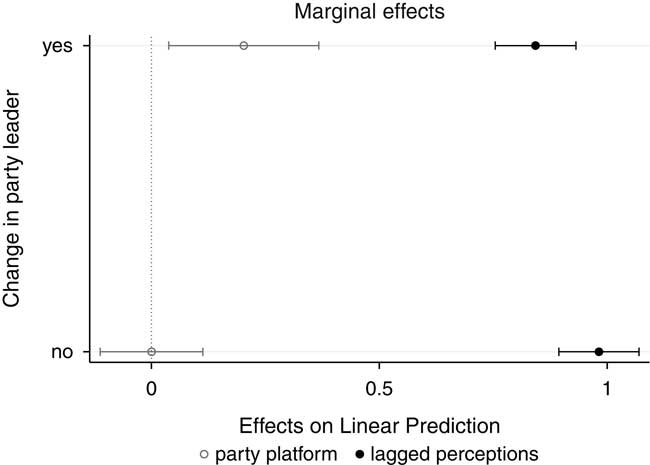
What is more, these results provide evidence that a leadership change is a necessary condition for voters to update their views in line with the party’s policy promises. This can be most clearly seen in the marginal effects presented in Figure 1, which plots the effects of party platform and lagged perceptions on current average left–right placements. When a veteran leader heads the party, the estimated effect of election platforms is 0, suggesting that in this scenario campaign pronouncements have no effect on voter perceptions. By the same token, inertia in perceptions is very high since the point estimate for the marginal effect is 0.98. By contrast, a new leader changes the picture: even though voter perceptions are still relatively sticky – the marginal effect of the prior perception is 0.84 – party campaigns have a substantial effect on where voters locate the party on a left–right scale: the marginal effect is 0.20.
Marginal effects and 95 per cent confidence intervals Note: hollow circles denote the marginal effect of party platforms on average left–right placements, while filled circles denote the marginal effect of lagged perceptions.

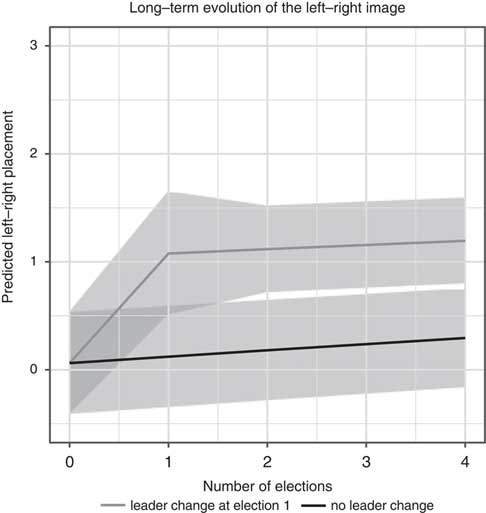
The previous figure presents the short-term effects of opposition party platforms depending on whether the party is running under a new leader. We now leverage our regression results to simulate the long-term impact of manifesto positions on left–right images.Footnote 60 Figure 2 plots the predicted average voter perception over four elections. In this example, the initial party placement is 0 and the party’s manifesto advocates policies located at 6 in each election afterwards. We consider two scenarios: in the first, the party keeps the same leader for the whole period. In the second, a new leader is elected before the first election and then stays in office until the fourth election.
Predicted evolution of the average party left–right placement with a 95 per cent confidence interval Note: the case of a party in opposition whose initial placement is 0 but decides to advocate policies located at 6 on the left–right scale. Two scenarios: in one, the party leader stays the same. In the second, a new leader is chosen before election 1 and stays in office until the end.
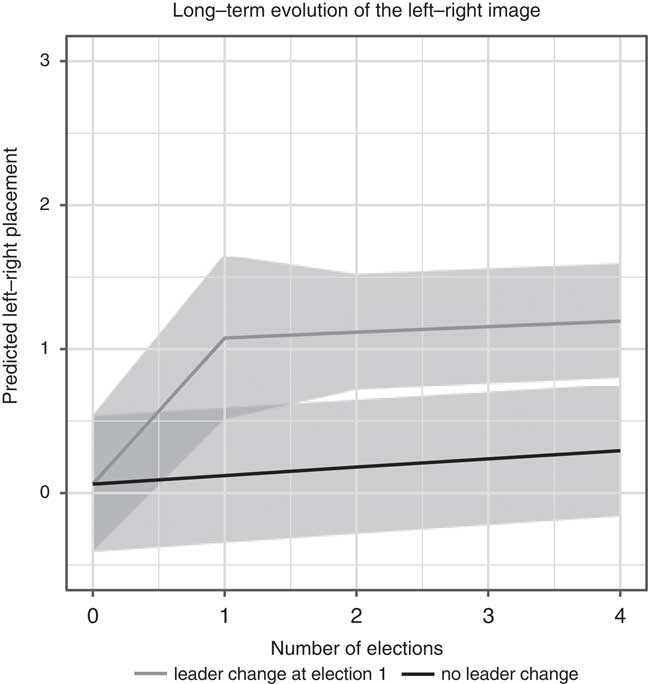
These predicted values show that, absent a leadership change, voter perceptions do not adjust to what the party is advocating in its campaign. The left–right placement of an opposition party led by the same politician does not significantly change despite advocating new policies over several elections. However, when a party elects a new leader, voters’ perceptions shift in the following election and then stabilize at the new level.
Taken together, the empirical evidence supports our claim that leadership changes open a window of opportunity for political parties to clarify their perceived left–right ideology. Our results suggest that opposition parties may need to replace their leader if they want to help voters more accurately perceive their policy positions. While campaign promises made by a party with a veteran standard bearer do not affect the party’s ideological image, after a leadership change voters update their views about what the party stands for. For incumbent parties, election platforms do not seem to affect voters’ perceptions of party positions either with veteran or new leaders.
Nevertheless, we are also aware that the impact of campaign rhetoric that we estimate for opposition parties with new leaders is modest. Indeed, for a one-unit change in the party’s manifesto position – on a 0 to 10 scale – the average placement of the party changes 0.2 units. Yet when set against the extraordinary stability of Western European parties’ left–right images,Footnote 61 even small changes in voter opinions are substantively relevant. In fact, given that the median shift in left–right images between two elections is only 0.3,Footnote 62 the effect we estimate implies a 66 per cent increase in the normal volatility of party reputations.
RULING OUT ALTERNATIVE EXPLANATIONS
As a further test of our argument that replacing the party leader increases the probability that voters will listen to the party’s policy proposals and more accurately perceive its positions, we check whether the empirical patterns we identify can be explained by alternative theoretical mechanisms.
One such alternative story could be that having a new leader is not per se what enhances parties’ capacity to educate voters about their left–right reputations, but the possibility that leadership transitions correlate with large shifts in party policy stances, which in turn receive more attention from voters. In order to evaluate this alternative explanation, we test whether it is indeed the case that shifts in the left–right position of party manifestos between elections t−1 and t are larger once the party has appointed a new leader. Table 3 reports a difference-in-means test that compares the size of the policy shifts that parties engage in with and without a leader replacement. It shows that the average size of manifesto left–right shifts is not statistically different between parties that do or do not change leaders. In fact, the point estimate for the mean policy shift is lower for parties with new leaders. This test therefore suggests that the increased effectiveness of party campaigns following a leadership change is not due to a concurrent increase in the magnitude of party policy shifts, but to the leadership change, which helps parties advocate their campaign promises more credibly to voters.Footnote 63
Average Policy Shifts, in Absolute Terms, as a Function of Whether the Party has Changed its Leader

Note: 0–10 left–right scale. Difference in means two-tailed t-test. Standard errors in parentheses.
A second alternative account posits that new leaders want to imprint the party’s policy rhetoric with their own policy preferences and therefore favor elaborating less ambiguous party manifestos. These clearer policy offerings could then help voters identify parties’ actual positions and adjust their perceptions. We evaluate the empirical support for this theoretical story by testing whether manifesto left–right positions can be estimated with less uncertainty after a change in leadership using the measurement error estimates in party platform positions computed by Lowe et al.Footnote 64 Table 4 presents the results of a difference-in-means test comparing the uncertainty – standard error – in estimates of manifesto left–right positions for parties with new and veteran leaders. As can be seen, the differences in the average standard error are neither substantially nor statistically significant. Hence, we can rule out the possibility that having clearer policy stances is what explains the finding that new leaders are more capable of convincing voters about a party’s position.
Average Standard Error in Party Platform position as a Function of Whether the Party has Changed its Leader

Note: 0–10 left–right scale. Difference in means two-tailed t-test. Standard errors in parentheses.
In additional analyses, reported in the Appendix, we show that our results do not change with an alternative definition of incumbency status (using only the parties in the last government before the election rather than using all parties that were in government at any time between the last and current elections), or when we exclude niche parties from our sample. A strand of the literature on party competition has emphasized how mainstream and niche parties diverge in their competitive strategies.Footnote 65 Given that in our sample all niche parties are out of office (see the Appendix for the various definitions of niche parties we use), it is plausible that the difference in voter updating between incumbent and opposition parties is driven by the presence of niche parties in the latter subsample. However, the results remain robust when we remove the niche parties from our sample.
DISCUSSION AND CONCLUSION
Our study analyzes whether voters’ perceptions of party policy positions are influenced by what parties propose in their election campaigns. We address the troubling finding in previous work that suggests that party policy stances do not substantially change voters’ beliefs.Footnote 66 We argue that leadership changes represent a window of opportunity for political parties to redefine their perceived policy positions. Electing a new leader increases the credibility of party policy rhetoric, and therefore voters are more likely to place the party closer to the position that it actually advocates. We also argue that leadership changes are more relevant for opposition parties since voters’ perceptions of incumbents are likely to be based on behavior in office rather than on policy rhetoric.
Examining voters’ perceptions of party positions in seven Western European countries over the 1979–2012 period, we find support for our hypotheses. Voters more accurately perceive opposition parties’ left–right positions in line with the party’s rhetoric when a new leader is heading the party. Leadership transitions, however, are not decisive for voter attitudes towards governing parties since incumbent rhetoric does not affect perceptions regardless of the leader’s tenure.
Our findings have implications for our understanding of the dynamics of party competition. We map conditions under which party campaign promises manage to reshape voters’ opinions about partisan ideologies. Specifically, the evidence we report suggests that the conclusion in Adams et al. and Fernandez-VazquezFootnote 67 that party platforms have little or no influence on party images is actually hiding an important source of heterogeneity: party campaigns can have an important impact on voter perceptions, but only as long as a ‘new face’ is leading the party. Our article thus contributes to our knowledge of the determinants of voters’ perceptions of party positions. While the extant research would suggest that voters’ opinions were responsive to party actionsFootnote 68 but not to party rhetoric,Footnote 69 we report robust evidence that campaign platforms can redefine party left–right images, but only under a new leader.
This is good news for democratic representation. We show that campaigns matter since they can provide credible information and help voters learn about (opposition) parties’ policy positions, which is consistent with previous work.Footnote 70 According to our evidence, a party in opposition with a new leader can credibly communicate its position to voters during the campaign, which enhances the capacity of citizens to select the party that best represents their interests. In terms of the classic typology of campaign effects defined by Lazarsfeld et al.,Footnote 71 our findings suggest that party policy proposals can lead voters to revise their opinions about parties and potentially change the orientation of their vote (conversion effect). At the same time, a credible shift in policy positions can demobilize former party supporters who dislike the change in policies (de-activation effect).
Moreover, the results of this article are also relevant to intraparty politics, as our findings draw a connection between the most important event in the internal life of a political party –electing a new leader – and the success of parties’ electoral strategies. Indeed, it is only after a leadership change that an opposition party can successfully reshape the way voters perceive its left–right positions. These results therefore have important implications for the growing literature on the saliency of party leaders in parliamentary democracies.Footnote 72
This article also suggests several avenues for further research. First, one implicit mechanism behind our description of the relationship between leadership changes and voters’ evaluations that party positions are more credible is that voters also get to hear more about political parties following a leadership change. As Gomibuchi shows,Footnote 73 media coverage of political parties increases when there is a leadership change, and this increased coverage of party policy positions certainly helps voters hear and learn more about the party and its policy positions. Nevertheless, the new volume of information about party policies provided by the media on its own would not influence voters’ perceptions if they do not find those positions credible, which supports our main argument. Yet it would be interesting for future work to analyze the role of media coverage in helping parties with new leaders redefine their ideological reputations. If leadership changes attract media coverage, the increased voter exposure to party rhetoric could complement the higher credibility of such messages that we highlight in this article.Footnote 74
This article also opens the way for work on individual-level differences in responsiveness to party policy messages. It is likely that, behind the modest aggregate-level effects of new leaders, there are important differences across voters. Future work could thus analyze whether individual traits like partisanship or political sophistication determine the effectiveness of party policy messages. Previous work on how these factors influence changes in individual beliefs and attitudes would suggest that this is the case.Footnote 75 It is indeed plausible to think that leadership changes are particularly relevant for citizens with higher levels of political awareness, who are more likely to identify these changes and understand their implications; it is possible that the substantive effect we find may be stronger for some subgroups of voters, such as highly politically interested or strong partisans. In addition, it would be interesting to examine whether ideological distance from a party mediates how a leadership change affects a voter’s perception of the party’s position. If we assume ideological voting, then if voters who are closer to a party’s position more accurately perceive the party’s position following a leadership change, they might be more likely to vote for that party. These individual-level analyses await scholarly attention and would have important implications for the political behavior literature.
Note also that, while this article focuses on leadership changes as a key moment that enhances the effectiveness of party campaigns (and despite the increasing saliency of party leaders for party campaigns in parliamentary democracies), leadership changes need not be the only relevant events that can influence changes in voters’ perceptions. Party splits, changes in the party’s name or major redefinitions of the logo, for instance, are the subject of increased public attention.Footnote 76 It would thus be interesting to study whether these momentous events also represent a window of opportunity for parties to redefine their image among voters.