Introduction
The fishing industry in Morocco has grown massively over recent years to reach an estimated production of around 1.5 million tons a year, the largest of any African country and representing 1.2% of world production (FAO, 2001). Nevertheless, little attention has been given in this context to the parasites of fish. Species of the nematode parasite Anisakis can potentially lead to economic and health problems. Adult worms of Anisakis are found in the stomach of marine mammals, from which the eggs are released into the sea via the faeces of the host (Smith, Reference Smith1983; Køie et al., Reference Køie, Berland and Burt1995). Third-stage larvae (L3) are then ingested by marine crustaceans, in which they become infective. Numerous teleosts also play a part in this life cycle and can carry the infective L3 larvae in the body cavity or muscle, thereby posing a health risk to human consumers of the fish (Klimpel et al., Reference Klimpel, Kellermanns and Palm2008). Anisakis larvae can induce lesions in the human digestive tract and can also produce allergic reactions through the consumption of parasitized fish and, to a lesser degree, through contact or inhalation or cross-reactivity with allergens of other organisms (Daschner et al., Reference Daschner, Alonso-Gómez, Cabañas, Suárez-de-Parga and López-Serrano2000; Scala et al., Reference Scala, Giani, Pirrotta, Guerra, Cadoni, Girardelli, De Pità and Puddu2001; Rodero et al., Reference Rodero, Chivato, Muro and Cuellar2005; Solas et al., Reference Solas, Garcia, Rodríguez-Mahillo, González-Munoz, De las Heras and Tejada2009). In addition, from an economic standpoint, Anisakis infection can have a negative impact on fish sales because the larvae are visible to the naked eye.
Data have been published on the presence of Anisakis spp. in fish from both the Mediterranean and Atlantic coasts of Morocco (Mattiucci et al., Reference Mattiucci, Paggi, Nascetti, Abollo, Webb, Pascual, Cianchi and Bullini2001; Shukhgalter, Reference Shukhgalter2004; Cissé & Belghyti, Reference Cissé and Belghyti2005; Farjallah et al., Reference Farjallah, Busi, Mahjoub, Slimane, Paggi, Said and D'Amelio2008; Kijewska et al., Reference Kijewska, Burzyński and Wenne2009; Abattouy et al., Reference Abattouy, Valero, Benajiba, Lozano and Martín-Sánchez2011). Horse mackerel (Trachurus trachurus) is one of the most widely consumed fish in Morocco, and the maximum catch quota increased from 200,000 tons in 2003 to 414,000 tons in 2006 (FAO, 2008). The aim of this epidemiological study was to determine the factors associated with the infection of horse mackerel from these waters and identify the Anisakis species involved.
Materials and methods
Collection and examination of fish
We studied 257 horse mackerel caught off the Moroccan coast in 2007 and 2008 during the different seasons of the year: 125 specimens (48.6%) obtained directly from fishing craft at M'diq port (35°40′53.27″N, 5°19′20.93″W) in Tetouan (Mediterranean) and 132 (51.4%) from fishing craft at Tangiers port (35°47′3.27″N, 5°48′15.85″W) (Atlantic). Following each collection, fish were immediately measured, weighed and dissected for sex determination. The viscera and epaxial and hypaxial muscles were then removed, weighed and separately digested in pepsin/HCl solution (pH 2–2.3) at 36°C for 3 h, following McGladdery (Reference McGladdery1986). Samples were then examined microscopically in Petri dishes to detect and count the larvae.
Isolated Anisakis spp. larvae were washed in 0.9% NaCl solution and rinsed in 70% alcohol and glacial acetic acid for microscopic observation and morphological study. This followed the criteria of Hartwich (Reference Hartwich, Anderson, Chabaud and Willmott1974), Petter & Maillard (Reference Petter and Maillard1988) and Køie (Reference Køie1993), which included noting the presence of a boring tooth at the anterior end and oesophageal ventricle in the first third and posterior end of the larva, which varies between morphotypes I and II. Larvae were then individually preserved in labelled Eppendorf tubes at − 20°C.
Molecular analysis
Polymerase chain reaction-restriction fragment length polymorphism (PCR-RFLP) was used to identify the species, extracting genomic DNA by means of the RealPure kit (Reference RBMEG01; DURVIZ s.l.u., Valencia, Spain). PCR amplification of rDNA fragment ITS1–5.8S–ITS2 used primers A (forward): 5′-GTC GAA TTC GTA GGT GAA CCTBGCG GAA GGA TCA-3′ and B (reverse): 5′-GCC GGA TCC GAA TCC TGG TTA GTT TCT TTT CCT-3′ reported by D'Amelio et al. (Reference D'Amelio, Mathiopoulos, Santos, Pugachev, Webb, Picanço and Paggi2000), and NC5 (forward), 5′-GTA GGT GAA CCT GCG GAA GGA TCA TT-3′ and NC2 (reverse), 5′-TTA GTT TCT TTT CCT CCG CT-3′ reported by Zhu et al. (Reference Zhu, Gasser, Podolska and Chilton1998). This was followed by digestion with 10 U/μ_rm;l restriction enzymes HinfI (Bioron International, Heidelberg, Germany), TaqI (Bioron International) and CfoI (Roche Diagnostics GmbH, Mannheim, Germany). The digestion product was subjected to 3% agarose gel electrophoresis for species identification according to the band pattern (D'Amelio et al., Reference D'Amelio, Mathiopoulos, Santos, Pugachev, Webb, Picanço and Paggi2000; Kijewska et al., Reference Kijewska, Słomińska, Węgrzyn and Rokicki2000; Martín-Sánchez et al., Reference Martín-Sánchez, Artacho-Reinoso, Díaz-Gavilán and Valero-López2005; Pontes et al., Reference Pontes, D'Amelio, Costa and Paggi2005; Umehara et al., Reference Umehara, Kawakami, Matsui, Araki and Uchida2006; Abattouy et al., Reference Abattouy, Valero, Benajiba, Lozano and Martín-Sánchez2011).
Data analysis
Levels of infection, including the prevalence, mean abundance and intensity were calculated after Bush et al. (Reference Bush, Lafferty, Lotz and Shostak1997). The chi-square test or Fisher's test was used to evaluate the differences in prevalence values, considering P< 0.05 to be significant.
The following variables were studied as potential risk factors for infection by Anisakis simplex s.l.: the sex, weight, length, gonad weight and liver weight of the fish and the catch area and season. Univariate and multivariate logistic regression analyses were performed, with total parasitization and muscle parasitization as dependent variables and the above factors (and parasitic load) as independent variables. A stepwise multivariate model was constructed, selecting variables significantly associated with parasitization. The goodness of fit of the model was evaluated by using the coefficient of determination (R 2) and residual plots. The collinearity of predictor variables was tested by calculating the Pearson correlation coefficient for pairs of variables. We also checked for possible confounders and for interactions among predictors. SPSS 15.0 (SPSS Inc., Chicago, Illinois, USA) was used for the data analyses.
Results
Two hundred and fifty-seven horse mackerel were studied, ranging in length from 14.4 to 30.0 cm (mean 21.3 cm) and in weight from 24.4 to 231.4 g (mean 92.2 g); 133 were males (51.8%) and 124 females (48.2%); 69 (26.8%) were caught in the autumn, 65 (25.3%) in the summer, 60 (23.3%) in the spring and 63 (24.5%) in the winter.
Anisakis type I larvae were detected in 54.9% of the 257 fish, with a mean intensity of 3.3 and a mean abundance of 1.8. A total of 471 larvae were detected, of which only 22 larvae were found in the muscle. The mean prevalence in muscle was 8.6%, the mean abundance 0.1 and the mean intensity was 1 (i.e. one larva in muscle for each parasitized horse mackerel). The highest infection level was in the abdominal cavity of the fish, which showed a prevalence of 45.5% (range, 0–26 larvae), mean intensity of 3.3 and mean abundance of 1.
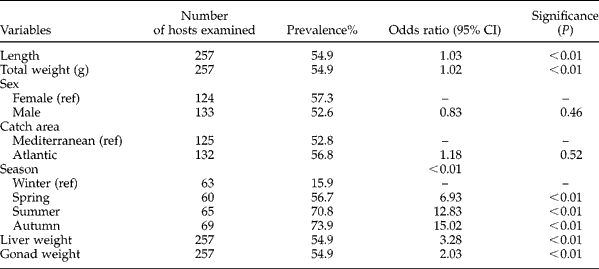
Mean infection data were similar (P= 0.52) between the fish from the Atlantic, with a prevalence of 56.8%, abundance of 1.9 and intensity of 3.3, and the fish from the Mediterranean, with a prevalence of 52.8%, abundance of 1.8 and intensity of 3.4. With regard to the season, the highest total prevalence was in fish caught during the autumn (73.9%), although the highest prevalence in the muscle was obtained during the summer (18.5%). Specimens caught during the winter had the lowest prevalence in the whole fish (15.9%) and also in the muscle (0%) (see tables 1 and 4).
Univariate logistic regression analysis of factors associated with the presence of A. pegreffii larvae in horse mackerel caught in Moroccan waters; the dependent variable is larval presence/absence; ref is the variable taken as a reference.

Molecular identification
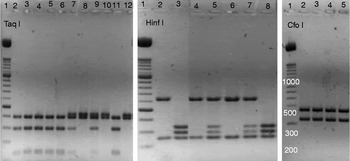
All parasites collected from horse mackerels were morphologically classified as Anisakis type I L3 larvae. A randomly selected sample of 110 larvae (23.4% of the total number of 471) was then subjected to PCR of the ribosomal ITS1–5.8S–ITS2 fragment using genetic markers for their identification. Based on the results obtained with HinfI and TaqI enzymes and the restriction patterns described by D'Amelio et al. (Reference D'Amelio, Mathiopoulos, Santos, Pugachev, Webb, Picanço and Paggi2000) and Martín-Sánchez et al. (Reference Martín-Sánchez, Artacho-Reinoso, Díaz-Gavilán and Valero-López2005), 96 (87.3%) of the 110 larvae (from both catch areas) corresponded to A. pegreffii, and the remainder (14/110) showed a hybrid PCR-RFLP band pattern with the restriction enzymes (sum of patterns for A. simplex s.s. and A. pegreffii). Out of these 14 larvae, 12 (85.7%) showed the hybrid genotype with only one enzyme, whereas the pattern with the other enzyme was indistinguishable from that of A. pegreffii (fig. 1). This mixture of the patterns of the two species has been interpreted as hybridization by some authors (Abollo et al., Reference Abollo, Paggi, Pascual and D'Amelio2003; Martín-Sánchez et al., Reference Martín-Sánchez, Artacho-Reinoso, Díaz-Gavilán and Valero-López2005; Marques et al., Reference Marques, Cabral, Busi and D'Amelio2006; Farjallah et al., Reference Farjallah, Busi, Mahjoub, Slimane, Paggi, Said and D'Amelio2008) and as incomplete homogenization in a multiple-copy repeated DNA region by others. We considered them as different genotypes, which is consistent with either interpretation.
Identification of A. pegreffii and A. simplex s.s. by PCR-RFLP. TaqI digestion: lanes 2–6 and 11, A. pegreffii; lanes 8, 10 and 12, A. simplex s.s.; lanes 7 and 9, hybrid genotypes. HinfI digestion: lanes 2, 4 and 6, A. simplex s.s.; 3 and 8, A. pegreffii; 5 and 7, hybrid genotypes. CfoI digestion: lanes 2 and 3, A. pegreffii; 4 and 5, A. simplex s.s. Lane 1 is always DNA molecular weight marker XIV (Roche).

Analysis of risk factors
In the univariate analyses, parasitization by A. pegreffii of the whole fish was associated with the weight, length, liver weight and gonad weight of the fish and with the season of their capture but not with the sex of the fish or the catch area (table 1).
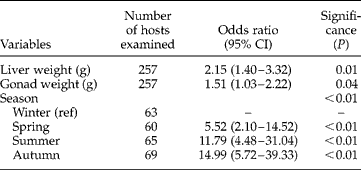
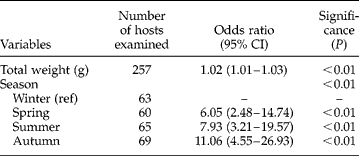
Because the length and weight of the host were strongly correlated, with a Pearson correlation of 0.9, only the weight was included in the model, as a more familiar concept for consumers than length. Liver weight and gonad weight were each strongly associated with total weight (Pearson's correlation of 0.6 in both cases) and neither entered the multivariate model. Tables 2 and 3 show the two multivariate models derived from these correlations, one with liver and gonad weight and the other with fish weight.
Multivariate logistic regression analysis of factors associated with the presence of A. pegreffii larvae in horse mackerel caught in Moroccan waters; the dependent variable is larval presence/absence; ref is the variable taken as a reference; R 2=0.406.

Multivariate logistic regression analysis of factors associated with the presence of A. pegreffii larvae in horse mackerel caught in Moroccan waters; the dependent variable is larval presence/absence, ref is the variable taken as a reference; R 2=0.377.

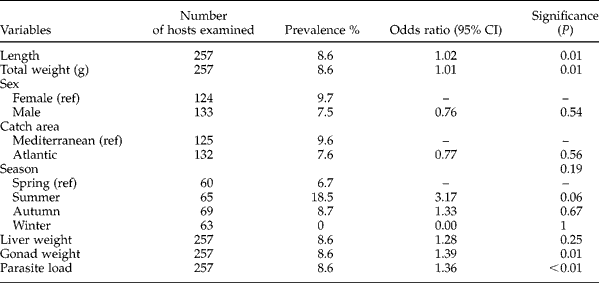
In the univariate analyses (table 4), the infection of A. pegreffii in the muscle of fish was positively associated with the weight, length, gonad weight and Anisakis parasite load of the fish and with the catch season (summer versus other seasons), but only season (OR = 5.17; CI = 1.87–14.25; P< 0.01) and Anisakis parasite load (OR = 1.38; CI = 1.19–1.59; P< 0.01) entered the multivariate model.
Univariate logistic regression analysis of factors associated with the presence of A. pegreffii larvae in muscle of horse mackerel caught in Moroccan waters; the dependent variable is larval presence/absence, ref is the variable taken as a reference.

Discussion
Trachurus trachurus is prone to infection with Anisakis spp. because the diet of this fish largely comprises pelagic crustaceans, especially euphausiids and mysids (Santic et al., Reference Santic, Jardas and Pallaoro2005), which play a major role in the life cycle of this parasite. In this study, A. pegreffii was the dominant Anisakis species in horse mackerel caught off the Atlantic and Mediterranean coasts of Morocco, and no specimens of A. simplex s.s. were found. Similar results were reported in a study of mackerel caught in northern Moroccan waters (Abattouy et al., Reference Abattouy, Valero, Benajiba, Lozano and Martín-Sánchez2011). In fact, Mattiucci & Nascetti (Reference Mattiucci and Nascetti2008) reported that A. simplex s.s. is widely distributed in the eastern Atlantic but not south of the waters neighbouring the straits of Gibraltar. With regard to A. pegreffii, the dominant species in the Mediterranean Sea, the same authors described its northern limit to be the waters off the coast of northern Spain (Mattiucci & Nascetti, Reference Mattiucci and Nascetti2008). In their study of the infection of the horse mackerel in the Moroccan Atlantic, Farjallah et al. (Reference Farjallah, Busi, Mahjoub, Slimane, Paggi, Said and D'Amelio2008) reported 78.6% A. pegreffii and 14.3% A. simplex s.s. in specimens from waters off Tangier and 90% A. pegreffii in specimens from waters off Casablanca.
The prevalence of A. pegreffii in both the entire fish and the muscle was similar between horse mackerel caught in the Atlantic and Mediterranean waters. Various authors have quantified the presence of A. pegreffii L3 in horse mackerel in studies designed to identify the species, but they did not report on its localization in the muscle (Mattiucci et al., Reference Mattiucci, Abaunza, Damiano, Garcia, Santos and Nascetti2007; Farjallah et al., Reference Farjallah, Busi, Mahjoub, Slimane, Paggi, Said and D'Amelio2008; Caballero et al., Reference Caballero, Ligas, Bruschi and D'Amelio2012). Out of the 471 larvae detected in the present study, only 22 (4.7%) were found in the musculature, which may reflect the poor ability of A. pegreffii to enter the muscle of the fish, as suggested by Suzuki et al. (Reference Suzuki, Murata, Hosaka and Araki2010) and Quiazon et al. (Reference Quiazon, Yoshinaga and Ogawa2011). The predominance of this species in Moroccan waters may imply a lower health risk for humans, who usually consume the muscle alone.
We also found no difference in A. pegreffii presence between the sexes, consistent with results obtained in other species of fish (Cremonte & Sardella, Reference Cremonte and Sardella1997; Silva & Eiras, Reference Silva and Eiras2003), including a report by our group on Scomber japonicus (Abattouy et al., Reference Abattouy, Valero, Benajiba, Lozano and Martín-Sánchez2011).
The risk of infection in horse mackerel doubled with every additional gram of liver weight and was 51% higher with every additional gram of gonad weight (table 2). The gonadosomatic index, which is defined by these two parameters, increases during preparation for reproduction (Durif et al., Reference Durif, Élie, Dufour, Marchelidon and Vidal2000), when a large part of the fish's energy is devoted to this process at the expense of other physiological functions. Thus, Jardas et al. (Reference Jardas, Santic and Pallaoro2004) observed a reduction in the intensity of food intake by horse mackerel during the reproductive period and the major physiological changes involved. Fish weight did not enter the multivariate model, due its strong correlation with liver and gonad weight, but we observed, for the same catch season, a 2% increase in parasitization risk with every additional gram of total fish weight. This association between the length or weight of the fish and infection was found by Adroher et al. (Reference Adroher, Valero, Ruiz-Valero and Iglesias1996) in horse mackerel from Spanish Mediterranean waters, by Manfredi et al. (Reference Manfredi, Crosa, Galli and Ganduglia2000) in T. trachurus and T. picturatus from the Mediterranean, and by Abaunza et al. (Reference Abaunza, Villamor and Pérez1995) in horse mackerel caught in Spanish Atlantic waters. However, this association does not appear to be attributable to changes in the diet of horse mackerel, which predominantly consists of euphausiids throughout their life (Bahar & Tuncay, Reference Bahar and Tuncay2009). The association between these two variables may be better explained by the accumulation of parasites in the host over its lifetime (Bussmann & Ehrich, Reference Bussmann and Ehrich1979; Valero et al., Reference Valero, Martín-Sánchez and Reyes-Muelas2000; Bahar et al., Reference Bahar, Chennubhotla and Tobi2007). In the present study, no association was observed between A. pegreffii infection and catch area. In contrast, the risk of parasitization by A. pegreffii was reported to be more than threefold higher in mackerel (Scomber japonicus) from Atlantic versus Mediterranean waters off the Moroccan coast for the same total weight, gonad weight and catch season (Abattouy et al., Reference Abattouy, Valero, Benajiba, Lozano and Martín-Sánchez2011).
The prevalence of A. pegreffii varies with the catch season (P< 0.01). All other variables in the model being equal, the risk of infection by A. pegreffii in horse mackerel is at its highest during the autumn and summer, followed by the spring, and is at its lowest during the winter (tables 2 and 3). These data are in agreement with a study by Manfredi et al. (Reference Manfredi, Crosa, Galli and Ganduglia2000) of horse mackerel caught in the Ligurian Sea (Mediterranean), which reported a higher mean prevalence and intensity of infection in November (autumn) than in the other months. A different pattern was observed by other authors in mackerel from the Moroccan coast, which showed a threefold higher risk of parasitization in winter or autumn than in spring or summer for the same total weight, gonad weight and catch area (Abattouy et al., Reference Abattouy, Valero, Benajiba, Lozano and Martín-Sánchez2011). According to Smith & Wootten (Reference Smith and Wootten1978), seasonal variations in infection levels are probably due to a change in the population of infected euphausiids, which are intermediate hosts of these nematodes. The possibility of a relationship between the feeding intensity of horse mackerel and infection by Anisakis may therefore be worth exploring. Thus, Jardas et al. (Reference Jardas, Santic and Pallaoro2004) reported a lower intake by horse mackerel at lower temperatures, i.e. in the winter and early spring, which is consistent with the present findings. In contrast, the risk of larval presence in muscle is fivefold higher in the summer, the hottest season, than at other times. This may be attributable to a stimulatory effect of higher temperatures on the migration of larvae to the muscle, as detected by Hauck (Reference Hauck1977) during the smoking of fish, although the effect on A. pegreffii would be limited by its lesser penetrative power.
In summary, the susceptible human population could minimize the risk of infection by avoiding the consumption of larger horse mackerel specimens during the summer, when the parasitization of the whole fish and of the muscle is more frequent. This study reveals differences in Anisakis infection risk models between horse mackerel and mackerel (Abattouy et al., Reference Abattouy, Valero, Benajiba, Lozano and Martín-Sánchez2011) that are related to their distinct ecological and dietary characteristics, underlining the need to develop a risk model for each fish species.
Acknowledgements
The authors would like to thank the Junta de Andalucía, Spain, for their financial assistance in project P07-CVI-03249; and the Agencia Española de Cooperación Internacional y Desarrollo AECID, Spain, in project A/7211/06, and for A.N.'s pre-doctoral grant.