Introduction
Although ethnic minorities have been living in the UK for many years and their number now accounts for 7.9 per cent of the total population (National Statistics, 2006a), the general public have limited knowledge of their welfare practices. Regarding the Chinese community, the Chinese in Britain Forum (1999) points out that ‘British people do not understand the UK Chinese people’. Further, Crawley (2005: 10), after examining findings from various opinion polls and surveys, concludes that ‘the British public appears to have little understanding of the difference between ethnic minorities, immigrants and asylum seekers’. By conflating asylum-seekers, immigrants and ethnic minorities as the same group of people, the public blame non-Whites for exploiting British welfare benefits. Nearly one-third of respondents in the British Social Attitudes Survey (National Centre for Social Research, 2004) were prejudiced against people of other races. More seriously, a BBC survey showed that 44 per cent of respondents believed immigration had damaged British society over the past 50 years (BBC, 2005a). Thus, misunderstanding has increased racial tensions, contributing to deteriorated race relations. Apart from facing negative public attitudes, ethnic minorities have to encounter new welfare demands from the New Labour Government, whose objectives are to reduce ‘poverty and welfare dependency and promote work incentives’ (Harman, Reference Harman1997). By using the welfare practices of the UK Chinese people as an example, this paper contests the myth of welfare dependency of ethnic minorities on the one hand, and discusses the social and moral foundation of self-reliance on the other hand.
New Labour's welfare state and the myth of welfare dependency
The New Labour Government has attempted to reconstruct the British welfare state by creating ‘a new culture, new rights and new responsibilities’ (Darling, Reference Darling1999). This is because the old welfare system was considered to turn needy people into passive recipients so that a culture of dependency has been cultivated. According to Field (BBC, 2005c) there is ‘a growing minority of claimants who have an attitude of take, take, take rather than give, give, give’ and the British welfare system had ‘led to growing poverty and dependence, not independence’ (BBC, 1998). Thus, self-reliance has become the focus of the New Labour Government's social policy. As the social security white paper, A New Contract for Welfare, stresses, ‘Welfare should become more focused on helping people to become independent, rather than locking them into dependency’ (Department of Social Security, 1998: 1). Accordingly, ‘work first’ has become a key solution to poverty, which helps and supports recipients to ‘become more independent’ (ibid.). Against this background, a wide range of New Deal programmes have been introduced, including New Deal for Young People, New Deal for 25 Plus, New Deal for 50 Plus, and New Deal for Lone Parents.
Having presented itself as an enabling state, the New Labour Government sees education and occupational training as the means to achieve social justice. According to Tony Blair, ‘education is the best economic policy we have’ (Secretary of State for Education and Employment, 1998). He explains that an enabling welfare state ‘helps people to help themselves’ by driving up social mobility, ‘the great force for equality in a dynamic market’ (Blair, Reference Blair2002). Thus, education is expected to help enhance the employability of the needy, who can improve their living standards by actively participating in the labour market. In short, the key features of New Labour's social policy are ‘an active, preventive welfare state, the centrality of work and the distribution of opportunities rather than income’ (Powell, Reference Powell2000: 43).
Against these policy developments, it is important to examine the welfare ideologies of ethnic minorities, especially their perception of New Labour's ‘welfare-to-work’. This is because only after understanding the welfare practices of ethnic minorities, can the government work out appropriate interventions to help meet the demands of the modern British welfare state by utilising training and employment opportunities. In particular, Jobcentre Plus is expected to deliver ‘the best possible service to ethnic minority customers’, and to end the ‘disadvantages of ethnic minorities in the workplace’, in order to achieve race equality (Johnson, Reference Johnson2004).
Better communication among different ethnic groups is a key to breaking racial barriers. Unfortunately, ethnic minorities have been perceived by many people as abusers of social welfare. For example, respondents of a study blamed minority welfare recipients for securing preferential access to public benefits (Valentine and McDonald, Reference Valentine and McDonald2004). Similarly, findings were reported by another study in which minority groups were accused by White respondents of manipulating the benefits of British people. For example, two participants of a study expressed the following views (ETHNOS Research and Consultancy, 2006: 12):
I'd be working seven days a week and couldn't possibly afford to live in properties like theirs and they were clearing benefits as well. (White Scottish, Glasgow)
They are putting all sorts of monies towards Asian children and that's not right. We are losing as a nation. We are losing our wealth because of that. (White English, Manchester)
These hostile attitudes might be related to several negative social and political factors. Firstly, some daily newspapers have created an ‘impression that the UK is a ‘soft touch’ targeted and ‘inundated’ by ‘waves’ of carefully calculating asylum seekers who weigh up the welfare benefits on offer in different countries and go to the most generous’ (BBC, 2002). Secondly, as mentioned at the beginning of this article, illegal immigrants, asylum seekers and ethnic minorities have been conflated (Crawley, Reference Crawley2005). As pointed out by Valentine and McDonald (2004: 11), there was ‘a tendency for some interviewees to depict all non-white people as asylum seekers’. As a result, a myth of welfare dependency has been attached to ethnic minorities.
In addition, ethnic issues have been manipulated by British politicians. For example, the Conservative Party during the 2004 general election urged the Labour Government to set an annual quota for asylum-seekers (Independent, 2005). To avoid being perceived as a soft party on immigration, the New Labour Government tightened control over the granting of refugee status, putting more restrictions on naturalisation. In particular, those who apply for British citizenship have been required to pass a ‘Britishness test’ (BBC, 2005b). Against this background, it is important to provide a clearer picture about the welfare practices of minority groups. Thus, this study attempts to give an account of the welfare attitudes of the UK Chinese people and discusses whether their ideologies fit the New Labour Government's welfare expectations.
Methodology
The present discussion on the welfare attitudes of Chinese people is based on data from an ESRC funded research project investigating the help-seeking behaviour of the UK Chinese community in 2003 (Chan et al., Reference Chan, Bowpitt, Cole, Somerville and Chen2004). The study consisted of 100 respondents from semi-structure interviews (SSIs) and 316 respondents from a postal survey (PS). It has been widely reported that the UK Chinese people have become concentrated in China towns and scattered in small areas as a result of their economic activities (Watson, Reference Watson1975; Shang, Reference Shang1984; Parker, Reference Parker and Lynn1999). Thus, the 100 SSIs were carried out in London, Manchester (Chinese concentrated areas), Cardiff and Lincoln (Chinese dispersed areas). Respondents of the SSIs were asked to rate their attitudes to 14 welfare statements on a 5-point scale, ranging from ‘strongly agree’ to ‘strongly disagree’.
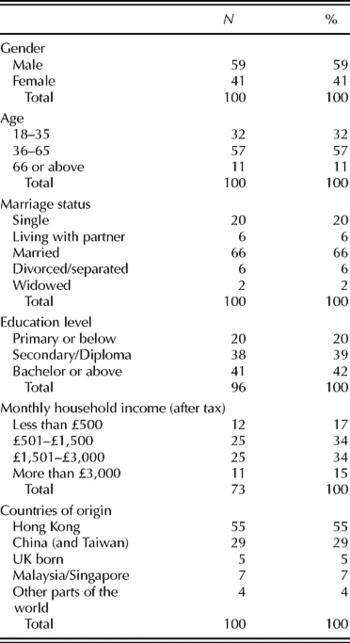
The 316 respondents of the PS were randomly drawn from 25 areas, which were classified into three types, big (over 5000), medium (2000–5000), and small (under 2000), according to the size of Chinese population. This paper will mainly use the findings of the SSIs, supplemented by data from the PS with regard to relevant issues. The main characteristics of the SSI respondents are as shown in Table 1.
Main characteristics of the SSI respondents

By comparison with official figures, our respondents have several features. In terms of marital status, respondents of the SSIs were similar to that of the Labour Force Survey, which showed that 60 per cent of Chinese women in the UK were ‘married’, 7 per cent ‘co-habiting’, and 3.5 per cent ‘divorced or separated’ (Lindley et al., Reference Lindley, Dale and Dex2004). As for education, more SSI respondents (42 per cent) were educated to bachelor degree level than the national average (31 per cent) (National Statistics, 2006b). Also, our sample had more respondents who were aged ‘65and over’ (11 per cent) compared with that of the 2000 Census (5 per cent) (National Statistics, 2001). As respondents of the SSI came from only four cities, some differences between the present sample and the national figures are predictable.
Key findings
Findings from this study reveal that our respondents emphasised family help, held a low expectation of public welfare and strongly supported workfare measures. These welfare features will be discussed in turn.
Attitudes towards family support
Most respondents considered the family as the basic welfare unit, emphasising filial piety and mutual help among family members. As many as 59 per cent of the respondents believed that in ‘meeting old people's financial needs’ ‘children should play the primary role’. As one respondent stressed: ‘this is my duty. My parents are now getting older. We should provide financial assistance for them.’ Further, an overwhelming majority (81 per cent) agreed/strongly agreed that ‘Children should take care of their parents.’ Among respondents who had to take ill parents to hospitals, one pointed out: ‘I wouldn't say it is a problem. My duty is to go with him to the hospital. I wouldn't say it is a problem.’ Similar views were expressed by older people in studies conducted by Chiu and Yu (Chiu and Yu, 2001). As many as 80 per cent of respondents in Chiu's 1991 study and 70 per cent of respondents in Yu's 1998 study ‘agreed that children should take care of their elderly parents’ (Chiu and Yu, Reference Chiu and Yu2001: 689). On the other hand, our respondents’ expectation of the financial role of the state in caring for older people was relatively low; over 70 per cent of them claimed that the state ‘should only play a supplementary role’. Thus, the findings show that caring for older people was still treated by our Chinese respondents as a family issue as well as a duty of children.
Apart from support for parents, respondents had a high expectation of mutual help among siblings. Nearly nine out of ten respondents (87 per cent) agreed ‘Brothers and sisters have a duty to help each other.’ This type of mutual help was further revealed from our postal survey sample in which as many as 69 per cent of respondents said that they would seek assistance from family members when they were in need. Several studies also reported that the family was still a basic caring unit to the UK Chinese people. Parker (Reference Parker1995) and Song (Reference Song1999) found that children and young people were actively involved in helping their parents’ take-aways and restaurants. By investigating the needs of Chinese older people, Yu (Reference Yu2000: 10) notices that ‘The family is not only an important care provider, but also serves as the most important place for the older people to find their role and purpose in life.’ Law et al. (Reference Law, Hylton, Karmani and Deacon1994) showed that Chinese lone parents sought assistance from male relatives in the process of receiving social security benefits. The dependency of Chinese women on husbands and close relatives was also revealed by Green et al. (Reference Green, Bradby, Lee and Eldridge2000). As our findings were similar to other studies conducted in the 1990s, it is reasonable to conclude that the UK Chinese people are still strongly attached to traditional family values, caring for older parents in particular.
Attitudes towards public welfare
Many respondents in the SSIs did not support the use of taxation to achieve social justice. Many of them (58 per cent) did not agree that ‘The British government should raise more taxes so as to improve social welfare.’ Instead, most of them stressed the importance of self-reliance and labour market participation. As many as 69 per cent of respondents thought that ‘The UK welfare system nurtures a dependency culture.’ Many of them (66 per cent) believed ‘One should be self-reliant.’ If one works, 75 per cent of respondents maintained, ‘One will not be in poverty.’ Obviously, many of them regarded work rather than wealth redistribution as an effective means to tackle poverty. Therefore, the data suggests that respondents tried to achieve self-reliance through hard work. It was evident that nearly four out of ten of our respondents worked more than five days a week and a third with weekly working hours of over 45. Thus, ‘work without poverty’ rather than ‘live on public benefits’ seems to be a survival strategy of our respondents.
Attitudes towards ‘welfare-to-work’
Our respondents clearly identified with New Labour's welfare-to-work ideologies. Many respondents (66 per cent) in the SSI believed that social welfare should only be provided for ‘those who cannot take care of themselves’. The majority of them also said that unemployed recipients should fulfil responsibilities such as attending ‘vocational courses’ (84 per cent) and doing ‘voluntary work’ (74 per cent). As the evidence shows, most respondents tended to agree with the concept of conditional welfare, believing social security recipients need to fulfil duties for receiving benefits. This might be related to our respondents’ personal responsibility and hard-working spirits; they also expected others to rely on personal efforts rather than to seek public assistance.
It should be emphasised that among the 100 SSI respondents, only five of them were UK born Chinese; the rest mainly came from Hong Kong, mainland China, Singapore and Malaysia. Interestingly, results generated from using regression and cross-tabulation analyses show that there is little statistical significance among respondents in terms of family care, government responsibilities and workfare measures. The findings suggest that there was a consensus among respondents on welfare ideologies.
Discussion
The Chinese respondents’ family-centred and pro-workfare attitudes directly challenge the common British public's perception of ethnic minorities as welfare dependents. The welfare practices of Chinese people also shed light on the moral foundation of self-reliance.
The myth of welfare dependency
As illustrated in the earlier part of this article, ethnic minorities have been regarded as dependents of public welfare. On the other hand, our findings clearly reveal that Chinese respondents emphasised family support rather than state welfare; they stressed self-reliance and agreed with workfare measures. To achieve independence, our respondents worked long hours; Chinese women also tried very hard to cope with demands from work and family. A mother shared her experiences: ‘Like today I have to wash clothes, iron clothes. Then, I have to buy some necessary goods for the shop. After that, I have to go to my children's school. All things come together. I found that time is too little to handle so many things.’ Another respondent who worked ten hours a day talked about ‘long working hours without personal time’. A hard-working spirit was found to be passed on from Chinese parents to children at a young age. Francis and Archer (Reference Francis and Archer2005: 95) reported that their respondents believed ‘if you work hard now you will reap the benefits in the future, demonstrating a willingness to defer pleasure in the present in order to ensure rewards later in life’. In short, it is expected that this self-reliant philosophy will be passed from Chinese adults to children.
Our respondents’ hard-working attitude indicates that Chinese people are mainly attracted by the British free economy, which provides them with employment and business opportunities. They prefer using the UK's market opportunities to relying on public benefits. Thus, the practices of UK Chinese people show that the current presumption of the welfare dependency of immigrants and ethnic minorities has been built on a limited or misguided understanding of the thinking and behaviour of foreigners. In order to achieve a harmonious multi-cultural society, the general public needs to be better informed of the welfare practices and life-styles of ethnic minorities.
UK Chinese welfare attitudes and Chinese culture
The above findings show that family support, self-reliance and a low expectation of state welfare are the main features of our respondents’ welfare ideologies. The socio-economic context has been considered as a key factor shaping Chinese people's thinking. Economically, many Chinese people are running family restaurants; they need to mobilize family members’ labour power in order to reduce the costs of production. Therefore, it is common for both women and children to help run the family's business. For example, Chau and Yu (Reference Chau and Yu1999) reported that among their 85 women respondents, 29.4 per cent of them took part in their family businesses such as takeaways, restaurants and food-processing factories. Song (Reference Song1995) noticed that women not only provided a supportive role but also actively took the initiative in establishing businesses themselves. Parker's (1995) study reveals that Chinese young people played a crucial role in running family business. Therefore, it has been argued that the development of self-reliance among the UK Chinese people is, in fact, the consequence of an economic life that requires the active involvement of family members in order to survive.
The impact of socio-economic factors on the UK Chinese people's welfare ideologies should not be denied. However, more in-depth analysis is necessary to explain the welfare consensus of Chinese people, especially those who are not in takeaway businesses. It should be stressed that Chinese people are not a homogenous group but divided by different countries of origin, occupations, levels of education, and English language abilities (Blackwell, Reference Blackwell, Yee and Au1997; Chan and Chan, Reference Chan and Chan1997; Cheng, Reference Cheng and Peach1996). For example, 58 per cent of Hong Kong Chinese in contrast to only 10 per cent of South East Asian Chinese worked in the catering industry. On the other hand, the South East Asian Chinese were more likely to enter high salaried jobs. Against these differences, Cheng (1996: 178) reminds us that ‘the restaurateur image is true for only 40 per cent of the working Chinese population and is mainly characteristic of Hong Kong-born Chinese’. Therefore, the life experiences of those working in the catering industry have limitations in explaining the self-reliance of other Chinese groups as well as Hong Kong Chinese people who are working in professional jobs. Traditional Chinese culture may play a part in explaining the welfare consensus of our Chinese respondents as well as the transmission of pro-family welfare practice. This is because different Chinese groups are still deeply influenced by Confucianism. Wu (Reference Wu and Michael1996: 154), after comparing Chinese parents in China, Taiwan and Singapore, concludes that ‘they share many basic values and practices’. He explains:
They pay attention to training children to develop a moral character, such as respecting elders, cooperating, and maintaining harmonious social relations. They help and push children to achieve in school and expected adult to set examples for children to emulate.
These characteristics were also reported by Francis and Archer after examining the UK Chinese parents’ and young people's attitudes towards education (Reference Francis and Archer2005). Thus, Wu agrees with the views of other Chinese experts such as Bond, Hus, Wu and Tseng that ‘Chinese traditions have an enduring historical and cultural continuity’ (Reference Wu and Michael1996: 154). Zukeran (Reference Zukeran2001) even believes that traditional Chinese values such as education, family loyalty, work ethics, honouring of ancestors and obedience to superiors ‘remain entrenched in Asian culture’ (see also Clark, Reference Clark2002). Thus, the present UK Chinese people's welfare practices can partly be explained from their adoption of traditional values in a new environment.
The basis of self-reliance between Chinese people and New Labour
One of the key concerns of this article is whether ethnic minorities can live up to the expectations of New Labour's welfare regime. Results from our examination suggest that the foundation of self-reliance of the UK Chinese people is more solid than that of New Labour. Confucianism is the core of Chinese values, which concerns ‘people-to-people relationships’ (Zukeran, Reference Zukeran2001). In particular, it emphasises filial piety, which is ‘the root of all virtue, and that from which all teaching comes’. This was echoed by an influential Confucian scholar Mencius, who said: ‘The actuality of human-heartedness is to serve one's parents. The actuality of righteousness is to obey one's elder brother’ (quoted in Fung, Reference Fung and Bodde1983: 125). Based on these beliefs, children are expected to be obedient and try their best to serve their parents. A parent-centred welfare unit was therefore formed based on the concept of filial piety as a prestigious virtue and a key to achieve self-actualisation. To Chinese people, mutual support is not confined to members of a nuclear family but included close relatives. This type of social support network has been revealed from the settlement patterns of our respondents. Among 44 respondents who received family support over the last 12 months, 50 per cent of them had family members living in the same towns/villages and 16 per cent in the same cities. In this way, many of them could mobilise immediate support to tackle social and economic challenges. Thus, self-reliance for Chinese people does not mean the independence of an individual and a family unit, but the self-sufficiency of a family network.
Education performs a special function in this type of family-centred welfare system. Traditionally, Chinese people emphasised education because of its impact on personal growth, as well as the social and economic outcomes. Education and study is ‘A hallmark of Confucius’ thought’ because education can create ‘gentlemen who carry themselves with grace, speak correctly, and demonstrate integrity in all things’ (Stanford Encyclopedia of Philosophy, 2002). Confucius points out that ‘The way of great learning consists in manifesting one's bright virtue, consists in loving the people, consists in stopping in perfect goodness’ (The Great Learning, Reference Muller1990). Francis and Archer (Reference Francis and Archer2005: 97) also reported that some UK Chinese parents considered education as ‘absolutely essential to humanity’. As one parent explained:
Education, because I think for instance animals, like humans, are living things and humans are cleverer than animals because they're educated. If you don't have education then you are like a stray dog. (ibid.)
Another parent also stressed that ‘you can understand a lot of stuff’ as a result of education (ibid.). Clearly, one of the functions of education to Chinese people is to learn virtues and achieve self-actualisation.
Educational success can also reward a person with a career, and his family with social prestige and economic returns (Shang, Reference Shang1984). As early as the sixth century, the Chinese government already set up public examinations to select candidates for the civil service, and Confucian classics were made the core of the educational curriculum. It was reported that 47 per cent of those who passed the highest level examinations in the Ming Dynasty were from families with few official connections (California State Polytechnic University, 2006). Thus, due to personal development, social prestige and economic returns, Chinese families traditionally were eager to invest in their children's education. This cultural background helps explain why most of the UK's Chinese children achieved outstanding academic performance. For example, 74.8 per cent of Chinese pupils got five or more grades A to C in GCSE/GNVQ compared with 40.7 per cent of Black African pupils and a national average of 50.7 per cent (10Downing Street, 2004). The above discussions show that the self-reliance of Chinese people is based on an ethic of mutual support among family members, supported by educational success and a hard-working spirit.
On the other hand, the basis of independence promoted by the New Labour Government is strongly rooted in a market economy. The new moral order, according to Heron and Dwyer (Reference Heron and Dwyer1999: 91), is to ask people to ‘take control of their own welfare,’ and ‘meet their own needs’. As mentioned previously, labour market participation has been regarded as a channel to tackle poverty. Unlike Confucian teachings, New Labour has a low expectation of the welfare role of children and close relatives. Instead, the government has tried very hard to strengthen parental duties, especially in school attendance and tackling anti-social behaviour. Unlike Confucianism, which promotes parents’ and children's duties mainly through moral teachings in the family and at schools, New Labour has adopted legislation to enforce parents’ responsibilities. For example, the 1998 Crime and Disorder Act introduced parenting orders by requiring parents to attend counselling or guidance sessions. The 2003 white paper, Respect and Responsibility, imposed more demands such as the introduction of Parental Contracts for parents of young offenders, a residential requirement to Parenting Orders, and fixed penalty notices (Secretary of State for the Home Department, 2003).
However, two issues are raised from the current government's interventions in the family. Firstly, it is about the effectiveness of external demands on parents through law and order. According to Confucius:
If you govern the people legalistically and control them by punishment, they will avoid crime, but have no personal sense of shame. If you govern them by means of virtue and control them with propriety, they will gain their own sense of shame, and thus correct themselves. (The Analects of Confucius, Reference Muller2004)
Thus, ritual act rather than law can encourage people to live up to their own aspirations (Tu, Reference Tu1999). The impact of moral education was revealed from the behaviour of the UK Chinese pupils, who were found to be ‘quiet’ and ‘obedient’ with fewer troubles at school (Francis and Archer, Reference Francis and Archer2004a). They were least likely to be excluded from school, six times less than their White counterparts (National Statistics, 2004). From the experiences of Chinese society, the New Labour Government may need to reassess the existing ethical base of parent–child relationship, exploring how parents’ duties can effectively be promoted through moral education and socialisation.
Secondly, by emphasising parents’ responsibilities towards children, the government mentions few obligations of children towards other family members, particularly towards parents. British children under New Labour seem to be mainly seen as rights holders and passive welfare recipients at the family level. In other words, the concept of self-reliance is based on the self-sufficiency of an individual or a nuclear family. In this way, the sense of family duties and the strength of mutual support among family members in the UK are far weaker than that of Chinese people.
In addition, although New Labour sees education as a means to achieve self-reliance, the social and ethical base of education is relatively weak. Chinese families provide a strong social base for supporting children's education. Francis and Archer (Reference Francis and Archer2004b) point out that ‘one of the key factors underpinning educational success [of the UK Chinese people] was the extremely high value placed on education’. Also, working hard has long been regarded by Chinese people as the key to academic results. As a young respondent of Francis and Archer's (Reference Francis and Archer2005: 96) study stressed, ‘I have to work hard, because of my mum make me, makes sure I do well. I do everything that I can, if I can't then I try anyway.’ To Chinese people, education is a whole family issue and educational success has been considered to be the combination of active parental involvement and pupils’ efforts.
Conclusion
Our findings show that the UK Chinese people emphasise self-reliance and mutual family support; they also work hard and use education as a strategy to achieve social mobility. Similarly, the New Labour welfare regime stresses self-help and educational success. Thus, the case of the UK Chinese people challenges the public's perception of the welfare dependency of ethnic minorities. The underlying cause of this wrong perception is our limited understanding of the welfare culture and practices of ethnic minorities. The welfare practices of the UK Chinese people further reveals that self-reliance needs a strong social and ethical base, expressed in the form of mutual support among family members as well as parental support for children's education. However, New Labour Government's legislation on enforcing parental duties have neglected the ethical base of socialising family members’ duties through formal and informal education as well as the social base of involving the participation of both parents and children in improving the quality of education. Thus, a strong social and ethical base needs to be established in order to achieve a welfare culture based on self-reliance.
Acknowledgements
We would like to express our gratitude to the Economic and Social Research Council for providing us with a grant for conducting this research study (award reference: R000223924).