g patterns (Jensen effects) exist which could be either environmental or genetic in origin. Therefore, they tell you nothing about causality simply by their existence (see Flynn, Reference Flynn2019: Reservations about Rushton).
I will use a new and better basketball example. You are presented with players who have never played and your job is to turn them into a good team. I will divide them into ‘groups’ at various stages along the road towards the optimum result – the point at which training has had its maximum effect. For example: the group before training has even started, the group 25 per cent of the way along the road and the group half-way along the road – all of these to be compared with a group when training is complete. This automatically controls for genes. I will assume what every coach knows: training improves easy tasks more quickly than complex tasks. For example, at half-way, compared with when the training regime is completed, they will be near-equals for making layups, getting there for foul shots, still a sizable gap for set shots outside the three-point line (long set shots), and a big gap for fade-away jump shots.
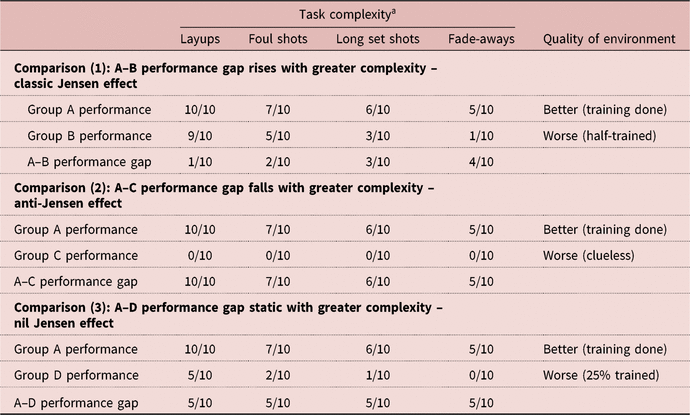
Table 1 shows surprising results. Group A represents our targets by the time the training regime is finished: 10 out of 10 layups diminishing to 5 out of 10 fade-aways. (1) First comparison: Group B shows our players at half-way. As the complexity of the task increases, their performance falls further and further short of the optimum and the performance gap between the two groups rises. This is a case where two groups are separated purely by environmental differences and where the g pattern (or Jensen effect) occurs. (2) Second comparison: Group C shows our players before they begin – utterly clueless what a basketball is and what you are supposed to do with it. As the complexity of the task increases, their nil performance is closer and closer to the optimum. This is a case where the two groups are separated purely by environmental differences and you get a powerful anti-Jensen effect. (3) Third comparison: Group D shows our players about 25 per cent of the way along their path. As the complexity of the task increases, their performance is exactly the same distance from the optimum. This is a case where the two groups are separated purely by environmental differences and you get a nil Jensen effect.
Training in basketball and the Jensen effect

a Task complexity: layups<foul shots<long set shots<fade-aways.
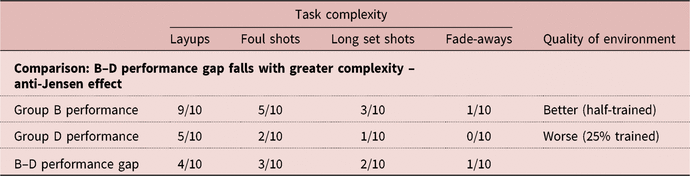
We leave basketball for cognition. Te Nijenhuis et al. (Reference te Nijenhuis, Choi, van den Hoek, Valueva and Lee2019) cite studies that show that training on cognitive tasks produces the largest standardized gains on the easiest items and the smallest standardized gains on the most difficult items. They note that this creates an anti-Jensen effect. But here the basketball example comes into its own. Table 2 is extracted from Table 1 with this rationale. The group we train on cognitive tasks would not be clueless. Let us assume that before training they already have cognitive skills that are 25 per cent towards an unattainable optimum – which makes them like Group D. Training brings them half-way towards the optimum – after training they become like Group B. Table 2 compares these two groups and shows that the environmental improvement produces a performance gap between before and after exactly in accord with cognitive training – greater gains on easy tasks and smaller ones on complex tasks, or exactly the anti-Jensen effect predicted. You can also compare our groups for every combination of better and worse environments short of using the optimum. And in every case we get an anti-Jensen effect. Every step on the road reveals a better environment enhancing easy skills more than hard skills – and thus consistent anti-Jensen effects. It is only when we get near the optimum that things reverse. At that point, we have enhanced easy skills to the maximum degree, while there is still room for some improvement on the hard skills.
Basketball and cognitive training reconciled

Therefore, improvement on the easy skills ‘stalls’ – so further environmental enhancement leaves the easy-skill gap unincreased. And all that is left is some improvement on the hard skills – so further environmental enhancement means the higher-level skill gap is increased. The combination gives a classic Jensen effect. Therefore, everything falls beautifully into place. The difference is that we really can produce virtually optimum basketball skills. As for cognition, we are still well short.
For those unfamiliar with basketball a simpler example. Take driving a car as a competence that involves a complexity hierarchy: turning on the ignition; ordinary city driving; beltway (or ring road) driving; parking. The better the driver the more they will open up a gap on the average person as you ascend this hierarchy. If you compare two groups, they may well be equal for starting the car, one a bit better for ordinary city driving, and that group better still for beltway driving. The beltway has cars going at high speeds, often shifting lanes, and a host of entrances and exits; indeed, it is one of the first things many drivers give up as they age. There are many reasonable drivers who are bad at parallel parking and it is the task that those taking a driving test fear most of all. Once again, the mere existence of a g pattern (a rising gap between the best and the average as you go up this scale) does not tell you the cause of the pattern. You must diagnose that independently. For example, one group may be country drivers newly arrived in the city, unaccustomed to its traffic, never having confronted a beltway, and used to having plenty of space where you can do a drive-in park. So an environmental hypothesis about causality seems probable. Or the two groups may be all experienced city drivers and some inherited trait (ease or difficultly in spatial visualization) may differentiate them.
But why do IQ gains over time not show the maximum anti-g pattern? Over the 20th century, American society has ‘trained’ its people to get higher scores on IQ tests. Score gains on the simpler tasks should have been far greater than those on the harder items (the more complex ones). My hypothesis is that since 1900, two things caused gains on high g-loaded tests. At that time, people did not have the habits of mind that allowed for good performance on items that demanded classification of the world and the use of logic freed from reference to the concrete world (Flynn, Reference Flynn2009, Reference Flynn2012, Reference Flynn2016). Society demanded the development of those cognitive skills, which provided a platform for gains on high g-loaded tests. But it also demanded better skills on low g-loaded tests such as memory, skills for which the friendly habits of mind were already in place in 1900. Given equal platforms in 1900, the latter would have been greater than the former. But the development of high-g platforms plus a slower tendency to build on them once developed just about equalled the non-development of low-g platforms plus a faster tendency to build on them. Thus we got what we have: roughly the same gains irrespective of g-loading – all of which took place within the assumption of an environmental enhancement that cast genetic factors into the shade.
Funding
This research received no specific grant from any funding agency, commercial entity or not-for-profit organization.
Conflicts of Interest
The author has no conflicts of interest to declare.
Ethical Approval
The author asserts that all procedures contributing to this work comply with the ethical standards of the relevant national and institutional committees on human experimentation and with the Helsinki Declaration of 1975, as revised in 2008.