Introduction
Attention-deficit hyperactivity disorder (ADHD), characterized by impairing hyperactivity/impulsivity and inattention often co-occurs with psychiatric and medical disorders (Kessler et al. Reference Kessler, Adler, Barkley, Biederman, Conners, Demler, Faraone, Greenhill, Howes, Secnik, Spencer, Ustun, Walters and Zaslavsky2006; Barkley et al. Reference Barkley, Murphy and Fischer2008). Epidemiological studies identified comorbidities between ADHD and binge eating across the lifespan (Cortese et al. Reference Cortese, Bernardina and Mouren2007a ; Reinblatt et al. Reference Reinblatt, Leoutsakos, Mahone, Forrester, Wilcox and Riddle2015). Binge eating is a key symptom in eating disorders such as bulimia nervosa (BN), binge-purge subtype of anorexia nervosa (AN), and binge-eating disorder (BED) (American Psychiatric Association, 2013). Prospective follow-up studies implicate childhood ADHD as a risk factor for conditions involving binge eating (Sonneville et al. Reference Sonneville, Calzo, Horton, Field, Crosby, Solmi and Micali2015), binge-purge behaviors (Bleck & DeBate, Reference Bleck and Debate2013), and BN (Mikami et al. Reference Mikami, Hinshaw, Patterson and Lee2008) in adolescence. Case–control studies revealed an increased risk for BN in women with ADHD, but not in children or males (Surman et al. Reference Surman, Randall and Biederman2006). Children in these studies were probably too young to have developed BN during the follow-up. Another study (Biederman et al. Reference Biederman, Ball, Monuteaux, Surman, Johnson and Zeitlin2007) described increased risk for BN and AN in girls with ADHD v. controls. Conversely, increased risk for ADHD was found in clinical populations characterized by overeating and obesity across the lifespan, such as child psychiatric services, obese adults undergoing bariatric surgery (Cortese et al. Reference Cortese, Bernardina and Mouren2007a , Reference Cortese, Isnard, Frelut, Michel, Quantin, Guedeney, Falissard, Acquaviva, Dalla Bernardina and Mouren b ; Davis et al. Reference Davis, Patte, Levitan, Carter, Kaplan, Zai, Reid, Curtis and Kennedy2009a ), or adults with BN (Seitz et al. Reference Seitz, Kahraman-Lanzerath, Legenbauer, Sarrar, Herpertz, Salbach-Andrae, Konrad and Herpertz-Dahlmann2013). Adult ADHD cases may differ from those with childhood onset (Moffitt et al. Reference Moffitt, Houts, Asherson, Belsky, Corcoran, Hammerle, Harrington, Hogan, Meier, Polanczyk, Poulton, Ramrakha, Sugden, Williams, Rohde and Caspi2015), highlighting the importance of studying the association between ADHD symptoms and binge eating in adults.
ADHD and binge eating may implicate overlapping neurobehavioral circuits, involving problems with response inhibition, emotional regulation, and reward processing (Seymour et al. Reference Seymour, Reinblatt, Benson and Carnell2015). Binge eating, BN, and the binge-purge subtype of AN have been associated with behavioral impulsivity (Engel et al. Reference Engel, Corneliussen, Wonderlich, Crosby, Le Grange, Crow, Klein, Bardone-Cone, Peterson, Joiner, Mitchell and Steiger2005; Rosval et al. Reference Rosval, Steiger, Bruce, Israel, Richardson and Aubut2006), which is a key component in ADHD symptomatology. Genetically influenced behavioral traits such as delay aversion and low inhibitory control play a role in ADHD (Solanto et al. Reference Solanto, Abikoff, Sonuga-Barke, Schachar, Logan, Wigal, Hechtman, Hinshaw and Turkel2001; Sonuga-Barke & Fairchild, Reference Sonuga-Barke and Fairchild2012) and binge eating (Davis et al. Reference Davis, Patte, Curtis and Reid2010; Seymour et al. Reference Seymour, Reinblatt, Benson and Carnell2015). Individuals with both ADHD and binge eating may represent a subgroup with specific therapeutic needs. In order to develop effective prevention and treatment strategies, it is important to determine to what extent the overlap between ADHD and binge eating reflects shared genetic and/or environmental factors. Genetic factors were established for both ADHD, with heritability estimates ranging from 30–40% for self-reported data in adults to 60–90% for childhood and adult clinical samples (Franke et al. Reference Franke, Faraone, Asherson, Buitelaar, Bau, Ramos-Quiroga, Mick, Grevet, Johansson, Haavik, Lesch, Cormand and Reif2012; Larsson et al. Reference Larsson, Asherson, Chang, Ljung, Friedrichs, Larsson and Lichtenstein2013; Brikell et al. Reference Brikell, Kuja-Halkola and Larsson2015), and for binge-eating behaviors and BEDs (heritability estimated between 41% and 70%) (Bulik et al. Reference Bulik, Sullivan and Kendler1998; Reichborn-Kjennerud et al. Reference Reichborn-Kjennerud, Bulik, Tambs and Harris2004; Bulik et al. Reference Bulik, Thornton, Root, Pisetsky, Lichtenstein and Pedersen2010; Mitchell et al. Reference Mitchell, Neale, Bulik, Aggen, Kendler and Mazzeo2010; Root et al. Reference Root, Thornton, Lindroos, Stunkard, Lichtenstein, Pedersen, Rasmussen and Bulik2010; Trace et al. Reference Trace, Baker, Penas-Lledo and Bulik2013a ). No twin study has examined the genetic and environmental factors shared between ADHD symptoms and binge eating.
We examined the association between ADHD symptoms with lifetime binge-eating behavior, BED, and BN, based on self-reported symptoms in a large adult twin population. We evaluated the extent to which the association between ADHD symptoms and binge-eating behavior is due to genetic and environmental factors using twin methods. The hyperactive/impulsive (HI) and inattentive (IN) symptom dimensions of ADHD co-vary (Willcutt et al. Reference Willcutt, Nigg, Pennington, Solanto, Rohde, Tannock, Loo, Carlson, Mcburnett and Lahey2012) and share some genetic factors (McLoughlin et al. Reference Mcloughlin, Ronald, Kuntsi, Asherson and Plomin2007; Larsson et al. Reference Larsson, Asherson, Chang, Ljung, Friedrichs, Larsson and Lichtenstein2013), but specific genetic influences for each symptom dimension have been identified (McLoughlin et al. Reference Mcloughlin, Ronald, Kuntsi, Asherson and Plomin2007). Therefore, we examined separately how binge-eating behavior associates with HI and IN symptom dimensions.
Methods and materials
Study population
This study used data from the national Swedish Twin Registry, the Study of Twin Adults: Genes and Environment (Lichtenstein et al. Reference Lichtenstein, Sullivan, Cnattingius, Gatz, Johansson, Carlstrom, Bjork, Svartengren, Wolk, Klareskog, De Faire, Schalling, Palmgren and Pedersen2006). The regional ethics committee of Karolinska Institutet, Stockholm, Sweden approved the project. All participants provided informed consent. From the target population of 42 582 Swedish adult twins, born 1959–1985, N = 25 491 (60%) responded. Participants received personal login to the study's website, containing a questionnaire on lifestyle, physical and mental health, described in earlier publications (Lichtenstein et al. Reference Lichtenstein, De Faire, Floderus, Svartengren, Svedberg and Pedersen2002; Furberg et al. Reference Furberg, Lichtenstein, Pedersen, Thornton, Bulik, Lerman and Sullivan2008; Friedrichs et al. Reference Friedrichs, Igl, Larsson and Larsson2012; Trace et al. Reference Trace, Thornton, Root, Mazzeo, Lichtenstein, Pedersen and Bulik2012; Capusan et al. Reference Capusan, Bendtsen, Marteinsdottir and Larsson2016). Non-responders received three reminders, and were offered the alternative of a telephone interview with a trained interviewer, and an additional self-administered paper questionnaire, instead of the web page. The total study population comprised 14 184 (55.6%) women, mean age = 33.6 years (s.d. 7.6 years; range 20–46 years) and 11 307 (44.4%) men, mean age = 33.7 years (s.d. 7.6 years; range 20–46 years); 23 767 (93.2%) individuals provided data on binge eating, 18 168 (71.3%) on ADHD symptoms, and 18 029 (70.7%) on both. A standard similarity questionnaire, validated with DNA analysis (Lichtenstein et al. Reference Lichtenstein, De Faire, Floderus, Svartengren, Svedberg and Pedersen2002; Peterson et al. Reference Peterson, Baker, Thornton, Trace, Mazzeo, Neale, Munn-Chernoff, Lichtenstein, Pedersen and Bulik2016), determined zygosity. As men had low prevalence for binge-eating behavior, with only one concordant MZ pair and no concordant DZ pairs, we included only females in the twin analysis; 14 184 female twins in 10 373 pairs (3811 complete and 6562 incomplete pairs with only data from one individual in the pair available). Zygosity was not possible to establish in 411 individuals (2.9%) from 147 complete, 117 incomplete pairs. The sample included 13 773 female twins: 7328 individuals (53.2%) [4312 (31.3%) MZ and 3016 (21.9%) same sex DZ] from 3664 complete pairs and 6445 individuals (46.8%) from incomplete pairs [950 MZ (6.9%), 1073 (7.8%) same sex DZ and 4422 (32.1%) opposite sex DZ individuals].
Measures
ADHD
Current ADHD symptoms were assessed with the 18 items (nine HI and nine IN items) from the Diagnostic and Statistical Manual of Mental Disorders, Text revision (DSM-IV-TR) (American Psychiatric Association, 2000). Response options for all items were: 0 = ‘no’, 1 = ‘yes, to some extent’, and 2 = ‘yes’ (online Supplementary material). Re-assessment of a subsample (n = 54) 2 years later with the Adult ADHD Self-Report Scale (ASRS) (Kessler et al. Reference Kessler, Adler, Gruber, Sarawate, Spencer and Van Brunt2007) found strong a correlation, estimated to 0.63 (p < 0.0001) with the initial ADHD measures, indicating stability over time for ADHD symptoms (Larsson et al. Reference Larsson, Asherson, Chang, Ljung, Friedrichs, Larsson and Lichtenstein2013), corresponding with previous research on self-reported adult ADHD symptoms (Boomsma et al. Reference Boomsma, Saviouk, Hottenga, Distel, De Moor, Vink, Geels, Van Beek, Bartels, De Geus and Willemsen2010). Individuals with elevated ADHD scores also displayed co-morbidities similar to those found in clinical ADHD cases (Friedrichs et al. Reference Friedrichs, Igl, Larsson and Larsson2012).
For twin analysis, we used the sum of ADHD symptom scores. We also created two variables based on sum scores of the nine HI and the nine IN symptoms. For descriptive purposes, we created diagnosis-like cut-offs for ADHD using the norm-based approach proposed by Barkley et al. (Reference Barkley, Fischer, Smallish and Fletcher2002), described in earlier studies (Friedrichs et al. Reference Friedrichs, Igl, Larsson and Larsson2012; Capusan et al. Reference Capusan, Bendtsen, Marteinsdottir and Larsson2016). Using this method, participants scoring two standard deviations (2 s.d.) above the mean on the HI, IN, or both ADHD symptom scales were scored positive for ADHD.
Binge-eating behavior
Binge-eating behavior was assessed via self-report items based on the Structured Clinical Interview for DSM-IV-TR (SCID) (First et al. Reference First, Spitzer, Gibbon and Williams2002). Questions had a ‘branching’ format: subsequent questions were only asked if participants answered yes to the first (gate) question/s in the section. See questions on binge eating and related disorders in online Supplementary material.
A lifetime history of binge-eating behavior was coded positive, if the participant answered yes to both having experienced eating binges and loss of control over food intake. Frequency and duration criteria were not required. We also evaluated binge-eating behavior using DSM-5 frequency and duration criteria (Trace et al. Reference Trace, Thornton, Root, Mazzeo, Lichtenstein, Pedersen and Bulik2012): recurrent eating binges and loss of control at least four times/month for at least 3 months (DSM-5 binge-eating behavior).
Lifetime BED and BN were defined using self-report symptoms (SCID) based on DSM-5 criteria. BED was judged present if the participant reported binge eating at least four times/month for at least 3 months, without compensatory behaviors (self-induced vomiting, diet pills, diuretics, laxatives, exercise more than 2 h daily, not eating, or other methods to prevent weight gain when binge eating); endorsed at least three additional BED symptoms; and reported feeling distressed over binge eating. BN was defined as binge eating at least four times/month for at least 3 months, coupled with recurrent inappropriate compensatory behaviors in association with binge eating, and self-evaluation unduly influenced by body shape and weight.
Statistical analysis
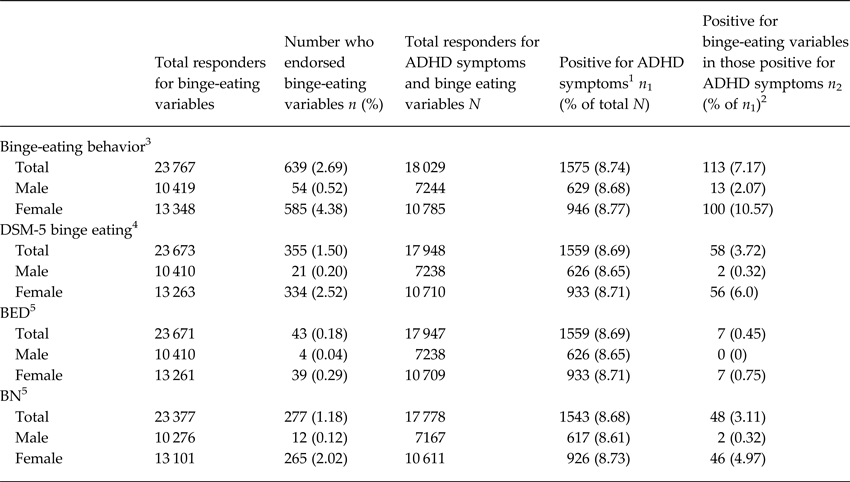
Descriptive statistics were used to characterize the study population (Table 1). We used mixed-effects logistic regression, with a random effect shared between twins in the same pair, adjusted for sex and age at assessment, to calculate prevalence odds ratios (ORs) and 95% confidence intervals (CIs), as measures of association between ADHD symptoms (2 s.d. cut-off) and binge-eating behavior, BED, and BN using Stata 11.2 (StataCorp LP, College Station, Texas, USA).
Distribution of binge-eating behavior, DSM-5 binge eating, BED, and BN in the population and ADHD symptoms (norm-based 2 s.d. method) in Swedish adult twins

BED, binge-eating disorder; BN, bulimia nervosa; ADHD, attention-deficit hyperactivity disorder; 2 s.d., 2 standard deviations; DSM-5, Diagnostic and Statistical Manual of Mental Disorders, Fifth edition.
1 ADHD symptoms, norm-based, 2 s.d. cut-off method.
2 Per cent of those positive for ADHD symptoms.
3 Binge eating ever, with concomitant loss of control required, no duration and frequency restrictions.
4 Binge eating for at least 3 months, at least four times/month.
5 BED and BN based on DSM-5 criteria.
We used structural equation modeling to perform maximum-likelihood model-fitting with OpenMx (Boker et al. Reference Boker, Neale, Maes, Wilde, Spiegel, Brick, Spies, Estabrook, Kenny, Bates, Mehta and Fox2011) for ADHD symptoms and binge-eating behavior in female twins. This allows inclusion of individuals, with information from only one twin in a pair available. In opposite sex DZ twins, males’ results were set as missing. We used the full information maximum likelihood method to handle missing data. We also fitted models using female–female pairs only, with results in line with current results (online Supplementary material). Low power prevented analysis of associations of ADHD symptoms with BED and BN.
Individuals from MZ twin pairs share 100%, while DZ pairs share, on average, 50% of their segregating genes. MZ and DZ twins are assumed to share family environment equally. Higher twin correlations (within twin pair correlation for a given trait) for MZ compared with DZ twins indicate the role of additive genetic factors (A), reflecting additive effects of different alleles; MZ correlations greater than twice the DZ correlations indicate non-additive effects (dominance, D), reflecting interaction effects between alleles at the same genetic locus. DZ correlations greater than half the MZ correlations suggest an effect of shared environment (C), i.e. environmental factors common to both twins. MZ correlations lower than 1 indicate the role of non-shared environmental effects (E), i.e. environmental factors acting to make twins different, including measurement error. Cross-twin, cross-trait correlations (CTCT) – the correlation between twin 1's status on ADHD and twin 2's status on binge-eating behavior, and vice versa – can indicate genetic and/or environmental factors shared between the two traits. All models were adjusted for age at time of assessment, used as a covariate.
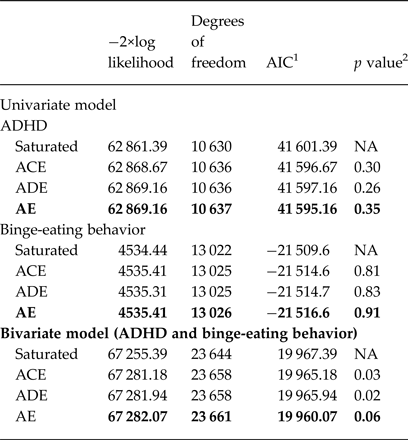
We applied structural equation modeling to estimate how much the variance of ADHD symptoms, binge-eating behavior, and the covariance between them, was explained by A, C, D, and E. Different models were fitted to the data, including models limited to components A, C, and E (ACE model); A, D, and E (ADE model); and A and E (AE model) (Neale & Cardon, Reference Neale and Cardon1992). Based on previous research and on the observed twin correlations in our sample, all fitted models included additive genetic components. Models were compared with a saturated model (i.e. all means and covariance matrices were allowed to differ for different types of twins) using a likelihood ratio χ2 test. This test can indicate if the model fits the data significantly worse than the fully saturated model. To identify the best-fitting model, we also computed the Akaike Information Criterion (AIC). Lower AIC values indicate better quality of the model for observed data. As AIC favors parsimony, models with fewer parameters adequately explaining the data are favored (Table 2).
Quantitative genetic model fitting for ADHD symptoms, binge-eating behavior in Swedish female twins (males set as missing), compared with the saturated model

A, additive genetic factors; D, dominant genetic factors; C, shared environmental factors; E, non-shared environmental factors; ADHD, attention-deficit hyperactivity disorder.
1 AIC – Akaike Information Criterion. Lowest AIC, indicating the best fitting model is highlighted in bold.
2 p value (compared with the saturated model).
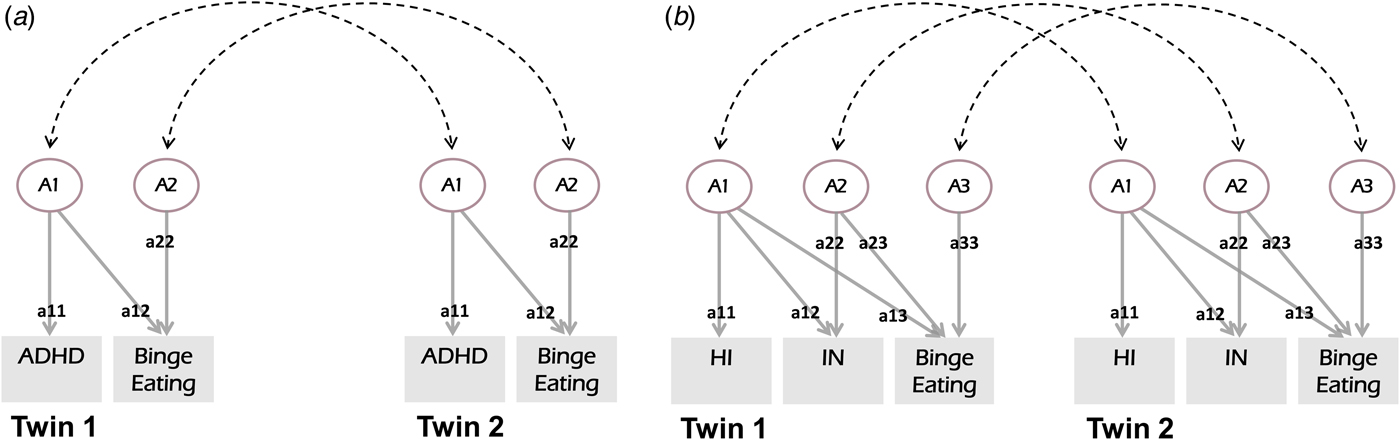
ADHD symptom count was a continuous variable, while binge-eating behavior was a binary variable. We used a liability-threshold approach, assuming an underlying normally distributed liability to binge-eating behavior. With this method, observed binge-eating behavior was 1 if the liability was above a threshold and 0 (no binge-eating behavior) if below. The phenotypic correlation refers to the correlation between ADHD symptoms and this underlying liability to binge-eating behavior. We used a univariate ACE model, to estimate heritability for ADHD-symptoms and binge-eating behavior and a bivariate-correlated factors model to estimate additive genetic (r A), shared environmental (r C), and non-shared environmental (r E) correlations between ADHD and binge-eating behavior. Similarly, in an ADE model, we estimated r A, dominant genetic (r D), and r E correlations, and in the AE model r A and r E. These correlations indicate the extent to which genetic and environmental influences on one measure correlate with those on the other. We also calculated the proportion of the phenotypic correlation between ADHD and binge-eating behavior explained by genetic and environmental factors. In a Cholesky decomposition (Fig. 1a ), the ordering of the variables is important; the variable to the left is allowed to explain variance in variables to the right, but not vice versa. Consequently, factor A1 stands for the genetic factors for one trait (ADHD in this case), including those shared with the other trait (binge-eating behavior). A significant path a12 will indicate shared genetic effects. A2 are the unique (residual) genetic factors for binge-eating behavior, and vice versa for ADHD if the order of the variables is reversed. For simplicity, Fig. 1a and b only illustrate genetic factors, but environmental factors were modelled using the same pattern.
(a) Bivariate Cholesky decomposition of genetic factors shared by ADHD and binge-eating behavior. A1 = genetic factors for ADHD and shared with binge-eating behavior (path a12), A2 = residual (unique) genetic factors for binge-eating behavior (when binge eating is set second in the model). (b) Trivariate Cholesky decomposition of unique genetic factors shared by IN and binge-eating behavior when controlling for common factors for HI, IN, and binge-eating behavior. A1 = factors in common between IN and HI shared with binge-eating behavior, A2 = additional factors unique to IN shared with binge-eating behavior. HI, hyperactive impulsive adult ADHD symptoms; IN, inattentive adult ADHD symptoms and binge-eating behavior (when binge eating is set second in the model); ADHD, attention-deficit hyperactivity disorder.

Further we examined how binge-eating behavior was associated with HI and IN ADHD symptom dimensions, respectively, using bivariate models. In both sets of analyses, phenotypic correlations, intra-class correlations and CTCT adjusted for age at assessment were estimated, similar to the main analysis. In order to determine if genetic or environmental effects shared with binge-eating behavior were specific to HI or IN symptoms, we fitted two separate trivariate models (Cholesky decomposition): first a model to estimate phenotypic correlation between HI and binge-eating behavior when controlling for IN (partial correlation), and second the partial correlation between IN and binge-eating behavior when controlling for HI. Similarly, we estimated genetic and non-shared environmental correlations between HI and binge-eating behavior when controlling for IN and vice-versa for IN, controlling for HI. In the trivariate model, the factor A1 in Fig. 1b represents genetic factors in common for HI, IN, and binge-eating behavior. Factor A2 captures additional factors unique to IN and shared with binge-eating behavior. A significant path between A2 and binge-eating behavior, labeled a23 in Fig. 1b , indicates effects associated with IN (but not HI) shared with binge-eating behavior. Similarly, genetic effects shared between HI (but not IN) and binge-eating behavior can be calculated, setting IN first in the model.
Results
Table 1 displays descriptive statistics for binge-eating behavior in the population by sex and by ADHD symptom status. The prevalence of binge-eating behavior was low. Of 23 767 individuals providing data, 639 (2.69%), males = 54 (0.52%) and females = 585 (4.38%), reported lifetime binge-eating behavior. N = 43 (0.18%) endorsed symptoms meeting criteria for BED, and n = 277 (1.18%) for BN. Low prevalence in males decreased the population prevalence (Table 1).
Those with ADHD symptoms (2 s.d. cut-off) had significantly increased risk for binge-eating behavior [OR 3.65 (95% CI 2.72–4.91), p < 0.001] and DSM-5 binge-eating behavior [OR 3.01 (95% CI 2.09–4.35), p < 0.001] compared with those without ADHD symptoms. Both BED [OR 2.55 (95% CI 1.11–5.86), p < 0.05] and BN [OR 3.09 (95% CI 2.09–4.56), p < 0.001)] were significantly more common in adults with ADHD symptoms (online Supplementary material).
Subsequent analysis focused on binge-eating behavior in female twins only. We observed a statistically significant phenotypic correlation of 0.20 (95% CI 0.15–0.26) between ADHD symptom count and binge-eating behavior. Twin correlations and CTCT correlations indicated genetic factors contributing to ADHD symptoms, binge-eating behavior, and the covariance between the two phenotypes (online Supplementary material).
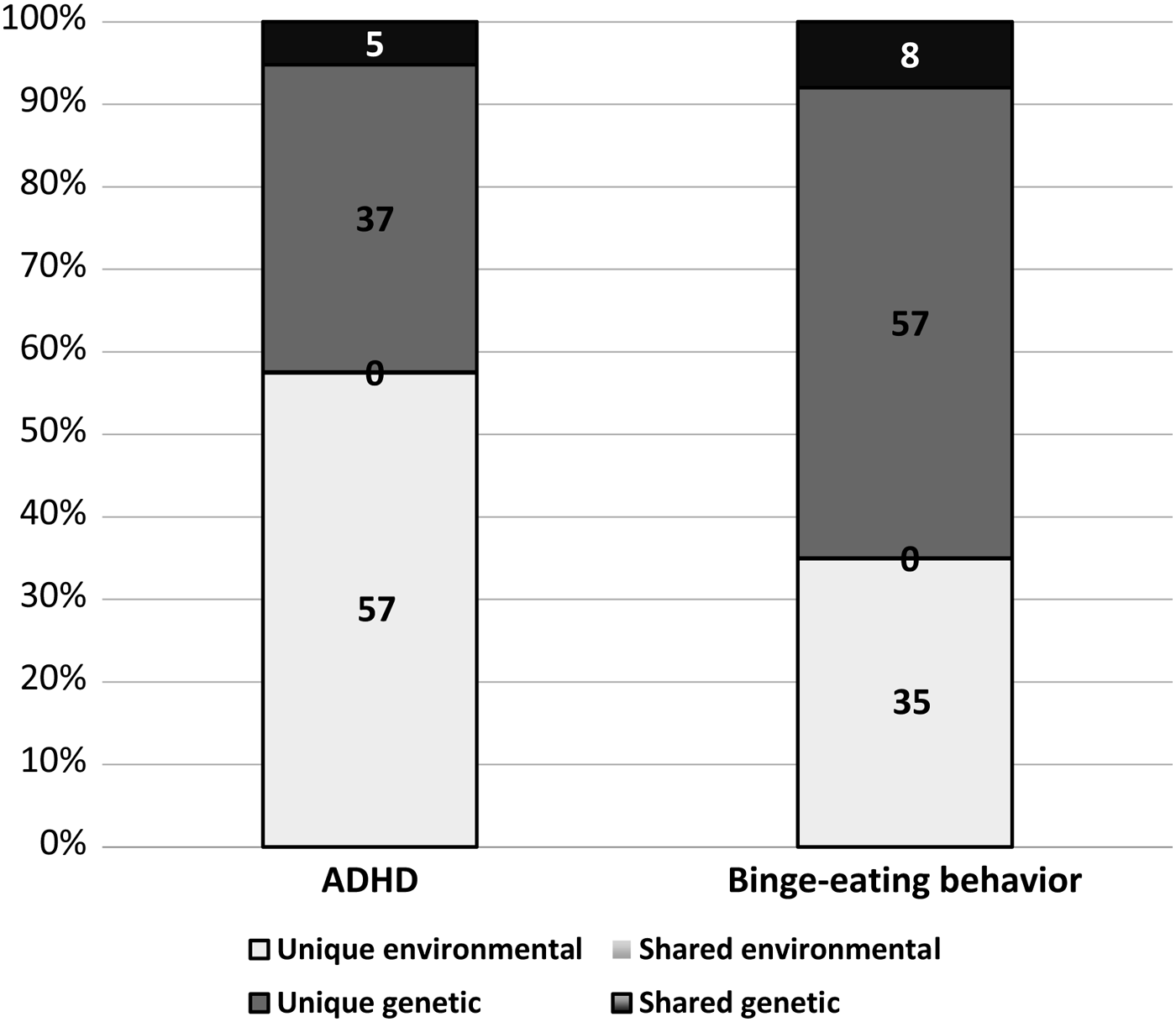
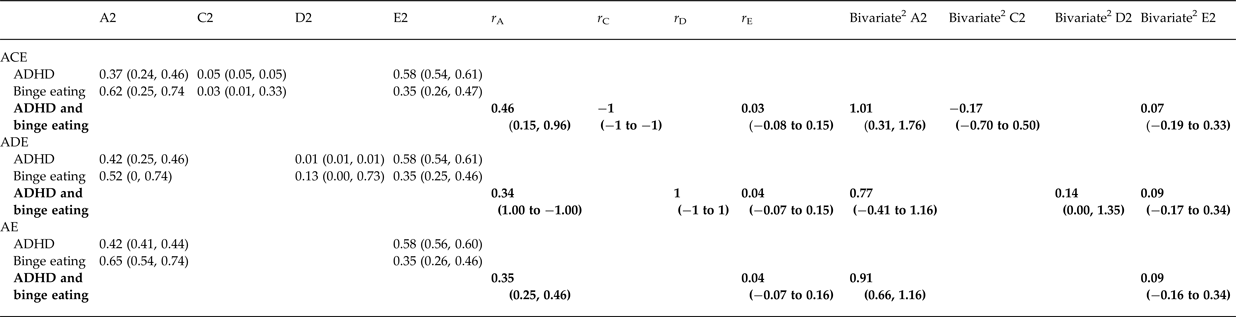
Univariate model fitting for ADHD and for binge-eating behavior indicated AE as best fitting models, not significantly different from the saturated models and with lowest AIC values (Table 2). Univariate analysis showed moderate heritability for ADHD (0.42, 95% CI 0.41–0.44) and high heritability for binge-eating behavior (0.65, 95% CI 0.54–0.74). Bivariate model fitting also indicated AE as the best fitting model. The genetic correlation was estimated at 0.28 (95% CI 0.17–0.40) and the non-shared environmental correlation at 0.10 (95% CI −0.04 to 0.24). Shared genetic factors explained 91% of the covariance between ADHD and binge-eating behavior. Non-shared environmental effects (E) accounted for the remaining 9% of the covariance (Table 3). Figure 2 shows the proportion of shared v. residual (unique) genetic and environmental effects explaining the variability of each phenotype (ADHD respectively binge eating).
Proportion of shared v. residual (unique) genetic and environmental effects explaining the variability of ADHD, when binge-eating behavior is set first in the model (Cholesky decomposition), respectively, of binge-eating behavior when ADHD is set first in the model. ADHD, attention-deficit hyperactivity disorder.

Parameter estimates (95% CI 1 ) for ACE, ADE and AE univariate models for ADHD symptoms; binge-eating behavior; and from bivariate model for ADHD and binge-eating behavior (binge eating) in a population of 13 773 adult Swedish female twins (3664 complete twin pairs)

A, additive genetic factors; D, dominant genetic factors; C, non-shared environmental factors; E, non-shared environmental factors; ADHD, attention-deficit hyperactivity disorder.
1 95% confidence interval.
2Bivariate A (bivariate heritability) refers to the amount of covariance between the two phenotypes explained by A, similarly for C, D, and E. Best fitting model for the bivariate analysis is highlighted in bold.
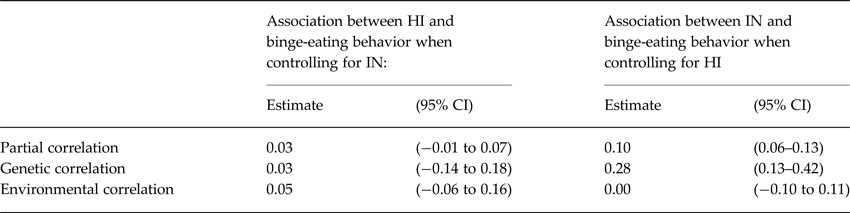
We analyzed separately how binge-eating behavior was associated with HI and IN ADHD symptom dimensions. Phenotypic correlations between binge-eating behavior and both HI (0.18, 95% CI 0.12–0.24) and IN (0.18, 95% CI 0.13–0.24) symptoms were similar. CTCT indicated shared genetic factors for both HI and IN with binge-eating behavior (online Supplementary material). The partial correlation between binge-eating behavior and the IN symptom dimension when controlling for HI (0.10, 95% CI 0.06–0.13) was stronger than the partial correlation between binge-eating behavior and the HI symptom dimension (0.03, 95% CI −0.01 to 0.07) (Table 4). Genetic correlation for the IN symptoms and binge-eating behavior remained statistically significant when controlling for factors shared with HI (0.28, 95% CI 0.13–0.42). In contrast, genetic and environmental correlations between the HI symptom dimension and binge eating attenuated substantially and became non-significant, when controlling for factors shared with IN.
Association between HI ADHD symptoms and binge-eating behavior, when controlling for IN, and associations between IN and binge-eating behaviors when controlling for HI

HI, hyperactive/impulsive ADHD symptoms; IN, inattentive ADHD symptoms; 95% CI, 95% confidence interval; ADHD, attention-deficit hyperactivity disorder.
Discussion
This study explored the association between ADHD symptoms in adults and lifetime binge-eating behavior in a population-based sample of twins. Shared genetic factors explained most of this association in females. Future genomic studies for ADHD and binge eating should focus on identifying such shared cross-disorder genetic risks. Better understanding of the nature of associations between ADHD and binge eating is useful when developing novel early intervention strategies and, thereby, possibly preventing the adverse correlates of binge eating, such as obesity, anxiety, depression, and suicidal risk (Davis, Reference Davis2015; Welch et al. Reference Welch, Jangmo, Thornton, Norring, Von Hausswolff-Juhlin, Herman, Pawaskar, Larsson and Bulik2016).
Phenotypic associations
Like previous studies (Surman et al. Reference Surman, Randall and Biederman2006; Cortese et al. Reference Cortese, Isnard, Frelut, Michel, Quantin, Guedeney, Falissard, Acquaviva, Dalla Bernardina and Mouren2007b ; Bleck & DeBate, Reference Bleck and Debate2013), we found ADHD symptoms in adults significantly associated with increased binge-eating behavior, as well as with BED and BN. Results are in accord with follow-up studies identifying childhood ADHD as risk factor for binge eating (Biederman et al. Reference Biederman, Ball, Monuteaux, Surman, Johnson and Zeitlin2007; Bleck & DeBate, Reference Bleck and Debate2013; Sonneville et al. Reference Sonneville, Calzo, Horton, Field, Crosby, Solmi and Micali2015). The lower prevalence of BED and BN in our population compared with other studies may partly be due to low prevalence in males and partly to geographical differences. A recent Finnish study estimated BED prevalence to 0.7% (Mustelin et al. Reference Mustelin, Raevuori, Hoek, Kaprio and Keski-Rahkonen2015), closer to our results and in contrast to US data suggesting BED prevalence around 3% (Davis, Reference Davis2015). Further studies are necessary to determine the prevalence of binge-eating behaviors and disorders and their association with clinically diagnosed ADHD. We found a considerable sex difference, with lower prevalence of binge-eating behaviors in men. Eating disorders are less common in men, but men may also under-report binge-eating symptoms due to feelings of shame and fear of stigmatization (Strother et al. Reference Strother, Lemberg, Stanford and Turberville2012; MacLean et al. Reference Maclean, Sweeting, Walker, Patterson, Raisanen and Hunt2015). Other approaches are necessary, such as using clinical samples in primary health care and psychiatry or questionnaires adapted to how men experience eating disorders (Anderson & Bulik, Reference Anderson and Bulik2004), to investigate binge eating and related problems in males.
Shared genetic and environmental factors
Our results suggest the association between ADHD symptoms and binge-eating behavior being primarily due to shared genetic factors. Part of this genetic overlap may reflect genetic risk variants with general effects cutting across traditional boundaries between neuropsychiatric traits and disorders (Pettersson et al. Reference Pettersson, Larsson and Lichtenstein2016). Identification of cross-disorder genetic risks is one of the challenges to understanding the etiology of neuropsychiatric disorders.
The finding of shared genetic risk factors may also partly reflect shared neurocognitive underpinnings of ADHD and binge eating (Seymour et al. Reference Seymour, Reinblatt, Benson and Carnell2015). These involve problems with executive and cognitive function, and emotional regulation, such as negative urgency (Racine et al. Reference Racine, Keel, Burt, Sisk, Neale, Boker and Klump2013). Individuals with ADHD also display deficits in inhibitory control, vigilance, planning (Carmona et al. Reference Carmona, Hoekzema, Ramos-Quiroga, Richarte, Canals, Bosch, Rovira, Soliva, Bulbena, Tobena, Casas and Vilarroya2012; Coghill et al. Reference Coghill, Seth and Matthews2014), and emotional regulation (Shaw et al. Reference Shaw, Stringaris, Nigg and Leibenluft2014), leading to suboptimal decision-making and preference for immediate v. delayed rewards (Solanto et al. Reference Solanto, Abikoff, Sonuga-Barke, Schachar, Logan, Wigal, Hechtman, Hinshaw and Turkel2001; Sonuga-Barke & Fairchild, Reference Sonuga-Barke and Fairchild2012). Deficits in inhibitory control and preference for immediate rewards are also exhibited in individuals with binge-eating behaviors, BN, binge-purge AN (Brogan et al. Reference Brogan, Hevey and Pignatti2010; Wu et al. Reference Wu, Hartmann, Skunde, Herzog and Friederich2013), and BED (Davis et al. Reference Davis, Patte, Curtis and Reid2010). Dopamine (DRD2) receptor variability has been described in obese individuals with BED (Davis et al. Reference Davis, Levitan, Reid, Carter, Kaplan, Patte, King, Curtis and Kennedy2009b ) and in ADHD (Franke et al. Reference Franke, Faraone, Asherson, Buitelaar, Bau, Ramos-Quiroga, Mick, Grevet, Johansson, Haavik, Lesch, Cormand and Reif2012), suggesting possible genetic overlap. Also dopamine D3 receptor implicated in HI ADHD symptoms and binge eating may have a role in the association (Davis et al. Reference Davis, Patte, Levitan, Carter, Kaplan, Zai, Reid, Curtis and Kennedy2009a ).
Another mechanism may involve the addictive potential of highly palatable foods (such as sweet and fatty and salty and fatty foods) that, similarly to psychoactive substances, activate dopamine release in mesolimbic reward pathways, increasing the risk for overeating (Gearhardt et al. Reference Gearhardt, Davis, Kuschner and Brownell2011a ; Schulte et al. Reference Schulte, Grilo and Gearhardt2016). Several studies suggest an addictive dimension to obesity (Volkow et al. Reference Volkow, Wang, Tomasi and Baler2013) and BED (Gearhardt et al. Reference Gearhardt, White and Potenza2011b ). Common genetic factors have been identified for BN (involving binge eating) and alcoholism (Trace et al. Reference Trace, Thornton, Baker, Root, Janson, Lichtenstein, Pedersen and Bulik2013b ) as well as between ADHD and alcoholism (Edwards & Kendler, Reference Edwards and Kendler2012; Capusan et al. Reference Capusan, Bendtsen, Marteinsdottir, Kuja-Halkola and Larsson2015). It could be speculated that shared genetic factors of ADHD symptoms and binge eating may partly reflect common genetic pathways for different addictive behaviors (Blum et al. Reference Blum, Braverman, Holder, Lubar, Monastra, Miller, Lubar, Chen and Comings2000). Genetically influenced traits such as delay aversion and low inhibitory control were found in individuals with ADHD (Solanto et al. Reference Solanto, Abikoff, Sonuga-Barke, Schachar, Logan, Wigal, Hechtman, Hinshaw and Turkel2001; Sonuga-Barke & Fairchild, Reference Sonuga-Barke and Fairchild2012) and females with binge eating and related disorders (Davis et al. Reference Davis, Patte, Curtis and Reid2010; Wu et al. Reference Wu, Hartmann, Skunde, Herzog and Friederich2013). These may be particularly detrimental in environments with pervasive food-related cues, and with highly palatable foods easily available at all times (Davis et al. Reference Davis, Levitan, Reid, Carter, Kaplan, Patte, King, Curtis and Kennedy2009b ; Gearhardt et al. Reference Gearhardt, White and Potenza2011b ). The role of food-related addictive behaviors in binge eating and the association with ADHD needs further exploration in clinical samples.
In addition, overlap between ADHD and binge-eating behavior may also reflect ADHD dimension-specific genetic effect. We found a small but significant genetic correlation between the IN symptoms and binge-eating behavior, even after controlling for the genetic effects shared with HI symptoms. There was however no evidence supporting specific genetic effects for the HI symptom dimension. This is somewhat surprising given that HI in girls has been associated with eating problems later in life (Mikami et al. Reference Mikami, Hinshaw, Patterson and Lee2008). In our study, we analyzed the association between ADHD symptoms in adults and binge eating. HI symptoms tend to decrease at a higher rate with age compared with IN symptoms (Biederman et al. Reference Biederman, Mick and Faraone2000). We have no information on whether women reporting mainly IN symptoms, had more HI symptoms in their childhood. Future genomic studies on the association between ADHD and binge eating may benefit from including information about ADHD symptom dimensions and/or subtypes.
In the univariate analysis, 42% heritability estimate for ADHD is in line with previous twin studies based on self-report data (Boomsma et al. Reference Boomsma, Saviouk, Hottenga, Distel, De Moor, Vink, Geels, Van Beek, Bartels, De Geus and Willemsen2010; Franke et al. Reference Franke, Faraone, Asherson, Buitelaar, Bau, Ramos-Quiroga, Mick, Grevet, Johansson, Haavik, Lesch, Cormand and Reif2012), but lower than heritability estimates for childhood ADHD and clinically diagnosed adult ADHD (around 60–90%) (Larsson et al. Reference Larsson, Chang, D'onofrio and Lichtenstein2014). Differences in heritability estimates have previously been attributed to rater effects (Brikell et al. Reference Brikell, Kuja-Halkola and Larsson2015) and measurement error in self-report data (Franke et al. Reference Franke, Faraone, Asherson, Buitelaar, Bau, Ramos-Quiroga, Mick, Grevet, Johansson, Haavik, Lesch, Cormand and Reif2012). However, molecular genetic studies show similar polygenic risks (Levy et al. Reference Levy, Hay, Mcstephen, Wood and Waldman1997; Martin et al. Reference Martin, Hamshere, Stergiakouli, O'donovan and Thapar2014) in clinical ADHD samples as for those associated with ADHD symptoms in the population, supporting the use of population samples for the study of ADHD (Faraone et al. Reference Faraone, Asherson, Banaschewski, Biederman, Buitelaar, Ramos-Quiroga, Rohde, Sonuga-Barke, Tannock and Franke2015). For binge-eating behavior, heritability was estimated as 65%, which is higher than one Norwegian study [41% (95% CI 31–50%) (Reichborn-Kjennerud et al. Reference Reichborn-Kjennerud, Bulik, Tambs and Harris2004)], but in line with another study assessing binge eating in women [70% (95% CI 26–77%) (Root et al. Reference Root, Thornton, Lindroos, Stunkard, Lichtenstein, Pedersen, Rasmussen and Bulik2010)].
Limitations
Presented results should be considered in the context of several limitations. Response rates of 60%, similar to other large epidemiological surveys, were relatively low. Drop-out has previously been attributed to unwillingness to answer to a survey with over 1300 questions. Drop-out analyses, described earlier (Furberg et al. Reference Furberg, Lichtenstein, Pedersen, Thornton, Bulik, Lerman and Sullivan2008; Friedrichs et al. Reference Friedrichs, Igl, Larsson and Larsson2012; Larsson et al. Reference Larsson, Asherson, Chang, Ljung, Friedrichs, Larsson and Lichtenstein2013), found that non-responders did not significantly differ from responders regarding birth weight and age; however, non-responders were significantly more often male, had a parent/s born outside of Sweden, had been diagnosed with a psychiatric condition, and convicted for any type of crime. As ADHD is associated with psychiatric disorders (Kessler et al. Reference Kessler, Adler, Barkley, Biederman, Conners, Demler, Faraone, Greenhill, Howes, Secnik, Spencer, Ustun, Walters and Zaslavsky2006), and is more prevalent in prison populations (Edvinsson et al. Reference Edvinsson, Bingefors, Lindstrom and Lewander2010; Ginsberg et al. Reference Ginsberg, Hirvikoski and Lindefors2010), individuals with more severe ADHD probably did not respond to the questionnaire, limiting generalizability of our findings to the more severe end of the ADHD spectrum.
All data were based on self-reported symptoms in the general population. Self-reported ADHD symptoms show satisfactory psychometric properties (Murphy & Schachar, Reference Murphy and Schachar2000; Sandra Kooij et al. Reference Sandra Kooij, Marije Boonstra, Swinkels, Bekker, De Noord and Buitelaar2008), and were found to be stable over time (Larsson et al. Reference Larsson, Asherson, Chang, Ljung, Friedrichs, Larsson and Lichtenstein2013). Information on functional impairment or childhood onset was not available. Our sample probably includes subthreshold cases, with ADHD symptoms, without fulfilling criteria for a clinical diagnosis that may be the less severe manifestations of the syndrome (Faraone et al. Reference Faraone, Biederman, Doyle, Murray, Petty, Adamson and Seidman2006).
Reliability of self-reported data on binge eating and related conditions is more unclear. An earlier twin study found low reliability and lower heritability estimates, around 50% (Bulik et al. Reference Bulik, Sullivan and Kendler1998) for binge eating reported by just one assessment. Described results reflect an association between ADHD symptoms and binge-eating behavior, in about half of the cases outside DSM-5 BED and BN cut-offs. Given the low prevalence in our sample compared with international findings, it is likely that binge eating was under-reported and our measures are conservative, probably restricting generalizability to the milder end of the spectrum in the population.
Heritability estimates were based on only eight female DZ twins concordant for binge-eating behavior, possibly affecting precision of our estimates. Despite a large study population, statistical power was too low to examine genetic and environmental aspects of the association in males, which is an important limitation and calls for future research using alternative methodologies that more accurately capture symptom patterns in males and could therefore yield different results.
Although we assess lifetime binge eating, ADHD is assessed as current symptoms. As data are cross-sectional, we are not able to draw any inference regarding whether ADHD leads to binge eating in adults. Longitudinal follow-up research found that ADHD in children and adolescents is a risk factor for later binge eating (Biederman et al. Reference Biederman, Ball, Monuteaux, Surman, Johnson and Zeitlin2007; Bleck & DeBate, Reference Bleck and Debate2013; Sonneville et al. Reference Sonneville, Calzo, Horton, Field, Crosby, Solmi and Micali2015). Further longitudinal clinical studies are necessary to elucidate the temporal nature of the association between ADHD and binge eating in adults.
Results may also be influenced by inherent limitations in twin studies. For instance, basic assumptions in twin studies include random mating in the population. Assortative mating in some psychiatric conditions, including ADHD (Nordsletten et al. Reference Nordsletten, Larsson, Crowley, Almqvist, Lichtenstein and Mataix-Cols2016) may lead to underestimating heritability. Conversely, gene–environment interactions between the easy availability of highly palatable foods and genetically determined characteristics, such as reduced inhibitory control or emotional dysregulation in individuals with ADHD, cannot be excluded. In a twin study, these effects would be subsumed in the heritability estimates, possibly overestimating common genetic factors in bivariate models.
In conclusion, this study suggests that the association between adult ADHD symptoms and lifetime binge-eating behavior is primarily due to shared genetic risk factors in females. Clinicians need to be aware of these associations when assessing and managing individuals presenting with ADHD symptoms or binge-eating behavior.
Supplementary Material
The supplementary material for this article can be found at https://doi.org/10.1017/S0033291717001416.
Acknowledgements
A.J.C. has received ALF Grants, Region Östergötland, Sweden (LIO-440851). C.M.B. acknowledges funding from the Swedish Research Council (VR Dnr: 538-2013-8864). S.Y. acknowledges financial support from China Scholarship Council.