Over the past decades, Latin American countries have expanded their welfare states (Huber and Stephens Reference Huber and Stephens2012; Pribble Reference Pribble2013; Martínez-Franzoni and Sánchez-Ancochea Reference Martínez-Franzoni and Sánchez-Ancochea2016; Garay Reference Garay2017). Arguably the most significant universalization of noncontributory healthcare and pensions has taken place in Brazil and Bolivia, respectively. In the late 1980s, Brazil universalized health provision to those without insurance, and in the mid-2000s, Bolivia guaranteed universal access to pension benefits. While temporally apart, both initiatives took place in the context of major constitutional reforms, preceded by discussions in constituent assemblies. This context provided a window of opportunity for social movements and other civil society organizations (CSOs) to influence the reform process.Footnote 1 The focus of this article is the participation of civil society in social policymaking.
Whereas previous scholars have shown that organized civil society matters for explaining social policy characteristics in Latin America (Huber and Stephens Reference Huber and Stephens2012; Pribble Reference Pribble2013; Niedzwiecki Reference Niedzwiecki2014, Reference Niedzwiecki2015; Garay Reference Garay2017), we know little about how and to what extent patterns of mobilization and participation differ for shaping universalistic social policies. Specifically, the mechanisms that connect CSOs with the characteristics of social policies are less well documented and theorized. This article contributes to those debates and to the growing literature on the promotion of popular participation.Footnote 2 This literature has overwhelmingly focused on the expansion of citizen participation through consultative processes and mechanisms that take place in local arenas (Fung and Wright Reference Fung and Wright2001), as opposed to the impact of popular input on national policy processes. This article focuses on national policymaking, and especially on policies with massive redistributive impact.
Understanding forms of popular participation in national social policymaking is crucial because policies that allow for civil society input can potentially be more representative, accountable, stable, and generous. When the policymaking process is more participatory, it allows underrepresented groups to shape the outcome. These groups not only influence the characteristics of the policy that will be adopted but also increase accountability mechanisms in the implementation stage. Policies that emerge as a product of pressures from CSOs tend to be implemented in a nondiscretionary way (Garay Reference Garay2017, 57). In addition, citizens who experience direct forms of democratic participation may increase their sense of efficacy and may be invested in the long-term maintenance of the policy. Furthermore, Pribble (Reference Pribble2013) and Garay (Reference Garay2017) show that social policies that receive societal input have the potential to be more universalizing than policies that remain in the exclusive realm of elite decisionmaking. Whereas the existing literature emphasizes the benefits of popular participation for social policy, the forms of participation have been undertheorized. This article shows that popular participation and social policies can be connected by different mechanisms or paths.Footnote 3
To address this issue, this study looks at differences in patterns of popular participation in social policy at the time of passing reforms, the dependent variable.Footnote 4 The influence of civil society organizations has been particularly important for the development of social policy in Bolivia and Brazil, perhaps even more than in other Latin American countries. In both countries, societal participation has meaningfully shaped policies aimed at decreasing inequality. This influence ranges from introducing reforms on the agenda to modifying reforms in the policymaking process. Yet the forms of participation differ across cases. In Brazil, popular participation in social policymaking takes place mostly through “inside” formal channels and mechanisms for citizen participation. These participatory structures, such as conferences and councils, institutionalize participation within the structure of the state.Footnote 5 In Bolivia, by contrast, influence in social policymaking occurs predominantly via “outside” channels (by coordinating pressure and sustaining collective action in the streets). This study explains not the amount of influence popular sector groups wield but the form that influence takes.
We argue that the different patterns of participation in social policies (i.e., inside vs. outside channels) can be explained by a combination of two factors: the previous institutional context and the type of movement. The more institutionallyrobust the context before the enactment of these reforms, the lower the incentives for CSOs to resort to the streets. Arce (Reference Arce2010) and Machado et al. (Reference Machado, Scartascini and Tommasi2011) show that the level of protest in Latin America since the Third Wave of democratization has increased in weaker institutional contexts, while stronger institutional contexts have dampened extrasystemic forms of participation. This argument is not tautological, given that it is possible to have highly robust institutions that are “sealed” to bottom-up participation. In other words, if strong institutions are not open and responsive, they can push people to express their demands outside formal channels.
Overall, Brazil’s institutional environment is more robust than Bolivia’s and thus offers higher incentives for CSOs to influence policymaking from within. In Brazil, the bureaucratic-authoritarian regime (1964–85) partly kept elections and Congress in place, and this proved consequential for the gradual transition to democracy. After the transition, in spite of the weakness of the overall party system, parties on the left (especially the Workers’ Party and the Communist Party) exhibited relatively high levels of institutionalization (Mainwaring Reference Mainwaring, Mainwaring and Scully1995, Reference Mainwaring1999). These parties proved to be key allies of social movements pushing for health universalization (Garay Reference Garay2017, 132–33). Bolivia’s context in the early 2000s was one of weak democratic institutions, with established parties in a state of collapse (Roberts Reference Roberts2015; Cyr Reference Cyr2017), an overall “crisis of representation,” in which political parties failed to represent societal interests in the formal democratic arena and formal institutions were in disarray (Mainwaring et al. Reference Mainwaring, Bejarano and Leongómez2006). In that context, the cost of bypassing formal institutional channels was low.
The institutional context makes the choice of one path over the other more likely. However, it cannot fully explain why patterns of participation in social policymaking vary so much. For instance, in Brazil, organized healthcare workers used institutionalized channels to advance their goals in the reform process, whereas that did not happen in the social assistance sector. The institutional context creates incentives, but it requires mobilizing forces capable and willing to use those incentives to their advantage. Thus, variation in the forms of popular participation also responds to differences in the type of social actors that are pressuring for reform: professional-based or grassroots movements.
The main power resource of associations made up of middle-class workers in the professions is their capacity to bargain with politicians in higher office—through the provision of in-depth knowledge about an issue, financial contributions, and electoral support—while a core strength of grassroots movements lies in their capacity to bring together large numbers of participants and engage in “street politics.” Therefore, the former have incentives to choose inside channels and the latter, outside forms of participation. In Brazil, the healthcare movement, called the Movimento Sanitarista, is a middle-class association formed mostly of health professionals. In the case of Bolivia, conversely, most movements pushing for social policy reform are organizations that represent rural and urban poor social sectors, groups traditionally excluded from the political power game. The characteristics of the health movement in Brazil make inside forms of participation in social policies morelikely. The reverse—that is, grassroots organizations representing subordinate groups—makes the use of outside channels more likely in Bolivia.
Bolivia and Brazil are cases with high levels of participation, resulting in the most universalizing social policies in the pension and health sectors, respectively. Moments of constitutional reform are windows of opportunity to exert influence on the characteristics of the state, including the welfare state. Aside from the high level of participation during the contentious processes of constitutional reform, however, these countries exhibit deep differences in the form of participation.
For each country, we selected the social policy sector that has seen the greatest expansion: healthcare in Brazil and pensions in Bolivia. In Brazil, the sanitaristas, in alliance with unions, grassroots organizations, and left parties, pushed to reform the health system in 1988 and created the Unified Health System (Sistema Único de Saúde, SUS), which provides universal access to healthcare. Participation happened mostly via inside channels. Bolivia experienced a similar expansion, but mobilization from below was central for passing legislation that pushed pensions toward greater universalism. That included the 2010 reform to the pension system and a previous expansion of the noncontributory pension Renta Dignidad in 2007. Both reforms expanded pensions to those who were not covered by the contributory system. Furthermore, the different timing of the reforms (1980s in Brazil and the mid-2000s in Bolivia) allows us to control for a number of alternative explanations to forms of popular participation, including the role of left parties in power and the characteristics of the decentralization process.
Patterns of Popular Participation in Social Policies
Welfare states in Latin America expanded after the consolidation of democracy (Haggard and Kaufman Reference Haggard and Kaufman2008; Huber and Stephens Reference Huber and Stephens2012). Recent literature on the expansion of social policies incorporates the important role of the strength and mobilizational power of civil society, sometimes in coalition with left parties (Huber and Stephens Reference Huber and Stephens2012; Pribble Reference Pribble2013; Niedzwiecki Reference Niedzwiecki2014, Reference Niedzwiecki2015, Reference Niedzwiecki2018). Garay (Reference Garay2017) shows that social policies that receive input from social movements or respond strategically to their demands produce more inclusive benefits with broader coverage.
Our central aim is to unpack the “how” of this process (the forms of popular participation in social policymaking), a topic that has been neglected overall in the literature on Latin American welfare expansion. In doing so, this article offers not only a theoretical and empirical contribution to this literature but also a methodological contribution: it explores the possibility that the role of CSOs and the universalization of social policy are connected by different causal mechanisms. It explains how some independent and dependent variables in the literature on Latin American welfare states can be the same across countries, and yet their causal mechanisms may differ across cases.Footnote 6
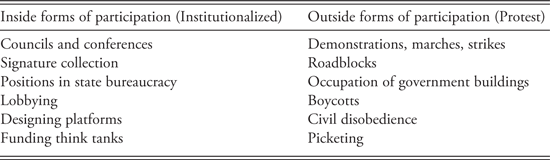
Our dependent variable is forms of popular participation in the expansion of social policies at the time of passing a given reform. Forms of popular participationcan have different characteristics. On the one hand, popular participation in social policies can take place through outside channels. Social actors exert pressure through “street politics,” by organizing protests and other disruptive manifestations of collective power in the streets or outside of the formal political arena, and in a permanent or at least semipermanent manner. On the other hand, popular participation can take place through inside channels. Civil society can participate and have good chances to influence the formulation of social policies through its involvement in councils and conferences, as well as through gathering signatures for petitions and occupying key positions in core state bureaucracies and representative institutions. This guarantees privileged access to policymaking. Table 1 lists possible inside and outside strategies for popular participation in policymaking; the list is not exhaustive, but it illustrates the dependent variable.
Possible Forms of Popular Participation in Social Policy Reforms (dependent variable)

The form of participation in the initial moment of the reform process—either inside, outside, or a combination of the two—in turn, shapes participation patterns during the implementation process. Following Pierson (Reference Pierson2004, 152), once a certain path has been established, deviating from it becomes increasingly unlikely—especially if a given pattern has been in place for some time. We expect forms of popular participation to be similar both in the initial process of policy reform and during the implementation process.
What accounts for variation in the forms of popular participation? We argue that differences in the institutional context in each country and the type of social actors pushing for social policy expansion explain, in large measure, these differences.
Institutional Context
The characteristics of the institutional context shape whether organized social actors use inside or outside channels of participation. A more institutionally robust and stable context can channel popular demands and thereby create incentives for using inside mechanisms for exerting influence. Conversely, contexts of weaker and volatile institutions offer greater incentives to express demands outside the formal rules of the game. Arce (Reference Arce2010) shows that in contexts of high-quality representation exercised by political parties in Latin America, individuals exercise their demands through electoral and legislative means.Footnote 7 Conversely, when the quality of party representation is low, the levels of social mobilization increase. Machado et al. analyze the probability of joining protests and demonstrations and argue that “when institutions are strong, actors are more likely to participate through institutionalized arenas. When they are weak, however, protests and other unconventional means or participation become more appealing” (Reference Machado, Scartascini and Tommasi2011, 3).
Both Brazil and Bolivia were undergoing highly contentious processes of constitutional change at the moment of the reforms analyzed in this study. This provided citizens and civil society actors with a unique window of opportunity to exert pressure to expand the welfare state. But in spite of this overarching similarity—or shared “starting points” in their contexts—Bolivia exhibited lower levels of institutional continuity at the moment of the reforms and therefore stronger incentives for resorting to outside forms of participation. The costs of operating outside of the formal rules of the game were comparatively lower in Bolivia than in Brazil.
Brazil’s health reform was added to the constitution in 1988. The country was undergoing a transition to democracy characterized by some degree of institutional continuity. Although the bureaucratic-authoritarian regime initially dissolved Congress and abolished parties, it later retained some vestiges of formal democracy and kept some national democratic institutions in place. In the early 1970s, as part of the decompression, the military reopened Congress and allowed opposition political parties and relatively free congressional elections. The maintenance of these institutions shaped the slow transition from authoritarianism to democracy. After the transition, Brazil normalized its strong bicameral and federal systems (Mainwaring Reference Mainwaring, Mainwaring and Scully1995, Reference Mainwaring1999; Samuels and Mainwaring Reference Samuels, Mainwaring and Gibson2004). Additionally, although scholars have underscored the weakness of political parties in Brazil at the time of the reform, left-wing parties were more disciplined, cohesive, and had stronger ties with unions and other social movements (Mainwaring Reference Mainwaring, Mainwaring and Scully1995, 354, 376). Links between opposition left parties in Congress and the sanitaristas were crucial for the success of the health reform.
At the time of the Constituent Assembly, the Bolivian institutional environment was marked by crisis, with parties broken and incapable of representing societal interests in the formal political arena (Cyr Reference Cyr2017) and an acute weakness of the legislative branch (Laserna et al. Reference Laserna, Oporto, Verdesoto and Zegada2007). Representative democracy and the broader political establishment entered a terminal crisis in the early 2000s (Mainwaring et al. Reference Mainwaring, Bejarano and Leongómez2006), and they were challenged by mobilized social actors in the streets.
Institutional contexts, however, cannot alone explain the differences in patterns of participation across or even within countries. Formal institutions provide the channels or the opportunities for participation and create different incentives. Their success, however, depends to a large extent on whether there are mobilizing forces that are both willing and capable of taking advantage of those opportunities. While in Brazil a well-organized movement such as the sanitaristas was able to use formal institutions to push forward its goals, there was no comparable organized group in the social assistance sector that could shape the national policymaking process similarly. Inside and outside channels require mobilizing forces to be operative.
Types of Civil Society Organizations
The sociodemographic characteristics of the social actors who are involved in the process help to explain the diverging patterns of participation. The main power resource of middle-class or professional-based associations is their capacity to bargain with politicians through the provision of in-depth knowledge around a policy issue and the provision of financial donations and electoral support. Conversely, the main strength of grassroots movements is their capacity to engage in massive and disruptive protest in the streets. This differentiates the sanitaristas in Brazil, a middle-class professional association, from grassroots movements in Bolivia. Although both seek to influence politics and policy processes, the former are more likely to do so through inside channels, whereas grassroots movements are more likely to engage through outside channels (Kitschelt Reference Kitschelt, Katz and Crotty2006, 281).
This does not mean that all middle-class movements (those that represent insiders, such as formal workers or doctors) will automatically use inside channels while grassroots movements (those representing outsiders, such as the unemployed, landless peasants, and the urban poor) will use outside channels. Otherwise, our argument would risk endogeneity by potentially defining the social movement by the form of participation. In fact, in Bolivia, unions representing formal salaried workers (insiders of the labor market) joined other grassroots organizations (representatives of outsiders) to support the pension reform in the streets, while in Brazil, grassroots organizations in São Paulo, for example, used councils as a mechanism for exerting influence in the healthcare reform. The type of movement may create an inclination to use one mode of participation or the other but does not automatically determine the path used.
The ability of those actors to intervene in politics and influence policies also depends on their partisan allies. Based on power resources theory (Korpi Reference Korpi1978; Esping-Andersen Reference Esping-Andersen1990; Huber and Stephens Reference Huber and Stephens2001), previous works show the relevance of left parties and their coalitions with organized civil society for social policy expansion (Huber and Stephens Reference Huber and Stephens2012; Pribble Reference Pribble2013). Huber and Stephens (Reference Huber and Stephens2012, 269) explain that the main effect of democracy for the expansion of social policies in Latin America is through the organization of underprivileged groups, who are natural allies of left parties.
Bolivia presents clear support for the power resources theory, with a left party in power expanding social policies. Brazil is less clear, as the universalization of healthcare has the movement (and not the left party) as the major driver of change. The healthcare movement promoted the universalization of healthcare in Brazil in 1988; that is, more than a decade before the Workers’ Party (PT) won the presidency in 2002. The movement exercised influence in the Constituent Assembly by building alliances with left parties in Congress, including the Communist Party and the PT. By comparison, Bolivia universalized pensions only after the MAS captured state power. The MAS is a newer party that emerged as a challenger to neoliberal policies in the mid-1990s and rose to power when social mobilization was high. The party could rely on mobilizational strategies as a policymaking tool.
Case Selection and Alternative Explanations
To identify different forms of popular participation in social policy and the causes for such variation, we engage in process tracing across two countries and two policy areas (Bennett and Checkel Reference Bennett and Checkel2015). Process tracing allows us to identify both the patterns of participation and the factors that explain the predominance of one pattern or the other. We select the policy sectors in each country that represent the main expansions of the welfare state and exhibit high levels of popular participation in their policymaking process. Brazil’s health system was universalized in 1988, and Bolivia’s pensions saw comparable expansion in the mid-2000s. At the same time, popular participation took place through inside channels in Brazil and outside channels in Bolivia.Footnote 8
Selecting different policy areas across countries raises the question of whether forms of participation are shaped by the type of social policy. While one may expect higher levels of participation in the health sector than in the pension sector, several instances of popular mobilization against pension reforms have taken place outside Bolivia, which indicates that participation in both policy areas can be high. In Argentina in the 1990s, for instance, unions pressured against the privatization of the system, gaining a number of concessions (Niedzwiecki Reference Niedzwiecki2014, 38).Footnote 9
Relatedly, one could claim that while pensions are more likely to create incentives for outside channels of participation, healthcare reform lends itself more easily to inside channels. Empirically, however, there is no clear reason why this would be the case. On the one hand, in Brazil, the Configuration of Agricultural Workers (CONTAG), in coalition with the peak union association (CUT), also used mostly inside channels to influence the pension reform during the process of constitutional reform (Garay Reference Garay2017, 135). After social movements gained concessions for rural workers during the Constituent Assembly, these unions continued participating through councils—or inside channels.Footnote 10
On the other hand, in other countries, health reform opponents have taken their demands to the streets. In Argentina, President Carlos Menem (1989–99) tried to open up private competition with the union-run health insurance system in 1992. Unions, key losers in this proposal, organized a general strike against it and forced the government to scale back the complete deregulation of the system (Murillo Reference Murillo2001, 145; Niedzwiecki Reference Niedzwiecki2014). On the basis of these examples, the type of policy is not a good predictor of the form of participation.
The difference in the time of the reforms requires further elaboration. The reform in Brazil dates from the late 1980s and in Bolivia from the mid-to-late 2000s. Both reforms have in common that they took place at the time of constituent assemblies created with the aim of rewriting the countries’ constitutions. This particular moment is a window of opportunity for organized social actors to influence the characteristics of the welfare state. As “foundational” moments, the decisions made at this time carry deep political and socioeconomic consequences. Recognizing that their actions would have long-lasting influence, CSOs participated actively in the expansion of social policy in both countries (Garay Reference Garay2017, 131; Silva Reference Silva2017, 103).
Besides these similarities in terms of their starting points, the broader historical context was different: Brazil was undergoing a process of transition to democracy, while Bolivia had been a democracy for two decades and was experiencing the recent election of a leftist government. This different time period allows us to control for a number of alternative explanations.
One alternative explanation for different patterns of participation in social policymaking emphasizes the different experiences with the left in both countries since the early 2000s. While Bolivia under the MAS has been characterized as a “radical” or “contestatory” type of left, Brazil under the PT has been described as belonging to the more “moderate” left (Weyland et al. Reference Weyland, Madrid and Hunter2010). Relatedly, the PT experienced a strong “normalization”—a process by which it lost a great deal of its initially bottom-up participatory élan—in order to attain power (Hunter Reference Hunter2010). By comparison, the MAS is a movement-based party—one formed by social movements—that has not yet experienced a comparable process of normalization and has remained more responsive to autonomous social mobilization (Anria Reference Anria2013, 37). As a result, we could expect more inside patterns of participation in Brazil compared to Bolivia. However, the health reform in Brazil was approved 15 years before the PT took power at the national level and at the time when the PT still retained the bulk of its participatory attributes (Hunter Reference Hunter2010). In fact, the PT in the 1980s looked very similar to the MAS in the mid-2000s. The difference in time period allows us to control for the type of left across countries.
The difference in the use of outside versus inside forms of participation could also respond to whether the left is in power or not. When left parties are in power (such as in Bolivia since 2006), CSOs may have incentives to participate through outside channels. Conversely, when left parties are in the opposition (such as in Brazil in the 1980s), CSOs may have incentives to participate through inside channels. Empirically, this argument does not pan out; CSOs in Bolivia exerted pressure in the streets long before Morales was elected (Anria Reference Anria2018), and CSOs in Brazil continued to influence policymaking from inside after Lula was elected (Niedzwiecki Reference Niedzwiecki2014, Reference Niedzwiecki2018).
The different timing in the reforms across countries allows us to control for an additional alternative explanation: the types of decentralization reforms. In Brazil, the 1988 Constitution and consequent legislation provided specific guidelines for institutionalized participation in social policy across all territorial levels of government, which could have created incentives for participation via inside channels. In Bolivia, the 1994 Law of Popular Participation (LPP) did not create clear channels of participation in national policymaking, which made the use of outside channels more likely than in Brazil. The type of decentralization could make one path more likely than the other. However, the 1988 decentralization reform in Brazil took place at the same time as the health reform, thus making it impossible for the former to be a cause of the latter.
Differences across countries in the strength of society in relation to the state are a final alternative explanation that might account for differences in forms of participation. Bolivian civil society is especially well organized, and the case can be seen as an example of a “strong society, weak state” (Gray Molina Reference Gray Molina, Crabtree and Whitehead2008). Seen in comparative perspective, levels of social organization are much lower in Brazil than in Bolivia (Anria Reference Anria2018).Footnote 11 These differences in societal structure could make the use of outside channels more likely in Bolivia than in Brazil and, conversely, the use of inside channels more likely in Brazil than in Bolivia. However, this is not necessarily the case. As the literature on advanced welfare states shows, powerful unions in Nordic countries do not need to organize strikes; their influence is exerted through linkages with social-democratic parties, or through inside channels (Korpi and Shalev Reference Korpi and Shalev1979). Put differently, a strong civil society does not always need outside channels to exert influence.
Brazil’s Sistema Único de Saúde
Brazil has one of the most universal systems of health provision in Latin America, the SUS. The SUS is publicly funded, and it is based on the principles of universality, equity, decentralization, and social participation. Incorporated in the 1988 Constitution, the SUS subsequently expanded to lessen the differences in service provision between those in the formal and informal labor markets. This health system is the product of pressures from the Movimento Sanitarista. The main opposition to the SUS came from those who protected the insurance and private health plans, including private providers and associations of hospitals. Weakened by the military dictatorship, however, the opposition coalition could only delay implementation of the SUS after it was constitutionalized (Weyland Reference Weyland1996; Garay Reference Garay2017, 133).
Inside Forms of Popular Participation
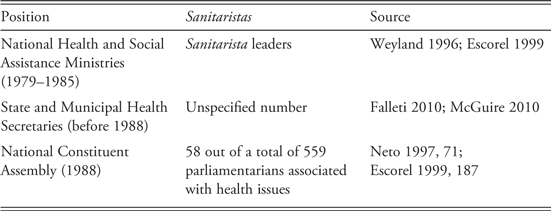
The Movimento Sanitarista initially shaped health policy from inside, by “infiltrating” the authoritarian state and occupying key positions in state bureaucracies before the health reform in 1988 (Avritzer Reference Avritzer2009, 118; Falleti Reference Falleti, Mahoney and Thelen2010). Table 2 illustrates this point; it shows some of the positions occupied by members of the movement at the national, state, and local levels, including 10 percent of parliamentarians in the 1988 National Constituent Assembly. In addition, a leader of the movement was appointed president of INAMPS (Instituto Nacional de Assistência Médica da Previdência Social) in the 1980s (Weyland Reference Weyland1996, 159).
State Positions Occupied by Sanitaristas Before the 1988 Reform

Source: Niedzwiecki Reference Niedzwiecki2014, 15.
Sanitaristas also formed the Bancada de Saúde (Health Caucus) in Congress. The movement influenced the debate partly through its linkages with left political parties, including the PT, the Communist Party, and the left segment of the PMDB, which was the largest party at the time (Garay Reference Garay2017, 132–33). The PT, in particular, was founded by labor leaders, activists, and intellectuals contesting Brazil’s military dictatorship in the 1980s. It started winning elections at the subnational level, promoting local participatory budgeting as a way to “deepen” democracy (Hunter Reference Hunter, Levitsky and Roberts2011). When the health reform was designed and constitutionalized, the PT was an opposition party with centralized party committees at all levels of government. Additionally, PT candidates were required to have participated in unions or social movements (Hunter Reference Hunter2010, 22, 23). The party’s hierarchical yet participatory internal organization created incentives for formalized channels of participation by any group associated with it, from the Movement of Landless Rural Workers (MST) to the sanitaristas.
CSOs also influenced the reform through National Health Conferences, another institutionalized channel. About four thousand people participated in the government-sponsored 8th National Health Conference in 1986, including universities, urban and rural unions, professional associations, community associations, political parties, and major churches. The Health Conference created a National Commission of Health Reform to suggest changes to the health system through deliberation. The reform commission included representatives from both the state and civil society, such as private providers, health professionals, workers, and community associations. This commission would be the precursor of the National Health Council (Côrtes et al. Reference Côrtes, Silva, Réos, Barcelos and Côrtes2009, 49–51; Ferrarezi and Oliveira Reference Ferrarezi and Oliveira2011). The health reform proposal elaborated in the commission was presented at the Constituent Assembly. The sanitaristas formed the National Plenary of Health Organizations for the Constituent Assembly. The plenary included about two hundred organizations and aimed to advise legislators, attend meetings, and develop activities in support of the reform, such as collecting signatures and organizing information campaigns (Garay Reference Garay2017).
Health councils have also been one of the main channels of sanitarista participation. Health councils are the product of the sanitaristas, the Catholic Church, and grassroots organizations working together, and of national health conferences demanding the integration of civil society into health policymaking (Avritzer Reference Avritzer2009, 119–21). Health councils were codified in the Healthcare Statute (Lei Orgânica da Saúde) in 1990 (Mayka Reference Mayka2019). They consist of government representatives, health professionals, and citizens, and are the main venue through which the movement has influenced the implementation process.
Councils are permanent and deliberative institutions in charge of monitoring the implementation of health policies at the local, state, and federal levels. Local councils, in particular, are part of the municipal administration, providing direct links to the local executive office (Wampler Reference Wampler2015, 134, 156). Municipal health councils vote on policy recommendations; these recommendations are then evaluated in state councils, which then vote on and send them to the federal level. These recommendations can be translated into health pacts that, since 2011, have been legally binding (Coelho Reference Coelho2006; Hooghe et al. Reference Hooghe, Marks, Schakel, Niedzwiecki, Osterkatz and Shair-Rosenfield2016; Mayka Reference Mayka2019).Footnote 12
Explaining Inside Forms of Participation: Institutional Stability and the Sanitarista Movement
The characteristics of the institutional context and of the sanitarista movement shaped the institutionalized pattern of popular participation in the creation of the SUS. Brazil’s health reform was incorporated in the 1988 Constitution, in a context of transition from authoritarianism to democracy. Brazil’s main institutions were kept relatively in place during the bureaucratic-authoritarian regime of 1964–85. In particular, the congress, parties, and elections were generally allowed to function, albeit controlled by the military. In 1965, the government dissolved previous parties and created two new ones: the National Renovating Alliance (Arena)—associated with the military and the rich—and the Democratic Brazilian Movement (MDB)—associated with democracy and the poor (Mainwaring Reference Mainwaring, Mainwaring and Scully1995, Reference Mainwaring1999; Samuels and Mainwaring Reference Samuels, Mainwaring and Gibson2004). Mainwaring (Reference Mainwaring, Mainwaring and Scully1995, 369) argues that by the 1970s, social movements and union leaders, among others, where actively engaged in building stronger political parties. While decisively nondemocratic, the military regime was an institutionalized regime that, for the most part, followed bureaucratic procedures. The maintenance of democratic institutions shaped Brazil’s gradual democratic transition (Mainwaring Reference Mainwaring, Mainwaring and Scully1995, Reference Mainwaring1999).
Democratization normalized the bicameral system and reestablished a strong federal system (Samuels and Mainwaring Reference Samuels, Mainwaring and Gibson2004). In spite of the traditional weakness of political parties in Brazil (Mainwaring Reference Mainwaring, Mainwaring and Scully1995, Reference Mainwaring1999), Brazilian parties have never faced a collapse similar to that which Bolivia experienced. Moreover, not all Brazilian parties are created equal. Left-wing parties tend to be more cohesive and disciplined and to exhibit stronger linkages to unions and social movements. In particular, the Brazilian Communist Party was created in 1922 and renamed the Popular Socialist Party in 1992. In addition, the Communist Party of Brazil has existed since 1962, when it splintered off from the Brazilian Communist Party (Mainwaring Reference Mainwaring, Mainwaring and Scully1995, 354, 376). The PT is a newer party (yet significantly older than the Bolivian MAS) with a higher level of institutionalization than the rest of the parties in Brazil’s party system. Left parties are particularly relevant for the process of health reform, since they were “natural allies” of the sanitarista movement.
A stable and robust context provided incentives for citizens to channel their frustrations and demands from within. Additionally, the writing of a new constitution through the formation of a Constituent Assembly in 1988 provided CSOs with a window of opportunity for influencing the reform agenda.
To understand the inside form of popular participation in the adoption of the SUS, the institutional context alone is not enough; the characteristics of the Movimento Sanitarista are crucial. In about 1918, a group of doctors, civil servants, and academics formed a Pro-Sanitation League to demand government action against malaria, chagas disease, and other endemic illnesses. The league’s goals presaged those of the sanitaristas and of societal actors in public health more generally (McGuire Reference McGuire2010, 159; Sugiyama Reference Sugiyama2013, 115). The Movimento Sanitarista arose in an authoritarian context; it was an advocacy group formed by healthcare professionals, local healthcare authorities, health-related unions, and left-wing health experts. The characteristics of the movement as a middle-class and professionally driven association partly explain why it used institutionalized or inside channels to achieve its aims. The initial main power resource of the movement was its academic influence though meetings of medical students and through the creation of academic institutions, mainly the Centro Brasileiro de Estudos de Saúde (Brazilian Center for Health Studies, CEBES) and the Associação Brasileira de Pós-Graduação em Saúde Coletiva (Brazilian Association of Graduate Studies in Collective Health, ABRASCO).
However, the sanitaristas were not just a middle-class organization, since they articulated their actions with unions and other popular sectors. Health-related unions supported the health reform because it would expand the state’s healthcare provision and monitoring of private providers (Mayka Reference Mayka2019). Additionally, since the late 1970s, the sanitaristas had joined groups of organized poor that were demanding better access to healthcare. One such encounter was in São Paulo, and it received support from the Catholic Church (Avritzer Reference Avritzer2009, 119). The synergy between the sanitaristas, the church, and the grassroots organization of poor people living in the city raised the issue of accessible and good-quality health services. These groups established a committee for monitoring the implementation of healthcare in São Paulo, which became the first health council in Brazil.
Bolivia’s Pension Universalization
The most significant social policy innovations in Bolivia have been in the pension sector, first through the expansion of noncontributory pensions and then through a partial return to the pay-as-you-go system. Renta Dignidad, Evo Morales’s signature social policy, is a universal, noncontributory pension for Bolivians above 60 years old, enacted in 2007. It is conceived as a right of all elderly Bolivian citizens, and it reaches broad segments of society (Arza Reference Arza2012). Renta Dignidad is partly funded by resources received from the Direct Tax on Hydrocarbons (IDH), paid by departmental governments, as well as by municipalities, the Indigenous Fund, and transfers from the National Treasury.
Outside Forms of Popular Participation
Given that Renta Dignidad required a decrease in the percentage of national transfers to hydrocarbon-producing departmental governments, it generated militant opposition from elites in those regions. Mass mobilizations against the proposed policy followed and quickly gained momentum. A wide array of popular movements linked to the MAS responded by taking to the streets in defense of the legislation. The first ones to mobilize were rural indigenous people organized by the Confederation of Indigenous Peoples of Bolivia (CIDOB), the Unique Confederation of Rural Laborers of Bolivia (CSUTCB), and the Bolivian Syndicalist Confederation of Colonizers (CSCB)—the country’s largest indigenous peasant social movement organizations. Urban associations representing salaried workers, such as the Regional Labor Federation-El Alto (COR-El Alto), as well as neighborhood organizations like the Federation of Neighborhood Boards-El Alto (FEJUVE-El Alto), also mobilized in support of the reform. Informal sector workers accompanied their mobilizations.Footnote 13
Lacking control of Congress and confronting a highly mobilized opposition, the MAS’s ability to pass Renta Dignidad was in real danger. The day the bill was voted on, the supporting movements and associations formed a human barricade around the National Congress, preventing members of the opposition from entering—that is, they used democratically questionable tactics to disrupt and marginalize the opposition and weaken its capacity to resist the proposed reform. The law that approved Renta Dignidad was passed in the absence of opposition in Congress and while social movements were keeping guard outside.
Morales enacted Renta Dignidad on November 28, 2007. He announced the policy surrounded by leaders of allied social movements. In his speech, Morales expressed his aspiration to constitutionalize the policy, and he thanked the social movements for their active role in the struggle (El Deber Reference Santa Cruz2007). The first payment of the Renta Dignidad took place on February 1, 2008, and distribution has been uninterrupted ever since. It guarantees basic social protection to more than one million people—most of whom hitherto lacked any protection through social security (Cecchini et al. Reference Cecchini, Filgueira, Martínez and Rossell2015, 227).
After passing Renta Dignidad, the Morales government engaged in a broader reform of the system to redress other inequities. The government took control of the management of the pension funds, lowered the retirement age from 65 to 60 (and even lower for hazardous jobs, such as miners and the armed forces), increased the benefits, and extended benefits to workers in the informal sector—a broad category that includes street traders, artisans, transport workers, and others. The reform was introduced by the MAS government in recognition of the popular sector demands that had become clear during the period of antineoliberal contention since the early 2000s (Silva Reference Silva2017). During that period, a wide array of popular sector movements converged on the need to strengthen the role of the state and stressed the need to “nationalize” natural resources as one way to accumulate more state revenue to enable a substantial acceleration of public spending on health, education, and social security.
In that context, popular sector movements demanded this broader reform of the pension system (Montes Reference Montes2013; Delgadillo Reference Delgadillo2013). The Bolivian Workers’ Central (COB), a militant labor confederation strategically allied with the MAS, was one of those groups. Without becoming formally integrated into the party, the COB placed labor leaders as MAS candidates and occupied high-ranking positions in the government (such as in the Ministry of Labor), becoming a strategic ally with privileged access to agenda setting and decisionmaking through inside channels of representation.
The presence of MAS legislators directly connected with the COB facilitated a greater substantive representation of their interests, and the COB was able to sponsor the pension reform from within, putting it on the agenda (Montes Reference Montes2013; Delgadillo Reference Delgadillo2013). The process was far from smooth, however, and it entailed four years of negotiation, contestation, and compromise. The use of inside channels alone did not ensure the passing of legislation. During this time, the COB mobilized against the MAS government on several occasions (Silva Reference Silva2017), mostly demanding minimum wage increases and exerting pressure via outside channels, including marches, blockades, and highway shutdowns. In 2008, COB-affiliated unions mobilized against the government’s proposal to fund pensions with revenue from natural resources, and in 2010 they mobilized against the reduction of energy subsidies.
At the same time, the greater presence of strong economic groups linked to the COB in core state bureaucracies and Congress gave them greater space for input in the reform process. For example, transportation unions, one of the strongest groups that have gained representation through their associational linkages with the MAS, played a leading role from Congress (an inside channel) and also in the streets (Durán Reference Durán2013). They helped negotiate a Solidarity Fund that would allow the government to extend pension benefits to workers in the informal sector, who were left out of the existing pension scheme (BolPress 2010). A broad-based coalition of peasant workers, street traders, coca growers, mine cooperative workers, and other well-organized groups connected with the MAS also participated by providing mobilizational power in defense of this fund when the COB leadership seemed reluctant to accept it (Machaca Reference Machaca2013).
Explaining Outside Forms of Participation: Party System Collapse, Social Movements, and the MAS
Understanding patterns of popular involvement in social policymaking in Bolivia in the 2000s requires an explanation of the institutional context and the characteristics of the social movements that propelled the MAS to power. If Brazil provides an example of a more institutionally robust environment, Bolivia illustrates the obverse. Since democracy was restored in 1982, core state institutions have remained weak. Congress, in particular, has remained a weak institution overpowered by the executive branch. The low quality and inefficiency of the legislative branch and its limited deliberative capacity have been widely documented (Laserna et al. Reference Laserna, Oporto, Verdesoto and Zegada2007).
The early 2000s were a turbulent period, marked by the weakening and collapse of the traditional parties and heightened social mobilization (Silva Reference Silva2017; Cyr Reference Cyr2017). This mobilization was channeled politically by the MAS, a new, movement-based party, which placed Evo Morales in the presidency in 2006. Morales convoked a constituent assembly to rewrite the country’s constitution. It was in that context of flux and institutional discontinuity that discussions over Renta Dignidad began. The context of high social mobilization and weakened institutions provided strong incentives for the use of outside channels and mobilized participation as a policy tool.
The groups that mobilized in support of social policy expansion, and in particular the pension reforms, were, for the most part, grassroots organizations linked to the popular sectors—an additional reason they found outside channels of participation more effective. Key actors included, among others, indigenous peoples’ movements, informal sector workers, salaried mineworkers, and other groups in subordinate positions.
Consistent with power resource theory, the MAS in power played a leading role forging linkages with popular actors that guaranteed the passing of the reforms through coordinating pressure in the streets. As a result, inside channels also played a role in the social policymaking process, although a much more marginal role than in Brazil. In its road to power, the MAS built alliances with a wide array of rural and urban popular organizations involved in the antineoliberal protests (indigenous groups, peasant and urban labor unions, neighborhood associations, among others). Once the party took office, these groups gained greater representation in national and subnational institutions, as well as privileged access to agenda setting and decisionmaking spheres (Anria Reference Anria2018).
The growing presence of well-organized groups in core state institutions gave voice to sectors that used to have little influence on how the country was run. In some cases, such as the pension reform, having some presence in Congress (and state bureaucracies) allowed labor unions to sponsor the pension reform from within. Still, in the absence of clear party channels to articulate demands—a pattern associated with the organizational fluidity of the MAS (Anria Reference Anria2018)—negotiations over policy often escaped the confines of formal institutional channels.
Even after assuming office at the national level, the party retained several of its foundational organizational characteristics and deliberately resisted developing a bureaucratic organizational pattern. It remained open and responsive to autonomous social mobilization. This means that the processes of social policy reform in today’s Bolivia are highly interactive, contestatory, and based on intense negotiations between the MAS and its organized social bases. Reform processes are open to real bottom-up input, but influence varies widely by policy area and remains contingent on a given group’s capacity to mount and sustain autonomous collective action (Anria Reference Anria2018). Consistent with this pattern, Silva (Reference Silva2017) argues, is an emerging pattern of interest intermediation in the country, one that extends to areas beyond social policy reform and is both informal and contestatory. This involves “routinized interactions where the government proposes a policy, affected popular sector organizations protest vigorously, and negotiation ensues,” and then “the pattern repeats regularly” (Silva Reference Silva2017, 96).
Conclusions
Civil society’s participation in Brazil and Bolivia played a crucial role in expanding noncontributory social policies. This influence was central for introducing issues onto the agenda and for making sure that the policy would eventually be approved in Congress. Understanding forms of popular participation matters because policies that allow for civil society input can potentially be more democratic, universalistic, nondiscretionary, and long-lasting. In particular, the SUS in Brazil is currently a highly deliberative health policy that incorporates feedback from all levels of government. Renta Dignidad in Bolivia is sustainable because social movements pressured for guaranteeing more secure funding sources. In other words, the same outcome is reached through different mechanisms. Both policies have the characteristics of universalistic policies, including their broad coverage, sustainable financing, and nonclientelistic distribution (Pribble 2008).
While previous literature on Latin American welfare states has noted the relevance of the participation of CSOs in social policy reform, it has paid insufficient attention to the forms of such participation. Understanding the “how” allows us to disentangle the mechanisms that connect popular participation and social policy reforms. Brazil and Bolivia exhibit starkly different modes of popular participation in social policymaking. In Bolivia, participation takes place through outside channels, while in Brazil, participation is through institutionalized or inside channels. At the same time, in both countries, CSOs have gained greater influence over social policies by infiltrating representative institutions and state bureaucracies at all levels of government, which has given them privileged access to policymaking.
With Bolivia’s Renta Dignidad, social movements were crucial for passing the policy in a context of a minority in Congress (and mobilized opposition in the streets) by resorting to social mobilization outside of formal institutional channels when the legislation was in real danger. Additionally, the pension reform in Bolivia was a response to a bottom-up demand from groups aligned with (and represented in Congress by) the MAS. These groups used both their inside connection with congressional representatives and pressure in the streets when needed. The Movimento Sanitarista pushed the SUS in Brazil by occupying crucial positions in all levels of government, creating a “health caucus” in Congress, serving on committees for the Constituent Assembly, and actively participating in health conferences and councils.
This article has argued that the institutional context, together with the characteristics of the social actors pushing for reform, goes a long way toward explaining these differences across countries. Brazil’s 1988 context was one of more institutional strength than that of Bolivia two decades later. The military regime in Brazil had kept many democratic institutions in place (yet with a diminished role), and the transition to democracy was gradual and slow. Additionally, left parties that served as allies of the sanitaristas in Congress were relatively cohesive and disciplined. Conversely, in Bolivia, democratic institutions and parties were in shambles and unable to process societal demands. As a result, inside channels seemed like a more efficient path in Brazil than in Bolivia.
The kinds of actors with most influence also explain different patterns of participation across the cases. In Brazil, the Movimento Sanitarista is a network of middle-class professionals, while the main movements wielding influence in Bolivia belong to subordinate social sectors. However, even the sanitaristas worked together with unions and popular sector organizations to effectively influence health policies. The 8th National Health Conference and the National Commission of Health Reform in 1986 succeeded in meeting the sanitaristas’ demands, partly because they incorporated unions and community organizations in the network of professionals and providers (Côrtes et al. Reference Côrtes, Silva, Réos, Barcelos and Côrtes2009, 52). In addition, participatory health councils find their origins not only in national health conferences but also in a joint effort between sanitaristas and grassroots organizations in São Paulo (Avritzer Reference Avritzer2009).
In Bolivia, mobilized groups in support of the pension reforms belonged to grassroots organizations linked to popular sectors, including indigenous peoples’ movements and informal sector workers, in coalition with salaried, unionized workers. Popular sector movements and civic associations in Bolivia have muscled their way into organized politics through associational linkages with a strong left party, the MAS, and they have been crucial in keeping the MAS open and responsive. Strong linkages between the MAS and popular movements have encouraged bold social policy initiatives.
Although social policies in both these countries are participatory, the nature of this participation is uneven at best: not all policies are permeable to popular participation everywhere, not all groups have the same influence, and not all forms of popular participation are equally democratic. In particular, Brazilian councils in other policy areas, such as social assistance, were not as active as in healthcare in the 1988 constitutional reform, partly because civil society is not as organized in this sector. But even in healthcare, participatory forums in Brazil exhibit different results across the territory, depending on a number of political and capacity factors (Coelho Reference Coelho2006). Subnational democratic contexts empower civic organizations and have been more conducive to highly participatory councils in the implementation of the SUS (Niedzwiecki Reference Niedzwiecki2018; Touchton et al. Reference Touchton, Sugiyama and Wampler2017).
Popular participation does not always use democratic means, as when MAS-affiliated social movements ensured that the Renta Dignidad would pass by not allowing opposition members to enter Congress. That extreme tactic of disruption, as has been argued elsewhere, can be understood only in the context of adversity that the MAS inherited when it captured the presidency (Anria and Niedzwiecki Reference Anria and Niedzwiecki2016). Such actions entailed a clear trade-off: they were necessary to pass such critical legislation, but they weakened democratic institutions. In a democracy, in fact, a highly mobilized society can often be a double-edged sword. It enables subordinate groups to make their weight felt in politics, but when formal channels of interest intermediation are absent, it can make democracy ungovernable and even undermine it. In Bolivia today, participation in social policymaking depends heavily on social mobilization. With exceptions, that mobilization is acting more as a supplement to institutional politics than as its antithesis or substitute.
All this means that popular participation in these two countries is not high at all times or across the territory and is not (always necessarily) synonymous with good-quality democratic governance or with greater democratization. As Robert Dahl (Reference Dahl1971) put it, to the extent that public contestation is restricted, advances in participation (or inclusiveness) need not be quickly equated with greater democratization. Whatever their flaws, however, social policies that allow for some level of popular input can potentially be more representative and longer-lasting and can help to generate promising policy legacies.