Introduction
Global increases in the consumption of vegetable oils have been paralleled by rapid expansions of oil palm plantations at the cost of tropical forests and peatlands (Koh & Lee Reference Koh and Lee2012). The conversion of forests to oil palm plantations has been identified as a major contributor to biodiversity loss and climate change (Fitzherbert et al. Reference Fitzherbert, Struebig, Morel, Danielsen, Brühl, Donald and Phalan2008, Koh & Wilcove Reference Koh and Wilcove2008, Danielsen et al. Reference Danielsen, Beukema, Burgess, Parish, Brühl and Donald2009, Dislich et al. Reference Dislich, Keyel, Salecker, Kisel, Meyer and Auliya2017, Pardo et al. Reference Pardo, de Oliveira Roque, Campbell, Younes, Edwards and Laurance2018). In response to this issue, two major approaches have been proposed.
According to the first approach, future increases in the demand for vegetable oils are inevitable, and as palm oil is the most efficient vegetable oil, continued expansion of oil palm cultivation will require the smallest possible amount of land conversion (Corley Reference Corley2009, Murphy Reference Murphy2014). When viewed from this perspective, the environmental consequences of oil palm cultivation can best be mitigated by promoting more wildlife-friendly and sustainable production standards. However, existing measures seem limited in their ability to increase the sustainability of palm oil production (Edwards et al. Reference Edwards, Hodgson, Hamer, Mitchell, Ahmad, Cornell and Wilcove2010, Laurance et al. Reference Laurance, Koh, Butler, Sodhi, Bradshaw and Neidel2010, Carlson et al. Reference Carlson, Heilmayr, Gibbs, Noojipady, Burns and Morton2018).
According to the second approach, increases in the demand for vegetable oils can partly be attributed to wasteful and excessive consumption, and reducing vegetable oil consumption is both possible and necessary to save biodiversity and to reduce carbon emissions (Koh & Lee Reference Koh and Lee2012). Koh and Lee (Reference Koh and Lee2012) demonstrated that relatively minor decreases in vegetable oil consumption in the Western world can substantially alleviate the pressure to convert forests into oil palm plantations – even when assuming increasing consumption levels in India and China. Their simulations raise the obvious question of how such reductions in vegetable oil consumption can be achieved.
Understanding and promoting those behaviours that conserve the natural environment has been a longstanding objective of the behavioural sciences (Kollmuss & Agyeman Reference Kollmuss and Agyeman2002, Lehman & Geller Reference Lehman and Geller2004, Steg & Vlek Reference Steg and Vlek2009). More than four decades ago, behavioural scientists have already studied possible ways to curb car use (Foxx & Hake Reference Foxx and Hake1977), electricity use (Winett & Nietzel Reference Winett and Nietzel1975) and the purchase of non-reusable drink containers (Geller et al. Reference Geller, Farris and Post1973). Their methods, however, have scarcely yet been applied to the issue of palm oil consumption behaviour.
The few existing studies point to a critical role for consumer knowledge (Bartkus et al. Reference Bartkus, Hartman and Howell1999). In contrast to other conservation behaviours such as recycling or saving electricity, many consumers may not know that they can benefit the environment by reducing the amount of palm oil they consume. For example, most consumers surveyed by Giam et al. (Reference Giam, Mani, Koh and Tan2016) did not seem to identify palm oil as a product that may cause deforestation (cf., Ostfeld et al. Reference Ostfeld, Howarth, Reiner and Krasny2019). However, when consumers are given information on the environmental consequences of palm oil, their knowledge about the issue appears to increase along with their support for mandatory palm oil labelling (Pearson et al. Reference Pearson, Lowry, Dorrian and Litchfield2014).
While these studies shed the first light on the relevance of the concept, a comprehensive analysis of palm oil-related knowledge is still lacking. We present two studies assessing both subjective consumer knowledge (i.e., what consumers think they know) and objective consumer knowledge (i.e., what they actually know) about palm oil. We examine how these types of palm oil-related knowledge relate to each other and to the intention to reduce palm oil consumption.
In addition, we approached the question of how consumers can be stimulated to acquire palm oil-related knowledge. To this end, we tested whether a simple behavioural technique, the default nudge (Sunstein & Reisch Reference Sunstein and Reisch2014), can encourage consumers to actively engage with palm oil-related information. Given their relative ease of implementation (Jachimowicz et al. Reference Jachimowicz, Duncan, Weber and Johnson2019), such nudging techniques can, if proven effective, play a critical role in reducing excessive palm oil consumption to a more sustainable level.
Methods
Online study
An online survey was conducted among students at Flemish institutions of higher education; participation was voluntary and participants did not receive financial compensation. We adopted two measures to address the possibility that participants might have used outside sources when completing questions testing their palm oil-related knowledge in an anonymous online setting. First, participants who did not explicitly confirm that they would answer all of the questions without help from outside sources (n = 5) were immediately directed to the end of the survey. Second, responses from participants who gave a correct answer to a highly specific knowledge question (i.e., about the exact percentage of palmitic acid in palm oil, n = 6) were excluded from all analyses. After excluding an additional 26 participants who did not complete the survey, responses were analysed from a sample of 141 participants. Their age ranged between 18 and 46 years (mean = 21.73, SD = 2.64). Eighty participants were female, 60 were male and 1 preferred not to reveal their gender.
Participants were first asked to write a maximum of three lines about their prior knowledge (if any) regarding palm oil. After completing items assessing their subjective and objective palm oil-related knowledge, participants provided demographic data and completed two personality measures (see Supplementary Materials, available online). Finally, we assessed participants’ intention to avoid consuming palm oil and asked them to identify perceived constraints of their efforts to reduce their palm oil consumption. For this purpose, they could select from five options (lack of time/money/knowledge/interest, social pressure) or use a free-response format.
In order to assess subjective palm oil-related knowledge, participants were asked to rate their knowledge about: (1) the environmental impact of palm oil consumption; (2) the possibilities to reduce this impact; and (3) the environmental impact of buying Certified Sustainable Palm Oil (CSPO) products. For each of these, participants indicated how well they felt informed about it (1) in general (1: not at all – 5: extremely well); (2) as compared to the average person (1: much worse – 5: much better); and (3) as compared to experts (1: much worse – 5: much better). Responses to these nine questions were summed up to yield an aggregate measure of subjective palm oil-related knowledge (α = 0.85).
For the assessment of objective palm oil-related knowledge, participants answered 45 binary-response questions. They were asked to identify: typical uses of palm oil (6 questions: e.g., cosmetics (yes), fertilizer (no)); palm oil-containing products (10 questions: e.g., chocolate spread (yes), cornflakes (no)); countries with large (>10 000 ha) oil palm plantations (9 questions: e.g., Indonesia (yes), South Africa (no)); direct environmental consequences of oil palm cultivation (9 questions: e.g., deforestation (yes), dioxin pollution (no)); palm oil derivatives (7 questions: e.g., sodium laureth sulphate (yes), thiamine mononitrate [no]); and veridical statements about palm oil (4 questions: e.g., ‘For producers, palm oil has a high yield per hectare in comparison to other vegetable oils’ (yes), ‘It has been proven that palm oil is healthier in general than other vegetable oils’ (no)). The number of correct responses was summed to yield an aggregate measure of objective palm oil-related knowledge.
Participants responded to two items about their behavioural intentions (‘In the future, I will try to avoid buying products that contain palm oil’ and ’I have a strong intention to buy as few palm-oil-containing products as possible’) on a five-point scale (1: disagree strongly – 5: agree strongly). Responses were summed to yield an aggregate measure of participants’ intention to avoid consuming palm oil (α = 0.80). Note that this measure only captured intended palm oil avoidance, not whether participants intend to substitute palm oil products with products containing other vegetable oils. This should be taken into account when interpreting our intention data.
Laboratory study
This study aimed to replicate the online survey under more controlled conditions and tested the effectiveness of the default nudge (Sunstein & Reisch Reference Sunstein and Reisch2014) as a technique to stimulate consumers to acquire additional palm oil-related knowledge. Specifically, we examined whether making one option (i.e., being presented with additional palm oil-related information or not) the default option (i.e., the option that is chosen when consumers do not actively intervene) affects consumer engagement with information about palm oil-related issues.
The study was the final part of a laboratory session involving two other studies. The session took c. 30 minutes to complete and participants received €6 for their participation. We advertised the study to participants enlisted in the subject pool of the Faculty of Economics and Business and collected data from 227 participants. Two participants aborted the session before completing the study and five participants were excluded based on the same filter question as in the online study, leading to a sample size of 220 (97% students; 63% female, 37% male). Participants’ age range was 17–48 years (mean = 23.30, SD = 5.27).
Participants were tested in groups of up to 16 participants. They completed the same subjective knowledge items (α = 0.89), objective knowledge questions and behavioural intention items (α = 0.75) as in the online study. After completing these measures, participants were asked whether they wanted to review some brief information about: (1) the environmental impact of palm oil consumption; and (2) what they can do to reduce their palm oil consumption. The order of these two questions was counterbalanced across participants. One of the options (‘yes’, ‘no’) participants could select in response to these questions was pre-selected (i.e., the corresponding response box was already checked; see Supplementary Materials). Participants were randomly assigned to the ‘default-yes’ condition (n = 109) or the ‘default-no’ condition (n = 111). In the default-yes condition, the ‘yes’ response was pre-selected for both questions, and in the default-no condition, the ‘no’ response was pre-selected for both questions. When selecting the ‘yes’ option, participants were presented with textual information regarding palm oil-related environmental issues or possible ways to reduce palm oil consumption, respectively. Both texts were 393 words long and referred to two sources. When presented with these texts, participants were free to proceed to the next part of the questionnaire at any time. We recorded the time they spent on the pages displaying the information texts.
Statistical analyses
Relationships between objective knowledge, subjective knowledge and intention were analysed using Pearson correlation coefficients and linear regression analyses as visual data inspection did not reveal severe deviations from bivariate normal distributions. The magnitude of correlation coefficients was compared using the procedure of Meng et al (Reference Meng, Rosenthal and Rubin1992). The proportion of participants who chose to review palm oil-related information texts was compared between conditions using Fisher’s exact test and logistic regression analyses. The time participants took to review these texts was compared between conditions using a Mann–Whitney U test as reading time distributions were heavily right-skewed. The level of significance was set to α = 0.05. All data can be accessed at https://osf.io/xjk67.
Results
Online study
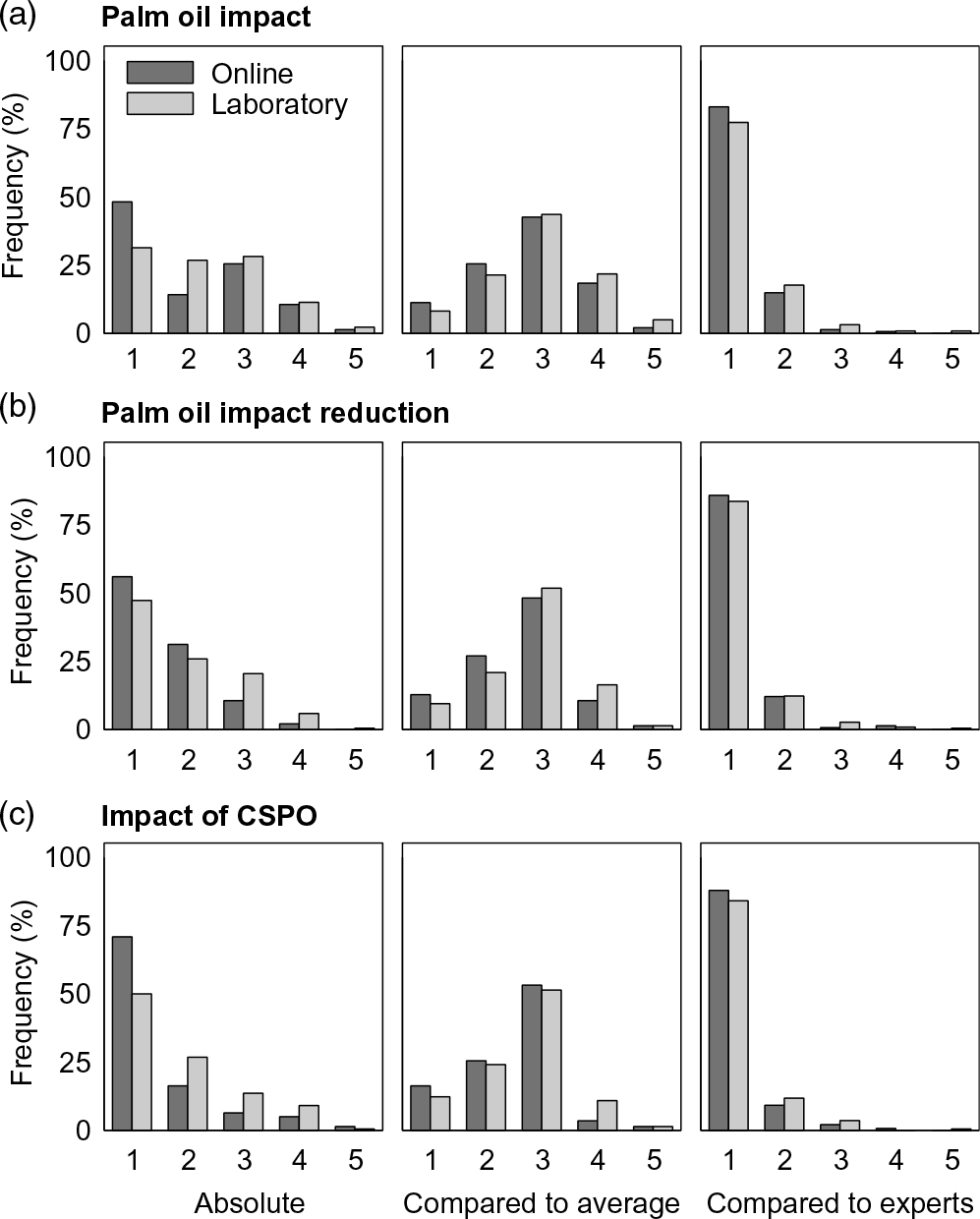
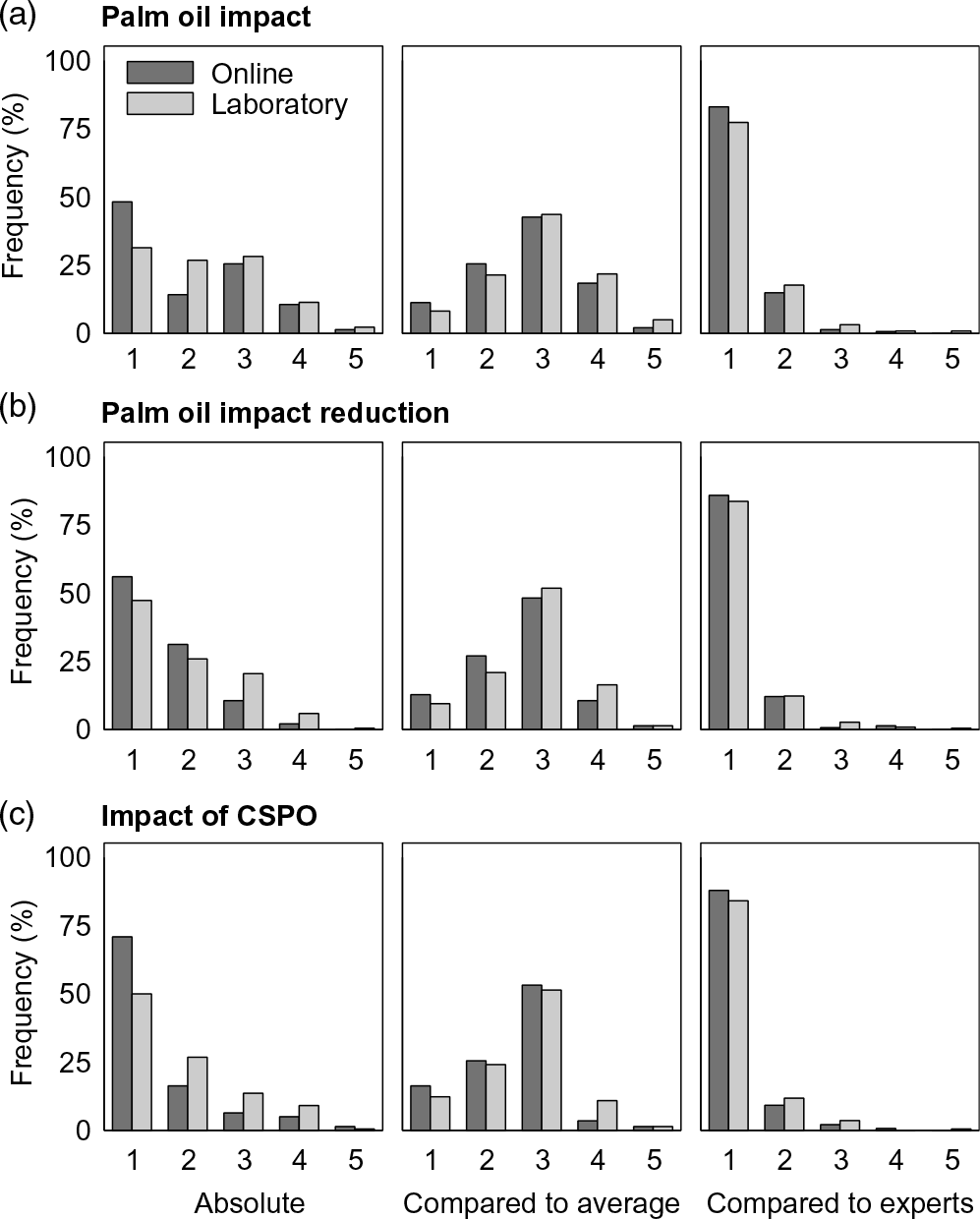
Overall, participants’ confidence about their palm oil-related knowledge seemed limited. In response to the open question about what they already knew about palm oil, 31% explicitly indicated that they did not have any prior knowledge. Only 30% explicitly linked palm oil to negative environmental consequences. This impression was corroborated by the subjective knowledge questions, which revealed that most participants rated their palm oil-related knowledge to be largely absent and to be much worse than that of experts (Fig. 1). A total of 88% indicated that they perceived a lack of knowledge as a factor constraining their ability to reduce their own palm oil consumption.
Frequency distribution of participants’ responses to subjective palm oil-related knowledge items. Absolute knowledge (first column) was rated on a scale from 1 (not at all) to 5 (extremely well). Knowledge compared to the average person (second column) and compared to experts (third column) was rated on a scale from 1 (much worse) to 5 (much better). CSPO = Certified Sustainable Palm Oil.
Across the 45 objective knowledge questions, participants achieved a mean score of 29.19 (SD = 3.99, range: 16–39) correct answers. Given a guessing probability of 50%, a score of 29 correct responses would be required to conclude that a participant responded significantly (p < 0.05) better than random. A total of 42% of all participants did not reach this criterion.
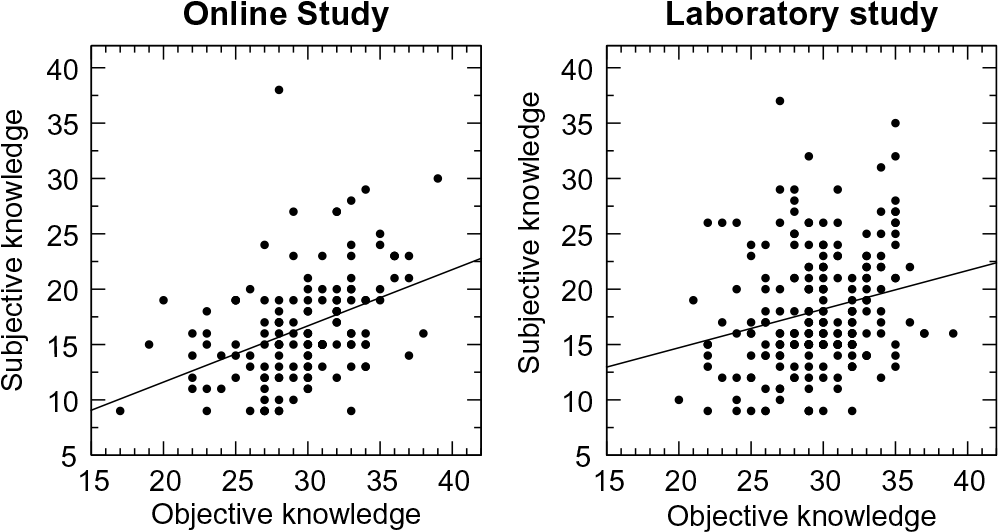
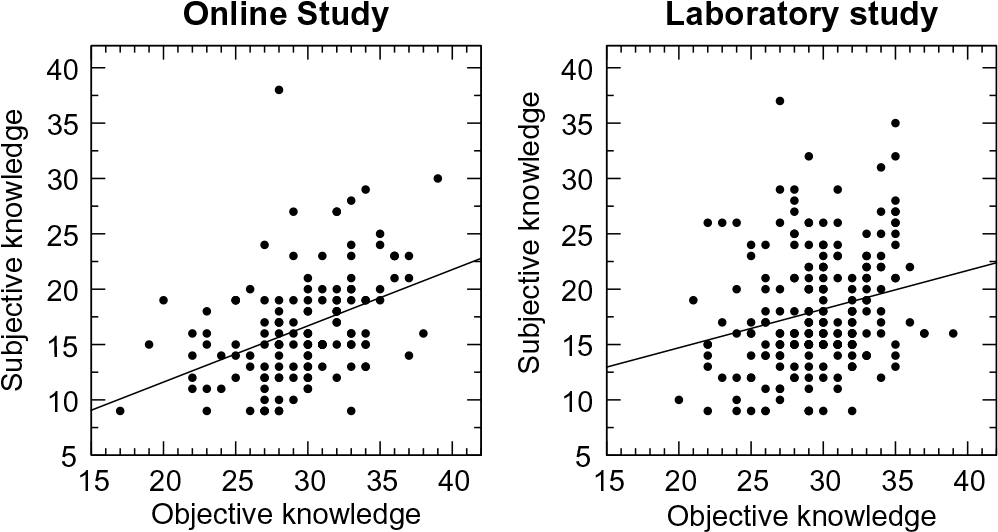
Subjective and objective knowledge were moderately related to each other (r = 0.42, 95% confidence interval (CI) 0.27–0.55, p < 0.001) (Fig. 2). Subjective knowledge (mean = 16.48, SD = 4.88, range: 9–38) was positively related to participants’ stated intention to avoid consuming palm oil (r = 0.47, 95% CI 0.33–0.59, p < 0.001). In contrast, the correlation between objective knowledge and intention was not significant (r = 0.16, 95% CI –0.01 to 0.32, p = 0.058). The correlation between intention and subjective knowledge was significantly stronger than the correlation between intention and objective knowledge (z = 3.64, p < 0.001). Age was positively associated with intention (r = 0.20, 95% CI 0.04–0.35, p = 0.018), while male participants had better objective knowledge than female participants (r = 0.21, 95% CI 0.05–0.36, p = 0.014). Regressing intention on objective knowledge, subjective knowledge, age and gender revealed that only subjective knowledge accounted for a significant amount of unique intention variance (see Supplementary Materials).
Scatterplots of the relationships between objective and subjective palm oil-related knowledge, showing linear regression lines.
Laboratory study
Most participants again rated their subjective palm oil-related knowledge to be low (Fig. 1). Participants achieved a mean objective knowledge score of 29.63 (SD = 3.44, range: 20–39) correct answers; 34% did not perform significantly better than random on these questions (<29 correct responses).
Subjective knowledge (mean = 18.08, SD = 5.64, range: 9–45) was correlated to both objective knowledge (r = 0.21, 95% CI 0.08–0.34, p = 0.001) (Fig. 2) and participants’ intention to avoid consuming palm oil (r = 0.36, 95% CI 0.24–0.47, p < 0.001), while the correlation between objective knowledge and intention was not significant (r = 0.12, 95% CI –0.02 to 0.24, p = 0.089). Intention was more strongly related to subjective knowledge than to objective knowledge (z = 2.94, p = 0.004). Age was positively associated with subjective knowledge (r = 0.28, 95% CI 0.15–0.40, p < 0.001), objective knowledge (r = 0.17, 95% CI 0.04–0.30, p = 0.010) and intention (r = 0.31, 95% CI 0.19–0.42, p < 0.001). Female participants had stronger intentions to avoid palm oil consumption than male participants (r = 0.25, 95% CI 0.12–0.37, p < 0.001). A multiple linear regression analysis revealed that subjective knowledge, age and gender, but not objective knowledge significantly accounted for unique variance in behavioural intentions (see Supplementary Materials).
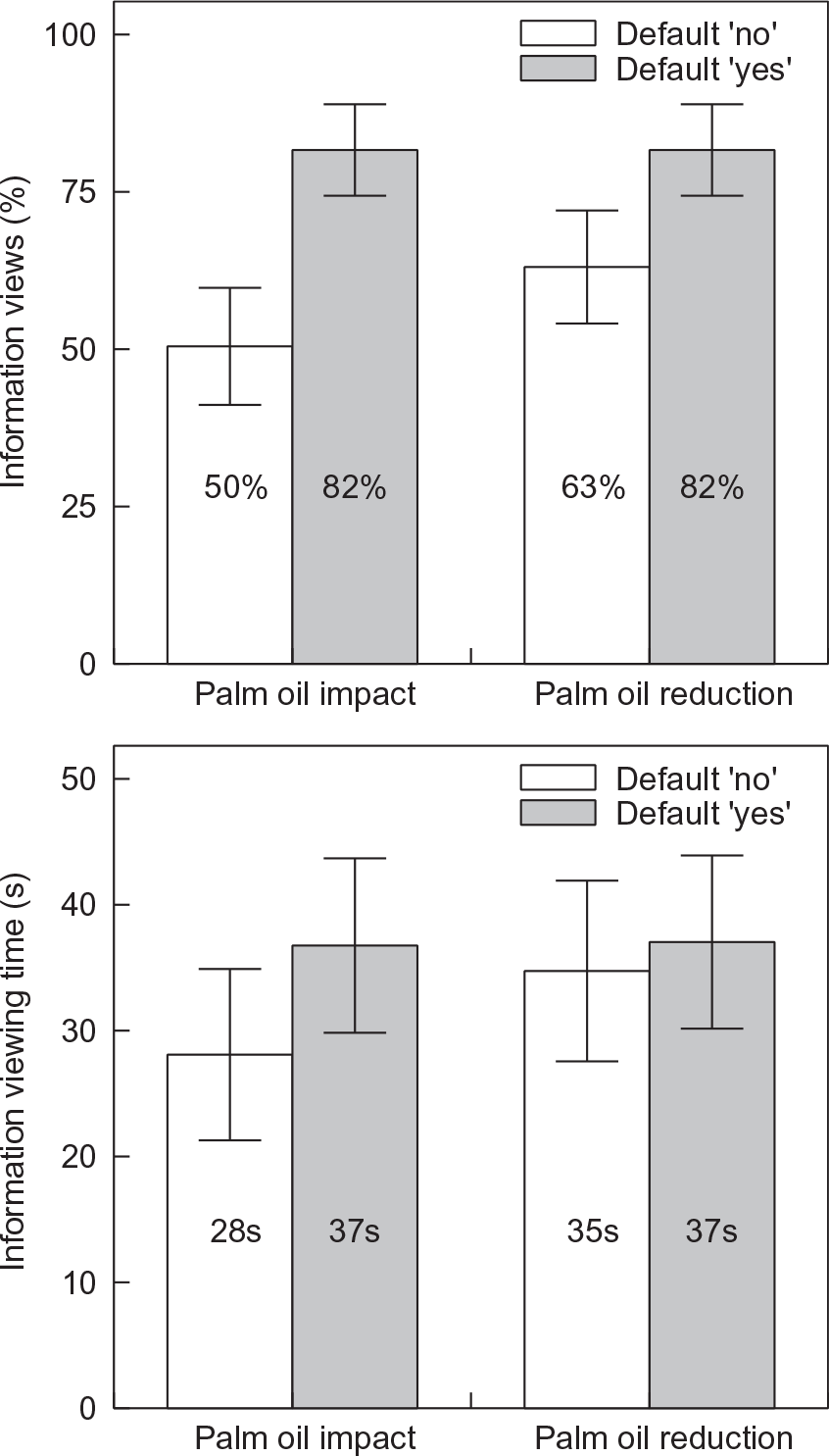
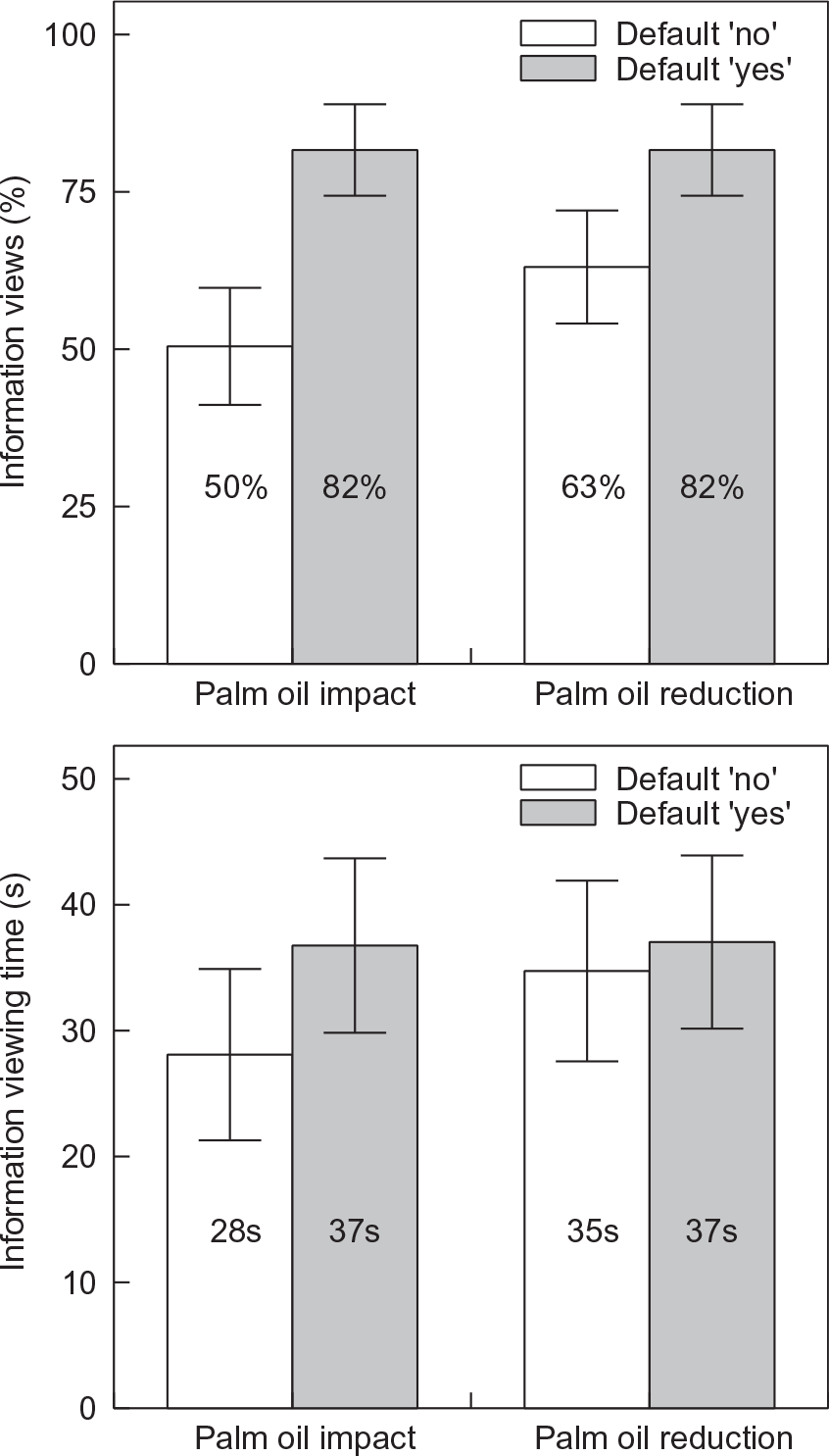
A total of 84% of participants chose to review at least one of the palm oil-related information texts. Participants in the ‘default yes’ condition were more likely to review optional palm oil-related information than participants in the ‘default no’ condition. This default effect was significant for both information about the environmental impact of palm oil consumption (χ2(1) = 23.83, p < 0.001, odds ratio (OR) = 4.37, 95% CI 2.37–8.05) and information about ways to reduce palm oil consumption (χ2(1) = 9.48, p = 0.002, OR = 2.61, 95% CI 1.40–4.84). Logistic regression analyses did not find the default effect to be moderated by information type (impact versus reduction), subjective or objective knowledge (all χ2 < 2.16, all p > 0.140).
The total time spent on the information texts ranged from zero (i.e., participants chose not to view either of the texts) to 277 seconds (mean = 68.26, SD = 63.83). In comparison to participants in the ‘default no’ condition (mean = 62.83, SD = 62.28), participants in the ‘default yes’ condition (mean = 73.80, SD = 63.18) spent an additional 11 seconds on the information texts; however, this difference was not significant (U = 5356.50, p = 0.141, r = 0.10, 95% CI –0.03 to 0.23) (Fig. 3).
The effect of making reviewing versus not reviewing palm oil-related information the default option on participants’ decisions to actually review this information. Vertical bars are 95% confidence intervals.
Discussion
Our studies revealed critical limitations in consumers’ knowledge about palm oil, across different knowledge domains, in different study settings (online versus laboratory), as well as using both objective and subjective measures of palm oil-related knowledge. Objective and subjective palm oil-related knowledge were positively correlated, with the average strength of the association being medium in size. Palm oil-related knowledge was positively related to consumers’ intentions to reduce their palm oil consumption, with the correlation being significantly larger when involving a subjective versus an objective measure of knowledge. Subjective knowledge also accounted for significant variance in palm oil consumption intentions beyond age, gender and objective knowledge. In addition, our results suggest that consumers can be stimulated to consult information about palm oil by means of a simple situational nudge.
Most participants rated their palm oil-related knowledge to be poor, performed close to chance level in our palm oil-related knowledge test and indicated that their ability to reduce their palm oil consumption was constrained by a lack of knowledge. It is important to note that this level of knowledge was obtained in samples of university students and that it cannot automatically be generalized to non-student populations. However, given the well-documented positive link between education and environmental knowledge (e.g., Coyle Reference Coyle2005), we deem it rather unlikely that our results underestimate the degree of palm oil-related knowledge in the population at large.
Subjective knowledge is often observed to be more relevant for the prediction of pro-environmental behaviour than objective knowledge (Gifford Reference Gifford2014). Our results from the domain of palm oil consumption seem compatible with this notion. Yet, stronger correlations between subjective versus objective knowledge and participants’ intention to reduce their palm oil consumption might also be attributed to methodological factors such as common method variance (Podsakoff et al. Reference Podsakoff, MacKenzie, Lee and Podsakoff2003). In the present study, intentions and subjective knowledge, but not objective knowledge, were assessed by means of introspective self-report items. Future studies should address the possibility of inflated correlations among self-report measures by involving, for example, observations of actual behaviour (Lange & Dewitte Reference Lange and Dewitte2019).
Given the likely role of knowledge in supporting reductions of palm oil consumption, the challenge remains regarding how to provide consumers with the necessary knowledge. While the results from our nudging experiment indicate that making the display of palm oil-related information the default option can promote the access of this information, they also reveal a critical limitation. Many participants seemed to follow the default setting in choosing to review information about palm oil without spending much time on actually reading it. If the default nudge cannot be demonstrated to increase engagement with this information, it cannot be expected to affect knowledge or knowledge-based behaviour. In other words, facilitating the access to palm oil-related information might only be the first step in a successful intervention to increase consumer knowledge about palm oil. Creating attention-capturing information material that promotes continued engagement could be a promising way to potentiate the effect of default options and other situational nudges. Future studies are needed to explore this possibility and to translate laboratory insights into educational campaigns for promoting palm oil-related knowledge.
In spite of our focus on consumer knowledge and intentions, it is important to acknowledge the complexity of the palm oil issue. Even well-informed and well-intentioned consumers are limited in their possibilities to shape production practices through their purchase behaviour; delegating all conservation responsibility to them would likely undermine the capacity to respond to environmental issues (Isenhour Reference Isenhour2014). Instead, coordinated action across sectors and scales will be needed to effectively mitigate the environmental footprint of palm oil.
Supplementary material
To view supplementary material for this article, please visit https://doi.org/10.1017/S0376892920000053
Acknowledgements
The authors thank Siegfried Dewitte for his support of this project.
Financial support
This project received funding from the FWO and European Union’s Horizon 2020 research and innovation programme under the Marie Skłodowska-Curie grant agreement No. 665501.
Conflict of interest
None.
Ethical standards
The authors assert that all procedures contributing to this work comply with applicable ethical standards of the relevant national and institutional committees on human experimentation and with the Helsinki Declaration of 1975, as revised in 2008.