Socioeconomic disadvantage early in development is a multidimensional and complex exposure associated with a variety of outcomes and risks (Duncan et al., Reference Duncan, Magnuson, Kalil and Ziol-Guest2012; The World Bank, 2022). The likelihood of experiencing early adversity is increased in families living in disadvantage (Jahanshahi et al., Reference Jahanshahi, Murray and McVie2022; Lacey et al., Reference Lacey, Howe, Kelly-Irving, Bartley and Kelly2022; Lee et al., Reference Lee, Slack, Berger, Mather and Murray2021). Several studies have found that children from socially disadvantaged families have reduced access to appropriate learning environments (Bethell et al., Reference Bethell, Newacheck, Hawes and Halfon2014; Duncan et al., Reference Duncan, Yeung, Brooks-Gunn and Smith1998; Jimenez et al., Reference Jimenez, Wade, Lin, Morrow and Reichman2016), and increased exposure to domestic (Coleman et al., Reference Coleman, Weinman and Hsi1980; Hillard, Reference Hillard1985; Petersen, Reference Petersen1980), and community violence (Tracy et al., Reference Tracy, Smith, Miller, Clayton, Bailey, Gerrin, Eversley-Kelso, Carney and MacNew2019). In turn, these adverse experiences have been shown to impact developmental and long-term outcomes.
Early adversity is common, affecting approximately 50% of individuals in the United States, and robustly associated with long-term outcomes, such as psychopathology (McLaughlin et al., Reference McLaughlin, Greif Green, Gruber, Sampson, Zaslavsky and Kessler2012) and achievement (Duncan et al., Reference Duncan, Yeung, Brooks-Gunn and Smith1998). Gaining a better understanding of the mechanisms through which early adversity comes to shape risk for these outcomes could produce novel interventions and enhance public health activities. Historically, early conceptualizations of adversity emphasized the unique impact of specific exposures. In contrast, cumulative risk models propose that a wide variety of adversities accumulate, leading to greater risk of developing negative outcomes through a shared mechanism. It is argued that allostatic load, or the accumulation of maladaptive physiological stress response over time is the main mechanism by which cumulative risk functions (Gunnar & Quevedo, Reference Gunnar and Quevedo2007). While cumulative risk models effectively highlight the impact of early adversity on long-term outcomes, dimensional models of adversity propose that experiences might shape development through distinct pathways (Sheridan & McLaughlin, Reference Sheridan and McLaughlin2016).
The Dimensional Model of Adversity and Psychopathology (DMAP) builds on the existing animal and human literature to propose two dimensions of early adversity that have differential impacts on neurodevelopment: deprivation and threat. Deprivation is defined as the absence of species-expected cognitive, linguistic, and social inputs early in development and is proposed to impact neural architecture through typical processes of developmental plasticity (McLaughlin et al., Reference McLaughlin, Sheridan and Nelson2017). Neural networks that support higher order cognition, including the fronto-parietal brain (D’Esposito et al., Reference D’Esposito, Detre, Alsop, Shin, Atlas and Grossman1995; Kharitonova et al., Reference Kharitonova, Martin, Gabrieli and Sheridan2013), are proposed to be affected uniquely by deprivation. Empirical studies testing this theory have found that deprivation is associated with altered function and structure in the frontoparietal regions (McLaughlin et al., Reference McLaughlin, Weissman and Bitrán2019), deficits in higher order cognition associated with these regions (Lambert et al., Reference Lambert, King, Monahan and McLaughlin2017; Machlin et al., Reference Machlin, Miller, Snyder, McLaughlin and Sheridan2019; Miller et al., Reference Miller, Sheridan, Hanson, McLaughlin, Bates, Lansford, Pettit and Dodge2018, Reference Miller, Machlin, McLaughlin and Sheridan2021; Schäfer et al., Reference Schäfer, McLaughlin, Manfro, Pan, Rohde, Miguel, Simioni, Hoffmann and Salum2022), and that these cognitive mechanisms mediate the impact of deprivation on psychopathology (Miller et al., Reference Miller, Sheridan, Hanson, McLaughlin, Bates, Lansford, Pettit and Dodge2018, Reference Miller, Machlin, McLaughlin and Sheridan2021).
Threat experiences are characterized by interpersonal violence, such as experiencing physical abuse or witnessing domestic violence (Sheridan & McLaughlin, Reference Sheridan and McLaughlin2016). Threat is hypothesized to selectively impact development of basic emotional processes, such as fear learning and emotional reactivity (Sheridan & McLaughlin, Reference Sheridan and McLaughlin2016). Studies show that exposure to threat impacts the development of fear learning (Raineki et al., Reference Raineki, Cortes, Belnoue and Sullivan2012; Sarro et al., Reference Sarro, Sullivan and Barr2014), and learned and innate threat expression (Junod et al., Reference Junod, Opendak, LeDoux and Sullivan2019; Santiago et al., Reference Santiago, Lim, Opendak, Sullivan and Aoki2018) in the rodent. In addition, several studies have shown reductions in amygdala and hippocampal volumes in children exposed to threat, as well as altered amygdala and salience network function (De Brito et al., Reference De Brito, Viding, Sebastian, Kelly, Mechelli, Maris and McCrory2013; McLaughlin et al., Reference McLaughlin, Sheridan, Gold, Duys, Lambert, Peverill, Heleniak, Shechner, Wojcieszak and Pine2016). In humans, children exposed to higher levels of threat show an early emergence of fear learning, (Machlin et al., Reference Machlin, Miller, Snyder, McLaughlin and Sheridan2019) higher emotional reactivity and worse autonomic emotion regulation (Lambert et al., Reference Lambert, King, Monahan and McLaughlin2017). Threat has also been identified as a risk factor for the development of psychopathology (Heleniak et al., Reference Heleniak, Jenness, Vander Stoep, McCauley and McLaughlin2016; Weissman et al., Reference Weissman, Rosen, Colich, Sambrook, Lengua, Sheridan and McLaughlin2022), and this association is mediated by emotional functioning (Milojevich et al., Reference Milojevich, Norwalk and Sheridan2019; Schäfer et al., Reference Schäfer, McLaughlin, Manfro, Pan, Rohde, Miguel, Simioni, Hoffmann and Salum2022).
In the current study, we tested whether exposure to deprivation and threat in early childhood increase later risk for psychopathology and poor academic achievement. Previous research suggests that the effects of deprivation and threat on development are differential, however, the existing literature has several limitations, including: (1) Currently published longitudinal studies have not tested the association between threat as prospective predictor of psychopathology through hypothesized mechanisms (Miller et al., Reference Miller, Sheridan, Hanson, McLaughlin, Bates, Lansford, Pettit and Dodge2018, Reference Miller, Machlin, McLaughlin and Sheridan2021) and (2) these studies have only examined longitudinal associations with psychopathology, ignoring other key developmental outcomes known to be related to adversity exposure, such as academic achievement (Jimenez et al., Reference Jimenez, Wade, Lin, Morrow and Reichman2016; Suntheimer & Wolf, Reference Suntheimer and Wolf2020). The current analyses use a cohort study uniquely designed to test these hypotheses because of its longitudinal design (children were recruited at 3 months and followed until they were 7 years old), and enriched exposure to structural inequality, a known predictor of adversity exposure. Historically research in child development has often either included primarily White participants, systematically excluding participants with minoritized racial or ethnic identities, or has included a diverse group of participants in which race or ethnicity is highly correlated with other demographic variables which lead to structural inequality such as income (Swilley-Martinez et al., Reference Swilley-Martinez, Coles, Miller, Alam, Fitch, Cruz, Hohl, Murray and Ranapurwala2023). In the current study efforts were made to recruit a sample of participants which reflected the diversity of the city (Durham, North Carolina, United States) in which recruitment occurred with regards to both race and socioeconomic status (SES). Moreover, we operationalized exposure to deprivation as the lack of cognitive stimulation observed during the parent–child interaction, and threat as the presence of intimate partner violence. While prior research suggests that these experiences are highly correlated with other indices of deprivation and threat (Machlin et al., Reference Machlin, Miller, Snyder, McLaughlin and Sheridan2019), we acknowledge that these do not reflect cumulative measures of these constructs. Consistent with prior work and the DMAP, we hypothesized that deprivation would predict higher levels of psychopathology and poor academic achievement through impaired cognition (i.e., effortful control and executive function), and threat would predict these distal outcomes through increased emotional reactivity.
Methods
Sample
The present study is a secondary data analysis from participants of a longitudinal sample of 206 healthy and full-term children who were followed from 3 months to 7 years of age. Recruitment for the study started in 2003 and used fliers at birth and parenting courses, and birth records occurred over a span of 1.5 years in Durham, North Carolina. The proposed analysis uses data collected from 9 different study visits at 3, 6, 12, 18, 24, 30, 36, 60, and 84 months of children’s age.
Exclusion criteria of the study included participants who were born premature, were one of a multiple birth, or experienced perinatal insults identified at or directly following birth. In addition, mothers who were less than 18 years of age, not sufficiently fluent in English to consent to participation, or who expected to move out of the area within the next three years were excluded. Recruitment into the study was limited to mothers who identified as White or Black. Participants were selected in accordance with a stratified sampling plan that specified approximately equal numbers of Black and White families sampled from both low- and middle-income groups. The resulting sample is 56% Black and 44% White. Approximately, 53% of families had incomes at or below 200% of the federal poverty level for a family of their size (i.e. income to needs ratio of 2 or less). Mothers who identified Black were slightly more likely than their White counterparts to have lower levels of socioeconomic disadvantage, t(181.96) = −5.25, p < .001. For a complete comparison by race of all main study variables, please refer to Table S1.
Because our a priori hypotheses are independent of race, we do not include race as a covariate in our main models. We believe this is the most inclusive approach to our data analysis, race is a socially constructed non-biological variable (Swilley-Martinez et al., Reference Swilley-Martinez, Coles, Miller, Alam, Fitch, Cruz, Hohl, Murray and Ranapurwala2023), and racism, which likely predicts exposure to adversity, was not included in these analyses. However, because race is confounded with SES in our study, we conducted sensitivity analyses with race as a covariate to detect whether our effects or model fit changed based on this modification. Our results show that neither model fit nor observed effects are modified by adding race as a covariate in every path of our model. Thus, here, we present our results without race as a covariate.
Ethical considerations
All procedures performed involving human participants were in accordance with the ethical standards of the institutional and national research committee and with the 1964 Helsinki declaration and its later amendments or comparable ethical standards. Informed consent was obtained from all individual participants included in the study. All procedures were approved by the Institutional Review Board at the University of North Carolina, Chapel Hill.
Measures
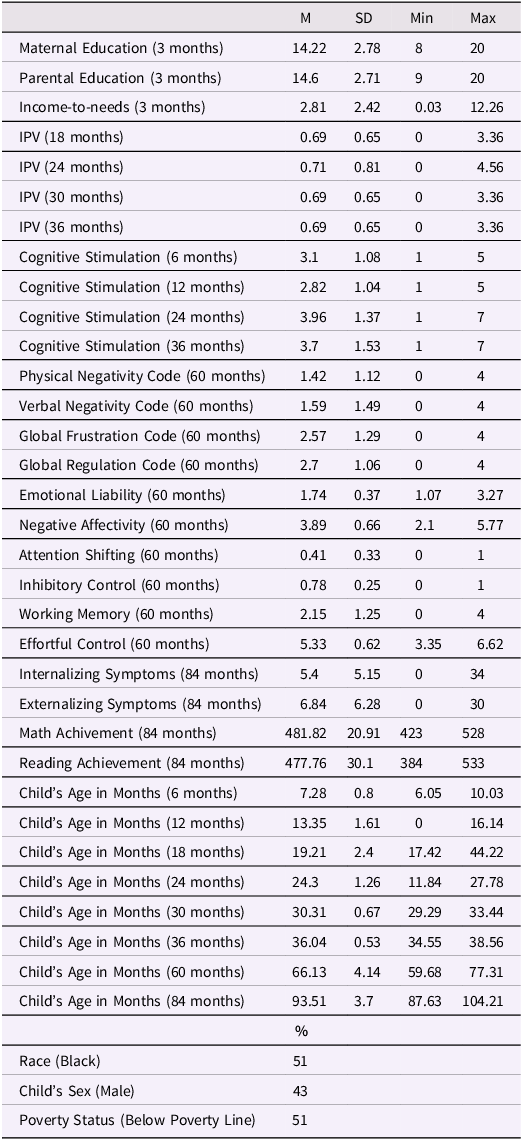
Table 1 contains an overview of the measurements across timepoints as well as descriptive statistics of the sample.
Sample description

Note. IPV = Intimate-Partner Violence; M = Mean; SD = Standard Deviation; Min = Minimum Value; Max = Maximum Value.
Socioeconomic disadvantage
Parents reported total income of the household during an income interview. Total income was used to calculate an income-to-needs ratio using the federal poverty guidelines from 2003, and the number of people in the household. For the proposed analyses we will use the income-to-needs from the data collected when children were 3 months old. Additionally, both parents reported on their years of schooling at the 3-month visit, this goes from 0 (kindergarten and below) to 20 (Professional degree and above). A composite score of socioeconomic disadvantage was created after standardizing the income-to-needs ratio, and the years of schooling from both parents to z-scores. The composite score was reversed for higher scores to represent higher levels of socioeconomic disadvantage. Maternal education was positively correlated with paternal education (r = .72, p < .001), and income-to-needs ratio (r = .69, p < .001); and paternal education was positively associated with income-to-needs ratio (r = .57, p < .001).
Deprivation
Mothers participated with their children in a series of free play sessions where they were instructed to interact with them as they would at 6 and 12 months (Mills-Koonce et al., Reference Mills-Koonce, Gariépy, Propper, Sutton, Calkins, Moore and Cox2007). Sets of standard toys were given to the dyad to play with, and the session was videotaped for behavioral coding. At 24 and 36 months, they participated in a different task completing three puzzles of increasing difficulty (NICHD Early Child Care Research Network, 1999). For further information about the task and deprivation variable see Supplementary Information Methods section.
Threat
Intimate partner violence was assessed using the Conflict Tactics Scale-Couple Form (Straus et al., Reference Straus, Gelles and Asplund1990), a 19-item scale measuring self-reports of physical violence and verbal aggression between mother and her partner. Mothers completed the self-report at 18, 24, 30, and 36-months (Straus et al., Reference Straus, Gelles and Asplund1990). For further information about the instrument and threat variable see Supplementary Information Methods section.
Parent report of effortful control
At 60 months the Children’s Behavior Questionnaire-Short Form was administered to mothers. The Children’s Behavior Questionnaire-Short Form is a 94-item caregiver-report questionnaire of children’s temperament (Putnam & Rothbart, Reference Putnam and Rothbart2006). The effortful control factor will be used, this factor is a composite of mean scores of the inhibitory control, attention focusing, low intensity pleasure, and perceptual sensitivity scales of the Children’s Behavior Questionnaire-Short Form. Overall, effortful control is defined as the degree to which the child uses their cognitive abilities to inhibit and control their behavior. Internal consistency for effortful control was α = .57.
Executive function tasks
At 60-months executive function was assessed using three different laboratory tasks that measure different cognitive processes: attention shifting, inhibitory control, and working memory. Attention shifting was measuring using the Flexible Item Selection Task (Jacques & Zelazo, Reference Jacques and Zelazo2001); inhibitory control was assessed using the Day/Night task (Gerstadt et al., Reference Gerstadt, Hong and Diamond1994); working memory was assessed using a backward version of the Digit Span (McCarthy, Reference McCarthy1972). Previous factor analytic work with this sample describes the creation of an executive function composite with the above tasks (Nesbitt et al., Reference Nesbitt, Baker-Ward and Willoughby2013).
Parent report of emotional reactivity
As mentioned above, at 60-months the Children’s Behavior Questionnaire-Short Form was administrated to parents, the negative affectivity factor will be used (Putnam & Rothbart, Reference Putnam and Rothbart2006). Emotional reactivity is broadly defined as a tendency children must show negative behaviors and emotions in face of stimuli. Internal consistency for negative affectivity was α = .62. The Emotional Range Checklist is a 24-item caregiver report that assesses children’s ability to cope and handle emotions. The emotion liability scale was used, and it refers to the level that the child has anger dysregulation and mood lability and reactivity (Shields & Cicchetti, Reference Shields and Cicchetti1997). This scale was used at the 60-month visit, and internal consistency emotional liability scores at 60 months was α = .96. The negative affectivity and emotional liability scores were standardized to z-scores. A parent report of emotional reactivity score was created by averaging those standardized scores. Negative affectivity, and emotional liability were significantly correlated with each other (r = .43, p < .001).
Emotional reactivity task
The Lock Box task (Goldsmith & Rothbart, Reference Goldsmith and Rothbart1992) was used to assess emotional reactivity at 60-months. An emotional reactivity composite was calculated by averaging z-scores of global frustration, global regulation (reversed score), physical negativity, and verbal negativity codes. Global frustration was correlated with physical negativity (r = .56, p < .001), verbal negativity (r = .74, p < .001), and global regulation (r = −.95, p < .001); physical negativity was correlated with verbal negativity (r = .57, p < .001), and global regulation (r = −.55, p < .001); and verbal negativity was correlated with global regulation (r = −.73, p < .001). For further information of administration and coding of the task see Methods section of Supplementary Information.
Psychopathology
Caregivers completed the Child Behavior Checklist, a standardized caregiver-reported assessment that obtains ratings on children’s emotional and behavioral problems. Higher scores represent higher presence of symptoms. Internalizing symptoms include mood disturbance, anxiety, depression, and social withdrawal. Externalizing symptoms include social conflict and violation of norms (Achenbach, Reference Achenbach1991). This measure was obtained during the 84-month visit. Internal consistency for internalizing and externalizing scores were α = .84 and α = .89, respectively.
Academic achievement
Children completed standardized tests from the Woodcock-Johnson Tests of Achievement III, a battery of assessments that evaluate mathematical and literacy skills (Woodcock et al., Reference Woodcock, McGrew and Mather2001). Two tests were included in the study: the applied problems and letter-word identification. The applied problems test measures children’s capacity to solve math problems. Children are expected to listen to the problem, identify the mathematical solution, and do the calculation to find the answer. The letter-word test measures word identification skills, where children read different words with increasing difficulty. Raw scores were converted to grade-based standard scores for both applied problems and letter-word using Woodcock-Johnson Tests of Achievement III software. Scores from applied problems test (α = .92) and letter-word test (α = .98) have shown good internal reliability (Woodcock et al., Reference Woodcock, McGrew and Mather2001).
Covariates
Child’s sex, age at time of outcomes, and socioeconomic disadvantage were used as covariates.
Analytical plan
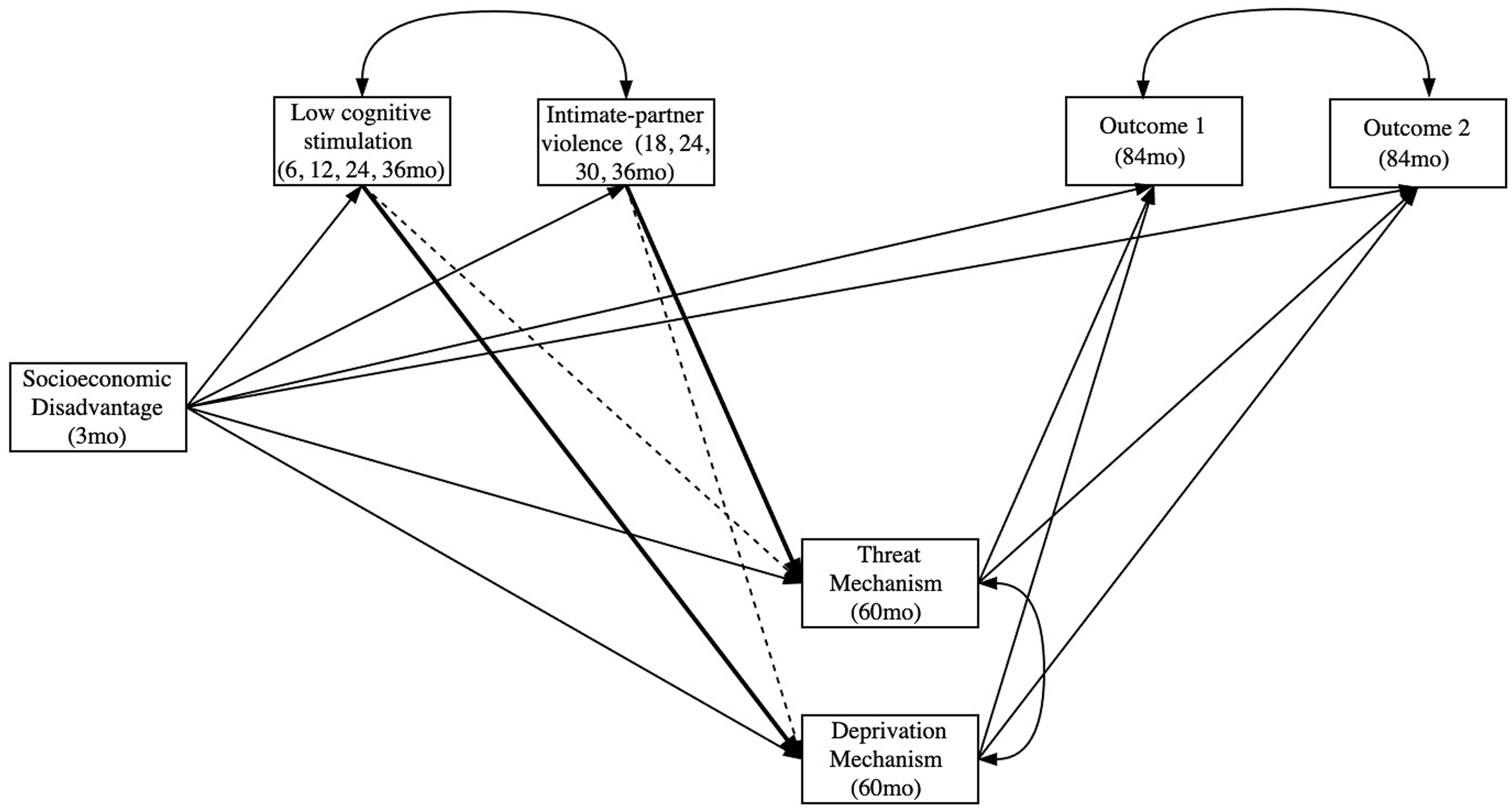
The present analyses leverage a longitudinal study design. Preliminary descriptive analyses (e.g., bivariate correlations) and path models were conducted using RStudio and lavaan (Rosseel, Reference Rosseel2012). In order to account for missing data (rates were low, 0-30%, depending on the variable), maximum likelihood was leveraged, as it has been found to produce less biased parameter estimates (Allison, Reference Allison1987). The fit of each model was evaluated using Chi-square (χ 2) test, the root means square error of approximation (RMSEA), comparative fit index (CFI), Tucker-Lewis’s index (TLI), and standardize root mean residual (SRMR). Good model fit is indicated by a non-significant χ 2, a RMSEA value of less than .06, CFI and TLI values greater than .95, and SRMR values of less than .08 (Bentler & Bonett, Reference Bentler and Bonett1980). This is the first time the deprivation and threat pathways are tested in relation to school achievement. Thus, it was decided to conduct separate models for psychopathology and academic outcomes, as prior research has supported these pathways for psychopathology (Miller et al., Reference Miller, Sheridan, Hanson, McLaughlin, Bates, Lansford, Pettit and Dodge2018, Reference Miller, Machlin, McLaughlin and Sheridan2021), but not school outcomes. Moreover, prior research suggests that performance-based assessments and parent-report measures of children’s behavior are not always correlated with each other and predict different developmental outcomes. Additionally, children lack the linguistic capacity and awareness to report on their psychological functioning, and parent-report measures of children’s behavior have been found to be biased, as they rely on the perception of others to understand children’s functioning and experiences (Ten Eycke & Dewey, Reference Ten Eycke and Dewey2016). Thus, we conducted separate models for observed and parent reported mechanisms, as they both have strengths and weaknesses and might predict outcomes differentially. We tested our hypotheses using the following modelling approach (illustrated in Figure 1):
Illustration of theoretical models. Single-headed arrows represent regression paths, while curve, double-headed arrows represent correlations. Black arrows represent effects tested across all models (hypothesized, inverted, fully connected). Bolded arrows represent effects tested in hypothesized but not inverted models. Dashed arrows represent effects tested in inverted, but not hypothesized models. Threat mechanism = observed emotional reactivity in observed mechanisms models & parent-reported emotional reactivity in parent-reported mechanisms model; deprivation mechanism = executive function in observed mechanisms models & parent-reported effortful control in parent-reported mechanisms model; outcome 1 = externalizing symptoms in psychopathology models & math achievement in school modes; outcome 2 = internalizing symptoms in psychopathology models & reading achievement in school models.

Does deprivation and threat predict psychopathology and academic achievement through observed measurement of executive function and emotional reactivity?
Path analyses were used to test: (1) the effects of socioeconomic status on deprivation and threat, (2) the effects of deprivation on executive function, (3) the effects of threat on emotional reactivity, (4) the effects of executive function and emotional reactivity on internalizing and externalizing symptoms, and (5) the effects of executive function and emotional reactivity on math and reading achievement. In this set of models, we operationalized executive function using the combined scores from three behavioral tasks designed to assess executive function and emotional reactivity using observed behaviors coded during the Lock-box task. Robust standard errors were used to account for the non-normality of the data. We conducted separate models for psychopathology and academic achievement as outcomes. Effects were estimated using bootstrapped standard errors (1,000 draws) for direct effects and the following: (1) indirect effects of deprivation on internalizing, externalizing symptoms, math and reading achievement through executive function and (2) indirect effects of threat on internalizing, externalizing symptoms, math and reading achievement through emotional reactivity.
To explore the goodness of fit of our data we fitted three different models: In hypothesized models we investigated indirect effects of deprivation on outcomes (i.e., psychopathology or school outcomes) through executive function and the indirect effects of threat on outcomes (i.e., psychopathology or school outcomes) through emotional reactivity. In inverted models we investigated indirect effects of deprivation on outcomes (i.e., psychopathology or school outcomes) through emotional reactivity and the indirect effects of threat on outcomes (i.e., psychopathology or school outcomes) through executive function. In fully connected models, where we add all the possible paths linking deprivation, threat, executive function, emotional reactivity, symptoms of psychopathology and measures of academic achievement. In each of our models we also tested for covariance between deprivation and threat, executive function and emotional reactivity, internalizing symptoms and externalizing symptoms, and math and reading achievement. The model with best fit was determined using Akaike’s Information Criteria (AIC), Bayesian’s Information Criteria (BIC), and sample size adjusted BIC (SABIC). Lower values on these criteria are indicative of better fit. Additionally, a χ2 difference test was conducted to compare fit between the hypothesized and fully connected model.
Does deprivation and threat predict psychopathology and academic achievement through parent report effortful control and emotional reactivity?
Using the same approach as described above (with observed behaviors), we tested similar associations using parent-report: (1) the effects of deprivation on parent report effortful control, (2) the effects of threat on parent report emotional reactivity, (3) the effects of parent reported effortful control and emotional reactivity on internalizing and externalizing symptoms, and (4) the effects of parent reported effortful control and emotional reactivity on math and reading achievement. We conducted separate models for psychopathology and academic achievement as outcomes. Robust standard errors were used to account for the non-normality of the data. Effects were estimated using bootstrapped standard errors (1,000 draws) for direct effects and the following: (1) indirect effects of deprivation on internalizing, externalizing symptoms, math and reading achievement through effortful control and (2) indirect effects of threat on internalizing, externalizing symptoms, math and reading achievement through emotional reactivity.
To explore the goodness of fit of our data we fitted three different models: In hypothesized models we investigated indirect effects of deprivation on outcomes (i.e., psychopathology or school outcomes) through effortful control and the indirect effects of threat on outcomes (i.e., psychopathology or school outcomes) through emotional reactivity. In inverted models we investigated indirect effects of deprivation on outcomes (i.e., psychopathology or school outcomes) through emotional reactivity and the indirect effects of threat on outcomes (i.e., psychopathology or school outcomes) through effortful control. In fully connected models, where we add all the possible paths linking deprivation, threat, effortful control, emotional reactivity, symptoms of psychopathology, and measures of academic achievement. In each of our models we also tested for covariance between deprivation and threat, effortful control and emotional reactivity, internalizing symptoms and externalizing symptoms, and math and reading achievement. The model with best fit was determined using Akaike’s Information Criteria (AIC), Bayesian’s Information Criteria (BIC), and sample size adjusted BIC (SABIC). Lower values on these criteria are indicative of better fit. Additionally, a χ 2 difference test was conducted to compare fit between the hypothesized and fully connected model.
Results
Sample characteristics
In this sample, 48% of children had male sex assigned at birth, 56% of parents identified their race as Black (44% as White), and 53% lived below the poverty line. At time of recruitment (3-month visit) maternal mean age was 27.87 years on average (SD = 5.68), average maternal and parental education was 14.22 years (SD = 2.77), and 14.59 years (SD = 2.71), respectively, mean income to needs ratio was 2.78 (SD = 2.42), and 57.76% of mothers were married. For more information about the sample refer to Table 1. Child age at time of outcome, sex assigned at birth, and socioeconomic disadvantage (composite of family income to needs and parental education, see Methods for further information) were used as covariates in the analyses. For first order correlations of study main variables see Table S2.
Model selection
Across models, inverted models showed poor fit (see Table S3 and Table S4 for information on model fit and selection indices). Additionally, and across models, chi-square difference tests comparing hypothesized to fully connected models showed no improvement in model fit (Psychopathology and observed mechanisms model: (χ 2 (6, N = 206) = 5.88, p = .43); Psychopathology and parent-reported mechanisms model: (χ 2 (6, N = 206) = 9.32, p = .15); School outcomes and observed mechanisms model: (χ2 (6, N = 206) = 3.02, p = .80); School outcomes and parent-reported mechanisms model: (χ 2 (6, N = 206) = 11.22, p = .08). Across inverted and fully connected models, effects not hypothesized by DMAP (i.e., deprivation on emotional reactivity, and threat on cognition) were not significant.
Hypothesized models showed good fit: Psychopathology and observed mechanisms (χ 2 (16, N = 206) = 21.03, p = .177; CFI = .97, TLI = .94; RMSEA = .03; SRMR = .03); psychopathology and parent-reported mechanisms (χ 2 (16, N = 206) = 22.43, p = .130; CFI = .97, TLI = .944; RMSEA = .04; SRMR = .03); and school outcomes and observed mechanisms (χ 2 (16, N = 206) = 24.49, p = .079; CFI = .95, TLI = .82; RMSEA = .07; SRMR = .02). However, the hypothesized school outcomes and parent-reported mechanisms model showed poor fit. It was concluded that the best model across research questions was the hypothesized model, except for the school outcomes and observed mechanisms model where the hypothesized and inverted model showed poor fit, while the fully connected model showed no improvement in model fit. For more information on the hypothesized model linking early adversity to school outcomes through parent-reported mechanisms see Supplementary Information.
Path analyses
Across all models, socioeconomic disadvantage was associated with higher levels of intimate-partner violence, and low cognitive stimulation (see Figure S1).
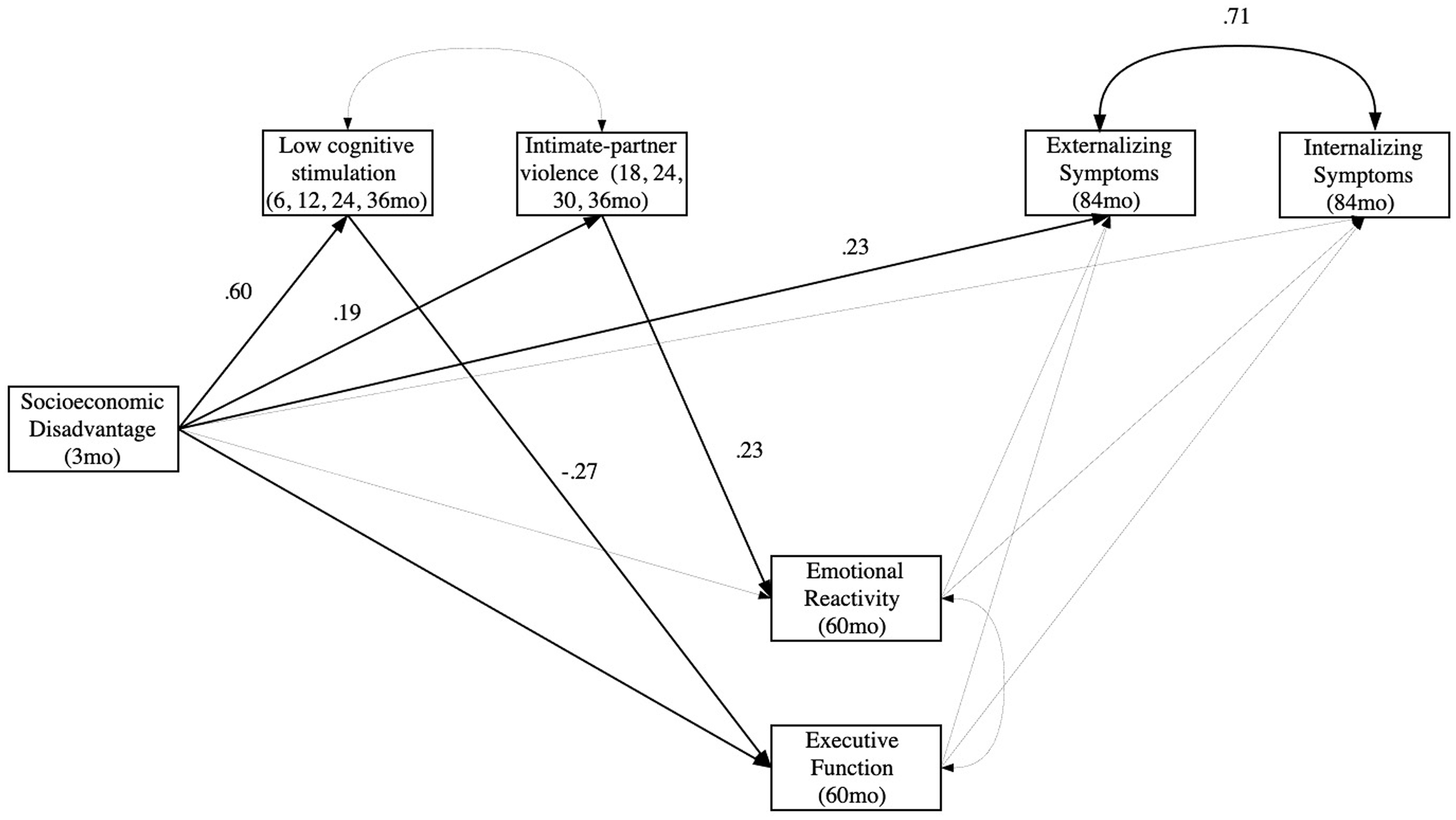
For the model linking early adversity to psychopathology through observed behavior, intimate-partner violence was associated with more emotional reactivity (β = .23, 95% CI = [.50, .72]), and low cognitive stimulation with worse executive function (β = −.27, 95% CI = [−.47, −.09]). No indirect effects were significant (Figure 2; For more information on model statistics see Table S5).
Path model illustrating the effects of early adversity on psychopathology through observed mechanisms. Single-headed arrows represent regression paths, while curve, double-headed arrows represent correlations. Standardized parameter estimates (β) are presented for all significant paths (with bootstrapped confidence intervals using 1,000 iterations) using solid lines. For simplicity, paths from covariates are not pictured.

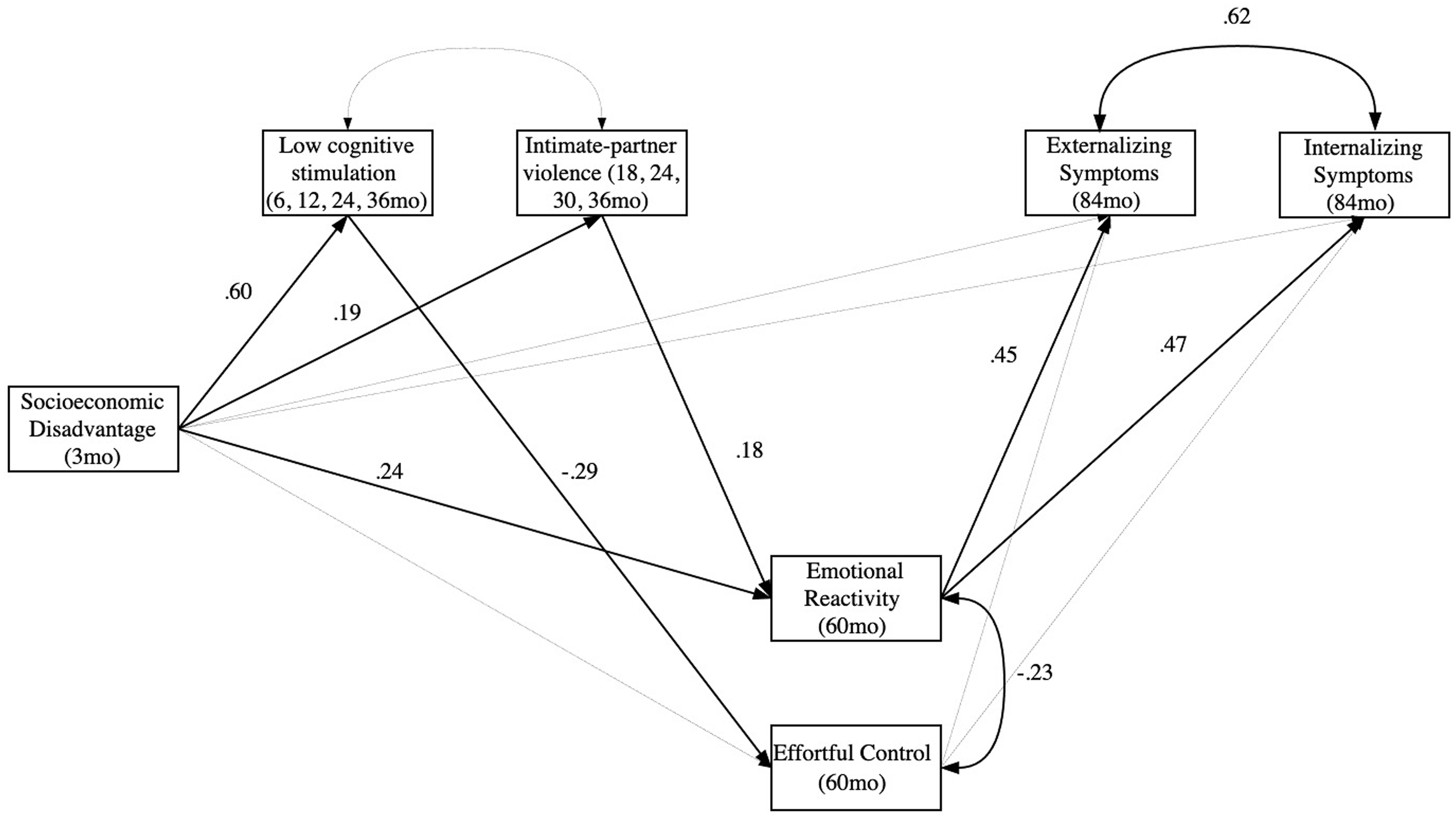
For the model linking early adversity to psychopathology through parent-reported behavior, intimate-partner violence was associated with higher child emotional reactivity (β = .18, 95% CI = [.02, .35]), and low cognitive stimulation with lower child effortful control (β = −.29, 95% CI = [−.31, −.06]). Emotional reactivity was associated with higher levels of internalizing (β = .47, 95% CI = [.29, .65]) and externalizing (β = .45, 95% CI = [.24, .64]) symptoms and there two significant indirect effects of intimate-partner violence on internalizing (β = .08, 95% CI = [.01, .18]) and externalizing (β = .08, 95% CI = [.00, .18]) symptoms through emotional reactivity (Figure 3; For more information on model statistics see Table S6).
Path model illustrating the effects of early adversity on psychopathology through parent-reported mechanisms. Single-headed arrows represent regression paths, while curve, double-headed arrows represent correlations. Standardized parameter estimates (β) are presented for all significant paths (with bootstrapped confidence intervals using 1,000 iterations) using solid lines. For simplicity, paths from covariates are not pictured.

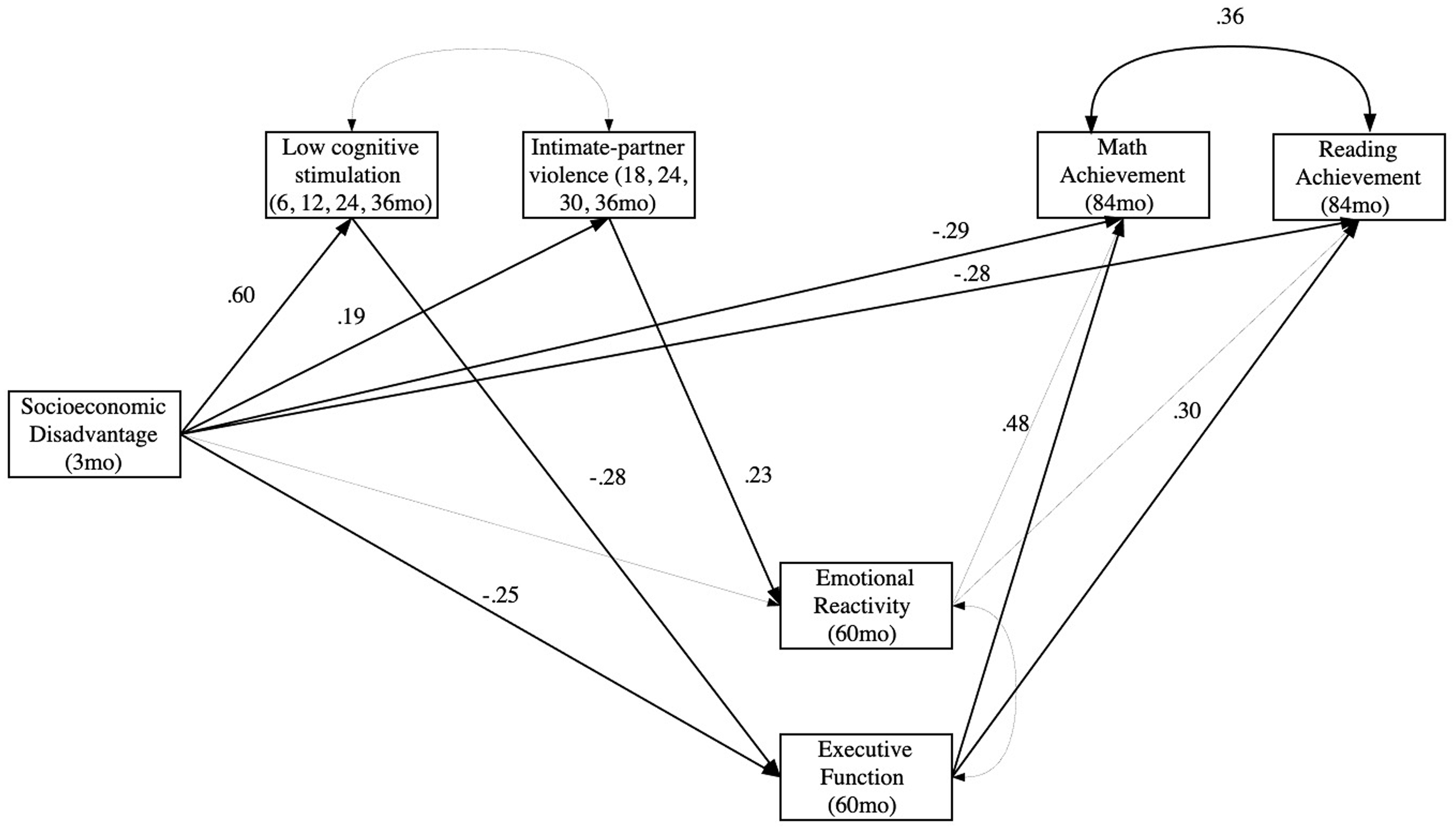
For the model linking early adversity to school outcomes through observed behavior, threat was associated with higher levels of emotional reactivity (β = .23, 95% CI = [.05, .49]), and low cognitive stimulation with worse executive function (β = −.28, 95% CI = [−.49, −.11]). Executive function was associated with higher math (β = .48, 95% CI = [.30, .64]) and reading (β = .30, 95% CI = [.08, .47]) achievement. There were significant indirect effects of low cognitive stimulation on math (β = −.13, 95% CI = [−.26, −.04]) and reading (β = −.08, 95% CI = [−.18, −.01]) achievement though executive function (Figure 4; For more information on model statistics see Table S7).
Path model illustrating the effects of early adversity on academic achievement through observed mechanisms. Single-headed arrows represent regression paths, while curve, double-headed arrows represent correlations. Standardized parameter estimates (β) are presented for all significant paths (with bootstrapped confidence intervals using 1,000 iterations) using solid lines. For simplicity, paths from covariates are not pictured.

For more information on the model linking early adversity to school outcomes through parent-reported behavior please see Table S8.
Discussion
The present study examined behavioral mechanisms by which early adversity increases risk for psychopathology and poor school outcomes. Specifically, we observe, in a longitudinal study with multi-model measurement beginning in early infancy, that children born to families with lower SES are exposed to higher levels of deprivation and threat. Children with higher exposure to deprivation (operationalized as low cognitive stimulation) in infancy and early childhood subsequently show worse executive function and lower levels of effortful control and through disrupted executive function, poor academic achievement. Further, exposure to higher levels of threat (operationalized as intimate-partner violence) between 18 and 36 months is associated with higher levels of observed and parent-reported emotional reactivity, and through parent-reported emotional reactivity, higher levels of psychopathology. These findings are consistent with dimensional models of adversity which propose that neurodevelopment is influenced by early experience, thus leading to risk for psychopathology. In addition, they show that low family SES may lead to difficulties with psychopathology and academic achievement at least in part because of family SES increases risk for exposure to adversity. These findings extend prior work in several important directions.
Deprivation
Prior studies using dimensional models have shown that experiences of deprivation are uniquely associated with deficits in cognitive function, including executive function, cognitive control, and verbal abilities (Lambert et al., Reference Lambert, King, Monahan and McLaughlin2017; Machlin et al., Reference Machlin, Miller, Snyder, McLaughlin and Sheridan2019; Miller et al., Reference Miller, Machlin, McLaughlin and Sheridan2021; Vogel et al., Reference Vogel, Perry, Brandes-Aitken, Braren and Blair2021). Two of these studies showed that deprivation is associated with poor executive function and cognitive control in early childhood. However, most of this prior work has utilized parent report of stimulating resources in the home (i.e., number of books, number of toys), cognitive stimulation, and neglect. Studies within the DMAP literature which do not focus on caregiver self-report often utilize the assessment of learning materials which may be driven by household resources and expendable income. Here, we operationalized deprivation using observations of maternal cognitive stimulation coded from a series of parent–child interaction tasks in a standard laboratory setting (NICHD Early Child Care Research Network, 1999). This is a novel approach within this literature, which eliminates sources of bias present in self- and caregiver-report measures used in prior studies. Findings from the present study are consistent with prior work demonstrating that deprivation, but not threat is associated with deficits in higher order cognition, and particularly, executive function. This is the first study to demonstrate this association with a longitudinal measurement of deprivation from infancy through toddlerhood (6-36 months of age).
The DMAP hypotheses are based on animal and human research showing that very early deprivation of species-expected stimuli is associated with longitudinal changes in brain and cognitive development (Sheridan & McLaughlin, Reference Sheridan and McLaughlin2016). Neuroscientific models of developmental plasticity focus on neural developmental processes such as proliferation and pruning which peak in infancy, from 0-2 or 3 years of age. Although deprivation has been measured in early childhood (Machlin et al., Reference Machlin, Egger, Stein, Navarro, Carpenter, Goel, Patel, Copeland and Sheridan2023; Miller et al., Reference Miller, Sheridan, Hanson, McLaughlin, Bates, Lansford, Pettit and Dodge2018, Reference Miller, Machlin, McLaughlin and Sheridan2021), the present study is the first to measure it during infancy, the period of peak developmental plasticity where it was proposed deprivation might have the largest impact on brain and cognitive development. In addition, this study tests longitudinal associations with cognition, measuring the long-term importance of this early experience even through middle childhood. Recent experimental work from the Bucharest Early Intervention Project shows that children randomly assigned out of institutional care between 6-36 months of age exhibit longitudinal changes in prefrontal cortex structure and in white matter tracts connecting the parietal and prefrontal cortices (Sheridan et al., Reference Sheridan, Mukerji, Wade, Humphreys, Garrisi, Goel, Patel, Fox, Zeanah, Nelson and McLaughlin2022) highlighting a potential neural pathway for our longitudinal observations of cognitive function.
Even though the associations between deprivation and cognition were present and as expected, we did not replicate associations between deprivation and psychopathology observed in previous studies (Miller et al., Reference Miller, Sheridan, Hanson, McLaughlin, Bates, Lansford, Pettit and Dodge2018, Reference Miller, Machlin, McLaughlin and Sheridan2021; Schäfer et al., Reference Schäfer, McLaughlin, Manfro, Pan, Rohde, Miguel, Simioni, Hoffmann and Salum2022). We did not observed deprivation to predict psychopathology through executive function or effortful control. One possible reason could be that in the present study we are measuring a less severe form of deprivation in comparison to other studies, that, in part, measure neglect (Miller et al., Reference Miller, Sheridan, Hanson, McLaughlin, Bates, Lansford, Pettit and Dodge2018, Reference Miller, Machlin, McLaughlin and Sheridan2021; Schäfer et al., Reference Schäfer, McLaughlin, Manfro, Pan, Rohde, Miguel, Simioni, Hoffmann and Salum2022). Another likely possibility is that we measured psychopathology in middle childhood (7 years of age), considering the rapid onset of symptoms of psychopathology in early to mid -adolescence (Solmi et al., Reference Solmi, Radua, Olivola, Croce, Soardo, Salazar De Pablo, Il Shin, Kirkbride, Jones, Kim, Kim, Carvalho, Seeman, Correll and Fusar-Poli2022), we may a constrained range of psychopathology to observe in this young sample.
The current study also examined whether deprivation was associated with school outcomes. As expected, deprivation predicts lower math and reading achievement through executive function longitudinally from 6 months to 7 years of age. These results are similar to previous DMAP-informed work showing that deprivation, but not threat, is associated with school achievement (Oeri & Roebers, Reference Oeri and Roebers2022) and with previous work showing that random assignment out of institutionalization between 6-36 months of age is associated with improved IQ (Humphreys et al., Reference Humphreys, King, Guyon-Harris, Sheridan, McLaughlin, Radulescu, Nelson, Fox and Zeanah2022). Given strong associations between SES and deprivation in this sample, this may be the environmental mechanism by which poverty predicts school outcomes through executive function. Moreover, even though DMAP empirical work has focused mainly on psychopathology as a distal outcome (Sheridan & McLaughlin, Reference Sheridan and McLaughlin2016), research shows that early academic achievement is associated with important long-term economic, social, and health trajectories.
Threat
Here we find that exposure to threat but not deprivation between 18 and 36 months of age predicts higher levels of emotional reactivity and subsequently psychopathology in childhood. The present findings are consistent with the hypothesis that threat exposure is a form of intense learning experience that shapes neural development and subsequently emotion reactivity (Sheridan & McLaughlin, Reference Sheridan and McLaughlin2016). This is the first study to use a longitudinal design to show that early experiences of threat are associated with deficits in later emotional functioning in any age-range. As with deprivation, while previous studies have examined threat exposure in early childhood (Lambert et al., Reference Lambert, King, Monahan and McLaughlin2017; Milojevich et al., Reference Milojevich, Norwalk and Sheridan2019), the present study is among the first to measure it during infancy and toddlerhood. Finally, as with deprivation, we find that lower SES was associated with increased risk for exposure to threat. It maybe that SES increases risk for psychopathology in part because of the impact of threat on emotion reactivity.
In the developmental literature, negative emotionality, part of our operationalization of emotional reactivity, has been thought of as a domain of temperament, understood as a stable and strongly genetically constrained set of attributes. However, temperament is often measured after periods of infancy, and here we show that exposures to threat during those early periods are associated with long-term differences negative emotionality. Relatedly, meta-analytic work has shown maltreated children display more negativity and reactivity (Lavi et al., Reference Lavi, Katz, Ozer and Gross2019), and other empirical work shows that abused children tend to show higher levels of emotional reactivity (Shackman & Pollak, Reference Shackman and Pollak2005). In addition, systematic evidence suggests threat is associated with key networks that subserve emotional reactivity, such as the salience network (McLaughlin et al., Reference McLaughlin, Weissman and Bitrán2019). These associations, like our observations in this study, are consistent with the possibility that threat experiences during periods of peak developmental plasticity might shape neural structure and function in a way which increases emotional reactivity, as suggested by the rodent literature (Junod et al., Reference Junod, Opendak, LeDoux and Sullivan2019; Santiago et al., Reference Santiago, Lim, Opendak, Sullivan and Aoki2018). Here we observe threat is associated with emotion reactivity both by parent report and observed reactivity in a task. The use of multi-modal assessment is a strength of this study, demonstrating making it the first to show that the specificity of the association between threat and emotion reactivity is observable regardless of how emotional reactivity is operationalized.
Threat was associated with higher internalizing and externalizing symptoms through caregiver reported emotional reactivity. These findings are consistent with previous studies which have found that the association between threat and psychopathology is mediated by emotion regulation (Milojevich et al., Reference Milojevich, Norwalk and Sheridan2019; Schäfer et al., Reference Schäfer, McLaughlin, Manfro, Pan, Rohde, Miguel, Simioni, Hoffmann and Salum2022). Together, these results elucidate a behavioral mechanism, emotional reactivity, by which exposure to threat contributes to psychopathology in children and expand findings demonstrating them to be robust to variation in measurement. However, while threat predicted observed emotional reactivity, this behavior did not act as a pathway between threat and psychopathology. One possible reason could be that laboratory settings are not ecologically valid measures of children’s behaviors, as these environments tend to have low levels of distraction and are highly structured (Rabbitt, Reference Rabbitt1997). Thus, the levels of reactivity observed in the laboratory might be high enough to reflect the impact of threat on these emotional systems, however, not high enough to reflect a pathway to psychopathology.
Modeling and measurement
To identify specificity of pathways linking deprivation and threat to developmental outcomes, we tested model fit for inverted models where deprivation predicted emotional reactivity and threat predicted executive function/effortful control. In previous work, studies have tested hypothesized effects of deprivation and threat on outcomes while controlling for the other exposure (Lambert et al., Reference Lambert, King, Monahan and McLaughlin2017; Machlin et al., Reference Machlin, Miller, Snyder, McLaughlin and Sheridan2019). In contrast, we showed that these inverted models had poor fit and that non-hypothesized pathways (e.g., between deprivation and emotional reactivity) were not significant. Poor model fit could happen for several reasons including that the model does not reflect the true relation between the measured variables (Kenny, Reference Kenny2015), an interpretation bolstered in this case by the lack of significance in non-hypothesized paths. In all cases we observed that models where deprivation predicted emotional reactivity and threat predicted executive function/effortful control were not consistent with the data and required re-specification (Kenny, Reference Kenny2015).
Moreover, we also tested fully connected models, where both deprivation and threat predicted emotional reactivity and executive function/effortful control. While these models showed good fit, statistical comparison showed that these fully connected models did not perform significantly better than our hypothesized models (i.e., models where deprivation predicted executive function/effortful control (but not emotional reactivity), and threat predicted emotional reactivity (but not cognition)). Suggesting that aggregating those paths to our model did not contribute to the goodness of fit of our data. Another common reason for poor model fit is the inclusion of extraneous variables (Kenny, Reference Kenny2015), which could explain the reason we observed poor model fit in our inverted models and our fully connected models did not significantly improve model fit. This model testing provides further support for the DMAP which hypothesizes selective effects of dimensions of adversity on mediating capabilities such as emotional reactivity or executive function while also hypothesizing equifinal outcomes for both dimensions of adversity, when considering distal developmental outcomes such as psychopathology or school achievement.
However, we did observe that one of our hypothesized models did not show good model fit. In this model we observed associations between early adversity and school outcomes through parent-reported mechanisms (i.e., effortful control and emotional reactivity). As suggested above, this poor model fit might be due to the inclusion of variables that do not contribute to the explained variance in our outcome variables (i.e., math and reading achievement). Research suggests that parent-reports and performance-based measures of cognition predict different developmental outcomes (Ten Eycke & Dewey, Reference Ten Eycke and Dewey2016). Thus, this could explain why models that contained parent-report pathways showed poor model fit. While both performance-based and parent-reported behaviors are valuable tools in developmental research, as children age it might be important to explore whether their perceptions on their individual psychological functioning (i.e., reactivity, regulation, control) also changes statistical indices such as model fit and the significance of observed effects. Moreover, this model did not test the association between low cognitive stimulation and outcome variables, which contributed to our poor model fit as suggested by the covariance residuals calculated from the model (see Supplementary Information).
Strengths and limitations
The present study is not without limitations. First, unlike other studies (Machlin et al., Reference Machlin, Miller, Snyder, McLaughlin and Sheridan2019, Reference Machlin, Egger, Stein, Navarro, Carpenter, Goel, Patel, Copeland and Sheridan2023), we did not create composites of deprivation and threat that had multiple indicators of each. For example, previous studies use multiple indicators of interpersonal violence, including childhood abuse and domestic violence, to create a threat composite. The present study only focuses on experiences of intimate partner violence, which is an exposure to threat, but does not capture other experiences of threat which are likely to co-occur. The same is true for deprivation, as we only measure the scaffolded learning experiences provided by the parent in a laboratory setting, and no other sources (i.e., the home). Thus, these are not comprehensive composites of cumulative deprivation and threat, and more research is needed with these types of variables to reiterate the validity of these claims and hypotheses. Second, our deprivation and threat timepoints differed. Deprivation was measured at 6, 12, 24, and 36 months (infancy and toddlerhood); while threat was measured at 18, 24, 30, and 36 months (toddlerhood only). Future studies should try to capture dimensions at the same timepoints to get at more accurate differential effects. Third, there is a rich body of knowledge showing associations between prenatal and genetic factors, and children’s outcomes (Godfrey & Barker, Reference Godfrey and Barker2001) that we were not able to account for in the current sample. Fourth, while our sample includes Black and White families, these findings are not generalizable to other races and ethnicities (e.g., Asians, Native Americans, Hispanics) that also experience socioeconomic disadvantage, and thus, are a greater likelihood of experiencing deprivation and threat. Future studies should aim to include families from diverse race and ethnic backgrounds to assess the generalizability of the present findings. Finally, a key limitation of the present study is the use of data that was collected more than 10 years ago (expanding from 2003 to 2010). For example, research shows that childhood poverty, a main predictor of childhood adversity, has decreased at least 20% from 2000 to 2018 (Finkelhor, Reference Finkelhor2020) in the United States. Moreover, intimate-partner violence, our main threat predictor, has had a 27% decline from 2000 to 2013 (Lauritsen & Rezey, Reference Lauritsen and Rezey2018). Recent reports show that children of color experience more adversities than their white counterparts (Sacks & Murphey, Reference Sacks and Murphey2018), with 61% of non-Hispanic black children experiencing at least one type of early adversity. Thus, the present data is limited in how it can inform current studies, given great differences in both the general occurrence of these experiences, and how these experiences are distributed across racial groups.
Despite these limitations this study has several notable strengths. One of the main strengths of the present study is its longitudinal design. We tested how early exposures (i.e., socioeconomic disadvantage) predicted childhood experiences (i.e., deprivation and threat), and how those early experiences predicted negative outcomes at 84 months (i.e., psychopathology and school achievement) through behavioral mediators at 60 months. One of the key limitations of the current literature is the use of cross-sectional samples (Lambert et al., Reference Lambert, King, Monahan and McLaughlin2017; Machlin et al., Reference Machlin, Miller, Snyder, McLaughlin and Sheridan2019), with specific exceptions (Machlin et al., Reference Machlin, Egger, Stein, Navarro, Carpenter, Goel, Patel, Copeland and Sheridan2023; Miller et al., Reference Miller, Sheridan, Hanson, McLaughlin, Bates, Lansford, Pettit and Dodge2018, Reference Miller, Machlin, McLaughlin and Sheridan2021). Moreover, this is one of the first studies to test pathways through which deprivation and threat distinctively predict school outcomes (Oeri & Roebers, Reference Oeri and Roebers2022). In addition, this is the first study to test DMAP models predicting both psychopathology and school achievement in the same sample (Miller et al., Reference Miller, Sheridan, Hanson, McLaughlin, Bates, Lansford, Pettit and Dodge2018) and thus it is the first study to demonstrate differential pathways of deprivation and threat to both psychopathology and school achievement in childhood. Finally, our sample comes from a diverse background (both with regards to minoritized race and ethnic identities and with regards to family SES), increasing the generalizability of our observations.
Future directions
In the present study, we extended prior work demonstrating differential effects of deprivation and threat on children’s development. However, because these hypotheses are built from neurodevelopmental theory (Sheridan & McLaughlin, Reference Sheridan and McLaughlin2016), future work should explore neural structure and function in early childhood as mechanisms linking early adversity and to important developmental outcomes. Studies should explore how deprivation and threat impact neural structure, and activation during tasks that require cognitive control and emotion regulation (Murgueitio et al., Reference Murgueitio, Tate, Lurie, Priddy, Boda, Shipkova, Rodriguez, Machlin, Furlong, Mitchell, McLaughlin and Sheridan2024).
Conclusion
In summary, this study documents that deprivation is associated with poor cognition and threat with higher emotional reactivity. Additionally, deprivation predicts poor math and reading achievement through performance in executive function tasks, while threat predicts psychopathology through emotional reactivity. We provide evidence of these associations using a longitudinal design, multimodal assessments, and path analyses. These findings suggest that deprivation and threat uniquely contribute to children’s behavior and functioning.
Supplementary material
The supplementary material for this article can be found at https://doi.org/10.1017/S0954579424001664.
Acknowledgments
We thank the families and children who participated in the study.
Funding statement
This study was supported by The North Carolina Child Development Research Collaborative, which is funded by the NSF through Children’s Research Initiative Grant (BCS-0126475) and an Integrative Research Activities for Developmental Science Grant (BCS-0720660).
Competing interests
None.
Consent statement
All stages of the current study were approved by the University of North Carolina at Chapel Hill Institutional Review Board.