Introduction
An inherent and persistent risk associated with fish introductions is the transmission of their parasitic fauna to native host fishes (Kennedy, Reference Kennedy1994; Kirk, Reference Kirk2003). These naïve hosts may be highly susceptible to infection where there has been a lack of host–parasite co-evolution, which may result in low natural immunity, altered disease dynamics and poor anti-parasite behaviour (Taraschewski, Reference Taraschewski2006; Kelly et al., Reference Kelly, Paterson, Townsend, Poulin and Tompkins2009). Transmission of non-native parasites to new geographical localities has already resulted in serious and irreversible effects in some species, such as the detrimental effect of Anguillicoloides crassus (Kuwahara, Niimi et Itagaki, 1974) on the European eel Anguilla anguilla L. (Székely et al., Reference Székely, Palstra, Molnár and Van den Thillart2009). The global spread of parasites with invading hosts is therefore a major cause of disease emergence and holds important implications for native aquatic environments (Gozlan et al., Reference Gozlan, St-Hilaire, Feist, Martin and Kent2005, Reference Gozlan, Whipps, Andreou and Arkush2009; Perkins et al., Reference Perkins, Altizer, Bjornstad, Burdon, Clay, Gómez-Aparicio, Jeschke, Johnson, Lafferty, Malmstrom, Mertin, Power, Strayer, Thrall and Uriarte2008; Peeler et al., Reference Peeler, Oidtmann, Midtlyng, Miossec and Gozlan2011).
In England and Wales the European catfish Silurus glanis L. has been widely introduced for enhancing the performance of recreational lake fisheries (Britton et al., Reference Britton, Cucherousset, Davies, Godard and Copp2010). Many of these introductions have been completed outside of relevant regulatory frameworks and so have not been subjected to risk assessment processes prior to their release (Hickley & Chare, Reference Hickley and Chare2004; Copp et al., Reference Copp, Garthwaite and Gozlan2005, Reference Gozlan, Whipps, Andreou and Arkush2009). In order to better understand the ecological risks associated with this species, research has been conducted to assess the invasiveness of this fish in the UK. Most of this work has focused on colonization potential under current and future climatic conditions (Britton et al., Reference Britton, Davies, Brazier and Pinder2007, Reference Britton, Cucherousset, Davies, Godard and Copp2010; Copp et al., Reference Copp, Britton, Cucherousset, García-Berthou, Kirk, Peeler and Stakènas2009). However, according to Copp et al. (Reference Copp, Britton, Cucherousset, García-Berthou, Kirk, Peeler and Stakènas2009), virtually all aspects of the environmental biology of S. glanis require further study. This includes disease risk, as to date little attention has been given to the parasite fauna of this fish in Britain, despite awareness that it may serve as host for a wide range of parasite species (Copp et al., Reference Copp, Britton, Cucherousset, García-Berthou, Kirk, Peeler and Stakènas2009). In an effort to address this knowledge gap, the present study describes the results of parasitological investigations of S. glanis from freshwater fisheries.
Materials and methods
Between 2009 and 2011, five specimens of S. glanis (50–170 cm) were examined from four different still-water fisheries in England. These fish were made available as part of Environment Agency investigations into the colonization potential and invasion biology of S. glanis in inland waters in England and Wales. These sites were located in Staffordshire, Hampshire, Kent and Essex (precise locations withheld for confidentiality).
All fish were captured by means of seine netting and transported alive to holding facilities at the Environment Agency, Brampton. Fish were killed by lethal anaesthesia (benzocaine solution 5% w/v) and examined for external and internal parasites, using low- and high-power light microscopy. The identity, site of attachment and approximate intensity of any parasites that were encountered were recorded.
Results and discussion
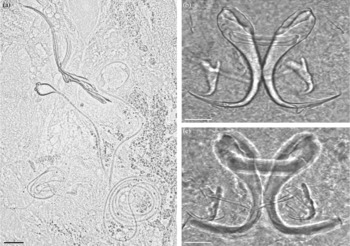
The ancyrocephalid monogenean parasite, Thaparocleidus vistulensis (Siwak, 1932) was recorded on the gills of all five fish (intensity range 1–35 per gill arch). Identification was confirmed from examination of the copulatory complex (fig. 1a) and the haptoral sclerites (fig. 1b and c).
Copulatory complex (a) and haptoral sclerites (b, c) of Thaparocleidus vistulensis (Siwak, 1932). Scale bar = 20 μm.

Other parasite findings included light infections of Camallanus lacustris (Zoega, 1776) in the intestinal tract (mean intensity, 1), Argulus foliaceus (L.) on the skin (mean intensity, 1), Diplostomum spp. in the eye (intensity range 1–5), Trypanosoma spp. in the kidney and Ergasilus sieboldi (Nordmann, 1832) on the gill lamellae (intensity range 1–10 per gill arch).
These studies provide the first record of T. vistulensis in the UK. This parasite is a specialist of siluriform fishes. Voucher specimens of T. vistulensis have been deposited in the parasitic worm collection of the Natural History Museum, London (NHMUK 2011.10.27.1-3). Ergasilus sieboldi is also a non-native parasite, but may infect a wide range of fish species (Fryer, Reference Fryer1969).
Thaparocleidus spp. have been recorded from much of Asia and Europe (Lim et al., Reference Lim, Timofeeva and Gibson2001; Moravec, Reference Moravec2001; Galli et al., Reference Galli, Stefani, Benzoni, Crosa and Zullini2003; Copp et al., Reference Copp, Britton, Cucherousset, García-Berthou, Kirk, Peeler and Stakènas2009). Specific records for T. vistulensis include Italy, the Czech Republic, the Slovak Republic and Poland (Siwak, Reference Siwak1932; Moravec, Reference Moravec2001; Paladini et al., Reference Paladini, Gustinelli, Fioravanti, Minardi and Prearo2008), although these are likely to reflect detection effort rather than the true extent of distribution. Limited information exists on the pathogenicity of T. vistulensis and the pathology of this parasite has not been described. Blanc (Reference Blanc1997) listed a number of ancyrocephalid Monogenea in a table of introduced fish pathogens. However, the pathogenic importance of these species was not detailed.
Despite the examination of only a small number of fish, the recording of T. vistulensis confirms the potential for introduced fish to concomitantly introduce their parasitic fauna into areas outside of their natural range. This finding closely follows the detection of the ancyrocephalid monogenean Onchocleidus dispar (Müller, 1936) in pumpkinseed Lepomis gibbosus (L.) introduced into the UK (Hockley et al., Reference Hockley, Williams, Reading, Taylor and Cable2011). Andrews & Chubb (Reference Andrews and Chubb1984) recorded Proteocephalus osculatus (Goeze, 1782), a common parasite of catfish in Russia, from S. glanis imported to a fish farm in Yorkshire, England. Although the fate of these fish was not detailed, it can be assumed that parasite colonization was prevented as these fish underwent antihelminthic treatment.
Many non-native monogeneans have been recorded in Europe following fish translocations (Johnson & Jensen, Reference Johnson and Jensen1991; Moravec, Reference Moravec2001; Galli et al., Reference Galli, Stefani, Benzoni, Crosa and Zullini2003). Although the potential for disease surrounds any parasite introduction (Kennedy, Reference Kennedy1994), the risk posed by these monogeneans may be limited due to their purported strict host specificity. Thaparocleidus vistulensis is restricted to freshwater siluriforms that are naturally absent from the UK fish fauna (Lim et al., Reference Lim, Timofeeva and Gibson2001; Davies et al., Reference Davies, Shelley, Harding, McLean, Gardiner and Peirson2004; Paladini et al., Reference Paladini, Gustinelli, Fioravanti, Minardi and Prearo2008).
However, the simultaneous detection of E. sieboldi in the examined fish highlights a potential disease risk to native host species. The high reproductive rate, direct life-cycle and low host specificity of many ergasilid parasites have led to their rapid colonization and spread. Ergasilus sieboldi has a predilection for large fish and has been the cause of mortality in a range of fish species in still-water fisheries (Alston & Lewis, Reference Alston and Lewis1994; Tildesley, Reference Tildesley2008). The spread of this parasite with wels catfish represents an additional disease risk, as fishery managers and anglers have a propensity to stock large specimens of S. glanis for enhancing lake fisheries (Hickley & Chare, Reference Hickley and Chare2004; Britton et al., Reference Britton, Davies, Brazier and Pinder2007). These human-driven fish movements are the result of the commoditization of such valuable fish within the UK recreational fishery sector (Hickley & Chare, Reference Hickley and Chare2004) and provide a dispersal pathway for the introduction and spread of fish pathogens.
The translocation of parasites with the trade in fish represents a considerable threat to aquatic biodiversity and fishery development (Copp et al., Reference Copp, Garthwaite and Gozlan2005; Gozlan et al., Reference Gozlan, Peeler, Longshaw, St-Hilaire and Feist2006). Examples of disease outbreaks following the introduction of non-native parasites, including a number of monogeneans, are well documented (Johnson & Jensen, Reference Johnson and Jensen1991; Bauer et al., Reference Bauer, Pugachev and Voronin2002; Matsche et al., Reference Matsche, Flowers, Markin and Stence2010). Many biotic and abiotic factors influence the colonization, establishment and pathogenicity of introduced parasites (Kennedy, Reference Kennedy1994). However, the illegal release of alien fish species into the wild (BBC, 2008), and increasing demand for large and unusual species like catfish and sturgeon, Acipenser spp., as sport fish (Hickley & Chare, Reference Hickley and Chare2004), provide clear avenues for disease transfer. The introduction of Bothriocephalus acheilognathi Yamaguti, 1934 with imported fathead minnow Pimephales promelas Rafinesque, 1820 (C. Williams, pers. obs.) and the accidental discovery of the Rosette agent Sphaerothecum destruens Arkush, Mendoza, Adkison et Hedrick, 2003, in the highly invasive topmouth gudgeon Pseudorasbora parva (Temminck et Schlegel, 1846) (Gozlan et al., Reference Gozlan, Whipps, Andreou and Arkush2009), further illustrate these dangers. Current risk assessment frameworks may not be sufficient to prevent new parasite introductions from occurring, emphasizing the need for continued disease monitoring of high-risk fish movements and strengthening regulatory efforts to protect freshwater fisheries.
Acknowledgements
The authors would like to thank Environment Agency colleagues for the collection of catfish samples and assistance with dissections, as well as Giuseppe Paladini (University of Stirling) for confirming the identification of T. vistulensis. The opinions provided in this paper are those of the authors and not their parent organizations.