Suicidal thoughts (i.e., thoughts of killing oneself; Silverman, Berman, Sanddal, O'Carroll, & Joiner, Reference Silverman, Berman, Sanddal, O'Carroll and Joiner2007) and behaviors (i.e., non-fatal self-directed injury with at least some intent to die; Silverman et al., Reference Silverman, Berman, Sanddal, O'Carroll and Joiner2007) are major public health concerns among youth. Suicidal thoughts and behaviors (STBs) typically begin during adolescence and rates increase markedly during this developmental period (Glenn et al., Reference Glenn, Lanzillo, Esposito, Santee, Nock and Auerbach2017b; Nock et al., Reference Nock, Borges, Bromet, Cha, Kessler and Lee2008, Reference Nock, Green, Hwang, McLaughlin, Sampson, Zaslavsky and Kessler2013). In the most recent (2019) data from the Centers for Disease Control and Prevention's (CDC) Youth Risk Behavior Survey, 18.8% of high school students reported thinking about suicide in the past year and 8.9% attempted suicide at least once (Ivey-Stephenson et al., Reference Ivey-Stephenson, Demissie, Crosby, Stone, Gaylor, Wilkins and Brown2020). These high rates of non-fatal STBs among youth are alarming because they cause significant impairment in academic and social domains (Copeland, Goldston, & Costello, Reference Copeland, Goldston and Costello2017; Foley, Goldston, Costello, & Angold, Reference Foley, Goldston, Costello and Angold2006), and increase risk for suicide (Ribeiro et al., Reference Ribeiro, Franklin, Fox, Bentley, Kleiman, Chang and Nock2016) – now the second leading cause of death among youth (CDC, 2018).
In an effort to better understand and predict who may be most at risk for taking their own life, decades of research have focused on identifying potential risk factors for suicide across the life span (Franklin et al., Reference Franklin, Ribeiro, Fox, Bentley, Kleiman, Huang and Nock2017). This research has helped to identify groups that may be at elevated risk over the long term (e.g., specific sociodemographic groups and those with certain psychiatric disorders and comorbidities; Franklin et al., Reference Franklin, Ribeiro, Fox, Bentley, Kleiman, Huang and Nock2017). However, this research base has provided less information about factors that predict risk over shorter time periods, such as hours, days, and weeks. The field's limited understanding of short-term risk is due to what has been measured and how it has been measured (Glenn & Nock, Reference Glenn and Nock2014). What has been measured are primarily distal (from suicide outcomes), time-invariant (do not fluctuate over time), and non-modifiable risk factors (e.g., sociodemographic factors), which may indicate who is at risk but not when an individual is most at risk. Moreover, many studies have focused on specific psychiatric disorders as risk factors, but the role of specific disorders may be less useful given the high rates of psychiatric comorbidity found among individuals with STBs (Beautrais et al., Reference Beautrais, Joyce, Mulder, Fergusson, Deavoll and Nightingale1996; Hawton, Houston, Haw, Townsend, & Harriss, Reference Hawton, Houston, Haw, Townsend and Harriss2003; Kessler, Chiu, Demler, & Walters, Reference Kessler, Chiu, Demler and Walters2005; Rudd, Dahm, & Rajab, Reference Rudd, Dahm and Rajab1993; Wunderlich, Bronisch, & Wittchen, Reference Wunderlich, Bronisch and Wittchen1998), and because these heterogenous diagnostic categories tell us less about the psychological processes that put individuals at risk for suicide over the short term (Glenn, Kleiman, et al., Reference Glenn, Kleiman, Cha, Deming, Franklin and Nock2018; Glenn, Cha, Kleiman, & Nock, Reference Glenn, Cha, Kleiman and Nock2017a). How these factors have been measured has been limited by largely retrospective designs or long follow-up periods in longitudinal studies (i.e., years to decades; Franklin et al., Reference Franklin, Ribeiro, Fox, Bentley, Kleiman, Huang and Nock2017). Taken together, to identify short-term risk factors for STBs, the field needs intensive prospective research over short time periods that examines transdiagnostic, time-varying, and modifiable risk factors (Glenn & Nock, Reference Glenn and Nock2014). This research has key implications for downstream suicide prevention approaches by indicating which factors may be proximally related, and treatment targetable, to decrease suicide risk.
To date, this type of research has been limited because it is methodologically challenging. Given that STB outcomes are relatively infrequent (i.e., low base rate) in most samples, a key methodological approach is to focus on high-risk populations (i.e., those at elevated risk for engaging in suicidal behavior) during high-risk periods when both fluctuations in time-varying risk factors and STBs are likely to co-occur, such as the high-risk period following discharge from acute psychiatric care (Chung et al., Reference Chung, Ryan, Hadzi-Pavlovic, Singh, Stanton and Large2017). Temporally sensitive methods, such as real-time monitoring (Russell & Gajos, Reference Russell and Gajos2020; Trull & Ebner-Priemer, Reference Trull and Ebner-Priemer2013), have the ability to elucidate the short-term associations between time-varying risk factors and STBs (Kleiman, Glenn, & Liu, Reference Kleiman, Glenn and Liu2019). The current study fills a significant research gap by examining a specific transdiagnostic, time-varying, and modifiable risk factor–sleep problems.
Sleep problems as a short-term risk factor for suicidal thoughts and behaviors
Sleep problems (broad term used here to refer to a range of sleep difficulties, including insomnia symptoms, nightmares, and poor sleep quality) may be one promising short-term risk factor for STBs in youth. Converging research has demonstrated a link between a range of sleep problems and STBs in cross-sectional and long-term follow-up (longitudinal) research with adults (Bernert, Kim, Iwata, & Perlis, Reference Bernert, Kim, Iwata and Perlis2015; Harris, Huang, Linthicum, Bryen, & Ribeiro, Reference Harris, Huang, Linthicum, Bryen and Ribeiro2020; Littlewood, Kyle, Pratt, Peters, & Gooding, Reference Littlewood, Kyle, Pratt, Peters and Gooding2017; Liu et al., Reference Liu, Steele, Hamilton, Do, Furbish, Burke and Gerlus2020; Pigeon, Pinquart, & Conner, Reference Pigeon, Pinquart and Conner2012b; Porras-Segovia et al., Reference Porras-Segovia, Pérez-Rodríguez, López-Esteban, Courtet, López-Castromán, Cervilla and Baca-García2019; Russell et al., Reference Russell, Allan, Beattie, Bohan, MacMahon and Rasmussen2019) and youth (Chiu, Lee, Chen, Lai, & Tu, Reference Chiu, Lee, Chen, Lai and Tu2018; Fernandes, Zuckerman, Miranda, & Baroni, Reference Fernandes, Zuckerman, Miranda and Baroni2021; Goldstein & Franzen, Reference Goldstein and Franzen2020; Kearns et al., Reference Kearns, Coppermsith, Santee, Insel, Pigeon and Glenn2020; Liu et al., Reference Liu, Tu, Lai, Lee, Tsai, Chen and Chiu2019a; Liu et al., Reference Liu, Steele, Hamilton, Do, Furbish, Burke and Gerlus2020). The link between sleep problems and STBs is notable for three major reasons.
First, sleep problems are transdiagnostic symptoms (Harvey, Murray, Chandler, & Soehner, Reference Harvey, Murray, Chandler and Soehner2011) reported among a variety of disorders linked to STBs, including mood, anxiety, and posttraumatic stress disorders (Borges et al., Reference Borges, Nock, Abad, Hwang, Sampson, Alonso and Bromet2010; Nock et al., Reference Nock, Borges, Bromet, Cha, Kessler and Lee2008, Reference Nock, Green, Hwang, McLaughlin, Sampson, Zaslavsky and Kessler2013). Of note, sleep problems have been uniquely linked to STBs above and beyond depression and anxiety (Bernert, Hom, Iwata, & Joiner, Reference Bernert, Hom, Iwata and Joiner2017; Bishop, Ashrafioun, & Pigeon, Reference Bishop, Ashrafioun and Pigeon2018; Littlewood et al., Reference Littlewood, Kyle, Carter, Peters, Pratt and Gooding2019; Pigeon et al., Reference Pigeon, Pinquart and Conner2012b; Pigeon, Britton, Ilgen, Chapman, & Conner, Reference Pigeon, Britton, Ilgen, Chapman and Conner2012a), suggesting that they may help explain the relationship between these disorders and suicide risk. In fact, this transdiagnostic link was observed in one cohort of US Veterans (Britton, McKinney, Bishop, Pigeon, & Hirsch, Reference Britton, McKinney, Bishop, Pigeon and Hirsch2019).
Second, sleep problems are promising because they hold particular importance for youth. Notably, sleep patterns change significantly, and become more irregular, during adolescence (Carskadon, Reference Carskadon1990; Carskadon, Acebo, & Jenni, Reference Carskadon, Acebo and Jenni2004; Ohayon, Carskadon, Guilleminault, & Vitiello, Reference Ohayon, Carskadon, Guilleminault and Vitiello2004). For instance, compared to children, adolescents prefer to go to bed later (delay in sleep onset) while, at the same time, they are required to wake up earlier for school (Carskadon et al., Reference Carskadon, Acebo and Jenni2004). As a result, most adolescents do not get the recommended 8–10 hr of sleep per night (Hirshkowitz et al., Reference Hirshkowitz, Whiton, Albert, Alessi, Bruni, DonCarlos and Katz2015), despite having an increased biological need for sleep (Carskadon et al., Reference Carskadon, Acebo and Jenni2004). Not surprisingly, many adolescents report feeling fatigued during the day (Fisher, Reference Fisher2013; Fredriksen, Rhodes, Reddy, & Way, Reference Fredriksen, Rhodes, Reddy and Way2004; Ohayon, Roberts, Zulley, Smirne, & Priest, Reference Ohayon, Roberts, Zulley, Smirne and Priest2000). Further, insomnia symptoms, reported in 25%–40% of youth (Chung, Kan, & Yeung, Reference Chung, Kan and Yeung2014; Ohayon et al., Reference Ohayon, Roberts, Zulley, Smirne and Priest2000), are associated with significant impairment in academic performance (Dewald, Meijer, Oort, Kerkhof, & Bögels, Reference Dewald, Meijer, Oort, Kerkhof and Bögels2010), interpersonal relationships (Roberts, Roberts, & Duong, Reference Roberts, Roberts and Duong2008), and overall health (Dahl & Lewin, Reference Dahl and Lewin2002; Roberts et al., Reference Roberts, Roberts and Duong2008). Alarmingly, even a decrease of 1 hr of sleep has been linked to increased suicide ideation in adolescents (Winsler, Deutsch, Vorona, Payne, & Szklo-Coxe, Reference Winsler, Deutsch, Vorona, Payne and Szklo-Coxe2015). Taken together, the significant changes in sleep patterns during adolescence, and the impairment from even small amounts of sleep deprivation, suggest that sleep problems may be particularly pernicious for youth (Fernandes et al., Reference Fernandes, Zuckerman, Miranda and Baroni2021; Kearns et al., Reference Kearns, Coppermsith, Santee, Insel, Pigeon and Glenn2020).
Third, sleep problems are promising risk factors because they are time-varying (i.e., fluctuating between days; Bernert et al., Reference Bernert, Hom, Iwata and Joiner2017; Littlewood et al., Reference Littlewood, Kyle, Carter, Peters, Pratt and Gooding2019) and exhibit a unidirectional relationship with STBs, as opposed to STBs predicting sleep problems (Hochard, Heym, & Townsend, Reference Hochard, Heym and Townsend2015; Littlewood et al., Reference Littlewood, Kyle, Carter, Peters, Pratt and Gooding2019; Ribeiro et al., Reference Ribeiro, Pease, Gutierrez, Silva, Bernert, Rudd and Joiner2012; Zuromski, Cero, & Witte, Reference Zuromski, Cero and Witte2017). Finally, sleep problems are modifiable and amenable to treatment through empirically supported interventions, such as cognitive behavioral therapy for insomnia (CBT-I; Blake, Sheeber, Youssef, Raniti, & Allen, Reference Blake, Sheeber, Youssef, Raniti and Allen2017a; Ma, Shi, & Deng, Reference Ma, Shi and Deng2018; Werner-Seidler, Johnston, & Christensen, Reference Werner-Seidler, Johnston and Christensen2018) and imagery rehearsal therapy (IRT) for nightmares (Krakow, Reference Krakow2011; Krakow & Zadra, Reference Krakow and Zadra2006).
Relevance to developmental psychopathology and the RDoC framework
The examination of sleep problems as a risk factor for STBs among youth is consistent with developmental perspectives and dimensional frameworks for studying psychopathology. First, this approach is in line with the developmental psychopathology (DP) perspective. The DP perspective focuses on pathophysiology (beyond psychiatric disorders) with an emphasis on dimensional processes assessed utilizing a multimethod approach (Cicchetti, Reference Cicchetti1993; Rutter & Sroufe, Reference Rutter and Sroufe2000). Moreover, the DP perspective highlights the significance of sensitive periods during development and using knowledge of normative development to inform selection of important processes during a particular stage (Casey, Oliveri, & Insel, Reference Casey, Oliveri and Insel2014). Consistent with this perspective, sleep problems are transdiagnostic symptoms, of particular relevance during adolescence, that can be assessed using a variety of methods (e.g., self-report of sleep quality, behavioral assessment of sleep–wake patterns using actigraphy).
Second, this approach to studying risk for STBs is consistent with the National Institute of Mental Health's proposed framework to transform understanding of psychopathology – the Research Domain Criteria (RDoC) initiative (Glenn et al., Reference Glenn, Cha, Kleiman and Nock2017a; Glenn, Kleiman, et al., Reference Glenn, Kleiman, Cha, Deming, Franklin and Nock2018). The RDoC framework aims to identify transdiagnostic dimensions (that are more fine-grained than the disorders and heterogenous constructs typically examined in psychopathology research) across multiple units of analysis (from genes to self-report; Cuthbert, Reference Cuthbert2014; Insel et al., Reference Insel, Cuthbert, Garvey, Heinssen, Pine, Quinn and Wang2010; Sanislow et al., Reference Sanislow, Pine, Quinn, Kozak, Garvey, Heinssen and Cuthbert2010). Within the RDoC framework, the construct of sleep–wakefulness is categorized within the Arousal and Regulatory Systems domain, and refers to “endogenous, recurring, behavioral states that reflect coordinated changes in the dynamic functional organization of the brain and that optimize physiology, behavior, and health” (National Institute of Mental Health, 2012). Although sleep can be examined across multiple units of analysis, behavior (e.g., sleep timing and variability) and self-report (e.g., perceived sleep quality) may be the most useful units for examining sleep's relationship to fluctuations in STBs observed in an individuals’ naturalistic environment (Glenn et al., Reference Glenn, Cha, Kleiman and Nock2017a; Millner, Robinaugh, & Nock, Reference Millner, Robinaugh and Nock2020). It is important to note that there are several ways that the DP perspective can inform the RDoC initiative (Drabick, Reference Drabick2009; Franklin, Jamieson, Glenn, & Nock, Reference Franklin, Jamieson, Glenn and Nock2015; Garber & Bradshaw, Reference Garber and Bradshaw2020). Although RDoC is relatively new to the field (i.e., past decade; Insel et al., Reference Insel, Cuthbert, Garvey, Heinssen, Pine, Quinn and Wang2010; Sanislow et al., Reference Sanislow, Pine, Quinn, Kozak, Garvey, Heinssen and Cuthbert2010), the DP perspective, for decades, has been utilizing a multimethod and (in part) dimensional approach to understand the complex development of psychopathology across the life span (Cicchetti, Reference Cicchetti1993; Rutter & Sroufe, Reference Rutter and Sroufe2000). Development was not initially incorporated into the two-dimensional (2D) RDoC framework (i.e., domain/construct × unit of analysis); however, it was later conceptualized as another plane in the matrix, such that domains/constructs measured across different units of analysis could be examined at developmental periods relevant to the construct or clinical outcome (Badcock & Hugdahl, Reference Badcock and Hugdahl2014; Glenn et al., Reference Glenn, Cha, Kleiman and Nock2017a; Woody & Gibb, Reference Woody and Gibb2015). As described above, adolescence is a particularly critical period for the onset and escalation of STBs, as well as for significant changes in sleep patterns.
Limitations of prior research on sleep problems and suicidal thoughts and behaviors
Although prior evidence is promising, there are three major limitations of previous research on the link between sleep problems and STBs. First, there is limited research in adolescents (Kearns et al., Reference Kearns, Coppermsith, Santee, Insel, Pigeon and Glenn2020; Liu et al., Reference Liu, Steele, Hamilton, Do, Furbish, Burke and Gerlus2020). This is a notable gap given the importance of sleep for youth (as previously described). Second, prior research on the sleep–STB link, particularly among youth, has been limited by the methods used to assess sleep problems (Kearns et al., Reference Kearns, Coppermsith, Santee, Insel, Pigeon and Glenn2020). Prior studies have relied primarily on brief self-report measures (and in many cases, single-item measures) that fail to assess the multidimensional nature of sleep problems (Kearns et al., Reference Kearns, Coppermsith, Santee, Insel, Pigeon and Glenn2020; Lallukka, Dregan, & Armstrong, Reference Lallukka, Dregan and Armstrong2011; Lewandowski, Toliver-Sokol, & Palermo, Reference Lewandowski, Toliver-Sokol and Palermo2011). Thus, research with these measures may not accurately assess the link between sleep problems and STBs and, given the decreased specificity, may be limited in their treatment utility. Alternatively, there are a range of measures and methods that can more comprehensively assess the nature of sleep disturbance (Van Meter & Anderson, Reference Van Meter and Anderson2020). In terms of subjective (self-report) assessment tools, there are well-validated self-report scales that better assess the multidimensional nature of sleep problems over intervals of 2–4 weeks (e.g., seven-item Insomnia Severity Index [ISI; Bastien, Vallières, & Morin, Reference Bastien, Vallières and Morin2001] and 19-item Pittsburgh Sleep Quality Index [PSQI; Buysse, Reynolds, Monk, Berman, & Kupfer, Reference Buysse, Reynolds, Monk, Berman and Kupfer1989]). In addition, daily self-report sleep diaries assess details about a single (the prior) night's quality and quantity of sleep, allowing for the computation of specific sleep parameters (e.g., sleep efficiency – the percentage of time asleep out of the total window of time in bed) for a single night of sleep that can then be examined over time (Buysse, Ancoli-lsrael, Edinger, Lichstein, & Morin, Reference Buysse, Ancoli-lsrael, Edinger, Lichstein and Morin2006; Carney et al., Reference Carney, Buysse, AncoliIsrael, Edinger, Krystal, Lichstein and Morin2012; Perlis et al., Reference Perlis, Swinkels, Gehrman, Pigeon, Matteson-Rusby and Jungquist2010). Moreover, given the known limitations of subjective assessments of sleep patterns (Carskadon et al., Reference Carskadon, Dement, Mitler, Guilleminault, Zarcone and Spiegel1976; Lauderdale, Knutson, Yan, Liu, & Rathouz, Reference Lauderdale, Knutson, Yan, Liu and Rathouz2008; McCall & McCall, Reference McCall and McCall2012), objective measurement of sleep patterns is important to consider. A common and flexible option for objective assessment of sleep patterns is actigraphy, which is the measurement of sleep–wake patterns via motor activity using a sensor, an actigraph, worn on the wrist or ankle. Actigraphy has been validated against polysomnography (PSG; i.e., lab-based sleep study; Marino et al., Reference Marino, Li, Rueschman, Winkelman, Ellenbogen, Solet and Buxton2013; McCall & McCall, Reference McCall and McCall2012; Sadeh, Hauri, Kripke, & Lavie, Reference Sadeh, Hauri, Kripke and Lavie1995), is widely considered to be the diagnostic gold-standard in sleep research (combined with daily sleep diaries; Kushida et al., Reference Kushida, Chang, Gadkary, Guilleminault, Carrillo and Dement2001), and has strong reliability and validity for measuring activity during sleep across the life span (Kushida et al., Reference Kushida, Chang, Gadkary, Guilleminault, Carrillo and Dement2001; Meltzer, Montgomery-Downs, Insana, & Walsh, Reference Meltzer, Montgomery-Downs, Insana and Walsh2012; Sadeh, Reference Sadeh2011). Actigraphy may be preferable to PSG because it is low cost, non-invasive, and allows for longitudinal assessment in the naturalistic environment. However, only a few studies to date have used actigraphy to examine the association between sleep problems and STBs: three studies in adults (Benard et al., Reference Benard, Etain, Vaiva, Boudebesse, Yeim, Benizri and Geoffroy2019; Bernert et al., Reference Bernert, Hom, Iwata and Joiner2017; Littlewood et al., Reference Littlewood, Kyle, Carter, Peters, Pratt and Gooding2019) and one in youth (Meir, Alfano, Lau, Hill, & Palmer, Reference Meir, Alfano, Lau, Hill and Palmer2019). In addition, only two of these studies have leveraged the temporal resolution of actigraphy to examine the relation between sleep parameters and suicide ideation over the short term (Bernert et al., Reference Bernert, Hom, Iwata and Joiner2017; Littlewood et al., Reference Littlewood, Kyle, Carter, Peters, Pratt and Gooding2019) – an issue we turn to next.
Third, prior research has been limited in its temporal resolution, or the timing between the assessment of sleep problems and STBs. Longitudinal research, which is necessary to establish sleep problems as a risk factor for STBs (Kraemer et al., Reference Kraemer, Kazdin, Offord, Kessler, Jensen and Kupfer1997), has been limited in youth compared to adults (Kearns et al., Reference Kearns, Coppermsith, Santee, Insel, Pigeon and Glenn2020; Liu et al., Reference Liu, Steele, Hamilton, Do, Furbish, Burke and Gerlus2020). Collectively, eight longitudinal studies with adolescents have demonstrated that a range of sleep problems and daytime sleepiness prospectively predict greater STBs in youth (Asarnow et al., Reference Asarnow, Bai, Babeva, Adrian, Berk, Asarnow and McCauley2020; Liu et al., Reference Liu, Liu, Wang, Yang, Liu and Jia2019b; Meir et al., Reference Meir, Alfano, Lau, Hill and Palmer2019; Nrugham, Larsson, & Sund, Reference Nrugham, Larsson and Sund2008; Wong & Brower, Reference Wong and Brower2012; Wong, Brower, & Zucker, Reference Wong, Brower and Zucker2011) or when adolescents are followed into adulthood (Mars et al., Reference Mars, Heron, Klonsky, Moran, O'Connor, Tilling and Gunnell2019; Roane & Taylor, Reference Roane and Taylor2008). However, this prior research is limited by few studies in clinical samples (however, see Meir et al., Reference Meir, Alfano, Lau, Hill and Palmer2019, which included children [7–11 years old] with clinical and subclinical anxiety symptoms, and Asarnow et al., Reference Asarnow, Bai, Babeva, Adrian, Berk, Asarnow and McCauley2020, which included adolescents [12–18 years old] with current suicide ideation and history of suicide attempt or nonsuicidal self-injury), brief (in some cases, single-item) assessments (however, see Asarnow et al., Reference Asarnow, Bai, Babeva, Adrian, Berk, Asarnow and McCauley2020; Meir et al., Reference Meir, Alfano, Lau, Hill and Palmer2019), and long follow-up periods (the shortest is 6 months, but most are one year or more). Long follow-up periods in youth create a notable gap because they cannot identify how sleep problems impact suicide risk over the short term (needed to establish sleep problems as a proximal risk factor for STBs; Kraemer et al., Reference Kraemer, Kazdin, Offord, Kessler, Jensen and Kupfer1997).
Only two studies, both in adults, have examined how sleep problems predict suicide ideation over the short-term – over the subsequent days and weeks (Bernert et al., Reference Bernert, Hom, Iwata and Joiner2017; Littlewood et al., Reference Littlewood, Kyle, Carter, Peters, Pratt and Gooding2019). In a sample of 50 college students (18–23 years old) with a prior suicide attempt and/or recent suicide ideation, sleep disturbance was measured with wrist actigraphy (verified with daily sleep diaries) for seven days, and past-week suicide ideation was measured with the Beck Scale for Suicide Ideation (Beck & Steer, Reference Beck and Steer1991) at baseline, 7-day follow-up, and 21-day follow-up (Bernert et al., Reference Bernert, Hom, Iwata and Joiner2017). Greater variability in sleep timing (i.e., standard deviation of sleep onsets [when the sleep period started] and sleep offsets [when the sleep period ended]) predicted changes in suicide ideation from baseline to 7-day follow-up and from 7- to 21-day follow-up, even when controlling for depression symptoms (Bernert et al., Reference Bernert, Hom, Iwata and Joiner2017). Most notably, a recent study leveraged the temporal resolution of ecological momentary assessment (EMA; i.e., repeated assessment of thoughts, feelings, and behaviors in an individual's natural environment; Shiffman, Stone, & Hufford, Reference Shiffman, Stone and Hufford2008) to measure suicide ideation in combination with daily sleep diaries and actigraphy. In 51 adults (18–65 years old) with recent suicide ideation or attempts, the link between sleep disturbance (actigraphy and daily sleep diaries) and suicide ideation (using six daily prompts via EMA) was examined intensely for seven days (Littlewood et al., Reference Littlewood, Kyle, Carter, Peters, Pratt and Gooding2019). Less total sleep time (assessed via actigraphy and daily sleep diaries) and poorer sleep quality (assessed via daily sleep diaries) predicted greater suicide ideation the following day, even after controlling for depression and anxiety symptoms. Of note, greater suicide ideation did not predict poorer sleep the following night, further supporting the temporal precedence of sleep problems in predicting subsequent increases in suicide ideation (Ribeiro et al., Reference Ribeiro, Pease, Gutierrez, Silva, Bernert, Rudd and Joiner2012; Zuromski et al., Reference Zuromski, Cero and Witte2017). Taken together, these real-time monitoring studies indicate that, in adults, sleep problems (e.g., greater sleep variability, less total sleep time, poorer sleep quality) exhibit a unique and unidirectional association with increased suicide ideation over the short term. However, this fine-grained approach has not yet been used to examine the association between sleep problems and STBs in youth.
Current study
Using an intensive real-time monitoring design, the goal of the current study was to examine the association between sleep problems (assessed via daily sleep diaries and continuous wrist actigraphy) and suicidal thinking (multiple prompts daily via EMA) over the short term in a high-risk sample of adolescents. Specifically, this study focused on adolescents who were recently hospitalized for suicide risk and were intensely monitored for 28 days following their discharge from acute psychiatric care. Consistent with prior real-time monitoring studies in adults (Bernert et al., Reference Bernert, Hom, Iwata and Joiner2017; Littlewood et al., Reference Littlewood, Kyle, Carter, Peters, Pratt and Gooding2019), we hypothesized that daily-level sleep problems (multiple sleep parameters were assessed using daily sleep diaries and wrist actigraphy) would predict greater suicidal thinking the next day. In addition to within-person sleep problems, we also examined how baseline (person-level) sleep problems predicted greater suicidal thinking over the same time period.
Further, we explored how important clinical constructs linked to both sleep problems and suicidal thinking – depression and rumination – related to greater suicidal thinking over the 28-day follow-up period. Depression is closely linked to both sleep problems (Baglioni et al., Reference Baglioni, Battagliese, Feige, Spiegelhalder, Nissen, Voderholzer and Riemann2011; Buysse et al., Reference Buysse, Angst, Gamma, Ajdacic, Eich and Rössler2008; Pigeon & Perlis, Reference Pigeon and Perlis2007; Roberts & Duong, Reference Roberts and Duong2013) and suicidal thinking (Avenevoli, Swendsen, He, Burstein, & Merikangas, Reference Avenevoli, Swendsen, He, Burstein and Merikangas2015; Beck, Steer, Beck, & Newman, Reference Beck, Steer, Beck and Newman1993; Birmaher et al., Reference Birmaher, Ryan, Williamson, Brent, Kaufman, Dahl and Nelson1996; Wilkinson, Kelvin, Roberts, Dubicka, & Goodyer, Reference Wilkinson, Kelvin, Roberts, Dubicka and Goodyer2011). Moreover, given prior research indicating the unique association between sleep problems and suicide risk controlling for depression (Bernert et al., Reference Bernert, Hom, Iwata and Joiner2017; Pigeon et al., Reference Pigeon, Pinquart and Conner2012b), we included depression in our models. We examined person-level depression symptoms at baseline and daily-level sadness ratings (as a within-person measure of a related affect state). In addition, ruminative thinking has been related to both sleep problems (Harvey, Reference Harvey and Clark2005; Harvey, Tang, & Browning, Reference Harvey, Tang and Browning2005) and suicidal thinking (Miranda & Nolen-Hoeksema, Reference Miranda and Nolen-Hoeksema2007; Morrison & O'Connor, Reference Morrison and O'Connor2008; O'Connor & Noyce, Reference O'Connor and Noyce2008; Rogers & Joiner, Reference Rogers and Joiner2017) and was included in two forms. Ruminative thoughts before sleep were assessed in the daily sleep diary as one potential mechanism of sleep disruption, and person-level rumination was assessed at baseline. Finally, for significant within-person predictors (i.e., EMA and actigraphy), we examined the interaction between daily-level (within-person) and person-level (baseline) predictors of these constructs. That is, we explored how different baseline levels of these constructs may moderate how these factors predict suicidal thinking at the daily level. These analyses were exploratory and therefore we did not have specific hypotheses.
Method
Participants
Adolescents, 12–18 years old, were eligible for the study if they had recently received acute psychiatric care (i.e., psychiatric emergency department, inpatient unit, or partial hospitalization) for suicide risk (i.e., suicide ideation with intent and/or plan, suicide attempt) and were being discharged to outpatient care. Youth were excluded if they were: unable to provide informed consent (e.g., extreme cognitive impairment, current mania or psychosis), unwilling to complete the study procedures (i.e., unwilling to wear wrist actigraphy device or complete smartphone-based EMA surveys), or a safety concern (i.e., imminent risk for suicide or other-directed violence). Of note, adolescents without a smartphone were loaned an Android (Tracfone) with a pre-paid data plan. The full sample included 53 adolescents and their parents (see for additional details about the full sample in Glenn et al., Reference Glenn, Kleiman, Kearns, Santee, Esposito, Conwell and Alpert-Gillis2021). For the current study, the first five adolescents were excluded because they did not receive the same EMA questions assessing suicide risk as the rest of the sample (i.e., the question about ability to keep themselves safe was added after the first five participants). Table 1 displays the major demographics for the 48 adolescents (age: M = 14.96 years; gender identity: 64.6% female; race: 77.1% White) and their parents included in this study. Prior to enrollment in the study, eight adolescents (16.7%) were discharged directly from the psychiatric emergency department, 19 (39.6%) from inpatient care, and 21 (43.8%) from partial hospitalization (Note. Prior to partial, most adolescents [71.4%] were admitted to the psychiatric emergency department or inpatient unit). In addition, 10 adolescents (18.9%) were treated on a medical unit for their suicide attempt before transitioning to psychiatric care.
Major demographics and history of suicidal thoughts and behaviors in the sample

BDI-Y = Beck Depression Inventory for Youth; DDNSI = Disturbing Dreams and Nightmares Severity Index; ISI = Insomnia Severity Index; NSSI = nonsuicidal self-injury; PSQI = Pittsburgh Sleep Quality Index; RRS = Rumination Responses Scale.
a Nonbinary includes adolescents identifying as transgender, nonbinary, or agender.
b Four adolescents preferred not to report their ethnicity.
c One parent reported that they were both employed full time and a full-time student.
d Current diagnoses were determined by integration of the adolescent and parent reports (obtained separately). Anxiety disorder includes any of the following current disorders: panic disorder, agoraphobia, social anxiety disorder, specific phobia, or generalized anxiety disorder; Attention-deficit hyperactivity disorder includes any of the following current subtypes: inattentive only, hyperactive/impulsive only, or combined; Bipolar disorder includes current bipolar I or II disorder; Disruptive behavior disorder includes current conduct disorder or oppositional defiant disorder; Eating disorder includes current anorexia nervosa or bulimia nervosa; Substance use disorder includes current alcohol use disorder or substance (drug) use disorder. Given time constraints, not all disorder modules were administered to all participants resulting in missing data.
e Out of the sample of lifetime suicide attempters, the percentage who reported more than one suicide attempt in their lifetime.
f Average number of lifetime NSSI methods among adolescents reporting lifetime NSSI.
Procedure
Adolescents were enrolled in the study within two weeks of discharge from acute psychiatric care. Each adolescent had at least one parent or legal guardian (referred to collectively as Parents) participate in the study (even 18-year-olds for consistency across the sample). Informed consent was obtained prior to study initiation: adolescent assent and parental permission for 12-to-17-year-olds and adolescent consent and parental consent (for their own participation) for 18-year-olds. All study procedures were approved by the University of Rochester's Institutional Review Board. The study included three main phases: (a) baseline, (b) 28-day monitoring period, and (c) a final phone follow-up (not relevant for the current study so not described here).
Baseline
Adolescents and their parents completed a baseline assessment in the principal investigator's (PI's) research laboratory within approximately two weeks of the adolescent's discharge from acute psychiatric care (M = 8.75 days, SD = 3.86, Range = 0–15). The baseline consisted of interviews to assess history of STBs and major psychiatric disorders (see Measures), a battery of self-report questions to assess baseline sleep problems, depression, and rumination (see Measures), an orientation to the smartphone-based EMA application and the wrist actigraphy device, and concluded with a risk assessment and review of the adolescent's most recent safety plan (developed during acute psychiatric care or with their current outpatient provider).
28-day monitoring period
Following the baseline assessment, adolescents completed 28 consecutive days of EMA (including sleep diaries) and continuous wrist actigraphy was measured.
EMA
Participants completed a range of EMA surveys (those relevant for the current study are described here): (a) Interval-contingent/fixed surveys were completed each morning (ICAM), within 2 hr of waking up. Adolescents answered questions about the previous night's quantity and quality of sleep (see Measures). The median ICAM completion time was 1 min 36 s (SD = 4 min 2 s). (b) Signal-contingent/random surveys (SC) were completed multiple, 3–6, times each day (but not during week-day school hours), within 30 min of receiving the SC survey prompt. SC surveys asked about current suicidal thinking and sadness (see Measures). The median SC completion time was 3 min 25 s (SD = 4 min 58 s). The timing of all surveys was determined based on each adolescent's waketime and bedtime to increase survey adherence and validity of data (i.e., ICAM with sleep diary was completed within a short time after waking up). All EMA surveys were completed on participants’ smartphones (personal or loaned) using HIPAA-compliant EMA software designed specifically for mobile EMA research (www.metricwire.com).
Given the high-risk sample, adolescents’ EMA survey responses were monitored multiple times daily to assess their risk and ensure their safety. Appropriate steps were taken to keep youth safe during this assessment study (additional details about the risk and safety monitoring procedures reported in Glenn et al., Reference Glenn, Kleiman, Kearns, Santee, Esposito, Conwell and Alpert-Gillis2021).
Actigraphy
Wrist actigraphy was measured in the current study with the Actiwatch Spectrum Plus–a lightweight (31 g with band), unobtrusive wristwatch-like device (size: 48 mm × 37 mm × 15 mm) containing a miniaturized solid-state three-axis MEMS-type accelerometer that detects and locally stores motor information (sampling rate: 32 Hz). These watches share many features in common with widely used commercial devices, such as the Fitbit. In the current study, the Actiwatch was worn consistently throughout the 28-day monitoring period on the adolescent's nondominant wrist, except for during activities when it would be submerged in water (i.e., showering, bathing, swimming) or potentially damaged (e.g., contact sports). These Actiwatches hold a charge for up to 60 days and therefore did not need to be charged during the study period (increasing adherence). Actiwatches capture raw data that are stored locally on the device and retrieved when the watch is connected to the Actiware software (e.g., on a lab computer). See Measures section for the sleep parameters assessed with the Actiwatch. At the end of the study period, Actiwatches were returned to the PI's lab by mail, drop off, or meeting at a public place to return the device.
Compensation
Adolescents and parents were compensated $25/hr for the baseline assessment (max $75). For the 28-day monitoring period, adolescents were compensated with a $25 Amazon gift card for each week they completed at least 75% of the EMA surveys. In addition, they received a $15 Amazon gift card for returning the Actiwatch at the end of the study period.
Measures
Sleep problems
Baseline self-report measures
Sleep problems were measured at baseline from the adolescent using several well-validated self-report scales.
Sleep disturbance and quality in the past month were measured with the 19-item Pittsburgh Sleep Quality Index (PSQI; Buysse et al., Reference Buysse, Reynolds, Monk, Berman and Kupfer1989. The PSQI provides seven component scores assessing subjective sleep quality, sleep latency, sleep duration, habitual sleep efficiency, sleep disturbances, use of sleeping medications, daytime dysfunction, and global sleep quality. The seven component scores are summed to a global PSQI score, which ranges 0–21 with higher scores indicating poorer sleep quality. Scores 5 or greater indicate poor sleep quality. The PSQI has been consistently used to assess sleep problems in adolescents (Bei et al., Reference Bei, Byrne, Ivens, Waloszek, Woods, Dudgeon and Allen2013; Blake et al., Reference Blake, Snoep, Raniti, Schwartz, Waloszek, Simmons and Dahl2017b; Harvey et al., Reference Harvey, Hein, Dolsen, Dong, Rabe-Hesketh, Gumport and Silk2018). In the current sample, reliability of the seven components of the PSQI was low (Cronbach's α = .625), but acceptable when examining individual PSQI items (Cronbach's α = .746).
The presence and severity of insomnia was assessed using the Insomnia Severity Index (ISI; Bastien et al., Reference Bastien, Vallières and Morin2001. The ISI is a seven-item self-report scale that measures the type, severity, and impact of insomnia. ISI scores range 0–28: 0–14 = no insomnia or sub-clinical insomnia, 15–21 = moderate insomnia, and 22–28 = severe insomnia. The ISI has been widely used to assess insomnia in adolescents (Clarke et al., Reference Clarke, McGlinchey, Hein, Gullion, Dickerson, Leo and Harvey2015; Conroy et al., Reference Conroy, Czopp, Dore-Stites, Dopp, Armitage, Hoban and Arnedt2019; Palermo, Beals-Erickson, Bromberg, Law, & Chen, Reference Palermo, Beals-Erickson, Bromberg, Law and Chen2017). The ISI demonstrated acceptable reliability in the current sample (Cronbach's α = .766).
Nightmares were measured using the Disturbing Dreams and Nightmare Severity Index (DDNSI; Krakow et al., Reference Krakow, Melendrez, Johnston, Clark, Santana, Warner and Lee2002). The DDNSI is a five-item self-report measure that assesses the number of nightmares a week (up to 14), the number of nights in which nightmares occur, the intensity and severity of nightmares (each rated 0–6), and nighttime awakenings due to nightmares (rated 0–4). Scores >10 are consistent with nightmare disorder. The DDNSI has been used to assess nightmares in young people (Bernert et al., Reference Bernert, Hom, Iwata and Joiner2017; Russell, Rasmussen, & Hunter, Reference Russell, Rasmussen and Hunter2018). The DDNSI demonstrated acceptable reliability in the current sample (Cronbach's α = .778).
28-day monitoring period
Daily sleep diary. Each morning (ICAM survey), adolescents completed a sleep diary, assessing the previous night's sleep quality and quantity, using the core items of the Consensus Sleep Diary (Carney et al., Reference Carney, Buysse, AncoliIsrael, Edinger, Krystal, Lichstein and Morin2012). Sleep diary questions were used to compute the following sleep parameters on a daily basis (see Table 2 for sleep parameter definitions): (a) sleep onset latency (SOL), (b) wake after sleep onset (WASO), (c) total sleep time (TST), (d) sleep efficiency (SE), and (e) sleep quality (SQ). In addition, sleep timing variability (i.e., sleep onset variability and sleep offset variability) was an average over the 28-day monitoring period. Further, adolescents reported the presence of nightmares the prior night using an item adapted from the DDNSI (Krakow et al., Reference Krakow, Melendrez, Johnston, Clark, Santana, Warner and Lee2002). Finally, ruminative thoughts while trying to fall asleep were assessed with items adapted from the Ruminative Responses Scale (RRS) – brooding subscale (Treynor et al., Reference Treynor, Gonzalez and Nolen-Hoeksema2003); see Rumination section for additional information). The specific sleep diary questions and sleep parameters derived from the responses are reported in Table 2. Participants completed an average of 16.04 sleep diaries each (SD = 8.06, Range = 3–28).
Items utilized during 28-monitoring period to assess sleep (via sleep diary and actigraphy) and suicidal thinking

a Standard acronyms and definitions of sleep parameters adapted from Buysse et al. (Reference Buysse, Ancoli-lsrael, Edinger, Lichstein and Morin2006).
Actigraphy. Continuous actigraphy data was collected for 28 days following the baseline assessment. The Actiwatch captured data to compute the following sleep parameters (see Table 2 for sleep parameter definitions): SOL, WASO, TST, and SE. In addition, sleep timing variability (i.e., sleep onset variability and sleep offset variability) was an average over the 28-day monitoring period. Participants wore the actigraph an average of 23.41 nights (SD = 9.38, Range = 3–39Footnote 1).
Suicidal thoughts and behaviors (STBs)
Baseline interview
The Columbia-Suicide Severity Rating Scale (C-SSRS; Posner et al., Reference Posner, Brown, Stanley, Brent, Yershova, Oquendo and Shen2011), which has been validated in adolescents (Brent et al., Reference Brent, Greenhill, Compton, Emslie, Wells, Walkup and Posner2009; Gipson, Agarwala, Opperman, Horwitz, & King, Reference Gipson, Agarwala, Opperman, Horwitz and King2015), was utilized to assess lifetime and recent suicide ideation, plans, and attempts. Nonsuicidal self-injury (NSSI: deliberate self-inflicted injury with no intent to die) presence and frequency were assessed with a supplemental form based on the validated Self-Injurious Thoughts and Behaviors Interview (SITBI; Nock, Holmberg, Photos, & Michel, Reference Nock, Holmberg, Photos and Michel2007), which has been widely used in adolescents (Auerbach, Millner, Stewart, & Esposito, Reference Auerbach, Millner, Stewart and Esposito2015; Barrocas, Hankin, Young, & Abela, Reference Barrocas, Hankin, Young and Abela2012; Nock, Prinstein, & Sterba, Reference Nock, Prinstein and Sterba2009; van Alphen et al., Reference van Alphen, Stewart, Esposito, Pridgen, Gold and Auerbach2017). The prevalence of adolescents’ lifetime self-injurious thoughts and behaviors are presented in Table 1.
28-day monitoring period via EMA
Daily suicidal thoughts were assessed 3–6 times daily using signal-contingent (SC) EMA prompts. Four suicidal thinking items were adapted from prior EMA studies with adolescents (Nock et al., Reference Nock, Prinstein and Sterba2009) and adults (Kleiman et al., Reference Kleiman, Turner, Fedor, Beale, Huffman and Nock2017). Questions asked about current (at that moment) suicide desire, suicide intent, desire for life, and inability to keep oneself safe (see Table 2). These four items were summed to create a suicidal thinking composite score at each time point to reflect the multi-faceted nature of suicidal thinking and to enhance model parsimony (including one main suicidal thinking variable in each model). Higher scores on this composite variable indicated greater suicidal thinking.
Over the course of the study, participants completed an average of 62.36 SC surveys (SD = 31.03, Range = 6–116). Surveys are reported as raw numbers instead of percentages because the number of total prompts varied across participants depending on the number of days enrolled in the study and number of daily prompts based on availability. Only three SCs were required each day for total adherence (details of adherence and enrollment in study were reported in our prior manuscript: Glenn et al., Reference Glenn, Kleiman, Kearns, Santee, Esposito, Conwell and Alpert-Gillis2021).
Rumination, depression, and daily sadness
Baseline self-report measures
Rumination. Because we examined rumination before sleep in the daily sleep diary, we also included trait-level rumination (assessed at baseline) with the RRS – brooding subscale; Treynor et al., Reference Treynor, Gonzalez and Nolen-Hoeksema2003). The RRS assesses ruminative thinking and behavioral responses to negative mood. The RRS brooding subscale assesses “mood pondering” (e.g., You think “Why do I always react this way?”) on a four-item scale from 1 = Almost never to 4 = Almost always. The RRS has demonstrated excellent reliability and validity in prior research (Butler & Nolen-Hoeksema, Reference Butler and Nolen-Hoeksema1994; Nolen-Hoeksema & Morrow, Reference Nolen-Hoeksema and Morrow1991) and has been used in hundreds of prior studies to assess rumination in adolescents and adults (see review: Nolen-Hoeksema, Wisco, & Lyubomirsky, Reference Nolen-Hoeksema, Wisco and Lyubomirsky2008). The current study used the brief (10-item) RRS scale, which has been validated in prior research (Erdur-Baker & Bugay, Reference Erdur-Baker and Bugay2010) and is psychometrically equivalent in women and men (Whisman et al., Reference Whisman, Miranda, Fresco, Heimberg, Jeglic and Weinstock2020). The RRS brooding subscale demonstrated acceptable reliability in the current sample (Cronbach's α = .800).
Depression. Depression symptoms were assessed with the Beck Depression Inventory for Youth (BDI-Y; Beck, Reference Beck2005), which has demonstrated good psychometric properties in high-risk samples of adolescents (Stapleton, Sander, & Stark, Reference Stapleton, Sander and Stark2007). The BDI-Y contains 20 sets of statements assessing symptoms of depression, scored from 0 = Never to 3 = Always, with higher scores indicating greater depression severity.Footnote 2 Raw total scores are T-scored based on sex and age. The current study assessed gender identity, but not sex assigned at birth. For adolescents who identified as transgender or nonbinary, the average of T-scores for females and males at that age was utilized. The BDI-Y demonstrated acceptable reliability in the current sample (Cronbach's α = .943).
28-day monitoring period
Daily sadness. When possible, we included complementary person-level (baseline) and daily-level measures. Given the important role of person-level depression, we also included daily sadness, which was assessed 3–6 times daily in the SC survey. The sadness affect item was adapted from the Positive and Negative Affect Schedule (PANAS) short form (Mackinnon et al., Reference Mackinnon, Jorm, Christensen, Korten, Jacomb and Rodgers1999), utilized in previous EMA studies with suicidal populations (Kleiman et al., Reference Kleiman, Turner, Fedor, Beale, Huffman and Nock2017; Nock et al., Reference Nock, Prinstein and Sterba2009). Momentary sadness was rated on a 5-point scale: 0 = Very slightly/not at all to 4 = Extremely.
Additional background and clinical information
Baseline self-report and interviews
Sociodemographic information (age, gender identity, race, ethnicity, sexual orientation, and socioeconomic status) was assessed from the adolescent and parent separately at baseline. Major psychiatric disorders were assessed from the adolescent and parent (separately) using the Mini International Neuropsychiatric Interview for Children and Adolescents (MINI-Kid; Duncan et al., Reference Duncan, Georgiades, Wang, Van Lieshout, MacMillan, Ferro and Boyle2020), a brief diagnostic interview. Current diagnoses were determined by integration of adolescents and parents reports to characterize the sample (see Table 1). At the baseline assessment, 45 adolescents (93.8% of the sample) reported taking at least one psychiatric medication, and 37 (77.1%) reported taking some type of medication that could be utilized for sleep: 34 reported prescription medications used for sleep (most common: off-label use of the antihistamine Hydroxyzine;Footnote 3 66.7% of the total sample, 86.5% of the sample on any medication that could impact sleep) and six over-the-counter medications (5 melatonin; 1 Benadryl).Footnote 4 Notably, no adolescents were receiving any pharmacotherapy that is recommended by insomnia clinical guidelines (Sateia, Buysse, Krystal, Neubauer, & Heald, Reference Sateia, Buysse, Krystal, Neubauer and Heald2017).
Data preparation
Sleep data
Sleep data (i.e., sleep diaries and actigraphy) were inspected and cleaned prior to analysis. A brief overview is provided below but also see Supplementary Material. Sleep data were available from the two streams on some overlapping days, but on a significant number of different days. To maximize available data, sleep diary and actigraphy data were included in separate models.
Daily sleep diary
Daily sleep diaries were manually reviewed for outliers and inconsistent responses prior to analysis. Sleep parameters were scored consistent with established guidelines (Buysse et al., Reference Buysse, Ancoli-lsrael, Edinger, Lichstein and Morin2006). We adjusted the 24-hr window for EMA self-reports of sleep onset and offset times from mid-day to mid-day instead of midnight to midnight, as doing so allowed us to avoid issues with artificially high standard deviations for participants who went to bed just after midnight some nights and just before midnight on other nights.
Actigraphy
De-identified, raw actigraphy data were downloaded to a secure computer by the research team at the end of the study period. Prior to analysis, actigraphy data were examined: (a) manually to verify adherence and detect potential outliers (e.g., extremely long sleep intervals) and (b) using the Philips Actiware software that automatically generates sleep–wake statistics needed for our analyses.
Daily suicidal thinking and sadness (EMA reports)
Although these variables were assessed multiple times each day, we aggregated all EMA data to the day level, given that our main predictors – sleep problems – were assessed at the day level. For suicidal thinking, we included the maximum report of suicidal thinking in any given day (i.e., highest suicidal thinking composite score each day), consistent with research focused on worst-point models of suicide risk (i.e., suicidal thinking at its worst point may be the best indicator of risk for suicidal behavior; Beck, Brown, Steer, Dahlsgaard, & Grisham, Reference Beck, Brown, Steer, Dahlsgaard and Grisham1999). For sadness, we included the average report of sadness each day (mean affect intensity) as one indicator of daily sadness (Larsen & Diener, Reference Larsen and Diener1987).
Missing data
For baseline moderators (BDI-Y, DDNSI, and RRS), listwise deletion was utilized when some or all of the scale items were missing. For EMA, data were missing at the survey level (i.e., a survey was not completed) rather than at the item level (i.e., all items were completed in a single survey). If a morning survey (i.e., sleep diary) was missing, that day's data were not included in the model (because the predictor was missing for that day). If a random survey was missing (i.e., suicidal thinking), other random surveys that day were included in the model. If all random surveys were missing (i.e., no assessment of suicidal thinking – the DV), that day's data were not included in the model. We did not use imputation because we had no cases where it would be useful, as the configuration of our missing data involved a completely missing survey rather than a missing item from an otherwise complete survey.
Data analysis
The main analyses examined how daily sleep problems predicted next-day worst-point suicidal thinking. Sleep problem predictors from daily diaries and actigraphy (see Table 2) were included in separate models. Given the large number of potentially related predictors and lack of specific hypotheses about individual predictors, we utilized multilevel least absolute shrinkage and selection operator (LASSO) regression. Multilevel LASSO regression is a type of linear regression-based machine learning that applies to the regression coefficients a regularization penalty that penalizes predictors (i.e., brings regression weights closer to zero) whose influence on the model is overly large. It can also shrink to zero any predictors that do not significantly contribute to the model, making it distinct from other regression approaches. Because it can be used for both reduction of large coefficients and removal of noninformative predictors (i.e., feature selection), this approach is useful, in cases like the present study, where there are a large number of predictors, lack of specific hypotheses about individual predictors, and potentially high levels of multicollinearity (Tibshirani, Reference Tibshirani1996).
Because we had repeated-measures EMA data, we used an implementation of LASSO in the glmmLasso R package (Groll, Reference Groll2017) that allowed for such data. To determine the optimal penalization parameter, lambda (λ), we compared the Bayesian information criterion (BIC) of models across a range of possible lambda values (0–100, incremented by 5), and for each model chose the lambda that produced the lowest BIC. Although it is difficult to determine power for machine learning models, several rules of thumb exist, generally converging on the idea that 5–10 datapoints per feature are needed (Hua, Xiong, Lowey, Suh, & Dougherty, Reference Hua, Xiong, Lowey, Suh and Dougherty2005). Using this rule of thumb, our sample of almost 3,000 datapoints was sufficient for models with up to 300 features, far fewer than the 21 main effects included in this paper.
We conducted separate sets of models for the sleep diary (EMA) predictors and actigraphy predictors. In addition to daily-level (within-person) predictors, we also included person-level variables assessing sleep timing variability (i.e., SD of sleep onsets and offsets), baseline sleep problems (ISI, PSQI, DDNSI), baseline depression (BDI-Y), and baseline rumination (RRS-brooding). We person-mean centered all repeated-measures data using the EMAtools R package (Kleiman, Reference Kleiman2017) and grand-mean centered BDI-Y, DDNSI, and RRS scores, as they were used in interaction effects. All models had random intercepts and used worst-point suicidal thinking in any given day for the outcome variable.
For the EMA models, we included three different steps. The first model included EMA (daily-level) variables only (sleep from the prior night: SOL, WASO, TST, SE, SQ, nightmares, rumination before sleep; and average sadness during the day). The second model added relevant person-level variables (PSQI, ISI, DDNSI, BDI-Y, RRS-brooding; sleep timing variability: SD of sleep onsets and offsets). Finally, the third model added interactions between significant daily-level variables and person-level variables that assessed the same construct (i.e., daily rumination × baseline rumination [RRS]; daily nightmares × baseline nightmares [DDNSI]; daily sadness × baseline depression [BDI-Y]). When interactions were significant, we plotted them using the sjPlot R package (Lüdecke, Reference Lüdecke2021). We calculated simple slopes using data from a traditional multilevel model and the interactions R package (Long, Reference Long2019).
We utilized a similar approach for the actigraphy data. The first model included daily sleep problems assessed via actigraphy (i.e., SOL, WASO, TST, and SE). The second model added relevant person-level variables (PSQI, ISI, DDNSI, BDI-Y, RRS-brooding; sleep timing variability: SD of sleep onsets and offsets). Because there were no theoretically relevant combinations of actigraphy and baseline sleep variables, we did not test any interactions in this set of models.
Results
Daily-level (EMA) sleep models
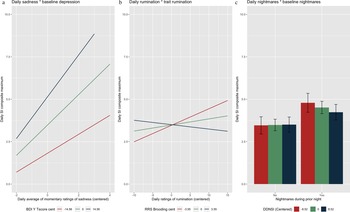
Table 3 shows the results of the LASSO models with the EMA variables (i.e., sleep diary variables and daily sadness). In the first model (shown in the leftmost columns), the following sleep indices were related to greater (more severe) suicidal thinking the next day: greater SOL, greater SQ (opposite from the hypothesized direction), presence of nightmares, and more rumination before sleep. In addition, higher daily average sadness was related to greater suicidal thinking during the day. Because variables were entered simultaneously, the previously mentioned sleep variables were significant when daily sadness was included in the model. SE was the only variable that shrank to zero (i.e., no meaningful contribution). In the second model (shown in the middle column of Table 3), person-level variables were added to the model. The same EMA variables from the prior model were still associated with greater suicidal thinking. In addition, in this model, lower TST (hypothesized direction) and greater SE (opposite from the hypothesized direction) were positively associated with suicidal thinking. Among the new person-level predictors added to the model, only baseline depression (BDI-Y) was a significant predictor of greater suicidal thinking. The third model added interaction effects between significant EMA variables and the associated baseline measure of the construct: daily nightmares × baseline nightmares (DDNSI), daily rumination before sleep × baseline rumination (RRS-brooding), and daily sadness × baseline depression severity (BDI-Y). In this model, the same daily-level (EMA) and person-level variables were significant. All three interactions were significant and are plotted in Figure 1 and probed below.
Significant interactions between daily-level (ecological momentary assessment, EMA) and person-level (baseline) variables predicting next-day worst-point suicidal thinking. BDI-Y = Beck Depression Inventory for Youth; DDNSI = Disturbing Dreams and Nightmares Severity Index; RRS = Ruminative Response Scale; SI = suicidal thinking. (a) Significant interaction between daily sadness and baseline depression (BDI-Y). BDI-Y scores are plotted at the mean, 1SD above the mean, and 1SD below the mean. Those with greater depression severity at baseline exhibited a stronger association between daily sadness and next-day worst-point suicidal thinking. (b) Significant interaction between rumination before sleep (daily-level) and baseline rumination (RRS brooding). RRS scores are plotted at the mean, 1SD above the mean, and 1SD below the mean. Those with lower rumination scores at baseline exhibited a stronger association between daily rumination before sleep and next-day worst-point suicidal thinking. (c) Significant interaction between daily nightmares and baseline nightmares (DDNSI). DDNSI scores are plotted at the mean, 1SD above the mean, and 1SD below the mean. Error bars represent standard error of the mean. Those with lower nightmares scores at baseline exhibited a stronger association between daily nightmares and next-day worst-point suicidal thinking.

Results of LASSO regression models using daily-level (ecological momentary assessment, EMA) and person-level (baseline) self-report data to predict next-day worst-point suicidal thinking

BDI-Y = Beck Depression Inventory for Youth; BIC = Bayesian information criterion; DDNSI = Disturbing Dreams and Nightmare Severity Index; ISI = Insomnia Severity Index; LASSO = multilevel least absolute shrinkage and selection operator; N/A = not applicable because magnitude shrank to zero; PSQI = Pittsburgh Sleep Quality Index; RRS = Ruminative Response Scale.
Results of the simple slopes probe for the daily nightmares × baseline nightmares (DDNSI) interaction show that the relationship between nightmares and next-day suicidal thinking was significant and positive at all levels of DDNSI. The relationship was stronger among those with lower baseline nightmares/DDNSI scores (−1SD, b = 1.30, t = 5.08, p < .001) than those with mean-level (b = 1.00, t = 6.56, p < .001) or higher (+1SD, b = 0.70, t = 4.37, p < .001) DDNSI scores. Results of the simple slopes probe from the daily rumination × trait (baseline) rumination (RRS) interaction show that the relationship between daily rumination before sleep and next-day suicidal thinking was only significant for those at low (−1SD; b = 0.10, t = 3.07, p < .001) baseline rumination levels (RRS scores). The relationship was not significant at mean (b = 0.03, t = 1.93, p = .05) or high (+1SD, b = −0.03, t = −1.21, p = .22) rumination levels. Results of the simple slopes probe for the daily sadness × baseline depression (BDI-Y) interaction show that the relationship between sadness and next-day suicidal thinking was significant and positive at all levels of BDI-Y, but was stronger among those with higher baseline BDI-Y scores (+1SD, b = 1.28, t = 15.55, p < .001) than those with mean (b = 0.94, t = 16.14, p < .001) or lower (−1SD, b = 0.59, t = 6.52, p < .001) depression levels.
Daily-level (actigraphy) sleep models
Table 4 shows the results of the LASSO models involving the actigraphy data predicting next-day suicidal thinking. In the first model (actigraphy only; left columns), less WASO (opposite from hypothesized direction) was the only variable associated with more severe suicidal thinking the next day. In the second model, which added the baseline/person-level variables (shown in the right column), less WASO, and higher baseline depression (BDI-Y scores) were associated with greater next-day suicidal thinking. SOL, SE, and TST shrank to zero in this model.
Results of LASSO regression models using daily-level (actigraphy) data and person-level (baseline) self-report data to predict next-day worst-point suicidal thinking

BDI-Y = Beck Depression Inventory for Youth; DDNSI = Disturbing Dreams and Nightmare Severity Index; ISI = Insomnia Severity Index; LASSO = multilevel least absolute shrinkage and selection operator; N/A = not applicable because magnitude shrank to zero; PSQI = Pittsburgh Sleep Quality Index; RRS = Ruminative Response Scale.
Discussion
The current study found some support for sleep problems predicting short-term increases in suicidal thinking among suicidal adolescents during the 28 days following discharge from acute psychiatric care. There are five major findings of this research. First, specific sleep problems assessed via daily sleep diary (e.g., longer time to fall asleep, presence of nightmares, ruminative thoughts before sleep) were related to greater next-day suicidal thinking. Second, these sleep diary predictors held when controlling for baseline depression and daily-level sadness. Third, most sleep parameters assessed via actigraphy were not predictive of suicidal thinking, and those that did, were not in the expected direction (i.e., less time awake during the night). Fourth, person-level sleep problems (i.e., assessed at baseline) were not uniquely predictive of suicidal thinking during the 28-day monitoring period, over and above daily-level predictors. Fifth, and finally, associations between daily-level sleep problems and suicidal thinking were moderated by person-level (baseline) measures of similar constructs (e.g., baseline nightmares moderated the association between daily-level nightmares and next-day suicidal thinking). Each finding will be discussed in turn.
A range of sleep problems assessed through daily sleep diaries were related to greater next-day suicidal thinking. Three sleep problems were related to suicidal thinking in the hypothesized direction across all models. First, greater sleep onset latency (i.e., taking more time to fall asleep) significantly predicted greater next-day suicidal thinking. Although this specific sleep parameter was not a significant predictor in prior short-term (days and weeks) longitudinal research (Bernert et al., Reference Bernert, Hom, Iwata and Joiner2017; Littlewood et al., Reference Littlewood, Kyle, Carter, Peters, Pratt and Gooding2019), difficulty falling asleep is consistent with initial insomnia (i.e., early insomnia or sleep-onset insomnia), and different types of insomnia have been linked with STBs in previous research (Harris et al., Reference Harris, Huang, Linthicum, Bryen and Ribeiro2020; Kearns et al., Reference Kearns, Coppermsith, Santee, Insel, Pigeon and Glenn2020; Liu et al., Reference Liu, Steele, Hamilton, Do, Furbish, Burke and Gerlus2020). Second, the finding that ruminative thoughts before sleep was related to next-day suicidal thinking may suggest what is occurring when sleep onset is delayed. Although prior studies have not examined ruminative thoughts before sleep specifically, the connection between rumination and STBs has been found in long-term longitudinal research (Glenn, Kleiman, et al., Reference Glenn, Kleiman, Cha, Deming, Franklin and Nock2018), as well as EMA research linking rumination to engagement in nonsuicidal self-injury (Selby, Franklin, Carson-Wong, & Rizvi, Reference Selby, Franklin, Carson-Wong and Rizvi2013; Zaki, Coifman, Rafaeli, Berenson, & Downey, Reference Zaki, Coifman, Rafaeli, Berenson and Downey2013). Third, and finally, the association between nightmares and next-day suicidal thinking is consistent with prior research (Liu et al., Reference Liu, Steele, Hamilton, Do, Furbish, Burke and Gerlus2020; Russell et al., Reference Russell, Allan, Beattie, Bohan, MacMahon and Rasmussen2019; Titus et al., Reference Titus, Speed, Cartwright, Drapeau, Heo and Nadorff2018), including short-term longitudinal research (Bernert et al., Reference Bernert, Hom, Iwata and Joiner2017) and one prior daily diary study linking nightmares to (nonsuicidal and suicidal) self-harm (Hochard et al., Reference Hochard, Heym and Townsend2015). In addition to these three indices of sleep problems, less TST also was related to next-day suicidal thinking in some, but not all, models. Shorter sleep duration has been related to greater risk for STBs in youth (Chiu et al., Reference Chiu, Lee, Chen, Lai and Tu2018; Mars et al., Reference Mars, Heron, Klonsky, Moran, O'Connor, Tilling and Gunnell2019), and a real-time monitoring study with adults found associations between less TST and suicide ideation at the daily level (Littlewood et al., Reference Littlewood, Kyle, Carter, Peters, Pratt and Gooding2019). Finally, two sleep parameters predicted suicidal thinking in the direction opposite from hypothesized. Specifically, better sleep quality and greater sleep efficiency (in some models) were also related to next-day suicidal thinking. Prior research in adults has found that poorer perceived sleep quality predicts next-day suicidal thinking (Littlewood et al., Reference Littlewood, Kyle, Carter, Peters, Pratt and Gooding2019). It is possible that this overall evaluation of sleep quality may be less useful in youth, as compared to more specific questions about sleep patterns (e.g., presence of nightmares). Supporting this hypothesis, the trait measure of sleep quality (i.e., PSQI) exhibited lower reliability in this high-risk adolescent sample compared to prior studies. Further, sleep efficiency was not a significant predictor of suicidal thinking in prior research with adults (Bernert et al., Reference Bernert, Hom, Iwata and Joiner2017; Littlewood et al., Reference Littlewood, Kyle, Carter, Peters, Pratt and Gooding2019). As a parameter assessed from sleep diaries, sleep efficiency is calculated from a number of estimates of total time in bed and time slept (see Table 2), which may make it less reliable, particularly in younger and higher risk populations. Integrating across the other significant findings, adolescents could have had efficient, but shorter duration, sleep in which nightmares were present.
Notably, all of these sleep patterns (assessed via sleep diary) were related to next-day suicidal thinking, even when controlling for baseline depression symptom severity and daily-level sadness. This is consistent with prior research indicating that sleep problems are uniquely linked to suicide risk, beyond the role of depression (Bernert et al., Reference Bernert, Hom, Iwata and Joiner2017; Bishop et al., Reference Bishop, Ashrafioun and Pigeon2018; Littlewood et al., Reference Littlewood, Kyle, Carter, Peters, Pratt and Gooding2019; Pigeon et al., Reference Pigeon, Britton, Ilgen, Chapman and Conner2012a; Pigeon et al., Reference Pigeon, Pinquart and Conner2012b).
In contrast to the findings with sleep diaries, most sleep problems assessed via actigraphy were not related to next-day suicidal thinking. The only actigraphic parameter that was related to suicidal thinking at the day-level was not in the hypothesized direction. Specifically, less wake after sleep onset (i.e., less waking up in the middle of the night) was related to greater next-day suicidal thinking in some, but not all, models. Using daily sleep diaries, this sleep parameter was not significantly related to suicidal thinking. Notably, most of the significant sleep diary variables could not be assessed using actigraphy (i.e., nightmares and ruminative thoughts before sleep). It is possible that adolescents woke up less on a given night, but still experienced nightmares or disturbing dreams (that did not wake them), which may have negatively impacted them the next day. The discrepancy between subjective and objective measures of sleep problems is consistent with prior research indicating that subjective sleep indicators may be more strongly related to clinical outcomes than objective sleep indicators (Edinger et al., Reference Edinger, Fins, Glenn, Sullivan, Bastian, Marsh and Shaw2000). Moreover, these findings underscore the importance of assessment across multiple units of analysis that may be best suited to measure these constructs (Cuthbert, Reference Cuthbert2014).
This study also incorporated person-level sleep problems (general sleep quality, insomnia, nightmares) assessed at baseline. When included in models with daily-level (within-person) sleep problems, person-level sleep problems were not predictive of suicidal thinking during the 28-day monitoring period. This study adds to the mixed findings in adults: some studies have found that sleep problems predict suicide ideation at the day level (Littlewood et al., Reference Littlewood, Kyle, Carter, Peters, Pratt and Gooding2019), whereas others have found this effect only at the person level (Kaurin, Hisler, Dombrovski, Hallquist, & Wright, Reference Kaurin, Hisler, Dombrovski, Hallquist and Wright2020). The current study suggests that certain indices of sleep problems at the within-person level (assessed via sleep diary) relate to greater suicidal thinking in high-risk adolescents. However, person-level (baseline) sleep problems were significant moderators (discussed next).
Finally, this study found that several of the associations between daily-level sleep problems (assessed via sleep diary) and suicidal thinking were moderated by person-level (baseline) measures of the related construct. First, the association between daily-level nightmares and next-day suicidal thinking was moderated by baseline reports of nightmares, such that those with lower nightmare scores at baseline (indicating lower frequency, intensity, and severity of nightmares) exhibited a stronger association between daily (sleep diary) nightmares and suicidal thinking at the day level. This may mean that nightmares are most disruptive for those who do not experience them on a regular basis (e.g., given the significant autonomic arousal experienced with nightmares; Paul, Alpers, Reinhard, & Schredl, Reference Paul, Alpers, Reinhard and Schredl2019). Of note, daily nightmares were significantly related to next-day suicidal thinking at all baseline nightmare levels, indicating the robust role of nightmares as a sleep problem and potential treatment target (Titus et al., Reference Titus, Speed, Cartwright, Drapeau, Heo and Nadorff2018). In addition, the relationship between ruminative thoughts before sleep (assessed via sleep diary) and next-day suicidal thinking was moderated by baseline rumination, such that only those with lower rumination at baseline exhibited a significant association between rumination and suicidal thinking at the day level. Similar to the nightmare interaction, this may mean that ruminative thoughts before sleep are the most impairing for those who do not typically ruminate. This interaction pattern is consistent with some prior research examining the impact of rumination on physical recovery (Key, Campbell, Bacon, & Gerin, Reference Key, Campbell, Bacon and Gerin2008). However, not all interactions followed this pattern. The association between daily-level sadness and next-day suicidal thinking was moderated by baseline depression symptom severity such that those with higher depression symptoms exhibited a stronger association between sadness and suicide thinking at the day level. This suggests that daily increases in sadness may be most related to suicide risk for those with greater baseline depression severity, consistent with some prior research (i.e., examining the interaction between daily negative affect and baseline depression on quality of life; Barge-Schaapveld, Nicolson, Berkhof, & Marten, Reference Barge-Schaapveld, Nicolson, Berkhof and Marten1999). It is important to note that because all interactions were included simultaneously, they each exhibited a unique effect on next-day worst-point suicidal thinking. Future research is needed in larger samples to further explore the significant interactions between person-level and daily-level risk factors.
Taken together, this study provides further evidence to support bringing a developmental perspective to the RDoC framework. Specifically, these findings indicate that sleep problems, which are transdiagnostic symptoms, are important predictors of suicidal thinking during a critical stage of development – adolescence. In addition, they indicate the sleep constructs/parameters that may be the most helpful to assess during this developmental stage. Future research is needed to explore how sleep problems dynamically impact suicidal thinking from childhood through young adulthood, as well as how the environment (fourth plane in the matrix; Woody & Gibb, Reference Woody and Gibb2015) may impact these associations.
Limitations and future directions
Although this study provides unique information about the association between sleep problems and suicide risk in youth, limitations of the current project suggest important areas for future research. First, there were some limitations of the sample. The current study's sample was relatively small. Although well powered for within-person analyses (based on the repeated-measures design), the study was less powered for between-person analyses. In addition, the sample was predominantly female and White, which limits generalizability to diverse youth. Given high rates of STBs among transgender and nonbinary youth (The Trevor Project, 2020) and increasing suicide rates among youth of color (Centers for Disease Control and Prevention, 2018; Lindsey, Sheftall, Xiao, & Joe, Reference Lindsey, Sheftall, Xiao and Joe2019), it is imperative that future research increase recruitment of youth from diverse and underrepresented groups (Cha et al., Reference Cha, Tezanos, Peros, Ng, Ribeiro, Nock and Franklin2018). Moreover, we were unable to examine how sleep problems relate to suicidal behavior because the sample was small and suicidal behavior is much lower in prevalence compared to suicide ideation (Ivey-Stephenson et al., Reference Ivey-Stephenson, Demissie, Crosby, Stone, Gaylor, Wilkins and Brown2020). Future research would benefit from replication in larger and more diverse samples that allow examination of individual differences and how sleep problems relate to short-term risk for suicidal behavior.
Second, there were a few assessment limitations. At baseline, the severity of sleep problems was assessed with self-report measures, rather than diagnostic tools (to assess sleep disorders). Future studies may benefit from examining how within-person effects are moderated by between-person differences in sleep problems. In addition, the psychometric properties of actigraphy are less well established in high-risk adolescents, such as the current sample. Although actigraphy demonstrates good convergence with gold-standard sleep measures (i.e., PSG; Kushida et al., Reference Kushida, Chang, Gadkary, Guilleminault, Carrillo and Dement2001; Sadeh, Reference Sadeh2011) and having an objective measure of sleep is preferred to reliance on self-report only (Lunsford-Avery, LeBourgeois, Gupta, & Mittal, Reference Lunsford-Avery, LeBourgeois, Gupta and Mittal2015), the accuracy of actigraphy declines with reductions in sleep quality and quantity (Kushida et al., Reference Kushida, Chang, Gadkary, Guilleminault, Carrillo and Dement2001; Martin & Hakim, Reference Martin and Hakim2011). Evaluating the reliability of actigraphic assessment in high-risk adolescents is an important step before research moves forward in this area. Finally, the current study was unable to examine the role of daily sleep medications on suicidal thinking, which will be important to examine in future studies.
Third, there were some limitations of the data analytic plan that suggest important future directions. This study examined one main empirically informed outcome of suicidal thinking (i.e., worst-point suicide ideation; Beck et al., Reference Beck, Brown, Steer, Dahlsgaard and Grisham1999). Future studies would benefit from examining other indices of suicide ideation severity (e.g., duration). In addition, the current study's sample was sufficiently large for our machine learning approach to identify the most robust sleep indices, but larger samples are needed for gold-standard “out-of-sample” cross-validation (Jacobucci, Littlefield, Millner, Kleiman, & Steinley, Reference Jacobucci, Littlefield, Millner, Kleiman and Steinley2021). Finally, this study examined one potential temporal association between sleep problems and suicidal thinking. However, there may be other associations that are useful to explore, such as the accumulation of sleep problems over several days or how sleep problems predict suicide risk several days later (as opposed to just one day later).
Beyond understanding the temporal association between sleep problems and suicidal thinking, there are several other important future directions. Additional research is needed to understand the mechanisms linking sleep problems to increased suicide risk. Prior research has suggested potential affective (Baum et al., Reference Baum, Desai, Field, Miller, Rausch and Beebe2014; Ben-Zeev, Young, & Depp, Reference Ben-Zeev, Young and Depp2012), cognitive (De Bruin, van Run, Staaks, & Meijer, Reference De Bruin, van Run, Staaks and Meijer2017; Keilp et al., Reference Keilp, Sackeim, Brodsky, Oquendo, Malone and Mann2001), and inflammatory mechanisms (Black & Miller, Reference Black and Miller2015; Irwin & Piber, Reference Irwin and Piber2018) that may mediate this association (Kearns et al., Reference Kearns, Coppermsith, Santee, Insel, Pigeon and Glenn2020; Liu et al., Reference Liu, Steele, Hamilton, Do, Furbish, Burke and Gerlus2020). Moreover, it will be important to test the presence and strength of sleep problems as a causal risk factor and to what extent these may differ if the sleep problem is due to a specific sleep disorder (e.g., insomnia, obstructive sleep apnea). To determine whether sleep problems are a causal risk factor (Kraemer et al., Reference Kraemer, Kazdin, Offord, Kessler, Jensen and Kupfer1997), research is needed to examine how modifying sleep problems reduce suicidal thoughts and behaviors among adolescents. There are a number of evidence-based psychosocial treatments for reducing sleep problems in youth, including CBT-I when the sleep problem is insomnia (Blake et al., Reference Blake, Sheeber, Youssef, Raniti and Allen2017a; Ma et al., Reference Ma, Shi and Deng2018; Werner-Seidler et al., Reference Werner-Seidler, Johnston and Christensen2018), and IRT when the sleep probem is nightmares (Krakow, Reference Krakow2011; Simard & Nielsen, Reference Simard and Nielsen2009). In addition to their impact on insomnia severity, sleep treatments, like CBT-I, have been found to also reduce mental health symptoms related to STBs (e.g., anxiety, depression) in youth (Blake et al., Reference Blake, Sheeber, Youssef, Raniti and Allen2017a). STBs have not been examined as an outcome in sleep trials among youth, but growing research with adults indicates that improving sleep reduces STBs (Bishop, Walsh, Ashrafioun, Lavigne, & Pigeon, Reference Bishop, Walsh, Ashrafioun, Lavigne and Pigeon2020; Christensen et al., Reference Christensen, Batterham, Gosling, Ritterband, Griffiths, Thorndike and Mackinnon2016; Ellis, Rufino, & Nadorff, Reference Ellis, Rufino and Nadorff2019; Manber et al., Reference Manber, Bernert, Suh, Nowakowski, Siebern and Ong2011; Pigeon, Funderburk, Cross, Bishop, & Crean, Reference Pigeon, Funderburk, Cross, Bishop and Crean2019; Trockel, Karlin, Taylor, Brown, & Manber, Reference Trockel, Karlin, Taylor, Brown and Manber2015). Considerably more research in youth is needed across all aspects of the sleep–suicide relationship.
Summary
This study found some support for the role of sleep problems as a short-term risk factor for suicidal thinking among high-risk youth. Findings indicate that some sleep problems (e.g., greater sleep onset latency, nightmares, and ruminative thoughts before sleep assessed via sleep diary) predicted worst-point suicidal thinking among high-risk adolescents following discharge from acute psychiatric care. It will be important for future research to replicate findings in larger samples, examine mechanisms in the sleep–suicide link, and test treatments that intervene on sleep problems and their mechanisms to decrease suicide risk among youth.
Supplementary Material
The supplementary material for this article can be found at https://doi.org/10.1017/S0954579421000699
Acknowledgments
The authors would like to thank the following members of the research team for their assistance with this project: Erika Esposito, John (Kai) Kellerman, Angela Santee, and all of the research assistants who helped with data collection and risk monitoring. The authors would also like to thank the adolescents and their families who volunteered to participate in this research, as well as Michael Scharf, MD, Claudia Blythe, and the clinical team in Pediatric Behavioral Health & Wellness at the University of Rochester Medical Center for their support with this research.
Funding Statement
This research was supported in part by a grant from the American Foundation for Suicide Prevention (YIG-1-054-16), funding from the National Institute of Mental Health (L30 MH101616), and pilot funding from the University of Rochester Medical Center.
Conflicts of Interest
Author CG receives royalties from UpToDate. Author WP has consulted for CurAegis Technologies, Inc., and received contract funding from Pfizer, Inc. and from Abbvie, Inc. The other authors have no conflicts of interest to disclose.