Introduction
The evidence for clinical effectiveness of brief talking therapies in depressive and anxiety disorders is strongest for cognitive behaviour therapy (CBT). Despite this consensus, not all patients given CBT improve (Churchill et al. Reference Churchill, Hunot, Corney, Knapp, McGuire, Tylee and Wessely2001) and some may do better with, or prefer, other forms of talking therapy such as psychodynamic psychotherapy, non-directive counselling (NDC) and interpersonal psychotherapy. Less evidence for the effectiveness of these therapies has been published than for CBT. England's National Institute for Health and Clinical Excellence (NICE) recommends NDC (hereafter referred to as counselling) as a treatment for people with persistent subthreshold depressive symptoms or mild to moderate depression who decline an antidepressant, CBT, interpersonal therapy, behavioural activation and behavioural couples therapy (National Institute for Health and Clinical Excellence, 2009). However professionals are urged to discuss with the person the uncertainty of its effectiveness. The 2010 Scottish Intercollegiate Guidelines Network (SIGN; Scottish Intercollegiate Guidelines Network, 2010) concluded that there is insufficient evidence on which to base a recommendation for counselling. We conducted one of the largest randomized trials of effectiveness of counselling in the UK in which we compared it with CBT and usual care for patients who present with depression and anxiety in British general practice (Ward et al. Reference Ward, King, Lloyd, Bower, Sibbald, Farrelly, Gabbay, Tarrier and Addington-Hall2000). CBT and counselling were both more effective than usual general practitioner (GP) care but there was no significant difference in effectiveness between patients randomized to the two therapies. However, the trial was criticized on the grounds that a proportion of patients either did not meet the criteria for any psychiatric diagnosis, or received a diagnosis of an anxiety state (Ward et al. Reference Ward, King, Lloyd, Bower, Sibbald, Farrelly, Gabbay, Tarrier and Addington-Hall2000). On these grounds the findings were dropped as contributory evidence by the 2010 SIGN (Scottish Intercollegiate Guidelines Network, 2010). National Guidelines influence the choice of available therapies in the UK Government's current programme of Improving Access to Psychological Therapies (NHS, 2009). Thus, we decided to conduct further analyses of our 2000 trial (Ward et al. Reference Ward, King, Lloyd, Bower, Sibbald, Farrelly, Gabbay, Tarrier and Addington-Hall2000) with the aim of comparing the effectiveness of CBT, counselling and usual GP care in those with and without major depression according to the criteria of the International Diagnostic Classification of Mental Disorders, tenth revision (ICD-10; WHO, 1992).
Method
Participants and trial allocation
Patients were recruited from February 1996 to November 1997 from 13 general practices in north London and 11 practices in Greater Manchester. GPs referred patients suffering from depression or mixed depression and anxiety who they believed required a brief psychological intervention. Patients who fulfilled the inclusion criteria and scored 14 or more on the Beck Depression Inventory (Beck et al. Reference Beck, Steer and Garbin1988) entered the study. The trial was a patient preference (or comprehensive cohort) design in which patients with strong preferences for any particular trial arm were allocated their preferred arm, while the remainder were randomized three ways. Randomization was generated in the two trial centres and used opaque, sealed envelopes and was stratified on severity [high (over 23) or low (14–22) on the Beck Depression Inventory]. About 9 months into the trial the preference arms for counselling and CBT were close to being filled. Discussions with patients indicated that most had no preference for a specific psychological therapy but were reluctant to risk random allocation to usual GP care. We therefore decided to offer newly referred patients with a preference for a psychological therapy (but no preference between therapies) randomization between the two therapies. This procedure had the advantage of increasing the numbers of randomized patients available for the comparison of the two psychological therapies. Separate allocation sequences (blocked and stratified randomization) were generated for this procedure. Ethical approval was obtained for the original trial (Ward et al. Reference Ward, King, Lloyd, Bower, Sibbald, Farrelly, Gabbay, Tarrier and Addington-Hall2000).
Therapies
The counselling and cognitive behaviour therapies are described in full in our earlier publications (King et al. Reference King, Sibbald, Ward, Bower, Lloyd, Gabbay and Byford2000; Ward et al. Reference Ward, King, Lloyd, Bower, Sibbald, Farrelly, Gabbay, Tarrier and Addington-Hall2000). Counsellors provided a nondirective, inter-personal approach which was outlined in a manual that we developed based on the work of Carl Rogers (Rogers, Reference Rogers1967). Cognitive behaviour therapists provided traditional CBT using a problem formulation and staged intervention approach, which has been outlined in published clinician and patient manuals (Greenberger & Padesky, Reference Greenberger and Padesky1995; Padesky & Greenberger, Reference Padesky and Greenberger1995). These practical manuals outline the CBT approach to a number of psychological disorders including major depression. The early manual by Beck et al. (Reference Beck, Rush, Shaw and Emery1979) is much more commonly used in trials of the effectiveness of CBT. We used these manuals because of the broader nature of the population (some with mixed anxiety and depression) likely to be recruited from general practice. However we did not assume that use of a manual in of itself would ensure fidelity to the CBT model. In addition, we audiotaped a number of therapy sessions for each participant in each arm of the trial and subjected them to independent ratings as detailed below.
The therapists undertook 1 h of supervision for every 6 h of patient contact time. In all, six counsellors and three psychologists took part in London and eight counsellors and nine psychologists in Manchester. All counsellors had the necessary qualifications and experience to be accredited by the British Association for Counselling and Psychotherapy. All cognitive behaviour therapists were psychologists who had the necessary qualifications and experience for accreditation by the British Association for Behavioural and Cognitive Psychotherapies and were eligible for registration with the United Kingdom Council for Psychotherapy. Patients were offered up to twelve 50-min appointments, which were mostly provided on a weekly basis at the general practice. Participants were free to see their GP as usual, but we requested that the doctors refrain from routinely prescribing antidepressants for these patients.
As reported previously, therapy sessions were audio-recorded and rated for quality of CBT by an independent psychologist using the Cognitive Therapy Rating Scale (Blackburn et al. Reference Blackburn, James, Milne, Baker, Standart, Garland and Reichelet2001). A score of 39 out of 78 was used as a cut-off indicating adequate CBT. All of the CBT, but none of the counselling sessions, were recorded above the predetermined threshold of 39 indicating adequate CBT.
Assessments
Patients were assessed at baseline using the Revised Clinical Interview Schedule, a semi-structured interview that generates psychiatric diagnoses according to ICD-10 (Goldberg et al. Reference Goldberg, Cooper, Eastwood, Kedward and Shepherd1970; Lewis et al. Reference Lewis, Pelosi, Araya and Dunn1992). Patients also completed demographic questions and our main outcome measure, the Beck Depression Inventory, at baseline, and at 4 and 12 months. Other outcomes measured were the Brief Symptom Inventory (Derogatis & Melisaratos, Reference Derogatis and Melisaratos1983; Derogatis, Reference Derogatis1992), which measures a range of psychological symptoms, and the modified Social Adjustment Scale (Cooper et al. Reference Cooper, Osborn, Gath and Feggetter1982). Assessments were not conducted blind to allocation.
Statistical analysis
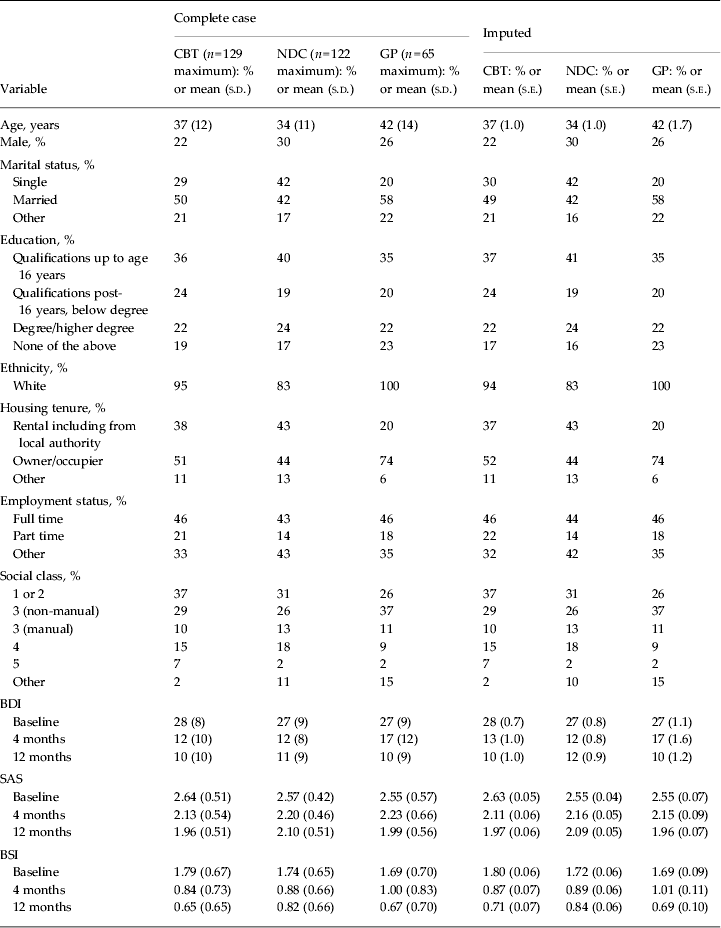
We analysed the data using Stata Release 11 (StataCorp LP, USA). In this analysis patients who were allocated to the treatment arm of their choice in the comprehensive cohort (preference arms) were not considered. We used the last-observation-carried-forward method to impute missing data in our original analysis, as this was a standard approach at the time. In this analysis, we used multiple imputation, which is unbiased compared with the last-observation-carried-forward method (Carpenter & Kenward, Reference Carpenter and Kenward2007). To do so, we used the method of chained equations, implemented by the Stata command ice (Royston, Reference Royston2005), to impute 10 datasets (White et al. Reference White, Royston and Wood2011) and obtain combined estimates (Rubin, Reference Rubin1987). We imputed missing data for the whole dataset using the variables in Table 1. We examined which factors were predictors of ‘missingness’ on the Beck Depression Inventory at 12 months. The only sociodemographic factor associated with missing data was housing tenure, wherein 53% of those with missing data living in rented accommodation compared with 33% without. All other predictors of missingness were scores on the other rating scales. For the most part this came about as a result of non-attendance at 12 months, i.e. participants with missing Beck Depression Inventory scores at 12 months were often the same as those with missing data on other scales. However, because it was possible that other sociodemographic factors were associated with missingness and/or the values for a given scale for other outcomes and/or other time points, we also included them in the imputation models. As there was a small percentage of missing data for some baseline demographic variables (marital status, highest educational qualification, ethnicity, housing tenure, employment status and social class), they were included in the imputation model as a complete case (i.e. they informed the outcome variables, but were not imputed themselves). Outcome variables were imputed using linear regression. Those whose diagnosis was missing were excluded from all analyses.
All randomized patients with an ICD-10 diagnosis

ICD-10, International Classification of Diseases, tenth revision; CBT, cognitive behaviour therapy; NDC, non-directive counselling; GP, usual care from general practitioner; s.d., standard deviation; s.e., standard error; BDI, Beck Depression Inventory; SAS, Social Adjustment Scale, BSI, Brief Symptom Inventory.
Modelling was carried out using generalized estimating equations (GEEs) with the multiply imputed datasets. The level-two variable was set as participant [level 1 (implicit) was time]. The outcomes were mean scores on the Beck Depression Inventory, Brief Symptom Inventory and Social Adjustment Scale at 4 and 12 months. Variables in the models were randomized group, the baseline measure of the outcome (for example, where Beck Depression Inventory was the outcome, Beck Depression Inventory at baseline was included as a covariate in the model) and time point as a dichotomous variable indicating data collected at 4 and 12 months. Randomization was stratified by participants' Beck Depression Inventory scores at recruitment. Thus, this binary variable (score 14–23 or >23) was also included as a covariate in the analyses concerning the Brief Symptom Inventory and Social Adjustment Scale. We took two main approaches to the analysis. (1) We first included all randomized patients who had been assigned a diagnosis and introduced terms for the interaction between randomized group and diagnosis (major depression versus other diagnosis). (2) In the second approach we selected only those randomized patients who had a primary or secondary diagnosis of ICD-10 depressive episode. Finally, we also conducted sensitivity analyses using multiple linear regression of depression outcome at 4 months and 12 months, adjusting for baseline Beck Depression Inventory Score, ICD-10 depressive episode status and including an interaction between randomized group and ICD-10 depressive episode status, to explore whether this confirmed our result.
Results
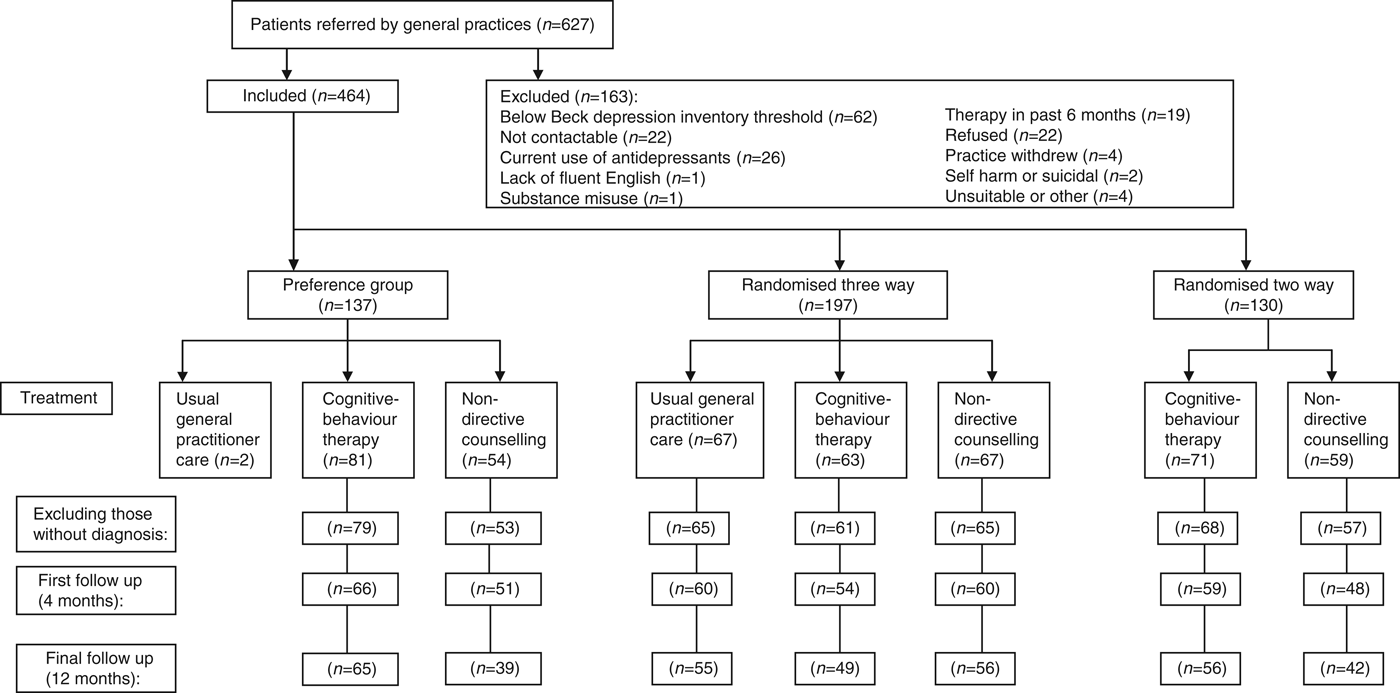
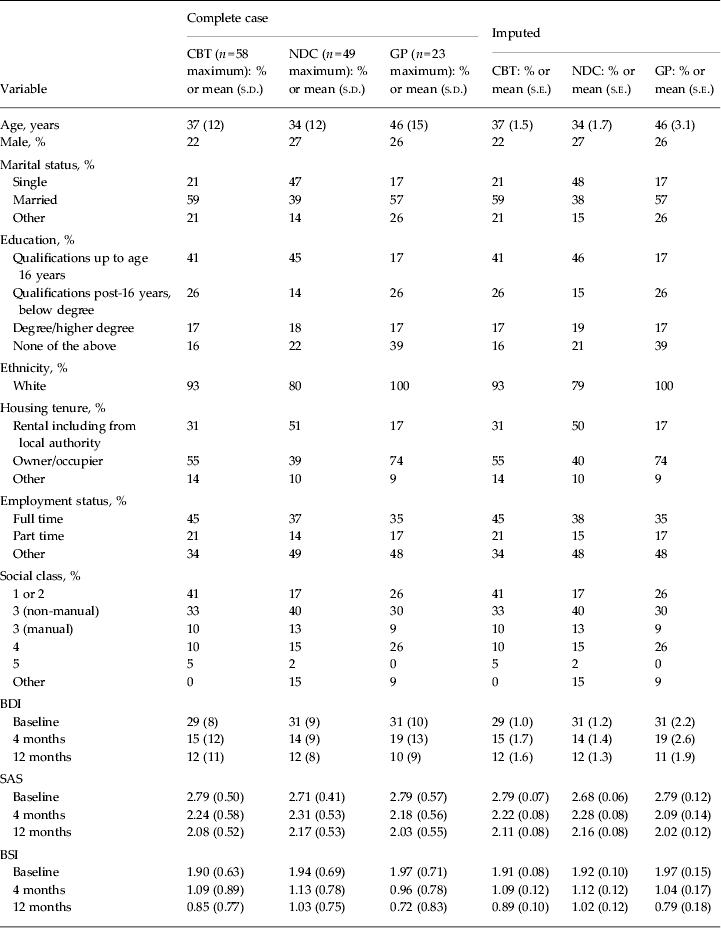
As previously reported by Ward et al. (Reference Ward, King, Lloyd, Bower, Sibbald, Farrelly, Gabbay, Tarrier and Addington-Hall2000), 134 participants were randomized to CBT, 126 to counselling and 67 to usual GP care alone. In our first approach we analysed 129 randomized to CBT, 122 to counselling and 65 to usual care, all of whom had been assigned a diagnosis (Fig. 1). In the second analysis we focused only on the 130 (41%) who had an ICD-10 depressive episode as a primary (126) or secondary (4) diagnosis. Imputed outcome scores were close to complete case outcomes for both those with any diagnosis (Table 1) and those with a diagnosis of ICD-10 depression (Table 2).
Trial flow diagram.

Randomized participants with a primary or secondary diagnosis of ICD-10 depression

ICD-10, International Classification of Diseases, tenth revision; CBT, cognitive behaviour therapy; NDC, non-directive counselling; GP, usual care from general practitioner; s.d., standard deviation; s.e., standard error; BDI, Beck Depression Inventory; SAS, Social Adjustment Scale, BSI, Brief Symptom Inventory.
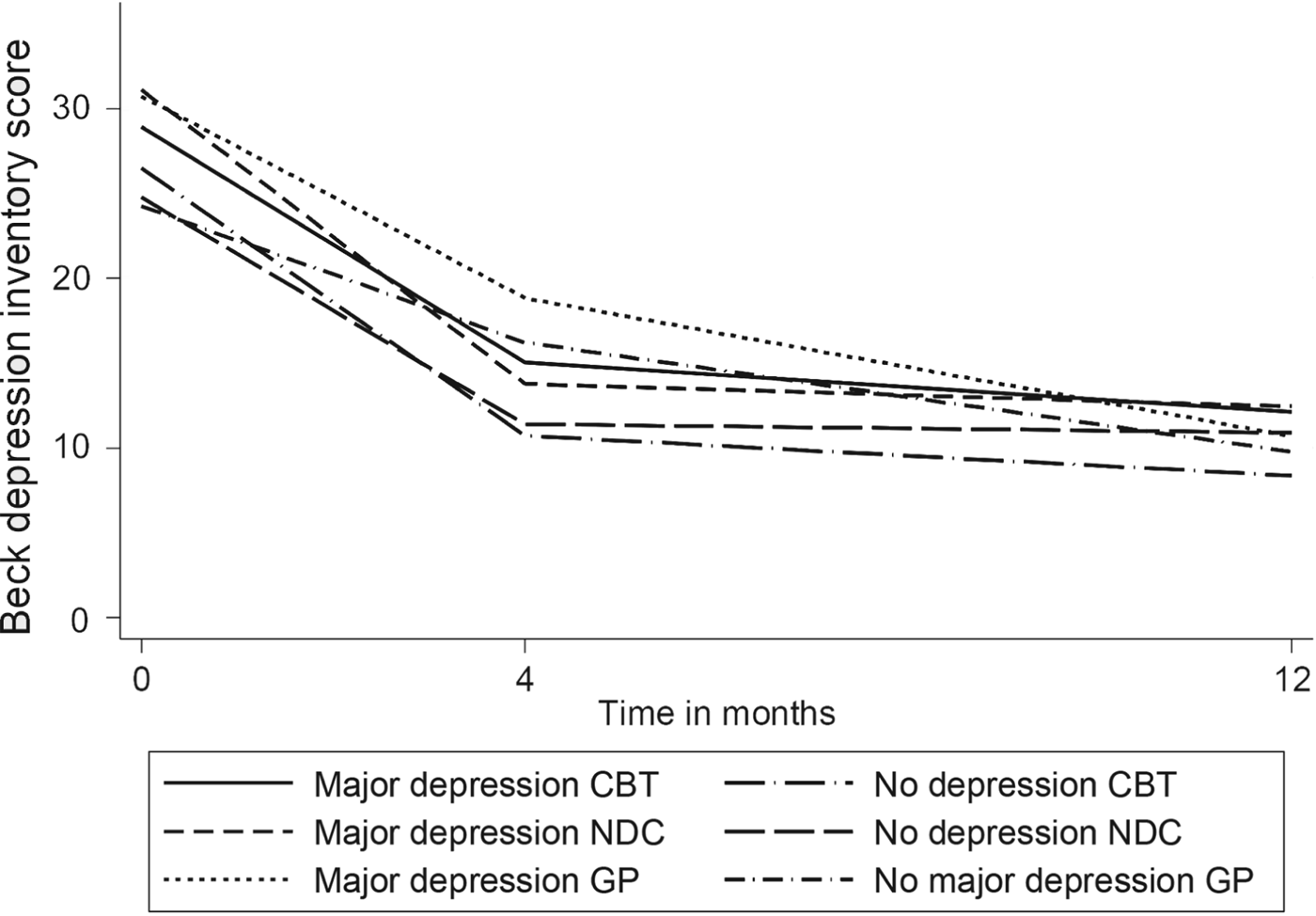
As expected, mean scores on the Beck Depression Inventory and Brief Symptom Inventory tended to be higher at baseline and over the course of follow-up in those with ICD-10 depression than those with other diagnoses. For example, those with ICD-10 depression in the CBT group had a baseline score on the Beck Depression Inventory of 29 (s.e. = 1.0), compared with 26 (s.e. = 1.0) for those with other diagnoses (p = 0.091); at 12 months this was 12 (s.e. = 1.6) versus 8 (s.e. = 1.2), respectively (p = 0.053). In the case of the Brief Symptom Inventory, those in the ICD-10 depression, CBT group had a baseline score of 1.9 (s.e. = 0.08) compared with 1.7 (s.e. = 0.08) for those with other diagnoses (p = 0.076); at 12 months this was 0.9 (s.e. = 0.10) and 0.6 (s.e. = 0.08), respectively (p = 0.008).
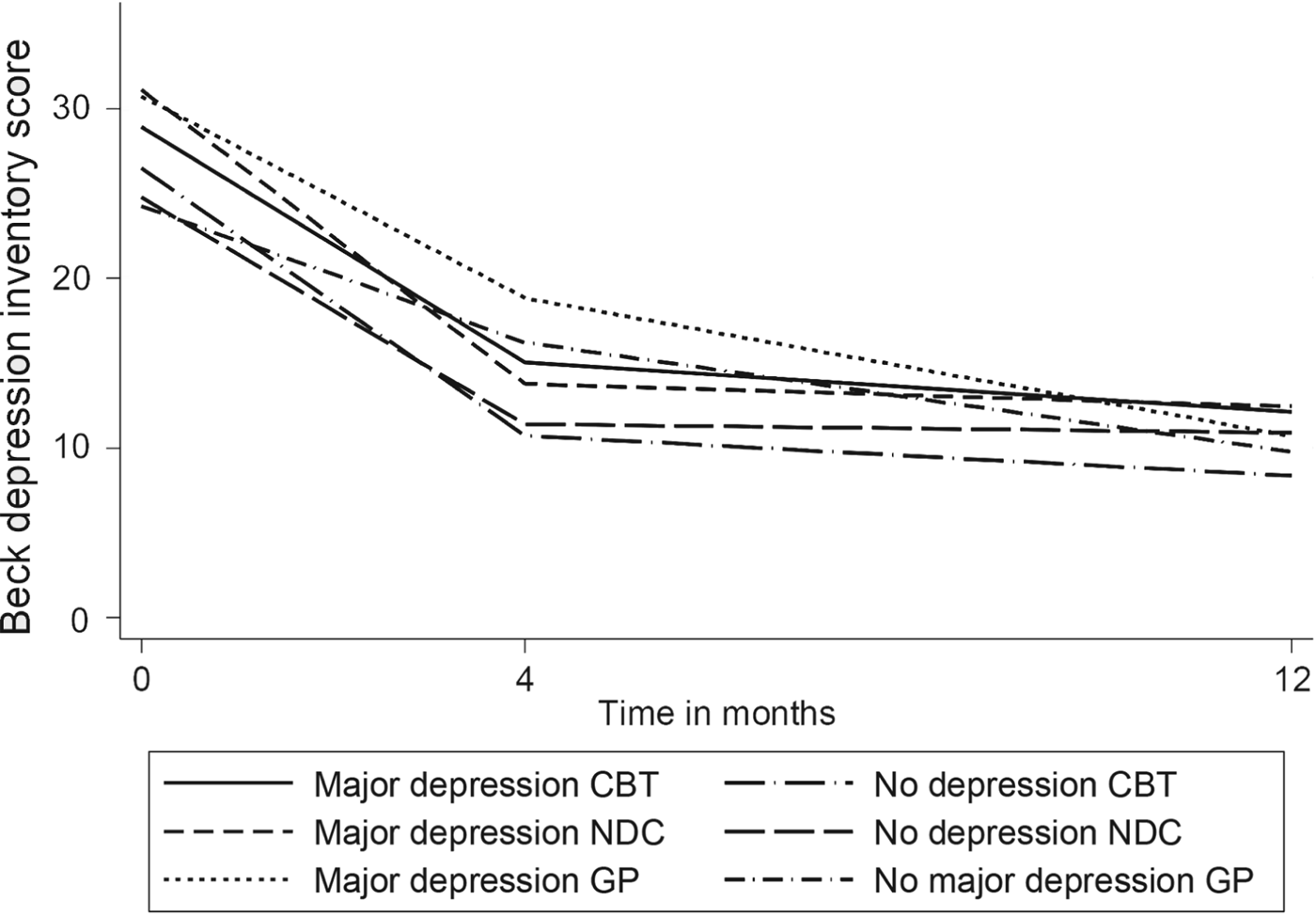
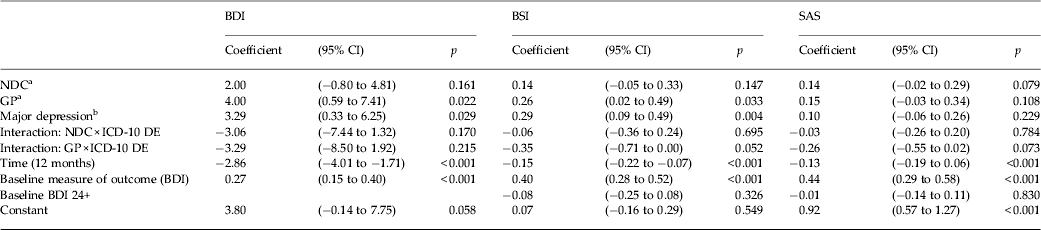
In the first model (with interactions between randomized group and diagnosis), there was no significant difference between CBT and counselling for the three main outcomes (Table 3): Beck Depression Inventory [2.00, 95% confidence interval (CI) −0.80 to 4.81, p = 0.161], Brief Symptom Inventory (0.14, 95% CI −0.05 to 0.33, p = 0.147) or Social Adjustment Scale (0.14, 95% CI −0.02 to 0.29, p = 0.079). The GP group did significantly worse than the CBT group for the Beck Depression Inventory and the Brief Symptom Inventory and showed a similar trend for the Social Adjustment Scale. The interaction between those randomized to counselling and diagnosis was not significant for any outcome (Table 3): Beck Depression Inventory (−3.06, 95% CI −7.44 to 1.32, p = 0.170), Brief Symptom Inventory (−0.06, 95% CI −0.36 to 0.24, p = 0.695) or Social Adjustment Scale (−0.03, 95% CI −0.26 to 0.20, p = 0.784), indicating that neither therapy had the advantage in terms of getting patients better quicker or more completely (Fig. 2 and Table 3).
Plot of therapy by diagnosis for outcomes in the randomized arms. CBT, Cognitive behaviour therapy; NDC, non-directive counselling; GP, usual care from general practitioner.
Interaction analysis for the outcomes

BDI, Beck Depression Inventory; BSI, Brief Symptom Inventory; SAS, Social Adjustment Scale; CI, confidence interval; NDC, non-directive counselling; GP, usual care from general practitioner; ICD-10 DE – depressive episode according to the International Classification of Diseases, tenth revision; BDI, Beck Depression Inventory; BDI 24+, Beck Depression Inventory baseline scores 24 and over versus those below 24.
a Cognitive behaviour therapy is the reference group.
b Without ICD-10 depressive episode is the reference group.
The widths of the CIs for the regression coefficients suggested that we had limited power for this interaction approach, and thus it was important to examine the point estimates involved. We calculated point estimates for Beck Depression Inventory scores at 4 months using the coefficients from the modelling, the mean baseline Beck Depression Inventory score and the diagnostic group (ICD-10 depression or not) for each of the six possible combinations with therapy arm. Thus, (1) in patients without an ICD-10 depressive episode (model coefficients can be seen in Table 3), who received CBT, the estimated Beck Depression Inventory score at 4 months is 10.92 [3.80 (the regression constant) + 0.27 × 26 (coefficient for mean baseline Beck Depression Inventory × mean baseline Beck Depression Inventory score)]. In those without an ICD-10 depressive episode who received NDC, estimated Beck Depression Inventory score at 4 months is 12.65 [3.80 + 2.00 + (0.27 × 25)] and for those without an ICD-10 depressive episode who received GP care it is 14.37 [3.80 + 4.00 + (0.27 × 24)]. (2) In a similar calculation (regression coefficients not shown in tables), mean Beck Depression Inventory score at 4 months in those with an ICD-10 depressive episode who received CBT is 15.03 [3.80 + 3.29 + (0.27 × 29)]. For those with an ICD-10 depressive episode who received NDC it is 14.52 [3.80 + 2.00 + 3.29−3.06 + (0.27 × 31)] and for those with an ICD-10 depressive episode who received GP care it is 16.28 [3.80 + 4.00 + 3.29−3.29 + (0.27 × 31)]. These estimates indicate that while patients with ICD-10 depression made greater gains in either therapy group, there was very little clinical difference in outcome between the therapies in those with or without ICD-10 depression.
In the second GEE models (selecting only those randomized patients with a primary or secondary diagnosis of ICD-10 depressive episode) there were no significant differences between counselling and CBT for mean scores on the Beck Depression Inventory (coefficient −1.08, 95% CI −4.65 to 2.48, p = 0.550), Brief Symptom Inventory (0.08, 95% CI −0.18 to 0.33, p = 0.551) or Social Adjustment Scale (0.10, 95% CI 0.08–0.28, p = 0.287) (Table 4). Standard mean differences (or treatment effects) are difficult to calculate in imputed data. However, it can be seen in Table 2 that point estimates for Beck Depression Inventory scores for the two therapies at each follow-up point are very small (one scale point) at 4 months and non-existent at 12 months. Those in the usual GP care group scored higher (worse) on the Beck Depression Inventory than those in the counselling or CBT groups at 4 months (end of therapy) but had similar scores at 12 months of follow-up. These results were also confirmed in sensitivity analyses at 4 months and 12 months separately adjusting for baseline Beck Depression Inventory Score, ICD-10 depressive episode status and including an interaction between randomized group and ICD depressive episode status. Beck Depression Inventory score was not significantly different between CBT and NDC at 4 months, but those randomized to usual GP care scored significantly higher (worse). At 12 months, there was no significant difference in Beck Depression Inventory score between those randomized to CBT versus NDC nor those randomized to CBT versus usual GP care (results not shown).
Analysis for only those who have an ICD-10 diagnosis of depression

ICD-10, International Classification of Diseases, tenth revision; BDI, Beck Depression Inventory; BSI, Brief Symptom Inventory; SAS, Social Adjustment Scale; CI, confidence interval; NDC, non-directive counselling; GP, usual care from general practitioner; BDI, Beck Depression Inventory; BDI 24+, Beck Depression Inventory baseline scores 24 and over versus those below 24.
a Cognitive behaviour therapy is the reference group.
Discussion
A total of 316 patients with psychological distress who were randomized to counselling or CBT or usual GP care and had an ICD-10 diagnosis were included in the analysis. Both our approaches to the analysis produced similar results. In our first approach in which we conducted an interaction analysis using all 316 patients, or in our second where we conducted an analysis of only those 130 (41%) participants with ICD-10 depression at baseline, the point estimates of our main outcomes and our tests of statistical significance indicated that there was no difference in the effectiveness of the two therapies. As we found in our original analysis (Ward et al. Reference Ward, King, Lloyd, Bower, Sibbald, Farrelly, Gabbay, Tarrier and Addington-Hall2000), both were superior to GP usual care by 4 months but not by 12 months.
Our reanalysis is necessarily less precise in its estimate of differences between trial arms than our original study. However, in the absence of a large and expensive non-inferiority trial of counselling versus CBT, we believe our result is important to consider. Given the small, and non-significant, difference in point estimates on the Beck Depression Inventory between the therapy arms at 4 and 12 months, we consider that our conclusion is firmly based. In the interaction analysis we included all 316 participants (129 participants randomized to CBT, 122 randomized to counselling and 65 randomized to usual GP care). It can be shown that an analysis that includes an interaction term requires four times the sample size of the analysis without the interaction (Brookes et al. Reference Brookes, Whitely, Egger, Smith, Mulheran and Peters2004). This explains the wider CIs for the regression coefficients in this analysis. However, as we demonstrated, the point estimates of the differences in outcome for the Beck Depression Inventory between the two therapies were very small and well below clinical significance. Thus, despite lower power, it is very unlikely that the therapies in this trial differed in clinical effectiveness. Although we used non-standard manuals to guide the cognitive behaviour therapists and although the focus of the raters may have been slightly different from what they would normally have had in a trial of a depressed population, their ratings of a random selection of tapes indicated adequate adherence to the cognitive model.
Current treatment guidelines emphasize the strength of evidence for the effectiveness of CBT (National Institute for Health and Clinical Excellence, 2009; Scottish Intercollegiate Guidelines Network, 2010). However, research is needed into the clinical effectiveness of other talking therapies in order to be able to offer choice where patients do not wish to receive CBT or where they are expected not to benefit, and for provision of alternatives when CBT fails. NDC remains the commonest alternative offered in community settings in the UK (Mellor-Clark et al. Reference Mellor-Clark, Simms-Ellis and Burton2001); 50% of therapists who are members of the British Association for Counselling and Psychotherapy provide such counselling. Our results suggest that the findings of this trial (Ward et al. Reference Ward, King, Lloyd, Bower, Sibbald, Farrelly, Gabbay, Tarrier and Addington-Hall2000) remain relevant and recommend that NICE and SIGN guidelines once again take them into consideration in weighing up the evidence for or against effectiveness of alternatives to CBT.
Acknowledgements
The original trial was funded by the NHS Health Technology Assessment programme. The views expressed in this paper are those of the authors only and are not attributable to the Department of Health.
Declaration of Interest
None.