Introduction
In this invited review, we reflect on the oeuvre of clinical and academic scholarship that is the bedrock of present-day anorexia nervosa treatment and draw attention to emerging developments.
Systematic evidence reviews are the cornerstone of appraising the status of a field and guiding treatment delivery. Yet, for anorexia nervosa, they only capture a fraction of treatments delivered in the community. Severe anorexia nervosa is typically treated in an in-patient or residential environment using multimodal treatment delivered by multidisciplinary teams. The complexity, cost and logistics of this approach do not lend readily to examination by randomized controlled trial (RCT). For example, non-oral feeding approaches, occasionally used as a life-preserving intervention for severely malnourished anorexia nervosa patients (APA, 2006), have not been evaluated in RCTs, with one exception (Rigaud et al. Reference Rigaud, Brondel, Poupard, Talonneau and Brun2007). Best practices for the critically ill emaciated patient, for the long-term chronic patient, and for patients requiring alternative feeding approaches to oral refeeding (nasogastric tube, nasojejunal tube, gastrostomy–jejunostomy, total parenteral nutrition) remain the province of clinical opinion and expert consensus with little guidance from empirical studies. The conduct and interpretation of RCTs are inhibited by the severity of the physical and psychiatric aspects of illness, which preclude ethical randomization of participants to waiting list, non-specific, or placebo control groups. Because of these limitations and constraints, what we can glean from RCTs and systematic reviews of anorexia nervosa represents only a partial picture of the treatment provided for this pernicious and potentially life-threatening eating disorder.
In this environmental scan, we broadened our perspective and ‘ways of knowing’ beyond the traditional systematic review to combine three sources of knowledge. We begin with the ‘gold standard’ evidence-based approach. We then review advances in practice guidelines, which although informed by science, also incorporate expert consensus on treatment. Finally, we review treatments that are currently under investigation by teams endeavoring to advance the evidence base. Via this triangulated approach, we provide a scan of best practices in the treatment of anorexia nervosa across the age spectrum.
Background on anorexia nervosa: diagnosis and epidemiology
Anorexia nervosa is an eating disorder characterized by low body weight (<85% of expected for age and height), body image disturbance, fear of weight gain, and amenorrhea (absence of menstruation for ⩾3 months when otherwise expected) (Diagnostic and Statistical Manual of Mental Disorders, fourth edition; DSM-IV; APA, 2000). The restricting subtype involves energy restriction, increased energy expenditure, fasting and other non-purging compensatory behaviors in the absence of binge eating; and the binge-eating/purging type includes the presence of binge eating or purging behaviors (or both). The fifth edition of DSM (DSM-5) will eliminate the amenorrhea criterion. Anorexia nervosa affects 0.9–2.2% of women over the lifetime but subthreshold conditions are more common. The prevalence is lower in men (about 0.3%) (Hudson et al. Reference Hudson, Hiripi, Pope and Kessler2007). Onset typically occurs during adolescence and naturalistic follow-ups suggest that less than half of patients fully recover, with the remainder chronically ill or partially improved (Berkman et al. Reference Berkman, Lohr and Bulik2007). Anorexia nervosa has the highest mortality rate of any psychiatric illness (Harris & Barraclough, Reference Harris and Barraclough1997; Birmingham et al. Reference Birmingham, Su, Hlynsky, Goldner and Gao2005; Berkman et al. Reference Berkman, Lohr and Bulik2007, Arcelus et al. Reference Arcelus, Mitchell, Wales and Nielsen2011) and the standardized mortality ratio is dramatically elevated for mortality secondary to suicide (56.9, 95% confidence interval 15.3–145.7) (Keel et al. Reference Keel, Dorer, Eddy, Franko, Charatan and Herzog2003).
Physical corollaries can involve every major organ of the body, including the cardiovascular, gastrointestinal, reproductive, hematological, endocrine and integumentary systems, and impaired growth in children. Many people require hospitalization during the course of illness for reasons commonly including extreme low weight, cardiac abnormalities, electrolyte disturbance, hypotension and bradycardia. An estimated 50% of children with new-onset threshold or subthreshold anorexia nervosa have life-threatening medical complications (Madden et al. Reference Madden, Morris, Zurynski, Kohn and Elliot2009). Psychiatric co-morbidity is prevalent, in particular, anxiety disorders (>50%) (Bulik, Reference Bulik, Fairburn and Brownell2002; O'Brien & Vincent, Reference O'Brien and Vincent2003), depressive disorders (20–80%) (Bulik, Reference Bulik, Fairburn and Brownell2002; O'Brien & Vincent, Reference O'Brien and Vincent2003) and cluster C personality disorders (O'Brien & Vincent, Reference O'Brien and Vincent2003).
Evidence-based practice
Evidence reviews rely heavily on RCTs, the uncontested ‘gold standard’ for establishing plausible causality between an intervention and outcome. Systematic evidence reviews of treatments for anorexia nervosa have rarely been encouraging; ‘weak evidence’ (Bulik et al. Reference Bulik, Berkman, Brownley, Sedway and Lohr2007), ‘no specific approach can be recommended’ (Hay et al. Reference Hay, Bacaltchuk, Byrnes, Claudino, Ekmejian and Yong2003), ‘uniformly discouraging’ (Attia & Schroeder, Reference Attia and Schroeder2005) have typified their conclusions leading one practitioner researcher to ask, ‘Is evidence based treatment of anorexia nervosa possible?’ and to respond with, ‘Barely’ (Fairburn, Reference Fairburn2005).
RCTs for anorexia nervosa are notoriously challenging to conduct. First, the relative rarity of anorexia nervosa makes recruitment challenging and multiple sites are often necessary. Second, drop-out in adult trials is unacceptably high: about 40% in medication trials and about 25% in behavioral trials (Berkman et al. Reference Berkman, Bulik, Brownley, Lohr, Sedway, Rooks and Gartlehner2006). Clinical trials for adolescents report lower drop-out (10–20%), which may be attributable to parents' ability to compel a child's treatment (Halmi, Reference Halmi2008). Drop-out can undo the effects of randomization and make groups no longer comparable. Although intent-to-treat analysis can be used, drop-out may still introduce bias, as assumptions about participants' endpoint outcomes are made to impute missing data. A treatment effect may be obscured if participants in the control group worsen and attrite to seek alternative treatment, as this could bias the control group toward better outcomes. Similarly, if the intervention worsened outcome in some patients in the treatment group, and they dropped out, the overall treatment effect would be erroneously biased toward better outcomes. Halmi et al. (Reference Halmi, Agras, Crow, Mitchell, Wilson, Bryson and Kraemer2005) opined that no further large clinical trials for anorexia nervosa should be conducted until drop-out and treatment refusal are addressed. Third, a no-treatment or placebo comparison is unethical given the severity and medical complications of the disorder. Accordingly, in RCTs for anorexia nervosa, treatments are generally compared with other treatments, or with a control group that does not receive the trialed intervention but rather some other background treatment such as treatment as usual in the community. In these instances, non-specific therapy factors, time, and background interventions cannot be ruled out as possible explanations for overall improvement. Fourth, as noted previously, RCTs do not lend themselves well to the study of complex treatment settings and modalities. RCTs are better suited to the evaluation of single-modality treatments; comparison of levels of care can be unethical and may lose clinical meaning given that admission to level of care in community clinical settings is typically determined by clinical severity indices.
Section 1: review of clinical trials
This evidence review provides a resource to activate existing knowledge, to infill knowledge gaps, and enhance awareness of recent developments.
Method
Inclusion and exclusion criteria
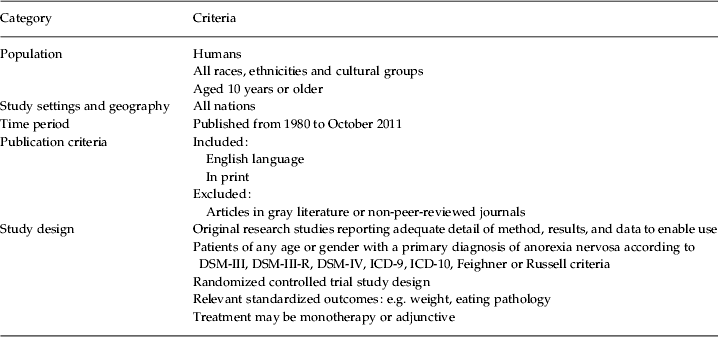
A priori inclusion and exclusion criteria are noted in Table 1.
Inclusion and exclusion criteria

DSM, Diagnostic and Statistical Manual of Mental Disorders; ICD, International Classification of Diseases.
Literature search and retrieval process
We included studies identified in two previous searches for systematic reviews. Each of the authors was directly involved with and updated the systematic searches in these former reviewsFootnote 1Footnote †. The methodology for these two former reviews is described briefly.
Berkman et al. (Reference Berkman, Bulik, Brownley, Lohr, Sedway, Rooks and Gartlehner2006); Bulik et al. (Reference Bulik, Berkman, Brownley, Sedway and Lohr2007): Agency for Healthcare Research and Quality Evidence Report (USA)
A total of six databases were searched: Medline; PsycINFO; the Cumulative Index to Nursing and Applied Health; Educational Resources Information Center (ERIC); the National AGRIcultural OnLine Access; and Cochrane Collaboration libraries. A list of medical subject heading (MeSH) search terms was developed for Medline and comparable terms for other databases. MeSH terms included ‘anorexia’ and ‘AN’, and searches were limited by type of study, including RCT, single-blind method, double-blind and crossover designs. Articles were solicited from experts in the field, and studies published from 1980 to September 2005 were sought.
Watson et al. (Reference Watson, Elphick, Dreher, Steele and Wilksch2010): National Eating Disorders Collaboration Review (Australia)
A total of five databases were searched: Medline (1985 to July 2009); PsycINFO (1985 to July 2009); EMBASE (1980 to July 2009); SCOPUS (1960 to June 2009); and the Cochrane Collaboration libraries. In addition, the table of contents of the International Journal of Eating Disorders was hand searched between January 2004 and July 2009. All searches used eating disorders and anorexia nervosa with truncated terms where relevant. Retrieval was limited to RCTs published from 2004 to July 2009 and to systematic reviews with search dates between 2004 and July 2009 to identify earlier RCTs. Medline and EMBASE were searched with search filters developed by the British Medical Journal, and PsycINFO was searched based on a search filter developed for the Wales Health Evidence Bulletins. Search filters are fully reported in Watson et al. (Reference Watson, Elphick, Dreher, Steele and Wilksch2010).
Systematic search updating
The systematic searches were updated to October 2011 using the electronic database search methodology reported in Watson et al. (Reference Watson, Elphick, Dreher, Steele and Wilksch2010). Abstracts were systematically reviewed against a priori criteria to determine inclusion. Disagreements regarding inclusion were resolved by discussion between authors.
Reporting of studies and treatment outcomes
All RCTs are summarized in Table 2 according to study characteristics (year of publication, country, setting, percentage female, race/ethnicity, number of subjects (n), study arms, treatment duration and dosage). Studies are grouped by phase of treatment (acute or maintenance) and study population (mixed adults and youth, or youth only). Effect sizes for weight-related and eating pathology outcomes were calculated from data reported in RCTs, i.e. means and standard deviations, t, F or χ2 values, significance levels, gain scores, ordinal categories, and frequencies, following procedures described by Hedges & Olkin (Reference Hedges and Olkin1985), Cohen (Reference Cohen1962), Lipsey & Wilson (Reference Lipsey and Wilson2001) and Rosenthal (Reference Rosenthal1991). In studies with crossover designs, first period data were considered only. Hedges' g (Hedges, Reference Hedges1981) was reported because it is a readily interpretable variant of the Cohen's d family and corrects for biases associated with small sample sizes. Tables of treatment outcomes (Tables 3–6) are organized by timing of outcome measurement (endpoint or follow-up) and comparator type (control/placebo or active treatment).
Characteristics of randomized controlled trials of anorexia nervosa treatment
NR, Not reported; CBT, cognitive–behavioral therapy; BT, behavioral therapy; TAU, treatment as usual; BMI, body mass index; CAT, cognitive analytic therapy; NZ, New Zealand; IPT, interpersonal psychotherapy; SSCM, specialist supportive clinical management (formerly non-specific supportive clinical management); rhGH, recombinant human growth hormone; EOIT, ego-oriented individual therapy/adolescent-focused individual therapy; BAT, body awareness therapy; FBT, family-based treatment/family therapy.
a Average at end of study. b Average number for sample. c Range at end of study. d Average over study period.
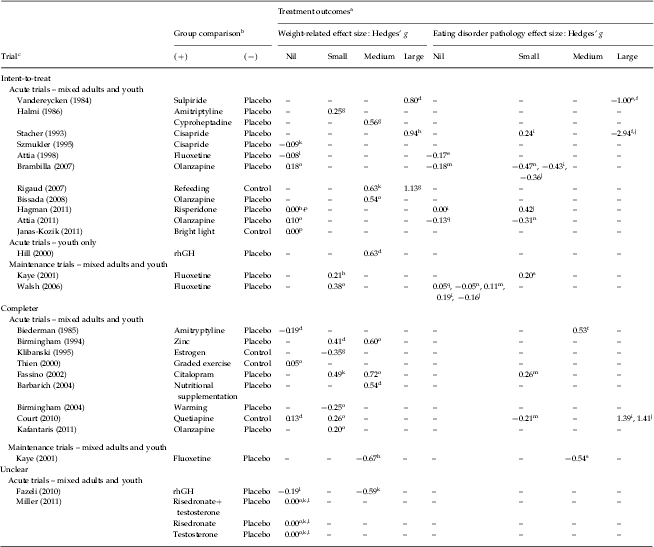
Randomized controlled trials identified through systematic review: anorexia nervosa treatment outcomes at treatment endpoint for active intervention versus control
rcGH, Recombinant human growth hormone; EAT/ChEAT, Eating Attitudes Test/Children's Eating Attitudes Test; EDI, Eating Disorders Inventory; BMI, body mass index; YBC-EDS, Yale-Brown-Cornell Eating Disorder Scale; EAT-Bulimia, Eating Attitudes Test bulimia subscale.
a Effect size conventions: nil, <0.2; small, 0.2– < 0.5; medium, 0.5– < 0.8; large, >0.8. Effect sizes were calculated from data reported in the primary study with effect sizes calculated from means and standard deviations, t, F or χ2 values, significance levels, gain scores, ordinal categories, and frequencies and followed procedures described by Hedges & Olkin (Reference Hedges and Olkin1985), Cohen (Reference Cohen1962), Lipsey & Wilson (Reference Lipsey and Wilson2001) and Rosenthal (Reference Rosenthal1991). Studies with crossover designs had first-period data considered only. b A positive effect size favors the group in the (+) column; a negative effect size favors the group in the (−) column. c For further details of treatment groups, see Table 2. d Weight gain. e EAT/ChEAT total. f Randomization clearly failed: the groups had large baseline differences on the outcome measure. Using average gain scores instead, the effect size was nil. g Achieved target weight. h Change in percentage ideal body weight. i EDI-body dissatisfaction. j EDI-drive for thinness. k Weight. l Percentage ideal body weight. m EDI-bulimia. n EDI-total. o BMI. p Change in BMI. q YBC-EDS. r BMI percentile. s Change in YBC-EDS. t EAT-Bulimia.
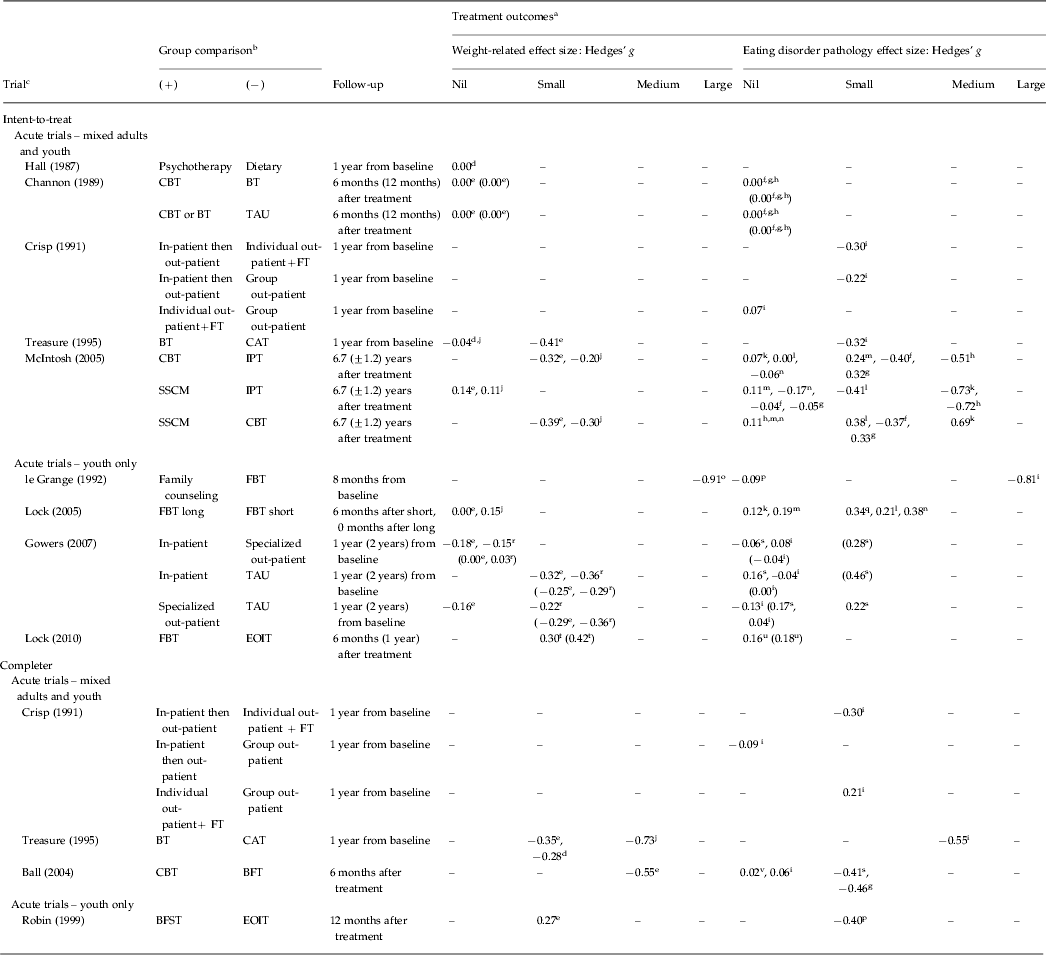
Randomized controlled trials identified through systematic review: anorexia nervosa treatment outcomes at treatment endpoint for active intervention versus active intervention
CBT, Cognitive–behavioral therapy; BT, behavioral therapy; TAU, treatment as usual; FT, family therapy; CAT, cognitive analytic therapy; IPT, interpersonal psychotherapy; SSCM, specialist supportive clinical management (formerly non-specific supportive clinical management); FBT, family-based treatment/family therapy; FGP, family group psychoeducation; EOIT, ego-oriented individual therapy/adolescent-focused individual therapy; PPC, parent-to-parent consultation; BFT, behavioral family therapy; BFST, behavioral family systems therapy; BMI, body mass index; EDI, Eating Disorders Inventory; EDE-SC, Eating Disorder Examination shape concern subscale; EDE-R, Eating Disorder Examination restraint subscale; EDE-EC, Eating Disorder Examination eating concern subscale; EDE-WC, Eating Disorder Examination weight concern subscale; EAT/ChEAT, Eating Attitudes Test/Children's Eating Attitudes Test; YBC-EDS, Yale-Brown-Cornell Eating Disorder Scale; ABOS, Anorectic Behavior Observation Scale.
a Effect size conventions: nil, <0.2; small, 0.2– < 0.5; medium, 0.5– < 0.8; large, >0.8. Effect sizes were calculated from data reported in the primary study with effect sizes calculated from means and standard deviations, t, F or χ2 values, significance levels, gain scores, ordinal categories, and frequencies and followed procedures described by Hedges & Olkin (Reference Hedges and Olkin1985), Cohen (Reference Cohen1962), Lipsey & Wilson (Reference Lipsey and Wilson2001) and Rosenthal (Reference Rosenthal1991). Studies with crossover designs had first-period data considered only. b A positive effect size favors the group in the (+) column; a negative effect size favors the group in the (−) column. c For further details of treatment groups, see Table 2. d Achieved target weight. e Weight gain. f BMI. g EDI-bulimia. h EDI-body dissatisfaction. i EDI-drive for thinness. j EDI-total. k Weight. l EDE-SC. m EDE-R. n EDE-EC. o EDE-WC. p Percentage ideal body weight. q Morgan–Russell total score. r EAT/ChEAT total. s At FBT short endpoint. t YBC-EDS. u At FBT long endpoint. v Weight for height. w BMI percentile. x EDE global. y Maintained target weight. z ABOS.
Randomized controlled trials identified through systematic review: anorexia nervosa treatment outcomes at treatment follow-up for active intervention versus control
FT, Family therapy; BAT, body awareness therapy; EDI, Eating Disorders Inventory; BMI, body mass index.
a Effect size conventions: nil, < 0.2; small, 0.2– < 0.5; medium, 0.5– < 0.8; large, > 0.8. Effect sizes were calculated from data reported in the primary study with effect sizes calculated from means and standard deviations, t, F or χ2 values, significance levels, gain scores, ordinal categories, frequencies, and narrative descriptions of no effect if no other useable data were reported, and followed procedures described by Hedges & Olkin (Reference Hedges and Olkin1985), Cohen (Reference Cohen1962), Lipsey & Wilson (Reference Lipsey and Wilson2001) and Rosenthal (Reference Rosenthal1991). Studies with crossover designs had first-period data considered only. b A positive effect size favors the group in the (+) column; a negative effect size favors the group in the (−) column. c For further details of treatment groups, see Table 2. d Morgan–Russell global score. e EDI-total. f Weight. g Percentage ideal body weight. h Achieved target weight. i BMI. j EDI-bulimia. k EDI-body dissatisfaction. l EDI-drive for thinness.
Randomized controlled trials identified through systematic review: anorexia nervosa treatment outcomes at treatment follow-up for active intervention versus active intervention
CBT, Cognitive–behavioral therapy; BT, behavioral therapy; TAU, treatment-as-usual; FT, family therapy; CAT, cognitive analytic therapy; IPT, interpersonal psychotherapy; SSCM, specialist supportive clinical management (formerly non-specific supportive clinical management); FBT, family-based treatment/family therapy; BFT, behavioral family therapy; BFST, behavioral family systems therapy; EOIT, ego-oriented individual therapy/adolescent-focused individual therapy; BMI, body mass index; EDI, Eating Disorders Inventory; EDE-R, Eating Disorder Examination restraint subscale; EDE-EC, Eating Disorder Examination eating concern subscale; EDE-SC, Eating Disorder Examination shape concern subscale; EDE-WC, Eating Disorder Examination weight concern subscale; EAT/ChEAT, Eating Attitudes Test/Children's Eating Attitudes Test; ABOS, Anorectic Behavior Observation Scale.
a Effect size conventions: nil, < 0.2; small, 0.2– < 0.5; medium, 0.5– < 0.8; large, >0.8. Effect sizes were calculated from data reported in the primary study with effect sizes calculated from means and standard deviations, t, F or χ 2 values, significance levels, gain scores, ordinal categories, frequencies, and narrative descriptions of no effect if no other useable data were reported, and followed procedures described by Hedges & Olkin (Reference Hedges and Olkin1985), Cohen (Reference Cohen1962), Lipsey & Wilson (Reference Lipsey and Wilson2001) and Rosenthal (Reference Rosenthal1991). Studies with crossover designs had first-period data considered only. Numbers in parentheses denote a second follow-up. b A positive effect size favors the group in the (+) column; a negative effect size favors the group in the (−) column. c For further details of treatment groups, see Table 2. d Weight gain. e BMI. f EDI-bulimia. g EDI-body dissatisfaction. h EDI-drive for thinness. i Morgan–Russell global score. j Weight. k EDE-R. l EDE-EC. m EDE-SC. n EDE-WC. o Percentage ideal body weight. p EAT/ChEAT. q YBC-EDS. r Weight for height. s EDI-total. t BMI percentile. u EDE global. v ABOS.
For treatments compared with control/placebo, efficacious treatments ideally demonstrate large effect sizes (i.e. standardized difference), which by convention indicate practical importanceFootnote 2, and, conversely the absence of difference or a nil effect indicates the lack of a specific treatment effect. For treatments compared with another active treatment, we interpret a large effect size as favoring the treatment with the more positive outcome; a lack of difference does not indicate that one or the other treatment is ineffective (or effective), only that there is no difference in outcome between the two treatments. A limitation of these interpretive stances is that they are presumptive of a lack of bias, which is often not the case in real-world research.
Results and discussion
Characteristics of studies
A total of 48 RCTs (see Table 2) met inclusion criteria, including 19% (9/48) unreported in the previous reviews (Berkman et al. Reference Berkman, Bulik, Brownley, Lohr, Sedway, Rooks and Gartlehner2006; Bulik et al. Reference Bulik, Berkman, Brownley, Sedway and Lohr2007; Watson et al. Reference Watson, Elphick, Dreher, Steele and Wilksch2010). The majority (90%, 43/48) evaluated treatment in the acute phase of illness and the remainder (10%, 5/48) randomized to treatment after weight restoration and were classified as maintenance trials. Of the acute trials, 79% (34/43) had mixed samples comprising adults and youth (i.e. we define ‘youth’ according to the National Institutes of Health guidelines as 21 years) and the rest (9/43) focused exclusively on youth from 11 to 20 years.
Treatment outcomes
In this section, we summarize RCT study results, emphasizing the most impactful treatment findings, defined as the most well-studied interventions, studies for which results have been highly anticipated, and studies considerably making an impact on practice guidelines, and cover psychotherapy and pharmacotherapy approaches. Effect sizes for trials are shown in Tables 3–6.
Mixed samples of adults and youth
Acute treatment
Commensurate with previous reviews (Hay et al. Reference Hay, Bacaltchuk, Byrnes, Claudino, Ekmejian and Yong2003; Attia & Schroeder, Reference Attia and Schroeder2005; Bulik et al. Reference Bulik, Berkman, Brownley, Sedway and Lohr2007), and despite an influx of new studies, few treatment studies for anorexia nervosa have identified a large treatment effect relative to control, placebo, or active treatment at endpoint or follow-up (Tables 3–6).
Behavioral interventions investigated include cognitive–behavioral therapy (CBT), behavioral therapy (BT), interpersonal psychotherapy (IPT), specialist supportive clinical management (SSCM; originally referred to as non-specific supportive clinical management), family therapy, focal psychodynamic psychotherapy, cognitive analytic therapy (CAT), graded exercise, warming, and nutritional/dietary treatment. No clear primacy of any approach has been demonstrated; as seen in Tables 3–6, outcome differences are generally nil to small.
McIntosh et al.'s (Reference McIntosh, Jordan, Carter, Luty, McKenzie, Bulik, Frampton and Joyce2005) psychotherapy trial randomized 56 women (17–40 years) to CBT, IPT and SSCM (control group; combined aspects of clinical management with supportive therapy and education) and was highly anticipated given that the study compared two highly plausible treatment approaches with proven efficacy for depression, namely CBT and IPT. Study findings were unexpected – overall the control group had superior outcomes – SSCM was superior to IPT, and CBT fell somewhere in between. At about 7-year follow-up, the three groups were equivalent on all physical, cognitive and behavioral measures of eating disorders (Carter et al. Reference Carter, Jordan, McIntosh, Luty, McKenzie, Frampton, Bulik and Joyce2011). There was a good outcome overall in 49%, although the control group had a significantly faster rate of recovery than the IPT group (Carter et al. Reference Carter, Jordan, McIntosh, Luty, McKenzie, Frampton, Bulik and Joyce2011).
Considerable enthusiasm remains for CBT, which has been spurred by strong, replicable outcomes for other eating disorders, plausible and testable theory, and scholarly backing by treatment experts. The limited evidence base has not indicated superiority of CBT over other psychotherapies for anorexia nervosa; for example, in addition to the aforementioned trial, Channon et al. (Reference Channon, De Silva, Hemsley and Perkins1989) found that patients improved, but CBT, BT and control did not differ in effectiveness. Ball & Mitchell (Reference Ball and Mitchell2004) reported that 79% of completers achieved a good outcome with CBT, although it did not differ significantly from family therapy. This is only one small study out of a larger group, which generally concluded no effect, and the sample was small (n = 25). Tables 4 and 6 confirm the minimal effect size differences.
The first RCT to examine nasogastric refeeding (Rigaud et al. Reference Rigaud, Brondel, Poupard, Talonneau and Brun2007) compared a combination of nasogastric feeding plus meals and snacks versus meals and snacks only in 81 patients with anorexia nervosa (mean age = 23 years). The intervention group had significantly faster and greater weight gain to the 2-month endpoint (1.36 v. 0.88 kg/week) and a longer relapse-free period at 1-year follow-up, but there was no difference in the proportion relapsing at 1 year. Table 3 shows that at endpoint, the effect size for weight was large and favored nasogastric feeding.
For pharmacotherapy interventions, among combined samples of adults and youth, atypical antipsychotics and selective serotonin reuptake inhibitors (SSRIs) have been the most extensively evaluated (see Table 3). As shown in Tables 3–5, medication treatments have not yielded large effects on weight-related outcomes or eating pathology. Clinically, atypical antipsychotics are prescribed to reduce anxiety associated with co-morbid disorders, reduce obsessional thinking and anorexic cognitions, and relieve agitation associated with weight gain and treatment challenges (i.e. refeeding). In normal-weight and other psychiatric populations, atypical antipsychotics show an undesired side effect of extreme weight gain, experienced by up to 80% of individuals with psychotic illnesses (Álvarez-Jiménez et al. Reference Álvarez-Jiménez, González-Blanch, Crespo-Facorro, Hetrick, Rodriguez-Sánchez, Pérez-Iglesias and Vázquez-Barquero2008). Inconsistent small to moderate overall benefits have been reported from antipsychotic treatment for anorexia nervosa, with olanzapine being the most commonly studied in 55% (5/9) of trials. The majority of these studies reported no differences between olanzapine and placebo on psychological outcomes such as eating pathology, body image, general psychiatric symptoms, obsessionality and compulsivity (Mondraty et al. Reference Mondraty, Birmingham, Touyz, Sundakov, Chapman and Beumont2005; Bissada et al. Reference Bissada, Tasca, Barber and Bradwejn2008; Attia et al. Reference Attia, Kaplan, Walsh, Gershkovich, Yilmaz, Musante and Wang2011; Kafantaris et al. Reference Kafantaris, Leigh, Hertz, Berest, Schebendach, Sterling, Saito, Sunday, Higdon, Golden and Malhotra2011), although one favored olanzapine for reducing depressive symptoms (Brambilla et al. Reference Brambilla, Garcia, Fassino, Daga, Favaro, Santonastaso, Ramaciotti, Bondi, Mellado, Borriello and Monteleone2007). Olanzapine was associated with small but statistically significant weight gain in three trials (Brambilla et al. Reference Brambilla, Garcia, Fassino, Daga, Favaro, Santonastaso, Ramaciotti, Bondi, Mellado, Borriello and Monteleone2007; Bissada et al. Reference Bissada, Tasca, Barber and Bradwejn2008; Attia et al. Reference Attia, Kaplan, Walsh, Gershkovich, Yilmaz, Musante and Wang2011), only in the binge–purge subtype in one (Brambilla et al. Reference Brambilla, Garcia, Fassino, Daga, Favaro, Santonastaso, Ramaciotti, Bondi, Mellado, Borriello and Monteleone2007), and no reported effect beyond control in the other two trials (Mondraty et al. Reference Mondraty, Birmingham, Touyz, Sundakov, Chapman and Beumont2005; Kafantaris et al. Reference Kafantaris, Leigh, Hertz, Berest, Schebendach, Sterling, Saito, Sunday, Higdon, Golden and Malhotra2011). Compliance was assessed in three of these trials: Attia et al. (Reference Attia, Kaplan, Walsh, Gershkovich, Yilmaz, Musante and Wang2011) reported detectable medication in the serum of seven out of eight patients; Bissada et al. (Reference Bissada, Tasca, Barber and Bradwejn2008) reported 100% compliance from weekly urine samples; and Brambilla et al. (Reference Brambilla, Garcia, Fassino, Daga, Favaro, Santonastaso, Ramaciotti, Bondi, Mellado, Borriello and Monteleone2007) reported compliance through pill counts. Four other antipsychotic trials (Vandereycken, Reference Vandereycken1984; Ruggiero et al. Reference Ruggiero, Laini, Mauri, Ferrari, Clemente, Lugo, Mantero, Redaelli, Zappulli and Cavagnini2001; Court et al. Reference Court, Mulder, Kerr, Yuen, Boasman, Goldstone, Fleming, Weigall, Derham, Huang, McGorry and Berger2010; Hagman et al. Reference Hagman, Gralla, Sigel, Ellert, Dodge, Gardner, O'Lonergan, Frank and Wamboldt2011) produced inconsistent findings on weight and psychological outcomes. In sum, atypical antipsychotics have had a considerable degree of evaluation, but evidence for a specific treatment effect on anorexia nervosa is inconsistent and underwhelming.
It remains unclear whether and under what conditions SSRIs are beneficial in the treatment of anorexia nervosa. Two trials compared SSRI with placebo or treatment as usual (Attia et al. Reference Attia, Haiman, Walsh and Flater1998; Fassino et al. Reference Fassino, Leombruni, Daga, Brustolin, Migliaretti, Cavallo and Rovera2002) and found no effect on eating pathology or weight outcomes. Three trials compared SSRIs with second-generation antidepressants (Brambilla et al. Reference Brambilla, Draisci, Peirone and Brunetta1995a, b; Ruggiero et al. Reference Ruggiero, Laini, Mauri, Ferrari, Clemente, Lugo, Mantero, Redaelli, Zappulli and Cavagnini2001). Intervention groups showed improvement on psychological outcomes (i.e. eating pathology, depression, anxiety), and there were generally no statistically significant group differences. Neurochemical and secondary disturbances, for example tryptophan deficiency, may render medication ineffective in malnourished individuals, and SSRIs may be more valuable after weight restoration and/or in conjunction with nutritional supplement augmentation (Attia & Schroeder, Reference Attia and Schroeder2005). Barbarich et al. (Reference Barbarich, McConaha, Halmi, Gendall, Sunday, Gaskill, La Via, Frank, Brooks, Plotnicov and Kaye2004) randomized patients to fluoxetine with or without nutritional supplementation designed to regulate serotonin function or placebo and found no differences on weight gain, anxiety, or obsessive–compulsive symptoms, suggesting that nutritional supplementation did not enhance fluoxetine efficacy. The effect size difference between groups (Table 3) on body mass index (BMI) was medium.
It is necessary to note that in Table 3, sulpiride appeared to have a large impact on weight gain at endpoint in an early study; however, inspection of the primary study data revealed that the effect is an artifact of failed randomization, with large group differences at pretreatment carrying over to endpoint. The earliest study of cisapride showed a similar phenomenon, leading to marked variation in endpoint outcomes; cisapride also has been voluntarily withdrawn in many countries because of cardiac risks.
Maintenance treatment for weight-restored anorexia nervosa
A total of four maintenance trials were identified – two on fluoxetine (Kaye et al. Reference Kaye, Nagata, Weltzin, Hsu, Sokol, McConaha, Plotnicov, Weise and Deep2001; Walsh et al. Reference Walsh, Kaplan, Attia, Olmsted, Parides, Carter, Pike, Devlin, Woodside, Roberto and Rockert2006), one on family therapy (Russell et al. Reference Russell, Szmukler, Dare and Eisler1987) and one on CBT versus nutritional counseling (Pike et al. Reference Pike, Walsh, Vitousek, Wilson and Bauer2003). Walsh et al. (Reference Walsh, Kaplan, Attia, Olmsted, Parides, Carter, Pike, Devlin, Woodside, Roberto and Rockert2006) found no differences between fluoxetine and placebo in time to relapse, or changes during treatment on BMI, core eating disorder pathology, depression, and other psychiatric symptomatology, except for anxiety, which was reduced more in the intervention group. Kaye et al. (Reference Kaye, Nagata, Weltzin, Hsu, Sokol, McConaha, Plotnicov, Weise and Deep2001) found that only those who remained on fluoxetine for 1 year had significant improvement on weight and psychological outcomes; however, effect sizes did not reflect this (Table 5) and the numbers of subjects were small.
Family therapy showed superior benefit to individual supportive psychotherapy at 1 year in the group whose illness was not chronic and had begun before the age of 19 years (Russell et al. Reference Russell, Szmukler, Dare and Eisler1987); and, at 5-year follow-up, more patients in family therapy (90%) experienced a good outcome (i.e. normal body weight and regular menses) compared with individual supportive psychotherapy (36%) (Eisler et al. Reference Eisler, Dare, Russell, Szmukler, le Grange and Dodge1997); however, as shown in Table 4 the effect size difference on weight was small.
Compared with nutritional counseling, CBT for 1 year was associated with a significantly higher proportion of participants attaining a good outcome (i.e. normal body weight and regular menses). The CBT group had lower relapse (22 v. 53%) at 1 year, although this difference was not statistically significant (Pike et al. Reference Pike, Walsh, Vitousek, Wilson and Bauer2003).
Youth
Acute treatment
Family therapy was evaluated in six trials, five with out-patients (le Grange et al. Reference le Grange, Eisler, Dare and Russell1992; Robin et al. Reference Robin, Siegel, Moye, Gilroy, Dennis and Sikand1999; Eisler et al. Reference Eisler, Dare, Hodes, Dodge, Russell and le Grange2000; Lock et al. Reference Lock, Agras, Bryson and Kraemer2005, Reference Lock, le Grange, Agras, Moye, Bryson and Jo2010) and one with in-patients (Geist et al. Reference Geist, Heinmaa, Stephens, Davis and Katzman2000). Family therapy for anorexia focuses primarily on weight gain by empowering the family to take control of re-nutrition. Three RCTs compared alternative content/delivery formats of family therapy (le Grange et al. Reference le Grange, Eisler, Dare and Russell1992; Eisler et al. Reference Eisler, Dare, Hodes, Dodge, Russell and le Grange2000; Lock et al. Reference Lock, Agras, Bryson and Kraemer2005) and as such effect size differences of nil to medium (Table 4) imply no differences between the alternative delivery formats. One trial (le Grange et al. Reference le Grange, Eisler, Dare and Russell1992) showed large effect sizes, favoring ‘family-based treatment’ (FBT) on weight and eating pathology compared with a similar approach whereby parents and child were seen separately. Three RCTs compared family therapy with treatment as usual or an active comparator (Robin et al. Reference Robin, Siegel, Moye, Gilroy, Dennis and Sikand1999; Geist et al. Reference Geist, Heinmaa, Stephens, Davis and Katzman2000, Lock et al. Reference Lock, le Grange, Agras, Moye, Bryson and Jo2010). Lock et al. (Reference Lock, le Grange, Agras, Moye, Bryson and Jo2010) randomized 121 youth aged 12–18 years to FBT or adolescent-focused individual therapy for 12 months. There was a large end-of-treatment effect size difference on weight, favoring FBT (Table 4). Remission, defined as achieving ⩾95% of expected weight and eating pathology scores within 1 s.d. of community norms, did not differ statistically between groups at end of treatment (42 v. 23%), but was significantly higher in FBT at 6 months (40 v. 18%) and 12 months (49 v. 23%). An in-patient RCT (Geist et al. Reference Geist, Heinmaa, Stephens, Davis and Katzman2000) comparing family therapy with family group psychoeducation reported equivalent effects but found family group psychoeducation more economical. Findings from this trial have been labeled difficult to interpret because both treatments occurred in the context of in-patient weight restoration and most weight gain (76%) was attained prior to hospital discharge (le Grange, Reference le Grange2005). As seen in Table 4, there were no large effect size differences on weight and eating outcomes between groups.
Gowers et al. (Reference Gowers, Clark, Roberts, Griffiths, Edwards, Bryan, Smethurst, Byford and Barrett2007) randomized 170 youth aged 12–18 years to: specialized in-patient treatment (multimodal intervention with a focus on weight restoration), specialized out-patient (primarily CBT-oriented), or Child and Adolescent Mental Health Service community treatment as usual. Overall, participants improved over the 2-year follow-up with no group differences, consistent with effect sizes in Table 6.
Maintenance treatment for weight-restored anorexia nervosa
Rhodes et al. (Reference Rhodes, Baillee, Brown and Madden2008) randomized 20 families of girls aged 12–16 years to family therapy with or without one parent-to-parent consultation early in treatment. Immediately after the consultation, there was a significant increase in weight in the consultation group; however, at the end of the treatment program, there were no statistically significant between-group differences in weight or recovery status and effect size estimates indicated no difference (Table 4).
Since the last published systematic reviews, the evidence base has expanded most in the area of FBT for youth. Although not yet definitive, findings do converge toward the value of including family members in systematically delivered family-based intervention. Worldwide, the practice milieu for acute child and adolescent eating disorders has been indelibly influenced by controlled research on family therapy, particularly FBT, which RCT evidence supports to date and is commonly used clinically. Unfortunately, in both pharmacological and psychotherapeutic interventions for adults, no clear superior treatments have emerged. Further, the evidence base has yet to develop novel and feasible designs that allow testing of the entire spectrum of interventions for anorexia nervosa (i.e. from in-patient weight restoration to maintenance and relapse prevention).
Section 2: practice guidelines
We purposely target this section to an eating disorder non-specialist readership and focus on two widely used sets of guidelines: the National Institute for Health and Clinical Excellence (NICE, 2004) and the American Psychiatric Association (APA, 2006). We acknowledge that many countries and specialties have developed practice guidelines for the treatment of anorexia nervosa, but the broad influence of these two guidelines stems from the high standard of development, which in each case involved a detailed systematic review of evidence and literature, expert opinion and consensus, and wide circulation and review.
The objectives of this section are: to share the main areas addressed in the practice guidelines that are not addressed by the extant RCT literature (i.e. treatment setting and team, renourishment, and family involvement); to share recommendations essential for clinicians; and to highlight important evidence-based developments that may inform guideline revision. We integrate this section with the previous section by highlighting whether recommendations are consistent with the evidence base.
Treatment setting and team
Services available for people with eating disorders range from out-patient to partial hospitalization, in-patient, and residential care. Most people with anorexia nervosa should be managed in an out-patient setting (NICE, 2004; APA, 2006). In-patient treatment is warranted for specific medical, psychiatric and social reasons, such as acute medical stabilization relating to the complications of malnutrition, suicidality, severe family environment or social problems, and a decline in weight despite maximally intensive community-based care (NICE, 2004; APA, 2006). The decision to admit patients on a medical versus psychiatric unit should be informed by the patient's general medical and mental health status and the skills, availability and suitability of staff and interventions on respective units (APA, 2006). Continuity of care across levels is essential, which can be assisted with a designated care coordinator (APA, 2006).
Treatment is optimally delivered by a multidisciplinary team, given the variety of physical and psychiatric aspects of the illness (APA, 2006). Appropriate professionals include a psychiatrist, other physician, clinical psychologist, dietitian, nurse, social worker and occupational therapist (APA, 2006).
Renourishment
The first treatment priority of anorexia nervosa is to restore healthy weight and treat physical complications (APA, 2006). Management necessarily involves restoration of nutritional status (i.e. healthy weight, normal perceptions of hunger and satiety, normalized eating patterns, and correction of malnutrition) through a renourishment program (NICE, 2004; APA, 2006). Oral-based nutrition is the most common refeeding approach; enteral or parenteral nutrition support may be warranted in extreme cases of malnutrition and patient refusal to eat, at which time nasogastric feeding is preferable to intravenous feeding (APA, 2006). Total parenteral nutrition should not be used, unless the patient has severe gastrointestinal dysfunction (NICE, 2004). Feeding against patient will is an absolute last resort (APA, 2006). Critics of the guidelines claim that the conservative, ‘defensive’ refeeding approach that is recommended to protect against refeeding syndrome is outdated, and may obstruct timely improvement and cause harm. Alternatively, renourishment can afford to be more aggressively implemented, while being more efficient and safe (Kohn et al. Reference Kohn, Madden and Clarke2011; Garber et al. Reference Garber, Michihata, Hetnal, Shafer and Moscicki2012).
Family involvement
For youth, guidelines suggest that family members including siblings should be involved in the wider treatment, and, for adults, family and spousal involvement should be considered on a case-by-case basis (NICE, 2004; APA, 2006). RCT evidence has supported family involvement in youth treatment (see Section 1).
Treatment modality
The recommended treatment for youth is family therapy that directly addresses the eating disorder (NICE, 2004; APA, 2006). This therapy was assigned a Grade B in the NICE guidelines (indicating that a treatment has evidence of effectiveness in well-conducted clinical studies), the highest grade of all the treatment approaches for anorexia nervosa. This recommendation for youth is consistent with the evidence base (see Section 1), with the study by Lock et al. (Reference Lock, le Grange, Agras, Moye, Bryson and Jo2010) adding further strong support.
Among adults, Grade C (indicating expert consensus or opinion) is the highest level of evidence, and recommends CAT, CBT, IPT and focal psychodynamic therapy, with no primacy assignable to any particular approach (NICE, 2004; APA, 2006). Dietary counseling should not be the sole treatment, nor should pharmacological interventions (NICE, 2004). For adults, these recommendations are consistent with the evidence base (see Section 1), with no treatments demonstrating clear superiority.
Pharmacotherapy interventions have a limited evidence base and should not be used as the primary or sole treatment (APA, 2006). Caution is advised when administering pharmacological treatments, as some clinical features (i.e. depression, obsessive–compulsiveness) remit with weight regain (NICE, 2004; APA, 2006). In the USA, there are no Food and Drug Administration-approved medications for the treatment of anorexia nervosa. These recommendations hold on the basis of current RCT evidence (see Section 1). It is our contention that more research is needed to investigate efficacy, particularly for antipsychotics, where inadequate compliance measurement and mixed findings have dominated the control trial landscape.
Section 3: on the horizon
Controlled trial findings and practice guidelines have captured many components of clinical practice, but new empirical forays to develop and advance the evidence base are underway. The objective of this section is to overview the hub of activity that will yield the data to inform the coming decades of clinical practice. Because of the enormous scope of ongoing research, we have limited our discussion to RCTs. The trials underway are motivated by: methodological shortcomings of previous trials (i.e. drop-out, non-compliance); new theoretical developments (i.e. neurocognitive, socio-emotional); theoretical extensions [i.e. transdiagnostic theory/'enhanced CBT' (CBT-E)]; replication (i.e. efficacy of SSCM over theoretically based alternatives); adaptations for subpopulations and contexts (i.e. couple-based therapy, adult-based family therapy); lack of research on the efficacy of treatment levels (i.e. in-patient, day, out-patient); and most significantly, because both the extant RCT base (see Section 1) and the practice guidelines (see Section 2) have been unable, for adults, to identify any first-line treatment options. Our ability to address critical components such as drop-out and compliance will have to await the completion of these trials.
Information about active or completed but unpublished RCTs at the time of this search (October 2011) was sourced from clinical trials registries [National Institutes of Health Research Portfolio Online Reporting Tool (RePORTer), clinicaltrials.gov, Australian New Zealand Clinical Trials Registry (ANZCTR) and ISRCTN], contact with experts in the field, and the Eating Disorders Research Society LISTSERV (see Table 7 for the summary list of ‘ongoing’ trials).
Characteristics of ongoing randomized controlled trials for anorexia nervosa
PI, Principal investigator; m, male; f, female; FBT, family-based treatment; CBT, cognitive–behavioral therapy; CBT-E, cognitive–behavioral therapy – enhanced; SSCM, specialist supportive clinical management; MANTRA, cognitive–interpersonal treatment (Maudsley model of anorexia nervosa treatment for adults); CRT, cognitive remediation therapy; TAU, treatment as usual; LEAP, Loughborough Eating disorders Activity therapy; BMI, body mass index; rhIGF-1, recombinant human insulin-like growth factor-1; AN-EX/RP, exposure and response prevention for anorexia nervosa; ECHO, Experienced Carers Helping Others self-help intervention; ECHOc, Experienced Carers Helping Others guided self-help intervention; CAT, cognitive analytic therapy; FPT, focal psychodynamic therapy.
In 2007 and in response to the leanness of the evidence base, the National Institute of Mental Health issued a request for proposals entitled ‘Innovative Trials for the Treatment of Anorexia Nervosa in Late Adolescence & Adulthood’. They sought novel applications addressing priority areas for anorexia nervosa as identified in a National Institutes of Health workshop (for the report describing proceedings, see Agras et al. Reference Agras, Brandt, Bulik, Dolan-Sewell, Fairburn, Halmi, Jimerson, Kaplan, Kaye, le Grange, Lock, Mitchell, Rudorfer, Street, Striegel-Moore, Vitousek, Walsh and Wilfley2004). The initiative funded four studies which are, respectively: (1) [principal investigator (PI): Lock] cognitive remediation therapy (Tchanturia & Hambrook, Reference Tchanturia, Hambrook, Grilo and Mitchell2010), which is designed to improve neurocognitive abilities such as central coherence and set-shifting skills; (2) (PI: Bulik/Baucom) couple-based cognitive–behavioral intervention (Bulik et al. Reference Bulik, Baucom, Kirby and Pisetsky2011), which helps couples work together in the treatment of anorexia nervosa; (3) (PI: Marcus) emotion acceptance behavior therapy (Wildes & Marcus, Reference Wildes and Marcus2011), which aims to encourage emotional awareness, reduce emotional avoidance, and support resumption of valued activities outside the eating disorder; and (4) (PI: Steinglass) exposure and response prevention therapy with motivational interviewing for weight-restored patients (Steinglass et al. Reference Steinglass, Sysko, Glasofer, Albano, Simpson and Walsh2011), which addresses eating-related fear using traditional exposure techniques and has a motivational enhancement element. Table 7 provides further information on these studies.
As shown in Table 7, several pharmacotherapy placebo-controlled RCTs are underway, examining olanzapine, aripiprazole and quetiapine.
The majority of RCTs identified are examining psychotherapeutic interventions. FBT in its standard form is being compared with systems family therapy (PI: Agras), and an RCT in Australia (PI: Touyz) is investigating whether FBT outcomes are significantly better if preceded by in-patient weight restoration. FBT adaptations undergoing testing include a more intensive ‘multi-family group day treatment’ (PI: Dare; Dare & Eisler, Reference Dare and Eisler2000); FBT for young adults (PIs: le Grange and Chen), which broadens family of origin to include family of ‘choice’ (e.g. spouse/cohabiting partner, aunts/uncles, grandparents, etc.) and FBT for children and adolescents with prodromal presentations (PI: Loeb) (Loeb et al. Reference Loeb, Craigen, Goldstein, Lock, le Grange, Le Grange and Lock2011).
SSCM is based on theoretical models of clinical management and supportive psychotherapy (McIntosh et al. Reference McIntosh, Jordan, Carter, Luty, McKenzie, Bulik, Frampton and Joyce2005). The unexpected superior effect of SSCM spurred interest in whether the approach has a ‘specific’ active ingredient beyond non-specific or placebo factors, or whether the small sample size and high attrition rate in the initial trial influenced findings. Until now, there have been no further RCT data to inform this discussion. SSCM is a comparator in four active RCTs (PIs: Byrne; Schmidt; Schmidt; Touyz). Notably, one of these trials (PI: Touyz) is evaluating the efficacy of SSCM and CBT in a chronic anorexia nervosa population. The goals of treatment of chronic anorexia have been adapted to improve quality of life, reduce the impact of the eating disorder, achieve some weight gain, and reduce the use of medical services; a key question of this study is whether psychological symptom change can occur despite the chronicity and previous failures of treatment.
A novel cognitive–interpersonal treatment which addresses perfectionism, obsessive–compulsive personality traits, avoidance, pro-anorectic beliefs, and responses of close others (Schmidt & Treasure, Reference Schmidt and Treasure2006) is being evaluated in two trials (PIs: Byrne; Schmidt). Based on preliminary open trial data (Wade et al. Reference Wade, Treasure and Schmidt2011), this approach offers promise. A large 10-site German study (Wild et al. Reference Wild, Friederich, Gross, Teufel, Herzog, Giel, de Zwaan, Schauenburg, Schade-Brittinger, Schäfer and Zipfel2009) is comparing CBT-E with focal psychodynamic therapy and treatment as usual-enhanced. This study promises to have one of the largest sample sizes of any clinical trial for anorexia ever conducted and important public health implications for service planning in Germany.
There is growing interest in caregiver and parent skill-building interventions to improve skills in caring for a loved one with an eating disorder, reduce carer distress, and remediate eating disorder symptoms and maintaining factors. An RCT comparing group parent training with FBT among adolescents is underway (PI: Zucker). The program draws from traditional and contemporary therapy approaches (Zucker et al. Reference Zucker, Marcus and Bulik2006). In addition, the Maudsley team has developed skill-building workshops for carers and parents of adults with eating disorders, based on motivational interviewing and CBT (Treasure et al. Reference Treasure, Sepulveda, MacDonald, Whitaker, Lopez, Zabala, Kyriacou and Todd2008). Compassion, emotional intelligence, resilience and stress management, expressed emotion (i.e. overprotective, hostile, or critical responses), and communication are targeted, and the program is supplemented by a carer skills-based manual (Treasure et al. Reference Treasure, Smith and Crane2007). Open pilot studies have demonstrated acceptability and impact on carer knowledge and skills; however, evaluation of the impact on clinical outcomes in an anorexia-only population is needed.
Excessive exercise has had no focused attention in treatment evaluations. Meyer et al. (Reference Meyer, Taranis, Goodwin and Haycraft2011) view excessive exercise as a maintaining factor of illness, as one of the last symptoms to recede, and as a behavior that heightens risk of relapse. A CBT intervention to address excessive exercise, developed from a cognitive–behavioral theoretical model (Meyer et al. Reference Meyer, Taranis, Goodwin and Haycraft2011), is being trialed in an RCT among adult out-patients (PI: Hay).
It is anticipated that this plethora of research will yield new and helpful treatment models that can be readily disseminated, and will resolve perplexing clinical questions that currently pervade the field.
Concluding remarks
In psychiatry and psychology, the standing of a field rests considerably on the evidence base for treatment. Treatment trials with anorexia nervosa patients are challenging. Recruitment is trying; prevalence is low, and ambivalence and reluctance to engage in treatment are common. The medical compromise associated with the illness precludes allocation to a control group without proper treatment (i.e. waiting list, placebo); hence all treatment trials for anorexia nervosa begin methodologically penalized. As a result, treatment trials for anorexia nervosa are unable to determine whether treatment produces improvement beyond what the passage of time alone would produce. Nor are they able to determine whether improvement extends beyond the impact of non-specific factors, such as the care provider–patient relationship, treatment expectations, or medically necessary background treatments (e.g. hospitalization), which are typically uncontrolled and possibly unbalanced across comparison arms. Drop-out rates are inordinately high compared with many psychological conditions and even other eating disorders (Halmi et al. Reference Halmi, Agras, Crow, Mitchell, Wilson, Bryson and Kraemer2005; Berkman et al. Reference Berkman, Bulik, Brownley, Lohr, Sedway, Rooks and Gartlehner2006; Halmi, Reference Halmi2008), posing problems for cost, attainment of sufficiently powered samples, and interpretation of findings. Possibly the biggest challenge facing treatment research is that treatment as usual in clinical practice often involves multidisciplinary management and choices about level of care, raising the question, what proportion of variance in our treatments are actually captured by RCTs?
In endeavoring to understand and advance best practice in anorexia nervosa treatment, clinicians and researchers may be best served by adopting an approach that incorporates knowledge of: the treatment evidence base; clinical practice guidelines, particularly recommendations for practice areas that RCT evidence cannot or has not brought to light; and ongoing treatment research. Together, these three lines of knowledge will support safe, effective and relevant clinical practice.
The evidence base for the treatment of anorexia nervosa is advancing, albeit unevenly. In three decades of research, family therapy (also termed FBT) is the treatment of choice for young people. Notwithstanding, the methodological issues that challenge interpretation of RCTs in anorexia nervosa generally apply to this body of research, as discussed elsewhere (e.g. Downs & Blow, in press) and additional advances for this evidence base are needed, such as comparison of FBT with other plausible approaches, such as CBT. At a broader level, where possible, the family including siblings should be involved in treatment, and community-based care is preferable, with in-patient care generally reserved primarily for medical stabilization or necessary weight restoration as noted in practice guidelines.
For adults, the research and practice guidelines are less instructive; psychotherapy is the treatment of choice, but there is limited evidence as to which psychotherapy with SSCM, CBT, IPT, CBT, focal psychodynamic therapy, and family therapy as recommended options (NICE, 2004; APA, 2006). In terms of pharmacotherapy, SSRIs have not shown benefit in malnourished individuals even with nutritional supplementation to modulate neurochemical deficits. Atypical antipsychotics have been evaluated to a moderate degree but findings are inconsistent. Although weight gain is a common side effect of atypical antipsychotics in normal-weight populations, clear efficacy in malnourished patients with anorexia nervosa has not yet been established, and long-term metabolic effects have not yet been documented.
Given the medical and cognitive compromise secondary to malnourishment, it is also meaningful to evaluate psychotherapy from the point of weight restoration. Few studies have done this. Among youth, only family therapy has been evaluated and shown promise; among adults, CBT and family therapy have (very limited) evidence of specific effectiveness.
Despite limited evidence of treatment efficacy, particularly for adults, and challenges in interpreting findings, a lack of evidence is not commensurate with ‘lack of effectiveness’ or a ‘do nothing’ approach (Carney et al. Reference Carney, Tait, Touyz, Ingvarson, Saunders and Wakefield2006). There is a clinical imperative to treat individuals with anorexia nervosa despite uncertainty over the comparative effectiveness of interventions. Proper management can be both life extending and life saving.
To assist the conduct of future RCTs, drop-out, retention and barriers to pharmacological uptake need to be addressed and collaborative investigator networks fostered. Pharmacotherapy and psychotherapy trials ought to report compliance data to establish whether null effects are attributable to the intervention or non-compliance. Dosage has a positive relationship with antipsychotic-induced weight gain (Nemeroff, Reference Nemeroff1997) and it is noteworthy that the patients in the anorexia nervosa trials received lower average dosages compared with psychotic patients (Álvarez-Jiménez et al. Reference Álvarez-Jiménez, González-Blanch, Crespo-Facorro, Hetrick, Rodriguez-Sánchez, Pérez-Iglesias and Vázquez-Barquero2008).
Serious concerns remain with the evidence base even when projecting outcomes of the many and varied trials on the horizon. First, it is conceivable that over the next 5 years as these trials come to fruition, we will accumulate more partial knowledge based on small underpowered clinical trials – either secondary to single-site designs or to the impact of treatment drop-out on statistical power. Second, few trials are designed specifically to address the applicability of treatments to males or minority participants – including racial, ethnic and sexual minorities. Third, even including the treatments on the horizon, completed and emerging RCTs do not focus on optimal in-patient hospitalization and renourishment approaches, thereby omitting a critically important aspect of treatment for severe anorexia nervosa. Fourth, even with the most promising treatment for youth, FBT, it is critical to know how best to treat those individuals for whom FBT does not succeed. Fifth, will the extant research literature generalize to the diagnostic groups that will be identified under the new DSM-5 schema?
The treatment of anorexia nervosa is neither simple nor cheap. Ultimately the goal should be to develop a rich and developmentally tailored pharmacopeia and theracopeia (i.e. palette or collection of psychotherapies) to meet the needs of the full range of individuals who present for anorexia nervosa treatment – from prepubertal youth to late-life adults, from acute to chronic, from individuals with families and/or partners to individuals with less social support, and from individuals with close access to specialized care to those remotely located.
We look for advances in treatment that emerge from expanding bodies of literature on neurocognition, biomarkers, and genetics of eating disorders. Enhanced understanding of cognitive function may assist with understanding barriers to engaging in treatment and challenges in penetrating the recalcitrant core symptoms of the illness. Biomarker investigations that successfully parse biomarkers of starvation from biomarkers of illness may point toward new drug targets that focus on the core features of the disease rather than the historical approach of adopting medications that have been successful in other related conditions. Finally, further advances in genetics may provide insight into biological pathways that influence anorexia nervosa that can guide treatment development. Together, these advances could allow us to develop medications that specifically and effectively target the core features of the illness and advance us to the stage of other areas of neuropsychiatry in which pharmacogenomic approaches are beginning to pave the way toward individualized medicine approaches (McMahon & Insel, Reference McMahon and Insel2012).
In addition to treatment research, there is a critical need for improved detection and early referral, both at first presentation and relapse, to reduce duration of exposure to the most severe stages of anorexia nervosa illness.
Finally, our interventions must not abandon individuals with anorexia nervosa after initial successful treatment. Individuals with histories of anorexia nervosa face ongoing challenges even post-recovery with developmental milestones such as pregnancy, child rearing, adult stressful life events, and the perimenopausal transition. We must continue to refine interventions to assist with these challenges to enable our patients to thrive throughout their lives and interrupt the cycle of risk that perpetuates eating disorders across generations.
Declaration of Interest
None.