Introduction
Anyone familiar with the process of typological classification knows it is fraught with frustrations. Bent over a collection of specimens, constantly shifting them around in search of an underlying order or logic, we repeatedly seem to come short: the distinctions often seem weak and arbitrary; we hesitate, but eventually we draw a line, because we must, and some items are put on one side and some on the other. The result is a clean and unambiguous account, but one that tends to cover up obscurities, rather than overcome them.
This is a longstanding issue in archaeology (and elsewhere: Sokal Reference Sokal1974; Tattersall Reference Tattersall2014), and one that is unlikely to go away any time soon. Some scholars seem to opt for the possibility of renouncing such classificatory efforts altogether, engaging their incomprehensible diversity with wonder and naivety (Pétursdóttir Reference Pétursdóttir2012; Reference Pétursdóttir2013; Witmore Reference Witmore2014); others, holding onto the ideals of mechanical objectivity (Daston & Galison Reference Daston and Galison2007), seek to remove the human element from classification by developing elaborate algorithms and even means of automatization of the classificatory process (Gilboa et al. Reference Gilboa, Karasik, Sharon and Smilansky2004; Karasik & Smilansky Reference Karasik and Smilansky2011; Niccolucci & Hermon Reference Niccolucci and Hermon2002). There is also a fair number of ways to bypass and contain this difficulty. For example, one may argue that our categories are theoretical constructs and that their efficacy lies in the functions they serve, rather than a claim to be real in any substantive sense (Adams & Adams Reference Adams and Adams1991; Wylie Reference Wylie2002). Alternatively, one may argue that categorical obscurity is a function of temporal processes that coalesced into a single collection, or otherwise that we are not really discussing questions of categorization, but process and change (Sørensen Reference Sørensen, Kristiansen, Šmejda and Turek2015).
I do not want to engage any of these directly, however. Instead, I would like to question the demand to draw distinctions; or more precisely, the demand to draw distinctions in the typological way (cf. Gorodzov Reference Gorodzov1933; Krieger Reference Krieger1944). Typology is not a neutral method that acquires meaning once applied to the world. It is a structure that consists of expectations and requirements. Adams & Adams (Reference Adams and Adams1991, 76–80) note as many as seven structural features: boundedness, comprehensiveness, mutual exclusiveness, consistency of definition, equivalence of types, equidistance of types, and independence of types (see also Bowker & Star Reference Bowker and Star1999, 10–11). Some of these may be more contentious than others, and not all are necessarily applied with the same rigour. Yet the conclusion that typologies embody a particular kind of logic is inescapable. Consequently, typological classifications do not only articulate the logic of a given set, they also rearrange the set to adhere to their own logic. If we feel we must draw a line between one thing and another, as noted above, it is because it is demanded by typology, not necessarily because it is a hidden feature of the set that is yet to be disclosed.
Indeed, if we feel cornered by the demands of typology and sense that the distinctions we draw are arbitrary, it is probably because the objects subjected to classification do not agree with the standards they are being made to answer (Latour Reference Latour2000). It is a particular instance of what Pickering (Reference Pickering1995) calls the dialectic of resistance and accommodation. The scientific process, according to Pickering, is an ongoing dance of agency. The scientist brings together a wide range of elements—concepts, instruments, objects, expectations, goals, etc.—and seeks to achieve compatibility among them. The procedure is one of an ongoing dialectic: things are brought forth, but fail to cohere; then some tinkering ensues—concepts are revised, instruments tuned, expectations reconsidered, etc.—and the scene is set once more. This procedure continues until compatibility is reached and the dance can come to an end (Pickering Reference Pickering2011).
It seems appropriate, therefore, to say that often assemblages resist typological classification. But instead of evoking reconfigurations and adjustments, what usually follows is the imposition of typological logic, effectively covering up whatever resistances were encountered (cf. Bille & Sørensen Reference Bille, Sørensen, Bille and Sørensen2016; Gero Reference Gero2007; Sørensen Reference Sørensen2016). Thus, if classification is a scientific process, it often stops short. And one might wonder what this says of the elaborate structures that are founded on the output of a procedure that did not reach its conclusion. To be clear, I am not arguing that typologies should be done away with. There are surely assemblages for which typology serves perfectly well. But there are plenty for which it does not, and for the sake of these, typology should not have the final word.
Focusing on morphology, this paper seeks to explore how classification might proceed after acknowledging the resistance to typology. It will do so by drawing on a case study of three small ceramic assemblages, assigned to the late Pottery Neolithic of the southern Levant. Fortunately, the resistance of these assemblages is quite specific: they object to the demand that morphological types be strictly bounded and mutually exclusive. As such, these assemblages are morphologically ambiguous. Consisting of a broad, poorly differentiated range of forms, they reject the segmented structure of typological articulation and call for something more continuous. Thus, tinkering with our conceptual and analytical apparatus, the paper seeks to explore these assemblages as continuous uninterrupted morphological distributions, somewhat like a landscape inscribed onto a map.
Much of the paper explores the implications of this. It will be argued that some forms may be designated as types on account of their quantitative prominence, but these are neither absolute, nor do they cover all or even most of the assemblage; in fact much of the assemblage remains undesignated. Nevertheless, these types offer articulations for the assemblage, demonstrating a structure that is expressed in terms of relative prominence and distinction-complementarity among types. It is thus suggested that, despite its poor morphological differentiation, the assemblage can be shown to offer an articulated account of its character. Yet it is an account that is persistently challenged. It is noted, for example, that the specification of types on quantitative grounds entails a degree of arbitrariness and implies that they are constantly open to question. It is also observed that, while some types complement each other to formulate in conjunction a logical order, they are accompanied by ‘dissident’ types that defy the organizing principles at work. Thus the assemblage as a whole emerges from this analysis as a confused and ambiguous entity that both constitutes and undermines its own standing.
The assemblages are thus ambivalent phenomena, leaning in different and incompatible directions. It is ultimately suggested that the assemblages are plural, that their ambivalence is a function of incompatible features harboured in the one assemblage. Thus, the morphological ambiguity (inarticulateness) analysis began with is in fact the multiplicity of the assemblage left unacknowledged and undifferentiated. In the final section of the paper, the extent to which these observations can and should serve the production of a diachronic account will be explored.
The site: Hanaton (south)
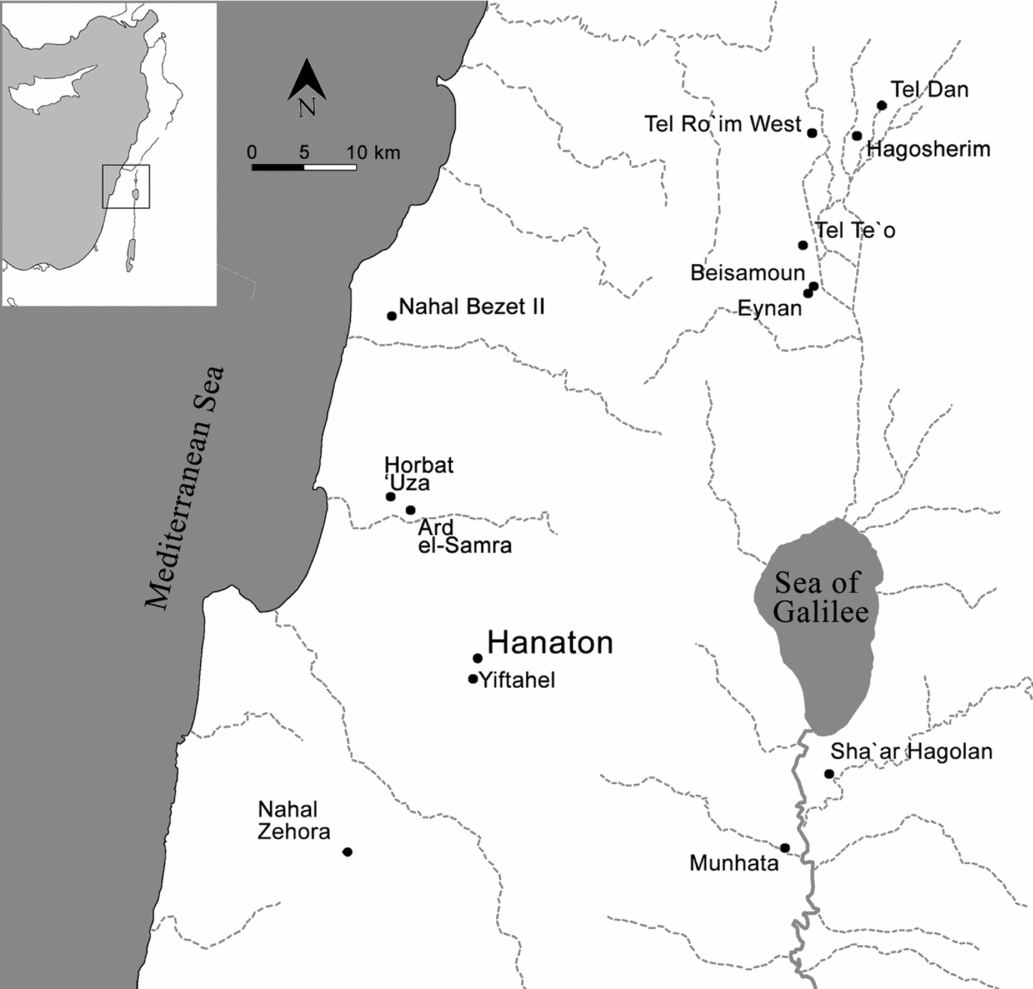
The site of Hanaton (south) is located in the Lower Galilee, Near Kibbutz Hanaton, some 1.4 km north of the site of Yiftahel and 1.8 km southwest of Tell Hanaton (Fig. 1). It is positioned on the eastern slope of a chalk hill, overlooking a small alluvial plain.
Map showing the geographical location of the site of Hanaton (south).

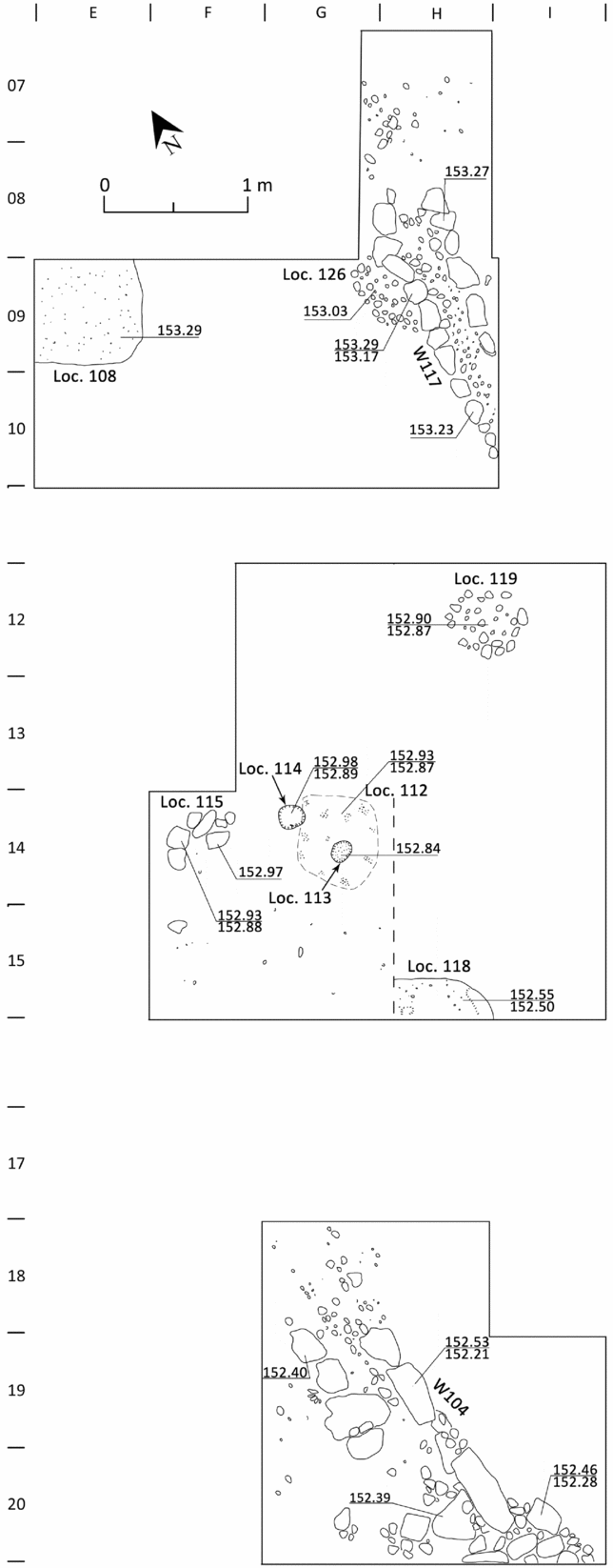
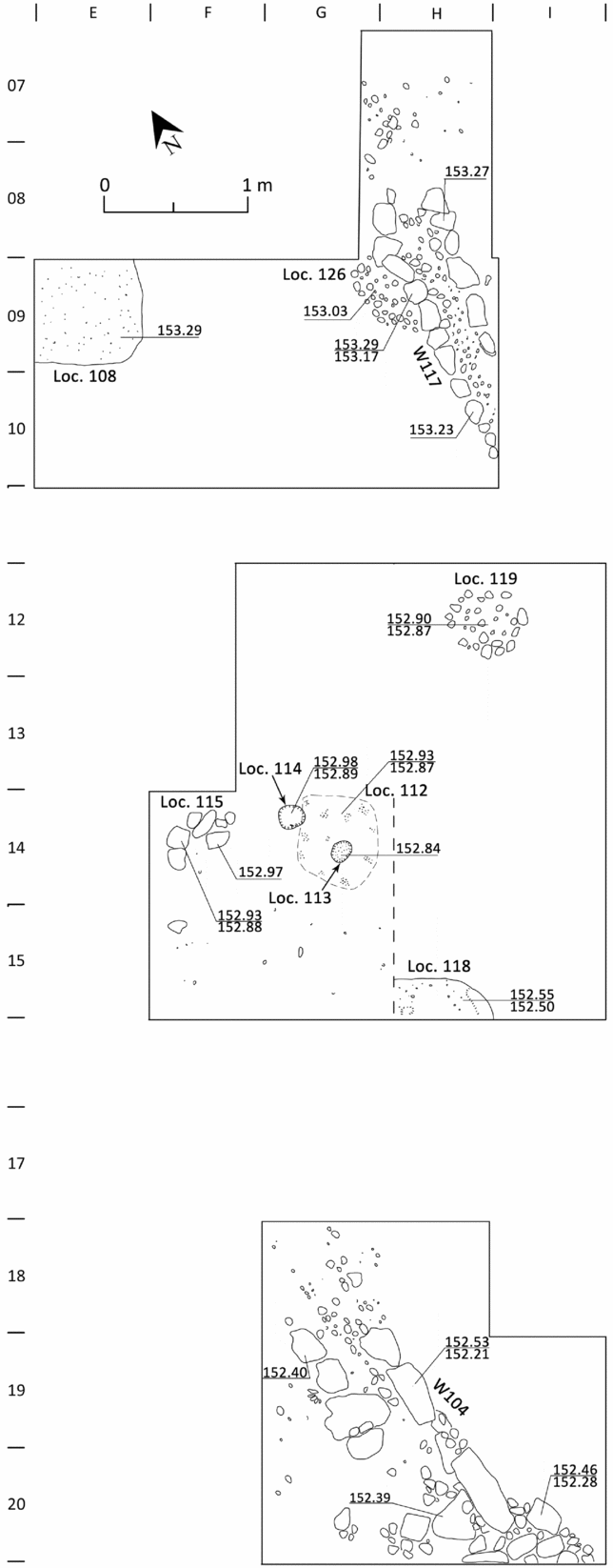
In the main excavation area (Area A), three successive strata were defined: Stratum III, attributed to the Late Pre-Pottery Neolithic B (mid eighth–mid seventh millennia bc), and strata II and I assigned to the Wadi Rabah Culture (mid sixth–early fifth millennia bc) of the Pottery Neolithic, although some scholars prefer to regard this cultural horizon as belonging to the Early Chalcolithic Period (for more details, see Nativ et al. Reference Nativ, Shimelmitz, Agha, Ktalav and Rosenberg2014).Footnote 1 Only the two later strata are of interest to us here. Stratum II consists of a variety of features, surfaces and installations (Fig. 2). These include two stone wall foundations (W104, W117), roughly oriented north–south, three patched beaten earth surfaces mixed with crushed chalk (Loc. 108, 112, 118), stone built installations (Loc. 115, 119, 126), a small mud-plastered depression (Loc. 113) and a small depression filled with greyish-orange sediment (Loc. 114).
Plan of Stratum II, Hanaton (south).
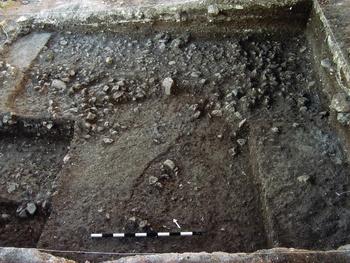
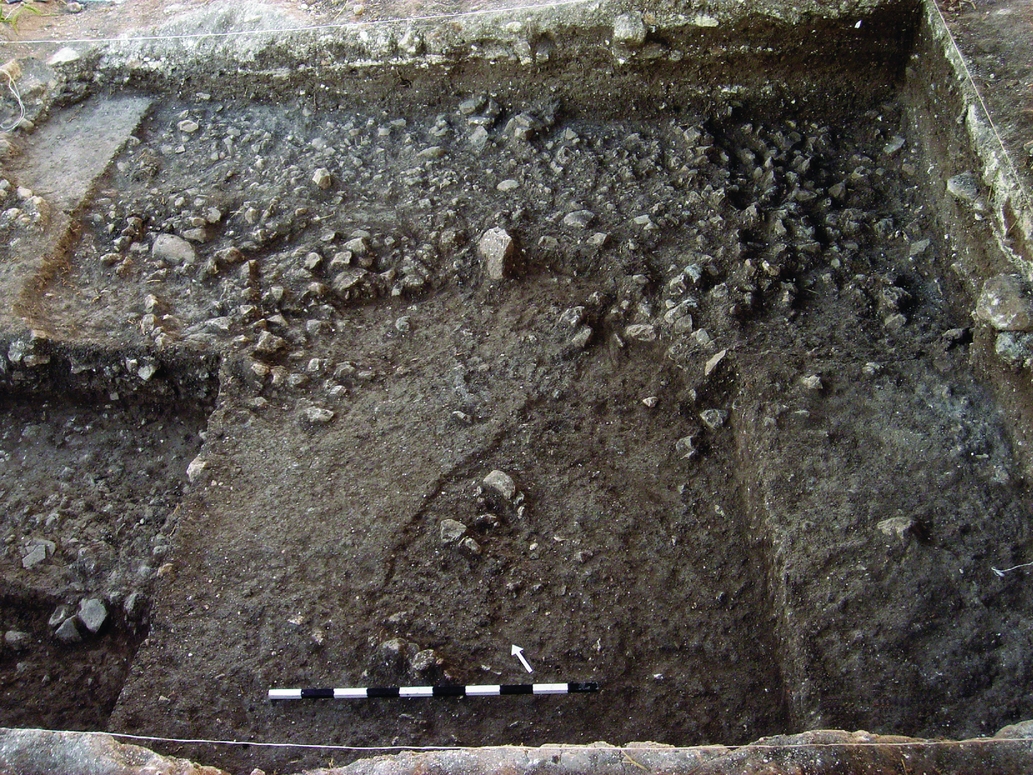
Stratum I is marked by a sequence of stone surfaces that were limited to the northeastern part of the area (Fig. 3). They vary in density and breadth, and feature considerable vertical proximity. According to the sections at least three stone surfaces succeeded each other, promoting a tripartite subdivision of Stratum I, labelled I a–c. In the immediate vicinity of these surfaces, but never on them, a number of features were discerned: stone installations, a pit, a hearth and a concentration of ground stone tools and ceramic base fragments that may be the remains of a well-defined ‘activity area’.
One of the stone surfaces of Hanaton (south), Str. I.
Introducing the assemblages
Some 300 rim fragments that allow an appreciation of vessel morphology were retrieved from these contexts. They were split into three groups according to their stratigraphic provenance, designated lower, middle and upper. The lower assemblage is attributed to Stratum II and consists of 107 specimens; the middle assemblage is attributed to the lower part of Stratum I (Stratum Ic and intermediary Ic–b contexts), consisting of 78 specimens; and the upper assemblage is attributed to the upper part of Stratum I (strata Ib and Ia contexts), consisting of 113 specimens.
Not to be confused with the more sophisticated assemblage theory (DeLanda Reference DeLanda2006; Fowler Reference Fowler2017; Hamilakis & Jones Reference Hamilakis and Jones2017), the assemblages evoked in this paper are of the conventional kind: collections of associated artefacts, constituted along depositional and typological lines (Clarke Reference Clarke1968, 245; Lucas Reference Lucas2012, 193–5). Importantly, these assemblages are fixed and unchanging. This is not because of some remarkable quality that situates them beyond history, but because they are constructed that way, like most forms of archaeological documentation (see Nativ in press). It is only on account of this durability of archaeological constructs that scholars have recourse to anything at all. Under these conditions whatever is said about them or on their behalf can be checked and re-examined. Indeed, had they not been made durable it is questionable if classification was possible at all.
As constructs, these assemblages are not given, but produced—or assembled—through scholarly procedures. This does not mean that the resulting assemblages are not real. It only means that they are reworked; and it is because of these re-workings that we can analyse, discuss and debate them. As Latour (Reference Latour2000; Reference Latour2005, 88–93) notes repeatedly, the issue is not whether an object of enquiry is constructed, but whether it is constructed well. And from a scholarly point of view, this largely depends on the chain of references maintained across the various transformations. Ultimately the chain is only as strong as its weakest link (Latour Reference Latour2013, chapter 3; see also Hacking Reference Hacking1999).
Having said this, my concern here is not with the quality of the transformations that culminated in a particular assemblage, but with the transformation that follows: the account—typological or other—produced for this assemblage. What does it consist of? How is it structured? Indeed, to determine how an object emerged is not the same as to determine what it is. And it is the latter that concerns us here.
Returning to the three assemblages of the case study, it is notable that there is nothing remarkable about them. They are readily assigned to the Wadi Rabah cultural horizon, fitting quite comfortably in the established chrono-stratigraphic sequence of the southern Levant, and finding parallels with other sites in the vicinity: Munhata, Stratum 2a (Garfinkel Reference Garfinkel1992); Tel Asawir, Stratum VI (Yannai Reference Yannai2006); Horbat ‘Uza, strata 18–17 (Getzov et al. Reference Getzov, Lieberman-Wander, Howard and Syon2009); Nahal Betzet I (Gopher et al. Reference Gopher, Sadeh and Goren1992); and Nahal Zehora II, stratum II (Gopher & Eyal Reference Gopher, Eyal and Gopher2012). This is particularly pertinent for the assemblage of Stratum II, while that of Stratum I hints towards a slightly later horizon, somewhat comparable to assemblages of Nahal Zehora I (Gopher Reference Gopher2012) and Horbat ‘Uza 17–16 (Getzov et al. Reference Getzov, Lieberman-Wander, Howard and Syon2009).
Thus, the objects of analysis and the challenges they present are fairly typical, hardly any different from those encountered with other contemporary Neolithic ceramic assemblages of the southern Levant, and many other contexts for that matter. As such, they offer a point of departure very similar to that of other analyses, providing a common base upon which a comparison can later draw.
Typological impasse
Having constituted the assemblages, they now need to be articulated; and the standard procedure is typological, sorting the various specimens into types, thus determining composition and offering grounds for comparison. After some deliberation, several dozen types were defined (curved bowl, sinuous bowl, carinated bowl, bow-rim jar, flaring-neck jar, globular holemouth, straight-walled holemouth, churn, and so forth). The problems that followed are surely familiar: the distinction among types proved to be fluid (Fig. 4)Footnote 2 and many specimens are equally attributable to two or more designations. Thus, unless significant concessions are made (in favour of typological order), this mode of classification collapses in face of the objects it is meant to describe.
An illustration of a continuous sequence of morphological variation.

Typology, it seems, leads to an impasse. We can either leave the assemblage standing as a single opaque and inarticulate object, or we may break it down to its individual components. Either way we end up treading water. In the former case we are left with an assemblage that cannot be differentiated; in the latter case we produce an account as useless as a map of an empire at the scale of the empire, to borrow from Borges. If we are to move forward, our mode of articulation will need to be revised.
In order to bring about such a revision it is important to recognize that, notwithstanding the frustrations involved, the failures of typology serve to demonstrate real aspects of the assemblages at hand, and our analysis must be accommodated accordingly. Thus, firstly, given the difficulties of inferring a complete vessel from a fragment, analysis will drop all aspirations to reconstruct a system of whole vessels and limit itself to the articulation of the body of finds proper. The collection of rims is that which is in question, not so much a system they are supposed to have derived from. And secondly, acknowledging that the assemblages are poorly differentiated, morphologically continuous bodies, analysis will abandon the effort to conceptualize them as cohorts of specifiable forms and will accept their morphological fluidity as its point of departure.
Types: delegates of articulation
We may begin by noting that poor differentiation need not mean uniformity. After all, even dust clouds have areas of greater and lesser density. Similarly, although consisting of a morphologically continuous space, some portions of the assemblage are quantitatively more pronounced than others. That is, some shapes are more common than others. Thus, while distinctions are not afforded on morphological grounds, quantitative variation has the effect of setting certain portions of the assemblage in relief, which in turn allows them to be indicated, defined and labelled. Being distinguished in this way, we may designate these accentuated portions of the assemblage as types.
This, however, applies only to a portion of the specimens, many of which remain indeterminate and nameless, immersed in the continuous and poorly differentiated morphological space. A type in this regard is not only a morphological category, it is also a focal point, towards which the assemblage as a whole may be said to be inclined (and disinclined: see below); for types in the sense evoked here are not self-sufficient and they do not precede the assemblage. Rather it is the assemblage, as collective, that distinguishes them and constitutes them.
Types are, in this respect, the articulated representatives of an otherwise inarticulate phenomenon. They are like spokespersons for a collective that lacks the means to speak for itself. Like elected members of parliament, the assemblages’ types are not the same as the assemblages themselves. Rather, they are representatives that offer an ‘authorized’ articulation of the totality, but one that is nevertheless mediated and transformed. Articulation here is the transfer of the phenomenon at hand—the assemblage—across the threshold of symbolic-like expression. The gap between the assemblage and its delegates is inevitable and one we will have to consider more closely further on. For now, however, let us get acquainted with the delegates of each of the three assemblages.
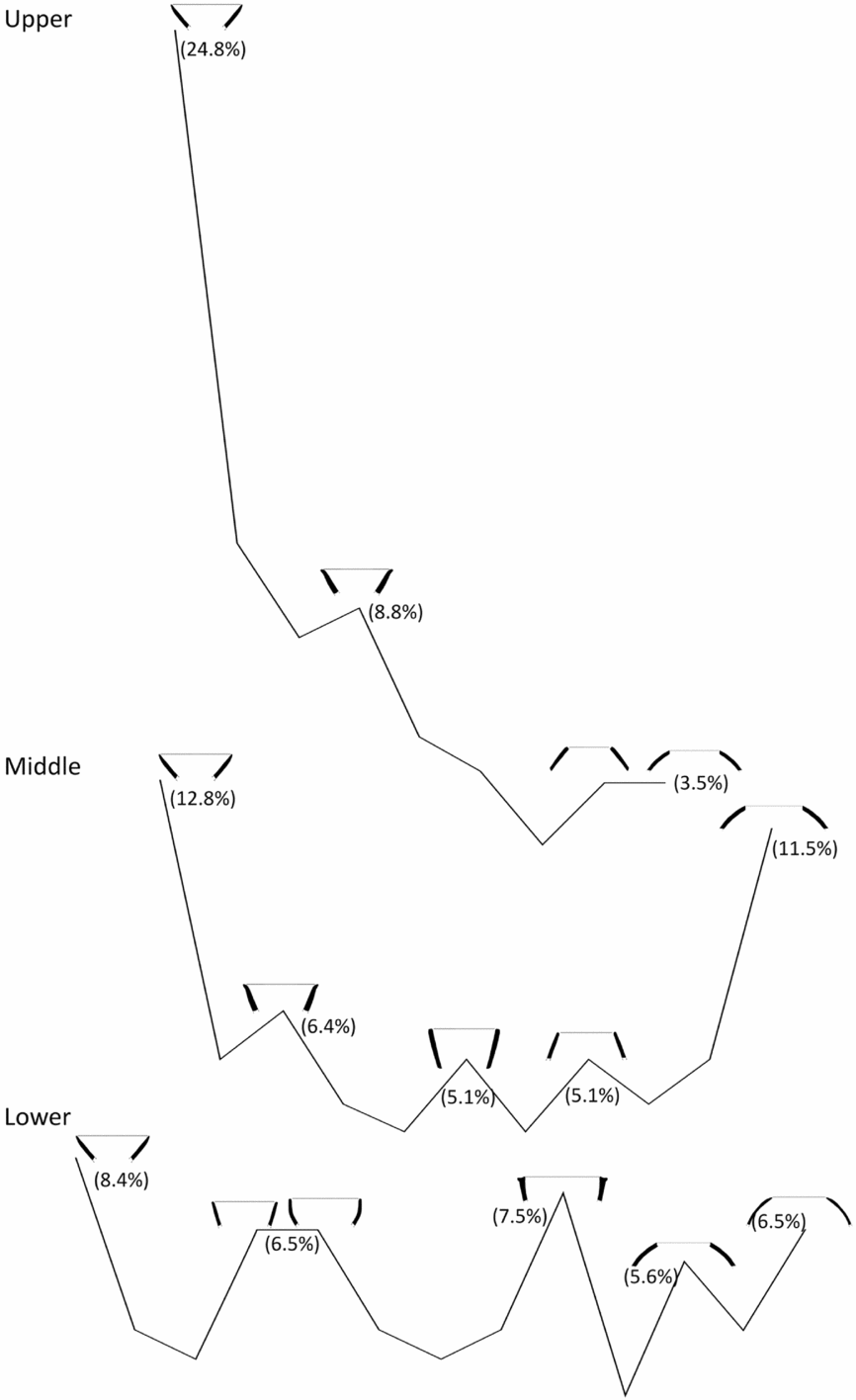
Figure 5 offers a graphic adaptation of the quantitative patterns, a cross-section of sorts through the assemblages. The horizontal axis represents a continuous morphological range, while the vertical marks the quantitative distinction. It is immediately apparent that each assemblage appoints different delegates of articulation and that the types differ among themselves in distinction. The lower assemblageFootnote 3 distinguishes five types of fairly similar weight:Footnote 4 (1) straight-sided bowl, (2) bowl with straight-to-curved wall and round rim, (3) robust krater, (4) robust holemouth, and (5) delicate holemouth jar. Somewhat differently, the middle assemblage constitutes two principal types—(1) straight-sided bowl and (2) robust holemouth—alongside which three lesser types are noted: (3) flaring-walled bowl, (4) deep bowl and (5) straight-sided holemouth. Lastly, the upper assemblage designates three types, each marked with remarkably different quantitative emphases. The straight-sided bowl is clearly the most dominant; it is followed far behind by the flaring-walled bowl and the curved-to-straight walled holemouth in the lower margins.
A schematic ‘cross-section’ through the assemblages, illustrating quantitative variations of emphasis across the morphological continuum. Lower assemblage, bottom, n=107; middle assemblage, middle, n=78; upper assemblage, top, n=113.

Thus, each assemblage constitutes its ‘delegates’—its representative forms—and decides their relative prominence. In every assemblage the particular combination of articulated types is different; and in every assemblage the distribution of emphases is different. They draw on distinct terms and they do so differentially. Every assemblage, therefore, provides another account of its character and identity.
Structure, logic
Not unlike an elected parliament of representatives that constitutes an account of the wider public, so the types provide an account for the assemblage as a whole (note that this need not imply that the account is accurate, true, or correct). How is this account to be articulated? As representatives of a larger totality, we may expect the various types to accommodate each other so as to produce a more-or-less coherent rendition of what this totality is. Ideally, the distinctions among types would prove to be complementary so that in conjunction they produce an orderly whole. The exemplary model for this is the binary opposition, which consists of mutually exclusive terms that together denote a totality (e.g. nature:culture, sacred:profane, above:below; for a concise review, see O'Sullivan et al. Reference O'Sullivan, Hartley, Saunders, Montgomery and Fiske1994, 30–33). Such an account is both economic and elegant; it seeks to discover organizing principles that explain in one move both the individual components and the overall architecture.
In this vein, the present analysis commences by distinguishing pairs of types that are morphologically opposed (e.g. open form versus closed form, flaring wall versus in-curving wall) and therefore complement each other. In this manner, a higher integrative order is allowed to emerge, predicated on specifiable principles. As will become apparent, however, the resulting patterns are not as clean and tidy as those of the structuralist ideal. While some of the constituted types do articulate an integrative order and suggest organizing structural principles, there are always also others that are incommensurable with them. This will be made clear in the analyses below.
The lower assemblage
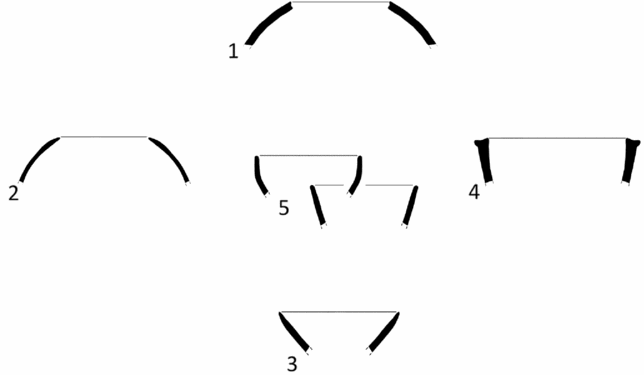
The lower assemblage constitutes five types similarly prominent. Among these, two pairs are readily discernible (Fig. 6). One pair consists of a robust holemouth (Fig. 6.1) on one side, and a straight walled bowl (Fig. 6.3), on the other; the second pair consists of a delicate holemouth (Fig. 6.2) on one side, and a krater (Fig. 6.4) on the other. In both pairs the differences between the types are significant: while on one side of each pair there is a vessel with an open profile, on the other side is a vessel with a closed profile; on one side the vessel's wall is curved, on the other it is straight; and on one side the rim is pointed, on the other it is guttered. Thus, each pair constitutes a diametric opposition, where each term is a complementary counterpart for the other.
Lower assemblage structure. (1) Robust holemouth with gutter rim; (2) Delicate holemouth with pointed rim; (3) Open straight-walled bowl; (4) Krater; (5) Curved-to-straight-walled bowl with round rim.

Moreover, the same can be said about the relations between the pairs themselves. While in one pair a pointed rim is associated with an open profile and a straight wall, in the other pair it is associated with a closed profile and a curved wall; and an equivalent pattern is noted also for the guttered rim: in one pair it is associated with a closed profile and a curved wall, in the other pair it is associated with an open profile and a straight wall. Thus, the oppositions embodied by each pair are themselves oppositions, and one pair is complemented by the other. The assemblage, therefore, consists of an intersection of two independent oppositions that in turn consist of two levels of complementarity, once between the terms that make a pair and once between the pairs. One can summarize the structural logic as follows:
Closed profile+curved wall: Open profile+straight wall
Pointed rim: Guttered rim
A closed profile always has a curved wall, an open profile always has a straight wall, but they can have either a pointed or a guttered rim.
This leaves the fifth type, a bowl with a relatively vertical profile, straight-to-curved walls and a rounded rim (Fig. 6.5).5 This type does not constitute a complementary opposition to any of the other four. Rather, it blurs the distinctions that constitute them. The curved wall is associated here with a relatively open profile, not a closed one; and the rounded rim softens of the sharp pointed rim, leaning a little closer to the more robust guttered rim. As such this type provides an intermediary term, a middle ground that mediates among the four diametric morphological types. But it also challenges the structural order by establishing an ambiguous entity that defies the principles at work.
In short, the lower assemblage constitutes five types of similar weight to account for its character. Four of these complement each other, producing in the process a logical construct of a higher order. The fifth type, however, remains somewhat detached, even rebellious. While it may be viewed as an intermediary that bridges the distance between the other types, it defies the distinctions upon which the discerned order is predicated. Thus, while four of the assemblage's delegates of articulation complement and elaborate on each other, the fifth is defiant.
The middle assemblage
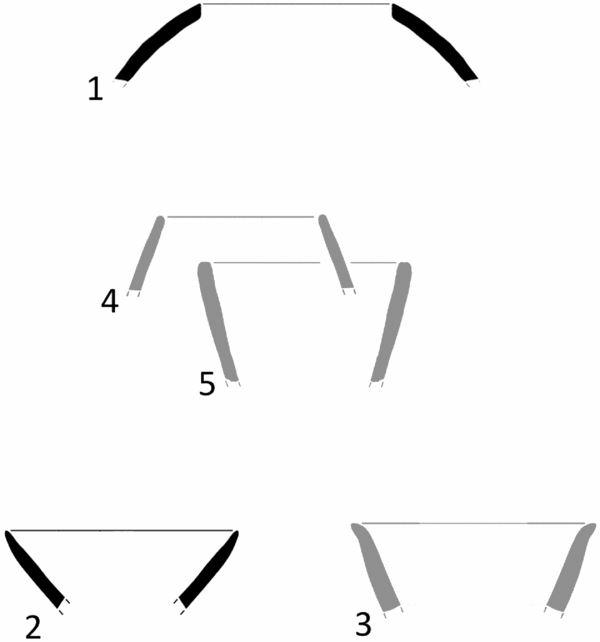
Like the lower, the middle assemblage also constitutes five types. But two of these are more prominent than the others: the straight-sided bowl (Fig. 7.2) and the robust holemouth (Fig. 7.1). In conjunction they produce a binary opposition (pointed rim versus flat rim, straight wall versus curved wall, open profile versus closed profile), articulating a logical order. The remaining three types, however, do not agree or elaborate on it. Rather, they undermine it. Two of these—a cylindrical straight-sided holemouth (Fig. 7.4) and a deep bowl (Fig. 7.5)—occupy intermediary, ambiguous positions that weaken the distinctions of the binary opposition. Most pertinently, one associates a straight wall with a closed profile, instead of an open one; the other associates a flat rim with an open profile, rather than a closed one. Finally, the fifth type—a flaring-walled bowl (Fig. 7.3)—is closely associated with the straight-sided bowl of the binary opposition and is equally removed from its counterpart, the robust holemouth. Here the lesser type in question undermines the structural logic by obscuring the very terms of the opposition: is it the straight-sided wall or the flaring one that is opposed to the holemouth's curved wall?
Thus, alongside the binary logic articulated, the assemblage also constitutes a significant number of dissident types, each questioning it in another way. However, they are all of comparatively little weight, fairly weak incommensurable voices in the background. The oppositional structure consisting of the two prominent terms articulates the assemblage's principal account of its character, while three additional types question the validity of this account.
The upper assemblage
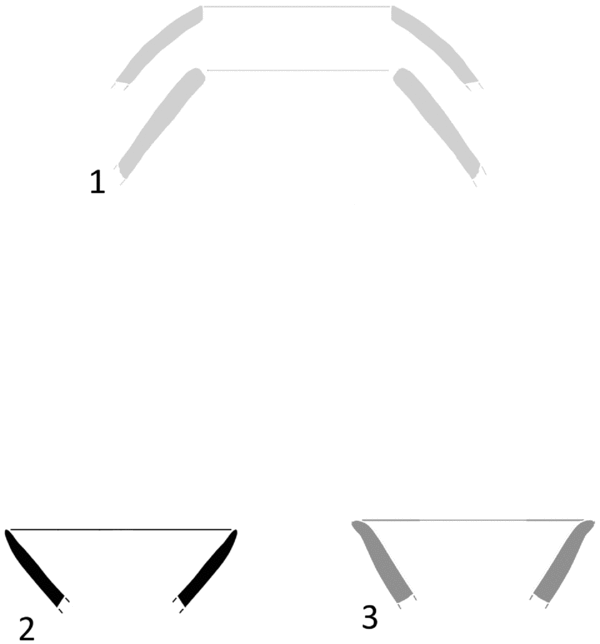
Only three types are constituted by the upper assemblage, each of them differently pronounced. The straight-sided bowl is undoubtedly the most prominent among them (Fig. 8.2), followed by the flaring-walled bowl (Fig. 8.3); and last, barely noticeable, is the robust holemouth (Fig. 8.1). Unlike the other two assemblages, the possibility for complementarity among types is minimal due to the great disparities in quantitative distinction. The straight-sided bowl, it seems, is the assemblage's principal articulation, with a couple of weak alternatives in the background. There is little room here for something more systemic or holistic. At most, the inconspicuous robust holemouth induces a faint echo of a binary opposition against the all too conspicuous straight-sided bowl.
In short, the upper assemblage's articulation is to a considerable extent a rejection of the systemic logical premise of the assemblages. On the one hand, it reduces the assemblage to a single term. On the other hand, it still allows for other ‘voices’; but these produce little more than themselves.
Assemblage articulations
Evidently, there is much disorder and inconsistency in the accounts offered by the assemblages’ delegates of articulation, by their types. Their ability to formulate in conjunction logical premises and organizing principles, upon which the assemblages may be founded, is partial at best. One finds among them elements that undermine or contradict such orderly structures, expressing dissent and discord. The assemblages’ articulation, therefore, does not reveal an underlying order that is simply obscured by random variations, nor does it find logic within chaos. Rather, it finds a field of negotiation, in which the constituted types position themselves in relation to one another in terms of quantitative distinguishability and morphological distinction/complementarity.
Like disparate atoms that combine into molecules on account of a match between their specific properties, so do types produce bonds of complementarity, from which logical order emerges. Yet, some types remain detached. The crystallized logical order is unable to contain all of them, and those that remain unincorporated are a testimony to its limits, its failure to encompass all relevant entities.
The articulation of each of the three assemblages is a particular illustration of this condition. Each has its principal order—a quadruple structure for the lower assemblage, a binary structure for the middle one and a single prominent type for the upper one—and each has its deviances: a single type in the lower assemblage, three marginal types in the middle assemblage, and a faint reference to a binary structure in the upper. In short, the accounts provided by the assemblages’ types are equivocal and inconsistent. They lean towards something specifiable and orderly, but also include elements that defy and challenge this order.
Ambivalence
However confusing and contradictory the articulations provided above may seem, they pertain directly only to a portion of each of the assemblages analysed. To reiterate an earlier observation, the assemblages at hand are principally inarticulate; it is through the constitution of types along quantitative (rather than morphological) lines that distinctions are made possible and the articulation of meaning viable. In other words, the understanding of the assemblages gained is a mitigated understanding; it is delivered by the delegate types. As such, the offered account belongs primarily to them, and only secondarily to the assemblage, the phenomenon they purport to represent. If we are to attempt an understanding of an assemblage in its entirety, we should also expect that the result will be even more complex and confusing.
What, we must now ask, is the nature of the relationship between the assemblage as a whole, the types it constitutes and the articulations these types provide? On the one hand, we are speaking here of a sequence of emergent properties, each predicated on the former, while introducing new principles. Thus, types are an emergent property of the assemblage, introducing morphological distinctions that are otherwise absent; and negotiable structures are an emergent property of the types, introducing logic and controversy where otherwise there is only juxtaposition. It is on account of this that each emergent phenomenon enjoys a degree of autonomy, operating according to principles of its own (cf. Polanyi Reference Polanyi1966).
Yet, on the other hand, all properties and all principles at work belong, in the final analysis, to the assemblage as a whole, to the morphologically undifferentiated cohort of artefacts from which they derive. While they may achieve an autonomous standing, their ties to their background are never severed. After all, it is the assemblage that constitutes the types, and the types that produce structure and negotiation. Crucially, the specification of types is a function of quantitative prominence that sets them in relief; their distinction is relative. The assemblages discussed do not constitute discrete and absolute categories; rather they stress certain portions that are otherwise nearly indistinguishable.
Importantly, specification by degree, instead of by kind, entails doubt and obscurity. A quantitatively distinguished form differs only little from others in its morphological vicinity; and while the former has been named and articulated, the latter remained indiscriminate and nameless. What possible justification might the assemblage have for specifying one instead of the other? None. It is a matter of chance, coincidence and circumstance. There is no definitive rule or law that dictates either way; the outcome has an irreducible arbitrariness to it. Thus insofar as types are constituted by degree, their standing is by definition questionable.
One could formulate it as a matter of inclination, that an assemblage has a leaning towards certain forms and that the types constituted are an expression of this. But on account of the types’ questionable standing, it is equally valid to say that the assemblage is also inclined away from them. Or, to put it differently, to the same degree that one can view the types of an assemblage as emerging out of the undifferentiated whole, one can also view them as dissolving into it. Either way, the assemblages’ relation to their types is both of constitution and de-constitution, distinction and confusion. An assemblage bolsters its types in that it allows their specification and distinction; it obscures them in that such specifications are morphologically ambiguous and equivocal.
The assemblage's relationship to its types, therefore, is a confused mixture of endorsement and doubt. It is ambivalent. It simultaneously constitutes and undermines them. Thus the autonomy the types enjoy and their ability to function as mediators of articulation is somewhat precarious, consequently throwing much doubt onto the structure they convey. What, then, does this imply for the negotiations, the logic and the controversies among types? Surely, as the upper echelon in this tower of cards, it is weakly founded. It consists of a rational echo that had to be filtered through morphological obscurity and ambivalence.
However, it is also an attempt to rationalize the confusion; to discover order where there is much disarray. It is a statement of sorts that, despite all the forces of dissipation, the assemblage has articulable significance and that the types are not entirely without justification; but one that is, nevertheless, challenged on all levels: controversy at the level of the discourse and ambivalence at the level of the types.
Returning to the question we opened with, how are we to understand the assemblages of Hanaton (south)? They are confused, ambiguous and equivocal phenomena; to understand them, therefore, is to appreciate their confusion and ambiguity. We have seen that each of them articulates different types, distributes its confidences and doubts in different ways and delivers a different discourse. We have also seen that they are all ambivalent and all have unresolved inconsistencies. We need not reiterate the specificities of each case; these were already discussed in sufficient detail. We need only acknowledge that to appreciate what these assemblages are is to recognize how they constitute embodiments of conflicting qualities, how each of them exemplifies confused meaningfulness and ambivalent persuasion.
Multiplicity
The foregoing analysis did not cause the obscurities we started with to disappear and it did not result in more readily manageable assemblages. Rather, it replaced one form of confusion with another, ambiguity (inarticulateness) with ambivalence. Nevertheless, it would be a mistake to view the discussion above as simply recreating the same condition; ambiguity and ambivalence are not the same. Most importantly, ambiguity resides in the relationship between the object and the conceptual structures that are meant to account for it; ambivalence belongs to the object proper. Both entail incompatibilities. But while ambiguity is an incompatibility between the object as a single whole and the symbols that refer to it, ambivalence is between features and qualities of the same object. We find multiplicity within the one. Thus while ambivalence is an acknowledgement of this pluralism inherent to the object, ambiguity is this same pluralism left undifferentiated and unrecognized.
The crux of the foregoing analysis, therefore, lies in its capacity to introduce valid differentiations and to articulate incompatibilities and tensions among them. We have seen, accordingly, that while assemblages are morphologically fluid, they nevertheless constitute distinct types; and that while assemblages tend towards logical order, they are also inclined—in more than one way—to undermine it. Importantly, this multiplicity does not refer to a mysterious mechanism that operates somehow behind the scenes, or below the surface of the observed phenomenon. Nor does it pertain to disparate pre-existing forces that combine into a complex system. The multifaceted assemblage is not reducible to smaller uni-faceted things. Rather, it is a single entity that has various qualities that are not fully commensurate with each other.
Admittedly, this has a strange, even paradoxical, ring to it. But it is not as unfamiliar as it seems. In fact, there are multiple examples for this. Goodman's (Reference Goodman1978) discussion of worldmaking, Harman's (Reference Harman2011) metaphysics of the quadruple object and Latour's (Reference Latour2013) investigation into modes of existence are cases in point. Yet perhaps the most compelling demonstrations are offered by a well-known series of images that depict two different things at once. There is, for example, Rubin's vase-faces figure, the duck-rabbit portrait, the old-young woman portrait, Escher's ascending-descending stairs, and the list goes on. While these fascinating depictions are often discussed in terms of perception, inspired by Gestalt psychology (for a recent review, see Wagemans et al. Reference Wagemans, Elder, Kubovy, Palmer, Peterson, Singh and von der Heydt2012), each of them is nevertheless a single unified image that is simultaneously a depiction of one thing as well as another. Like the assemblages discussed here, they are ambiguous insofar as we insist on a single account and leave their multiplicity undifferentiated; but they are ambivalent if we grant them their multiplicity. Is this part of the image a rabbit's ears or a duck's beak? Both. Is this line a young woman's necklace or an old woman's mouth? Both. These and other components are ambivalent in that they are single specifiable elements, but also two different incompatible things.
Temporality and process
Our engagement with the three assemblages of Hanaton (south) has thus taken us from ambiguity to ambivalence and, finally, to multiplicity. How does this help us in the pursuit of archaeological goals like a better understanding of past conditions and processes? Insofar as these assemblages constitute the empirical link with the past, it may be expected that a better, more detailed and more nuanced understanding of these entities also means improved access to the features and conditions from which they derive. On the other hand, however, this improved understanding of the archaeological assemblages also has the effect of causing the past to retreat farther away, at least the past as we would like to know it; for if archaeological objects are ambiguous, ambivalent and multiple, it follows that the past they present us with will be ambiguous, ambivalent and multiple as well. Rather than achieving sharper lines and clearer views into prehistoric culture, this culture will become less intelligible and less understandable.
Yet the concepts of the past in general and temporality in particular have been greatly problematized (Bailey Reference Bailey1983; Reference Bailey2007; Lucas Reference Lucas2005; Reference Lucas2015; Murray Reference Murray1999), and today few scholars would openly endorse the understanding of the past as a unified autonomous object. In fact, it is questionable whether the past can be distinguished at all. Some scholars, in a vein reminiscent of Hawkes’ (Reference Hawkes1954) ladder of inference, go so far as to say that the past as it was is wholly beyond our reach and that at most we engage in the generation of proximal hypotheses. Olivier (Reference Olivier2011) made a compelling argument that archaeology should not be conceived as a historical discipline, but as a field of scholarship preoccupied with the workings of memory. The archaeological record, he argues, is the memory of the past inscribed in earth and matter. But an event and a memory of this event are not the same thing. The former is forever gone; the latter is repeatedly transformed and distorted. To borrow from Latour, ceramic assemblages and other archaeological objects are not intermediaries, but mediators; they ‘transform, translate, distort, and modify the meaning or the elements they are supposed to carry’ (Latour Reference Latour2005, 39): in our case, past culture, society, experience and what not. At bottom, the account provided by archaeological assemblages, is precisely that: an account of archaeological assemblages.
In this vein, the foregoing analysis should be read as an attempt to elucidate the terms in which the assemblages at hand express themselves; and insofar as they carry reference to past events, how these events are conveyed by them. In this section, I will attempt to trace the account offered by these assemblages for their temporal development. This is nowhere near as ambitious as many other discussions of cultural dynamics in archaeology. It will not argue for the human angle and it will not attempt to reveal the social conditions that operated behind the scenes. In fact, I will not even argue that the dynamic processes articulated really happened, but only that this is what the assemblages express.
In order to begin properly, it is necessary first to clarify how a move to a processual view entails a rearrangement of our conceptual field. Until now the three assemblages were treated as distinct and atemporal. After all, this is how archaeological practice constitutes them (see Nativ in press). Consequently, if we are to shift our discussion to a temporal mode, at least two things must happen. First, we change our object; we are no longer dealing with three distinct assemblages, but with three phases that punctuate the changes undergone by a single assemblage. And second, the phenomenon in question is no longer static, but dynamic. Neither move is self-evident. Crucially, this means we are no longer working towards a better understanding of the archaeological phenomena lying before us. Rather, we are attempting to reveal something else, which is not directly accessible. The assemblages are now signifiers.
That said, let us consider briefly how the observed qualities emerge when considered in diachronic, processual terms. Broadly speaking, the overall trend may be qualified as one of simplification, contraction and possibly even dissipation. The number of types—that is, the quantitatively pronounced and distinguishable forms—decreases from five at the beginning of the sequence to three at the end; the logical rationalization shifts from a quadruple order consisting of two diametric pairs to a simpler binary structure; and by the latest phase the structural order appears to have collapsed, as confidence shifted to rest almost exclusively on a single type.
While the assemblage we find at the end of the sequence is very different from the one at the beginning, it is important to bear in mind that they are disparate realizations of the underlying conditions of ambivalence and multiplicity. At no point along the line were types freed from the poorly differentiated morphological range, from which they were distinguished by degree rather than by kind. And at no point did these types cease to be implicated in relations of distinction and complementarity, on the one hand, and confronted with structural inconsistencies, on the other. While the protagonists and their relationships change, in the process transforming their collective identity, the stage upon which this story unfolds remains stable and persistent.
What is the mechanism through which the protagonists are replaced or removed? Because types are constituted in relative terms, drawn out of a morphologically undifferentiated background, alternatives are always close at hand. It is ultimately a matter of increasing or decreasing emphasis, or shifting it from one form to another. The types that enter and exit the stage do not emerge and disappear; they just gain or lose their quantitative distinction. The assemblage is somewhat like an excited effervescent field that constantly raises some parts and lowers others.
The assemblage thus embodies considerable degree of spontaneity. Yet the line of development observed here is not entirely erratic. While challenged, some structural features have a lasting hold over the assemblage. The diametric pair that consists of a bowl on the one hand and a robust holemouth on the other is a case in point, illustrating the delicate interplay between the structural and typological levels of the assemblage, and between persistence and transformation. On the one hand, the binary opposition persists throughout the sequence. Yet it also transforms in two respects: (1) the morphological traits of the holemouth undergo modifications; and (2) the relative prominence of the terms varies. The transformations of the holemouth side of the opposition consist of a moderation of its originally pronounced rim from guttered to flat (Figs. 6, 7), and subsequently an extension of its morphological range to include both curved and straight-walled profiles (Fig. 8). These changes in form are an expression of gradual drift of the assemblage's quantitative emphasis within the continuous morphological field, as if a curve's peak simply shifts a little along a preexisting axis, like a wave. Interestingly, these transformations seem to have little impact on the structural level, for the holemouth maintained its oppositional position vis à vis the bowl.
Middle assemblage structure; shade indicates difference in quantitative conspicuousness. (1) Robust holemouth with flat rim; (2) Open straight-walled bowl; (3) Flaring-walled bowl; (4) Cylindrical straight-sided holemouth; (5) Deep bowl with flat rim.

Upper assemblage structure; shade indicates difference in quantitative conspicuousness. (1) Curved-to-straight walled robust holemouth; (2) Open straight-walled bowl; (3) Open flaring-walled bowl.

While morphological modifications need not have significant structural implications, a discrepancy of the terms’ relative prominence does, for the structural efficacy of a diametric pair depends on the two sides’ ability to maintain a balance between them. In the case at hand, such a balance was achieved and maintained throughout the first two phases. But by the end of the sequence this balance broke down, when the bowls’ quantitative prominence doubled and that of the holemouths was cut by more than half. Thus, while morphologically still oppositional and complementary, the quantitative discrepancy renders the logical structure unstable. Importantly, while this marks the crossing of an important threshold, with significant implications for the assemblage as a whole, it was ultimately instigated by a minor nudge in the assemblage's ambivalence towards its types. Both sides of the opposition were open to question and doubt; and it just so happened that one attained greater support, while the other retreated. It is quite striking to observe just how delicate and vulnerable the assemblage's structure is. It does not take much to bring about its collapse. And yet it persists. This is quite remarkable, underscoring the importance of the assemblage's logical rationalization.
This is roughly the account provided by the assemblage for its development along the temporal axis. It is a story of an ambiguous, ambivalent and multiple phenomenon that has order, but also doubts and transforms it. Somewhat like the shifting images in a kaleidoscope, there is always some order to be noted. But this order rests on shaky grounds, emerging from a poorly differentiated field that consists of numerous autonomous elements. As their relations are negotiated and transformed, so does the order that emerges from them.
Discussion
This paper presented an experiment. If an assemblage does not agree with the segmented structure of typologies, what alternatives are there? Is it possible to produce a clear account of an assemblage that is ambiguous and inarticulate? What might such an account look like? Pursuing these questions, the paper moved from ambiguity to ambivalence, and eventually to multiplicity; each an elaboration of the former. Thus ambiguity is a consequence of ambivalence, a form of indecision; and ambivalence is a function of multiplicity, holding on to alternatives, even if only in the form of a thesis and its negation.
Given the constant search for better ways in which to discover and understand the human past, some readers may find this discussion excessively technical. What is the point in all this drivel, if it does not move beyond the dry bones of the ceramic sherds? The point is that too often the pursuit of the cultural past justifies glossing over empirical ambiguities and difficulties. The insistence on applying typological classification to the three assemblages discussed here is a case in point. On the one hand, typology has many merits: readily quantifiable, easily presentable, conducive to functional interpretations, and well designed for comparative purposes. In many respects it is tailored to serve the archaeological agenda and its preoccupation with the past. On the other hand, it draws and stresses qualities the assemblages they are supposed to account for do not possess. Or bluntly said, they purport a false account. Thus, with all due respect to the past conditions from which the assemblages derive, it is no less significant and challenging to produce an account that is faithful to the assemblages at hand.
It is ironic that archaeology as an academic discipline is less responsive to the empirical confusions it regularly encounters than it is to abstract promises of an absent prehistoric reality (cf. LaCapra Reference LaCapra1999; Nativ Reference Nativ2017). In this vein, the paper attempts to resist constituting the past as principal aspiration and goal, putting more emphasis on accommodating empirical challenges and resistances. It may be that the general tendency to gloss over such matters embodies a tacit decision to dodge a direct engagement with the peculiarities of archaeological phenomena, strongly suggesting that there is a great deal that we fail to understand and appreciate about them. If one finds the ambivalence and multiplicity of the three ceramic assemblages strange and interesting, one only needs to imagine what this might mean for other archaeological phenomena.
Having offered this justification for a concern in ceramic assemblages proper, regardless of what they may or may not signify, it is appropriate to ask how the analysis outlined in the paper is to be positioned in the broader scholarly discourse. We may note that the foregoing discussion converges at various points and levels with numerous other lines of thought: from dissipative systems (Harvey & Reed Reference Harvey and Reed1994) to assemblage theories (DeLanda Reference DeLanda2006), from fuzzy sets (Hermon et al. Reference Hermon, Niccolucci, Alhaique, Iovino, Leonini, Fischer-Ausserer, Börner, Goriany and Karlhuber-Vöckl2004; Niccolucci & Hermon Reference Niccolucci and Hermon2002) to object-oriented ontologies (Harman Reference Harman2011; Olsen Reference Olsen2010), not to mention the diverse and sometimes contradictory discussions on typology (Krieger Reference Krieger1944; Read Reference Read1974; Sørensen Reference Sørensen1997; Spaulding Reference Spaulding1953; Wylie Reference Wylie2002), Lucas’ detailed treatment of the archaeological record and especially his discussion of archaeological assemblages (Lucas Reference Lucas2012, 193–203) and phenomenology (Lyotard Reference Lyotard1991; Merleau-Ponty Reference Merleau-Ponty1963). However, while this tangled maze of intricate argumentation is undoubtedly relevant and of interest, I think there is something more fundamental at stake. This is the manner in which reduction, classification, pluralism and ambiguity have become closely intertwined and mutually constitutive in the foregoing discussion
The term ‘reduction’ has a troublesome ring to it. It suggests a cutting-down of size and quality, implying a failure to appreciate and register correctly. Yet comprehension and understanding are all about reduction. The world must be made compatible with our fairly limited conceptual and perceptual faculties. Otherwise it is too large (sometimes too small), too complex and too obscure to be grasped (see Polanyi Reference Polanyi1958, 69–82). To fathom a phenomenon, one must distinguish the grain from the chaff, its relevant or significant features from its irrelevant or insignificant ones.
Classification, whether typological or other, is first and foremost a reductive process. It is the indispensable mediator that brings the world (or a part thereof) into our reach, transforming it into something that can be analysed, managed and discussed. The best illustration for this is of a landscape inscribed onto a map; and a map's merits are not limited to questions of accuracy, but also economy: only a fraction of the details are represented and at a scale that is manageable (Latour Reference Latour2013, 74–81; Ziman Reference Ziman2000, 126–32). As such, classification is pre-scientific. It is not only part of the scientific enterprise, it is also a precondition that makes this enterprise possible (Adams & Adams Reference Adams and Adams1991, 39–41; Ziman Reference Ziman2000, 118–26).
This does not mean that anything goes; surely not in scientific settings. Indeed, in these settings the principal challenge of classifications is to achieve reduction without distortion. It is one thing to produce useful categories and concepts; it is another for these to be valid and correct. In the case of the three assemblages analysed above, typology was said to have failed at this. It provided reduction by focusing on matters of morphology, but it amounted to a distortion because it sought a morphologically segmented structure that the assemblages do not possess. Thus limiting one's concern to a given set of traits and features is valid, even necessary. But science is obliged to trace the patterns carefully along these lines.
Recognizing that the emphasis of some features of an object of study over others is inescapable and imperative necessarily makes way for pluralism. The present paper offered an account of three assemblages according to their morphological patterning; were it to have been concerned with other traits—fabric, surface treatment, etc.—or distributed its emphases differently, the assemblages would have come forth as something else. We would thus have several incompatible, but equally valid, accounts of the same assemblage. Or in other words, depending on how we engage with them, we will encounter different and potentially incommensurable assemblages; and insofar as they are equally valid and irreducible to a common base, we must accept this plurality.
This is not a contradiction. As Goodman (Reference Goodman1978, 2) observes, ‘If there is but one world, it embraces a multiplicity of contrasting aspects; if there are many worlds, the collection of them all is one’. Thus, while pursuing different reductions, the one assemblage emerges as many; this pluralism still belongs to the one. This is closely related to the observation that, as an object reveals certain features, it also withdraws others; it always holds something back (cf. Bryant Reference Bryant, Bryant, Srnicek and Harman2011; Harman Reference Harman2011). This, I think, goes a long way to clarify the above claim that ambiguity may at times be a function of undifferentiated multiplicity. It is as if several layers of tracing paper, each bearing a different but equally valid image of the same object, were placed one over the other. The result would be fuzzy and obscure. It is on this ground that I suggest that ambiguity can often be read as an invitation to look closer, to try to peel some layers from the confused image. It is of note, however, that the multiplicity of the assemblages recorded by the analysis above is not so much due to the overlapping of alternative accounts, as it is due to the coexistence of a specifiable trait (types, structure) and its negation (non-types, disorder). This difference, however, I suspect is one of degree, not so much of kind.
I do not want to push these points too far; they embody the temptations of circular reasoning. Nevertheless, it is difficult to deny the strong connections between ambiguity and pluralism, and between pluralism and the reductive nature of knowledge. Whether ambiguity is the starting or ending point of the process makes little difference; either way it need not be a hindrance to valid knowledge, and it is not something to be covered with a veneer of absolute and categorical terminology. While it may be at odds with the aspiration for simple and decisive explanations, it need not exclude clear and lucid articulation. Plurality is a viable answer, making it possible to speak clearly about obscurity.
Acknowledgements
The site of Hanaton (south) was excavated on behalf of the Israel Antiquities Authority (license no. A-6123). Much of the preliminary analyses, upon which the present account is based, was supported by Zinman Institute of Archaeology, University of Haifa. The author extends his gratitude to Danny Rosenberg and Mark Iserlis, for their comments on earlier drafts of the paper; and the contribution of two anonymous reviewers cannot be overstated.