The franciscana, Pontoporia blainvillei (Gervais & d'Orbigny, 1844), is a small dolphin that inhabits shallow coastal and estuarine waters of tropical and temperate regions of the western South Atlantic Ocean (Siciliano et al., Reference Siciliano, Moreno, Silva and Alves2006). Pontoporia blainvillei is discontinuously distributed from Itaúnas (18°25′S 030°42′W), Espírito Santo State, Brazil (Siciliano et al., Reference Siciliano, Di Beneditto and Ramos2002) to Golfo Nuevo (42°35′S 064°48′W), Argentina (Crespo et al., Reference Crespo, Harris and Gonzáles1998). Two gaps in the distribution of this species have been observed: one from Ilha Grande Bay to Macaé, in Rio de Janeiro State and the other one from Barra do Itabapoana to Regência in Espírito Santo State (Azevedo et al., Reference Azevedo, Fragoso, Lailson-Brito and Cunha2002; Bordino et al., Reference Bordino, Siciliano, Bastida and Cremer2002; Siciliano et al., Reference Siciliano, Moreno, Silva and Alves2006) (Figure 1). The franciscana dolphin has been adversely impacted by gill-net fisheries, and it represents the major conservation concern in its entire distribution (Ott et al., Reference Ott, Secchi, Moreno, Danilewicz, Crespo, Bordino, Ramos, Di Beneditto, Bertozzi, Bastida, Zanelatto, Perez and Kinas2002). The annual mortality of franciscana due to by-catch on the Brazilian coast, ranges from 564 to 1889 and recent studies have indicated that the mortality rate of this species is unsustainable (Crespo, 1998; Ott et al., Reference Ott, Secchi, Moreno, Danilewicz, Crespo, Bordino, Ramos, Di Beneditto, Bertozzi, Bastida, Zanelatto, Perez and Kinas2002; Secchi et al., Reference Secchi, Ott and Danilewicz2002; Secchi & Wang, Reference Secchi and Wang2002). This coastal dolphin is classified as Data Deficient by the World Conservation Union (IUCN), but the population from southern Brazil and Uruguay is classified as Vulnerable due to the high risk of extinction in the wild (Secchi & Wang, Reference Secchi and Wang2003). The coastal habitat of P. blainvillei is likely the main factor that makes it more vulnerable to entanglements (Netto & Barbosa, Reference Netto and Barbosa2003). Despite the fact that this dolphin usually inhabits coastal waters as far as 30 nautical miles (n.m.) from the coast and 30 m deep, most of the franciscana dolphins have been sighted as far out as 5 n.m. and at depths of 8–15 m (Pinedo et al., Reference Pinedo, Praderi, Brownell and Perrin1989; Flores et al., Reference Flores, Sousa-Lima and Siqueira2000; Di Beneditto et al., Reference Di Beneditto, Ramos and Lima2001; Moreno et al., Reference Moreno, Martins, Andriolo and Engel2003).
The geographical distribution of franciscanas from Golfo Nuevo, Argentina to Espírito Santo State, Brazil. The map shows the study area from Saquarema (S) to Quissamã (Q), in north-east Rio de Janeiro State. The symbols in the study area refer to the locality where the franciscana dolphins were recovered. ○, dolphins with evidence of entanglements; •, franciscana carcass found in advanced state of decomposition; SP, São Paulo State.

The aim of this work is to present records of P. blainvillei stranded along the north-eastern coast of the Rio de Janeiro State, Brazil. From 1999 to 2007, the marine mammal research group GEMM-Lagos (Grupo de Estudos de Mamíferos Marinhos da Região dos Lagos) has regularly monitored 235 km of coastline from Saquarema (22°55′12″S 042°30′37″W) to Quissamã (22°06′24″S 041°28′20″W) recovering stranded marine mammals, turtles and wrecked seabirds. All dolphins found stranded in that region were fully examined in order to identify the cause of death, which included examination of signals that evidenced fishery interaction. These signals included attached gear, line or net marks, knife cuts, etc. (Geraci & Lounsbury, Reference Geraci and Lounsbury2005; Pugliares et al., Reference Pugliares, Bogomolni, Touhey, Herzig, Harry and Moore2007). Only four franciscanas out of 146 cetaceans were recovered during eight years of the monitoring programme, representing 2.7% of the total number of cetaceans' carcasses found beached.
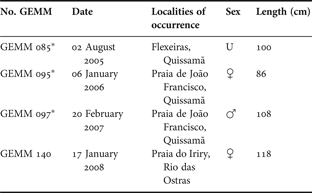
Three franciscana dolphins were found inside the area of the isolated population located on the north-east coast of Rio de Janeiro State, between the two gaps (Figure 1). These three dolphins presented net marks in different regions of their bodies, but principally in the extremities, such as in the beaks, flukes and peduncle, showing clear evidence of entanglement. Surprisingly, GEMM 140 was found in the locality of Praia do Iriry (22°51′S 041°91′W), Rio das Ostras, only 6.5 km south of the previously known limit of distribution between the gaps, i.e. Macaé. This dolphin could not be examined for entanglement evidence because of its advanced state of decomposition (code 3) (Geraci & Lounsbury, Reference Geraci and Lounsbury2005) (Table 1; Figure 1). However, it is possible that this dolphin was captured or had died in the proximity of Macaé and the body was carried by sea currents/winds to the stranded location. Conversely, we cannot discard the hypothesis that this animal moved south and out of the known distribution area in order to search for prey or to engage in other activities and died nearby the stranding location.
Records of franciscana dolphins (Pontoporia blainvillei) found along the north-east coast of Rio de Janeiro State, Brazil, in the period 1999 to 2007.

GEMM, Grupo de Estudos de Mamíferos Marinhos da Região dos Lagos; *, franciscana dolphins that suffered human interaction; U, sex unknown.
Franciscana females from the northern Rio de Janeiro State attain sexual maturity at three years and a total body length of 130 cm, and males at two years and a total body length of 115 cm. Furthermore, the birth length of this species is estimated to be 70 cm (Ramos et al., Reference Ramos, Di Beneditto and Lima2000; Danilewicz et al., Reference Danilewicz, Rosas, Bastida, Marigo, Muelbert, Rodriguez, Lailson-Brito, Ruoppolo, Ramos, Bassoi, Ott, Caon, Rocha, Catão-Dias and Secchi2002). Therefore, the four dolphins presented in this work were immature.
The capture of high numbers of immature dolphins less than three years old is a common trend in several fisheries through franciscana distribution and until now it is not possible to determine the reason of this age bias in the capture (Ott et al., Reference Ott, Secchi, Moreno, Danilewicz, Crespo, Bordino, Ramos, Di Beneditto, Bertozzi, Bastida, Zanelatto, Perez and Kinas2002). However, this tendency could reflect the age structure of local populations or different behaviour of immature animals, which makes them more vulnerable to entanglements (Ott et al., Reference Ott, Secchi, Moreno, Danilewicz, Crespo, Bordino, Ramos, Di Beneditto, Bertozzi, Bastida, Zanelatto, Perez and Kinas2002).
The distribution of franciscana dolphins depends on several factors, like prey distribution, water transparency and presence/absence of predators (Bordino et al., Reference Bordino, Siciliano, Bastida and Cremer2002; Siciliano et al., Reference Siciliano, Di Beneditto and Ramos2002). According to Schmiegelow (Reference Schmiegelow1990) the heterogenic spatial distribution of the franciscana dolphins found stranded in São Paulo and Paraná State could be due to the influence of the coastal current. Santos et al. (Reference Santos, Pacífico and Gonçalves2007) reported an unusual record of P. blainvillei swimming in the inner waters of the Cananéia estuary, São Paulo State, Brazil (24°55′S 047°54′W). According to these authors this dolphin could move to shallower waters during spring and summer, and either move to the inner estuary that is a protected area against potential predators, such as killer whales (Orcinus orca) or for food availability. Bordino et al. (Reference Bordino, Thompson and Iñiguez1999) also observed a similar trend in movements of franciscanas in Bahía Anegada, Argentina.
There is poor evidence of migratory pattern for this species; however, it may conduct seasonal and tidal movements connected with changes in water temperature and movements of prey (Bordino et al., Reference Bordino, Siciliano, Bastida and Cremer2002).
Although the two gaps in the franciscana distribution are well known and supported, the presence of P. blainvillei has been seldom documented in the edges of these areas (this study; Azevedo et al., Reference Azevedo, Fragoso, Lailson-Brito and Cunha2002). These findings indicate that the franciscana is extremely rare or absent in such gaps' edges, thus supporting the hypothesis of the discontinuous distribution (Figure 1).
The reason for these gaps is still unknown, but water transparency, depth and presence of potential predators seem to be some of the influences on this discontinuous distribution (Siciliano, Reference Siciliano2001; Siciliano et al., Reference Siciliano, Di Beneditto and Ramos2002).
In this study, only four franciscana dolphins were collected during eight years of the beach monitoring programme, but this number is probably underestimated. A similar situation was found by Netto & Barbosa (Reference Netto and Barbosa2003) who from 1994 to 2001 failed to find any evidence of P. blainvillei in Espírito Santo State from a monitoring research programme of stranded marine mammals. On the other hand, Moreno et al. (Reference Moreno, Martins, Andriolo and Engel2003) recorded some groups of franciscanas in the southern limit distribution of the northern population during an aerial survey in Espírito Santo State. According to Netto & Di Beneditto (Reference Netto and Di Beneditto2008) franciscana is the most vulnerable species to incidental capture in fishing nets in this region. Di Beneditto (Reference Di Beneditto2003) studied the fishery activities and their impacts in cetaceans on the northern coast of Rio de Janeiro State. According to this author the passive gill-net is estimated to kill incidentally 110 franciscanas annually in this region, which include our study area from Quissamã to Macaé (Figure 1). The small body size of the dolphins associated with oceanographic factors, such as currents and profiles of the beaches could have prevented carcasses of franciscanas from being washed ashore. Therefore, the number of franciscana dolphins stranded does not reflect the real mortality rate or abundance of this species in the study area.
Although one franciscana dolphin was found inside the gap, no other dolphin was found out of this known distribution during the eight years of the monitoring programme. It supports the hypothesis of the discontinuous distribution of this species.
ACKNOWLEDEMENTS
This is a contribution of Projeto de Monitoramento de Aves e Mamíferos Marinhos da Bacia de Campos – ENSP/FIOCRUZ & CENPES/PETROBRAS. The authors are very grateful to the team involved with GEMM-Lagos (Grupo de Estudos de Mamíferos Marinhos da Região dos Lagos) for their help during field work. Thanks to Luiz Antônio Fernandes dos Santos from Secretaria de Agricultura e Meio Ambiente, Prefeitura de Quissamã for the logistical support. J.F. de Moura has a fellowship from Fundação Carlos Chagas Filho de Amparo à Pesquisa do Estado do Rio de Janeiro—FAPERJ (Process no. E-26/151.184/2007). We also thank Ignacio B. Moreno and two other anonymous referees for their critical comments on the manuscript.