Benevento and its region present a unique case in the history of Latin plainsong in that, for nearly two centuries, two melodic and liturgical traditions for the celebration of the Mass and the Office coexisted in some sort of balance.Footnote 1 We are entirely in the dark on the origins of the Beneventan liturgy and its chant, although it is clear from the terminology used here and there in the eleventh century, which referred to Beneventan chant as ‘Ambrosianum cantum’,Footnote 2 and a number of concordances with the Milanese repertory, that it was one of a number of melodic and liturgical dialects of the Italian peninsula and most closely related to the dialect used by the northern Lombard churches, which is not surprising since the area of Benevento had been conquered by the Lombards in the late seventh century. The Roman rite with its Romano-Frankish music, Gregorian chant, probably arrived in the area of Benevento as a foreign element with the brief invasion of the Duchy of Benevento in 786–87 by Charlemagne, but the son of Prince Arichis II, the future Grimoald III, spent a number of years in the Frankish court as his father gave him as hostage to Charlemagne.Footnote 3 Further, Emperor Lothair II, son of Louis the Pious, visited Benevento in the company of Pope Paschal I shortly before his coronation in Rome in 823, and his son Louis II, who became king of Italy in 844 and emperor in 850, spent virtually his entire career in Italy, including expeditions in southern Italy, sometimes as an ally and others as a foe of Prince Adelchis.Footnote 4 Thus between 841 and 871, there was a strong and prestigious Frankish presence in Benevento. At the distance of more than a millennium, it does appear that the Romano-Frankish liturgy and its chant had the prestige of its ‘imperial’ pedigree, and was readily accepted by the Lombards, who nevertheless continued using their own liturgy, at least for certain occasions, well into the eleventh century. The suppression of the Beneventan liturgy in the late eleventh century was largely the work of a series of German popes, culminating with the nefarious papacy of Gregory VII, who enforced what can only be described as cultural genocide upon the Iberian peninsula.Footnote 5 The suppression of Old Beneventan chant did not have as dire a consequence for those in Benevento as it did in Iberia because Beneventan scribes, unlike the Hispanic scribes, had developed a diastematic notation by the middle of the eleventh century, and a good amount of the Beneventan liturgy was copied in books primarily devoted to the Romano-Frankish liturgy, so it survived in transcribable form.
The earliest surviving south Italian sources for Gregorian chant, such as the notated missal Ben 33 and BAV, Vat. lat. 10673,Footnote 6 appear in the late tenth century, and the earliest surviving sources for Beneventan chant probably are no earlier than the second quarter of the eleventh century. This is the case of Ben 38 and 40, Gregorian graduals with Beneventan masses, and the few fragments left of pure Beneventan books, such as the two leaves from a gradual at the end of Ben 35, the palimpsest leaves of MC 361, or the palimpsest leaves of RoV c 9, appear to be roughly contemporary of Ben 38 and 40 or even a little later. The earliest Beneventan source for Gregorian chant, the missal Ben 33, transmits in its liturgy for Holy Week a number of distinct Old Beneventan antiphons.Footnote 7 This not only means that Gregorian and Beneventan chant entered the written tradition in southern Italy at about the same time, and just in the final decades of the survival of Beneventan chant before its suppression, but also that from the ninth to the eleventh centuries both liturgies and both musical traditions survived side by side, almost surely practised and sung by the same people. In these circumstances, the wonder is not that Gregorian elements and organisation filtered into the Beneventan chant, but rather that given the imperial and papal prestige of Gregorian chant the Beneventan repertory retained so much of its own melodic ethos.
A wild card in this process is the matter of Roman chant. The main surviving sources of Roman chant, which are only a few decades younger than Ben 38 and 40,Footnote 8 are witnesses of another melodic tradition and one that could be assumed to have interacted with that of Benevento.Footnote 9 Liturgically, the Roman rite is basically the same north and south of the Alps, and the south Lombard liturgy of Benevento is closer to it than to the north Lombard liturgy of Milan, even though the Ambrosian and Beneventan repertories share a number of pieces.Footnote 10 Still, the music of the Roman books of the eleventh century is very different from that of the Frankish books for the same rite, and whatever common tradition might have stood behind the Roman and the Romano-Frankish melodic traditions in the seventh century, it had evolved differently north and south of the Alps in the course of the eighth and ninth centuries, largely in oral tradition. The transalpine Romano-Frankish chant began to be written down sometime in the ninth century, but the subalpine chant dialects, including the Ambrosian, Roman, Beneventan and the archaic Gregorian or Romano-Frankish chant that had arrived in Benevento in the eighth century, remained in oral tradition until the early or the middle of the eleventh century.Footnote 11
Between 871 and the eleventh century, the Beneventan church was relatively isolated from the Frankish north, but not from Rome itself,Footnote 12 although there are traces of maritime commerce with Aquitaine. Nevertheless, Thomas Kelly has noted that most of the interpenetration of Roman and Beneventan chant that can be traced today is with the Romano-Frankish chant rather than with the Roman chant itself, and in fact with the archaic Gregorian tradition that was in the region since the ninth century, thus emphasizing the relative isolation of the region.Footnote 13 A consequence of this, however, is that it would appear that Beneventan singers managed to keep two separate melodic traditions, Beneventan and archaic Gregorian, with remarkable stability in oral tradition for some two hundred years.
The Gregorian repertory that came to Benevento in the second quarter of the ninth century most likely already had some of the kinds of additions that we now call post-Gregorian, specifically sequentiae, proses and possibly a few ordinary and proper tropes. I see a few symptoms that this was most likely the case. The ‘contamination’ of the Gregorian repertory by the new forms had clearly alarmed a number of traditionalists in the church, and one of the canones extravagantes of the Council of Meaux in 848 condemns a number of practices, specifically what the canon calls ‘those compositions called proses or other such fictions in the Angelic Hymn, that is, “Gloria in excelsis Deo,” or in the sequentiae that are often sung in the solemn alleluia’, which indicates that the practice was probably already widespread.Footnote 14 What the council is condemning is what we today call proses and Gloria tropes, and in this context it is worth noting two things: first, that the sequentiae are counted as part of the ‘pure old uses’, which probably means they preceded tropes and proses by several decades; and second, that the earliest surviving sources for any of these genres, manuscripts and fragments copied c.900, transmit primarily Gloria tropes and proses, although all of these early sources also transmit a few introit and offertory tropes.Footnote 15
One genre not found in these fragments is the partially texted sequentia, but the earliest source for any of them is a late ninth-century addition to the Compiègne antiphoner, which has Fulgens praeclara rutilat, which indicates that these sequentiae also arose in the ninth century.Footnote 16 In another study I have argued that a similar partially texted sequentia, which for lack of a better name I will call Adorabo,Footnote 17 and which was probably composed in Limoges, arrived in Italy, both in Ravenna and in Benevento, in a form that preceded the earliest Aquitanian version that we have, which was copied c.936 in St Martial; the Italian manuscripts transmit a version that had been rendered obsolete with the dedication of the basilica of St Martial in 852, so that the sequentia, as it arrived in Italy, probably dates to the second quarter of the ninth century at the latest. In Ravenna it was copied as a partially texted sequentia, albeit left without music, while in Benevento it was looked upon as a wildly overgrown alleluia with six verses, and was provided with an equally wild set of prosulae and labelled as a prose. In this guise, it mystified virtually all scholars who stumbled upon it in the first three-quarters of the last century.Footnote 18 Once again this indicates that, most likely, tropes and proses arrived in Benevento in the ninth century as part of the ‘Gregorian’ repertory.
The Beneventan repertory of tropes and related genres presents another measure of the archaism of the tradition in terms of the Gregorian repertory. I have just noted that the oldest trope sources north of the Alps transmit proses, prosulas, a few Gloria tropes, a minuscule number of introit and offertory tropes, and isolated examples of Sanctus and communion tropes. The Beneventan Graduals reflect this, albeit with a more substantial repertory. They transmit a large number of proses and prosulas, a good number of Gloria tropes and introit tropes, these last rubricated most of the time as ‘versus de introito’,Footnote 19 a much smaller number of Sanctus and Agnus tropes, but only a single offertory trope, the very early Ab increpatione et ira, and not a single communion trope.Footnote 20 The one repertory absent from the early trope collections but present in the Beneventan Graduals in a substantial number consists of Kyries with verses. Most of the pieces in these repertories are clearly imported. Some of the introit and Gloria tropes probably came to Benevento quite early, and many of them appear in variants unique to the region. The Kyries with verses are perhaps a later import, but again a number of them are present in regional variants. Nonetheless, there are in all categories works that are clearly Italian, originating in Rome, Montecassino and Benevento. John Boe has made a cogent case for a few Glorias originating in Montecassino, and a few of the Kyries originating in Rome, one of the few instances of true Roman imports into the Beneventan liturgy,Footnote 21 but the earliest Roman Kyries, like virtually all the earliest surviving Kyries, are most likely tenth-century pieces if not slightly earlier. This is surely the case of the most popular of southern Kyries, Auctor caelorum deus, which by the early eleventh century had spread to the entire Beneventan area and also to Tuscany.
After this brief survey of the different repertories that coexisted in southern Italy in the tenth and eleventh centuries, we may turn now to the music itself, particularly that of the old Beneventan chant. Kelly described the melodic style of the old Beneventan chant as follows: ‘It has a very standardized set of cadences written and used with extreme regularity; a limited stock of frequently-used turns of phrase; and a tendency, in many cases, to form longer pieces from several repetitions of a single phrase.’Footnote 22 Slightly later he adds, ‘The Beneventan chant, regardless of its liturgical category, proceeds at a uniform, rather elaborate pace, with much stepwise motion and relatively free of dramatic melodic contours.’Footnote 23 This tendency towards stepwise motion is regarded by scholars as a trait of ‘Italian’ chant, a term that includes Beneventan, Old Roman, Ravennatic and Ambrosian chant. Speaking of the Kyrie melodies, John Boe states: ‘Melodies in Italian style usually move by step within a limited range. This range is often confined to a fourth or a fifth and seldom exceeds a sixth. A melodic kernel deriving from anaphoral chant … usually appears at the start.’Footnote 24 In composing what Hesbert has called Romano-Beneventan chant,Footnote 25 that is, new chants for the Gregorian liturgy composed in the tenth and eleventh centuries in Benevento, as well as in composing tropes and proses for this liturgy, Beneventan musicians retained aspects of the Italian melodic style, most notably the tendency to stepwise progression; they abandoned the use of the typical cadences and melodic formulas of Beneventan chant, since they were, after all, writing ‘new music’, but then tended to use the ‘new’ melodic formulas and cadences they came up with in the manner in which the older melodic formulas and cadences were used in Beneventan chant, that is, as blocks of melody that are repeated either literally or with very small variation to build the large structures of the music. In addition, the new chants often proceed, as Kelly notes for the Beneventan chant, at a relatively uniformly elaborate pace. The ‘words’, so to speak, of the old chant, that is, the formulas noted by Kelly and by Matthew Peattie, disappear from the new music, be it Romano-Beneventan pieces or the tropes and proses composed in Benevento, but the general melodic syntax of the chant remains largely the same. It is tempting to speculate that the abandonment of the old formulas might have something to do with the advent of a written tradition, and one that apparently developed early on a relatively accurate diastematy. This speculation is fuelled by something that Kelly and Peattie have observed about the Beneventan chant, which is that many of the formulas and cadences appear in the written tradition consistently at the same pitch (once one can establish the final of a given chant) so that they might have been in and of themselves a factor of modal or pitch stability in the oral tradition.Footnote 26
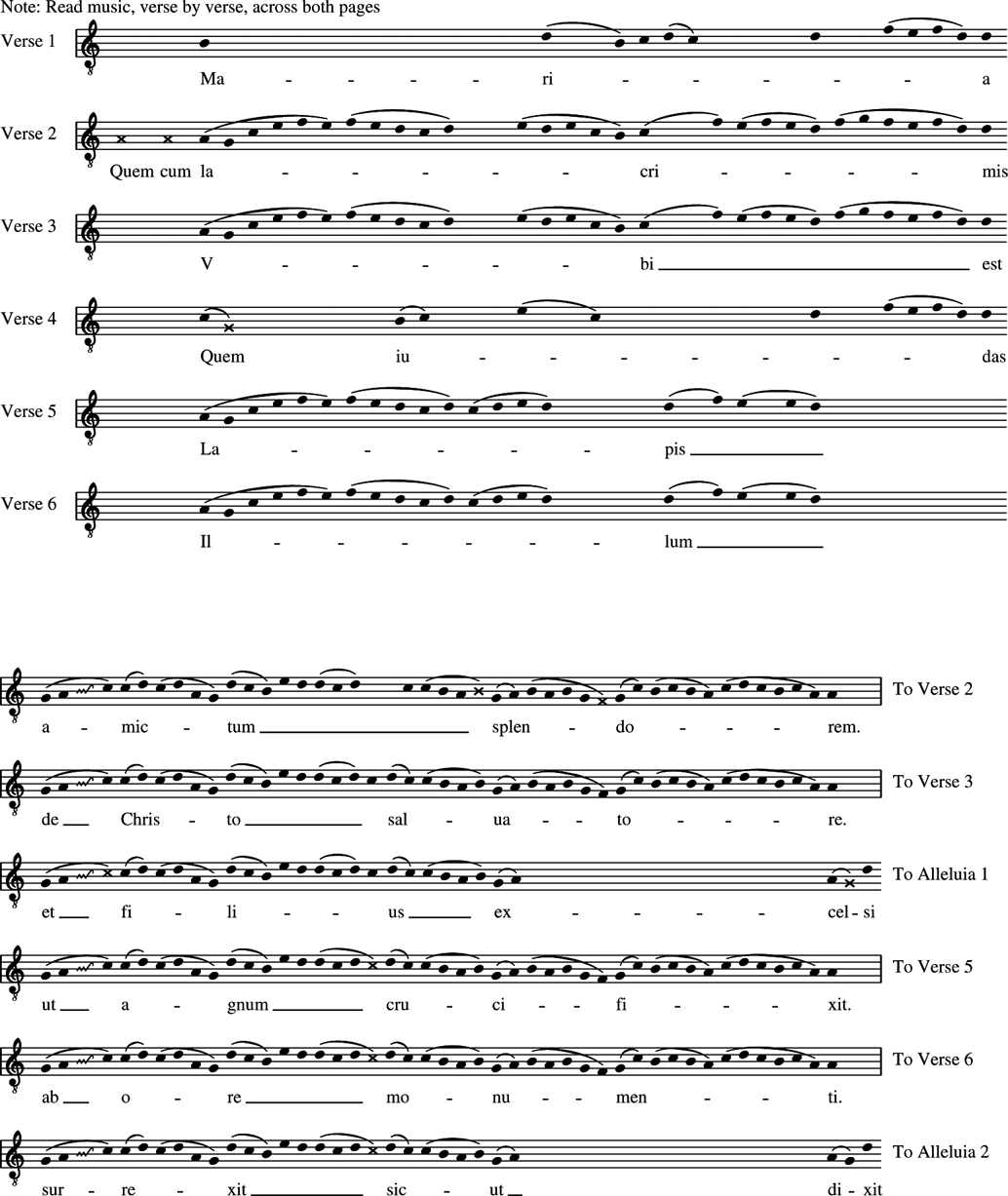
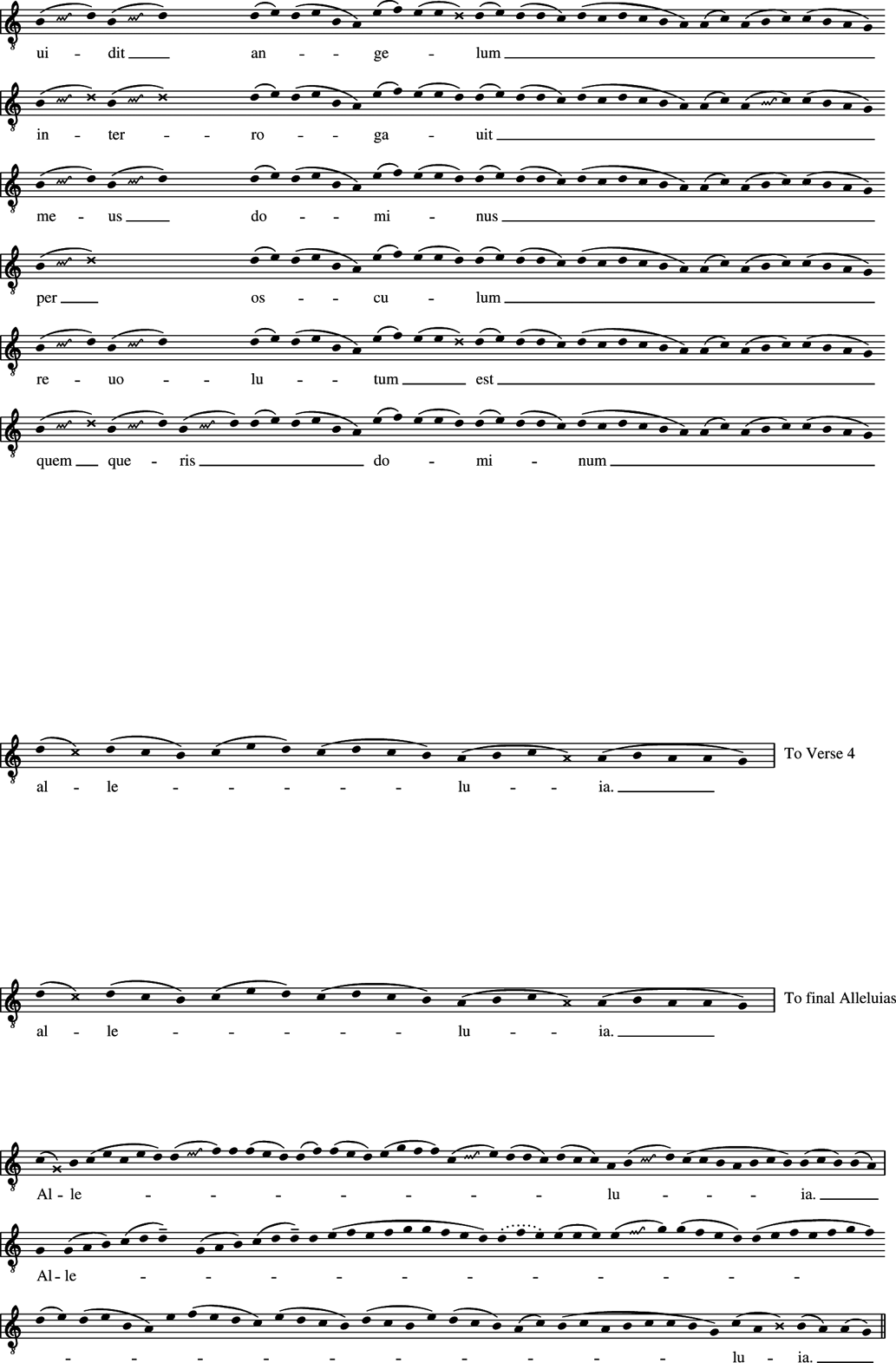
The large-scale rhetoric of the chant, which is the main aspect of the Beneventan tradition that was preserved in the new music of the tenth and eleventh centuries, is most obviously apparent in the ingressa Maria vidit angelum. This is an exceptional piece in that is the longest and most elaborate of the ingressae, and indeed one of the longest and most elaborate chants from the old repertory. It appears as Example 1.
Ingressa Maria vidit angelum (Ben 38, fols. 52v–53r).

Continued
This piece might be one of the oldest surviving monuments of Beneventan chant. The text appears as a processional antiphon with a wide distribution: in northern Francia in the Compiègne Antiphoner, PaN 17436, copied by the main scribe between 860 and 880; in Aquitaine in PaN 776, from St Michel de Gaillac, copied before 1079; in northern Italy in Pst 120, a gradual from Pistoia from the first half of the twelfth century and in a fragment of a slightly earlier gradual bound with it; in a troper from Novalesa, OxD 222, copied at the end of the eleventh century; and from central Italy in a processional from San Domenico in Sora copied in the late eleventh century, BAV, Reg 334. The text was expanded into a Kyrie verse in two late eleventh-century manuscripts, Ben 34 and Ben 39.Footnote 27 The antiphon has no music in Compiègne, but has a different melody in every one of the other sources except for the two Pistoia Graduals that have the same tune, and there is no relationship between the different melodies of the antiphon, the Kyrie melody or the Beneventan ingressa.Footnote 28 The wide distribution of the text and its context in Compiègne suggests a Roman origin that might be as early as the seventh century, since in Compiègne it is part of a preliminary fascicle that includes pieces that can be traced to the Rome of Gregory I.Footnote 29 The melody of the ingressa was also used for the ingressa for the feast of the Twelve Martyr Brothers, whose relics were collected by Prince Arichis II and brought to Santa Sofia in Benevento in 760.Footnote 30 The text of the ingressa for this feast, Sancti videntes stellam, is an imitation of the text of Maria vidit angelum with material derived from the legend of the saints, and every indication is that the Easter ingressa was the model. Since the liturgy for the Twelve Martyrs was surely composed shortly after the translation of their relics to Benevento, it is possible to assume that Maria vidit angelum goes back at least to sometime before 760.
John Boe has shown how the different melodies of the antiphon settings read the text, either as couplets, each ending with ‘alleluia’ in PaN 776, or as three stanzas, as in OxD 222. The ingressa reads it as two stanzas of three lines each, ending with a single alleluia, and then two added alleluias at the end. But in addition, each stanza consists of three repetitions of the same long melody. Lines 1 and 4, the start of each stanza, have an independent opening, leading at ‘Maria’ and ‘quem Iudas’ to one of the most common cadences of Beneventan chant, this time pitched a fourth above its usual place in most of the chants.Footnote 31 What follows is a long melody, beginning with a recitation formula, b c d, that pervades the surviving repertory. The melody is virtually identical all six times, except that lines 3 and 6, which lead to the alleluias, have a shortened ending. All the other lines end with the ‘Maria’ cadence, this time at the pitch most commonly found in the repertory.Footnote 32 Lines 5 and 6 omit the ‘Maria’ cadence, but otherwise are essentially repetitions of the same long melody. The two alleluias at the end of lines 3 and 6 are sung to same melody, and only the final two alleluias, which are ‘detachable’ alleluias, that is, alleluias that one finds added to other ingressae, are melodically different.
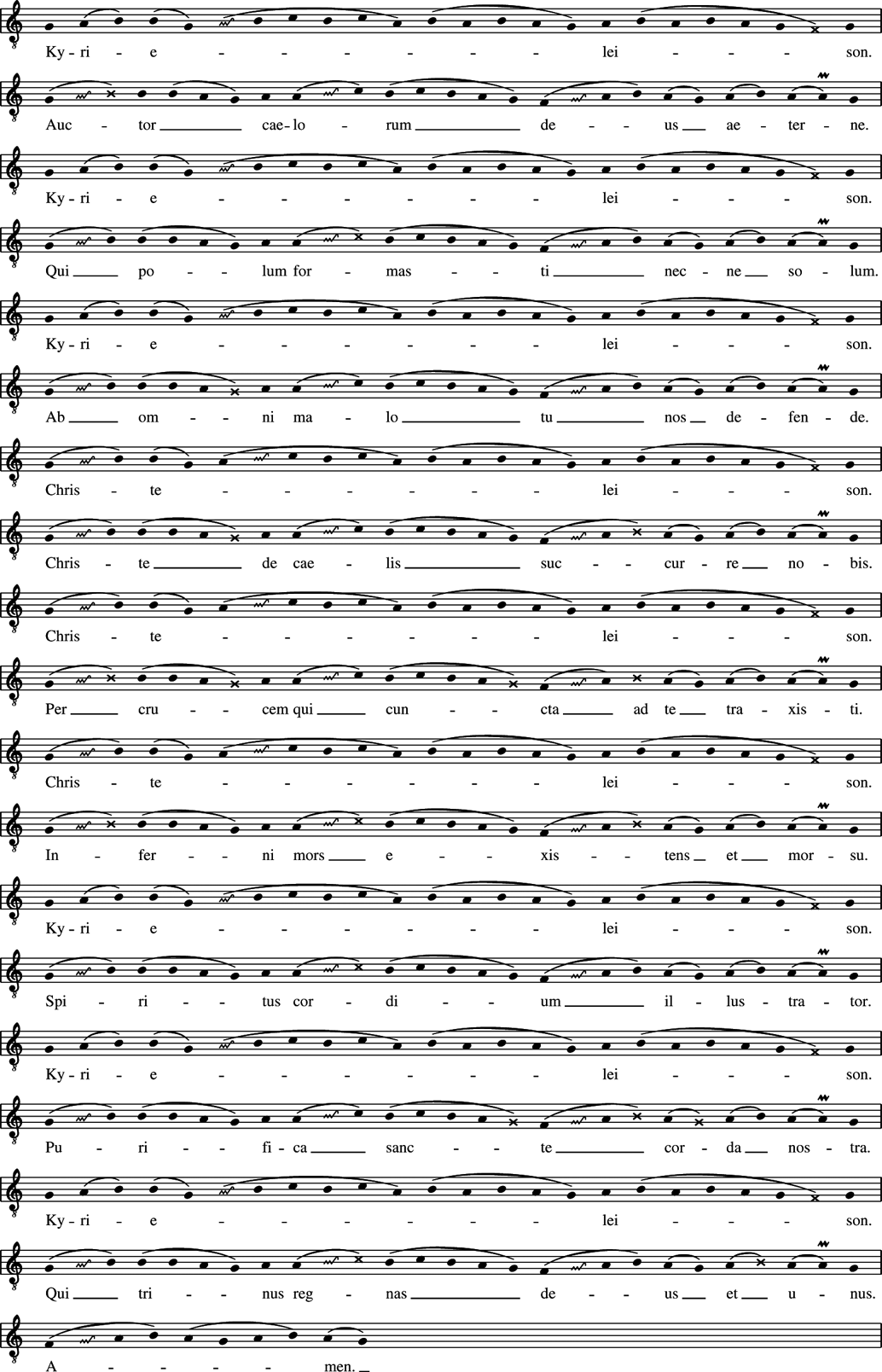
Now let us turn to one example of the new music of the tenth and eleventh centuries, the Kyrie Auctor caelorum deus, which might be originally from MontecassinoFootnote 33 but became the most widely used Kyrie in southern Italy. The common southern form of the piece appears as Example 2.
Kyrie Auctor caelorum deus (Ben 40, fol. 21r–v).
The entire Kyrie consists of an alternation of two related melodies covering the same range of a fifth: one for the verse and another for the melisma. The melodic rhetoric is basically the same as that of the ingressa, although the Kyrie melody is simpler. The melismatic version has one of the few instances where the melodic detail appears to go back to one of the clichés of Beneventan (and Roman) music: in the oscillation b–a that forms the central part of the phrase, although here the oscillation is neither absolutely consistent nor is it notated as a series of pedes or clives, as it is in the older repertories. The relationship between the melody of the invocation and that of the melisma appears to be irrational. A comparison is given in Example 3.
Relationship between melisma and invocation in Auctor caelorum dues.
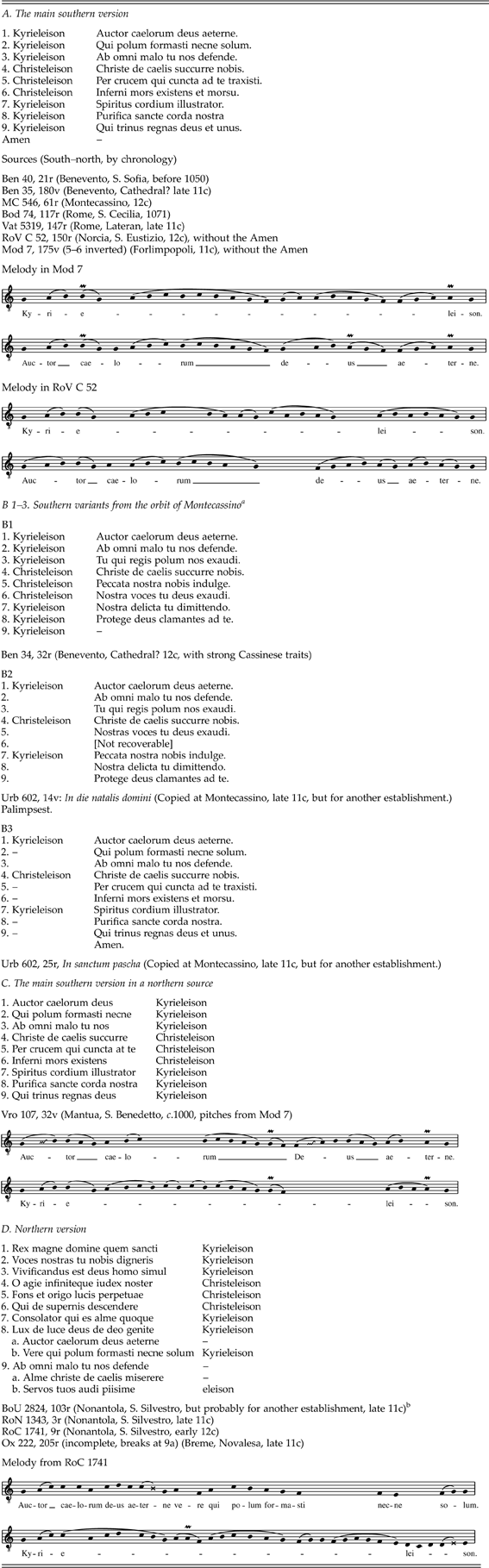
The transmission of the Kyrie is in itself interesting. Although a southern work, it appears not only in manuscripts from Benevento, Montecassino and Rome, but also in a source from San Benedetto near Mantua, another from Forlimpopoli near Ravenna, three from Nonantola and one from Novalesa. Four versions survive: three closely related and one a very different one, given in Table 1.
Kyrie Auctor caelorum dues
Notes
a. But note that MC 546 from Montecassino itself has the main southern version.
b. The end of 9a is missing on account of a lost folio, but 9b had been added at the bottom of the surviving folio.
The melodic tradition of versions A and B in the southern sources is essentially identical. Ben 34 and Urb 602, despite the text differences, have the same melody as Ben 40. Oddly enough, MC 546, at the descent on ‘caelorum’, has a small variant: b–c–b–a a–g, with an oriscus on the second a, which might be behind some of the small inconsistencies at this point in Vro 107, which sometimes adds a note to the descent (see the version in Table 1).
Ironically, it is a northern source, Vro 107, from Mantua, that is the earliest surviving source for the Kyrie, which allows us to date it to the tenth century. Since the melodic behaviour of the piece is entirely foreign to the north Italian repertory, it is clearly an import from the south that had reached Mantua by the turn of the millennium. The northern versions of the Kyrie show its being made into a piece understandable by the northern traditions in different ways. In Vro 107, the text of the verse is closest to the main southern version, but in accordance with northern tradition the melisma has been placed after the verse and the Amen has been eliminated. At the same time, the melisma has been accommodated to the melody of the verse, since in the north the verse was a prosula of the melisma, while in the south the verse and the melisma were related but slightly different melodies. Vro 107 is notated in non-diastematic neumes, but the melody can be reconstructed from the neume shapes and a comparison of the pitches with all the southern sources, which are all diastematic and several have lines and clefs, as well as RoV C 52 and Mod 7, which are diastematic with lines. In these last two manuscripts the position of the melisma and the verse are those found in the south, although the Amen has been eliminated. That is not surprising in that Mod 7 is from Forlimpopoli, 32 kilometres south of Ravenna, and the liturgy of Ravenna retained strong connections to the south and many archaic features, and RoV C 52, from Norcia, was copied in what had been the Lombard Duchy of Spoleto. The irrational relationship between melisma and verse remains more perceptible in RoV C 52, while the version in Mod 7 has been made considerably more regular. In all these northern versions, however, the regular alternation of melody and verse sung to the same A, A' tune characteristic of the south was retained.
The Nonantola version is very different. In this version a variant of the text of verses 1–4 of the main southern version have been inserted as substitutions into the final set of invocations of a late tenth-century Aquitanian Kyrie, Rex magne domine, that had the typical melodic structure of the large-scale Frankish Kyries:Footnote 34 A–B–A C–D–C E–F–E' where E' consists of two repetitions of E plus an extended cadential figure, so that the melodic pattern at the end is a five-phrase structure: E–F–E–E–Cadence. The final of the Kyrie is E, but phrases E and F cadence in G, and it is within this group that the verses of Auctor caelorum deus have been incorporated. The Italian version of Rex magne domine has been ‘Italianised’ so to speak, by removing a number of melodic segments. Taking account small variants, the melodic organisation of the Italian version is: A–A–A C–C–C E'–E'–E' in terms of the melismas, until the last set of invocations, where the texted line follow the shorter E pattern, and the final verse is used as text for the cadential figure.Footnote 35
In a number of ways, the case of Rex magne domine is unusual. The Italians, north, centre and south, adopted a number of Frankish Kyries exactly as they arrived in the peninsula, but for some reason the singers at Nonantola, which is surely the place of origin of this version, decided to turn it into something that sounded more Italian to them, and this apparently involved not only a drastic simplification of the melodic structure of the piece but also removing some of the verses of the final set of invocations and replacing them with the beginning of the most famous and widespread of the south Italian Kyries.
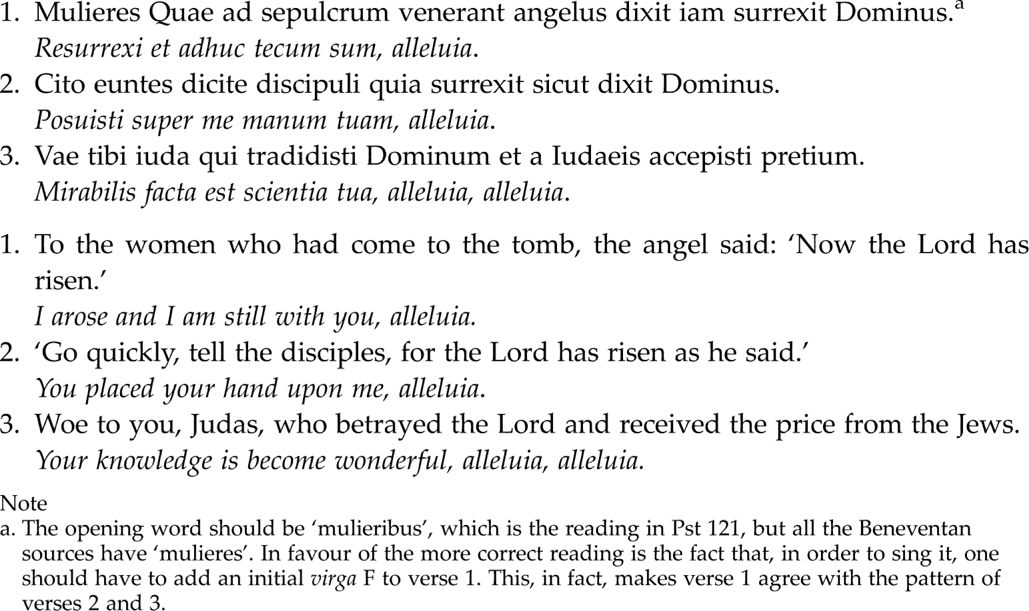
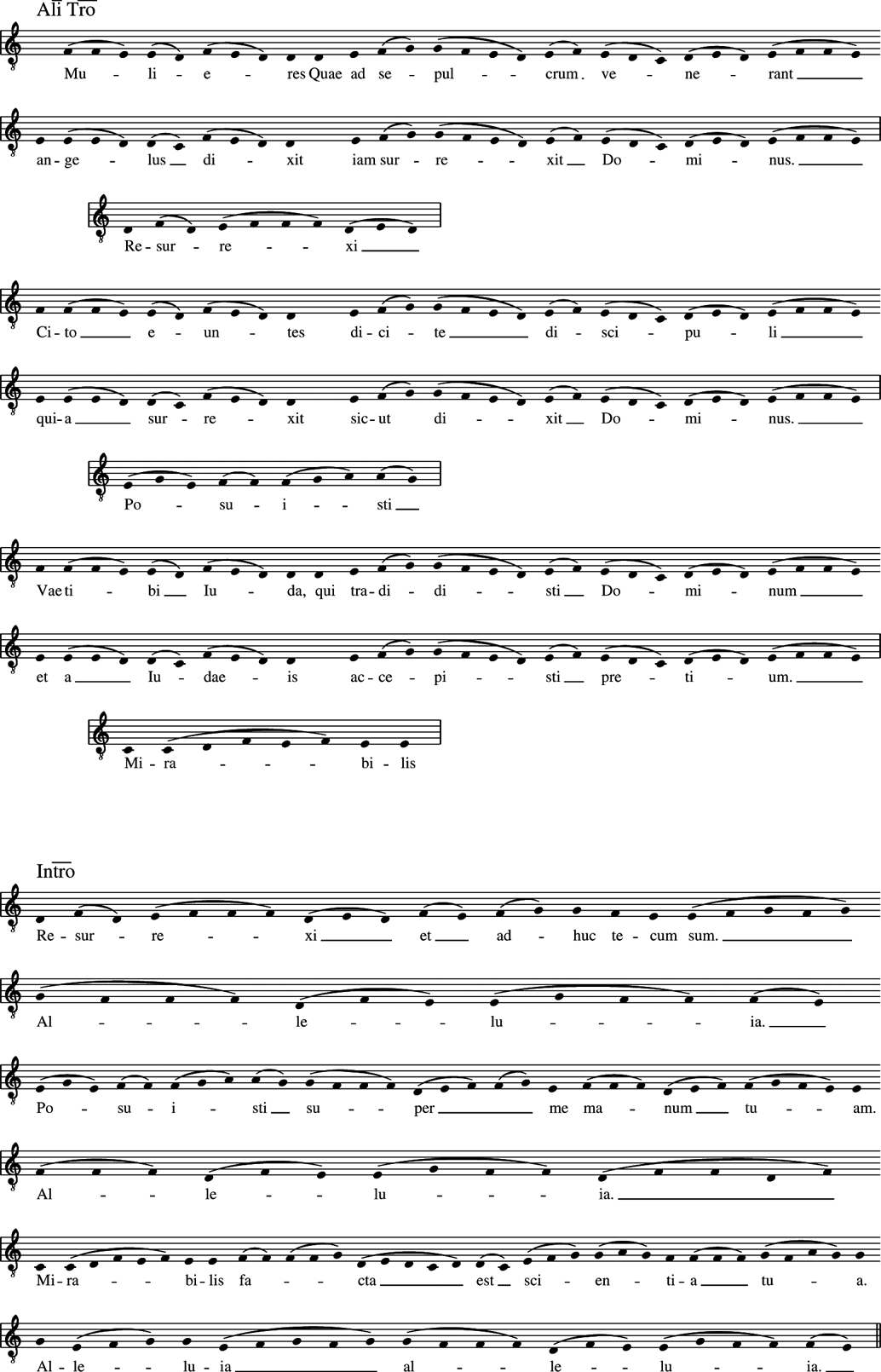
My next example is a chant that, like the Auctor caelorum deus, originated in the south and was transmitted to and changed in the north. Most likely it is a product of the tenth century. It is the introit trope for the Easter introit found in four of the Beneventan Graduals: Ben 35, Ben 38, Ben 39 and Ben 40. It was copied with a different melody in the late eleventh century in Pst 121, and incorporated without music in the late tenth-century missal from Abruzzi, Vat. lat. 4770. The text and a translation are given in Example 4, and the music of the trope in Example 5.Footnote 36
Introit trope Mulieres quae ad sepulcrum and introit Resurrexi (Ben 40, fol. 20v).
Introit trope Mulieres quae ad sepulcrum and introit Resurrexi (Ben 40, fol. 20v).
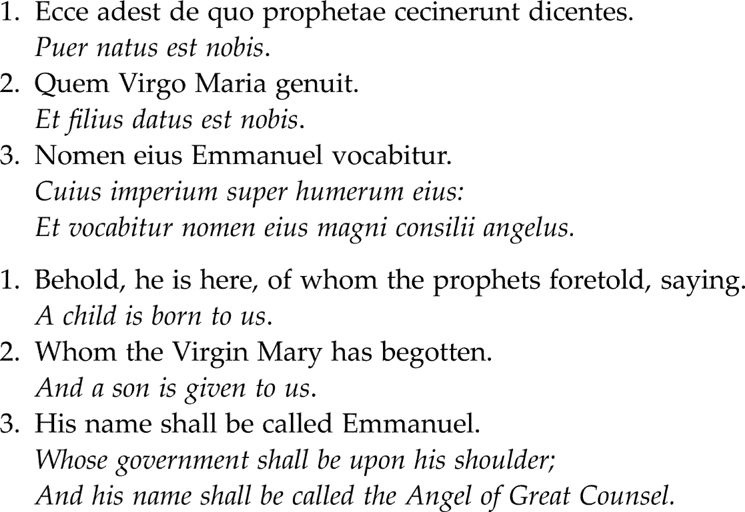
Now, in virtually all the trope repertories the relationship between the tropes and the texts of the proper of the Mass is that of an introduction or a gloss or commentary upon the text of the official liturgy. Typical of this is one of the oldest and most widespread tropes to the Christmas introit given in Example 6.Footnote 37
Introit trope Ecce adest and introit Puer natus est (CC 473, Winchester, 11c, fol. 11v).
In this case the connection of the trope to the introit text is syntactically clear, and the trope introduces the introit and enlarges upon its text. The case of Mulieres quae ad sepulcrum venerant is very different. The trope merely coexists with the introit, and if the connection between verse 1 and the introit is at best tenuous, it becomes more problematic with the second verse and dissolves into a complete non sequitur with the third.
But if one reads the text of the trope by itself, it tells a very coherent story in verses 1 and 2, ending with an emotional exclamation against Judas in verse 3. In other words, it makes perfect narrative and emotional sense. But there is more, if one sings the trope, again by itself: it consists of three repetitions of a single melody, which is divided into two nearly identical phrases, the first beginning with the descent f–f–e–e–d–f–e–d–d, and the second with the descent e–e–d–d–c–f–e–d–d. Thus we end up with the following melodic structure: A–A', A–A', A–A', which is structurally identical to that of the Kyrie Auctor caelorum deus. Indeed the half-verses of Mulieres quae ad sepulcrum are more closely related to each other than the syllabic and melismatic phrases of the Kyrie Auctor caelorum deus, and the range of both pieces is equally narrow, a fifth for the Kyrie and a fourth for the trope.
It is probably no coincidence that the structure of the trope, when considered as an entity in itself, is a small-scale replica of the structure of Maria vidit angelum without the attached final alleluias after verse six. What we have here is the Beneventan singer-composer of the tenth century who hears the shape of something he is going to sing at the start of the Easter Mass, not like a commentary of the Gregorian introit, or even like that introit itself, but rather something like a small Beneventan ingressa.
This last comparison should not be drawn too tightly. Maria vidit angelum is largely a strictly strophic setting. A number of ingressae have considerable repetition in them, and a few come close to being strophic,Footnote 38 but the trope is more rigidly strophic than these ingressae. The repetition of a musical phrase to accommodate a longer text is typical of both the Old Beneventan chant and some of the Romano-Beneventan pieces, and there is also the deliberate re-working of Aquitanian tropes in Benevento in order to accommodate them to the kinds of long-range melodic repetition one finds in Beneventan (and Romano-Beneventan) chant.Footnote 39 In terms of the modest structure of the trope phrases, another model close at hand is the Old Beneventan Good Friday antiphon Velum templum,Footnote 40 where the setting consists of two repetitions of the same melody. In this respect, Mulieres quae ad sepulcrum can be heard as belonging at the same time to several of the traditions found in eleventh-century Benevento, but to my ears its closed strophic structure and its variation technique recall the music of the ingressae of the older rite.
My final example comes also from the music written in Benevento in the tenth century, specifically the proses. I am deliberately avoiding here the Romano-Beneventan propers, written in imitation of Gregorian chant but which show many of the same traits of Beneventan music from this time; they have been subjected to an extended study by Luisa Nardini.Footnote 41 In a prior study, I made survey of the proses copied in the Beneventan sources with a view towards determining which could be local works.Footnote 42 As the case of Adorabo shows, sequentiae and proses probably came to Benevento in the ninth century as part of the ‘Gregorian’ repertory. Besides Adorabo, this repertory included a sequentia with curious ouvert and clos endings copied in the sequentiary of Chartres 47, where the melody's name had partially burned away when the facsimile was produced, and in Angers 144, where the name is illegible, but which was known in England in the tenth century as Berta vetula, and was provided with the prose text Arce summa. Footnote 43 In Aquitaine, also in the late tenth century, the same sequentia was called Alme sanctorum and had a prose that began with that text, which survived into the early eleventh century, but had a very narrow transmission.Footnote 44 In Benevento, that melody served as the tune for the main prose for St Peter, patron of two of the important monasteries in the city, and appears in all five Beneventan graduals, which indicates that it was sung well into the twelfth century.Footnote 45 What this suggests is that by the time Beneventan singers began producing their own proses in the tenth century they had probably nearly a century of experience singing Frankish proses, most likely including the settings by Notker and his followers that can be found in the Beneventan tradition. The written record also suggests that some of the Notker proses arrived in southern Italy in versions unmediated by the north Italian transmission of this repertory. A tantalising symptom of this is provided by two leaves – all that survives of an early eleventh-century gradual in Beneventan script. One of them transmits part of the mass for St Lawrence including a fragment of Notker's prose Laurenti David magni, and is now in the Franciscan Library at Dún Mhuire in Ireland (Kil B29). The notation and script are similar to those of Ben 40, but the ductus of the script points towards Montecassino or one of its dependencies.Footnote 46 The manner in which the prose is notated is absent from all known Italian manuscripts and was a purely German tradition. Although notation of the music in the margins is a widespread German trait, the simultaneous notation in the margin and over the text is considerably more rare, it appears in Ba 5, copied c.1000 for Reichenau, in a few pieces in Lo 19768, copied between 936 and 965 for St Alban in Mainz, in a few additions of the twelfth century copied into SG 381, the earliest full prosarium from the abbey, and most importantly in one or two pieces in PaN 10587, a fragment of Notker's Liber hymnorum copied at St Gall c.900 and thus during Notker's life and surely under his supervision.Footnote 47
Killiney, Dún Mhuire, Franciscan Library, MS B29, verso. (colour online)
Excursus: the melody of Laurenti David magni in the eastern and western traditions
The melody of Laurenti David magni is a sequentia that probably goes back at least to the middle of the ninth century, and like most of Notker's melodies, a West Frankish sequentia. It is also important to this discussion in that it had an Italian, and more specifically a Beneventan, transmission both with its west Frankish text and with Notker's settings.
The melody was called ‘Romana’ in St Gall and served as the tune for two of Notker's proses: Iohannes Iesu Christo for St John the Evangelist and Laurenti David magni for St Lawrence. In the West, the sequentia received various names, derived from the proses written for it. In Aquitaine it had two names, ‘Dic nobis quibus’ and ‘Clara gaudia’, both derived from proses sung to it. The earliest surviving source for the text of Dic nobis is PaN 1240, copied between 923 and 936, and that for the text of Clara gaudia is PaN 1084, copied at the end of the tenth century.
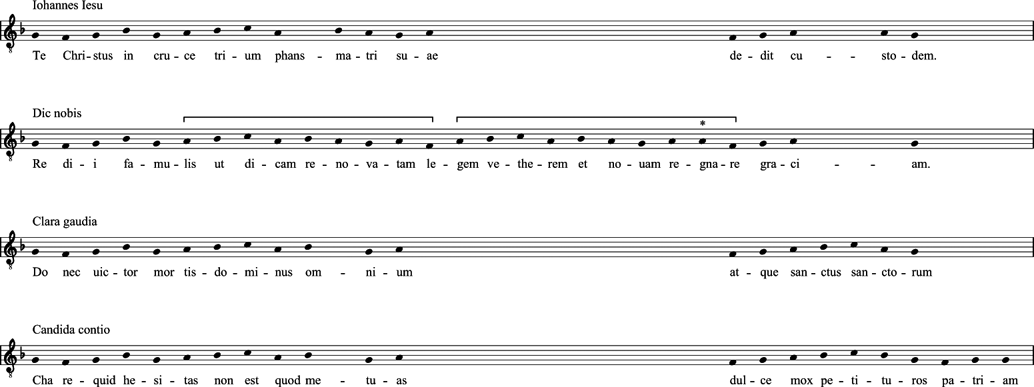
The editors of Analecta Hymnica, Nicolas de Goede, and David Hiley, equate this sequentia with a north French sequentia found in Angers 144, copied c.1000, with the name ‘Musa’ and in other early northern sequentiaries with the names ‘Angelica’ and ‘Nobilissima’, which was used as the melody for the prose Candida contio for a number of saints.Footnote 48 This is not quite the case: one can summarise the structure of Dic nobis and Clara gaudia as follows:
But that of Candida contio is
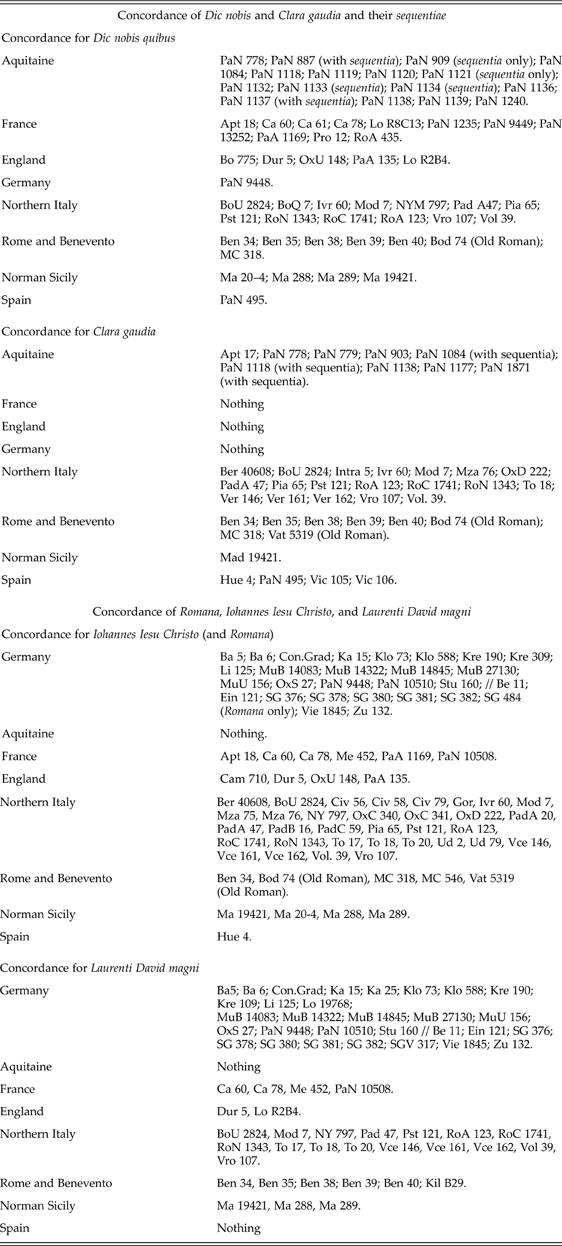
so Candida contio, which is missing the entire first phrase of the melody, and has an entirely different ending, could play no role in any attempt to establish the east and west transmission of the melody for the proses that would in fact include the opening phrase.Footnote 49 The concordance for the German and French versions of the sequentia and the four oldest proses connected with it appear in Table 2.
Concordances
In terms of the sequentia itself, the oldest written witness for it is SG 484, copied in the second quarter of the tenth century, roughly fifty years after the completion of Notker's Liber hymnorum. The sequentiaries of PaN 1084 and PaN 1118 come from the last decade of the tenth century, but the prose Dic nobis, albeit without notation, was copied in PaN 1240, which is roughly contemporary with SG 484, so that evidence of this melody as part of the written tradition appears in the west and the east about the same time. The concordance of the French proses is quite telling. Using a rough half-century chronology, Dic nobis was known by 950 in St Martial; by 1000 in Aurillac, Narbonne or Auch, Autun, Prüm, Pavia, Mantua and wherever Apt 18 was copied; and by 1050 in Nevers, Winchester, Bologna, Benevento and probably Rome. The only German source for it is the Prüm troper, copied around 1000. Clara gaudia is documented by 1000 in Aurillac, Narbonne or Auch, Mantua, Monza and Pavia; and by 1050 in St Yrieix, Novalesa, Bologna, Vercelli, Benevento and probably Rome, but was apparently entirely unknown in northern France, Germany and England. Just as Prüm is the outlier source for Dic nobis, the fourteenth-century Venetian gradual Ber 40.608 is the outlier source for Clara gaudia, since the Venetian and Aquileian sources tend to follow the German tradition. The sequentia must have existed by the third quarter of the ninth century, when Notker was composing his Liber hymnorum, although it does not turn up in the earliest sequentiaries, such as that of Chartres 47, nor does Dic nobis, clearly the earliest West Frankish text for the tune, turn up in the small collections from c.900 that transmit proses. Still, given the wide transmission of Dic nobis by 1000, it is not unreasonable to assume that it might be contemporary with Notker's texts and the original West Frankish text for the sequentia. Richard Crocker takes an uncommonly pessimistic view of the transmission of this melody:
In this case the model used by Notker may be out of our reach. Of the two earliest West-Frankish texts, Dic nobis and Clara gaudia, each shows similarities and differences with respect to Notker's version in such a way as to make decision difficult. Indeed, it seems more likely that neither of these extant West-Frankish texts – at least as they stand – is the original text, or the one that Notker saw. Notker's two texts to the melody, Laurenti David and Johannes Jesu, both show signs of maturity; it is possible that by the time Notker received the melody, more than one version was already in circulation.Footnote 50
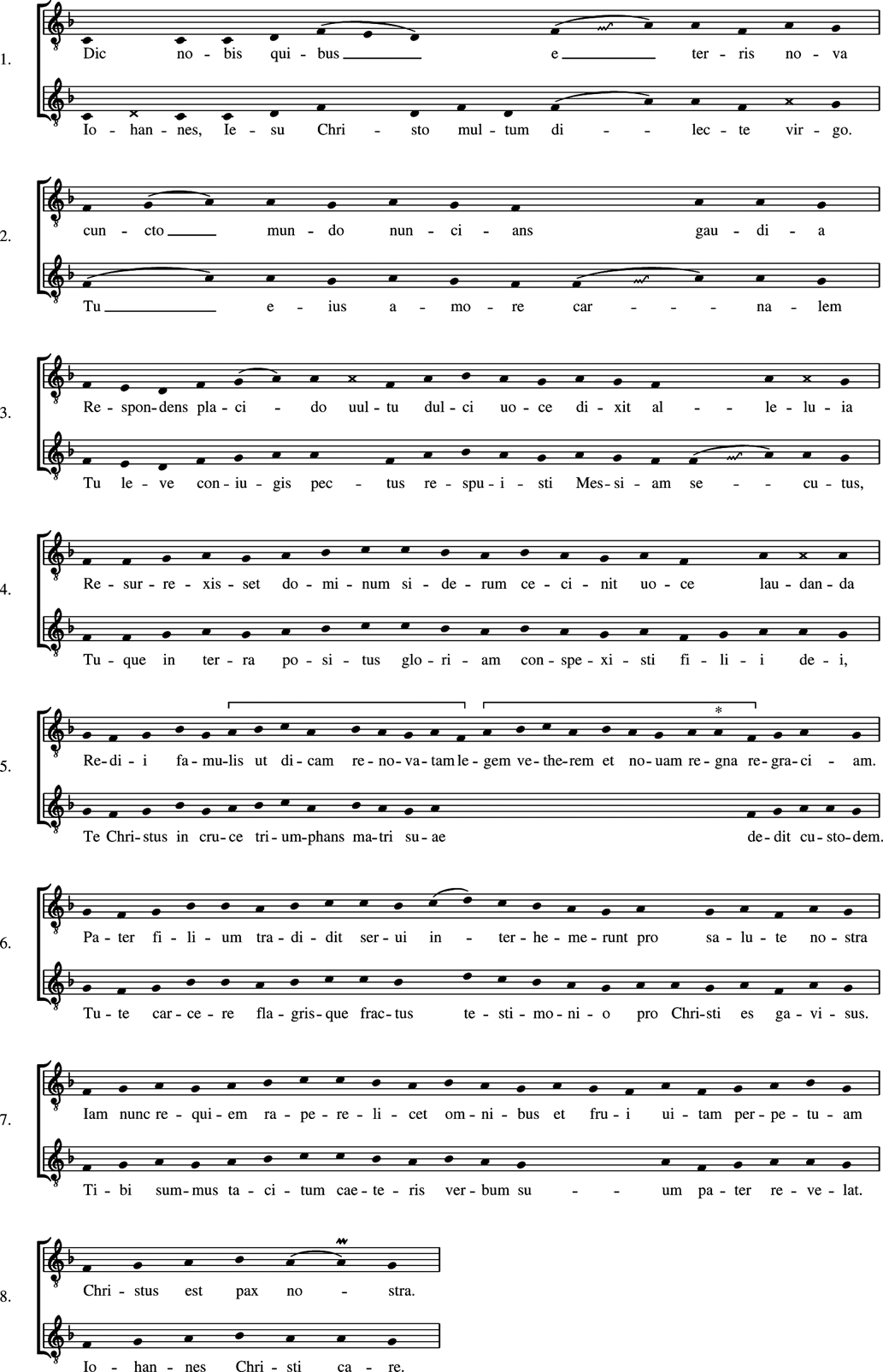
I think that in this case Crocker is misled by his concerns for the text. Example 7 provides a comparison of the melody, east and west, by using the first and last lines, as well as the first line of every couplet of Dic nobis and Iohannes Iesu. In both proses, the second line of each pair is set to an identical number of notes.Footnote 51 An identical result could be achieved by comparing the two sequentiae, and in a few instances the presence or absence of a pressus in one or another of the sequentiae makes the similarity greater.
Comparison of the melodies for Dic nobis quibus and Iohannes Iesu Christo.
Melodically a number of the differences are matters of ornamentation: the liquescent D at [Io]han[nes] and the passing notes at [qui]bus e in line 1; the passing G at [cun]cto in line 2; the pressus figure at [pla]cido vultu in line 3; the passing G at filii in line 4; the pressus figure at custodem in line 5; the passing C at inter[hemerunt] and the pressus figure at pro Christi in line 6. Of these, the pressus figure at line 3, absent from Notker's setting, is present in Romana, and the pressus figure pro Christi in line 6, absent from Dic nobis, is present in the sequentia.
A second layer of variants presents a different but consistent profile: they all occur in the third F to A near the end of each line. At their simplest they are the addition of a passing G in lines 1 and 4 (already noted); in lines 2 and 3 they add a repeat of the F that opens the ascent. More elaborate are the two instances where the third goes down: A to F in lines 5 and 7. They are related in that the expanded West Frankish version involves an ornamented repeat of the descent F–A. The simpler case is in line 7, where the descent occurs first with a passing tone, A–G–F, and then as a leap A–F, where Notker's tune has only the leap. More elaborate, and involving a true verbal variant: twenty-seven syllables in the West Frankish prose and eighteen syllables in Notker, is what happens in line 5. What we have is a pattern of nine notes: A–B–C–A–B–A–G–A–F, ending with the F–A leap, which is repeated in the west and not repeated in Notker.Footnote 52 Crocker has noted time and again the instances where double verses in the west appear as singles in Notker, and through very careful verbal analysis has shown how a number of these double verses are redundant in terms of the text of the prose and perhaps were originally singles that were later regularised in the west.Footnote 53 This implies that Notker simply set the text as prosae to the melismas, and never even considered editing the total textual and musical material that came to him. But this might have been always the case: Notker objected to the texts themselves, probably as Calvin Bower has observed, because for Notker ‘the French texts “notated” Notker's melodies incompetently, and thus he wrote new “versus” to fasten his East Frankish melodies in his memory.’Footnote 54 Crocker also notes that both Iohannes Iesu and Laurenti David show signs of being mature works. To Crocker this suggests that the melodies had evolved separately in the east and west by the time Notker wrote his proses,Footnote 55 but the overall similarity of the melodies and the structure of Dic nobis and Iohannes Iesu argue against that. Nonetheless it is quite possible that a mature Notker would have regarded the extended internal repetition in a line that was already going to be sung twice as a musical solecism and simply eliminated it in his texting. One should note that the repetition of that pattern is absent from Clara gaudia (and from Candida contio), but in that verse the melody of Clara gaudia shows considerable divergence from Dic nobis or the melody used by Notker.
Comparison of fifth stanza of Iohannes Iesu Christo with the West Frankish melodies.
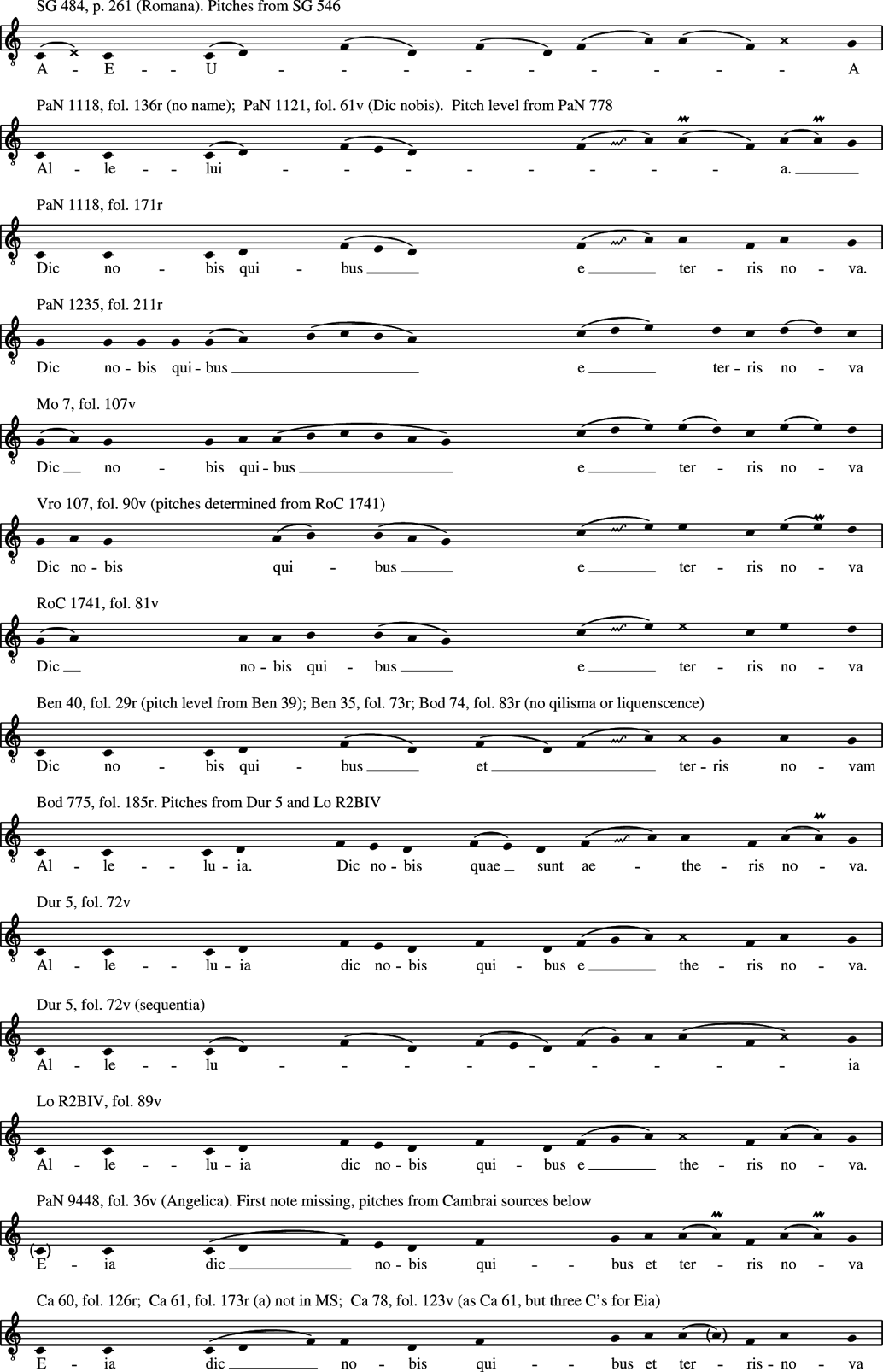
The one major variant that remains is the repeat of the leap of a third F to D in verse 1, which is found in Notker's melody but not in the Aquitanian Dic nobis (cf. Ex. 7). In this context it is worth remembering again that the Beneventan manuscripts transmit what appears to be an archaic version of the Gregorian repertory. A comparison of the opening strain of Notker's melody with a representative sample of German, North French, Aquitanian, North Italian and Beneventan proses appears in Example 9.
The first strain of Romana or Dic nobis in east and west and in Italy.
The north French and north Italian manuscripts pitch the melody a fifth up, probably because it sometimes resembles the behaviour of eight mode melodies, particularly in the prose repertory. The unusual ending of the phrase in PaN 1235 is probably a scribal error and Ben 39 also has a scribal error (rare in that manuscript),Footnote 56 giving the last seven notes a step up. Mod 7, from Forlimpopoli, near Ravenna, ‘Italianises’ the melody through a series of passing tones.
The repeated F–D in Notker's melody is absent from French (including Aquitanian) and north Italian sources for Dic nobis quibus, but appears in all the Beneventan manuscripts that transmit the piece as well as in the Old Roman Gradual of St Cecilia. To be sure, the earliest notated French and north Italian versions date from c.1000, and the earliest Beneventan copy from c.1050, but as the case of the sequentia ‘Adorabo’ with the Gloria victoria partial text, it is clear that mid-ninth-century versions of some of these pieces reached Benevento and were preserved there.Footnote 57
Some aspects of the transmission of this melody with the text Dic nobis to the north are puzzling, however. It appears in the younger of the two Winchester tropers, Bod 775, with a corrupt text and a rubric to Feria tertia, presumably in Easter week, as part of a relatively disorganised appendix and without the melismatic version for the first verse.Footnote 58 The neumation, though entirely adiastematic, is virtually identical to that found in the Canterbury Gradual Dur 5, which transmits basically a pre-Conquest repertory. Dur 5 is partially diastematic, and gives the melismatic version of the first verse as well in particularly accurate notation. In any case, this version survived the conquest and appears in the gradual from St Albans, Lo R2B4, with the Canterbury and Winchester melody on a four-line staff. All these sources transmit the repeated F–D variant found in Notker and Benevento. Ironically, the one German source that transmits Dic nobis quibus, the Rhenish troper from Prüm, PaN 9448, has at this point an entirely different reading. PaN 9448 is entirely adiastematic and is clearly missing the first neume. Otherwise, however, the neumation is entirely compatible with the near diastematic notation of Ca 60 and 78, from Cambrai, and Ca 61, with lines and clefs, from Lille, so that what we have here is a distinct Rhenish variant of the opening. PaN 9448 adds the name ‘Angelica’ to the tune, and if the missing neume was a pes as in Romana, then the neumation is compatible with the neumation of the sequentia ‘Angelica’ in Ca 75, from Arras, and in fact, the neumation of ‘Angelica’ in Ca 75 is compatible with the melody for the entire prose as transmitted in PaN 9448 and Ca 60, 61 and 78. This sequentia is not in the Winchester tropers, but CC 473 transmits the prose Candida contio with the rubric ‘Sq Angelica’. But we must remember that Candida contio omits the first phrase of Dic quibus, and the melody of the last couplet of Candida contio is not the melody of the last two strains of the sequentia ‘Angelica’ in Cambrai 75. Thus the music of Dic nobis quibus, with the opening ‘alleluia’ or ‘eia’, appears in PaN 9448, Ca 60, 61 and 78, and as the sequentia ‘Angelica’ in Ca 75, but this melody, although related to the melody of Candida contio and the ‘Angelica’ referred to in CC 473, is not the same melody.
All this tends to confirm Crocker's view that the melody evolved differently in different regions, but at the same time runs counter to his hypothesis that Dic nobis is not the ‘original’ text for that melody. Except for the internal repetition in line 5, which would be something Notker could have decided to edit out, the melody of Dic nobis in southern Italy and in Anglo-Saxon England is the melody that Notker knew as Romana, and despite the variants the presence of that text in Aquitaine by 936 and on both sides of the Rhine by 1000, not to speak of its presence in Autun and Mantua by that date and all over Europe, including Anglo-Saxon England by around 1025, suggests that the text probably is from the ninth century and the Beneventan manuscripts, as they often do, transmit the archaic version of the piece, which is closer to the melody Notker used than that in the Aquitanian and French sources.
The point of this excursus is to note that not only in the Gregorian repertory itself but also in an attendant repertory of tropes, sequentiae and proses, the Beneventan tradition has not only very early roots but also retained the archaic aspects of this repertory in an oral tradition quite effectively for nearly two hundred years.
It is possible to speculate that one of the reasons why the Beneventan tradition was so successful in preserving the archaic aspects of the Gregorian repertory it received in the ninth century is precisely because of the decision to keep the Old Beneventan liturgy and its music alive side by side with the Gregorian repertory. No other region of Europe succeeded in doing that. Papal Rome and Visigothic Spain kept their chant traditions essentially unique until their destruction at the hands of the eleventh-century popes and their successors. The difference being that papal Rome had developed a transcribable notation so that the few monuments of its music that survived can be read melodically today, while Visigothic Spain had not done so. Milan fought popes and emperors to a standstill in the matter of its liturgy and music. But in none of these regions were there two ‘official’ bodies of chant and two slightly different liturgies cultivated side by side as in the case of southern Italy. This must have given Beneventan cantors an acute sense of the melodic individuality of both repertories and therefore may have acted as something of a brake to the creeping change that is characteristic of oral traditions.
As I have noted above in the case of some of the introit tropes, when Beneventan singers came to produce their ‘new music’ of the tenth and eleventh centuries, they tended to use the melodic grammar of Gregorian chant, albeit in an Italianate manner, since the new genres, tropes and proses belonged in the Gregorian liturgy as they understood it. But at the same time in matters of formal and melodic rhetoric, they often adopted strategies that were foreign to the Gregorian repertory and harked back to some of the strategies of Old Beneventan chant.
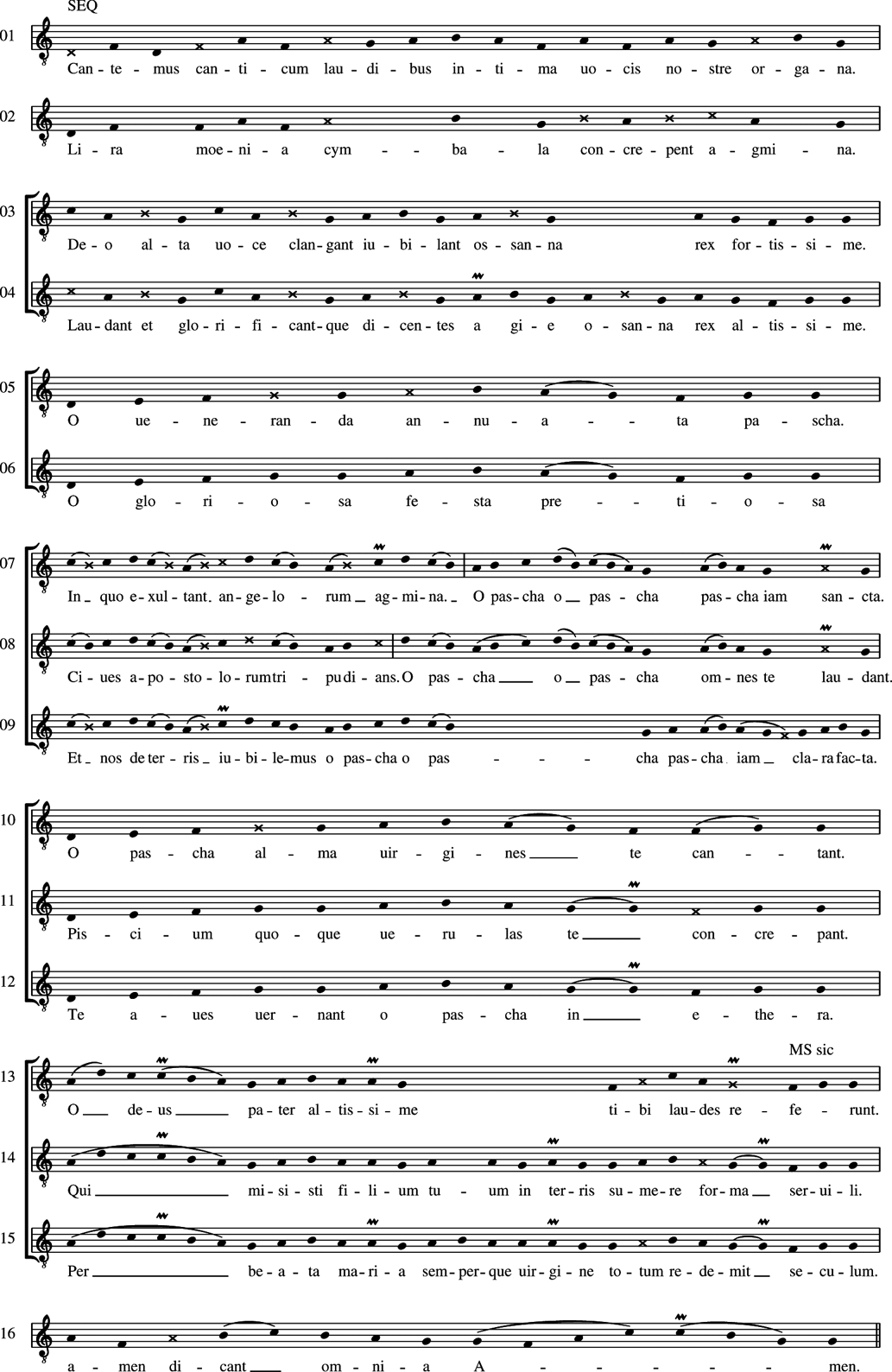
For my last example I am choosing quite deliberately a piece that even within the repertories of south Italian chant is probably a witness of a lost repertory. It is the prose Cantemus canticum laudibus in Ben 35, fol. 87r. The piece is unique to it, which surely means that it was not part of the normal repertory of Santa Sofia, San Pietro Intra Muros or whatever establishment was the original locus of Ben 38, nor yet Montecassino and its dependencies, since it is absent from Ben 34. Ben 35, although perhaps copied by someone from the cathedral,Footnote 59 was something of an anthology, where one can catch hints of repertories from southern Italy outside the city of Benevento. Some of the tropes in Ben 35 indicate that part of its repertory might have come from San Vicenzo al Volturno, one of the Beneventan establishments that most eagerly received the Gregorian repertory all the more in that in the late eighth century some of the abbots were Franks rather than Lombards.Footnote 60 The position of the prose in Ben 35 indicates some liturgical displacement: the text of the prose deals directly with Easter, addressing the feast in a true apostrophe, that is, ‘O pascha iam sancta!’ and ‘O pascha, o pascha, omnes te laudant’, and yet its position in the manuscript is near the end of Eastertide, on the fifth Sunday after Easter. The music is given as Example 10.
Cantemus canticum laudibus (Ben 35, fol. 87r).
Melodically and structurally the prose in the kind of work that would been have given fits not just to Notker or Iso, but also to the Aquitanian prosatores of the ninth and tenth centuries. At a very simple level, the musical surface of verses 1–6 is conventional enough, but with verse 7 we begin to encounter bits of neumatic writing, and melismata in verses 14–16. Then there is the formal structure: verses 1–2 are two singles, but at the same time they are related in the manner in which the syllabic and melismatic strains of the Kyrie Auctor caelorum deus are related. Verses 3–4 are a couplet: verse 3 consist of two iterations of a pattern, C–A–B–G, and two iterations of the last three notes of the pattern, A–B–G before the standard cadence used in hundreds of prose melodies in G, A–G–F–G–G. The added word in verse 4 simply adds a third iteration of the A–B–G pattern to the tune. Verses 5–6 are a straightforward couplet, but verses 7–9 are a trio, with something distantly related to an ouvert and clos ending, in that melodically verses 7–8 are identical, while verse 9 is missing the final ascent to the D and has a closing that is an elaboration of the close of verses 7–8. All three verses consist of an introduction, indicating the joy of the angels in verse 7, that of the apostles in verse 8, and that of the congregation in verse 9, parallel words to the parallel music, followed by a series of exclamations beginning ‘O pascha’. In verses 7 and 8 the text has a period at the end of the introductory sentence and a capital O at the start of the exclamation, suggesting a formal articulation, while verse 9 runs the two together. But all three verses begin the exclamation at a different point in the melody, although the ‘O pascha’ in verse 9 is set to a melodic pattern that recalls that of verse 7, and the first ‘O pascha’ of verse 9 begins at the same place as the second ‘O pascha’ of verse 8. Finally, the last syllable of the final ‘O pascha’ (as opposed to simply ‘pascha’) in all three verses arrives at the G that precedes the final melodic gesture despite the absence of some eight notes in verse 9. I know of very few instances of such a complex counterpoint of text and melodic structure in the entire prose repertory.
Verses 10–12, in contrast, are a straightforward trio, but they are also a repetition of the melody of verses 5–6, the only difference is that the first G of the melody is repeated in verses 10–12. Verses 13–15 are structurally a mirror image of the trio of verses 7–9; here it is verse 13 that has the shorter text and the different ending, although one could hear the F–A–C–A–G of verse 13 as an intervallic amplification of the G–A–B–A–G of verses 14–15. Also the neumatic opening of verse 13 becomes a melisma in verses 14–15. The ending of the amen sounds a bit like an echo of the ending of verse 13.
The Beneventan love for melodic repetition is shown not only in the three consecutive trios, and the repetition of the tune of verse 5 in verses 6, 10, 11 and 12, but also in the construction of verses 3–4 and even more so in that of verses 7–8, which simply go down and up the tetrachord A–D, in an A–A' pattern familiar from the Kyrie Auctor caelorum deus and the trope Mulieres quae ad sepulcrum before sounding the G at the end of the last ‘O pascha’ exclamation.
Formally this is a complicated and in some ways irrational piece. Dreves, Blume and Bannister referred to the Beneventan Kyries and proses some times as ‘verwildert’.Footnote 61 In the case of Cantemus canticum they added ‘alma’ in verse 7 between ‘pascha’ and ‘iam’, and added ‘laetantes’ in verse 9 between ‘terris’ and ‘iubilemus’, neither of which could be sung without severe damage to the melodic shape. They find the poetry ‘inferior’ (minderwertigen) and the transmission corrupt.Footnote 62 Now, for Cantemus canticum we have only one source, but, as a rule, it is remarkable that in the pieces that survive in all the Beneventan graduals and in Montecassino 546 how stable and unified the local tradition is over the century and a half covered by these sources. They are a product of a sensibility very different from that of Notker or that of the West Frankish prosatores, but clearly they are the product of singers who heard the music very carefully and remembered it for a very long time.
Appendix: manuscripts in order by siglum
- Angers 144
Angers, Bibliothèque Municipale, MS 144.
- Apt 18
Apt, Basilique de Sainte Anne, 18 (4).
- Ba 5
Bamberg, Staatsbibliothek, MS lit. 5 (Ed. V. 9).
- Ba 6
Bamberg, Staatsbibliothek, MS lit. 6 (Ed. III. 7).
- Be 11
Berlin, Deutsche Staatsbibliothek (now in Kraków, Biblioteka Jagiellońska), MS Theol. 4o 11.
- Ben 33
Benevento, Biblioteca Capitolare, MS 33.
- Ben 34
Benevento, Biblioteca Capitolare, MS 34.
- Ben 35
Benevento, Biblioteca Capitolare, MS 35.
- Ben 38
Benevento, Biblioteca Capitolare, MS 38.
- Ben 39
Benevento, Biblioteca Capitolare, MS 39.
- Ben 40
Benevento, Biblioteca Capitolare, MS 40
- Ber 40.608
Berlin, Staatsbibliothek Preussischer Kulturbesitz, Ms Mus 40.608.
- Bod 74
Cologny Geneva, Bibliotheca Bodmeriana, MS 74.
- Bod 775
Oxford, Bodleian Library, MS Bodley 775.
- BoQ 7
Bologna, Museo Internazionale e Biblioteca della Musica di Bologna, MS Q 7.
- BoU 2824
Bologna, Biblioteca Universitaria, MS 2824.
- Ca 60
Cambrai, Médiathèque Municipale, MS 60.
- Ca 61
Cambrai, Médiathèque Municipale, MS 61.
- Ca 75
Cambrai, Médiathèque Municipale, MS 75.
- Ca 78
Cambrai, Médiathèque Municipale, MS 78.
- Cam 710
Cambridge, University Library, MS 710.
- CC 473
Cambridge, Corpus Christi College, MS 473.
- Chartres 47
Chartres, Bibliothèque Municipale, MS 47 (destroyed 1944).
- Civ 56
Cividale, Museo Archeologico, MS LVI.
- Civ 58
Cividale, Museo Archeologico, MS LVIII.
- Civ 79
Cividale, Museo Archeologico, MS LXIX.
- Con.Grad.
Printed Gradual, no title page, printed perhaps in Constance c.1473 (London, British Library, IB 15154 (reported lost about 1990).
- Dur 5
Durham, University Library, MS Cosyn V. V. 6.
- Ein 121
Einsiedeln, Stiftsbibliothek, MS 121.
- Gor
Gorizia, Biblioteca del Seminario, MS I.
- Hue 4
Huesca, Biblioteca Capitular, MS 4.
- Intra 5
Intra, Biblioteca Capitolare de San Vittore, MS 5 (14).
- Ivr 60
Ivrea, Biblioteca Capitolare, MS 91, Bollati LX.
- Ka 15
Kassel, Murdharsche Bibliothek, MS Theol. 4o 15.
- Ka 25
Kassel, Murdharsche Bibliothek, MS Theol. 4o 25.
- Kil B29
Killiney, Dún Muire, Franciscan Library, MS B 29.
- Klo 73
Klosterneuburg, Stiftsbibliothek, MS 73.
- Klo 588
Klosterneuburg, Stiftsbibliothek, MS 588.
- Kre 190
Kremsmünster, Stiftsbibliothek, MS 190.
- Kre 309
Kremsmünster, Stiftsbibliothek, MS 309.
- Li 125
Linz, Bundestaatsliche Studienbibliothek, MS 125.
- Lo 19768
London, British Library, Additional MS 19768.
- Lo R2B4
London, British Library, MS Royal 2 B IV.
- Lo R8C13
London, British Library, MS Royal 8 C XIII.
- Ma 288
Madrid, Biblioteca Nacional, MS 288.
- Ma 289
Madrid, Biblioteca Nacional, MS 289.
- Ma 19421
Madrid, Biblioteca Nacional, MS 19421.
- Ma 20-4
Madrid, Biblioteca Nacional, MS Vitrina 20-4.
- Mad 1503/17
Madrid, Archivo Histórico Nacional, Cod. L 1503, fragmento 17.
- MC 318
Montecassino, Archivio della Badia, MS 318.
- MC 361
Montecassino, Archivio della Badia, MS 361.
- MC 546
Montecassino, Archivio della Badia, MS 546
- Metz 452
Metz, Bibliothèque Municipale, MS 452 (destroyed 1944).
- Mod 7
Modena, Biblioteca Capitolare, MS O. I. 7.
- MuB 14083
Munich, Bayerische Staatsbibliothek, MS clm. 14083.
- MuB 14322
Munich, Bayerische Staatsbibliothek, MS clm. 14322.
- MuB 14843
Munich, Bayerische Staatsbibliothek, MS clm 13843.
- MuB 14845
Munich, Bayerische Staatsbibliothek, MS clm. 14845.
- MuB 27130
Munich, Bayerische Staatsbibliothek, MS clm. 27130.
- MuU 156
Munich, Universitätsbibliothek, MS 156.
- Mza 12/75
Monza, Biblioteca Capitolare, MS c 12/75.
- Mza 75
Monza, Biblioteca Capitolare, MS c 12/75.
- Mza 76
Monza, Biblioteca Capitolare, MS c 13/76.
- NYM 797
New York, Morgan Library, MS 797.
- OxC 340
Oxford, Bodleian Library, MS Canon. lit. 340.
- OxC 341
Oxford, Bodleian Library, MS Canon. lit. 341.
- OxD 222
Oxford, Bodleian Library, MS Douce 222.
- OxS 27
Oxford, Bodleian Library, MS selden supra 27.
- OxU 148
Oxford, University College, MS 148 (at the Bodleian Library).
- PaA 1169
Paris, Bibliothèque de l'Arsenal, MS 1169.
- PaA 135
Paris, Bibliothèque de l'Arsenal, MS 135,
- PadA 47
Padua, Biblioteca Capitolare, MS A 47.
- PadA 20
Padua, Biblioteca Capitolare, MS A 20.
- PadB 16
Padua, Biblioteca Capitolare, MS B 16.
- PadC 59
Padua, Biblioteca Capitolare, MS C 59.
- PaN 495
Paris, Bibliothèque Nationale de France, nouv. acq. lat., MS 495.
- PaN 776
Paris, Bibliothèque Nationale de France, fonds latin, MS 776.
- PaN 778
Paris, Bibliothèque Nationale de France, fonds latin, MS 778.
- PaN 887
Paris, Bibliothèque Nationale de France, fonds latin, MS 887.
- PaN 909
Paris, Bibliothèque Nationale de France, fonds latin, MS 909.
- PaN 1084
Paris, Bibliothèque Nationale de France, fonds latin, MS 1084.
- PaN 1087
Paris, Bibliothèque Nationale de France, fonds latin, MS 1087.
- PaN 1118
Paris, Bibliothèque Nationale de France, fonds latin, MS 1118.
- PaN 1119
Paris, Bibliothèque Nationale de France, fonds latin, MS 1119.
- PaN 1120
Paris, Bibliothèque Nationale de France, fonds latin, MS 1120.
- PaN 1121
Paris, Bibliothèque Nationale de France, fonds latin, MS 1121.
- PaN 1132
Paris, Bibliothèque Nationale de France, fonds latin, MS 1132.
- PaN 1133
Paris, Bibliothèque Nationale de France, fonds latin, MS 1133.
- PaN 1134
Paris, Bibliothèque Nationale de France, fonds latin, MS 1134.
- PaN 1136
Paris, Bibliothèque Nationale de France, fonds latin, MS 1136.
- PaN 1137
Paris, Bibliothèque Nationale de France, fonds latin, MS 1137.
- PaN 1138
Paris, Bibliothèque Nationale de France, fonds latin, MS 1138.
- PaN 1139
Paris, Bibliothèque Nationale de France, fonds latin, MS 1139.
- PaN 1177
Paris, Bibliothèque Nationale de France, nouv. acq. lat., MS 1177.
- PaN 1235
Paris, Bibliothèque Nationale de France, nouv. acq. lat., MS 1235.
- PaN 1240
Paris, Bibliothèque Nationale de France, fonds latin, MS 1240.
- PaN 1871
Paris, Bibliothèque Nationale de France, nouv. acq. lat., MS 1871.
- PaN 9448
Paris, Bibliothèque Nationale de France, fonds latin, MS 9448.
- PaN 9449
Paris, Bibliothèque Nationale de France, fonds latin, MS 9449.
- PaN 10510
Paris, Bibliothèque Nationale de France, fonds latin, MS 10510.
- PaN 10587
Paris, Bibliothèque Nationale de France, fonds latin, MS 10587.
- PaN 13252
Paris, Bibliothèque Nationale de France, fonds latin, MS 13252.
- PaN 17436
Paris, Bibliothèque Nationale de France, fonds latin, MS 17436.
- Pia 65
Piacenza, Biblioteca Capitolare, MS 65.
- Pro 12
Provins, Bibliothèque Municipale, MS 12.
- Pst 120
Pistoia, Biblioteca Capitolare, MS C 120.
- Pst 121
Pistoia, Biblioteca Capitolare, MS C 121.
- Reg 334
Vatican, Biblioteca Apostolica Vaticana, MS Reg. lat. 334.
- RoA 123
Rome, Biblioteca Angelica, MS 123 (B. III. 18).
- RoA 435
Rome, Biblioteca Angelica, MS 435 (D. V. 3).
- RoC 1741
Rome, Biblioteca Casanatense, MS 1741 (C. VI. 2)
- RoN 1343
Rome, Biblioteca Nazionale, MS 1343 (Sessorianus 62).
- RoV 9
Rome, Biblioteca Valliceliana, MS c 9.79.
- RoV 52
Rome, Biblioteca Valliceliana, MS c 52.
- SG 376
Sankt Gallen, Stiftsbibliothek, MS 376.
- SG 378
Sankt Gallen, Stiftsbibliothek, MS 378.
- SG 380
Sankt Gallen, Stiftsbibliothek, MS 380.
- SG 381
Sankt Gallen, Stiftsbibliothek, MS 381.
- SG 382
Sankt Gallen, Stiftsbibliothek, MS 382.
- SG 484
Sankt Gallen, Stiftsbibliothek, MS 484.
- SGV 317
Sankt Gallen, Kantonsbibliothek, Vadiana 317.
- Stu 160
Stuttgart, Landesbibliothek, MS Brev. 160.
- To 17
Turin, Biblioteca Nazionale, MS F. III. 17.
- To 18
Turin, Biblioteca Nazionale, MS F. IV. 18.
- To 20
Turin, Biblioteca Nazionale, MS G. V. 20.
- Ud 2
Udine, Biblioteca Arcivescovile, MS 2.
- Ud 79
Udine, Biblioteca Arcivescovile, MS 79.
- Urb 602
Vatican, Biblioteca Apostolica Vaticana, MS Urb. lat. 602.
- Vat 4770
Vatican, Biblioteca Apostolica Vaticana, MS Vat. lat. 4770.
- Vat 5319
Vatican, Biblioteca Apostolica Vaticana, MS Vat. lat. 5319.
- Vat 10673
Vatican, Biblioteca Apostolica Vaticana, MS Vat. lat. 10673.
- Ver 146
Vercelli, Biblioteca Capitolare, MS 146.
- Ver 161
Vercelli, Biblioteca Capitolare, MS 161.
- Ver 162
Vercelli, Biblioteca Capitolare, MS 162.
- Vic 105
Vich, Biblioteca Episcopal, MS 105 (111).
- Vic 106
Vich, Biblioteca Episcopal, MS 106 (Rip. 31).
- Vie 1845
Vienna, Österreichische Nationalbibliothek, MS 1845.
- Vol 39
Volterra, Biblioteca Guarnacci, MS L. 3. 39.
- Vro 90
Verona, Biblioteca Capitolare, MS XC (85).
- Vro 107
Verona, Biblioteca Capitolare, MS CVII (100).
- Zu 132
Zürich, Zentralbibliothek, MS 132.