Introduction
Bryophyte and lichen communities constitute one of the few types of terricolous vegetation in Maritime Antarctica, being especially developed in favourable coastal locations. Ice-free areas of coastal sites experience most of the human impact from ship-borne tourism and scientific research on the Antarctic Peninsula and offshore islands (Lynch et al. Reference Lynch, Crosbie, Fagan and Naveen2010, Hughes et al. Reference Hughes, Fretwell, Rae, Holmes and Fleming2011). Therefore terrestrial vegetation is especially vulnerable to human foot traffic. The increase of visitors to the Antarctic has been exponential during the last twenty years with cumulative trampling impacts detected at or near tourist landing sites (Bastmeijer & Roura Reference Bastmeijer and Roura2004) and around scientific field camps (Tejedo et al. Reference Tejedo, Justel, Benayas, Rico, Convey and Quesada2009). Increased human presence is relatively well documented. Data on national research programmes activities are available on the Antarctic Treaty Secretariat (ATS) website (http://www.ats.aq/e/ie.htm). Information on tourist visits is published on the International Association of Antarctica Tour Operators (IAATO) website (http://iaato.org/es/tourism-statistics). Tourist visits are largely concentrated in the Antarctic Peninsula region. Tourists arrive on cruise ships and make shore visits on the ice-free coastal zones of two to three hours each, one to three times daily (Bertram Reference Bertram2007). Scientific expeditions are far more widespread along the Antarctic Peninsula, as personnel can work out of stations, ships or field camps (Hughes et al. Reference Hughes, Fretwell, Rae, Holmes and Fleming2011). As a result, both diffuse and concentrated trampling patterns can be expected to result from human activities on the Antarctic Peninsula.
Other factors, such as climate change (Vaughan et al. Reference Vaughan, Marshall, Connolley, Parkinson, Mulvaney, Hodgson, King, Pudsey and Turner2003, Turner et al. Reference Turner, Colwell, Marshall, Lachlan-Cope, Carleton, Jones, Lagun, Reid and Iagovkina2005) and human induced biological invasions (Frenot et al. Reference Frenot, Chown, Whinam, Selkirk, Convey, Skotnicki and Bergstrom2005, Hughes & Convey Reference Hughes and Convey2010), could act in synergy with the deterioration of terrestrial ecosystems resulting from trampling (Smith Reference Smith1994, Olech Reference Olech1996, Smith & Richardson Reference Smith and Richardson2011). Moreover, other human activities could also have indirect effects. For example, in the case of the South Orkney Islands, sealing activities in the 18th century may have indirectly led to the severe damage to vegetation caused by expanding fur seal populations (Smith Reference Smith1988). Available knowledge on the effects of trampling in the Antarctic is currently rather sparse (Tin et al. Reference Tin, Fleming, Hughes, Ainley, Convey, Moreno, Pfeiffer, Scott and Snape2009, Convey Reference Convey2010).
This study offers a first attempt to assess the sensitivity of bryophyte and lichen terricolous communities under experimental trampling conditions in Antarctica. Previous studies of trampling on bare soils conducted by Ayres et al. (Reference Ayres, Nkem, Wall, Adams, Barrett, Broos, Parsons, Powers, Simmons and Virginia2008) in the McMurdo Dry Valleys showed that even low levels of human traffic could produce impacts on soil biota. Tejedo et al. (Reference Tejedo, Justel, Rico, Benayas and Quesada2005, Reference Tejedo, Justel, Benayas, Rico, Convey and Quesada2009) developed indicators and measured the effects of experimental trampling on bare soils on Byers Peninsula. On Cuverville Island, de Leeuw (Reference De Leeuw1994) and Beyer & Bölter (Reference Beyer and Bölter2002) reported that low trampling intensities rapidly led to disturbances to terrestrial vegetation. Thor (Reference Thor1997) and Johansson & Thor (Reference Johansson and Thor2008) studied the possible impacts of human activities on terrestrial vegetation around research stations in Dronning Maud Land and reported no severe damage but a decline in the number of lichen species. In our study area, the South Shetland Islands, significant damage to terrestrial vegetation has already been documented at sites with a high concentration of scientific stations, such Fildes Peninsula, King George Island (ASOC 2004), or tourist visited sites such Barrientos Island, Aitcho Archipelago (Ecuador & Spain 2012). On a larger scale, Scott & Kirkpatrick (Reference Scott and Kirkpatrick1994) conducted studies of the effects of trampling on the biodiversity of sub-Antarctic Macquarie Island. Also in the sub-Antarctic, Gremmen et al. (Reference Gremmen, Smith and van Torengen2003) examined the different habitats crossed by paths on Marion Island. In the Arctic, West & Maxted (Reference West and Maxted2000) examined the effects of trampling around field camps in Svalbard. To our knowledge, no experimental trampling studies focused on the sensitivity of cryptogamic formations have been performed in the Antarctic Peninsula.
Experimental trampling studies of vegetation have been frequently conducted in more temperate areas (Cole & Bayfield Reference Cole and Bayfield1993, Cole Reference Cole1995a, Reference Cole1995b, Marion & Cole Reference Marion and Cole1996, Marion & Leung Reference Marion and Leung2001, Farrell & Marion Reference Farrell and Marion2001, Reference Farrell and Marion2002), providing an extensive framework of procedures. The specific aim of the current study is to measure the resistance capacity of different Antarctic terricolous cryptogamic communities to human trampling. The resistance of vegetation to trampling is defined by the amount of damage in terms of cover loss caused by a given trampling intensity (Cole & Bayfield Reference Cole and Bayfield1993). To this end, we used a linked set of indicators and field observations. Our objectives were to identify effective indicators for assessing the consequences of trampling on cryptogamic vegetation, and to estimate the magnitude of this impact on different bryophyte and lichen communities. With this study, we hope to advance our baseline knowledge on crytogamic formations in the Antarctic Peninsula, contribute towards minimizing the environmental impacts of scientific expeditions, and alert the scientific community to the challenges faced by these most sensitive plant formations in the context of increased human activity in the Antarctic.
Material and methods
Description of the study area
Byers Peninsula is situated on the western side of Livingston Island (62°34′35′′–62°40′35′′S, 60°54′14′′–61°13′07′′W) and is the largest ice-free area in the South Shetland Islands (López-Martinez et al. Reference López-Martínez, Martínez de Pisón, Serrano and Arche1996). Its numerous freshwater bodies are of interest for limnological studies (Quesada et al. Reference Quesada, Camacho, Rochera and Velázquez2009). The periglacial landscape comprises tens of lakes and streams with diverse biological conditions (Toro et al. Reference Toro, Camacho, Rochera, Rico, Bañón, Fernández-Valiente, Marco, Justel, Vincent, Avendaño, Ariosa and Quesada2007). The landforms and deposits with various origins support varied types of vegetation. The cryptogamic flora of Byers Peninsula is remarkably rich, including 42 species of mosses (Ochyra et al. Reference Ochyra, Smith and Bednarek-Ochyra2008, ATCM 2011), similar to that of South Bay, another important ice-free area on Livingston Island (Sancho et al. Reference Sancho, Schulz, Schoeter and Kappen1999).
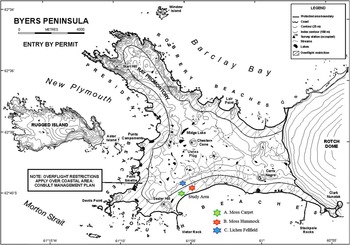
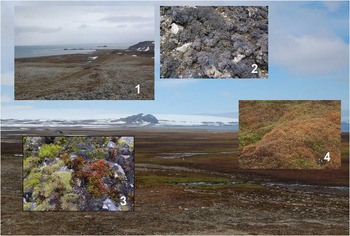
Although lichen communities can be found throughout Byers Peninsula, bryophyte vegetation is more developed on the south coast (Lindsay Reference Lindsay1971), and especially in areas at low altitudes that benefit from nearby meltwater. We analysed three terricolous cryptogamic communities situated inland and on the southern beaches (Fig. 1) which have different appearances and ecological affinities (Fig. 2). Community A (“moss carpet community”) comprises uniform moss carpets of highly hydrophilous pleurocarpous mosses growing on wet coastal plains, permanently bathed by melting snowpacks. Community B (“moss hummock community”) corresponds to heterogeneous moss assemblages dominated by large hummocks of pleurocarpous mosses, irregularly patched with turfs and cushions of acrocarpous mosses, developed on seepages areas of raised beach terraces not permanently wetted. Community C (“lichen fellfield community”) is an example of a fellfield cryptogamic community dominated by small foliose lichens accompanied by different mosses, growing on seepage areas of exposed upland slopes that dry out after the spring melt. Following the classification by Smith (Reference Smith1996) and Ochyra et al. (Reference Ochyra, Smith and Bednarek-Ochyra2008) the three communities can be related to three different types of sub-formations within the non-vascular cryptogam tundra formation. Community A corresponds to the bryophyte carpet and mat sub-formation, Community B the tall moss cushion (hummock) sub-formation, whereas Community C is placed in the crustaceous and foliaceous lichen sub-formation.
Study site at Byers Peninsula ASPA No. 126 topographic map (modified). Inset: the location of the three cryptogamic communities in the South Beaches of Byers Peninsula. Source: ASPA 126 Management Plan, Byers Peninsula (Map 2).

Diagram of cryptogamic communities in South Beaches. Main image: large moss covered lowland area containing communities A and B. Author: L.R. Pertierra. January 2010. Top left-hand image (1): highland containing Community C. Top right-hand image (2): detail of fellfield lichen community (C) on exposed upland slopes. Bottom left-hand image (3): detail of a moss hummock community (B) on a raised beach terrace. Bottom right-hand image (4): detail of a uniform moss carpet community (A) on a coastal plane.

Determination of baseline conditions
At the start of each experiment, before any trampling has been initiated, the baseline conditions of each cryptogam community were referred to as ′Level Zero′ (0). In order to conduct initial descriptions of the bryophyte and lichen composition of each community, experimental plots of 6 m2 that were representative of each community were selected. Species composition was determined in the laboratory from samples from the plots, following established procedures (Sancho et al. Reference Sancho, Schulz, Schoeter and Kappen1999, Bednarek-Ochyra et al. Reference Bednarek-Ochyra, Váňa, Ochyra and Smith2000, Øvstedal & Smith Reference Øvstedal and Smith2001, Putzke & Pereira Reference Putzke and Pereira2001, Ochyra et al. Reference Ochyra, Smith and Bednarek-Ochyra2008). Specimens are stored in the MAUAM herbarium.
Edaphic parameters were determined in the laboratory from triplicate core samples of each community. Soil organic matter was quantified by the Walkley & Black wet oxidation method (Nelson & Sommers Reference Nelson and Sommers1982). Total nitrogen (N) content was determined by the Kjeldahl method (Bremner & Mulvaney Reference Bremner and Mulvaney1982). Exchangeable potassium (K) was determined by atomic absorption spectrometry using an ammonium acetate extraction method (Thomas Reference Thomas1982). The method of Olsen et al. (Reference Olsen, Cole, Watanabe and Dean1954) was used to estimate available phosphorus (P). Soil acidity (pH) was measured in water and in 0.1 M potassium chloride (KCl) using a 1:2.5 soil/solution ratio. Electrical conductivity was measured in a 1:5 soil: water extract. General geomorphological information was extracted from local cartography (López-Martinez et al. Reference López-Martínez, Martínez de Pisón, Serrano and Arche1996, Navas et al. Reference Navas, López-Martínez, Casas, Machín, Durán, Serrano, Cuchi and Mink2008).
Procedures for trampling experiments
Trampling was measured as the number of pedestrian transits. For the purpose of standardization (Cole Reference Cole1995a, Reference Cole1995b), experiments were performed by a person 1.80 m tall, weighing 85 kg and wearing rubber boots. Transects followed the dimensions suggested by Cole & Bayfield (Reference Cole and Bayfield1993). Dimensions of 6 m x 1 m were selected in order that three random plots, each 25 cm x 25 cm, could be sampled at each of five semi-quantitative stages. The five sampling stages were defined by the resistance of the cryptogam communities to trampling. The first sampling stage took place when the first evidence of damage as a result of trampling could be seen, or when 95% of the vegetation cover remained intact. This stage was labelled as ′Level One′ (1). Trampling would continue and measurements were made at subsequent levels of degradation including: ′Level Two′ (2), where c. 75% of the vegetation cover remained intact, ′Level Three′ (3), where c. 50% of the vegetation cover remained intact, ′Level Four′ (4), where c. 25% of the vegetation cover remained intact and ′Level Five′ (5), where less than 5% of the initial vegetation cover remained intact. This approach was selected in order to fully cover the dynamics of vegetation denudation. Since it represents 50% of vegetation denudation, ′Level Three′ serves as an indicator of resistance of the moss and lichen communities that can be used for comparing with other studies. In the remainder of this paper, we will refer to the various states of the cryptogam communities by means of a code combining the letter of the community (A-B-C) with the level of degradation (0 to 5).
For the purpose of monitoring when the next sampling stage was reached, the amount of vegetation cover was estimated every time trampling intensity was doubled. A grid of 25 squares was laid over a random plot of 5 cm x 5 cm and photographically documented. The percentage of area with complete loss of macroscopic structure was estimated and used as a measure of the loss of vegetation cover. Trampling intensity was increased until total disruption of the crytogamic community was reached.
At each sampling stage, physical and biological indicators were measured in three random 25 cm x 25 cm sampling plots. Soil resistance to penetration was used as an indicator of the effective gradual impact on soil compaction (Tejedo et al. Reference Tejedo, Justel, Rico, Benayas and Quesada2005, Reference Tejedo, Justel, Benayas, Rico, Convey and Quesada2009). Five measurements were taken at each sampling stage on the soil of each cryptogam community with a hand edaphic penetrometer. For total biomass and water content, core samples were removed from the sampling plots. In total, 54 circular cores were collected. Core dimensions (7 cm diameter x 7 cm length) were sufficient to obtain approximately 200 g of wet samples. A core depth of 7 cm was selected in order that all biomass could be recovered after trampling. As a result, the measured biomass and water content need to be considered at these conditions. Soil fraction from additional samples was sieved in a 2 mm mesh to measure soil moisture. Cores collected were frozen at -20°C in sealed bags until analysis.
Soil moisture, water content and total organic matter were respectively quantified in triplicates through loss-on-ignition technique with wet & dry weight calculation after heating in porcelain crucibles in a muffle furnace. Soil moisture (% soil weight) and water content (% sample weight) were measured after 24 hr at 105°C, while biomass (mg carbon (C) cm-2 soil) was measured after 4 hr at 450°C.
Results from soil resistance to penetration, water content and total biomass were expressed with standard deviations and represented in graphs. On these graphs the model fit which best represented the observed trend was also calculated with its coefficient of determination (r 2). Vegetation coverage loss trends were also represented. It was estimated once per stage and thus no standard deviations were obtained.
Experiments were conducted in the late summer on days where there had been minimal precipitation on previous days. Results on soil resistance to penetration and water content are circumscribed within these conditions and cannot be easily extrapolated to other studies. Nonetheless all measurements were performed on the three communities in parallel and they can therefore be compared.
Results
Floristic composition
Community A was made up of dense, uniform and extensive moss carpets that developed on flat terrain, and dominated by the hydrophilous pleurocarpous moss Warnstorfia sarmentosa (Wahlenb.) Hedenäs. Other large mosses could be occasionally found, particularly Sanionia georgicouncinata (Müll. Hal.) Ochyra & Hedenäs and Polytrichastrum alpinum (Hedw.) G.L. Sm. The community was heavily flooded, with a water content of 87% in core samples and a soil moisture content of 28% (see Supplemental Table at http://dx.doi.org/10.1017/S095410201200082X).
Community B comprised heterogeneous, moss dominated vegetation growing on sandy pebble-rich substrate of raised terraces, frequently adjacent to Community A but under drier conditions. It was dominated by the pleurocarpous Sanionia georgicouncinata and, to a lesser extent, by the acrocarpous Polytrichastrum alpinum. Depending on microtopographical conditions, which favoured greater or lesser water supply, other species could be present, such as Warnstorfia sarmentosa or Polytrichum juniperinum Hedw. Intermixed with all these large mosses, many very small species could appear in small proportions, and we found Bartramia patens Brid., Pohlia wahlenbergii (F. Weber & D. Mohr) A.L. Andrews, Andreaea regularis Müll.Hal., Brachythecium austrosalebrosum (Müll.hal.) Kindb., and the leafy liverwort Cephaloziella varians (Gottsche) Steph. The Antarctic hairgrass Deschampsia antarctica E. Desv. was also present in small patches. Samples from this community had a water content of 53% and a soil moisture content of 19% (Supplemental Table). The substrate was sandier, resulting in moderate drainage, and bedrock was more evident and was occasionally visible.
Community C was a cryptogam assemblage that developed on upland terrains and was dominated by the blackish foliose cyanolichen Leptogium puberulum Hue. The pleurocarpous mosses Brachythecium subpilosum (Hook. f. & Wilson) A. Jaeger and Sanionia uncinata (Hedw.) Loeske were also abundant. Other mosses found in lower proportions were Bartramia patens, Polytrichastrum alpinum, Schistidium lewis-smithii Ochyra, and Pohlia cruda (Hedw.) Lindb. This community grew on moraine soils which were among the driest conditions included in this study. Water content in the samples was c. 21% and soil moisture was also around 20%.
Soil characteristics
Soil characteristics are shown in Table I. Organic matter (OM) content was very poor for the moss dominated communities A and B (mineralised soil), and was deficient in the lichen fellfield Community C (soil mineral-organic). Results are consistent with the C/N ratios, which indicates that these nutrients do not act as constraints in the humidification–mineralization process. Nitrogen content is normal in Communities A and B, whereas it is comparatively high in Community C which probably has a higher mineral nitrogen ratio. Soils from all communities have a low salt content, and hence low electrical conductivity. All soils have very low values of phosphorus. Levels of potassium in all soils can also be considered as low but they lie within normal limits (Thomas et al. Reference Thomas, Fogg, Convey, Fritsen, Gili, Gradinger, Laybourn-Parry, Reid and Walton2008).
Chemical properties and nutrient content of the soils from the terrestrial cryptogamic communities from Byers Peninsula.

Physical effects of trampling
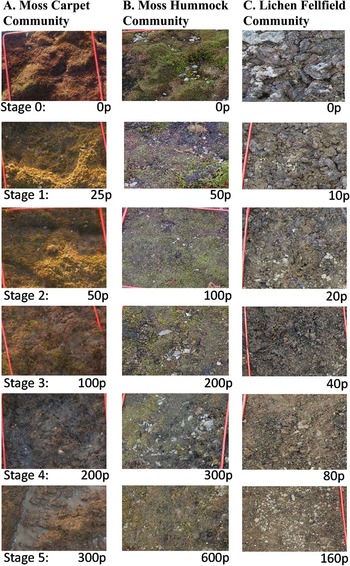
The effects of trampling on cryptogamic vegetation are influenced by several factors, such as hydrological conditions, geography and topography. These factors may influence the response of the plant communities to human activity. Visual effects of trampling experiments were photographically documented (Fig. 3). In the case of the moss carpet community (A), the first visible effects were detected after the first 25 passes (A1). Macroscopic destruction of the vegetation cover was detected after 300 passes (A5). The moss hummock community (B) exhibited visible effects after 50 passes (B1) and reached macroscopic destruction after 600 passes (B5). The lichen fellfield community (C) exhibited visible effects after only 10 passes (C1) and reached macroscopic destruction after only 160 passes (C5).
Visual features. Visual status of experimental plots along trampling simulation respectively in A-B-C communities. Author: L.R. Pertierra. January 2010.

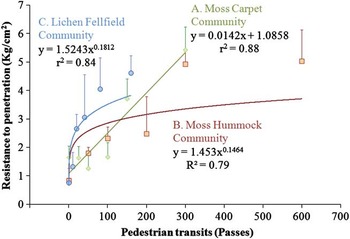
Soil characteristics differ between communities (Table I). Data obtained on resistance to penetration are shown in Fig. 4. Whereas initial values on soil compaction were similar (c. 1 kg cm-2) for communities A, B and C, final values varied. Moss carpet community (A) soils' compaction reached c. 300 passes without saturation when the simulation ended due to the total loss of vegetation in the community. Moss hummock community (B) has an intermediate compaction on a slow rate up to 600 passes when the experiment finished. Finally, lichen fellfield community (C) has the fastest saturation at 160 passes with the lowest maximum compaction of the three communities at the end of the simulation.
Physical features. Trampling intensity (passes) and resistance to penetration (kilogrammes per square centimetre) for trampling experiments at communities A, B and C.

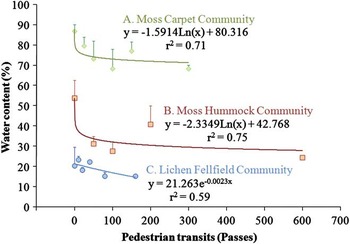
The moss carpet community (A) was the richest in water content. It contained 87% water content prior to the experiment and at the end of the experiment, water content fell to 67% (Fig. 5). All of the three communities showed water loss as a result of trampling. Water content in the moss hummock community (B) dropped from an initial value of 55% to 26%. In the lichen fellfield community (C) water content fell from 24% to 18%.
Hydrological features. Trampling intensity (passes) and water content (percentage in weight) for trampling experiments at communities A, B and C.

Biological effects of trampling
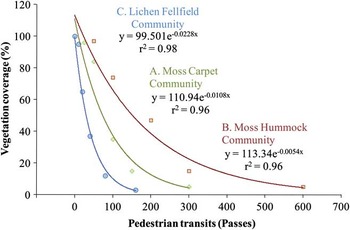
Trends of biological parameters are shown in Figs 6 & 7. For all three communities, loss of vegetation coverage as a consequence of increased trampling followed a negative exponential model, although the variation rate was different for each community (Fig. 6). The lichen fellfield community (C) exhibited the fastest rate, whereas the moss hummock community (B) showed the lowest of the three.
Biological features (I). Trampling intensity (passes) and vegetation coverage (percentage) for trampling experiments at communities A, B and C.

The visual details of the denudation process were quite different for each community (Fig. 3). The moss carpet community (A) showed an initial resistance. During the first 10–15 passes, while footprints were visible, the structure of the community was apparently unaffected. At around 25 passes, first scars were observed and, as soon as the cohesion was damaged, the fissures advanced rapidly. Due to the high water content of this vegetation the fragmented portions formed a muddy mass. At c. 300 passes the muddy mass had become sufficiently eroded to reveal bare ground and allow puddles of water to form. Seventy-eight passes were sufficient to result in loss of 50% of the vegetation cover (Fig. 6).
The moss hummock community (B), growing on raised beach terraces, was drier and easier to walk on. The vegetation appeared to be firmer and exhibited a higher resistance than that of Community A. To disturb the cohesion required around 50 passes and scars were only produced in the bigger tufts which were more exposed as trampling continued and the vegetation was crushed instead of turning into a muddy mass as in the case of Community A. Loss of macroscopic moss coverage was not seen even up to 600 passes. One hundred and forty seven passes were needed to cause a loss of 50% of the vegetation cover (Fig. 6).
Lichen fellfield community (C) was easily fractured with less than 10 passes, as the dominant lichen had a crunchy texture when dry. Total loss of plant cover was evident at 160 passes. Thirty-nine passes were sufficient to result in 50% loss of vegetation cover (Fig. 6).
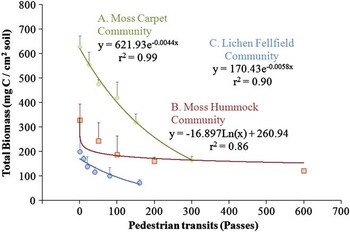
Finally, total biomass per square centimetre of soil on experimental plots was quantified to contrast with plant coverage loss (Fig. 7). The moss carpet community (A) contained the highest initial biomass of 629 mg C cm-2. Approximately 74% of the initial biomass was removed in the experimental process, leaving a final 165 mg C cm-2 soil at the end of the trampling experiment. The moss hummock community (B) had initially a 52% lower biomass content than in A. Biomass content in B was at 328 mg C cm-2 soil prior to trampling and was 121 mg C cm-2 soil after trampling, corresponding to a 63% loss. The lichen fellfield community (C) contained the lowest biomass content. It was slightly lower than in B (60%) and much lower than in A (31%). Biomass content in C began at 200 mg C cm-2 soil before trampling and ended at 72 mg C cm-2 soil after trampling, corresponding to a 68% biomass loss.
Biological features (II). Trampling intensity (passes) and total biomass (milligrams per cm2 soil) for trampling experiments at communities A, B and C.

Discussion
Most of the mosses found in the samples from the three communities are common on Livingston Island (Sancho et al. Reference Sancho, Schulz, Schoeter and Kappen1999, Putzke & Pereira Reference Putzke and Pereira2001, Ochyra et al. Reference Ochyra, Smith and Bednarek-Ochyra2008), but two of them were reported for the first time for the island: Pohlia wahlenbergii, already known from other islands in the South Shetland Islands, and Brachythecium subpilosum, a new report for the archipelago (Reference Lara and PertierraLara & Pertierra 2012). Both species have small known Antarctic populations (Ochyra et al. Reference Ochyra, Smith and Bednarek-Ochyra2008). Liverworts are not well represented in Antarctica, and the tiny Cephaloziella varians is the most common and most widespread liverwort in Antarctica (Newsham Reference Newsham2010), and is abundant on Livingston Island (Sancho et al. Reference Sancho, Schulz, Schoeter and Kappen1999). The lichen Leptogium puberulum and the vascular plant Deschampsia antarctica one of the two phanerogams native to maritime Antarctica are representative components of the local flora (Lindsay Reference Lindsay1971, Sancho et al. Reference Sancho, Schulz, Schoeter and Kappen1999). Communities that are richer in biodiversity are likely to harbour rare species, presumably with populations that are easily disturbed, although further studies will be needed before it could be determined if these populations are threatened.
Physical effects on soils
The pH ranges from slightly acidic (Communities A and B) to neutral (Community C), which is consistent with data obtained for this area by other authors (Navas et al. Reference Navas, López-Martínez, Casas, Machín, Durán, Serrano, Cuchi and Mink2008). These results correspond to oligotrophic sand soils. Organic matter and electrical conductivity in Community C were found to be slightly higher than in the other two sites, but within the range of values quoted in previous studies (Roser et al. Reference Roser, Seppelt and Nordstrom1994).
Soil resistance to penetration proves to be a good indicator for assessing cumulative trampling effects in soils. It is noteworthy that, after the plant layer is pierced, the soil surface starts to act in the same way as bare soils (Fig. 3). The increase in penetration with increased trampling in Fig. 4 are similar to those found by Tejedo et al. (Reference Tejedo, Justel, Benayas, Rico, Convey and Quesada2009) for bare soil, and these values could in themselves be sufficient to disturb the existing edaphic fauna. Soil characteristics such as texture also differed among communities (Table I). Therefore the observed differences can be also explained by the physical properties of the soils of the different communities soils, such as bulk density (Tejedo et al. Reference Tejedo, Justel, Benayas, Rico, Convey and Quesada2009). Our results show that drier areas with less dense vegetation were more sensitive to disturbance from trampling. The presence of vegetation prevented compaction by protecting the soil below.
In all three cryptogamic communities, water loss was consistently proportional to trampling (Fig. 5). We found that extreme conditions in water content affected negatively the plant resistances. As a result the moss hummock community (B) had in this case the highest resistance capacities. The moss carpet community (A) had the highest water content and hence exhibited the least resistance to trampling. In the lichen fellfield community (C), we also detected a diminished resistance that could be explained by the extreme dryness of the vegetation due to the particular environmental conditions that were present during the period of our experiments. For this reason it can be argued that resistance of the communities to trampling can be severely affected by meteorological conditions. Differences in resistance to penetration could be also linked to the initial water content of the community.
In contrast, soil moisture did not change much between communities nor along the transect (Supplemental Table), indicating that it was not affected by the trampling process. Long-term effects of trampling remain to be seen. Lower water retention due both to compaction increase and vegetation loss by trampling could lead to shifts in species composition. This projection can be exemplified by the results of Gremmen et al. (Reference Gremmen, Smith and van Torengen2003) who found significant differences in species composition and soil moisture between control plots and frequented paths on Marion Island.
Biological disturbances
Damages to vegetation are perhaps the most evident impacts from trampling (Fig. 3). The continuous and spongy moss carpets, rich in biomass and with a high water content, can absorb a small amount of disturbance. But, as soon as their initial capacity to resist disturbance is surpassed, the damage grows linearly with the amount of disturbance. Our results are similar to those of de Leeuw's (1994) obtained from moss peat vegetation on Cuverville Island, Danco Coast. In moss hummock communities the damage is gradual and is tempered by the physical characteristics of the community. Drier soils and strong attachment to the substrate could prevent moss from direct damage. These communities appear to be more resistant to trampling, but we must ascertain whether, when certain levels are surpassed, the damage becomes irreversible due to extreme loss of water availability or a thinner soil layer. Finally, lichen fellfield communities show a low degree of vegetation resistance to trampling due to its extreme dryness and the morphology of the dominant lichen with the mixed mosses, which are weakly attached to the substrate. Direct damage can be observed after a very small amount of disturbance.
Amount of vegetation cover and visual changes served as preliminary indicators for assessing degradation status and resistance capacity of cryptogamic communities in relation to different intensities of trampling (Figs 3 & 6). However, vegetation is frequently patchy and circumstantial disaggregation can be difficult to unequivocally distinguish from the effects of human trampling. If new species are found, it might be necessary to monitor small plots in order to assess the effects of disturbance on plant richness. Thus, this indicator relies on the existing reference conditions (Fretwell et al. Reference Fretwell, Convey, Fleming, Peat and Hughes2011). Alternatively the technique applied by Gremmen et al. (Reference Gremmen, Smith and van Torengen2003) involved comparing species composition along the path against composition on either side of it. That technique overcomes the need for long time series in sites without information on possible changes in species composition when assessing already impacted areas.
With the present results, i.e. 50% cover loss within less than 200 passes (Fig. 6), we consider all three communities as extremely sensitive to human trampling (Cole Reference Cole1995a, Reference Cole1995b, Farrell et al. Reference Farrell and Marion2001, Reference Farrell and Marion2002). Our results are similar to those of the most sensitive species described by Cole & Bayfield (Reference Cole and Bayfield1993), although their study was conducted on herbaceous vascular plants. While our trampling experiments may be indicating that these three cryptogamic communities in the Antarctic Peninsula have low short-term resistance to disturbance, it is possible that these communities possess high recovery capacities since cryptogams are characterized by their capacity for vegetative growth from fragmented units (Smith Reference Smith1993, Johansson & Thor Reference Johansson and Thor2008).
Total biomass decreased as the amount of disturbance increased (Fig. 7). This was particularly evident in the case of Community A (moss carpet community), where initial biomass was the largest. Trampling fragmented the vegetation which was scattered across the transect or washed away. A large fraction of the fragmented vegetation (c. 50% of biomass) remained in the transect in a damaged condition which can potentially act as a propagule bank. A key issue here involves whether the erosion exceeds the recovery capacity of the remaining biomass or the growth rate of new propagules (Smith Reference Smith1993, Johansson & Thor Reference Johansson and Thor2008).
Impact mitigation
Spatial strategies for minimizing impacts of trampling by visitors in national parks are discussed in Leung & Marion (Reference Leung and Marion1999) and, for the case of Antarctica, in Reference Tejedo, Pertierra, Benayas, Convey, Justel and QuesadaTejedo et al. (in press). Here we detail some lessons learnt from the present study for the minimization of damages to existing communities. First, due to the extreme sensitivity of cryptogamic communities, the best approach should always be to avoid disturbing them. Alternative routes should be considered. For instance, bare soils could be more resilient to low traffic. For this approach Tejedo et al. (Reference Tejedo, Justel, Benayas, Rico, Convey and Quesada2009) contains more detailed recommendations. Also, stream beds have traditionally been considered as another alternative route; however, there is little knowledge about the effects of human traffic on freshwater ecosystems.
To avoid short-term irreversible damage to moss carpet communities (A), access should be forbidden to any large groups. In general, shore visits for tourist groups are managed so that only 100 people are on shore at any one time, with one guide for every 20 tourists (IAATO 2011). These numbers are sufficient to cause severe damage which can easily spread over a large area. If the only option is to cross over an area covered by moss carpet communities, a sacrificial path that is precisely defined will be a more preferable solution than letting the group spread over a large area. Nonetheless this will not only inevitably lead to the destruction of the moss community along the path but will also turn the path into a muddy area. This is due to the relatively high contents of water and biomass. These muddy areas are likely to expand as people try to avoid the existing muddy area by making detours, thereby increasing the width of the path and creating even more muddy areas, an idea expressed already in Gremmen et al. (Reference Gremmen, Smith and van Torengen2003) and recently reported in Barrientos Island (Ecuador & Spain 2012). Thus, from the perspective of the protection of these cryptogam communities group leaders should ensure that members of their group remain on the path. For small groups of no more than 1–5 people passing through this area once or twice, such as scientific expeditions, our recommendation would be that they spread out, since the trampling intensity is insufficient to produce direct impact as long as the trampling pressure is not reproduced. The impact can be easily spotted by the characteristic indentations on the moss carpet (Fig. 3).
In contrast, damage on moss hummock communities (B) can become difficult to detect since the visual impact is less identifiable than in A (Fig. 3). Large groups might not observe any visible damage after their pass and may feel free to walk there, but the damage is gradual and cumulative, and visitors should be restricted to the sacrificial path in order to avoid extended denudation processes. It should be remembered that, as found in the samples studied, this community contains a high diversity of bryophytes with rare moss species.
The lichen fellfield community (C) shows a high degree of sensitivity. Each pedestrian transit creates direct impact and spreading is not an option, not even for small groups. The impact on this community is not easily visualized due to the low biomass and cryptic colours, with dominant black and grey shades (Fig. 3). Elevated zones with exposed lichen formation should be avoided by groups to the maximum extent.
Conclusions
The three cryptogam communities studied are all highly sensitive to trampling. Vegetation cover, soil characteristics, water content and biomass were identified as relevant aspects for the understanding of the denudation process. High sensitivity was related to extreme hydration and relatively large biomass in one community and to extreme dryness and a weak attachment of plants to the substratum in another community. The three communities behaved differently in the trampling experiments but they all exhibited low resistance of the vegetation to trampling. Different strategies are suggested to minimize the impacts of trampling; nonetheless the basic recommendation provided by SCAR (2009) to directly avoid sensitive habitats would be the first measure to apply to all these communities. The capacity for a sustainable recovery from trampling disturbances within the context of global change relies on appropriate management systems addressing the relative vulnerabilities of terrestrial ecosystems in Maritime Antarctica (Reid Reference Reid2007, Tin et al. Reference Tin, Fleming, Hughes, Ainley, Convey, Moreno, Pfeiffer, Scott and Snape2009, Convey Reference Convey2010). Thus, a key issue for the future would then involve the study and monitoring of the resilience of the plant communities.
Acknowledgements
This paper was contributed to by two projects: LIMNOPOLAR and EVA-ANTARCTICA. They were supported by the Spanish Government (POL2006-06635, CGL2007-28761-E/ANT and CTM2009-06604-E). Permission to work in the study area for the 2009–10 season was granted by the Spanish Polar Committee. Logistical support was provided by the UTM (Marine Technology Unit, CSIC) and the Spanish Navy. We thank Dr Lars Wormer (University of Bremen, Germany) for his “trampling” field support. Thanks also to Dr Jerónimo López-Martinez from the Autonomous University of Madrid, for the provision of Byers cartography. We also thank two anonymous reviewers for their useful comments. Finally, we have special thanks to Dr Tina Tin for her frequent advice that greatly improved the paper.
Supplemental material
A supplemental table will be found at http://dx.doi.org/10.1017/S095410201200082X