Introduction
The association between an increased risk of mortality and medical conditions has been extensively investigated. Chronic diseases such as cancer, coronary heart disease, respiratory disease, diabetes mellitus, cerebrovascular disease and dementia are among the most important predictors increasing mortality in older adults (Ostbye et al. Reference Ostbye, Hill and Steenhuis1999; Garssen & Hoogenbeezem, Reference Garssen and Hoogenbeezem2005; Donnan et al. Reference Donnan, Fisher, Macleod and Davis2008; Janssen et al. Reference Janssen, Kunst and Mackenbach2008). In addition, common mental disorders such as depression substantially increase the risk of death, both by unnatural causes and by their detrimental effects on physical health (Murphy et al. Reference Murphy, Monson and Olivier1987; Penninx et al. Reference Penninx, Geerlings, Deeg, Van Eijk, van Tilburg and Beekman1999; Geerlings et al. Reference Geerlings, Schoevers, Beekman, Jonker, Deeg, Schmand, Ader, Bouter and Van Tilburg2000; Schoevers et al. Reference Schoevers, Geerlings, Beekman, Penninx, Deeg, Jonker and Van Tilburg2000; Holwerda et al. Reference Holwerda, Schoevers, Dekker, Deeg, Jonker and Beekman2007). Much less is known about the association between social conditions such as social isolation and feelings of loneliness and mortality risk.
With age, the number of social relationships decreases. Apart from physical ageing and diminished resilience, older persons are prone to becoming lonely due to loss of intimate relationships. Loneliness has been recognized as a clinically important frailty factor in older persons, associated with psychosocial problems, mental disorders such as depression, as well as physical problems. These include increased systolic blood pressure, higher vulnerability for heart conditions, sleeping problems, increased fibrinogen and natural killer cell responses to stress and greater cognitive decline (Cacioppo et al. Reference Cacioppo, Hawkley, Berntson, Ernst, Gibbs, Stickgold and Hobson2002a, Reference Cacioppo, Hawkley, Crawford, Ernst, Burleson, Kowalewski, Malarkey, Cauter and Berntsonb; Wilson et al. Reference Wilson, Bienias, Mendes de Leon, Evans and Bennett2003; Steptoe et al. Reference Steptoe, Owen, Kunz-Ebrecht and Brydon2004; Tilvis et al. Reference Tilvis, Kähönene-Väre, Jolkkonen, Valvanne, Pitkala and Strandberg2004; Hawkley et al. Reference Hawkley, Masi, Berry and Cacioppo2006;Wilson et al. Reference Wilson, Krueger, Arnold, Schneider, Kelly, Barnes, Tang and Bennett2007; Luanaigh & Lawlor, Reference Luanaigh and Lawlor2008). Evidence emerges that loneliness is at the core of a complex constellation of socio-emotional states that include self-esteem, mood, anxiety, anger, optimism, fear of negative evaluation, shyness, social skills, social support and sociability (Cacioppo et al. Reference Cacioppo, Ernst, Burleson, McClintock, Malarkey, Kowalewski, Paulsen, Hobson, Hugdahl, Spiegel and Berntson2000; Boomsma et al. Reference Boomsma, Willemsen, Dolan, Hawkly and Cacioppo2005). To date, very few studies have examined whether loneliness may also be associated with longevity, especially when controlling for other potentially confounding factors (Penninx et al. Reference Penninx, Van Tilburg, Kriegsman, Deeg, Boeke and Van Eijk1997).
Loneliness is typically defined in relation to indices of social integration such as marital status, contacts with close friends or family, and lack of social integration and ‘embeddedness’. This is often referred to as ‘social loneliness’ or social isolation (Helmer et al. Reference Helmer, Damon, Letenneur, Fabrigoule, Barberger-Gateau, Lafont, Fuhrer, Antonucci, Commenges, Orgogozo and Dartigues1999; Fratiglioni et al. Reference Fratiglioni, Wang, Ericsson, Maytan and Winblad2000; De Jong Gierveld & Van Tilburg, Reference De Jong Gierveld and Van Tilburg2008; Luanaigh & Lawlor; Reference Luanaigh and Lawlor2008). However, individuals vary in the way they perceive their social context. Another definition of loneliness is based on the discrepancy between a person's desired and actual relationships. This subjective experience – feeling lonely – is often referred to as perceived or emotional loneliness (De Jong Gierveld & Van Tilburg, Reference De Jong Gierveld and Van Tilburg2008; Luanaigh & Lawlor, Reference Luanaigh and Lawlor2008). Earlier studies generally did not make this distinction between actual contextual factors and the subjective experience of loneliness (Berkman & Syme, Reference Berkman and Syme1979; Fratiglioni et al. Reference Fratiglioni, Wang, Ericsson, Maytan and Winblad2000). It is highly relevant to assess whether the untoward consequences of loneliness concern the actual situation of being alone or the perceived lack of embeddedness. It has been argued that networks influence physical and mental health through different pathways such as social support, social influence, access to resources and material goods and through social engagement and attachment. These psychosocial and behavioural processes are thought to influence more proximate pathways to health status including direct physiological stress responses, psychological states and traits including self-esteem, self-efficacy and security, health-damaging and health-promoting behaviour and exposure to diseases. Accordingly, adverse health conditions can be either the result of macrosocial forces, a limited social network and lack of social support (a status of being alone), or a consequence of an emotional state (feelings of loneliness) that relates to biological responses that are potentially relevant to health, or both (Berkman et al. Reference Berkman, Glass, Brisette and Seeman2000; Steptoe et al. Reference Steptoe, Owen, Kunz-Ebrecht and Brydon2004). The question remains to what extent social isolation and feelings of loneliness contribute to health outcome.
Apart from being the consequence of (objective) environmental characteristics or the subjective experience of being lonely, loneliness has also been conceptualized as a stable personality trait, with different individual set-points for these feelings in different individuals, and with differences between men and women. Both environmental and genetic components are thought to contribute to these individual variations. Men are thought to be more vulnerable as a result of forming less close and enduring relationships outside marriage (Dykstra & De Jong Gierveld, Reference Dykstra and De Jong Gierveld2004; Boomsma et al. Reference Boomsma, Willemsen, Dolan, Hawkly and Cacioppo2005).
Loneliness may also be a symptom of depression. A study by Stek et al. (Reference Stek, Vinkers, Gussekloo, Beekman, Van der Mast and Westendorp2005), however, showed that people who feel lonely often do not meet the criteria for a depressive disorder. Loneliness and depression are considered to be distinct entities (Luanaigh & Lawlor, Reference Luanaigh and Lawlor2008).
It thus remains unclear whether social isolation and feelings of loneliness are associated with an increased risk of mortality. Furthermore, to our knowledge no studies have examined whether such an association is different in men and women, although social and individual differences between men and women are present (Berkman et al. Reference Berkman, Glass, Brisette and Seeman2000). Also as far as we know, no studies have been performed to ascertain whether such an association is explained by potentially confounding factors such as depression, somatic illnesses and other health characteristics.
We hypothesized that feelings of loneliness are psychological experiences with adverse effects on health associated with increased mortality, with men being more vulnerable than women. The current study investigates whether feelings of loneliness, rather than social isolation factors, are associated with an increased risk of mortality in men and women in our large cohort of community-dwelling older persons, while controlling for social isolation and potentially confounding influences of mental disorders, somatic conditions and diseases, cognitive functioning, functional status and sociodemographic factors.
Method
Study cohort
Residents of the city of Amsterdam were recruited in The Amsterdam Study of the Elderly (AMSTEL) using the registers of 30 general practitioners (Van Ojen et al. Reference Van Ojen, Hooijer, Jonker, Lindeboom and Van Tilburg1995; Geerlings et al. Reference Geerlings, Schoevers, Beekman, Jonker, Deeg, Schmand, Ader, Bouter and Van Tilburg2000; Schoevers et al. Reference Schoevers, Geerlings, Beekman, Penninx, Deeg, Jonker and Van Tilburg2000, Reference Schoevers, Geerlings, Deeg, Holwerda, Jonker and Beekman2009). Subjects were included if they were over age 65 years and younger than 84 years, and were randomly selected from four age categories of 5 years each. The population over the age of 65 years (15%) and the age and gender distribution were representative of the Amsterdam population aged 65 years and older. In total, 5666 residents were approached of whom 4051 agreed to participate (71.5%). Non-response in the population aged under 75 years was associated with poor cognitive functioning and with a poor medical condition. In the population aged over 75 years, no associations with non-response were found (Launer et al. Reference Launer, Wind and Deeg1994). A home assessment by means of a structured interview was performed by trained and supervised interviewers. For follow-up analyses mortality data were 98.8% complete, leaving 4004 participants for this study.
Measurements
Assessment of social isolation and feelings of loneliness
At baseline, social isolation and feelings of loneliness were assessed in men and women. Social isolation was operationalized as either living alone or not/no longer being married or by the lack of social support (the question was asked if participants were getting help from family, neighbours or home support). Marital status, living arrangement and social network have earlier been recognized and investigated as risk factors in studies on prognosis of older adults (Helmer et al. Reference Helmer, Damon, Letenneur, Fabrigoule, Barberger-Gateau, Lafont, Fuhrer, Antonucci, Commenges, Orgogozo and Dartigues1999; Fratiglioni et al. Reference Fratiglioni, Wang, Ericsson, Maytan and Winblad2000). Feelings of loneliness were operationalized as experiencing loneliness (the subjective feeling of loneliness) by the participant when asked by the interviewer: do you feel lonely? Both were assessed by a structured clinical interview (AMSTEL, see below).
Assessment of mortality
The vital status of male and female participants was ascertained up to 1 January 2001 through linkage with the registers of the municipality of Amsterdam or the municipalities in which participants had relocated during the study period. The participants' survival time was calculated on a monthly basis with a follow-up period up to 1 January 2001 with an average follow-up of 117.8 months (109.2 to 127.2 months).
Assessment of potentially confounding and explanatory variables
At baseline, psychiatric disorders (including minor and major depression and generalized anxiety disorder), medical disorders and conditions (including ischaemic heart disease, cerebrovascular disease, respiratory disease, diabetes, hypertension, cancer, arthritis/arthrosis, epilepsy, Parkinson's disease and dementia), smoking and drinking behaviour, cognitive and daily functioning and demographic characteristics (including educational level) were assessed by means of the structured AMSTEL interview. This structured interview includes the Geriatric Mental State Examination (GMS AGECAT; Launer et al. Reference Launer, Wind and Deeg1994), a diagnostic system with diagnoses of (neuro) psychiatric disorders (in our study depression, generalized anxiety disorder and dementia) and severity of the disorders on 5 levels. Levels 3–5 represent valid clinical cases – dementia, minor (level 3) and major (level 4, 5) depression, and generalized anxiety disorder – whereas levels 1–2 represent subcases of depression, generalized anxiety disorder and cognitive impairment no dementia (CIND) (Copeland et al. Reference Copeland, Dewey and Giffith-Jones1986, Reference Copeland, Dewey, Wood, Searle, Davidson and McWilliam1987, Reference Copeland, Davidson, Dewey, Gilmore, Larkin, McWilliam, Saunders, Scott, Sharma and Sullivan1992). The assessment of psychiatric and medical disorders, past and family history on psychiatric and medical disorders and cognitive functioning was performed using the Cambridge Mental Disorders of the Elderly Examination (CAMDEX; Roth et al. Reference Roth, Tym, Mountjoy, Huppert, Hendrie, Verma and Goddard1986) which has sections on present and past state of psychiatric and medical functioning and on neuropsychological functioning using the cognitive section of CAMDEX (known as the CAMCOG) and the Mini Mental State Examination (Folstein et al. Reference Folstein, Folstein and McHugh1975), smoking (20 cigarettes/day during at least 1 year in the past or currently) and drinking (alcohol abuse: four or more/day in the past or currently) behaviour and the activities of daily living (ADL) and instrumental activities of daily living (IADL) scales (Katz et al. Reference Katz, Ford, Moskowitz, Jackson and Jaffe1963; Lawton & Brody, Reference Lawton and Brody1969).
Statistical analysis
Descriptive (χ2) statistics were used to characterize baseline data, to assess differences between men and women at baseline on social isolation, feelings of loneliness and potentially confounding factors and to assess whether feeling of loneliness were more prevalent in socially isolated male and female subgroups. Mortality ratios for men and women were calculated for all risk factors potentially associated with excess mortality in bivariate analyses, to assess which risk factors to adjust for in the multivariate model. The associations between the social isolation factors, feelings of loneliness and mortality (when controlling for other variables) were calculated using separate Cox proportional hazard regression models. The interaction between feelings of loneliness and gender was assessed and added to this model. Results are presented as hazard ratios (HRs) for men and women separately, and adjusted for separate social isolation factors and/or feelings of loneliness, depression (also including subthreshold depression), age and education, pre-existing ischaemic heart disease, cerebrovascular disease, diabetes, cancer, respiratory disease, arthritis/arthrosis, epilepsy and Parkinson's disease, and cognitive and daily functioning. In order to control for confounding, bivariate associations between depression and social support status were assessed using both a dichotomous and a continuous depression variable incorporating the five severity/caseness levels provided in GMS AGECAT. If such an association was found, an interaction term was added to the model in multivariate analyses. Kaplan–Meyer curves were created to visualize the association between feelings of loneliness and excess mortality in men and women.
Results
Characteristics of the study population at baseline (n=4004)
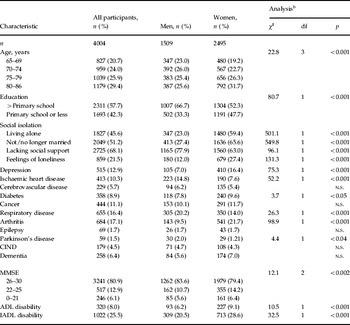
Table 1 summarizes baseline data on the most important variables under review. Men and women differed significantly for most conditions. More women (27.4%) than men (12.0%) reported feelings of loneliness and more women (59.4%) than men (23.0%) were living alone. Men (72.6%) were more often married than women (34.4%), and women more often were receiving social support (37.0%) than men (22.1%). Male participants had higher education, and more often had ischaemic heart disease, respiratory disease, Parkinson's disease and (a history of/met criteria of) alcohol abuse and smoking. Female participants had higher levels of functional limitations, depression, generalized anxiety disorder, arthritis/arthrosis, hypertension, cardiac arrhythmias and diabetes than men. No differences between men and women were found in diagnosis of epilepsy and cancer, CIND and dementia.
Characteristics of male and female participants at baseline (n=4004)Footnote a

df, Degrees of freedom; n.s., non-significant (p>0.05); CIND, cognitive impairment no dementia; MMSE, Mini Mental State Examination; ADL, activities of daily living; IADL, instrumental activities of daily living.
a Data of generalized anxiety disorder, hypertension, cardiac arrhythmias, alcohol abuse and smoking not shown.
b χ2 test for differences between men and women in bivariate analysis.
Within subjects who were living alone or who were unmarried, more women than men reported feelings of loneliness (p<0.001). In subjects without social support, more men than women perceived feelings of loneliness (p<0.001) (data not shown).
Feelings of loneliness and associated 10-year mortality (n=4004)
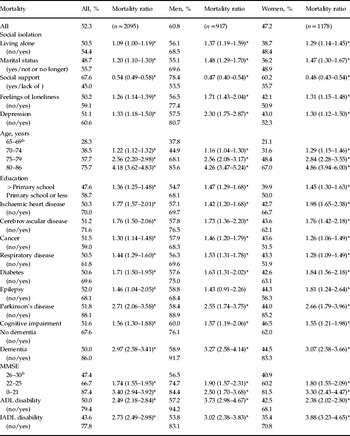
At 10 years follow-up, the overall risk of mortality was 52.3% (men 60.8% and women 47.2%). The mortality rate in persons living alone was 54.4% (men 70.3%, women 50.7%); in those who were not or no longer married this was 55.7% (men 71.9%, women 51.7%). In persons without social support the mortality rate was 45.0% (54.8% of men and 37.6 of women). The mortality rate in older persons with feelings of loneliness was 59.1%; 78.9% of men and 53.9% of women experiencing these feelings had died. Table 2 shows bivariate associations between potential risk factors and 10-year mortality. Living alone, not or no longer being married and feelings of loneliness were associated with an increased risk of mortality in both genders. Mortality ratios were 1.37 [95% confidence interval (CI) 1.19–1.59] for men and 1.29 (95% CI 1.14–1.45) for women living alone, 1.48 (95% CI 1.29–1.70) for men and 1.47 (95% CI 1.30–1.67) for women not or no longer married and 1.71 (95% CI 1.43–2.04) for male participants with feelings of loneliness and 1.31 (95% CI 1.15–1.48) for female participants with these feelings. No increased mortality was found in men and women lacking social support.
Bivariate associations between risk factors and excess mortality (10-year follow-up, n=4004)Footnote a

MMSE, Mini Mental State Examination; ADL, activities of daily living; IADL, instrumental activities of daily living.
a Percentages of mortality in participants without and with condition. Mortality ratios for men and women [deceased or alive on 1 January 2001, % deceased of baseline category, first row mortality (%) without condition, second row with condition unless otherwise specified, odds ratios with 95% confidence intervals]. Data of generalized anxiety disorder, hypertension, cardiac arrhythmias, arthrosis/arthritis, alcohol abuse and smoking are not shown.
b Reference category.
* Significant mortality ratio (p<0.05).
Nearly all other potentially confounding factors were also associated with an increased risk of mortality in bivariate analysis, except arthrosis/arthritis, hypertension, generalized anxiety disorder, smoking and alcohol abuse. In participants who did not have social support, an opposite association was found in bivariate analysis. We explained this by hypothesizing that those needing more support were in poorer health. We found indeed that in participants receiving social support, significantly greater numbers suffered from conditions such as ischaemic heart disease, cerebrovascular disease, respiratory disease, arthrosis/arthritis, diabetes, hypertension, cardiac arrhythmias, Parkinson's disease, depression, generalized anxiety disorder, CIND, dementia, ADL and IADL disabilities (data not shown).
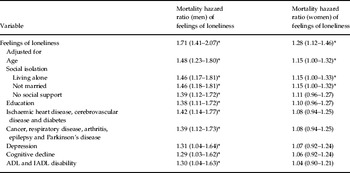
Table 3 shows the association between 10-year risk of mortality and feelings of loneliness in male and female participants, with adjustment for all potentially confounding factors. Results are presented in HRs for time to death. Cox proportional hazard analyses showed that after adjustment for social isolation, age and education, depression (including subthreshold depression), ischaemic heart disease, cerebrovascular disease, diabetes, cancer, respiratory disease, arthritis, epilepsy, Parkinson's disease, cognitive functioning and functional status the association of feelings of loneliness with an increased mortality risk remained significant in men (HR 1.30, 95% CI 1.04–1.62) and lost significance in women (HR 1.01 95% CI 0.87–1.17).
Mortality hazard ratios of feelings of loneliness with time for death, with successive adjustment for potential risk factors and explanatory variablesFootnote a

ADL, Activities of daily living; IADL, instrumental activities of daily living.
a Mortality hazard ratios for men and women (deceased or alive on 1 January 2001) with successive adjustment for potential confounders using Cox proportional hazards model, with 95% confidence intervals.
* Significant mortality ratio (p<0.05).
In multivariate analysis no increased risk of mortality was found in socially isolated older adults. HRs were 0.88 (95% CI 0.65–1.19) for men and 0.96 (95% CI 0.78–1.20) for women living alone and 1.21 (95% CI 0.91–1.59) for men and 1.07 (95% CI 0.85–1.34) for women who were not/no longer married (data not shown). However, in men without objective determinants of social isolation (living with others and being married), feelings of loneliness were also associated with an increased risk of mortality. The association between feelings of loneliness and mortality was 1.62 (95% CI 1.14–2.29) for men living with others, HR 1.60 (95% CI 1.13–2.27) for married men, and HR 1.33 (95% CI 0.95–1.87) for men receiving social support. In women living with others, being married or receiving social support, no increased mortality was found in relation to feelings of loneliness (data not shown). Finally, a strong interaction was found between feelings of loneliness and gender (p<0.0001).
In bivariate analysis both the dichotomous and continuous depression variable was not associated with not having social support but instead was associated with receiving social support in both men and women (Pearson χ2p<0.000). However, we found no significant interaction between depression and having social support in either men or women (p=0.90 and 0.12) in the multivariate model. Thus, the association between no social support as a measure of social isolation and mortality was not confounded by depression. These data show again that feelings of loneliness independently raise mortality risk and are not dependent on actual social isolation and depression.
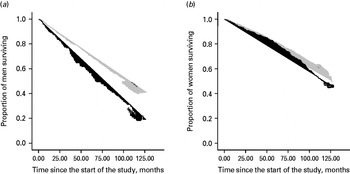
Kaplan–Meier analysis demonstrates that feelings of loneliness are associated with increased mortality in men but not in women (Fig. 1 a, b)
Kaplan–Meier survival curves for feelings of loneliness in men and women (proportion of subjects who survived); cumulative survival. (▪), Feelings of loneliness; ( ), no feelings of loneliness. (a) Association between feelings of loneliness and mortality in men (log rank test 31.8, degrees of freedom 1, p<0.000). (b) Association between feelings of loneliness and mortality in women.

Discussion
This study examined whether feelings of loneliness rather than social isolation factors are related to an increased mortality risk in community-dwelling older persons, and whether this correlation may be different for men and women.
We found that overall, more women than men were socially isolated in terms of not or no longer being married and living alone (p<0.001), but that women were receiving more social support than men (p<0.001). We also found that subjective feelings of loneliness have a high prevalence in both men (12.0%) and women (27.5%). Although feelings of loneliness were more prevalent in women (p<0.001), such feelings were associated with increased mortality only in older men, when controlling for potentially confounding factors. There was a strong interaction between feelings of loneliness and gender (p<0.0001), confirming a differential association with excess mortality in men and women. After adjustment for social isolation (living alone, not having a marital partner and not receiving social support), depressive disorder (including subtheshold depression), demographic characteristics, common medical disorders, cognitive functioning and functional disabilities, older men who reported feelings of loneliness were 30% more likely to have died at 10-year follow-up. In contrast, social isolation was no longer associated with excess mortality in multivariate analysis.
Interpretation
Feelings of loneliness and excess mortality
Loneliness – like depression, anxiety and anger – has been described as an internal emotional state, with lowered mood and clinical distress negatively influencing mental health and physical well-being. There is some evidence of loneliness stimulating psychobiological pathways involving central nervous system activation of neuroendocrine, autonomic and immune responses with potentially adverse biological effects on physical health (Steptoe et al. Reference Steptoe, Owen, Kunz-Ebrecht and Brydon2004). Loneliness may play a causal role in the development and maintenance of depression, but has also been identified as a vulnerability factor that, separate from depression, may contribute to suicidal ideation, suicide attempts, self-inflicted injury and suicide completion (Heinrich & Gullone, Reference Heinrich and Gullone2006).
An explanation for the association between feeling lonely and increased mortality could be that these feelings are an indicator of personality traits such as a low self-esteem, sensitivity to rejection, shyness, deficiency in social skills or a personality disorder (i.e. avoidant and borderline personality disorder). These personality characteristics could accelerate mortality by increasing vulnerability to psychological distress and negative emotions, causing both depression and suppression of anger, factors associated with increased mortality (Wilson et al. Reference Wilson, Bienias, Mendes de Leon, Evans and Bennett2003). Recent findings show that conscientiousness, extraversion and openness are inversely related to all-cause mortality. Persons with these characteristics are more likely to engage in healthy behaviours such as regular exercise, better adherence to medical recommendations, having social interactions that decrease the impact of stress, and are less likely to be heavy smokers or drinkers (Iwasa et al. Reference Iwasa, Masui, Gondo, Inagaki, Kawaai and Suzuki2008). Evidence also suggests that personality traits are related to neuroendocrine alterations in hypothalamic–pituitary–adrenal axis function, neuroanatomical alterations in hippocampus and anterior cingulate cortex and alterations in neurotrophin and serotonergic signalling pathways (Foster & MacQueen, Reference Foster and MacQueen2008). Feelings of loneliness could be concomitant to (one of) these traits, and, like depression, could cause these neuroendocrine and neuroanatomical alterations. The question remains whether the observed increased risk of mortality in older persons with feelings of loneliness is causal or whether these feelings are a (subclinical) manifestation of another condition (e.g. genetic factor, vulnerability/frailty factor or unknown condition).
Gender differences
To our knowledge, previously no hypotheses have been developed to explain the mortality gap between men and women associated with feelings of loneliness. However, from several studies it is known that fundamental biological differences between the genders, such as differences in genetics and the immune system [human leukocyte antigen (HLA) haplotypes] may play a role through a different response to stress between men and women. Oestrogens have a beneficial effect on immune-inflammatory responses, which could also possibly account for the different mortality patterns between men and women (Candore et al. Reference Candore, Balisteri, Listi, Grimaldi, Vasto, Colonna-Romano, Franceschi, Lio, Caselli and Caruso2006; Choi & McLaughlin, Reference Choi and McLaughlin2007; Oksuzyan et al. Reference Oksuzyan, Juel, Vaupel and Christensen2008). From studies on loneliness, depression, health-seeking behaviour and longevity, we know that older men are particularly reluctant to disclose emotional distress and are more likely to find an intimate attachment in marriage, whereas women may also find protection from loneliness in other social ties. For men, more than women, a marriage bond appears to play a pivotal role in the involvement with others (Van Grootheest et al. Reference Van Grootheest, Beekman, Broese van Groenou and Deeg1999; Murray et al. Reference Murray, Banerjee, Byng, Tylee, Bhugra and McDonald2006). With men possibly being more vulnerable to emotional distress and to loss of an intimate marriage attachment, this could account for the mortality gap in feelings of loneliness.
Strengths and limitations
The strengths of this study include its large sample size, with a virtually complete ascertainment of vital status over a long (10-year) period. Furthermore, the study contains a wide range of medical, individual and social risk factors that, in this combination, are rarely available in other studies. The fact that the study was performed in community-dwelling older persons underlines the importance of these findings for public health. Data were collected by means of a structured interview performed by trained and supervised interviewers. Patients' self-report on chronic diseases and conditions have been shown to be fairly accurate (Kriegsman et al. Reference Kriegsman, Penninx, Van Eijk, Boeke and Deeg1996). By analysing the effects of both an objective estimation of social embeddedness and the individual perception of loneliness, the study was able to focus on the actual meaning that people attach to such circumstances, in line with a deepening understanding of the concept of loneliness.
Some limitations also warrant discussion. First, despite the ability to distinguish between feelings of loneliness and social isolation, we were not able to use a more extensive loneliness scale for measuring the severity and extent of loneliness and thereby ascertain structural aspects of social relationships (such as number of contacts and network size). At the time of the first wave of the study, the questionnaire used represented a reliable instrument for measuring social integration, and there are obvious advantages to using a short questionnaire when interviewing large numbers of respondents. However, this simplicity is also a weakness. The question ‘Do you feel lonely?’ presumes an understanding of the concept of loneliness by participants. Both the nature and meaning of the concept may vary among different groups of people and over time. Still, the use of a single-question self-rating scale to measure loneliness has been widely used in both Europe and North America. It was found to be highly acceptable to research participants. By asking directly about loneliness, it offers the possibility of describing a personal experience, while loneliness scales ask about loneliness in an indirect way by relating it to social networks and the availability of relationships. Especially in older persons, such a single question may not necessarily be less valid as older persons are less likely to admit feeling lonely as they consider loneliness as stigmatizing (Victor, Reference Victor2005). In the primary-care setting where time is often limited, the use of a limited number of questions is time efficient and mandatory and does appear to identify people with a problem of clinical significance that needs to be addressed by health-care workers (Luanaigh & Lawlor, Reference Luanaigh and Lawlor2008). A second potential limitation is that our definition of social isolation might be vulnerable to bias by depression. Reports about living alone and not being married are straightforward and probably not affected by depression status, but depressed persons may have an unduly negative view of their relationship to their social environment (Beck et al. Reference Beck, Ward, Mendelson, Mock and Erbaugh1961) and complaints of loneliness in elderly depressed patients may overemphasize actual isolation (Beck et al. Reference Beck, Ward, Mendelson, Mock and Erbaugh1961; Kay et al. Reference Kay, Beamish and Roth1964; Morgado et al. Reference Morgado, Raoux, Jourdain, Lecrubier and Widlocher1991a, Reference Morgado, Smith, Lecrubier and Widlocherb). We did find that depression was more prevalent in older persons who were receiving social support. However, we found no interaction between depression and social support in the multivariate model. A third limitation is that we are unable to exclude the possibility of residual confounding due to errors in the measurement of confounding variables or from measures which were not assessed. Examples of these are personality and personality disorders. Last, as our study was performed in a Caucasian population we do not know if our findings are generalizable to non-Caucasian populations.
Conclusions, implications for future research and therapeutic interventions
In later life, feelings of loneliness significantly increase the risk of death in older men, also when taking into account a comprehensive set of potentially confounding other risk factors associated with longevity. As this association remained after controlling for different aspects of social isolation, feeling lonely seems to have more to do with individual perceptions of (the quality of) social contacts and interactions than with the objective situation of being alone. Feelings of loneliness indicate a warning signal for approaching death in older men. Future work will need to establish whether feelings of loneliness are an indicator of central nervous system activation of neuroendocrine, autonomic and immune responses with adverse biological effects, an indicator of vulnerable personality traits or other unknown conditions accelerating mortality. It will also need to focus on the somatic and psychosocial differences between men and women with respect to these feelings. As an example, men who feel lonely may be more prone to develop an unhealthy life-style, or self-injurious and suicidal behaviour. Future research on loneliness using more extensive measures should seek to disentangle the different pathways involved in loneliness such as macrosocial forces, social networks, social support and emotional states and their relation to behavioural and biological responses including higher morbidity and mortality.
In terms of intervention, a number of approaches have been suggested to address social isolation. These include general education and information to inform the general public about the problem, promotion of expertise on social isolation in health-care professionals, social and personal activation of socially isolated individuals, courses to improve social skills and psychotherapy, e.g. dealing with the loss of a partner (Cattan et al. Reference Cattan, White, Bond and Learmouth2005; Van Tilburg & De Jong Gierveld, Reference Van Tilburg and De Jong2007). Further study is needed to clarify whether these interventions also have an impact on feeling lonely, and whether interventions would also be effective in reducing the excess risk of mortality in men.
Feelings of loneliness are a considerable individual risk, promoting distress and adverse health consequences that deserve clinical attention. Developing a better understanding of the nature of these feelings may help us to improve care and possibly develop interventions that may both enhance quality of life and increase lifespan, especially in older men.
Acknowledgements
For funding, this study received grants from The Netherlands Health Research Promotion Programme and The Netherlands Foundation of Mental Health. The study was approved by the Medical Ethical Committee, Vrije Universiteit Amsterdam.
Declaration of Interest
None.