1. Introduction
There is a growing body of prolific research which indicates that bilingualism affords advantages over monolingualism in executive control processes (e.g., Bak, Nissan, Allerhand & Deary, Reference Bak, Nissan, Allerhand and Deary2014; Bialystok, Reference Bialystok2009; Bialystok, Craik & Luk, Reference Bialystok, Craik and Luk2012; Emmorey, Luk, Pyers & Bialystok, Reference Emmorey, Luk, Pyers and Bialystok2008; Luk, De Sa & Bialystok, Reference Luk, De Sa and Bialystok2011). Such seminal research challenges the hitherto commonly held belief that speaking more than one language has the potential to impair cognitive development (see Pavlenko, Reference Pavlenko2006, who reviews this stigmatisation). An explanation for this bilingual advantage is that bilinguals, in contrast to monolinguals, need to constantly manage attention to their two languages, and that the executive control network is recruited for this purpose (Abutalebi & Green, Reference Abutalebi and Green2007). More recently, it has also been proposed that this control network adapts dynamically as different tasks are managed (Green & Abutalebi, Reference Green and Abutalebi2013).
Executive control processes are hypothesised to supervise “the selection, initiation, execution, and termination” of multiple task performance (Rubinstein, Meyer & Evans, Reference Rubinstein, Meyer and Evans2001, p. 763). For example, walking down a busy street while carrying on a conversation with a friend could be considered to recruit executive control processes; as, in order to successfully implement such an activity, multiple tasks must constantly be managed and moderated, while distractions are ignored. Such a postulated executive control system leans away from models of the more instinctual performance of perceptual-motor tasks. If such a distinct executive control system exists, frequently postulated executive mechanisms underlying the overall system are the (1) shifting of mental sets, (2) monitoring and updating of working memory representations, and (3) inhibiting competing stimuli (Miyake, Friedman, Emerson, Witzki, Howerter & Wager, Reference Miyake, Friedman, Emerson, Witzki, Howerter and Wager2000, p. 50).
However, in contrast to the growing body of research indicating a bilingual advantage in executive control processes, some recent studies suggest that bilinguals might not be afforded an advantage over monolinguals (de Bruin, Treccani & Della Sala, Reference de Bruin, Treccani and Della Sala2014; Hilchey & Klein, Reference Hilchey and Klein2011; Paap & Greenberg, Reference Paap and Greenberg2013). For example, it has been proposed that there is actually “no coherent evidence for a bilingual advantage in executive processing” (Paap & Greenberg, Reference Paap and Greenberg2013, p. 232). In their study, Paap and Greenberg (Reference Paap and Greenberg2013) actually found a bilingual disadvantage in executive processing. Moreover, the precise cognitive mechanism underlying a proposed bilingual advantage in executive control, and how it might surface in different non-linguistic tasks, is disputed (Hilchey & Klein, Reference Hilchey and Klein2011). Given the current contentious literature on whether an executive control advantage for bilinguals exists (Bialystok, Kroll, Green, MacWhinney & Craik, Reference Bialystok, Kroll, Green, MacWhinney and Craik2015; Valian, Reference Soveri, Rodriguez-Fornells and Laine2015), the research area needs clues as to variables which may modulate this relationship.
A small growing body of research suggests that individuals who are proficient in more than one language might not benefit uniformly from enhanced executive control. For example, on the Flanker task, it has been shown that only unimodal bilinguals (those who use two or more languages within the same modality, such as two spoken languages) exhibit enhanced executive control over bimodal bilinguals (those who use two or more languages in different modalities, such as one spoken and one signed language) and monolinguals (Emmorey et al., Reference Emmorey, Luk, Pyers and Bialystok2008). To explain their findings, Emmorey et al. (Reference Emmorey, Luk, Pyers and Bialystok2008) proposed that “[u]nimodal bilinguals are constantly faced with more challenging production demands because their languages utilize the same articulation system” (p. 1205), and that it is this difference in production mode which drives the benefits in executive control in unimodal bilinguals, rather than the acquisition and competition of “two distinct syntactic systems, two lexicons, [or] even two phonological systems” (p. 1204). It has also been demonstrated that late bilinguals perform more like monolinguals on the Flanker task, while early bilinguals evidence benefits. In their study, Luk et al. (Reference Luk, De Sa and Bialystok2011) defined age of acquisition (AoA) as “the age at which the bilinguals began using both languages on a daily basis” (p. 589), thereby requiring a high amount of language use as a cut-off for AoA. Costa, Hernández and Sebastián-Gallés (Reference Costa, Hernández and Sebastián-Gallés2008) used an adapted version of the Flanker task to assess executive control in bilinguals and monolinguals and found that the bilinguals who had used both of their languages from birth onwards were faster than monolinguals “irrespective of whether the trial was congruent or incongruent” (p. 77). They suggested that the mechanisms involved, in resolving the conflict which arises when competing stimuli are presented, are more efficient in bilinguals due to the constant management of their two language systems, but did not link this advantage specifically to inhibition. Additionally, Poarch and van Hell (Reference Poarch and van Hell2012) observed that the Simon effect advantage was evidenced in bilingual and trilingual children over monolinguals, and marginally so over children learning a second language (henceforth, L2); in their Attentional Network Task (ANT), bilinguals and trilinguals also displayed enhanced conflict resolution over L2 learners. More recently, it has been reported that only full bilinguals, who had entirely completed the French immersion programme in Canada, exhibited a more accurate performance than the monolinguals on a working memory task, but that bilinguals whose French immersion was interrupted (the ‘lapsed’ bilinguals), performed somewhere between the full bilinguals and monolinguals (Bogulski, Rakoczy, Goodman & Bialystok, Reference Bogulski, Rakoczy, Goodman and Bialystok2015). Notably, in their study no bilingual advantage on the Flanker task was evidenced.
Such groundbreaking findings suggest that the reason the bilingual advantage in executive control is sometimes observed and other times not observed is due to the nature of the participants’ bilingualism, which is variable. Our primary objective was therefore to examine whether a bilingual advantage in executive control, as tested through the Flanker task, was replicable in bilingual adults, who all had English as an L2. Our secondary objective was to examine whether specific independent variables influenced any potentially enhanced executive control in the bilinguals. As described in more detail below, the chosen independent variables were self-assessed percentage of daily English use, AoA, and English pronunciation proficiency, which may be thought of as frequency, duration, and accuracy of the executive function network. If competition for speech production creates the circumstances under which bilinguals must make greater usage of their executive control network than monolinguals, as Emmorey et al. (Reference Emmorey, Luk, Pyers and Bialystok2008) suggest, we hypothesized that those bilinguals with better L2 pronunciation proficiency would have better managed this competition at the level of speech production and would thus have enhanced executive control relative to monolinguals and those bilinguals with lower L2 pronunciation proficiency. Accordingly, the growing body of research examining the relationship between executive function and different forms of code-switching and language mixing (Costa, Hernández, Costa-Faidella & Sebastián-Gallés, Reference Costa, Hernández, Costa-Faidella and Sebastián-Gallés2009; Prior & MacWhinney, Reference Prior and MacWhinney2010; Soveri, Rodriguez-Fornells & Laine, Reference Salthouse2011) was not a focus of the current study.
2. Methodology
2.1. Experimental procedure
In the first data collection phase, the same procedure was followed in both Madrid and London, where the recordings were conducted in a sound attenuated room at the Laboratorio de Fonética at the Centro de Ciencias Humanas y Sociales or the Phonetics Laboratory at Queen Mary University of London. Data was collected in both Madrid and London specifically in order to ensure that a wide range of bilingual profiles was included, e.g., bilinguals with both a low and high use of English. After the participants filled in an adapted version of the MPI Language Background Questionnaire (Gullberg & Indefrey, Reference Gullberg and Indefrey2003), they read aloud Aesop's fable “The North Wind and the Sun” (International Phonetic Association, 1999). This standard phonetic text was chosen to ensure that similar vocabulary and syntactic complexity were produced by all participants so that subsequent listener assessments would be based solely on pronunciation. Speakers read the text aloud only once.
Finally, the Flanker task was administered, in which participants were instructed to indicate the direction in which the red arrow was pointing as quickly and as accurately as possible. As in Emmorey et al. (Reference Emmorey, Luk, Pyers and Bialystok2008), there were three types of blocked trials of which only the final conflict block, which is the actual Flanker task, was analysed to determine the response times (RTs) of the incongruent trials. This block consisted of an equal number of congruent trials (distractors pointing in the same direction as the target red arrow) and incongruent trials (distractors pointing in the opposite direction). The red arrow could be in the centre or one place to the left or right of the middle position. In the conflict condition, participants had to focus only on the direction of the target arrow while ignoring the flanking distractors.
The Flanker task was administered using a laptop computer with a joystick. Participants were instructed to put their left index finger on the left button of the joystick and their right index finger on the right button. Each stimulus was presented for 2,000 ms during which the participant's response was made. Both RT and accuracy were measured for all blocks, but similar to Emmorey et al. (Reference Emmorey, Luk, Pyers and Bialystok2008) the RT of the incongruent trials was used as the dependent variable.
2.2. Speakers
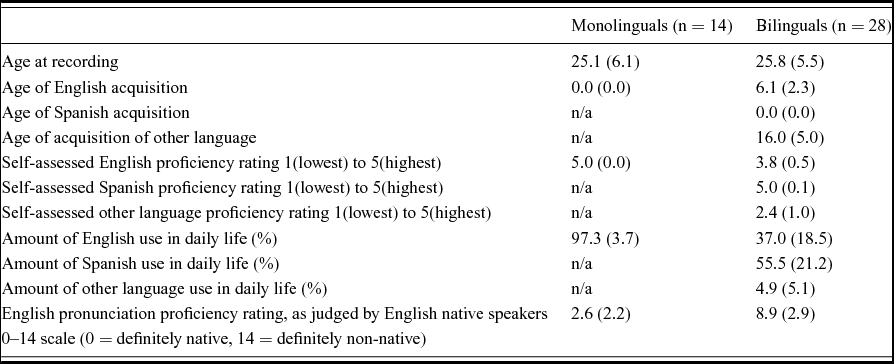
Two groups of speakers were differentiated: (1) 14 monolingual English native speakers; and (2) 28 Spanish L1 and English L2 bilinguals (see Table 1). All adult speakers were under 40 years of age to ensure that any effects in cognitive performance on the Flanker task could not be due to age (Salthouse, Reference Salthouse1991, Reference Salthouse1996); they all had normal or corrected vision, and reported to have no hearing or speech impairment. In line with similar research examining differences between individuals who speak more than one language (Bogulski et al., Reference Bogulski, Rakoczy, Goodman and Bialystok2015; Luk et al., Reference Luk, De Sa and Bialystok2011; Poarch & van Hell, Reference Poarch and van Hell2012), we use the terms bilingual to describe people who use two or more languages in their everyday lives (Grosjean, Reference Grosjean1998, Reference Grosjean2010), as “bilinguals do not necessarily need to have perfect knowledge of all the languages they know to be considered as such” (Fabbro, Reference Fabbro2001, p. 201). This inclusive definition of bilingualism allowed us to examine interspeaker variation in executive control, which is the secondary objective of our research.
Language background information for the monolinguals and bilinguals.

The 14 monolingual speakers all considered English to be their native language and learned English from birth onwards (Table 1). They all self-assessed English with the highest proficiency rating of 5.0 on the scale of 1 (lowest) to 5 (highest). Due to foreign language education, some of the monolinguals learned other languages during school, but reported their proficiency in other languages to be negligible, and to rarely if ever be exposed to other languages (Table 1). We therefore considered these individuals to be functional monolinguals in comparison to the bilinguals.
All of the 28 bilinguals listed Spanish as their native language, had learned Spanish from birth onwards, and learned English as their L2 in childhood (Table 1). They self-assessed Spanish with the highest proficiency rating of 5.0 and self-assessed English as the second highest language proficiency rating following Spanish. Those who reported themselves to have proficiencies in another language (again, unavoidable in the context of school foreign language education) self-assessed their overall proficiency ratings to be lower than for either English or Spanish. On average, the bilinguals began learning English at around 6 years of age, while their additional language was learned at approximately 16 years of age (Table 1). We therefore considered these individuals to be sequential bilinguals with English as their L2.
2.3. Speech materials
For the second data collection phase, a recording was created from “The North Wind and the Sun”, including sections of two to four words from each speaker that were repeated (i.e., each speaker spoke twice) which were semi-balanced for syllable count, taking intonational breaks into consideration. This edited version resulted in one recording of 9:20 minutes. The listeners heard each sentence twice in succession, which was considered to be less tiring and to evoke higher attentional levels than repeating the entire story.
2.4. Listeners
Seven native speakers of British English (3 female; 4 male) with a mean age of 27.7 years judged the speech samples. They were recruited from the students and employees at Queen Mary University of London and all of them identified as being native monolingual speakers of English and as being monolinguals in an abridged version of the MPI language background questionnaire (Gullberg & Indefrey, Reference Gullberg and Indefrey2003). Each sample of two to four words was followed by a break of seven seconds during which the listeners made their judgements regarding: (1) native versus non-native judgement; (2) level of confidence for previous judgement on a 3-point scale, i.e., high, mid, low; (3) perceived foreign accent on a 10-point scale with 1 = native and 10 = non-native. This resulted in a 0–14 scale (0 = definitely native, 14 = definitely non-native) (Table 1), a method of pronunciation proficiency assessment considered to be more refined than a previous version (de Leeuw, Schmid & Mennen, Reference de Leeuw, Schmid and Mennen2010) as many of the speakers were highly proficient in English. There was a highly significant positive correlation between the listeners’ ratings, r = 0.961, n = 38, p < .0001, showing consistency across ratings.
3. Results
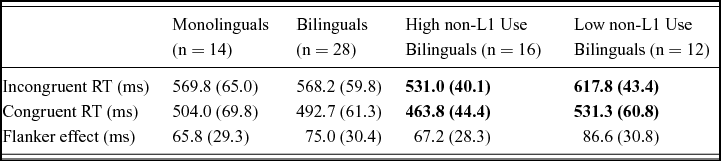
In order to investigate the primary objective of this study, an independent t-test was conducted testing the effect of group (English monolinguals, n = 14; Spanish–English bilinguals, n = 28) on the incongruent RT of the Flanker test (Emmorey et al., Reference Emmorey, Luk, Pyers and Bialystok2008), as in both groups the Shapiro-Wilk test indicated that the data came from a normal distribution. No significant differences were found between these two groups, t(40) = 0.078, p = .938. For reasons of transparency, we report congruent RTs, t(40) = 0.537, p = .594, and Flanker effect, t(40) = −0.987, p = .330, which were similarly not significant (Table 2).
Averaged results from incongruent and congruent trials and the Flanker effect. The significant differences between the high non-L1 use and low non-L1 use bilinguals are indicated in bold, revealed through the Tukey posthoc test.
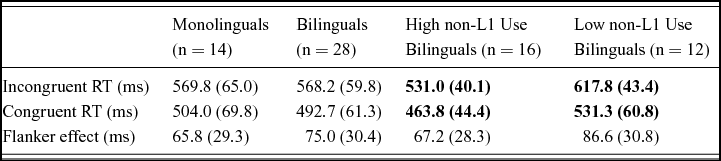
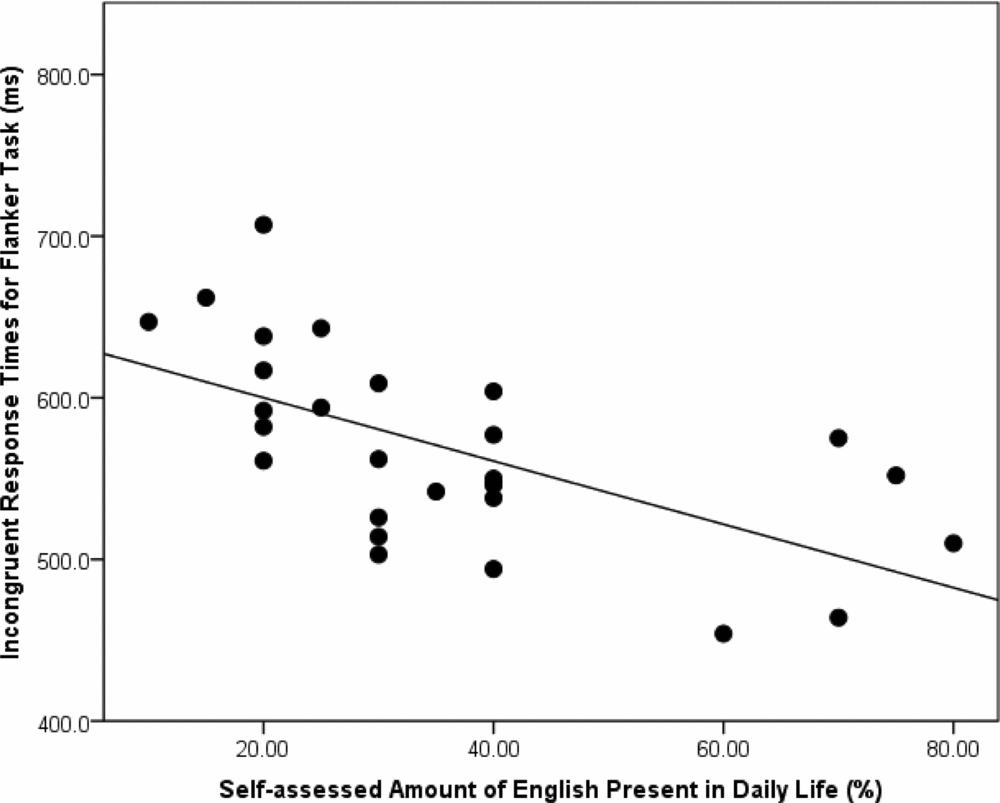
In line with our secondary objective, to see whether there were differences in executive control within the bilinguals (n = 28), a multiple regression was conducted with incongruent RT as the dependent variable as in Emmorey et al. (Reference Emmorey, Luk, Pyers and Bialystok2008); and English phonetic proficiency; age of English acquisition; and amount of English use in daily life entered as the predictor variables. This model proved to be significant (F(3,24) = 7.195, p < .01) with a total adjusted R squared of .408. Only amount of English daily use added significantly to the model, p < .0001 with a standardized beta value of −.640, indicating that self-assessed amount of daily L2 use of English was responsible for over 40% of the variation of executive control in the bilinguals (Figure 1).
Scatterplot of incongruent response times for Flanker task (ms) over self-assessed amount of English present in daily life (%).

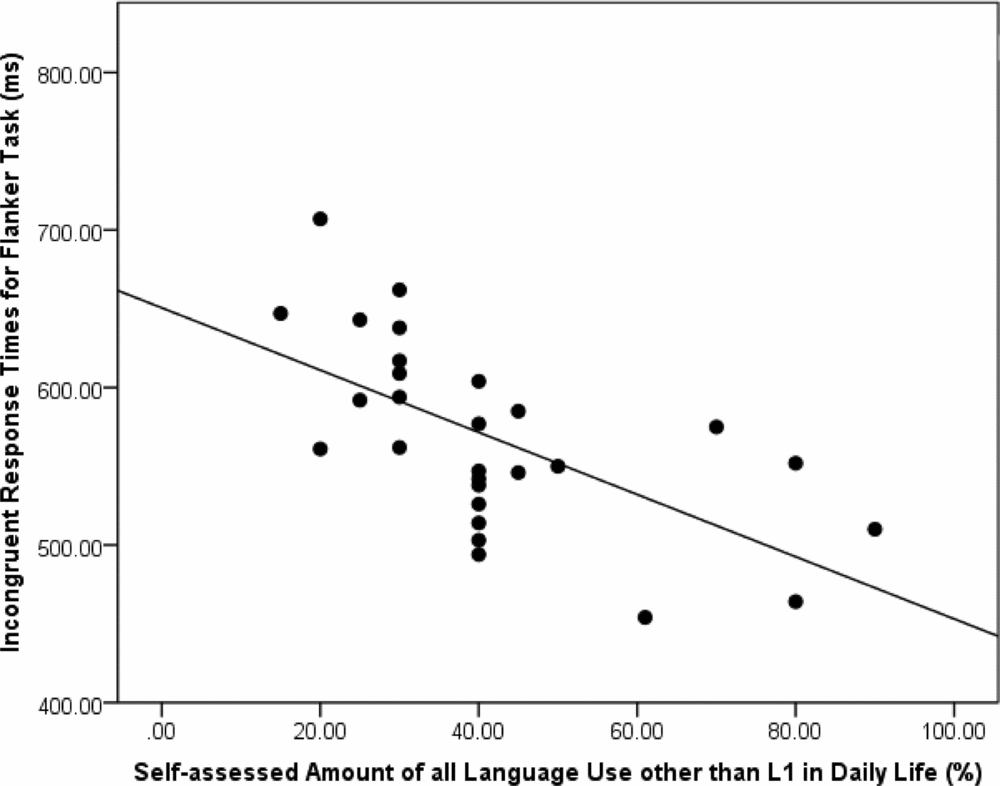
In a further analysis of how language use in bilinguals might moderate executive control, a highly significant relationship was revealed between incongruent RT and amount of non-Spanish daily use (i.e., including all languages which the bilinguals used), r = −0.662, n = 28, p < .0001 (Figure 2), indicating that those bilinguals who used their L1 less frequently were more likely to exhibit enhanced executive control.
Scatterplot of incongruent response times for Flanker task (ms) over self-assessed amount of all language use other than L1 in daily life (%).

In a final step of the analysis, to see whether only bilinguals who spoke an additional language frequently (regardless of whether the additional language was English) were afforded enhanced executive control, a one way ANOVA was conducted on the English monolinguals (n = 14, mean = 569.8 ms; standard deviation = 65.0 ms), the Spanish–English bilinguals whose amount of self-assessed non-Spanish daily use was the highest, ranging from 40–90% (n = 16; mean incongruent RT = 531.0 ms; standard deviation = 40.1 ms), and the Spanish–English bilinguals whose amount of self-assessed non-Spanish daily use was the lowest, ranging from 15–35% (n = 12; mean incongruent RT = 617.8 ms; standard deviation = 43.4 ms). This model was highly significant (F(2,39) = 10.101, p <. 0001) and a Tukey post hoc test revealed that the effect was solely driven by a difference between the bilingual sub-groups, i.e., there were no significant differences between the monolinguals and the bilingual sub-groups. As displayed in Table 2, the same pattern was revealed for congruent response times.
4. Discussion
With regard to our primary objective, we found no significant differences between the monolinguals and bilinguals. These results concur with other studies in which a range of bilinguals have been included (Bogulski et al., Reference Bogulski, Rakoczy, Goodman and Bialystok2015; Luk et al., Reference Luk, De Sa and Bialystok2011; Paap & Greenberg, Reference Paap and Greenberg2013; Poarch & van Hell, Reference Poarch and van Hell2012) to investigate intergroup variation, particularly because completely balanced bilingualism is quite rare (Grosjean, Reference Grosjean1998, Reference Grosjean2010). The analysis of our secondary objective revealed that amount of daily English L2 use was responsible for over 40% of the variation in executive control in the bilinguals, while neither English pronunciation proficiency nor AoA were significant. This finding was contrary to our initial hypothesis that those bilinguals with better L2 pronunciation proficiency would better manage competition at the level of speech production and would thus be more likely to evidence enhanced executive control. Moreover, those bilinguals who used languages aside from their native language more frequently (40% of the time or more) were significantly faster on the incongruent trials of the Flanker task than those who used their additional languages less frequently (35% of the time or less).
These results underline that bilingualism, in all its forms, is a diverse experience, and that therefore the effect(s) bilingualism has on executive control in bilinguals in comparison to monolinguals cannot be treated as a unitary phenomenon. We therefore interpret them to support previous findings which suggest that enhanced executive control in bilinguals is modulated by different forms of bilingualism (Bogulski et al., Reference Bogulski, Rakoczy, Goodman and Bialystok2015; Costa et al., Reference Costa, Hernández and Sebastián-Gallés2008; Emmorey et al., Reference Emmorey, Luk, Pyers and Bialystok2008; Luk et al., Reference Luk, De Sa and Bialystok2011; Poarch & van Hell, Reference Poarch and van Hell2012). In turn, this pattern of results may go some way to resolving the current contentious debate as to whether or not bilingualism confers an advantage in executive control. An absence of an overall monolingual–bilingual difference can co-exist with the finding of a strong benefit that exists primarily in bilinguals with a high daily use of additional languages, as we have found. Moreover, we emphasise that our findings do not indicate that the use of additionally learned languages entirely replace use of the native language to observe benefits in executive control. Contrarily, we assert that frequent use of additional languages, while nevertheless maintaining native language use, is associated with improved executive control.
Finally, other contributors not assessed in this study might also play a role. Research indicates that many factors decrease the rate of cognitive decline in adulthood, such as “social contacts, leisure activities, physical exercise, and diet [. . .]” (Coley, Andrieu, Gardette, Gillette-Guyonnet, Sanz, Vellas & Grand, Reference Coley, Andrieu, Gardette, Gillette-Guyonnet, Sanz, Vellas and Grand2008, p. 35), as well as other possibly confounded factors such as socioeconomic status and IQ, which we did not control for in our study. There is also a possibility that individuals with enhanced executive control might use additional languages more frequently, rather than a high L2 use causing enhanced executive control. We therefore suggest that future research examines how language use interacts with other potential contributors – such as social contacts, leisure activities, physical exercise, diet, socioeconomic status, and IQ – to influence executive control and cognitive development over the life-span in monolinguals, bilinguals and multilinguals.