In the context of the theatre, the advent of electricity has traditionally been seen as the arrival of new artistic tools, their ingenious uses, and associated stylistic ruptures. In other words, it has been reduced to the story of the spotlight. More importantly, however, the new technology introduced radically new objects into the theatre: peculiar hybrids that were neither tools nor words and were simultaneously technological and aesthetic in nature. One of these objects is the incandescent light bulb. Its entrance onstage and in theatres is the starting point for this article's considerations.
Legend has it that this light bulb was first devised by the inventor Thomas Edison. But the history of technology has objected: he was not the only person to come up with the light bulb, and the light bulb was not his real invention. In fact, to call his achievement an invention might be misleading in the first place, since Edison's breakthrough was due to the introduction of a system for producing, distributing and selling electrical light and thus turning electricity into a consumer commodity that could successfully compete with gaslight, which had only recently become widespread.Footnote 1 Edison's light bulb was just the very last piece of that greater puzzle, requiring very specific technical properties to work within the overall system and make it technically as well as commercially feasible.
Thus the moral of the story is not that Edison came second, but that wondering who came first is itself a misleading line of inquiry, as the possible answers tend to invoke myths of creation and creators that actually explain very little about how things came to be. It is therefore more useful to ask how the standards became established, which incompatible interests were entangled in their negotiation, and what competing options were suppressed along the way. Such a mode of investigation restores the historical contingencies that led to the outcomes. What applies to the history of technology is valid for theatre history.
Taking its inspiration from the historiography and sociology of technology, this article analyses some early appearances of the light bulb, before it was decided what would become of the object, before the standards of modern theatre were established. Contrasting the light bulb's entrance on the Bayreuth stage in the 1880s, its discursive representation in brochures of the early electricity industry at the same time and its later reappearance in the modernist aesthetics of Adolphe Appia, the article explores the entanglements of technical objects, aesthetic programmes and political ideologies. In particular the article tries to show that each of these instances envisions very different kinds of theatrical future, while demonstrating that the electrification of theatres is anything but a road without junctions, or a journey driven by technology and steered by directors.
The purpose of focusing on the light bulb's role in theatre history, then, is not so much to tell a different story, as it is to tell the story differently. In no small part, this will facilitate a reframing of the theatre in light of technology. Recently, this relationship has been under fresh scrutiny from varying angles of both historical research and analysis.Footnote 2 In particular, renewed scholarly attention has been paid to electrification within the culture of nineteenth-century spectacle.Footnote 3 But the more influential theoretical premises for these considerations have been developed in the fields of social construction of technology (SCOT), science and technology studies (STS), and actor-network theory (ANT), which have persuasively introduced ways of thinking about technology that depart from the naive notion of a tool while avoiding deterministic models.Footnote 4
The scope of these questions is international. The electrical industry has been both a global enterprise and part of a colonial world order from its very inception. When the electric lights were switched on, first on the facades and in the lobbies of theatres in European metropolises and colonies alike, it was a display of symbolic capital powered by financial capital: a final triumph of the modern magic of the West over the ‘primitive’ magic of the ‘rest’. Installing electricity in theatres was a lucrative business in the early stages of the electrical industry. In particular, two German companies with large domestic markets, AEG and Siemens, quickly became worldwide suppliers of electrical stage machinery.Footnote 5
At the same time, another successful German export has been the idea or practice of the Gesamtkunstwerk, a romanticized version of modernism that had long-ranging impacts on the notion of theatre as an art form independent of literature. Adolphe Appia, a Swiss Wagnerite who wrote in French and had German-supremacist friends, particularly helped establish the idea in the English-speaking world, as Appia was hailed as a founding father of modern theatre alongside Edward Gordon Craig.
This afterlife in aesthetic discourse is why it matters what Wagner and Appia did with electricity, or, to be more precise, how their theatre became entangled with the technology of their time.
The light bulb and the Grail: healing and regression
Over the course of the nineteenth century, European theatres became potentially catastrophic. Disasters were simulated using all the available tools, but they did not only occur onstage.Footnote 6 The theatre itself fell victim to them with growing frequency.Footnote 7 It had that in common with the railway. The intensities made possible by the controlled combustion of fossil fuels could cause accidents of unprecedented scale.Footnote 8 Although fires targeting the bodies of women dancers were usually punished by no more than disciplinary sanctions, the more frequent theatre fires at the end of the century threatened the audience and thus the business model.Footnote 9 The same technology to which the nineteenth-century theatre owed its aesthetic and commercial expansionFootnote 10 – gaslighting – now appeared to jeopardize theatre itself. The 1883 fire at the Ringtheater in Vienna – and the media circus of the ensuing trial – marked only one milestone in this development.Footnote 11
A year earlier, the International Electrotechnical Exhibition in Munich (the world's second electricity exhibition after the Paris Exposition of the previous year) included an experimental electrotechnical theatre that inspired the stages of the German Empire and beyond.Footnote 12 In the years that followed, partly with safety considerations in mind, theatres gradually switched from gas to incandescent lighting, although this conversion happened unevenly from place to place, and lasted into the 1920s.Footnote 13 After all, the installation of light bulbs, electric cables and regulators was always dependent on the infrastructure by which power was generated. At first, stand-alone steam generators and dynamo machines were installed in the basements of courtly playhouses, but increasingly, municipal electrical stations became responsible for providing theatres with both energy and technology.
Scarcely a year after the Vienna disaster and only a few months after that first experimental electrical theatre was exhibited in Munich, an early light bulb was deployed in the theatre. On 26 July 1882, it was illuminated in a newly built wooden theatre on the outskirts of a small town in northern Bavaria – entirely independent of the big-city electrical industry – and it remained in use there until 1914.
This light bulb made its appearance in the first and third acts of a production designated as a ‘Festival Play for the Consecration of the Stage’ (Bühnenweihfestspiel), as part of a prop that has become known as the Grail. Eyewitness reports describe a ‘tall vessel with a semicircular crystalline bowl’ and ‘a fiery red hue’, comparing it with a ‘glass for Berlin wheat beer, from which the light issues when holding it at a slight angle’.Footnote 14 The libretto describes it thus: ‘A ray of light shoots from above upon the cup, which begins to glow with a purple lustre. When Amfortas raises it and holds it high, it burns like a ruby … In the dusk the knights are kneeling and worshiping it.’Footnote 15 An eyewitness later described the scene as follows: ‘To poignant effect, the (electrical) halo descends from the apex of the dome onto the new Grail King when Parsival takes hold of the Grail, illuminated by purple light, and brandishes it.’Footnote 16
The stagecraft behind this first light bulb's use was also documented. George Davidson describes the procedure from the backstage perspective:
When the boy … has placed [the Grail] down in the middle of the rotunda, an invisible wire connection is established that runs between a small Siemens electrical bulb inside the red chalice and a motor [i.e. a battery] inside the tabernacle. This connection is established by a man who has been placed next to the motor and who is also hidden inside the tabernacle.Footnote 17
In Parsifal, however, this glowing Grail emerges as the life-giving core of a ritual brotherhood, which is weakened by the loss of a holy spear and by the resulting ailment of its leader. The blame for this pitiable situation is placed on the sensory devotion to a sexuality that is stylized as eternally feminine. This is what has caused the loss of the spear, i.e. the phallus, and opened a wound that now serves as a constant reminder of the suffering of corporeal existence. Thus weakened, the leader reluctantly fulfills his duty to carry out the rite that metaphysically nourishes the community. Salvation can therefore only come from a new leader with the ability to resist the modern world's temptations, a leader removed from modernity's rationalism and guided by a sense of compassion that comes from a place preceding all socialization. In Wagner's imagination, only such a ‘naive’ hero who has essentially ‘fallen out’ of modernity can regain control over the spear/phallus by destroying the ‘magic garden’ and condemning the ‘flower maidens’, thus restoring the healthy order of things. In other words, dismantling the music halls and stoning the variety show dancers contains a promise to restore a wounded masculinity, and thereby to heal the ailing community.
Thus the baring of the Grail once more at the end of the ‘Festival Play’ – this time by Parsifal, the new leader, in front of the kneeling knights and the audience in their curved rows – aesthetically resolves all the contradictions that had been raised after the end of the Hegelian system and its raison d’état. In the Grail, the regressive vision of an antimodern ersatz religion is illuminated: as a light bulb. The life-giving force unleashed upon the exposure of this lighting prop, translated into the profane reality of stagecraft, is no more than electrical energy generated by a stagehand who is hiding in the tabernacle, turning the crank that drives the dynamo to produce the light.
This electrical energy suffuses much of Wagner's work, as revealed by the printed price list of the stage electrician Hugo Bähr, who had already made his name supplying the Duke of Meiningen. Items listed include the following:
Sword with illuminated handle (Walküre); lance with illuminated tip (Siegfried); lance tip, illuminated, to fly, with wire (Siegfried); anvil, spark-spraying, with block of wood to split (Siegfried); the Grail, illuminated (Parsival); the Rhinegold (Rheingold); hearth, glowing and flashing (Walküre); evening star (Tannhäuser).Footnote 18
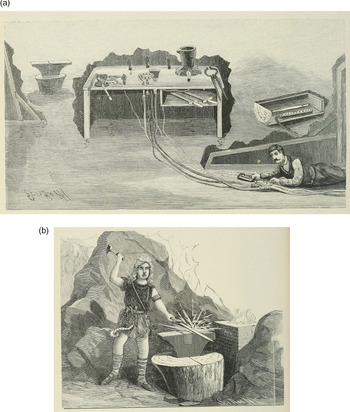
In his 1898 overview of stage magic, Albert Hopkins describes in detail, for example, how the smithy scene at the beginning of Siegfried is staged using a combination of gaslight, incandescent bulbs and steam.Footnote 19 The final climax comes at the moment when the hammer hits the sword, causing short-circuit sparks to fly with every impact (Fig. 1).
Siegfried's anvil, reverse side (a) and front side (b). Albert Allis Hopkins, Magic: Stage Illusions and Scientific Diversions, Including Trick Photography (New York: Munn & Co., 1898), pp. 328, 330.

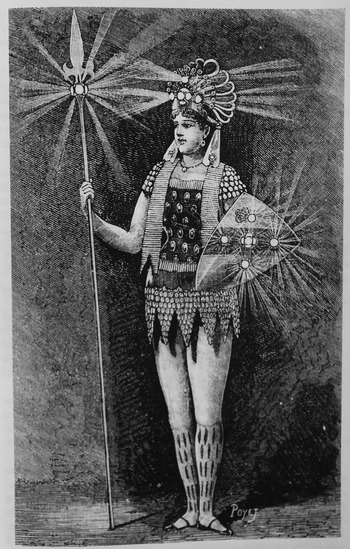
But from a comparative perspective, as so often with Wagner, these heroically Germanic twinkles and flashes appear to be no more than a regressive völkisch (racist supremacist) variation on a more worldly and metropolitan theatrical trend: bijoux électriques, or electric jewellery. In 1880s London and Paris, these battery-powered illuminated diadems turned ballerinas into light fixtures (Fig. 2); they were also popular in ballrooms. In his sales brochure L’électricité au théâtre: Bijoux électro-mobiles, the leading European supplier Gustave Trouvé listed illuminated brooches of all shapes and sizes alongside light-up crowns, corsages and walking sticks.Footnote 20 A fée d’électricité (electricity fairy) performed in countless full-length ballets, becoming a proverbial symbol of electrotechnical progress and embodying the supremacy of European civilization in a suggestive guise.Footnote 21
Amazon adorned with luminous electric jewellery for the ballet Chilpéric at the Empire in London. Georges Barral, Histoire d'un inventeur: Exposé des découvertes et des travaux de M. Gustave Trouvé dans le domaine de l'électricité (Paris: G. Carré, 1891).

As an embodiment of progress, electricity was also frequently framed in the late nineteenth century as a promise of healing. There were hopes that the second wave of industrialization would undo the distortions of the first wave and restore natural and social balance. There was a widespread notion of (hydro)electricity as a clean energy source that would drive the poverty and coal soot out of the cities and, thanks to its decentralized distribution, give craftsmanship the upper hand over manufacturing again.Footnote 22
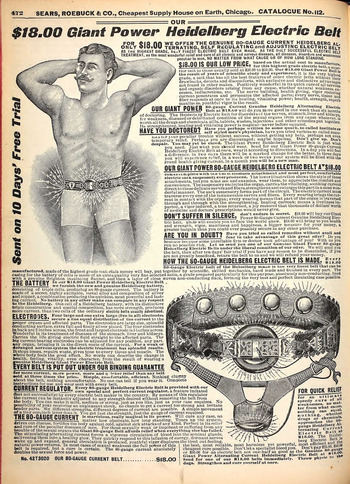
The electrical industry that took shape starting in 1880 remained coloured by ideas of a romantic science that saw electricity as a universal life force that would make it possible to reconcile conflicts, unite natural forces and cure bodies that had been thrown off balance.Footnote 23 Because electricity was not naturally occurring, and because electrical science had no ancient precedents and had only debuted in the seventeenth century as a courtly curiosity, its industrial uses made it the magic of technological modernity. This is also clearly demonstrated by the many-layered history of electrotherapy.Footnote 24 In the late nineteenth century, electromedicine was mainly used against neurasthenia, a virulent fatigue syndrome that seemed also to affect men, unlike the feminized hysteria.Footnote 25 For example, the Heidelberg electric belt, which was prominently peddled by one of the very first major mail-order catalogues, promised – like the Grail – to restore lost virility (see Fig. 3).
$18 Giant Power Heidelberg Electric Belt by Sears (Catalog No. 114C. from Sears, Roebuck and Company, ed. Cleveland Amory, Chicago, 1905, p. 476).

In 1900, electricity was not yet the stable and therefore mundane entity that comes out of a power socket.Footnote 26 The relationships between the social experience, technical development and cultural significance of electricity were still in flux. Electricity was still futurism and futurism was electricity.Footnote 27 Victor Hugo, Henry Ford and Vladimir Lenin all agreed that the future lay in electricity. Parsifal's life-giving prop, containing that technology, resonates with that inherent promise of salvation.
After all, Wagner's Bayreuth project, the wooden building on the Green Hill, ‘in some beautiful wasteland, far from the smoke and pestilential industrial odors of our urban civilization’, aimed precisely at curing industrial modernity by means of a no less modern technology.Footnote 28 Even though Wagner made repeated elitist and reactionary comments against the urbane, commercial, technological culture of his time, his oeuvre is in fact a culmination of the nineteenth-century industrial theatre's aesthetic obsession with effects and stagecraft devices.Footnote 29 More than any other theatre, the Bayreuth Festspielhaus (and its guiding concept of the Gesamtkunstwerk) represents the apotheosis and capitulation of an aesthetic apparatus that since the late eighteenth century had transformed a mechanism into a thermodynamic engine through the use of all possible technical methods, but especially gaslighting. In his German-style féerie, mobilizing all the means at his disposal since the Grand Opera, Wagner staged the ‘unapproachability of a dream apparition’ as a cabinet of theatrical curiosities:Footnote 30
River mermaids (Nixen), which swim around the water like fish; a rainbow arcing over the entire stage, upon which walk gods incarnate; magical spells transforming [characters] into a giant serpent, a toad, or a dragon; a sea of flames blazing around the boulder with the fighting Valkyries; a castle of the gods sinking in the great fire of the world; and more still.Footnote 31
However, this scenic bestiary surpasses the mechanics of the scenery, dooming it to failure. In 1883, the critic Max Kalbeck wrote that the ‘sublime was [verging] into the ridiculous’ once and for all, in a comment on Fafner's performance as a dragon: ‘We are as unafraid of the rubber monster with its movable tail and head as the young hero, and we inwardly share his laughter.’Footnote 32 In 1876, having travelled from Berlin, Paul Lindau remarked upon ‘the capricious excesses’ of a ‘despotic imagination’ and concluded that the stage effects could ‘scarcely be called mediocre; it is a downright failure’.Footnote 33 And in a later publication he compares the Bayreuth stage technique to the state of the art of metropolitan theatres: ‘We have already seen all of that much better on the stages of the great courtly theatres and the Victoria Theatre of Berlin – to say nothing of the London stages, which specialize in extravaganzas for children's enjoyment at Christmastime.’Footnote 34
But the composer Heinrich Ehrlich voiced more fundamental concerns. He wondered whether what had gone wrong was not, after all, the technology, but the aesthetics, ‘because the principle of imitating nature, which is correct in and of itself’, produces ‘the opposite of the intended result’ when carried out ‘absolutely’.Footnote 35 The strictness of the mimicry shows clearly ‘that nature cannot be fully imitated’ because ‘the spectator's imagination must be granted a certain leeway’.Footnote 36 When this leeway is ‘excessively confined,’ he argued, ‘only the senses [are] active’, until they too ‘finally grow fatigued and require ever new stimuli of spectacular pageantry’.Footnote 37 Here, overstimulation and signs of fatigue call illusionism into question in the framework of nineteenth-century physiological thinking, exposing illusionism as unhealthy. It is the Lindwurm dragon that puts an end to the Meininger-style theatrics. This is where Wagner's attempt to appease industrial modernity through a theatrical restoration of myth ultimately fails, opening the gate to an aesthetics of physiological effects and affects, represented by the Grail.
Recovery is the promise of the glowing Grail, whose light not only rises above the mechanical toys of older stagecraft, but also distinguishes itself from another kind of electric light that had shaped the spectacular theatre of the nineteenth century. In 1849, a carbon-arc lamp was first featured onstage as a futuristic sunrise at the end of the third act of Giacomo Meyerbeer's Le prophète; together with limelight, it dominated dramaturgical effects of both grand opera and melodrama.Footnote 38 And yet this cold, harsh, bluish light that issued from an electrical connection between two carbon rods, with its flickering volatility and blinding brightness, proved to be incompatible with the gaslit lifestyle of nineteenth-century middle-class society and was perceived as unsuitable for parlours and theatres alike.Footnote 39 Because it was neither technically nor economically scalable, this form of lighting was reserved for large nocturnal construction sites and metaphysical stage effects. Before its final glorious role in film projection, it shone one more time in the Grail scene of Parsifal as a halo descending from the sky.
Yet the light issuing from the Grail itself was different. Instead of shining, it glowed – and it represented the future, both technically and economically. Like no other previous form of lighting, it avoided any combustion or by-products, and its success was thanks in large part to the fact that, like every new medium, it started off by imitating the old one.Footnote 40 It was pitched as a better, cleaner and safer gaslight that could provide domestic cleanliness.
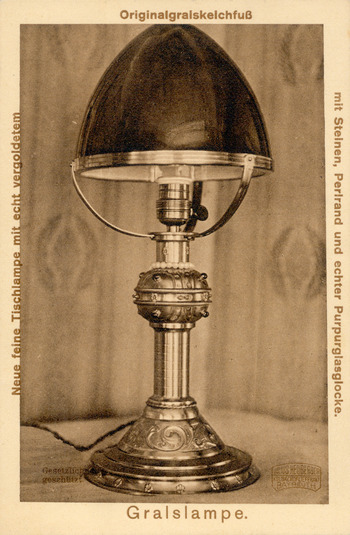
Setting aside the mythical battlements and the waves, the object that was meant to bring the ailing community together strikingly resembled – and functioned the same as – an electric desk lamp (Fig. 4). Wagner's efforts to capture home and hearth in the world of Nordic legend through his Gesamtkunstwerk are reminiscent of the electrical industry's promises of a domesticity liberated from labour thanks to household devices. Enlightenment turns into domesticity, and that also applies to the tranquil glow of the Grail, only in the reactionary völkisch (racist supremacist) variation – even if the Festspielhaus's records clearly indicate that the light bulb in question, despite the claims to the contrary, was made by England's Swan company, the leading manufacturer at the time, and not by Germany's Siemens.
Grail lamp produced by the Heuberger company. National Archives of the Richard Wagner Foundation, Bayreuth, Sign.: Bi1779.

Edison and electricity: healing and hygiene
The glowing Grail remains a mere curiosity, a new technical device installed in an older theatrical dispositif. As with Hugo Bähr's other apparatus, it was one of a kind, handcrafted to solve a specific scene's problems with technology. By contrast, the electrification of the theatre – the conversion from gas pipes to electrical wires that began in the 1880s and lasted through the late 1920s – constituted a systemic transformation. This conversion was intimately connected to the nascent electrical industry and the accompanying sociopolitical transformation that said industry shaped and often advanced. Indeed, in the same year a lone member of the stage crew was turning a crank behind the scenes to light up the bulb in Parsifal, the very first dynamo machines were being installed in theatre basements and outbuildings. A few years later, theatres began to be connected to local power stations, then finally, from the 1890s onward, to power grids operated by municipal utility companies. In the process, theatres lost their autonomy and sovereignty once and for all and grew dependent on the knowledge of engineers and on the cities’ technical infrastructure.
Thus the advent of the light bulb not only illuminated a historical promise of healing, but also gave rise to a new economic model. The light bulb only makes sense as part of a large technical system that includes electricity production, distribution and consumption.Footnote 41 This whole system rests on the subdivision of light; in other words, the ability to link an indefinite number of consumers to a parallel circuit; this is what enabled mass production of light and lamps in the first place.Footnote 42 Finally, suitably large-scale production also requires demand, which must be continually cultivated as a consumer need. Thus the light bulb is almost a paradigmatic embodiment of an industrial product and consumer capitalism at once. Like no previous technology, its implementation was shaped by capital investments and advertising campaigns.
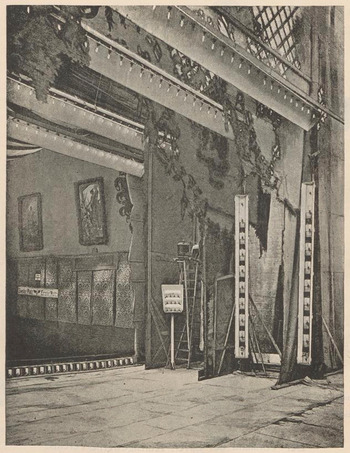
The theatres played a major role in that implementation process. Worldwide representative state theatres and commercial theatres were electrified very early on, starting in the 1880s, and consumed as much as a quarter of all electricity generated into the 1890s. Once again, this process started simply by replacing gaslights with light bulbs, pipes with wires, and valves with resistance levels (Fig. 5). The lights’ positions, brightness and usages remained largely static through the 1920s. Spotlights were reserved for special effects, and the aesthetic practice of lighting was scarcely modified. In other words, art was by no means the driver of change; art first inserted the new within the old.
Lighting installation at the Munich Electrical Exhibition, Münchener Elektrizitäts-Ausstellung. Offizieller Bericht über die im Königlichen Glaspalaste zu München 1882 unter dem Protektorate Sr. Majestät des Königs Ludwig II. von Bayern stattgehabte Internationale Elektricitäts-Ausstellung, ed. Wilhelm von Beetz (Munich: Autotypie-Verlag, 1883), Fig. 16, p. 61.

What advanced the electrification of the theatre in the beginning was a political–economical alliance. The theatrical installation of electricity entailed a symbolic deal between old and new power structures. The ageing institution of the court theatre appears highly modern through electricity, and industrial electrical technology gains cultural capital. Yet what this symbolic exchange communicates is the idea of a technical amelioration of culture; in other words, the assertion that electricity makes theatre into a better – safer and healthier – place. Central to this is the idea of a societal recovery – ‘healing society’ – which in this case is a project of hygiene.
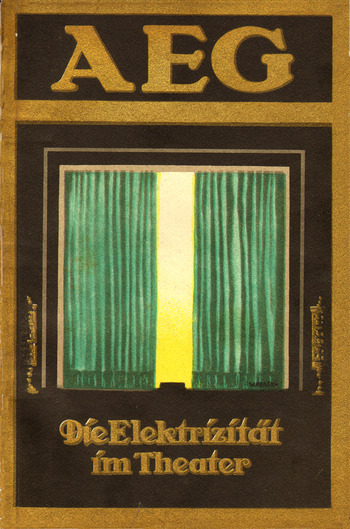
This hygienic argument for electricity is fully elaborated in a series of brochures that were published by the German Edison Society (Deutsche Edison-Gesellschaft, DEG), the predecessor of the AEG (Allgemeine Elektrizitäts Gesellschaft) upon its establishment in the early 1880s (Fig. 6). The first of these brochures, in its very title, presents the significance of Edison incandescent light for hygiene. On page 1, it already asks a rhetorical question about the effects of gaslighting on health: ‘Does the artificial lighting of our living rooms, classrooms and lecture halls, theatres, concert halls, factories, and all the rooms through which people pass in large numbers live up to the requirements of modern-day health standards?’Footnote 43
Company brochure of AEG. AEG, Die Elektrizität im Theater (Berlin, 1925), Staatsbibliothek zu Berlin, Ogb. 1/64.

Naturally, in the context of a promotional brochure for electrical systems, this rhetorical question could only be answered with a firm no, only to be followed in short order by a crucial ‘culture question’:
The geographical position of the countries that play leading roles as cultured states increases the dark daytime hours during the autumn and winter months and compels cultured peoples to take extended advantage of artificial illumination in order to also utilize the part of the day that has been withdrawn from labour by the early onset of darkness.Footnote 44
Inasmuch as ‘cultural growth’ correlated with an increased ‘need for light’ and the ‘demand for increased brightness’ signified advancing ‘cultural development’, progress relied on lighting technology. However, according to the DEG, this increase in lighting, which until 1881 largely entailed burning natural gas, had brought unhygienic scourges that the electrical industry was now intervening to abolish. It warmed the air, filled it with noxious substances and exposed human eyes to flickering light – all factors associated with the physical flame itself.
As its scientific key witness, the brochure cites Privy Councillor Prof. Max von Pettenkofer, co-founder of the German Association for Public Health Standards and founding director of the Institute of Hygiene at Ludwig Maximilian University of Munich. When the Edison incandescent light bulbs were installed at the Munich Court Theatre, von Pettenkofer conducted ‘comparative studies between incandescent and gaslighting from a hygienic standpoint’ commissioned by the DEG. The studies tracked temperature and carbon dioxide levels during a performance in the orchestra, on the balconies and in the upper tiers, once with an audience and once without one. Concluding his research, von Pettenkofer summarizes:
Based on the available investigations, two conclusions can be drawn with certainty: 1. That the electrical lighting to a great degree prevents the air in the theatre from overheating, 2. That, nonetheless, it is not capable on its own of obviating the need for ventilation in the theatre …Footnote 45
Here, the theatre enters the discourse on hygiene, and thereby the industrial era's highly paradoxical relationship with the body. Hygiene combats germs and it produces healthy bodies via technology and management that are less vulnerable to early industrial living standards.Footnote 46 The process of building conduits and connecting them into networks that facilitate circulation is above all a tool of hygiene, whether the conduits are water lines and sewers or, later, ducts for air circulation. These circulation systems owed their implementation to an ideal of purity that was taught via education programmes, especially to the lower classes of society, as a new self-compulsion.Footnote 47 Thus hygiene transformed the feudal era's representative body into the useful and productive body on which bourgeois culture and industrialization came to depend.
As a third supply system circulating in urban environments, after water and gas, electricity joined this mechanism of hygiene by promising to maintain the purity of light and air. It is no coincidence that the same hygienist, von Pettenkofer, whose investigation of the atmosphere, extended beyond the theatre, would later offer testimonials in defence of nudism: ‘Our skin has evolved to be exposed to a constant flow of air.’ According to this view, skin required exchange with the environment (‘it is not the purpose of our clothes to seal us off from the air’) and suitable circulation: ‘The air in our clothing shall not be permitted to stagnate.’Footnote 48 Just as clothing must allow the air to circulate around the body, the theatre ought to provide a healthy atmosphere, including the light and airiness that only electricity can guarantee (according to the electrical industry).
The electrical industry's promotional message was scarcely tempered by the fact that Pettenkofer's ultimate findings were more modest than anticipated, nor was it troubled by his conclusion that ventilation was necessary even when using electricity. The DEG's second brochure, from 1884, which exclusively promoted electrical lighting in theatres, primarily found fault in the overheating caused by gaslighting, along with issues of soot and fire hazards:
Under the exhausting influences of the heat [and the] air contaminated by the combustion products of gaslighting, the body and mind grow more fatigued; the longer one lingers in the heat and the befouled air, the more the befoulment and the temperature increase.Footnote 49
Temperatures towards the end of the performance approached those of a Roman bath, and as a result theatres had to be closed altogether in the warmer seasons, it was said. The results, according to the brochure, were ‘tension’ and a drop in ‘vigour’ over the course of the performance because the temperatures were unsuitably high for the human organism. Heightened activity of the senses and the mind, without which the enjoyment of a work of art was inconceivable, would be – as in the tropics – impossible. But even more than the spectator, the actor or singer would suffer, being directly shone upon by the rays of heat under the gaslight, which, the brochure claimed, dried the mucous membranes of the mouth and throat. The brochure concludes, ‘Anyone who knows the physical strength required to perform a major role can appreciate what it means to complete it at a temperature that would drive southerners [i.e. southern Europeans] to take a siesta.’Footnote 50
The hardy inhabitants of the cold North's ‘cultured states’ assert themselves as superior to soft southern Europeans, even onstage as actors. As spectators, however, they undergo sensory confusion like that of a ‘tropical frenzy’ (Tropenkoller, a nervous malady attributed to hot climates). The heated air rising from the apron of the stage formed ‘a wall that partially allows sound to pass through, but partially reflects it’. Not only does this reduce the audible volume, the brochure contends, but it causes a muddling or confusion of the tone. The visual sense, too, is said to be confused: the stage appears ‘filled with thick, trembling air’ and the ‘flaring, flickering gaslight’ made already nervous people ‘only more nervous still’. If an evening at the theatre provokes tropical intoxication and Fata Morgana, the DEG brochure asserts that only incandescent light can give theatres back the ‘comforts’ that gaslight had withdrawn from them. Incandescent light radiates a ‘pure … brilliance’ and creates a ‘soothing clarity’ that permits ‘the eye to be at ease’. ‘Let us hope then, dear sirs’, the DEG brochure concludes, ‘that we are not so far from the day when we can rejoice in the advantages of electrical illumination in our theatres and no longer be compelled to appreciate art with sweat on our countenance’.Footnote 51
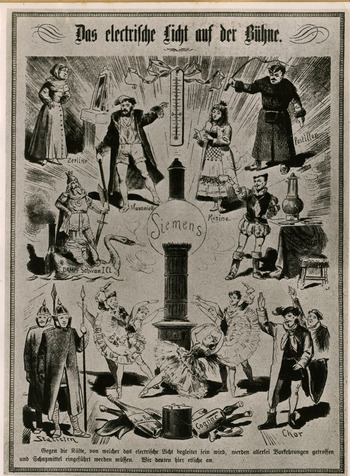
Thus aspects of this (northerly) coolness to be technologically restored in the theatre (which Siemens also invoked in its marketing; see Fig. 7) were not only medical, but also aesthetic, i.e. perceptual. As such, electrical, theatrical hygiene aims at an all-encompassing improvement of an atmosphere that encompasses everything, from the audience's bodies to the condition of the space to sensory perception. Eschewing open flames and banishing combustion creates a purified experience, unspoiled by the waste products of light and energy generation. Theatres should not only be safe, but pure, just like the bleached linens that drew a very similar link between health and hygiene during department stores’ ‘white week’ sales. Before atmospheres became a topic of aesthetics they were one of hygiene.
‘The Electric Light Onstage’, advertisement by Siemens Company, probably wrongly dated to 1936. Theaterwissenschaftliche Sammlung, Universität zu Köln, Nachlass Baumann.

Appia and the avant garde: healing and totalitarianism
Thus the light bulb holds different meanings for Wagner and the AEG. We see the emergence of competing electro-aesthetics that view the intersection of technology, theatre and society entirely differently. The regressive, reactionary light of the Grail stands in contrast to the hygienic, imperialist improvement of a civilized climate. However, both perspectives are adopted and taken in a third direction in Adolphe Appia's totalitarian and racist programme, which I will conclude by summarizing.
In 1882, Adolphe Appia sat in the Bayreuth Festspielhaus and beheld the glowing Grail. He was a young music student from Geneva, and theatre was a guilty pleasure for him. He arrived in Bayreuth with great expectations and was severely disappointed to see how the music was staged. Several years later, after an apprenticeship under the same Hugo Bähr who had wired the light bulb in the Grail, as well as traineeships at the opera houses of Dresden and Vienna, he returned with fully elaborated designs for a new Ring des Nibelungen. But by then the ‘master’ had already died and his widow was not interested in innovating or the innovator. She sent the visitor off, saying that his efforts were futile: the cycle's staging was already written into the score.Footnote 52
This double disappointment of the young Adolphe Appia sets the stage for the history of modern theatre. It hails the rupture between the reactionary widow and the avant-garde youth as the defeat of an outdated aesthetic, which was doomed to disappoint because of its intellectually naive, technically flawed attempts to portray the reality outside the theatre. That the work's ageing custodian viewed the young novice as no more than a better electrician fits perfectly into this narrative. In an often quoted letter to their common friend, right-wing ideologue Houston Stewart Chamberlain, Cosima Wagner writes,
I assume that Appia's significance lies in the field of technology, specifically lighting technology. Plenty of scope remains to be filled in there if [Wagner's] intentions are truly to be enacted because the electrical light is present, but is still very glaring. Arranging the transitions, bringing forth delicate modifications, that is the role of a technician who knows how to invent in his field; yet Appia must not want dark where the poetry says bright, and vice versa.Footnote 53
But Appia's ambition lay precisely in wanting ‘dark where the poetry says bright’. He wanted to be more than the first lighting director in stage history, which is how Cosima Wagner envisioned him. He published La mise en scène du drame wagnérien in 1895, followed in 1899 by the expanded German Die Musik und die Inscenierung, a treatise whose first objective was to justify why he, Appia, ought to have more say in what happened onstage than the ‘master’ himself.
Central to this argument was the ‘staging question’, which, Appia wrote, posed ‘a seemingly irresolvable problem’.Footnote 54 Unlike the literary side of the theatre, which was timeless and subservient to the author, staging, ‘as a process of illustration for the eye’, was ‘subject to all the fluctuations in taste and imagination’. The historicity of the scenery seemed problematic to Appia because it risked undermining the ‘master's’ intentions. A solution to the ‘staging question’ therefore required an (organizing) principle that would guarantee the subservience of the staging techniques based on the eternal interiority of the work itself. For Appia, that interiority comprised the music, which was well placed to serve this purpose, specifically thanks to its lack of symbolism and its essential ‘flexibility’.
To do so, however, the music needed to be able to flow like light. That became Appia's central metaphor. Thanks to such ‘overflowing intensity’ and ‘fluid manageability’, the music could take possession of the performer onstage. In order to shed the ‘coincidental husk’ of his ‘personality’, the performer could adopt the necessary ‘pliant and corrigible mobility’ and become the ‘sanctified instrument … of a higher will’.Footnote 55 If there were another ‘material contact point between the performer and decorative material’ the music could ‘emanate outward from the performer and, through his mediation, flow through the entire performance’.Footnote 56 Thus the performer would become like ‘a living paintbrush that [the maestro] dips into the light’ so that ‘it can discharge light to all sides of the stage’ and ‘for the sole purpose of sharing one person's conception with a large crowd’.Footnote 57
In other words, Appia's ‘staging question’ amounts to a scenic synthesis that serves to break down individual points of resistance and to subordinate the theatre to a central controlling authority. The higher will of one individual can then overwhelm the senses of the many inferiors through a powerful torrent. Wagner was to be that higher will, but as his living representative, Appia appoints himself – as the director, the prophet of the master, and the ‘despotic drill sergeant’ – who now ‘compels’ the totality of the staging and thereby gains an ‘unanticipated power’.Footnote 58
The ultimate goal was an aesthetically pleasing ‘atmosphere’. For Appia, this was the sole purpose that ‘illusion’, or ‘scenic deception’, could still serve.Footnote 59 That was how to overcome the ridiculousness of the rubber monster. Appia notes that Wagner had not recognized the disconnect between the ‘brittleness of the material’ and ‘the character's conception’. ‘The ideal fluidity of an expressive scenic spectacle is a concept that … permanently eluded Wagner. For him, everything that happens onstage really takes place.’Footnote 60 This ultimately ‘technical fallacy’, on which Wagner had run aground, was only masked and drowned out by the grandiosity of the music.Footnote 61 In turn Appia, with his totalitarian ‘concept of staging’, put forward a technical solution to this technical problem.
Appia's atmospheric light-spaces, which were often celebrated for their avant-garde aesthetics, are inspired by a deeply ideological agenda laid out in the little-discussed third section of his treatise. Here Appia extends his theoretical considerations with a historical outline that proposes a culturally pessimistic and völkisch (racist supremacist) nationalist genealogy of directing. He begins by presenting the ‘energy of a century’, which poses the ‘greatest challenge to the materialistic and utilitarian powers of our century’; for Appia, this energy bears the name Richard Wagner:Footnote 62 ‘Such energy’, he elaborates, ‘is not acquainted with the reservations of those who follow the general current; their only concern is to create a lever strong enough to carry through what they have undertaken’.Footnote 63
However, this lever gets stuck in the system of the scenery, and the obstructed energy leads to further and further intensifications, the result of which is ultimately the ‘shameful emptiness’ of ‘Wagnerian hypnotism’.Footnote 64 ‘Overstimulated minds’ could only be reached through violent means because the people's ‘palates, burned by alcohol, are unable to taste anything besides almost destructively strong spices’.Footnote 65 For Appia, the blame for this draining intensity did not lie with Wagner himself, but was the result of a ‘culture derailed onto the wrong track’. But with Wagner deceased, it was up to Appia to establish a new ‘equilibrium’ and strengthen a (theatrical) organism that can be flowed through evenly.Footnote 66
For Appia, the ‘staging’ was elevated to a war of liberation against French forms – and a ‘racial and cultural question’.Footnote 67 In line with Houston Stewart Chamberlain, to whom Appia's essay is dedicated and whose textbook of anti-Semitism was published in the same year, Appia sees in Bayreuth the dawn of a new era of German culture through the nationalization of music.Footnote 68 Appia believed that Bayreuth had ‘given the Germanic race the opportunity to voice the thoughts that dominate its culture with a purity that our contemporary civilization does not at all appear to permit’.Footnote 69 And therefore, according to his crude line of argument, the Festspielhaus is the very reason for a ‘true cosmopolitanism … a cosmopolitanism that is not only spread by the telegraph and that the press is able to contain by the uniform hollowness of its lies’.Footnote 70 Instead of the ‘pestilential influence’ of the ‘two cultures commingling’, in Appia's eyes all cultural exchange can only take place on a national soil ‘upon which the dominant thought of the culture in question is expressed with the greatest purity’.Footnote 71 Only through one's own purity could it be guaranteed, he argued, that no ‘foreign element [can] impose itself without simultaneously enriching and fertilizing’ and that the cultural ‘treasure of the raise’ would be preserved.Footnote 72
Thus, in Appia's view, Bayreuth became a place where ‘the German’ could ‘recover and regain his strength’, a ‘testament to the inexhaustible vitality of his race and the primal purity of his blood’, a place of aesthetic/racist purification whereby everything foreign is purged. So he envisions the theatre in Bayreuth as an institution to purify a national essence:
[It] allows him [‘the German’] to perceive at his core the great extent to which certain foreign elements have dripped in, unregulated, and sullied that purity. First, an indefinite unease befalls him: in his soul, a painful and disorienting type of purge takes place. Finally it appears as though [his] conscience were pointing the finger at all those noxious elements; to sacrifice them, with the emphatic language in which Bayreuth unflaggingly speaks to him, is an urgent obligation.Footnote 73
At the end of this purification, ‘the German genius’ reveals itself, ‘having hurried ahead of all others’.Footnote 74 For ‘the foreigner’, however, Bayreuth rises up with corresponding majesty and demands ‘the complete relinquishment of all wishes and ambitions … that are specifically innate to his race’, demanding that he strip himself of anything ‘personal–coincidental’ and heed the ‘call of the German genius’. He thus claims Bayreuth, and accordingly the idea of ‘staging’, to be an organic Gesamtkunstwerk and totalitarian torrent, a countermodel to the metropolitan Parisian theatre culture.Footnote 75
So-called ‘racial hygiene’ goes hand in hand with theatrical hygiene. Through the ‘staging’, which functions as the ‘outward radiation of an inner core of light’, the influence of historical stage conventions is to be stripped away, making space for timelessness within the fleeting performing arts.Footnote 76 However, this is to be accomplished on behalf of an organic aesthetic effect, which is subordinated to German interiority and its will in order to ‘cleanse’ the theatre of ‘foreign’ influences – by means of energy. Crucial to such a post-Wagnerian project, for Appia, is establishing a rigid hierarchy and a totalitarian control structure – which, according to Appia, is in no small part a technical matter. As Appia put it, ‘Today, the Gesamtkunswerk must pave the way by technical means; for only through technical form can it create a refuge, amidst the depravity of our artistic institutions, the idea of whose establishment has indeed been tangibly pursued in Bayreuth.’Footnote 77
Thus, if Appia had his way, German ‘directorial theatre’ would overcome the popular Gallic streetscape with purification, with a discharge followed by the establishment of regulatory technologies. The incandescent craving for electro-theatrical healing, as manifested in Wagner's Grail, finds its sequel in Appia's concept of staging as a totalitarian torrent, and yet the electro-theatrical concept proposed here is a very different one. Wagner's reactionary incandescence functions differently from Appia's totalitarian torrent. Yet they both pin their anti-modern impulse and their mistrust of industrial capitalism to the same innovation – electrotechnology – that made Germany into one of the leading industrial nations in the late nineteenth century. It is therefore striking to note that this ‘torrent’ and these control techniques, which Appia introduced to the theatre with his aesthetic theory, were at the same time being installed in theatres technologically, in yet a different ideological fashion.
Conclusion
So what happened to the light bulb in Appia's theory? A few years before the First World War, Appia played a role in conceiving what would become known as the Festspielhaus Hellerau. Set up primarily as a school for the rhythmic gymnastics of Emile Jacques Dalcroze in the first German garden city, close to Dresden, the institution became a famous performance venue due to its annual festivals in 1912 and 1913, drawing a large international crowd of artists and writers.Footnote 78 Built as a modernist temple, it centred on an empty and undivided performance space, draped on all four sides and the ceiling with white cloth that concealed an installation of regularly spaced light bulbs. The effect was of a diffuse and indirect light whose intensity and colour could be gradually shifted with a central regulator, filling the space in its entirety and making it possible to direct the light in time with sound and movement.
As the story goes, this was where Appia, who for so long had failed to enact his theories, finally became practical. His light-spaces were realized, electricity was unleashed, and theatre finally took shape as a modern light-based art form.Footnote 79 But it was not Appia who built or designed the lighting system in Hellerau – that was Alexander von Salzmann – and Appia never said or wrote much about the place. Furthermore, as Scott Palmer has persuasively argued, the technology that most informed Appia's theatrical experiences and theoretical writings was not the incandescent light bulb, with its homely glow, but the radiant beams of the carbon arc.Footnote 80 Thus it appears that there is less continuity between the Appia of Bayreuth and the Appia of Hellerau than the name suggests. But again, this might be due to a misleading line of questioning, as both Bayreuth and Hellerau are severely misunderstood as the notorious visions of great men. Instead, it might be more instructive to think of them as constellations of an at once aesthetical, technological and political nature that, like garden cities, brings together diverse actors, performing gymnasts and light bulbs to form theatrical apparatus that articulates competing conceptions of modernity.
Modernity is traditionally associated with autonomy. The arts became modern by gaining independence from other social systems: no longer serving and obeying the rules of the nobility, the church or the market, but declaring their own set of self-imposed rules. In that sense, Wagner, who built his theatre as a site for worship of the theatre itself – conceived to bring together a nation and constitute the very purpose of that nation – was a modern artist, as was his later prophet, Appia, who elevated autonomy to the absolute. But as I have shown, this aesthetic autonomy of modernity always rests on an increase in dependency: on city infrastructure, engineering knowledge, social ideologies and more. Theatres paradoxically gained autonomy and therefore modernity by becoming more and more embedded into the societal and technical systems of their time, by being built around objects that were both aesthetic and technological. From this point of view, developed above, the history of theatrical modernity appeared to be not so much a story of artistic rupture, as one of entanglement. Depending on the diverging conjunctions of aesthetics, technology and politics realized through the installation of the light bulb, very different kinds of theatrical modernity were envisioned.