INTRODUCTION
The species of Bathypalaemonella are deep-sea shrimps found at depths of 215–2750 m (Cleva, Reference Cleva2001). Most records are of specimens taken in trawls, with little information on the type of sea floor or any associated species. With the availability of deep-sea cameras and remotely operated vehicles (ROVs), the researcher can now view these shrimps alive and in situ.
Bathypalaemonella serratipalma Pequegnat, Reference Pequegnat, Pequegnat and Chace1970 was originally described from six specimens taken in 1968–1969 in the north-western and south-western Gulf of Mexico at depths of 878–1774 m. All were collected in a benthic skimmer (see Pequegnat et al., Reference Pequegnat, Bright, James, Pequegnat and Chace1970 for details). Crosnier & Forest (Reference Crosnier and Forest1973) later re-described and illustrated this species and reported it from the eastern Atlantic at 32°34′N 9°49′W, 1590 m. The Biodiversity Research and Teaching Collection of Texas A&M University (BRTC, formerly the Texas Cooperative Wildlife Collection) includes another 11 specimens, all of them missing the major chela. Ten of the shrimp were taken in the north-eastern Gulf of Mexico by trawl at 516–1829 m, and a single additional specimen was taken by skimmer from the south-western Gulf of Mexico at 1199–1440 m. Cleva (Reference Cleva2001) questionably reported this species from off New Caledonia, but this material may belong to a different species. A second species, Bathypalaemonella texana Pequegnat, Reference Pequegnat, Pequegnat and Chace1970, collected at 1464 m in the north-western Gulf of Mexico (27°01.6′N 94°42′W), remains known only from the unique holotype.
Watling (Reference Watling, Fransen, de Grave and Ng2011) was the first to report the association of Bathypalaemonella serratipalma with deep-water colonial anthozoans, family Chrysogorgiidae. At 1970 m, on the Kelvin Seamount, north Atlantic, he observed 16 Bathypalaemonella serratipalma on Iridogorgia splendens Watling, 2007 and Chrysogorgia sp. All but three of these shrimp were females, and most of them were ovigerous. Only one shrimp inhabited each host colony.
MATERIALS AND METHODS
In 2012 and 2014, the RV Okeanos Explorer carried out an exploration in the Gulf of Mexico to study deep shipwrecks and coral communities. In 2012, the ROV Little Hercules was deployed at locations including Keathley Canyon (26°25′N 93°27′W, 27 April) and along the Sigsbee Escarpment (27°8.4′N 90°28.8′W, 24 April and 26°43′N 90°35.5′W, 25 April). In 2014, the ROV Deep Discoverer was deployed at Keathley Canyon, 16 April, the West Florida Escarpment (26°19′N 85°2′W, 26 April), an area of hard substrate (‘Deep Mound’) north of Bryant Canyon (27°4.8′N 92°49′W, 14 April) and at a large asphalt extrusion, the ‘Tar Lily’ (26°37′N 91°6.5′W, 24 April). Live video feed enabled researchers on shore to view the communities in real time and provide comment. The ROV could also take video stills of selected organisms, but was not equipped with collecting gear.
Unlike other deep-water crustaceans, species of Bathypalaemonella are easily recognized from photographs by the characteristic major chela. It seems reasonable that photographs of shrimp of similar size, shape, colour and habitat are likely to be the same species. We compared the shrimp shown in the photographs with 11 non-type specimens of Bathypalaemonella serratipalma from the collections of Texas A&M University. Distinguishing characters between Bathypalaemonella serratipalma and Bathypalaemonella texana include the rostral teeth, denticles on the lower surface of the major chela and the number of terminal spines of the telson (see Pequegnat, Reference Pequegnat, Pequegnat and Chace1970; Crosnier & Forest, Reference Crosnier and Forest1973 for further differences). Most of these features, including the characteristic denticles on the lower surface of the major chela, cannot be seen in the photographs because of the angle of the photograph or its depth of field. We could see the relative lengths of the segments of the antennular peduncle, and the size and shape of the dactylus of the third pereopod in the photographs. Using a combination of these morphological features, and the colour and habitat in life as reported by Watling (Reference Watling, Fransen, de Grave and Ng2011), we believe that all of our photographs show Bathypalaemonella serratipalma. We report herein on the observations of Bathypalaemonella serratipalma during our studies.
RESULTS
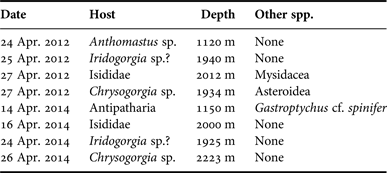
The host colony, depth and associated fauna for this species are provided in Table 1. New host anthozoan associations of Bathypalaemonella serratipalma are a bamboo coral (Gorgonacea: Isididae) at Keathley Canyon (Figure 1B), Anthomastus sp. (Alcyonacea: Alcyoniidae) on the Sigsbee Escarpment (Figure 3A) and an unidentified black coral (Antipatharia) at the site, north of Bryant Canyon (Figure 3B). We are not certain of the species identity of Chrysogorgia sp. (Figure 1A) or another member of the family Chrysogorgiidae (probably Iridogorgia sp., Figure 2A, B) and, therefore, cannot determine if they are the same hosts as observed by Watling (Reference Watling, Fransen, de Grave and Ng2011). It is noteworthy that Little Hercules photographed B. serratipalma on Iridogorgia sp. again on Kelvin Seamount, at 2052 m, on 29 September 2014, confirming Watling's earlier observations.
Bathypalaemonella serratipalma Pequegnat, Reference Pequegnat, Pequegnat and Chace1970: (A) Ovigerous female among Chrysogorgia sp., Sigsbee Escarpment, 24 April 2012, 1020 m; (B) Ovigerous female among unidentified Isididae, Sigsbee Escarpment, 25 April 2012, 1940 m.

Bathypalaemonella serratipalma on the unidentified Chrysogorgiidae (Iridogorgia sp.): (A) ‘Tar Lily’, 24 April 2014, 1925 m; (B) Deep Mound, 14 April 2014, 1150–1050 m.
Bathypalaemonella serratipalma: (A) Ovigerous female on Anthomastus sp., Sigsbee Escarpment, 24 April 2012, 1120 m; (B) Ovigerous female on unidentified Antipatharia, with Gastroptychus sp., 14 April 2014, 1150–1050 m.
Data on Bathypalaemonella serratipalma specimens, showing host, depth and other species found on the same host.
As reported by Watling (Reference Watling, Fransen, de Grave and Ng2011), we only saw one shrimp per host. Unless the shrimp was ovigerous, we could not determine its sex. It is difficult to determine the size of the shrimp, but in comparison with their hosts, we suspect that these shrimp were likely to range in carapace length from 10 to 15 mm, the size range found among the specimens in the collections.
We did not observe any direct interactions among the animals on the host colonies. The mysidaceans and chirostylids were on different branches of the host to that of the shrimp, or were higher or lower along the central axis. One Bathypalaemonella rested on the same colony of Chrysogorgia sp. that an unidentified starfish seemed to be eating.
DISCUSSION
Except for the work of Watling (Reference Watling, Fransen, de Grave and Ng2011), there are no reports of host associations for species of Bathypalaemonella. The associated anthozoan colonies usually inhabit hard surfaces, which are difficult to sample by skimmer or trawl.
Pequegnat (Reference Pequegnat, Pequegnat and Chace1970, Figures 4–6C) and Crosnier & Forest (Reference Crosnier and Forest1973, Figure 46I) illustrated the short, curved dactylus of the third pereopod of Bathypalaemonella serratipalma. Bruce (Reference Bruce, Jones and Endean1976, Figure 11), describing adaptations of carideans to commensalism with coral reef invertebrates, stated that the development of a stout, hooked dactylus was one of the ‘commonest adaptations’ and occurred ‘independently’ in various genera associated with a ‘variety’ of hosts. The dactylus of B. serratipalma has a similar shape as the dactyli of these shrimp, suggesting that this is an adaptation to commensalism with colonial anthozoans.
Pequegnat & Pequegnat (Reference Pequegnat, Pequegnat, Pequegnat and Chace1970) described the association of Uroptychus nitidus (A. Milne-Edwards, 1880) (Anomura: Chirostylidae) with Chrysogorgia elegans (Verrill, 1883) and Acanella arbuscula (Johnson, 1862) (Isididae). This chirostylid was collected with Chrysogorgia spp. during trawl studies in the northern Gulf of Mexico in 2000–2004 (Rowe & Kennicutt, Reference Rowe and Kennicutt2009), and was probably the species of chirostylid photographed by Little Hercules on Chrysogorgia sp. at 1120 m on the Sigsbee Escarpment on 24 April 2012 (M.K. Wicksten, unpublished work). We did not see U. nitidus living on the same colonies as B. serratipalma. Pequegnat & Pequegnat (Reference Pequegnat, Pequegnat, Pequegnat and Chace1970) suggested that the host associations of U. nitidus might be associated with depth. Specimens of U. nitidus collected during 2000–2004 were collected by trawl on muddy sea floors (M.K. Wicksten, unpublished work), while B. serratipalma seems to be more often associated with colonial anthozoans of hard substrates.
Ongoing studies in the northern Gulf of Mexico indicate that deep reefs can support growths of stony corals (Lophelia pertusa (Linnaeus, 1758), Madrepora spp. and others; order Scleractinia), as well as the antipatharians, gorgonians and alcyonaceans on which Bathypalaemonella serratipalma lives. The larger chirostylid lobster Eumunida picta Smith, 1883 was photographed and collected among Lophelia pertusa (29°09.7′N 88°01.1′W, Ronald H. Brown dive 32, 460 m, ROV, 23 September 2003) and also photographed among Madrepora sp. (29°09.69′N 88°01.10′W, Ronald H. Brown dive 30, 456 m, ROV, 30 September 2003, M.K. Wicksten, unpublished work). Reed et al. (Reference Reed, Weaver and Pomponi2006) also reported that E. picta was associated with Lophelia pertusa off south-western Florida and the south-eastern Atlantic coast of the USA. We also photographed smaller squat lobsters (Anomura: Munidopsidae) among scleractinians, as well as the various soft corals among which Bathypalaemonella lives, but these have not yet been identified, nor are we certain that they are directly associated with corals instead of hard surfaces in general.
Deep coral reefs (at depths of more than 185 m), for the most part, are located out of the reach of commercial trawl fishing in the northern Gulf of Mexico. Oil and gas companies exploring in the northern Gulf are required to conduct underwater surveys to locate any shipwrecks, reefs or other topographical features that may lie in the path of pipelines or drilling, and to avoid these structures. Deep-sea oil spills, however, are unpredictable and can have devastating effects on slow-growing corals and their associates. The nature of the interactions between the corals and the crustaceans, their recruitment rate, growth and lifespans remain unknown.
ACKNOWLEDGEMENTS
The cruises of the Okeanos Explorer were supported by the National Oceanographic and Atmospheric Administration. We are grateful to William Kiene and Steve Gittings, NOAA, for providing helpful information. The images are courtesy of the NOAA Okeanos Explorer Program, Gulf of Mexico Expeditions 2012 and 2014.